Saturday, December 30, 2023


The World’s Economic Centre of Gravity Is Returning to Asia


Han Youngsoo (Republic of Korea), Seoul, Korea 1956–1963.

Han Youngsoo (Republic of Korea), Seoul, Korea 1956–1963.

In October 2023, the United Nations Conference on Trade and Development (UNCTAD) published its annual Trade and Development Report. Nothing in the report came as a major surprise. The growth of the global Gross Domestic Product (GDP) continues to decline with no sign of a rebound. Following a modest post-pandemic recovery of 6.1% in 2021, economic growth in 2023 fell to 2.4%, below pre-pandemic levels, and is projected to remain at 2.5% in 2024. The global economy, UNCTAD says, is ‘flying at “stall speed”’, with all conventional indicators showing that most of the world is experiencing a recession.

The latest notebook from Tricontinental: Institute for Social Research, The World in Depression: A Marxist Analysis of Crisis, questions the use of the term ‘recession’ to describe the current situation, arguing that it acts as ‘a smokescreen meant to hide the true nature of the crisis’. Rather, the notebook explains that ‘the prolonged and profound crisis that we are experiencing today is… a great depression’. Most governments in the world have used conventional tools to try and grow their way out of the great depression, but these approaches have placed an enormous cost on household budgets, which are already hit hard by high inflation, and have curbed the investments needed to improve employment prospects. As UNCTAD notes, central banks ‘prioritise short-term monetary stability over long-term financial sustainability. This trend, together with inadequate regulation in commodity markets and continuous neglect for rising inequality, are fracturing the world economy’. Our team in Brazil explores these matters further in the recently launched Financeirização do capital e a luta de classes (‘Financialisation of Capital and the Class Struggle’), the fourth issue of our Portuguese-language journal Revista Estudos do Sul Global (‘Journal of Global South Studies’).

There are some exceptions to this rule, however. UNCTAD projects that five of the G20 countries will experience better growth rates in 2024: Brazil, China, Japan, Mexico, and Russia. There are different reasons why these countries are exceptions: in Brazil, for instance, ‘booming commodity exports and bumper harvests are driving an uptick in growth’, as UNCTAD writes, while Mexico has benefited from ‘less aggressive monetary tightening and an inflow of new investment to establish new manufacturing capacity, triggered by the bottlenecks that emerged in East Asia in 2021 and 2022’. What seems to unite these countries is that they have not tightened monetary policy and have used various forms of state intervention to ensure that necessary investments are made in manufacturing and infrastructure.
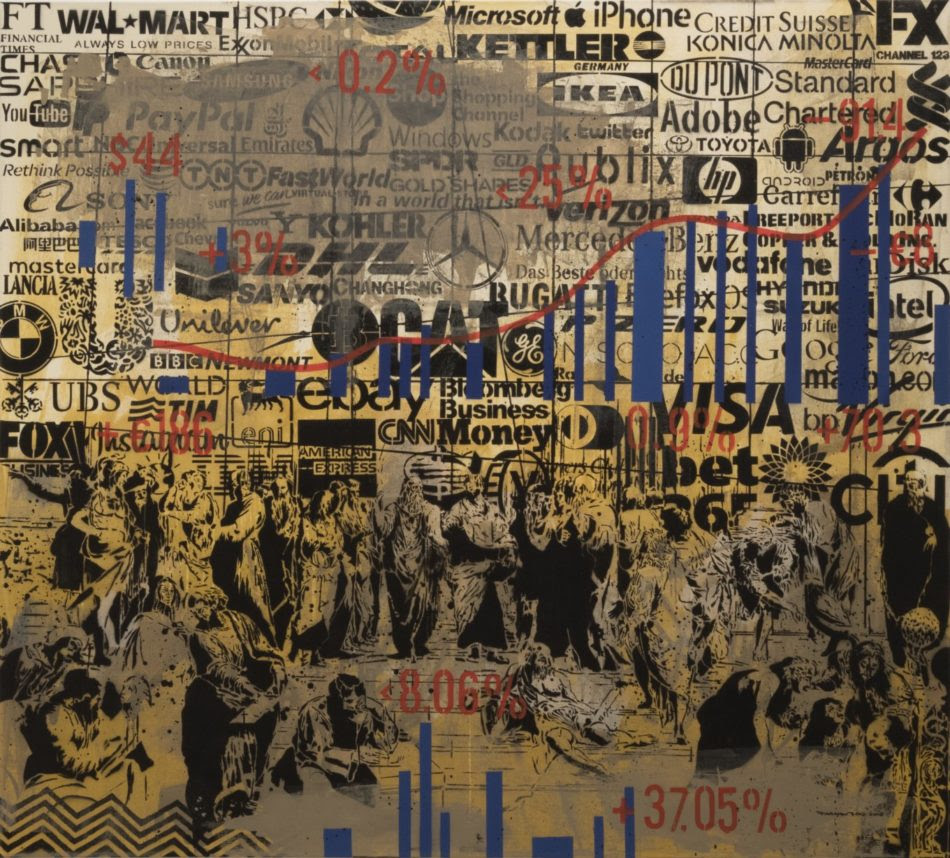
Farhan Siki (Indonesia), Market Review on School of Athens, 2018.

Farhan Siki (Indonesia), Market Review on School of Athens, 2018.

The OECD’s Economic Outlook, published in November 2023, is consistent with UNCTAD’s assessment, suggesting that ‘global growth remains highly dependent on fast-growing Asian economies’. Over the next two years, the OECD estimates that this economic growth will be concentrated in India, China, and Indonesia, which collectively account for nearly 40% of the world population. In a recent International Monetary Fund assessment entitled ‘China Stumbles But Is Unlikely to Fall’, Eswar Prasad writes that ‘China’s economic performance has been stellar over the past three decades’. Prasad, the former head of the IMF’s China desk, attributes this performance to the large volume of state investment in the economy and, in recent years, to the growth of household consumption (which is related to the eradication of extreme poverty). Like others in the IMF and OECD, Prasad marvels at how China has been able to grow so fast ‘without many attributes that economists have identified as being crucial for growth – such as a well-functioning financial system, a strong institutional framework, a market-oriented economy, and a democratic and open system of government’. Prasad’s description of these four factors is ideologically driven and misleading. For instance, it is hard to think of the US financial system as ‘well-functioning’ in the wake of the housing crisis that triggered a banking crisis across the Atlantic world, or given that roughly $36 trillion – or a fifth of global liquidity – is sitting in illicit tax havens with no oversight or regulation.

What the data shows us is that a set of Asian countries is growing very quickly, with India and China in the lead and with the latter having the longest sustained period of rapid economic growth over at least the past thirty years. This is uncontested. What is contested is the explanation for why China, in particular, has experienced such high rates of economic growth, how it has been able to eradicate extreme poverty, and, in recent decades, why it has struggled to overcome the perils of social inequality. The IMF and the OECD are unable to formulate a proper assessment of China because they reject – ab initio – that China is pioneering a new kind of socialist path. This fits within the West’s failure to comprehend the reasons for development and underdevelopment in the Global South more broadly.

Over the past year, Tricontinental: Institute for Social Research has engaged with Chinese scholars who have been trying to understand how their country was able to break free of the ‘development of underdevelopment’ cycle. As part of this process, we collaborate with the Chinese journal Wenhua Zongheng (文化纵横) to produce an international quarterly edition that collects the work of Chinese scholars who are experts on the respective topics and brings voices from Africa, Asia, and Latin America into dialogue with China. The first three issues have looked at the shifting geopolitical alignments in the world (‘On the Threshold of a New International Order’, March 2023), China’s decades-long pursuit of socialist modernisation (‘China’s Path from Extreme Poverty to Socialist Modernisation’, June 2023), and the relationship between China and Africa (‘China-Africa Relations in the Belt and Road Era’, October 2023).

The latest issue, ‘Chinese Perspectives on Twenty-First Century Socialism’ (December 2023), traces the evolution of the global socialist movement and tries to identify its future direction. In this issue, Yang Ping, the editor of the Chinese-language version of Wenhua Zongheng, and Pan Shiwei, the honorary president of the Institute of Cultural Marxism, Shanghai Academy of Social Sciences, contend that a new period in socialist history is currently emerging. For Yang and Pan, this new ‘wave’ or ‘form’ of socialism, following the birth of Marxism in nineteenth-century Europe and the rise of many socialist states and socialist-inspired national liberation movements in the twentieth century, began to emerge with China’s period of reform and opening up in the 1970s. They argue that, through a gradual process of reform and experimentation, China has developed a distinct socialist market economy. The authors both assess how China can strengthen its socialist system to overcome various domestic and international challenges as well as the global implications of China’s rise – that is, whether or not it can promote a new wave of socialist development in the world.

Denilson Baniwa (Brazil), The Call of the Wild//Yawareté Tapuia, 2023.

Denilson Baniwa (Brazil), The Call of the Wild//Yawareté Tapuia, 2023.

In the introduction to this issue, Marco Fernandes, a researcher at Tricontinental: Institute for Social Research, writes that China’s growth has been sharply distinct from that of the West since it has not relied upon colonial plunder or the predatory exploitation of natural resources in the Global South. Instead, Fernandes argues that China has formulated its own socialist path, which has included public control over finance, state planning of the economy, heavy investments in key areas that generate not only growth but also social progress, and promoting a culture of science and technology. Public finance, investment, and planning allowed China to industrialise through advancements in science and technology and through improving human capital and human life.

China has shared many of its lessons with the world, such as the need to control finance, harness science and technology, and industrialise. The Belt and Road Initiative, now ten years old, is one avenue for such cooperation between China and the Global South. However, while China’s rise has provided developing countries with more choices and has improved their prospects for development, Fernandes is cautious about the possibility of a new ‘socialist wave’, warning that the obstinate facts facing the Global South, such as hunger and unemployment, cannot be overcome unless there is industrial development. He writes:

this will not be attainable merely through relations with China (or Russia). It is necessary to strengthen national popular projects with broad participation from progressive social sectors, especially the working classes, otherwise the fruits of any development are unlikely to be reaped by those who need them the most. Given that few countries in the Global South are currently experiencing an upsurge in mass movements, the prospects for a global ‘third socialist wave’ remain very challenging; rather, a new wave of development with the potential to take on a progressive character, seems more feasible.

This is precisely what we indicated in our July dossier, The World Needs a New Socialist Development Theory. A future that centres the well-being of humankind and the planet will not materialise on its own; it will only emerge from organised social struggles.

Philip Fagbeyiro (Nigeria), Streets of Insignificance, 2019.


Vijay Prashad is an Indian historian and journalist. Prashad is the author of twenty-five books, including The Darker Nations: A People’s History of the Third World and The Poorer Nations: A Possible History of the Global South. Read other articles by Vijay, or visit Vijay's website.
Tigray authorities warn of looming famine in Ethiopia’s war-scarred north

The authorities in Ethiopia’s war-scarred Tigray region warned Friday of a looming famine linked to drought and the lingering effects of the devastating two-year war in the north of the country.


Issued on: 30/12/2023 -
A file photo showing workers at a water point at an internally displaced person campe near Mekelle Industrial Park in Mekele, the capital of Tigray region, Ethiopia, on June 28, 2021. 
© Yasuyoshi Chiba, AFP

By: NEWS WIRES

Getachew Reda, president of the interim regional authority in Tigray, said more than 91 percent of the population was “exposed to the risk of starvation and death” and called for the Ethiopian government and international community to help.

In a statement posted on X, formerly known as Twitter, Getachew likened the situation to the Ethiopian famine in the 1980s which cost the lives of around one million people.

“Since the signing of the Pretoria agreement, thousands of Tigrayans have perished due to lack of food,” Getachew said, referring to the November 2022 peace deal that ended the war between Tigrayan rebels and Ethiopian government forces.

The situation on the ground in northern Ethiopia cannot be independently verified as media access to Tigray is restricted by the federal government.

Getachew said Tigray’s interim administration had declared a disaster emergency in areas under its control but had limited resources to handle the crisis.

“The Ethiopian government and the international community have done their part to silence the guns. Now they should do their part to address the looming humanitarian catastrophe,” he said.

Getachew highlighted the devastating consequences of the conflict including economic crisis, mass displacement and destruction of health facilities, combined with the shortage of seasonal rains followed by destructive rainfall, as well as locust invasions.

He said the temporary suspension of aid earlier this year by the United States and the UN’s World Food Programme (WFP) had also played a role in the crisis.

USAID and the WFP halted all food aid to Ethiopia in June, alleging a “widespread and coordinated” campaign to divert donated supplies, but deliveries are slowly resuming.

“Although aid has since been restored on a limited basis, the amount of aid reaching the needy is a fraction of what is necessary to meet current requirements,” Getachew said.

In a statement published on December 22, the UN’s humanitarian response agency OCHA said: “The drought situation is worsening in some parts of northern, southern, and southeastern Ethiopia and is expected to deteriorate further unless aid is urgently scaled up.”

It said the food security situation covering the October 2023-May 2024 period in Tigray is likely to deteriorate, while some populations, particularly those displaced, will experience severe food insecurity according to the global Famine Early Warning Systems Network.

(AFP)

Thousands protest in Belgrade in biggest rally yet against alleged electoral fraud

Thousands of protesters gathered Saturday in Belgrade in the biggest of a series of rallies against alleged electoral fraud.


AFP
Issued on: 30/12/2023 - 
People attend a protest organised by ProGlas, the Serbian pro-democracy movement, amid opposition claims of major election law violations in Belgrade city and parliament races, in Belgrade, Serbia on December 30, 2023. 
© Zorana Jevtic, Reuters

Video by :Emerald MAXWELL

It marked the 13th consecutive demonstration since the December 17 parliamentary and local elections in which Serbian President Aleksandar Vucic's party said it secured a commanding victory.

Opposition groups contested the results and protesters have erected sporadic roadblocks in Belgrade, with more than 30 arrested after an attempt to storm city hall last week.

"Students, 18 and 20 years old, are being charged for overthrowing the constitutional order, they are in house arrest -- is that a sign of fair elections?" asked one of the student leaders, Emilija Milenkovic.

"We only want our voice to be heard at least in the polling stations," she added, thanking her colleagues who endured the 24-hour street blockade.

The main opposition coalition "Serbia Against Violence" as well as other groups and initiatives alleged many irregularities, including that ethnic-Serb voters from neighbouring Bosnia had been allowed to cast ballots illegally in the capital.

Saturday's protests were a continuation of the first 24-hour blockade of streets in central Belgrade 
© Andrej ISAKOVIC / AFP

International observers also reported irregularities while several Western nations voiced concern over the electoral process.

Saturday's protests were a continuation of the first 24-hour blockade of streets in central Belgrade, mainly by students organised within the Borba ("Fight") movement, who are calling for the results to be annulled and new votes held.

The organisers called for facilitation by the European Union as well as establishing an independent investigation committee for the alleged irregularities, setting fair conditions for elections and organising new polls in six months.

University professor Filip Ejdus said that the students "these days are holding a public class of civic responsibility and courage".

"We do not agree on stolen election, arrested students and police torture," he added.

The appearance on stage of Serbian opposition leader Marinika Tepic -- who had been on hunger strike since December 18 in protest -- enlivened the crowd the most.

After being helped to get on the stage to address the demonstrators, Tepic went to the hospital and announced she was ending her hunger strike.

The protest continued with demonstrators marching towards the Constitutional Court.

"This is what we wanted, to bring back hope," said university professor Tamara Dzamonja Ignjatovic.


It marked the 13th consecutive demonstration since the December 17 
parliamentary and local elections 
© Miodrag SOVILJ / AFP


Symbolic location

The location at Terazije fountain symbolically connects the gathering with the so-called "Plush revolution" from March 1991 -- one of the first major demonstrations against former Serbian strongman Slobodan Milosevic.

Thousands of students marched in central Belgrade in response to the violent dispersion of earlier protests that included tanks on the streets.

The "Plush revolution" lasted four consecutive days with all demands being met, among them the resignation of the interior minister and a change in the leadership of public broadcaster RTS, a demand that is also relevant today.

Vucic's right-wing Serbian Progressive Party (SNS), in power since 2012, on December 17 won roughly 46 percent of votes in the parliamentary elections, while the leading opposition coalition secured 23.5 percent, the official results show.

The protests culminated on Sunday, when demonstrators tried to storm Belgrade city hall using flagpoles and rocks.

Police pushed them back with pepper spray and arrested more than 30 of them.

(AFP)


Bolivian court rules that former president Morales cannot seek re-election

Bolivia's Constitutional Court has disqualified former president Evo Morales from running for re-election in 2025, reversing a ruling that had let him seek a fourth term in 2019.


Issued on: 30/12/2023 - 
 
Bolivia's ex-president Evo Morales, wearing garlands of flowers and coca leaves, delivers a speech during a political gathering to mark the 28th anniversary of the ruling Movement for Socialism (MAS) party, in Ivirgarzama, central Bolivia, on March 26, 2023.
 © Aizar Raldes, AFP

By: NEWS WIRES


It said on its website that term limits provide "an ideal measure for ensuring that someone does not perpetuate themself in power."

Bolivia's first Indigenous president, Morales first took power in 2006 and was extremely popular until he tried to bypass the constitution and seek a fourth term in office in 2019.

He won that vote but was forced to resign amid deadly protests over alleged election fraud, and fled the country. He returned after his then ally Luis Arce won the presidency in October 2020.

Morales has since fallen out with Arce.

Saturday's announcement from the court reversed a ruling it had made in 2017 which effectively found that being able to run for re-election is a "human right."

The new ruling cannot be appealed.

Morales denounced the new ruling as evidence of what he called complicity against him among judges, the government and the right wing in Bolivia.

The court's decision means that people in Bolivia can serve no more than two terms as president -- either consecutively or not.

Morales has said he wanted to run for president in 2025, as he locks horns with Arce, who had been his ally and served as economy minister for most of Morales' time in power since 2006.

The about-face by the Constitutional Court is based on criteria of the Inter-American Court of Human Rights, which does not consider re-election to be a human right.

That court issued an amicus ruling in 2021, at the request of Colombia, on the idea of presidents seeking re-election in an open-ended fashion.

When Morales resigned and left the country he was replaced by lawmaker Jeanine Anez, who now faces trial on charges of staging a coup against him.

"The court has ended Morales' delirium of getting re-elected forever," Anez said on X, the former Twitter.

(AFP)
MYOB
In 2024, California employers can no longer punish employees for using marijuana outside work

2023/12/29
Beginning Monday, Jan. 1, 2024, California employers will be barred from discriminating against employees who use marijuana in their off hours. 
- Photo by Brad Horrigan | bhorrigan@courant.com/Hartford Courant/TNS

SACRAMENTO, Calif. — Beginning Monday, California employers will be barred from discriminating against employees who use marijuana in their off hours.

Assembly Bill 2188 requires employers to change how they test for marijuana use among employees, using tests that show current impairment and not just past usage. The law carves out some exceptions, such as for those who work in the construction trades.

“Technology to test for marijuana impairment has actually advanced quite a bit, so basically employers can now just test for THC — the psychoactive component in cannabis — and that can show impairment,” said Los Angeles-based attorney Bernard Alexander in a statement. “Most of the older tests detect the non-psychoactive metabolites, which can stay in a person’s system for weeks. So, a worker can test positive when they’re not high or impaired at all.”

California Gov. Gavin Newsom signed AB 2188 into law in September 2022, but a provision of the law prevented it from going into effect until Jan. 1, 2024.

The bill was championed by California NORML, a marijuana advocacy organization, which said in a statement that “not a single, scientifically controlled FDA study has shown cannabis metabolite testing to be effective in improving workplace safety or productivity. Studies indicate that metabolite tests for past use of marijuana are useless in protecting job safety.”

The group pointed to a survey of more than 136,000 Canadian workers that found no association between cannabis use and workplace-related injury, even in high-risk occupations.

The bill was opposed by the California Chamber of Commerce, which argued that employers would face liability by taking legitimate disciplinary measures against employees who use marijuana.

“Put simply: marijuana use is not the same as protecting workers against discrimination based on race or national origin and should not be in (the Fair Employment and Housing Act),” the chamber wrote in its argument.

Alexander noted that employers who disapprove of employees’ use of marijuana even in off hours “will be looking for alternative ways to terminate employees for other reasons, and attorneys who defend those employees will argue those other reasons are just pretexts.”

Los Angeles-based attorney Amy Duerk said that while the law will protect the rights of most workers to use cannabis when not working, it doesn’t preclude employers from keeping their workplace drug-free.

“These laws will push improvements in testing for impairment and psychoactive metabolites in cannabis. Employers will likely step up efforts to train supervisors on impairment testing. Testing will continue to improve to help employers distinguish between recent use of cannabis and non-impairment traces of cannabis,” Duerk said in a statement.

© The Sacramento Bee
Want to get into stargazing? A professional astronomer explains where to start

The Conversation
December 29, 2023

Milky Way Galaxy (shutterstock.com)

There are few things more peaceful and relaxing than a night under the stars. Through the holidays, many people head away from the bright city lights to go camping. They revel in the dark skies, spangled with myriad stars.

As a child, I loved such trips, and they helped cement my passion for the night sky, and for all things space.

One of my great joys as an astronomer is sharing the night sky with people. There is something wondrous about helping people stare at the cosmos through a telescope, getting their first glimpses of the universe’s many wonders. But we can also share and enjoy the night sky just with our own eyes – pointing out the constellations and the planets, or discovering the joys of watching meteor showers.

It is easy to be bitten by the astronomy bug, and a common question I get asked is “how can I get more into stargazing?”. Here are ways to get started in this fascinating and timeless hobby that won’t break the bank.

Learning the night sky

A good place to start if you’re a budding astronomer is to learn your way around the night sky. When I was young, this involved getting hold of a planisphere (a star map, you can make your own here), or a good reference book.

Today, there are countless good apps to help you find your way around the night sky

A great example of such an app is Stellarium – a planetarium program allowing you to view the night sky from the comfort of your room or to plan an evening’s observing ahead of schedule.

To memorise the night sky, you can try star hopping. Pick out a bright, famous, easy to find constellation, and use it as a guide to help you identify the constellations around it.

Learn one constellation per week, and within a year, you’ll be familiar with most of the constellations visible from your location.

Let’s use Orion as an example. The slider below shows images from Stellarium, with Orion riding high in the sky on a summer’s evening. I’ve added arrows to show how you can use Orion (shown in the centre of the map below) to hop around the summer sky.

To learn the constellations around Orion, your task is relatively straightforward. Head out on a clear, dark summer’s night, and find Orion high to the north. The three stars of Orion’s belt are a fantastic signpost to Orion’s neighbors.


If you follow the line of the belt upwards and to the right, you come to Sirius – the brightest star in the night sky, and the brightest star in Canis Major, the big hunting dog. Carry the line on and curve to the left as you go, and you’ll find Canopus, the second brightest star in the sky.

Now come back to Orion’s belt, and follow its line down and to the left. You’ll come to a V-shaped group of stars, including the bright red Aldebaran. This is the Hyades star cluster (with Aldebaran a foreground interloper), which makes up the head of Taurus, the bull.

Take the line further, and you come to the Pleiades – often known as the Seven Sisters – a beautiful star cluster easily visible to the naked eye.


Back to Orion again. This time, you’re going to draw a line from Rigel (the bright star at the top-left of Orion’s boxy body) through Betelgeuse (the bright red star at the lower-right of the box) and continue it towards the horizon. This takes you to Gemini – the twins.

Just by using Orion as the signpost, you can find your way to a good number of constellations (the cyan line points to Lepus, the hare; the white line to Canis Minor, the little hunting dog).

By star hopping, you’ll slowly but surely learn your way around the night sky until the constellations become familiar friends.

Virtual observing

Looking at the sky with the naked eye is a wonderful thing, but it’s also great to zoom in and see more detail.

What if you don’t have access to binoculars or a telescope of your own? Thankfully, software like Stellarium can give you a fantastic virtual observing experience.


Imagine you want to see Saturn’s rings – a spectacular sight through even a small telescope. You can easily do this with Stellarium. Find Saturn by using the search bar and click on it to bring up the planet’s info.

Click on the cross-hair symbol to “lock on”, then zoom in. The further you zoom in, the more you’ll see. You can even run the clock forwards or backwards to see the planet’s moons move in their orbits, or the tilt of Saturn’s rings changing from our viewpoint over time.

A virtual observing session is as simple as that – just pan around the sky until you find something you want to see, and zoom in.


Example of using the clock feature in Stellarium to see the movement of Saturn’s moons. Stellarium
A hobby best shared


Now, a virtual observing session is great, but it pales compared to the real thing. I’d recommend using planetarium programs like Stellarium to figure out what you want to see, then heading out to look at it with your own eyes.

Astronomy is a wonderful hobby, and one that is best shared. Most towns and cities have their own astronomy clubs, and they’re usually more than happy to welcome guests who want to gaze at the night sky.

I joined my local astronomy society, the West Yorkshire Astronomical Society in the United Kingdom, when I was just eight years old. I owe them so much. The members were incredibly supportive of a young kid with so many questions, and I genuinely believe I would not be where I am today without their help. As a member, I saw firsthand just how fantastic the amateur astronomy community is.


The author Jonti Horner at age 16, showing then Astronomer Royal of the UK, Arnold Wolfendale (right), the WYAS 18-inch telescope, hand-made by members. Also seen is the society’s then president, Ken Willoughby. Alan Horner, author provided

At the society, we had weekly talks on astronomy, given by the club members and visiting astronomers from local universities. We also had regular night sky viewing nights, using the society’s very own telescope – a behemoth the members had built themselves.

People who are passionate about their hobby love nothing more than sharing it with others. The members of astronomical societies are fantastic guides to the night sky, and they often have incredible equipment they’re more than happy to share with you.

Both astronomy clubs and universities often offer public night sky viewing nights, which are the perfect opportunity to peer at the sky through a telescope, with an experienced guide on hand to find the most impressive sights to share.

So, if you want to learn more about the night sky, reach out to your local astronomy society – it could be the start of something very special.

If you want to find a local astronomy group, check out this list. If you’re a member of a group that isn’t listed, please reach out to get them to update the list using the ‘Contact Us’ link.

Jonti Horner, Professor (Astrophysics), University of Southern Queensland

This article is republished from The Conversation under a Creative Commons license. Read the original article.
Can seabirds hear their way across the ocean? Our research suggests so

The Conversation
December 28, 2023 

Wandering albatrosses can cover huge distances in a single trip. 
MZPhoto.cz/Shutterstock

Animals cover astonishing distances when they are looking for food. While caribou, reindeer and wolves clock up impressive mileage on land, seabirds are unrivalled in their travelling distances. Arctic terns travel from the Arctic to Antarctica and back as part of their annual migration. Wandering albatrosses (Diomedea exulans) fly the equivalent of ten times to the Moon and back over their lifetimes.

There has been a lot of research into how seabirds choose their flight paths and find food. They seem to use their sight or sense of smell to assess local conditions.

Wandering albatrosses can travel more than 10,000km in a single foraging trip, though, and we don’t know much about how these birds use mid- and long-range cues from their environment to decide where to go.

For the first time, however, my team’s recent study gives an insight into how birds such as wandering albatrosses may use sound to determine what conditions are like further away.

How seabirds use low-frequency sound

Previous research has shown that seabirds not only seek information about where to find food, but how to do so efficiently. We discovered that the way wandering albatrosses use their sense of sound may be crucial.

Our study looked at how these birds respond to a very low-frequency type of sound called infrasound, which can travel for thousands of kilometres.

While it’s typically inaudible to humans, we know that some animals can hear infrasound. When waves crash together or against coastlines, they create a frequency of infrasound called microbarums. This was the type of infrasound our study looked at.

We know that areas of high wave activity can be associated with upwellings – where fish are brought to the surface. Infrasound could provide information about where these areas are, and inform birds of good foraging patches.


Efficient foraging is particularly important for large seabird species like the wandering albatross, which have a wing span of 3.5 metres. Their size means they rely on wind to take off and fly efficiently, unlike smaller birds such as puffins, which flap their wings up to 400 times a minute.

High wave activity also indicates strong winds. Given we know that wandering albatrosses depend on wind to fly efficiently, my team’s study suggests that infrasound could give them a long-range cue for where optimal foraging conditions may be.

Infrasound is also generated when waves crash against coastlines, and we know that many coastal seabirds use the coast to select their flight paths and find their way back to their breeding colonies. So, infrasound could reveal the location of static features like coastlines, giving seabirds important information across long distances.

Despite the potential of this cue for seabirds, our paper (published in PNAS) is the first evidence that seabirds may respond to infrasound, which is monitored globally through a network of sensors installed by the Comprehensive Nuclear-Test-Ban Treaty Organization (CTBTO).

This system was installed to detect nuclear tests, but its byproduct is huge amounts of data which scientists can use. We combined the CTBTO’s records with our own GPS tracking data from 89 wandering albatrosses to compare microbarums and the birds’ movements.
What we learned


This allowed us to isolate data that showed how these albatrosses appeared to make decisions about where to go next. Our findings showed they chose the direction with the loudest infrasound. This suggests the birds could use infrasound to find food or to minimise the energy they use on their travels. However, we are not able to say for sure why louder areas are better.


Wandering albatross have a huge wing span.
  MZPHOTO.CZ/Shutterstock

Our findings may also give scientists insights into how other birds make decisions on medium- and long-distance journeys.

As with many studies testing a hypothesis for the first time, my team’s study raises as many questions as it answers. If seabirds respond to infrasound, they must be able to hear it and know where it is coming from. Lab studies have found evidence that some birds can hear infrasound, but there have been no tests on seabirds.

Taking a wandering albatross into a lab and creating a sound chamber large enough to run experimental tests seems unlikely in the near term, but other seabird species can live in captivity and research could focus on this.

Weather changes driven by climate change, and the damaging effects these are having on seabirds as well as many other plants and animals, are well documented – making it harder for them to find food, for example.

As humans alter ocean habitats, infrasound may help birds adapt by aiding them to find food, even as stocks diminish. Or human activity, such as more noise, could mask this kind of essential information, with harmful consequences for wildlife. Either way, understanding how and why seabirds use infrasound will help scientists understand its importance in the climate crisis.

Samantha Patrick, Reader in Marine Biology, University of Liverpool

This article is republished from The Conversation under a Creative Commons license. Read the original article.
Tatahouine: ‘Star Wars meteorite’ sheds light on the early Solar System

The Conversation
December 28, 2023 

The asteroid 4 vesta, left, and Tatooine, as seen in Star Wars, on the right. Nasa and wikipedia

Locals watched in awe as a fireball exploded and hundreds of meteorite fragments rained down on the city of Tatahouine, Tunisia, on June 27, 1931. Fittingly, the city later became a major filming location of the Star Wars movie series. The desert climate and traditional villages became a huge inspiration to the director, George Lucas, who proceeded to name the fictional home planet of Luke Skywalker and Darth Vader “Tatooine”.

The mysterious 1931 meteorite, a rare type of achondrite (a meteorite that has experienced melting) known as a diogenite, is obviously not a fragment of Skywalker’s home planet. But it was similarly named after the city of Tatahouine. Now, a recent study has gleaned important insights into the the origin of the meteorite – and the early Solar System.

Lucas filmed various scenes for Star Wars in Tatahouine. These include Episode IV – A New Hope (1977), Star Wars: Episode I – The Phantom Menace (1999) and Star Wars: Episode 2 – Attack of the Clones (2002). Various famous scenes were filmed there, including scenes of “Mos Espa” and “Mos Eisley Cantina”.

Mark Hamill, the actor who played Luke Skywalker, reminisced about filming in Tunisia and discussed it with Empire Magazine: “If you could get into your own mind, shut out the crew and look at the horizon, you really felt like you were transported to another world”.


Tatahouine, Tunisia. wikipedia, CC BY-SA

Composition and origin


Diogenites, named after the Greek philosopher Diogenes, are igneous meteorites (rocks that have solidified from lava or magma). They formed at depth within an asteroid and cooled slowly, resulting in the formation of relatively large crystals.

Tatahouine is no exception, containing crystals as big as 5mm with black veins cutting cross the sample throughout. The black veins are called shock-induced impact melt veins, and are a result of high temperatures and pressures caused by a projectile smashing into the surface of the meteorite’s parent body.

The presence of these veins and the structure of the grains of pyroxene (minerals containing calcium, magnesium, iron, and aluminum) suggest the sample has experienced pressures of up to 25 gigapascals (GPa) of pressure. To put that into perspective, the pressure at the bottom of the Mariana Trench, the deepest part of our ocean, is only 0.1 GPa. So it is safe to say this sample has experienced a pretty hefty impact.

By evaluating the spectrum (light reflecting off their surface, broken down by wavelength) of meteorites and comparing it to asteroids and planets in our Solar System, it has been suggested that diogenites, including Tatahouine, originate from the second largest asteroid in our asteroid belt, known as 4 Vesta.

This asteroid possesses interesting and exciting information about the early Solar System. Many of the meteorites from 4 Vesta are ancient, around ~4 billion years. Therefore, they offer a window to the past events of the early Solar System that we are unable to evaluate here on Earth.

Violent past


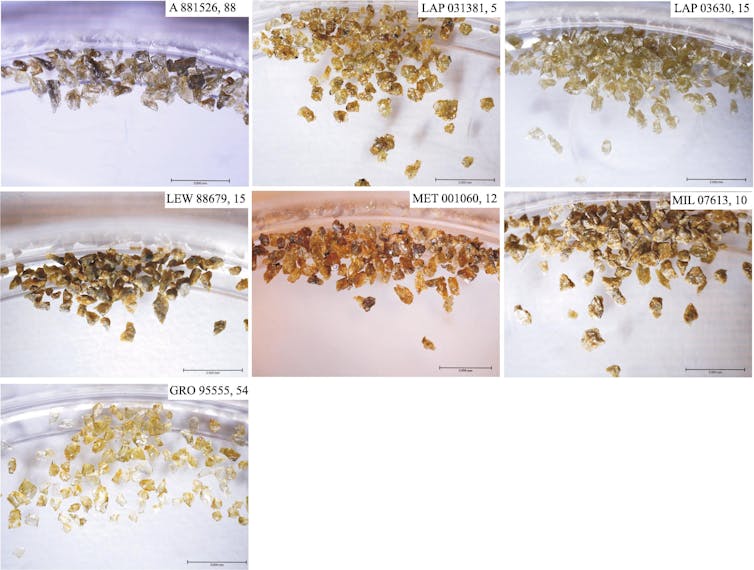
The recent study investigated 18 diogenites, including Tatahouine, all from 4 Vesta. The authors undertook “radiometric argon-argon age dating” techniques to determine the ages of the meteorites. This is based on looking at two different isotopes (versions of elements whose nuclei have more or fewer particles called neutrons). We know that a certain argon isotope in samples increases with age at a known rate, helping scientists estimate an age of a sample by comparing the ratio between two different isotopes.

The team also evaluated deformation caused by collisions, called impact events, using a type of electron microscope technique called electron backscatter diffraction.


Seven of the diogenites analysed. F. Jourdan et al, CC BY-SA


By combining the age dating techniques and the microscope technique, the authors managed to map the timing of impact events on 4 Vesta and the early Solar System. The study suggests that 4 Vesta experienced ongoing impact events until 3.4 billion years ago when a catastrophic one occurred.

This catastrophic event, possibly another colliding asteroid, resulted in multiple smaller rubble pile asteroids being produced known as “vestoids”. Unravelling large scale impact events such as this, reveals the hostile nature of the early Solar System.

These smaller bodies experienced further collisions that caused material to hurtle to Earth over the last 50 to 60 million years – including the fireball in Tunisia.

Ultimately, this work demonstrates the importance of investigating meteorites – impacts have played a major role in the evolution of asteroids in our Solar System.

Ben Rider-Stokes, Post Doctoral Researcher in Achondrite Meteorites, The Open University

This article is republished from The Conversation under a Creative Commons license. Read the original article.
Hong Kong democracy activist Tony Chung flees to U.K. to seek asylum

Agence France-Presse
December 29, 2023 6:38AM ET

Hong Kong democracy activist Tony Chung said Friday he had fled to Britain because he could no longer endure living in fear (ISAAC LAWRENCE/AFP)

Hong Kong democracy activist Tony Chung said Friday he had fled to Britain because he could no longer endure supervision from authorities, who had pressured him to become an informant and limited his work options.

In 2021, Chung, then 20, became the youngest person to be imprisoned under Hong Kong's national security law -- imposed by Beijing after massive pro-democracy protests kicked off in 2019 in the former British colony.

He pleaded guilty to "secession" and was sentenced to three and a half years in prison.

Since his early release in June, Chung said he has lived in daily fear.

"I feared stepping out of my home, feared using the phone in public, and worried about the possibility of being detained again by national security police officers on the streets," he said in a statement posted on social media early Friday but dated December 27.

Chung said he was told by authorities that he was not allowed to work in "specific businesses", and that "national security police officers kept on coercing and inducing me to join them".

"They proposed providing informant fees, urging me to supply information about others as proof of my reformation and willingness to cooperate."

He said he got permission to leave Hong Kong by saying he wanted to go on holiday in Okinawa, Japan, and sought help once outside Chinese territory.

"As I publish this statement, I have safely arrived in the United Kingdom and have formally applied for political asylum upon entry," Chung said.

His post on social media included a photo of him holding a suitcase in front of a "UK Arrivals" sign.


Leung Kin-ip, deputy commissioner of Hong Kong's correctional services, condemned Chung for "evading responsibility and blatantly endangering national security".

Authorities have "issued a recall order and have contacted other law enforcement agencies to pursue him in accordance with the law", Leung said.

Asked whether national security police had turned Chung into an informant, Leung said he had "not heard of" such claims, declining to comment on other departments.


AFP has contacted the police for comment.

- 'Hong Kong exile' -

Chung was the convenor of the now-disbanded Student Localism, a small group he set up five years ago as a secondary school pupil to advocate for Hong Kong's independence from China.


Separation from China was then a fringe view in Hong Kong, although calls for self-rule became more vocal during the 2019 protests.

In 2020, Chung was nabbed by plainclothes police from a coffee shop opposite the US consulate, where he was allegedly planning to seek asylum.

Since October, he had "intermittently fallen ill" following his release from prison, and doctors diagnosed him with "significant mental stress", he said.


National security police had requested meetings every two to four weeks, Chung said, where he was asked extensively about his activities and people he met.

"Each meeting involved meeting at random locations, being ordered to board a seven-seater vehicle with closed curtains, and transported to unknown destinations."

Authorities compelled him to sign an order banning him from public speaking, and disseminating anything related to his conviction or deemed a danger to national security, Chung said.

He was also stopped from seeking legal assistance, with authorities citing a confidentiality clause under the security law.

Chung's departure follows fellow Hong Kong activist Agnes Chow's announcement this month that she had moved to Canada.

Chow said that, as part of a deal with police, she agreed to travel to mainland China for a tour promoting the country's achievements in return for permission to study abroad.

In his social media post, Chung wrote that police had asked him to go on a trip to mainland China, but that he had objected.

Calling himself a "Hong Kong exile", Chung said it was impossible for him to return home in the foreseeable future.

"I believe that as long as the Hong Kong people never give up, the seeds of freedom and democracy will sprout alive again."


WW3.0
China tensions rising, US revives WWII-era Pacific airfield

2023/12/30

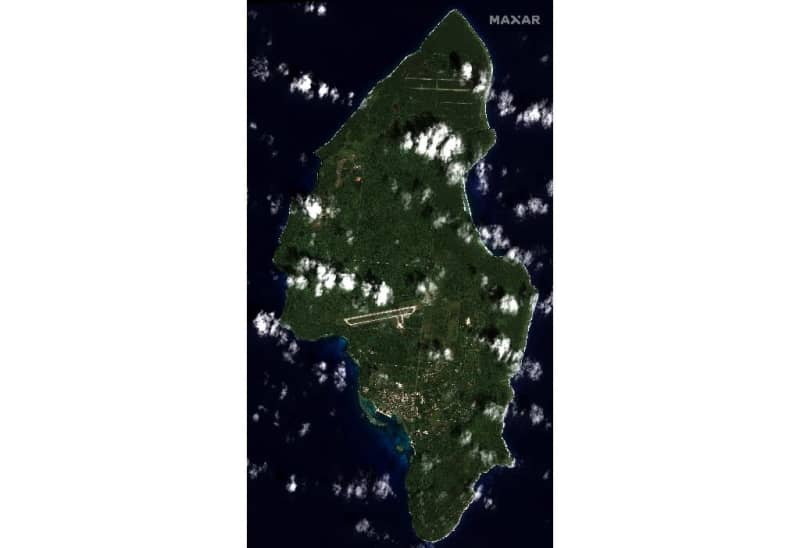
This January 10, 2022 satellite image released on December 28, 2023 by Maxar Technologies shows the island of Tinian, where the US is reviving a World War II-era airfield

Washington (AFP) - In the middle of the Pacific ocean, an abandoned US airfield once key to dropping the nuclear bomb on Japan -- and nearly lost to history amid encroaching forest -- is being revived.

But as the Americans hack away at the jungle overgrowth at Tinian island airfield and other old, World War II-era bases across the region, it won't be with Japan on their mind.

Rather, it's Beijing's growing influence in the Pacific that is spurring the recovery of a slew of abandoned runways on the 40 square-mile (100 square-kilometer) speck of land that makes up Tinian, part of the US territory of the Northern Mariana Islands.

"Rehabilitation of World War II-era airfields has provided Pacific Air Forces (PACAF) a rapidly executable avenue to enhance infrastructure in the region," a spokesperson told AFP.

Though the statement mentioned a "sense of urgency" enabling PACAF to "enhance... warfighting capability and improve deterrent posture alongside Allies and partners," it did not mention China directly.

But Washington's plans for what officials have described as "an extensive" facility on Tinian comes amid a serious military pivot to the Pacific in recent years -- and as China builds its own new bases in the region, including in disputed waters.

"The most comprehensive and serious challenge to US national security is the (People's Republic of China's) coercive and increasingly aggressive endeavor to refashion the Indo-Pacific region and the international system to suit its interests and authoritarian preferences," the Department of Defense's 2022 planning document, called the National Defense Strategy, reads.

Tinian's old military airfield "has extensive pavement underneath the overgrown jungle. We'll be clearing that jungle out between now and summertime," Air Force General Kenneth Wilsbach recently told Japanese outlet Nikkei Asia.

Meanwhile, military projects for "fuel and airfield development" at the island's nearby civilian airport are already underway, according to the PACAF spokesman.
Back to the future

If little known now, the airfield at Tinian was perhaps the most important -- and the busiest -- in the world in 1945, as its six hastily built runways played host to US B-29 bombers carrying out missions against Japan, some 1,500 miles (2,300 kilometers) away.

Including, on August 6 and August 9 of that year, the planes that dropped nuclear bombs on Hiroshima and Nagasaki.

"Little Boy" and "Fat Man," as the weapons were known, killed some 200,000 people.

In the last three years, money annually allocated to Indo-Pacific military construction costs has doubled, from $1.8 billion in 2020 to just shy of $3.6 billion in 2023, according to a recent report from the Congressional Research Service (CRS).

It's part of a Pentagon strategy to open a range of flexible military bases, able to operate outside of the larger, longstanding installations in Japan, South Korea and the American island territory of Guam.

On Tinian, initial work started near the civilian airport in February 2022, before extending toward the World War II airfield on the north of the island.

Within two years, tarmac rehabilitation and the construction of fuel tanks are set to be completed, at a budget of at least $162 million, part of contingency plans in the event "access to Andersen Air Force Base or other western Pacific locations is limited or denied," according to Air Force financial documents reviewed by AFP.

Across multiple projects at Tinian, the total cost is unclear, "due to differing timelines and requirements, and the fact that not all work is being executed by the US Air Force," the PACAF spokesperson said.
No 'super bases'

Tinian isn't the only World War II-era base being revamped: new defense appropriations also include money for construction at Basa Air Base in the Philippines, "along with ongoing projects" at the Royal Australian Air Force's Darwin and Tindal bases, according to the PACAF spokesperson.

"A lot of our strategy there is taking many of the World War II airfields that frankly are overgrown by the jungle, and there's still concrete or asphalt underneath," Wilsbach said in a September speech.

"We're not making super bases anywhere. We're looking for a place to get some fuel and some weapons, maybe get a bite to eat and take a nap and then get airborne again."

Satellite images already show the extent of the work underway, including a new tarmac built just north of the civilian airport.

Not far off, satellite images show other military developments -- from China, which has created artificial islets among the diplomatically contested Spratly Islands, used to host its own air bases.

© Agence France-Presse