Friday, March 29, 2024

If US Supreme Court Restricts Abortion Pills, Birth Control Could  WILL  Be Next


Republicans across the country have blocked Democratic efforts to codify the right to use contraception.
March 26, 2024
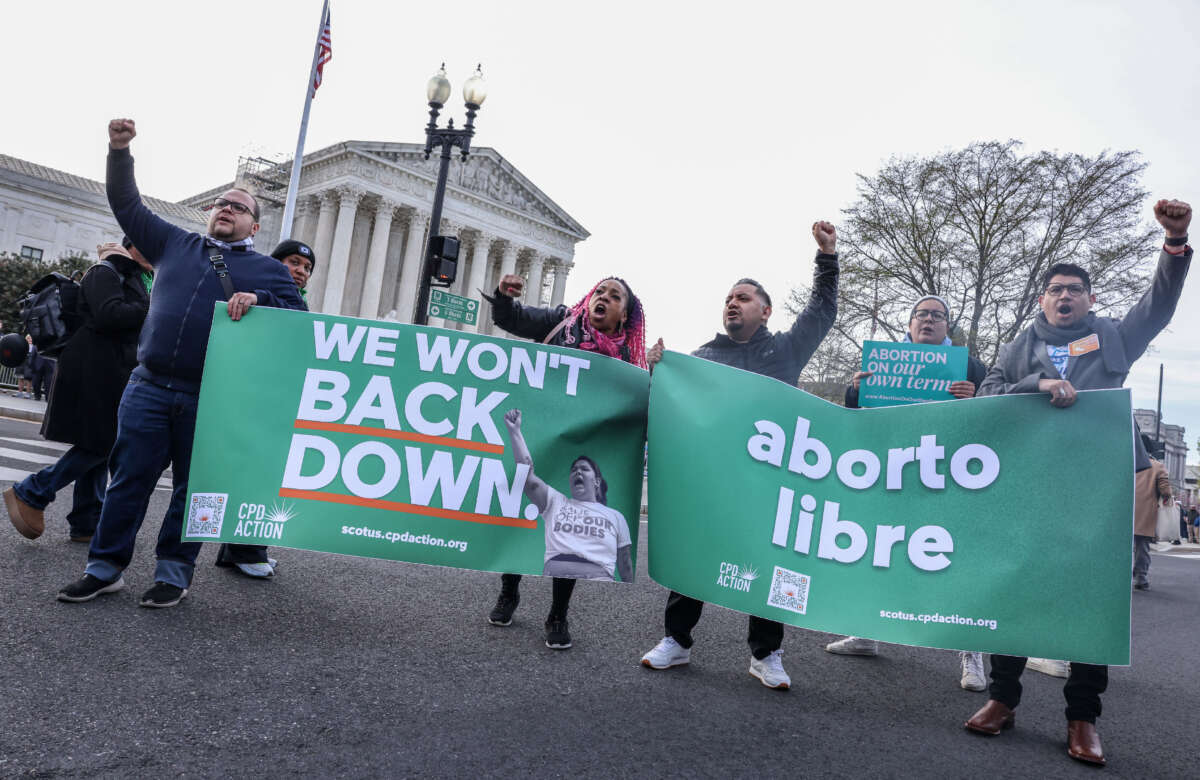
Demonstrators gather in front of the Supreme Court during the "Bans Off Our Mifepristone" action organized by the Women's March, on March 26, 2024, in Washington, D.C.JEMAL COUNTESS / GETTY IMAGES FOR WOMEN'S MARCH

Today the Supreme Court hears oral arguments over whether to restrict access to the abortion medication mifepristone — a drug that became crucial for reproductive freedom after the court’s conservative majority threw out the right to abortion in 2022. Meanwhile, Republicans across the country are thwarting efforts by Democrats to enshrine the right to use birth control and other methods of contraception.

If the Supreme Court offers a broad ruling against Food and Drug Administration (FDA) approvals for mifepristone, such a ruling could invite further legal challenges to other medications that are used by millions of people but remain controversial on the right, including Plan B emergency contraception, birth control pills, vaccines and gender-affirming hormone therapy.

The Supreme Court is considering a challenge from an anti-abortion group of doctors to decisions made by the FDA in 2016 and 2021 to make abortion pills available for use at up to 10 weeks of pregnancy and allowing physicians to prescribe the medication remotely. Abortion medications are typically used at home and are considered a safe way to end early pregnancy by major medical associations. Anti-abortion idealogues are attempting to convince the Supreme Court otherwise.

The FDA approvals allowed patients to receive abortion pills in the mail, and now 63 percent of abortions in the U.S. are medication abortions. If the Supreme Court sides with the anti-abortion plaintiffs, the ruling could devastate mutual aid networks that help patients in states with abortion restrictions access the medication.

Many anti-abortion groups also oppose the use of contraceptives due to religious teachings and work to wrongly stigmatize drugs such as birth control and Plan B as a form of abortion. Legislation regularly introduced in red states would declare that life begins at the moment of conception, which is widely seen as the first step toward banning birth control and Plan B.

RELATED STORY
Supreme Court Will Hear Arguments Tuesday on FDA Mifepristone Approval Process
Lower courts in the case relied on anonymous internet blog posts and questionable witnesses to formulate their opinions.
By Chris Walker , TRUTHOUT  March 25, 2024


Meanwhile, Republicans in Congress and multiple states have rejected Democratic legislation that would codify the right to access contraceptives such as birth control pills, condoms and IUDs. Now that abortion is banned in 14 states, and abortion pills are under attack in the nation’s highest court, reproductive rights advocates warn that the anti-abortion movement has contraception in its sights, despite claims by nervous Republicans to the contrary.

Restrictions on contraception are extremely unpopular with voters, but Republican politicians remain under intense pressure to curtail contraception from the Christian nationalists and anti-abortion groups in the party’s base. Stephanie Schriock, a Democratic Strategist and former president of the pro-choice EMILY’s List, said the anti-abortion movement has always opposed contraceptives, even though it focused primarily on abortion until Supreme Court overturned Roe v. Wade.

“They want to end all of it,” Schriock said in an interview. “That has been the case for the Susan B. Anthony Foundation, the Heritage Foundation and National Right to Life; they have all been seeking to restrict access to contraception the whole time, it just got underneath the effort to restrict abortion access.”

In 2022, just weeks after the Supreme Court threw out the right to abortion and greenlit bans and restrictions on pregnancy care in red states that have put pregnant people in danger, 195 House Republicans voted down a bill that would have codified the right to access Plan B, birth control, condoms, and other methods of contraception.

While blue states codified the right to abortion, bills to establish the right to contraception failed to gain traction in Alabama, Georgia, Louisiana, Florida, Iowa, Mississippi, Nevada, North Carolina, Tennessee and Wisconsin. Only Virginia passed a Right to Contraception Act, and now Gov. Glenn Youngkin, a Republican, must decide whether to sign it.

In Tennessee, GOP lawmakers recently rejected a pair of bills written to clarify that the state’s harsh post-Roe abortion ban does not criminalize contraception and in vitro fertilization for families faced with infertility, the latter being under threat after the Alabama Supreme Court ruled last month that frozen embryos in storage have the same rights as people.

Tennessee Republicans said the bills were obsolete because there are no prohibitions on the books, but Democrats pointed to a 2022 ProPublica investigation revealing that anti-abortion groups in the state privately raised the prospect pressuring lawmakers to restrict contraception and in vitro fertilization after the abortion ban went into effect.

Arizona Senate Majority Leader Sonny Borrelli recently made national headlines for suggesting that women put aspirin “between the knees” to prevent pregnancy as fellow Republicans voted unanimously to block the Right to Contraception Act. Borrelli later apologized for his misogynist comment, but Arizona Democrats say access to birth control and Plan B remains under threat as long as the GOP controls the legislature.

“This has been the case for years and years … that these Republican men in particular just didn’t know how birth control pills work, that you take one every single day, that there are actually lots of reasons why women take birth control pills that are not to prevent reproduction” said Schriock, who added that birth control is also used to treat migraines, for example.

Kimberly Inez McGuire, executive Director of URGE: Unite for Reproductive & Gender Equity, a youth-led rights group, said she used abortion medication after having a miscarriage last month to protect her health and ability to have children in the future. McGuire took misoprostol, the drug prescribed with mifepristone to end pregnancy.

“These pills, mife and miso, are essential, life-saving medications used by people all over the globe,” McGuire said during a rally outside the Supreme Court on Tuesday. “Yet right now inside that building, anti-abortion extremists are arguing a case based on junk science, busybody doctors, and plain old misogyny.”

Right-wing opposition to contraception puts Republicans between an electoral rock and a hard place. Polls consistently show that about 90 percent of voters support the right to birth control and contraception, including the vast majority of Republicans. Support for Republicans in Congress plummets when pollsters tell participants they opposed a national Right to Contraception Act.

“This is a gigantic problem for the Republican Party in every election to come,” Schriock said. “They are already on thin ice because of their abortion bans.”

Why would Republicans choose to put themselves in this position? Schriock said some in the GOP fear being primaried from the extreme right, but the extreme right has also gone mainstream within the party. The anti-abortion movement has built enormous power in the Republican Party, which benefited from consolidating the evangelical vote.

Before 2022, Republicans could virtue signal to the anti-abortion movement without considering the consequences that actually banning abortion would have on pregnancy care. That all changed after the Supreme Court overturned Roe v. Wade and red states banned abortion with few exceptions. Decades after abortion became a partisan issue, GOP is now full of ideologues such as House Speaker Mike Johnson who sincerely oppose abortion and contraception due to deeply held religious beliefs, according to Schriock.

With a conservative majority that is clearly hostile to abortion rights, Schriock said it’s unclear how the Supreme Court will rule on abortion pills. It will depend on whether the court sides with the anti-abortion plaintiffs or the government, and how broad or narrow the ruling will be. In oral arguments on Tuesday, justices questioned whether the anti-abortion doctors have standing to challenge the FDA the first place. A ruling is expected in June.

“I would think they would be very, very careful on overruling the FDA on anything, because not only would it open to [challenges to] other forms of birth control, but where would it stop after that,” Schriock said. “I can’t imagine them wanting to open this all up, but also couldn’t imagine them getting rid of Roe.”


MIKE LUDWIG is a staff reporter at Truthout based in New Orleans. He is also the writer and host of “Climate Front Lines,” a podcast about the people, places and ecosystems on the front lines of the climate crisis. Follow him on Twitter: @ludwig_mike.
Trump Is Turning the January 6 Coup Leaders Into Fascist Martyrs

Trump’s heroization of those who led the attack on the Capitol is eerily similar to tactics used by Hitler in 1923.
March 27, 2024
Republican presidential candidate and former President Donald Trump speaks to a crowd during a "Get Out The Vote" rally at Coastal Carolina University on February 10, 2024, in Conway, South Carolina.
WIN MCNAMEE/GETTY IMAGES

Backed by overwhelming support from the GOP’s primary voters, and by most Republican congressmembers and senators, former President Donald Trump is now barreling toward the 2024 presidential election as his party’s presumptive nominee.

Usually, at this point in the election process, once the base has been satisfied during the primary season, a candidate starts the long, slow, sometimes awkward pivot back toward the political middle. Trump, by contrast, is veering evermore into the extremes, plunging into political conspiracy theories and violent rhetoric.

He’s repeatedly spoken of immigrants “poisoning” the nation’s blood. He has taken to calling out individuals such as former White House Aide Cassidy Hutchinson, who testified against him in the congressional hearings into the January attack, arguing that they should be prosecuted for their words. He’s basically invited Russia to take military action against North Atlantic Treaty Organization members who don’t boost their military budgets.

But Trump is, perhaps, at his most incandescently dangerous when talking about the January 6 coup attempt and the efforts by his followers to prevent the peaceful transfer of power. Last week, at a rally in Ohio, the crowd was asked to rise to pay tribute to those imprisoned after the events of January 6. Trump got up and gave a salute, while the loudspeakers blared a version of the national anthem recorded by some of these prisoners.

The Washington Post has tracked Trump’s language surrounding the January 6 perpetrators, and recently published a graph showing his increasing usage of the incendiary term “hostages” to describe them. Between November and the third week of March, the paper identified 12 times in which Trump used this term, each time further corroding his base’s trust in the democratic political system.


Trump Says Conviction Will Make Him More Popular. Polls Say Otherwise.
Poll after poll demonstrates that a criminal conviction between now and November makes Trump less popular.
By Chris Walker , TRUTHOUT  March 26, 2024


This isn’t accidental. Trump is consciously creating a martyr mythology, a stabbed-in-the-back-by-a-fifth-column storyline. It is the same narrative used by the early Nazis to describe those — including Adolf Hitler — imprisoned by the Weimar state after the failed Munich “Beer Hall Putsch” of November 1923.

In that attempted coup, Hitler and his followers tried to seize power in Munich, to capture government buildings, and from that stronghold to then launch a march on Berlin aimed at creating what Hitler termed a “national revolution.”

After the effort failed, the Nazi leader was arrested, charged with treason, and in a trial the following February, sentenced to five years in prison. He was, however, pardoned after less than a year behind bars. As they say, the rest is history.

In the subsequent Nazi mythology, the men sentenced to prison after the putsch attempt, as well as for various other violent assaults on Weimar leaders and institutions, became martyrs; instead of the malcontents and violent political extremists that in reality they were, they were painted by Nazi propagandists as heroes who had sacrificed their freedom for a noble cause.

The Nazi newspaper, Völkischer Beobachter, wrote, as the Beer Hall coup was unfolding, that it was aimed at destroying “five years of the most atrocious shame and disgrace perpetrated by Jews and the Jewish regime.” (This, just two years after the industrialist Walter Rathenau, the Weimar state’s foreign minister, was assassinated by nationalist extremists infuriated by his Jewish origins and his internationalist political leanings.)

Nineteen years later, in the depths of World War II, Hitler made a lengthy speech commemorating the uprising that was larded with antisemitic bile. He claimed:

In the beginning I did not have much more to give than faith, the faith that if anyone pursues a just aim with unchanging and undisturbed loyalty and never lets himself be diverted from it, but puts everything into it, then others will be found who are determined to be his followers, and that from this host an ever stronger faith must gradually radiate to the whole people, and that out of this host the worthiest part of the whole people must one day finally find themselves together, and that finally this worthiest part must acquire the power of the state.

In this speech, Hitler denounced Franklin D. Roosevelt for being a “half-Jew,” with a “Jewish brain-trust.” He claimed that Jews controlled the Soviet government, accused wealthy Jews of a conspiracy to control the world, and so on.

Even as Trump tries in his usual offensive fashion to persuade Jewish voters to elect him (he recently argued that “any Jewish person that votes for Democrats hates their religion”), he has long deployed thinly veiled antisemitic tropes in his speeches. For example, as the Washington Post reported, he has frequently asserted to Jewish Americans that Israel is “your country,” thus essentially accusing them of dual loyalties. Moreover, he has flaunted his friendship with the notoriously antisemitic Kanye West, and after the 2017 Unite the Right march in Charlottesville, in which fascist participants chanted “Jews shall not replace us,” Trump went out of his way to say there were “very fine people” on the fascist side of the confrontation.

Meanwhile, Trump also deploys dehumanizing, fascistic language to attack his perceived enemies in all quarters. On the campaign trail, for example, he has called his opponents “vermin,” and indicated that he would support executing ex-Chairman of the Joint Chiefs of Staff General Mark Milley.

Trump’s wholehearted embrace of the January 6 coup leaders and his escalating martyrdom language about their fate are part of this chilling political package. Faced with more than half a billion dollars in court-imposed fines, the possibility of some of his marquis properties being seized and the imminent start of at least one of his four criminal trials, Trump is now marshalling an army of the angry and the conspiracy-minded to serve as a battering ram against the legitimacy of the state itself.

Promising to release violent paramilitary supporters — as Trump routinely does these days when pledging to free the January 6 perpetrators on day one — isn’t politics as usual. Rather, it’s an unprecedented embrace of political violence by a candidate who is, yet again, showing that he has no moral limits.


SASHA ABRAMSKY is a freelance journalist and a part-time lecturer at the University of California at Davis. His work has appeared in numerous publications, including The Nation, The Atlantic Monthly, New York Magazine, The Village Voice and Rolling Stone. He also writes a weekly political column. Originally from England, with a bachelor’s in politics, philosophy and economics from Oxford University and a master’s degree from the Columbia University Graduate School of Journalism, he now lives in Sacramento, California.


Donald Trump’s Horst Wessel moment | Will Bunch Newsletter

Plus, Merrick Garland’s Neville Chamberlain moment.


by Will Bunch | Columnist
Published Mar. 19, 2024
PHILEDELPHIA INQUIRER

I know this will probably shock a lot of people, but for once I identify with Donald Trump. On Monday, his lawyers said posting the whopping $465 million bond on his New York State fraud judgment is a “practical impossibility.” It would be for me, too. Of course, I’m not a billionaire. Maybe the media should come to realize the financial wizard behind Trump Vodka and Trump University isn’t one, either.

Where did Trump learn to turn thugs into heroic martyrs? Try 1930s Germany.


Republican presidential candidate and former President Donald Trump speaks at a campaign rally Saturday, March 16, 2024, in Vandalia, Ohio.
Jeff Dean / AP

Those of us who’ve had the misfortune of chronicling the Donald Trump Era in America have learned by now never to characterize any comment or political rally, no matter how vile, as “a new low,” because the next bottomless pit is always just around the corner. That said, Saturday’s Trump rally in Dayton, Ohio was a dark abyss that the media is still exploring days later.

The never-ending debate over what the 45th president truly meant when he promised a “bloodbath” — maybe just for the auto industry, but maybe for a nation already fearful of a civil war — obscured all the other shocking things the presumptive GOP nominee for a second, non-consecutive term in the White House said that were unambiguous. Like claiming there won’t be another election in America if he loses. Or saying some refugees at the southern border are “not people.

Then there was the start of the rally, with a version of the National Anthem so horrific that it gets Roseanne Barr off the hook for the worst ever. Heck, Barr’s shrieked ballpark version sounded like Maria Callas compared to this weekend’s opening act in Dayton.

“Ladies and gentlemen, please rise for the horribly and unfairly treated Jan. 6 hostages,” boomed a man who sounded like a baritone NBA arena announcer tied up and forced to read a ransom note handwritten by Trump himself. What followed was an altered “Star Spangled Banner” as rendered by the so-called J6 Choir — insurrectionists who violently overran the U.S. Capitol and injured scores of police officers on Jan. 6, 2021 and who are held in the D.C. jail, most awaiting felony trials.

It wasn’t the first time that Trump had launched a major rally with the jazz of these felonious punks. In fact, the wannabe 47th president is featured as a voice on the record, renamed ”Justice For All” and briefly boosted to No. 1 on the iTunes chart with help from the king of schlock marketing. The latest airing comes as Trump’s re-framing of hundreds arrested for their riotous activities on Jan. 6 as unfairly treated “hostages” — an insult to the world’s too-many actual hostages from Gaza to Moscow, where U.S. journalist Evan Gershkovich has been locked up for a year — is gaining steam from formerly mainstream Republicans like Rep. Elise Stefanik, now a veep hopeful.

Indeed, Trump’s increasingly forceful promise to abuse the powers of the president to pardon the Capitol Hill insurrectionists — rioters he calls “patriots” because they were willing to upend the peaceful transfer of presidential power on his behalf — is rightly considered as Exhibit A in the ways that a second Trump term would upend 237 years of constitutional norms and plunge America’s shaky democracy into an Orbán-esque form of dictatorship.

But there’s something else about about Trump’s rhetoric, his J6 Chorus, and the revamped national anthem that I find even more disturbing. It’s just the latest incident that makes you wonder how much Trump — who was given a book of Adolf Hitler speeches in the 1980s and later praised some “good things” about the German dictator to his top aide — and his team are modeling the authoritarian rise of the Nazis in the 1930s, either consciously or unconsciously.

Trump’s literal salute to those willing to commit violence on behalf of his MAGA movement — both the arrestees he now calls “hostages” and the slain rioter Ashli Babbitt, hailed by the ex-president as a martyr — is very much in line with the way that Nazis, led by their propaganda minister Joseph Goebbels, invoked slain or jailed thugs as heroes to rally their followers.

This included the victims of Hitler’s own initial insurrection aimed at gaining power — the notorious Munich beer hall putsch of 1923 that killed 16 early Nazis and four police officers. But the most famous Nazi martyr was Horst Wessel, a young member of the Nazis’ paramilitary force officially called the SA, but better known as “the brownshirts” who brawled in the streets with their leftist enemies.

Wessel’s frequent denunciations of the rival Communist Party and his involvement in violent raids into Berlin’s working-class neighborhoods raised his profile among the pro-Hitler brownshirts but made mortal enemies on the far left. On Jan. 14, 1930, on the eve of the Nazi rise to power, Wessel was shot by two Communist Party members under very murky circumstances and later died. Goebbels seized on his death as an invaluable propaganda tool.

The future Nazi minister hailed Wessel in an article as a good Christian who “offer[ed] himself up as a sacrifice,” then lured as many as 30,000 movement members to march through the streets for his funeral and filmed the event. But Wessel and the rallying effect of his supposed martyrdom primarily lived on through music. A marching fight song that Wessel himself composed was given new lyrics and redubbed as “Horst-Wessel-Lied,” meaning “The Horst Wessel Song.

“The Horst Wessel Song” became not just a Nazi Party anthem, but later the co-national anthem of Germany (along with the “Deutschland über Alles” version of the current anthem) after Hitler took power in 1933. It was even played in churches as Goebbels forged his own version of Christian nationalism. In 1934, as the dictator consolidated his grip, legendary filmmaker Leni Riefenstahl filmed the party’s massive Nuremburg rally for her documentary, Triumph of the Will. The movie starts with “The Horst Wessel Song” as the swastika-painted plane carrying the Führer circles the massive throng before a dramatic landing.

Does any of this sound familiar?

Ruth Ben-Ghiat, the New York University historian who authored Strongmen, about the commonalities of authoritarians up through Trump, wrote after Trump’s 2022 campaign kickoff in Waco that fascists use rallies and “propaganda to change the public’s perception of violence, associating it with patriotism and national defense against internal and external enemies.” To Ben-Ghiat, the historical line from “The Horst Wessel Song” to the J6 Chorus is especially striking. She writes: “The Nuremberg rally enshrined victimhood and mourning into regime ritual and justified Nazi violence as national defense.”

Triumph of the Will supposedly survived as a cautionary tale about propaganda and mass manipulation, but apparently it’s now an instructional video for a new generation of Hitler clones. The ritual fetishizing of today’s brownshirts who stormed the Capitol on Jan. 6 would be alarming if it were the only party-like-it’s-1934 flashback from the Trump campaign. Instead, it’s just one more sour Wagnerian note, along with calling enemies “vermin,” dehumanizing migrants, and agreeing that he’ll be a dictator, but “only for a day.”

Trump is currently flying high and humming his own Horst Wessel song all the way to the White House. When will Americans wake up and hear the music?


THE BROWN SHIRTS WERE HITLERS PROUD BOYS

FILM NEWS OF THE GERMAN CAPITAL; The Widely Read Story of Horst Wessel, the Nazi Movement's Almost Legendary Hero, Reaches the Screen

Feb. 4, 1934
Credit...The New York Times Archives
See the article in its original context from
February 4, 1934, 

VIEW ON TIMESMACHINE
This is a digitized version of an article from The Times’s print archive, before the start of online publication in 1996. To preserve these articles as they originally appeared, The Times does not alter, edit or update them.
Occasionally the digitization process introduces transcription errors or other problems; we are continuing to work to improve these archived versions.


WHEN in the Summer the first announcement came that the Volksdeutsche Film Company had bought the rights to the popular story "Horst Wessel," by Hans Heinz Ewers, the rest of the film producers were kicking themselves for having slipped up on this fireproof chance. For at that time no one foresaw the changes in the development of the national government which were to come later. In those early days everything Nazi in book, theatre, film, was necessary propaganda. Quantity alone could give weight to the political steam roller. The making of a "Horst Wessel" film would surely have full governmental support. Was he not their officially sanctioned idol? Did not the mediocre song he had composed become their revolutionary chant? The program proves that earlier support: Supervision and music, Ernst Hanfstaengl (Hitler's press chief); SA adviser, Richard Fielder (Nazi organizer); a number of Nazi military organizations and, above all, the actual police force.Then about six weeks ago came the previewing of the film by a Nazi compendium with Dr. Goebbels at its head. One could now afford to be fastidious—the film was forbidden "for the heroic figure of Horst Wessel was incompetently interpreted, thereby endangering the interest of State and German prestige." Two weeks ago the film censor announced his okay on "Hans Westmar" (phonetic substitute for "Horst Wessel"), yesterday we had the première at the Capitol and today it has the unreserved approbation of the government. It proved to be a hundred percenter.Jazz and Communism.It shows the student, Hans Westmar, returning from a genial waltz loving Vienna to an objectionably international Berlin, where, in a bar, a Negro jazz band plays havoc with the martial rhythms of "Die Wacht am Rhein" and a Spanish dancer toys with the morals of a somewhat less martial burgher of the democratic year 1929. It shows communism as a corroding force and its head, a Russian, a serf to Moscow. Hans Westmar sees delivery from all this and more in the tenets of National Socialism. He becomes active. His organizing gifts are extraordinary, but he believes the party's growth to be in the masses. So he gives up his studies and becomes a manual laborer. He goes to live in the East of Berlin, the stronghold of the Communists. They plot against him, for he succeeds in winning over too many of their members. He is shot, and, though he lingers on a few days, the wound is fatal—he dies.Emil Lohkamp, who takes the title part, has the physical propensities of a fanatic. His abrupt manner of acting and speech underlines this to an almost unsympathetic degree. This must have been the cause of Dr. Goebbels's unfavorable verdict. Irmgard Willers, as the submissive creature of the Communists in love with Hans West-mar, outlines figure of such frail intensity in this first screen appearance that one may hopefully add her to the scant list of the more personal film faces. There are tow parts taken by Jews: a university professor advocating internationalism, which Siegmund Nunberg plays with direct simplicity; the other, a Communist leader and member of the Reichstag, is mugged by Hugo Döblin, who invests this rôle with all the approved bugbear characteristics — a contemptible performance. Neither of these two actors is mentioned in the program. The audience found cause for a laugh when the screen showed two bearded Jews watching a street fight, their whole attitude expressing a childlike and worried wonder at these combative doings—a reaction unthinkable outside the Reich's border.There is an intensely dramatic but very much abbreviated shot of a "Mensur," the German student's sabre practice, with the opponents standing close, deftly parrying heavy blows. A close-up shows their cheeks pouted. I take it this is to protect their teeth in case of cuts, which are frequent. But it did look comical and little in keeping with the seriousness of the situation and the dangerousness of this drill, which has caused the loss of so many lives. The ban which since the war had been put on this "exercise" has recently been lifted. Another one of the numerous Nazi reversions to pre-war practices.The most realistic and therefore the most vital parts of this picture are its mass scenes. The supposed to be historically exact street fight as the funeral cortège passes the Karl Liebknecht house, the Communist headquarters, is brutally convincing and gives one the sensation of an eyewitness. In the transition from "Horst Wessel" to "Hans Westmar" the film loses continuity and takes a knowledge of the book too much for granted. Because of this and in spite of an overabundance of close-ups, the intent of the picture is reversed—the story of Hans Westmar merely becomes background to a forcefully documented national movement."Bedside," which is about an X-ray photographer and the fortune he made by cultivating his professional manner, will be turned loose on Broadway soon by First National. It features Warren William and Jean Muir."The Heir Chaser," James Cagney's latest film, will be released by Warner Brothers under the title, "Blondes and Bonds." This is scheduled for an early Broadway showing. Bette Davis and Alice White are the women in it. Out in Hollywood Mr. Cagney is preparing to begin work with Joan Blondell in "Without Honor," which marks the first Cagney-Blondell collaboration since "Blonde Crazy." Most of the action takes place in a small fishing village and Lloyd Bacon, the director, has been hunting good location scenes along the California coast.Harry Wilcoxon, the young English actor, has gone to Hollywood to become Marc Antony in Cecil B. De Mille's "Cleapatra." Although he planned to spend several days in New York seeing plays and the sights, the studio demanded his presence and he sternly boarded a plane for the Coast. Mr. Wilcoxon holds a British aviation pilot's license and plans to do all his traveling in this far-flung country by plane. Just before leaving England, he played the leading rôle opposite Evelyn Laye in a British film, "Princess Charming."


A version of this article appears in print on Feb. 4, 1934 of the National edition with the headline: FILM NEWS OF THE GERMAN CAPITAL; The Widely Read Story of Horst Wessel, the Nazi Movement's Almost Legendary Hero, Reaches the Screen.


En.wikipedia.org

https://en.wikipedia.org/wiki/Horst_Wessel

Horst Wessel ... Horst Ludwig Georg Erich Wessel (9 October 1907 – 23 February 1930) was a member of the Sturmabteilung (SA), the paramilitary wing of the Nazi ...

Britannica.com

https://www.britannica.com/biography/Horst-Wessel

Feb 19, 2024 ... Horst Wessel martyr of the German Nazi movement, celebrated in the song “Horst Wessel Lied,” adopted as an anthem by Nazi Germany.

Jewishvirtuallibrary.org

https://www.jewishvirtuallibrary.org/horst-wessel

The shooting was immediately exploited by both the Nazis and the Communists to further their political aims. The Communists portrayed Wessel as a pimp, while ...

Searches Related toHORST WESSEL

Encyclopedia.ushmm.org

https://encyclopedia.ushmm.org/content/en/timeline-event/holocaust/before-1933/sa-member-horst-wessel-dies

February 23, 1930. On this date, Nazi stormtrooper Horst Wessel dies after being shot and becomes a martyr in Nazi propaganda.


Loc.gov

https://www.loc.gov/item/2005686473

14 items (13 photographic prints, 1 brochure) ; 18 x 25 cm. or smaller. | Photographs show Nazi ceremonies honoring Horst Wessel who wrote the lyrics to the ...


GLAAD, Media Matters Call Out NYT for Excluding Transgender Voices


Research reveals The New York Times excluded transgender voices in 66 percent of its trans issue coverage.
TRUTHOUT
March 27, 2024
The New York Times building stands in Midtown on February 7, 2024, in New York City.
SPENCER PLATT / GETTY IMAGES

Arecent study conducted by Media Matters and GLAAD reveals that in the year following public backlash for its coverage of anti-trans legislation, The New York Times neglected to include transgender voices in approximately two-thirds of its stories on the subject.

“The paper of record has an obligation to present its readers with the full human toll of the anti-trans legislative assault,” Ari Drennen, LGBTQ Program Director at Media Matters, said in a statement. “Trans people are more than theoretical curiosities to be debated from afar. Each and every anti-trans bill affects living, breathing people whose voices deserve to be heard and whose stories deserve to be told.”

Between February 15, 2023, and February 15, 2024, the Times published 65 articles addressing U.S. anti-trans legislation in either their headlines or opening paragraphs. Media Matters and GLAAD’s research found that 66 percent of the articles did not include a single quote from a trans or gender-nonconforming person, 18 percent of the articles quoted misinformation from anti-trans activists without sufficient factchecking or contextual elaboration, and six articles obscured the anti-trans backgrounds of sources, neglecting to mention their histories of extremist rhetoric or actions.

“As a well respected news organization, The New York Times should be ashamed of their lack of fact checking and representation of trans voices in their articles. The New York Times’ biased articles have contributed to the deadly culture war against the transgender community,” LGBTQ legislative researcher Allison Chapman told Truthout.

RELATED STORY

States’ Anti-LGBTQ Moves May Have Disastrous Health Impacts, Experts Say
Medical professionals are worried about the long-term physical and mental effects of anti-LGBTQ legislation.
By Orion Rummler , THE19TH
March 23, 2024

The Times has been increasingly critiqued for its problematic coverage of transgender people and challenges, such as gender-affirming care bans, facing the transgender community over the past year.

“Prominent frontpage coverage has frequently missed the big picture of the trans community, choosing instead to hyper-scrutinize essential and mainstream medical care, undermining its support among readers who know next to nothing about this care, while laundering extremist talking points as legitimate concern,” Serena Sonoma wrote for GLAAD in April 2023. “The Times’ coverage has elevated critics without alerting readers to their anti-LGBTQ, anti-trans histories and their coordination and connections to longtime anti-LGBTQ groups like Alliance Defending Freedom.”

Last February, over 150 LGBTQ organizations and leaders, including GLAAD, published an open letter condemning the Times‘ harmful and inaccurate coverage of transgender people. The letter demanded that the Times stop publishing anti-trans articles, meet with leaders from the transgender community, and hire transgender writers and editors. According to GLAAD, the Times has not met any of the letter’s demands.

“One of the first recommendations we make during the hundreds of LGBTQ education briefings we hold with national and local newsrooms is to include LGBTQ voices in LGBTQ stories: interview the people impacted by your coverage and include their perspectives. The New York Times failed that basic reporting lesson 101, and replaced it with a pattern of obfuscating sources’ anti-trans affiliations and allowing their misinformation to go unchecked,” Sarah Kate Ellis, President and CEO of GLAAD, said in a statement. “Our coalition of more than 150 organizations, community leaders, and notable LGBTQ people and allies remains steadfast in our calls for the Times to improve their coverage of transgender people.”

In April of last year, hundreds of contributors to the Times also wrote a letter critiquing its handling of transgender topics. Times management responded by saying in a memo that: “Participation in such a campaign is against the letter and spirit of our ethics policy. That policy prohibits our journalists from aligning themselves with advocacy groups and joining protest actions on matters of public policy. We also have a clear policy prohibiting Times journalists from attacking one another’s journalism publicly or signaling their support for such attacks.”

The Times’ anti-trans coverage has been weaponized by anti-LGBTQ groups in legal filings to undermine transgender youth’s access to lifesaving health care. In fact, an anti-transgender op-ed published by the Times in February by Pamela Paul titled “As Kids, They Thought They Were Trans. They No Longer Do.” which was thoroughly debunked by transgender activist and journalist Erin Reed as relying on “pseudoscience,” was cited in a legal brief in Idaho within just four days of its publication.

“I felt compelled to highlight how central these pieces are to the legal structures limiting our material survival. Within 4 days of publication Paul’s piece was cited by Idaho officials in federal court — represented by Alliance Defending Freedom — in the state’s defense of their anti-trans law banning this medical treatment for minors,” Chase Strangio, the deputy director for transgender justice with the ACLU’s LGBT & HIV Project, said on Instagram earlier this year. “The distortions and the false debate are causing immediate and severe material harms that will be felt for generations.”

This article is licensed under Creative Commons (CC BY-NC-ND 4.0), and you are free to share and republish under the terms of the license.

ZANE MCNEILL is a trending news writer at Truthout. They have a Master’s Degree in Political Science from Central European University and is currently enrolled in law school at the University of Denver Sturm College of Law. They can be found on Twitter: @zane_crittheory.


Revealed: VIP health system for top US officials risked jeopardizing care for soldiers
JUST LIKE IN CIVILIAN LIFE

Female American Soldier -


Top U.S. officials in the Washington area have received preferential treatment from a little-known health care program run by the military, potentially jeopardizing care for other patients including active-duty service members, according to Pentagon investigators.

Do you have experience with the federal executive medicine program, either as an employee or a patient, you’d like to share? Click here to contact our reporting team.Contact us

White House officials, senior military and other national security leaders, retired military officers, and family members have all benefited. The Washington elite could jump the line when filling prescriptions, book appointments through special call centers, and receive choice parking spots and escorts at military hospitals and other facilities, including Walter Reed National Military Medical Center in Bethesda, Maryland, according to the Pentagon’s inspector general.

Through a unit at the White House, government personnel were routinely allowed to receive treatment under aliases, providing no home address or insurance information. For some of them, the care was free, as Walter Reed had no way to bill for it or waived charges.

The so-called executive medicine program was described in a report the Pentagon’s inspector general released in January. The investigation drew extensive media attention for spotlighting a history of loose prescribing practices and poor controls of powerful drugs including opioids in the White House Medical Unit, a military outfit that attends to the president, vice president, and others in the White House compound.

But the White House Medical Unit is just the tip of the broader executive medicine program, intended to provide VIP treatment to senior government and military officials. Though the program is meant largely to accommodate top officials’ busy schedules, the privileges have followed many patients into retirement. According to data from late 2019 and early 2020, the IG’s report said, 80% of the executive medicine population in the national capital region were military retirees and members of their families.

Some facilities “provided access to care for executive medicine patients over active-duty military patients that had acute needs,” according to the report, which added that prioritizing medical care by seniority rather than medical need “increased the risk to the health and safety of non‑executive general patient population.”

Much of the report was written in past tense, leaving unclear whether all the practices it described continue. Before the report was made public, a draft was under review by the White House Medical Unit for more than three years — from May 2020, when Donald Trump was in office, to last July. The delay isn’t explained in the report, and White House spokespeople didn’t respond to questions for this article.

A spokesperson for the inspector general’s office, Deputy Assistant Inspector General Reishia Kelsey, declined to elaborate on the report. A spokesperson for the Pentagon, James P. Adams, also declined to comment.

In a response included in the inspector general’s report, a Pentagon official said there were “new procedures already put in place by the White House Medical Unit.” The report didn’t detail those changes.

At Walter Reed, the program is available to Cabinet members; members of Congress; Supreme Court justices; active-duty and retired generals and flag officers and their beneficiaries; members of the Senior Executive Service who retired from the military; secretaries, deputy secretaries, and assistant secretaries of the Department of Defense and military departments; certain foreign military officers; and Medal of Honor recipients.

Walter Reed’s executive medicine program caters to the “time, privacy, and security demands” of leaders’ jobs, the hospital says on its website. The IG report makes clear that the program has, at times, provided extraordinary privileges to the government’s most elite officials.

For example, one unnamed executive medicine patient asked to have a prescription for an unspecified “controlled medication” refilled two weeks early — and complained when pharmacy staff at Fort Belvoir Community Hospital said that wasn’t allowed.

Hospital leaders told hospital staff to fill the prescription as requested. According to the report, the staff said the task required an estimated 30 hours of extra work.

Controlled medications are subject to abuse, and some, such as opioids, can be addictive. Defense Department health policy calls for minimizing the use of opioids and prescribing them only when indicated.

A spokesperson for the Fort Belvoir hospital, now known as Alexander T. Augusta Military Medical Center, said every patient is seen through the same lens and treated with the care they deserve.

The spokesperson, Reese Brown, said the facility shows military deference to top officers on account of their rank. For example, they don’t have to sit with the general population of patients.

The facility’s website mentions an “Executive Medicine Health & Wellness Clinic” for authorized patients, including eligible family members.

Brown said he was unaware of the inspector general’s account of the prescription refill and had no information about it.

The report said that at one unidentified pharmacy site, “all pharmacy staff members expressed frustration about the prioritization and filling of executive medicine prescriptions. This prioritization of executive medicine prescriptions diverted the pharmacist from filling prescriptions for patients diagnosed with conditions that are more urgent.”

Executive medicine services are also provided at the DiLorenzo Tricare Health Clinic at the Pentagon, Fort McNair Army Health Clinic, and Andrew Rader U.S. Army Health Clinic, the report said.

The inspector general recommended the Department of Defense take steps such as establishing controls for billing nonmilitary senior officials for outpatient services. The assistant secretary of defense for health affairs agreed but said the department would consider “the historical practices of the White House Medical Unit, the DoD’s health care support for non‑military U.S. Government senior officials, and the need for strict security protocols to protect the health and safety of White House principals.”

Chaseedaw Giles, KFF Health News’ digital strategy & audience engagement editor, contributed to this report.KFF Health News is a national newsroom that produces in-depth journalism about health issues and is one of the core operating programs at KFF—an independent source of health policy research, polling, and journalism. Learn more about KFF.


Scientists won't classify anthropocene as 'epoch' yet — but say human impact undeniable


Julia Conley
Common Dreams

The idea underpinning scientists' push to recognize the current time period as a new geological epoch called the Anthropocene dates back more than 100 years, but on Tuesday, a committee of experts voted down the proposal to officially declare a new age defined by human beings' impact on the Earth.

The panel, organized by the International Union of Geological Sciences (IUGS), was tasked with weighing whether the Holocene—the epoch that began at the close of the last ice age, more than 11,000 years ago—has ended, and if so, when precisely the Anthropocene began.

Another group, the Anthropocene Working Group (AWG), had previously posed that an Anthropocene—an epoch during which "the scale and character of human activities have become so great as to compete with natural geological and geophysical forces," as British geologist Robert Lionel Sherlock argued in 1922—began in the mid-20th century.

Around that period, the U.S. and other countries began testing nuclear weapons while fossil fuel production began ramping up significantly, intensifying planetary heating, ocean acidification, and other climate impacts.

AWG presented geological evidence compiled at Crawford Lake in Canada, where radioactive isotopes dating back to the 1950s are embedded in the lake bed, to argue in favor of an Anthropocene that began decades ago.

Several members of the IUGS committee found that the time period proposed began too recently and "failed to capture the earlier impact of humans during, say, the development of farming or the onset of the Industrial Revolution," as Yale Environment 360 noted.

AWG members Simon Turner of University College London and Colin Waters of the University of Leicester told New Scientist Tuesday that the voting result was "very disappointing given the huge contribution by AWG to develop our case."

"All these lines of evidence indicate that the Anthropocene, though currently brief, is—we emphasize—of sufficient scale and importance to be represented on the Geological Time Scale," they said.

The academics who opposed recognizing a new geological epoch in the 12-4 vote are among the scientists who "prefer to describe the Anthropocene as an 'event,' not an 'epoch,'" The New York Times reported.

Geological "events" don't appear on the official Geological Time Scale, "yet many of the planet's most significant happenings are called events, including mass extinctions, rapid expansions of biodiversity, and the filling of Earth's skies with oxygen 2.1 to 2.4 billion years ago," according to the Times.

Michael Mann, director of the Center for Science, Sustainability, and the Media at University of Pennsylvania, called the disagreement over the terminology "a tempest in a teapot" that won't stop scientists from identifying the current time period as one in which humans are significantly and negatively impacting the planet.

While the scientific community is not yet labeling the current time period as a new epoch, committee member Jan Piotrowski of Aarhus University in Denmark told the Times, "Our impact is here to stay and to be recognizable in the future in the geological record."

"There is absolutely no question about this," Piotrowski said.
Faith in numbers: Behind the gender difference of nonreligious Americans


Photo by Naassom Azevedo on Unsplash
praying woman inside church

March 25, 2024


One of the most consequential stories in American religion in recent years is the rapid and seemingly unceasing rise of “nones” – those who respond to questions about their religious affiliation by indicating that they are atheists, agnostics or “nothing in particular.”

According to some recent estimates, around 4 in 10 millennials and members of Gen Z, a group that comprises those born after 1980, do not identify with a religious tradition. In comparison, only about a quarter of baby boomers indicate that they are religiously unaffiliated.

Social scientists are only beginning to explore the demographic factors that drive individuals who no longer feel attached to a religious tradition.

But as someone who follows the data on religious trends, I note one factor appears to stand out: gender.

Scholars have long noted that atheism skews male. Meanwhile, critics have pointed toward the apparent dominance of male authors in the “new atheism” movement as evidence of a “boys club.” Indeed, a quick scan of the best-selling books on atheism on Amazon indicates that almost all of them are written by male authors.

According to data from the Nationscape survey, which polled over 6,000 respondents every week for 18 months in the runup to the 2020 election, men are in general more likely than women to describe themselves as atheists, agnostics or nothing in particular. The survey, conducted by the independent Democracy Fund in partnership with the University of California, Los Angeles, was touted as one of the largest such opinion polls ever conducted.

However, tracking the gender gap by age reveals that at one point the gap between men and women narrows. Between the ages of 30 and 45, men are no more likely to be religiously unaffliated than women of the same age.

But the gap appears again among older Americans. Over the age of 60, men are 5 to 8 percentage points more likely to express no religious affiliation.

Moreover, older Americans – both men and women – tend to be far less likely to identify as “nones” compared with younger Americans, according to respondents of the survey.
The ‘life cycle’ effect

What may be driving this pattern of young women and older women being less likely to identify as nones than their male counterparts?

One theory in social science called the “life cycle effect” argues that when people begin to marry and have children, some are drawn back into religious circles to raise their kids in a religious environment or to lean on support structures that religion may provide.

But once kids grow up and leave the house this attachment fades for many. I make this point in my forthcoming book called “The Nones.”

The data on gender and those with no religious affiliation could indicate that this drifting is especially acute for men. One explanation could be that men are more likely to be religious when they are part of a family unit, but when children grow up, that connection becomes weaker. Unfortunately, the survey does not offer a direct test of this hypothesis.

But it would fit with survey research over the past five decades that has consistently found that Christian women are more likely than men to attend church.

One word of caution about the data is necessary. The survey is just a single snapshot of the public in 2019 and 2020. It’s possible that this same pattern would look different if data were collected 20 years ago or 20 years from now. Either way, it offers a small window into how age and gender interact with the religious lives of Americans.

Ryan Burge, Assistant Professor of Political Science, Eastern Illinois University

This article is republished from The Conversation under a Creative Commons license. Read the original article.
Top US nitrogen gas producers ban use in executions

Photo by Greg Rosenke on Unsplash
water droplets on glass window


Brett Wilkinsand
Common Dreams
March 12, 2024

Three of the leading U.S. manufacturers of medical-grade nitrogen gas said this week that they will not allow their products to be used in executions, a move that came after Louisiana approved the controversial capital punishment method recently used to kill an Alabama prisoner who appeared to be in agony before he died.

Airgas—owned by the French company Air Liquide—along with Air Products, and Matheson Gas toldThe Guardian that they are banning the use of their nitrogen gas products in the previously untested execution method used to cause death by hypoxia, or deprivation of oxygen to vital tissues.

Veterinarians consider nitrogen gas unethical for euthanizing animals and United Nations human rights experts have asserted that the execution technique may violate international anti-torture law.

"Airgas has not, and will not, supply nitrogen or other inert gases to induce hypoxia for the purpose of human execution," the company said.

Matheson Gas told The Guardian that use of its products in executions is "not consistent with our company values," while Air Products told the U.K.-based newspaper that it has established "prohibited end uses for our products, which includes the use of any of our industrial gas products for the intentional killing of any person (including nitrogen hypoxia)."

Four states—Alabama, Louisiana, Mississippi, and Oklahoma—have approved nitrogen gas for use in executions. Last week, Louisiana Gov. Jeff Landry, a Republican, signed legislation passed by the GOP-controlled state Legislature expanding execution methods to include the electric chair and nitrogen hypoxia. This, despite the agonizing execution in January of 58-year-old Kenneth Smith, who was killed by the state of Alabama by nitrogen hypoxia on January 25 after the U.S. Supreme Court rejected his last-ditch appeal.

Rev. Jeff Hood, a spiritual adviser to U.S. death row inmates, witnessed Smith's killing, which he described as "horrific and cruel." Hood and other witnesses said Smith convulsed violently for several minutes while he was strapped to a gurney and forced to breathe nitrogen gas through a mask. Even prison guards were taken by surprise as the gurney shook and Smith struggled for his life.

Alabama officials had claimed that nitrogen hypoxia is "perhaps the most humane method of execution ever devised."

States have sought alternative means of killing condemned prisoners—including nitrogen gas and firing squads—ever since the European Union banned the sale and export of lethal injection drugs in 2011.

Maya Foa, co-executive director of the anti-death penalty group Reprieve, told The Guardian that "drug manufacturers don't want their medicines diverted and misused in torturous executions and the makers of nitrogen gas share the same objection: They do not want their products to be used to kill."

"States which claim that the lethal injection or gas inhalation are 'humane' methods of execution are merely seeking to mask what it means for a state to forcibly put someone to death," Foa added. "The makers of these products see through the lie and naturally want nothing to do with it."