Friday, March 29, 2024

Cori Bush Demands Repeal of 'Zombie Statute' Weaponized by Anti-Abortion Zealots

"The Comstock Act must be repealed," said the Missouri Democrat


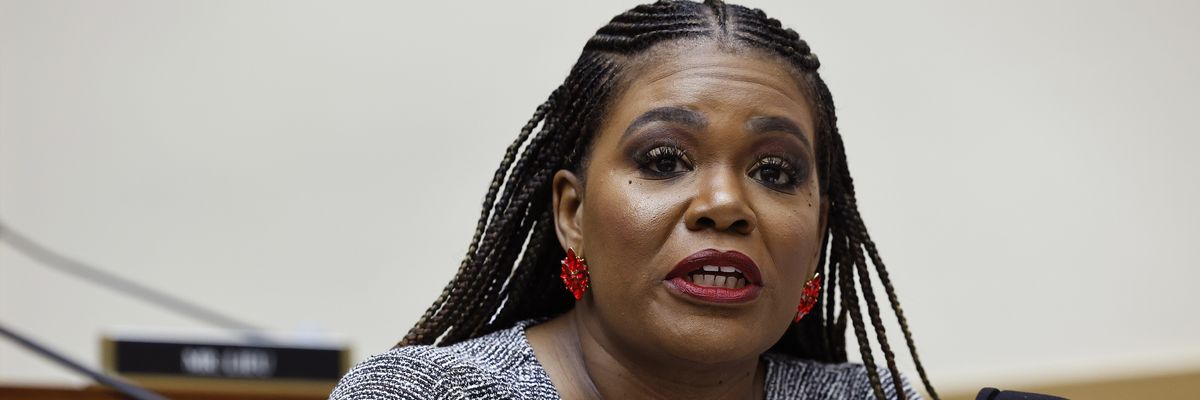
Rep. Cori Bush (D-Mo.) speaks during a House Judiciary Committee hearing on March 12, 2024.
(Photo by Chip Somodevilla/Getty Images)


.


JAKE JOHNSON
Mar 27, 2024
COMMON DREAMS

Rep. Cori Bush on Tuesday called for the repeal of a long-obsolete law that anti-abortion activists, lawmakers, and judges have worked to revive as part of their nationwide assault on reproductive rights.

"The Comstock Act must be repealed," Bush (D-Mo.) wrote in a social media post on Tuesday as the U.S. Supreme Court heard oral arguments in a case brought by a group of anti-abortion doctors aiming to curtail access to mifepristone—a medication used in more than 60% of U.S. abortions.

"Enacted in 1873, it is a zombie statute, a dead law that the far-right is trying to reanimate," Bush warned. "The anti-abortion movement wants to weaponize the Comstock Act as a quick route to a nationwide medication abortion ban. Not on our watch."

Bush's office said she was the first member of Congress to demand the law's repeal since the U.S. Supreme Court overturned the constitutional right to abortion in the summer of 2022.

The Comstock Act, which hasn't been applied in a century and was repeatedly narrowed following its enactment, prohibits the mailing of any "instrument, substance, drug, medicine, or thing" that "may, or can, be used or applied for producing abortion." Legal experts have described the dormant law as the "most significant national threat to reproductive rights."

Given that "virtually everything used for an abortion—from abortion pills, to the instruments for abortion procedures, to clinic supplies—gets mailed to providers in some form," a trio of experts wrote earlier this year, the anti-abortion movement's "interpretation of the Comstock Act could mean a nationwide ban on all abortions, even in states where it remains legal."

"Enforcing a Victorian-era law would be deeply unpopular and Democrats have a chance to sound the alarm, take action in both chambers, and run on it."

The Biden Justice Department has argued that the Comstock Act "does not prohibit the mailing of certain drugs that can be used to perform abortions where the sender lacks the intent that the recipient of the drugs will use them unlawfully."

But the law has nevertheless been cited with growing frequency by far-right advocacy groups and judges following the overturning of Roe v. Wade.

In 2023, a Trump-appointed federal judge in Texas, Matthew Kacsmaryk, invoked the Comstock Act in a decision suspending the Food and Drug Administration's 2000 approval of mifepristone. In 2021, the FDA said it would allow patients to receive abortion medication by mail—which Kacsmaryk claimed the Comstock Act "plainly forecloses."

That case, which has massive implications for abortion rights nationwide, is now before the U.S. Supreme Court.

During oral arguments on Tuesday, Justices Justices Samuel Alito and Clarence Thomas "repeatedly invoked the Comstock Act," The Washington Postreported, "pressing lawyers about whether the 1873 federal law should apply to abortion drugs sent through the mail today."

The justices' comments raised concerns that they could try to resurrect the Comstock Act in their coming ruling in the mifepristone case.


"While the Biden administration has issued guidance saying that the federal government will not enforce the laws," the Post noted, "a future administration seeking to restrict abortion could choose to do so."


Donald Trump, the former president and presumptive 2024 Republican nominee, has expressed support for a national abortion ban.

Jezebel's Susan Rinkunas wrote Tuesday that "enforcing a Victorian-era law would be deeply unpopular and Democrats have a chance to sound the alarm, take action in both chambers, and run on it."

"We definitively have one lawmaker on board," Rinkunas added, referring to Bush. "Who's next?"
Alabama Mercedes-Benz Workers Accuse Company of Union-Busting in NLRB Complaint

"It's just plain retaliation from Mercedes, but I'm not going to be intimidated," said one worker.


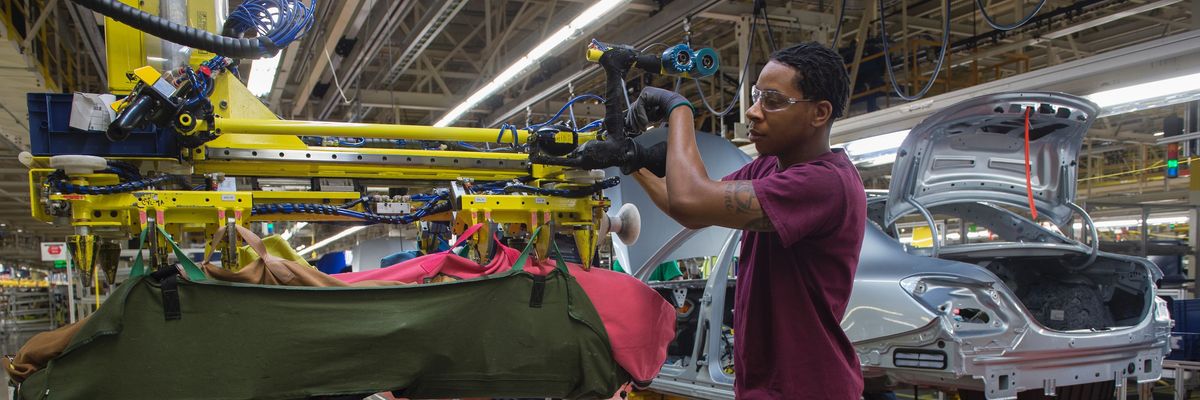
An employee uses a robotic arm to help lift internal parts for a Mercedes-Benz C-Class at the Mercedes-Benz U.S. International factory in Vance, Alabama on June 8, 2017.
(Photo: Andrew Caballero-Reynolds/AFP via Getty Images)

JULIA CONLEY
Mar 26, 2024
COMMON DREAMS

A month after the United Auto Workers announced that a majority of workers at the Mercedes-Benz plant in Vance, Alabama had signed union cards, employees struck a defiant tone Tuesday as they filed official complaints of union-busting by the company with the National Labor Relations Board.

Workers detailed the illegal disciplinary measures management has taken against them for taking leave and objecting to anti-union materials that have been shown in captive-audience meetings since most of the plant's 6,000 workers indicated they want to join the UAW.

"Since we started organizing, I put in my [Family and Medical Leave Act] leave with management multiple times and every time they said they lost the paperwork," Lakeisha Carter, who works in the company's battery plant, told the UAW. "It's just plain retaliation from Mercedes, but I'm not going to be intimidated."


The U.S. Department of Labor last month recovered $438,625 in back pay, unpaid bonuses, and damages for two people who had formerly worked at the plant in Vance, finding that management had illegally fired the workers when they requested FMLA-protected leave to care for a family member and recover from a serious health condition.

After winning new contracts for workers at the Big 3 automakers last fall following an historic "stand-up strike," the UAW has launched campaigns at non-unionized plants owned by Mercedes, Volkswagen, Hyundai, and Toyota, convincing more than 10,000 autoworkers so far to sign union cards.

Another battery plant worker, Taylor Snipes, told the UAW that managers at the company were forcing him and his coworkers "to attend meetings and watch anti-union videos that are full of lies."

After he objected, Snipes was called into a meeting and "immediately fired for having his phone on the factory floor," even though he had been given permission to have his phone with him so he could be in touch with his child's daycare center.


"I told management that it was suspicious that I was being called into the office on the same day that I spoke up in anti-union meeting," said Snipes. "My manager said the two had nothing to do with one another, but then proceeded to aggressively interrogate me about why I support having a union."

UAW President Shawn Fain met with Mercedes workers in Alabama on Sunday.


"Unlike previous drives, the workers are in command," said Luis Feliz Leon of Labor Notes. "They are the collective force that will either press on to a union victory or a defeat."


Experts Warn of Toxins in GM Corn Amid US-Mexico Trade Dispute

"The Mexican government is both wise and on solid ground in refusing to allow its people to participate in the experiment that the U.S. government is seeking to impose."


Farmer Arnulfo Melo shows harvested corn from his organic field in Milpa Alta, Mexico, on October 18, 2021, months after the Mexican government banned genetically modified corn for human consumption.
(Photo: Rodrigo Arangua/AFP via Getty Images)


JESSICA CORBETT
Mar 26, 2024
COMMON  DREAMS

Friends of the Earth U.S. on Monday released a brief backing Mexico's ban on genetically modified corn for human consumption, which the green group recently submitted to a dispute settlement panel charged with considering the U.S. government's challenge to the policy.

Mexican President Andrés Manuel López Obrador announced plans to phase out the herbicide glyphosate as well as genetically modified (GM) or genetically engineered (GE) corn in 2020. Last year he issued an updated decree making clear the ban does not apply to corn imports for livestock feed and industrial use. Still, the Biden administration objected and, after fruitless formal negotiations, requested the panel under the United States-Mexico-Canada Agreement (USMCA).

"The U.S. government has not presented an 'appropriate' risk assessment to the tribunal as called for in the USMCA dispute because such an assessment has never been done in the U.S. or anywhere in the world," said agricultural economist Charles Benbrook, who wrote the brief with Kendra Klein, director of science at Friends of the Earth U.S.

"The U.S. is, in effect, asking Mexico to trust the completeness and accuracy of the initial GE corn safety assessments carried out 15 to 30 years ago by the companies working to bring GE corn events to market."

The group's 13-page brief lays out health concerns related to GM corn and glyphosate, and the shortcomings of U.S. analyses and policies. It also stresses the stakes of the panel's decision, highlighting that "corn is the caloric backbone of the Mexican food supply, accounting, on average, for 50% of the calories and protein in the Mexican diet."

Blasting the Biden administration's case statement to the panel as "seriously deficient," Klein said Monday that "it lacks basic information about the toxins expressed in contemporary GMO corn varieties and their levels. The U.S. submission also ignores dozens of studies linking the insecticidal toxins and glyphosate residues found in GMO corn to adverse impacts on public health."

The brief explains that "since the commercial introduction of GE corn in 1996 and event-specific approvals in the 1990s and 2000s, dramatic changes have occurred in corn production systems. There has been an approximate fourfold increase in the number of toxins and pesticides applied on the average hectare of contemporary GE industrial corn compared to the early 1990s. Unfortunately, this upward trend is bound to continue, and may accelerate."

The U.S. statement's assurances about risks from Bacillus thuringiensis or vegetative insecticidal protein (Bt/VIP) residues "are not based on data and science," the brief warns.

"The U.S. is, in effect, asking Mexico to trust the completeness and accuracy of the initial GE corn safety assessments carried out 15 to 30 years ago by the companies working to bring GE corn events to market," the document says. "The Mexican government is both wise and on solid ground in refusing to allow its people to participate in the experiment that the U.S. government is seeking to impose on Mexico."

"The absence of any systematic monitoring of human exposure levels to Bt/VIP toxins and herbicides from consumption of corn-based foods is regrettable," the brief adds. "It is also unfortunate that the U.S. government rejected the Mexican proposal to jointly design and carry out a modern battery of studies able to overcome gaps in knowledge regarding GE corn impacts."

"The U.S. government's case against Mexico has no more scientific merit than its sham GMO regulatory regime, and should be rejected by the USMCA dispute resolution panel."

Friends of the Earth isn't the only U.S.-based group formally supporting the Mexican government in the USMCA process. The Center for Food Safety sent a 10-page submission by science director Bill Freese, an expert on biotech regulation, to the panel on March 15. His analysis addresses U.S. regulation of genetically modified organisms (GMO) along with the risks of GM corn and glyphosate.

"GMO regulation in the U.S. was crafted by Monsanto, now owned by Bayer, and is a critical part of our government's promotion of the biotechnology industry," Freese said last week, referring to the company known for the glyphosate-based weedkiller Roundup. "The aim is to quell concerns and promote acceptance of GMOs, domestically and abroad, rather than critically evaluate potential toxicity or allergenicity."

His submission notes that the U.S. Food and Drug Administration "does not require a GE plant developer to do anything prior to marketing its GE crop or food derived from it. Instead, FDA operates what it calls a voluntary consultation program that is designed to enhance consumer confidence and speed GE crops to market."

"When governmental review is optional; and even when it's conducted, starts and ends with the regulated company's safety assurance—what's the point?" Freese asked. "Clearly, it's the PR value of a governmental rubber stamp."

"The Mexican government's prohibition of GM corn for tortillas and other masa corn products is fully justified," he asserted. "The U.S. government's case against Mexico has no more scientific merit than its sham GMO regulatory regime, and should be rejected by the USMCA dispute resolution panel."

In a Common Dreams opinion piece last week, Ernesto Hernández-López, a law professor at Chapman University in California, pointed out that Mexico's recent submission to the panel also "offers scientific proof and lots of it," including "over 150 scientific studies, referred to in peer-review journals, systemic research reviews, and more."

"Mexico incorporates perspectives from toxicology, pediatrics, plant biology, hematology, epidemiology, public health, and data mining, to name a few," he wrote. "This clearly and loudly responds to American persistence. The practical result: American leaders cannot claim there is no science supporting the decree. They may disagree with or dislike the findings, but there is proof."

The Biden administration's effort to quash the Mexican policy notably comes despite the lack of impact on trade. While implementing its ban last year, "Mexico also made its largest corn purchase from the U.S., 15.3 million metric tons," National Geographicreported last month.

Kenneth Smith Ramos, former Mexican chief negotiator for the USMCA, told the outlet that "right now, it may not have a big economic impact because what Mexico is using to produce flour, cornmeal, and tortillas is a very small percentage of their overall imports; but that does not mean the U.S. is not concerned with this being the tip of the iceberg."


'Collapse of Political Ambition': EU Shelves Nature Restoration Law

THANKS TO REVANCHIST LANDLORDS
KULAKS BY ANY OTHER NAME

"To let this go now means we go into European elections saying the European system is not working, we do not protect nature, we do not take climate seriously," said Ireland's environmental minister. "That would be an absolute shame."


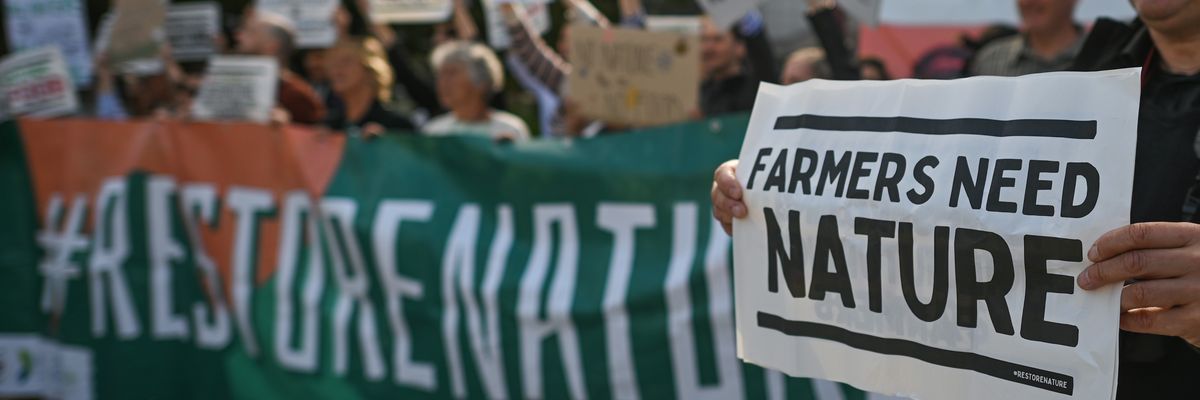
Environmental activists protest in Brussels in support of the European Union's Nature Restoration Law on May 31, 2023.
(Photo: Artur Widak/NurPhoto via Getty Images)


JULIA CONLEY
Mar 26, 2024
COMMON DREAMS

Environmental ministers in the European Union on Monday warned that the bloc's credibility on heading off the global biodiversity and climate emergencies is in peril following the European Council's decision to remove the historic Nature Restoration Law from its agenda after the proposal lost key support.

"We inspired others, yet now we risk arriving empty handed at COP16 [the 2024 UN Biodiversity Conference]," Virginijus Sinkevičius, E.U. commissioner for environment, oceans, and fisheries, said in a statement. "Backtracking now is... very difficult for me to accept."

The law, first introduced in 2022 and approved by European Parliament last month, faced one final hurdle to passage with the planned Council vote, but recent protests by farmers over the new nature restoration requirements helped push some previous supporters to reverse their positions on Monday.

The Nature Restoration Law, which supporters said they still intend to try to pass before E.U. elections in June, would require member states to adopt measures to restore at least 30% of habitats by 2030, working up to 90% by 2050. Member states would be required to take action to reverse pollinator populations, restore organic soils in agricultural use, increase development of urban green areas, and take other steps to protect biodiversity.

Since the farmer protests began in France and started spreading to other countries including Spain, Belgium, and Italy, policymakers have offered concessions including delayed implementation of another set of biodiversity rules calling for the agriculture industry to keep 4% of farming land free of crop production to regenerate healthy soil. The European Commission also shelved an anti-pesticide law in February in response to the protests.

As countries announced their new opposition to the Nature Restoration Law in recent days, some ministers suggested the demonstrations contributed to their decision.

Anikó Raisz, Hungary's minister of state for environmental affairs, said the law would "overburden the economy" and cited concerns about the "sensitive situation" in the agriculture sector. Italy also said it was concerned about the biodiversity rules' impact on farmers.

The World Wide Fund For Nature (WWF) accused far-right Hungarian President Viktor Orbán, who has dismissed European climate policies, of being behind the "unexpected and clearly politically motivated change in Hungary's position."

Hungary's opposition "was left unchallenged by Sweden, Poland, Finland, the Netherlands, Belgium, Austria, and Italy—who continue to either abstain or oppose," and "has now put the [Nature Restoration Law] in jeopardy again, giving Hungary's President Viktor Orbán the green light to further his own agenda and hold E.U. decision-making hostage," said WWF.

Eamon Ryan, Irish minister for the environment, accused other policymakers in the bloc of "buckling" before the farmer protests, which continued Tuesday, ahead of June elections.

"The biggest risk is the collapse of political ambition and will," Ryan said. "To let this go now means we go into European elections saying the European system is not working, we do not protect nature, we do not take climate seriously. That would be an absolute shame."


BirdLife Europe called on the E.U. the continue its efforts to pass the Nature Restoration Law before the session ends this summer.

"The E.U.'s reputation hangs in the balance in this critical year of E.U. elections," said the group. "Failure to make the law a reality also undermines the E.U.'s credibility and leadership on its international commitments to tackle the biodiversity and climate crises."

Sinkevičius was among the leaders who said they planned to continue negotiations on the law, saying he was "optimistic" that "the member states can bring it over the finish line."


"This is definitely not the end of the story," Alain Maron, Belgium's minister for climate change, environment, energy, and participative democracy, told reporters at a press conference Monday. He added that the Belgian presidency of the European Council "will work hard in the next few weeks to find possible ways out of this deadlock, and get the file back on the agenda for adoption in another council."
Grave 'Threat to Journalists' Remains as UK Court Delays Assange Extradition Ruling

"The Biden administration should take the opportunity to drop this dangerous case once and for all," said the executive director of the Freedom of the Press Foundation.


Supporters of WikiLeaks founder Julian Assange hold placards outside of the United Kingdom's High Court in central London on March 26, 2024.

(Photo: Daniel Leal/AFP via Getty Images)


JAKE JOHNSON
Mar 26, 2024
COMMON DREAMS

The United Kingdom's High Court ruled Tuesday that WikiLeaks founder Julian Assange cannot immediately be extradited to the United States and gave the Biden administration three weeks to provide "assurances" that the publisher's First Amendment rights will be protected and that he won't face the death penalty.

If the U.S. does not provide the requested assurances, Assange will be allowed to pursue a limited appeal of his extradition. Should the U.S. submit assurances by the April 16 deadline, a hearing will be held on May 20 to determine whether they are "satisfactory."

Assange, whose health has deteriorated badly during his five years in a high-security London jail, faces 17 counts of violating the Espionage Act and a possible 175-year prison sentence in the U.S. for publishing classified information—a common journalistic practice. WikiLeaks disclosures exposed grave U.S. and U.K. war crimes in Iraq and Afghanistan.

Press freedom and human rights groups say the extradition of Assange to the U.S. would set a dangerous precedent and pose a dire threat to journalism everywhere.

Trevor Timm, executive director of the Freedom of the Press Foundation, said in a statement Tuesday that "we are glad Julian Assange is not getting extradited today."

"But this legal battle is far from over, and the threat to journalists and the news media from the Espionage Act charges against Assange remains," said Timm. "Assange's conviction in American courts would create a dangerous precedent that the U.S. government can and will use against reporters of all stripes who expose its wrongdoing or embarrass it. The Biden administration should take the opportunity to drop this dangerous case once and for all."

"It's long past time for the U.S. Justice Department to abandon the Espionage Act charges and resolve this case."

The U.S., which has been aggressively pursuing Assange's extradition for years, previously provided the U.K. government with assurances that Assange would not be held at a supermax prison that's notorious for its inhumane treatment of inmates.

Human rights groups have said such assurances from the U.S. government are "inherently unreliable" and should not be taken seriously by British authorities.

"While the U.S. has allegedly assured the U.K. that it will not violate Assange's rights, we know from past cases that such 'guarantees' are deeply flawed—and the diplomatic assurances so far in the Assange case are riddled with loopholes," noted Simon Crowther, legal adviser at Amnesty International.

"The U.S. must stop its politically motivated prosecution of Assange, which puts Assange and media freedom at risk worldwide," Crowther said Tuesday. "In trying to imprison him, the U.S. is sending an unambiguous warning to publishers and journalists everywhere that they too could be targeted and that it is not safe for them to receive and publish classified material—even if doing so is in the public interest."

Jameel Jaffer, executive director of the Knight First Amendment Institute at Columbia University, echoed that message, saying in a statement that "prosecuting Assange for the publication of classified information would have profound implications for press freedom, because publishing classified information is what journalists and news organizations often need to do in order to expose wrongdoing by government."

"It's long past time for the U.S. Justice Department to abandon the Espionage Act charges and resolve this case," said Jaffer.
Sanders Rips 'Absurd' US Claim That Israel Is Not Violating International Law

"The State Department's position makes a mockery of U.S. law and assurances provided to Congress," said Sen. Bernie Sanders.


Children in Rafah, Gaza gather to receive food distributed by aid organizations on March 15, 2024.
(Photo: Jehad Alshrafi/Anadolu via Getty Images)


JAKE JOHNSON
Mar 26, 2024
COMMON DREAMS


Sen. Bernie Sanders on Monday said the U.S. State Department's determination that Israel is not violating international law with its assault on the Gaza Strip is "absurd on its face," pointing to the mass death, destruction, and starvation that Israeli forces have inflicted on the territory's population over the past six months.

"Thirty-two thousand Palestinians in Gaza have been killed and almost 75,000 injured, two-thirds of whom are women and children," Sanders (I-Vt.) said in a statement. "Some 60% of the housing units have been damaged or destroyed, and almost all medical facilities have been made inoperable. Today, hundreds of thousands of Palestinian children are facing starvation because [Israeli Prime Minister Benjamin] Netanyahu won't let in sufficient humanitarian aid, while thousands of trucks are waiting to get into Gaza."

"The State Department's position," said Sanders, "makes a mockery of U.S. law and assurances provided to Congress."

The senator's statement came after State Department spokesperson Matthew Miller told reporters during a press briefing earlier Monday that the Biden administration has not found Israel "to be in violation of international humanitarian law, either when it comes to the conduct of the war or when it comes to the provision of humanitarian assistance."

Miller was responding to a question about assurances the administration has received from the Israeli government that its use of American weaponry has complied with international law and that it has permitted U.S. humanitarian aid to enter Gaza, where the entire population is facing acute hunger.

Under a new Biden administration policy known as NSM-20, recipients of American military aid are required to provide the U.S. government with "credible and reliable" written assurances that they are using such assistance "in a manner consistent with all applicable international and domestic law and policy."


Late last week, a group of U.S. senators—including Sanders—warned the Biden administration that deeming Israeli assurances credible would "be inconsistent with the letter and spirit of NSM-20" and "establish an unacceptable precedent" for the application of the policy "in other situations around the world."

"Until Biden is ready to impose real policy consequences on Netanyahu's government, the famine will continue."

It is a violation of U.S. law to continue sending military assistance to a country that is obstructing the delivery of American humanitarian aid. Last month, far-right Israeli Finance Minister Bezalel Smotrich blocked a U.S.-funded flour shipment from entering the Gaza Strip, and Israeli forces have repeatedly fired on convoys attempting to deliver aid to desperate Gazans.

Prominent human rights groups have been calling on the U.S. to impose an arms embargo on Israel for months, pointing to documented examples of the Israeli military using American weaponry to commit atrocities in Gaza.

But the Biden administration has refused to even apply concrete restrictions on American military aid. Over the weekend, U.S. President Joe Biden signed into law a measure that approves $3.8 billion in unconditional military assistance for the Israeli government and imposes a one-year ban on funding for the primary humanitarian aid organization in Gaza.

Jeremy Konyndyk, the president of Refugees International and a former USAID official, said Monday that Israel's assurances to the U.S. are "not remotely credible" and argued the Biden administration is undermining efforts to combat the worsening humanitarian crisis in Gaza by accepting the Israeli government's claims.

The U.S., he said, is "talking a big game about fighting the famine that its bombs and diplomatic cover have helped create." Resorting to "gimmicky" efforts such as airdrops and temporary ports while a U.S. ally obstructs humanitarian aid "is not how you fight a famine," Konyndyk argued.

"Fundamentally Biden must choose: between continuing to enable Netanyahu, or ending the famine. There's no way to split the difference," said Konyndyk. "Until Biden is ready to impose real policy consequences on Netanyahu's government, the famine will continue."
'We're Calling for Justice': Allies Slam Trial for El Salvador Water Defenders

Ahead of proceedings next week, an international coalition continues to back a call to "drop the baseless charges against the Santa Marta Five."


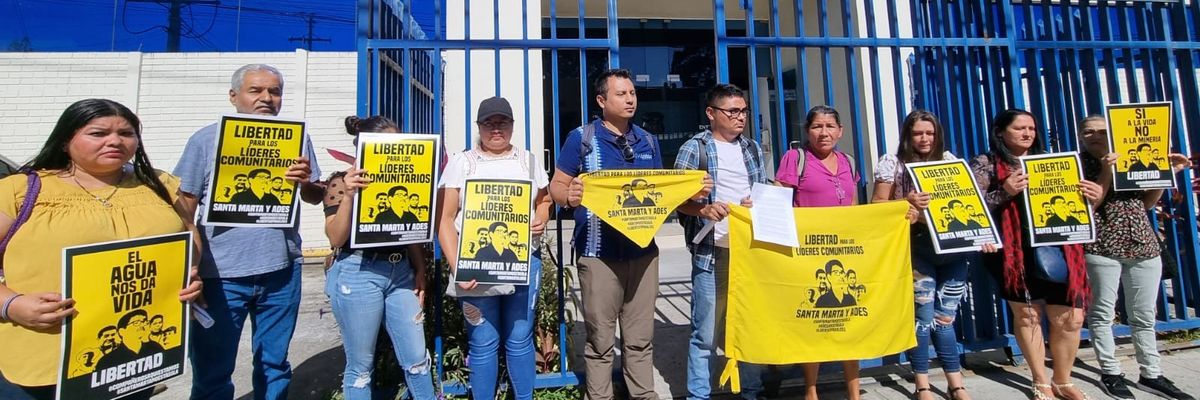
Supporters of the Santa Marta Five gathered in El Salvador on February 16, 2024.
(Photo: Comunidad Santa Marta/X)

JESSICA CORBETT
Mar 25, 2024
COMMON DREAMS

Nine organizations from around the world on Monday renewed calls for El Salvador's government to drop "politically motivated charges" against the "Santa Marta Five" as the well-known water defenders prepared to stand trial beginning April 3.

Miguel Ángel Gámez, Alejandro Laínez García, Pedro Antonio Rivas Laínez, Teodoro Antonio Pacheco, and Saúl Agustín Rivas Ortega were arrested in January 2023 and accused of murdering an alleged military informant during a civil war over three decades ago. Rights groups worldwide have repeatedly highlighted that not only has the Salvadoran government failed to produce any proof of their guilt, but also the five men should be covered under a 1992 amnesty law related to the war.

"In the spirit of Saint Óscar Romero, these community leaders have embodied the legacy of the preferential option for the poor in their fight for justice and for the well-being of their communities," Institute for Policy Studies (IPS) senior adviser John Cavanagh said Monday, a day after the 44th anniversary of Romero's assassination in San Salvador.

"Now, we're calling for justice for the Santa Marta Five as they face politically motivated charges and attempts to silence their movement," added Cavanagh, whose group gave its 2009 Letelier-Moffitt Human Rights Award to the National Roundtable on Metals Mining, a coalition the arrested water defenders helped build.

"We recognize the historic and heroic struggle of the community of Santa Marta to build a better future for the most marginalized populations."

The Santa Marta Five, who were released to house arrest in September, helped pass a 2017 legislative ban on metal mining in El Salvador. Salvadoran President Nayib Bukele, who was reelected last month, has reportedly been considering reversing the prohibition in response to economic issues resulting from his policies.

"The Santa Marta Five water defenders were part of an emblematic fight to protect their land and waters from Canadian gold mining and ban metal mining," declared Viviana Herrera, Latin America program coordinator at MiningWatch Canada. "However, as in other countries in the region, their environmental struggle has come at an immense cost for them and their communities."

Chris Aylward, national president of the Public Service Alliance of Canada, said that "we recognize the historic and heroic struggle of the community of Santa Marta to build a better future for the most marginalized populations, one where universal rights are guaranteed, including to health and water for all."

Acknowledging the global movement that has rallied behind the Santa Marta Five, the United Church of Canada's Christie Neufeldt vowed to keep pushing "for the charges to be dropped and to accompany their work to protect the ban on metals mining.

Along with the Canadian groups and IPS, the coalition supporting the five men includes the Central American Alliance on Mining, Pax Christi International, the SHARE Foundation, Sisters of Mercy of the Americas, and the Washington Ethical Society (WES)
.

“The Washington Ethical Society has a long history with the communities of El Rodeo and Santa Marta. We partnered with ADES in an eight-year process to build a potable water system for the community," noted Ross Wells, co-chair of WES's sister community program in El Salvador. "Antonio Pacheco, director of ADES and one of the arrested water defenders, was instrumental in making this project possible."

"WES members met with him every year for 12 years. Like the other members of the Santa Marta Five, Antonio was arrested and jailed for political reasons. These men fought hard to protect the waters of El Salvador from the ravages of metallic mining," he continued. "To help prop up an imploding economy, the current regime is making moves to reintroduce mining against the will of the people."

Wells also pointed out that the Santa Marta Five are among the tens of thousands of people arrested under El Salvador's state of exception, which began in March 2022 and has provoked intense condemnation from rights groups that have documented sweeping abuse by security forces, including arbitrary detention without due process.

"WES stands with the people of Santa Marta, in working for a just El Salvador, where human rights and the rule of law are respected," he said. "We pledge to continue fighting with others in the international community to protect the existing law against mining and drop the baseless charges against the Santa Marta Five."
Just ‘Stop Drilling,’ Critics Say After Biden Admin Finalizes Methane Limits


The new Biden administration rule will limit methane emissions, but critics say it's time to stop drilling for fossil fuels.


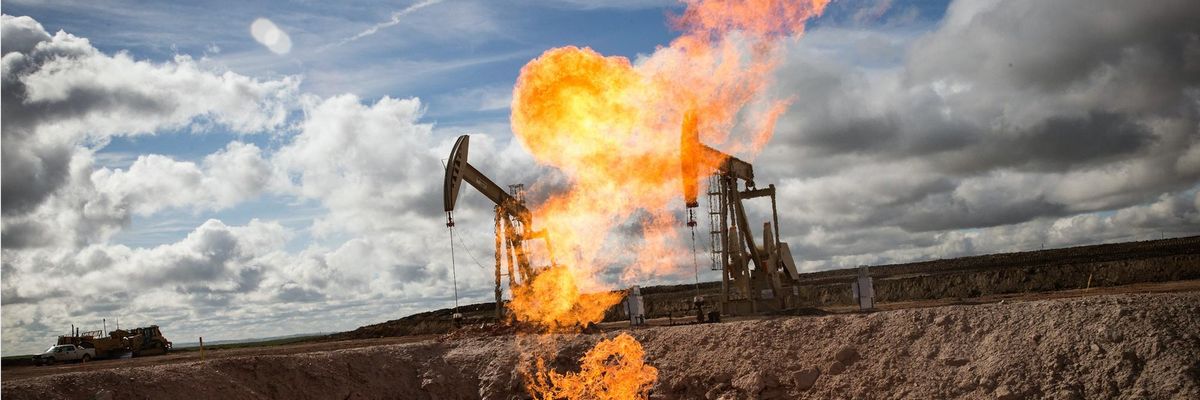
A gas flare is seen at an oil well site  outside Williston, North Dakota.
(Photo: Andrew Burton/Getty Images)

THOR BENSON
Mar 28, 2024
COMMON DREAMS

The Biden administration on Tuesday finalized rules that will force oil and gas companies to reduce their methane emissions, but critics say the administration needs to do more to curb a key driver of the planet-warming pollution: fossil fuel drilling.

Methane is a potent greenhouse gas, and the Bureau of Land Management's new rules will require that fossil fuel companies contain methane leaks at oil and natural gas wells that are on federal land, and they will also have to limit how much methane they burn off.

Critics say the only solution that will truly address the climate crisis is to stop drilling entirely. Recently released Interior Department data shows that the Biden administration has approved close to 50% more oil and gas drilling permits on public lands than the Trump administration did during its first three years.

"The best way to eliminate methane pollution from public lands is to stop fossil fuel drilling, period. In the midst of a climate emergency, we need to take the actions necessary to stop pollution once and for all," Food & Water Watch Policy Director Jim Walsh said in a statement. "We look forward to working with climate champions in Congress like Rep. Jan Schakowsky to pass the Future Generations Protection Act to ban fracking on public lands and everywhere else."

Some praised the new rules as needed progress, including Sen. Ed Markey (D-Mass.).


Interior Secretary Deb Haaland said in a statement Tuesday that “this final rule, which updates 40-year-old regulations, furthers the Biden-Harris administration’s goals to prevent [methane] waste, protect our environment and ensure a fair return to American taxpayers.”

Methane can trap far more heat than CO2, so limiting emissions is a critical part of addressing the climate crisis. Despite pledging to cut methane emissions, oil and gas companies have not significantly reduced emissions in recent years. The U.S. is currently the largest emitter of methane from oil and gas in the world.

The International Energy Agency says major reductions in methane emissions need to be made if the world is going to avert catastrophic global warming.


US Leads Charge as Surge of Oil and Gas Projects Threaten Hope for Livable Planet

"The science is clear: No new oil and gas fields, or the planet gets pushed past what it can handle," said one analyst.


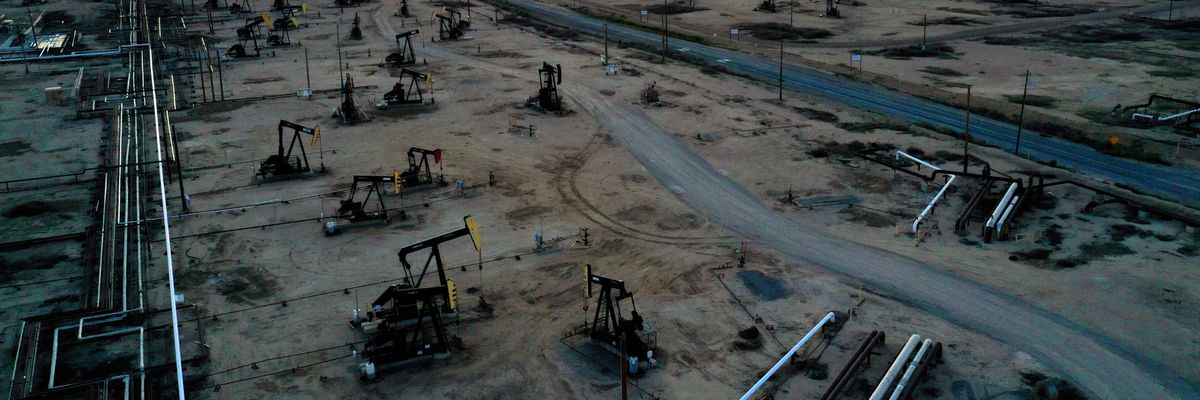
There are over 1,100 oil-producing wells in the McKittrick oil field, just north of the town of McKittrick, California.

(Photo: Carolyn Cole/Los Angeles Times via Getty Images)


JULIA CONLEY
Mar 28, 2024
COMMON DREAMS

Fossil fuel-producing countries late last year pledged to "transition away from fossil fuels," but a report on new energy projects shows that with the United States leading the way in continuing to extract oil and gas, governments' true views on renewable energy is closer to a statement by a Saudi oil executive Amin Nasser earlier this month.

"We should abandon the fantasy of phasing out oil and gas," the CEO of Saudi Aramco, the world's largest oil company, said at an energy conference in Houston.

new report published Wednesday by Global Energy Monitor (GEM) suggests the U.S. in particular has abandoned any plans to adhere to warnings from climate scientists and the International Energy Agency (IEA), which said in 2021 that new oil and gas infrastructure has no place on a pathway to limiting planetary heating to 1.5°C.

Despite the stark warning, last year at least 20 oil and gas fields worldwide reached "final investment decision," the point at which companies decide to move ahead with construction and development. Those approvals paved the way for the extraction of 8 billion barrels of oil equivalent (boe).

By the end of the decade, companies aim to sanction nearly four times that amount, producing 31.2 billion boe from 64 oil and gas fields.

The U.S. led the way in approving new oil and gas projects over the past two years, GEM's analysis found.


NO CANADA LISTED!!!

ALONG WITH AN EXAGGERATED 
GUYANA MAKES THIS SUSPICOUS


An analysis by Carbon Brief of GEM's findings shows that burning all the oil and gas from newly discovered fields and approved projects would emit at least 14.1 billion tonnes of carbon dioxide.

"This is equivalent to more than one-third of the CO2 emissions from global energy use in 2022, or all the emissions from burning oil that year," said Carbon Brief.

GEM noted in its analysis that oil companies and the policymakers who continue to support their planet-heating activities have come up with numerous "extraction justifications" even as the IEA has been clear that new fossil fuel projects are incompatible with avoiding catastrophic planetary heating.

The report notes that U.S. Sen. Lisa Murkowski (R-Alaska) "supported ConocoPhillips' Willow oil field, arguing that the Alaskan oil and gas industry has a 'better environmental track record,' and not approving the project 'impoverish[es] Alaska Natives and blame[s] them for changes in the climate that they did not cause.'"

Carbon Brief reported that oil executives have claimed they are powerless to stop extracting fossil fuels since demand for oil and gas exists for people's energy needs, with ExxonMobil CEO Darren Woods tellingFortune last month that members of the public "aren't willing to spend the money" on renewable energy sources.

A poll by Pew Research Center last year found 67% of Americans supported the development of alternative energy sources. Another recent survey by Eligo Energy showed that 65% of U.S. consumers were willing to pay more for renewable energy.

"Oil and gas producers have given all kinds of reasons for continuing to discover and develop new fields, but none of these hold water," said Scott Zimmerman, project manager for the Global Oil and Gas Extraction Tracker at GEM. "The science is clear: No new oil and gas fields, or the planet gets pushed past what it can handle."

Climate scientist and writer Bill McGuire summarized the viewpoint of oil and gas executives and pro-fossil fuel lawmakers: "Climate emergency? What climate emergency?"

The continued development of new oil and gas fields, he added, amounts to "pure insanity."

Breakdown of Safety Is Not Unique to Boeing — It’s Endemic to Capitalist Society


Heads are rolling at Boeing, but new leadership doesn’t alter the labor conditions and profit motives that erode safety.

March 28, 2024
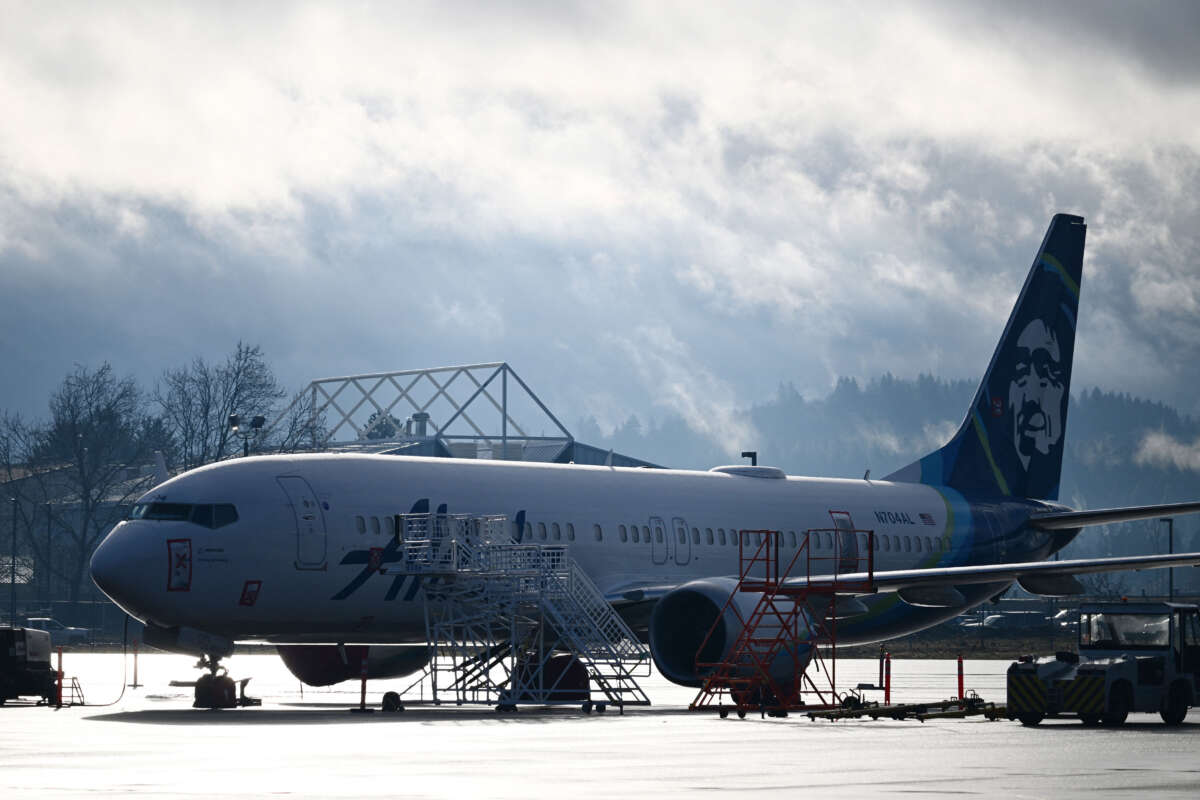
Alaska Airlines N704AL, a Boeing 737 Max 9, which made an emergency landing at Portland International Airport on January 5, is parked at a maintenance hanger in Portland, Oregon, on January 23, 2024.
PATRICK T. FALLON / AFP VIA GETTY IMAGES

In a dramatic turn of events, Boeing CEO Dave Calhoun announced on March 25, 2024, that he will step down at the end of the year following the company’s poor safety record, negative press and significant financial losses following the multiple safety problems with its 737 Max jets.

The now-infamous Alaska Airlines January flight, landing after a door panel blew off the plane mid-flight, led to the grounding of 171 737 Max jets (and subsequent mass cancellation of flights) and a Federal Aviation Administration (FAA) order to suspend production on the 737 Max. The National Transportation Safety Board has made the flight an investigative priority. Since then, more dramatic accidents have occurred, including a cracked windshield, plane fires, fuel leaks, stuck rudder pedals, at least one tire failure, and other problems.

The FAA announced in a February 26 report conducted by a panel of experts including government, industry, labor and academics over the past year, that Boeing failed 33 of 89 safety audits of its 737 Max manufacturing process. The report led to a devaluation of Boeing stock, a market value of about $45 billion in 2024. To say this has been devastating for the company and for airline travelers’ confidence is an understatement.

Calhoun is not the only leader who has departed — other members of the executive leadership at the company have stepped down or announced their intention to, as well. But while the dramatic news of the deposed CEO has made many headlines, it’s also a corporate sleight of hand that obscures the ways in which corporate profit motives — including a failed “safety culture” that continues to leave workers vulnerable to reprisal as well as ongoing attempts to undercut union plants — have promoted unsafe production practices permitted by a weak regulatory state regime.

This latest corporate leadership shuffle is a signal to consumers and investors that the company means to improve confidence in Boeing’s products. But we cannot understand the Boeing controversy in a vacuum.

1 US Worker Dies on the Job Every 96 Minutes, Latest Data Shows
New data from the Bureau of Labor Statistics documents a significant jump in on the job deaths in the US. By Tyler Walicek , TRUTHOUTFebruary 17, 2024

Boeing was once known as an industry leader in manufacturing safe and well-made jets. The Boeing 737 was the best-selling airplane in history, used by 80 airlines, with most of them operating in Asia. But in October 2018 and March 2019, less than five months apart, the Boeing 737 Max jets experienced fatal crashes in Indonesia and Ethiopia, killing a total of 346 people. The FAA, under former President Donald Trump, was reluctant to ground the jets but finally grounded the 737 Max (following the lead of China’s aviation authority, Canada, the European Union, and 10 other countries) while the jet underwent a 20-month safety review process. The agency greenlit the jet to take flight again in November 2020, but concerns persist. Aviation experts argue Boeing has consistently chosen financial gains over an abundance of caution when dealing with pressing safety concerns. (Much has already been written about how financialization of Boeing, exemplified by its relocation of some production from Puget Sound in 2001, was a key turning point for the company.)

Boeing’s leaders knew there were serious safety problems with their company’s 737 Max jet and other products, yet they failed to institute systemic changes, despite the fact that workers gave them such warnings.

The American Airlines pilots union urged Boeing to address 737 safety concerns in a meeting with Boeing executives prior to the deadly 2019 Ethiopian Airlines crash. Pilots asked Boeing leadership to fix a malfunctioning anti-stall system, called “Maneuvering Characteristics Augmentation System” (designed to prevent the 737 from climbing too steeply and stalling) but Boeing’s vice president pushed back, claiming it wasn’t clear that a malfunctioning system caused the 2018 Malaysian Air crash. To make matters worse, Boeing also refused to honor one pilot’s requests for additional training on the 737, reprimanding him instead.

Changes in the federal safety regulation of aviation demonstrate how these endemic problems within Boeing’s safety regime were permitted. Regulatory oversight of aviation was understaffed and underresourced during the Trump administration, with the FAA’s top position vacant for 14 months and enforcement fines against airlines dropping 88 percent. Trump’s FAA gave more authority to private companies, but his administration isn’t solely responsible for the deregulatory shift, as the FAA had been moving toward “sharing” regulatory oversight with manufacturers over the years. This began in 2004, against the protests of aviation unions who warned such a move would hurt the safety of the industry and lead to more accidents.

While the dramatic news of the deposed CEO has made many headlines, it’s also a corporate sleight of hand that obscures the ways in which corporate profit motives … have promoted unsafe production practices.

Democratic administrations have also had a hand in dismantling regulatory oversight. During the Obama administration, the FAA continued to increasingly delegate safety monitoring and oversight to private companies. Part of the justification for continuing the practice were concerns about the increasing competitive pressure from foreign jet plane manufacturing rivals above the concerns of government watchdog investigations. This practice is now deeply institutionalized, with FAA-certified employees at private companies doing 90 percent of safety certifications. Proponents of this “sharing” of regulation seek to justify the arrangement by arguing that industry innovation is outpacing the expertise of government regulators. But even private sector regulators are suffering from a lack of sufficient personnel, with high rates of turnover and retirements after COVID-19. This was also confirmed in the February FAA report, which called the turnover of “experienced personnel” a “major concern.”

The FAA report also revealed the endemic anti-safety biases within Boeing’s production process. The February 2024 FAA expert panel’s report, based on hundreds of employee interviews and review of 4,000 pages of documents, stated: “Boeing employees across all disciplines and roles expressed concerns over the lasting power of the SMS [safety management system] program and safety initiatives. This raises concerns about the sustainability of SMS. The lack of feedback and/or delay in providing feedback jeopardizes the longevity of SMS.”

According to the report, employees did not always understand Boeing’s safety managements systems. Employees did not always know the appropriate reporting channels and were not informed about the outcomes of their reports. Employees also shared examples of retaliation and interference — especially in regard to salary and furlough ranking — that occurred when workers expressed safety concerns. These retaliatory practices exacerbated the disconnect between the goals of corporate leadership and actual shop floor practices. Workers knew that reporting safety concerns would lead to slowdowns in safety certification or production processes, which in turn could hurt economic goals. A workplace where employees cannot speak up without fear of reprisal and where their input isn’t integrated in everyday production practices cannot be a company that truly prioritizes product and consumer safety.

As much as this story is one of consumer safety, Boeing’s problems are also the result of an anti-worker culture. Rich Plunkett, who is director of strategic development at Boeing’s union, the Society of Professional Engineering Employees in Aerospace, released a statement in conjunction with the publishing of the February FAA report:

Our members have long reported a disconnect between the messaging they get from Boeing headquarters in Chicago or Virginia, and the messages they get from their direct supervisors here. Quality and safety must be the Boeing Co.’s core values, embraced by everyone, but the report reflects the reality that people who see something are afraid of saying anything for fear of jeopardizing their careers.

As a result of the FAA report, the union requested the creation of an Aviation Safety Action Program, a collaboration between Boeing and FAA, that would allow workers to bring forward safety concerns, including production and design errors, without fear of retaliation.

Perhaps one of the most tragic parts of this story is the loss of whistleblower John Barnett, a former quality control manager who expressed multiple concerns about safety at the company’s 787 Dreamliner manufacturing plant in South Carolina. (The 787 has also been grounded multiple times for safety concerns, including over smoke and fire incidents.) Barnett noted the significant differences in safety reporting in his unionized plant (in Everett, Washington) in contrast to the failures of safety reporting in his nonunionized Charleston, South Carolina, Boeing plant. (There was one quality assurance inspector per 15 mechanics in Everett, but only one inspector per 50 mechanics in Charleston, and many of those mechanics were brand new to the industry.)

Barnett was participating in a deposition relating to his suit against the company for the retaliation he suffered at Boeing for his whistleblowing activities, and was found dead of an apparent self-inflicted gunshot wound in the parking lot of a Charleston, South Carolina, Holiday Inn on March 9, 2024.

Evidence of Boeing’s poor operations and organizational culture also came to light when the company declared it could not find documents related to Alaska Airlines’s blown-off door plug in response to a query from a federation investigation. It’s clear that the company’s toxicity toward safety-oriented employees has been devastating, as reflected by the February FAA report.

Aviation experts argue Boeing has consistently chosen financial gains over an abundance of caution when dealing with pressing safety concerns.

The poor working conditions at Boeing were amplified by a terrible contract negotiation in 2014, in which workers agreed to a contract that included givebacks on pensions, minimal wage increases (4 percent over 10 years) and that locked them in this suboptimal set of conditions for a decade. To force an end to the company’s fixed pension plan, Boeing threatened to take 777X production from Seattle to South Carolina. The International Association of Machinists and Aerospace Workers (IAM), which represents many Boeing employees (about 35 percent of its total workforce) is taking cues from the United Auto Workers and tight labor market to make strong demands.

In 2024, the union is looking for 40 percent wage increases and a return of the company’s pension plan, in addition to other workplace protections. Considering that safety problems have emerged as Boeing has shifted production away from the highly unionized Puget Sound region to the South, District 751 IAM President Jon Holden wants Boeing to commit to multiple decades of production in the Northwest. IAM machinists are also requesting a seat on Boeing’s board as a way to promote great future safety.

While the future of the 737 Max remains unclear, what is clear is that the retreat of the regulatory state, combined with Boeing’s aggressive attacks on workers — both in terms of bargaining with unions and retaliating against individual workers — has contributed to the enduring marginalization of safety culture at the company. Some consumer advocates see the Federal Bureau of Investigation and Department of Justice’s criminal investigation into the Alaska Airlines incident as progress, but this won’t be the first criminal proceeding against Boeing.

While some consumers remain understandably frightened and are deliberately avoiding Boeing flights, these problems are not exclusive to Boeing. The breakdown of consumer safety measures is endemic to the neoliberal capitalist pursuit of profit in the provision of public services, and to an employment regime that continually fails to provide adequate protections for workers.

Workers’ right to have a voice in their workplaces and to speak freely about product safety concerns is a necessary minimum for the safety of their products. Only when this basic condition is met can people in the U.S. fly safely, with confidence in the quality of their airplanes.


SUSAN KANG  is an associate professor of political science at John Jay College, City University of New York. She is the author of Human Rights and Labor Solidarity: Trade Unions in the Global Economy.

Boeing CEO's Voluntary Departure Is Not Accountability for Corporate Crime: Watchdog

"For real and lasting change to occur," said Public Citizen's Robert Weissman, "Boeing must now be held criminally accountable."


Boeing CEO Dave Calhoun leaves a meeting with Sen. Mark Warner on January 24, 2024.
(Photo: Tom Williams/CQ-Roll Call, Inc. via Getty Images)


JAKE JOHNSON
Mar 25, 2024
COMMON DREAMS

Embroiled once again in an alarming quality control and safety scandal, the aircraft manufacturing giant Boeing on Monday announced a management shake-up that will see CEO Dave Calhoun step down at the end of the year, the head of the company's commercial airplanes division resign immediately, and the chairman of the board depart after Boeing's annual meeting in May.

Calhoun, who said he decided on his own to resign, took charge at Boeing in the midst of the company's previous high-profile crisis—the grounding of the 737 MAX jet following a pair of crashes in 2018 and 2019 that killed more than 340 people.

Robert Weissman, president of the consumer advocacy group Public Citizensaid in response to the news of Calhoun's coming departure that "if Boeing had been held criminally accountable after the... 737 MAX disasters, the more recent quality debacles quite likely could have been averted."

Earlier this year, a door plug of a Boeing 737 MAX 9 flew off the aircraft as it ascended, causing minor injuries and forcing the pilots to conduct an emergency landing. More than 170 MAX 9s were subsequently grounded to undergo inspections.

The incident prompted federal regulators, airlines, and journalists to—once again—closely scrutinize Boeing's manufacturing processcost-cutting effortslobbying against safety regulations, and executive and shareholder payouts.

The Leverreported days after the January 5 incident that "less than a month before a catastrophic aircraft failure prompted the grounding of more than 150 of Boeing's commercial aircraft, documents were filed in federal court alleging that former employees at the company's subcontractor repeatedly warned corporate officials about safety problems and were told to falsify records."

The outlet also found that "operators of Boeing's troubled 737 MAX planes have filed more than 1,800 service difficulty reports—more than one per day—warning government regulators about safety problems with the aircraft since the fleet was allowed to resume flying after two fatal crashes."

Alaska Airlines, the operator of the January 5 flight, said in late January that it found loose bolts on "many" of Boeing's 737 MAX 9s.

"The FAA identified noncompliance issues in Boeing's manufacturing process control, parts handling and storage, and product control."

In an update published on March 4, the Federal Aviation Administration (FAA) said its six-week audit of Boeing and Spirit AeroSystems—a major Boeing contractor—uncovered "multiple instances where the companies allegedly failed to comply with manufacturing quality control requirements."

"The FAA identified noncompliance issues in Boeing's manufacturing process control, parts handling and storage, and product control," the agency said. "To hold Boeing accountable for its production quality issues, the FAA has halted production expansion of the Boeing 737 MAX, is exploring the use of a third party to conduct independent reviews of quality systems, and will continue its increased onsite presence at Boeing's facility in Renton, Washington, and Spirit AeroSystems' facility in Wichita, Kansas."

Earlier this month, days after the FAA update was published, a Boeing whistleblower who raised concerns about the company's quality control practices was found dead of what local officials said appeared to be a self-inflicted gunshot wound.

Weissman of Public Citizen said Monday that "of course CEO Dave Calhoun should be dismissed" over the company's latest safety crisis.

"But for real and lasting change to occur," he argued, "Boeing must now be held criminally accountable both for the recent safety failures and the... crashes that took 346 lives."

In 2021, Boeing entered into a deferred prosecution agreement with the U.S. Justice Department to avoid a criminal charge over an alleged conspiracy to defraud the FAA in the wake of the 2018 and 2019 crashes.

Public Citizen noted in a report published Monday that "such agreements now help the most powerful businesses in the world dodge the legal consequences of their criminal misconduct."

"Instead of facing prosecution—which would mean plea agreements or trial in a public court of law—leniency deals are negotiated quietly between prosecutors and corporate lawyers with little or no judicial oversight," the group said. "Proponents say the agreements are a streamlined way to effectively deter corporate crime. Public Citizen research, however, shows about 15% of the agreements historically involve repeat offenders, casting doubt on their deterrent effect."