Saturday, March 30, 2024

Baltimore's bridge collapse recalls lessons of Florida tragedy decades ago

In 1980, a ship crashed into Sunshine Skyway over Tampa Bay, killing 35


The Sunshine Skyway Bridge in Tampa, Fla., was rebuilt in 1987 after the original bridge collapsed in 1981. A freighter struck a support post during a storm, collapsing the southbound span. A Greyhound bus and seven other vehicles were plunged into the water, killing 35 people.
 File Photo by Robert Neff/Wikimedia Commons

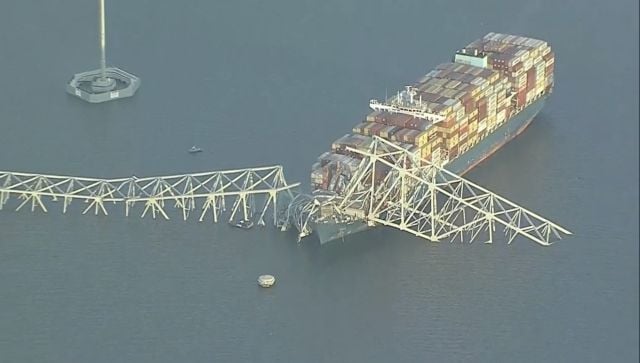
March 27 (UPI) -- The catastrophic collapse of the Francis Scott Key Bridge early Tuesday over Baltimore's Patapsco River, where six people remain missing and presumed dead, is drawing tragic comparisons to a similar bridge collapse in Florida 44 years ago.

On the morning of May 9, 1980, a freighter slammed into the support columns of the old Sunshine Skyway bridge over Tampa Bay during a violent thunderstorm, causing a 1,300-foot section of the southbound span to collapse. A Greyhound bus and seven other vehicles plunged into the water, where 35 people died. Only the driver of a pickup truck survived the drop.

In Baltimore, a Singapore-based cargo ship is reported to have issued a mayday Tuesday morning after losing power. Crews performing pothole work on the bridge alerted drivers to stop the flow of traffic as the ship crashed into a support column, collapsing much of the span and sending eight people into the water. Two were rescued as a search continued for the other six until late Tuesday, when it was called off.

Both bridge collapses involved freighters hitting support columns, collapsing much of the span, and plunging vehicles and people into the water below. Both bridge collapses cut off a major artery for drivers and for shipping. And both spans that collapsed opened in the 1970s.

Related

As investigators gather in Baltimore to determine what happened Tuesday, the question is what lessons learned from Florida's tragedy decades ago could have made a difference this week.

Post-disaster findings


In Florida's bridge collapse, the pilot of the ship, John Lerro, ultimately was cleared of negligence and the collision was deemed an accident. During months of hearings, Lerro maintained that he had no control over the freighter and was at the mercy of the 70-mph winds as he navigated through the 800-foot-wide opening under the twin bridge spans.

"We believe he made a reasonable decision of attempting to transit under the bridge, in view of his fear of slamming into the bridge broadside," Douglas Rabe, chief National Transportation Safety Board investigator, said in 1981. Investigators ultimately determined the National Weather Service should have warned mariners of the severe storm and that Lerro should have abandoned his attempt to navigate under the Sunshine Skyway Bridge.

While Tuesday's bridge collapse is still early in the investigation, there are reports that the crew aboard the cargo ship Dali issued a "mayday," saying the vessel had lost power, before it slammed into one of the support piers of Baltimore's Francis Scott Key Bridge.

Engineering protective barriers


On Tuesday, engineers and bridge designers raised questions about the structural safety of Baltimore's bridge and whether protective barriers around the support columns would have prevented the tragedy.

British structural engineer and bridge designer Ian Firth told The Baltimore Sun that protective barriers include cable systems, pontoons, caissons and submerged islands. Firth said the most commonly used protection for bridge support columns are bumpers or "dolphins," which are filled with sand or concrete to protect the bridge from cargo ships.

When the Sunshine Skyway was rebuilt in 1987 at a cost of $240 million, engineers added dolphins mounted to artificial islands to protect the bridge from "potential water-traffic collisions." The six piers, closest to the shipping channel in Tampa Bay, are protected and the two main piers are flanked by 60-foot dolphins, which can withstand an impact of up to 30 million pounds.

Maryland's Francis Scott Key Bridge opened 10 years earlier in 1977. Codes for building bridges and their structures have changed over the years and vary state by state to accommodate vehicle traffic above and maximum access for water traffic to traverse underneath.

Benjamin Schafer, a professor of civil and systems engineering at Johns Hopkins University, told the Sun that protecting the bridge piers, in the unlikely event that a large freighter is unable to navigate, could have made a difference Tuesday.

"This sort of protection is what FSK did not have, and we can see now that it may -- may -- have helped," Schafer said.

Scenes from Francis Scott Key Bridge collapse in Baltimore


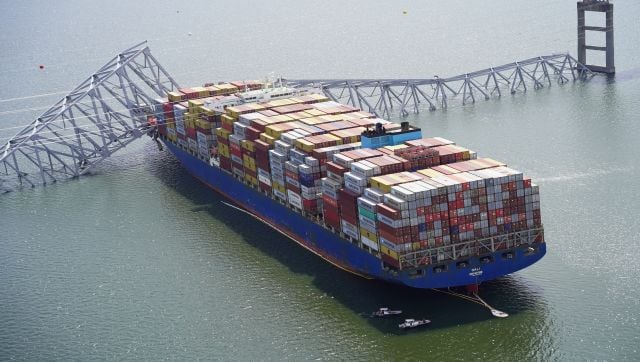
A damaged container ship rests next to a bridge pillar in the Patapsco River after crashing into and destroying the Francis Scott Key Bridge at the entrance to Baltimore harbor on March 26, 2024.
 Photo by David Tulis/UPI | License Photo
Explained: The outrage over the racist cartoon mocking Indian crew of ship behind Baltimore bridge crash

FP Explainers • March 29, 2024


An American webcomic posted an illustration of the Baltimore bridge collapse incident showing the ship’s Indian crew wearing loincloths ahead of the collision. This came a day after US president Biden praised the team for their prompt Mayday call

Explained: The outrage over the racist cartoon mocking Indian crew of ship behind Baltimore bridge crash
The narrative has drawn criticism for both undermining the ship's crew and for its racist portrayal of Indians. Image Courtesy: @FoxfordComics/X

An out-of-control cargo ship rammed into Baltimore’s Francis Scott Key Bridge, resulting in six presumed fatalities on 26 March.

The Indian crew on the ship is receiving praise from US President Joe Biden, Maryland Governor Wes Moore, and other prominent figures; yet, a “racist” cartoon that depicts the tragedy has sparked controversy.

Let’s take a look.

The racist cartoon

An American webcomic has posted an illustration of the tragic event the day after US president Biden praised the ship’s crew, the majority of whom were Indians, for their prompt Mayday call.

The animated film, which was aimed at the ship’s crew, depicts dishevelled men wearing only loincloths ahead of the collision. 

An audio clip of people cursing at each other in English with a heavy Indian accent was also included in the cartoon.

The video was posted on X with the caption, “Last known recording from inside the Dali moments before impact,” by Foxford Comics.

With 4.2 million views and more than 2,000 comments, the image has become widely popular.

Parts of the Francis Scott Key Bridge remain after a container ship collided with one of the bridge’s supports in Baltimore. Rescuers are searching for multiple people in the water. WJLA via AP

Criticism

The narrative has drawn criticism for both undermining the ship’s crew and for its racist portrayal of Indians.

Indian economist Sanjeev Sanyal shared the cartoon and stated that a local pilot was probably in control of the ship at the time of the tragedy.

“At the time that the ship hit the bridge, it would have had a local pilot. In any case, the crew had warned the authorities which is why the casualties were relatively few (for such a disaster). The mayor in fact thanked the Indian crew as “heroes” for raising an alarm that limited casualties,” he said.

Another X user said, “It’s shameful that people are mocking Indian crew for the tragic incident. Meanwhile the governor himself praised the crew.”

“This racist trash is one of the reasons that many Indians still don’t prefer the United States, apart from the cheap way in which your gun laws enable your citizens to dispose our brethren due to the same racist agenda without fear,” a third user chipped in.

Biden and others praise Indian crew

Synergy said all crew members and the two pilots on board were accounted for, and there were no reports of any injuries. “All 22 crew members of Cargo ship that hit Key Bridge in Baltimore are Indian,” Synergy said in a statement issued on its website.

After the tragedy, Maryland governor Wes Moore hailed the Indian crew on board the Dali , saying that it was their quick thinking that saved other lives.

US president Biden said that the crew notifying officials that they had lost control of the ship, prompted the shutdown of the bridge, a move that “undoubtedly” resulted in the saving of many lives.

Personnel on board the ship were able to alert the Maryland Department of Transportation that they had lost control of their vessel. As a result, local authorities were able to close the bridge to traffic before it was struck, which undoubtedly saved lives,” stated Biden during his comments at the White House regarding the collapse.

Aerial view of the Dali cargo vessel which crashed into the Francis Scott Key Bridge, causing it to collapse in Baltimore. Six people have been presumed dead following the incident. Reuters

Baltimore bridge tragedy

The ship flying under Singapore’s flag departed from Baltimore port at 1 am local time on Tuesday for a journey lasting around one month to Colombo, Sri Lanka, as per Marine Traffic.

The operators of the Dali cargo ship issued a mayday call that the vessel had lost power moments before the crash. At around 1.28 am, the vessel struck one of the 2.6-kilometre bridge’s supports, causing the span to break and fall into the water within seconds.  Puffs of black smoke were seen as the lights flickered on and off.

The six missing people were part of a construction crew filling potholes on the bridge, according to Paul Wiedefeld, the state’s transportation secretary. Guatemala’s consulate in Maryland said in a statement that two of the missing were citizens of the Central American nation. Honduras’ deputy foreign affairs minister Antonio Garcia told AP that a Honduran citizen, Maynor Yassir Suazo Sandoval, was missing. The Washington Consulate of Mexico also said on X that citizens of that nation were also among the missing.

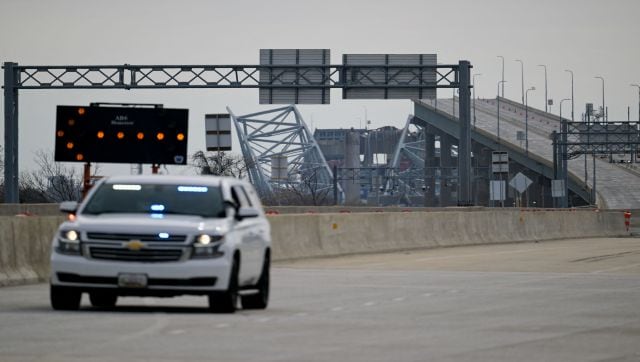
A view of the Francis Scott Key Bridge, after the Dali cargo vessel crashed into it causing it to collapse, in Baltimore. Reuters

Rescuers pulled two people out of the water, one of whom was treated at a hospital and discharged hours later. Multiple vehicles also went into the river, although authorities did not believe anyone was inside.

Tuesday’s collapse might create a logistical nightmare along the East Coast for months, if not years, shutting down ship traffic at the Port of Baltimore.

The port is a major East Coast hub for shipping. The four-lane bridge spans the Patapsco River at the entrance to the busy harbour, which leads to the Chesapeake Bay and the Atlantic Ocean.

The governors of those states promised in a joint statement on Thursday that the Port Authority of New York and New Jersey will plan to take on more cargo to assist minimise the impacts on the supply chain up the coast from Baltimore.

Other racist cartoons

There have been numerous occasions in the past where visuals have drawn attention to the unequal treatment given to different nations.

In August 2023, a German magazine named Der Spiegel published a cartoon depicting India’s population overtaking China. It showed an overcrowded Indian train passing a modernised Chinese bullet train travelling on a parallel track with only two drivers inside. The passengers on top of the Indian train were seen holding the tricolour.

While people on social media heavily criticised the inaccurate portrayal, some politicians and other authorities have also used Twitter to condemn the cartoon as “racist” and “derogatory.”

In 2015, a cartoon was published in the Australian newspaper depicting starving Indians chopping up and eating solar panels sent to the developing nation in an attempt to curb carbon emissions has been condemned as “unequivocally racist.”

Drawn by the veteran cartoonist Bill Leak, the cartoon received massive criticism for being racist. Amanda Wise, an associate professor of sociology at Macquarie University, was quoted as saying by The Guardian, “This cartoon is unequivocally racist and draws on very base stereotypes of third world, underdeveloped people who don’t know what to do with technology,”

In 2014, the New York Times newspaper published a cartoon showing a man, wearing a shirt, dhoti, and a turban, standing with a cow and knocking on the door of a room marked “Elite Space Club” where two bespectacled men donning Western clothes were reading a newspaper on India’s Mars Mission.

The cartoon, made by Singapore-based artist Heng Kim Song, accompanied an article titled India’s Budget Mission to Mars. It received widespread condemnation, with many calling it ”racist,” and accusing it of mocking India.

For the uninitiated, in September the same year, India became the first nation to successfully put the Mangalyaan robotic probe into orbit around Mars on its first attempt. With this, ISRO joined the elite club of NASA, the European Space Agency, and the Soviet Union for carrying out successful missions to the Red Planet.

With inputs from agencies

Global real estate market hits $365.51 trillion in 2023

Oktay Ozdemir |
30.03.2024 - 


ISTANBUL

A Turkish real estate firm, Trem Global, announced that the global real estate and infrastructure market hit a record high of $365.51 trillion in 2023.

The real estate sector, which has defied global economic fluctuations, continues to maintain its strength this year, according to the company's statement Thursday, based on Precedence Research results.

The increase in the market was achieved in an environment full of geopolitical tensions in the residential segment.

Murat Meric, deputy general manager of sales at Trem Global, said Türkiye is an attractive destination for foreign and domestic investors with its dynamic economy and rich real estate options.

"Türkiye is a bridge in international real estate markets and its competitive advantages are increasing," he added.

Meric stated that between 2022 and 2023, investors from 52 nationalities pioneered their investments in Türkiye, and "in 2024, the demand started to come mainly from western countries and this situation will provide diversity in Türkiye's real estate markets and will pave the way for both Türkiye's economy and innovative approaches in the real estate sector."

The firm expected that 2023 will see significant transformation for the real estate sector toward a smart, sustainable and diverse future.

While tourism and infrastructure investments in the Middle East support the growth of the real estate market, trends such as the rise of co-living spaces, increasing digitalization in real estate transactions and sustainable development come to the fore, according to the statement.

The company said factors such as Saudi Arabia's mega cities, Dubai's rising trend and Istanbul's topping the list of the world's most visited cities last year are increasing the daily interest of international investors in those countries.

International investment trends continue to play an important role in real estate markets, it noted.

While factors such as wars and natural disasters cause population loss, issues such as economic opportunities, education and quality of life increase the demand for migration to developed and developing countries, it said.

The US, Germany, Canada, Australia, Australia, Türkiye and the United Arab Emirates are among the countries expected to receive the most immigration in 2024, it asserted.

It stressed that while this trend increases the demand for real estate in immigrant countries, it leads to a decrease in demand in immigrant countries.

Türkiye continues to attract the attention of international investors in 2024 with its strategic geographical location, increasing tourism statistics, diversity in the real estate ecosystem and climate advantages, it added.
Why Russia is protecting North Korea from nuclear monitors

On March 28, Russia used its veto power in the United Nations Security Council to kill off a U.N. panel of experts that has been monitoring North Korea’s efforts to evade sanctions over its nuclear program for the past 15 years

David E. Sanger 
Washington 
Published 30.03.24

Kim Jong Un and Vladimir Putin


Through the most tense encounters with President Vladimir Putin’s Russia over the past decade, there has been one project in which Washington and Moscow have claimed common cause: keeping North Korea from expanding its arsenal of nuclear weapons.

Now, even that has fallen apart.

On Thursday, Russia used its veto power in the United Nations Security Council to kill off a U.N. panel of experts that has been monitoring North Korea’s efforts to evade sanctions over its nuclear program for the past 15 years.

Russia’s discomfort with the group is a new development. Moscow once welcomed the panel’s detailed reports about sanctions violations and considered Pyongyang’s nuclear program to be a threat to global security.

But more recently, the panel has provided vivid evidence of how Russia is keeping the North brimming with fuel and other goods, presumably in return for the artillery shells and missiles that the North Korean leader, Kim Jong Un, is shipping to Russia for use against Ukraine. The group has produced satellite images of ship-to-ship transfers of oil, showing how the war in Ukraine has proved to be a bonanza for the North.

The apparent dismantlement of the panel, which had no enforcement power, is one more piece of evidence of how what was once a global effort to constrain nuclear proliferation has eroded rapidly over the past two years.

“It’s a remarkable shift,” said Robert Einhorn, a State Department official during the Obama administration who is now a senior fellow at the Brookings Institution.

“For much of the post-Cold War period, the United States, Russia and China were partners in dealing with proliferation challenges, especially with North Korea and Iran. They were fully on the American and European side during the Iran negotiations, and helped with North Korea during the ‘fire and fury’ period in 2016 to 2017,” he said, referring to the Obama administration’s final negotiations with the North and former President Donald Trump’s threats when he came to office.

In that era, Russia regularly voted for sanctions against North Korea, as did China, even while they all did a fair bit of business, and more than a little smuggling at sea and over their narrow border crossing, especially a rail bridge where the three all meet.

But as Einhorn noted, that unity has fractured with the reemergence of great power competition. The partnership on containing nuclear threats, even from North Korea, whose nuclear facilities pose a safety challenge to both China and Russia, has vanished.

Russia is now helping North Korea evade sanctions, and neither Russia nor China is actively working to pressure Iran to slow its accumulation of enriched uranium, the critical step needed if it ever decides to build nuclear weapons.

When resolutions have come up to condemn North Korea for its constant barrage of missile tests, Russia and China have rejected them. But eliminating the “experts committee,” which began its work in 2009, cuts new territory in relieving pressure on the country.

The Russian government made no apologies for killing off the panel.

“It is obvious to us that the U.N. Security Council can no longer use old templates in relation to the problems of the Korean Peninsula,” a spokesperson for the Russian Foreign Ministry, Maria Zakharova, was quoted by Reuters as saying. “The United States and its allies have clearly demonstrated that their interest does not extend beyond the task of ‘strangling’ the DPRK by all available means,” she added, using the abbreviation for the Democratic People’s Republic of Korea.

The committee had no great investigative powers, but it was thorough — and its findings often created headlines. It followed oil shipments, and explained what happened when ships turned off their transponders so they would not be tracked at sea. The group looked at banking relationships and luxury goods that made it to North Korea, despite sanctions passed 18 years ago. It also inspired private groups to dig deeper, explaining mysteries like how Kim got his luxury cars.

The experts were outsiders, and their findings were often not adopted. “Everything that goes into the report has to be approved by Security Council members,” Jenny Town, a North Korea expert and senior fellow at the Stimson Center, a nonproliferation think tank, noted Friday. “So while it is an investigative body, its findings exist in a political process.”

Still, the existence of the committee gave an international, neutral imprimatur to the charges of sanctions evasion. “They have been very useful in producing some gravitas on sanctions implementation,” said Town, who is also the director of 38 North, which publishes analysis of North Korea’s capabilities and pronouncements.

The State Department denounced Russia’s decision, saying that the country had “cynically undermined international peace and security,” and declaring that “Russia alone will own the outcome of this veto: a DPRK more emboldened to reckless behavior and destabilizing provocations.”

The New York Times News Service
Five Miners Killed After Roof Collapses Due To Heavy Rain In Balochistan

The coal mine collapsed due to the torrential rain and five workers were buried under the debris and died, officials said.

PTI
Updated on: 30 March 2024 


Roof collapses due to heavy rainfall in Pakistan

At least five mine workers were killed when the roof of a house collapsed due to heavy rainfall in Pakistan's Balochistan province.

According to the police officials, the house was built for the accommodation of the workers outside the local coal mine.

The coal mine collapsed due to the torrential rain and five workers were buried under the debris and died, they said.

According to the police authorities, the bodies of the deceased were shifted to the hospital, from where they were sent to their native areas after necessary action.

The heavy rains have also killed some seven people from a house collapse in the same area, police said.

The incident comes just days after 12 coal miners were killed in a methane gas explosion inside a mine in Harnai in the province while in another incident three coal miners were kidnapped four days back by armed men from a mine in Dukki and are yet to be recovered by the law enforcement agencies.

The latest incident has again reignited the discussion around the existing safety protocols for coal mine workers and the steps needed to enhance these protocols to save lives.

Friday, March 29, 2024


Suppressing boredom at work hurts future productivity, study shows


UNIVERSITY OF NOTRE DAME


Boredom is more common at work than in any other setting, studies show, and employees are bored at work for more than 10 hours per week on average.

Even astronauts and police officers get bored on the job. No occupation is immune.

Boredom serves an important purpose — it signals the need to stop an action and find an alternative project. But boredom becomes problematic when it’s ignored.

New research from the University of Notre Dame shows that trying to stifle boredom prolongs its effects and that alternating boring and meaningful tasks helps to prevent the effects of one boring task from spilling over to reduce productivity on others.

Breaking Boredom: Interrupting the Residual Effect of State Boredom on Future Productivity,” forthcoming in the Journal of Applied Psychology from lead author Casher Belinda, assistant professor of management at Notre Dame’s Mendoza College of Business, along with Shimul Melwani from the University of North Carolina and Chaitali Kapadia from Florida International University.

The team sought to understand if, when and why experiencing boredom now might lead to attention and productivity deficits later. They tested these possibilities in three studies that examined the consequences of boredom on a task-to-task basis.

The first study drew on data from dual-career families working in a variety of industries. Participants responded to multiple surveys per day at different intervals, enabling the team to examine the relationships between boredom, attention and productivity over time. Follow-up studies used alternative methods to reach a broader audience and focused on how meaningful work tasks help mitigate boredom’s prolonged effects.

Belinda, who specializes in emotions, interpersonal communication and close relationships within organizations, noted that boredom is viewed as a nuisance emotion that any strong-willed employee should subdue for the sake of productivity.

He found that experiencing boredom at any one point in time leads to delayed or residual bouts of mind-wandering. Employees often try to “power through” boring tasks to make progress on their work goals, but he said that not only does this fail to prevent boredom’s negative effects, it’s also one of the most dysfunctional responses to boredom.

“Like whack-a-mole, downplaying boredom on one task results in attention and productivity deficits that bubble up during subsequent tasks,” he said. “Paradoxically, then, trying to suppress boredom gives its harmful effects a longer shelf life.”

Part of the solution lies in how work tasks are organized throughout the day. Although boring tasks can’t be avoided, effectively combating the negative effects of boredom requires careful consideration of the nature of different work tasks and how they are sequenced. Casher said it helps to work strategically, looking beyond a single boring task.

“‘Playing the long game’ will help minimize the cumulative effects of boredom over the course of the day,” Belinda explained. “Following an initial boring task, employees should turn to other meaningful tasks to help restore lost energy.”

Contact: Casher Belinda, 574-621-9629, cbelinda@nd.edu


How commercial rooftop solar power could bring affordable clean energy to low-income homes


A new study led by Stanford researchers finds that factory and warehouse rooftops offer a big untapped opportunity to help disadvantaged communities bridge the solar energy divide.


STANFORD UNIVERSITY


Lower-income communities across the United States have long been much slower to adopt solar power than their affluent neighbors, even when local and federal agencies offer tax breaks and other financial incentives.

But, commercial and industrial rooftops, such as those atop retail buildings and factories, offer a big opportunity to reduce what researchers call the “solar equity gap,” according to a new study, published in Nature Energy and led by researchers at Stanford University.

“The solar equity gap is a serious problem in disadvantaged communities, in part because of income inequalities, but also because residential solar isn’t usually practical for people who don’t own their homes,” said Ram Rajagopal, senior author of the study and associate professor of civil and environmental engineering and of electrical engineering at Stanford. “This new study shows that commercial and industrial properties have the capacity to host solar resources to fill in part of that gap.”

Untapped resources

First, the bad news. The researchers found that non-residential rooftops generate 38% less electricity in disadvantaged communities than in wealthier ones. That gap, which is mainly because of lower deployment in poorer areas, has widened over the past two decades. Nevertheless, this gap is significantly lower than that of residential solar in these neighborhoods.

The good news, the researchers say, is that non-residential buildings have large unused capacity to produce solar power for their own benefit and to supply the communities around them. In low-income communities, commercial enterprises may be more responsive to government incentives for solar power than households are. An earlier study by the same researchers found that residential customers in disadvantaged communities, who may have fewer financial resources and often don’t own their homes, show less response to tax breaks and other financial inducements.

“Using Stanford’s DeepSolar database, we estimated that solar arrays on non-residential buildings could meet more than a fifth of annual residential electricity demand in almost two-thirds of disadvantaged communities,” said Moritz Wussow, the study’s lead author.

“Also, the raw cost of that power would be less in many communities than the residential rates that local electric utilities charge,” said Wussow, who was a visiting student researcher in Rajagopal’s lab group in 2022 and 2023.

To quantify the distribution of non-residential solar power installations, the researchers used satellite images and artificial intelligence to identify the number and size of rooftop solar arrays in 72,739 census tracts across the United States. About one-third of those tracts are deemed disadvantaged by the U.S. government.

The team tracked non-residential solar deployment as well as the amount of unused rooftops that would be good candidates for solar installation from 2006 through 2016 and then again for 2022. They then calculated the average annual cost of producing solar electricity in each area, based on the amount of local sun exposure and other variables. The costs ranged from about 6.4 cents per kilowatt-hour in sun-drenched New Mexico to almost 11 cents in Alaska. But those costs were lower than residential electricity rates in many of those areas – even in many northern states.

Chad Zanocco, a co-author of the new study and a postdoctoral fellow in civil and environmental engineering, noted that getting the power to residential areas would include other costs, such as battery storage and the construction of microgrids.

“We estimate that battery storage would increase total system costs by about 50%, but even that would be practical in almost two-thirds of the disadvantaged communities we studied,” Zanocco said.

Economies of scale

If commercial and industrial solar arrays can feed their surplus electricity into local power grids, the researchers write, lower-income residents could gain access through community subscriptions rather than by building their own rooftop panels. Commercial and industrial sites also offer greater economies of scale, compared to individual household solar panels. Another big advantage is that non-residential power customers could also be highly sensitive to tax incentives and other government inducements, leading to greater adoption.

Further lowering barriers, the researchers noted, is the Inflation Reduction Act of 2022 which has provided billions of dollars for states and local communities for clean-energy infrastructure. That money has already reduced the cost of new microgrids.

“Beyond reducing carbon emissions and slowing climate change, increased access to solar power would offer tangible local benefits to lower-income communities,” said Zhecheng Wang, a co-author and a postdoctoral fellow at Stanford’s Institute for Human-Centered Artificial Intelligence.

“This would promote local clean and low-cost energy generation, which would also increase the resilience from outages and reduce the pollution caused by fossil fuel power plants – many of which are located in low-income areas.”

Additional Stanford co-authors on the paper are: Rajanie Prabha, a PhD student in Civil & Environmental Engineering; June Flora, a senior research scholar in Civil & Environmental Engineering, and in Stanford’s School of Medicine; and Arun Majumdar, dean of Stanford Doerr School of Sustainability, professor in the departments of Energy Science & Engineering, of Mechanical Engineering, and of Photon Science at SLAC National Accelerator Laboratory, and senior fellow at the Precourt Institute and Stanford Woods Institute for the Environment. Civil & Environmental Engineering is a joint department of the Stanford School of Engineering and the Stanford Doerr School of Sustainability. Dirk Neumann, a professor of information systems research at Albert-Ludwigs-Universität in Freiburg, Germany, is also a co-author. Ram Rajagopal is also co-director of the Bits & Watts Initiative at the Precourt Institute for Energy, which is part of the Stanford Doerr School of Sustainability.


Wild plants face viral surprise

MSU, UC Riverside study reveals infections from crops

Peer-Reviewed Publication

MICHIGAN STATE UNIVERSITY

Wild squash 

IMAGE: 

BY ANALYZING NATIVE PLANTS, SUCH AS THIS WILD SQUASH, IN THE CALIFORNIAN DESERT, A TEAM OF RESEARCHERS FROM MICHIGAN STATE UNIVERSITY AND THE UNIVERSITY OF CALIFORNIA, RIVERSIDE REVEALED THAT NON-NATIVE VIRUSES FROM AGRICULTURE ARE INVADING THESE HABITATS.

view more 

CREDIT: TESSA SHATES

Just as many people battle seasonal colds and flu, native plants face their own viral threats. People have long known that plants can succumb to viruses just like humans. Now, a new study led by Michigan State University and the University of California, Riverside reveals a previously unknown threat: non-native crop viruses are infecting and jeopardizing the health of wild desert plants.

“For years, the ecological field assumed wild plants were immune to invasive viruses that damage crops,” said Carolyn Malmstrom, a professor of plant biology and ecology, evolution and behavior at MSU and a co-leader of the study. Kerry Mauck, an associate professor and Alfred M. Boyce Endowed Chair in Entomology, was the team leader at UC Riverside and adviser for the lead author Tessa Shates, who was a graduate student in the Mauck Lab. 

“But we’ve found that we need to be just as concerned about protecting indigenous plants as we are agricultural ones,” Malmstrom said. 

Published in the Phytobiomes Journal, this discovery holds significant implications for conservation efforts. The research utilizes advanced genetic sequencing and field experiments to demonstrate how insects, acting as unwitting infectors, ferry harmful pathogens from cultivated fields to native ecosystems. 

The study focused on desert regions of Southern California, where the Cucurbita species of wild squash thrived alongside irrigated agriculture. The team meticulously identified, marked and collected samples from the wild plants.

Then, analyzing the genetic makeup of viruses within these wild plants, the researchers discovered a surprising presence of crop pathogens like cucurbit yellow stunting disorder virus and cucurbit aphid-borne yellows virus, or CABYV. 

In fact, they found that infection rates with CABYV — a non-native pathogen — could reach as high as 88% in some wild Cucurbita populations, with visible impacts on plant growth and root health, both vital for the plants survival in the harsh desert environment.

“These wild plants are crucial components of desert ecosystems, providing food and habitat for other species,” Malmstrom said.  “Their decline from crop virus infections could have cascading effects on entire ecological communities.”

“Our findings should help the greater community recognize that our impact on the landscapes around us are not always obvious or clear to see,” Shates said. “It’s easy to see the landscape changes of a clear-cut forest, but it is harder to recognize how hitchhiking microbes might change plant community structure over time.” 

Plant virology and research at MSU

Collaboration across the country and fields of research was an important facilitator of this research. Having leading experts in plant biology and entomology contributed to the scientific success of the project, as well as the growth of its early-career researchers.

“In addition to her own contributions, Dr. Malmstrom has been a great mentor throughout this study,” said Shates, who is now an infectious disease scientist with the research company Quest Diagnostics.

“Doing this research, especially during the pandemic, required learning new skills and expanding my research toolkit,” Shates said. “Dr. Malmstrom was a great resource for recommending technical methods to try for data analysis and generating ‘genomes’ for the viruses in our samples.” 

As an AgBioResearch scientist, Malmstrom was also able to tap into both agricultural and natural systems expertise at MSU. 

“This project bridges the gap between agriculture and natural systems, reminding us that nature and agriculture are intricately linked,” said Malmstrom. “It also underscores the need for a more holistic approach to managing plant health and shows that understanding the complex dynamics of viruses in natural systems is essential for developing sustainable solutions that benefit both agriculture and biodiversity.”


Carolyn Malmstrom of Michigan State University (left) and Jaimie Kenney (center, kneeling) and Kerry Mauck of the University of California, Riverside work at the Motte Rimrock Reserve. This was one of the field sites the researchers worked at to discover viruses from crops were infecting native plants.

CREDIT

Tessa Shates


University of California, Riverside researchers Kerry Mauck (left), Tessa Shates (center) and Jaimie Kenney (right, in distance) worked in the field to discover the prevalence of viral pathogens from agriculture in native plant populations.

CREDIT

Carolyn Malmstrom