Saturday, October 05, 2024

Russians were Shocked by Ukrainian Advance into Kursk Oblast but Now Mostly have Taken It in Stride, Levada Center Head Says

Paul Goble

            Staunton, Oct. 7 – When Ukrainian forces began their intervention in Kursk Oblast in early August, Russians overwhelmingly were in a state of shock having convinced themselves that such an event was impossible given the pressure the Russian forces have put on Ukrainian forces inside Ukraine, Denis Volkov says.

            But in the weeks since, most Russians have come to terms with this Ukrainian military action and view it within the context of the broader fighting inside Ukraine rather than as a separate problem, the head of the independent Levada Center polling agency says (forbes.ru/mneniya/520270-privycnaa-trevoga-cto-dumaut-rossiane-o-nastuplenii-vsu-v-kurskoj-oblasti).

            That does not mean that Russians have accepted this Ukrainian action as a fait accompli. Rather, it is the product of Moscow propaganda and its insistence that Russia has everything in hand  and will soon expel the Ukrainian forces from Russian territory, Volkov says polling data show.

            There have been, however, two consequences of the Russian reaction to Kursk that have been less widely noted but may prove more important. On the one hand, there is no ever less talk about the possibility of any peace negotiations with Kyiv to end the war. And on the other, Russians have become more angry about social and economic problems.

            If the reasons for the first of these are obvious, those behind the second are less so, Volkov suggests. They involve increasing cynicism in the population about Russian government declarations and a sense that the war is likely to drag on for some time if Ukraine is able to mount such operations.   


Extreme Right ‘Russian Community’ Becoming Active in Circassian Areas

Paul Goble

            Staunton, Oct. 5 – The extreme right Russian nationalist organization, the Russian Community, already the largest Russian nationalist group in the country, involved in suppressing non-Russian groups across the country, and the source many fear for complecting the regional militias Moscow is allowing is now becoming active in Circassian areas.

            (For background on this group and the fears it is provoking among non-Russians, see windowoneurasia2.blogspot.com/2024/09/russian-community-now-largest-extreme.htmlwindowoneurasia2.blogspot.com/2024/08/clashes-between-ethnic-diasporas-and.html and windowoneurasia2.blogspot.com/2024/09/moscow-gives-heads-of-all-federal.html.)

            The Circassian National Front reports that “the first branches of this nationalist group have opened in Kabardino-Balkaria (Nalchik) and Karachayevo-Cherkessia (Cherkessk). In Krasnodarsk Kray and Adygeya (Maikop), the Russian Community has already been functioning for several years” (t.me/cirnatfront/50).

            Some members of the Russian Community in these regions are flying the notorious Bakalanov flag which was used by Russian irregulars at the end of the Circassian war, and the Circassian National Front fears that the appearance of this group with such flags means that Russian nationalists hope to “extinguish” the Circassian nation on its homeland.

            However that may be, the appearance of the Russian Community in Circassian areas almost certainly is going to spark more conflicts in the binational republics of the central North Caucasus, republics that in recent months have seen a significant rise in ethnic tensions (windowoneurasia2.blogspot.com/2024/09/islamist-radicalism-continues-to-spread.html).          

Jail sentence for scammers who fooled Apple into replacing fake iPhones with new ones

By HT News Desk, New Delhi
Oct 05, 2024 

The tech giant suffered a loss of more than $2.5 million as a result of the scam, that unfolded in the United States.

Two Chinese nationals living in the United States were sentenced earlier this week for duping Apple into replacing 6000 counterfeit iPhones with real models, resulting in a loss of more than ₹$2.5 million (approx. ₹21 crore) to the tech giant, the Department of Justice (DOJ) has announced.

The Apple logo is illuminated at a store in the city center in Munich, Germany, on Dec. 16, 2020.. (AP Photo/Matthias Schrader, File)

Sentenced on Wednesday, the two men are Haotian Sun (34) and Pengfei Xue (also 34). Both are residents of the Maryland state, living in Baltimore and Germantown respectively, a DOJ statement read.

Are you a manager having bigger career aspirations? Enroll now for University of Massachusetts Global MBA Programme

Also, as per the statement, Sun received 57 months in prison, three years of supervised release, and has been ordered to pay $1,072,200 in restitution to Apple and a forfeiture money judgment of $53,610.

On the other hand, Xue got 54 months in jail, three years of supervised release, and ordered to pay $397,800 in restitution to Apple and a forfeiture money judgment of $19,890.

The scam

Court documents and documents presented at the trial show the scam unfolded from May 2017 to September 2019. Under the scheme, the pair would receive shipments of inauthentic but genuine-looking iPhones from their co-conspirators who used to send these from Hong Kong. The delivery was made via UPS mailboxes throughout the Washington D.C., metropolitan area.

The fake iPhones, with spoofed IMEI numbers, were then submitted at Apple retail stores and other authorised Apple service providers, for ‘repair.’ The IMEI numbers were linked to real customers' iPhones that were still under warranty and in turn, this led to the Tim Cook-led company being tricked into substituting fake devices with genuine ones.

However, a tip-off from an Apple investigator alerted law enforcement and the conspiracy was busted

Sun and Xue were convicted in February after a five-day jury trial.
Kamala Harris' tax plan for small businesses sounds like it will cost a lot of money — it won't

Alice Tecotzky 
Oct 5, 2024
Harris has made supporting small businesses a key part of her economic proposal. 
JEFF KOWALSKY / AFP


Harris has proposed expanding the small business tax credit from $5,000 to $50,000.
Experts told BI the proposal would shift the timing of deductions and isn't all that pricey.
If the proposal inspired more small business creation, it would likely spur economic growth.

Patricia Oswlad, 55, and her husband have spent years building up their retirement fund. But when Oswald decided to launch a small business in the fall of 2022, the couple liquidated some of their assets to fund the company, throwing their financial planning to the wind.

With fewer than five weeks until Election Day, Vice President Kamala Harris is making a targeted pitch to entrepreneurs like Oswald, who are burdened by startup expenses. She even mentioned a key proposal in her opening answer at the presidential debate: expand the small business tax credit 10-fold, from $5,000 to $50,000.

In a pamphlet on her economic plan, dubbed the "Opportunity Economy," Harris explains that she would let business owners take advantage of the $50,000 tax deduction right away or a few years after launching, to help lower taxes once they start turning a profit. The proposal, like many of her others, would need congressional approval.

Oswald told Business Insider the credit would have been "invaluable" in getting Brisa Systems, which offers powered drying racks, off the ground.

Harris' proposal shifts the tax timeline for entrepreneurs.

Tax experts told BI that enacting the credit would mean a change in timing more than anything else. Under current law, small businesses can deduct up to $5,000 in expenses immediately and must deduct any future expenses against their income over 15 years. Harris' proposal would let entrepreneurs deduct more money quickly.

Owners have expenses before even launching their business, and the deduction would help cover those costs.

Rhett Buttle, the co-executive director of Small Business Roundtable and a former business advisor for President Joe Biden, told Business Insider that startup costs accumulate in three primary areas: marketing, basic equipment, and hiring.

For Oswald, most early costs have been in manufacturing and intellectual property services. Taylor McCleneghan, who launched her product development company, Small Shop LLC, in 2018, named inventory and marketing as the biggest upfront costs. Both women are based in the Chicago area.

Harris has made supporting small business a key part of her economic agenda. Danielle Parhizkaran/The Boston Globe via Getty Images

Brett Theodos, a senior fellow at Urban Institute who specializes in small business loans, told BI that entrepreneurs would "love" to be able to deduct more of those expenses right away. Moving up the timeline would, he said, make many feel less strapped for cash from the very outset.

Related stories


Kamala Harris' economic agenda may now depend on beating Ted Cruz or Rick Scott


What you need to know about Kamala Harris' 'opportunity economy'


And there's another potential upside, according to Garret Watson, a senior policy analyst at the nonpartisan Tax Foundation. Small businesses would likely benefit from getting the deduction more quickly because of inflation, he said.

Many entrepreneurs are psyched about the effort. Theodos struggled to think of a reason why they wouldn't want this, and Buttle said that those he works with are overwhelmingly excited about the plan.

McCleneghan, of the Small Shop, said having access to a $50,000 tax deduction early on would have allowed her to do better long-term planning. With the expanded tax deduction, Oswald said she might not have had to divest retirement funds or take out lines of credit.
Advertisement


"Getting money in the hands of entrepreneurs sooner is going to allow them to hire, to get equipment, to get a space, to pay off some debt, to pay themselves," Theodos said. "So it's meaningful to allow them to accelerate the deduction of startup expenses."

But while small business owners may jump at the opportunity for more early cash flow, where this money would come from is more unclear. McCleneghan herself acknowledged that the details seem hazy.
Despite the flashy numbers, the proposal likely wouldn't have a significant impact on the federal budget.

Though $50,000 sounds like a big-ticket promise, the experts BI spoke to said Harris' proposal actually wouldn't make a big dent in the federal budget. The Tax Foundation, where Watson works, examined cost estimates from prior expansions and found that the proposal would cost about $24.5 billion over 10 years.

"Relative to the federal government's budget and spending, it's very small," Watson said. "This $25 billion number is in the context of a tax plan for the Harris campaign that would raise about $5 trillion over 10 years. So you're talking about orders of magnitude more money on the tax hike side."
Advertisement

Harris' proposal would require congressional approval.
 Chip Somodevilla/Getty Images

Some of the loss, he said, stems from the likelihood that certain entrepreneurs will use the deduction and then go out of business. Since the proposal changes when businesses can deduct rather than how much they deduct, it will cost some money, but not "big money," Theodos said.

And the proposal could help spur growth, if it becomes law. According to a study from the Pew Research Center published in April 2024, small businesses employ nearly half of the country's private sector employees.

Theodos called small businesses "essential" for the US economy, and Buttle said they're a crucial source of innovation. But the tax experts said the full potential economic impact of the proposed expansion is still up in the air.

"The question is, will this significantly contribute to a startup boom or really change the needle there or move the needle there? I think that's a reasonable question. It's up for debate, particularly because this is such a narrow provision," Watson told BI, while noting that giving businesses deductions is generally a good policy.
Advertisement


If the policy did spur more development, though, Mary Hansen, an economics professor at American University and co-director of the nonpartisan Institute for Macroeconomic and Policy Analysis, said it would eventually have a net positive impact on government revenue.

As of now, Harris' promise is just that — a promise.

Should she win the election, Congress would need to pass legislation to turn her expanded tax deduction idea into a reality. Despite the prevailing congressional gridlock, all of the experts BI spoke with said small businesses are a rare point of potential bipartisan agreement. Watson predicted that lawmakers would likely tie the proposal to their actions on the expiring 2017 tax provisions.

Harris' proposal would disproportionately impact entrepreneurs with less access to capital, namely women and people of color. 
Francine Orr / Los Angeles Times

Should Congress ever pass the expanded tax deduction, all startups and small businesses would access the same amount of money — but the experts told BI that some would feel the impact more than others. Entrepreneurs with less initial cash flow would disproportionately benefit from the change, they said.

Buttle said it would help women and people of color who have a harder time accessing capital. The Pew Research study found 61% of small businesses are majority-owned by men and, as of 2021, 85% were majority-white owned.

"We're talking about community businesses, micro-businesses, businesses where the founder doesn't have as much net worth," Theodos told BI. "Everybody can benefit from $45,000, but the question is, who is that making the critical difference for?"
American Arabs, Muslims feel 'betrayed' by Biden administration as Gaza genocide anniversary nears

Community leaders criticize administration for unwavering support of Israel, citing broken promises, failure to halt Gaza genocide

Hakan Copur |05.10.2024 - TRT/AA


​​​​WASHINGTON

American Arabs and Muslims, who fiercely denounced the US’ unwavering support for Israel’s genocide in the Gaza Strip, feel "betrayed" by the Biden-Harris administration as the first anniversary of the ongoing tragedy approaches.

As many dynamics have shifted in the Middle East during the last year, the administration appears to be losing significant credibility with American Arabs and Muslims.

Demands from non-governmental organizations urging the Biden administration to take action for a cease-fire and halt arms shipments to Israel have resonated in Washington, but have not resulted in any concrete policy changes.

"We’re very frustrated and angry with this president who has put Israeli interests over humanitarian interests and over American interests, and also, he betrayed the trust that we have given him as a president," Nihad Awad, head of the Council on American-Islamic Relations (CAIR), told Anadolu.

He said Biden has become the worst American president, adding that a genocide has been committed under his watch. Biden opposed all kinds of ceasefires, and participated in parroting the Israeli talking points, said Awad.

"Our feelings as American Muslims, is just like the feelings of all people's conscience around the world seeing the devastation, the carnage, the genocide committed by the extremist Israeli government's army in Gaza and now into Lebanon and threatening to engulf the region into a major war," said Awad.

"We're looking at an extreme Israeli government that is planning to annex and ethnically cleanse the entire Palestine, fulfilling a false religious narrative. So, it is more painful for us because this is happening and supported by our own government, sending arms and using and exploiting and misusing our tax dollars that should go to rebuild America, to build infrastructure, finance, education and healthcare," he said. "We are angry at him, we are angry at (Vice President) Kamala Harris, at the entire Biden administration and also (Donald) Trump for their one-sided policies. And we believe that they will pay for it at the at the ballot box in November" in the presidential election.

'Disappointed with our government'

Oussama Jammal, general secretary of the United States Council for Muslim Organizations (USCMO), lamented that there was not a lot of effort focusing on Gaza and the cease-fire deal that will bring the genocide in the enclave to end.

"As American Muslims, we feel so disappointed with our government, especially with President Biden, who has in his power to bring this genocide to stop, he can easily pressure Israel, who lives on American support and assistance to forces to make a deal and stop the genocide and resolve this in a peaceful way. Unfortunately, we have not seen enough pressure put on Israel," Jammal told Anadolu.

"So, after a full year of atrocities, of genocide, innocent people, we can sense that the whole objective of this is really not about hostage or anything else. It is about ethnic cleansing. It is about completely destroying Gaza, not making it a livable place," he said.

Noting that Biden is being called "Genocide Joe" by those who criticized him for his inaction on the plight of Palestinians, who have been under an Israeli onslaught for one year, he said, "I don't think this is a good legacy for Joe Biden, with the few days left in his presidency to be remembered as such."

Jammal also voiced disappointment about promises by Biden, saying the outgoing president has not delivered any. "What we take from him is empty statements ... nobody believes Joe Biden's -- any promise that he made."

"They are unfortunately capable of allowing the Holocaust to happen back in the 40s, and now they are allowing genocide to happen in the 21st century. It is a shame," Jammal added.

Executive Director of the Islamic Society of North America (ISNA) Basharat Saleem said there is large-scale devastation and death and destruction in the Palestinian enclave.

"So, there is definitely a lot of human suffering going on in Gaza for about a year now. ISNA really is calling for peace from the beginning. You know, we are calling for peace in the region. We are calling for a cease-fire from Israel. We are calling to stop this," said Saleem.

"The United States government has not shown any type of action that can prevent these things. We have not seen that from President Biden, although they talk about many efforts for a cease-fire, but we have not seen any concrete plans," he added.

'Huge list of mistakes'

Khalil Jahshan, the executive director of Arab Center Washington DC, said it has been "hell" for Palestinians in Gaza in the past 12 months, amid continued attacks.

He believes developments in Lebanon, where Israel is carrying out frequent strikes against Hezbollah, are a result of the same logic and aggression applied in Gaza by the Israeli government.

Jahshan said Israel wants to keep control of northern Gaza, keep it lightly inhabited under its control, by allowing "some people maybe to come back."

"This (Biden) administration has made a huge list of mistakes since the beginning of this conflict," he said.

"On the one hand, Mr. Biden keeps preaching about the need of a cease-fire and the need to end the fighting and to protect the civilian population. At the same time, he continues to commit to unlimited armaments and aid to Israel to continue the war.

"You cannot continue to add fuel to the fire at the same time pretend to be extinguishing the fire," said Jahshan.

He said for some communities, Harris also has not made "sufficient attempts" to distance herself from Biden's policies such as arming and participating in Israeli genocide.

Israel has continued its brutal offensive on Gaza following an attack by the Palestinian group, Hamas, on Oct. 7, 2023. More than 41,800 people, mostly women and children, have since been killed.

The military campaign has turned much of the enclave of 2.3 million people into ruins, leaving most civilians homeless and at risk of famine.

Israel faces accusations of genocide at the International Court of Justice for its actions in Gaza.
Bruce Springsteen endorses Kamala Harris and Tim Walz in US election

Bang Showbiz
5 Oct, 2024 


Bruce Springsteen endorses Kamala Harris and Tim Walz for the 2024 US election. Photo / via X, Twitter

Bruce Springsteen has endorsed Kamala Harris in the 2024 US presidential election.

“The Boss”, 75, who appeared at a string of Barack Obama’s rallies during his election campaigns, joins the likes of Taylor Swift and Jennifer Lawrence as another celebrity Harris supporter.

He showed his support for the Democrat by posting an Instagram Reel in which he voiced his support for her in a video recorded at a diner.

Springsteen declared in the clip: “Friends, fans, and the press have asked me who I’m supporting in the most important of elections.

“And with full knowledge of my opinions (being) no more or less important than any of my fellow citizens, here’s my answer: I’m supporting Kamala Harris for President and Tim Walz for Vice President.”

Springsteen added November’s US presidential election was the “most consequential” in his life and said America has not felt as divided “politically, spiritually, and emotionally” since the nation’s Civil War.

The E Street Band frontman added: “At this moment, it doesn’t have to be this way.”

Springsteen also slated Harris’ White House race rival Donald Trump the “most dangerous” candidate for president in his lifetime – adding: “He doesn’t understand the meaning of this country, its history, or what it means to be deeply American.”

He aded Harris and her running mate Walz are “committed to a vision of this country that respects and includes everyone, regardless of class, religion, race, your political point of view or sexual identity”.

Springsteen went on: “They want to grow our economy in a way that benefits all – not just for a few like me on top.

Satellite observations show accelerating greening of Antarctic Peninsula


4 October, 2024 News stories

New research released today in Nature Geoscience reveals that vegetation cover on the Antarctic Peninsula has increased more than tenfold in the past four decades.

Researchers from University of Exeter, University of Hertfordshire and British Antarctic Survey used satellite data to measure the extent and speed of “greening” occurring in the Antarctic Peninsula as a response to climate change. They found that vegetation cover in the Peninsula rose from less than one square kilometre in 1986, to nearly 12 square kilometres by 2021.

The study also identified an acceleration in this greening trend of over 30% in recent years (2016-2021) compared to the overall study period (1986-2021) – with an annual increase of more than 400,000m2 during this timeframe. 

A figure from the paper shows the greening trend on the Antarctic Peninsula over the past 35 years (https://doi.org/10.1038/s41561-024-01564-5)

The Antarctic Peninsula is warming at a rate that exceeds the global average, with extreme heat events becoming increasingly frequent in the region.

In earlier research involving core samples from moss-dominated ecosystems on the Antarctic Peninsula, the team found significant evidence of heightened plant growth rates in recent decades. This new study corroborates the widespread greening trend across the Antarctic Peninsula, showing that it is both occurring and accelerating.


Dr Thomas Roland, an environmental scientist from from University of Exeter, said:

“The plants on the Antarctic Peninsula – mostly mosses – grow in perhaps the harshest conditions on Earth. The landscape is still almost entirely dominated by snow, ice and rock, with only a tiny fraction colonised by plant life. But that tiny fraction has grown dramatically – showing that even this vast and isolated ‘wilderness’ is being affected by anthropogenic climate change.”


The research suggests that it is likely that the extent of greening in Antarctica will continue to increase, as emerging ecosystems grow and become more established, and the climate warms.


Dr Olly Bartlett, from the University of Hertfordshire, added:

“Soil in Antarctica is mostly poor or non-existent, but this increase in plant life will add organic matter, and facilitate soil formation – potentially paving the way for other plants to grow. This raises the risk of non-native and invasive species arriving, possibly carried by tourists, scientists or other visitors to the continent.”

The researchers emphasise the urgent need for further research to establish the specific climate and environmental mechanisms that are driving the “greening” trend.


Dr Roland added:

“Our findings raise serious concerns about the environmental future of the Antarctic Peninsula, and of the continent as a whole. In order to protect Antarctica, we must understand these changes and identify precisely what is causing them.”

The researchers are currently exploring how newly deglaciated landscapes are being coloniSed by plants and how this process may evolve in the future.

“Sustained greening of the Antarctic Peninsula observed from satellites”
by Thomas P. Roland, Oliver T. Bartlett, Dan J. Charman, Karen Anderson, Dominic A. Hodgson, Matthew J. Amesbury, Ilya Maclean, Peter T. Fretwell & Andrew Fleming is published today in Nature Geoscience.


ANOTHER GLOBAL CRISIS

More seniors applying for jobs to cope with rising cost of living


MALAYSIA MAIL

ANN/THE STAR – A rising number of seniors are applying for jobs post-retirement to cope with the rising cost of living and a longer life expectancy, says Jobstreet by SEEK.

The online employment company’s managing director Vic Sithasanan said there has been a 13-per-cent rise in job applications from seniors aged 60 and above between January 2023 and the end of August 2024.

He said this was likely due to factors such as the rising cost of living and extended life expectancy, which necessitates longer careers for financial stability.

“The reasons reflect personal motivations and broader economic factors, but the most pressing is the rising cost of living.

“On Jobstreet’s platform, we’ve seen the number of senior users aged 60 to 99 grow 2.6 times from 2022 to 2023, with a 2.4-fold increase in Q1 (the first quarter) of 2024 alone compared with 2022.

“Seniors are motivated to extend their careers to increase their financial safety net,” he said.

He added that with longer life expectancies, seniors feel the need to sustain their income for a longer duration, prompting many to seek employment opportunities beyond the retirement age.

Sithasanan said an estimated one per cent of the current 3.9 million seniors are actively searching for jobs, which reflects a significant portion of the aged population engaging in the job market.

“As the workforce ages and the value of experience becomes more apparent, companies will – if they have not yet already – recognise the benefits of hiring senior talent.

“This requires a shift in perception, and the need to create a working environment that supports and encourages the hiring of older workers.”

He said many companies are implementing upskilling and reskilling programmes specifically designed for older employees, ensuring they stay up to date with the latest technologies and industry trends.

“Doing this will appeal to senior hires, who are looking for ways to remain relevant and leverage their vast experience to mentor and guide younger employees, fostering a culture of knowledge transfer and intergenerational collaboration.”

Sithasanan said companies offering flexibility at the workplace could also appeal to older talent who prioritise the ability to manage family or health commitments.

He added that government has several initiatives that support and incentivise older workers in the workforce, such as income tax reductions for employers who hire older workers, as well as training and development programmes to help older workers acquire new skills.

“The Human Resources Ministry has also stepped in to issue age-friendly workplace guidelines to address the specific needs of older workers, such as ergonomic workstations and accessible facilities,” he said.

Sithasanan said Jobstreet’s Laws of Attraction (LOA) survey has shown that Malaysian talent is largely driven by salary and compensation, but more mature generations such as Gen X and Baby Boomers typically look for roles that can showcase their wealth of experience and knowledge, with job security at the forefront of their minds.

“Seniors have also expressed a desire to stay active and engaged in the workforce, as a way to maintain a sense of purpose and contribute to society,” he said.

He said in terms of competitiveness in the workforce, the inclusion of senior workers complement the workforce as they prefer roles that differ from those sought by younger candidates, such as part-time, consultancy, or mentorship positions.

Sithasanan said companies are increasingly aware of the unique skills and perspectives of senior employees, particularly those who can mentor younger employees and position the company for sustained success.

“Their experience enables them to efficiently navigate challenges, making them valuable assets in decision-making processes, especially in roles that require specialised knowledge.

“This can be particularly beneficial to productivity and stability, especially in industries facing skills shortages.”

In terms of the type of jobs senior citizens are seeking, the highest number of job applications on Jobstreet are from the manufacturing, transport & logistics industries (15 per cent), followed by accounting (12 per cent), and human resources & recruitment sectors (10 per cent).

Sithasanan said awareness, government support, age-friendly workplace policies, and a commitment to inclusivity is necessary to help seniors rejoin the workforce

“Employers must be made aware of various policies and initiatives that exist to incentivise the hiring of senior citizens. “The government could also expand funding for training and development programmes that help senior workers acquire new skills, ensuring they remain competitive in a rapidly evolving job market,” he said.
Sri Lanka approves controversial foreign debt deal

Published: 05 Oct 2024 


Colombo: Sri Lanka's new government has approved a controversial restructure of $14.7 billion in foreign commercial credit tentatively agreed by its predecessor, the finance ministry said Saturday.

Former leader Ranil Wickremesinghe announced a deal with international sovereign bondholders and the China Development Bank just two days before he lost presidential elections last month.

The new leftist President Anura Kumara Dissanayake had called for better terms, but after two days of talks with an IMF delegation in Colombo, his government said it would honour his predecessor's deal.

"Sri Lankan authorities confirm their endorsement of... the agreement in principle terms as announced on September 19," the finance ministry said in a statement.

The debt restructuring is a key International Monetary Fund demand to rebuild the island's economy, which suffered its worst crisis in 2022 when it shrank by 7.8 percent.

In June, the government concluded a deal with its bilateral lenders to restructure its official credit amounting to $6 billion.

Under the deal announced on September 19, private creditors holding more than half of international sovereign bonds and foreign commercial loans to the South Asian nation agreed to a 27 percent haircut on their loans.

They also agreed to a further 11 percent reduction on the interest owed to them.

International sovereign bonds account for $12.5 billion and the balance of $2.2 billion is owed to the China Development Bank.

Sri Lanka's external debt stood at $46 billion at the time of its foreign debt default in 2022, when it ran out of foreign exchange to finance even the most essential imports such as food and fuel.

The bond restructuring endorsed by the new government must still go to parliament for ratification.

Dissanayake dissolved the assembly days after he was sworn in and called a snap election for November 14, a year ahead of schedule. The legislature is set to have its first session on November 21.

Austerity measures in line with the IMF bailout loan of $2.9 billion secured last year helped stabilise the economy but also caused severe hardships for low income Sri Lankans.

The IMF has said that Sri Lanka returned to growth in the wake of the crisis, but warned its economy was still not out of the woods.

AFP
CLIMATE CRISIS

Record 164-day drought grips Brazil’s capital Brasilia, wildfires and heat intensify, ‘orange alert’ issued for critically low humidity


This aerial view shows smoke billowing from a forest fire affecting the Brasilia National Park in Brasilia on September 16, 2024. Brazil is suffering the effects of a multiplication of fires from north to south in the midst of an extreme drought linked to climate change. — AFP pic

Saturday, 05 Oct 2024 

SAO PAULO, Oct 5 — Brasilia, the capital of Brazil, has set a new record for its longest dry spell, with 164 straight days without rain, the National Institute of Meteorology (Inmet) reported yesterday, said Xinhua.

The prolonged drought has fuelled widespread wildfires and grassland burns, which have surged across various regions of the country since August.

The previous record was set in 1963, just three years after Brasilia’s founding, with 163 consecutive rainless days. The city, located in Brazil’s central region, is now grappling with the dual threat of extreme heat and low humidity.


Smoke from wildfires covers part of Brasilia on the day the Brazilian capital broke the historic drought record set in 1963 by reaching 164 consecutive days without rain, according to the Meteorological Institute, in Brasilia, Brazil October 4, 2024.
 — Reuters pic

Authorities have issued an “orange alert” due to the critically low humidity level of 15 per cent, combined with temperatures exceeding 35 degrees Celsius.

A report from the National Institute for Space Research (INPE) highlighted a 269 per cent increase in wildfires in Brasilia this year compared to previous years.

Inmet forecasts relief with rain expected on October 8, following Thursday’s sweltering 36.8 degrees Celsius — the hottest day of the year so far.

Brasilia is situated in the Cerrado biome, a vast tropical savanna, which has seen record-breaking wildfires this year. — Bernama-Xinhua


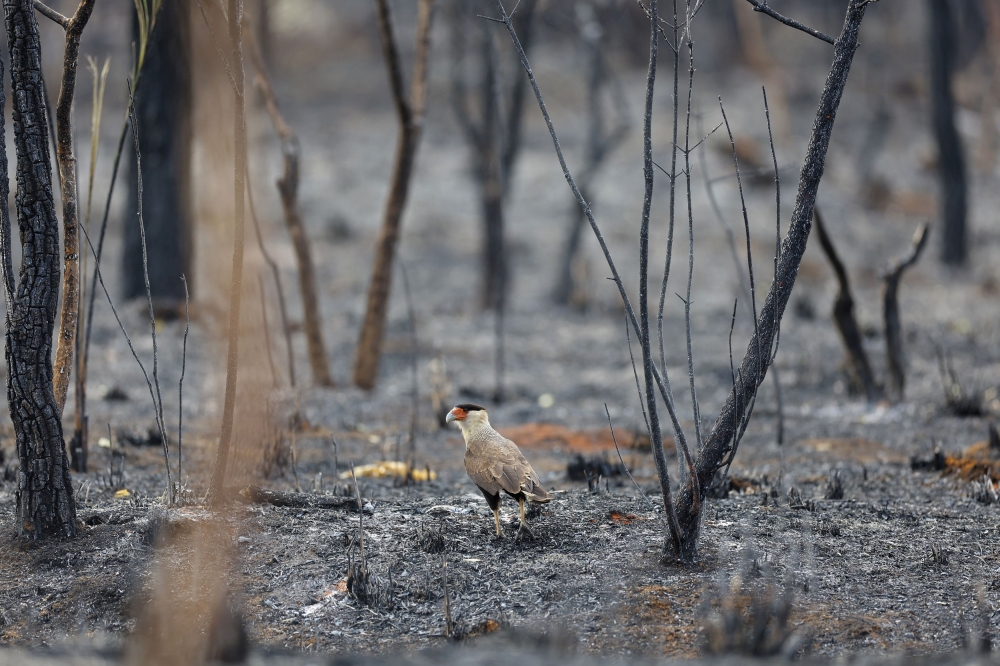
A bird is seen in a burned area of the Embrapa Biological Reserve on the day the Brazilian capital broke the historic drought record set in 1963 by reaching 164 consecutive days without rain, according to the Meteorological Institute, in Brasilia, Brazil October 4, 2024.
 — Reuters pic


EU's push for tariffs on Chinese EVs faces backlash from member states, auto industry

(Xinhua14:08, October 05, 2024

BRUSSELS, Oct. 5 (Xinhua) -- European countries and auto industry leaders have criticized the EU's push for punitive tariffs on Chinese electric vehicles (EVs), warning the move could boomerang and, in turn, hurt the EU's competitiveness.

Though the European Commission said it had secured necessary support from member states, 12 EU members abstained and five voted against the decision. Meanwhile, the Commission also called on the two sides to explore an alternative solution.

OPPOSITION FROM MEMBER STATES

The loudest outcry against the tariff came from Germany.

"Tariffs on Chinese electric cars would be wrong ... We have to speak plainly and negotiate with China - but trade wars only have losers," said German Finance Minister Christian Lindner Thursday on X, former Twitter, in the wake of Chancellor Olaf Scholz's call for continuing negotiations with China on Wednesday.

Echoing these concerns, Hungary voted against the imposition. "What they are making us do right now, or what the EU wants to do, is an economic Cold War," Hungarian Prime Minister Viktor Orban told state radio in a Friday interview, referring to the proposed EU tariffs.

Matjaz Han, Slovenia's minister of economy, tourism and sport, also voiced opposition to the tariffs, warning of "too high a price" for Europe. Instead, he advocated for more practical economic and trade cooperation between the EU and China.

Finland abstained from the Friday vote. Jukka Kuurma, a senior Finnish foreign ministry official, told local media that there was not enough proof of damage caused to the EU by the "so-called" Chinese state support to the EV industry. "We are not quite convinced that the import tariffs would be in the overall interest of the Union," Kuurma said.

Spain was also among the countries that abstained from the vote. Spanish Minister for Economy, Trade and Business, Carlos Cuerpo, said the decision to abstain was to keep the negotiation with China open and find a negotiated solution.

INDUSTRY OUTCRY

The Commission's announcement on the controversial tariffs has provoked an outcry from the European automotive industry. They warned that the move may hurt the competitiveness of local carmakers and undermine the interests of consumers.

In a statement released on Friday, Hildegard Muller, president of the German Association of the Automotive Industry, depicted the vote as a further step away from global cooperation.

Germany's auto giant Volkswagen also issued a statement, calling for a negotiated solution. The planned tariffs, it said, are the wrong approach and would not improve the competitiveness of the European auto industry.

"Today's vote is a fatal signal for the European automotive industry," BMW CEO Oliver Zipse told local media. "Now a quick solution is needed between the European Commission and China to prevent a trade conflict that will ultimately only have losers."

Mercedes also fretted about its negative effects on the industry. "We are convinced that punitive tariffs worsen the competitiveness of an industry in the long term," a spokeswoman was quoted by German news agency DPA as saying.

On top of harming competitiveness, industry insiders also believe the tariffs could undercut the interests of European consumers.

"Ultimately, tariffs won't help anyone, they will only harm European consumers, who will lose out, as well as the countries themselves," said Hrvoje Prpic, president of the Croatian Electric Vehicle Drivers Association.

CALL FOR NEGOTIATION

Following the EU announcement, the China Chamber of Commerce to the EU (CCCEU) expressed deep disappointment over and strong dissatisfaction with the EU's adoption of protectionist trade measures.

"We strongly encourage the EU to approach the final measures with caution, delay the implementation of these tariffs and prioritize resolving disputes and trade tensions through consultations and dialogue," the CCCEU said in a statement on Friday.

In an interview after the EU vote, Holger Goerg, director of the Kiel Centre for Globalization, told Xinhua that he hoped that both sides would maintain a cool head and remain at the negotiating table as negotiations between China and the EU are still ongoing.

In a joint statement, the largest single trade union in Germany IG Metall and the works councils of major car manufacturers in Germany proposed an alternative CO2-oriented trade and support regime that applies equally to all manufacturers.

"In view of the future prospects for hundreds of thousands of employees at German car manufacturers and their suppliers, we say unequivocally: tariffs are the wrong approach...," it said. 

(Web editor: Xian Jiangnan, Wu Chaolan)