Saturday, February 22, 2025

Plateau water security claims challenged

By YAN DONGJIE | China Daily | Updated: 2025-02-22 

On the southeastern edge of the Tibetan Plateau, at the convergence of the Hengduan Mountains and the Himalayas, abundant moisture creates a unique climate and ecological environment. [Zhao Wanglin/For China daily]

Chinese scientists' recent commentary published in Nature challenged a previous study published in the scientific journal that suggested Atlantic meteorological droughts threaten the water resource security of the Tibetan Plateau.

The academic commentary by scientists from the Chinese Academy of Sciences, which was published in the journal on Thursday, argued that Atlantic meteorological droughts do not pose a threat to the water resource security of the Asian Water Tower.

The Tibetan Plateau provides a robust safeguard for water resource demand in the surrounding Himalayan region. Amid global warming, the Tibetan Plateau is undergoing significant changes, and how it will evolve in the future is a critical scientific issue concerning the sustainable development of the Himalayan region, said Zhao Yutong from the Institute of Tibetan Plateau Research of the CAS, who was also a co-corresponding author of the article.

A study conducted in 2023 by a joint research team of scientists from China, the United States and Switzerland, published in Nature, claimed that meteorological droughts in the North Atlantic, where evaporation exceeds precipitation, triggered a significant decline in terrestrial water storage on the Tibetan Plateau between 2003 and 2016.

Based on this, the study further predicted that this trend of decline would intensify in the future, posing severe challenges to water resource security.

"The two key pieces of evidence supporting the aforementioned conclusions are untenable," Zhao said.

The authors of the original study used a water vapor tracking model and suggested that the North Atlantic transports substantial water vapor to the Tibetan Plateau via mid-latitude westerlies, contributing significantly to annual precipitation on the plateau.

"Observations from water vapor stable isotopes identify that the Indian Ocean monsoon is the primary source of water vapor instead of the North Atlantic, which contradicts the findings of the 2023 research," Zhao said.

When water vapor moves from the Atlantic Ocean to the plateau, precipitation, diffusion and other processes occur, leading to deposition along its path, potentially accounting for a significant portion of the total. The original research overlooked this important process, thus exaggerating the contribution of the Atlantic, she said.

"To better understand the water resource security of the Asian Water Tower, it's necessary to expand the coverage of the water vapor observation network across the plateau and conduct detailed monitoring," Zhao said.

PAKISTAN

‘Our water has been taken hostage’: Zulfikar Bhutto Jr

A new generation’s fight for water, power and resistance in Pakistan, and why Sindh’s survival depends on resisting megaprojects.


Farahnaz Zahidi 
 February 21, 2025
PRISM/DAWN

On a crisp Karachi morning, I meet Zulfikar Ali Bhutto Jr; he is calm, approachable, and dressed in an equally crisp white shalwar kameez (a traditional South and Central Asian outfit).

In his office, at Fateh Point Archives, 71 Clifton, he is surrounded by rare photographs of the Bhutto family and an eclectic selection of books — his aunt Benazir Bhutto’s autobiography, Daughter of the East, contrasts with Arnold Schwarzenegger’s New Encyclopedia of Modern Bodybuilding. (Bhutto casually explains he is “into bodybuilding”.)
A house of symbols and struggles

The road leading to this address is flanked by a giant poster of Bhutto Jr’s father, the late Mir Murtaza Bhutto. The politician was assassinated near this residence in 1996, after a confrontation with the police.

Outside, the walls of the family home are covered in symbols of identity and resistance: a Sindhi-language alphabet; a map of Sindh with the Indus River flowing through it; a Palestinian map and flag; a picture of the Al-Aqsa mosque in Jerusalem; and a clenched fist above an unsheathed sword, painted onto the main gate.

The message is clear: this is a space where history and defiance converge.

Farahnaz Zahidi


An artist, environmentalist and activist, Bhutto Jr is named after his grandfather, the former Pakistani president, and then prime minister, Zulfikar Ali Bhutto.

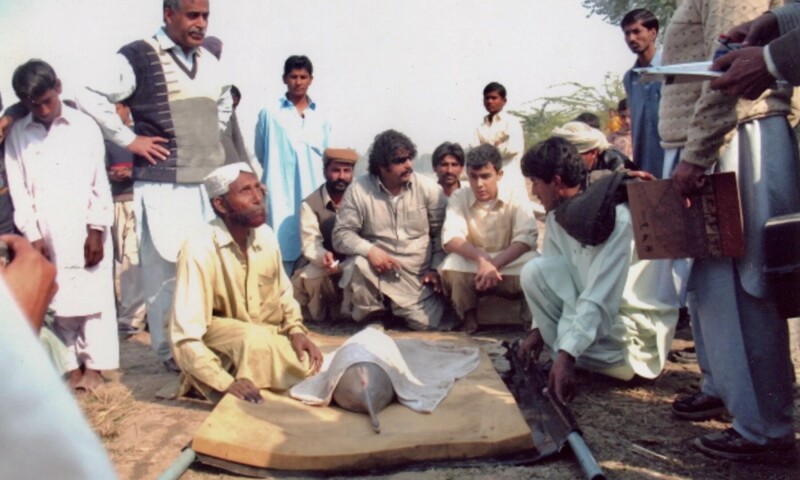
Through his environmental organisation, Bulhan Bachao (Save the Bulhan in Sindhi), he works to protect the Indus River and the endangered, blind Indus River dolphin (the bulhan).

“We’re so lucky to have one of the rarest freshwater marine mammals surviving in a river that’s so stressed, heavily exploited and dying,” he says. His affinity with the bulhan is more than symbolic — he proudly reveals a tattoo of the animal.

“It’s a beautiful, delicate, shy, obscure survivor. For me, it’s a symbol of resilience. It’s an integral part of my faith to fight for its survival. It embodies the struggles of the Sindhi people; both depend on the Indus for their existence.”

Zulfikar Ali Bhutto Jr (seated, second from right) in 2006, aged 15, at a dolphin rescue operation conducted by the Sindh Wildlife Department in collaboration with WWF. — Bangul Channa


Damned if they do, damned if they don’t

Recently, Bhutto has been part of protests against the controversial Six Canals Project. He strongly opposes the development, calling it a potential disaster for Sindh’s already scarce water resources.

Bhutto repeats his warnings to me: “It will lead to starvation and possibly famine. With climate change already reducing water availability, we are more reliant than ever on the little that remains.”

He says the project will exacerbate water shortages, threaten agricultural livelihoods and lead to environmental degradation. His statements have resonated with many in downstream Sindh, where fears are growing that the province’s water rights are being overlooked in favour of upstream Punjab.

Both ruling and opposition parties in Sindh have voiced concerns over the project’s long-term impact.

The federal government plans to build the canals off the Indus River, in Punjab, to irrigate the Cholistan Desert in the south of the province. But the people of Sindh, already suffering from chronic water shortages, fear this will further deplete their share.

The concern is real: Pakistan’s Meteorological Department reported a 52 per cent drop in rainfall in Sindh between September 2024 and mid-January 2025. The Indus provides close to 90pc of Pakistan’s agricultural water.

“Statistically speaking, there’s no possible way that they can hold that much water and redistribute it upstream to Cholistan. By the time it reaches Cholistan, evaporation, seepage and outright theft will have depleted it,” Bhutto argues.

All major political parties in Sindh, including the ruling Pakistan Peoples Party (PPP), oppose the Six Canals Project. However, opposition leaders accuse the PPP of not doing enough to protect Sindh’s water interests.

Mid-conversation, Bhutto suddenly rises, his gaze fixing on a slightly askew frame. He strides over, adjusting it with practiced precision, before stepping back to assess his work. “Is it straight now?” he asks, his brow furrowed, revealing a quiet preoccupation with order.

Looking at the history of water developments in Sindh, Bhutto references British colonial interventions in water-scarce areas. “They decided to produce rice in Larkana, where there had never been rice.

Prior to the construction of the Sukkur barrage, rice was grown in Thatta, because it had access to more water from the delta. But the British killed the delta.

Now look at Thatta’s land: salt-ridden and infertile. Some 60-75pc of water withdrawn is lost in Sindh, due to evaporation or seepage into saline groundwater,“ he says.

Over time, Bhutto adds, minerals build up and the land becomes unproductive. “We are left with saline and waterlogged land, in which many native trees and crops can’t grow. Large parts of northern Sindh have been rendered inarable due to these experiments with water.”

Bhutto warns that Cholistan could suffer the same fate. “I would potentially buy into this if the project was benefiting landless farmers, but it doesn’t.”


Members of Sindh Abadgar Ittehad, a farmers unity group, at a protest in Hyderabad, November 2024. The group is against the construction of new canals in Punjab, which will divert water from the Indus River. Sindh Abadgar Ittehad warns of worsening water shortages and threats to agriculture. — Pakistan Press International/Alamy

Tensions between Sindh and Punjab over water are not new. Data from the Indus River System Authority shows Sindh faced a 40pc water shortage between 1999 and 2023.

Bhutto believes the government should focus on managing smaller seasonal rivers, instead of overburdening the Indus: “The floods showed us that we have so much potential for water storage outside of the Indus mainstream.”

When asked about the Diamer Bhasha Dam, Bhutto is sceptical. While it could have a modest positive impact, he says the country already has enough dams.

“Pakistan has so many dams — 150! That’s more than most developed countries. The idea that dams equal progress is a myth. While a dam may provide things like energy and mass hydropower … over time they silt up.”

He gives Sukkur as an example, where the riverbed has risen so high that floods are now common. There was a time when you could see the steps leading up to the Sadh Belo temple. Now, water laps at the top of the stairs.“

According to Bhutto, “building dams is about optics. It’s a way to spend money quickly where it’s not needed.” He stops for a moment, before launching into a tirade against the entrenched mindset of policymakers who see megaprojects as the only solution to water management.

“We need to think more creatively. Why are we, as a nation, so intellectually stunted that we can only think of this one monster — the dam? This is how Sindh is sabotaged. Our water has been taken hostage from us. It’s leveraged constantly, and the threat of less water coming to us has been a threat since the inception of Pakistan.”


Too many dams, too little land

Among Bhutto’s perceived priorities for Pakistan is the need for land reforms. “It should make people ill to think that in a country as poor as ours, billions of rupees are being spent on a project that benefits less than 0.5pc of the population.

Surely, if you’re going to spend so much, it should be for the betterment of the poor. But the poor are going to be expected to do what they’ve always done, which is work for nothing for someone who couldn’t care less about them.“ His tone is laced with frustration and irony.

Bhutto says his haris (farmers) are also deserving of land ownership. “A farmer needs to have security that the land that he works on is in fact his — in his name, in his child’s name — and that no one is going to come take it. Reforms that guarantee that farmers are seen as human beings, as malik (owners) and not just nokar (servants). My grandfather gave up a significant portion of his land to haris in Sindh,” he claims.

As a member of Pakistan’s premier political dynasty, Bhutto is aware of the weight his words carry: “When I speak, it lands differently. I can’t help that, and I’m not naive about it. I use my voice for what matters.”

On Pakistan’s climate response, he is blunt: the country — like much of the world — does little more than pay lip service: “Look at the Loss and Damage Fund from COP27. More than two years later, people displaced by the 2022 floods remain homeless”.

What should Pakistan and others do? While he acknowledges richer nations are “responsible for more emissions”, Bhutto urges local action, too. In particular, the restoration of the Indus River’s natural course, to ensure its waters reach Sindh’s parched lands.

 “Make the river flow to the sea.”
PAKISTAN

Lurking drought
 February 22, 2025 
DAWN


AMID the heated debate on new canals, corporate farming and a mythical surplus of water, a meteorological drought alert issued by the Pakistan Meteorological Department is a matter of consternation. Drought advisory-II stated that “drought conditions [are] emerging in parts of the country” was issued on Jan 21 by the PMD. The advisory revealed that from Sept 1, 2024, to Jan 15, 2025, Pakistan received, on average, 40 per cent less rainfall than normal for the period. Alarmingly, suboptimal rainfall was observed in Sindh (-52pc), Balochistan (-45pc), and Punjab (-42pc).

Meteorological drought is characterised by a spell of abnormally dry weather, which triggers a serious imbalance of water availability in any area. Thirteen districts in Sindh, 14 in Punjab and nine in Balochistan have been marked out for this situation.

Various updates of precipitation paint a grim scenario for water availability in the early Kharif season. Rainfall in December and January remained alarmingly below normal. Sindh and Punjab received 97pc and 89pc less rainfall than normal during this period. In the northern areas of Gilgit-Baltistan and Azad Kashmir, rainfall was, respectively, 38pc and 72pc less than usual. Water balance is evidently heading towards a disturbing cycle unless the weather takes a more positive turn in the next two months.

However, the prognosis by weather pundits suggests that the ongoing drought conditions are likely to be aggravated as no significant rainfall is expected in the coming weeks. The PMD ominously warned that the second half of this season (January to March) will possibly become drier, which may exacerbate mild drought conditions to the level of moderate drought conditions. Some rain and snowfall were received upcountry in the latter half of February, but the drought risk has not been averted yet.

Winter snowfall is a major source of summer flows in the Indus and Jhelum catchments. So far, snowfall has been below the annual average. PMD data shows that from October to the first week of February, only 33 centimetres of snowfall was recorded against the October-March annual average of 126.2 cm. The snowfall pattern of the last two decades (2004-05 to 2024-25) shows that for 11 years, snowfall was below the annual average. A research paper authored by Simon Gascoin, Snowmelt and Snow Sublimation in the Indus Basin, published by the Multidisciplinary Digital Publishing Institute, mentions that snowmelt in the upper Indus basin contributed 74pc of the annual run-off during 2001-2014. Other contributing factors included 23pc rainfall and 3pc snowmelt. Hence, declining snowfall and rainfall during these months will negatively affect water flows in the Indus river during the summer on this.


Drought conditions are likely to be aggravated.


Water stored in the Tarbela Dam is currently being used to grow Rabi crops. Outflows from the dam remained 45,000 cusecs against an inflow of 13,000 cusecs in the third week of February. Due to this imbalance of inflows and outflows, Tarbela levels tumbled four metres in a week. If no significant rain is received in the catchment area, water shortage is expected in April when Sindh’s barrages need a flow of over 40,000 cusecs. Sindh’s water requirements will swell to over 77,000 cusecs in May. Snowmelt in the upper Indus helps to augment Tarbela’s water level. If the mou­ntain areas do not receive a few healthy spells of snowfall in March and April, storage in Tarbela will experience stress after May. With winter delayed, snowmelt also lags. This can deprive Sindh of the required am­­ount of water for crop sowing in the early Kharif season.

Overall, water availability in the Indus and its tributaries have shown a declining trend du­­ring this century’s first quarter, with the exception of the two floods of 2010 and 2022. Flow data shows that from the period 2000-01 to 2022-23, there were 10 dry years when less than 8.6 million acre feet of water were discharged below Kotri — the minimum flow recommended by international experts. The average annual flow below Kotri Barrage has drastically declined from 40.69 maf during 1976-1998 to 14 maf during 1999-2022. These numbers also defy the frequently claimed quantum of surplus flows below Kotri Barrage to justify new reservoirs and canals in the Indus basin.

A World Bank report, Pakistan’s Water Economy: Running Dry, paints a grim picture, pointing out that due to rapid glacier retreat, the Indus basin is likely to endure a colossal decrease of 30pc to 40pc in its flows in the coming decades as glacial reservoirs become empty. Empirical evidence demands more rational planning for the responsible use of the rapidly declining water flows. Rather than developing new command areas, it would be prudent to focus on increasing water productivity.

The writer is a civil society professional.
nmemon2004@yahoo.com


Published in Dawn, February 22nd, 2025
PAKISTAN

A malleable agenda
Published February 21, 2025 
DAWN


The writer is a development professional and impact adviser with over 25 years of experience designing and managing programmesto improve people’s lives.


AS the new world order takes shape, with Trumpism at the forefront, many of us can only watch with bemused interest how, globally, priorities and interests are radically shifting. Diversity, equity and inclusion are dead in the water. Environmental and climate change considerations can unashamedly be relegated to the back row. Their inclusion in the rhetoric (given that not much in terms of action and practice ever took place) of governments, corporates and multinationals will soon disappear. Oil and coal are back in business. Renewables chug along at a slow pace.

As for global institutions such as the WHO, the entire UN system, and even the international financial institutions, the impact is going to be far-reaching. The pulling back of American funds is creating a sense of panic. See what is happening with USAID, a home-grown institution. Many of these global institutions rely heavily on US funding, and its loss will require a complete rethink and reshaping of institutional structures

While this may seem like an awful blow, a large part of me feels that we are in dire need of a paradigm shift. The way the international donor and development sector has been shaped over the past 30 years is no longer working. We must lose the baggage and the weeds that are strangling us, and take a leap into the unknown, to test new ways of achieving our goals.

Against this backdrop of ‘minor’ chaos, the World Bank announced its Country Partnership Framework for Pakistan, which builds on the learnings of their previous experience with projects and programmes in the country. The strategy, as a result, focuses on a 10-year time frame (2026-2035), targeting six key outcomes which supposedly have broad backing from across the political, bureaucratic and corporate arenas. The commitment is for $20 billion and envisions working in close partnership with other members of the World Bank Group — the International Finance Corporation and Multilateral Investment Guarantee Agency. The conventional wisdom is that consensus means less obstructions and easier to achieve goals. Two of the six outcomes focus on environment and climate: Outcome 3 — “increased resilience to climate change”, and Outcome 4 — “cleaner energy and better air quality”.

Under Outcome 3, the World Bank aims to improve the resilience of more than 100 million people over the decade; targeting the Sustainable Development Goals (SDGs) related to reduced hunger, greater food security, improved gender equality, and more sustainable communities and cities. There are a set of actions which need to be taken by government, private sector and civil society for the outcome to be achieved. These include enhancing agricultural productivity and water management, growth of the agri-food sector, opportunities for women’s economic empowerment and financial inclusion, climate-resilient infrastructure and services, and improving disaster-risk reduction and disaster response.

The way the international donor and development sector has been shaped is no longer working.

Outcome 4 focuses on the transition to a cleaner, cheaper, and more sustainable and equitable energy system (I hope this means reducing the burden of electricity bills for those who really cannot afford them), and addressing the multiple sources of air pollution. This outcome also targets specific SDGs such as climate action, sustainable cities and renewables. Actions include enabling 10 gigawatts of renewable energy capacity and working in key air-polluting sectors such as transport, construction, residential cooking, industry, agriculture and land use.

The 10-year time frame includes projects that are currently in the pipeline or already active. Which is to say that the proposed $20bn investment does not mean immediate materialisation, if at all. At the end of five years there will be a full review, and if progress towards outcomes is not favourable, there will be a revision in the strategy.

The enlightening bits of the report reside in two areas — the first is the country context and some of the economic forecasting that may be a bit too optimistic for what is actually happening in our economy and society. Such over-optimism in planning nearly always ends badly. The second is the risk rating that the World Bank gives to in-country areas. It acknowledges that the strategy faces high risk in implementation from nearly all quarters — political and governance; fiduciary; macroeconomic; sector strategies and policies; fragility, conflict and violence; and environmental and social. Risks related to technical design, institutional capacity to deliver and stakeholders are rated as substantial. The overall high-risk rating, with no new solutions as to how the World Bank itself will address these, doesn’t bode well for actual progress.

There is one further risk that remains unmentioned. The US influence over the World Bank Group is significant. The bank operates out of Washington, D.C. and all WB presidents have been American, the current one, Ajay Banga is a US citizen of Indian origin. The Trump administration is going to exert its power, either by withdrawing funding or forcing the closure of entire programmes and especially those related to DEI and climate change. Will this impact the strategy for Pakistan? Will the residing powers that be use this opportunity to continue their flagrant disregard for environment in favour of money? I believe the answer to both questions is yes.

While our focus may be on Trump’s antics, the ‘Ministry of Climate Shame’ has again revealed its intention to doing away with the greening of the Margalla Hills protected areas. Don’t they understand that allowing the concretisation of the hills (under the guise of tourism for the people) will destroy us? As will the official mindset that decided to cut down 150 trees in Shakarparian (a beautifully wooded area) to make way for an electric vehicle charging station, and is now planting hundreds of palm trees (not indigenous) in Islamabad. God save Pakistan.


samialakhan21@gmail.com


Published in Dawn, February 21st, 2025
TRUMP’S NEO-COLONIAL FANTASY IN GAZA


In a series of inflammatory statements, US President Donald Trump has proposed a ‘radical reimagining’ of Gaza — one that involves forcibly relocating its Palestinian population and transforming the enclave into "prime real estate."

Published February 16, 2025
 EOS/DAWN


“If the stranger hadn’t been there! But he WAS. And Caesar crossed. With such results!” — Mark Twain, The Turning Point of My Life

“If Protestantism…came to be identified as the poster religion of capitalism, then US President Donald Trump has always been a convert.”
— Professor Joseph Massad, ‘Trump’s Plan to Colonise Gaza Echoes Failed 19th-century American Missions’; Middle East Eye

“GENTRIFICATION OF GAZA”

Standing with Israel’s visiting Prime Minister Benjamin Netanyahu at a joint press meet on February 5, 2025, US President Donald Trump spoke about taking over and owning Gaza and resettling Gaza’s Palestinian population elsewhere, in “a beautiful area with homes and safety [where] they can live out their lives in peace and harmony” because “the only reason the Palestinians want to go back to Gaza is they have no alternative. It’s right now a demolition site… Virtually every building is down.”

This was the continuation of his January 20 inauguration day comments about Gaza being a “phenomenal location”, where “beautiful things could be done.” These musings were followed by his offhand comments on January 26, where he told reporters on Air Force One that Gazans should be moved to Egypt and Jordan and “we” should just “clean out” the enclave.

The February 5 comments, which he read from a text prepared for him by someone — since he normally ad-libs — have therefore been taken seriously by concerned world leaders within and outside the Middle East. His Gaza Plan, or what many now describe sardonically as his ‘Riviera Plan’, has since been roundly dismissed and condemned by virtually everyone except Israel’s far right.

In a series of inflammatory statements, US President Donald Trump has proposed a ‘radical reimagining’ of Gaza — one that involves forcibly relocating its Palestinian population and transforming the enclave into ‘prime real estate.’ The proposal has sparked global outrage, with many calling it a blatant exercise in modern imperialism. Is Trump simply bluffing? And if so, what is his end goal?

After the negative international reaction, administration officials tried to walk back some of what he said, especially in relation to expelling Gazans and resettling them in Egypt, Jordan or even Somaliland, clarifying that any such resettlement would be temporary.

Trump torpedoed that effort by doubling down the next day and stated that “This [Gaza Plan] was not a decision made lightly. Everybody I’ve spoken to loves the idea of the United States owning that piece of land, developing and creating thousands of jobs with something that will be magnificent.”

Then, on February 10, he sat down with Fox News channel’s Bret Baier and said Palestinians would have no right to return under his “I would own it” plan and that there could be as many as six different sites for Gazans to live outside the enclave.

What should one make of it? The plan is morally reprehensible, of course. Any attempt to implement it would violate several provisions of international law, which we shall refer to in due course; forced displacement is considered ethnic cleansing. The plan has no details and lacks sinews. So why should anyone be worried about it if it is so outlandish and is dead on arrival?

One answer should be obvious: regardless of whether it can or cannot be implemented, there’s a thick miasma of 19th century colonialism that hangs around it. That itself is enough for all conscientious peoples and leaders of the world to call it out for what it is — 21st century imperialism that flies in the face of the moral and legal-normative values that have painstakingly evolved over a century-and-half.

Also, no less troubling is the fact that it follows close on the heels of Israel’s genocidal war the world has seen unfold live on cameras. That demands even greater urgency from the world to ensure that the unholy alliance between the political scions of Ze’ev Jabotinsky and a “non-denominational Christian” supported by “American evangelical Protestants” cannot carry this sordid tale any further.


Donald Trump’s February 5 comments, which he read from a text prepared for him by someone — since he normally ad-libs — have therefore been taken seriously by concerned world leaders within and outside the Middle East. His Gaza Plan, or what many now describe sardonically as his ‘Riviera Plan’, has since been roundly dismissed and condemned by virtually everyone except Israel’s far right.

HOW DID IT BEGIN?

On February 15, 2024, Jared Kushner, Trump’s son-in-law and a former property dealer, spoke with Professor Tarek Masoud, faculty chair of the Middle East Initiative at Harvard’s Kennedy School of Government, as part of the speakers’ series.

He told Masoud that “Gaza’s waterfront property could be very valuable… if people would focus on building up livelihoods… It’s a little bit of an unfortunate situation there but, from Israel’s perspective, I would do my best to move the people out and then clean it up.” But he added that he didn’t “think that Israel has stated that they don’t want the people to move back there afterwards” [italics added].

Kushner was Trump’s senior White House adviser in his first term and played a key role in the Abraham Accords that normalised relations between Tel Aviv and four Arab countries in 2020. His Saudi-backed firm Affinity Partners “received the green-light from Israeli regulators to double its stake in Phoenix Financial Ltd”, as reported by Bloomberg on January 15 this year. Phoenix is a major Israeli financial firm and funds the construction of illegal settlements in the Occupied Palestinian Territories. The nod from Israeli regulators came days before Trump’s inauguration.

For his part, Kushner told Bloomberg that “Investing in Phoenix in July 2024 was a decision rooted in my belief in Israel’s resiliency and the fundamentals of Phoenix’s business. Six months later, the increased value of our shares reaffirms my conviction — both in Israel’s strength and the growing promise of Phoenix.”

According to Who Profits, an NGO that tracks Israel’s illegal occupation, Phoenix Financial has financed and insured construction projects throughout Israeli settlements in the occupied West Bank and the Syrian Golan Heights. Phoenix also owns an 80 percent stake in a large shopping mall in an illegal East Jerusalem settlement and stakes in various companies operating throughout other settlements.

BUSINESS DEALS OVER DEAD BODIES


The “little bit of an unfortunate situation” in Gaza that Kushner spoke about, the International Court of Justice described in its interim judgement thus: “In the Court’s view, the facts and circumstances… are sufficient to conclude that at least some of the rights claimed by South Africa and for which it is seeking protection are plausible.”

Leaving legal technicalities aside, the latest figures just before the ceasefire went into effect recorded at least 61,709 people killed, including 17,492 children. The figure for missing or presumed dead is 14,222 while 111,588 people, mostly women and children, have been wounded, a majority with life-altering injuries. Nearly 80 percent of Gaza’s infrastructure, especially in the north, has been completely destroyed.

It is important to position the business deals Kushner talks about and the Israeli perspective he refers to with the actual human tragedy that has unfolded — and could well continue to unfold — in Gaza and also in the West Bank.

Business is also Trump’s pivot, as is the brazen exercise of power. Neither he nor Kushner has any sense of history regarding the conflict and its human cost for the Palestinians over the past century. Both look at Palestine as sweetheart business deals that will make them money and, in the process, also secure peace without any reference to a just settlement of the Palestinian nakba.

In a February 7 post for Appointed Times, his substack, American political scientist Barnett Rubin writes under the title, ‘All Hands on Deck’: “The domestic and foreign policies of the oligarchy led by Donald Trump are united by the principles of contempt for law and rights, and the idolatry of wealth and force. Every government, movement and citizen in the world must ask — can I live in a world without rules, even if rules entail hypocrisy and double standards? Will I acquiesce to a world where there is ‘No law, no heaven?’”

This is not a theatrical or melodramatic call. To understand Donald Trump, one must read American journalist Wayne Barrett’s book, Trump: The Greatest Show on Earth: The Deals, the Downfall, the Reinvention. First published in 1991, Barrett updated it in 2016.


Jared Kushner and Donald Trump pictured at the White House in 2020: both Trump and Kushner look at Palestine as sweetheart business deals that will make them money | AP


WHO IS TRUMP?


Barrett was an investigative reporter and wrote for Village Voice, the New York City’s alternative paper, founded in 1955 by, among others, writer Norman Mailer. Tom Robbins, a former colleague of Barrett’s at the Voice, described him after the latter’s death on November 19, 2017 as the city’s “foremost muckraker.”

One might ask, given the number of books written about Trump, why Barrett’s? Having read a few, including Bob Woodward’s Trump trilogy, I would say that, while others have tried to look at Trump through what he does, Barrett unpacks Trump himself, to inform us why he does what he does.

It starts with grade-A narcissism. Writes Barrett: “A couple of months after [his presidential announcement speech], when asked to name a leader he looked to for advice on managing his company, Trump said, ‘Me.’ A deputy in the Trump Tower office, where the interview took place, affirmed, ‘Mirror. The Mirror.’ Donald, who actually has a large mirror on the elaborate desk in his Tower apartment, added, ‘I look at me.’”

Barrett’s book goes into the nitty-gritty of Trump’s life and what the magazine Mother Jones described as his “bent psyche”: “The Trump Tower apartments, and some of the offices above the atrium, had long been magnets for criminals. A half dozen felons, including the head of the [mob family] Gambino-tied concrete-drivers’ union, owned part or all of over two dozen units in the tower in its first decade. Trump’s cluelessness on foreign policy, apparent even in his opening speech, extended to the tower’s apartment and office occupants —a disturbing collection of international rogues.”

It is this man, a rapacious practitioner of backroom deals, who told the reader in his ghostwritten book The Art of the Deal to “protect the downside and the upside will take care of itself”, and who now controls the most powerful office in the world, a “chaos president” — to quote former president George W Bush’s son Jeb Bush.

The portrait that emerges is of an unscrupulous narcissist who will use the law when it suits him, break and bend it when doing so is required, whose id, the primitive and instinctual part of the mind, dominates his working within the corrupted structures of capitalism.

But he is what America has got and he is what the world has to deal with.

As Caesar stood on the banks of Rubicon, debating the pros and cons of crossing the river, a stranger sat playing a pipe. Mark Twain, quoting the Roman historian Gaius Suetonius, tells the reader that the stranger “snatched a trumpet from one of [the soldiers], ran to the river with it and, sounding the advance with a piercing blast, crossed to the other side.”

That decided the matter. “Upon this, Caesar exclaimed: ‘Let us go whither the omens of the gods and the iniquity of our enemies call us. The Die Is Cast.’”

Why is this important? Having voted in Trump for the second and perhaps more ominous time, America might just have crossed the Rubicon and by doing so “changed the future of the whole human race, for all time.”

Omar Khayyam called it the “moving finger.” Once it has written, the course of events gets fixed and the counterfactuals, T.S. Eliot’s “what might have been”, become meaningless or, at most, an academic exercise.

INTERNATIONAL LAW AND TRUMP

We have already talked about Trump’s contempt for domestic law, norms and regulations. What he does within and has already set out to do is a fight the Americans have to fight, and they may already be in trouble. Political scientists Steven Levitsky and Lucan A. Way call it ‘The Path to American Authoritarianism’ in a February Foreign Affairs essay, and argue that America is headed towards “competitive authoritarianism”, where competing interests would “weaponise the state.”

What we are witnessing is a disregard for both domestic and international law. How America shapes up internally or, more aptly, frays will also have consequences for the external world. Our concern right now is, however, with international law and Trump’s avowed announcements to destroy that meticulously crafted regime.

In recent times, it began with the Lieber Code. When the Civil War broke out in 1861, Abraham Lincoln “wanted to provide instructions to Union officers on the particularly complicated legal issues arising from non-international armed conflicts.” Jurist-academic Franz Lieber, teaching constitutional questions at Columbia Law School, was asked to write one.

The result was 157 provisions that deal with a wide range of legal issues in armed conflict. Many of its provisions, for instance the permissibility of starving civilians, would rankle modern sensibility. But, as German jurist Jenny Gesley says, the code became the basis for “many subsequent international codifications of the laws and customs of war, in particular the International Declaration Concerning the Laws and Customs of War agreed upon at the Brussels Conference in 1874, and the Hague Conventions on Land Warfare of 1899 and 1907.”

These provisions were further honed and nuanced through multiple iterations of the Geneva Conventions that resulted in the International Humanitarian Law (IHL), which are a set of rules that seeks to limit the effects of armed conflict.

Other International Law provisions prohibit wars of aggression, occupation and annexation. States have also pushed for other norms to preserve territorial boundaries, by drafting instruments that seek to establish a duty not to recognise the transfer of title in certain cases involving forcible acquisitions of territory, and advocated for what came to be known as the “duty of non-recognition” of occupation and annexations.

Similarly, there are laws and regulations against forced displacement of populations. Even circumstances in which it can serve a legitimate purpose — to safeguard the population from an ongoing military operation — such displacement “must meet certain minimum safeguards and take place in conditions of safety and dignity.”

The permanent displacement of a population, the attempt to create ethnically homogeneous geographic areas, is ethnic cleansing and, therefore, completely illegal under International Law. In other words, the Gaza case (or West Bank), if Trump or Israel were to actually try to do what is being proposed, will be an open and shut case stamped ILLEGAL, besides being morally deplorable.


Donald Trump meets with Israel’s Prime Minister Benjamin Netanyahu in the Oval Office of the White House in Washington on February 4, 2025: of all the issues on Trump’s plate, Palestine is the most complex and, in his last tenure, Trump threw his weight squarely behind Israel | AFP

IS TRUMP THE FIRST IMPERIALIST?

No, he isn’t. But at least through his pronouncements he seems to be going back to the 19th century.


Daniel Immerwahr, American historian and professor at Northwestern University, explains to the reader in his 2019 book, How to Hide an Empire, of how US imperialism began — with guano, bird-poop. East Coast farms were suffering soil exhaustion and soil required fertilisation. That’s where guano and hundreds of uninhabited Pacific islands came in.

The entire exercise was codified in The Guano Islands Act of 1865. It “enabled citizens of the United States to take possession of unclaimed islands containing guano deposits in the name of the United States.” Migratory birds for centuries were coming to these remote islands and pooping. There was guano everywhere and it needed to be blasted. Labour conditions were terrible and the white masters cruel.

So in Navassa island near Haiti, the African-American workers mutinied and killed five white supervisors. They were tried and sentenced to death. Enter E J Waring, a black lawyer, to defend the mutineers. He made the argument that they could not be tried in US courts because guano islands were foreign territory and because the US could not claim overseas territory. The US Supreme Court (USSC) mulled the question and declared that the guano islands were US territory and therefore the mutineers could be tried in the US.

As Immerwahr says, in doing so, the USSC “lays the basis for the legal foundation for the US empire, because it establishes the constitutionality of the fact that the US can claim overseas territory and that is consonant with the US Constitution.”

This is also the beginning of much interest in the US about expanding to not just small islands but larger colonies. To cut it short, during the American-Spanish war, the US ends up occupying Cuba, Puerto Rico, Guam, and playing a most ironic and deceitful hand, the Philippines, by first supporting the insurgents and then simply taking over Manila and the rest of the country.

Later, in the first decade of the 20th century, the term colonies was considered too brazen and it was decided to call them territories.

After World War II, the US decided to hide its empire through a web of international and financial institutions, leading to what Pan-African revolutionary and Ghana’s first president Kwame Nkrumah called neo-colonialism, the “worst form of imperialism” because “power [is exercised] without responsibility and, for those who suffer from it, it means exploitation without redress.”

A year after Nkrumah’s book Neo-Colonialism, The Last Stage of Imperialism came out, he was ousted from power in an allegedly CIA-backed coup, ironically corroborating what he had argued in the book. The literature on the US’ covert (and other times overt) financial and geopolitical imperialism is thick and has attracted such international scholars as Noam Chomsky, Michael Hudson, Abraham Newman and Henry Ferrell, to name just a few. Hudson calls it “super-imperialism.”

Trump has removed the fig leaf from the crotch.

SO HOW WILL IT PLAY OUT?

An ideal world for Trump would be what Barrett called an “auto-erotic autobiography”. Mercifully, the real world contains many actors, state and non-state. Some will toe his line; others will push back. The real world is far too complex even for the megalomania that informs Trump.

He knows that. He is not a fool. So what’s his strategy? To act as a mad man and force others to take him seriously, like what Nixon tried to do with the Vietnamese and failed? Maybe. What is clear is that he sets the opening price to create what negotiation theory calls the anchoring effect and what psychological studies have shown to have a considerable and persistent effect on other parties. In doing so, he claims value for himself by taking as much value away from the other party as he can, a process akin to bargaining for items that do not have a fixed price.

Take his original ultimatum to Panama on the canal. He began with a maximalist claim: the US built it and the US should take it over and run it. The claim was also sprinkled with half-facts and untruths. Was he prepared to occupy Panama? No. He wanted the Chinese booted out and Panama to get out of China’s Belt and Road Initiative. He got both. In other words, start big and bully and then negotiate.

The question is, how will he deal with Gaza? Perhaps a better question would be, is his Gaza Plan about Gaza?

Look at it like this: if he ratchets up pressure on Egypt, Jordan and Saudi on issue XYZ and then wants them to make concessions on ABC, the real prize, how would these countries react, especially if they believe that it’s easier to concede on ABC and there’s even a better quid for the quo in terms of closer relations with the US and the benefits to be accrued from that?

Also, what is a bigger prize for Israel, West Bank and East Jerusalem or Gaza? In theory, if Israel, which has already turned the West Bank into multiple bantustans, could annex that territory, it could let Gaza be, leaving it destroyed and miserable for years to come.

None of this might come to pass. Of all the issues on Trump’s plate, Palestine is the most complex and vexing. In his last tenure, he threw his weight squarely behind Israel, shutting down the PLO office in New York, legitimising Israel’s occupation of the Golan, moving the US embassy to Jerusalem and facilitating illegal Israeli settlements in the Occupied Palestinian Territories. That begot the October 7 military attack by Hamas, among other factors. If he continues with the same policy, we could see more violence and, possibly, even the reversal of the normalisation process.

Meanwhile, the fragile ceasefire is already threatened because Israel has violated the benchmarks for aid delivery and Hamas has announced it will withhold the prisoner swap. Trump has weighed in by saying that if Hamas doesn’t release all the prisoners by Saturday, all hell will break loose.

CONCLUSION


One scenario is for Trump to force the targeted Arab states, most of whom are the US’ vassals, to take the Palestinians. Those states will have to weigh the consequences of capitulating to US pressure with anger in their streets. That anger is thick and palpable and it can’t be lightly dismissed.

But let’s assume, in theory, that they would. Jordan’s King Abdullah II bin Al-Hussein looked distraught in his meeting with Trump. Egypt’s President, Fattah el-Sisi says he will stay away from a White House meeting if Gaza displacement is on the agenda but has also said Egypt is preparing a plan for Gaza’s future. All this implies that Trump, like last time, is subtracting the Palestinians from their future.

That said, we still have the problem of how to move the Palestinians out of their lands. Would West Bank follow, what Israeli far right calls Judea and Samaria? Some 200,000 Gazans have already left the strip, mostly those with foreign passports. Some others might too: students, children, older people and women. But it will be merely a percentage of the total. The majority would stay, as would the fighters.

Would Trump give a nod to Israeli Occupation Forces to resume their genocidal assault on Gaza and force the Gazans out of the strip? That’s what the Israeli far right definitely wants. But if he does, it would be clear as daylight that Trump has, in fact, sanctioned Israel’s genocidal campaign. That would be an order of magnitude worse than Joe Biden’s legacy. It would also fly in the face of Trump’s claim that he is a unifier and doesn’t want to embroil the US in wars.

That would also have consequences for an international order that, despite state interests, is underpinned by legal and moral constraints. Other powers, global and regional, would take a cue from the US and resort to the use of force, attacking, occupying and annexing territories. The world would be back to the 19th century, Thomas Hobbes without a check by John Locke.

There’s a Y-junction here and, as Robert Frost told us, we can’t travel both: allow Israel to exterminate the Palestinians or right the original wrong. The first leads to more violence and anarchy, the second to a strengthening of legal-moral norms. I am not wagering on the second.

Correction: In the print version of this story, the last line mistakenly read ‘I am not wagering on the first.’ This has been corrected to ‘I am not wagering on the second.’

The writer is a journalist interested in security and foreign policies.
X: @ejazhaider

Published in Dawn, EOS, February 16th, 2025
PAKISTAN PRIVATIZED HEALTH CARE 

Conflict of interest
Published February 22, 2025 
DAWN


“The need for justice grows out of the conflict of human interests.” — John Rawls.


WE were sitting in a committee room in the National Assembly building, participating in a meeting of the National Assembly Standing Committee on Health. The subject under discussion was the regulation of private medical colleges in Pakistan because of serious concerns about their performance.

At least three members of this committee owned private medical colleges and two others were on the board of different colleges in Pakistan. They were loudly justifying the working of private medical institutions. Nobody pointed out the conflict of interest. The meeting ended without concluding anything on the stringency of regulation.

The above example is repeated every day in different forms, with different people, and during different meetings on different topics, and those who have a direct interest in the subject usually prevail. Nobody talks about it, nobody takes it up, and if ever there is a mention by anybody, that person becomes persona non grata, a troublemaker, and is portrayed as somebody who doesn’t understand the ‘realities’ of the world. As happened in the above-mentioned meeting!

Recently, the owner of a medical college, a teaching hospital, and a number of other health-related organisations was made chairman of the Board of Authority of Islamabad Healthcare Regulatory Authority. Nothing personal, but it is against common ethical sense. Those who are to be regulated must not head the regulatory body which is going to regulate them.

In a society suffering a moral crisis, conflict of interest is on the lower rung of the ladder. It comprises a faded shade on the ethics spectrum, which people hardly ever see. There are much bigger issues — such as disrespecting the Constitution, and the lack of rule of law; hence, few care about discussions on conflict of interest. However, in healthcare, ignorance or lack of attention to a conflict of interest can be a matter of life and death, directly or indirectly. So, it is indeed very important.

There are many definitions and descriptions of conflict of interest from the legal, moral and technical perspectives. One that I really like is picked from a World Health Organisation publication. It describes a two-day meeting on the subject, where experts discussed and agreed on this definition: “An actual conflict of interest arises when a vested interest has the potential to unduly influence official or agency judgement/action through the monetary or material benefits it confers on the official or agency.” I think this is it.

Those who are to be regulated must not head the body which is going to regulate them.

In 2021, a major scoping review was published in the British Medical Journal by Susan Chimonas et al on mapping all known ties between the medical product industry and the healthcare ecosystem. They developed a map through the synthesis of 538 articles from 37 countries showing the extensive network of medical product industry ties to activities and parties in the healthcare system. They identified activities in health research, healthcare education, guideline development, formulary selection, and clinical care.

The medical product industry was found to have direct ties to almost all parties in the healthcare ecosystem, including non-profit entities, the healthcare profession, the market supply chain, and government. The most frequently identified parties were individual health professionals described in 422 (78 per cent) of the included studies.

More than half (303 or 56pc) of the publications documented the medical product industry ties to research, with clinical care (156 or 29pc), health professional education (145 or 27pc), guideline development (33 or 6pc), and formulary selection (eight or 1pc). Policies for conflicts of interest existed for some financial and a few non-financial ties.

Nothing is interest-free though. We all have legitimate professional and personal interests. The issue arises when opposing interests combine in one person or an entity and when private interests are pursued through a position of pow­er by undermining professional or public interest.

Situations of conflict of interest are ubiquitous and natural. The real point of the discussion should be how to deal with conflicts of interest. First of all, the system should be sensitive to such situations and it should be able to recognise it. Secondly, there should be an institutional framework to manage a conflict of interest. A proper system of declaration and management of conflict of interest blunts the interest to the extent required in the conflict situation.

I have sat in many international meetings where all participants had to sign an elaborate conflict of interest form before the beginning of the meeting and some participants had to recuse themselves on certain points of discussion which had to do with their direct interest. And all this is recorded in the minutes of the meeting.

Institutions that believe in and practise good governance usually have explicit, written-down policies on conflict of interest. The best definition of a policy is that it helps people avoid becoming hostage to events. Getting caught in a situation and not knowing what to do about it or how to handle it lands the organisation in a position of arbitrariness.

Power, instead of principle, then prevails. Once a policy is made, there should be a mechanism and well-defined responsibilities for the implementation of the policy. The members of the organisation should be made aware of the policy; they must be trained and then monitored for their conduct, and reported in a transparent way; appropriate well-laid-out accountability procedures must take their course.

True, even with all the above in place it doesn’t mean that everything will be sorted out and everybody will live happily thereafter. The key is to continue to work in the loop of practice, learning, monitoring, course correction and continuity of practice.

In Pakistan, conflict of interest is generally not seen as a conflict or even a milder form of the problem; hence it has permeated our body politic at every level and every sector and organisation. When people stop feeling guilty about an unethical act, it becomes normalised, and this is the most dangerous situation.

The writer is a former health minister and currently a professor of health systems & population health at the Shifa Tameer-i-Millat University.

Published in Dawn, February 22nd, 2025
U$A THE WORLDS GUNRUNNER

What is the F-35 fighter jet that Trump has promised Modi?

The F-35 is billed as the most advanced fighter jet ever made.


Dawn.com Published February 21, 2025


In a significant boost to defence cooperation between the United States and India, President Donald Trump announced his administration’s willingness to sell F-35 fighter jets to India, America’s most advanced military aircraft.

The offer came during Indian Prime Minister Narendra Modi’s visit to Washington on February 13, as part of broader discussions on trade and security cooperation.

But what exactly is the F-35, and why is this offer significant?
A ‘next-generation’ fighter

The F-35 Lightning II is, according to manufacturer Lockheed Martin, the world’s most advanced fighter jet, combining stealth technology with supersonic speed and highly sophisticated combat capabilities.

According to product documentation, the “Joint Strike Fighter” represents the pinnacle of American military aviation technology and is described as the “quarterback of the fighting force”.

Lockheed adds that the jet has logged over 983,000 flight hours, with over 1,110 deliveries made to 20 operating nations.

What makes the F-35 special is its “5th Generation” capability: a combination of radar-evading stealth technology, advanced sensors, information fusion, and network connectivity.

The aircraft can operate without being detected at supersonic speeds, making it particularly valuable in modern warfare scenarios.


An F-35 jet lands on the flight deck of the USS Carl Vinson aircraft carrier south of Oahu, Hawaii in this file photo from July 2024. — Reuters/File


Why India wants it


India currently relies on an ageing fleet of Russian fighter jets and a small number of French-made Rafale aircraft. Access to F-35s would represent a significant upgrade to India’s air force capabilities, which has traditionally relied heavily on Russian equipment.

On February 27, 2019, a day after Indian aircraft violated the Line of Control and performed strikes from Pakistani airspace, two Indian Air Force planes were shot down by Pakistan, with an Indian pilot captured.

Then-director general of the Inter-Services Public Relations Major General Asif Ghafoor confirmed the development on Twitter (now X), writing: “[The] PAF shot down two Indian aircraft inside Pakistani airspace. One of the aircraft fell inside AJ&K (Azad Jammu and Kashmir) while [the] other fell inside IoK (Indian-occupied Kashmir). One Indian pilot [was] arrested by troops on [the] ground while two in the area.”


US President Donald Trump and Indian Prime Minister Narendra Modi are pictured in a mirror as they attend a joint press conference at the White House in Washington on February 13. — Reuters

According to the Institute of Strategic Studies Islamabad think tank, one of the Indian aircraft shot down was a MiG-21 Bison, the most common jet-powered military aircraft, as certified by the Guinness Book of World Records.

India is the largest operator of the MiG-21, with Rahul Bedi writing for The Wire in 2023 that since 1963, India inducted around 870 variants of the plane. As of 2023, only 40 aircraft remain in active service, with the last two squadrons to be phased out this year.

Aside from the plane’s ageing design, it has been plagued by crashes and a poor safety record. Bedi wrote that over 500 MiG-21s have crashed killing over 170 pilots. The incidents “led to the fighters being ignominiously dubbed by the media as ‘flying coffins’ and ‘widowmakers’”, he wrote.

The potential acquisition would also strengthen India’s position in the Indo-Pacific region, where it faces an increasingly assertive China. By 2025, there will be more than 300 F-35s operating in the Indo-Pacific region, according to Lockheed Martin data.

The US has expressed interest in selling the jets to India since as far back as 2011. The US Defence Department, in a report to Congress on US-India security cooperation, said if New Delhi indicated an interest in Lockheed Martin’s F-35 Joint Strike Fighter, the Pentagon would be willing to provide information on the aircraft’s security and infrastructure requirements.

Technical specifications

The F-35A, the variant that is sold the most, boasts:Maximum speed: Mach 1.6
Combat radius: More than 590 nautical miles
Weapons payload: 18,000 pounds
Advanced stealth technology
Sophisticated sensor suite and combat systems
The exclusive club

If the deal moves forward, India will join an elite group of nations authorised to purchase the F-35. Current operators include US military services, Nato allies, close partners like Israel and Japan and select nations like Australia and South Korea.


According to Lockheed Martin, the first F-35 was delivered to the US in July 2011, with the first international delivery of the aircraft being to the United Kingdom the next year.

The jet first saw combat in 2018 in Israel, which used modified versions of the plane with the moniker ‘Adir’. According to Defense News, which cited Haaretz, the Israeli military tweeted that it was the first nation to use the F-35 in an operational capacity.

“The Adir planes are already operational and flying in operational missions,” the tweet said, quoting Israel Air Force head Major General Amikam Norkin. “We are the first in the world to use the F-35 in operational activity.”

Most recently, on February 4, Norwegian F-35s intercepted a flight of Russian aircraft near northern Norway.

Nato reported that the F-35s “quickly located and identified the Russian aircraft”, adding that the Joint Strike Fighter’s “advanced capabilities allowed them to gather important information and ensure that the Russian aircraft did not violate Nato airspace”.

Regional implications

Pakistan has expressed deep concern about the potential F-35 sale to India. The Foreign Office spokesperson, Shafqat Ali Khan, warned that such transfers could “accentuate military imbalances in the region and undermine strategic stability”.

He urged “international partners” to adopt “a holistic and objective view of the issues of peace and security in South Asia” and avoid taking “one-sided positions divorced from ground realities”.

Challenges ahead

Despite the bonhomie on display at the White House, the path to India acquiring F-35s is complex, as was evident by the measured tones that Indian officials demonstrated when commenting on the potential purchases.

Should India pursue acquiring the aircraft, it will need to consider the costs of owning and operating the F-35.

According to the Centre for Arms Control and Non-Proliferation, the cost-per-unit of an F-35 Lightning II exceeds $100 million. In 2021, The F-35A variant, with conventional takeoff and landing, cost $110.3m; the F-35B, with STOVL (Short Takeoff and Vertical Landing) capabilities, cost $135.8m; the F-35C, designed for use with aircraft carriers, cost $117.3m.

These costs included depot maintenance, ground support and spare parts, the Centre said.

A file photo from 2020 shows the vertical takeoff capabilities of the F-35 in action at an airshow in Singapore. — Reuters/File


Additionally, John A Tirpak wrote for Air and Space Forces Magazine in 2020 that the F-35 costs $35,000 per flight hour to operate, though he noted that the F-35 Joint Programme Office aims to lower these costs to $25,000 per hour by this year.

Over its lifetime, the aircraft has cost the US Defence Department over $1 trillion to operate, according to an April 2024 report from the US Government Accountability Office.

Additionally, the Centre for Arms Control warned in a 2021 datasheet that there is a significant risk of injury to pilots who eject from the aircraft.

“Tests in July and August of 2015 demonstrated a 23 per cent probability of death and a 100pc probability of neck injury upon ejection for pilots weighing between 136 and 165 pounds, and a 98pc probability of death for pilots under 136 pounds,” the data read.

The Centre added that modifications to the ejection seat “allegedly” lowered the risks, but cited a 2017 internal report by the US Air Force warning that a dozen pilots could be killed by flaws in the ejector seats.

Despite its advanced avionics, the F-35 has a documented history of crashes, with one crashing in Alaska as recently as January 29, the latest of 11 reported crashes, according to Anadolu.

According to a report released last year by the US Director of Operational Test and Evaluation, the F-35 faced ongoing challenges with reliability, maintainability, and availability, with aircraft being ready for missions just 51pc of the time, falling short of the targeted 65pc goal.

“The operational suitability of the F-35 fleet remains below service expectations and requirements,” the report, released in January 2024, said.

Indian Foreign Secretary Vikram Misri has noted that no formal process has yet begun, characterising the F-35 deal as merely “a proposal at this point”. This caution reflects the considerable groundwork still needed before any potential sale could move forward.

Header image: An F-35 fighter jet taxis after landing during the “Aero India 2025” air show at the Yelahanka air base in Bengaluru on February 11.

 — Reuters/File


INDIA/U$A

Bromance on the brink?

Rafia Zakaria 
February 22, 2025
DAWN

The writer is an attorney teaching constitutional law and political philosophy.


THE week before Indian Prime Minister Narendra Modi was to arrive in the United States, he received an unwelcome gift. A military plane from the US carrying around 100 undocumented Indian migrants was sent to Indian Punjab.

The men had endured the 40-hour journey from detention centres in the US to India in shackles. More such flights followed, with the total number of Indian deportees from the US crossing 330 in under two weeks. Heartrending ordeals have been described by the deportees who have been subjected to such treatment by President Donald Trump’s administration that is intent on getting them out of the US.

It must, therefore, have been a humiliating time for Modi, who has long been a fan of Trump with whom he shares the same authoritarian inclinations. Ever since Modi’s 2019 visit to the US and Trump’s return trip the next year, with both men speaking to packed audiences during their respective visits, Indians in general and Modi in particular had imagined that the bromance between the two leaders set them apart from the rest. Considering the punishments that the Trump administration has been raining down on so many other countries, they thought that they would be spared.

But the first plane full of deportees undoubtedly rattled nerves. In the run-up to the actual meeting, India television anchors continued to praise the two men’s cosy relationship plastering screens with images from the rallies in Houston and Ahmedabad. The nerves were not just because of the planeload of deportees. In the new era of trade that the Trump administration seems eager to pioneer, tariffs reign supreme and trade deficits are determinative. By these metrics, India would be hit hard.

This became obvious hours before the meeting when President Trump announced that the US would be slapping reciprocal tariffs on every country who charged America tariffs. The Trump administration was also peeved about the enormous trade deficit between the two countries — $45.6 billion in favour of India.

In the Trumpian worldview, such deficits are the direct result of the high tariffs that a particular economy — in this case India — is charging the US for access to their consumer market. During his election campaign, Trump had actually referred to India as a “big abuser” of trade ties. He said that India would need to step up its purchases of gas, oil, and defence equipment from America.

Despite the support for Trump, the right-wing Hindutva establishment that props up Modi was essentially given a scolding.

During his recent visit, when Modi embraced Trump, the latter did not seem to be as effusive. While Indian media streaming the event live tried to put a positive spin on the two men’s meeting; highlighting what Trump said about Modi’s negotiating skills — “he’s a much tougher negotiator than me, and he’s a much better negotiator than me” — the meeting, by any objective standard, was not a success, central to which was the fact that Modi came back without any waivers on the reciprocal tariffs issue.

According to Reuters, in 2023, India imposed an aggregates weighted tariff of 11pc on American goods, which is higher than what the US charges India. In certain sectors, tariffs were even higher.

For instance, the White House said in a fact sheet: “The US average applied Most Favoured Nation … tariff on agricultural goods is 5pc. But India’s average applied MFN tariff is 39pc. India also charges a 100pc tariff on US motorcycles, while we only charge a 2.4pc tariff on Indian motorcycles.” The last example virtually ensures that no American manufacturer can sell motorbikes to the Indian consumer market.

With such announcements coming out of the White House even before Modi’s arrival in Washington, the outcome of the meeting was more or less expected. Trump announced no waivers just because India was ‘special’ or because he and Modi were ‘good buddies’. “Prime Minister Modi and I have agreed that we will be in negotiations to address the long-running disparities,” Trump said, instead, referring to the US-India trade relationship. But really, we want a certain level of playing field, which we really think we’re entitled to.“

Modi walked away having been told that his country which now buys oil and gas from other countries would now have to buy it from the US and then ship it all the way from the US to India. This purchase will be a lot more expensive than the ones India has been used to.

Trump also offered the possibility for India purchasing F-35s — something that may sound good but that camouflages the fact that India would now likely have to buy whatever expensive defence goods the US chooses to produce or sell to it so that the trade deficit narrows.

All this is not good news for Modi. Despite the support for Trump, the right-wing Hindutva establishment that props up Modi was essentially given a scolding. The reciprocal tariffs are likely to slow down India’s growth rate even further as it has to buy expensive things it does not need to bring down the trade deficit. All this may even cause Indian manufacturers to have decreased access to the American consumer market if Modi does not bring down tariffs.

The US is in the process of instituting a new foreign policy; one which is harsh and unapologetically self-serving. India — where Islamophobia has been made a part of national culture — felt that the also Islamophobic Trump may make exceptions for them. The new America under Trump, however, is simply not interested.

At the press conference during his visit, Modi mouthed an overwrought comparison and combination of ‘Make America Great Again’ and ‘Make India Great Again’ — “mega partnership for prosperity”. To nobody, except the Modi supporters in the room, did this statement make sense.

rafia.zakaria@gmail.com


Published in Dawn, February 22nd, 2025

 UK

New energy price hikes forecast, despite billions in industry profits

Campaigners have claimed that the latest energy price forecasts show customers are being gaslighted by an industry that has made £483 billion in profits since 2020.

At the heart of the scandal is the system that sees electricity prices being set by the cost of gas up to 40% of the time under the marginal pricing rules.

Now, with the cost of gas rising to a two-year high in recent weeks, the over-reliance on fossil fuels in the country’s energy system is once again causing distress in households.

Warm This Winter spokesperson Caroline Simpson said: “It’s soul-destroying that there will be another price cap rise. What billpayers don’t know is that even their electricity bills are chained to gas prices. This over-reliance on gas – both for our heating and in setting the electricity price – is why we saw huge hikes in bills four years ago and now we are seeing prices  set to rise again.

“Instead, the public are being told by some politicians that net zero and green policies are to blame. This couldn’t be further from the truth and we need to stop gaslighting people.

“Our bills are high and the ones who benefit are greedy gas and oil companies who are making billions. That is why we desperately need to develop our own renewable energy sources as the only way to achieve lower prices and energy security for good.”

Analysts predict the price cap is set to rise yet again in April when Ofgem makes their announcement a week today. That is because it is linked to the current gas price surge driven by the conflict in Ukraine, a colder than expected European winter and city market traders who buy and sell gas to desperate countries. 

Simon Francis, coordinator of  the End Fuel Poverty Coalition, said: “As volatile energy bills continue to be set by our reliance on global wholesale markets and driven by the cost of gas, it is even more vital that we see moves toward sustainable, cheaper, renewable energy.

“This of course needs to be combined with investment in helping people make their homes more energy efficient – especially those living in low quality private rented homes. But until then, consumers need to navigate a confusing array of energy tariffs. The key point to remember is to use your own energy usage when comparing prices and do not rely on industry averages which may hide the true cost you will pay.

“Customers must also look out for exit fees which may trap you into uncompetitive tariffs in the future. And, if a household is interested in moving to a ‘tracker’ style tariff, it is even more important to make sure you look at your own usage, the unit costs and the standing charges and check that they will offer you real value for money.”

The advice comes as the warnings in the media suggest that a typical bill could rise by more than £100 a year. Ed Miliband has urged the energy watchdog Ofgem to take action to protect consumers.  Nine million homes on variable tariffs are likely to be particularly hard hit by the price hike.

The number of people in England and Wales who sought help with energy bills jumped by 20% last year, according to Citizens Advice. With Labour’s axing of winter fuel payments to pensioners, that figure is likely to raise.

Image: https://pix4free.org/photo/2475/energy.html Credit: Pix4Free.org Energy by Nick Youngson CC BY-SA 3.0 Pix4free Attribution-ShareAlike 3.0 Unported CC BY-SA 3.0 Deed