Wednesday, February 26, 2025


UC Irvine-led study finds possible links between PFAS exposure and childhood cancers


Results underscore value of continued monitoring for drinking water contamination


University of California - Irvine


Irvine, Calif., Feb. 26, 2025 — A study led by the Joe C. Wen School of Population & Public Health at the University of California, Irvine has revealed possible links between exposure to per- and polyfluoroalkyl substances in drinking water and an increased risk of certain childhood cancers.


Widely used in industrial and consumer products, PFAS — commonly known as “forever chemicals” due to their persistence in the environment — have been linked to various adverse health effects. An Environmental Protection Agency monitoring program documented detectable levels of PFAS in California drinking water between 2013 and 2015.


In an online study in the journal Environmental Epidemiology, the researchers investigated the role that PFAS exposure via drinking water contamination may play in childhood cancer risk.


“Our findings indicate suggestive associations between predicted prenatal PFAS exposure and certain childhood cancers, including acute myeloid leukemia and Wilms tumors,” said corresponding author Natalie Binczewski, a UC Irvine Ph.D. candidate in environmental health sciences.


Researchers analyzed data from 10,220 children up to age 15 diagnosed with cancer between 2000 and 2015, along with 29,974 healthy children. They estimated maternal PFAS levels by linking geocoded addresses at birth to local water district contamination data and determined that higher concentrations of two PFAS – perfluorooctanesulfonic acid and perfluorooctanoic acid – were associated with certain childhood cancers.


“While these results do not confirm that PFAS exposure directly causes childhood cancers, they add to a growing body of evidence highlighting potential health risks,” Binczewski said. “Further studies are needed to confirm and better understand these associations, but this research underscores the importance of clean drinking water and continued regulatory efforts to protect public health.”


Other team members included Veronica Vieira, UC Irvine professor and chair of environmental & occupational health; Libby M. Morimoto, associate project scientist, and Catherine Metayer, adjunct professor, both from the Division of Epidemiology in UC Berkeley’s School of Public Health; Xiaomei Ma, professor and interim chair of epidemiology at the Yale School of Public Health; and Joseph L. Wiemels, professor of population and public health sciences at USC’s Keck School of Medicine.


This work was supported by grant R01 ES032196 from the National Institutes of Health.


About the University of California, Irvine: Founded in 1965, UC Irvine is a member of the prestigious Association of American Universities and is ranked among the nation’s top 10 public universities by U.S. News & World Report. The campus has produced five Nobel laureates and is known for its academic achievement, premier research, innovation and anteater mascot. Led by Chancellor Howard Gillman, UC Irvine has more than 36,000 students and offers 224 degree programs. It’s located in one of the world’s safest and most economically vibrant communities and is Orange County’s second-largest employer, contributing $7 billion annually to the local economy and $8 billion statewide. For more on UC Irvine, visit www.uci.edu.


Media access: Radio programs/stations may, for a fee, use an on-campus studio with a Comrex IP audio codec to interview UC Irvine faculty and experts, subject to availability and university approval. For more UC Irvine news, visit news.uci.edu. Additional resources for journalists may be found at https://news.uci.edu/media-resources.

Who owns AI-created content? Right now, 'nobody knows,' expert says

With AI systems trained on vast datasets, also including copyrighted materials, concerns persist over whether creators will receive fair compensation

Seda Sevencan |26.02.2025 -  TRT/AA

TechEx Global 2025 event, in which the latest innovations in artificial intelligence, big data and digital transformation are introduced, is held in London, United Kingdom on February 5, 2025.

With AI systems trained on vast datasets, also including copyrighted materials, concerns persist over whether creators will receive fair compensation

On who owns AI-generated content, intellectual property law expert Guido Westkamp says it 'very much depends, because if it is a fully automated result of some AI process, in my view, no one'


ISTANBUL

As artificial intelligence (AI) advances, its intersection with copyright law remains fraught with legal uncertainty, raising questions about fair compensation for creators and the boundaries of intellectual property.

At the 2nd Symposium on News Copyright and Artificial Intelligence in Media, held at Bogazici University and organized by Anadolu, Guido Westkamp, an academic at Queen Mary University of London and expert in intellectual property and comparative law, underscored the legal ambiguities surrounding AI-driven content.

With AI systems trained on vast datasets, also including copyrighted materials, concerns persist over whether creators will receive fair compensation. Yet, as Westkamp pointed out, the legal framework remains unclear.

"It's a very topical question, and the answer is that at present, nobody knows," he said.

Westkamp explained that current copyright law includes exceptions allowing data mining — rules originally designed for scientific research rather than AI training.

"We have an exception in law for copyright that allows data mining. That wasn't made for AI. It was made for other purposes, and there are two exceptions."

"One for scientific research — so everything that is done for scientific research is permitted. There is another one that is for general purposes, where authors can actually opt out, by basically declaring that they do not wish their works to be trained. That causes a number of additional issues."

A ruling from a lower court in Germany has further complicated the debate. "There is now a very recent decision, one of the first decisions on whether this data mining exception can apply to AI. It's a decision from Germany,” Westkamp explained. “The court said, yes, it can."

"In other words, the data mining exception applies generally, even if the data mining is done to appropriate data, including works, in this case photographs, for the purpose of training generative AI models. If that is the case, then no further issues will arise. In other words, there's not going to be any kind of remuneration."

"It is just free as a matter of freedom of research, i.e. scientific research. Whether that decision will stand is an entirely different matter. It will go up, of course, through the court system."

Whether this ruling will hold up in higher courts remains uncertain. "It will probably end up with the Court of Justice for the EU, where the court will have to address questions of balance," Westkamp added.

He believes that creators should have a right to remuneration and the ability to opt out. "My own personal view is that, necessarily, there needs to be maybe a right to remuneration, predominantly a right to remuneration that ensures authors, journalists, and so on are paid. And at the same time, authors should have a right actually to object," he said. "In other words, to opt out of a system like that."

Should AI-generated content be copyrighted?

One of the questions in copyright law today is the ownership of AI-generated content. Should it belong to the creator of the AI, the organization using it, or someone else?

"That very much depends, because if it is a fully automated result of some AI process, in my view, no one," Westkamp stated. "Because it is made by a machine, and of course copyright law is based on human creativity, and I think that is very clear.”

“There may be ideas to say it's a kind of investment, but I find that rather far-reaching. When it comes to instances where maybe an artist, or a journalist also, simply uses AI as a tool, then it can be a creative process.”

He dismissed the argument that AI-generated content could be classified as an investment, saying: "There may be ideas to say it's a kind of investment, but I find that rather far-reaching."

However, he made a distinction for cases where AI serves as a tool rather than as the sole creator. "If an artist or journalist simply uses AI as a tool, then it can be a creative process. People have always used technology to be creative. In that case, we still have human authorship," he explained.

"When it comes to instances where maybe an artist, or a journalist also, simply uses AI as a tool, then it can be a creative process. And then there is no distinction between, you know, people have always used technology to be creative in that sense, so if it's used in that sense, then nothing will change. We will still have human authorship," he said.

"But it's clear, I think, if it's fully automated, no authorship. If you're just using it as a way to express yourself, as a tool, if you have a creative idea behind it that you want to express, in that case, I think it's just a bog-standard copyright matter."

For media organizations adopting AI-driven tools, compliance with copyright laws is an evolving concern.

"At the moment, this is just really a matter of transparency in the EU," Westkamp explained.

"So the AI Act is basically saying you are fine using AI, but you would need to follow certain steps in terms of being clear on the works you've used. So apparently that means having records and things like that. Whether there will be more in future is a different matter."

Broader implications of AI and copyright law

Beyond the immediate legal challenges, Westkamp sees AI as a fundamental test for intellectual property law in the digital age.

"In general, maybe the discussion is very compartmentalized. In copyright law in particular, or even in patent law, can this be creative, can this be inventive? Yes, you can discuss all that, but there is a much broader concern, which I think has to do with the relationship between humanity and robots, so to speak," he said.

He raised philosophical questions that may shape future legal debates. "And the question of, you know, what does that have to do with fundamental rights? Can, for instance, AI be a bearer of fundamental rights, a bearer of freedom of opinion and freedom of art and all these rights that have to do with communication? And that very much is, in my view, the more fundamental question that needs to be addressed in the years to come, so that there is clearly no immediate answer to that."

"We will see in 20 years how things have turned out. I think it is very premature," said Westkamp.
Malaysia yet to finalise MH370 search contract, as ship heads to new zone


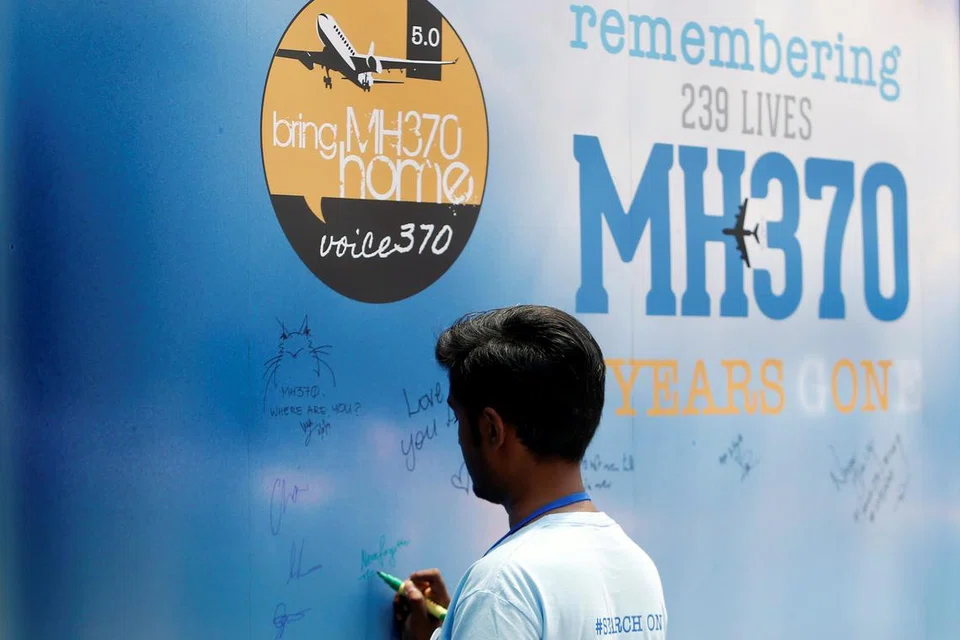
: A man writes on a message board for passengers, onboard the missing Malaysia Airlines Flight MH370, during its fifth annual remembrance event in Kuala Lumpur, Malaysia March 3, 2019. REUTERS/Lai Seng Sin/File Photo

UPDATED Feb 26, 2025

KUALA LUMPUR - A ship that will hunt for missing Malaysia Airlines Flight MH370 has deployed to its Indian Ocean search zone, according to Malaysia's transport minister and ship tracking data, raising hopes of solving one of aviation's greatest mysteries.

In December, Malaysia agreed to resume the search for the Boeing 777 that was carrying 227 passengers and 12 crew when it vanished en route from Kuala Lumpur to Beijing on March 8, 2014.

Malaysia has not yet signed off on the contract to search the seabed for wreckage, however, casting uncertainty over whether a search has begun.


Contacted by Reuters, U.S. exploration firm Ocean Infinity, which conducted the last search for the plane that ended in 2018, said it had no information to provide at this stage.

Malaysia had not yet signed the contract with Ocean Infinity, Transport Minister Anthony Loke said on Tuesday, but he welcomed the company's "proactiveness" to deploy its ships to that area to begin the search.

"Since Ocean Infinity already started to mobilise their ships, of course we welcome it because we have given the principle approval for the search to resume and just need to finalise the contract," Loke told a press conference.


The search would not be open-ended, however, he warned.

"It is not indefinite; there is a certain timeframe given for the contract. These are the details that we need to finalise before we sign," Loke added.

Refinitiv ship tracking data shows one of Ocean Infinity's ships, Armada 78 06, began tracking on Sunday a part of the Southern Indian Ocean, about 2,000 km (1,200 miles) off Australia's west coast.

Ocean Infinity's proposal to resume the search will see it expand the previous search area by 15,000 sq km (5,790 sq miles) in an effort lasting 18 months, with the period from January to April offering the best window, Malaysia said in December.

No precise location of the new search area was given at the time.

Ocean Infinity was "very confident that the current search area is more credible ... This is the area that they have missed in the past," Loke added.

DECADE-LONG HUNT

Malaysia engaged Ocean Infinity in 2018 to search in the southern Indian Ocean, but two attempts failed.

They followed an underwater search by Australia, China and Malaysia over an area of 120,000 sq km (46,332 sq mile) of the southern Indian Ocean, based on records of automatic connections between an Inmarsat satellite and the aircraft.

MH370's last transmission was about 40 minutes after it took off from Kuala Lumpur for the Chinese capital. The pilots signed off as the plane entered Vietnamese air space over the Gulf of Thailand and soon after its transponder was turned off.

Military radar showed the plane left its flight path to fly back over northern Malaysia and then out into the Andaman Sea before turning south, when all contact was lost.

Debris, some confirmed and some believed to be from the aircraft, has since washed up along the coast of Africa and on islands in the Indian Ocean.

Victims' relatives have demanded compensation from Malaysia Airlines, Boeing, aircraft engine maker Rolls-Royce and the Allianz insurance group, among others.

A 495-page report into the disappearance in 2018 said the Boeing 777's controls were probably deliberately manipulated to go off course, but investigators could not determine who was responsible and stopped short of offering a conclusion on what happened, saying that depended on finding the wreckage.

Investigators have said there was nothing suspicious in the background, financial affairs, training and mental health of both the captain and co-pilot.

REUTERS


What we know about Malaysia’s missing MH370 plane, 11 years on


FILE PHOTO: Family members of the victims pose for a group picture with a debris of the missing Malaysia Airlines flight MH370 in Putrajaya, Malaysia, March 7, 2020. REUTERS/Lim Huey Teng

UPDATED Feb 26, 2025

The disappearance almost 11 years ago of Malaysia Airlines flight MH370 with 239 people on board remains one of the world's greatest aviation mysteries.

The Boeing 777 went missing on its way from Kuala Lumpur to Beijing on March 8, 2014.

Satellite data analysis showed the plane likely crashed somewhere in the southern Indian Ocean, off the coast of western Australia. However, two major searches failed to come up with any significant findings.


Here are some details of the search for MH370 and the unresolved mystery of what happened:

WHAT IS KNOWN?

The last transmission from the plane was about 40 minutes after it took off from Kuala Lumpur for Beijing.

Captain Zaharie Ahmad Shah signed off with "Good night, Malaysian three seven zero", as the plane entered Vietnamese airspace.

Shortly thereafter, its transponder was turned off, which meant it could not be easily tracked.

Military radar showed the plane left its flight path to fly back over northern Malaysia and Penang Island, and then out into the Andaman Sea towards the tip of the Indonesian island of Sumatra. It then turned south and all contact was lost.

UNDERWATER SEARCHES

Malaysia, Australia and China launched an underwater search in a 120,000 sq km (46,332 sq miles) area in the southern Indian Ocean, based on data of automatic connections between an Inmarsat satellite and the plane.

The search, which cost about A$200 million ($143 million), was called off after two years in January 2017, with no traces of the plane found.

In 2018, Malaysia accepted a "no-cure, no-fee" offer from U.S. exploration firm Ocean Infinity for a three-month search, meaning the company would only get paid if it found the plane.

That search covered 112,000 sq km (43,243 square miles) north of the original target area and also proved fruitless, ending in May 2018.

DEBRIS

More than 30 pieces of suspected aircraft debris have been collected along the coast of Africa and on islands in the Indian Ocean, but only three wing fragments were confirmed to be from MH370.

Most of the debris was used in drift pattern analysis in the hopes of narrowing down the aircraft's possible location.

INVESTIGATION REPORT

A 495-page report into MH370's disappearance, published in July 2018, said the Boeing 777's controls were likely deliberately manipulated to take it off course, but investigators could not determine who was responsible.

The report also highlighted mistakes made by the Kuala Lumpur and Ho Chi Minh City air traffic control centres and issued recommendations to avoid a repeat incident.

Investigators stopped short of offering any conclusions about what happened to MH370, saying that depended on finding the plane's wreckage.

CONSPIRACY THEORIES

The inability to locate MH370's crash site has fuelled numerous conspiracy theories, ranging from mechanical error or a remote-controlled crash, to more bizarre explanations like an alien abduction or a Russian plot.

In recent years, some aviation experts have said the most likely explanation was that the plane was deliberately taken off course by an experienced pilot.

But investigators have said there was nothing suspicious in the background, financial affairs, training and mental health of both captain and co-pilot.

NEW SEARCH

Malaysia's transport minister said in December the government had agreed in principle to resume the search for the wreckage following a new proposal from Ocean Infinity, which would receive $70 million if substantive wreckage is found.

The new search, once a contract is signed, would expand the previous search area by 15,000 sq km, the minister said. The contract would cover 18 months and the firm had indicated the best time for the search would be between January and April.

This week, ship tracking data showed an Ocean Infinity ship had moved into the southern Indian Ocean. The minister said Ocean Infinity had deployed ships to the new search area, but Malaysia had not yet finalised the contract with the exploration firm.

 REUTERS


USAID cuts and their fallout on the ground


Sophia Anders
February 26th, 2025
LSE

Trump’s crackdown on USAID has deep financial and humanitarian consequences. As funding is frozen and officials are side-lined, crises unfold worldwide. Tim Allen, Professor at LSE’s Department for International Development, witnessed this at the Uganda-DRC border, where halted aid exacerbates health and security risks, while a rise in illicit trade highlights the economic interests partially driving the US retreat from humanitarian aid. Sophia Anders provides context on the situation.

Aid workers, diplomats and lawmakers have been trying to make sense of a series of concerning developments regarding the main US agency for foreign aid (USAID). On February 2nd, President Donald Trump declared that it was run by “radical lunatics” who his administration will “get out”. In a similar vein, Elon Musk, the head of the newly created Department of Government Efficiency, called USAID “a criminal and evil organisation” whose “time to die” is here, on X. Both Trump and Musk agree on cutting, what they consider, wasteful US government spending on USAID. This includes putting on leave two top security officials and restricting email access for other officials.

Looking ahead, Trump and his team have made it clear that they want US foreign aid to align with their “America First” agenda. Suggestions are also ciruclating that USAID will be absorbed into the state department. Internally, current and former officials consider this a test case for the Trump administration looking to wield executive power, through unilaterally acting around, and also against, Congress. Externally, this has serious (financial) implications for long-standing US development and assistance programmes. As such, Trump has frozen billions of dollars in foreign assistance, causing serious harm to humanitarian efforts worldwide (and potentially allowing China to fill the void left by the US). Already, this prompeted crises in humanitarian and development organisations involved in everything from life-saving medical activities to anti-narcotics efforts to clean water programmes.

Professor Tim Allen from the LSE International Development Department witnessed the immediate effects that are already felt on the ground at the border between Uganda and the Democratic Republic of Congo (DRC). The situation has already been precarious before budget cuts for USAID, but is being dramatically exacerbated by it. There are cases of Monkeypox, cholera, Marburg virus, as well as Ebola on both sites of the border. Now, pandemic surveillance with US funding as well as HIV services have been stopped.

Moreover, the area has previously been attacked by the Allied Democratic Forces (ADF) and schoolchildren were massacred a year ago. The Ugandan army has crossed into DRC ostensibly to secure the border, but it seems they are also supporting the M23 rebellion. President Musuveni’s son, for instance, has openly supported the rebellion in the past.

Beyond this, Professor Allen noticed the omnipresence of soldiers, including in hospitals and health centres. Supposedly, this is for health security, but it also seems to help monitor trucks crossing the border, as well as to tax the informal trade in valuable items being brought across. For context, Uganda has increased gold exports tenfold since 2022, and an estimated 95 percent comes from the DRC. Other commodities are essential for the manufacture of mobile phones and a host of other things – cobalt, tin, tantalum, tungsten etc. Presumably, the illicit trading is condoned, even supported, by the governments of countries importing items from the region, including the US. Given the scale of activities, and the escalation in commodities from DRC passing through Uganda, reports from USAID staff are ostensibly not welcome in Washington. This might be one of the reasons why Trump is attacking the agency. As such, Washington’s crackdown on USAID appears not just as a domestic policy shift with disastrous consequences that are already felt on the ground, but also, potentially, as a strategy to ensure US economic and trade interests worldwide.

LSE’s Global Health Initiative will host a panel, focused on the recent termination of USAID funding and its implications on epidemic control on the border of Uganda and the DRC with Grace Akello, Tim Allen, Myfanwy James, Melissa Parker and Philipa Mladovsky, on Monday 03 March from 5.30pm in MAR 2.06. All welcome.

The views expressed in this post are those of the author and in no way reflect those of the International Development LSE blog or the London School of Economics and Political Science.

Featured image credit: Laura via Flickr. CC BY-NC-ND 2.0.

About the author

Sophia Anders is a Research Student in International Development at LSE. Her work focuses on the intersection of cultural and artistic practice and community cohesion as well as the overall role of cultural spaces for nation- and identity formation in the post-Soviet space, particularly in Ukraine. Currently, she is also one of the LSE ID blog editors.

Surviving Gaza Genocide: 'All my previous war coverage is like a picnic compared to this one'

Meet Mohammed Asad, photojournalist, father and diver. He is MEMO's man on the ground and he has survived a genocide. For 15 months, Mohammed reported from the deadliest Israeli war on Gaza. It was not his first, but the one where death whispered loudest. MEMO's Jehan Alfarra speaks to Mohammed about his life and work during Gaza's bloodiest Israeli attack which has left at least 61,000 Palestinians dead, mostly women and children, and reduced the majority of the besieged enclave to rubble.

February 26, 2025 

Israel's 'Gazafication' of West Bank forcing largest displacement since 1967, warns Oxfam

At least 800 Israeli military checkpoints, barriers and gates causing unprecedented movement restrictions

Nada AlTaher
February 26, 2025
Live updates: Follow the latest on Israel-Gaza

The intensifying Israeli military operations in the occupied West Bank are causing the largest forced displacement of Palestinians in the territory since the occupation began, charity Oxfam International warned on Wednesday.

More than 40,000 people have been forcibly displaced from the West Bank since the Gaza ceasefire came into force on 19 January amid what the charity described as a “dramatic rise” in Israeli military violence.

Oxfam said this is “the highest number since Israel occupied the West Bank in 1967".

On Monday, Israel sent tanks into the West Bank for the first time since the second Intifada 20 years ago, and Defence Minister Israel Katz said he had instructed the military to prevent people from returning to their homes, in direct breach of international humanitarian law. The move to occupy Jenin, Tulkarm and Nur Shams – three of the world's oldest refugee camps – further squeezes Palestinians from an ever-shrinking strip of land

Israeli Prime Minister Benjamin Netanyahu ordered the army to step up its operations during a rare visit to troops in the territory that drew Palestinian condemnation. His visit to Tulkarm refugee camp in the north came after Israeli officials blamed the bombing of several buses in central Israel last week on fighters from the West Bank.

“As the ‘Gazafication’ of the West Bank unfolds, vital humanitarian work and projects are being delayed or destroyed,” Oxfam said.

It added that Palestinian communities across the West Bank are experiencing “multiple traumas, including deaths and arbitrary detention, heavily restricted movement and access to jobs and education, and mass demolitions of homes and infrastructure”.

At least 800 Israeli military checkpoints, barriers and gates causing unprecedented movement restrictions; two-hour journeys now take twelve, hampering humanitarian response, warned the charity.


Oxfam’s Mustafa Tamaizeh described what's happening as “a calculated annexation strategy. Overnight, movement between cities has been paralysed, piling economic and social pressure on already struggling communities”.

Several Israeli ministers previously said that they had ordered preparations for the annexation of the West Bank in the hope that the US administration would recognise Israel’s “sovereignty” over the occupied territory. Israel's annexation policies include the expansion of settlements, land confiscation, demolition of Palestinian homes, and forcible “transfer” of Palestinian civilians.

For Palestinian student Saleh Abu Zaid, “Israel's mask has finally fallen off”'.

His journey – marked by imprisonment, disrupted education, and a lack of future prospects – reflects the hardships the West Bank has endured under occupation for decades.

He was a law student at Birzeit University in Ramallah, when he was arrested by Israeli security troops in 2020 and accused of firing at a military outpost, a charge he denies. “I spent 85 days in interrogation by the Israeli Shabak [security services] at the Ashqelon prison, then was transferred from one cell to another,” he told The National.

Mr Abu Zaid says that although there was no evidence to support the charge, he was held for three years before being released and then arrested again for six months.


Such incidents have become commonplace in the West Bank after the Gaza war began in October 2023, with at least 14,500 people arrested since then in Israeli raids targeting “terrorists”, but are rarer in Ramallah.

“In fact, armed groups are only really rampant in refugee camps – and with Ramallah being the metropolitan home of the Palestinian Authority, with heavy security presence, militant activity cannot thrive,” Palestinian political analyst Khalil Sayegh said.

Since the ceasefire in Gaza on January 19, 2025, it has been extremely difficult for Oxfam and its partners to carry out humanitarian activities in the West Bank, the charity said in its report.

“Movement restrictions have resulted in increased operational costs, delays in aid delivery, loss of perishable supplies, and increased security risks for our staff.”
Updated: February 26, 2025, 4:08 AM
Trump posts bizarre Gaza AI video showing giant golden statue of himself

The US president shared an AI-generated video on his Truth Social account which shows Gaza filled with beaches, luxury yachts and Dubai-style skyscrapers

Trump’s name and likeness feature heavily in the AI-generated video
 (Photo: @realDonaldTrump / Truth Social)

Alexa Phillips
FEBRUARY 25, 2025
iNEWS

Donald Trump has shared a vision for his takeover of Gaza, complete with golden statues of himself and a tower bearing his name.

The US president posted an AI-generated video on his Truth Social account which depicts Gaza filled with beaches, luxury yachts and Dubai-style skyscrapers.

The footage begins with footage of the war-torn territory overlaid with the question: “Gaza 2025… What’s Next?”

The area, apparently renamed “Trump Gaza”, is then shown transformed into a beach resort with children and adults running and playing down the coastline and ritzy hotels.

Trump is depicted dancing in a nightclub with a woman wearing a dress that exposes her buttocks, and sunbathing with Israeli Prime Minister Benjamin Netanyahu as they sip cocktails.Trump’s name and likeness feature heavily in the AI-generated video (Photo: @realDonaldTrump/Truth Social)  

Elon Musk appears throughout the video (Photo: @realDonaldTrump/Truth Social)

A giant golden statue of the US President can be seen on the street, with miniature golden statues of him for sale in a souvenir shop.

A child walks down the street holding a golden balloon in the shape of Trump’s head, and a large “Trump Gaza” tower is depicted.

Billionaire Elon Musk, who leads the US Department of Government Efficiency, is shown throwing dollar bills in the air as smiling children try to catch them.

Elsewhere, the Tesla chief executive eats hummus and flatbreads as bearded belly dancers perform on the beach.

The area is shown transformed into a beach resort (Photo: @realDonaldTrump/Truth Social)

It is unknown who created the video. Sky News reported that it had previously been shared by accounts unrelated to Trump.

A song plays in the background, with the lyrics: “Donald’s coming to set you free, bringing the light for all to see, no more tunnels, no more fear: Trump Gaza is finally here.

“Trump Gaza’s shining bright, golden future, a brand new life.

“Feast and dance the deal is done, Trump Gaza number one.”

Trump is seen dancing and sunbathing (Photo: @realDonaldTrump/Truth Social)

Trump announced his plan to develop the territory into the “Riviera of the Middle East” earlier this year.

He said he wanted to relocated two million Gazans to neighbouring Arab countries, stating: “The US will take over the Gaza Strip, and we will do a job with it too.”

READ NEXT
He said America would be “responsible for dismantling all of the dangerous unexploded bombs and other weapons on the site”, before it would “get rid of the destroyed buildings” and “level it out”.

“Everybody I’ve spoken to loves the idea of the United States owning that piece of land, developing and creating thousands of jobs,” he added.

The White House described the proposal as “out-of-the-box” and “visionary” – but it was criticised as the effective “ethnic cleansing” of Palestinians from Gaza.
BP unveils multi-billion-dollar deal to redevelop Iraq's oil fields

DRILL BABY DRILL, FUCK RENEWABLES


Copyright Kin Cheung /Kin Cheung

By Hamish MacDonald
Published on 26/02/2025 

The energy giant's announcement of the tie-up comes as it finalises plans to ditch renewables targets set under previous CEO.

The agreement between BP and Iraq's government will focus on the redevelopment of four large oil and gasfields in Kirkuk in the north of the country.

The agreement follows a memorandum of understanding between BP and Iraq signed in July 2024 – of which technical terms were agreed in December and the majority of commercial terms agreed in January – together with previous work that BP has done on the fields in Kirkuk from 2013 to 2019.

The deal, which could be worth $25 billion(€23.8bn) over the lifetime of the project, comes as BP is set to row back on previous targets to cut oil and gas production by 2030.

It's also a major achievement of Iraq where output has been constrained by years of war, sectarian tensions and corruption.

In a statement BP said that the agreement was for an initial phase that would include oil and gas production of more than three billion barrels of oil equivalent.

It includes the Baba and Avanah domes of the Kirkuk oil field and three adjacent fields: Bai Hassan, Jambur and Khabbaz.
Untapped potential for 20 billion barrels of oil

BP added that the wider resource opportunity across the contract and surrounding area is believed to include up to 20 billion barrels of oil equivalent.

BP executive vice president William Lin said: "This agreement builds on our longstanding and strategic relationship with the Government of Iraq and delivers access to a material new resource opportunity, within one of the world's most prolific hydrocarbon provinces.

"It will enable us to bring our experience of managing giant fields to realise the potential of this important asset for Iraq."

He added: "This opportunity is fully in line with our priority of pursuing new growth opportunities for bp as we strengthen and high-grade our portfolio across the world."
Major shift in BP strategic aims

The British multinational is currently undergoing a reset of a green strategy set under its previous CEO Bernard Looney which aimed at focusing the company more on renewable energy.

At an event in London this morning, Looney's successor, Murray Auchincloss, announced a major pivot away from green targets.

He said: "Today we have fundamentally reset BP's strategy. We are reducing and reallocating capital expenditure to our highest-returning businesses to drive growth, and relentlessly pursuing performance improvements and cost efficiency. This is all in service of sustainably growing cash flow and returns."
Extreme Winter Conditions Delay Petronas' First Canadian LNG Shipment

By Julianne Geiger - Feb 25, 2025


Petronas’ first LNG cargo from the massive LNG Canada project is now expected to sail in July 2025, missing its initial end-2024 target, the company said on Tuesday. The delay is due to extreme winter conditions in British Columbia, which slowed insulation work at the Kitimat facility, as well as earlier labor shortages, according to Petronas EVP Datuk Adif Zulkifli.

LNG Canada, a joint venture between Shell (40%), Petronas (25%), Mitsubishi Corp. (15%), Korea Gas Corp. (5%), and PetroChina (15%), will process 1.9 billion cubic feet of natural gas per day—a significant chunk of Canada’s output. Once operational, the project is expected to boost Canadian natural gas prices, as supply that previously flowed south to the U.S. gets redirected to Asian markets.

Michael Rose, CEO of Tourmaline Energy, Canada’s top natural gas producer, has warned that LNG Canada's start-up will erase the longstanding discount on Alberta’s AECO gas prices. With natural gas currently trading at $4.14/MMBtu (+3.63%), the industry expects further upside as demand from LNG exports kicks in.

Despite Petronas' project setback, the bigger picture remains bullish for Canadian LNG. The U.S. is doubling its LNG capacity, and Canada is projected to export 36.2 million tons of LNG per year by 2040, according to Wood Mackenzie. However, Canada’s federal government has remained lukewarm on LNG, recently shutting down hopes of a German supply deal.

Meanwhile, Petronas President & Group CEO Tan Sri Tengku Muhammad Taufik emphasized that the company will navigate any geopolitical headwinds, including potential U.S. trade policy shifts, by sticking to established pricing mechanisms and fair trade practices.

While LNG Canada’s debut has been pushed back, once it launches, it will reshape North America’s gas flows—and investors are taking note.

By Julianne Geiger for Oilprice.com
OPINION

Canada already is America’s 51st state


And that is thanks to a political elite that did not heed prescient warnings.


Andrew Mitrovica
Al Jazeera columnist
Published On 26 Feb 202526 Feb 2025

Flags wave in the wind near the Ambassador Bridge which connects Windsor, Ontario, Canada, and Detroit, Michigan, the US on February 4, 2025 [Carlos Osorio/Reuters]


For many Canadians, a thrilling ice hockey game turned out to be an exhilarating antidote to an unforgiving winter.

More than that – as a subdued Canadian coach Jon Cooper told reporters after Canada’s best hockey players beat America’s best hockey players in overtime last week – the beleaguered country “needed a win”.

Cooper wasn’t asked nor did he elaborate on why Canada had to prevail.

He didn’t have to.

The reasons were plain to the millions of Canadians who leapt, I reckon, with a mixture of joy and relief when the world’s most gifted hockey player, Connor McDavid, potted the goal that sent his team and a grateful nation into a happy frenzy.

For weeks, a blustering US President Donald Trump has taunted Canada and its prime minister. He has referred to a proud people and land as America’s would-be 51st state and Justin Trudeau as its “governor”.

Trump’s antics and threats have triggered a surge of pride among usually reserved Canadians about their beloved home and worry for its uncertain future.
Advertisement

And the trash-talking leader of Canada’s “dearest” and “closest” ally has proven that most politicians and corporate-hugging columnists have the foresight of Mr Magoo.

Like the doddering, shortsighted, cartoon character, a host of free-trade-adoring politicos and polemicists refused to see or heed the warnings sounded in the 20th century about the existential risks of tying Canada more tightly into the dominant US economy in the 21st century.

It is a remarkable sight to watch, hear, and read Canada’s myopic “intelligentsia” drape themselves in the Maple Leaf while urging the country to “buy Canadian” and fashion other systemic and structural ways to try, belatedly, to curb its dependency on the United States to stave off becoming – officially – America’s 51st state.

It is a remarkable sight because, since the early 1980s, the reactionary elites have devoted – without hesitation or regret – their considerable powers and influence to backing every calculated step towards Canada morphing, in effect, into America’s 51st state – economically, culturally, militarily, and diplomatically.

The beaming poster boy for this blatant hypocrisy is Ontario’s premier, Doug Ford, who, by conviction and temperament, was all for Donald Trump before he was against him.

In a rare moment of sincerity, Ford – the pretend “populist” anointed “Captain Canada” by a gullible and easily impressed establishment press – admitted that he had wanted the havoc-wreaking Trump to return to the White House.

A crystal ball wasn’t necessary to picture that, given the right conditions, a resource-hungry commander-in-chief with hegemonic aspirations would eventually occupy the Oval Office and attract like-minded acolytes in Canada.

In the early 1980s, I was a lowly undergraduate political science student, studying at the University of Toronto.

One of my professors was the late and renowned Canadian political economist, Stephen Clarkson.

Professor Clarkson was a brilliant teacher and thinker who thought and wrote a lot about Canada’s past, present, and the turbulent waters the country was heading into at that pivotal time.

I was among the lucky stable of Clarkson’s research assistants when he embarked on writing a book about the perils that the brewing prospects of a free trade deal between Ottawa and Washington – championed by US President Ronald Reagan – posed to Canada’s sovereignty.

The book published in 1982 and titled, Canada and the Reagan Challenge, was, at once, a sober rebuttal to the legion of giddy continentalists who were convinced that Canada should deepen its already inexorable links to the United States, as well as a flare that raised the alarm about the country’s fast waning ability to exert any tangible measure of independence at home and abroad.

While Clarkson was a nationalist, he was also a realist. He knew that, by virtue of geography and history, Canada and America were bound to one another.

Still, he understood the urgent imperative for Canada to look beyond the immediate horizon to broaden trade in existing and emerging markets outside the United States as a means to diversify its export and import policies and, as a result, reduce America’s gravitational pull.

Clarkson’s prescient cautions were dismissed by a smug gallery of “free-trade” apostles as the anachronistic, anti-American “spleen bursts” of an academically trained ostrich opposed to prosperity.

So, when Prime Minister Brian Mulroney negotiated a comprehensive free-trade deal with Reagan in 1988 – much of Parliament and the press trumpeted the agreement as a victory of commerce over silly, outdated notions of Canadian autonomy.

The 1988 federal election was fought over the potential consequences for Canada of the Mulroney-Reagan pact.

In a televised debate, then Liberal leader, John Turner, famously challenged Mulroney – who claimed, absurdly, that the deal could be “cancelled” at any time.

“With one signature of a pen,” Turner thundered, “you’ve … thrown us into the north-south influence of the United States and will reduce us, I am sure, to a colony of the United States because political independence is sure to follow.”

Turner’s chest-thumping performance was just that – a performance. The Liberal Party’s opposition to the Mulroney-brokered free-trade accord was a rhetorical pantomime.

Soon enough, Liberal prime ministers were singing their own fulsome praises of the deal and inviting Mexico to join the continent-wide arrangement consecrated by the smiling, hand-holding “Three Amigos”.

Fast forward to February 2025 and Professor Clarkson’s admonitions and reservations from more than four decades ago have come to fruition.

An emboldened US president appears intent on annexing Canada by economic coercion and, given the policy of almost unfettered integration pursued by a succession of Liberal and Conservative governments – and endorsed by starry-eyed editorial writers – Trump has the levers and leverage to do it.

Suddenly, Clarkson’s critics – inside and outside amnesiac newsrooms and capital cities – are rushing to adopt his “silly, outdated” prescriptions to preserve the nation’s phantom sovereignty and outdo one another as standing on guard for thee – Canada, that is.

Their epiphanies are 40 years too late.

Canada has, by their deliberate design, long been America’s eager, “open for business” vassal.

The views expressed in this article are the author’s own and do not necessarily reflect Al Jazeera’s editorial stance


.
Andrew Mitrovica
Al Jazeera columnist
Andrew Mitrovica is an Al Jazeera columnist based in Toronto.