Thursday, April 10, 2025

Trump Revived the Law Used to Intern Japanese Americans, and SCOTUS Let Him

This week the Supreme Court left the door open for Trump to continue invoking the Alien Enemies Act to deport people.
April 9, 2025

An ICE Enforcement and Removal Operations unit initiates a raid to apprehend immigrants without any legal status and who may be deportable in Riverside, California, on August 12, 2015.Irfan Khan / Los Angeles Times via Getty Images

The Supreme Court made two key initial procedural rulings on Monday in cases related to the Trump administration’s aggressive efforts to grease the wheels of mass detention and mass deportation primarily through outsourcing to El Salvador’s Centro de Confinamiento del Terrorismo (CECOT) prison, which is known worldwide for its flagrant human rights abuses.

In its procedural ruling on Trump v. J.G.G., the court upheld the Trump administration’s rhetorical reliance on the Alien Enemies Act to justify the transfers but required it to comport with the barest minimums of constitutional “due process” through individualized habeas corpus proceedings in largely hostile courts closer to the location of the detention centers where those targeted by the act are likely being held. The Supreme Court’s majority opinion was simultaneously outrageous and perfunctory, and procedural challenges are likely to continue.

Justice Sonia Sotomayor penned what will come to be recognized as a historic 17-page dissent, expressing the arguments and sounding the warnings that should have served as a basis for the court’s ruling. Speaking as the court’s only Puerto Rican and first Latina member, Sotomayor offered a lament for how the Supreme Court has squandered its voice at this crucial historical moment. There is poetry latent in her scathing critique of the court’s limitations. At one moment in her dissent, she argued:

The Government takes the position that, even when it makes a mistake, it cannot retrieve individuals from the Salvadoran prisons to which it has sent them.The implication of the Government’s position is that not only noncitizens but also United States citizens could be taken off the streets, forced onto planes, and confined to foreign prisons with no opportunity for redress if judicial review is denied unlawfully before removal. History is no stranger to such lawless regimes, but this Nation’s system of laws is designed to prevent, not enable, their rise.

The J.G.G. decision revives both the notorious Korematsu case, which upheld the mass internment of Japanese Americans during World War II, and the 18th-century Alien Enemies Act (AEA), upon which their internment was based. The Supreme Court’s initial procedural ruling this week legitimized the AEA through the back door, without addressing any of the pressing substantive issues raised by its current weaponization by the Trump administration, as Justice Ketanji Brown Jackson noted in her own dissent in concurrence with Sotomayor.

Kilmar Abrego García, a Maryland man who is a legal U.S. resident, is a Salvadoran immigrant with no criminal record and no gang membership, who was “accidentally” deported to the CECOT prison in El Salvador. In the past, he fled from systematic persecution in El Salvador by the kinds of gang members he is now surrounded by in detention. The Trump administration has conceded that his “deportation” to El Salvador was the product of an “administrative error.” Yet at the same time it has continued to insist that it has neither the power nor the inclination to return him to the U.S., despite this grievous, potentially life-threatening mistake.

The Supreme Court’s ruling on Monday breathed artificial life into one of the court’s most notorious decisions in the 1944 Korematsu case, which upheld the legality of the mass detention of over 120,000 people of Japanese origin in the U.S in response to Pearl Harbor. In so doing, the court has exercised what can only be described as a new kind of zombie jurisprudence, while leaving key threshold questions utterly and deliberately unexamined. This is evidently the Supreme Court’s way of ducking, for now, a more fundamental clash with the Trump administration’s increasingly evident intent to undermine judicial control and even review of its most dangerous policies.

Key unresolved questions include whether the Alien Enemies Act is itself constitutional or not, whether it should be for the first time activated in peacetime — not against the citizens of a country with which the U.S is at war, but against a criminal gang and its alleged members, whom the administration has deemed “terrorists” and is depriving of due process rights in the name of “national security.” Sound familiar? El Salvador’s megaprison is, for these purposes, in effect the new Guantánamo (or another equivalent “black site”), while the U.S base on illegally occupied Cuban territory continues to gear up for increased occupancy.

The Supreme Court’s majority also failed to place limits on invocations of expansive executive power along these lines, which might for example include additional executive orders that seek to expand the targets of the Alien Enemies Act — or equivalent provisions — beyond their current focus (alleged Venezuelan members of the Tren de Aragua gang) to other groups whom the president wishes to repress. Many more executive orders may be signed with even lesser transparency, and ever larger potential reach.

This implicit slippery slope effect is already evident in what has unfolded with those hundreds of young men — primarily Venezuelan, but also of Salvadoran origin — on the three “deportation” flights on March 15 that laid the groundwork for both of Monday’s Supreme Court cases. No evidence has been made public that confirms that any of these young men are or were ever members of the Tren de Aragua gang or its Salvadoran equivalents, and most do not have criminal records anywhere.

Most of those currently detained in hellish conditions in El Salvador have committed no recognizable offense, except that they were primarily young Venezuelan men who could be targeted in the dark of night — “taken off the streets, forced onto planes, and confined to foreign prisons” in Sotomayor’s words — because Donald Trump and Marco Rubio said so.

As Justice Sotomayor has eloquently argued, there is in fact no material force in place that prevents the Trump administration from extending the logic of its current sweeps against alleged Venezuelan or Salvadoran gang members — or holders of green cards or student visas like Mahmoud Khalil and Rümeysa Öztürk whose speech offends the Trump administration’s sensibilities — to others, including U.S. citizens. This is especially true under an administration that is actively seeking to redefine and restrict birthright citizenship and voting rights, and that has been acting in bad faith in cases like these, seeking to both undermine and elude judicial review of its arbitrary actions.

“The Government’s conduct in this litigation poses an extraordinary threat to the rule of law,” Sotomayor wrote in her disssent. “That a majority of this Court now rewards the Government for its behavior with discretionary equitable relief is indefensible. We, as a Nation and a court of law, should be better than this.”

And yet cases like this also remind us that Sotomayor’s faith may be misplaced. Many have forgotten cases like those of Paul Robeson or W.E.B DuBois during the McCarthy era — or later Muhammad Ali — whose passports were confiscated and whose right to travel outside the U.S. was nullified for supposed “disloyalties” equivalent to those weaponized today by Rubio, at Trump’s behest.

Poets tend to be better at cultivating such memories. Bertolt Brecht once asked himself, amid his own forced exile from Nazi Germany, “In the dark times / will there also be singing? / Yes, there will also be singing. / About the dark times.”

A writer whose work carries on this spirit of resistance today is the poet Martín Espada (honored with the National Book Award for Poetry in 2021), whose extraordinary new book A Jailbreak of Sparrows is rooted in the revolutionary rhythms of the liberation struggles of Puerto Rico. Espada’s poetry is also imbued with his background as a lawyer, and like Sotomayor, is grounded in his upbringing in New York’s Puerto Rican community, as part of the same generation. Sotomayor has written eloquently about how these origins decisively shaped her experiences and approach as a student, lawyer, and ultimately federal judge and Supreme Court Justice.

Espada reminds us in concrete lyrical detail how Trump’s dehumanization of migrants through the rhetoric of “invasion” laid the groundwork for the El Paso Massacre in August 2018 and for police killings like that of Mario González in Alameda, California, in April 2021. He also reminds us of the human costs of the McCarthyist persecution of dissidents both in Puerto Rico and on the mainland through the cases of renowned poets such as Juan Antonio Corretjer and William Carlos Williams.

Espada tells us too, in the book’s stunning title poem, about how U.S. Thunderbolt fighter planes sought to bomb into submission the Puerto Rican mountain town of Utuado — his father’s and grandmother’s birthplace — in the wake of the October 30, 1950, pro-independence uprising led by the island’s nacionalistas:


In towns with names that fly, Jayuya, Arecibo, Naranjito, Utuado, they lined up

against the walls, fingers woven behind their heads, bayonets sniffing their ribs,

taken by trucks to jails with names that stop the tongue: La Princesa in a land

where the princess waves from a float, Oso Blanco in a land without white bears.

The poet who knew the room of stone returned with a face of stone. The poet new

to the room of stone scribbled on stone whatever the voices bellowed in his ear.

But it all began with the words that were forbidden-

“La Ley de la Mordaza, the Law of the Muzzle years ago,confiscating the ink of presses that stamped the page with the words colonialism

and independence, empire and political prisoner, clapping handcuffs on anyone

who sang verses that flew like a jailbreak of sparrows. The flag of Puerto Rico,

fanning a grave in the heat or asleep in a closet between the sheets, would

now become the prosecutor’s proof, good for ten years in a room of stone”

Together the combined eloquence and depth of Sotomayor’s emerging jurisprudence of resistance and Espada’s life-long praxis of the poetry of liberation provide us with a basis for the kind of critical reflection and engagement we need, from below, in response to the onslaught that seeks to erode and nullify our rights, and the channels through which we express them. Today, on campuses and in communities throughout the country, it is words like those evoked by Espada and their equivalents — or those that resonate with Sotomayor’s warnings — that could lead to our targeting, as if we were “alien enemies.” Espada and Sotomayor, together, write for us.


This article is licensed under Creative Commons (CC BY-NC-ND 4.0), and you are free to share and republish under the terms of the license.


Camilo Pérez-Bustillo is former executive director of the San Francisco Bay Area chapter of the National Lawyers Guild; member of the leadership team at Witness at the Border; a fellow at the Institute for the Geography of Peace in Juárez, Mexico/El Paso, Texas, and at the University of Bergen, Norway’s, Global Research Programme on Inequality; co-chair of the National Lawyers Guild’s Task Force on the Americas; professor of law and ethnic studies at St. Mary’s College of California; visiting chair professor of human rights at National Taiwan University’s College of Law; and co-founder of the International Tribunal of Conscience of Peoples in Movement.
This chart explains why Trump flip-flopped on tariffs

The Conversation
April 10, 2025


The Trump administration has announced a 90-day pause on its plan to impose so-called “reciprocal” tariffs on nearly all US imports. But the pause does not extend to China, where import duties will rise to around 125%.


The move signals a partial retreat from what had been shaping up as a broad and aggressive trade war. For most countries, the US will now apply a 10% baseline tariff for the next three months. But the White House made clear that its tariffs on Chinese imports will remain in place.

So why did President Trump back away from the broader tariff push? The answer is simple: the economic cost to the US was too high.
Our economic model shows the fallout, even after the ‘pause’

Using a global economic model, we have been estimating the macroeconomic consequences of the Trump administration’s tariff plans as they have developed.

The following table shows two versions of the economic effects of the tariff plan:“pre-pause” – as the plan stood immediately before Wednesday’s 90-day pause, under a scenario in which all countries retaliate except Australia, Japan and South Korea (which said they would not retaliate)

“post-pause” after reciprocal tariffs were withdrawn.


As is clear, the US would have faced steep and immediate losses in employment, investment, growth, and most importantly, real consumption, the best measure of household living standards.

Heavy costs of the tariff war

Under the pre-pause scenario, the US would have seen real consumption fall by 2.4% in 2025 alone. Real gross domestic product (GDP) would have declined by 2.6%, while employment falls by 2.7% and real investment (after inflation) plunges 6.6%.

These are not trivial adjustments. They represent significant contractions that would be felt in everyday life, from job losses to price increases to reduced household purchasing power. Since the current US unemployment rate is 4.2%, these results suggest that for every three currently unemployed Americans, two more would join their ranks.

Our modelling shows the damage would not just be short-term. Across the 2025–2040 projection period, US real consumption losses would have averaged 1.2%, with persistent investment weakness and a long-term decline in real GDP.

It is likely that internal economic advice reflected this kind of outlook. The decision to pause most of the tariff increases may well be an acknowledgement that the policy was economically unsustainable and would result in a permanent reduction in US global economic power. Financial markets were also rattled.
The scaled-back plan: still aggressive on China

The new arrangement announced on April 9 scales the higher tariff regime back to a flat 10% for about 70 countries, but keeps the full weight of tariffs on Chinese goods at around 125%. Rates on Canadian and Mexican imports remain at 25%.

In response, China has announced an 84% tariff on US goods.

The table’s “post-pause” column summarises the results of the scaled-back plan if the pause becomes permanent. For consistency, we assume all countries except Australia, Japan and Korea retaliate with tariffs equal to those imposed by the US.

As is clear from the “post-pause” results, lower US tariffs, together with lower retaliatory tariffs, equal less damage for the US economy.

Tariffs applied uniformly are less distortionary, and significant retaliation from just one major partner (China) is easier to absorb than a broad global response.

However, the costs will still be high. The US is projected to experience a 1.9% drop in real consumption in 2025, driven by lower employment and reduced efficiency in production. Real investment is projected to fall by 4.8%, and employment by 2.1%.

Perhaps we should not be surprised that the costs are still so high. In 2022, China, Canada and Mexico accounted for almost 45% of all US goods imports, and many countries were already facing 10% reciprocal tariffs in the “pre-pause” scenario. Trump’s tariff pause has not changed duty rates for these countries.

US President Donald Trump discusses the 90-day pause.
A temporary reprieve

Tariffs appear to be central to the administration’s economic program. So Trump’s decision to pause his broader tariff agenda may not signal a shift in philosophy: just a tactical retreat.

The updated strategy, high tariffs on China and lower ones elsewhere, might reflect an attempt to refocus on where the administration sees its main strategic concern, while avoiding unnecessary blowback from allies and neutral partners.

Whether this narrower approach proves durable remains to be seen. The sharpest economic pain has been deferred. Whether it returns depends on how the next 90 days play out.


James Giesecke, Professor, Centre of Policy Studies and the Impact Project, Victoria University and Robert Waschik, Associate Professor and Deputy Director, Centre of Policy Studies, Victoria University

This article is republished from The Conversation under a Creative Commons license. Read the original article.
DESANTISLAND
More cuckoos than a Swiss clock factory: FL Republican pushes ludicrous ‘chemtrails’ bill


Photo by Andrew Palmer on Unsplash


Craig Pittman, 
April 10, 2025

TALLAHASSSEE — If you’re one of the 900 new people who move to Florida every day, you may not know this crucial secret of Florida government. I’m a Florida native, so let me clue you in. Lean in close and I’ll whisper it in your ear. Are you ready?

The Florida Legislature contains more cuckoos than a Swiss clock factory.

Now that you’re aware of this fact, how are you holding up? How’s your blood pressure? Can you handle the truth?

You want some evidence? Just last year, a legislator claimed his new anti-bear bill was necessary because there were bears on crack invading people’s houses. This was, of course, a complete fantasy. Yet his colleagues didn’t question his sanity or call the paramedics. They just passed the bill. It’s the law now!

This year there’s one that’s even kookier. I am referring to the so-called “chemtrails” bill.

In case you’re unfamiliar with that debunked conspiracy theory, the folks who believe in “chemtrails” are convinced the government (or maybe it’s the Illuminati) is dispatching planes to fly over us unsuspecting Americans and spray chemicals on us.

Why? The chemtrails can change the weather, say the diehards. Or maybe they can control people’s minds. Or maybe they’re just going to poison everybody they don’t like. Who knows? After all, it’s a secret, like the 1947 UFO crash landing in New Mexico.

Anyway, there’s a bill in the Legislature to track and attack chemtrails. Instead of being laughed out of the Capitol building, as it deserves, the bill was just passed by the full Senate, because that’s what our state’s elected leaders are like right now. I wish I could tell you the “Looney Tunes” theme song played while they voted.

“The measure (SB 56), sponsored by Miami Republican Ileana Garcia, would prohibit the injection, release, or dispersion of any means of a chemical, chemical compound, substance, or apparatus into the atmosphere for the purpose of affecting the climate,” my colleague Mitch Perry reported in the Phoenix last week. “Any person or corporation who conducts such geoengineering or weather modification activity would be subject to a third-degree felony charge, with fines up to $100,000.”

The bill would require the Florida Department of Environmental Protection to set up a hotline so anyone concerned about streaks in the sky can call and report them. I’m sure the DEP will jump right on those reports, just the way the agency has jumped on reports of rampant water pollution that fuels toxic algae blooms, kills seagrass, and leaves manatees to starve.

I tried calling Sen. Garcia to ask her some questions about her bill. While I waited to talk to her, I was struck by a subversive thought:

What if the chemtrails bill becomes law and we folks who still live in the real world use it to flip the script? What if we employ its provisions to go after the people who really ARE changing the weather — with their greenhouse gas emissions?
A healthy skepticism

The most shocking thing about this chemtrails bill is not that it was filed — filed, I should add, by a senator who won her seat by just 32 votes, thanks to an illegal ghost candidate scheme backed by Florida Power & Light.

Nor is the most shocking thing that it passed one house of our Legislature by a vote of 28-9 and now is headed for the other.

No, what’s shocking is that it was endorsed by Senate President Ben Albritton and Gov. Ron DeSantis, two allegedly well-educated people. At this rate, they’ll next endorse a taxpayer-funded expedition to explore how we ended up living inside a Hollow Earth.

Actually, DeSantis’ endorsement isn’t that much of a surprise. He’s happy to appease the Tinfoil Hat Brigade if it gets him a mention on Fox News or its imitators.

Remember, DeSantis is the guy who appointed as his surgeon general the world’s biggest vaccine skeptic and now lets him run around the state trying to convince everyone to stop preventing children’s tooth decay. I sometimes wonder if he and RFK Jr. share a brain worm.

But Albritton’s comments threw me. He’s a longtime citrus man who’s familiar with the need for accurate weather forecasts. Yet he actually called this lunacy “a great piece of legislation” that would address “real concerns from our constituents.”

If some of those constituents also think their elected politicians are all lizard people, presumably he’d be fine with legislation requiring a reptilian DNA test before administering the oath of office.

“I have heard the conspiracy theories out there,” Albritton said about Garcia’s bill, “but the fact is we should not be shutting down legitimate concerns. Healthy skepticism is important. There’s a lot we don’t know in this field of science and people are rightfully concerned.”

Because I grew up in Florida, I have a healthy skepticism toward anything Florida politicians say. Albritton’s statement suggests that I’m right to be skeptical because there’s a lot that’s wrong with his comments.

We actually know quite a lot about the weather modification attempts. We know they don’t work and have mostly been discontinued.

Florida law currently requires anyone who wants to modify the weather to get a permit first. A Senate bill analysis of SB 56 points out, “There have been no applications for weather modification licenses in the past 10 years.”

Four years ago, eight Western states tried cloud seeding to produce rains to end a lengthy drought. However, Scientific American reported, “there is little evidence to show that the process is increasing precipitation.”

Yet “weather modification” is what our Legislature chooses to tackle instead of lowering property insurance rates, boosting educational test scores, or any one of a dozen more important issues. Maybe they’re under some bizarre mind control method that requires them to be ineffective at good governing.
Legitimate concerns

Albritton’s statement about people being “rightfully concerned” about chemtrails sounds like he’s endorsing the bogus claims that spread last year that the government steered two hurricanes to clobber specific communities ahead of the election.

Those rumors were, of course, lies spread by the unscrupulous to fool the gullible. They became so pervasive that the National Oceanic and Atmospheric Administration had to put out a press release denying it.

“NOAA does not modify the weather, nor does it fund, participate in or oversee cloud seeding or any other weather modification activities,” it said.

Given how Elon Musk is rapidly dismantling the agency now, I doubt they can control the thermostat in their office buildings, much less the weather.

I wish Albritton were as supportive of the “legitimate concerns” many of us Floridians feel about climate change.

We’re on the front lines of it, with our rising sea levels, more intense hurricanes, higher storm surges, and increased temperatures even at night. It’s hurting everything from our seafood industry to our sea turtle nesting. Heck, it’s even hurting Albritton’s own industry, agriculture.

Hard-headed property insurance companies recognize the dangers and disruptions of climate change. Why can’t our state officials?

“If lawmakers want to protect Floridians by addressing substances affecting the temperature, weather, and climate, they should hold power companies and the oil and gas industry accountable,” said longtime Florida climate activist Susan Glickman of the CLEO Institute, a non-profit dedicated to climate education and advocacy. “The pollution they release is warming the climate in increasingly extreme and deadly ways.”

But last year the Legislature voted to delete most references to climate change from state law under the well-known scientific theory of “If We Don’t Talk About It, Surely It Will Go Away.” Given how we were all beaten up by intense hurricanes and big storm surges last year, I don’t think it went away.

Fortunately, I see a way to take this “chemtrails” bill and turn it into a “let’s fight climate change” bill. Let me explain.
Contrail confusion

I have a confession to make: Every time I read someone’s rants about chemtrails, I always crack up. That’s because I always picture Cary Grant fleeing the evil crop-duster in the movie “North by Northwest,” which is the silliest and most inefficient murder method ever attempted.

Was the pilot supposed to crash into Cary and kill himself too? Cut Cary’s head off with the propeller, which would make the plane stop flying? Or maybe force him to cough up a lung because of all the pesticide he was inhaling? None of these options seem practical.

Similarly, the whole chemtrails theory falls apart on practical questions. How often and how much do you need to spray those chemicals in the sky to affect everyone? There are 23 million people in Florida alone. That’s a lot of folks to spritz with your mind-control concoction.

Seems to me you’d need WAAAAAY more chemical spraying than what we’re seeing if you plan to coat every single one of us with the goop. You’d need to dump it out in quantities like the helicopter pilots dropping the contents of an entire pond on a wildfire.

Nope, what we’re seeing up in the sky are simple contrails — droplets of water vapor clinging to particles of soot that were emitted by an airplane’s engine.

So imagine my surprise when Rafe Pomerance of Rethink Energy Florida told me, “Water vapor is a greenhouse gas.”

“Say what now?” I replied, displaying my usual incisive intellect.

“You warm up the earth, and one of the effects is an increase of water vapor in the atmosphere,” he explained. Then the vapor traps heat in our atmosphere just like carbon dioxide and other greenhouse gases do. The heat that created the vapor gets amplified by the vapor.

When I expressed that old healthy skepticism, he referred me to a scientist named Adam Boies of Stanford University. He’s an expert on contrails. He confirmed that chemtrails are bogus and also confirmed what Pomerance told me.

Some of the contrails disappear in minutes after the plane that created them leaves the area, Boies said. But some, say about 20%, linger longer. Those are the dangerous ones that can trap heat in the atmosphere.

Airplane engine manufacturers are worried about this so they are working on engine designs that will stop producing contrails, he said.

“The airlines are so concerned about this that they’re willing to try new fuels or rerouting flight patterns to try to avoid them,” Boies told me.

Thus, for once, the Legislature might do the right thing for the wrong reason — asking people to report something that actually is a cause of climate change. That’s why I think we should embrace this silly chemtrails bill and join DeSantis and Albritton in pushing it forward.

Then, once the bill passes, I say we all start contacting that DEP hotline to report, say, Florida Power & Light and its fellow utilities for burning fossil fuels to produce electricity. They’re building a lot of solar farms now, but they ought to replace their older plants too.

The same goes for all the municipal incinerators across the state, too, and the Big Sugar companies burning their fields and sending billows of thick smoke into the communities south of Lake Okeechobee. I say we report every one of these folks messing up our state.

“Hello, DEP,” we can say, “there’s a chemical plant in Pensacola that’s altering the weather with its nitrous oxide emissions. The clouds of pollutants are going up in the atmosphere and trapping heat here! You should do something about that, pronto.”

Or how about, “Hello, is this the DEP? I want to report someone for altering the weather. It’s the Florida DOT. They’re building a lot of roads for heavily polluting cars and trucks and doing nothing for mass transit. No electric vehicle charging stations, either. Can you get after them for that?”

By the way, I never did reach the bill’s sponsor, Sen. Garcia. It’s too bad. I was ready to congratulate her for doing more to combat climate change than either DeSantis or his predecessor, Rick Scott. Of course, to hear me speak, she’d first have to unwrap all that tinfoil from around her head.


Florida Phoenix is part of States Newsroom, a nonprofit news network supported by grants and a coalition of donors as a 501c(3) public charity. Florida Phoenix maintains editorial independence. Contact Editor Michael Moline for questions: info@floridaphoenix.com


Republicans provide plenty of affirmation action for mediocre white men


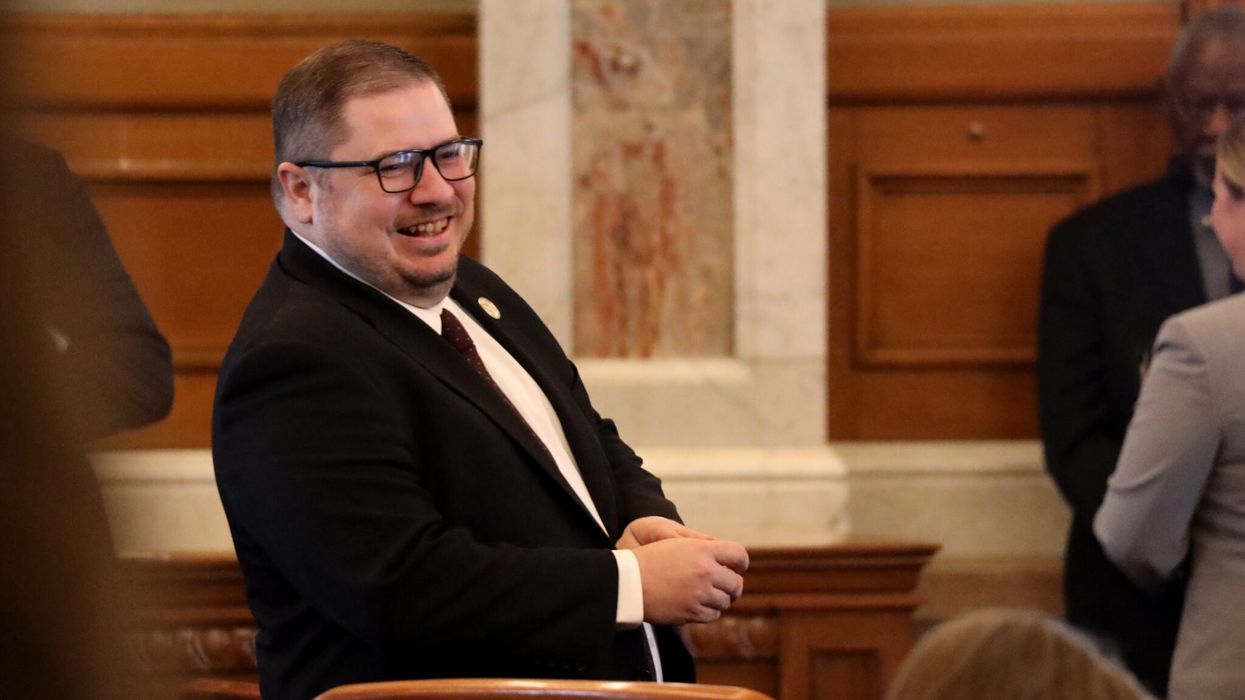
Rep. Nick Hoheisel, R-Wichita, appears during a March 24, 2025, session of the House (Grace Hills/Kansas Reflector)

April 10, 2025

Being a Republican in Kansas means never having to say you’re sorry.

Not really. Sure, you might have to mumble a half-hearted apology or lose an election here or there. But don’t worry! You won’t face any sanctions with teeth or be out of office for long. Kansas Republicans embrace affirmative action for middle-aged, mediocre white men who believe the right things.

Take Rep. Nick Nick Hoheisel, R-Wichita. Back in February, he found himself in a bit of a jam after confronting with Rep. Ford Carr, D-Wichita, on the House floor. Hoheisel, who is white, confronted Carr, who is Black, over Carr’s rhetoric. According to witnesses, the Republican used profanity. Carr later filed a formal complaint.

In our original coverage of events, Hoheisel appeared to deny that anything untoward had occurred.

“I’m not going to dignify any of those false and outlandish allegations with a response,” Hoheisel wrote editor Sherman Smith in a text message.

Yet Hoheisel eventually apologized to the House, while still claiming the allegation were “significantly overstated.”

A special committee made up of three Republicans and three Democrats looked into the complaint and deadlocked. Republican leaders lowered the boom on Carr, however, and subjected him to a multi-day ordeal before that same committee. His main sin appears to have been calling the GOP racist. The panel will potentially send a letter to the full House admonishing Carr.

Hoheisel escaped any discipline whatsoever.

That’s just for Democrats or saps.

Conservatives don’t pay a price for cursing at their opponents, losing high-profile races or an array of other bad behavior. Not in Kansas, they don’t.

State Sen. Virgil Peck once joked about shooting immigrants from helicopters. Then a representative, he issued a brief apology and kept serving. Eventually, he lost a primary for state Senate. But he worked his way into the chamber eventually, spreading nonsense about chivalrous manhood along the way.

Just this session, he criticized journalists’ “inaccurate” stories to justify raising the rent of press offices at the Statehouse.

Rep. Pat Proctor has left a trail of bellicosity and startling rhetoric about Kansas elections. Yet he’s now running to administer those same elections as secretary of state. A previous contender for that office, Mike Brown, failed in his 2022 bid to unseat elections chief Scott Schwab. Yet Brown simply pivoted to run for state GOP chairman the very next year — and won.

Senate President Ty Masterson went through bankruptcy and somehow found a six-figure job at Wichita State University to complement his legislative work. Nice work if you can get it, right? He’s likely to launch a gubernatorial bid soon.

The one and only Kris Kobach lost consecutive statewide elections to Gov. Laura Kelly in 2018 and Sen. Roger Marshall in 2020. He finally managed to claw his way back to relevancy through a successful bid for attorney general. Who knows where he might land next, but he clearly wasn’t daunted by Kansas voters’ repeated rejections. They don’t know what a good deal they have in voting for another subpar white man.

As I said, white male Republicans of a conservative bent can rest assured in their continued relevance, no matter controversies or losses.

The one person who appears to have paid a price for his shortcomings is House Majority Leader Gene Suellentrop, who was jailed on a drunk driving charge and ousted from his post in 2021. He stayed around the Statehouse through early 2023, though. Statehouse leaders didn’t want to look like they were too tough on the poor fellow, I suppose.

This year, we’ve heard repeatedly from those in Washington, D.C., that efforts to embrace diversity, equity and inclusion have gone too far.

We’ve heard repeated suggestions that prominent and accomplished Black people, women and LGBTQ+ community members don’t have what it takes. Marshall even suggested that DEI policies contributed to the crash of a passenger plane from Wichita.

Yet those in Topeka have shown us throughout recent years that the real threat doesn’t come from Black people, women or LGBTQ+ folks.

It comes from doughy white men who won’t take a hint to leave the rest of us alone.

Clay Wirestone is Kansas Reflector opinion editor. Through its opinion section, Kansas Reflector works to amplify the voices of people who are affected by public policies or excluded from public debate. Find information, including how to submit your own commentary, here.

Kansas Reflector is part of States Newsroom, a nonprofit news network supported by grants and a coalition of donors as a 501c(3) public charity. Kansas Reflector maintains editorial independence. Contact Editor Sherman Smith for questions: info@kansasreflector.com.
Trump administration appealing order to restore AP access

Agence France-Presse
April 9, 2025

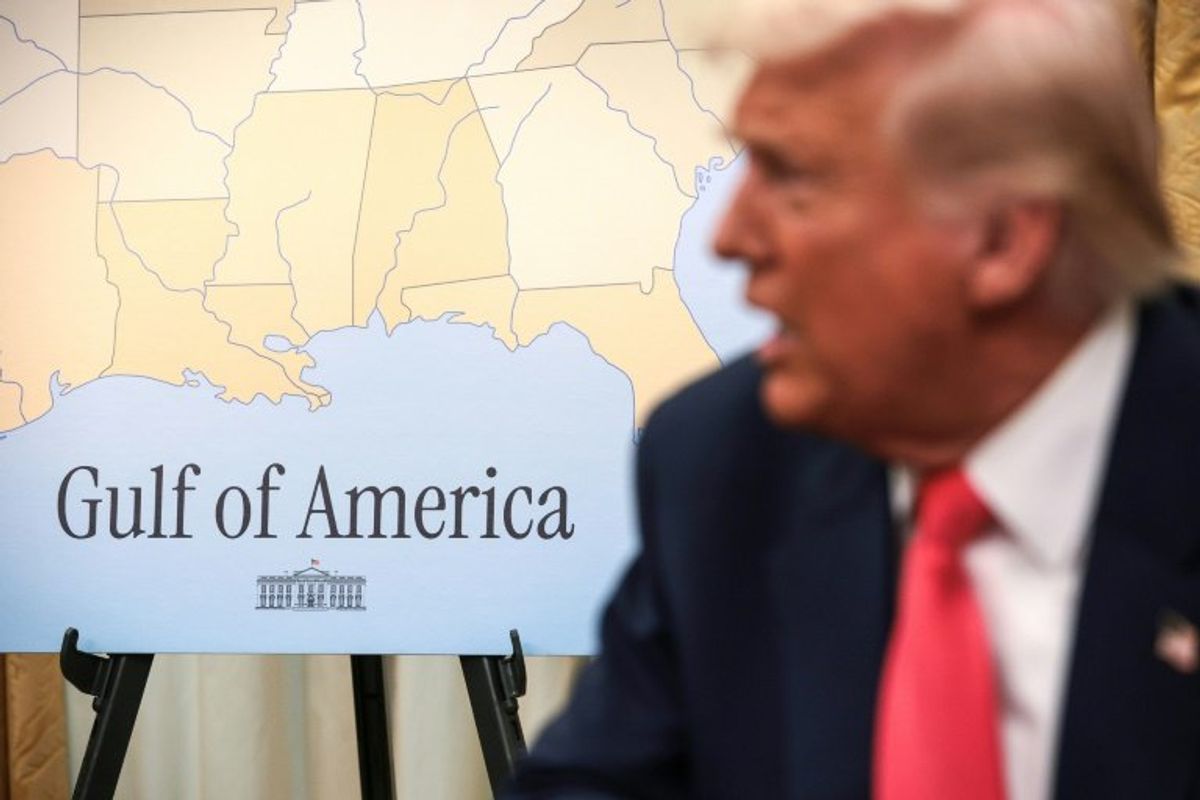
President Donald Trump and a map showing the 'Gulf of America' in the Oval Office. (AFP)

The Trump administration said Wednesday that it is appealing a court ruling ordering the White House to restore the Associated Press's access to official presidential events.

The US Attorney's Office said it was filing the appeal with the US Court of Appeals for the District of Columbia on behalf of the three senior White House officials named in the AP complaint.

AP journalists and photographers have been barred from the Oval Office and from traveling on Air Force One since mid-February because of the news agency's decision to continue referring to the "Gulf of Mexico" -- and not the "Gulf of America" as decreed by President Donald Trump.

On Tuesday, District Judge Trevor McFadden said the "viewpoint-based denial of the AP's access" was a violation of the First Amendment to the US Constitution, which guarantees freedom of speech and of the press.

"If the Government opens its doors to some journalists -- be it to the Oval Office, the East Room, or elsewhere -- it cannot then shut those doors to other journalists because of their viewpoints," McFadden said.


McFadden ordered the White House to "immediately rescind the denial of the AP's access to the Oval Office, Air Force One, and other limited spaces... when such spaces are made open to other members of the White House press pool."

The judge put off implementation of his order for five days to give the White House time to reply or to file an appeal.

AP spokeswoman Lauren Easton welcomed the court order on Tuesday restoring access.

"Today's ruling affirms the fundamental right of the press and public to speak freely without government retaliation," Easton said in a statement. "This is a freedom guaranteed for all Americans in the US Constitution."

In its style guide, the AP notes that the Gulf of Mexico has "carried that name for more than 400 years" and the agency "will refer to it by its original name while acknowledging the new name Trump has chosen."

"As a global news agency that disseminates news around the world, the AP must ensure that place names and geography are easily recognizable to all audiences," the AP said.


The 180-year-old organization has long been a pillar of US journalism and provides news to print, TV and radio outlets across the United States and around the world.
Trump asserting powers 'even the most tyrannical monarchs' didn't have: analysis


Brad Reed
April 10, 2025 
RAW STORY

A trio of legal experts is warning that the Trump Department of Justice is asserting that the president has unprecedented powers that were not even possessed by English monarchs.

Writing at Just Security, Yale Law School professors Harold Hongju Koh and Fred Halbhuber, along with Yale Law J.D. candidate Inbar Pe'er, point to recent assertions made by Trump DOJ lawyers in court that the United States Constitution does not prohibit President Donald Trump from issuing bills of attainder, which are orders that impose "a punishment on a specific person or group of people without first going through a trial."

During a recent hearing on Trump's executive orders targeting law firms that have in the past represented his political enemies, Judge Beryl Howell asked the Trump DOJ if such orders could be considered bills of attainder, which the United States Constitution explicitly prohibits.


Rather than merely denying that the orders were bills of attainder, the government replied that "as a pure constitutional matter... the bill of attainder restriction is only on Article I and not on Article II [of the Constitution], and so it doesn’t apply to the president."

ALSO READ: 'Addicted': Conservative WSJ writer warns GOP it's plunging itself into years of suffering

The three Yale Law experts then break down just how unprecedented this assertion of powers is, not just in American history but in the history of British monarchies.


"Even under the most tyrannical monarchs, the king never asserted unilateral authority to issue bills of attainder—a power the president now asserts for himself," they contend.

They then walk through the history of bills of attainder, which in England were issued by the Parliament rather than directly from kings as a way to counterbalance what the scholars describe as "counterweights to royal favoritism run amok."

In fact, even a king as notorious as Henry VIII respected that issuing such bills was not a power that he alone could wield.


"For each of the approximately 130 attainders issued during his reign, Henry VIII observed the requirement for parliamentary approval," they explain. "If Parliament’s assent was not forthcoming, Henry VIII acknowledged that he was powerless to act. So, when Henry VIII famously sought to attain a list of alleged traitors, and the House of Lords refused to proceed until Sir Thomas More was removed from the bill, it was Henry VIII that relented."

Turning back toward the present, they write that Trump's assertion of such powers is clearly well outside the bounds of constitutional law.

"The Trump administration’s claim that the president alone can issue what would be forbidden bills of attainder if enacted by legislation represents a dangerous misreading of the Constitution’s history," they warn. "The very Framers who suffered under bills of attainder never intended to grant their new president a unilateral power to punish perceived enemies that even three centuries of English kings did not possess."
Why Trump’s executive order targeting state climate laws is probably illegal


Lois Parshley, 
Grist
April 9, 2025 


U.S. President Donald Trump looks on, as he signs executive orders and proclamations in the Oval Office at the White House in Washington, D.C., U.S., April 9, 2025. REUTERS/Nathan Howard

President Donald Trump continued dismantling U.S. climate policy this week when he directed the Justice Department to challenge state laws aimed at addressing the crisis — a campaign legal scholars called unconstitutional and climate activists said is sure to fail.

The president, who has called climate change a “hoax,” issued an executive order restricting state laws that he claimed have burdened fossil fuel companies and “threatened American energy dominance.” His directive signed Tuesday night, is the latest in a series of moves that have included undermining federal climate and environmental justice programs, withdrawing from the Paris Agreement, and promising to expand oil and gas leases.

It specifically mentions California, Vermont, and New York, three states that have been particularly assertive in pursuing climate action. The order directs Attorney General Pam Bondi to identify and report state laws that focus on climate change or promote environmental social governance, and to halt any that “the attorney general determines to be illegal.”

That directive almost certainly includes the climate superfund laws that New York and Vermont recently passed. The statutes require fossil fuel companies to pay damages for their emissions, a move the executive order deems “extortion.” The president’s order also gives Bondi 60 days to prepare a report outlining state programs like carbon taxes and fees, along with those mentioning terms like “environmental justice” and “greenhouse gas emissions.”

“These state laws and policies are fundamentally irreconcilable with my administration’s objective to unleash American energy,” the executive order reads. “They should not stand.”

Legal scholars, environmental advocates, and at least one governor have said Trump’s effort to roll back state legislation is unconstitutional, and court challenges are sure to follow. “The federal government cannot unilaterally strip states’ independent constitutional authority,” New York Governor Kathy Hochul said in a statement on behalf of the United States Climate Alliance, a coalition of 24 states working toward emissions reductions.

Although critics of the move said Trump is on shaky legal ground, forcing state and local governments to litigate can have a chilling effect on climate action. Beyond signaling the administration’s allegiance to the fossil fuel interests that helped bankroll his campaign, Trump’s order is “seeking to intimidate,” said Kathy Mulvey, the accountability campaign director for the climate and energy program at the Union of Concerned Scientists.

“It seems pretty hypocritical for the party that claims to be about the rights of states to be taking on or seeking to prevent states from taking action,” she said.

The American Petroleum Institute praised the order, saying it would “address this state overreach” and “help restore the rule of law.”

Trump’s order comes several weeks after fossil fuel executives gathered at the White House to warn the president about increasing pressure from state lawsuits, including moves to claim polluters are guilty of homicide. Trump told the executives he would take action, according to E&E News.

“This executive order parrots some of the arguments that we’ve seen from companies like Exxon Mobil, as they’ve sought to have climate cases removed from federal court, and then dismissed in the state courts,” Mulvey says.

The president announced the move while standing in front of coal miners gathered for a White House ceremony during which he signed a separate executive order supporting what he called the “beautiful, clean coal” industry. That order removed air pollution limits and other regulations adopted by the Biden administration. “The ceremony as a whole was mainly about theatrics and bullying,” says Kit Kennedy, managing director of power, climate, and energy at Natural Resources Defense Council.

Read Next
He’ll try, but Trump can’t stop the clean energy revolution
Matt Simon

Experts say economics makes a resurgence of coal unlikely. For the last two decades, the industry has steeply declined as utilities have embraced gas and renewables like wind and solar, all of which are far cheaper. In California, which banned utilities from buying power from coal-fired plants in other states in 2007 and established a cap and trade program where power plants have to buy credits to pay for their pollution, emissions have fallen while the economy has grown. Such programs may be targeted by the president’s recent executive orders.

“It should be clear by now that the only thing the Trump administration’s actions accomplish is chaos and uncertainty,” Liane Randolph, who chairs the California Air Resources Board, said in a statement.

It remains unclear how the executive order will be implemented. “The executive branch doesn’t actually have authority to throw out state laws,” Mulvey said. States have a well-established primacy over environmental policies within their borders. The executive order would turn that on its head. “It’s hard to imagine a scenario in which the DOJ challenging the states on these policies would be successful,” Kennedy said.

That’s not to say the Trump administration can’t take steps to fulfill the objectives outlined in the order. Even if the executive order doesn’t overturn state laws directly, climate advocates worry the Trump administration will threaten to withhold federal funding for other programs, like highways, if they don’t comply.

“The executive order itself has no legal impact, but the actions that government agencies will take in pursuit would, and many of those will be vigorously challenged in court,” said Michael Gerrard, faculty director of Columbia University’s Sabin Center for Climate Change Law.

It was immediately clear that at least some states aren’t going to back down. “This is the world the Trump administration wants your kids to live in,” California Governor Gavin Newsom said in a statement. “California’s efforts to cut harmful pollution won’t be derailed by a glorified press release masquerading as an executive order.”

Republican states benefited the most from the 2022 Inflation Reduction Act, a strategy some advocated could make the bipartisan legislation harder for future administrations to rescind. Ironically, Kennedy says, they aren’t necessarily labeled as climate policies, potentially sparing funding for things like battery manufacturing facilities in the South from the executive order. “They’re simply going about the business of creating the clean energy economy,” Kennedy said.

That progress makes the executive order’s “lawless assault” galling, said Senator Sheldon Whitehouse (D-RI). “Not only does this latest Big Oil fever dream violate state sovereignty,” he wrote to Grist, “it tries to void decades of state-enacted policies that lower energy costs for families, protect clean air and water, reduce the carbon pollution responsible for climate change, and protect Americans from the price shocks of dependence on fossil fuels.”

This article originally appeared in Grist at https://grist.org/politics/why-trumps-executive-order-targeting-state-climate-laws-is-probably-illegal/.

Grist is a nonprofit, independent media organization dedicated to telling stories of climate solutions and a just future. Learn more at Grist.org
DESANTISLAND


'Beloved' Florida teacher loses job for calling trans student by preferred name: reports


Brad Reed
April 10, 2025
RAW STORY


Transgender Flag (Shutterstock)

A teacher in Florida is being dismissed for referring to a transgender student by their preferred name, according to reporting.

The Washington Post reports that Brevard County teacher Melissa Calhoun has been dismissed for allegedly violating a state law that prohibits teachers from referring to students by anything but the name given by their parents without getting their parents' permission.

"One of the student’s parents complained to the school district, which investigated the matter," writes that Post. "The teacher admitted to knowingly using an alternative name without permission."

Calhoun was informed by the school that her contract would not be renewed, although she will be allowed to continue teaching for the rest of the school year.

What's more, the state of Florida will be reviewing Calhoun's teaching certificate, which opens the possibility that her career teaching in the state could be over.

Amy Roub, a parent in Brevard County and volunteer with Florida’s chapter of Defense of Democracy, has been vowing to fight Calhoun's termination and she tells the Post that many parents have grown fed up with decisions being made by local school board officials.

Roub also said that two of her own children had taken classes with Calhoun and described her as "a beloved teacher, a teacher that changed her students’ lives."
'An enormous scam:' Senator accuses Trump of massive 'insider trading scandal'

Travis Gettys
April 10, 2025
ALTERNET

Chris Murphy/X

Sen. Chris Murphy (D-CT) flagged a social media post by president Donald Trump as possible evidence of insider trading.

The president urged investors to buy as the stock market dipped Wednesday morning, saying "this is a great time to buy" on Truth Social at 9:37 a.m., but less than four hours later Trump announced a 90-day pause on nearly all of his tariffs, sending stocks soaring.

"So I have questions about the tariff announcements today," Murphy said in a video posted to X. "Who benefitted, and who made money? This should matter to you, too, because this could be an enormous scam. What we know is at about 9:30 [Wednesday], Trump posts on social media that people should buy, it's a good time to buy, and then three hours later, guess what? He announces that there's going to be a 90-day suspension of many of the tariffs."

The S&P 500 showed the stock market gained back about $4 trillion, or 70 percent, of the value it had lost over the previous four trading days after Trump announced the suspension.

"Predictably, the market, which had been crashing, shoots up, and anyone who made investments early today likely made a lot of money, and so the question is, who close to Trump knew that he was going to suspend the tariffs?" Murphy said. "Which of his Mar-a-Lago friends or his billionaire advisers were able to capitalize on that inside information? Why did Trump send out that post to his supporters earlier in the day? The bottom line is that the chaotic nature of this tariff policy, with Trump's position changing every single hour, gives ample opportunity for any individual who has early access to information about the White House's change in position to make boatloads of money, either by investing at the right time or pulling their money out of the market at the right time."

"This entire White House is one giant grift," the senator added. "Donald Trump and his friends are in power in order to use their access to government to make money. It stinks, and we should get to the bottom of it."


'Something to encourage': EPA chief says insider trading 'not something to investigate'

David Edwards
April 10, 2025 
RAW STORY


Fox Business/screen grab

Environmental Protection Agency administrator Lee Zeldin insisted that allegations of insider trading were "not something to investigate" in response to allegations from Democrats.

After President Donald Trump paused many of his tariffs for 90 days, Rep. Adam Schiff (D-CA) called for members of the administration to be scrutinized.

"I'm writing to the White House to demand who knew in advance that the president was going to once again flip-flop on tariffs and are people cashing in?" Schiff said. "There is just all too much opportunity for people in the White House and the administration to be inside of trading."


On Thursday, Fox Business host Maria Bartiromo told Zeldin that Trump had urged his Truth Social followers to buy stocks about five hours before freezing the tariffs.

"Your reaction to Adam Schiff coming up with this new claim now?" she asked the EPA chief.

"President Trump has a very good team around him working on trade policy, and there are a lot of countries that are working out to the U.S. We're reaching out to the White House, reaching out to President Trump wanting to talk and enter good deals," Zeldin replied.

"President Trump should be working with this team," he added. "That's not something to investigate, something to encourage."

Watch the video below from Fox Business or click the link.

Trump move was 'just one more con on working people': Watchdog

Jessica Corbett,
 Common Dreams
April 10, 2025 


"Trump's 'will he, won't he' tariff chaos is just one more con on working people."

That's what Melinda St. Louis, Global Trade Watch director at the watchdog group Public Citizen, said in a Wednesday statement after U.S. President Donald Trump announced a 90-pause for what he has called "reciprocal" tariffs, excluding China.

"He claimed that the so-called 'reciprocal tariffs' would protect American jobs, but these reckless tariffs were never designed to do that," she said of Trump. "He just wants to wield threats as a schoolyard bully while giving his billionaire buddies sweetheart deals."

St. Louis warned that "when he says he's going to 'negotiate,' he means more harmful free trade agreements that double down on the failed trade model he claims to oppose and that force countries to gut public interest protections for the benefit of Big Tech, Big Pharma, and other corporate giants."

"Who's left out of his megalomaniacal game? The workers he claimed to support."

"And he wants U.S. companies to beg for exemptions from his tariffs, as they did in his first term. This is all part of Trump's authoritarianism and corruption, forcing countries and businesses to bend the knee just as he is doing with law firms and universities," she stressed. "Who's left out of his megalomaniacal game? The workers he claimed to support. All he has shown is that he'll cave to Wall Street's hand-wringing and prioritize his own power over real people's plight."

St. Louis wasn't alone in continuing to blast Trump's tactics around tariffs, which have led some economists to conclude that the president does not actually even understand how international trade works.

"It took a month to 'negotiate a deal,' but it only took one day for Trump to hit the brakes on his nonsensical new tax on autos from Canada and Mexico," Senate Finance Committee Ranking Member Ron Wyden (D-Ore.) said in a Wednesday statement. "This endless flip-flopping and bluster is just further proof that Donald Trump has no economic strategy beyond slapping tariffs on our trading partners."

"Instead of coming up with a real plan to get American workers a fair shake, he's making the United States into an international joke and driving up prices for U.S. consumers," he added. "If Republicans in Congress allow him to keep this up, Trump will keep yo-yoing on tariffs and using threats to pressure U.S. companies to stay in line instead of fighting back against this senseless economic war on American families."

Sen. Bernie Sanders (I-Vt.), a longtime critic of "disastrous unfettered free trade deals," said in a lengthy statement that "targeted tariffs can be a powerful tool to stop corporations from outsourcing American jobs... But Trump's chaotic across-the-board tariffs are not the way to do it."

"What Trump is doing is unconstitutional. Trump has claimed supposed 'emergency' powers to bypass Congress and impose unilateral tariffs on hundreds of countries... This is another step toward authoritarianism," the senator asserted. "And let's be clear about why Trump is doing all this: to give massive tax breaks to billionaires."

"These tariffs will cost working families thousands of dollars a year, and Trump plans to use that revenue to help pay for a huge tax break for the richest people in America. That is what Trump and Republicans in Congress are working on right now: If they have their way on the tariffs and their huge tax bill, most Americans will see their taxes go up, while those on top will get a huge tax break," he added. "Enough is enough. We need a coherent trade policy that puts working people first."


Despite warnings that the costs of his planned tariffs would be passed on to consumers, Trump unveiled the duties last week, causing stocks to plummet and fueling recession warnings and speculation that he's tanking the economy on purpose.

Trump's tariffs took effect at midnight Wednesday. By the early afternoon, the president declared a partial pause via his Truth Social platform. He said that more than 75 countries have reached out "to negotiate a solution."

In clarifying comments to reporters on Wednesday, U.S. Treasury Secretary Scott Bessent said that the 10% baseline tariffs will remain in effect, but higher duties targeting various nations are suspended. He also reiterated that the administration's message is, "Do not retaliate, and you will be rewarded."

The exception to the pause is China, which initially hit back by announcing 34% import duties on American goods last Friday. Faced with Trump's 104% rate on Wednesday, China hiked that to 84% and imposed restrictions on 18 U.S. companies.

Trump wrote on social media Wednesday that "based on the lack of respect that China has shown to the World's Markets, I am hereby raising the Tariff charged to China by the United States of America to 125%, effective immediately."

The Chinese government issued a travel advisory on Wednesday, saying in a statement, "Recently, due to the deterioration of China-U.S. economic and trade relations and the domestic security situation in the United States, the Ministry of Culture and Tourism reminds Chinese tourists to fully assess the risks of traveling to the United States and be cautious."

The Hill reported that during a Wednesday press briefing, Lin Jian, China's Foreign Affairs spokesperson, said that "the U.S. is seeking hegemony in the name of reciprocity, sacrificing the legitimate interests of all countries to serve its own selfish interests, and prioritizing the U.S. over international rules. This is typical unilateralism, protectionism, and economic bullying."

"The abuse of tariffs by the United States is tantamount to depriving countries, especially those in the Global South, of their right to development," he added.

Before Trump announced the pause, the European Union was planning to respond to Trump's steel tariffs with "levies of up to 25% on a sweeping list of U.S. products," The Washington Post reported. "There was no immediate comment from the European Union, and it was unclear how Trump's latest announcement might affect the E.U. countermeasures approved Wednesday."


Although stocks soared after Trump's pause announcement, many experts remain skeptical and demanded transparency around the administration's global trade talks.

"Absent transparency about what is being demanded, we could end up with the worst of all outcomes—a bunch of bad special interest deals, all of the economic damage caused by tariff uncertainty and no trade rebalancing, U.S. manufacturing capacity, or goods jobs," said Lori Wallach, director of the Rethink Trade program at the American Economic Liberties Project, in a Wednesday statement.

"The Trump administration could be striking deals with dozens of countries, but absent transparency, the public will not know whether their interests or Trump's billionaire Cabinet and friends on Wall Street or his family are being served," she pointed out. "Deals must focus on addressing the mercantilist practices that some countries employ, which fuel the extreme global trade imbalances that have deindustrialized the United States and today deny the benefits of trade to numerous countries worldwide."

Wallach emphasized that "the Trump administration must not use these talks to bully countries into gutting their online privacy and Big Tech anti-monopoly policies or undermining their food safety, health, or environmental laws."

"The chaos of these whipsaw tariffs flip-flops is already causing economic chaos and losses, undermining confidence in America and our markets," she added. "Cutting deals in secret only adds to that uncertainty and risks corruption, which won't just hurt Trump's stated goal of investment in U.S. manufacturing but the economy as a whole."

While experts like Wallach call for transparency in the tariff process, many congressional Republicans are working to further empower Trump. Nearly all GOP members of the U.S House of Representatives voted Wednesday for a rule that blocks lawmakers' ability to force a vote on repealing the president's import duties for 90 days.