Thursday, April 10, 2025


Drug pollution alters migration behavior in salmon


Griffith University
Dr Marcus Michelangeli conducting the field study in Sweden’s River Dal. 

image: 

Dr Marcus Michelangeli conducting the field study in Sweden’s River Dal. 

view more 

Credit: Credit: Michael Bertram


In the largest study of its kind to date, a team of international researchers has investigated how pharmaceutical pollution affects the behaviour and migration of Atlantic salmon.

The study, led by the Swedish University of Agricultural Sciences, revealed that commonly detected environmental levels of clobazam – a medication often prescribed for sleep disorders – increased the river-to-sea migration success of juvenile salmon in the wild.

The researchers also discovered that clobazam shortened the time it took for juvenile salmon to navigate through two hydropower dams along their migration route – obstacles that typically hinder successful migration.

Dr Marcus Michelangeli from Griffith University's Australian Rivers Institute, who was a key contributor to the study published in Science, emphasised the increasing threat of pharmaceutical pollution to wildlife and ecosystems worldwide.

“Pharmaceutical pollutants are an emerging global issue, with over 900 different substances having now been detected in waterways around the world,” Dr Michelangeli said.

“Of particular concern are psychoactive substances like antidepressants and pain medications, which can significantly interfere with wildlife brain function and behaviour.

Dr Michelangeli noted that the study’s real-world focus sets it apart from previous research.

“Most previous studies examining the effects of pharmaceutical pollutants on wildlife have been conducted under controlled laboratory conditions, which don’t fully capture the complexities of natural environments,” he said.

“This study is unique because it investigates the effects of these contaminants on wildlife directly in the field, allowing us to better understand how exposure impacts wildlife behaviour and migration in a natural context.

“While the increased migration success in salmon exposed to clobazam might seem like a beneficial effect, it is important to realise that any change to the natural behaviour and ecology of a species is expected to have broader negative consequences both for that species and the surrounding wildlife community.”

The research team employed innovative slow-release pharmaceutical implants and animal-tracking transmitters to monitor how exposure to clobazam and the opioid painkiller tramadol – another common pharmaceutical pollutant – affected the behaviour and migration of juvenile Atlantic salmon (Salmo salar) in Sweden’s River Dal as they migrated to the Baltic Sea.

A follow-up laboratory experiment also found that clobazam altered shoaling behaviour, indicating that the observed migration changes in the wild may result from drug-induced shifts in social dynamics and risk-taking behaviour.

Dr Michelangeli explained that predicting the full extent of these impacts remains challenging

“When you consider realistic exposure scenarios where entire ecosystems are exposed – encompassing multiple species and a diversity of contaminants – the potential consequences become even more complex,” he said.

While the recent decline of Atlantic salmon is primarily attributed to overfishing, habitat loss, and fragmentation – leading to their endangered status – the study highlights how pharmaceutical pollution could also influence key life-history events in migratory fish.

Dr Michelangeli pointed out that many pharmaceuticals persist in the environment due to poor biodegradability and insufficient wastewater treatment. However, there is hope.

“Advanced wastewater treatment methods are becoming more effective at reducing pharmaceutical contamination, and there is promising potential in green chemistry approaches,” he said.

“By designing drugs that break down more rapidly or become less harmful after use, we can significantly mitigate the environmental impact of pharmaceutical pollution in the future.”

The study ‘Pharmaceutical pollution influences river-to-sea migration in Atlantic salmon (Salmo salar)’ has been published in Science.


In-lab demo of altered migrati [VIDEO] | 

An in-lab demonstration of the impacts pharmaceuitcal pollution is having on Atlantic salmon migration behaviou


Venom characteristics of a deadly snake can be predicted from local climate


In dryer regions of India, the venom of Russell’s vipers contains more protein-degrading enzymes


PLOS

Venom characteristics of a deadly snake can be predicted from local climate 

image: 

Russell's viper 

view more 

Credit: Kartik Sunagar


Local climate can be used to predict the venom characteristics of a deadly snake that is widespread in India, helping clinicians to provide targeted therapies for snake bite victims, according to a study publishing April 10 in the open-access journal PLOS Neglected Tropical Diseases by Kartik Sunagar and colleagues at the Indian Institute of Science.

Russell’s viper (Daboia russelii) is found across the Indian subcontinent and is responsible for over 40% of snake bite-related deaths in India each year. Its venom is extremely variable, and snake bites cause different symptoms in different regions of India. The toxic effects of snake venom are caused by the concentrations of different enzymes, which can be influenced by many factors, including prey availability and climate. However, the factors driving variation in Russell’s viper venom are unknown.

To investigate, researchers analyzed venom samples from 115 snakes collected in 34 locations across India. They tested the activity of venom toxins, including enzymes that break down proteins, phospholipids and amino acids. Next, they used historical climate data to understand the relationship between venom composition and the local climate where the snakes were caught. They found that temperature and rainfall partly explained regional variation in snake venom composition. Protease activity showed the closest relationship to climate variables, whereas the activity of animo acid oxidases was unaffected by climate. Snakes in drier regions of India tended to have higher protease activity. The researchers used this data to create a map of expected venom types across Russell’s viper’s range in India, which could be used to predict the clinical symptoms of snake bites in different regions.

The venom maps developed in this study could help clinicians select the most appropriate treatment for patients with snake bites, or to develop targeted therapies such as toxin-specific antibodies, the authors say.

Author Kartik Sunagar adds: “Russell's viper is arguably the clinically most important snake species in the world. It kills and maims more people than any other snake species. As a result, it is important to precisely unravel the composition, activity, and potency of Russell's viper venoms and understand the role of biotic and abiotic factors in shaping them. Recent studies from our lab have shed light on the influence of biotic factors, such as developmental shifts in diet, on Russell's viper venom composition and toxicity. However, the effects of abiotic or environmental factors remained unstudied. Here, we highlight, for the first time, the role of climatic conditions, such as temperature, humidity and rainfall, in driving the biochemical functions of Russell's viper venoms.”

####

In your coverage please use this URL to provide access to the freely available article in PLOS Neglected Tropical Diseases: https://plos.io/4jnlC5q

Citation: Sarangi N, Laxme RRS, Sunagar K (2025) Significant Serpents: Predictive Modelling of Bioclimatic Venom Variation in Russell’s Viper. PLoS Negl Trop Dis 19(4): e0012949. https://doi.org/10.1371/journal.pntd.0012949

Author Countries: India

Funding: KS was supported by the Wellcome Trust DBT India Alliance Fellowship (IA/I/19/2/504647). RRSL was supported by the Prime Minister’s Research Fellowship (PMRF) from the Ministry of Human Resource Development (MHRD). The funders had no role in study design, data collection and analysis, decision to publish, or preparation of the manuscript.

GOP’s defense of 'Dear Leader' Trump’s 'idiocy' resembles famous suicide cult: analysis

April 10, 2025
ALTERNET

Critics of President Donald Trump often describe the MAGA movement as a "cult," arguing that Trump supporters behave like cult members when they express their relentless devotion to him and explode in anger at even subtle criticism.

But Salon's Amanda Marcotte takes the MAGA/cult analogy a step further in an article published on April 10, comparing the GOP of 2025 to a suicide cult in which Republicans avoid criticism of Trump no matter how bad his "idiocy" becomes.

"History's most famous cults are known primarily for their final suicidal acts: the mass poisoning at Jonestown, the self-immolation of the Branch Davidians, the self-asphyxiations of Heaven's Gate," Marcotte explains. "We know these things happen, but it's still a mystery to most of us how cult members get to this point. Why didn't they hit the eject button sooner, as their leader descended further into his incoherent megalomania? Why did they stick by him, even as it became increasingly clear he was putting the whole community on a pathway to self-destruction? Why didn't more people voice doubts or even confront the cult leader before things got this bad?"

Marcotte continues, "We're getting a compelling illustration on the national stage of how a cult leader can induce his followers to stick by him, even as he loses his mind and his behavior becomes too erratic and dangerous to defend. Almost every Republican on Capitol Hill knows that Donald Trump's tariff plan is political suicide, but few are willing to admit that Dear Leader fully intends to see this idiocy to the very end. Instead, most resemble the residents of Jonestown, many who hoped Jim Jones was testing their faith with all this poison-Kool-Aid talk, which allowed them to play along until it was too late to save themselves."

Some right-wing conservatives and libertarians aren't shy about offering scathing condemnation of Trump's policies, from tariffs to his obsession with the U.S. acquiring Greenland. But those on the right who bash Trump frequently are likely to be MSNBC or CNN pundits or writers for The Bulwark — and they have long since been banished from Fox News, Fox Business and the Republican National Committee (RNC).

Nonetheless, Marcotte notes that there is a caveat with Trump's "Jim Jones fantasies": Some of his supporters are expressing their frustration with tariffs, including GOP Senators Ted Cruz of Texas and John Kennedy of Louisiana — albeit in a "passive" way. And Republicans in Congress, according to Marcotte, have a "collective action problem" when it comes to Trump policies that trouble them.

"Few are willing to be the one seen questioning the infinite wisdom of Dear Leader, lest they draw his ire and be singled out for punishment," Marcotte observes. "Instead, they resort to passive language, in hopes they can convey their concerns without daring to question whether the MAGA prophet is not the wisest man who ever lived…. What ties all this together is a fear of criticizing Trump directly, and instead hoping that all this gentle hand-holding and blame-shifting will give their leader the space he needs to stop the madness."

Amanda Marcotte's full article for Salon is available at this link.
Colleges in Nazi Germany thought giving in to government demands would save them


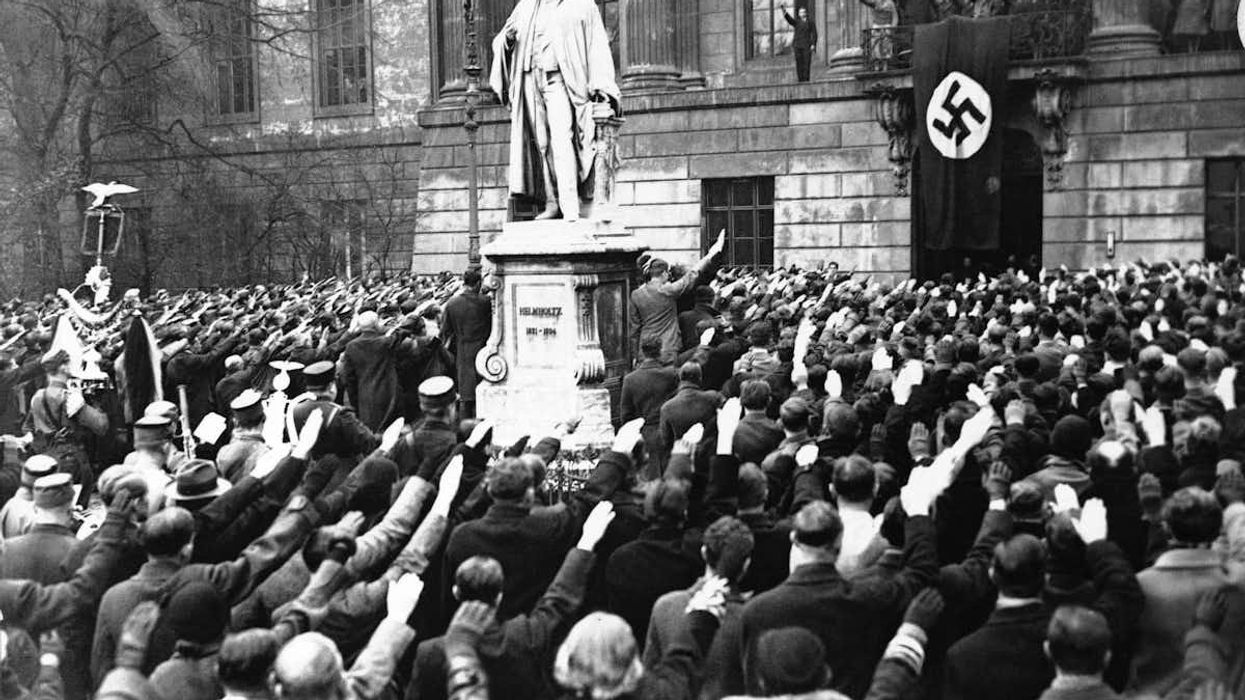
Students and other Nazi supporters gather at Humboldt University in Berlin in 1933. 

April 09, 2025

Many American universities, widely seen globally as beacons of academic integrity and free speech, are giving in to demands from the Trump administration, which has been targeting academia since it took office.

In one of his first acts, President Donald Trump branded diversity, equity and inclusion programs as discriminatory. His administration also launched federal investigations into more than 50 universities, from smaller regional schools such as Grand Valley State University in Michigan and the New England College of Optometry in Massachusetts to elite private universities such as Harvard and Yale.

Trump ramped up the pressure by threatening university research funding and targeting specific schools. In one example, the Trump administration revoked US$400 million in grants to Columbia University over its alleged failures to curb antisemitic harassment on campus. The school later agreed to most of Trump’s demands, from tightening student protest policies to placing an entire academic department under administrative oversight – though the funding remains frozen.

Cornell, Northwestern, Princeton, Brown and the University of Pennsylvania have also recently had grants frozen. Harvard was sent a list of demands in order to keep $9 billion in federal funding.

Now, across the United States, many universities are trying to avoid being Trump’s next target. Administrators are dismantling DEI initiatives – closing and rebranding offices, eliminating positions, revising training programs and sanitizing diversity statements – while professors are preemptively self-censoring.

Not all institutions are complying. Some schools, such as Wesleyan, have refused to abandon their diversity principles. And organizations including the American Association of University Professors have filed lawsuits challenging Trump’s executive orders, arguing they violate academic freedom and the First Amendment.

But these remain exceptions, as the broader trend leans toward institutional caution and retreat.

As a scholar of comparative and international education, I study how academic institutions respond to authoritarian pressure – across political systems, cultural contexts and historical moments. While some universities may believe that compliance with the administration will protect their funding and independence, a few historical parallels suggest otherwise.


German universities: A lesson

In the 1975 book “The Abuse of Learning: The Failure of German Universities,” historian Frederic Lilge chronicles how German universities, which entered the 20th century in a golden age of global intellectual influence, did not resist the Nazi regime but instead adapted to it.

Even before seizing national power in 1933, the Nazi Party was closely monitoring German universities through nationalist student groups and sympathetic faculty, flagging professors deemed politically unreliable – particularly Jews, Marxists, liberals and pacifists.

After Hitler took office in 1933, his regime moved swiftly to purge academic institutions of Jews and political opponents. The 1933 Law for the Restoration of the Professional Civil Service mandated the firing of Jewish and other “non-Aryan” professors and members of the faculty deemed politically suspect.

Soon after, professors were required to swear loyalty to Hitler, curricula were overhauled to emphasize “national defense” and “racial science” – a pseudoscientific framework used to justify antisemitism and Aryan supremacy – and entire departments were restructured to serve Nazi ideology.

Some institutions, such as the Technische Hochschule Stuttgart, even rushed to honor Hitler with an honorary doctorate within weeks of his rise to power. He declined the offer, though the gesture signaled the university’s eagerness to align with the regime. Professional associations, such as the Association of German Universities, stayed silent, ignoring key opportunities to resist before universities lost their autonomy and became subservient to the Nazi state.

As linguist Max Weinreich wrote in his 1999 book “Hitler’s Professors,” many academics didn’t just comply, they enabled the regime by reshaping their research. This legitimized state doctrine, helping build the intellectual framework of the regime.

A few academics resisted and were dismissed, exiled or executed. Most did not.

The transformation of German academia was not a slow drift but a swift and systemic overhaul. But what made Hitler’s orders stick was the eagerness of many academic leaders to comply, justify and normalize the new order. Each decision – each erased name, each revised syllabus, each closed program and department – was framed as necessary, even patriotic. Within a few years, German universities no longer served knowledge – they served power.

It would take more than a decade after the war, through denazification, reinvestment and international reintegration, for West German universities to begin regaining their intellectual standing and academic credibility.
USSR and fascist Italy suffer similar fate

Other countries that have fallen under authoritarian regimes followed similar trajectories.

In fascist Italy, the shift began not with violence but with a signature. In 1931, the Mussolini regime required all university professors to swear an oath of loyalty to the state. Out of more than 1,200, only 12 refused.

Many justified their compliance by insisting the oath had no bearing on their teaching or research. But by publicly affirming loyalty and offering no organized resistance, the academic community signaled its willingness to accommodate the regime. This lack of opposition allowed the fascist government to tighten control over universities and use them to advance its ideological agenda.

In the Soviet Union, this control was not limited to symbolic gestures – it reshaped the entire academic system.

After the Russian Revolution in 1917, the Bolsheviks oscillated between wanting to abolish universities as “feudal relics” and repurposing them to serve a socialist state, as historians John Connelly and Michael Grüttner explain in their book “Universities Under Dictatorship.” Ultimately, they chose the latter, remaking universities as instruments of ideological education and technical training, tightly aligned with Marxist-Leninist goals.

Under Josef Stalin, academic survival depended less on scholarly merit than on conformity to official doctrine. Dissenting scholars were purged or exiled, history was rewritten to glorify the Communist Party, and entire disciplines such as genetics were reshaped to fit political orthodoxy.

This model was exported across Eastern and Central Europe during the Cold War. In East Germany, Czechoslovakia and Poland, ministries dictated curricula, Marxism-Leninism became mandatory across disciplines, and admissions were reengineered to favor students from loyalist backgrounds. In some contexts, adherents to older intellectual traditions pushed back, especially in Poland, where resistance slowed though could not prevent the imposition of ideological control.

By the early 1950s, universities across the region had become what Connelly calls “captive institutions,” stripped of independence and recast to serve the state.

A more recent example is Turkey, where, following the failed 2016 coup, more than 6,000 academics were dismissed, universities were shuttered and research deemed “subversive” was banned.
History’s warning

The Trump administration’s early and direct intervention into higher education governance echoes historical attempts to bring universities under state influence or control.

The administration says it is doing so to eradicate “discrimatory” DEI policies and fight what it sees as antisemitism on college campuses. But by withholding federal funding, the administration is also trying to force universities into ideological conformity – by dictating whose knowledge counts but also whose presence and perspectives are permissible on campus.

Columbia’s reaction to Trump’s demands sent a clear message: Resistance is risky, but compliance may be rewarded – though the $400 million has yet to be restored. The speed and scope of its concessions set a precedent, signaling to other universities that avoiding political fallout now may mean rewriting policies, reshaping departments and retreating from controversy, perhaps before anyone even asks.

The Trump administration has already moved on to other universities, including the University of Pennsylvania over its transgender policies, Princeton for its climate programs and Harvard over alleged antisemitism. The question is which school is next.

The Department of Education has launched investigations into over 50 institutions, accusing them of using “racial preferences and stereotypes in education programs and activities.” How these institutions choose to respond may determine whether higher education remains a space for open inquiry.

The pressure to conform is not just financial – it is also cultural. Faculty at some institutions are being advised not to use “DEI” in emails and public communication, with warnings to not be a target. Academics are removing pronouns from their email signatures and asking their students to comply, too. I’ve been on the receiving end of those warnings, and so have my counterparts at other institutions. And students on visas are being warned not to travel outside the U.S. after several were deported or denied reentry due to alleged involvement in protests.

Meanwhile, people inside and outside academia are combing websites, syllabi, presentations and public writing in search of what they consider ideological infractions. This type of peer surveillance can reward silence, incentivize erasure and turn institutions against their own.

When universities start regulating not just what they say but what they teach, support and stand for – driven by fear rather than principle – they are no longer just reacting to political threats, they are internalizing them. And as history has shown, that may mark the beginning of the end of their academic independence.

Iveta Silova, Professor of Comparative and International Education, Arizona State University

This article is republished from The Conversation under a Creative Commons license. Read the original article.


White House Freezes Billions in Funds for Cornell and Northwestern Universities


The Trump administration has increasingly used grant cuts to force universities to comply with its political agenda.

By Zane McNeill , TruthoutPublishedApril 9, 2025

People walk through the Cornell University campus on November 3, 2023, in Ithaca, New York.Matt Burkhartt / Getty Images

The White House announced on Tuesday that it has suspended federal funds exceeding $1 billion for Cornell University and about $790 million for Northwestern University amid ongoing investigations into dubious accusations of civil rights violations at both universities.

The Trump administration has increasingly leveraged the threat of revoked grant funding to pressure universities into aligning with its far right political agenda. In March, it sent warning letters to 60 universities, accusing them of failing “to protect Jewish students on campus” and threatening funding cuts.

Cornell, one of the universities named, pushed back forcefully. University President Michael Kotlikoff penned an op-ed in The New York Times reaffirming the institution’s commitment to academic freedom and open discourse. He argued that universities must be able to engage with global issues — such as Israel’s genocide in Gaza — without fear of government retaliation.

“Universities, despite rapidly escalating political, legal and financial risks, cannot afford to cede the space of public discourse and the free exchange of ideas,” Kotlikoff wrote. “We cannot let our caution overtake our purpose. Our colleges and universities are cradles of democracy and bulwarks against autocracy.”

Critics of the Trump administration have argued that it is weaponizing accusations of antisemitism to suppress pro-Palestine speech, silence dissent, and undermine academic freedom under the pretense of civil rights enforcement.

Related Story


“The attack on universities is part of an ideological battle to shut down any dissent against Donald Trump’s agenda. It makes sense for them [the Trump administration] to start by targeting the pro-Palestinian movement with the cynical weaponization of antisemitism, because it activates both decades of cultivated anti-Arab sentiments, and a more generalized anti-immigrant sensibility,” said Nivedita Majumdar, author of The World in a Grain of Sand: Postcolonial Literature and Radical Universalism, in a March interview with Truthout. “But we need to be very clear that they won’t stop with pro-Palestinian protesters; it’s just the lowest-hanging fruit.”

Funding has already been revoked from institutions like Columbia University, the University of Pennsylvania, Princeton University, and the University of Maine. According to The New York Times, over $3.3 billion in federal funds to leading universities has been halted in the past month alone, with more under review, including funds for Harvard University and Brown University.

Columbia University, in particular, drew backlash from academics and free speech advocates after complying with several of the Trump administration’s demands in hopes of reclaiming federal funding. These included increased administrative oversight of its Middle Eastern Studies department, a campus-wide ban on face coverings, expanded authority for campus security to detain or remove individuals, and a mandate to boost “intellectual diversity” by hiring more faculty at its Institute for Israel and Jewish Studies.

Former Columbia University president Lee Bollinger recently described these developments as “an authoritarian takeover” in an interview with The Chronicle of Higher Education.

“We cannot get ourselves to see how this is going to unfold in its most frightening versions. You neutralize the branches of government; you neutralize the media; you neutralize universities, and you’re on your way,” Bollinger said. “We’re beginning to see the effects on universities. It’s very, very frightening.”

On Tuesday night, Cornell acknowledged media reports that federal agencies may be freezing up to $1 billion in research funding. While the university had not received formal confirmation of the figure, it did report receiving more than 75 stop-work orders from the Department of Defense that same day.

In response, Kotlikoff and other university leaders asserted that Cornell has “worked diligently to create an environment where all individuals and viewpoints are protected and respected.” They added that university leaders are “actively seeking information from federal officials to learn more about the basis for these decisions.”

Northwestern University also confirmed in a statement to Inside Higher Ed that it was aware of media reports about a potential funding freeze. However, it said it had yet to receive formal notice from the federal government and noted that it has been cooperating fully with the investigation.

But as some universities emphasize compliance and cooperation, faculty are making it clear that such strategies won’t shield higher education from the broader political assault it now faces.

“Academic freedom is not Trump’s to take or boards’ to give away. Our commitment to truth-telling will not be compromised by lobbying groups, donors and politicians, and the governance of our institutions will not be outsourced to boards for whom we are appendages to investment portfolios,” Jennifer Ruth, a professor at Portland State University, recently wrote for Truthout. “Our universities will be by and for the people who work and study at them, not by and for finance capitalists, ‘broligarchs’ and fascists.”

TRUMP THE NIXONIAN

'Madman act': Trump using this lethal foreign policy theory in dealing with domestic affairs


April 10, 2025
ALTERNET

An article written by political commentator Ed Kilgore that appeared in Intelligencer magazine on Thursday argues that the Trump administration has been using the "madman theory" to run the affairs of the government.

"The blend of chaos, malice, and terror associated with pursuit of the madman theory in foreign policy has been abundantly present in the unprecedented assault on the federal government by Elon Musk’s DOGE and Russell Vought’s Office of Management and Budget," Kilgore, who is a longtime policy analyst at the Democratic Leadership Council, wrote in the article.


The term "madman theory" was reportedly coined by former President Richard Nixon. Nixon's aide H.R. Haldeman said his boss wanted the North Vietnamese to think he was willing to go to any lengths, including the potential use of nuclear weapons, to end the Vietnam War.

ALSO READ: 'Is this market manipulation?' Rumors swirling over potential Trump admin insider trading

The madman theory suggests that a leader who acts as though they could take extreme actions is more likely to convince other international players to make compromises they might not otherwise consider.


Kilgore wrote in his Thursday article that President Donald Trump and Musk "strongly believe the deep state is a nest of evil civilization-devouring elitists who must be crushed remorselessly."

"In his own companies, Musk has invariably exemplified the move-fast-and-break-things ethic of Silicon Valley, wherein running up video-game numbers of jobs lost and lives ruined is inherently virtuous," he added.

In 2015, Trump told an interviewer, quoting another businessman, “There’s a certain unpredictability about Trump that’s great.” In his first major speech of the 2015 campaign, he criticized United States foreign policy during the Obama administration. “We must as a nation be more unpredictable," Trump said at the time.
by Taboola
Sponsored LinksYou May Like

Here’s What a 1-Day Gutter Upgrade Should Cost Youleaffilterguards
Learn More


ALSO READ: Sucking up the oxygen: How Donald Trump has gatecrashed the upcoming election — in Australia

According to Kilgore, "the possibility that the most powerful military in the history of the world may be in the hands of a homicidal maniac gave said maniac enormous leverage in situations involving international conflict."

"And the ever-constant threat of incredibly lethal violence fit in perfectly with Trump’s own personality and his Jacksonian approach to national defense, in which Uncle Sam would mostly mind his own business but was prepared to wreak holy hell on anyone who looked funny at him," he added.


But Kilgore says that in his second term, Trump is using this theory not only in foreign policy but also in dealing with domestic issues.

"In Trump 2.0, it is increasingly apparent that the same psychology of erratic and often terrifying brinkmanship has been extended into nearly every policy arena, domestic as well as international, which isn’t surprising insofar as Trump’s universe of perceived 'enemies' now tilts heavily toward people living in this country," he wrote.
Donald Trump’s new policies are 'stupid' — according to stupidity researchers


REUTERS/Nathan Howard
U.S. President Donald Trump reads a paper during an event with the racing champions from NASCAR Cup Series, NTT IndyCar Series, and IMSA WeatherTech SportsCar Championship, at the White House in Washington, D.C., U.S., April 9, 2025.


The Conversation
April 09, 2025


Before he stepped down as Canadian prime minister, Justin Trudeau called Donald Trump’s tariff policies “very dumb.” This might be an accurate description of many Trump administration policies — but the more objectively correct word is “stupid.”


In fact, Québec’s largest newspaper, Le Journal de Montréal, published a front-page photo of Trump in early February with the word “stupid” in 350-point type. Some may call this an opinion, but the science of stupidity tells us that it’s more of a definition.

Recent research has produced a succinct label for the poorly calculated actions of decision-makers: stupidity.

This is not simple name-calling, but a phenomenon that comprises loss and features a set of actions that are either outright recognizably dysfunctional, or appear so at odds with any sensible course of action that it seems a hidden agenda could be involved.

Stupidity that causes everyone to lose

According to the seminal and transactional view of human stupidity by Carlo Cipolla, the late Italian economic historian, interactions fall into four categories:Intelligent interactions that are beneficial to all – a positive-sum game like Scottish philosopher Adam Smith’s notion of wealth through specialization and trade;Helpless interactions that result in a loss in a zero-sum game;
Bandit interactions that result in a gain in zero-sum game;
Stupid interactions that cause all parties to suffer a loss.

Free trade is based on an intelligent positive-sum interaction. Trump’s transactional zero-sum view is that for every winner there is a loser.

He apparently doesn’t understand that tariffs are only successful if other countries don’t retaliate. But other countries do retaliate, and as the world is now witnessing, the resulting trade war can decimate the global economy.

Trump’s protectionist measures aimed at boosting the U.S. economy can therefore be considered “stupid” interactions that risk deepening and lengthening an economic depression.

Stupidity as recognizable actions

Modern-day researchers have also identified three recognizable sets of actions embodying stupidity:

Confident ignorance that involves people taking risks without having the necessary skills to deal with them. It’s not just being ignorant of one’s ignorance — explained by the Dunning-Kruger effect — but being self-assured despite contrary evidence.

Trump may know what he does not know, so he delegated many tasks to Tesla founder Elon Musk and trade tariff architect Pete Navarro, both of whom seem to possess no such awareness.

Absent-minded failure means people knew the right thing to do but were not paying sufficient attention to avoid doing something stupid. Organizations create agendas, but if issues don’t reach a point where they seriously impact the organization’s objectives, they are ignored.

An example is the recent U.S. strikes against Yemeni Houthis. U.S. officials ignored critical security components by sharing information about their plans over unsecure connections and with a member of the media.

Lack of control means that autocratic decision-makers compromise their organizations by failing to accept objections from those charged with implementing the leader’s preconceived plans.

Such autocratic decision-makers may select biased information to support their proposals. Those working under these leaders either buy into efforts to selectively use information, limit alternatives and execute these preconceived plans or they leave the organization (either voluntarily or not).

In the U.S., witness the firing of Justice Department pardon attorney Elizabeth Oyer. She failed to support restoring gun rights to actor Mel Gibson, who had been convicted of domestic violence in 2011. Gibson’s pardon was reportedly based on his personal relationship with the president.

Types of stupidity


Organizational researchers have used the term functional stupidity to describe those who refuse to use their intellectual capacities when making decisions and then avoid justification for their actions. This allows group members to quickly execute routine functions without much thought.

Dysfunctional stupidity is a lack of organizationally supported reflection, reasoning and justification. Organizations fail to use intellectual resources to process knowledge or question norms or claims of knowledge when confronted with new or non-routine decisions. By blocking communications, muffling criticism and squelching doubts, organizations ensure adherence to superiors’ edicts.

One Trump administration example is the unquestioning permission given to allow the Department of Government Efficiency (DOGE), headed by Musk, to access to a wide array of government data.

It can take the combined efforts of organizational officials on multiple levels to maintain stupidity.

Individually, stupidity is reinforced by ignoring crucial information because of a need for a rapid response.

Consequently, quick decisions and shortcuts made by individuals result in negative outcomes. An example would be the Trump administration’s apparent need to appear to find cost savings quickly to allow for tax cuts, overriding a more logical approach to find ways to achieve those savings without gutting legally mandated services.

Organizationally, stupidity is reinforced because organizations limit acceptable alternative behaviours when they cannot process all available information. Data is restricted, controls are tightened and organization officials fall back to using previously well-learned responses in their comfort zones. Inexperienced decision-makers fall back on uninformed assumptions, or no assumptions at all.

Witness Trump’s “reciprocal” trade tariffs that battered financial markets worldwide, finally causing him to hit the pause button. No tariffs were calculated using current tariff rates, while others were based on American trade deficits with other countries. Other tariffs seem to be based on no rationale at all.


Stupidity as a hidden agenda?

Some actions that appear stupid may simply hide a hidden agenda. When the Trump administration erroneously detains and deports anyone under the Alien Enemies Act, is it an accident or a way to instil fear in everyone that authorities can detain, mistreat and deport them without due process at any point?

Many of the actions being taken by the Trump administration appear stupid. Tariffs, for example, represent a loss — a transactionally negative sum game.

Trump’s decisions exhibit confident ignorance, absent-minded failure and lack of control. They also show dysfunctional stupidity as Trump officials seemingly refuse to use their full intellectual resources. Stupidity is also being reinforced through unfounded assumptions. Is this all hiding a secret agenda?

“You can’t fix stupid,” so the saying goes. But having capable administrators in place while other branches of government exercise their constitutionally mandated oversight role might dampen some of the Trump administration’s stupidity.

Jerry Paul Sheppard, Associate Professor of Business Administration, Simon Fraser University

This article is republished from The Conversation under a Creative Commons license. Read the original article.