It’s possible that I shall make an ass of myself. But in that case one can always get out of it with a little dialectic. I have, of course, so worded my proposition as to be right either way (K.Marx, Letter to F.Engels on the Indian Mutiny)
Tuesday, April 15, 2025
A revisit to continental collision between India and Asia
The conceptual sketch of multiple Wilson cycles for a series of subduction‐collision‐subduction processes during the evolution of Tethyan realm during the Phanerozoic, with the final collision between the Indian and Asian continents in the Early Cenozoic.
The India-Asia continental collision and the uplift of the Tibetan Plateau have long been attributed to continuous Cenozoic convergence with two generic assumptions: the ongoing India-Asia collision and the underthrusting of the Indian continent beneath the Tibet hinterland. This study presents a challenge to the two assumptions through an integrative analysis of geological, geophysical and geochemical data, mainly focusing on the duration of syn-collisional processes, the spatial range of syn-collisional effects, and the distinction in structure and composition between syn-collisional and post-collisional products. It turns out that the India-Asia collisional orogeny was short-lived in the Early Cenozoic without significant underthrusting of the Indian continent beneath the Tibet hinterland, and that the plateau uplift was governed by post-collisional mantle dynamics in the Late Cenozoic rather than the ongoing collision/subduction during the whole Cenozoic. The geological architecture of the Tibetan Plateau is highlighted as a mosaic of terranes that were accreted northwards from the Early Paleozoic through the Late Paleozoic to the Mesozoic. These terranes and their sutures were variably reactivated during the short-lived collision in the Early Cenozoic rather than forming as a singular collisional entity throughout the entire Cenozoic. The India-Asia collisional effects are the most prominent in the Himalayan and Gangdese orogens.
Inspection of key findings in the literature dismantles the traditional paradigms based on the two generic assumptions. Seismic tomography and helium isotope data constrain subduction of the Indian continent to depths of 200–300 km mainly beneath the Yarlung-Zangpo Suture that marks the southernmost margin of the Tibetan Plateau. Paleomagnetic discrepancies regarding the width of Greater India are resolved by emphasizing the cover-basement decoupling during soft collision and shallow subduction, limiting its underthrusting to short distances of ≤300 km. This reconciles geological shortening estimates with exaggerated paleomagnetic-derived convergence distances. A critical examination of petrological, structural and geochronological data partitions the formation of the Himalayan orogen into two stages. The first is the continental suturing from soft collision through hard collision to deep subduction, leading to crustal shortening through slice thrusting mainly at 55–45 Ma in the Early Cenozoic. The second is the post-collisional reworking due to upwelling of the asthenospheric mantle induced by foundering of the lithospheric mantle, resulting in crustal anatexis, emplacement of leucogranites and metamorphic core complexes, and domical uplift mainly at 30–10 Ma in the Late Cenozoic. The Himalaya-Tibet tectonic collage has behaved in a intracontinental setting in the Late Cenozoic when it uplifts due to the asthenospheric upwelling in response to the lithospheric foundering.
This study demonstrates that the two generic assumptions for the India-Asia collision do not stand any more under close scrutiny and thus are essentially specious in previous studies. It has great bearing on the evolution of the Himalaya-Tibet tectonic collage in the Cenozoic. It casts doubt on the tectonic interpretation of paleomagnetic and seismic data with respect to the continental convergence and underthrusting between India and Asia. Many of geological and geochemical observations were interpreted under the two assumptions, overlooking a series of differences in temporal sequence, dynamic regime and geothermal gradient between the syn-collisional and post-collisional processes. Therefore, it is necessary to examine the rationality of geodynamic models for the processes, mechanisms and effects of the India-Asia collision and plateau uplift through prioritizing of the post-collisional processes over the syn-collisional effects. As such, this study offers transformative insights into the nature of continental tectonics at precedingly converged plate margins globally.
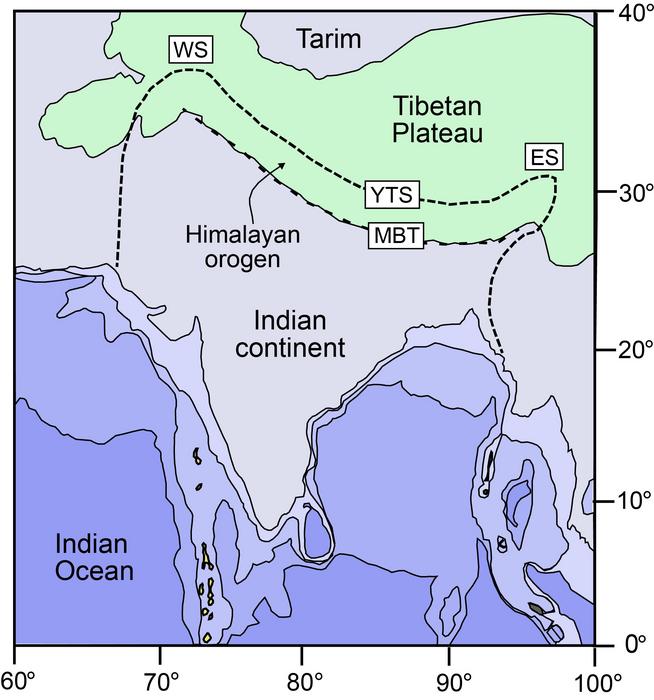
Sketch map of the tectonic superposition between the Indian and Asian continental margins in the Cenozoic. The width of Greater India beneath the southern margin of the Lhasa terrane is limited to ca. 200-400 km rather than to ca. 400-800 km. Abbreviations: YTS, Yarlung-Zangpo Suture; MBT, Main Boundary Thrust; ES, Eastern Syntaxis; WS, Western Syntaxis.
Computer simulation of a one-sided magnetic field on early Mars based on data from a study led by the University of Texas Institute for Geophysics. The study could explain the unusual magnetic imprint found on Mars today.
Like Earth, Mars once had a strong magnetic field that shielded its thick atmosphere from the solar wind. But now only the magnetic imprint remains. What’s long baffled scientists, though, is why this imprint appears most strongly in the southern half of the Red Planet.
A new study from the University of Texas Institute for Geophysics (UTIG) could help explain the one-sided imprint. It presents evidence that the planet’s magnetic field covered only its southern half.
The resulting lopsided magnetic field would match the imprint we see today, said the study’s lead author Chi Yan, a UTIG research associate at the UT Jackson School of Geosciences. It would also make Mars’ magnetic field different from Earth’s, which covers the entire globe.
Yan said that the one-sided magnetic field could arise if Mars’ inner core was liquid.
“The logic here is that with no solid inner core, it’s much easier to produce hemispheric (one-sided) magnetic fields,” Yan said. “That could have implications for Mars’ ancient dynamo and possibly how long it was able to sustain an atmosphere.”
In the study, published in the journal Geophysical Research Letters, the researchers used a computer simulation to model this scenario.
Until now, most studies of early Mars had relied on magnetic field models that gave the Red Planet an Earth-like inner core that’s solid and surrounded by molten iron.
The researchers were inspired to try simulating a fully liquid core after NASA’s InSight lander found that Mars’ core was made of lighter elements than expected. That means the core’s melting temperature is different from Earth’s and therefore quite possibly molten, said study co-author Sabine Stanley, a Bloomberg Distinguished Professor at Johns Hopkins University.
If Mars’ core is molten now, it almost certainly would have been molten 4 billion years ago when Mars’ magnetic field is known to have been active, Stanley said.
To test the idea, the researchers prepared simulations of early Mars with a liquid core and ran them a dozen times on supercomputers. With each run the researchers made the planet’s northern half of the mantle a little hotter than the south.
Eventually, the temperature difference between the hotter mantle in the north and the cooler mantle in the south led to the heat escaping from the core to be released only at the southern end of the planet. Channeled in such a way, the escaping heat was sufficiently vigorous to drive a dynamo and generate a strong magnetic field focused in the southern hemisphere.
A planetary dynamo is a self-sustaining mechanism that generates a magnetic field, typically through movement in the molten metallic core.
“We had no idea if it was going to explain the magnetic field, so it's exciting to see that we can create a (single) hemispheric magnetic field with an interior structure that matches what InSight told us Mars' interior is like today,” Stanley said.
According to UTIG planetary researcher Doug Hemingway, the finding offers a compelling alternative theory to a common assumption that involves asteroid impacts obliterating evidence of a planet-wide magnetic field in northern hemisphere rocks.
“Mars is naturally interesting to look at because it's like Earth in some ways and it’s the closest planet that we can imagine actually setting up shop on,” said Hemingway, who was not part of the study. “But then, it’s got this dramatic hemispheric dichotomy where the topography, the terrain and the magnetic field of the northern hemisphere and southern hemisphere are dramatically different. Anything that gives a clue at what could account for some of that asymmetry is valuable.”
The study was funded by the NASA InSight program. The simulations were conducted at the Maryland Advanced Research Computing Center.
Mars' Hemispheric Magnetic Field From a Full-Sphere Dynamo
An illustration of NASA's InSight spacecraft. The lander’s instruments found that Mars may have a fully molten core. That could explain Mars’ one-sided magnetic field according to research by the University of Texas Institute for Geophysics.
Credit
NASA/JPL-Caltech
How flexible wearables protect astronauts' health in space
A review published recently in Wearable Electronics examines the current applications and persistent challenges of flexible wearable technologies in aerospace medicine. As human space exploration progresses toward extended-duration missions, the imperative for real-time monitoring of astronauts' physiological and psychological well-being has become increasingly critical. The unique space environment characterized by microgravity conditions, cumulative radiation exposure, and extreme thermal fluctuations presents multifaceted health risks to crew members.
Flexible wearable systems, equipped with multimodal sensor arrays, enable comprehensive and continuous health surveillance. These integrated platforms include inertial measurement units, biosignal electrodes, and environmental detectors, among others. They have proven to be indispensable for early anomaly detection in cardiopulmonary functions, neuromuscular performance, and circadian rhythm regulation, thereby facilitating timely personalized countermeasures.
Nonetheless, despite recent advancements in materials science and miniaturized electronics, three notable technical barriers persist: 1) device reliability under combined space stressors, 2) secure data management protocols addressing confined spacecraft privacy concerns, and 3) multi-parametric data fusion challenges involving temporal-spatial synchronization of heterogeneous bio-signals.
Breakthrough development trajectories emphasize future research in the field of flexible wearable devices, particularly for astronaut applications, will focus on several key areas and their interdisciplinary collaborations. These research areas will cover advanced materials science, new materials and sensor technology, intelligent algorithms, data processing and device integration. Interestingly, the development of technologies in the field will still rely on material innovation, the creation of intelligent algorithms, the improvement of user experience and interdisciplinary cooperation. In particular, continuous development and maturity of the technology, together with flexible electronic devices, will play an important role in enhancing astronauts' health monitoring capabilities and promoting the progress of human space exploration in the future.
Fig. 2. Integrated smart wearables with advanced features
Credit
Yi Wang, et al.
Fig. 3. To develop more advanced astronaut health monitoring devices in the future, interdisciplinary collaborations are needed, including but not limited to new materials and sensor technology, intelligent algorithms and data processing as well as device integration.
Credit
Yi Wang, et al.
Contact the author: Yi Wang, Corresponding author at: Department of Physical Education, Renmin University of China, Beijing 100872, China., wyi@bsu.edu.cn
The publisher KeAi was established by Elsevier and China Science Publishing & Media Ltd to unfold quality research globally. In 2013, our focus shifted to open access publishing. We now proudly publish more than 200 world-class, open access, English language journals, spanning all scientific disciplines. Many of these are titles we publish in partnership with prestigious societies and academic institutions, such as the National Natural Science Foundation of China (NSFC).
Flexible wearable device applications for monitoring astronaut health: Current status and challenges
Scientists may have solved a puzzling space rock mystery
Carbon-rich asteroids are abundant in space yet make up less than 5 per cent of meteorites found on Earth. An international team of scientists scoured the globe to find an answer
An international team of researchers may have answered one of space science’s long-running questions – and it could change our understanding of how life began.
Carbon-rich asteroids are abundant in space yet make up less than 5 per cent of meteorites found on Earth.
Published today in Nature Astronomy, researchers analysed close to 8500 meteoroids and meteorite impacts, using data from 19 fireball observation networks across 39 countries — making it the most comprehensive study of its kind.
“We’ve long suspected weak, carbonaceous material doesn’t survive atmospheric entry,” Dr Devillepoix said.
“What this research shows is many of these meteoroids don’t even make it that far: they break apart from being heated repeatedly as they pass close to the Sun.
“The ones that do survive getting cooked in space are more likely to also make it through Earth’s atmosphere.”
Carbonaceous meteorites are particularly important because they contain water and organic molecules — key ingredients linked to the origin of life on Earth.
Paris Observatory’s Dr Patrick Shober said the findings reshape how scientists interpret meteorites collected so far.
“Carbon-rich meteorites are some of the most chemically primitive materials we can study — they contain water, organic molecules and even amino acids,” Dr Shober said.
“However, we have so few of them in our meteorite collections that we risk having an incomplete picture of what’s actually out there in space and how the building blocks of life arrived on Earth.
“Understanding what gets filtered out and why is key to reconstructing our solar system’s history and the conditions that made life possible.”
The study also found meteoroids created by tidal disruptions — when asteroids break apart from close encounters with planets — are especially fragile and almost never survive atmospheric entry.
“This finding could influence future asteroid missions, impact hazard assessments and even theories on how Earth got its water and organic compounds to allow life to begin,” Dr Shober said.
Other institutions involved in the study were the Astronomical Institute of the Romanian Academy, National Museum of National History and Aix-Marseilles University.
The study was supported by funding from the International Centre for Radio Astronomy Research.
Perihelion history and atmospheric survival as primary drivers of the Earth’s meteorite record was published in Nature Astronomy.
Perihelion history and atmospheric survival as primary drivers of the Earth’s meteorite record
Article Publication Date
14-Apr-2025
Innovative networking opportunities for young scientists in Europe
With the new EPICUR Hubs, the European University Alliance EPICUR establishes adynamic, virtual platform for networking and skill development of early-career researchers
For young researchers, it is often hard to engage in networking with like-minded colleagues outside their own research group or specific conferences. This issue is addressed by the newly created EPICUR Hubs: Their objective is to establish an easily accessible, straightforward network where early career researchers within Europe can find each other and exchange views.
“The intense collaboration with our European partners is a major prerequisite for strengthening Europe as a center of science on the international level,” says Professor Thomas Hirth, Vice President Transfer and International Affairs at KIT. “The EPICUR Hubs provide access to a European network of skills. Young scientists and regional stakeholders from industry, civil society, and other areas are brought together in a way that enables them to pool knowledge, work jointly on innovative projects, and develop solutions to complex problems.”
Pooling Skills and Creating Synergies
The EPICUR Hubs can be understood as transnational and interdisciplinary centers. They are part of the EPICUR Alliance, providing master students and early career researchers with many opportunities for continued education and networking. The Hubs offer virtual and hybrid formats and blended learning – a learning method combining in-person teaching with online elements – and in-person events including courses, workshops, online events, networking sessions, and short research stays.
“The Hubs support young people in gaining international experience and help them shape transformative initiatives. They promote the exchange of ideas and provide access to infrastructures and educational funding sources, with the aim to address urgent global challenges,” says Kirsten Rosa, Research-Oriented Teaching Officer with the EPICUR Project. Together with Professor Nicolaos Theodossiou from Aristotle University of Thessaloniki, she heads the first Hub, which will focus on sustainable transformation.
Until the end of 2026, three other Hubs themed “European Values”, “Global Health”, and “Future Intelligence”, will follow and act as incubators for new ideas and thereby drive the cooperation of science, business, and society.
The virtual kick-off of the EPICUR Hub was on Tuesday, April 08, 2025.
About EPICUR
The aim of the European university alliance EPICUR (European Partnership for an Innovative Campus Unifying Regions) is to create an attractive and innovative European university for a new generation of students and researchers in Europe. EPICUR has partnered with nine universities in Europe: the universities of Poznań, Amsterdam, Thessaloniki, Freiburg, Mulhouse, Vienna, Odense, Strasbourg, and Karlsruhe. (amo)
Being “The Research University in the Helmholtz Association”, KIT creates and imparts knowledge for the society and the environment. It is the objective to make significant contributions to the global challenges in the fields of energy, mobility, and information. For this, about 10,000 employees cooperate in a broad range of disciplines in natural sciences, engineering sciences, economics, and the humanities and social sciences. KIT prepares its 22,800 students for responsible tasks in society, industry, and science by offering research-based study programs. Innovation efforts at KIT build a bridge between important scientific findings and their application for the benefit of society, economic prosperity, and the preservation of our natural basis of life. KIT is one of the German universities of excellence.