Monday, May 12, 2025

Adapt or be undone: climate resistance from below

As the world barrels toward climate tipping points, fields and forgotten urban areas are devising their own survival strategies. We look at examples from Bulgaria to Brittany, fog water harvesters, urban communities resisting unfair emissions zones, and precarious workers.

Published on 6 May 2025 
Emanuela Barbiroglio
VOXEUROPA

 
Vasco Gargalo | Cartoon movement

The Copernicus Climate Change Service (C3S) and the UN's World Meteorological Organization (WMO) have just published the European State of the Climate report 2024, and the news is far from good.

Europe is confirmed as the fastest-warming continent, and 2024 as the warmest year on record for Europe, with record temperatures in central, eastern, and southeastern regions. Severe storms and widespread flooding claimed at least 335 lives, affecting an estimated 413,000 people.


This year, the report also featured a new layer highlighting examples of climate resilience and adaptation initiatives in cities across Europe. It shows that 51% of European cities have adopted dedicated climate adaptation plans, representing encouraging progress from 26% in 2018.

More : From breakdown to crackdown: environment and climate activists in the crosshair

WMO Secretary General Celeste Saulo called adaptation “a must”. “We are making progress but need to go further and need to go faster, and we need to go together," she said.

EU Climate Commissioner Wopke Hoekstra is meanwhile due to "lead the work on a European Climate Adaptation Plan to support member states, notably on preparedness and planning and ensure regular science-based risk assessments", his mission letter said last summer. "This should, for example, cover the impact on infrastructure, energy, water, food, and land in cities and rural areas" and "look at incentives for nature-based solutions".

A recent Guardian feature suggests to avoid the usual suspects, given the current geo-political tensions within the US, and look at Africa instead. The article’s authors William Ruto and Patrick Verkooijen say “Africa was an early champion of climate adaptation”, with 17 of the 20 countries most vulnerable to climate change on the continent.

“We wanted to move beyond disaster management to forward-looking strategies that reduced our exposure to climate risks. We sought solutions to protect our people and businesses from ever-more destructive weather extremes. Adaptation is not simply a means of minimising the damage inflicted by extreme weather, although that alone would justify the investment. Done properly, it can transform economies, as well as strengthen them against natural disasters.”

Poorer, developing nations could show Europe the way: how to avoid the destructive steps of capitalism altogether and move on to the next stages, where people and the planet have found a way to survive together.

Ekhosuehi Iyahen, secretary general of the Insurance Development Forum (IDF), explores the flip side of the adaptation coin for Italian newspaper Domani: insuring ourselves from climate change. “Urgent action is needed to protect these ecosystems, but many coastal communities do not have the necessary financial resources. Closing the financial gap is essential to mitigate the effects of climate change: the insurance sector can be a powerful driver of positive change,” she writes.

More : How Italian newspapers greenwashed the bonds of national oil champion Eni

In Portugal, with Marie-Cécilia Duvernoy and Reporterre, we meet engineers André Mota and Paula Pereira. Despite the droughts and the fires, the Life Nieblas team remains enthusiastic. By capturing fog water with nets, thousands of replanted oak trees thrive year after year in central Portugal.

And yet, across the EU, low-income communities are pushing back against climate measures that ignore social realities. In Alternatives Economiques, Mines Paris’ professor Blanche Segrestin explores the backlash against Low Emission Zones in cities like Paris and Lyon, where the poorest risk being priced out of mobility: “The general average then imposes a rule of solidarity: a sacrifice to ensure the ‘rescue’ must be shared in proportion to the wealth that will actually be saved. In the case of the danger of the city becoming unusable, we could thus at least replace polluting cars by sharing the effort not only among the owners of these cars, nor among motorists, but among all those who have something to save.”

Talking about the just transition, Cross-border Talks zooms in on Bulgaria and Romania, where fossil fuel workers fear they’re going to be left behind. Trade unions and local leaders warn that without genuine dialogue and investment, the shift could deepen inequality and fuel populist backlash.

More : Environmental journalist Hervé Kempf: ‘The ecological and social issues are inextricably intertwined’

“We really need a clear direction and a clear commitment. We need to know what is going to be done year by year. Only this way the measures applied within the just transition framework would be properly aligned with everything else. Then, nobody will be left behind in the process of decarbonisation. Instead, we see right-wing populist parties using the issue of just transition to make a political scandal. They are stopping the process. We are nowhere in the process of reviewing and changing the just transition plans, indicators and milestones,” Georgi Stefanov, founder of the Climate Coalition Bulgaria, told Małgorzata Kulbaczewska-Figat.
Debunking the far-right myth: there is not such a thing as little room for the environment

As part of a push to water down the EU’s Green Deal, far-right and conservative politicians are claiming that the measures being discussed to tackle biodiversity loss in Europe will undermine the economy. But research and data show that failing to restore nature poses a greater financial risk.


Fact-checking RightWatch | Climate
Published on 7 May 2025 
Emanuela Barbiroglio
VOXEUROP

 
Wes Rowell | Cartoon Movement

Claim to be verified: During the discussions on the EU Nature Restoration Regulation, in early 2024, Dutch member of the European Parliament from the far-right European Conservatives and Reformists Group (ECR) Bert-Jan Ruissen claimed that “too much land was reserved for nature restoration”. Like several other right wing officials, he took up the argument that conservation undermines economic stability.

Background: The Nature Restoration Regulation was a key component of the European Green Deal aimed at reversing biodiversity loss and mitigating climate change. Originally, it was expected to impose the restoration of only a part of the EU’s land and seas considered degraded, after which no further ecosystem degradation would have been allowed. The Commission tabled its proposal in 2022 with targets of "at least 20% of Europe's marine and terrestrial land" and "30% of habitats in poor conservation status" by 2030 – followed by a 100% restoration of ecosystems in need by 2050.

Far-right politicians were not the only ones who did not welcome the file: anticipating a shift, the centre-right European People Party (EPP) started fuelling concerns about environmental policies that could threaten farmers, food supply, and economic stability. As the EU neared its Parliament’s elections in summer 2024, and the political debate started heating up, statements like that of Ruissen became the common argument for right parties to undermine the Green Deal and therefore gain votes.

As the 2024 European elections closed in, right-wing candidates wanted to move the majority away from that of 2019: quite progressive in fact, where the Greens played a crucial role for the first time, in the wake of public movements like Fridays for Future.

Dutch MEP from the far-right European Conservatives and Reformists Group (ECR) Bert-Jan Ruissen and his peers began a series of actions aimed at, if not dismantling the Green Deal, slowing its pace on a pretence of social justice and framing it as an economic threat. Ruissen was by February 2024 shadow rapporteur in the Committee on Agriculture for the development of the Nature Restoration Regulation, known as “nature law” in the public debate.

Because a green transition was costly and risked leaving behind those citizens whose jobs and entire lives still evolve around traditional ways of production, it should be revised and made more “pragmatic” or “realistic”, according to the far-right.
More : Why Donald Trump is going after Europe’s Green Deal

For former MEP of the European People's Party (EPP, conservative), Marlene Mortler, who drafted a report on food security, the “Green Deal mustn’t jeopardise food security” – something she considered a potential risk as more land becomes “useless” due to protection measures.

Calling for a complete rejection of the Commission’s proposal, the EPP leader Manfred Weber said in 2023 that “the law’s objective is to restore nature back to its state of 1950”. “It challenges local and regional governments to do the impossible: turn back 70 years of changes to nature in about 25 years,” he added.
A series of unfortunate events

Opponents of the law have falsely claimed that vast areas of farmland will be rewilded.

In reality, the bill does not expropriate farmland, as it prioritises degraded ecosystems and explicitly acknowledges the need to balance conservation with economic activity. The nature law also includes flexibility mechanisms, ensuring that restoration efforts are compatible with food production and rural livelihoods.

Although opposers made the legislative procedure a painful journey, co-legislators reached a deal in a last-minute battle and signed a final act in June 2024 – just before the EU elections.

The text will oblige EU member states to restore at least 30% of habitat types covered in the bill by 2030, prioritising protected sites under the existing Natura 2000 network. Now the EU’s 27 member states have until 1 September 2026 to submit their draft national restoration plans to the Commission.

Ruissen’s claim, not supported by scientific evidence or public consultation data, was the perfect way to ruin the Green Deal’s reputation. Policy making in 2025 is still paying the price for this trend.

“As the protests spread, the agricultural lobbies and the conservative right began to exploit those squares,” said Associazione Terra!.

With a certain degree of success: last year, several bits of European legislation fell victim to such worries.

The Common agricultural policy (CAP) was modified in order to enable farmers to get EU farming subsidies even if they don’t meet the bloc’s environmental standards, known as conditionality rules.

The European Parliament rejected a text for a proposal to limit the use of pesticides.

The Regulation on Deforestation-free Products was delayed, following a push from conservative parties to water down the requirements for third parties.

Emissions from intensive farming were not equated with industrial emissions in 2040 targets.

The Farm to Fork strategy, the agri-food component of the previous mandate, should be declared dead too.


Neoliberal agricultural policies


But a closer examination at farmers’ protests, often portrayed as a direct reaction to nature restoration policies, reveals that their primary concerns lay elsewhere.

For instance, the EU-Mercosur trade agreement has the potential for lower-cost agricultural products from Latin America to disrupt the EU market.

International movement La Via Campesina pointed out that farmers in 2024 were “fed up with spending their lives working incessantly without ever getting a decent income.”
Contrary to claims that land conservation undermines economic stability, research shows – if anything – that failing to restore degraded ecosystems poses a far greater financial risk

“We have reached this point after decades of neoliberal agricultural policies and free trade agreements”, it says, “production costs have risen steadily in recent years, while prices paid to farmers have stagnated or even fallen [...] Since the 1980s, various regulations that ensured fair prices for European farmers have been dismantled. The EU put all its faith in free trade agreements, which placed all the world’s farmers in competition with each other, encouraging them to produce at the lowest possible price at the cost of their own incomes and growing debt. Producing ecologically has huge benefits for the health and the planet, but it costs more for the farmers, and so to achieve the agroecological transition, agricultural markets need to be protected. Unfortunately, we were not heard.”

What data says


Contrary to claims that land conservation undermines economic stability, research shows – if anything – that failing to restore degraded ecosystems poses a far greater financial risk.

The Intergovernmental Panel on Climate Change (IPCC) highlights how ecosystem degradation directly threatens agricultural productivity and food security: “observed climate change is already affecting food security through increasing temperatures, changing precipitation patterns, and greater frequency of some extreme events” and “food security will be increasingly affected by projected future climate change”.

Furthermore, continues the IPCC, “about 21–37% of total greenhouse gas (GHG) emissions are attributable to the food system”.

Taking the current food system for granted, the UN Food and Agriculture Organization (FAO) estimates that there is a need to produce about 50% more food by 2050 in order to feed the increasing world population. “This would engender significant increases in GHG emissions and other environmental impacts, including loss of biodiversity,” says the IPCC.

With 2 billion people more on planet Earth, we simply can’t afford to continue living as we do. And yet, it is not a simple matter of space: only new, sustainable forms of agriculture can respond to the issues industrial agriculture created in the past few decades.

More : Cop29: climate leader or fossil regime?

“Combining supply-side actions such as efficient production, transport, and processing with demand-side interventions such as modification of food choices, and reduction of food loss and waste, reduces GHG emissions and enhances food system resilience,” says the IPCC.

Consultancy firm PwC estimates that over 50% of global GDP is at risk due to biodiversity loss, meaning that protecting nature is an economic imperative, not a hindrance.

The World Resources Institute (WRI) has demonstrated that climate finance investment in nature restoration yields substantial economic returns and job creation.

While a vision is needed, this is something undeniably hard to propose at a time of wars and fear. Other climate policies are facing strong resistance, in the name of the status quo. It’s not by chance that the same rhetoric responsible for attacking the nature law was also behind a roll back on energy policies.

While the EU’s Renewable energy directive raised the targeted share of EU consumption of renewable energy to 42.5% by 2030, with an additional 2.5% indicative top-up that would allow the bloc to reach 45%, some expressed concerns that agriculture production was also in danger as renewables compete for available land.

But a study by the European Environmental Bureau (EEB) and a report published by EU power association Eurelectric said biodiversity and electric grids can co-exist without compromising on nature or food production.

Conservatives say the planet is too small for both activities that have been ruining it and those activities that are attempting to save it. They are right, but guess which ones should be abandoned?

As climate risks escalate, scientists do not consider restoring nature a luxury: they found that is a necessity. In other words, preserving and restoring ecosystems is not a threat to economic stability – it is a safeguard against future collapse.


This article was produced with the support of the European Media and Information Fund (EMIF). It may not necessarily reflect the positions of the EMIF and the Fund Partners, the Calouste Gulbenkian Foundation and the European University Institute.
The sole responsibility for any content supported by the European Media and Information Fund lies with the author(s) and it may not necessarily reflect the positions of the EMIF and the Fund Partners, the Calouste Gulbenkian Foundation and the European University Institute.
Abortion in Italy: a combination between neo-fascism and neoliberalism

The experience of Non Una di Meno Padua reflects a situation in Italy, where the right to abortion is diminishing due to conscientious objection, lack of information and the presence of "pro-life" groups, all in the context of a far-right government and cuts to public health.

Published on 12 May 2025
Margherita Gobbo
Translated by Ciarán Lawless
VOXEUROP

 
Emanuele Del Rosso | Cartoon Movement


on Una di Meno (NUDM, "Not One Less") is a transfeminist movement that began in Argentina in 2015, then spread globally, fighting against patriarchy, male violence, and gender-based violence. Active in several Italian cities, NUDM, among other activities, has taken action in defence of family planning clinics: public social and health services dedicated to sexual and reproductive health, born out of the feminist struggles of the seventies and institutionalised by law in 1975. Originally created as social, political and feminist health centres as well as gynaecological hospitals, these clinics have been under growing attack for years, with closures and funding cuts.

8 March 2024: the Liberated Clinic | Photo: NUDM Padua.

The Non Una di Meno Padua Clinic

The Consultoria was symbolically born on 8 March 2024, with the occupation of a former family planning clinic that had been vacant and unused since 2019. The choice of name, which transforms the masculine noun “consultorio” (clinic) into the feminine “consultoria”, is a political act and a reclaiming of these structures as places of collective care and self-determination.

The initiative, led by NUDM Padua, was born from the desire to reclaim a political and feminist space within the city, to create a self-managed sexual health centre, and to mount a defence against gender-based violence and institutional shortcomings, which are both physical (lack of facilities) and informational, especially with regard to abortion.


NUDM activists paint furniture donated by citizens to furnish the Consultoria | Photo: NUDM Padua.


The Consultoria involved the local community, which took part in its assemblies, sexual health workshops and social events. In its nine months of existence, numerous activities were performed, developed on the basis of the needs expressed by the community. These included speech circles, sexual and emotional education workshops with gynaecologists and healthcare professionals, as well as self-managed feminist self-defence workshops and support and information hubs against gender-based violence, in synergy with the work of Anti-Violence Centres.

One of the most important services provided in the Consultoria – a service that NUDM has been running for years – is the Abortion Desk, through which the volunteers offer information on abortion and accompany those who request it to their medical appointments for an abortion. “These help desks, which received at least two requests for help per week at the Consultoria, constitute the political framework of NUDM’s activity: not to replace public health services, but networking and fighting for a secular and accessible health service, where abortion is a right and not a privilege”, explains Cecilia, an activist for NUDM Padua.

Conscientious objection and lack of data

Abortion in Italy was decriminalised by the Law n°194, in 1978. This was the result of years of parliamentary debate, by which the feminist movement’s desire for self-determination was largely scaled back in order to reach a compromise with the conservative political forces of the time.

This is clear from the title of the law itself: “Rules for the social protection of maternity and on the voluntary termination of pregnancy”, which prioritises the protection of maternity before establishing the circumstances in which abortion is not a crime. As such, in Italy, unlike in other legal traditions, abortion is not conceived as a right of free choice, but as a health measure aimed at protecting human life.
More : ‘She’s his wife, he can do what he wants’: after #MeToo, the Mazan rape trial and the banality of patriarchal violence

As Cecilia explains, “The Law 194 is in fact an antinomy, since it includes within the legislation itself the instrument to weaken it, namely conscientious objection”. Article 9 guarantees that healthcare personnel, when faced with a woman’s request for an abortion, have the full right to refuse to perform the procedure for ethical and moral reasons. Although the latest report from the Ministry on the implementation status of Law 194 states that “there are no utilisation problems” and that “it is not affected by the right to conscientious objection”, the reality of the situation seems rather different.

Mental Health and Yoga in the Consultoria | Photo: NUDM Padua.

In Italy in 2025 the rate of conscientious objectors, including doctors and healthcare personnel, is so high that for many women, especially migrants or those with fewer economic opportunities, having an abortion becomes a bureaucratic and cultural obstacle course. Women wishing to access abortion services are faced with long waiting times and unhelpful information, and often find themselves forced to move between cities and regions in the hope of finding a doctor willing to perform the procedure.

Article 16 of Law 194 establishes that every year, by February, a report on the status of abortion, from the number of conscientious objectors to the total number of procedures performed, must be presented to the Italian Parliament. The most recent data from the Ministry of Health reports that, in 2022, 60.5% of gynaecologists, 37.2% of anaesthetists and 32.1% of non-medical personnel declared themselves to be objectors.

In 2021, the regions with the highest number of objecting gynaecologists were Sicily (85%), Abruzzo (84%) and Puglia (80.6%), while the lowest percentages were recorded in Trento (17.1%) and Valle d’Aosta (25%). In addition to the fact that the Report on the Implementation of Law 194 is chronically overdue—the most recent available report contains data from three years ago—the information provided by the Ministry is often confusing, obsolete and useless. As can be seen in Graph 1, the Ministerial report publishes aggregate data by average region, and not by hospital, making it difficult for a woman to understand which hospital to go to for an abortion.


Objecting gynaecologists by regions. Data processed from Mai Dati Maps, Ministry of Health (2021 data)


For many years, journalists Chiara Lalli and Sonia Montegiove from the Luca Coscioni Association have been conducting a periodic survey to address this situation, asking individual regions to publish updated data on abortion that references individual local health authorities and healthcare facilities.

However, many regions have refused to provide this information, have obscured specific data or made it unreadable. The picture that emerges from the “Mai Dati” report, which resulted from this investigation, depicts an even more critical situation than that suggested by the official version provided by the Ministry. According to Mai Dati, in 2022, between 80% and 100% of healthcare personnel in no fewer than 72 Italian hospitals were objectors; 100% of healthcare personnel in four clinics and 20 hospitals were objectors; and all the gynaecologists in 18 hospitals were objectors. In the Molise region access to abortion is especially prohibitive, with only one abortion clinic in the whole region.

In light of this, as Lalli and Montegiovi report in Mai Dati, the institutions perpetrate a double abuse when it comes to abortion. On the one hand, they violate Article 16 of Law 194 by failing to provide annual statistics in the Annual Report on the Implementation of Law 194. And they also contravene the 2016 Freedom of information act, which guarantees the right of access to information held by public administrations, by concealing data on conscientious objection. Access to abortion in Italy is therefore not only hindered by Law 194 itself, which allows conscientious objection, but also by the lack of information and the impossibility of accessing the information that exists.

In addition to the lack of information about where abortion services can be accessed, and the scarcity of locations that offer the service, the Ministry of Health, on its institutional webpage, provides very little practical information about abortion. As Cecilia says, “In Italy, access to abortion is not guaranteed, and part of this is not even knowing how to access it”.

Talking to me about their work in the Consultoria’s Abortion Help Desk, NUDM volunteers emphasise how often people call to get basic information, which seems trivial, but can be difficult to find: “How much will I bleed with RU486? How much pain will I feel? Can I drive the day after? Can I go to work?” In addition to providing answers to these and other questions, the help desks also offer psychological and emotional support in a welcoming and non-judgemental environment, filling a need that is often lacking in the public service.

The judgemental atmosphere that seems to characterise family planning clinics is not only a cultural issue, but has legislative roots that draw on the ambiguities inherent in the law itself.

In fact, the Italian law on abortion not only allows, but also provides for and encourages the presence of pro-life individuals and organisations supporting maternity in family planning clinics. These associations are in charge of “resolving” the motives underlying a woman’s decision to terminate her pregnancy – that is, “economic, social, family or health circumstances” (Law 194, Article 4) – thereby completely excluding the idea that a woman can have an abortion for personal reasons, and subordinating her will to a process of justification from the outset. For this very reason, Law 194 is an antinomy: it decriminalises abortion, but at the same time, in the very locations designated for its practice, it places people responsible for convincing women to do the opposite.
The role of the Meloni government

If Law 194 already limited women’s self-determination, recent regulatory changes have managed to further strengthen the influence of anti-abortion groups in clinics and hospitals. From April 2024, the agreements that sanction the access of “pro-life” organisations to clinics are no longer only financed with regional funds, but also with public and state funds, which draw on the PNRR (National Recovery Plan).

This change came about thanks to an amendment proposed by the ruling Fratelli d’Italia in April 2024 which strengthens the power of anti-abortion associations and “third sector organisations with proven experience in maternity support” to operate in clinics.

Pro-Life posters in the streets of Padua | Photo: NUDM Padua.

The party led by Giorgia Meloni described this measure as a tool to inform women about available welfare measures in order to prevent abortion being chosen for economic or social reasons. These changes were not simply theoretical, but had tangible consequences: they further strengthened the presence of pro-life groups in the territory.

In a “Catholic country” like Italy, Francesca from NUDM Padua explains, “anti-abortion organisations operate as militant groups with a widespread presence, from ecclesiastical settings to Centres for Assistance to Life” (CAV).

These Centres, voluntary Catholic associations where people can access Christian charity for the support of a child, are financed by public money (as in the case of the Piedmont region) and supported by the current government, which thus strengthens the anti-abortion influence in the country.

Guaranteed institutional access for pro-life groups is not limited to greater visibility in clinics, but also translates into an increasingly structured presence within the public health system. “Following the Fratelli d’Italia amendment, there are cities in which anti-abortion organisations have gained semi-institutional access to hospitals, obtaining the management of dedicated spaces”, explains Francesca. The most striking case, according to the activists, is that of the Sant’Anna Hospital in Turin, where a counselling room has been set up where pro-lifers have been given access to an information space for abortion “which in fact provides scientific misinformation”.
More : Healthcare in Greece: the ongoing ruination of a public service

As for the city of Padua, since December 2024, the hospitals of Camposampiero and Cittadella have renewed the agreement between the ULSS 6 Euganea regional health authority and the anti-abortion association Movement for Life (CAV), which allows anti-abortionists to volunteer in hospitals and to have notice boards and informational material made available.

Faced with this progressive dismantling of the right to abortion, NUDM’s struggle and resistance also takes form in Obiezione Respinta SoS Aborto ("Objection Denied SoS Abortion"), a project that aims to map conscientious objection in Italy, based on anonymous testimonies organised by facility. Using a QR code, people can access a portal that lists all the public health centres in the area, and describe their experience with the medical staff, reporting the presence of objectors or anti-abortion groups, as well as empathetic and qualified staff.
The crisis in Italian healthcare and ideological attacks

According to a 1996 Law, there should be one family planning clinic for every 20,000 inhabitants in Italy. However, in Padua, a city of 200,000 inhabitants, four clinics have been closed in the last ten years. In the Veneto region the rate of conscientious objection is close to 70%.

These dynamics are part of the general attack on Italian healthcare, due to the simultaneous defunding and downgrading of the National Health Service (SSN), which is losing its universalistic nature due to massive cuts. The Health Report edited by CREA (Centre for Applied Economic Research in Health, 2024) shows that total Italian national per capita health expenditure in 2023 was 37.8% lower than that of the other countries that joined the EU before 1995. The result is that healthcare in Italy is increasingly privatised, with strong regional disparities and access to care becoming increasingly difficult for the most vulnerable sections of the population, including migrants.
More : Elżbieta Korolczuk: ‘The struggle is now about how gender equality is defined and which women will be included or not’

In this context, with more than €37 billion taken from public health in the decade between 2010-2019 (GIMBE, 2024) by the ruling class over the last twenty years, regardless of political persuasion, more and more family planning clinics are being merged and closed. In Italy, 300 family planning clinics have been closed in the last 10 years (from 2,430 in 2013 to 2,140 in 2023, according to the National health service statistical yearbooks) and those that remain open are experiencing reductions in opening hours and staff.

The consequence and parallel phenomenon to this has been the depoliticisation of these structures, which are changing from innovative centres with multidisciplinary approaches to physical, mental and collective health, to becoming increasingly basic clinics.

The attack on family planning clinics should first be contextualised within the progressive weakening of Italy’s National Health Service, but it also fits into a broader ideological framework, that of the far right Meloni government.
Feminist community and socialising at the Consultoria. | Photo: NUDM Padua.


In addition to the April decree and the funding allocated by the state to the Centres for Life, the force behind the closure of family planning clinics in Italy also involves the vision of women as political subjects as portrayed by the current ruling class.

According to Francesca and Cecilia of NUDM, it is wrong to think that the Meloni government “is just a neo-fascist government, because Meloni has the ability to combine neo-fascism and neoliberalism in a very powerful way”. The woman appointed by the President is not only a mother, “but a woman, mother, worker, who finds her freedom in the freedom of the market”. Although the government, with the Ministry of Equal Opportunities, Family and Birth led by the pro-life minister Roccella, goes on about being pro-birth, which has led to comparisons with historical fascism, “the issue of the birth rate seems to be increasingly part of an anti-immigrant, racial discourse, where obstructing abortion in Italy is closely linked to a political will: that of reproducing the family, and therefore the white homeland”.


The Eviction of the Consultoria


The Consultoria was interrupted on 12 December 2024, when it was evicted nine months after it began its occupation, a period of time that the NUDM activists find ironic, given the theme of gestation.

The Padua Police Headquarters and the Territorial Agency for Residential Housing justified the intervention with the need to free up the space for a co-housing project. However, as the NUDM activists point out, the action was carried out in the most depoliticised way possible: in silence, without warning or possibility of dialogue, simply by changing the locks.

The Consultoria was not created to compensate for the privatisation of a public service, explains Cecilia, but to propose an alternative, grassroots health model that would operate “within and against” the system, while at the same time addressing the loneliness that characterises an increasingly atomised society. Today the NUDM Padua Consultoria is looking for a new home, and is currently negotiating with the local council to find a suitable space.

🤝 This article is published within the Come Together collaborative project
The weaponisation of feminism in Operation Sindoor

From its name to the imagery of two women leading the charge, India positioned its offensive against Pakistan as a triumph for its women.


Iqra Shagufta Cheema
12 May, 2025
DAWN


After the deadly Pahalgam attack in the Baisaran valley in India-administered Kashmir on April 22, the image of Himanshi Narwal sitting stoically by her husband’s body went viral. This image of a young woman, newly married to a naval officer, and widowed on their honeymoon in India-held Kashmir, became the symbol of the Pahalgam attack in India. More critically, it was extended into the signifier of what the Pahalgam attack means and must mean for India and its people.

In his speech after Pahalgam, Indian Prime Minister Narendra Modi declared it an assault on the soul of India and vowed unimaginable punishment for the attackers, while his audience chanted his name. On May 6, India launched “Operation Sindoor”.

Sindoor is the vermilion red powder that, traditionally, married Hindu women wear in the middle parting of their hair as a marker of their married status, as a religious symbol to wish for their husbands’ prolonged lives, and to show a wife’s commitment to protect her husband. Upon becoming widows, women stop wearing the sindoor. After the Pahalgam attack, many reported that the attackers exclusively targeted Hindu men, thus effectively erasing women’s sindoor.

With these significations, Operation Sindoor, dubbed “a tribute to the women who lost their husbands in the terror attack,” became the mission to symbolically restore women’s sindoor, to showcase that the state is capable of protecting them and their families. Many applauded the operation’s name for its commitment to women and their honour.

But in a patriarchal context, this name has broader connotations. Operation Sindoor draws an equivalence between the honour of the nation-state and its women nationals. It assigns a woman’s marriage a higher value than a woman’s full life, which may extend well beyond her marriage. It conflates a gendered religious marker with militaristic aspirations and in doing so, it attempts to expand the meaning of what sindoor means in Indian imagination. It tries to create an affiliation, one based on emotion, between Hindu women’s lives and the Indian military’s operation. It capitalises on women’s emotional attachments and familial investments to use them to promote war, which, as history shows us, hurts both women’s emotional well-being and family stability.

Wars take place in gendered histories and between gendered nations. In her book, Twelve Feminist Lessons of War, American political theorist Cynthia Enloe points out a wartime narrative centring “a story or a photograph intended to make a complex, violent conflict” where “the women featured are usually crying. They are crying over the dead body of a husband or son.” But rarely “are they interviewed and asked for their ideas about the war.”

Narwal, in an interview after the attack, made an appeal for peace, saying she did not want any hate towards Muslims or Kashmiris. She faced a barrage of vitriol, trolling, slut-shaming, and rape threats for expressing her desire for peace and justice, and for implicitly challenging brewing pro-war national sentiments.

In another interview after India launched Operation Sindoor, Narwal thanked the government for the operation and hoped that it was only the “start of the end of terrorism.” Given the criticism and harassment she faced for her anti-violence and pro-peace position, it is unclear whether her tilt towards supporting Operation Sindoor and giving up her pro-peace position was a strategic response shaped by personal loss, online harassment, and demands to prove her allegiance both to her late husband’s memory and to the state.

These pre-war (and post-war) patriarchal conditions lead Enloe to observe that “women’s wars are not men’s wars” because women’s wars are shaped by “gender politics during patriarchal peacetime.” Sexual violence, gender-based violence, underemployment, unpaid and underpaid work, and limited reproductive rights are women’s wars.

Criticising the name of this operation, Vaishna Roy, editor of Frontline, an English language magazine published by The Hindu Group, noted in a since-deleted tweet that it “reeks of patriarchy, ownership of women, ‘honour’ killings, chastity, sacralising the institution of marriage, and similar Hindutva obsessions.” Roy was also trolled and harassed for her critique, which again proved that “women’s wars are not men’s wars.”

Given the challenges of gender-based and sexual violence, responses to Narwal, Roy, and other women’s anti-violence positions and critiques of the patriarchy make it even clearer that South Asian, particularly Indian, women’s wars are different than South Asian men’s wars. However, Operation Sindoor conjoins men’s and women’s wars.

Examining Operation Sindoor is, therefore, important because men’s wars are often played around the spectacle of women’s bodies — like the photo where a shocked Narwal is sitting by her husband’s body.

In another viral image, Colonel Sofia Qureshi and Wing Commander Vyomika Singh sat alongside Indian Foreign Secretary Vikram Misri to lead the Operation Sindoor media briefing, lending a feminist face to the lingering India-Pakistan conflict. Indian media reported this as a historical milestone for Indian women’s representation. However, this curated image of communal and religious unity has been criticised as being mere “secular tokenism” that hides Indian Muslims’ and Kashmiris’ lived reality of discrimination and violence. The name also misrepresented women like Qureshi and Singh.

The name centres on women’s role as wives in traditional marriages. The professional work of women like Colonel Qureshi and Wing Commander Singh only becomes visible when they step in to protect the sindoor. This valorisation of militarism as feminism also overlooks the fact that Indian women are significantly underrepresented in the Indian military. In 2023, Indian women made up only one per cent of the army, one pc of the air force, and six pc of the navy.

The image also created women heroes of the war to ramp up support for the war. One headline read: “The terrorists ‘spared’ women, but India’s women will not spare them.” Unsurprisingly then, many Indian celebrities with feminist reputations shared the image of Qureshi and Singh’s media briefing to express their support and celebration. One viral image on X portrayed Qureshi and Singh’s portraits in military uniform alongside a topi-burqa-clad woman to compare feminist India against regressive Pakistan, to show that Indian women are ‘better’ than Pakistani women.

But the fact remains that both Pakistani and Indian women fight similar fights in pre-war or peacetime conditions. Eventually, this feminised spectacle that centred two women became one more building block for the hyper-masculinised spectacle of the conflict that followed soon after.

The image of Qureshi and Singh was the bandaid for the problem that Narwal inadvertently named when she asked for nonviolence toward Muslims and Kashmiris and advocated for peace and justice. However, what remain missing in these images and spectacle are Indian and Pakistani women married to men on the other side of the border, and images of Kashmiri women whose homes were demolished, and the women family members of at least 1,500 more Kashmiris who were detained after the Pahalgam attack. What doesn’t go viral are the images of Kashmiris on both sides of the border who have been exposed to more violence since May 6.

All this shows that feminising wars does not make wars feminist; women’s wars remain different than men’s wars even when it is Operation Sindoor — or especially when it is Operation Sindoor.
EMOLUMENTS AND GRIFT

Syria 'seeking to charm' US president for sanctions relief with 'Trump Tower Damascus'

Sources are saying that Syria's al-Sharaa is attempting to meet with Trump over its US policy on the country, and may woo him with a potential Trump Tower.

The New Arab Staff & Agencies
12 May, 2025


Ahmed al-Sharaa is seeking to lift US and Western-imposed sanctions on the country [Getty/file photo]

A Trump Tower in Damascus, a detente with Israel and US access to Syria's oil and gas are part of Syrian leader Ahmed al-Sharaa's strategic pitch to try to get face time with US President Donald Trump during his trip to the Middle East, according to several sources familiar with the push to woo Washington.

Jonathan Bass, an American pro-Trump activist, who on 30 April met Sharaa for four hours in Damascus, along with Syrian activists and Gulf Arab states has been trying to arrange a landmark - if highly unlikely - meeting between the two leaders this week on the sidelines of Trump's visit to Saudi Arabia, Qatar and the United Arab Emirates.

Syria has struggled to implement conditions set out by Washington for relief from US sanctions, which keep the country cut off from the global financial system and make economic recovery extremely challenging after 14 years of grinding war.

Bass hopes that getting Trump into a room with Sharaa, who still remains a US-designated terrorist over his al-Qaeda past, could help soften the Republican President and his administration's thinking on Damascus and cool an increasingly tense relationship between Syria and Israel.

Part of the bet for the effort is based on Trump's history of breaking with longstanding US foreign policy taboos, such as when he met with North Korean leader Kim Jong Un in the demilitarised zone between North and South Korea in 2019.


"Sharaa wants a business deal for the future of his country," Bass said, noting it could cover energy exploitation, cooperation against Iran and engagement with Israel.

"He told me he wants a Trump Tower in Damascus. He wants peace with his neighbours. What he told me is good for the region, good for Israel," said Bass.

Sharaa also shared what he saw as a personal connection with Trump: both have been shot at, narrowly surviving attempts on their lives, Bass said.

Syrian officials and a presidency media official did not respond to a request for comment.

Sharaa spoke with Saudi Arabia's de facto ruler Crown Prince Mohammed bin Salman on Sunday, according to the Syrian presidency.

A person close to Sharaa said afterwards a Trump-Sharaa meeting remained possible in Saudi Arabia, but would not confirm whether Sharaa had received an invitation.

"Whether or not the meeting takes place won't be known until the last moment," the person said.

'Push underway'

To be clear, a Trump-Sharaa meeting during the US president's visit to the region is widely seen as unlikely, given Trump's packed schedule, his priorities and lack of consensus within Trump's team on how to tackle Syria.

A source familiar with ongoing efforts said a high-level Syria-US meeting was set to take place in the region during the week of Trump's visit, but that it would not be between Trump and Sharaa.


"There is definitely a push underway," said Charles Lister, head of the Syria Initiative at the Middle East Institute.

"The idea is that getting to Trump directly is the best avenue because there are just too many ideologues within the administration to get past."

Washington is yet to formulate and articulate a coherent Syria policy, but the administration has increasingly been viewing relations with Damascus from a perspective of counterterrorism, three sources including a US official familiar with the policy-making said.

That approach was illustrated by the make-up of the US delegation in a meeting last month between Washington and Syrian Foreign Minister Asaad al-Shaibani in New York, which included a senior counterterrorism official from the State Department, two of the sources said.

US officials conveyed to Shaibani that Washington found steps taken by Damascus to be insufficient, particularly on the US demand to remove foreign fighters from senior posts in the army and expel as many of them as possible, the sources said.

The US Treasury has since conveyed its own demands on the Syrian government, bringing the number of conditions to more than a dozen, one of the sources said.

The US State Department declined to disclose who attended the meeting from the US side and said it does not comment on private diplomatic discussions.

White House National Security Council spokesperson James Hewitt said the actions of Syria's interim authorities would determine the future US support or possible sanctions relief.

'Olive branch'

A key aim of Syria's overtures to Washington is communicating that it poses no threat to Israel, which has escalated airstrikes in Syria since the country's rebels-turned rulers ousted former regime leader Bashar al-Assad last year.


Israel's ground forces have occupied territory in southwestern Syria while the government has lobbied the US to keep Syria decentralised and isolated.

Israel has said it aims to protect Syrian minority groups. Syria has rejected the strikes as escalatory.

Sharaa last week confirmed indirect negotiations with Israel aimed at calming tensions, after Reuters reported that such talks had occurred via the UAE.

In a separate effort, Bass said Sharaa told him to pass messages between Syria and Israel that may have led to a direct meeting between Israeli and Syrian officials.

But Israel soon resumed strikes, including one near the presidential palace, which it framed as a message to Syria's rulers to protect the country's Druze minority amid clashes with Sunni militants.

"Sharaa sent the Israelis an olive branch. Israel sent missiles," Bass said.

"We need Trump to help sort this relationship out."

Trump Tower Damascus? Syria seeks to charm US president for sanctions relief

With Gulf help, Sharaa launches bid to get face time with Trump during his Mideast visit with a pitch that includes a detente with Israel and US access to Syria’s oil and gas
Today


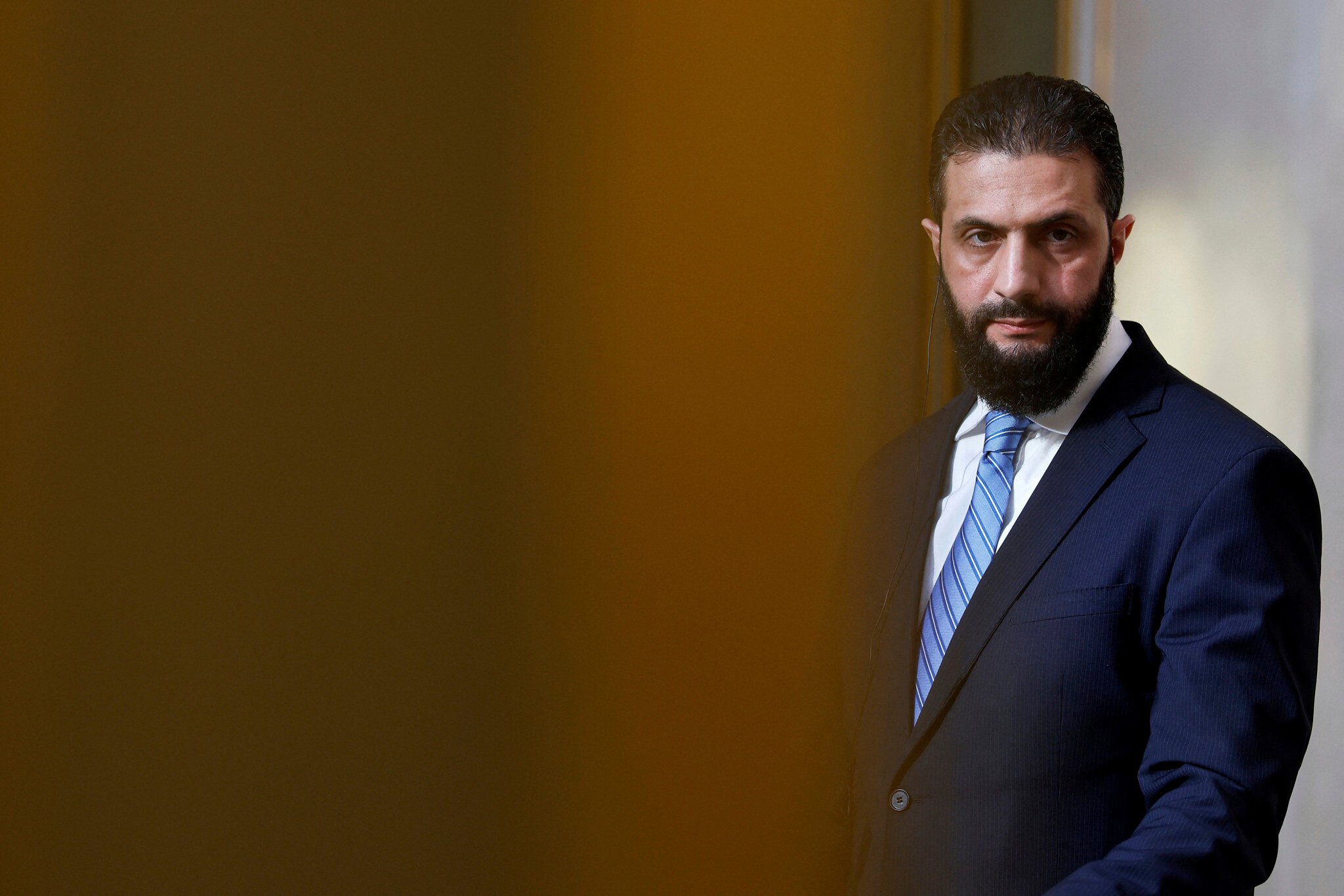
Syria's interim President Ahmad al-Sharaa listens during a joint press conference with French President Emmanuel Macron after a meeting at the Elysee Palace in Paris, May 7, 2025. (Stephanie Lecocq/Pool via AP)

DAMASCUS/WASHINGTON (Reuters) — A Trump Tower in Damascus, a detente with Israel and US access to Syria’s oil and gas are part of Syrian leader Ahmed al-Sharaa’s strategic pitch to try to get face time with US President Donald Trump during his trip to the Middle East, according to several sources familiar with the push to woo Washington.

Jonathan Bass, an American pro-Trump activist who on April 30 met Sharaa for four hours in Damascus, along with Syrian activists and Gulf Arab states has been trying to arrange a landmark — if highly unlikely — meeting between the two leaders this week on the sidelines of Trump’s visit to Saudi Arabia, Qatar and the United Arab Emirates.

Syria has struggled to implement conditions set out by Washington for relief from US sanctions, which keep the country cut off from the global financial system and make economic recovery extremely challenging after 14 years of grinding war.

Bass hopes that getting Trump into a room with Sharaa, who still remains a US-designated terrorist over his al-Qaeda past, could help soften the Republican president and his administration’s thinking on Damascus and cool an increasingly tense relationship between Syria and Israel.

Part of the bet for the effort is based on Trump’s history of breaking with longstanding US foreign policy taboos, such as when he met with North Korean leader Kim Jong Un in the demilitarized zone between North and South Korea in 2019.

“Sharaa wants a business deal for the future of his country,” Bass said, noting it could cover energy exploitation, cooperation against Iran and engagement with Israel.


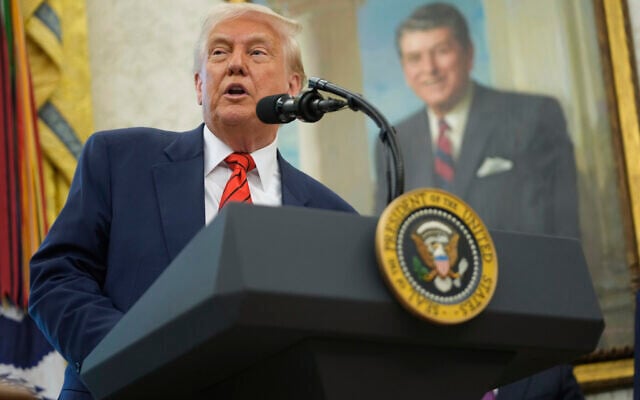
US President Donald Trump speaks before Steve Witkoff is sworn as special envoy in the Oval Office of the White House, May 6, 2025, in Washington. (AP/Mark Schiefelbein)

“He told me he wants a Trump Tower in Damascus. He wants peace with his neighbors. What he told me is good for the region, good for Israel,” said Bass.

Sharaa also shared what he saw as a personal connection with Trump: both have been shot at, narrowly surviving attempts on their lives, Bass said.

Syrian officials and a presidency media official did not respond to a request for comment.

Sharaa spoke with Saudi Arabia’s de facto ruler Crown Prince Mohammed bin Salman on Sunday, according to the Syrian presidency.

A person close to Sharaa said afterwards a Trump-Sharaa meeting remained possible in Saudi Arabia, but would not confirm whether Sharaa had received an invitation.

“Whether or not the meeting takes place won’t be known until the last moment,” the person said.
‘Push underway’

To be clear, a Trump-Sharaa meeting during the US president’s visit to the region is widely seen as unlikely, given Trump’s packed schedule, his priorities and lack of consensus within Trump’s team on how to tackle Syria.

A source familiar with ongoing efforts said a high-level Syria-US meeting was set to take place in the region during the week of Trump’s visit, but that it would not be between Trump and Sharaa.

“There is definitely a push underway,” said Charles Lister, head of the Syria Initiative at the Middle East Institute.

“The idea is that getting to Trump directly is the best avenue because there are just too many ideologues within the administration to get past.”

Washington is yet to formulate and articulate a coherent Syria policy, but the administration has increasingly been viewing relations with Damascus from a perspective of counterterrorism, three sources including a US official familiar with the policy-making said.

That approach was illustrated by the make-up of the US delegation in a meeting last month between Washington and Syrian Foreign Minister Asaad al-Shibani in New York, which included a senior counterterrorism official from the State Department, two of the sources said.

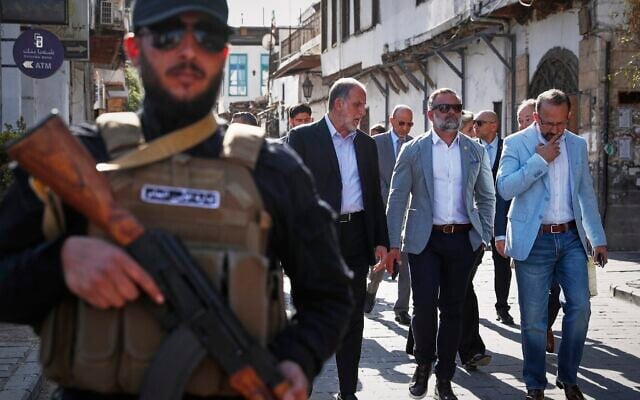
Accompanied by unidentified members of the delegation, US congressman Cory Mills (Republican of Florida), second from right, walks in the Old City of Damascus, April 18, 2025. Mills is in Damascus in an unofficial visit organized by a Syrian-American nonprofit, the first visit by US legislators since the fall of Syrian president Bashar al-Assad in December.(AP Photo/Omar Sanadiki)

US officials conveyed to Shibani that Washington found steps taken by Damascus to be insufficient, particularly on the US demand to remove foreign fighters from senior posts in the army and expel as many of them as possible, the sources said.

The US Treasury has since conveyed its own demands on the Syrian government, bringing the number of conditions to more than a dozen, one of the sources said.

The US State Department declined to disclose who attended the meeting from the US side and said it does not comment on private diplomatic discussions.

White House National Security Council spokesperson James Hewitt said the actions of Syria’s interim authorities would determine the future US support or possible sanctions relief.

‘Olive branch’

A key aim of Syria’s overtures to Washington is communicating that it poses no threat to Israel, which has escalated airstrikes in Syria since the country’s rebels-turned rulers ousted former strongman Bashar al-Assad last year.

Israel says the strikes were largely aimed at destroying Syria’s military and chemical arsenal to stop them falling into the hands of the new regime.

Israel’s ground forces have also occupied a buffer zone in southwestern Syria along the border, while the government has lobbied the US to keep Syria decentralized and isolated.

The IDF described its presence in southern Syria’s buffer zone as a temporary and defensive measure, though Defense Minister Israel Katz has said that troops will remain deployed to nine army posts in the area “indefinitely.”

Israel has also said it aims to protect Syrian minority groups. Sectarian violence in Syria has escalated in recent weeks, as Islamist supporters of the country’s new regime have targeted Druze communities in clashes in southern Syria. Reports have put the death toll from the fighting at around 100.


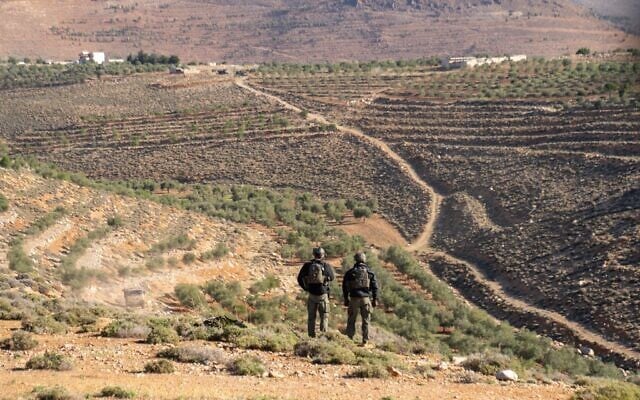
Troops of the 810th “Mountains” Regional Brigade operate in southern Syria, in a handout photo issued on May 5, 2025. (Israel Defense Forces)

Israel has vowed to protect the Syrian Druze community from threats, and the IDF has struck targets in the country as a “warning” to the new regime.

Syria’s government has condemned Israel’s strikes as escalatory and as foreign interference, and says the new government in Damascus is working to unify the country after 14 years of civil war.
Advertisement

Sharaa last week confirmed indirect negotiations with Israel aimed at calming tensions, after Reuters reported that such talks had occurred via the UAE.

In a separate effort, Bass said Sharaa told him to pass messages between Syria and Israel that may have led to a direct meeting between Israeli and Syrian officials.

But Israel soon resumed strikes, including one near the presidential palace, which it framed as a message to Syria’s rulers to protect the country’s Druze minority amid clashes with Sunni militants.

“Sharaa sent the Israelis an olive branch. Israel sent missiles,” Bass said.

“We need Trump to help sort this relationship out.”

Times of Israel staff contributed to this report.

Donald Trump plans to accept luxury 747 from Qatar to use as Air Force One

The luxury plane, which would be one of the most valuable gifts ever received by the U.S. government, would eventually be donated to Trump's presidential library after he leaves office

LIBRARY ON A PLANE, FILLED WITH ALL HIS OWN BOOKS

Reuters Published 12.05.25

U.S. President Donald Trump's administration intends to accept a Boeing 747-8 plane as a gift from the Qatari royal family that would be outfitted to serve as Air Force One, according to a source briefed on the matter.

The luxury plane, which would be one of the most valuable gifts ever received by the U.S. government, would eventually be donated to Trump's presidential library after he leaves office, the source said. A new commercial 747-8 costs approximately $400 million.

In a post on his social media site Truth Social late on Sunday, Trump appeared to confirm the proposal.

"So the fact that the Defense Department is getting a GIFT, FREE OF CHARGE, of a 747 aircraft to replace the 40 year old Air Force One, temporarily, in a very public and transparent transaction, so bothers the Crooked Democrats that they insist we pay, TOP DOLLAR, for the plane," he wrote.


The motorcade of U.S. President Donald Trump is parked next to a 12-year old Qatari-owned Boeing 747-8 that Trump was touring in West Palm Beach, Florida, U.S., February 15, 2025.Reuters

Democrats and good government advocates said it was unethical and likely unconstitutional for Qatar to make such a gift.

"Nothing says 'America First' like Air Force One, brought to you by Qatar," Senate Democratic Leader Chuck Schumer wrote on X. "It's not just bribery, it's premium foreign influence with extra legroom."

White House press secretary Karoline Leavitt said in a statement, "Any gift given by a foreign government is always accepted in full compliance with all applicable laws. President Trump's administration is committed to full transparency."

A Qatari spokesperson, Ali Al-Ansari, told the New York Times that the possible transfer of the aircraft was still under consideration and "no decision has been made," the newspaper reported.

ABC News was first to report the planned gift on Sunday.

Trump has expressed frustration at the delays in delivering two new 747-8 aircraft to serve as an updated Air Force One. During his first term, Trump had reached a deal with Boeing to deliver the jets in 2024. A U.S. Air Force official told Congress last week that Boeing had proposed finishing the planes by 2027.

Trump toured the Qatari-owned 747-8 in February when it was parked at Palm Beach International Airport in Florida, near his Mar-a-Lago resort. At the time, the White House said the president did so to get a better understanding of how the updated Air Force One planes would be configured.

In a statement, a spokesman for Citizens for Responsibility and Ethics, a good government organization based in Washington, questioned whether the transfer might violate the Constitution's ban on U.S. officials accepting gifts from foreign governments absent congressional approval.

"This sure looks like a foreign country that the president has personal business dealings in giving the president a $400 million gift right before he meets with their head of state," the spokesman, Jordan Libowitz, said.

Trump is set to visit Qatar during a trip to the Middle East this week. The airplane will not be presented or accepted while Trump is in Qatar.

ABC reported, citing sources, that lawyers for the White House counsel's office and the Department of Justice had prepared an analysis concluding that it would be legal and constitutional for the Defense Department to accept the plane as a gift and later transfer it to Trump's presidential library.

Trump ‘plans to accept’ $400,000,000 luxury plane gift from Qatar royal family

Craig Munro
Published May 12, 2025

Top left, the plane at Palm Beach airport and below, the interior (Pictures: Reuters/AFP/AMAC Aerospace)

Donald Trump is expected to accept one of the most generous foreign gifts ever offered to a US President – a $400 million jumbo jet.

Qatar’s royal family dangled the enormous ‘flying palace’ in front of the luxury-loving leader in Florida earlier this year, suggesting it could replace the aging Air Force One.

The aircraft would reportedly be donated to Trump’s presidential library after he completes his term in office, allowing him to make use of it in a personal capacity.

In a post on his Truth Social site, the president suggested the arrangement would be temporary and called Democrats ‘losers’ for criticising the move.

He wrote: ‘So the fact that the Defense Department is getting a GIFT, FREE OF CHARGE, of a 747 aircraft to replace the 40 year old Air Force One, temporarily, in a very public and transparent transaction, so bothers the Crooked Democrats that they insist we pay, TOP DOLLAR, for the plane.

‘Anybody can do that! The Dems are World Class Losers!!!’

But the donation has led to criticism beyond just Democrats, with influencer and die-hard Trump fan Laura Loomer writing she ‘would take a bullet’ for the president but he ‘cannot accept’ the plane.

She accused the Qataris of funding ‘Iranian proxies’ who have ‘murdered US Service Members’, and said acceptance would be ‘such a stain on the admin’.

ABC News reported the US Attorney General Pam Bondi and top White House lawyer David Warrington had concluded the deal would be ‘legally permissible’ as long as it is handed to the presidential library before the end of the president’s term.

Trump previously toured the plane when it visited Florida’s West Palm Beach International Airport near his Mar-a-Lago property in February.

A conference room inside the new plane (Picture: AMAC Aerospace)

A new Boeing 747-8, of the type being offered, would cost around $400 million.

The US Government has been seeking a replacement for Air Force One – actually two planes, though the designation is only given to the one carrying the president at a particular time – for more than 15 years.

They have been in use since George HW Bush’s administration in the early nineties, and the interiors were designed by former first lady Nancy Reagan.

By contrast, the interior of the new plan was designed by renowned French firm Alberto Pinto Cabinet.

It features staterooms, dining rooms and conference rooms with plush carpets and leather couches.

White House press secretary Karoline Leavitt said: ‘Any gift given by a foreign government is always accepted in full compliance with all applicable laws.’

She added: ‘President Trump’s Administration is committed to full transparency.’


TSMC: The Enduring Silicon Shield of Taiwan’s Economy

Written by Min-Hua Chiang.

Image credit: CHIPS-TSMC by 李 季霖/ Flickr, license: CC BY-SA 2.0.

Why did TSMC’s US$100 billion investment pledge in the US not remove Taiwan from President Trump’s plan for higher tariffs on foreign goods? Can Taiwan still use TSMC as leverage in future negotiations with the US for bilateral economic relations?

The immediate answer to the first question is that TSMC’s investment will not reduce the US trade deficit right away. It takes a few years before the chip plants can mass produce. In addition, semiconductors accounted for only 2.5% of America’s total imports in 2024, according to the Bureau of Economic Analysis. Given the chips’ small portion in the US total imports, even though TSMC’s investment might reduce America’s demand for foreign semiconductor chips, it will not shrink the overall US trade deficit noticeably.

As such, Taiwan’s economy will continue to face challenges from the US tariff threat in the near term, despite the investment commitment. Notably, Taiwan’s exports to the US could be severely harmed if the import levies were extended to information and communications technology (ICT) products, such as smartphones, computers, tablets, and so on. In the first quarter of 2025, over one-third of Taiwan’s exports were ICT goods, and around half of them went to the US, according to Taiwan’s Ministry of Finance.

Unlike the tariffs on ICT goods, President Trump’s tariff on semiconductor goods, if imposed, might not have a significant impact on Taiwan, as the US only accounted for 4% of Taiwan’s total exports of electronic components (including semiconductor chips) in the first quarter of 2025.  

However, Taiwan’s semiconductor exports could be impacted by the US’s extra import duties on final consumption goods manufactured in East Asia. Data from Taiwan’s Ministry of Finance reckons that in 2024, 52% of Taiwan’s electronic components were exported to China and Hong Kong, followed by 24% to Southeast Asian countries. Taiwan exported over 90% of its electronic components to all Asian countries. Those electronic components are mostly used for manufacturing final consumption goods in the region, which are later exported to the global market, particularly in the US.

Challenges from the new tariff policy are not for Taiwan alone, but for the entire global economy. Decades of investments from manufacturers around the world have built up the full global division of labour that provides the most production efficiency. Even if all trade barriers, non-trade barriers and tariffs between the US and Asian countries were eliminated, relocating manufacturing production back to the US would remain unappealing for businesses due to the significantly higher labour costs in America. Instead, freer trade would likely strengthen existing trade relationships based on each country’s comparative advantages. For example, with zero tariffs and trade barriers, firms would still favour Vietnam as a labour-intensive final assembly location whilst positioning the US as a key provider of chip design and innovation.

How the global economic structure will turn out in the end still relies on the outcome of tariff negotiations between the US and other countries. Despite the uncertainties, the benefits of TSMC’s investment in America still stand true so far. First and foremost, the investment will enable TSMC to capitalise on the “First-mover advantage” in the emerging AI industry in the US. Less than one month before the TSMC released its investment plan, OpenAI, SoftBank, and Oracle announced the largest AI infrastructure project in the US. Other tech giants, such as AppleMicrosoft, and Nvidia, have also committed to investing in the AI industry in the country. The chip plants in the US will facilitate TSMC’s advanced chip supply to the local customers in the AI industry.

Expanding chip fabrication in the US will help TSMC to develop an economy of scale, thus bringing down the overall production cost. Moreover, setting up an R&D centre in America will also help TSMC to advance its technology since the US has a much larger number of talents from all over the world in high-tech industries.

TSMC’s promising business prospect in the US, driven by the booming AI industry, will also benefit its largest shareholder—the Taiwanese government. The company’s annual report indicates that the Executive Yuan (6.38%) and Labour Pension Fund (1.31%) account for 7.69% of TSMC’s shares.

Greater investment in the US over the last few years has increased America’s importance in TSMC’s business. In the first quarter of 2025, 77% of the company’s net revenue is from North America, rising from 62% in 2018. The company’s global foundry market share also grew from 58% in Q2 2023 to 67% in Q4 2024, while the shares of other competitors diminished, according to the data from Counterpoint. The benefits from this investment extend beyond TSMC alone. The long-term positive impact on the American economy should be emphasised to the US government. For instance, TSMC’s investment in the US could create additional job opportunities in high-value-added manufacturing sectors—precisely what the country needs most. The fabrication of advanced chips might not only satisfy domestic demand but also boost America’s potential exports of chips and other high-tech goods to international markets, thereby helping to reduce the US trade deficit. Thanks to TSMC’s investment, the US is expected to hold 28% of the global advanced chip fabrication capacity by 2032from 0%  in 2022.

Even though the US will fabricate more advanced chips, more than 80% of TSMC’s advanced chips will still be fabricated in Taiwan in the next five years. Overall, Taiwan will still hold nearly 60% of global advanced chip fabrication by 2030. Therefore, the global reliance on made-in-Taiwan chips could continue to protect the island from China’s military invasion. On the one hand, the US might have to intervene in the military conflict in the Taiwan Strait due to the potential disruption of the global supply chain network and the impact on the world economy. On the other hand, China might restrain its military actions as the war with the island could sabotage its domestic economy, which also relies on chips made in Taiwan.

In the long term, the shrinking population on the island implies that there is a limit to how many advanced chips Taiwan can fabricate for the whole world. A small island like Taiwan will always need a larger business territory to sustain its domestic economy. For example, China’s abundant and cheap labour force and much larger export platform allowed Taiwanese firms to expand their global sales. Taiwan’s export-oriented economy also benefited from supplying key components and capital equipment to China for the final assembly. The US market today, the largest one in the world, will provide Taiwanese firms with new business opportunities if properly approached.

In sum, President Trump’s tariff policy will hurt TSMC only when manufacturers in East Asia can no longer afford to export final consumption goods to the US and thus reduce the industrial input from the company. If that is the case, the US economy will suffer from hyperinflation due to a severe shortage of supply. So far, the worst scenario has not happened yet. Instead, the policy has encouraged numerous countries, including Taiwan, to try to strike a new deal with America. TSMC is still Taiwan’s best chip in negotiating with the US. The question is how to properly place the company, the key player in the industry, on the global chessboard.

TSMC’s significant role in the global supply chain network should give Taiwan leverage. For example, its investment in America is likely to encourage both Taiwanese and foreign companies to follow suit. Therefore, the company will be key to kick-starting the global economic reshuffle and benefiting the US manufacturing revival as well as America’s national interests.

Min-Hua Chiang is a non-resident fellow at the Taiwan Research Hub, University of Nottingham.

This article was published as part of a special issue on ‘Trump’s Tariffs: What does it mean for Taiwan?‘.