Greenland blues to Delhi red carpet: EU finds solace in India
By AFP
Umberto BACCHI
Presiding over the signing of a major trade deal alongside Indian Prime Minister Narendra Modi on Tuesday, EU chief Ursula von der Leyen broke into a large smile.
A diplomatic and economic coup, the EU-India pact comes as a welcome piece of good news for Brussels after a tumultuous few weeks dominated by US threats over Greenland.
Addressing a press conference in New Delhi, von der Leyen described it as a tale of “two giants who choose partnership” and “the best answer to global challenges”.
In spite of its eye-tickling pollution, the Indian capital must have felt like a breath of fresh air for von der Leyen and European Council president Antonio Costa, who co-led the EU delegation.
As they flew away from Brussels over the weekend, the pair left behind a just-defused crisis in transatlantic relations and internal squabbling over another trade deal with South American nations.
In New Delhi, authorities rolled out the red carpet for the pair, who were feted as guests of honour at India’s Republic Day parade.
Posters emblazoned with their faces adorned lampposts across the city.
Costa, whose family hails from Goa, proudly flashed his Indian identity card at a press conference where Modi celebrated him as “the Gandhi of Lisbon”.
Meanwhile local media praised von der Leyen’s burgundy and gold brocade outfit — a nod to Indian fashion.
It was a far cry from the scorn and threats reserved for Europe by its traditional ally the United States at the World Economic Forum in Davos last week.
European officials had been hoping to make progress on Ukraine at the Swiss ski resort — a goal drowned out by US President Donald Trump’s push to wrest control of Greenland from EU member Denmark.
– ‘Difficult job’ –
Trump made an about-turn after talks with NATO chief Mark Rutte — a change of heart EU officials were keen to credit to Europe’s firm response — and the climbdown took the sting out of an emergency summit called on the Greenland issue.
One year into Trump’s second term, Costa said the European Union has “learned how to manage” the ups and downs, and not to “react to each message”.
“We need to keep calm and continue to have a polite, respectful relationship,” the council chief told AFP. “At the same time, we need to diversify our relationships”.
But few in Europe believe the Greenland crisis was a one-off bump in the road, with the unpredictable US leader at the helm.
Maros Sefcovic, the EU’s trade chief, told AFP he scours through newspaper headlines each morning in anticipation of “what else might happen”.
“It’s indeed a difficult job,” he quipped.
Yet he said the same was true for most other countries, which in turn found renewed appeal in what Europe has to offer: partnership, predictability and stability.
India, for one, was left bruised by tariffs slapped on it by the White House over its purchase of Russian oil as New Delhi and Washington were negotiating a — so-far-elusive — trade deal.
“The last year has turbocharged the European trade policy,” Sefcovic said.
Pushing to reduce its dependencies on the United States and China and lower the cost of US tariffs, the EU was negotiating or looking to open talks with an array of nations including the Philippines, Malaysia, the United Arab Emirates and Australia, he said.
– ‘New opportunities’ –
By cutting or eliminating tariffs on almost 97 percent of European exports, the deal struck in New Delhi will help ease access to India’s 1.4-billion-people-strong market for cars, wine, pasta and other EU products.
But the signing also allowed Brussels to turn the page after a just-sealed pact with South American bloc Mercosur was cast into limbo by a legal challenge in the European parliament.
That setback added to rancorous divisions among member states over the deal’s impact on European farmers, who remained deaf to the EU’s arguments and staged months of tractor-mounted protests against the accord.
European officials hope the new India deal will also help bring the South Asian giant diplomatically closer to Europe.
Neutral on Ukraine, New Delhi has relied on Moscow for key military hardware for decades, but has tried to cut its dependence by diversifying imports and pushing its own domestic manufacturing base.
Modi said a security partnership struck alongside the trade deal would provide “new opportunities” for defence companies.
While denying a pivot away from Russia, foreign secretary Vikram Misri said India was interested in hosting the joint production of European military kit.
Monday’s Republic Day parade featured Russian helicopters and planes, alongside dancers and motorcycle daredevils.
But, in perhaps a hint of things to come, it ended with a squad of French-made Rafale fighter jets zooming overhead.
By AFP
January 27, 2026

EU chiefs Ursula von der Leyen (R) and Antonio Costa were given a red-carpet welcome by Indian Prime Minister Narendra Modi for the signing of a massive trade deal - Copyright AFP SAUL LOEB
EU chiefs Ursula von der Leyen (R) and Antonio Costa were given a red-carpet welcome by Indian Prime Minister Narendra Modi for the signing of a massive trade deal - Copyright AFP SAUL LOEB
Umberto BACCHI
Presiding over the signing of a major trade deal alongside Indian Prime Minister Narendra Modi on Tuesday, EU chief Ursula von der Leyen broke into a large smile.
A diplomatic and economic coup, the EU-India pact comes as a welcome piece of good news for Brussels after a tumultuous few weeks dominated by US threats over Greenland.
Addressing a press conference in New Delhi, von der Leyen described it as a tale of “two giants who choose partnership” and “the best answer to global challenges”.
In spite of its eye-tickling pollution, the Indian capital must have felt like a breath of fresh air for von der Leyen and European Council president Antonio Costa, who co-led the EU delegation.
As they flew away from Brussels over the weekend, the pair left behind a just-defused crisis in transatlantic relations and internal squabbling over another trade deal with South American nations.
In New Delhi, authorities rolled out the red carpet for the pair, who were feted as guests of honour at India’s Republic Day parade.
Posters emblazoned with their faces adorned lampposts across the city.
Costa, whose family hails from Goa, proudly flashed his Indian identity card at a press conference where Modi celebrated him as “the Gandhi of Lisbon”.
Meanwhile local media praised von der Leyen’s burgundy and gold brocade outfit — a nod to Indian fashion.
It was a far cry from the scorn and threats reserved for Europe by its traditional ally the United States at the World Economic Forum in Davos last week.
European officials had been hoping to make progress on Ukraine at the Swiss ski resort — a goal drowned out by US President Donald Trump’s push to wrest control of Greenland from EU member Denmark.
– ‘Difficult job’ –
Trump made an about-turn after talks with NATO chief Mark Rutte — a change of heart EU officials were keen to credit to Europe’s firm response — and the climbdown took the sting out of an emergency summit called on the Greenland issue.
One year into Trump’s second term, Costa said the European Union has “learned how to manage” the ups and downs, and not to “react to each message”.
“We need to keep calm and continue to have a polite, respectful relationship,” the council chief told AFP. “At the same time, we need to diversify our relationships”.
But few in Europe believe the Greenland crisis was a one-off bump in the road, with the unpredictable US leader at the helm.
Maros Sefcovic, the EU’s trade chief, told AFP he scours through newspaper headlines each morning in anticipation of “what else might happen”.
“It’s indeed a difficult job,” he quipped.
Yet he said the same was true for most other countries, which in turn found renewed appeal in what Europe has to offer: partnership, predictability and stability.
India, for one, was left bruised by tariffs slapped on it by the White House over its purchase of Russian oil as New Delhi and Washington were negotiating a — so-far-elusive — trade deal.
“The last year has turbocharged the European trade policy,” Sefcovic said.
Pushing to reduce its dependencies on the United States and China and lower the cost of US tariffs, the EU was negotiating or looking to open talks with an array of nations including the Philippines, Malaysia, the United Arab Emirates and Australia, he said.
– ‘New opportunities’ –
By cutting or eliminating tariffs on almost 97 percent of European exports, the deal struck in New Delhi will help ease access to India’s 1.4-billion-people-strong market for cars, wine, pasta and other EU products.
But the signing also allowed Brussels to turn the page after a just-sealed pact with South American bloc Mercosur was cast into limbo by a legal challenge in the European parliament.
That setback added to rancorous divisions among member states over the deal’s impact on European farmers, who remained deaf to the EU’s arguments and staged months of tractor-mounted protests against the accord.
European officials hope the new India deal will also help bring the South Asian giant diplomatically closer to Europe.
Neutral on Ukraine, New Delhi has relied on Moscow for key military hardware for decades, but has tried to cut its dependence by diversifying imports and pushing its own domestic manufacturing base.
Modi said a security partnership struck alongside the trade deal would provide “new opportunities” for defence companies.
While denying a pivot away from Russia, foreign secretary Vikram Misri said India was interested in hosting the joint production of European military kit.
Monday’s Republic Day parade featured Russian helicopters and planes, alongside dancers and motorcycle daredevils.
But, in perhaps a hint of things to come, it ended with a squad of French-made Rafale fighter jets zooming overhead.
Greenland, Trump and the Fracturing of the Atlantic Alliance
Manoj Joshi
26 Jan 2026
THE WIRE
The message is unmistakable: this may be only the first stage in the unravelling of the Europe-US alliance.
26 Jan 2026
THE WIRE
The message is unmistakable: this may be only the first stage in the unravelling of the Europe-US alliance.
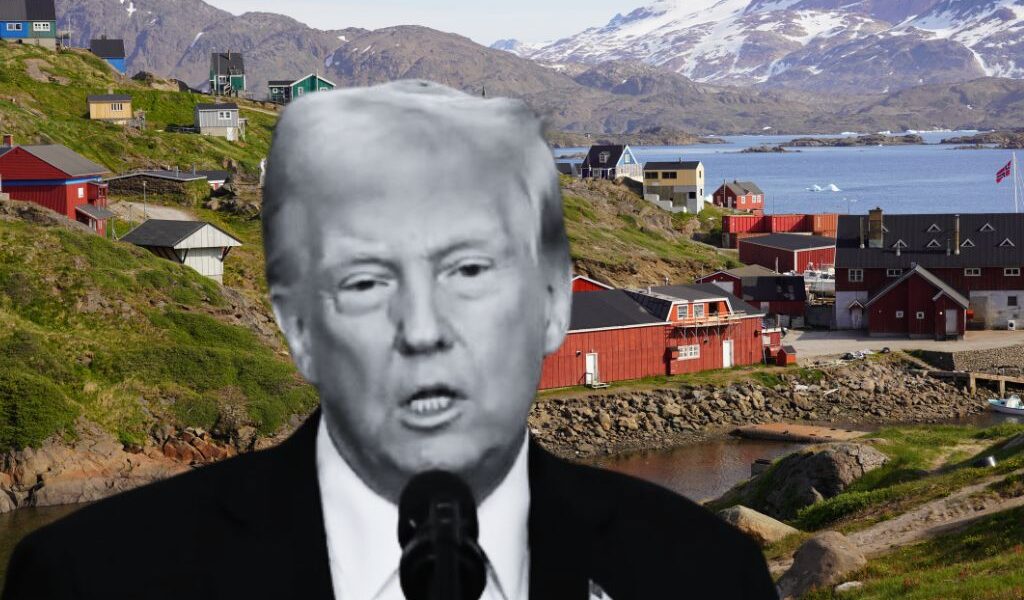
Donald Trump in the foreground. In the background is Sermiligaaq in Greenland. Photos: Video screengrab and CC BY-SA 2.0/Wikipedia.
Ostensibly, Trump’s Greenland saga is about his capricious nature. His desire to own Greenland, some say, arises from a wish to rival Jefferson’s Louisiana Purchase of 1803 and from resentment at being overlooked for the Nobel Peace Prize. Others argue he is a neo-imperialist seeking to acquire natural resources. In his own words, his whims are constrained only by his “own morality.”
Trump first expressed a desire to buy Greenland in 2019, during his first term. The island has been part of Denmark for 300 years, and both the Danes and Greenlanders rejected the offer. In 2024, the US Department of Defense issued its Arctic Strategy, describing the region as part of the global “pacing challenge of the People’s Republic of China,” while adopting a “monitor and respond” approach. In June 2025, Trump transferred responsibility for Greenland from US European Command to Northern Command and integrated it into homeland defence.
Last week, the drama over Greenland played out in Davos, the annual meeting of the global business and political elite. The event was effectively hijacked by Donald Trump, who made a forceful plea for the acquisition of Greenland and raised tariffs on America’s European trading partners and military allies for resisting his demands. Davos became a venue for slights, threats and snubs. Trump later walked back his threats, withdrew the tariffs, and claimed that the US had worked out “a framework for a future deal” with Denmark.
Greenland’s emergence as a geopolitical issue is a direct result of climate change. The steadily declining Arctic ice cap is expected to lose all its summer ice over the next decade, while winter ice will become thinner. This will make Arctic seas more navigable, intensifying geopolitical and geoeconomic tensions. Greenland itself has been losing around 280 billion tonnes of ice as its ice sheet breaks up.

In 1996, eight countries established the Arctic Council, an intergovernmental forum with a secretariat in Norway, to promote cooperation, coordination and interaction among Arctic states: Canada, Denmark, Finland, Iceland, Norway, Russia, Sweden and the United States. Thirty-eight non-Arctic states, including India, China and Germany, hold observer status. Yet in the recent controversies, little has been said either about the Council or by it.
What is remarkable is that the tensions have not arisen between the US and its putative rivals, China and Russia, but between Washington and its Atlantic allies. The crisis has been building for some time, with the EU championing the “rule of international law,” sovereignty and the UN system, while the US has sought primacy – or, more bluntly, domination and hegemony. As Canadian Prime Minister Mark Carney put it, the American attitude has led to “a rupture, not a transition.”
Golden Dome
Only when you look down on a globe focused on the North Pole do you fully grasp the region’s strategic salience. Canada and Russia flank the Arctic on two sides, with Norway alongside them; in between lie Iceland and Greenland. Since the missile age and the Cold War, this has been seen as the shortest route for Russian and American missiles aimed at each other. For this reason, Canada hosted the American DEW early-warning system. It is also why Trump considers Greenland strategically important.
In a hypothetical war, Greenland would lie squarely in the flight path of missiles travelling between Russia, China and the United States. Trump argues that Greenland would be vital to his proposed “Golden Dome” missile defence scheme, which he claims will be operational by 2029. “Because of the Golden Dome, and modern-day weapons systems, both offensive and defensive, the need to ACQUIRE is especially important,” Trump said in a Truth Social post on January 22.
The US already operates the only base in the region, at Pituffik, established in 1951. Given its location, its radar can look deep into Russia and detect missile launches early, enabling the Golden Dome to respond. Trump has insisted that the US needs ownership of Greenland because, “psychologically, who the hell wants to defend a licence agreement or a lease.” The logic is questionable, since US bases are spread across Europe; the same argument could be applied to them. There are similar radars in the UK – would the US then want to “acquire” Britain?
Pituffik matters today, but tomorrow the US will rely increasingly on space-based sensors to detect missile launches. Greenland could still be useful for stationing interceptor missiles, and Trump argues that the “highly complex system” could only work “if this land is included in it.” Yet there are no restrictions on the US expanding its facilities in Greenland, and Denmark is a NATO member.
Shipping
Shipping traffic from the Bering Strait currently uses the Northern Sea Route, which stays close to Russia’s Exclusive Economic Zone. However, it has yet to reach its full potential, as it passes through seas with limited port infrastructure and narrow straits that restrict ship size.
Thinning ice opens the possibility of a second Transpolar Route through the middle of the Arctic and a third, the Northwest Passage, hugging the Canadian coastline and weaving through some 36,000 islands. These routes could reduce shipping distance and time by as much as 50% compared to existing routes. The Northwest Passage remains unreliable because of the unpredictable annual distribution of sea ice, though it has seven alternative passages, some of which pose no constraints on ship size.
The Transpolar Route has yet to open and remains largely blocked by ice; even when it does open, it will require icebreakers to escort vessels. Still, this could become a reality within 50 years, offering the shortest route through the Arctic.
The Northern Sea Route has seen cargo volumes grow by about 540% since 1980, while ship traffic in Canada’s Northwest Passage has increased by 72.5%.
Strategic minerals
Greenland is believed to sit atop large reserves of oil and natural gas, though there is no commercial extraction yet. It also hosts significant deposits of graphite, terbium, neodymium, dysprosium, niobium and titanium. Trump has pointed to these mineral resources, though in Davos he claimed he was not interested in minerals for which “you have to go 25 ft down through the ice to get it.”
In reality, there are no restrictions on companies seeking to exploit Greenland’s minerals, and the island is open to US investment.
In 2022, under President Joe Biden, the US established the Minerals Security Partnership with a coalition of 14 countries to build and finance strategic mineral supply chains. This includes India, Australia, Nordic countries such as Finland, Norway and Sweden, as well as the European Commission.
China
The Polar Silk Road is an extension of China’s Belt and Road Initiative into the Arctic, focusing on new shipping routes and access to strategic minerals. Given its location, China would be a major beneficiary of shorter routes between Asia and Europe through the Arctic, consistent with the BRI’s strategy of creating multiple land and sea corridors across Eurasia to guard against disruption.
The initiative was announced in 2018 in China’s first Arctic policy white paper, in which Beijing described itself as a “near-Arctic state” with an interest in the region’s development. China’s northernmost point lies about 1,400 km from the Arctic Circle. Beijing has invested in the Yamal LNG facility in Sabetta, Russia; established the Yellow River research station in Svalbard in 2004; and deployed five icebreakers to study Arctic conditions. It has also begun exploring beneath the sea ice. Last year, a 98-day mission using crewed submersibles completed 43 dives to depths of 5,277 metres.
China hopes eventually to become a member of the Arctic Council, where it currently has observer status. The US Department of Defense insists that China is not an Arctic state and identifies it as the “main challenge to US interests in the region.” From Beijing’s perspective, however, the goal is not sovereignty over Arctic territory but strategic access. Despite its efforts, China has so far failed to establish a foothold in Greenland.
Conclusion
As the dust settles from the Davos eruption, it is clear that a genuine rupture has opened between the US and its allies. In mid-January, as Trump’s threats escalated, several European NATO states – including France, Germany, Sweden and Denmark – sent military personnel for a joint exercise to demonstrate readiness to defend the island. This only enraged Trump, who announced additional tariffs on the participating countries, later withdrawing them.
The message is unmistakable: this may be only the first stage in the unravelling of the Europe-US alliance. Europe must now move quickly to strengthen its self-defence capacity. This lies at the heart of its dilemma. Its greatest weaknesses are the lack of military integration and the financial burden of supporting Ukraine in its war with Russia. As a first step, instead of a token force, Europeans should establish a permanent military presence in Greenland, rather than relying solely on Article V of the NATO treaty.
The writer is a Distinguished Fellow, Observer Research Foundation, New Delhi.
This piece was first published on The India Cable – a premium newsletter from The Wire – and has been updated and republished here.

No comments:
Post a Comment