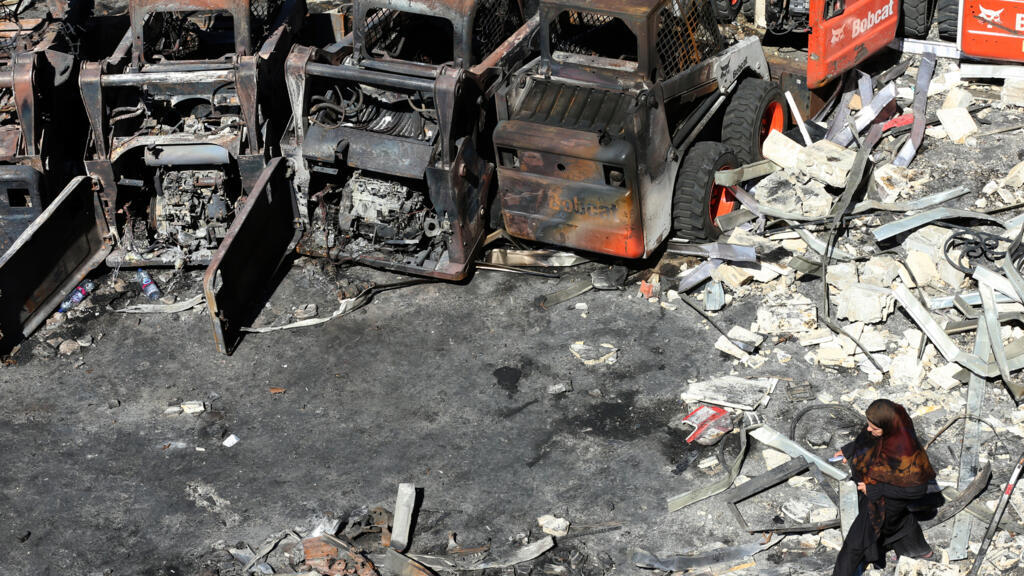
Dozens of masked Israeli settlers attacked two Palestinian villages in the occupied West Bank on Tuesday, torching vehicles and property before clashing with Israeli soldiers sent to stop the violence. These are among the latest surge of settler assaults that have intensified during the Gaza war.
Issued on: 12/11/2025
By: FRANCE 24
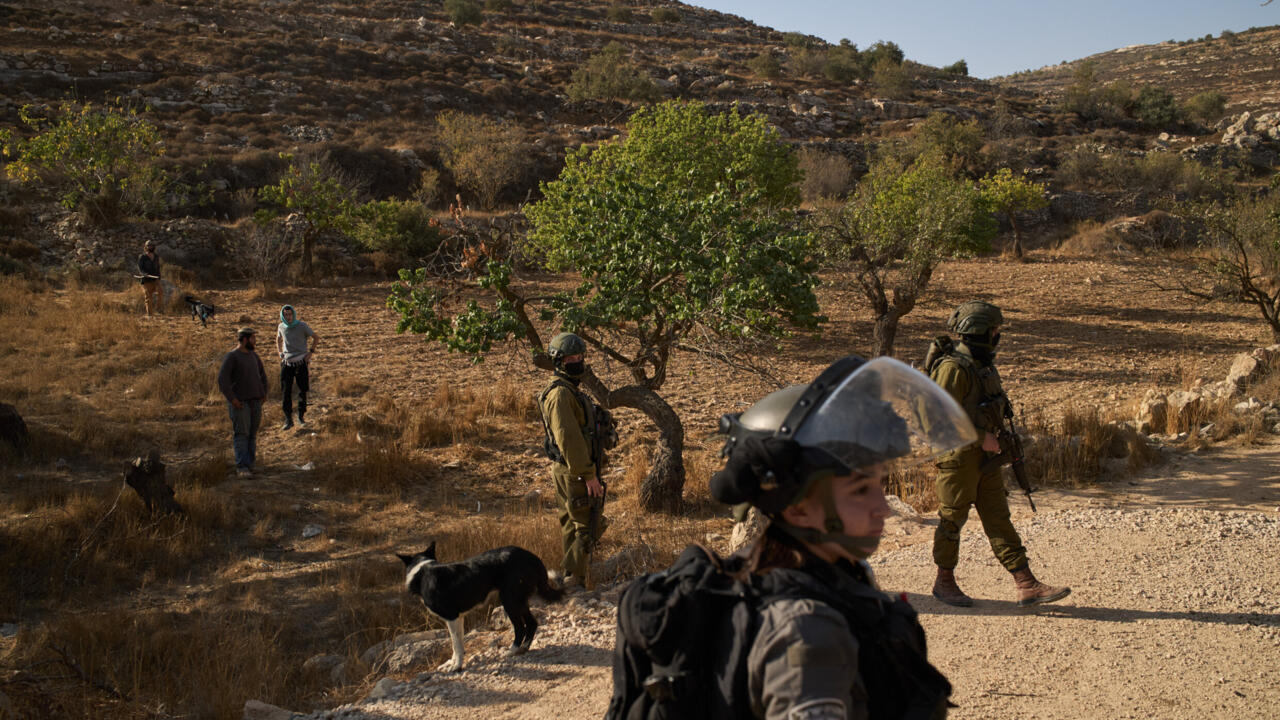
Israeli security forces block Palestinians from accessing an area for harvesting olives in the West Bank village of Sa'ir near Hebron on October 23, 2025, as Israeli settlers stand in the background. © Leo Correa, AP
Dozens of masked Israeli settlers attacked a pair of Palestinian villages in the occupied West Bank on Tuesday, setting fire to vehicles and other property before clashing with Israeli soldiers sent to halt the rampage, Israeli and Palestinian officials said.
It was the latest in a series of attacks by young settlers in the West Bank.
Israeli police said four Israelis were arrested in what it described as “extremist violence", while the Israeli military said four Palestinians were wounded. Police and Israel’s Shin Bet internal security agency said they were investigating.
Videos on social media showed two charred trucks engulfed in flames, with a nearby building on fire. Settler violence has surged since the war in Gaza erupted two years ago – and has intensified in recent weeks as Palestinians harvest their olive trees in an annual ritual.
Earlier on Tuesday, tens of thousands of Israelis attended the funeral of an Israeli soldier whose remains had been held in Gaza for 11 years, overflowing and blocking surrounding streets as somber crowds stood with Israeli flags.
The burial of Lt. Hadar Goldin was a moment of closure for his family, which had travelled the world in a public campaign seeking his return. The huge turnout also reflected the significance for the broader public in Israel, where Goldin became a household name.
Hamas returned his remains on Sunday as part of the US-brokered ceasefire deal that began last month. The bodies of four hostages taken in the Hamas-led attack on Israel on October 7, 2023, are still in Gaza.
Dozens of masked Israeli settlers attacked a pair of Palestinian villages in the occupied West Bank on Tuesday, setting fire to vehicles and other property before clashing with Israeli soldiers sent to halt the rampage, Israeli and Palestinian officials said.
It was the latest in a series of attacks by young settlers in the West Bank.
Israeli police said four Israelis were arrested in what it described as “extremist violence", while the Israeli military said four Palestinians were wounded. Police and Israel’s Shin Bet internal security agency said they were investigating.
Videos on social media showed two charred trucks engulfed in flames, with a nearby building on fire. Settler violence has surged since the war in Gaza erupted two years ago – and has intensified in recent weeks as Palestinians harvest their olive trees in an annual ritual.
Earlier on Tuesday, tens of thousands of Israelis attended the funeral of an Israeli soldier whose remains had been held in Gaza for 11 years, overflowing and blocking surrounding streets as somber crowds stood with Israeli flags.
The burial of Lt. Hadar Goldin was a moment of closure for his family, which had travelled the world in a public campaign seeking his return. The huge turnout also reflected the significance for the broader public in Israel, where Goldin became a household name.
Hamas returned his remains on Sunday as part of the US-brokered ceasefire deal that began last month. The bodies of four hostages taken in the Hamas-led attack on Israel on October 7, 2023, are still in Gaza.
The UN humanitarian office last week reported more Israeli settler attacks on Palestinians in the West Bank in October than in any other month since it began keeping records in 2006 – over 260 incidents in total.
Palestinians and human rights groups accuse the Israeli army and police of failing to halt attacks by settlers. Israel’s government is dominated by West Bank settlers, and the police force is overseen by Cabinet Minister Itamar Ben-Gvir, a hardline settler leader.
In Tuesday’s incident, the army said soldiers initially responded to settler attacks in the villages of Beit Lid and Deir Sharaf. It said the settlers fled to a nearby industrial zone and attacked soldiers sent to the scene, damaging a military vehicle.
Palestinian official Muayyad Shaaban, who heads the government’s Commission against the Wall and Settlements, said the settlers set fire to four dairy trucks, farmland, tin shacks, and tents belonging to a Bedouin community.
He said the attacks were part of a campaign to drive Palestinians from their land and accused Israel of giving the settlers protection and immunity. He called for sanctions against groups that “sponsor and support the colonial settlement terrorism project.”
French President Emmanuel Macron denounced the attacks during his meeting with Palestinian President Mahmoud Abbas in Paris on Tuesday, saying that “settler violence and the acceleration of settlement projects are reaching new heights, threatening the stability of the West Bank".
Displaced Palestinians in central Gaza said they continue to rely heavily on charity kitchens for their only daily meal, as soaring market prices and the lack of income leave them struggling.
Scores of people, most of them children, lined up with empty pots at a charity kitchen in Nuseirat refugee camp on Tuesday waiting to be served rice – the only food available that day.
“The rockets and planes stopped, but increasing living costs have been the hardest weapon used against us,” said Mohamed al-Naqlah, a displaced Palestinian.
On Tuesday, Gaza’s Health Ministry said the number of Palestinians killed in Gaza has risen to 69,182. Its count, generally considered by independent experts as reliable, does not distinguish between militants and civilians, but the ministry says more than half of those killed were women and children.
The latest war began with the 2023 Hamas-led attack on Israel, when around 1,200 people – mostly civilians – were killed, and 251 people were kidnapped.
Cabinet Minister Ron Dermer, one of Prime Minister Benjamin Netanyahu’s closest confidants, announced his resignation on Tuesday, citing family reasons.
In a letter, Dermer said he had promised his family to serve two years but extended his term by an additional year to deal with Iran’s nuclear programme and “to end the war in Gaza on Israel’s terms and bring our hostages home".
The US-born Dermer is a former Israeli ambassador to Washington. As strategic affairs minister, he served as Netanyahu’s envoy throughout the war in dealings with the United States and ceasefire negotiations.
Goldin was 23 when he was killed two hours after a ceasefire took effect in the 2014 war between Israel and Hamas. For years before the 2023 attack, posters with the faces of Goldin and Oron Shaul – another soldier whose body was abducted in the 2014 war – were displayed at intersections across Israel.
Israel’s military long ago determined that Goldin had been killed based on evidence found in the tunnel where his body was taken, including a blood-soaked shirt and prayer fringes. On Tuesday, it announced it had dismantled the tunnel shaft where his body was found. The military retrieved Shaul’s body in January.
Eulogies from Goldin’s siblings, parents, and former fiancée at his funeral never mentioned Netanyahu, who was prime minister when Goldin was kidnapped and for most of the years since. They thanked the Israeli military, including reserve soldiers, who tirelessly searched for Goldin’s body over the years.
Netanyahu did not attend the funeral, though Israel’s military chief of staff, Lt. Gen. Eyal Zamir, gave a eulogy on behalf of the military.
For years, Israel had four hostages in Gaza: Goldin, Shaul, and two Israelis with mental health conditions who had crossed into Gaza on their own and were held since 2014 and 2015. All four were returned in the past year.
(FRANCE 24 with AP)
Macron warns Israel over West Bank annexation during Abbas Paris visit
French President Emmanuel Macron warned on Tuesday that any Israeli plans for annexation in the West Bank would constitute a “red line” and would provoke a European reaction. He spoke as Palestinian President Mahmoud Abbas visited Paris, one month into a fragile truce between Hamas and Israel, following two years of conflict triggered by the militant group’s attack on Israel on 7 October 2023.
Issued on: 12/11/2025 - RFI

French President Emmanuel Macron receives Palestinian Authority leader Mahmud Abbas in the Elysée Palace in Paris, 11 November 2025. © Y. SAFRONOV, RFI
Abbas, 89, is the longtime head of the Palestinian Authority, which exercises limited control over parts of the Israeli-occupied West Bank, and is being considered to possibly assume governance in Gaza under the deal.
Macron, whose country in September recognised a Palestinian state, warned against any Israeli plans for annexation in the West Bank following an uptick in violence in the Palestinian territory.
"Plans for partial or total annexation, whether legal or de facto, constitute a red line to which we will respond strongly with our European partners," Macron said at a joint press conference with Abbas.
"The violence of the settlers and the acceleration of settlement projects are reaching new heights, threatening the stability of the West Bank and constitute violations of international law," the French president said.

Abbas, 89, is the longtime head of the Palestinian Authority, which exercises limited control over parts of the Israeli-occupied West Bank, and is being considered to possibly assume governance in Gaza under the deal.
Macron, whose country in September recognised a Palestinian state, warned against any Israeli plans for annexation in the West Bank following an uptick in violence in the Palestinian territory.
"Plans for partial or total annexation, whether legal or de facto, constitute a red line to which we will respond strongly with our European partners," Macron said at a joint press conference with Abbas.
"The violence of the settlers and the acceleration of settlement projects are reaching new heights, threatening the stability of the West Bank and constitute violations of international law," the French president said.
An Israeli settler enters a house at the entrance of the Palestinian market in the old city of Hebron, which was reportedly confiscated the previous night by settlers, on September 3, 2025, in the divided city of Hebron in the occupied West Bank. Far-right Israeli ministers have in recent months openly called for Israel's annexation of the West Bank. Violence in the Palestinian territory has soared since the October 7, 2023 Hamas attack on Israel that triggered the Gaza war. AFP - HAZEM BADER
Violence in the West Bank has soared since the war in Gaza broke out in October 2023.
At least 1,002 Palestinians, including militants, have been killed in the West Bank by Israeli forces or settlers since the start of the war in Gaza, according to the Palestinian health ministry.
During the same period, 43 Israelis, including soldiers, have been killed in Palestinian attacks in the West Bank, according to official Israeli figures.
Constitutional committee
Following their meeting to discuss the next steps after the Gaza ceasefire, Macron and Abbas announced the creation of a joint committee "for the consolidation of the state of Palestine", the French leader said.
It "will contribute to the drafting of a new constitution, a draft of which President Abbas presented to me".
Abbas renewed his commitment to "reforms", including "holding presidential and parliamentary elections after the end of the war".
Violence in the West Bank has soared since the war in Gaza broke out in October 2023.
At least 1,002 Palestinians, including militants, have been killed in the West Bank by Israeli forces or settlers since the start of the war in Gaza, according to the Palestinian health ministry.
During the same period, 43 Israelis, including soldiers, have been killed in Palestinian attacks in the West Bank, according to official Israeli figures.
Constitutional committee
Following their meeting to discuss the next steps after the Gaza ceasefire, Macron and Abbas announced the creation of a joint committee "for the consolidation of the state of Palestine", the French leader said.
It "will contribute to the drafting of a new constitution, a draft of which President Abbas presented to me".
Abbas renewed his commitment to "reforms", including "holding presidential and parliamentary elections after the end of the war".
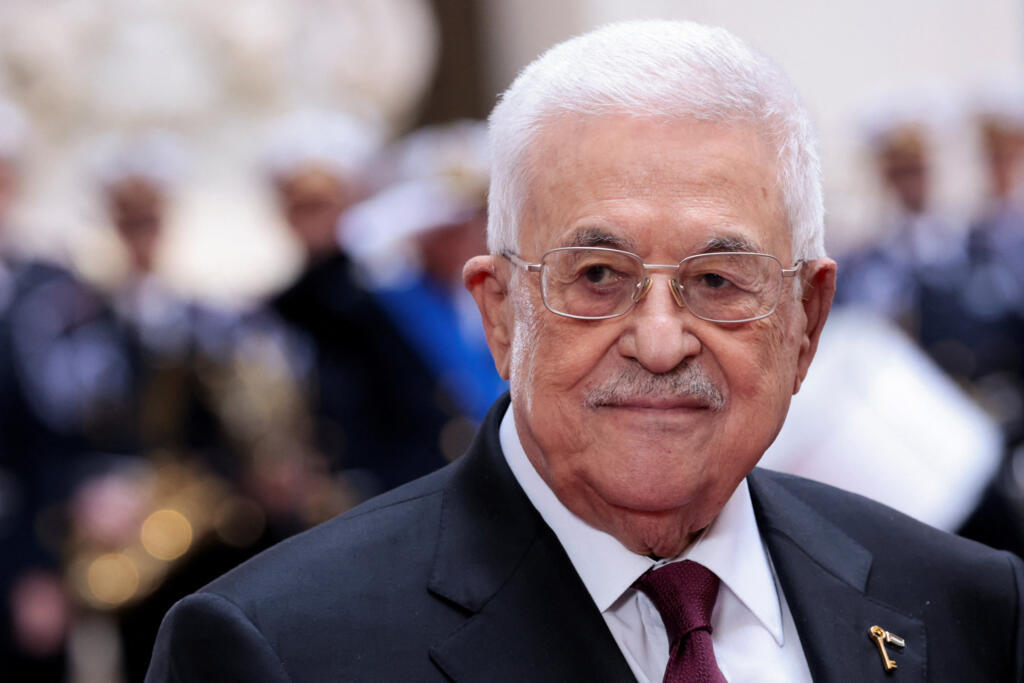
Palestinian Authority President Mahmoud Abbas and Italian Prime Minister Giorgia Meloni (not pictured) meet at Chigi Palace, in Rome, Italy, November 7, 2025. © Remo Casilli / Reuters
"We are nearing completion of a draft of the provisional constitution of the state of Palestine and the laws on elections and political parties," he added.
(With newswires)
"We are nearing completion of a draft of the provisional constitution of the state of Palestine and the laws on elections and political parties," he added.
(With newswires)
Macron Warns Israel Against West Bank Annexation
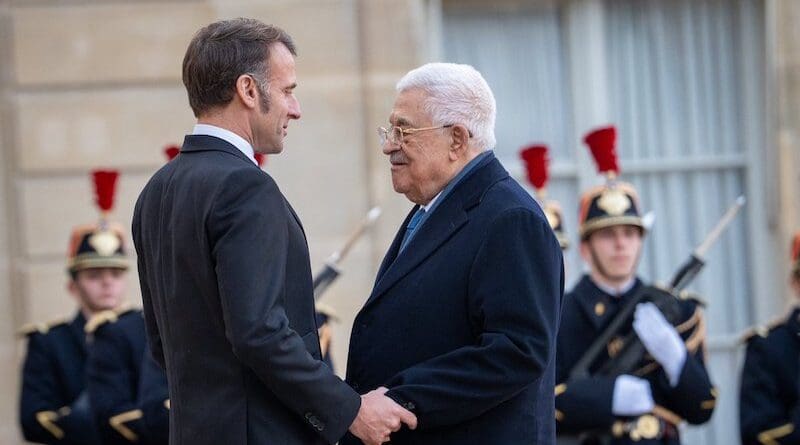
France's President Emmanuel Macron with Palestinian
Al Bawaba News
Al Bawaba provides top stories and breaking news about the Middle East and the world. The Al Bawaba network consists of several web portals and media platforms.
France's President Emmanuel Macron with Palestinian
President Mahmoud Abbas.
Photo Credit: @EmmanuelMacron, X
November 12, 2025
November 12, 2025
By Mansour Al-Maswari
(Al Bawaba) — French President Emmanuel Macron on Tuesday warned that any Israeli annexation of occupied West Bank territories, whether “partial, total, or de facto” through settlement expansion, would cross a “red line,” vowing a “forceful” European response if such plans advance.
Speaking at a joint press conference with Palestinian President Mahmoud Abbas at the Élysée Palace, Macron condemned what he described as “unprecedented levels” of settler violence and construction in the West Bank, saying they “threaten regional stability and violate international law.”
Macron hosted Abbas in Paris to discuss the implementation of a French-backed peace initiative following the Gaza ceasefire agreement reached on October 10, 2025, under U.S. President Donald Trump’s mediation.
The Élysée said the talks aimed to outline “security, governance, and reconstruction steps” for Gaza’s post-war phase, in coordination with Arab and international partners.
France officially recognized the State of Palestine in September during the UN General Assembly in New York, a move Macron framed as part of a broader European push to revive the two-state solution.
During their meeting, the two leaders announced the creation of a joint French-Palestinian committee to draft a constitution for the nascent state.
Abbas, for his part, reaffirmed his commitment to “reform the Palestinian Authority” and to hold long-delayed presidential and parliamentary elections “as soon as possible.”
Macron added that these elections are expected to take place “within a year after the transition to the second phase of the Gaza ceasefire,” which includes Hamas’s disarmament.
The French president’s remarks come as Washington prepares to submit a UN Security Council resolution endorsing Trump’s plan for Gaza, which envisions the deployment of an international stabilization force “very soon,” according to the U.S. president.
(Al Bawaba) — French President Emmanuel Macron on Tuesday warned that any Israeli annexation of occupied West Bank territories, whether “partial, total, or de facto” through settlement expansion, would cross a “red line,” vowing a “forceful” European response if such plans advance.
Speaking at a joint press conference with Palestinian President Mahmoud Abbas at the Élysée Palace, Macron condemned what he described as “unprecedented levels” of settler violence and construction in the West Bank, saying they “threaten regional stability and violate international law.”
Macron hosted Abbas in Paris to discuss the implementation of a French-backed peace initiative following the Gaza ceasefire agreement reached on October 10, 2025, under U.S. President Donald Trump’s mediation.
The Élysée said the talks aimed to outline “security, governance, and reconstruction steps” for Gaza’s post-war phase, in coordination with Arab and international partners.
France officially recognized the State of Palestine in September during the UN General Assembly in New York, a move Macron framed as part of a broader European push to revive the two-state solution.
During their meeting, the two leaders announced the creation of a joint French-Palestinian committee to draft a constitution for the nascent state.
Abbas, for his part, reaffirmed his commitment to “reform the Palestinian Authority” and to hold long-delayed presidential and parliamentary elections “as soon as possible.”
Macron added that these elections are expected to take place “within a year after the transition to the second phase of the Gaza ceasefire,” which includes Hamas’s disarmament.
The French president’s remarks come as Washington prepares to submit a UN Security Council resolution endorsing Trump’s plan for Gaza, which envisions the deployment of an international stabilization force “very soon,” according to the U.S. president.
Al Bawaba News
Al Bawaba provides top stories and breaking news about the Middle East and the world. The Al Bawaba network consists of several web portals and media platforms.