Friday, January 23, 2026

AFRICA

Source: Originally published by Z. Feel free to share widely.

Facing the strategic challenges in Algeria’s Southwest — water security, sustainable resource management, territorial stability, and socio-economic development — it is essential to complement major national projects with integrated approaches capable of amplifying their long-term benefits.

This contribution aims to do just that. It offers a complementary perspective on a state-led infrastructure project, exploring how a strategic investment can also become a lever for ecological regeneration, local wealth creation, and the sustainable strengthening of national food security.

In a context marked by heavy dependence on hydrocarbons — and soon, mineral resources — alongside regional water dynamics beyond our control, it is timely to exercise territorial intelligence. Designing resilient ecosystems capable of capturing, retaining, and valorizing water is key to enhancing the productive autonomy of local territories.

The Southwest of Algeria faces a paradox: a land rich in minerals and naturally capable of regeneration, yet increasingly dependent on agricultural imports from the North and extremely vulnerable to climate extremes. Droughts and floods alternate, access to fresh products is limited, and the cost of meat continues to rise. At worst, the country risks selling iron and hydrocarbons to import what this very land could produce locally — through its soil, water, and thousands of hands, especially those of its youth. Reversing this absurd cycle has become a necessity.

This reflection arises from years of observing the mega iron-mining project at Ghar Djebilat and its transport to Béchar, successfully managed by the national company Cosider. It proposes expanding the project’s scope by viewing it as a lever for regenerative development, integrating ecological, economic, and social dimensions.

Water: the true treasure at the heart of everything

The project could be called “The Train of Regeneration for Green Peace in the Sahara.” It is not only about extraction but about giving back. The real treasure lies not beneath the surface, but above it — falling from the sky: water.

We sell non-renewable resources to fund desalination plants, while we could instead capture the rain that currently flows to the sea or evaporates in the desert. We cannot continue to import this vital resource indirectly; we must learn to retain it in our soils with intelligence and humility.

Desertification: reversing the logic with pragmatic solutions

Desertification is not inevitable. It manifests primarily through bare, eroded soils depleted of microbial life. Combating it requires genuine hydration of the land, maintaining soil moisture through simple, proven methods adapted to arid environments.

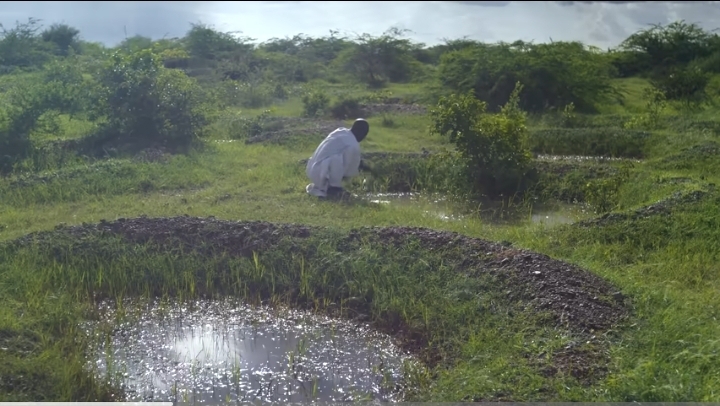
Water-retention half-moons, scientifically validated over thirty years by pioneering hydrologists like Michal Kravčík and successfully implemented by NGOs across Africa, are particularly suitable for this goal.

The operational capacity exists for large-scale deployment. Cosider, leveraging its logistics, machinery, and experience with the railway project, has the workforce, equipment, and field bases needed for excavation and light earthworks over a corridor exceeding 1,000 km. This workload plan could reconcile strategic infrastructure with ecological restoration while showcasing proven national expertise.

Pastures and livestock: towards strengthened food sovereignty

This greening process goes beyond soil stabilization and water-cycle improvement. It also allows for the reconstitution of natural pastures, essential for reviving camel herding and extensive sheep grazing, historically adapted to Saharan and pre-Saharan territories.

Restoring these pastoral areas reconnects livestock to local resources — soil, vegetation, and water — gradually reducing dependence on meat imports. Ultimately, this approach contributes to national food security, even during high-demand periods such as religious festivals, while fostering a sustainable pastoral economy that generates local income.

A concrete plan in two axes: from mining corridor to corridor of life

1. Hydrate the route, regenerate the soil: Excavate millions of half-moons (5 m diameter, 60 cm depth) perpendicular to water flows along the railway corridor. These basins will capture water, protect the track from floods, hydrate the soil, and enable pioneer vegetation to grow. Through evapotranspiration, this vegetation will generate atmospheric moisture, triggering a virtuous cycle of micro-rains.

2. Plant the future: In these water-filled basins, plant trees perfectly suited to arid conditions: argan, tamarisk, acacia, pistachio, fenugreek… These plantations will revive pastoralism, create new economic sectors, and stabilize the soil.

Revitalize the existing: oases as the starting point

Why build a new ecosystem when millennia-old ones are dying from neglect? The real starting point is revitalizing the existing oases along the Oued Saoura, hydro-agricultural masterpieces today threatened by wastewater discharge.

The first step is to reconnect the palmeries via a continuous route and restore their water supply. From Beni Ounif to Gsabi, passing through Taghit and Igli, along Oued Zouzfana and then Oued Saoura, the principle is the same: retain water. The same logic applies to Oued Guir and Daoura, all at risk of drying out.

A network of small perpendicular dams will slow floods, encourage infiltration, and recharge aquifers. This soft-retention approach should also guide protection of urban areas like Béchar against floods, far more efficiently than costly post-disaster repairs.

In complement to the agricultural projects initiated by the State over the past 20 years — where each farm had its well and basin — every farm should now have rainwater retention measures integrated on site.

A civilizational project reconciling time and territory

This plan is more than a technical intervention; it is a civilizational project, harmonizing temporalities and territories:

Short-term economic: The State can invest part of the mine’s revenue into regeneration over its lifetime.

Medium-term social: Thousands of low-skilled jobs are created in excavation, planting, and maintenance.

Long-term ecological and economic: Reduced meat and milk imports, new wealth through medicinal plants, and revived pastoralism.

It is also a matter of reconciliation. This region has endured, even after independence, nuclear and biological testing. Its residents, resilient guardians of desert life, bequeathed oases and traditional knowledge. Each palmerie must become a station on the train of regeneration — connecting communities, reactivating craftsmanship, and offering hope for self-sufficiency.

Choosing territorial intelligence

The overconfidence of modernity has resulted in endless drilling and wastewater discharge into these palmeries. Wisdom today lies in the small and the multiple: tiny dams, small half-moons, simple measures replicated millions of times.

Ignoring this path condemns the Southwest to dependency and costly disasters. Embracing it turns the territory into a living sponge, where every drop counts to make the desert green again.

Green Peace with the Sahara is not a dream. It is a concrete, pragmatic, and profoundly human plan, placing water, life, and territorial intelligence at the center of development. The Train of Regeneration is at the station — it only awaits political will to depart.

Pragmatic vision

Phasing:

Year 1: phase across 50 km of the railway corridor to demonstrate effectiveness, leveraging Cosider’s capabilities.

Years 2–5: Gradual deployment across the corridor’s width.

Years 5–10: Expansion to the entire region, with new economic sectors.

Benefits for all:

State: Protects mining and railway investments, reduces emergency costs (floods, imports), and demonstrates integrated, visionary development.

Population: Immediate local employment, village revitalization, pastoral revival, improved living conditions.

Environment: Concrete fight against desertification, soil restoration, reactivated water cycle, microclimate creation.

Economy: Diversification beyond extractives, export of medicinal plants, reduced food dependency.

A promising future:

Short-term (0–3 years): Jobs in earthworks and planting; first signs of vegetation.

Medium-term (3–10 years): Reduced agricultural imports, emergence of new economic sectors, gradual aquifer recharge.

Long-term (10+ years): Revitalized oases, food autonomy, a green, resilient, prosperous Southwest.

Our message

The Train of Regeneration is not a utopia. It is a realistic, actionable plan funded by local resources and driven by proven national expertise.

The advantages are clear:

  • Logistics already in place
  • Evident needs
  • Proven techniques
  • Available workforce
  • Strategic timing

What remains is political will to launch the first phase.

This project embodies a new approach to development: not “extract and leave,” but “invest and regenerate.” It promises Green Peace in our Sahara, a fertile, prosperous South, and a future for the next generation.Email

El Habib Ben Amara is an urban architect, science communicator committed to regenerating the water cycle, and translator of The New Water Paradigm by Michal Kravčík et al. into French and Arabic.

Is Climate Change an Externality?

Source: The Law and Political Economy (LPE) Project

This post is part of a symposium on Alyssa Battistoni’s Free Gifts: Capitalism and the Politics of Nature. Read the rest of the posts here.

** ** **

In Free Gifts, Alyssa Battistoni traces the concept of the “externality” across the past century. This history begins in 1920, when the economist Alfred Pigou observed how private market transactions could impose uncompensated harms on third parties, such that the prices of goods failed to reflect their true (social) cost. Fortunately, he argued, these external costs could be rectified by government intervention: adding a tax equal to the social cost, which would cause market trading to “internalize” the harm and produce the optimum amount of the activity in question. Free-market advocates viewed such externalities as a rare exception to the general rule of the wisdom of the market.

As Battistoni describes, however, this would change in the coming decades. As the U.S. postwar economy boomed, so did its pollution, and Pigou’s rare “market failures” began to seem ubiquitous rather than exceptional. In 1960, Ronald Coase challenged Pigou’s invitation for widespread government regulation in a landmark article, The Problem of Social Cost. Coase struck at the heart of welfare economics: how was Pigou, or the government, to determine the “optimal” level of pollution? How could they know how much people value the cost of pollution, or their own health? Battistoni dwells on Coase’s understanding of externalities as mutual costs. For Coase, the smokestack can only cause harm to health if people choose to live near it: “both parties cause the damage.”

Rather than dismiss Coase, Battistoni argues that Coase lands legitimate critiques on Pigou’s framework: Pigou makes a moral judgment (the assumption that pollution is bad) in pollution-generating markets, while declining to apply normative standards to any other types of markets or economic goods. But, in Battistoni’s words, “the distinction between pollution and other kinds of goods just doesn’t hold.”

Once Coase’s disciples recognized that pollution was just another kind of market, they launched an attack typical to that of the Chicago School, accusing regulators of paternalism. They argued that the government shouldn’t impose normative judgments on resource allocation; instead, it should set the conditions for people to negotiate the most efficient outcome amongst themselves. Markets all the way down. But Battistoni takes this observation in a different direction: “the burden of social costs is better characterized in terms of struggle between classes with disparate power than as a market exchange between equal individuals.” For Battistoni, “externalities” are the exception that explodes the rule: market allocations can never be assumed to achieve the “optimal” outcome, as they are always the product of unequal power relations.

Considering the host of this symposium, I cannot help but point out the similarities between Battistoni’s observations and some of the core principles of the LPE intellectual movement. Core to LPE is the revival of legal realist thought, and core to that thought are the anti-laissez faire writings of those like Robert Hale. Hale, writing around the same time as Pigou, and anticipating Coase, also recognized the reciprocity of social costs. Hale argued that the market itself was a system of “mutual coercion:” there was no such thing as the “free” market when it relied on an underlying state police power to enforce property rights. While Hale is not well known today, LPE scholars and their fellow travelers have resurrected his lessons for combatting the legacy of the Chicago School.

Hale and his compatriots were writing at a time of Lochnerism, when the conservative Supreme Court held an expansive view of due process protection of private property rights. While most economists and legal thinkers agreed that governmental price regulation was required in certain industries, such as state-granted monopolies, Hale believed that that utility-regulation, similar to Battistoni’s thoughts on externalities, was the exception that exploded the rule. Once you conceded that railroads, gas utilities, and hotels were “affected with the public interest” such that government regulation was justified, it was hard to identify any market that was not inextricably bound up with the “public interest.”

Another famous (proto) legal realist, Justice Oliver Wendell Holmes, in writing to justify governmental price regulation, once likened the harms of monopoly price power to that of pollution:

A hundred years ago, one could hardly use his land so as to injure another except by creating a nuisance. But things have grown more complex. The relations between property owners are not only those of mere contiguity: they are organic… If the railroads and elevators have a constitutional right to charge what they please, it is just as truly a right to destroy the property of others as a right to make noxious vapors would be.

This argument stands as a fascinating mirror of what Coase would do 80 years later. In order to get his audience comfortable with regulating price-related harms, Holmes likened them to smokestacks. To Holmes, the law of nuisance was a place where government intervention was clearly accepted, and pollution an obvious harm. Coase would argue from the other direction, saying that noxious vapors were a market like any other, where government intervention would lead to inefficiencies. Holmes, writing back in 1878, would likely have agreed with Battistoni’s argument that “The neoclassical assumption that a transaction can be contained to the parties to a contract appears delusional in a world where everything affects everything else.”

Yet Holmes discussion, appearing decades before Pigou formalized the concept of the externality, also makes clear that Pigou was far from the first person to recognize that pollution could harm third parties. The common law of tort had long recognized harms created by pollution, and Coase’s target in The Problem of Social Cost was just as much the common law approach as Pigou’s theory. And it wasn’t Pigou who assigned moral judgment to the harms of pollution, the very claims themselves were called “nuisance.” The common law’s recognition of pollution as a harm was bound up with moral judgments and social norms about who owed what to whom. It had nothing to do with efficiency and externalities, concepts whose later imposition on the law did more to distort than to clarify the underlying principles.

One of the lessons I have taken from teaching environmental law is that the LPE movement is in part about learning how to stop thinking like an economist at all. By the time the major modern environmental statutes were passed, the Supreme Court had long conceded the broad government right to regulate industries of all kinds. The Clean Air Act and Clean Water Act of 1970 and 1972 were passed before this country’s neoliberal turn toward Coasean thinking. The statutes do not talk of achieving the “optimal” levels of pollution, but rather “eliminating” pollution. The EPA is directed to limit pollution to the amount “requisite to protect the public health,” not to their most efficient levels. Today, however, environmental harms of all kinds are frequently cast as externalities, even by those seeking to emphasize the urgency of these harms. Indeed, as Battistoni observes, Nicholas Stern—who advocated for much more aggressive climate change action than many of his fellow economists—famously claimed that greenhouse gas emissions, as externalities, represented “the biggest market failure the world has seen.”

If we rejected the idea that climate change is best thought of as an externality, how would it change our thinking? One obvious alternative is to think of climate change is that of a moral harm. Battistoni, given her broadly Marxist approach, lays the blame for climate change on the capitalist system rather than individual bad actors. Yet for those who see climate change as a moral harm, one possibility could be to use the tools of criminal law, including charging fossil fuel companies with homicide, to work toward climate justice. Similarly, we might follow the lead of parties around the world pursuing nuisance claims against fossil fuel and other high-emitting corporations. To be clear, I do not think that conceiving of climate change as a moral harm requires resigning ourselves, as Jed Purdy’s post seems to suggest, to our inevitable demise at the hands of our own fundamental “human nature.”

Even when it comes to market governance, there is no need to conceptualize climate change as an externality, whose harm to be internalized, rather than eliminated entirely. Indeed, the Inflation Reduction Act of 2022 is arguably the result of successful campaigns to dethrone the externality-tackling carbon tax as the ideal climate policy. Worldwide, a new green industrial policy focuses on capital turnover and the replacement of fossil infrastructure with renewables. This Bidenomics approach, to draw from Ilmi Granoff, considers climate change to be “a substitution problem, not an externalities problem.” Even mainstream economists now write that climate change harms should be thought of as both externalities and “innovation failures.”

In many ways, unlearning externalities-thinking is just rediscovering what we knew in 1970. The Congress that passed the Clean Air Act expressly rejected the use of economic analysis in designing air pollution regulation. The Act’s Senate Report explained that “the health of people is more important than the question of whether [the achievement of air standards] is technically feasible… therefore… existing sources of pollutants either should meet the standard of law or be closed down.” The Supreme Court concluded that the Clean Air Act was a “drastic remedy,” “expressly designed to force regulated sources to develop pollution control devices that might at the time appear to be economically or technologically infeasible.” What this statutory design recognizes is that corporations don’t just act in markets, they control them. They can bring entire technologies, entire new compounds, into being. Asking a regulator or judge to assess the costs and benefits of limiting pollution—or expecting an affected individual to bargain in this situation—makes no sense. Before the automobile industry invented the catalytic converter, the costs of reducing air pollution seemed astronomical, enough to bankrupt the entire industry. After they invented the catalytical converter, the costs were manageable. And they only invented it because they were faced with the threat of being shut down.

Which brings me back to Robert Hale. While we no longer need Hale to argue on behalf of regulation in general, his insights have lessons for the fights of today, in which we are dominated by the decisions of the fossil and tech oligarchies. Hale’s insight into the coercive nature of markets led him to see that there was nothing free about the free market, and that corporations coerce and dominate us in much the same way a top-down government regulator might, but without any democratic accountability. He’s been dubbed “an originator of the concept of ‘private government.’” This insight leads me to conclude that it’s again time for a “drastic remedy” that reasserts the power of the people over the corporation in determining what our economy looks like.

So while Battistoni and I may disagree, in some abstract, academic way, that climate change should be called an externality, I think we ultimately agree on the remedy: Asserting democratic control over corporate investment decisions is key to an anti-capitalist climate agenda. Reporting has revealed that corporate AI-related capital expenditures were in the hundreds of billions of dollars in 2025 alone. We appear to be in the midst of yet another society-wrecking “innovation failure.” Imagine if we had collectively decided to build wind turbines and flood gates instead of data centers. Imagine that we could.Email

Madison Condon (@madisoncondon) is an Associate Professor at Boston University School of Law.

The Sun Sets on the Syrian Kurdish Rebellion

Source: Originally published by Z. Feel free to share widely.

The agreement that terminated the Syrian Kurdish enclave was presented by its signatories as a pragmatic settlement. But, in fact, the deal is a major political defeat for the Syrian Kurdish political formations. Certainly, the rapid advance of the Syrian armed groups loyal to President Ahmad al-Sharaa broke the resistance of the Syrian Democratic Forces (SDF), the largely Kurdish group, but this advance can only be understood by the total backing given by the United States to the Syrian government against the SDF. The SDF was outgunned and had no air support, which is what they had benefitted from in their war against the Islamic State. The SDF’s Mazlum Abdi signed the effective surrender on behalf of his party and their army. US Ambassador Tom Barrack’s tweet—despite its hyperbole —suggested the end of the Syrian Kurdish experiment called Rojava (the Kurdish word for where the sun sets, or the western part of the Kurdish lands).

The deal formalised what months of military pressure had already made clear. Syrian state institutions returned to the northeast not as partners but as authorities keen on a strong central state loyal to al-Sharaa. Over the course of the past year, border crossings that had been in the hands of various groups returned to central government control and oil revenues began to be collected for Damascus. The Syrian Democratic Forces, one of the last remaining independent military challenges to al-Sharaa after the rout of the Syrian Arab Army, agreed to be subordinated to the military’s central command but did not want its units dismantled; in other words, the SDF wanted to retain its own structures within the Syrian armed forces. This was the agreement that Abdi and others in the Kurdish leadership, such as Ilham Ahmed (former co-chair of the SDF), favoured, but they were outflanked by sections of the Syrian Kurdish leadership that did not want to lose the autonomy of the Kurdish enclave. But now Kurdish political offices have begun to close, flags are being removed, and the language of autonomy has been erased from official documents.

Al-Sharaa came to the presidency of Syria through his politicisation in al-Qaeda’s Syrian fronts. While he has left behind his turban for a suit, there are indications that his own followers are comfortable with the ideology of and links with al-Qaeda and the Islamic State and that they welcome an alliance with both the United States and Israel. In the days leading up to this ceasefire and deal, SDF officials reported that the Syrian armed forces focused their attention on the prisons that held Islamic State fighters who had been captured by the SDF; heavy fighting had indeed been reported near Shaddadi prison (Hasaka) and al-Aqtan prison (Raqqa). These attacks, the SDF said, were a ‘highly dangerous development’ since they suggested that the government forces wanted to free the Islamic State fighters from the prisons and put them back on the battlefield against groups such as the SDF. Now the state has control over these prisons and could do what it wants with these prisoners.

The Dawn of Rojava

In 2012, the government of Bashar al-Assad withdrew its military from the northeast so that it could defend the southwest from a cycle of rebellions. This withdrawal provided an opportunity for the Syrian Kurds, who had been fighting for either an independent Kurdistan or autonomy within Syria for decades. The leader of the Democratic Union Party (PYD) Salih Muslim told me in 2013 that the Kurdish political and military forces filled a vacuum. “We organised our society so that chaos would not prevail.” The PYD’s Muslim made three points: Syria must remain united, Syria must belong to all those who live in it, and Syria must be decentralised. The government in Damascus accepted these three points and a tacit understanding was reached between the Syrian Kurdish political forces, other minorities in Syria, and al-Assad’s government. This was the opportunity that allowed for the birth of Rojava.

Over the decade since 2012, the Rojava enclave came under serious attack by the Islamic State (in 2014-15) and the Turkish armed forces (2018) as well as sustained attacks by various smaller groups. In this decade, the army of the SDF, the People’s Defence Units (YPG), the Kurdish Peshmerga (from Iraq), and the armed forces of the Kurdish Workers’ Party (PKK from Turkey) defended this enclave, most dramatically from the advance of the Islamic State. When the Islamic State took Sinjar and began to ethnically cleanse the area of Yazidis in August 2014, it was the YPG and its allies that began a long siege of the area that was only won by them in November 2015 at a great cost. US air support began to assist the YPG and the SDF in their quest to defeat the Islamic State and to exist as an independent enclave from Damascus. Neither Salih Muslim nor other leaders of the Syrian Kurdish groups pinned their faith wholeheartedly on the United States, although the balance of forces set in motion an alliance that was always going to lead to betrayal.

Statements from Salih Muslim and Mazlum Abdi that silence about the Turkish invasion of Afrin in 2018 would “cost Syria its unity” or that the YPG was the only “barrier against Turkish occupation” did not count for much. Assad was not going to enrage the Turkish government at this time (in fact, it was in this period that Russia’s President Vladimir Putin and Turkey’s President Recep Tayyip Erdoğan signed a deal to demilitarise Idlib and allow the al-Qaeda inheritors, including al-Sharaa’s Hay’at Tahrir al’Sham or HTS to build their strength in peace and wait a turn of fortunes). Perhaps if Assad were a better chess player, he would have provoked Turkey by defending the Syrian Kurds, thereby preventing a deal and forcing his Russian allies to provide air support while the Syrian Arab Army entered Idlib to fight the remainder of the HTS and its allies. But Assad began to allow the Russians to do his strategic thinking and therefore conceded a point of strength in the hope that the Turkish government would cease its attempt to overthrow his government.

Turkey’s Erdoğan refused to see the Syrian Kurdish rebellion as anything other than an extension of the fight of the Turkish PKK. In 2020, he told his party cadre at a meeting, “Turkey will never allow the establishment of a terror state right beside its borders. We will do whatever is necessary and drain this swamp of terrorism”. This should have been clear to both Assad and the Syrian Kurds that there was going to be no support from Turkey and no end to the attempt at destabilisation by Turkey’s NATO partner, the United States. Over the past five years, Erdoğan leaned on the political leadership of the PKK to withdraw its rebellion and to effectively capitulate. In 2025, from his Turkish cell, PKK leader Abdullah Öcalan announced “the end of the method of armed struggle”. The Syrian Kurdish project, linked with the PKK, lost its broader strategic depth. Pressure mounted from the Turkish side for the Syrian Kurds to end their project of “armed autonomy”, as Turkish officials said. Turkish military pressure continued with reduced international condemnation or even consideration and diminished Kurdish legitimacy.

The mysterious role of Israel in this entire fiasco has yet to be properly written.

The Fall of Assad

With the full weight of Israeli and US air strikes, the forces of Hay’at Tahrir al’Sham led by Ahmad al-Sharaa dashed into Damascus. This victory marked a decisive rupture for the Syrian Kurds. Al-Sharaa, the new president, said that his government would reclaim the northern lands (but he said nothing about Israel’s occupation of the Golan Heights and nothing about the hundreds of square kilometres of the UN buffer zone seized by Israel after al-Sharaa took Damascus). Statements coming from Damascus sent a warning to the Kurds, although the Kurdish leadership hoped against any logic that the United States would protect them (in December 2024, Abdi said that the Syrian Kurds were in ‘continuous communication with our American friends, who support our efforts to stop the escalation and guarantee the rights of all Syrian components, including the rights of the Kurds within the framework of a unified state’). The United States began a withdrawal, and the Syrian Kurds began to voice their hopelessness. One SDF official told me that their forces had fought ISIS and had taken huge casualties but now were —in her words—”nothing at all”. Syrian forces flooded the north. “Syria does not need experiments imposed by force”, said al-Sharaa. Rojava was in his crosshairs. It did not take long to finish the job. “We are determined to protect the achievements of the revolution”, said Abdi, but this seems more like wishful thinking.

The example of Syria has sent a cold breeze across the border to the Kurdish autonomous region in northern Iraq. Iraqi leader Muqtada al-Sadr posted a message on X with a warning that what happened in Syria “should not be taken naïvely”. “The danger is imminent”, he wrote, “and terrorism is supported by global arrogance”. With the change of strategy of the Turkish PKK and the defeat of the Syrian Kurds, any faith in Irbil (Iraq) that the Kurdish autonomous region is eternal will now fade. Al-Sadr suggested unity in the face of external aggression. It is a suggestion that would be hard to reject in these times.

The collapse of Rojava was not merely the failure of a local revolt to be sustained. It was the defeat of a political wager: that decentralisation and armed self-defence could rely upon the support of the United States. The language of democracy and dignity might have appealed to an occasional US diplomat, but it meant nothing in Washington. “We built Rojava on a swamp”, said a Syrian Kurdish official to me a few hours after the deal.

This article was produced by GlobetrotterEmail

avatar

Vijay Prashad is an Indian historian, editor, and journalist. He is a writing fellow and chief correspondent at Globetrotter. He is an editor of LeftWord Books and the director of Tricontinental: Institute for Social Research. He is a senior non-resident fellow at Chongyang Institute for Financial Studies, Renmin University of China. He has written more than 20 books, including The Darker Nations and The Poorer Nations. His latest books are Struggle Makes Us Human: Learning from Movements for Socialism and (with Noam Chomsky) The Withdrawal: Iraq, Libya, Afghanistan, and the Fragility of U.S. Power. Tings Chak is the art director and a researcher at Tricontinental: Institute for Social Research and lead author of the study “Serve the People: The Eradication of Extreme Poverty in China.” She is also a member of Dongsheng, an international collective of researchers interested in Chinese politics and society.