It’s possible that I shall make an ass of myself. But in that case one can always get out of it with a little dialectic. I have, of course, so worded my proposition as to be right either way (K.Marx, Letter to F.Engels on the Indian Mutiny)
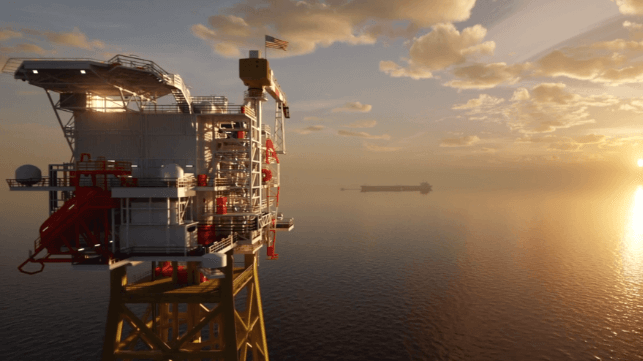
Just weeks after taking over the federal environmental-review process for deepwater oil and gas terminal licensing, the U.S. Department of Transportation has approved a construction and operation license for Texas GulfLink, the first issued under the Trump administration.
Texas GulfLink will be a twin single-point mooring facility located about 27 nautical miles off the coast of Brazoria County, Texas. It will be fed by a 42" subsea pipeline to a manned offshore platform, where its operations will be overseen on-site in real time. It is backed by Sentinel Midstream.
Capt. Stephen M. Carmel, head of DOT's Maritime Administration, said in a statement that the project will speed up exports of American oil to global buyers. "We are signaling to the global market that America is open for business. By approving projects like Texas GulfLink, we ensure that American oil producers aren't halted by domestic bottlenecks," he said.
According to the DOT, the project will support more than 700 jobs and increase oil export capacity by as much as one million barrels per day. It will be able to handle VLCCs, the most economical vessel class for transoceanic trade, and will make it less expensive to ship and sell oil to foreign refiners.
"The Texas GulfLink project is proof that when we slash unnecessary red tape and unleash our fossil fuel sector, we create jobs at home and stability abroad. This critical deepwater port will allow the U.S. to export our abundant resources faster than ever before," said Transportation Secretary Sean Duffy in a statement.
At present, only one VLCC-capable offshore terminal exists in the U.S. - the Louisiana Offshore Oil Port, or LOOP. At all other loading ports, VLCCs have to take on cargo using reverse lighterage, the process of sending a smaller tanker in and out of port several times in order to fill up. This is a relatively expensive and time-consuming method, and requires multiple transits through pilotage waters. An offshore single-point mooring can load a VLCC in a single evolution.
Future Prospects for the Port of Churchill on Canada’s Hudson Bay
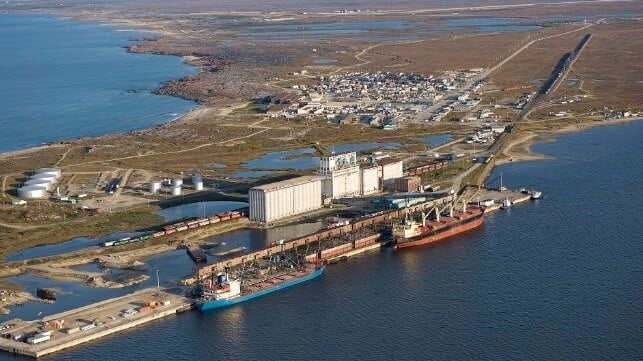
Discussions are underway in Canada in regard to the future development of the Port of Churchill on Hudson Bay. During the early to mid-1900s and prior to the opening of the St. Lawrence Seaway, Churchill was Canada’s main port for exporting Western Canadian agricultural produce to England and Europe, and could play a major role again if revived.
Introduction
The Port of Churchill is located in the northeastern region of the Canadian province of Manitoba, where the premier (equivalent to a state governor) is seeking assistance from Canada’s Federal Government to develop the port for future exports of oil and agricultural bulk freight. Several years ago, there was opposition from environmentalists in Quebec to plans to develop a pipeline intended to carry oil and natural gas from Western Canada to eastern Canada’s Atlantic provinces. There was a need across Eastern Canada for competitively priced oil and natural gas from Western Canada.
As a result of opposition to build a pipeline across Quebec to Eastern Canada, Western Canada’s oil producing region chose to seek alternative methods to export oil and natural gas to European markets. There is potential in Saskatchewan to connect an oil pipeline from Western Canada to the railway line that connects to the Port of Churchill. There is scope at that port to deepen the draft of the maritime terminal and navigation that connects to it, to accept deeper draft bulk carriers. There is also a plan to develop an offshore terminal in deeper water in Hudson Bay, close to Churchill.
Historical Factors
Dating back into the early 1800s, there was minimal east – west transportation across Canada. The colonial government in England responded by providing funding to build a navigation canal along the north side of the St. Lawrence River, upstream of Montreal. After completion during mid 1840s, small vessels began to sail between the Port of Montreal and Lake Ontario. Subsequent construction of navigation locks between Lake Erie and Lake Ontario, and between Lake Huron and Lake Superior, allowed ocean-going vessels of that period to sail between the Atlantic Ocean and the Great Lakes.
Per nautical mile, maritime transportation incurred lower transportation cost per ton (and per cubic foot of volume) when compared with railway transportation. While the inland waterway restricted the size of ocean vessels able to sail to/from Lake Superior, larger vessels of the late 19th and early 20th century could sail to the Port of Churchill. The cost of railway transportation to Port of Churchill from western Canadian wheat farms was far less than railway transportation to the Port of Montreal. As a result, the Port of Churchill proved to be practical and viable.
St. Lawrence Seaway
The construction of the St. Lawrence Seaway during the early 1950s and its opening during late 1950s allowed ocean size ships of that era passage between the Atlantic Ocean and Lake Superior. As a result, the shorter railway distance between Western Canadian wheat farms and the Port of Thunder Bay reduced transportation cost compared to the Port of Churchill. As a result, grain storage silos were built at Thunder Bay, reducing the competitiveness of the Port of Churchill. Over time, more exports moved through the Port of Thunder Bay as operations at the Port of Churchill declined.
Ship Development
Over the first five years following the opening of the St. Lawrence Seaway, the physical size of ocean-going freight ships remained essentially unchanged. By the mid-1960s, Japanese shipbuilders unveiled mega-scale bulk carriers of oil, for which there was a ready market. Over time, the physical size of carriers of dry bulk and oil increased to dimensions that exceeded the size of navigation locks along the St. Lawrence Seaway. At some locations, the sheer size of ultra-large bulk carriers required the construction of offshore terminals connected to land via undersea pipelines, to carry oil or liquefied natural gas.
There is scope to deepen the draft of the terminal at Port of Churchill, along with the navigation passage to/from Hudson Bay. Breakwaters would redirect river current to prevent deposits of silt at either the terminal or in navigation channel. There may be scope to develop an offshore terminal near the Port of Churchill, with a short distance of undersea pipeline to carry oil and/or natural gas. A precedent from Great Lakes shipping involves a small vessel sailing ahead of a large vessel to break up winter ice cover, making year-round sailing possible across Hudson Bay.
Future Prospects
There is scope to develop the Port of Churchill to serve mega-size ships that carry the combined bulk freight tonnage of a fleet of Seaway-max ships. From a common junction in Saskatchewan, the railway line to Thunder Bay is marginally shorter than the railway distance to Churchill. A structural upgrade to bridges along the line to Churchill would allow passage to trains with heavier axle loads. During winter when the ground below the railway line is frozen to several feet depth, the railway line would be able to carry a heavier load per axle.
Also, during winter, trains heavily laden per axle would be able to operate along the railway line to and from Churchill, carrying exports of bulk freight from Western Canada. Mega-size ships sailing from Port of Churchill to Europe and the Middle East would carry that freight at more competitive rates than shipping via the St. Lawrence Seaway aboard a fleet of small ships.
Conclusions
By opposing the construction of a pipeline through their territory, environmentalists in the Province of Quebec have provided an opportunity to explore the potential to develop the Port of Churchill on Hudson Bay. There is future scope for the port to load crude oil, potash and agricultural produce from Western Canada onto mega-size ships that will sail east across the North Atlantic, to destinations across Europe. There is also scope for container ships to sail to Churchill, to transfer containers to trains headed for Western Canada and the northwestern United States.
The opinions expressed herein are the author's and not necessarily those of The Maritime Executive.
Philippines
Divers Find Sunken Ferry Trisha Kerstin 3, Death Toll Rises to 43
After an extended search, the Philippine Coast Guard has discovered the location of the sunken ferry Trisha Kerstin 3, which went down last month off Basilan.
Divers located the vessel lying in an east-west orientation off Baluk-Baluk Island, southeast of Zamboanga City. The discovery of the wreck site raises the possibility that technical divers will be able to find additional human remains, and potentially may discover clues to the vessel's tragic capsizing.
The ferry Trisha Kerstin 3 departed Zamboanga City on January 25, headed for Jolo, Sulu. At about 0150 hours on January 26, the vessel capsized and went down off Baluk-Baluk Island. 316 passengers and crewmembers were rescued. The count of confirmed dead has continued to rise; with the discovery of one additional body on Tuesday, the total stands at 43 individuals. Taken together, the number of survivors and recovered bodies now exceeds the total size of the initially-reported vessel manifest, raising the possibility that the ferry was carrying extra off-books passengers.
The shipowner's overall operations are under investigation, and it is possible that it could lose its operating license, a spokesperson for Philippine regulator MARINA told Philippine Star - depending on "the gravity of the offense." For now, its passenger fleet remains subject to a no-sail order, and its vessels are undergoing a thorough inspection.
The cause of the casualty has not been determined, and an inquiry is under way. According to an initial passenger account, the vessel took on a list, and the passengers - lacking crew instruction - responded by rushing to the other side in an attempt to correct it. The vessel then rolled to the far side and capsized. So far, accounts suggest calm conditions on scene at the time of the casualty, consistent with weather observations.
A relative of the vessel owner told GMA that it is possible that a lashing on a truck in the ro/ro bay failed, allowing the vehicle to slide to one side and reduce the vessel's stability. This suggestion has not been confirmed.
Early results from MARINA's inquiry have turned up an unusual development: it appears that Trisha Kerstin 3 may have been swapped in for a different vessel at the last minute, and was not actually assigned to this route.
"Investigation showed that the passengers were supposed to board a different ship. The vessel’s name indicated in the ticket was allegedly different from the ship that was deployed. The passengers were not reportedly informed about this," MARINA official Luisito delos Santos said.
Korean RoRo Turns Around After Reporting Truck Fire
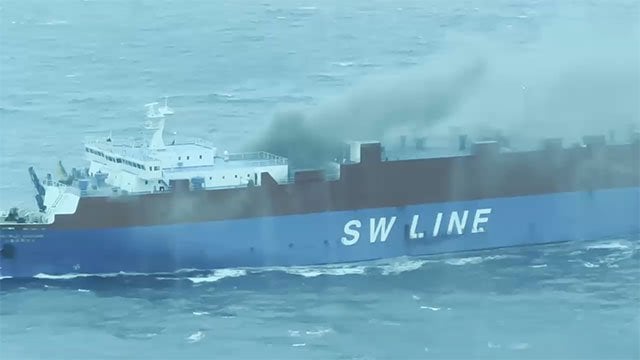
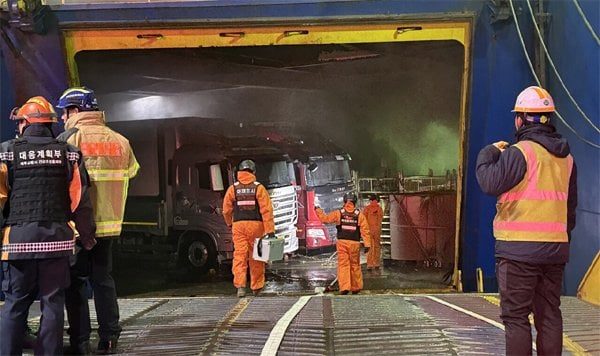
RoRo reported a truck shortly after departing port in Korea (Korean TV - Jeju Coast Guard)
A Korean-flagged RoRo operating as a ferry was forced to turn around on Friday evening, February 6, after the crew discovered a truck fire onboard. The crew, aided by the local fire department and the Coast Guard, was able to bring the fire under control after about two hours.
The Korean Coast Guard unit in Jeju and the fire department reported receiving the report of the fire at about 5:30 pm local time. The ship had departed Jeju bound for Mokpo approximately 40 minutes earlier. It had a crew of 16 aboard plus 12 truck drivers. The ship was reported to be carrying a total of 127 vehicles, including 86 trucks and 41 passenger cars.
The Coast Guard dispatched a helicopter to survey the situation while four patrol boats were also deployed. The fire department was put on standby at the pier awaiting the arrival of the ship.
After the fire alarms went off on the vessel, the crew initiated the fire suppression systems while the captain turned the vessel around to return to Jeju. Pictures from the Coast Guard show smoke emitted from the ferry, Seaworld Marine 2 (6,000 dwt). Built in 2002 as a Japanese vehicle carrier, the ferry has been operating in Korea since 2024.
(Jeju Fire and Safety Headquarters)
Medical teams set up an emergency station on the dock and reported treating crewmembers and truck drivers for smoke inhalation. Four people, two crewmembers and two truck drivers, were sent on to the hospital for further treatment.
Fire crews reported they were able to extinguish the fire about an hour after the vessel returned to the dock. Three trucks were reportedly heavily damaged, and a survey was ongoing of the vessel.
The fire was believed to have started in a refrigerated truck. The Coast Guard and fire department said they would be reviewing closed-circuit TV from the cargo areas to determine the cause of the fire.
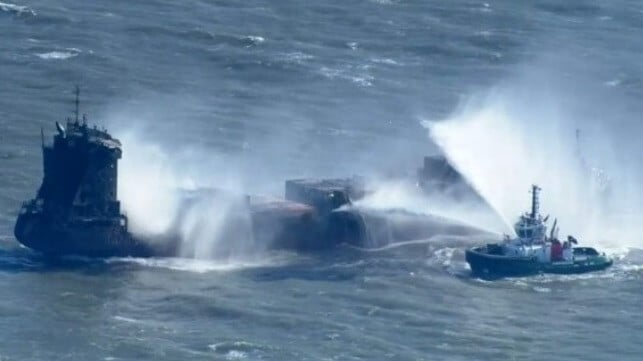
Russian Rescue Service Responds to Explosion and Fire on MSC Boxship
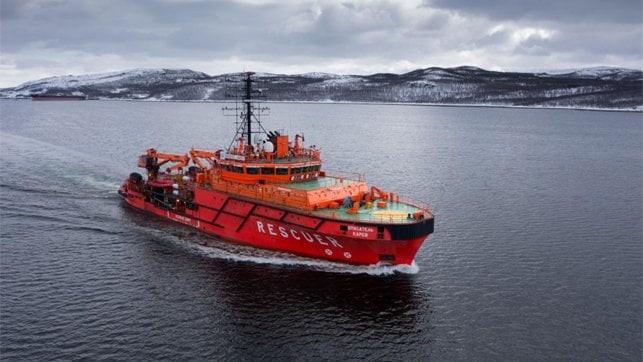
Russian rescue vessel "Spasatel Karev" and an icebreaker were reported to have responded to the disabled containership (Marine Rescue Service)
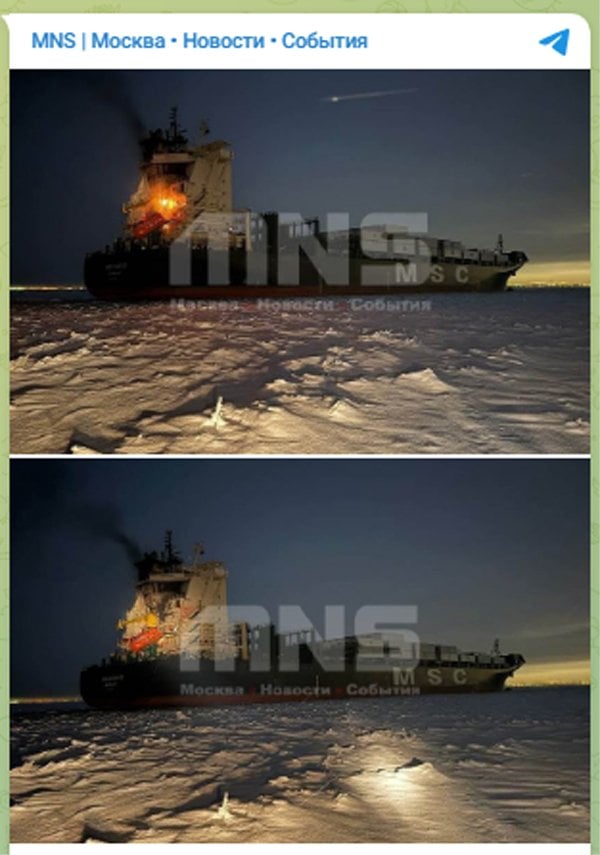
An MSC containership inbound for Saint Petersburg, Russia was reportedly disabled after an explosion and fire in the Gulf of Finland. Details are coming from Russian media reports of the incident without official confirmation from the maritime services or MSC.
A feeder ship named MSC Giada III (39,000 dwt) experienced an explosion in its engine room that is reported to have spread upward into the accommodation block of the ship. Images posted by the Russian media show flames at the rear of the accommodation block.
Reports indicate the fire was brought under control while the Russian icebreaker Semyon Dezhnev was dispatched to aid. There are conflicting reports that the rescue vessel Spasatel Karev may have also participated in the rescue operation.
The containership is registered in Liberia and has operated for MSC since 2022. Reports indicate it has a Russian captain and at least some of the crew are from Myanmar.
Russian media is reporting the vessel’s AIS signal went offline on the evening of February 4 while it was in Neva Bay. The ship appeared in Saint Petersburg on February 5, apparently towed into port. Its AIS signal has been restored and shows the vessel berthed.
The fire was reportedly contained to a small area of the vessel. There are no reports of injuries to the crew or pollution from the ship.
Built in 2002, it is a 2,700 TEU feeder that MSC employs on a route servicing the Baltic, Spain, and Portugal. The online schedule indicates the ship left Agadir and had made a stop in Antwerp before heading to Russia. It was due to proceed on to Riga and Klaipeda.
Small Tanker Grounds on Waterfront at Port of Santa Marta
Officials in Santa Marta, Colombia are attempting to refloat a small tanker that has gone aground next to a breakwater near the center of town.
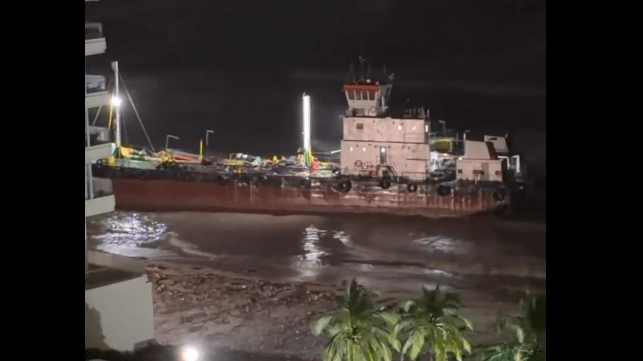
At about 2230 hours on Monday night, the small tanker Intergod VII grounded on Playa de Los Cocos, a beach about one mile south of the main commercial seaport. The vessel's master reported the incident to the local port authority and VTS operator, and the Colombian Navy responded to the scene.
The vessel and crew are unharmed, and no pollution has been reported.
The Colombian Maritime Authority (DIMAR) is investigating the casualty, and initial indications suggest that rough weather likely played a role. A cold front moving through the area brought high winds, heavy surf and record-setting rainfall on Monday. The weather conditions on the coast were severe enough that the port authority closed the harbor to navigation, and the public beaches were shut down for safety.
The difficult weather delayed any initial salvage response, but the authorities kept an eye on the grounding site to monitor for pollution.
On Tuesday, the vessel shifted on the sand as the tide came in and made contact with the brick-and-mortar breakwater on the beachfront, raising concerns of possible damage to either the vessel or the infrastructure. Later in the day, with weather improving, refloat operations got under way, with a tug and tow hawser rigged to pull the vessel off the beach. The authorities closed off the nearby section of the waterfront for security purposes.
On Wednesday, DIMAR reported that the tanker was safely refloated and moored at a nearby terminal.
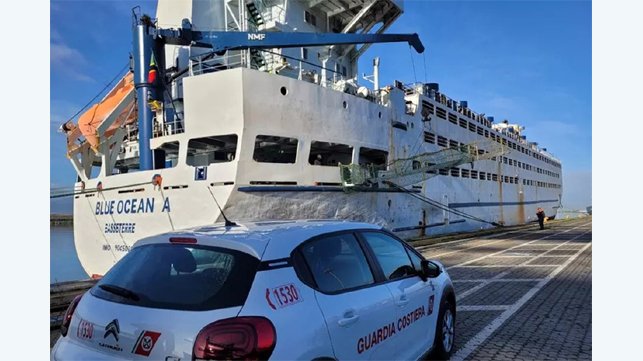
Italian Coast Guard Finds 54 Deficiencies After Saving Livestock Carrier
Guardia Costiera listed 54 deficiencies during the inspection of the livestock carrier (Guardia Costiera)
The Italian Coast Guard completed its inspection of the livestock carrier Blue Ocean A after overseeing the towing of the disabled ship into the port of Cagliari. While not saying it was a record, they are reporting the vessel racked up an astonishing 54 deficiencies during the inspection, and 30 of them led to a detention.
The full report has not been released pending resolution of the issues, but the Guardia Costiera and the Port Authority of Cagliari report that the ship will be staying in port until it can correct the long list of issues. The statement says the issues include “numerous irregularities related to the functioning of the firefighting systems, life-saving equipment, and bridge equipment” of the 34-year-old vessel. The inspection also looked at living conditions for the crew and their training.
The statement does not mention the problems with the ship’s engine, which started the incident. On January 28, the captain of the livestock carrier reported it was experiencing engine troubles and that they were attempting to anchor off the coast south of the island of Sardinia and near the small fishing and resort town of Carloforte on Isola di San Pietro. The ship had a crew of 33 aboard.
In a storm with winds of over 50 mph and waves running at 5 meters (over 16 feet), the anchor was not holding, and the ship was being driven toward the shoreline. The crew requested an emergency evacuation, but the winds were too strong for the helicopter. The first tug on the scene reported that four towlines had parted. The Coast Guard and a larger, private tugboat worked and were able to secure the vessel and hold its position offshore overnight until the storm subsided and the tug was able to tow it to Cagliari.
The Coast Guard reports the Rimochiatori Sardi company will be receiving a letter of commendation for its efforts. They called it a particularly complex rescue operation.
Typical of ships in this business, the Blue Ocean A (4,780 dwt) was built in 1992 as a containership and was converted in 2013 to become a livestock carrier. The ship, which is registered in St. Kitts & Nevis, is 117 meters (384 feet) in length and owned by a company in Turkey.
The ship was returning from the Middle East, bound for Cartagena, Spain, meaning it likely did not have any animals aboard. Its prior inspections in 2025 had found a few issues, including hull corrosion and issues with the steering gear, but the list of issues was short, and the vessel was not detained.
Captain of Solong Gets Six Years as Court Cites “Complacency and Arrogance"
The Solong burned for days with the prosecution arguing the collision was avoidable, endangered both crews, and killing the one seafarer
A judge at the UK’s “Old Bailey” court in London sentenced the former master of the Solong containership to six years in jail for causing the death of a seafarer in the fiery 2025 allision with the tanker Stena Immaculate. A jury on Monday had found Vladimir Motin, age 59 of Russia, guilty of gross negligent manslaughter.
Motin had been on watch and the sole member of the crew on the bridge on March 10, 2025, when the containership hit the anchored tanker Stena Immaculate off the coast of England. One crewmember, Mark Angelo Pernia, who was working at the bow of the containership, was never found and presumed to have died from the impact, explosion, and fire that engulfed the two ships. The other 13 crewmembers from the containership and the 23 on the tankers were rescued. The containership was a total loss, while Stena sold the badly damaged tanker and said the new owner intended to repair the ship.
Justice Andrew Barker said during the sentencing on February 5 that Motin’s version of events was “extremely implausible.” He called the allision with the tanker and the death of the seafarer “wholly avoidable.”
The master of the Solong, Vladimir Motin, was sentenced to six years in jail (Crown Prosecution Service)
During the sentencing hearing, the judge said that he believed the captain had fallen victim to his “complacency and arrogance.” Testimony during the trial had shown that the Solong was functioning properly and that the Stena Immaculate was visible for more than 30 minutes on radar. Motin, the court was told, had waited until the vessels were one nautical mile apart before attempting to turn the containership. He did not attempt to slow the containership, undertake a crash stop, or sound any alarms before hitting the Stena Immaculate amidships.
“You were a serious accident waiting to happen,” said Justice Barker, addressing Motin. The court had heard that Motin had turned off the system that required someone on the bridge to press a button every 30 minutes to confirm that the bridge was manned and someone was alert, although the captain asserted that he had not fallen asleep that morning or left the bridge after his watch began. He said a lookout was not required before there was good visibility, a fact the UK’s Marine Accident Investigation Branch (MAIB) challenged in its preliminary report, saying there was patchy visibility.
The judge said the facts suggested the Solong was not aware of another ship ahead. Motin, they said, had not acted properly and in a timely manner to avoid hitting the tanker.
The police investigator said they believed Motin had failed his duty as captain to protect the ships and their crew. Further, they said he had shown no remorse at any stage and asserted that he changed his account of the events. The judge called the captain’s attitude “somewhat combative” and “argumentative,” saying he was trying to argue his way out of the clear-cut case.
The defense had admitted Motin’s mistake but argued that it did not meet the standard of gross negligence. They said he had become confused when the ship did not respond to his change of course. Motin said he now realizes he pressed the wrong button and failed to turn off the autopilot. Prosecutors argued that it should have been immediately obvious, especially to Motin, who had commanded the ship for years. The defense cited his previous record and called the events of that morning an “aberration of his conduct.”
Motin had told the court he realized his career at sea was over. He said he never intended to return to sea.
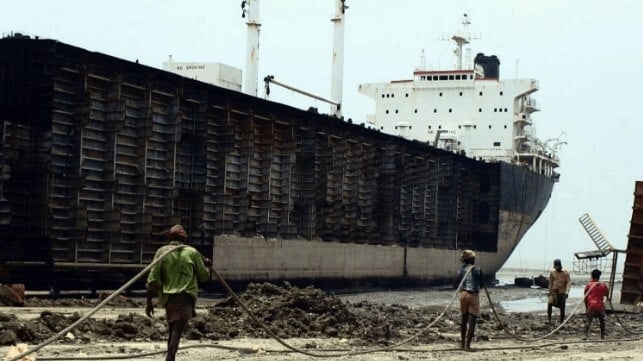
NGO Shipbreaking Platform Reports on 2025 and Calls for More Regulation
NGO Shipbreaking Platform raises concerns ahead of the anticipated surge is ships being sold for dismantling
The NGO Shipbreaking Platform compiled a report on the ships sold for dismantling in 2025 while calling for continued efforts to improve the industry’s adherence to safety and environmental regulations. The group highlights that despite the Hong Kong Convention coming into effect at mid-year, there was little improvement in the performance of the shipbreakers.
The listing shows a total of 321 vessels were dismantled in 2025. The overall number remains low as most segments of commercial shipping have extended the life of vessels, in part due to demand and waiting for environmental regulations to be solidified. NGO Shipbreaking expressed concern that, as the backlog of older ships starts to move to dismantling, the safety and environmental issues will be further exacerbated unless steps are taken now.
It highlights that 85 percent of the ships sold for dismantling in 2025 went to South Asia. A total of 214 ships, with Bangladesh and India remaining as the leading destinations, along with Pakistan. More than 6 million gross tons were sent to the three countries. By comparison, 49 ships went to Turkey (under 700,000 GT), 44 ships in other parts of the world, and only 14 ships were dismantled in the EU.
The global total in 2025 was just 321 ships, according to NGO Shipbreaking Platform. This is down from over 400 ships in each of the three prior years, and a peak of over 1,000 ships per year a decade ago.
Bangladesh, the group highlights, has already approved 17 yards under the Hong Kong Convention. The NGO, however, highlights that despite more than 100 shipbreaking plots in India around Alang, none so far have been authorized under the convention.
The convention seeks to improve the safety and environmental record of the industry by requiring specific ship recycling plans that consider the listing of hazardous materials that each ship is required to maintain. The yards also need to have safety and environmental plans. The convention applies to all ships over 500 GT sold by companies in any of the states having adopted the convention.
NGO Shipbreaking reports the safety concerns continued in 2025, with a total of 11 workers losing their lives. Despite lax and opaque reporting, it believes that another 62 workers were injured at the yards in South Asia.
Among the worst incidents reported in 2025, NGO Shipbreaking highlights the explosion on an oil tanker being dismantled in Bangladesh. Eight workers were injured in the explosion.
The group highlights that there are discussions at the International Maritime Organization about enhancing the requirements of the convention and updating the standards, which were drafted more than a decade ago. IMO states first adopted the Hong Kong Convention in 2009, but it took till 2023 to reach the threshold for it to go into force in 2025.
Ingvild Jenssen, Executive Director and Founder of NGO Shipbreaking Platform, emphasizes that the IMO must take action to phase out the beaching method for dismantling ships.
“At the same time, better enforcement of the Basel Convention’s restrictions on hazardous waste trade need to be ensured through measures that effectively hold the shipping industry accountable. This entails shifting responsibility to the states that actually have control over the owners of assets intended for disposal,” said Jenssen.
As the backlog of old ships breaks, the group points to the potential of hundreds of tankers being sold for dismantling, including ships from the so-called shadow fleet. It is concerned that these ships, which skirt regulations, will continue to do so with the owners seeking cash, crypto, and foreign currency deals to avoid sanctions.
NGO Shipbreaking calculates that China is one of the key sources of ships heading to South Asian shipbreakers. Last year, it reports China sent 21 vessels, with most going to Bangladesh. South Korea (19 ships) and the UAE (17 ships), it says, were also sending ships to the South Asia yards. The group points out that this is despite the UAE Ship Recycling Regulation, which went into force in June 2025, which prohibits ships from leaving the UAE territorial waters for beach scrapping and landing yards.
It also highlights that Europeans continue to use the yards in South Asia, often skirting the regulations. NGO Shipbreaking notes that Turkey is one of the few non-EU destinations that can receive WEU-flagged end-of-life-vessels, but notes that its sector is coming under mounting scrutiny. It notes the growing opposition to the industry at Allaga and the growing pressure for the EU to withdraw approvals for the yards.
Next year marks 20 years since the group was founded. It continues to follow its mission to reverse the environmental and human rights abuses of current shipbreaking practices and to ensure the safe and environmentally sound dismantling of end-of-life ships worldwide.
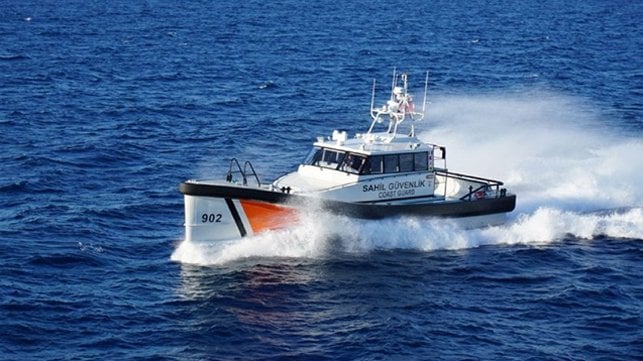
Turkish Fishermen Find Unexploded Drone in Waters Near Istanbul
The Turkish Coast Guard Command responded to the reports of an object in the water near Istanbul (Coast Guard)
The Turkish Coast Guard Command confirmed it was investigating the latest incident of an unexploded drone found in its waters. Earlier in Russia’s war with Ukraine, the concern had been errant mines, but more recently, Turkey is reporting a series of incidents with drones that have either crashed into its region or been spotted floating in the waters of the Black Sea.
The latest incident happened midday on Thursday, February 5, when a group of Turkish fishermen reported finding an unidentified device in the water. They were near Karaburun, in a district on the northwestern side of Istanbul.
The fishermen notified the Coast Guard Command, which sent a SAS team to investigate. According to the media reports, the team confirmed the object was an unmanned aerial vehicle. The team secured and neutralized the device. They analyzed it and, according to the reports, destroyed the UAV.
Turkey Today is reporting that it believes the device was a Russian-made Geran-2. It is based on the Iranian Shahed-136, a kamikaze aerial drone. The Coast Guard would only say that it was continuing to investigate the device.
Last July, Turkish officials confirmed the discovery of a 3-meter-long drone that looked a bit like a jet ski. Reports said it was carrying explosives. Since then, Turkey Today reports several other recent discoveries. In December, it says Turkey shot down a drone that violated its airspace. Over a five-day period, the newspaper says two more drones were found that had crashed in Turkey.
Concerns were raised because late last year and in January, a number of commercial vessels reported being struck by unknown objects, causing explosions and, in some cases, fires. Ukraine took credit for attacks on a few tankers heading to Russia, but the other incidents officially remain unsolved. Recently, it was reported that tankers were attempting to hug the Turkish coastline for added protection as they headed to the Russian terminals in the eastern Black Sea.
Dockworkers Disrupt Ports in Italy Protesting Alleged Arms Shipments
Italy's UBB union staged a 24-hour strike impacting many of the country's ports (UBB)
Port across Italy were reporting strikes and disruptions in their operations as unionized dockworkers staged a 24-hour strike to protest the alleged “militarization” of the ports. Reports indicate ships of Zim and MSC Mediterranean Shipping Company were being targeted and forced to hold offshore or divert.
Unione Sindacale di Base (UBB) called for the 24-hour action. They allege the ports are being “militarized” as shipments of arms and military equipment move on ships using their ports. The protest focused on arms to Israel, an issue that repeatedly appeared during the war in Gaza. Activists during the war protested against the ships moving through the ports and sought to deny port calls. The U.S. Federal Maritime Commission is investigating incidents related to Maersk Line, Ltd.'s American-flagged ships denied port calls in Spain in 2024.
The union’s calls for a day of action appear to have been largely followed, impacting most of the large ports in Italy. They are claiming that sympathy actions were also seen in Spain at Bilbao and Pasaia, Turkey in Mersin and Antalya, and even in Tangier Med, Hamburg, Bremen, Marseille, and Barcelona.
Among the ships that were reported to be impacted were three Zim containerships, all scheduled for port calls in Italy. AIS signals appeared to show that the Zim Virginia was holding off the Livorno coast, with the union saying the ship had been unable to dock. They are alleging the ship is “loaded with weapons.”
Additionally, the Zim New Zealand was holding in Fos-sur-Mer in France. The union reports it had been scheduled to dock in Genoa. The Zim Australia was holding in the Koper anchorage in Slovenia, with the union reporting it had been scheduled to dock in Venice and then proceed to Ravenna.
Additionally, the MSC Eagle III is sailing in the Mediterranean with its AIS signal showing it is coming from Israel. The union reports it was due to sail into Ravenna and then go on to Venice. Its AIS signal currently shows it is going to the anchorage at Koper.
According to the union’s reports, the container and RoRo terminals were blocked in Genoa, backing up road traffic as well as rail. Ships were reportedly not able to dock, and the strike had spread to La Spezia and Vado Gateway. They reported a 78 percent stoppage at La Spezia.
Similarly, in the east, in Trieste, the union said there was a broad impact on intermodal operations reaching Austria and Germany. They noted that those operations were already having to deal with delays due to adverse winter weather. The strike at Trieste, they said, was also impacting industrial traffic to Central Europe.