It’s possible that I shall make an ass of myself. But in that case one can always get out of it with a little dialectic. I have, of course, so worded my proposition as to be right either way (K.Marx, Letter to F.Engels on the Indian Mutiny)
This is a digitized version of an article from The Times’s print archive, before the start of online publication in 1996. To preserve these articles as they originally appeared, The Times does not alter, edit or update them.
Occasionally the digitization process introduces transcription errors or other problems; we are continuing to work to improve these archived versions
Years later, long after he was dead, “Bukharin's fox” was still racing around the Kremlin, which was empty and desolate by that time, and playing hide and seek in the Tainitsky Garden — Svetlana Alliluyeva, “Twenty Letters to a Friend.”
It was Bukharin's fox (he was a man inordinately fond of pets—hedgehogs, garter snakes, a crippled hawk and the famous fox) that haunted the Kremlin for years after Nikolai Bukharin was shot in March, 1938, following the greatest of Stalin's purge trials. But it is Bukharin's ghost, the indelible memory of his post‐Marxian philosophy and his remarkable prevision of the Nazi‐Soviet rapprochement and the inevitable deterioration of Stalin's Russia into proto‐Fascism, which remains to haunt the Communist world.
Nikolai Bukharin was Lenin's most brilliant disciple. He was more than that. He was in Lenin's last years almost his foster‐son, both in a personal sense and a political sense. It was of him that Lenin wrote in his famous Last Testament:
“Bukharin is not only the party's most valuable and greatest theoretician but he is also rightfully considered the favorite of the whole party.” Then Lenin added in a clear reflection of some recent disputes with Bukharin; “But his theoretical views can only with very great doubt be regarded as fully Marxist for there is something scholastic in them (he never studied and, I think, never fully understood dialectics).”
If his name has not come down to the present day with anything like the luster and excitement it evoked in the 1920's and 1930's the blame can be placed upon what Trotsky so precisely called “The Stalinist School of Falsification.” Bukharin's name was second only to Trotsky's when Lenin died in January, 1924. Now it glows dimly in the dusty polemics of Marxist splinters and in the occasional paragraph in the turgid prose issuing from the bowels of the MarxEngels‐Lenin Institute in Moscow.
Stephen Cohen's full‐scale study of Bukhaiin is the first major study of this remarkable associate of Lenin. As such it constitutes a milestone in Soviet studies, the by‐product both of increased academic sophistication in the use of Soviet materials and also of the very substantial increase in basic information which has become available in the 20 years since Stalin's death. Like the study of Stalin by Cohen's Princeton colleague, Robert C. Tucker, it is testimony to the maturity and mastery of Ameristudies in the Soviet field.
Cohen's industrious and thoughtful scholarship reveals that Bukharin tells us more about the present‐day Soviet Union than one might imagine. In his almost forgotten works written during and just after World War I (“Imperialism and World Economy,” “The Economics of the Transition Period,” and others) he drew a frightening picture of “militaristic state capitalism” that could serve as a blueprint of the Soviet state as it came to be under Stalin and his successors. Bukharin called it “the present‐day monster, the modem Leviathan,” a draconian proto‐Fascist state run by a dictatorial oligarchy which in Cohen's words, “mercilessly crushes all resistance.”
In this state, Bukharin said, “Centralization becomes the centralization of the barrack; among the elites the vilest militarism Inevitably intensifies as does the brutal regimentation and bloody repression of the proletariat.” Bukharin, as Cohen notes, was speaking of what he perceived as the emergence of “state capitalism” in the capitalist world. What he described fitted two states of the future—Hitler's Germany and Stalin's Russia.
Bukharin and Stalin clashed on two critical points concerning Germany. First, over Bukharin's opposition, through the Third International Stalin compelled the German Communists to break with the Social Democrats, thus insuring Hitler's rise to power. Then, with Hitler's advent —and this has nowhere been brought out more clearly than by Mr. Cohen —I3ukharin fought to the end against a policy of collaboration or detente with the Nazis, whereas Stalin as early as 1935 and 1936 had begun to lay the ground lines for the notorious Nazi‐Soviet pact.
This is not to suggest—and Mr. Cohen makes this clear—that Bukharin was a spotless hem. He was not. By collaborating wholeheartedly with Stalin until 1928 (despite some twistg and turns), he made possible Stalin's victories over all other rivals and placed himself in a position in which Stalin could cut hap down with comparative ease. Since Bukharin had supported repressive measures against many others, he was on shaky ground in opposing these tactics against himself. Like most of the old Bolsheviks, he helped to dig his own grave.
But unlike some old Bolsheviks, Bukharin perceived the abyss long before he was fi rally shoved into it. He was a brilliant writer and polemicist. For many years he was editor of Pravda and later the editor of Izvestia. It was in those pages that he fought Stalin's policies, first in open argument and ultimately in that cryptic code language the Communists call Aesopian—a kind of dauble‐talk.
Bukharin had no superior at this kind of trick. For example, at a time when Stalin's forced collectivization had spread famine through the countryside, Bukharin wrote: “What do the popes do? Do they not drive the Christiansi impoverished by papal plundering, to starvation —do they not unceasingly fleece their flock and cut into their flesh while shearing them?” The analogy was obvious to the alert Russian reader. (The Russian word for peasant is krestyanin.) Bukharin played this game to the end—to his appearance at the fateful purge trial of February‐March, 1938.
Mr. Cohen demonstrates rather conclusively that Bukharin did not testify as did his prototype, Rubashov, in Arthur Koestler's “Darkness at Noon” as a last service to the party.” His testimony almost certainly was compelled in his effort to save the lives of his young wife and son.
Having decided to testify, Bukharin then sought by means of Aesopian language to turn the trial into an “anti‐trial” in which he would place Stalin under indictment. This maneuver was only partially successful. It was clearly understood in a brilliant analysis written for the State Department at the time by George Kennan. A few of the Western correspondents present suspected what was going on, though the tactic was too subtle for United States Ambassador Joseph Davies and most of the world. They heard Bukharin's plea of guilty but did not penetrate the meaning of his brilliant duel with the prosecutor, Andrei Vishinsky.
On re ‐ reading the stenographic report of the BukharinVishinsky dialogue one can feel the tensions, the nearness to total revelation of the whole macabre Stalinist appamtus. But, of course, that reading is undertaken against a backdrop of more than 30 years' exposure of Stalin's lies, plots and crimes.
Yet there is a grim lesson in Bukharin's words and Bukharin's fate. Years have passed. The Old Bolsheviks are dead. Stalin is dead. Vishinsky is dead. Yagoda, Yezhov and Beria are gone. Even pedantic precise little Judge Ulrich who presided over all the trials and then primly retired to his second‐floor suite at the Metropole has died. But the system is not dead. Brezhnev is not Stalin. Nor is Solzhenitsyn Bukharin. Yet today the same deadly minuet is being played out in post‐Stalin Russia, in that vast and tragic country where, as Bukharin once put it, “Three ethical norms dominate everything: devotion to the ‘nation’ or to the ‘state,’ ‘loyalty to the Leader’ and the spirit.
Stephen F. Cohen has analyzed Bukharin's role witt brilliance and dogged determination. One must read this work to realize the extent to which Bukharin the man has been obliterated by the operation of the Soviet “memory hole” and the extermination of almost all those who knew him. Little remains but the enduring body of Bukharin's works, but these cast a lurid light over the Soviet regime which has emerged since the death of Stalin. ■
Nikolai Bukharin was a pioneer and founder member of Soviet Communism. An Old Bolshevik and a close comrade of Lenin, he was shot by Stalin, but eventually reinstated, posthumously, under Gorbachev. This collection of chapters provides is a systematic study of his ideas. The book analyses three major areas of his thought: economics and the peasantry, politics and international relations, and culture and science, and examines his influence both on his contemporaries and on subsequent thinkers. The introduction establishes the context for this discussion, and also provides a historical evaluation of Bukharin's role in relation to the emergence of Stalinism, the phenomenon that finally removed him from the political stage.
Contributors include Anna diBiagio, John Biggart, V. P. Danilov, Peter Ferdinand, Neil Harding, A. Kemp-Welch, Robert Lewis, and Alec Nove.
In 1919, Nikolai Bukharin, the leading theoretician of the Bolshevik Party, published a manual entitled The ABC of Communism meant to put the governing ideology of the newly formed Soviet State into eminently readable terms. Alexander Berkman, a Russian Anarchist who strongly supported the October Revolution, became disillusioned with the new regime in 1921 and left the country. He later published his own tract entitled The ABC of Anarchism.
This thesis pits these two theoretical works against each other as historical documents embodying the nature of leftist polemics that has characterized the movement since the dissolution of the First International. Both Bukharin’s and Berkman’s books engage in polemical self-definition by means of defining the other. By emphasizing Bukharin’s contributions to Bolshevism, this paper rescues the nature of the Bolshevik Party as a group of thinkers with wide-ranging beliefs in contrast to the historiographical trends that continue to emphasize Lenin as the only important figure in the party. I translate and analyze under-utilized articles that Bukharin published in New York from 1916-1917, and in Moscow in 1917 before the Revolution. In looking at Berkman’s critiques of Bolshevism in practice, the historiography of the Russian Revolution is enriched with analyses of the Party from the left, where it usually emphasizes criticism from the right. No major historiography exists on Berkman, and thus I typify his thought by reconciling his letters with his published works.
The tension in both Bukharin and Berkman in matching theory and practice is also a major component of this work and has its roots in the original splits of the Russian narodnik movement on the need for a vanguard
Wednesday, January 22, 2020
NIKOLAI BUKHARIN: ALTERNATIVE OR INTERREGNUM? Anthony Stephen Novosel, Ph.D. University of Pittsburgh, 2005 This dissertation examines the claims that Nikolai Bukharin was an inconsistent Marxist theoretician, at times “un-Marxist” in his thinking who radically altered his political philosophy to justify his support for such different policies as War Communism and the New Economic Policy. It also investigates the validity of the accepted wisdom that Bukharin represented a “liberal” alternative to Stalin and Stalinism within Bolshevism and that, by 1925, he had moved to the Right of the Party. This study begins by examining the conflicting visions of the state and the evolutionary and revolutionary strains within Marxism. It then studies the works of those Marxist thinkers, of the late nineteenth and early twentieth centuries, whose work on the state, revolution and the transition to socialism significantly influenced Bukharin’s work. Finally, it subjects Bukharin’s major theoretical works on imperialism, revolution and the role of the state in the transition to socialism, between 1915-1925, to an in-depth analysis to determine the validity of the claims made about Bukharin and his works. While one can still argue that Bukharin may have acted differently from Stalin once in power, this dissertation demonstrates that Bukharin was consistent in his theoretical work on the revolution and the transition to socialism. This study also conclusively demonstrates that Bukharin was located within the heart of both Marxism and Bolshevism and did not move to the Right during the NEP. It clearly shows that Bukharin’s support for War Communism and the NEP flowed directly from his original synthesis of the revolutionary and evolutionary strains within Marxism, and the need for a powerful, proletarian state, “The Dictatorship of the Proletariat,” that would manage the socialization of antagonistic petit-bourgeois elements into socialism, build socialism economically, and do whatever was necessary to protect the Revolution from its internal and external enemies. Thus, in reality, Bukharin, the “liberal alternative,” provided the philosophical foundation and justification for the use of unlimited state power, which in the hands of Stalin led to the “Revolution from Above” and from this perspective one can locate Bukharin as the philosophical interregnum between Lenin and Stalin. The Captain Goes Down With The Ship: Why Nikolai Bukharin Committed Political Suicide by Defending the New Economic Policy (NEP) Brenden Woldman
Monday, January 10, 2022
Sri Lanka 'technically bankrupt', seeks Chinese debt restructuring amid economic crisis
By KRISHAN FRANCIS
(Associated Press) Jan 10 2022 Fertiliser at the centre of a dispute between Sri Lanka & China
A dispute between Sri Lanka and China is escalating, and it all centres around organic fertiliser.
The president of debt-ridden Sri Lanka has asked China for the restructuring of its loans and access to preferential credit for imports of essential goods, as the island nation struggles in the throes of its worst economic crisis, partly due to Beijing-financed projects that don’t generate revenue.
President Gotabaya Rajapaksa told visiting Chinese Foreign Minister Wang Yi that it would be "a great relief to the country if attention could be paid on restructuring the debt repayments as a solution to the economic crisis that has arisen in the face of the Covid-19 pandemic,” according to a statement from his office.
Rajapaksa asked Wang for a concessionary credit facility for imports so that industries could run without disruption, the statement said. He also requested assistance to enable Chinese tourists to travel to Sri Lanka within a secure bubble.
Wang and Prime Minister Mahinda Rajapaksa, the president's brother, later visited Colombo’s Port City, a reclaimed island developed with Chinese investment, where they opened a promenade and inaugurated the sailing of 65 boats to commemorate the 65 years of diplomatic relations between the two countries.
In his speech at the Port City on Sunday, Wang said a persistent and unchecked pandemic had made economic recovery difficult and the two countries must use the anniversary to work closer together.
He did not elaborate nor announce any relief measures.
Wang arrived in Sri Lanka on Saturday from the Maldives on the last leg of a multinational trip that also took him to Eritrea, Kenya and the Comoros in East Africa. ERANGA JAYAWARDENA/AP Chinese Foreign Minister Wang Yi, left, poses for media before his meeting with Sri Lankan Prime Minister Mahinda Rajapaksa in Colombo, Sri Lanka.
Sri Lanka faces one of its worst economic crises, with foreign reserves down to around US$1.6 billion, barely enough for a few weeks of imports. It also has foreign debt obligations exceeding US$7b in 2022, including repayment of bonds worth US$500 million in January and US$1b in July.
The declining foreign reserves are partly blamed on infrastructure projects built with Chinese loans that don’t make money. China loaned money to build a seaport and airport in the southern Hambantota district, in addition to a wide network of roads.
Central Bank figures show that current Chinese loans to Sri Lanka total around US$3.38b, not including loans to state-owned businesses, which are accounted for separately and thought to be substantial.
“Technically we can claim we are bankrupt now,” said Muttukrishna Sarvananthan, principal researcher at the Point Pedro Institute of Development.
“When you have your net external foreign assets have been in the red, that means you are technically bankrupt.” ERANGA JAYAWARDENA/AP Sri Lankan President Gotabaya Rajapaksa, left, and Chinese Foreign Minister Wang Yi, center, inspect the Chinese funded sea reclamation Port City project in Colombo, Sri Lanka, Sunday, Jan. 9, 2022.
(AP Photo/Eranga Jayawardena)
The situation has left households grappling with severe shortages. People wait in long lines to buy essential goods like milk powder, cooking gas and kerosene. Prices have increased sharply, and the Central Bank says the inflation rate rose to 12.1 per cent by the end of December from 9.9 per cent in November. Food inflation increased to over 22 per cent in the same period.
Because of a currency shortage, importers are unable to clear their cargo containing essentials and manufacturers are not able to buy raw materials from overseas.
Expatriate remittances have also fallen after the government ordered the mandatory conversion of foreign currency and exchange rate controls.
Ratings agency downgrades have resulted in Sri Lanka losing much of its borrowing power. In December, Fitch Ratings noted an increased probability of credit default.
The Central Bank has added a currency swap in Chinese currency worth US$1.5b to the reserves, but economists disagree whether it can be part of foreign reserves or not.
Wang’s visit has again highlighted the regional power struggle between China and India, Sri Lanka’s closest neighbour that considers the island part of its domain. ERANGA JAYAWARDENA/AP A Chinese national who lives in Sri Lanka photographs the surroundings of Chinese funded sea reclamation Port City project during a ceremony held to mark the visit of Chinese Foreign Minister Wang Yi in Colombo, Sri Lanka.
Before Wang spoke with Sri Lankan leaders, the top Indian diplomat in the country on Sunday morning inaugurated a train service from a station near Colombo to the north using compartments provided through an Indian loan facility.
An Indian embassy statement quoted Vinod Jacob recalling “the priority placed by Indian Prime Minister Narendra Modi on ties with Sri Lanka in line with the ‘Neighbourhood First’ policy.”
He said that a recent statement by India's External Affairs Minister S Jaishankar that India would support Sri Lanka in difficult times was an affirmation of that policy in the current context.
“We can see Sri Lanka being saddled between India and China for a potential bailout package,” said political analyst Ranga Kalansooriya.
“India is dragging its feet for some time while China is trying to manipulate the situation to the maximum,” he added.
China considers Sri Lanka to be a critical link in its Belt and Road global infrastructure initiative. Relations were recently strained over a shipment of Chinese fertiliser that allegedly contained harmful bacteria, and business agreements that were inked with China’s rivals, the United States and India.
Kalansooriya said that China was unlikely to bail Sri Lanka out of its economic crisis. “They will look for more business opportunities, fishing in the troubled waters of economic doldrums in the country,” he said.
Bukharin on State Capitalism and Imperialism - Leftcom https://www.leftcom.org/.../bukharin-on-state-capitalism-and-imperialism 2020-08-21 · As we have already noted, for Bukharin, imperialism and state capitalism were linked to militarism and the inevitability of more wars. As he says in the article which follows, “Imperialism, militarism, state capitalism – this holy trinity of capitalist barbarism must be blown apart by the proletariat”. Imperialism was written in the first half of 1916 and published in mid-1917; Imperialism and World Economy was not published until several months later, but it was …
Ossinsky on Bukharin's Imperialism and the World … https://www.leftcom.org/en/articles/2019-09-11/ossinsky-on-bukharin-s... 2019-09-11 · For Bukharin the key features of the new phase of capitalism were imperialism and state capitalism. Lenin borrowed freely from Bukharin in his own “popular outline” in Imperialism – the Highest Stage of Capitalism but did not see that state capitalism was not a stage on the way to socialism. Bukharin made it quite clear in several places that for him state capitalism …
Imperialism: The Highest Stage of Capitalism ... https://socialistworker.org/2008/12/02/imperialism-the-highest-stage... 2008-12-02 · According to Bukharin, imperialism is the result of two conflicting tendencies in modern capitalism. Competition tends to give rise to the concentration and centralization of capital, and as this...
Nikolai Bukharin: Imperialism and World Economy https://www.marxists.org/archive/bukharin/works/1917/imperial/index.htm World Economy and the "National" State. Part 3 - Imperialism as the Reproduction of Capitalist Competition on a Larger Scale. 9. Imperialism as an Historic Category 10. Reproduction of the Process of Concentration and Centralisation on a World Scale 11. Means of Competitive Struggle, and State Power. Part 4 - The Future of Imperialism and World ...
As I noted in my reply to Argentine economist Claudio Katz, the debate among Marxists about imperialism theory has intensified in the past few years.1 A few weeks ago, another socialist writer, Promise Li, published a further contribution to this debate.2 Li is a socialist from Hong Kong now based in Los Angeles, where he is active as a member of Tempest Collective and Solidarity.
His contribution is an elaboration of his concept of imperialism as “antagonistic cooperation,” which he delineates, on one hand, from those who consider the “US Empire” as the only imperialist force and, on the other hand, from those who support Lenin’s orthodox theory of imperialism. As Li refers to me (correctly) as a supporter of the latter camp, I would like to respond to his criticism. I shall illustrate — both methodologically as well as empirically — that imperialism as “antagonistic cooperation” does not allow us to understand the dynamics of the current world situation.
As this is a wide topic, I will try to limit myself to the specific arguments and criticism presented by Li. For a more comprehensive elaboration of my understanding of the Marxist theory of imperialism, I refer readers to previous works.3
Li’s concept of imperialism as ‘antagonistic cooperation’
First, I would like to note that Li, in contrast to various other contributors to the debate, consistently rejects any accommodation to Chinese imperialism. As he noted in an interview, “the left must focus on building links between those resisting US and Chinese imperialisms.”4 Hence, he positively delineates himself from (proto-)Stalinist writers who adhere to a one-eyed anti-imperialism that strongly denounces the crimes of Washington but is very restrained when it comes to the crimes of Beijing and Moscow. No doubt, Li’s first-hand experience with the brutal reality of the Xi Jinping regime in Hong Kong has been pretty helpful for his understanding.
Nevertheless, his concept of imperialism is problematic as he downplays the accelerating inter-imperialist rivalry and overestimates the stability and cooperation between Great Powers. In contrast, I consider the capitalist world system as one which is in long-term decline. In such a period, the contradictions between imperialist powers in West (US, Western Europe and Japan) and East (China and Russia) as well as between these powers and semi-colonial countries cannot but intensify. Imperialism is not a system characterised by “antagonistic cooperation” but rather by antagonistic contradictions.
Before discussing the flaws of imperialism as “antagonistic cooperation”, I will start with a summary of Li’s presentation. He relates the origins of his theory to the writings of German communist August Thalheimer and Nikolai Bukharin, a leading Bolshevik theorist. The concept of imperialism as “antagonistic cooperation” was later revisited by the Brazilian Marxist collective Política Operária (POLOP) to which belonged, among others, Ruy Mauro Marini, most known for his theory of sub-imperialism.
I note in passing that the theory of sub-imperialism, like the concept of “antagonistic cooperation”, lacks a dialectical approach. However, at this point I will not discuss this issue and refer readers to other works in which I deal with the theory of sub-imperialism.5
Starting from this methodological basis, Li applies the concept to analyse the imperialist world order today.
[W]e can modify Thalheimer’s definition and consider antagonistic cooperation a particular stage of imperialism in which the terms for competition between national capitals take shape through or are mediated by the “interpenetration of mutual imperial interests and domains,” rather than cooperation and competition as distinct tendencies.
The author emphasises the relative stability of the capitalist world system. Of course, he recognises its repeated crisis, however, he thinks that the tendency towards cooperation between the powers is prevailing:
Without downplaying the ever-present threat of antagonistic crises and rivalries between states, this analysis foregrounds the capacity of the imperialist world system to maintain cooperative dynamics to maximize paths for global accumulation.
Consequently, Li delineates his concept from other theories such as, on one hand, that a “US-led Empire” dominates the world and, on the other hand, the orthodox Marxist theory of imperialism.
[W]e must not miss capitalism’s readjustment of its own constitution to develop new terms for recovery and stabilization. Antagonistic cooperation, a conceptual framework developed by Marxists in postwar Germany and Brazil, provides the best tools for analyzing this particular stage of imperialism. Unlike the unipolar theorization of Tricontinental or the multipolar rivalry of those following the Bolshevik theorists, which both overemphasize rivalry between imperialist powers, antagonistic cooperation understands the imperialist system as an interdependent totality that can accommodate interdependence between and beyond geopolitical blocs. Additionally, unlike the two models described above, antagonistic cooperation also allows for heterogeneity of power relations within this paradigm even as the overall structure of dependency between core and periphery economies continues to exist. For one, the rivalry between the United States and China does not imply their equality in the global imperialist system, which is still led and dominated by the former. What Claudio Katz calls “empires-in-formation,” and other intermediate or subimperial countries, are also cultivating the ability to occasionally check US power through military, economic, or other means. But this signals neither an anti-imperialist affront to US hegemony nor a straightforward leveling of the playing field as a new terrain of interimperialist rivalry.
Economic interdependence has shown surprising resilience even across rival geopolitical blocs. Existing theories of imperialism fail to fully account for these seemingly contradictory dimensions of today’s world system. Tricontinental theorizes the current stage of imperialism as “hyper-imperialism,” characterized by a unipolar “US-Led Military Bloc” as the sole imperialist force that renders all other global contradictions secondary or “non-antagonistic.” For the authors at Tricontinental, this imperialist bloc is being challenged by a multipolar “socialist grouping led by China,” representing “growing aspirations for national sovereignty, economic modernization, and multilateralism, emerging from the Global South.” Such a perspective disregards the implications of both the interdependence between the two blocs and the emergent role of certain intermediate economies — for example, Iran, the United Arab Emirates, and Russia — in developing regional hegemonies that facilitate imperialism amidst geopolitical tensions.
In contrast to Tricontinental, some see the form of imperialism today as an interimperialist conflict in the same vein as the First World War, which Bolshevik revolutionaries V. I. Lenin and Nikolai Bukharin first theorized. This view overly downplays the decline of US hegemony while overestimating the rise of new imperialists as a counterbalance to US imperialism. These faulty conceptions are two sides of the same coin: they overstate the dynamics of rivalry, thus obscuring salient sites of interconnection in the imperialist system that can yield powerful opportunities for solidarity across antisystemic struggles.
Thalheimer and Bukharin: Pioneers of the concept of ‘antagonistic cooperation’?
Who were Bukharin and Thalheimer? Bukharin joined the Bolsheviks as a young and dedicated militant and worked in the Moscow underground party before joining other Russian revolutionaries in exile. He became a Bolshevik leader in 1917 and was a key figure in shaping the party’s policy in the first decade after the revolution. Bukharin was a gifted theoretician who repeatedly clashed with Lenin on issues such as imperialism, the state and the national question. Nevertheless, he was a thoughtful and inspiring Marxist intellectual and Lenin appreciated his work, even calling him “the darling of the party”.
While Bukharin was initially a spokesperson for the ultra-left wing in the party, he joined Stalin’s faction in 1923 and played a crucial role in theorising the opportunist strategy of the Comintern, the pro-Kulak policy of the regime and as the expulsion of the Left Opposition, which was led by Leon Trotsky. Soon after the repression of the authentic Bolsheviks in late 1927, the Stalinist bureaucracy — facing economic crisis as a result of their past pro-Kulak policy — turned towards the forced collectivisation of the peasantry and super-industrialisation. Consequently, Stalin — whom Bukharin now realised to be a “new Genghis Khan” — kicked out the former “darling of the party”. However, in contrast to the Trotskyists, Bukharin and his supporters refrained from launching an opposition struggle and quickly capitulated to Stalin. This was the end of Bukharin as an independent politician and a few years later, during the horrific show trials in 1936-38, they were all shot.6
August Thalheimer was part of the left-wing of German social democracy before 1914, who joined the Spartacus League of Rosa Luxemburg and Karl Liebknecht during World War I. He became the Communist Party’s leading theoretician in 1921 when he and Heinrich Brandler took over the leadership. However, as they miserably failed in the revolutionary situation in the second half of 1923 (the “German October”), they had to retreat from leadership functions. After the downfall of their intellectual mentor Bukharin in 1928, Brandler and Thalheimer formed the so-called international Right Opposition, which only criticised the Stalinists for its ultra-left (but not its opportunist) mistakes and failed to call for an opposition struggle against the regime. Worse, they fully supported the arch-opportunist people’s front policy in the mid-1930s and refused to condemn the Moscow show trials. Unsurprisingly, the international Right Opposition crumbled in the late 1930s and only a small group continued to exist in Germany after World War II.7
Despite their methodological failings, Bukharin and Thalheimer (the first much more than the latter) were serious theoreticians who made a number of thoughtful contributions.
Like Li, the POLOP collective base their concept of imperialism as “antagonistic cooperation” on a German-language pamphlet by Thalheimer, Grundlinien und Grundbegriffe der Weltpolitik nach dem 2. WeItkrieg (Basic Principles and Concepts of World Politics after World War II), which was published in 1946. In this pamphlet, the German Communist called the imperialist alliance led by the US as “antagonistic cooperation”.
While it is true that this term originates from Thalheimer’s pamphlet, both POLOP and Li’s reference to this document is highly problematic. In this work, the German communist viewed his term “antagonistic cooperation” as a description of the situation after WWII. But he recognised that the cooperation between imperialist powers was based on the overriding class contradictions between the Western powers and the expanding Stalinist camp, and on the absolute superiority of the US. Hence his analysis of inter-imperialist cooperation was based on these conjunctural features.
Consequently, Thalheimer’s view of the world order was not one of “cooperation” but rather of a looming World War III, as the imperialist alliance was based on collective aggression against the Stalinist camp (the degenerated workers’ states):
We have shown that factors that have caused the imperialists’ urge for territorial expansion do not result in war within the capitalist camp but rather primarily in imperialist cooperation to different degrees. Therefore, this urge for territorial expansion can only be directed externally: against the socialist sector, the Soviet Union and its sphere of influence.”
If these facts show anything it is, in the immediate aftermath of World War II, the ongoing general deployment for a new world war.8
However, Li’s understanding of the concept of “antagonistic cooperation” is different. Such cooperation can no longer be based on a common policy of aggression against a joint enemy since the Soviet Union and its allies no longer exist. Hence, Li views “antagonistic cooperation” as a new stage of imperialism — independent of the existence of a common enemy that could keep the imperialist powers united. In contrast, Thalheimer elaborated his concept of “antagonistic cooperation” as a conjunctural description of a specific situation caused by the peculiar features of the outcome of World War II. For the German Communist, such a situation of “antagonistic cooperation” would not longer exist when the common enemy had disappeared.
Likewise, Bukharin's peculiar analysis of imperialism, certainly not without flaws, did not come close to the concept of “antagonistic cooperation” advocated by Li. Far from assuming a relatively stable world or even a prevailing cooperation between Great Powers, Bukharin viewed imperialism as an antagonistic system characterised by sharp inter-imperialist rivalry and a tendency towards war:
From the point of view of the ruling circles of society, frictions and conflicts between "national" groups of the bourgeoisie, inevitably arising inside of present-day society, lead in their further development to war as the only solution of the problem. We have seen that those frictions and conflicts are caused by the changes that have taken place in the conditions of reproducing world capital. Capitalist society, built on a number of antagonistic elements, can maintain a relative equilibrium only at the price of painful crises.9
The transition to a system of finance capitalism constantly reinforced the process whereby simple market, horizontal, competition was transformed into complex competition. Since the method of struggle corresponds to the type of competition, this was inevitably followed by the ‘aggravation’ of relations on the world market. Methods of direct pressure accompany vertical and horizontal competition, therefore the system of world finance capital inevitably involves an armed struggle between imperialist rivals. And here lies the fundamental roots of imperialism. … The conflict between the development of the productive forces and the capitalist relations of production must - so long as the whole system does not blow up - temporarily reduce the productive forces so that the next cycle of their development might then begin in the very same capitalist carapace. This destruction of the productive forces constitutes the conditions sine qua non of capitalist development and from this point of view crises, the costs of competition and - a particular instance of those costs - wars are the inevitable faux frais of capitalist reproduction.10
Bukharin — in contrast to Li — did not view the internationalisation of capitalist production and reproduction as a feature that would limit inter-imperialist tensions. Instead, he understood it as a development that would accelerate conflicts between Great Powers:
The international division of labour, the difference in natural and social conditions, are an economic prius which cannot be destroyed, even by the World War. This being so, there exist definite value relations and, as their consequence, conditions for the realization of a maximum of profit in international transactions. Not economic self-sufficiency, but an intensification of international relations, accompanied by a simultaneous "national" consolidation and ripening of new conflicts on the basis of world competition — such is the road of future evolution.11
Hence, the Bolshevik theoretician characterised war as an “immanent law” of imperialism:
War in capitalist society is only one of the methods of capitalist competition, when the latter extends to the sphere of world economy. This is why war is an immanent law of a society producing goods under the pressure of the blind laws of a spontaneously developing world market, but it cannot be the law of a society that consciously regulates the process of production and distribution.12
In summary, Li and the POLOP’s reference to Thalheimer and Bukharin as pioneers of the concept of “antagonistic cooperation” lacks justification.
A flawed methodological basis: Bukharin’s undialectical theory of equilibrium
Having said this, we do not deny that Li is partly justified in relying on Bukharin and Thalheimer, because imperialism as “antagonistic cooperation” shares certain methodological similarities with these two theoreticians. Namely, they all embrace — consciously or unconsciously — the mechanist equilibrium theory, which is devoid of dialectics.
Li’s “analysis foregrounds the capacity of the imperialist world system to maintain cooperative dynamics to maximize paths for global accumulation.” Likewise, he approvingly quotes another writer saying that “cooperation [between the imperialists] for the maintenance of the system prevails“:
As [Jeffrey] Sachs writes: ‘Antagonistic cooperation does not free the capitalist world from internal shocks at all levels, ups and downs. There are moments when antagonism seems to predominate, when the national bourgeoisies threaten an “independent” foreign policy, rebel against the schemes of the International Monetary Fund, and nationalize particularly unpopular foreign companies. The same phenomenon occurs among the imperialist powers themselves in moments of periodic relaxation of international tension. It disappears when there is a new upsurge in international tension and, as in France in 1968, when the capitalist regime is put in check. In the long run, cooperation for the maintenance of the system prevails.’
Bukharin disagreed with any view of the imperialist world as one of cooperation, but he did sympathise with the philosophical teachings of Alexander Bogdanov, who opposed dialectical materialism and elaborated a system called “organizational philosophy”. Bogdanov was a leading figure among the Bolsheviks in 1904-08, but Lenin waged a fierce struggle against him and his philosophy when political differences — Bogdanov combined idealist philosophy with support for ultra-left politics after the defeat of the first Russian Revolution in 1905-07 — threatened to paralyse the party. Lenin’s famous philosophical work Materialism and Empirio-criticism is a polemic against Bogdanov’s philosophy.13
Bukharin — about whom Lenin noted in his testament that “he has never made a study of dialectics, and, I think, never fully appreciated it” — adopted Bogdanov’s equilibrium theory. This theory considers reality as a (relative, moving) equilibrium which, repeatedly, gets disrupted by sudden crisis but, after some time, restabilises as a new equilibrium. In other words, equilibrium is the natural position of order. In his book Historical Materialism, Bukharin expresses this view explicitly:
On the other hand, we have here also the form of this process: in the first place, the condition of equilibrium; in the second place, a disturbance of this equilibrium; in the third place, the reestablishment of equilibrium on a new basis. And then the story begins all over again: the new equilibrium is the point of departure for a new disturbance, which in turn is followed by another state of equilibrium, etc., ad infinitum.14
This does not mean that Bukharin ignored contradictions and the resulting motion as crucial driving forces of development. However, he viewed contradictions not so much as an internal, essential feature of all things (including an equilibrium) but rather as something external. This is because he ignored the unity of opposites and the struggle between its contradictory parts as a fundamental law for understanding matter and its motion. “Development is the ‘struggle’ of opposites,” as Lenin said.15 Hence, for Bukharin motion was not so much caused by internal contradictions but rather by contradictions between different things (equilibriums).
He wrote:
If, in a condition of growth, the structure of society should become poorer, i.e., its internal disorders grow worse, this would be equivalent to the appearance of a new contradiction: a contradiction between the external and the internal equilibrium, which would require the society, if it is to continue growing, to undertake a reconstruction, i.e., its internal structure must adapt itself to the character of the external equilibrium. Consequently, the internal (structural) equilibrium is a quantity which depends on the external equilibrium (is a “function” of this external equilibrium)....16
The precise conception of equilibrium is about as follows: “We say of a system that it is in a state of equilibrium when the system cannot of itself, i.e., without supplying energy to it from without, emerge from this state.”17
Bukharin did not explicitly deny the role of internal contradictions; he was too smart a Marxist intellectual for this. But despite his intentions, he systematically underestimated the decisive role of internal contradictions as the primary driving force of motion.
A materialist dialectic critique
The connection between the mechanist equilibrium theory of Bukharin and the concept of imperialism as “antagonistic cooperation” should be clear. The philosophy of downplaying the struggle of opposites and of internal contradictions causing motion results in an understanding of reality as a state of (moving) equilibrium. On such a methodological basis, one ends up easily viewing the world situation as primarily characterised by relative stability and cooperation between imperialists. As a result, one gets confused and can not recognise the direction of motion of world politics and economy.
The mechanist method is incapable of answering correctly a crucial question: what is the determining characteristic of matter — a state of equilibrium or contradiction and motion as a result of the struggle of opposites? From the point of view of materialist dialectic, the correct answer is that the struggle of opposites, contradiction, is the determining feature since it causes motion, transformation, progress. In contrast, the state of equilibrium is only a temporary moment. Hegel was right when he noted: “Contradiction is the root of all movement and vitality, and it is only insofar as it contains a Contradiction that anything moves and has impulse and activity.”18
This was also the understanding of Marx and Engels. The latter explained in his Anti-Dühring:
Motion is the mode of existence of matter. Never anywhere has there been matter without motion, nor can there be. Motion in cosmic space, mechanical motion of smaller masses on the various celestial bodies, the vibration of molecules as heat or as electrical or magnetic currents, chemical disintegration and combination, organic life — at each given moment each individual atom of matter in the world is in one or other of these forms of motion, or in several forms at once. All rest, all equilibrium, is only relative, only has meaning in relation to one or other definite form of motion... Matter without motion is just as inconceivable as motion without matter. Motion is therefore as uncreatable and indestructible as matter itself.19
Based on such an approach, Lenin emphasised in his article “On the Question of Dialectics” that motion and the struggle between opposites are absolute while stability and unity of opposites are relative:
The unity (coincidence, identity, equal action) of opposites is conditional, temporary, transitory, relative. The struggle of mutually exclusive opposites is absolute, just as development and motion are absolute.20
Materialist dialectic refuses to view equilibrium as the “normal” or “basic” condition of matter. It is rather a temporary stage in a long process of motion. Engels noted in his preliminary studies for his Dialectics of Nature:
[T]he individual motion strives towards equilibrium, the motion as a whole once more destroys the individual equilibrium… All equilibrium is only relative and temporary.21
It is now possible to better understand the category of equilibrium. Marxists do not deny the legitimacy of this category. But it must be understood properly. Motion does not take place in a vacuum. It is caused by the struggle of opposites. Such struggle can only take place if there is a relationship between these opposites. The totality of such relationships constitutes a kind of (temporary) equilibrium. But such a relationship is in constant motion because “reality is a process of creation and destruction,” as Abram Deborin, the leading philosopher of the great dialectical school that dominated philosophical discussions in the Soviet Union in the 1920s, noted.22
From the point of view of materialist dialectic, there exists a clear dialectical hierarchy. NA Karev, another leading philosopher of the Deborin school and supporter of Trotsky’s Left Opposition, explained in a critique of Bogdanov’s equilibrium theory:
Hence, Engels does not say at all that this or that state of equilibrium would not exist in reality. But they are provisional, they only constitute moments in the motion of matters, they make sense only in relation to this or that form of moments, they are the result of a limited motion. Hence, the states of equilibrium are subordinated and temporary moments in the process of motion and development. The fundamental and determining factor is the motion.23
Karev’s critique of Bogdanov also applies to imperialism as “antagonistic cooperation,” as advocated by Li and POLOP:
Bogdanov’s theory of equilibrium basically rests on the static point of view and not the dynamic one, as it recognizes the moment of static state as determining and not the moment of motion of a given body. The category of “moving” equilibrium does not solve the problem as it views mobility as a breach of the equilibrium and not the other way round — that the state of equilibrium is a provisional and relative moment of stability within the process of motion. The unity of equilibrium and motion is here understood by emphasizing the category of equilibrium while dialectic emphasizes the motion of a body, which is always and everywhere inherent to it.24
This brings us to the last point of our brief philosophical digression. Underestimating the centrality of struggle of opposites resulting in motion, and overemphasising the concept of equilibrium, results in an inability to assess the dynamic and direction of development. For a mechanist, who is fixated on the state of equilibrium, things appear as static. In reality, profound developments take place “below the surface,” which can only be recognised by dialectically approaching a given state of things (an “equilibrium”) as a temporary expression of motions caused by the struggle of opposites.
To give a simple analogy from daily life. If one is cooking water at home, one would not observe big changes most of the time. The water appears unvaried … until the final moments when it starts boiling. Does this mean that for 99% of the time, nothing is happening, and the water is just in a state of equilibrium? You do not need a degree in physics to know that this is not the case, but that a “hidden” process of heating has taken place.
Similarly, Marxists analysing developments in world politics and economy must not stop at observing only those phenomena that appear at the surface. They must look below the surface and identify the processes of accumulating contradictions in order to understand the direction of development with ruptures and explosions ahead. As Deborin once said: “First and foremost, a Marxist must determine the general direction of development.”25
This is only possible if one applies a materialist and dialectical method and avoids the doctrinaire schemas of mechanist equilibrium theory, which paint an illusionary picture of drowsy stagnation. Hegel noted that the method is the “soul and substance” and that “anything whatever is comprehended and known in its truth only when it is completely subjugated to the method.”26 Without the method of materialist dialectic, one cannot understand the dynamic of modern imperialism.
The mechanist method a la Bukharin obstructs recognition of the decay of capitalism and the accompanying processes of wars, revolutions and counterrevolutions.
Capitalism in the 21st century: Restoring its growth dynamic?
Li emphasises that elements of cooperation between imperialist powers (and with national bourgeoisies in the Global South) are prevailing. Likewise, while he recognises that capitalism is facing repeated crises, he believes it has shown the capacity to overcome these and restore growth (albeit, he says, this is not an automatic process but needs political intervention):
However, we must also not mistake this interdependence for an inert tendency of the system toward equilibrium. In reality, the maintenance of this cooperation requires continual upkeep, especially as the capitalist system is forced to address the repeating appearance of crises stemming from its internal contradictions. The crises of profitability in the 1970s and the 2000s, for example, required fundamental transformations in how capitalism is organized in order to restore growth (and the suppression of working-class insurgency). Thus, the terms for cooperation must be consciously reinvented to be maintained.
But in the mid-1970s, capitalism entered a long-term period of crisis — or a “curve of decline” to use a category from Trotsky’s concept of “curves of capitalist development” that he elaborated in 1923.27 This process of crisis has deepened since the Great Recession in 2008/09.28
Naturally such decay is not a linear process since capitalist reproduction proceeds in business cycles and countervailing tendencies exist. However, the tendency of decline prevails, as evidenced by numerous facts.
Most importantly, there exists a profound civilisation crisis reflected in the devastating climate change with catastrophic consequences for growing parts of humanity.29 Likewise, there is a clear tendency towards stagnation and decline in the capitalist world economy, resulting in growing waves of migration, social misery and more wars. Related is the accelerating militarisation and rivalry between imperialist powers. Two major wars — in the Middle East and Ukraine — involving Great Powers, directly or indirectly, and with the potential to spread to other countries are powerful examples for this.
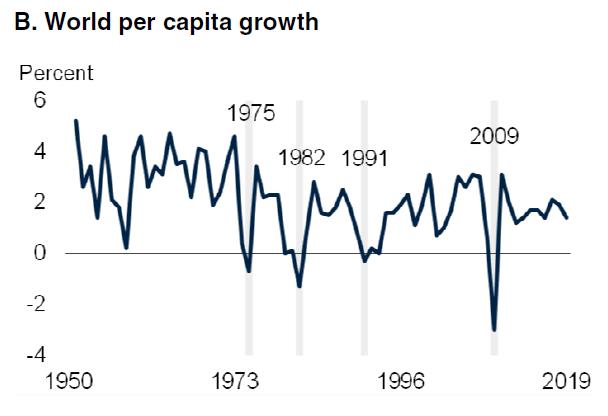
I have dealt with these issues elsewhere, so I will limit myself to presenting a few figures that demonstrate the declining dynamic of the capitalist world economy. Table 1 and Figure 1 show that there has been a continuous decline in Gross Domestic Product (GDP) growth rates — both in total as well as per capita — since the ’50s. These tables do not include figures for the Great Depression that started in late 2019, the worst slump since 1929.
Table 1: Average Annual Growth of Global GDP 1960-201930
Table 1: Average Annual Growth of Global GDP 1960-2019
Figure 1: Average Annual Growth of Global GDP Per Capita 1950-201931
Figure 1: Average Annual Growth of Global GDP Per Capita 1950-2019
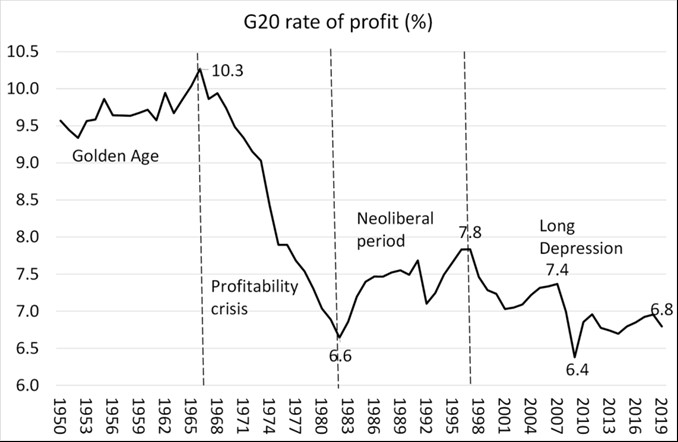
Declining growth rates have gone hand in hand with, or rather been caused by, a corresponding decline in the profit rate, which is, ultimately, the result of the declining share of living labour and rising share of dead labour (machines and raw materials) in total capital. Marx once noted, “this law, and it is the most important law of political economy, is that the rate of profit has a tendency to fall with the progress of capitalist production.”32
Figure 2 shows the development of the profit rate in the 20 largest economies (G20 states) in the past seven decades. As we can see, there has been a long-term tendency of the profit rate to fall, as Marx predicted.
Figure 2: Rate of Profit in G20 Economies 1950-201933
Figure 2: Rate of Profit in G20 Economies 1950-2019
World capitalism has not restored its growth rates of earlier times — despite numerous political interventions by the ruling class and despite “antagonistic cooperation”. It remains trapped in a long-time period of stagnation and decline.
Overestimating the rise of Chinese and Russian imperialism?
Li believes that I and others “overly downplay the decline of US hegemony while overestimating the rise of new imperialists as a counterbalance to US imperialism”. Unfortunately, he does not provide a single quote to prove his claim. I have not the slightest idea why Li thinks that I underestimate the decline of US hegemony. In any case, I think his criticism is not justified.
I have, however, shown how China’s capitalist class has not only massively enriched itself at the cost of the domestic working class but also been able to challenge the US on the world market. Again, I will limit myself to demonstrating this with just a few figures and refer interested readers to more elaborate studies.34
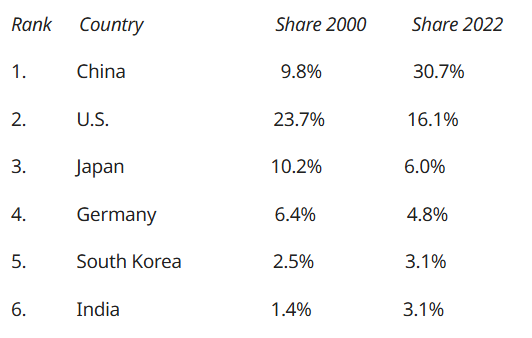
In the tables below, you can see that China has rapidly caught up with the long-time hegemon, US imperialism. Table 2 shows that China’s share in global manufacturing output was less than half of the US in the year 2000 (9.8% to 23.7%); however, by 2022, its share was already nearly double that of its Western rival (30.7% to 16.1%).
Table 2. Top Six Countries in Global Manufacturing, 2000 and 202235
Table 2. Top Six Countries in Global Manufacturing, 2000 and 2022
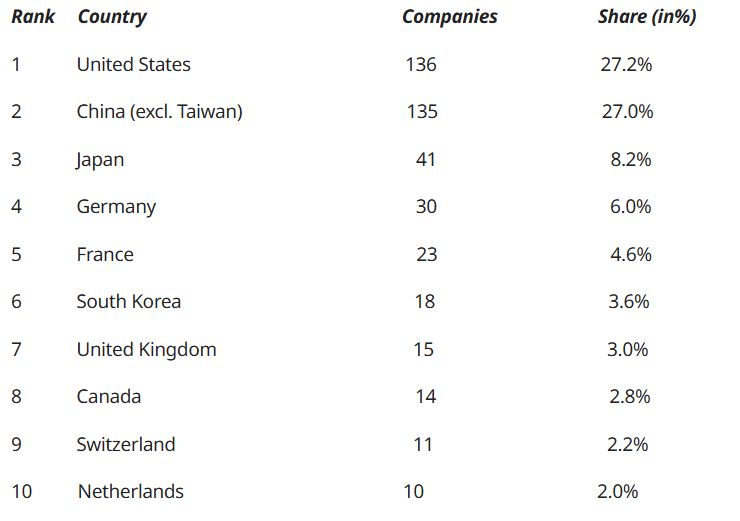
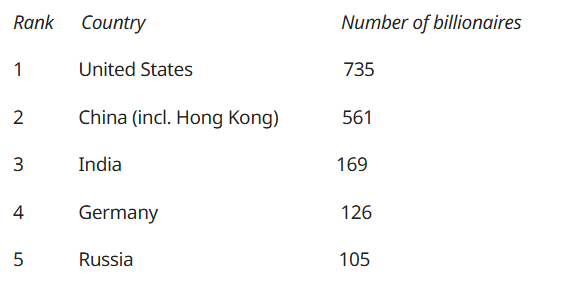
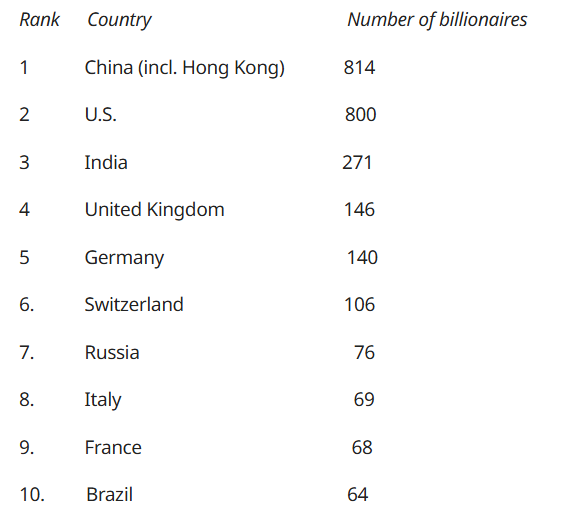
A similar picture emerges when we look at the national composition of the world’s leading corporations as well as the global ranking of billionaires (Table 3-5). In all these categories, China has become No.1 or 2 — ahead or behind the US
Table 3. Top 10 Countries with the Ranking of Fortune Global 500 Companies (2023)36
Table 3. Top 10 Countries with the Ranking of Fortune Global 500 Companies (2023)
Table 4. Top 5 Countries of the Forbes Billionaires 2023 List37
Table 4. Top 5 Countries of the Forbes Billionaires 2023 List
Table 5. Top 10 Countries of the Hurun Global Rich List 202438
Table 5. Top 10 Countries of the Hurun Global Rich List 2024
Russia has also developed a monopoly capital that dominates the domestic market and exports capital to various other countries, mainly in Central Asia and Eastern Europe. Its economic strength has been demonstrated by the fact that it has managed to resist an unprecedented wave of sanctions by Western powers for nearly three years. Its position on the world market is substantially weaker, albeit it has recently surpassed Germany’s and Japan’s GDP in PPP terms (Purchase Power Parity).39
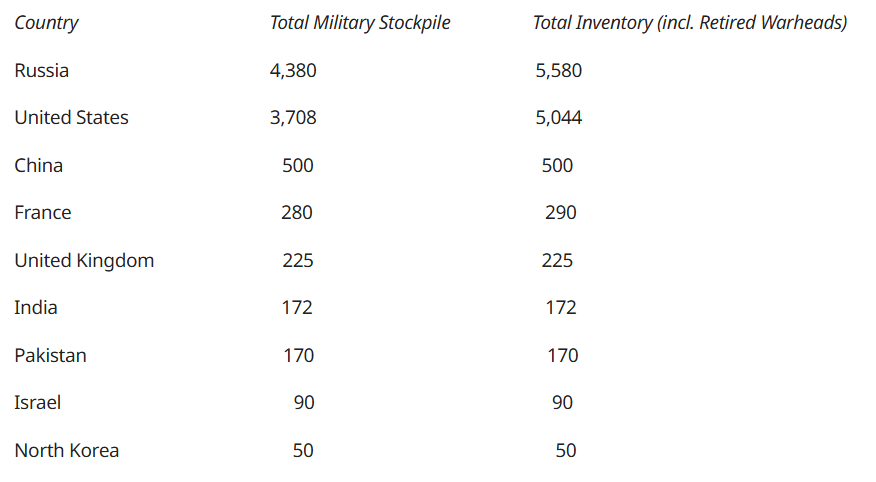
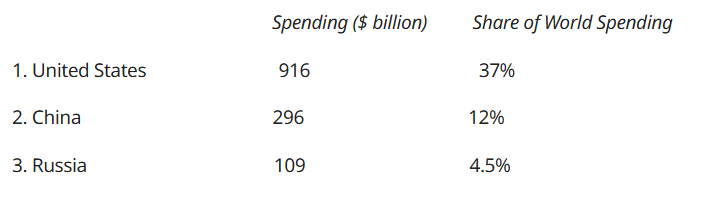
But while in economic terms Russia is clearly behind the US and China, it is a leading force in the military field. It has the largest nuclear arsenal and the third highest military expenditure. (See Table 6 and 7) Furthermore, it has demonstrated its military aggressiveness through numerous military interventions in other countries to expand its influence, putting down popular rebellions or keeping allied dictatorships in power (for example in Chechnya, Georgia, Kazakhstan, Syria, Libya, Mali, etc.)40
Table 7. Military Expenditure, in Billion US-Dollar as Share of World Spending, 202342
Table 7.Military Expenditure, in Billion US-Dollar as Share of World Spending, 2023
Furthermore, China and Russia have substantially expanded their spheres of influence as the enlargement of BRICS shows. Four states — Egypt, Ethiopia, Iran and United Arab Emirates — formally joined the five original BRICS members (Brazil, Russia, India, China and South Africa) at the start of 2024. One country, Saudi Arabia, has been invited to join but still not decided if it will. In October 2024, 13 other states became so-called “partner countries” (Algeria, Belarus, Bolivia, Cuba, Indonesia, Kazakhstan, Malaysia, Nigeria, Thailand, Türkiye, Uganda, Uzbekistan, and Vietnam).
As I elaborate in more detail in my reply to Katz, BRICS+ had, after its expansion to nine member states in 2023, a combined population of about 3.5 billion, or 45% of the world’s people (it is now more than half if one includes the new “partner countries”). Its combined GDP, depending on the method of calculation, is either a bit more than one third behind the Western Great Powers (G7) or has already surpassed the old imperialist powers. Likewise, BRICS+ accounts for 38.3% of the total world industrial production — the main sector of capitalist value production.
As for energy sources, BRICS+ members own 47% of the world’s oil reserves and 50% of its natural gas reserves.43 As of 2024, BRICS+ controls approximately 72% of the world's rare earth metal reserves.44
It is true that BRICS+ is not a homogenous and centralised alliance. Still, it is a “a non-western group", as Indian Prime Minister Narendra Modi and Russian president Vladimir Putin emphasised, dominated by Chinese and Russian imperialism. Furthermore, BRICS+ countries are capitalistically less developed and have a lower living standard.
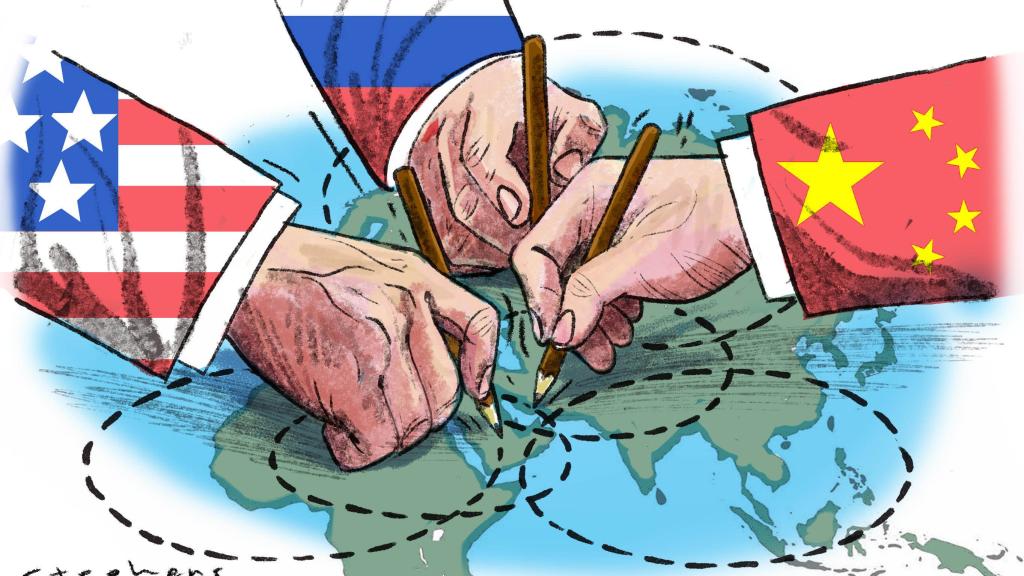
Nevertheless, while Li thinks that I overestimate the rise of China and Russia as new imperialist powers, I believe he underestimates this process and, as a result, also underestimates the acceleration of inter-imperialist rivalry. The military threats and nuclear sabre rattling between NATO and Russia, as well as the accelerating military tensions between Washington and Beijing in the South China Sea around Taiwan, are clear indications that the imperialist system is not so much characterised by “antagonistic cooperation” but rather by antagonistic contradictions.
It is therefore hardly surprising that, as SIPRI reports, global military expenditure has risen year on year since the mid-’90s and at $2,443 billion is about twice as high as it was 30 years ago. 45
The accelerating inter-imperialist rivalry is not limited to armament and military tensions. There is also an escalating trade war between the US, China, EU and Russia combined with rising protectionism. In fact, globalisation has ended since the Great Recession in 2008. Since then, world merchandise trade has declined as a share of global output from 51.2% (2008) to 45.8% (2023).46
So, when Li says that “far from undoing the neoliberal world order, the capitalist class innovates new terms for maintaining and reforming globalization”, he completely misunderstands the direction of development of relations between imperialist powers.
For all these reasons, it is difficult to understand why Li objects to the category of a “new Cold War” between the Western and Eastern powers, calling it an “ideological fiction”. Does he not see the rising militarism and acceleration of rivalry, which all point to another world war between the imperialist powers?
As I insisted before, Marxists must “determine the general direction of development” to understand the coming ruptures and explosions. Li’s concept of imperialism as “antagonistic cooperation” does not help in understanding the dynamics of the current world situation.
Is capitalist interdependence an obstacle for inter-imperialist war?
Finally, I want to deal with another important argument Li raises in his essay. He argues that “economic interdependence” has been a key feature of modern imperialism and, as a result, this constitutes the material basis for “antagonistic cooperation” between powers. Li even believes that such economic interdependence makes inter-imperialist war impossible or at least unlikely:
Indeed, global economic integration still existed in salient forms during the First World War, but mostly just contained within geopolitical camps, which historian Jamie Martin calls “strained interdependence.” However, the rise of neoliberalism has developed a level of interdependence that endures even across rival state blocs, thus undercutting the possibility of open interimperialist warfare witnessed in the first two World Wars.
This is wrong — both methodologically and historically. Bukharin correctly pointed out that interdependence not only deepens economic links but also accelerates rivalry. In the past years, China and the US have been among each other’s most important trading partners. This has not prevented these powers from starting and accelerating a trade war. The same is now the case between China and the EU, where the latter has imposed substantial tariffs on Chinese imports. True, big business on both sides is not happy about this. But in the end, they have to subordinate themselves to the objective laws of capitalism and its inherent inter-imperialist rivalry.
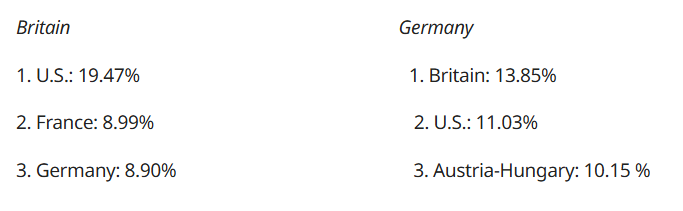
There is a historic precedent for such a development. Britain and Germany, two major rivals in World War I, had close economic relations before 1914.47 Table 8 shows that Britain was Germany’s most important trade partner before 1914 (the US was No. 2) while Germany was nearly as important as France for Britain’s trade. However, such economic interdependence did not prevent these powers from launching the most devastating war against each other.
Table 8. Main Trade Partners of Britain and Germany, 1890-1913 (Average % Share)48
Table 8. Main Trade Partners of Britain and Germany, 1890-1913 (Average % Share)
In the long run, increasing economic interdependence between imperialist powers does not result in a more stable capitalist world system. Nor does it create a type of imperialism characterised by “antagonistic cooperation”. Rather, imperialism remains a system full of antagonistic contradictions.
Conclusions
1. The concept of imperialism as “antagonistic cooperation” does not allow us to understand the dynamics of the current world situation. Li correctly recognises the imperialist nature of the old Western and new Eastern powers (China and Russia), but he mistakenly criticises supporters of the orthodox theory of imperialism of overestimating the rivalry between these.
2. Referencing Thalheimer and Bukharin as pioneers of the concept of imperialism as “antagonistic cooperation” is misleading. Bukharin, despite his weaknesses, emphasised rivalry and antagonism between imperialist powers, which inevitably had to result in wars. It is true that Thalheimer elaborated the thesis of “antagonistic cooperation” between imperialist powers in 1946. But this was a (correct) description of a specific global situation characterised by the huge expansion of the Stalinist states and the outcome of World War II, with the US as the absolute hegemon among imperialist states. His thesis of more cooperation between imperialist powers was directly related to their collective aggressive approach against the Stalinist states, which pointed to a new world war. Thalheimer considered that inter-imperialist tensions would be reduced because they were overridden by the huge acceleration of tensions between imperialist and degenerated worker states. However, after Stalinism collapsed in 1989-91, Thalheimer’s concept is no longer applicable for imperialism today.
3. It is true that Bukharin, the political mentor of Thalheimer, was influenced by the philosophy of Bogdanov, a staunch opponent of dialectical materialism. He advocated a world view that incorporated the mechanist equilibrium theory: a concept that downplays the role of internal contradictions as the driving force of motion. Consequently, supporters of such a method consider equilibrium as the main feature of matter when, in fact, it is motion. The Bukharinite method underestimates the tendencies of rupture, crisis and explosions in the world situation and overestimates its stability and equilibrium. Imperialism as “antagonistic cooperation“ suffers from such methodological deficits.
4. From the point of view of materialist dialectic, the driving force of motion are the internal contradictions caused by the unity and struggle of opposites. The mechanist method is incapable of answering this question correctly: what is the determining characteristic of matter — a state of equilibrium or contradiction and motion as a result of the struggle of opposites? From the point of view of materialist dialectic, the correct answer is that the struggle of opposites and contradiction is the determining feature, since it causes motion, transformation, progress. In contrast, the state of equilibrium is only a temporary moment.
5. There is a clear connection between the mechanist equilibrium theory of Bukharin and imperialism as “antagonistic cooperation”. The philosophy of downplaying the struggle of opposites and internal contradictions causing motion results in an understanding of reality as a state of (moving) equilibrium. On such a methodological basis, one ends up viewing the world situation as primarily characterised by relative stability and cooperation between imperialists. As a result, one can not recognise the direction of motion of world politics and economy.
6. Consequently, Li does not take sufficient account of the crisis-ridden character and decay of the imperialist world system, both economically and politically. The capitalist world economy is trapped in long-term stagnation and decline, climate change is threatening the survival of humanity, and social misery and wars are spreading.
7. Li’s criticism that I overestimate the rise of Chinese and Russian imperialism ignores the qualitative changes in the relation of forces between the Great Powers in the past 10-20 years. The Eastern imperialists are seriously challenging Western hegemony — economically, political and militarily. In fact, Li’s critique is related to his underestimation of inter-imperialist rivalry and his view that “antagonistic cooperation” is the main feature of the world situation.
8. Li claims that “economic interdependence” is a key feature of modern capitalism and that this “undercut[s] the possibility of open interimperialist warfare”. However, history has shown that this is not true. In the long run, increasing economic interdependence between imperialist powers does not result in a more stable capitalist world system. It does not create a type of imperialism characterised by “antagonistic cooperation”. Rather, imperialism remains a system full of antagonistic contradictions.
Michael Pröbsting is a socialist activist and writer. He is the editor of the website http://www.thecommunists.net/, where a version of this article first appeared.
Michael Pröbsting: Age of ‘Empire’ or age of imperialism? A reply to Claudio Katz https://links.org.au/age-empire-or-age-imperialism-reply-claudio-katz
For a critique of the “sub-imperialism” theory see Semi-Colonial Intermediate Powers and the Theory of Sub-Imperialism. A contribution to an ongoing debate amongst Marxists and a proposal to tackle a theoretical problem, 1 August 2019, https://www.thecommunists.net/theory/semi-colonial-intermediate-powers-and-the-theory-of-sub-imperialism/; see also chapter IV (“The Marxist Criteria for an Imperialist Great Power“ in our above-mentioned book “Anti-Imperialism in the Age of Great Power Rivalry”)
Useful biographies of Bukharin are e.g. Stephen Cohen: Bukharin and the Bolshevik Revolution. A Political Biography, 1888–1938. Oxford University Press, 1980; Wladislaw Hedeler: Nikolai Bucharin. Stalins tragischer Opponent. Eine politische Biographie. Matthes & Seitz, Berlin 2015; Adolf G. Löwy: Die Weltgeschichte ist das Weltgericht. Leben und Werk Nikolai Bucharins. Promedia-Verlags-Gesellschaft, Wien 1990; Anna Larina: This I cannot forget. The Memoirs of Nikolai Bukharin's Widow. W. W. Norton & Co, New York 1993.
On the history of the Right Opposition in English-language see Robert J. Alexander: The Right Opposition. The Lovestoneites and the International Communist Opposition of the 1930s, Greenwood Press, London 1981
On Alexander Bogdanov see James D. White: Red Hamlet: The Life and Ideas of Alexander Bogdanov, Brill, Leiden 2018; Dietrich Grille: Lenins Rivale: Bogdanov und seine Philosophie, Verlag Wissenschaft und Politik, Cologne 1966; see also the foreword of Bogdanov's Tektology Vol. 1 by Vadim N. Sadovsky and Vladimir V. Kelle, Centre for Systems Studies, University of Hull, 1996, pp. iii-xxii; V.A. Bazarov: Bogdanov as a Thinker, in: Alexander Bogdanov: Empiriomonism. Essays in Philosophy, Books 1–3, Brill, Leiden 2020, pp. xvii-xli.
Nikolai Bukharin: Historical Materialism. A System of Sociology (1921), Authorized Translation from the third Russian edition, George Allen & Unwin, Ltd, London 1926, p. 74
Georg Wilhelm Friedrich Hegel: Science of Logic, George Allen & Unwin, Ltd, New York 1969, p. 439 (also quoted in V.I. Lenin: Conspectus of Hegel’s Book the Science of Logic (1914); in: LCW 38, pp. 178-179)
Abram Deborin: Lenin als revolutionärer Dialektiker (1925); in: Nikolai Bucharin, Abram Deborin: Kontroversen über dialektischen und mechanistischen Materialismus, Frankfurt a.M. 1974, p. 54 (our translation)
N.A. Karew: Die Theorie des Gleichgewichts und der Marxismus; in: Wilhelm Goerdt (Hrsg.): Die Sowjetphilosophie. Wendigkeit und Bestimmtheit. Dokumente, Darmstadt 1967, p. 139 (our translation)
For our analysis of the current historic period see e.g. chapter 14 in the above-mentioned book “The Great Robbery of the South” as well as chapter I and II in the above-mentioned book “Anti-Imperialism in the Age of Great Power Rivalry”.
M. Ayhan Kose, Franziska Ohnsorge (Eds.): A Decade since the Global Recession, Lessons and Challenges for Emerging and Developing Economies, World Bank, 2019, p. 9
Figures for the year 2000: APEC: Regional Trends Analysis, May 2021, p. 2; the figures for Germany and India in the first column are for the year 2005 (UNIDO: Industrial Development Report 2011, p. 194); figures for the year 2022: UNIDO: International Yearbook of Industrial Statistics Edition 2023, pp. 36-37
I have published a number of works about capitalism in Russia and its rise to an imperialist power. The most important ones are the following pamphlets: The Peculiar Features of Russian Imperialism. A Study of Russia’s Monopolies, Capital Export and Super-Exploitation in the Light of Marxist Theory, 10 August 2021, https://www.thecommunists.net/theory/the-peculiar-features-of-russian-imperialism/; Lenin’s Theory of Imperialism and the Rise of Russia as a Great Power. On the Understanding and Misunderstanding of Today’s Inter-Imperialist Rivalry in the Light of Lenin’s Theory of Imperialism. Another Reply to Our Critics Who Deny Russia’s Imperialist Character, August 2014, http://www.thecommunists.net/theory/imperialism-theory-and-russia/; Russia as a Great Imperialist Power. The formation of Russian Monopoly Capital and its Empire, 18 March 2014, http://www.thecommunists.net/theory/imperialist-russia/.
See on this Helga Nussbaum: Der europäische Wirtschaftsraum. Verflechtung, Angleichung, Diskrepanz, in: Fritz Klein, Karl Otmar von Aretin (Eds): Europea um 1900, Akademie-Verlag, Berlin 1989, p. 49
Stefano Battilossi: The Determinants of Multinational Banking during the First Globalization, 1870-1914, Working Papers 114, Oesterreichische Nationalbank (Austrian Central Bank), 2006, p. 40