Sunday 18 January 2026, by Dan La Botz
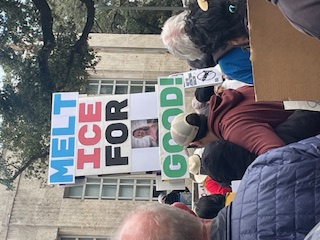
At the moment, Minneapolis is the frontline of the resistance.
President Donald Trump is at war with Governor Tim Walz of Minnesota, whom he hates as a political rival, and at war with liberal Minneapolis, the state’s largest city. Trump has now sent 3,000 agents of Immigration and Customs Enforcement (ICE) into Minneapolis, 1,000 more than there were before ICE murdered activist Renée Nicole Good. There are now more ICE agents in Minneapolis than there are police in the metropolitan area. The majority of the inhabitants see this as an occupation that is bringing fear and more violence into their city.
ICE agents, masked, wearing bulletproof vests, and carrying firearms and chemical sprays, appear at schools, hospitals, churches, and businesses, and without arrest warrants, grab brown and black people, both immigrants and U.S. citizens, put them into cars and take them away. Some are later released; some are shipped to far away cities to make it difficult for friends and families to find and help them. Because of ICE patrols, Minneapolis and other nearby districts have closed their schools for the next few weeks, offering virtual learning instead.
President Trump and Kristi Noem, head of the Department of Homeland Security, claim that ICE agents enjoy “absolute immunity.” But a federal judge, Kate M. Menendez issued a temporary injunction forbidding ice agents from retaliating against people “engaging in peaceful and unobstructive protest activity,” and from using “crowd dispersal tools” in retaliation for protected speech and from stopping and detaining people in cars unless they were forcibly blocking ICE. Judges in California, Illinois and Washington, D.C. have issued similar rulings in suits brought by immigrant rights organizations.
Both ordinary people and the city’s and state’s politicians, like Governor Tim Walz and mayor Jacob Frey consider what is happening to be an illegal, violent occupation. And there is resistance. Wherever ICE agents appear, members of activist networks blow their whistles to alert their neighbors and many come into the street to shout at the ICE agents to get out. Others have used their cars to block the streets and impede ICE. Some activists have thrown snowballs at ice agents, others have slashed ICE agents’ cars’ tires, and some have fired fireworks at the agents. The confrontations often become chaotic and highly emotional as local residents filled with fear and anger take courage to challenge the armed masked men who have come into their communities.
While on the one hand the militant resistance is admirable, on the other there is fear that it may provide Trump with the excuse to invoke the Insurrection Act which allows the president to send federal troops into any city or state. The Act can be invoked “to address an insurrection, domestic violence, unlawful combination, or conspiracy, in any state, which results in the deprivation of constitutionally secured rights, and where the state is unable, fails, or refuses to protect said rights.” The people of Minneapolis would argue that it is Trump who is creating the violence and depriving people of their rights.
Trump’s Justice Department has opened a criminal investigation into the actions of Governor Walz and Mayor Frey, accusing them of interfering with ICE. Frey told ICE to “get the fuck out of Minneapolis.”
Trump hates Walz because he was the Democratic vice-presidential candidate on the ticket that opposed him and vice-president J.D. Vance in 2024. And he hates Minneapolis where a large majority vote Democratic. And he hates brown immigrants because he’s a racist.
The people of Minneapolis are standing up to Trump and around the country people are hoping they continue their impressive bottom-up peaceful protests and that they—and we—will win.
17 January 2026
Attached documentstrump-s-occupation-of-minnesota-and-the-resistance_a9370.pdf (PDF - 1021.5 KiB)
Extraction PDF [->article9370]
Dan La Botz was a founding member of Teamsters for a Democratic Union (TDU). He is the author of Rank-and-File Rebellion: Teamsters for a Democratic Union (1991). He is also a co-editor of New Politics and editor of Mexican Labor News and Analysis.
Ice: The new face of the United States’ deportation machine
There is a long history of displacement and deportations in the US, and Ice is the latest expression of this racist regime, writes Camilla Royle
SOCIALST WORKER
There is a long history of displacement and deportations in the US, and Ice is the latest expression of this racist regime, writes Camilla Royle
SOCIALST WORKER
UK
Sunday 18 January 2026

People at Federal Plaza in New York City protesting against Ice and mass deportation in the second presidency of Donald Trump, September 2025 (Picture: SWinxy)
Donald Trump has waged war on Minneapolis as people resist mass deportations and protest the state murder of Renee Good.
His use of federal agents to try to sweep people off the streets of United States’ cities is an escalation of state violence against migrants.
But, as Adam Goodman’s book The Deportation Machine shows, driving out immigrants has long been part of the way the US state manages the capitalist system.
There is a popular idea that the US is a “nation of migrants”.
But there are contradictions.
While US capitalism needs migrant labour, it has always relied on anti-migrant racism to divide working class people.
And the first Europeans who moved to the US were not simply migrants, but settler colonialists who wiped out Indigenous people.
It is this tradition that Republican and Democrat administrations stand in when they seek to forcibly remove people from the country and shut the borders.
In the 1880s and 1890s, the federal government gave itself the authority to admit or exclude people through a series of acts of Congress and Supreme Court decisions.
As well as formal deportation, Goodman explains how removing people from the US has often involved both self-deportation and voluntary deportation.
But there is nothing “voluntary” about coercing people into agreeing to leave.
Goodman estimates that some 90 percent of expulsions of people throughout US history have been through voluntary deportation, largely hidden from the legal system.
In 1931, William N Doak was appointed to oversee the Bureau of Immigration—one of the precursors to today’s Ice. He set out to remove 100,000 “evaders of our alien laws”.
Agents searched “homes, churches, picket lines, public spaces, bars, dance halls and pool halls, sometimes without a warrant”.
The spectacular brutality of the raids was intended to work alongside the self-deportation drives by scaring people into leaving cities like Los Angeles on their own accord.
The deportation machine has targeted different groups throughout history, from Chinese labourers in the late 19th century to Minnesota’s Somali community today.
But the history of deportation in the US has largely been, according to Goodman, “the history of removing Mexicans”. They make up nine out of ten deportees.
An article in Life magazine in 1951 referred to an “invasion force” of Mexican migrants. It spread fear that the Mexican agricultural worker would never be unemployed.
This was “because he can weed a 1,000 foot furrow without once straightening up and he willingly works with the short-handled hoe”, which “tortures American spines”.
Some workers bought into the lie that migrants would undermine wages and conditions.
Biological racism was also used to define who was American and who was deportable.
Migrants were portrayed as economically inactive and a potential burden on the state.
They were seen as potential carriers of infectious diseases, as political subversives and as a sexual threat to women and girls.
This highlights a contradiction in the way the US controls migration.
The labour of migrant workers has been indispensable to bosses for over 100 years.
At times the state has tolerated unauthorised migration as a source of cheap labour, especially if migrants can be kept in a state of fear and precarity.
But in times of crisis the state can revert to cracking down on migration.
In the 1990s, Democrat Bill Clinton launched a campaign to “regain control” of the border with Mexico.
The total number of deportations reached an all-time high of over 1.86 million in the year 2000.
Goodman explains how since then there has actually been a steady decline in the numbers of people removed.
But for the first time the number of formal removals began to overtake so-called voluntary departures.
This was backed up by militarised borders. A rapidly expanding network of privately run detention facilities has incarcerated people whose only “crime” is crossing a border and separated them from family, friends and legal support.
Between 1986 and 2016, the number of Border Patrol officers increased from 3,700 to over 23,000.
It has more officers licensed to carry weapons than any other branch of the federal government except the military.
Ice was established in 2003, replacing several existing agencies. While the Border Patrol polices the borders, Ice investigates and removes people from within US territory.
As author Amy Kaplan argues, this fuels the idea that the US is in constant danger from migrants both within and outside its borders.
Despite the dangers they face, migrants in the US have organised for decades to defend their rights.
In the 1970s, trade unions became more sympathetic to organising undocumented migrants.
Factory bosses exploited migrant workers by exposing them to dangerous working conditions, which in turn harmed all workers.
Trade unionists from the ILGWU garment workers’ union saw directly how anti-migrant raids were damaging their ability to organise.
At one point, a raid removed 17 of the 20 strikers on their picket line.
In 2006, there were mass marches in over 160 cities and a day without migrants on 1 May. Over one million people took action. The movement was key to preventing the Senate passing a draconian anti-migrant bill.
The movement in Minneapolis today can deepen as students walk out of schools and universities and workers from all backgrounds organise to resist Ice.
It is this working class power that can throw a spanner in the works of the deportation machine.
Sunday 18 January 2026

People at Federal Plaza in New York City protesting against Ice and mass deportation in the second presidency of Donald Trump, September 2025 (Picture: SWinxy)
Donald Trump has waged war on Minneapolis as people resist mass deportations and protest the state murder of Renee Good.
His use of federal agents to try to sweep people off the streets of United States’ cities is an escalation of state violence against migrants.
But, as Adam Goodman’s book The Deportation Machine shows, driving out immigrants has long been part of the way the US state manages the capitalist system.
There is a popular idea that the US is a “nation of migrants”.
But there are contradictions.
While US capitalism needs migrant labour, it has always relied on anti-migrant racism to divide working class people.
And the first Europeans who moved to the US were not simply migrants, but settler colonialists who wiped out Indigenous people.
It is this tradition that Republican and Democrat administrations stand in when they seek to forcibly remove people from the country and shut the borders.
In the 1880s and 1890s, the federal government gave itself the authority to admit or exclude people through a series of acts of Congress and Supreme Court decisions.
As well as formal deportation, Goodman explains how removing people from the US has often involved both self-deportation and voluntary deportation.
But there is nothing “voluntary” about coercing people into agreeing to leave.
Goodman estimates that some 90 percent of expulsions of people throughout US history have been through voluntary deportation, largely hidden from the legal system.
In 1931, William N Doak was appointed to oversee the Bureau of Immigration—one of the precursors to today’s Ice. He set out to remove 100,000 “evaders of our alien laws”.
Agents searched “homes, churches, picket lines, public spaces, bars, dance halls and pool halls, sometimes without a warrant”.
The spectacular brutality of the raids was intended to work alongside the self-deportation drives by scaring people into leaving cities like Los Angeles on their own accord.
The deportation machine has targeted different groups throughout history, from Chinese labourers in the late 19th century to Minnesota’s Somali community today.
But the history of deportation in the US has largely been, according to Goodman, “the history of removing Mexicans”. They make up nine out of ten deportees.
An article in Life magazine in 1951 referred to an “invasion force” of Mexican migrants. It spread fear that the Mexican agricultural worker would never be unemployed.
This was “because he can weed a 1,000 foot furrow without once straightening up and he willingly works with the short-handled hoe”, which “tortures American spines”.
Some workers bought into the lie that migrants would undermine wages and conditions.
Biological racism was also used to define who was American and who was deportable.
Migrants were portrayed as economically inactive and a potential burden on the state.
They were seen as potential carriers of infectious diseases, as political subversives and as a sexual threat to women and girls.
This highlights a contradiction in the way the US controls migration.
The labour of migrant workers has been indispensable to bosses for over 100 years.
At times the state has tolerated unauthorised migration as a source of cheap labour, especially if migrants can be kept in a state of fear and precarity.
But in times of crisis the state can revert to cracking down on migration.
In the 1990s, Democrat Bill Clinton launched a campaign to “regain control” of the border with Mexico.
The total number of deportations reached an all-time high of over 1.86 million in the year 2000.
Goodman explains how since then there has actually been a steady decline in the numbers of people removed.
But for the first time the number of formal removals began to overtake so-called voluntary departures.
This was backed up by militarised borders. A rapidly expanding network of privately run detention facilities has incarcerated people whose only “crime” is crossing a border and separated them from family, friends and legal support.
Between 1986 and 2016, the number of Border Patrol officers increased from 3,700 to over 23,000.
It has more officers licensed to carry weapons than any other branch of the federal government except the military.
Ice was established in 2003, replacing several existing agencies. While the Border Patrol polices the borders, Ice investigates and removes people from within US territory.
As author Amy Kaplan argues, this fuels the idea that the US is in constant danger from migrants both within and outside its borders.
Despite the dangers they face, migrants in the US have organised for decades to defend their rights.
In the 1970s, trade unions became more sympathetic to organising undocumented migrants.
Factory bosses exploited migrant workers by exposing them to dangerous working conditions, which in turn harmed all workers.
Trade unionists from the ILGWU garment workers’ union saw directly how anti-migrant raids were damaging their ability to organise.
At one point, a raid removed 17 of the 20 strikers on their picket line.
In 2006, there were mass marches in over 160 cities and a day without migrants on 1 May. Over one million people took action. The movement was key to preventing the Senate passing a draconian anti-migrant bill.
The movement in Minneapolis today can deepen as students walk out of schools and universities and workers from all backgrounds organise to resist Ice.
It is this working class power that can throw a spanner in the works of the deportation machine.
Counter-protesters in Minneapolis drown out far-right influencer

 ORNING STAR, UK
Jake Lang, center in the vest, who organized the March Against Minnesota Fraud, clashes with pro-immigration counterprotesters near Minneapolis City Hall, January 17, 2026, in Minneapolis
by Our International Desk
HUNDREDS of counter-protesters drowned out a far-right activist’s attempt to hold a small rally in support of the Trump administration’s latest immigration crackdown in Minneapolis on Saturday.
Far-right influencer Jake Lang organised an anti-Islam, anti-Somali and pro-Ice demonstration, saying on social media beforehand that he intended to “burn a Koran” on the steps of City Hall. But it was not clear if he carried out that plan.
This came as the governor’s office announced that National Guard troops were mobilised and ready to assist law enforcement though not yet deployed to city streets.
There have been protests every day since the Department of Homeland Security ramped up immigration enforcement in the Twin Cities of Minneapolis and St Paul by bringing in more than 2,000 federal officers.
Only a small number of people showed up for Mr Lang’s demonstration, while hundreds of counter-protesters converged at the site, yelling over his attempts to speak and chasing the pro-Ice group away.
They forced at least one person to take off a shirt they deemed objectionable.
Mr Lang was eventually forced to leave the scene in some discomfort. He was previously charged with assaulting an officer with a baseball bat, civil disorder and other crimes before receiving clemency as part of President Donald Trump’s sweeping act of clemency for January 6 defendants last year. He recently announced that he is running for the US Senate in Florida.
In Minneapolis, snowballs and water balloons were also thrown before an armoured police van and heavily equipped city police arrived.
“We’re out here to show Nazis and Ice and DHS and Maga you are not welcome in Minneapolis,” protester Luke Rimington said. “Stay out of our city, stay out of our state. Go home.”
The Minneapolis immigration clampdown saw Renee Good, a US citizen and mother of three, shot dead by an Ice officer, Jonathan Ross, during a January 7 confrontation
by Our International Desk
HUNDREDS of counter-protesters drowned out a far-right activist’s attempt to hold a small rally in support of the Trump administration’s latest immigration crackdown in Minneapolis on Saturday.
Far-right influencer Jake Lang organised an anti-Islam, anti-Somali and pro-Ice demonstration, saying on social media beforehand that he intended to “burn a Koran” on the steps of City Hall. But it was not clear if he carried out that plan.
This came as the governor’s office announced that National Guard troops were mobilised and ready to assist law enforcement though not yet deployed to city streets.
There have been protests every day since the Department of Homeland Security ramped up immigration enforcement in the Twin Cities of Minneapolis and St Paul by bringing in more than 2,000 federal officers.
Only a small number of people showed up for Mr Lang’s demonstration, while hundreds of counter-protesters converged at the site, yelling over his attempts to speak and chasing the pro-Ice group away.
They forced at least one person to take off a shirt they deemed objectionable.
Mr Lang was eventually forced to leave the scene in some discomfort. He was previously charged with assaulting an officer with a baseball bat, civil disorder and other crimes before receiving clemency as part of President Donald Trump’s sweeping act of clemency for January 6 defendants last year. He recently announced that he is running for the US Senate in Florida.
In Minneapolis, snowballs and water balloons were also thrown before an armoured police van and heavily equipped city police arrived.
“We’re out here to show Nazis and Ice and DHS and Maga you are not welcome in Minneapolis,” protester Luke Rimington said. “Stay out of our city, stay out of our state. Go home.”
The Minneapolis immigration clampdown saw Renee Good, a US citizen and mother of three, shot dead by an Ice officer, Jonathan Ross, during a January 7 confrontation
Pardoned January 6 rioter pelted with snowballs and water balloons at rally
Sarah Hooper
Published January 18, 2026
‘If the corrupt politicians of Minnesota don’t obey the law and stop the professional agitators and insurrectionists from attacking the Patriots of I.C.E., who are only trying to do their job, I will institute the INSURRECTION ACT, which many Presidents have done before me, and quickly put an end to the travesty that is taking place in that once great State,’ he wrote on social media.
Minnesota attorney general Keith Ellison responded by saying he would challenge any deployment in court.
He is already suing to try to stop the surge by the Department of Homeland Security, which says it has made more than 2,000 arrests in the state since early December.
Sarah Hooper
Published January 18, 2026
METRO UK
One of the men Donald Trump pardoned for taking part in the January 6 insurrection sparked fury from protesters after holding a rally in support of ICE officers.
Jake Lang gathered a small group of supporters in Minneapolis, Minnesota, playing the song ‘Ice Ice Baby’ and talking about how immigrants were ‘replacing’ white people.
He advertised the rally as a ‘Crusader March’ on ‘Little Somalia’, which was labelled as racist and Islamophobic. He also vowed to burn a copy of the Quran.
Lang posted on social media before the rally: ‘America is a CHRISTIAN COUNTRY; we will not allow Somali Daycare Pirates to overtake Minneapolis.’
The scene quickly descended into chaos, as protesters marching against immigration raids in Minneapolis clashed with Lang’s group.
Emotions are running high in Minnesota after an ICE agent fatally shot US citizen Renee Good as she was sitting in her car earlier this month.

Jake Lang gathered a small group of supporters in Minneapolis, Minnesota, playing the song ‘Ice Ice Baby’ and talking about how immigrants were ‘replacing’ white people.
He advertised the rally as a ‘Crusader March’ on ‘Little Somalia’, which was labelled as racist and Islamophobic. He also vowed to burn a copy of the Quran.
Lang posted on social media before the rally: ‘America is a CHRISTIAN COUNTRY; we will not allow Somali Daycare Pirates to overtake Minneapolis.’
The scene quickly descended into chaos, as protesters marching against immigration raids in Minneapolis clashed with Lang’s group.
Emotions are running high in Minnesota after an ICE agent fatally shot US citizen Renee Good as she was sitting in her car earlier this month.
His march was called a ‘Crusader March’ (Picture: Reuters)

Snowballs rained down on the Conservative influencer (Picture: Reuters)
Lang and his group had water balloons and snowballs thrown at them by anti-immigration protesters, and quickly left the scene.
He posted on social media afterwards, claiming he had been ‘stabbed by a crazy white commie leftist rioter’. It’s unclear if his claims are true.
These protests have become common on the streets of Minneapolis since a federal agent shot Good on January 7.
Agents have pulled people from cars and homes and been confronted by angry bystanders demanding that officers pack up and leave.
Minneapolis mayor Jacob Frey described the situation as not ‘sustainable’ and has urged ICE to leave.
On Friday, Trump threatened to invoke the Insurrection Act, which would allow him to deploy troops as protests against Immigration and Customs Enforcement operations continue in Minneapolis.

Lang and his group had water balloons and snowballs thrown at them by anti-immigration protesters, and quickly left the scene.
He posted on social media afterwards, claiming he had been ‘stabbed by a crazy white commie leftist rioter’. It’s unclear if his claims are true.
These protests have become common on the streets of Minneapolis since a federal agent shot Good on January 7.
Agents have pulled people from cars and homes and been confronted by angry bystanders demanding that officers pack up and leave.
Minneapolis mayor Jacob Frey described the situation as not ‘sustainable’ and has urged ICE to leave.
On Friday, Trump threatened to invoke the Insurrection Act, which would allow him to deploy troops as protests against Immigration and Customs Enforcement operations continue in Minneapolis.
Lang had water balloons and snowballs thrown at him (Picture: Reuters)

Lang led chants with his small group before others began protesting (Picture: Reuters)
Trump has repeatedly threatened to invoke the rarely used federal law to deploy the US military or federalise the National Guard for domestic law enforcement, over the objections of state governors.
Trump has repeatedly threatened to invoke the rarely used federal law to deploy the US military or federalise the National Guard for domestic law enforcement, over the objections of state governors.
‘If the corrupt politicians of Minnesota don’t obey the law and stop the professional agitators and insurrectionists from attacking the Patriots of I.C.E., who are only trying to do their job, I will institute the INSURRECTION ACT, which many Presidents have done before me, and quickly put an end to the travesty that is taking place in that once great State,’ he wrote on social media.
Minnesota attorney general Keith Ellison responded by saying he would challenge any deployment in court.
He is already suing to try to stop the surge by the Department of Homeland Security, which says it has made more than 2,000 arrests in the state since early December.
.

No comments:
Post a Comment