Showing posts sorted by relevance for query DOROTHY DAY. Sort by date Show all posts

Sunday, December 15, 2024

Who Was Dorothy Day? The Radical Life of a Catholic Anarchist

Today, some historians classify her belief system as a form of libertarian socialism.

Dorothy Day is one of the most prominent Catholic Social Justice figures. Even in death, she has been profoundly influential among Catholic activists.

Dec 14, 2024 • By Rachel Knight, BA Theology/International Relations

Dorothy Day lived nontraditionally for a Catholic, yet she has a profound influence on many Catholics today. She is even being considered for canonization. She founded the Catholic Worker Movement, including the “hospitality houses” that serve as purposeful communities.

Catholic Social Justice

Press photograph of Dorothy Day, Kadel & Herbert News Photos, August 5, 1924. Source: Swann Galleries

In order to understand Dorothy Day, it is necessary to first have a brief primer on Catholic Social Justice. Catholic Social Teaching is a canonical set of beliefs about social issues. The modern history of Catholic Social Teaching began in 1891 with the publication of Rerum Novarum, written by Pope Leo XIII. This papal encyclical (a letter written by a pope) responded to problems caused by the Industrial Revolution. Common themes of Catholic Social Teaching are caring for the environment, somewhat left-leaning economic views, caring for the poor, and pacifism. Catholic Social Justice is simply Catholic Social Teaching put into practice.

Whereas the clergy are primarily responsible for coming up with the theological reasoning behind the church’s social teachings, laypeople—Catholics who are not priests—are usually the ones who channel these beliefs into action. This may include protesting, supporting certain policies, setting up charities and programs to help the less fortunate, and exemplifying Catholic Social Teaching principles in their everyday lives.

Pre-Catholicism Dorothy Day

Dorothy Day at City Hall. Source: Wikimedia Commons

Day’s road to becoming a Catholic was a long one. She was born on November 8, 1897, in New York City. She became a journalist, a vocation she would continue for her entire adult life. She was raised in an atheistic household. Despite this, she was interested in theology from an early age. She even convinced her parents to let her be baptized into the Episcopalian faith as a preteen. Still, she did not commit to any religion long-term, as she was always busy furthering social causes. In the end, she synthesized her anarchism, Catholic Social Teaching, and even aspects of communism to form a mission plan and change the world.

Journey to Faith

Dorothy Day Icon, by Nicholas Brian Tsai, 1998, photo by Jim Forest. Source: Flickr

Day was arrested for protesting on several occasions throughout her life. One incarceration in particular helped kindle a spark that would eventually lead to her conversion. Day was arrested for participating in a suffragist protest outside of the White House in 1917. “Suffragist” refers to people (typically women) who demanded that the US government allow women to vote. Back in 1917, there was no federal law allowing women to vote in elections.

Day practiced a political strategy known as civil disobedience. Civil disobedience is most famous for being the preferred method of Dr. Martin Luther King Jr., and many (perhaps most) other civil rights movement activists. It essentially means that protesters do not comply with the police, but do not resort to violence, either. Civil disobedience comes with the risk of arrest.

This particular incarceration was much harder on Day than her other stints in jail. The suffragists were tortured, force-fed, and made to live in inhumane conditions. Day was in solitary confinement for long periods of time. Her only respite was the Bible in her cell.

As the years went on, Day had positive experiences attending Catholic churches. She also met Catholic intellectuals who helped inform her personal approach to social justice. Praying the rosary helped her find peace during tumultuous times in her life.


Dorothy Day’s Conversion

Photograph of Dorothy Day on United Farm Workers picket line, by Bob Fitch, August 1973, photo by Jim Forest. Source: Flickr

Dorothy Day baptized her only daughter into the Catholic Church before she herself became a Catholic. That was in July of 1927. Day was not far behind, however; she converted to Catholicism in December of 1928. One may think, why did she wait so long to convert? Perhaps her political beliefs had been holding her back.

As an activist for social justice, she naturally crossed paths with communist activists. Day associated with communists her entire life, and shared some beliefs with them. However, Catholicism is staunchly against state communism. The main reason for this is that Catholicism considers private property to be a right. Communism is often anti-religion as well. Day was passionate about workers’ rights, much like the communists. She even felt frustrated that she could not participate in the movement due to her religion.

“The Communist Party cared about the welfare of the poor but was unequivocal in its opposition to religion…[Day] asked the elderly Spanish priest at the small church that she attended during the winter months in Manhattan, Our Lady of Guadalupe on West 14th Street, about this troubling dichotomy. Father Zachary Saint-Martin’s counsel was reassuring. ‘Keep your job,’ he told her. [Day was employed as a communist paper at one time.] ‘You have a child to support. That must be your priority, and if your faith is strong enough, there is no need to worry about anything else.’”
Dorothy Day: Dissenting Voice of the American Century, by John Loughery and Blythe Randolph


Collaborations With Peter Maurin

Peter Maurin, by Jim Forest. Source: Flickr

Day met Peter Maurin in December of 1932. This meeting was fortuitous. Maurin taught Day about Catholic Social Justice and she in turn was able to continue her activism in a manner conducive to her Catholicism.

Their beliefs meshed well together. Day and Maurin could be described as soulmates, but without the romance. Together they started a newspaper called The Catholic Worker. To this day, an issue of The Catholic Worker only costs one cent. The title is a play on The Daily Worker, a communist newspaper. The Catholic Social Justice activists and communist activists would engage in light ribbing as they each hawked their periodicals in the streets.

The Catholic Worker was partially made up of articles that expressed Day’s views on Catholic Social Justice. She wrote much of the paper, but others contributed as well. Gradually, a movement began to form. This was called the Catholic Worker Movement.

“The aim of the Catholic Worker movement is to live in accordance with the justice and charity of Jesus Christ. Our sources are the Hebrew and Greek Scriptures as handed down in the teachings of the Roman Catholic Church, with our inspiration coming from the lives of the saints, ‘men and women outstanding in holiness, living witnesses to Your unchanging love.’ When we examine our society, which is generally called capitalist (because of its methods of producing and controlling wealth)…we find it far from God’s justice.”
The Catholic Worker, May 2019 issue


The Catholic Worker Movement

Logo for Catholic Worker Movement. Source: The Catholic Worker Movemen

The purpose of the Catholic Worker Movement is to:

Examine unfair systems, such as most forms of capitalism.
Promote workers’ rights.
Condemn the proliferation of war and weapons.
Start eco-friendly ways of making a living that are not dependent on corporations or the government.
Provide for the impoverished.


In 1933, Day and Maurin began setting up places where people could live. These were the first “houses of hospitality.” The founders chose to live with the bare minimum, putting money and labor towards providing for others in need. Today there are over 100 houses of hospitality. Some specialize in certain services, such as housing corporate whistleblowers, or serving as soup kitchens.

Day believed in subsidiarity. Subsidiarity is a major part of Catholic Social Teaching. It is the principle that problems should be solved at the lowest level, as opposed to letting large government agencies handle every aspect of daily life. The New York City government did not approve of how many people Day allowed to live in her house of hospitality. She did not like that she was burdened with housing laws when she was just trying to run a homeless shelter. She went to court and was frustrated that she would not even be able to state her case for a long time, due to the docket being full of similarly frivolous cases.

The Canonization Controversy

FBI record of Dorothy Day, 1940. Source: Federal Bureau of Investigation records request

Canonization is the process of becoming a saint. Dorothy Day is in the process of canonization. However, there are aspects of her life that make canonization complicated. Firstly, she had an abortion. Her books do not mention this specifically, instead referring to that time in her life as a dark one for vague reasons. She published two of her memoirs in the 1950s and 1960s when abortion was generally not mentioned except behind closed doors. What is evident is that she was pressured into having an abortion, and regretted it deeply.

For years, she thought the procedure had made her infertile. She was overjoyed when she finally became pregnant again years later. Her daughter’s name was Tamara Theresa. The father was against Catholicism, which was becoming more and more important to Day. He was also not interested in fatherhood. Day was heartbroken that she had to cut him off, but continuing the relationship also made her miserable.

Aside from the abortion, and the birth out of wedlock, there are political reasons why Day may not look like an ideal saint on paper. Her FBI record calls her a communist, and even “recommended that [Day] be considered for custodial detention in the event of a national emergency.”

Canonization Concerns From Days’ Supporters

Dorothy Day at Subiaco Abbey, 1952. Source: Country Monks

Dorothy Day’s life was not free from controversy, making canonization complex. With that said, some who oppose her canonization are supporters of Day. Some critics of her canonization say that sainthood would sanitize her image.

The high cost of canonization is also cause for controversy. Some people believe that Day would have preferred that money be spent on the poor. Day once said, “Don’t trivialize me by trying to make me a saint.” On the one hand, this quotation can be used to show how humble Day was. On the other hand, some take the quotation at face value.

On the subject of canonization sanitizing Day’s image, there have indeed been efforts to explain away her abortion, as well as her political beliefs. Still, those who justify her canonization do make valid points.


Call for Canonization

An icon of Dorothy Day, Servant of God, by Di. Source: Wikimedia Commons


“It is a well-known fact that Dorothy Day procured an abortion before her conversion to the Faith. She regretted it every day of her life. After her conversion from a life akin to that of the pre-converted Augustine of Hippo, she proved a stout defender of human life…I contend that her abortion should not preclude her cause…”


“It has also been noted that Dorothy Day often seemed friendly to political groups hostile to the Church, for example, communists, socialists, and anarchists. It is necessary to divide her political stances in two spheres: pre-and post-conversion. After her conversion, she was neither a member of such political groupings nor did she approve of their tactics or any denial of private property. Yet, it must be said, she often held opinions in common with them. What they held in common was a common respect for the poor and a desire for economic equity…So much were her ‘politics’ based on an ideology of nonviolence that they may be said to be apolitical.”

Cardinal John O’Conner, Catholic New York, March 16, 2000, quoting from his February 7th letter to the Holy See


Saint Augustine, by Philippe de Champaigne, circa 1645. Source: Los Angeles County Museum of Art

O’Conner brings up Saint Augustine of Hippo because he was famously unchaste until he turned to God. He is arguably one of the most influential saints in all of Catholic theology. Like Augustine, Day wrote about chastity being difficult but important. O’Conner arguably does falter when he asserts that Day is not an anarchist, though. Day did identify as an anarchist after her conversion, specifically a Catholic anarchist.


Today, some historians classify her belief system as a form of libertarian socialism. This umbrella term applies to political views that combine socialist and anarchist beliefs. Libertarian socialists often regard state communism and capitalism as equally evil. Unlike communism, anarchism is not necessarily in opposition to Catholic beliefs.


Dorothy Day’s Legacy

Dorothy Day, 1916. Source: Wikimedia Commons

Dorothy Day died in 1980, but the Catholic Worker Movement is still going strong today. The newspaper that Day founded, The Catholic Worker, is still in rotation. The hospitality houses that she started are located around the world. Day wrote eight books not including anthologies.

In 2015, Pope Francis addressed the United States Congress. He named four exceptional Americans: A
braham Lincoln, Martin Luther King Jr., Thomas Merton, and Dorothy Day.

“In these times when social concerns are so important, I cannot fail to mention the Servant of God Dorothy Day, who founded the Catholic Worker Movement. Her social activism, her passion for justice and for the cause of the oppressed, were inspired by the Gospel, her faith, and the example of the saints.”

Pope Francis in his address to Congress


Bibliography

Day, D., & Eichenberg, F. (1952), The long loneliness: the autobiography of Dorothy Day. ‎ HarperOne.


Day, D. (1997), Loaves and fishes: the inspiring story of the Catholic Worker movement. Reprint Edition. Orbis Books.


READ NEXT:

Radical Change: The Social Impact of the Industrial Revolution


By Rachel Knight
BA Theology/International RelationsKnight’s main areas of expertise are Catholic Social Teaching and Dionysus. Her research credentials include “The Chosen Ones Who Cry Out Day and Night: The Applicability of Staurology to Women Victims of Violence,” presented in Say Something Theological: The Undergraduates Speak. “What can a Dionysian perspective of Harry Potter tell us about masculinity?” was presented at The Undergraduate Research Symposium. In her free time, she enjoys graphic design, as well as organizing events for writers and artists.

Tuesday, December 02, 2025

WORKING CLASS ANTI-WAR SAINT

Catholic Worker Dorothy Day’s grandchildren reflect on a legacy that still challenges the church

(RNS) — Kate Hennessy, the Catholic Worker co-founder’s granddaughter, said Day is a model for her fellow believers ‘to grasp faith and trust with all we have, even if it is by our bleeding fingertips.


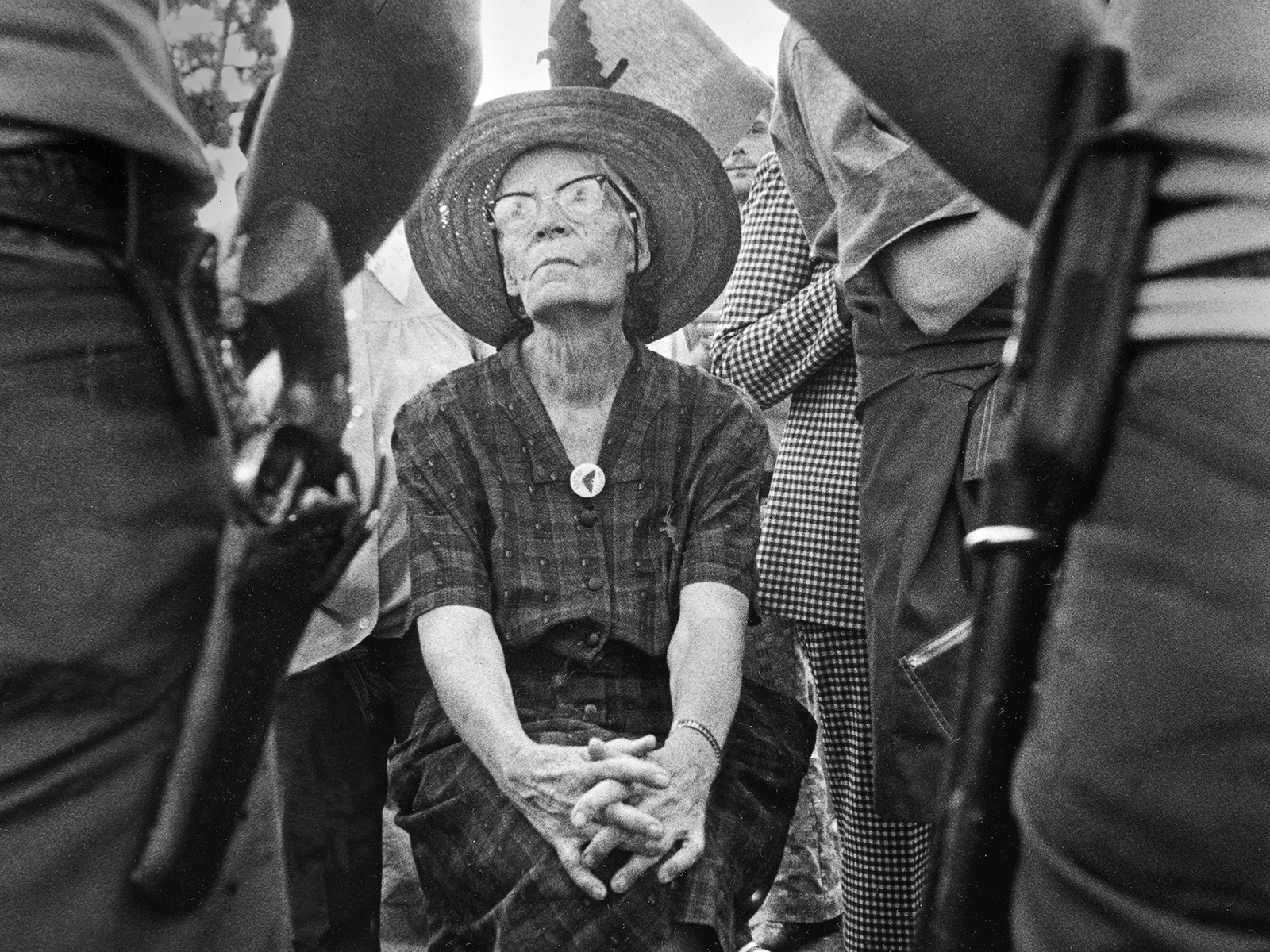
Dorothy Day sits in protest as police stand by. 
(Photo by Bob Fitch, courtesy of Journey Films)

Fiona Murphy
December 1, 2025
RNS

(RNS) — It is rare for the close relatives of a candidate for sainthood in the Catholic Church to be alive, much less able to observe the process. Yet at a Vatican symposium, “A Pilgrim of Hope: An Academic Symposium on the Legacy of Dorothy Day,” on Wednesday (Nov. 26), the grandchildren of Dorothy Day were able to hear how others think about her work as a founder of the Catholic Worker movement, and introduce many to the woman they knew.


“What I really want to do is to share her with others, share her with you,” said Martha Hennessy, Day’s granddaughter, who is a Catholic Worker herself and peace activist who runs farms in Vermont. “She did belong to the world, but she also belonged to her family. So, I just want to share some stories about family life.”

Day currently holds the title “Servant of God,” the first formal stage in the canonization process. Her local diocese has completed its investigation into her life and submitted evidence and testimony to the Vatican’s Dicastery for the Causes of the Saints. If approved, the pope would declare her “Venerable,” recognizing that she lived a life of heroic virtue. From there, beatification and canonization typically require two miracles attributed to her intercession.

The process has moved slowly in Rome, with the Vatican taking its time. Among the advocates for her cause, sustaining public engagement and promoting reflection on her life are crucial as the church shows little urgency.

So, while the audience heard from Kevin Ahern, a leading advocate for her sainthood and a member of Manhattan University’s Dorothy Day Guild, which works to preserve and promote Day’s legacy of charity, pacifism and spirituality, the symposium emphasized recollections from those who knew her.


Dorothy Day’s grandchildren Martha Hennessy, left, and Kate Hennessy, right, participate in the Vatican-hosted symposium titled “A Pilgrim of Hope: An Academic Symposium on the Legacy of Dorothy Day,” on Nov. 26, 2025, in Rome. (Video screen grab)

One such person is Robert Ellsberg, the religious publisher and author who dropped out of Harvard in 1975 at age 19 to join the Catholic Worker movement in New York City. Day asked him to become the managing editor of its newspaper, the Catholic Worker, and he worked closely with Day until her death in 1980, and would go on to publish Day’s letters and diaries, most notably in “The Duty of Delight: The Diaries of Dorothy Day,” in 2008.

“This year marks the 50th anniversary of my encounter with Dorothy Day,” Ellsberg said. “I decided to take a little time off from college, which turned into five years, and quite soon I got hooked there (at the New York Catholic Worker). Kind of lost track of time.”

Some believe that Day’s cause for sainthood has been slowed because her life, which unfolded largely in New York, challenges the church’s comfort and conscience. In the Catholic Worker and elsewhere, she wrote relentlessly about workers’ rights and the lives of the marginalized. She also purchased buildings to house people living in poverty and chose to live among them, and was jailed for protesting war and nuclear weapons. She routinely refused to pay income taxes as an act of conscience.


Dorothy Day in 1968. (Photo courtesy of Milwaukee Journal/Marquette University Archives)

Cardinal Timothy Dolan, the archbishop of New York, who recently commissioned a large mural that includes a portrait of Day in the city’s St. Patrick’s Cathedral, appeared via a prerecorded video, saying the archdiocese is “really proud of her.” He called the symposium meeting “appropriate.”

“She belongs to the world; she belongs to the church universal,” Dolan said. “We look for the day when the church universal can recognize that by edifying her on the first step towards canonization. Thanks for doing it, everybody.”

Martha Hennessy, who was accompanied by her sister Kate Hennessy, anchored Day’s spiritual power very intimately in her grandmother’s physical presence.“When I was 3 years old, I remember sitting on Dorothy’s lap,” Martha said. “I do believe that that experience of having my ear on her chest, hearing the resonation of her voice and hearing her heartbeat, that, for me, was an incarnational experience of God.”

With her works, the houses of hospitality, Martha said, her grandmother showed her how to integrate faith into one’s daily life, and the daily lives of others.

“I would describe life and work at Maryhouse as the agony and the ecstasy,” Martha said, referring to the movement’s New York outpost. “The skills that we need at Maryhouse are, can you cook a lot of food, can you be nice when you serve the food, and can you help clean up on a regular basis?”

Kate, a writer and artist living in Ireland who published the book “Dorothy Day: The World Will Be Saved by Beauty, An Intimate Portrait of My Grandmother” in 2017, framed Day’s legacy as an enduring moral challenge.

Hennessy talked about the institutional, economic, political and personal ways Day continues to challenge both Catholics and society at large.


Martha Hennessy, right, Dorothy Day’s granddaughter and a member of New York’s Maryhouse Catholic Worker community, reads an excerpt from her grandmother’s book “On Pilgrimage” in the courtyard of the Vineapple Cafe in New York, Dec. 8, 2021.
 (RNS photo/RenĂ©e Roden)

“I think it would be an utter tragedy if those of us who lived privileged and protective lives choose to see Dorothy the saint, as a way to comfort ourselves,” she said. “I have seen over the years many attempts to tame her, conform her, or when that is impossible, to dismiss or ignore her. Dorothy asks us to see the world suffering and to not turn away and say, I can do nothing.”

She noted that Day often taught the power of small acts, likening them to a pebble whose ripples extend far beyond what we can see. In an emotional tone, Kate said her grandmother believed there is always something humanity can offer, which is Christ-like love, even in the face of vast suffering.

“I suggest that we all be terrified of what she is asking of us to gaze clearly on,” Kate said. “In the here and now, to grasp faith and trust with all we have, even if it is by our bleeding fingertips.”

A legacy, she warned, should never be sanitized or turned to for personal comfort. Kate prefaced her remarks by acknowledging the emotional weight of her grandmother’s life and canonization cause. “This topic is so emotional for me, I’m going to cry through it,” she said.

Nearly 50 years after Day’s death, her legacy lives on not only in the church’s canonization deliberations in Rome, but in the grief and love her grandchildren continue to carry forward.

“We will all feel grief in our love as we open our hearts, for we will now know what we have and what we are in danger of losing,” Kate said. “What a gift, what a task we all have before us.”

Trump loyalists 'declare war on the Catholic church'

CHRISTIAN NATIONALISTS ARE ANTI-PAPIST PROTESTANTS

Donald Trump outside St. John's Episcopal Church in Washington, D.C. 
 (Official White House Photo by Shealah Craighead/Flickr)


December 01, 2025  
ALTERNET

Despite Pope Leo XIV to calling on his Catholic leadership to issue a forceful statement condemning President Donald Trump's "villification of immigrants," Trump loyalists, writes John Kenneth White in The Hill, have responded by declaring war on the Catholic church.

By a nearly unanimous vote, the United State Conference of Catholic Bishops issued their first special message in 12 years, saying they were “saddened by the state of contemporary debate and the vilification of immigrants,” and “concerned about the conditions in detention centers and the lack of access to pastoral care.”

They added that "we are grieved when we meet parents who fear being detained when taking their children to school and when we try to console family members who have already been separated from their loved ones.”

The bishops then put out a video denouncing the “dehumanizing rhetoric and violence” against those confronted by ICE — over 1.4 million have watched it so far, according to White.

But as clergy members continue to denounce the Trump administration's policies, MAGA has doubled down against the church.

“Boarder czar” Tom Homan condemned the bishops’ letter and the church as “wrong," adding “I’m saying it as not only border czar, I’ll say it as a Catholic. I think they need to spend time fixing the Catholic Church, in my opinion.”

White notes that Rep. Tim Burchett (R-TN) "accused the Catholic Church of using government grants to profit from services rendered to refugees. Gateway Pundit Jim Hoft charged that the bishops squandered more than $2.3 billion dollars received from the government, and praised Trump for terminating them."

Laura Loomer, Trump loyalist and so-called MAGA whisperer who called Pope Leo a "woke Marxist Pope," posted on X, "Are all of the Jew haters going to be calling out the Catholic bishops and the Marxist American Pope for condemning deportations?”

Matt Walsh, another Trump defender, White explains, "attacked the bishops, saying they didn’t make a video criticizing the Biden administration 'for supporting, funding, and facilitating the mass slaughter of children in the womb,' or 'its support for the castration and sexual mutilation of children.'"

White says that these attacks are the antithesis of the church's teachings.

"Those attacking the bishops and making reference to the sexual abuse scandals that have plagued the Catholic Church over the past decades does not diminish the bishops’ call for humane treatment of immigrants and adherence to the Gospel teachings of Jesus Christ," he writes.

"Trump casts himself as pro-Catholic and calls himself 'the most pro-life president ever.' But that does not mean that the maltreatment of those living outside the womb is no less a sin," he adds.

Actual Catholics, White says, are not happy with Trump.

"Catholics are swing voters and often determine election outcomes. Joe Biden won their votes in 2020; Donald Trump had a 12-point advantage in 2024. Today, a majority of Catholics disapprove of Trump," he writes.

"The Catholic Church is more than 2,000 years old. Declaring war on it is hardly civilized or politically smart. Trump has three years left in office. The Catholic Church will survive condemnation by those in power; it’s hardly the first time this has occurred in its long and storied history," he concludes.

Sunday, November 09, 2025

FELLOW WORKER DOROTHY DAY

On Dorothy Day’s birthday, the life and work of the last living Catholic Worker who knew her

NEW YORK (RNS) — Jane Sammon is the only Catholic Worker still living in one of the original Houses of Hospitality who worked with Dorothy Day, now a candidate for sainthood.


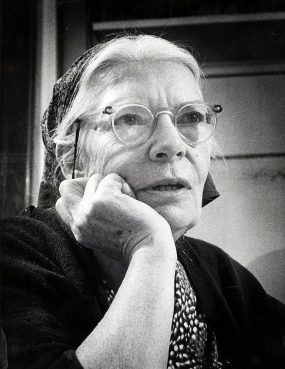
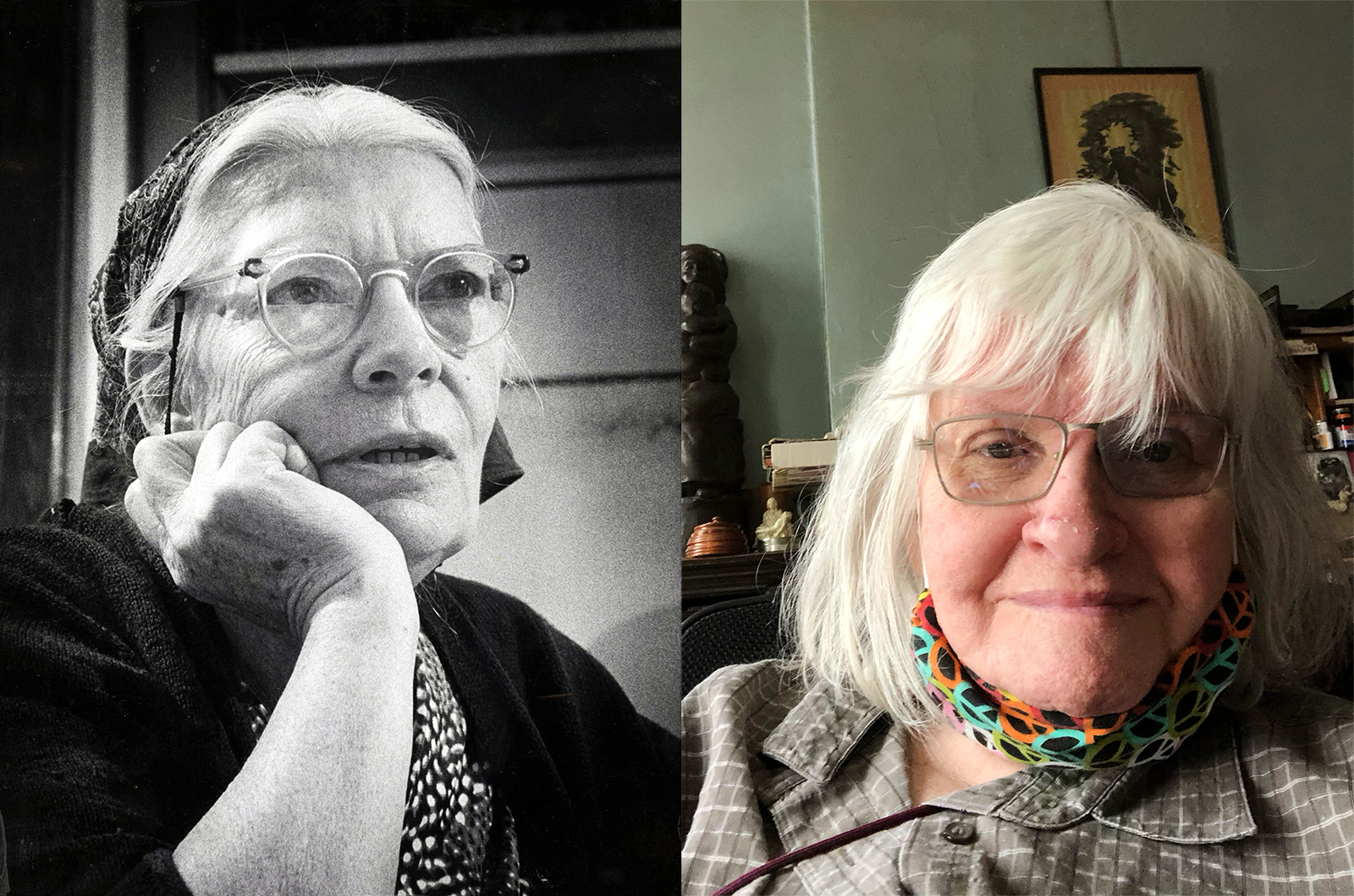
Dorothy Day in 1968, left, and Jane Sammon in 2025.
 (Photo courtesy Milwaukee Journal/Marquette University Archives; courtesy of Sammon)

Fiona Murphy
November 7, 2025
RNS


NEW YORK (RNS) — Jane Sammon was terrified the first time she met Dorothy Day, the Catholic Worker founder now being considered for sainthood by Rome.

“ I was at the front mopping the floor, and I thought my stomach would drop out,” Sammon said. “It’s like that saying, ‘Jesus is coming look busy,’ you know? Well, Dorothy is coming, look busy!”

It was 1972, and at 25, Sammon had traveled from Cleveland, Ohio, to St. Joseph’s House, a house of hospitality in Manhattan run by Dorothy Day and other members of the Catholic Worker, eager to see a place where Catholics were standing “unequivocally” against the Vietnam War. Staying with friends in Brooklyn, Sammon one day decided to visit St. Joseph’s House on E 1st Street. The rest, she said, is something of a mystery.

Decades later, Sammon is the only member still living in the movement’s New York Houses of Hospitality who lived and worked alongside Day, a woman known worldwide for feeding the poor and advocating for workers’ rights. Since 1933, when The Catholic Worker newspaper was founded, the world around the movement has changed, but Sammon says Day’s presence still looms large.

“ I don’t think anybody else in this house could say they knew Dorothy in the flesh,” Sammon said. “But for me, and this is the big thing, I think we could all know Dorothy Day the way we know Jesus.”

Fifty-three years have passed, and Sammon, 78, has spent most of her life within a two-block radius, living and working at St. Joseph’s House and Maryhouse. The Catholic Worker movement is a community founded by Day in New York through the first houses of hospitality, rooted in voluntary poverty and dedicated to living among and serving the poor in faith and solidarity.

“She’s been a very constant presence in that house,” Martha Hennessy, the granddaughter of Day, said. “She’s been very dedicated to Maryhouse, to the movement and to Dorothy.”

Saturday, Nov. 8, is Dorothy Day’s birthday. Day, with the title “Servant of God,” is currently in the first formal stage in the canonization process. The diocese’s collection of evidence and testimonies about her life has been sent to the Vatican’s Dicastery for the Causes of the Saints for review and approval, at which point Pope Leo would declare her “Venerable,” recognizing she lived a life of heroic virtue. After that, the beatification and canonization process generally requires two miracles attributed to her intercession.


Martha Hennessy, right, Dorothy Day’s granddaughter and a member of New York’s Maryhouse Catholic Worker community, reads an excerpt from her grandmother’s book “On Pilgrimage” in the courtyard of the Vineapple Cafe in New York, Dec. 8, 2021. (RNS photo/RenĂ©e Roden)

RELATED: Evidence of Dorothy Day’s ‘everyday’ sainthood heads to Rome, boxed and beribboned

Even after all these years, Sammon’s first encounter with Dorothy stays in her mind. “Her voice… it was very disarming to me,” said Sammon, who, with a mop in hand, recalls that in her mid-20s, she expected the then-75-year-old Day to sound old or possibly crotchety, but she didn’t.

The two shared a brief conversation about who Sammon was and where she was from, and little did either of them know, Sammon would be bringing Day medicine on her deathbed eight years later, in a room four floors above where Sammon lives now. Day died in 1980, just 21 days after her 83rd birthday.

“The last thing she said to me was, ‘and I really want to thank you,’” Sammon said. “And I said, ‘OK, Dorothy.’” At the time, Sammon and Day had lived on the same floor of Maryhouse for several years. “She said it to be comforting, in a way,” Sammon said.

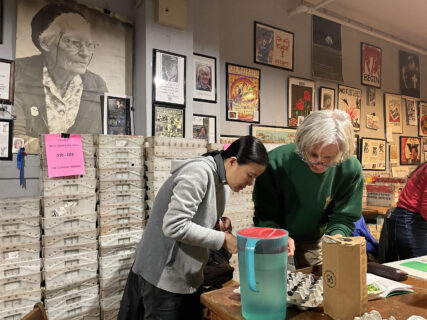
Today, Maryhouse and St. Joseph House still feed hundreds of New Yorkers every week and together house about 50 people. From Tuesday to Friday, Catholic Workers at Maryhouse, some volunteers, others residents, prepare lunch for dozens of vulnerable women.


Lunch service is prepared at Maryhouse in New York City. (RNS photo/Fiona Murphy)

On Friday nights, the auditorium at Maryhouse fills for what Peter Maurin, the French Catholic visionary and co-founder of the movement, called a “Clarification of Thought,” a gathering where activists, filmmakers, musicians, theologians and other thinkers share their ideas and projects.

“Jane is all of our mentor and a pillar in the community,” said Joanne Kennedy, 56, who first came to the New York Catholic Worker in 1995 and later lived at both St. Joseph’s House and Maryhouse. “It’s her home with a lot of other people, but she’s been one long, continuous strand, and that deserves a proper kind of reverence.”

Sammon has written a column for The Catholic Worker newspaper, still printed monthly, since Day’s death in 1980. The column, titled “The Book of Notes,” chronicles everyday life at the Worker and is published under the pen name Ric Rhetor, a play on the word “rhetoric.”

“It is the most popular thing, hands down, the most-read column in the paper on the regular,” said Kennedy. “It’s one of the only things that’s always in it.”

Fellow Catholic Worker Bernie Connaughton, 70, describes an evening in 2000 when he and Sammon were serving sandwiches in a subway station. Connaughton said police began harassing a homeless man on the stairs, and “Jane went right over to the cop and said, ‘Don’t you talk to him that way, officer,’” Connaughton recalls. “’He deserves respect.’”

“She can’t help herself,” Connaughton said. “She can’t stay quiet when she sees something wrong. That can work for good or bad, but it’s who she is.”


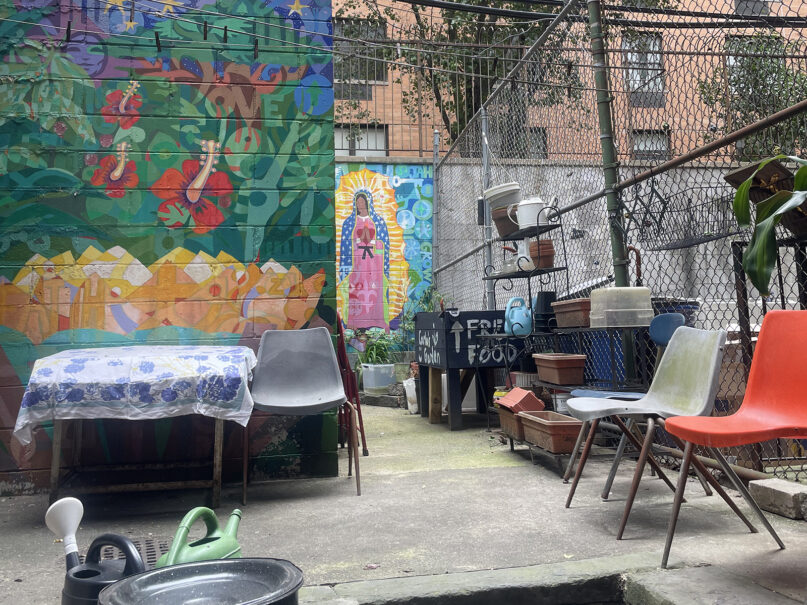
The communal backyard of the Catholic Worker’s Maryhouse in New York City. (RNS photo/Fiona Murphy)

Sammon grew up in a devout Catholic family in Cleveland, where her father, Leo, worked as a steam fitter and was involved in the Association of Catholic Trade Unionists. Her mother, Cecilia, who died when Jane was just 11, “had a heart for poor people,” Sammon said. When she was 10 years old, Sammon said her father first told her about Dorothy Day.

Years later, inspired by reading The Catholic Worker newspaper and its call to the works of mercy and its radical stance on peace, Sammon moved to New York with piqued interest. She describes “a trifecta” that drew her to the movement: the Catholic Workers’ genuine love for the Catholic Church, their willingness to live in voluntary poverty and their readiness to risk jail opposing the Vietnam War.

“This idea that your beliefs might have engendered an idea that would cause you to get arrested — and they were willing to do that,” Sammon said. “That was it. And then when I got here, they also had some good fun.”


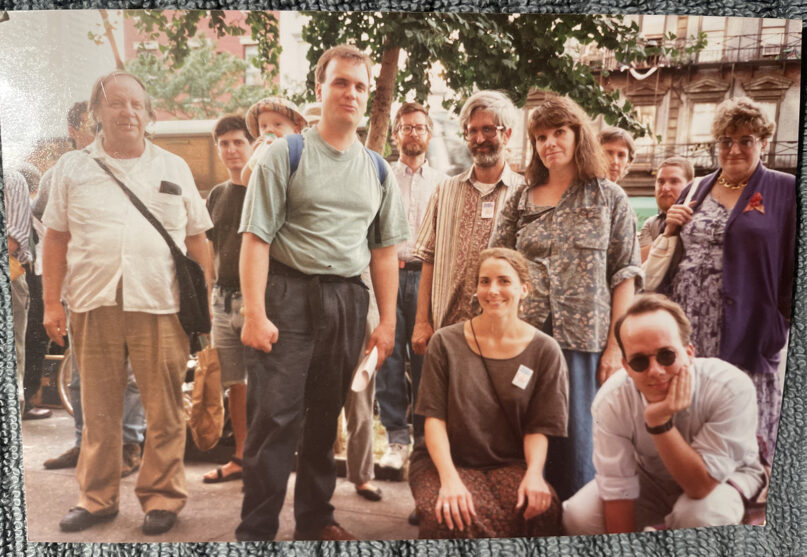
Jane Sammon, standing second from right, and fellow Catholic Worker community members in a photo from the late 1980s or early 1990s. (Photo courtesy of Sammon)

Sammon now faces health issues that make it difficult for her to walk. She said she does “considerably” less at the Catholic Worker than in years past. She still writes her column and helps organize some Friday night events. She continues to run Maryhouse on Sundays, a tradition she began more than a decade ago to give other residents a day of rest.

Today, new faces come through the Catholic Worker often. Maryhouse hosts an Integral Ecology Circle of approximately 50 members, mostly under age 40, who recently added a rooftop garden to provide fresh food.

Members of the Catholic Worker’s Integral Ecology Circle plant vegetable seedlings at the Maryhouse auditorium in New York City in March 2024. A photo of Dorothy Day, left, oversees the room. (RNS photo/Fiona Murphy)

The rooftop garden at Maryhouse in New York City. (RNS photo/Fiona Murphy)

RELATED: New York Catholic Workers bring new growth with rooftop garden

“I think I feel like I’m married to this place in a way,” said Sammon, who never married or had children and plans to continue her vow of poverty through the end of her life. “A lot of people find it very hard to understand choosing this lack of material success — to say you don’t want to have it — when there are others who never even had the chance to know whether they could choose that or not.

“What does it mean to be poor? I think at the Catholic Worker it’s a religious understanding,” she added.

In the archives at Maryhouse, there’s a short recording of a conversation between Sammon and Day, from when Sammon was still in her 20s. Day was speaking with a priest about nonviolence and Catholicism in the office at St. Joseph’s House when Sammon walked in looking for a pair of shoes.

“Dorothy said, ‘Come in, come in, what do you want? You can have anything!’” Sammon said. “I laughed, I said, ‘anything?'”


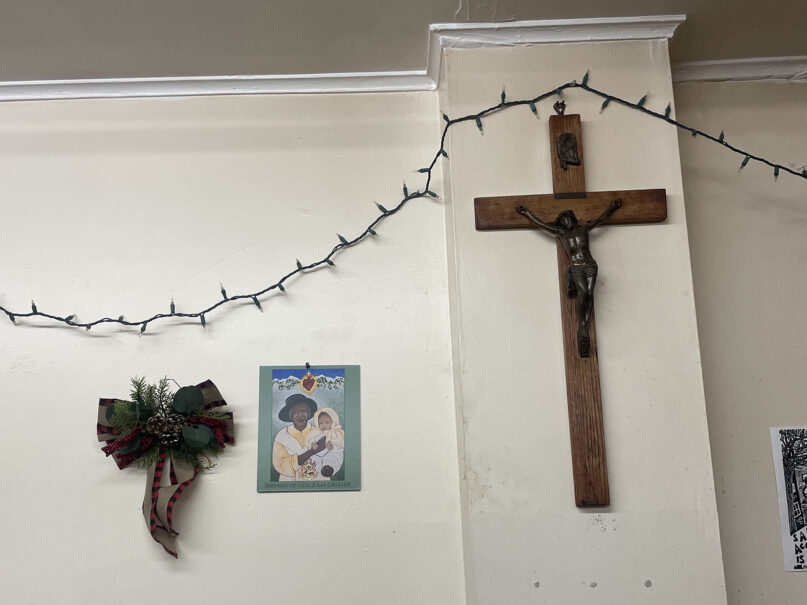
Decorations adorn Catholic Worker’s St. Joseph’s House in New York City. (RNS photo/Fiona Murphy)

Though Day has been gone for many years, Sammon said there’s no need to dwell on that.

“You’re able to learn from so many people at the Catholic Worker, not only the Dorothy Day person,” Sammon said. “But some woman who walks in, who’s lived out on the street, who just tells you about life in a way that you didn’t know before. And that’s the idea.”

There will be a Mass held at Maryhouse on E 3rd Street at 7 p.m. on Saturday evening, Nov. 8, dedicated to Dorothy Day.


Thursday, January 01, 2026

Oligarchy XIV: Thoughts on the Anarchism of Dorothy Day


 January 1, 2026

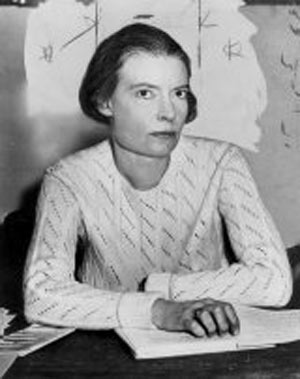
Dorothy Day in 1934. New York World-Telegram & Sun Collection. Public Domain.

I have a few thoughts in response to what seems like an uptick in interest in Dorothy Day (1897-1980) in recent years. When I first read Dorothy Day, the first thing that stood out to me was her continuity with a long tradition of Christian anarchism in America. Yet as a Catholic, she seemed to represent a split from the main line of Christian anarchism in America, which is distinctly Protestant (though not exclusively so, and who knows how to classify Tolstoy’s religion). In any case, I kept running into her name after years of studying and steeping in the Christian anarchism and non-resistance of folks like Adin Ballou, William Lloyd Garrison, and Henry Clarke Wright, among others. Many of the individualist anarchists received theological instruction and were ordained ministers (for example, Joshua K. Ingalls, William B. Greene). Day resembled these Protestants of the American libertarian tradition in her deep personal commitment and her total rejection of political action, which, as we will discuss, entails explicit renunciation of core features of our political life, for example, voting, paying taxes, and obeying unjust laws. The historian Anne Klejment helps us understand Day’s ideas within this context:

The seedbed of her pacifism extended back into her Protestant young adulthood. Her familiarity with the Bible remained a significant part of her spirituality and informed her pacifism. Back then, the Catholic laity was discouraged from Bible reading. It would take a convert like Dorothy to advance biblical nonviolence as an essential Catholic teaching. She placed enormous emphasis on the commandment to love God and love neighbor. She understood it as the core teaching of Jesus and pondered over it from adolescence until her death.

Many of the American Christian anarchists/non-resistants follow in a long tradition of antinomians, arguably going back to the Antinomian Controversy in New England and before. These episodes left an established tradition of challenging authority and hierarchical power. Day’s Christian anarchism stands out in its delicate location within the Catholic tradition. Indeed, hers was a stance that angered many in both the Church hierarchy and in her old left-wing circles. She recalled at the end of her life that many of her radical friends had felt betrayed by her conversion:

One who had yearned to walk in the footsteps of a Mother Jones and an Emma Goldman seemingly had turned her back on the entire radical movement and sought shelter in that great, corrupt Holy Roman Catholic Church, right hand of the Oppressor, the State, rich and heartless, a traitor to her beginnings, her Founder, etc.

Just as she was a poor fit with the narrow-minded college socialists (more on that below), she was also an awkward fit in a movement defined by people like Proudhon, whom she frequently discussed, and Bakunin. Day’s personalism is another distinctive feature of her approach to anarchism. This is the idea, grounded in a basic belief in the dignity of every human being, that each person must take personal responsibility on every level: that there is a duty to one’s neighbors and coworkers, and we cannot look to others, including large institutions, which are themselves the key offenders and impediments to change. Day often talked about how she was changed after the experience of seeing neighbors come to each other’s aid in the wake of the 1906 San Francisco earthquake. In an article in 1936, Day explained:

We are Personalists because we believe that man, a person, a creature of body and soul, is greater than the State, of which as an individual he is a part. We are Personalists because we oppose the vesting of all authority in the hands of the state instead of in the hands of Christ the King. We are Personalists because we believe in free will, and not in the economic determinism of the Communist philosophy.

Remarking on the 1927 murder of Italian immigrants and anarchists Nicola Sacco and Bartolomeo Vanzetti, Day noted that anarchism “is the word, or label, which confuses many of our readers (especially the bishops?)” Day saw anarchism, as a philosophy of mutual respect and voluntary cooperation, as a natural extension of Christian spiritual practice and fellowship. She argued that there is no human law applicable to those who love and follow Jesus, and that “anarchism means ‘Love God, and do as you will.’” From the moment it became aware of the Catholic Worker movement, the U.S. government has treated it with suspicion, targeting and spying on Day and the movement as supposedly subversive elements. Day’s activism drew the attention of the FBI, and she is said to have enjoyed reading her FBI files.

Day had joined the Socialist Party in Urbana, Illinois, as a teenage college student, but its “petty bourgeois” attitudes and lack of “the religious enthusiasm for the poor” left her cold. She was not one for posturing; her Christian anarchism was based on the idea that every person is “known and named,” and that the real movement for human freedom takes place where there is a human need to be satisfied. Day roundly rejected the value system and approach of rigid bureaucracies and hierarchies, either corporate or governmental, which treat people as case numbers within cold, detached systems of power. As Michael Kazin put it: “Like any good anarchist, Christian or not, Day had no faith whatsoever in the desire or ability of governing authorities to create a moral, egalitarian society.” Her political outlook was grounded in and expressed through the sharing of everyday acts of kindness, through up-close relationships rather than philosophical abstractions. Yet she was extremely well-read and capable of the most insightful and skillfully articulated engagements with advanced ideas. Day has a very particular way with words. There is a rare candor, which reflects her lack of pretenses and her vulnerability in sharing her full life in the most open and sincere way. Her columns go back and forth between the tragedy and the comedy of being human with real thought and skill. Some of the vignettes in her autobiography are as powerful and moving as anything written by any American, for my money. “In 2012, the U.S. Conference of Catholic Bishops unanimously voiced its support for her sainthood,” and this cause is, as I understand it, pending. An anarchist Catholic saint would be something to see.

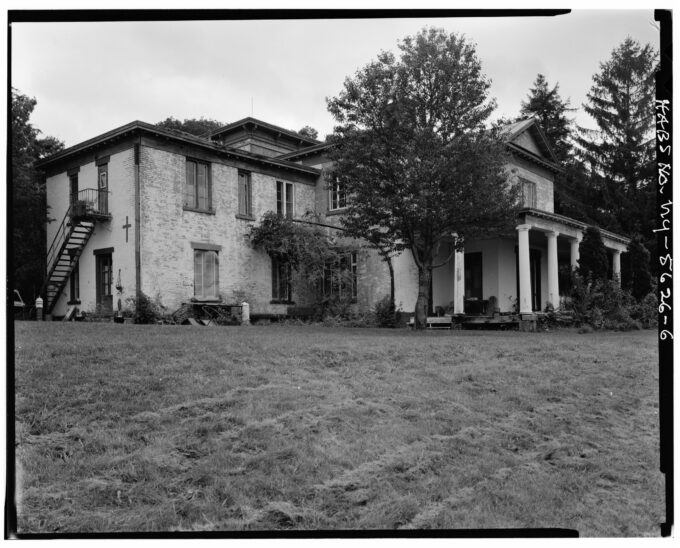
Rose Hill Catholic Worker farm, Tivoli, New York. Photo: National Park Service.

Day believed that we have the social and political question backwards, starting with abstractions, ideological camps, and grand plans, when what we should focus on what is personal and tangible, what can be done directly, immediately, and without “professional” intermediaries. I was drawn to Day’s writings first because her way of thinking about political and social questions is so categorically different from the one we get from both halves of the poisonous main currents of our discourse today. She rejected both versions of bloodthirsty twentieth century authoritarianism, capitalism and socialism, instead articulating a radical politics of the corporeal and close by. Nothing more complicated in policy terms than housing and feeding our neighbors, the most important work (we prefer conceptual complexity and institutional paralysis while oligarchs bleed the country). Her belief in the transformative power of community and hospitality at the most basic but most intimate scale led her to reject the way almost everyone of our age thinks about politics. Day’s politics were about love for and service to other people; her way of looking at the world, according to her granddaughter, focused on the idea that “what we can do is so little, but that is what we are given to do. That’s only what we can do, so let’s move forward and do what we each think that we can do.” She emphasized “the necessity of smallness,” encouraging a direct and hands-on approach to serving those in need. She could not accept any approach to activism or ministry that separated the theorizing from the doing. Contrast our culture of aloof contempt for the poor, workers, prisoners, migrants and refugees, etc. There is nothing lower than not having money in our anti-human culture and political system. It is thoroughly bipartisan and it will outlast every politician and political party. Rest assured that the state’s indifference toward the suffering of the poor will be there still when there is no more U.S. government.

In Day’s view, we are depriving ourselves of another political dimension in the notion that love is the only response to political moments like this one. Regardless of anyone’s opinions, if love and community are not reliable for us in the social and community context, then what are we talking about? If they aren’t starting with the people at the bottom, what are they building? Everyone seems to feel that the country is lost today. My suggestion is: do not try to find it. Dorothy Day’s example suggests that we find each other, face-to-face, and begin to relearn the lessons of solidarity and mutual aid. We do that and we don’t have to fuss with any of today’s counterfeit B.S. In the social reality that capital and the state are hawking, there is nothing for workers or the poor, nothing but getting shorted. Day saw the crises unfolding around her in terms of human suffering. She did not put herself in the position of judging or condemning; she did not hold out false solutions or panaceas. She asked people to follow her lead in taking personal responsibility and initiative. Among the goals of the House of Hospitality, she stated, was to “emphasize personal action, personal responsibility as opposed to political action and state responsibility.” As a social model, the House of Hospitality explicitly resists impersonal, bureaucratized forms of charity and deliberately puts givers and recipients on the same footing, creating genuine relationships and community life. Day lived a life of voluntary poverty and thought that one should try to “be close enough to people so that you are indifferent to the material.” Central to her thought was leading by example and in accordance with love for all people. Her life, her work, her politics, all inseparable, were based on the radical notion that Jesus meant what he said about loving each other, turning the other cheek, etc.

Day offers another way of thinking about what it means to be politically active within a broader network of movements for freedom, equality, and justice. We don’t need to play to the strengths of the ruling class by focusing our energies and resources back into the sources of hierarchy and domination. Day thought that we had things backwards when it came to political and social change: that is, she believed we are already where the action is, in that everything grows from the bottom up. The movement is where you are, and it exists within your power to take care of people in need. So this is obviously a way of thinking poles apart from the performative nonsense that is encouraged today. Her worldview was a wholesale rejection of today’s faux meritocracy and its ugly pretense that some people are worth more than others. She believed that there is a “a spirit of non-violence and brotherhood” in the Gospels that counsels anarchism in practice. She favored radical decentralization and recognized the principle of subsidiarity, or the idea that decision-making should take place at the most local possible level. In the United States, we have departed from this principle to our own peril, yet neither of our teams seem to understand the problem. Day did not mince words in providing a classically anarchist condemnation of government:

Eventually, there will be this withering away of the State. Why put it off in some far distant utopia? Why not begin right now and say that the state is the enemy. The state is the armed forces. The state is bound to be a tyrant, a dictatorship. A Dictatorship of the Proletariat becomes yet another dictatorship. (emphasis in original)

Day did not believe that we can effectively resist this system of poverty and social alienation by supporting politicians or by mimicking the coercive, bureaucratic style of elites. For her, it could not be a matter of voting, giving alms, or being a good member of some party. Day’s approach represents the opposite of the institutional distance and stuck-up elitism that characterize most of our systems. Day insisted on being there on the ground, sharing daily life in real human connections, resisting the state and consumerism through friendship and love rather than through government. This mode of politics can only be understood and practiced by one who is not interested in being there for others, not in her own opinions or in electing certain politicians, etc. This is the real revolution everyone has been talking about and waiting for, but Day’s isn’t a path most people are capable of walking. One of the mottos of the Catholic Worker movement is, “Conscience is supreme.” Day could not reconcile any politics of division or violence with her own conscience. Institutions that rely on violence – the state, for instance – could not help except by receding into the background; they are not there to help, but rather to create the conditions for widespread deprivation and poverty.

There may be no starker contrast to the hollow identitarian blather of our moment than the life and work of Dorothy Day. Today’s hideous and embarrassing elite-worship, its obsessions with maximums of speed and scale regardless of the social dangers or consequences, its institutional detachment and opacity, and its counterproductive GDPism all represent pervasive social decay and alienation within Day’s philosophy. They are not the visible signs of “progress.” By comparison, today’s PMC liberals appear to be deliberately authoritarian and parochial defenders of plutocracy. And our conservatives, particularly the churchgoing ones, seem to genuinely hate the people Day said we’re commanded to love. I think Professor Larry Chapp put it well, discussing the importance of Day’s politics of resistance to our current moment (now retired, Professor Chapp runs the Dorothy Day Catholic Worker Farm in Pennsylvania):

This is all modern Liberalism has to offer: blunt force and wealth. And what moral and spiritual weapons do we have that are not undermined by our own supreme hypocrisy? We all, rightly, recoil in horror at the sufferings inflicted by Putin’s insane military gambit to restore empire. But empire building is what Liberals do, and have done now for centuries, and so the moral condemnations of our political class rings hollow.

Day didn’t think it was all that difficult to see why our political culture and discourse continue to fail us, particularly those at the margins of our society. Political ideology totally abstracted from the real relations of ministering to the needs of the poor, from the real struggles of workers striving around the clock yet no further from the edges of social and economic oblivion. That is American liberalism today. The American right meanwhile offers an incoherent, unwholesome slop of racial and ethnic scapegoating, open thuggery and corruption, and in MAGA the treatment of the country as a cheap and trashy brand name for enriching the political mercenaries and shady billionaires around Donald Trump. But, fundamentally, the teams share a value system, and the poor are despised by that system. If they’re not blaming them for crime and social discord, politicians are trying desperately to ignore the poor and pretend they don’t exist. This is one of the bedrock values of our system, at least as it exists materially rather than in the purely imaginary fantasies of a PMC that proudly embeds itself in the military-industrial complex even as it scolds everyone.

Statists and imperialists of all kinds, including liberals, who try to appropriate Day should understand that she was not joking about anarchism and would not willingly cooperate with the government; her identity as an anarchist was inseparable from the rest of her life and work, which meant ignoring the law and living according to the law of conscience. Like many anarchists before and since, Day had run-ins with the law throughout her life. She was jailed several times, beginning in 1917, when she was arrested while picketing as part of the Silent Sentinels campaign. She was a fixture of the anti-war and anti-nuclear movements and was jailed several times in the 1950s for her refusal to take shelter during civil defense drills during that period (this protest seems to have been the brainchild of Ammon Hennacy, whom I discussed for the Cato Institute’s Libertarianism.org several years back). Responding to the nuclear mass murders in Hiroshima and Nagasaki in 1945, Day wrote with rare moral clarity against the death cult that still has our ruling class in its grip:

Jubilate Deo. We have killed 318,000 Japanese.

That is, we hope we have killed them, the Associated Press, on page one, column one of the Herald Tribune, says. The effect is hoped for, not known. It is to be hoped they are vaporized, our Japanese brothers – scattered, men, women and babies, to the four winds, over the seven seas. Perhaps we will breathe their dust into our nostrils, feel them in the fog of New York on our faces, feel them in the rain on the hills of Easton.

Jubilate Deo. President Truman was jubilant.

Day felt the truth in her bones. She understood that those dead families in Japan were our family – they were not evil foreigners. She protested through two world wars and saw firsthand every trick used by the state to stir up hatred and enthusiasm for war. Consider the attitudes of our putatively liberal elite on questions of war and empire today, and contrast them to those of Dorothy Day. Our corporate uniparty has two openly war-mongering and imperialistic wings, with differences only in emphases and vibes, and even there the degree of difference is smaller than is generally thought (respectable opinion in the District wants war, but with Russia and China, not Venezuela). Today, people who have made their entire careers pitching and overseeing disastrous wars of choice get in line for fancy fellowships and interviews on the supposedly progressive shows. Because the U.S. government manages a powerful empire, our political class is compelled by the agglomeration of interests around them to chaperone a politics of imperialism, with disagreement confined to the margins. Higher defense spending is popular with politicians of both parties, because war is the business the state is in. Violence is its key offering in economic terms, much as any lesser mafia. Virtually all members of Congress make their peace with it in one way or another, because this is what the overall system requires of them, and the system is very good at getting what it needs; whatever their reasons, both parties want and actively search for and recruit candidates that they know will be reliably pro-war, often those with connections to the Pentagon or the intelligence community, the major “defense” contractors of the federal government, or financial interests aligned with warfare and empire. Recall that the deepest and strongest connections between the two ways our ruling class shows itself, the state and capital, take place within the world of war. In our system, both always want war because they see it as a source of growth, but they were fused together even before the growth logic took over completely. That is the perversity of our system, which Day saw. She didn’t think one could escape complicity merely because they were positioned within bourgeois polite society; she called the scientists who worked on the bomb murderers, and she demanded accountability from the places of higher learning that allied themselves with “this colossal slaughter of the innocents.” To understand the perversity and degeneration of our politics and discourse, we just have to look at how quickly our simulacra of political participation set up a new enemy of the week, reincorporating the old enemies (e.g., the rehabilitation of George W. Bush) and using the energy and appearance of conflict to reaffirm the imperial system itself. Day understood that the state was a den of thieves and criminals regardless of who is in charge, and the source of positive social change has to be us, working together.

Dorothy Day was an amazing person and a true rarity. She relentlessly downplayed her own importance and contributions to the Catholic Worker movement. During an interview in 1971, a week before her 74th birthday, Day discussed the movement’s humble beginnings and reiterated the centrality of small, personal scale and the face-to-face community to the mission:

You start in with a table full of people and pretty soon you have a line and pretty soon you’re living with some of them in a house. You do what you can. God forbid we should have great institutions. The thing is to have many small centers. The ideal is community.

Not long after, reminiscing at the age of 75, she referred to herself as “the housekeeper of the Catholic Worker movement.” It wasn’t the fake humility of today’s political tabloid show. To her, that work is as worthwhile and honorable as any honest service to other people. She passed away in 1980 at the Catholic Worker’s Maryhouse on the Lower East Side. She was 83. If radicals today are looking for a normative model or a plan of action, the life of Dorothy Day, the first hippie, in Abbie Hoffman’s words, will at least provide inspiration. Growing interest in Dorothy Day must not obscure the central facts of her anarchist politics, that the work to which she dedicated her life can’t ever be carried out by the authoritarian, bureaucratic state or by the professional-managerial class administering it. Her commitments were not those of our political class, and she was explicit about that. They point to forms of personal responsibility and solidarity that are structurally incompatible with the state and capitalism. To take her political ethic seriously is to move in a direction directly opposed to the logic and practices of both mainstream and elite politics today.

David S. D’Amato is an attorney, businessman, and independent researcher. He is a Policy Advisor to the Future of Freedom Foundation and a regular opinion contributor to The Hill. His writing has appeared in Forbes, Newsweek, Investor’s Business Daily, RealClearPolitics, The Washington Examiner, and many other publications, both popular and scholarly. His work has been cited by the ACLU and Human Rights Watch, among others.