Showing posts sorted by relevance for query HOWL. Sort by date Show all posts

Saturday, October 08, 2005

HOWL


OCTOBER 8 1955
HOWL
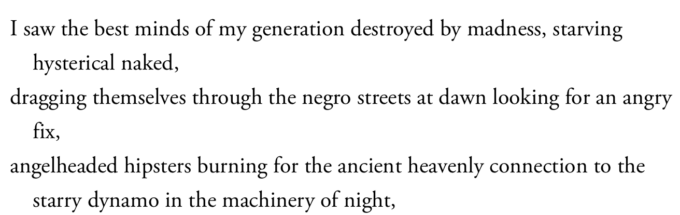
I saw the best minds of my generation destroyed by madness, starving hysterical naked,
dragging themselves through the negro streets at dawn looking for an angry fix,
angelheaded hipsters burning for the ancient heavenly connection to the starry dynamo in the machinery of night,
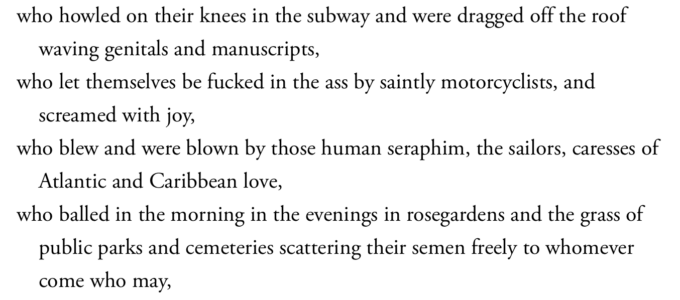
who poverty and tatters and hollow-eyed and high sat up smoking in the supernatural darkness of cold-water flats floating across the tops of cities contemplating jazz,
who bared their brains to Heaven under the El and saw Mohammedan angels staggering on tenement roofs illuminated,
who passed through universities with radiant cool eyes hallucinating Arkansas and Blake-light tragedy among the scholars of war

Howl of beat's heart


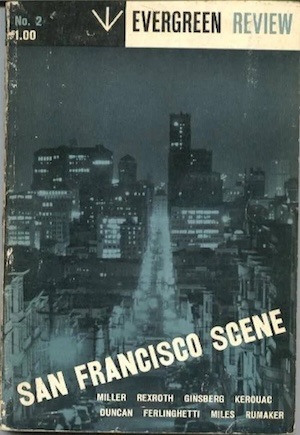
October 08, 2005 FIFTY years ago today in San Francisco, disaffected young bohemians, with their goatees, berets, angst, wine and marijuana, gathered at the Six Gallery to listen to poetry. It was a cool, hip thing to do and rock'n'roll had not yet been invented.

If they had arrived as individuals in search of confirmation that society sucked, by the time Allen Ginsberg had finished reading his seminal work, Howl, an eloquent, passionate rage against conformity, the 200 or so there left united into new movement: the beats.

"That was the day the bomb went off," says Anthony Bliss, curator of rare books and literary manuscripts at Berkeley's Bancroft Library, home to one of the foremost collections of beat literature.

The Howl Obscenity Trial and free speech

"Beat Generation" is a term referring to a heterogeneous mix of young people, artists and intellectuals of the 1950s (and later) whose unconventional work and lifestyle reflected profound disaffection with contemporary society. They expressed objection and criticism against American materialism in a bitter, harsh and often abusive language. They mocked its conformity, denounced its immorality and set out "on the road" to discover America's true spirit. They experienced with drugs and sex, explored Eastern religions and Western avant-gardes, from dada to jazz "burning for the ancient heavenly connection." (Ginsberg) The Beats rediscovered poetry as a form of public entertainment, returned to its sources in the body, breath, the spoken word and music. The Beat ethos reverberated through the anti-war movement and movements from psychedelia to punk and enjoys a current resurgence.
Members of the Beat Generation, responded to the conformist materialism of the period by adopting lifestyles derived from Henry David Thoreau's social disobedience and Walt Whitman's poetry of the open road. The movement had no shared artistic credo beyond breaking the current literary orthodoxy. Most representative and influential were Kerouac' s novel On the Road (1957) and Ginsberg's poem Howl (1956), and William S. Burroughs' Naked Lunch. (1959) Other prominent Beat related literary figures were poet and publisher Lawrence Ferlinghetti, poet Gregory Corso, and novelist John Clellon Holmes. In a first section of this course we will concentrate on the works of these "core Beats". We will then move on to study the convergence of the Beat Movement with the San Francisco Poetry Renaissance.


Howl was one of those books, and it is a book not just a 'poem', that had a profound impact on me when I was a teenager. The others were the Communist Manifesto, the writings of Bakunin, Freud's Analysis of Dreams, Heinlien's Stranger in a Strange Land, Aleister Crowley's Magick in Theory and Practice, the novels of H.P. Lovecraft, Raymond Chandler, William Burroughs, Samuel Delany and the poems and stories of Edgar Allan Poe. I liked my poets dark, stoned and gothic.

Don't call me a baby boomer, I never did. I am a child of the Atomic Age, the Space Age, the Age of Television, the new Age of Comics, Rock n Roll in the New Jazz Age. In growing up I embraced the Beat/Hippie/Yippie/Freak kulture.... I was baptized in the Anti-War and Liberation Movements of the seventies; youth libertation, womens liberation, gay liberation. Underground comix, Alternative Press and Media was juice for my creativity. The revival of Surrealism, Wobbly labour activism and Paganism was the carnival of resistance I ran away to join.

I was cheered by Hendrix, the poetics of the Doors, the siren call of Leary and the other Experiences of the Doors of Perception that opened for my in-between generation, 1954-64, not really the sixties and not yet generation X.


There now you know a bit more about me......
and at 50 I still Howl.


Saturday, September 20, 2025

‘The Howl That the World Doesn’t Hear’: A Gaza Teacher in Her Own Words

At 28, Reham Khaled has lived through eight wars of varying intensity. The current war has been the most brutal she’s known.


Relatives of the Palestinians, including children, who died as a result of Israeli attacks on different parts of Gaza City, mourn as the dead bodies were taken from the al-Shifa Hospital for burial in Gaza City, Gaza on August 25, 2025.
(Photo by Saeed M. M. T. Jaras/Anadolu via Getty Images)

Martha Baskin
Sep 20, 2025
Common Dreams

So begin the words of a Gaza teacher’s recent post after being forced to flee her home in the Al-Daraj neighborhood of Gaza City and the school she’d set up in a tent. A bomb tore apart the tent next to the one where Reham Khaled taught her students. Two were killed:
Pain is not a passing sensation, but a being that resides within. It has fangs and fingers. It presses on the heart, weighs down the chest, and makes the breath hesitate like a hole in the air. There is a moment, just one moment, when all the internal walls we have tried to build crumble and we reach what is called the threshold of pain. At this threshold, pain is no longer just an echo or a tremor. It turns into a howl.

Skilled at weaving the horror that is war-torn Gaza with evocative imagery of far sweeter things, Khaled says that before the bomb tore apart the tent, she and her father-in-law were dreaming of eating mangoes and chicken. “And then the rocket exploded. One moment. A collective scream. A small lake of blood begins with two children whose greatest ambition was to eat chicken and mango. It is a moment, but inside me it is years.”

Born in Gaza’s Jabalia refugee camp, her grandparents were displaced from the Palestinian village of Najd which was ethnically cleansed in 1948 when the state of Israel was created. The Israeli town of Sderot was later constructed over the site of the village, as well as the nearby village of Huj, according to Working Class History.com.

Her goal, other than giving as many students as possible the right to education, is to instill one idea in the children of Gaza “so that they may travel the world and spread peace one day.”

In Gaza, Khaled studied in UNRWA schools, the United Nations Relief and Works Agency for Palestine Refugees in the Near East, established by the UN in December 1949, to provide relief and humanitarian assistance to Palestine refugees displaced by the 1948 Arab-Israeli war.

At 28, she has lived through eight wars of varying intensity. The current war has been the most brutal she’s known. She and her extended family have been displaced 15 times.

The howl is “not a loud, audible scream”, explains Khaled, “but the howl of the soul, that subtle sound that the ear cannot pick up but shakes the entire body from within. It’s like the wind sweeping through an empty house, or the emptiness exploding in the head. In Gaza, this howl has become the secret language of everyone. The child who smiles so as not to cry in front of his mother, the mother who hides her tears from her child, the man who stands silently before the corpse of his son. They all howl from within, with a voice the world does not hear.”

A teacher of language and literature, Khaled is not overtly political and shies away from assigning blame for what is happening to her people once again. All she knows, she tells me when we exchange more messages, is that “the language of killing and violence is the biggest mistake that my people have been paying the price for two years or more.... The world is mean, cruel, and dull to the point of melting the nerves. I try to keep up with it, but I break. I try to look at it, but I find its eyes devoid of any glimmer of humanity.”

At this writing, Israeli forces have destroyed an estimated 70% of Gaza City. Airstrikes have turned entire apartment blocks and tent encampments into rubble. The Israel Defense Forces claim, without evidence, that Hamas has been using the buildings for surveillance; justifying collective punishment of Gaza City’s entire population. While collective punishment is a war crime and prohibited under the 1949 Geneva Conventions, this has done nothing to protect innocent civilians throughout Gaza from October 2023 to the present. An estimated 65,000 have been killed to date, with upwards of ten thousand trapped under the rubble.

“Howling,’ writes Khaled, “doesn’t always manifest in screams or tears. Sometimes it manifests as cold dullness. Evacuation notices drop on doors like inane announcements, read by people with blank eyes and then go on with their lives: a man arguing with his neighbor over a gallon of water, women fighting over a turn at the oven, a young man fixing a crack in the wall. It’s as if the announcement of the city’s destruction means nothing, as if the preordained mass exodus is just another rumor.”

“This isn’t true indifference,” she believes, “but another form of howling: a hidden protection against total collapse. When a person is unable to face the naked truth, they hide in the small details, clinging to crumbs to prevent their souls from disintegrating. Politics isn’t content with killing bodies; it seeks to break the inside, to make people treat their end as secondary news. It wants evacuation itself to become a habit, a weightless piece of paper, part of the daily noise.”

Israel has ordered everyone in Gaza City to evacuate to the al-Mawasi tent encampment in the south. But the camp is severely overcrowded with hundreds of thousands of displaced people from Rafah, Khan Younis, and other areas and there is no available land. Nor is it rent free, as others I am in touch with tell me. The entirety of Gaza’s most southern city, Rafah, once home to 250,000 people, was razed to the ground earlier this year. Khan Younis was razed in part, but some neighborhoods remain.

As for Khaled and her family, refusing to be broken or adhere exactly to Israeli orders, they moved to Deir al-Balah, a city about 10 miles south of Gaza City. They’re not safe there, but at least they found land to set up tents. Khaled has already started looking for a new place to establish a school. This morning she reposted a link for the school, which is backed by the Chuffed Project, a nonprofit whose goal is to support children’s education in Gaza

Her goal, other than giving as many students as possible the right to education, is to instill one idea in the children of Gaza “so that they may travel the world and spread peace one day. Plant a rose on the tip of every gun. Prevent killing. Spread love and peace and never allow war to continue for long.”

It doesn’t mean she’s not always hungry or trying to recover her voice or understand why such hell has been unleashed on her people. But that she refuses to surrender to the “twisted logic that turns life into a farce. My voice has been extinguished, not because it disappeared, but because the echo no longer returns. And my being? I’ve scattered like dust, like a ravening beast that isn’t satisfied with flesh and bones, but burrows deep within me in search of something I no longer know the name of. Yes, I’m hungry, but not just for bread. I’m hungry for the security that has become a myth, for the meaning that has become a mirage, for a slice of life that resembles life, not this mockery I live.”

Wednesday, February 24, 2021

REST IN POWER
Beat poet, publisher Lawrence Ferlinghetti dies at 101 -

SAN FRANCISCO — Lawrence Ferlinghetti, the poet, publisher, bookseller and activist who helped launch the Beat movement in the 1950s and embodied its curious and rebellious spirit well into the 21st century, has died at age 101.

© Provided by The Canadian Press

Ferlinghetti, a San Francisco institution, died Monday at his home, his son Lorenzo Ferlinghetti said. A month shy of his 102nd birthday, Ferlinghetti died “in his own room,” holding the hands of his son and his son’s girlfriend, “as he took his last breath." The cause of death was lung disease. Ferlinghetti had received the first dose of the COVID vaccine last week, his son said Tuesday.

Few poets of the past 60 years were so well known, or so influential. His books sold more than 1 million copies worldwide, a fantasy for virtually any of his peers, and he ran one of the world’s most famous and distinctive bookstores, City Lights. Although he never considered himself one of the Beats, he was a patron and soul mate and, for many, a lasting symbol — preaching a nobler and more ecstatic American dream.

“Am I the consciousness of a generation or just some old fool sounding off and trying to escape the dominant materialist avaricious consciousness of America?” he asked in “Little Boy,” a stream of consciousness novel published around the time of his 100th birthday

He made history. Through the City Lights publishing arm, books by Jack Kerouac, William S. Burroughs and many others came out and the release of Allen Ginsberg’s landmark poem “Howl” led to a 1957 obscenity case that broke new ground for freedom of expression.

He also defied history. The Internet, superstore chains and high rents shut down numerous booksellers in the Bay Area and beyond, but City Lights remained a thriving political and cultural outlet, where one section was devoted to books enabling “revolutionary competence,” where employees could get the day off to attend an anti-war protest.

“Generally, people seem to get more conservative as they age, but in my case, I seem to have gotten more radical,” Ferlinghetti told Interview magazine in 2013. “Poetry must be capable of answering the challenge of apocalyptic times, even if this means sounding apocalyptic.”

The store even endured during the coronavirus outbreak, when it was forced to close and required $300,000 to stay in business. A GoFundMe campaign quickly raised $400,000.

Ferlinghetti, tall and bearded, with sharp blue eyes, could be soft-spoken, even introverted and reticent in unfamiliar situations. But he was the most public of poets and his work wasn’t intended for solitary contemplation. It was meant to be recited or chanted out loud, whether in coffee houses, bookstores or at campus gatherings.

His 1958 compilation, “A Coney Island of the Mind,” sold hundreds of thousands of copies in the U.S. alone. Long an outsider from the poetry community, Ferlinghetti once joked that he had “committed the sin of too much clarity.” He called his style “wide open” and his work, influenced in part by e.e. cummings, was often lyrical and childlike: “Peacocks walked/under the night trees/in the lost moon/light/when I went out/looking for love,” he wrote in “Coney Island.”

Ferlinghetti also was a playwright, novelist, translator and painter and had many admirers among musicians. In 1976, he recited “The Lord’s Prayer” at the Band’s farewell concert, immortalized in Martin Scorsese’s “The Last Waltz.” The folk-rock band Aztec Two-Step lifted its name from a line in the title poem of Ferlinghetti’s “Coney Island” book: “A couple of Papish cats/is doing an Aztec two-step.” Ferlinghetti also published some of the earliest film reviews by Pauline Kael, who with The New Yorker became one of the country’s most influential critics.

He lived long and well despite a traumatic childhood. His father died five months before Lawrence was born in Yonkers, New York, in 1919, leaving behind a sense of loss that haunted him, yet provided much of the creative tension that drove his art. His mother, unable to cope, had a nervous breakdown two years after his father’s death. She eventually disappeared and died in a state hospital.

Ferlinghetti spent years moving among relatives, boarding homes and an orphanage before he was taken in by a wealthy New York family, the Bislands, for whom his mother had worked as a governess. He studied journalism at the University of North Carolina at Chapel Hill, received a master’s in literature from Columbia University, and a doctorate degree from the Sorbonne in Paris. His early influences included Ernest Hemingway, Thomas Wolfe and Ezra Pound.

Ferlinghetti hated war, because he was in one. In 1945, he was a Navy commander stationed in Japan and remembered visiting Nagasaki a few weeks after the U.S. had dropped an atom bomb. The carnage, he would recall, made him an “instant pacifist.”

In the early 1950s, he settled in San Francisco and married Selden Kirby-Smith, whom he divorced in 1976. (They had two children). Ferlinghetti also became a member of the city’s rising literary movement, the so-called San Francisco Renaissance, and soon helped establish a gathering place. Peter D, Martin, a sociologist, had opened a paperback store in the city’s North Beach section and named it after a recent Charlie Chaplin film, “City Lights.” When Ferlinghetti saw the storefront, in 1953, he suggested he and Martin become partners. Each contributed $500.

Ferlinghetti later told The New York Times: “City Lights became about the only place around where you could go in, sit down, and read books without being pestered to buy something.”

The Beats, who had met in New York in the 1940s, now had a new base. One project was City Lights’ Pocket Poets series, which offered low-cost editions of verse, notably Ginsberg’s “Howl.” Ferlinghetti had heard Ginsberg read a version in 1955 and wrote him: “I greet you at the beginning of a great career. When do I get the manuscript?” a humorous take on the message sent from Ralph Waldo Emerson to Walt Whitman upon reading “Leaves of Grass.”

Ferlinghetti published “Howl and Other Poems” in 1956, but customs officials seized copies of the book that were being shipped from London, and Ferlinghetti was arrested on obscenity charges. After a highly publicized court battle, a judge in 1957 ruled that “Howl” was not obscene, despite its sexual themes, citing the poem’s relevance as a criticism of modern society. A 2010 film about the case, “Howl,” starred James Franco as Ginsberg and Andrew Rogers as Ferlinghetti.

Ferlinghetti would also release Kerouac’s “Book of Dreams,” prison writings by Timothy Leary and Frank O’Hara’s “Lunch Poems.” Ferlinghetti risked prison for “Howl,” but rejected Burrough’s classic “Naked Lunch,” worrying that publication would lead to “sure premeditated legal lunacy.”

Ferlinghetti’s eyesight was poor in recent years, but he continued to write and to keep regular hours at City Lights. The establishment, meanwhile, warmed to him, even if the affection wasn’t always returned. He was named San Francisco’s first poet laureate, in 1998, and City Lights was granted landmark status three years later. He received an honorary prize from the National Book Critics Circle in 2000 and five years later was given a National Book Award medal for “his tireless work on behalf of poets and the entire literary community.”

“The dominant American mercantile culture may globalize the world, but it is not the mainstream culture of our civilization,” Ferlinghetti said upon receiving the award. “The true mainstream is made, not of oil, but of literarians, publishers, bookstores, editors, libraries, writers and readers, universities and all the institutions that support them.”

In 2012, Ferlinghetti won the Janus Pannonius International Poetry Prize from the Hungarian PEN Club. When he learned the country’s right-wing government was a sponsor, he turned the award down.


A Coney Island of the Mind, 28 by Lawrence Ferlinghetti ...

https://poets.org/poem/coney-island-mind-28

Coney Island of the Mind, 11. The wounded wilderness of Morris Graves is not the same wild west the white man found It is a land that Buddha came upon from a different direction It is a wild white nest in the true mad north of introspection where ‘falcons of the inner eye’ dive and die glimpsing in their dying fall all life’s memory of existence and with grave chalk wing draw upon 

___

Italie reported from New York.

Janie Har And Hillel Italie, The Associated Press


SEE
OBIT REDUX
LA REVUE GAUCHE - Left Comment (plawiuk.blogspot.com)


I WAS A REGULAR VISITOR TO SF IN THE EIGHTIES, VISITING FRIENDS, DOING INTERVIEWS IN THE SCI FI COMMUNITY, HANGING OUT WITH THE OTO AND VISITING CITY LIGHTS BOOKS THEN DRINKING BEER  TOKING ACROSS THE LANE AT THE VESUVIUS BAR. I WAS IN CONTACT WITH THE FOLKS PUTTING OUT RESEARCH MAGAZINE OUT OF CITY LIGHTS, A PAL FROM EDMONTON TOOK ME TO THE JAZZ CELLAR WHICH WAS STILL GOING AT THAT TIME. 


Monday, January 19, 2026

Ginsberg’s “America” Revisited


 January 19, 2026


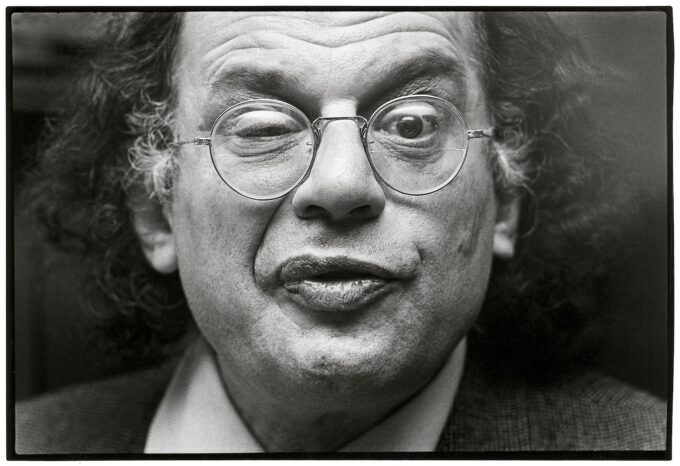
Allen Ginsberg, 1979. Image Wikipedia.

January 1956, Allen Ginsberg wrote: “America I’ve given you all and now I’m nothing.”

It is January 2026. I’m not sure if we’ve given it all as citizens or as a society. Some votes, some taxes, some rants, some protests, but surely not enough.

“Two dollars and twentyseven cents”? Don’t mention to Ginsberg the price of living in this economy.

Sometimes I, too, can’t stand my own mind.

“America when will we end the human war?” he asked. Not yet, Ginsberg, not yet. Nuclear weapons, missiles, drones, assault rifles, wrongful arrests, deportations without due process, homicides, the violence goes on and on.

“I don’t feel good don’t bother me.
I won’t write my poem till I’m in my right mind.”
Ginsberg, it’s simply not possible to be in our right minds anymore.

“America when will you be angelic?” Not angelic yet.
“When will you take off your clothes?” Fully armored still.
“When will you look at yourself through the grave?” That moment feels near, as we seem set on a suicide mission: democracy, foreign affairs, ecology. America First, burning itself down from the inside.

Ginsberg implored, “America why are your libraries full of tears?” But those volumes that contain our tears—genocide, slavery, discrimination, injustice—are now being removed from the shelves across the nation. Instead, the libraries are urged to display books that sing of power, pride, and progress.

“America when will you send your eggs to India?” Don’t get him started on the price of eggs.

Like Ginsberg, so many of us are sick of the insane demands. The ultimatum is: be a white Christian male, or else.

Well, I’m all else.

Ginsberg suspected, “There must be some other way to settle this argument.” There must be. An uprising. A declaration of heart and sanity. Saints against authoritarians. Radical hope against despair. Resilience, no matter what.

“America the plum blossoms are falling.” Then let us sweep the streets.

Ginsberg admitted he hadn’t read the newspapers for months with somebody going on trial for murder every day. Today the killers wear badges: ICE agents and police officers who often evade consequence. White House blames left-wing ideology, not bullets. It’s an old story in America, guns above human lives. All hail the Second Amendment.

Ginsberg predicted that there’s going to be trouble. And troubles followed. Detroit, Los Angeles, Seattle, Ferguson, Standing Rock. In this moment the pulse is in Minneapolis. The unrest feels inevitable, unstoppable. Necessary.

America’s emotional life was run by Time Magazine, Ginsberg lamented. Now there is Fox News, Facebook, X, CNN, morning talk shows, late-night comedy, alternative truths, deepfakes, AI.

It occurs to me that we are all America.
We are talking to ourselves in circles.

Ginsberg observed Asia rising. Oceans are also rising. Greenhouse emissions are rising. Inflation is rising. Unemployment is rising. Death toll is rising. May civilians rise like no other.

“I’d better consider my national resources.” And what are they now, a flag and a Bible? What about civil rights? What about national parks? What about schools, hospitals, museums?

So much for Ginsberg’s “unpublishable private literature that jetplanes 1400 miles an hour and twentyfive-thousand mental institutions.”

He said his ambition was to be President despite being Catholic. Don’t bother Ginsberg. This is a spectacle, nothing more.

“America how can I write a holy litany in your silly mood?”

And though the mood remained silly, even sinister and deceitful, Ginsberg raged on, obscene and luminous, word after word. He howled at America, and so will we:

America, free the immigrants.
America, defend democracy.
America, protect civilians.
America, restore the planet.

“America you don’t really want to go to war.” Please don’t.

“America its them bad Russians.
Them Russians them Russians and them Chinamen. And them Russians.
The Russia wants to eat us alive. The Russia’s power mad.”

But of course, we know Russia is not alone in its appetite to devour everything.
The President of the United States is power mad.
He wants to rule Venezuela.
He wants to claim Greenland.

He wants the Nobel Peace Prize.
He wants his name to crown the Kennedy Center.

He wants a gold-gilded ballroom.

Absolute loyalty. Solely his own morality. A government turned into reality TV. The whole world watching.

“America this is quite serious,” Ginsberg wrote; we ought to agree.

“I’d better get right down to the job,” he declared. And because he didn’t want to join the Army or turn lathes in precision parts factories, he offered, “America I’m putting my queer shoulder to the wheel.”

One poem at a time, 1400 miles an hour. That was his job. His gift to America.
It’s our turn. So I’m putting my immigrant shoulder to the wheel.

Because if not now, when?

Ipek S. Burnett, PhD, is the author of A Jungian Inquiry into American the Psyche: The Violence of Innocence (Routledge, 2020) and the editor of Re-Visioning the American Psyche: Jungian, Archetypal, and Mythological Reflections (Routledge, 2024). Based in San Francisco, she works with nonprofit organizations that specialize in social justice, human rights, and democracy. For more information visit: www.ipek burnett.com


LA REVUE GAUCHE - Left Comment: Search results for GINSBERG HOWL

Allen Ginsberg's "Howl" : a literary and cultural analysis. Allen ... Files. 2013-2014 Iglesias Rivas, Sara.pdf (240.55 KB). Identifiers. URI: http ...


Howl | The Poetry Foundation


Wednesday, February 24, 2021

OBIT REDUX
San Francisco poet Lawrence Ferlinghetti and City Lights bookstore founder, has died aged 101

Oscar Holland, CNN

Lawrence Ferlinghetti, the Beat poet, publisher and founder of San Francisco's beloved City Lights bookstore, has died aged 101
.
Poet Lawrence Ferlinghetti at his home in San Francisco, Calif., on Thursday, March 1, 2018. (Photo by Carlos Avila Gonzalez/San Francisco Chronicle via Getty Images)

He passed away from lung disease on Monday evening, confirmed the store's vice president and director of marketing and publicity, Stacey Lewis.

One of the last surviving members of the Beat Generation, Ferlinghetti played a key role in expanding the literary movement's focus to the West Coast. An online tribute, posted to City Lights' website on Tuesday, said that Ferlinghetti had been "instrumental in democratizing American literature."

"For over 60 years, those of us who have worked with him at City Lights have been inspired by his knowledge and love of literature, his courage in defense of the right to freedom of expression, and his vital role as an American cultural ambassador," the post read. "His curiosity was unbounded and his enthusiasm was infectious, and we will miss him greatly."

Born in New York in 1919, he co-founded the City Lights bookstore in San Francisco's North Beach neighborhood in 1953. In 1955, he would buy out fellow co-founder Peter D. Martin, and expand the business to include a publishing house of the same name.

Launching with the hugely influential Pocket Poets Series, Ferlinghetti went on to publish works by some of the postwar period's most important literary figures, including fellow Beat poets William S. Burroughs and Jack Kerouac. But it was a poem by Allen Ginsberg, "Howl," that would further thrust him into the spotlight.

San Francisco authorities seized copies of Ginsberg's collection "Howl and Other Poems" in 1957, published by City Lights the year before. Ferlinghetti was arrested and tried on obscenity charges due to the book's references to sex and drugs. The case garnered nationwide attention and provoked huge debate over censorship. Ferlinghetti was eventually cleared, with the judge ruling that the book had "redeeming social importance" -- a decision that would more broadly change the US courts' approach to creative free speech.

While continuing to provide a meeting place for San Francisco's literati, Ferlinghetti was a distinguished poet in his own right. His celebrated 1958 collection "A Coney Island of the Mind" was a big commercial success, and contained some of his best-known poems, including "I Am Waiting" and "Autobiography."

Ferlinghetti was prolific thereafter, with his accessible and witty style captured in celebrated poems like "Two Scavengers in a Truck, Two Beautiful People in a Mercedes" and "Euphoria." ("As I approach the state of pure euphoria," he memorably started the latter, "I find I need a large size typewriter case to carry my underwear in.")

He authored more than 30 collections of poetry, tackling themes such as social ills and mass corruption. He continued writing well into his later years, publishing his latest novel "Little Boy" in 2019. Upon his 100th birthday that year, San Francisco made March 24, his birthday, "Lawrence Ferlinghetti Day."

City Lights also continued to serve as a meeting place for the city's creative and literary communities, hosting regular readings, talks and book signings. The store and its publishing arm had, however, struggled with the financial challenges posed by the Covid-19 pandemic. Last April, CEO and publisher Elaine Katzenberger started a GoFundMe campaign to raise the $300,000 she said was needed to keep the business afloat.

Nonetheless, in its online tribute, the company said it hoped to "build on Ferlinghetti's vision and honor his memory by sustaining City Lights into the future as a center for open intellectual inquiry and commitment to literary culture and progressive politics."

A Coney Island of the Mind, 28 by Lawrence Ferlinghetti ...

https://poets.org/poem/coney-island-mind-28

Coney Island of the Mind, 11. The wounded wilderness of Morris Graves is not the same wild west the white man found It is a land that Buddha came upon from a different direction It is a wild white nest in the true mad north of introspection where ‘falcons of the inner eye’ dive and die glimpsing in their dying fall all life’s memory of existence and with grave chalk wing draw upon 


Top image: Lawrence Ferlinghetti at his home in San Francisco, California on March 1, 2018.


Lawrence Ferlinghetti gives a poetry reading at San Francisco's Jazz Cellar nightclub in 1957.

 
FERLENGETTI, ALLEN GINSGURG, BELLA ABZUG


REST IN POWER FERLENGETTI

I WAS A REGULAR VISITOR TO SF IN THE EIGHTIES, VISITING FRIENDS, DOING INTERVIEWS IN THE SCI FI COMMUNITY, HANGING OUT WITH THE OTO AND VISITING CITY LIGHTS BOOKS THEN DRINKING BEER  TOKING ACROSS THE LANE AT THE VESUVIUS BAR. I WAS IN CONTACT WITH THE FOLKS PUTTING OUT RESEARCH MAGAZINE OUT OF CITY LIGHTS, A PAL FROM EDMONTON TOOK ME TO THE JAZZ CELLAR WHICH WAS STILL GOING AT THAT TIME.