Showing posts sorted by relevance for query GINSBERG HOWL. Sort by date Show all posts

Monday, January 19, 2026

Ginsberg’s “America” Revisited


 January 19, 2026


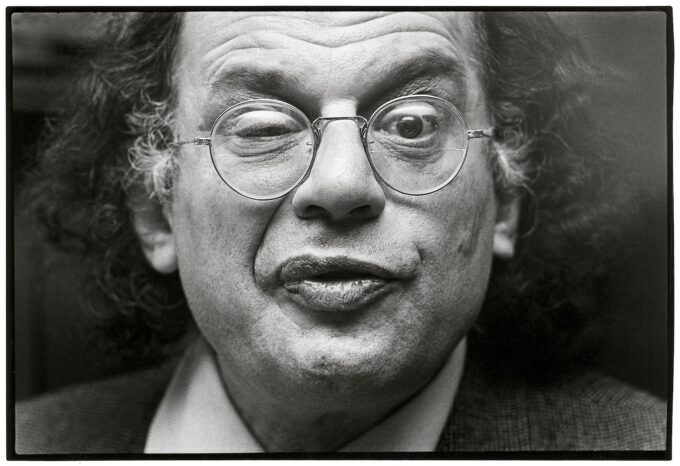
Allen Ginsberg, 1979. Image Wikipedia.

January 1956, Allen Ginsberg wrote: “America I’ve given you all and now I’m nothing.”

It is January 2026. I’m not sure if we’ve given it all as citizens or as a society. Some votes, some taxes, some rants, some protests, but surely not enough.

“Two dollars and twentyseven cents”? Don’t mention to Ginsberg the price of living in this economy.

Sometimes I, too, can’t stand my own mind.

“America when will we end the human war?” he asked. Not yet, Ginsberg, not yet. Nuclear weapons, missiles, drones, assault rifles, wrongful arrests, deportations without due process, homicides, the violence goes on and on.

“I don’t feel good don’t bother me.
I won’t write my poem till I’m in my right mind.”
Ginsberg, it’s simply not possible to be in our right minds anymore.

“America when will you be angelic?” Not angelic yet.
“When will you take off your clothes?” Fully armored still.
“When will you look at yourself through the grave?” That moment feels near, as we seem set on a suicide mission: democracy, foreign affairs, ecology. America First, burning itself down from the inside.

Ginsberg implored, “America why are your libraries full of tears?” But those volumes that contain our tears—genocide, slavery, discrimination, injustice—are now being removed from the shelves across the nation. Instead, the libraries are urged to display books that sing of power, pride, and progress.

“America when will you send your eggs to India?” Don’t get him started on the price of eggs.

Like Ginsberg, so many of us are sick of the insane demands. The ultimatum is: be a white Christian male, or else.

Well, I’m all else.

Ginsberg suspected, “There must be some other way to settle this argument.” There must be. An uprising. A declaration of heart and sanity. Saints against authoritarians. Radical hope against despair. Resilience, no matter what.

“America the plum blossoms are falling.” Then let us sweep the streets.

Ginsberg admitted he hadn’t read the newspapers for months with somebody going on trial for murder every day. Today the killers wear badges: ICE agents and police officers who often evade consequence. White House blames left-wing ideology, not bullets. It’s an old story in America, guns above human lives. All hail the Second Amendment.

Ginsberg predicted that there’s going to be trouble. And troubles followed. Detroit, Los Angeles, Seattle, Ferguson, Standing Rock. In this moment the pulse is in Minneapolis. The unrest feels inevitable, unstoppable. Necessary.

America’s emotional life was run by Time Magazine, Ginsberg lamented. Now there is Fox News, Facebook, X, CNN, morning talk shows, late-night comedy, alternative truths, deepfakes, AI.

It occurs to me that we are all America.
We are talking to ourselves in circles.

Ginsberg observed Asia rising. Oceans are also rising. Greenhouse emissions are rising. Inflation is rising. Unemployment is rising. Death toll is rising. May civilians rise like no other.

“I’d better consider my national resources.” And what are they now, a flag and a Bible? What about civil rights? What about national parks? What about schools, hospitals, museums?

So much for Ginsberg’s “unpublishable private literature that jetplanes 1400 miles an hour and twentyfive-thousand mental institutions.”

He said his ambition was to be President despite being Catholic. Don’t bother Ginsberg. This is a spectacle, nothing more.

“America how can I write a holy litany in your silly mood?”

And though the mood remained silly, even sinister and deceitful, Ginsberg raged on, obscene and luminous, word after word. He howled at America, and so will we:

America, free the immigrants.
America, defend democracy.
America, protect civilians.
America, restore the planet.

“America you don’t really want to go to war.” Please don’t.

“America its them bad Russians.
Them Russians them Russians and them Chinamen. And them Russians.
The Russia wants to eat us alive. The Russia’s power mad.”

But of course, we know Russia is not alone in its appetite to devour everything.
The President of the United States is power mad.
He wants to rule Venezuela.
He wants to claim Greenland.

He wants the Nobel Peace Prize.
He wants his name to crown the Kennedy Center.

He wants a gold-gilded ballroom.

Absolute loyalty. Solely his own morality. A government turned into reality TV. The whole world watching.

“America this is quite serious,” Ginsberg wrote; we ought to agree.

“I’d better get right down to the job,” he declared. And because he didn’t want to join the Army or turn lathes in precision parts factories, he offered, “America I’m putting my queer shoulder to the wheel.”

One poem at a time, 1400 miles an hour. That was his job. His gift to America.
It’s our turn. So I’m putting my immigrant shoulder to the wheel.

Because if not now, when?

Ipek S. Burnett, PhD, is the author of A Jungian Inquiry into American the Psyche: The Violence of Innocence (Routledge, 2020) and the editor of Re-Visioning the American Psyche: Jungian, Archetypal, and Mythological Reflections (Routledge, 2024). Based in San Francisco, she works with nonprofit organizations that specialize in social justice, human rights, and democracy. For more information visit: www.ipek burnett.com


LA REVUE GAUCHE - Left Comment: Search results for GINSBERG HOWL

Allen Ginsberg's "Howl" : a literary and cultural analysis. Allen ... Files. 2013-2014 Iglesias Rivas, Sara.pdf (240.55 KB). Identifiers. URI: http ...


Howl | The Poetry Foundation


Saturday, October 08, 2005

HOWL


OCTOBER 8 1955
HOWL
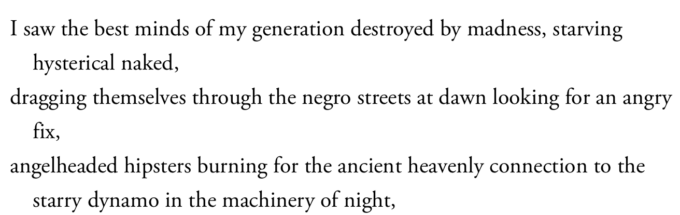
I saw the best minds of my generation destroyed by madness, starving hysterical naked,
dragging themselves through the negro streets at dawn looking for an angry fix,
angelheaded hipsters burning for the ancient heavenly connection to the starry dynamo in the machinery of night,
who poverty and tatters and hollow-eyed and high sat up smoking in the supernatural darkness of cold-water flats floating across the tops of cities contemplating jazz,
who bared their brains to Heaven under the El and saw Mohammedan angels staggering on tenement roofs illuminated,
who passed through universities with radiant cool eyes hallucinating Arkansas and Blake-light tragedy among the scholars of war

Howl of beat's heart


October 08, 2005 FIFTY years ago today in San Francisco, disaffected young bohemians, with their goatees, berets, angst, wine and marijuana, gathered at the Six Gallery to listen to poetry. It was a cool, hip thing to do and rock'n'roll had not yet been invented.

If they had arrived as individuals in search of confirmation that society sucked, by the time Allen Ginsberg had finished reading his seminal work, Howl, an eloquent, passionate rage against conformity, the 200 or so there left united into new movement: the beats.

"That was the day the bomb went off," says Anthony Bliss, curator of rare books and literary manuscripts at Berkeley's Bancroft Library, home to one of the foremost collections of beat literature.

The Howl Obscenity Trial and free speech

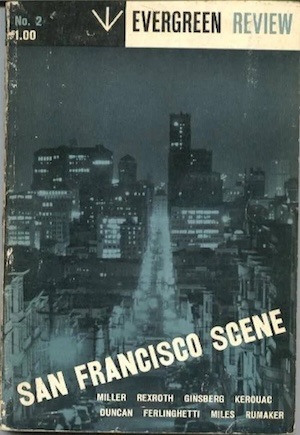
"Beat Generation" is a term referring to a heterogeneous mix of young people, artists and intellectuals of the 1950s (and later) whose unconventional work and lifestyle reflected profound disaffection with contemporary society. They expressed objection and criticism against American materialism in a bitter, harsh and often abusive language. They mocked its conformity, denounced its immorality and set out "on the road" to discover America's true spirit. They experienced with drugs and sex, explored Eastern religions and Western avant-gardes, from dada to jazz "burning for the ancient heavenly connection." (Ginsberg) The Beats rediscovered poetry as a form of public entertainment, returned to its sources in the body, breath, the spoken word and music. The Beat ethos reverberated through the anti-war movement and movements from psychedelia to punk and enjoys a current resurgence.
Members of the Beat Generation, responded to the conformist materialism of the period by adopting lifestyles derived from Henry David Thoreau's social disobedience and Walt Whitman's poetry of the open road. The movement had no shared artistic credo beyond breaking the current literary orthodoxy. Most representative and influential were Kerouac' s novel On the Road (1957) and Ginsberg's poem Howl (1956), and William S. Burroughs' Naked Lunch. (1959) Other prominent Beat related literary figures were poet and publisher Lawrence Ferlinghetti, poet Gregory Corso, and novelist John Clellon Holmes. In a first section of this course we will concentrate on the works of these "core Beats". We will then move on to study the convergence of the Beat Movement with the San Francisco Poetry Renaissance.


Howl was one of those books, and it is a book not just a 'poem', that had a profound impact on me when I was a teenager. The others were the Communist Manifesto, the writings of Bakunin, Freud's Analysis of Dreams, Heinlien's Stranger in a Strange Land, Aleister Crowley's Magick in Theory and Practice, the novels of H.P. Lovecraft, Raymond Chandler, William Burroughs, Samuel Delany and the poems and stories of Edgar Allan Poe. I liked my poets dark, stoned and gothic.

Don't call me a baby boomer, I never did. I am a child of the Atomic Age, the Space Age, the Age of Television, the new Age of Comics, Rock n Roll in the New Jazz Age. In growing up I embraced the Beat/Hippie/Yippie/Freak kulture.... I was baptized in the Anti-War and Liberation Movements of the seventies; youth libertation, womens liberation, gay liberation. Underground comix, Alternative Press and Media was juice for my creativity. The revival of Surrealism, Wobbly labour activism and Paganism was the carnival of resistance I ran away to join.

I was cheered by Hendrix, the poetics of the Doors, the siren call of Leary and the other Experiences of the Doors of Perception that opened for my in-between generation, 1954-64, not really the sixties and not yet generation X.


There now you know a bit more about me......
and at 50 I still Howl.


Wednesday, February 24, 2021

REST IN POWER
Beat poet, publisher Lawrence Ferlinghetti dies at 101 -

SAN FRANCISCO — Lawrence Ferlinghetti, the poet, publisher, bookseller and activist who helped launch the Beat movement in the 1950s and embodied its curious and rebellious spirit well into the 21st century, has died at age 101.

© Provided by The Canadian Press

Ferlinghetti, a San Francisco institution, died Monday at his home, his son Lorenzo Ferlinghetti said. A month shy of his 102nd birthday, Ferlinghetti died “in his own room,” holding the hands of his son and his son’s girlfriend, “as he took his last breath." The cause of death was lung disease. Ferlinghetti had received the first dose of the COVID vaccine last week, his son said Tuesday.

Few poets of the past 60 years were so well known, or so influential. His books sold more than 1 million copies worldwide, a fantasy for virtually any of his peers, and he ran one of the world’s most famous and distinctive bookstores, City Lights. Although he never considered himself one of the Beats, he was a patron and soul mate and, for many, a lasting symbol — preaching a nobler and more ecstatic American dream.

“Am I the consciousness of a generation or just some old fool sounding off and trying to escape the dominant materialist avaricious consciousness of America?” he asked in “Little Boy,” a stream of consciousness novel published around the time of his 100th birthday

He made history. Through the City Lights publishing arm, books by Jack Kerouac, William S. Burroughs and many others came out and the release of Allen Ginsberg’s landmark poem “Howl” led to a 1957 obscenity case that broke new ground for freedom of expression.

He also defied history. The Internet, superstore chains and high rents shut down numerous booksellers in the Bay Area and beyond, but City Lights remained a thriving political and cultural outlet, where one section was devoted to books enabling “revolutionary competence,” where employees could get the day off to attend an anti-war protest.

“Generally, people seem to get more conservative as they age, but in my case, I seem to have gotten more radical,” Ferlinghetti told Interview magazine in 2013. “Poetry must be capable of answering the challenge of apocalyptic times, even if this means sounding apocalyptic.”

The store even endured during the coronavirus outbreak, when it was forced to close and required $300,000 to stay in business. A GoFundMe campaign quickly raised $400,000.

Ferlinghetti, tall and bearded, with sharp blue eyes, could be soft-spoken, even introverted and reticent in unfamiliar situations. But he was the most public of poets and his work wasn’t intended for solitary contemplation. It was meant to be recited or chanted out loud, whether in coffee houses, bookstores or at campus gatherings.

His 1958 compilation, “A Coney Island of the Mind,” sold hundreds of thousands of copies in the U.S. alone. Long an outsider from the poetry community, Ferlinghetti once joked that he had “committed the sin of too much clarity.” He called his style “wide open” and his work, influenced in part by e.e. cummings, was often lyrical and childlike: “Peacocks walked/under the night trees/in the lost moon/light/when I went out/looking for love,” he wrote in “Coney Island.”

Ferlinghetti also was a playwright, novelist, translator and painter and had many admirers among musicians. In 1976, he recited “The Lord’s Prayer” at the Band’s farewell concert, immortalized in Martin Scorsese’s “The Last Waltz.” The folk-rock band Aztec Two-Step lifted its name from a line in the title poem of Ferlinghetti’s “Coney Island” book: “A couple of Papish cats/is doing an Aztec two-step.” Ferlinghetti also published some of the earliest film reviews by Pauline Kael, who with The New Yorker became one of the country’s most influential critics.

He lived long and well despite a traumatic childhood. His father died five months before Lawrence was born in Yonkers, New York, in 1919, leaving behind a sense of loss that haunted him, yet provided much of the creative tension that drove his art. His mother, unable to cope, had a nervous breakdown two years after his father’s death. She eventually disappeared and died in a state hospital.

Ferlinghetti spent years moving among relatives, boarding homes and an orphanage before he was taken in by a wealthy New York family, the Bislands, for whom his mother had worked as a governess. He studied journalism at the University of North Carolina at Chapel Hill, received a master’s in literature from Columbia University, and a doctorate degree from the Sorbonne in Paris. His early influences included Ernest Hemingway, Thomas Wolfe and Ezra Pound.

Ferlinghetti hated war, because he was in one. In 1945, he was a Navy commander stationed in Japan and remembered visiting Nagasaki a few weeks after the U.S. had dropped an atom bomb. The carnage, he would recall, made him an “instant pacifist.”

In the early 1950s, he settled in San Francisco and married Selden Kirby-Smith, whom he divorced in 1976. (They had two children). Ferlinghetti also became a member of the city’s rising literary movement, the so-called San Francisco Renaissance, and soon helped establish a gathering place. Peter D, Martin, a sociologist, had opened a paperback store in the city’s North Beach section and named it after a recent Charlie Chaplin film, “City Lights.” When Ferlinghetti saw the storefront, in 1953, he suggested he and Martin become partners. Each contributed $500.

Ferlinghetti later told The New York Times: “City Lights became about the only place around where you could go in, sit down, and read books without being pestered to buy something.”

The Beats, who had met in New York in the 1940s, now had a new base. One project was City Lights’ Pocket Poets series, which offered low-cost editions of verse, notably Ginsberg’s “Howl.” Ferlinghetti had heard Ginsberg read a version in 1955 and wrote him: “I greet you at the beginning of a great career. When do I get the manuscript?” a humorous take on the message sent from Ralph Waldo Emerson to Walt Whitman upon reading “Leaves of Grass.”

Ferlinghetti published “Howl and Other Poems” in 1956, but customs officials seized copies of the book that were being shipped from London, and Ferlinghetti was arrested on obscenity charges. After a highly publicized court battle, a judge in 1957 ruled that “Howl” was not obscene, despite its sexual themes, citing the poem’s relevance as a criticism of modern society. A 2010 film about the case, “Howl,” starred James Franco as Ginsberg and Andrew Rogers as Ferlinghetti.

Ferlinghetti would also release Kerouac’s “Book of Dreams,” prison writings by Timothy Leary and Frank O’Hara’s “Lunch Poems.” Ferlinghetti risked prison for “Howl,” but rejected Burrough’s classic “Naked Lunch,” worrying that publication would lead to “sure premeditated legal lunacy.”

Ferlinghetti’s eyesight was poor in recent years, but he continued to write and to keep regular hours at City Lights. The establishment, meanwhile, warmed to him, even if the affection wasn’t always returned. He was named San Francisco’s first poet laureate, in 1998, and City Lights was granted landmark status three years later. He received an honorary prize from the National Book Critics Circle in 2000 and five years later was given a National Book Award medal for “his tireless work on behalf of poets and the entire literary community.”

“The dominant American mercantile culture may globalize the world, but it is not the mainstream culture of our civilization,” Ferlinghetti said upon receiving the award. “The true mainstream is made, not of oil, but of literarians, publishers, bookstores, editors, libraries, writers and readers, universities and all the institutions that support them.”

In 2012, Ferlinghetti won the Janus Pannonius International Poetry Prize from the Hungarian PEN Club. When he learned the country’s right-wing government was a sponsor, he turned the award down.


A Coney Island of the Mind, 28 by Lawrence Ferlinghetti ...

https://poets.org/poem/coney-island-mind-28

Coney Island of the Mind, 11. The wounded wilderness of Morris Graves is not the same wild west the white man found It is a land that Buddha came upon from a different direction It is a wild white nest in the true mad north of introspection where ‘falcons of the inner eye’ dive and die glimpsing in their dying fall all life’s memory of existence and with grave chalk wing draw upon 

___

Italie reported from New York.

Janie Har And Hillel Italie, The Associated Press


SEE
OBIT REDUX
LA REVUE GAUCHE - Left Comment (plawiuk.blogspot.com)


I WAS A REGULAR VISITOR TO SF IN THE EIGHTIES, VISITING FRIENDS, DOING INTERVIEWS IN THE SCI FI COMMUNITY, HANGING OUT WITH THE OTO AND VISITING CITY LIGHTS BOOKS THEN DRINKING BEER  TOKING ACROSS THE LANE AT THE VESUVIUS BAR. I WAS IN CONTACT WITH THE FOLKS PUTTING OUT RESEARCH MAGAZINE OUT OF CITY LIGHTS, A PAL FROM EDMONTON TOOK ME TO THE JAZZ CELLAR WHICH WAS STILL GOING AT THAT TIME. 


Tuesday, January 27, 2026

Deborah Baker Revisits Allen Ginsberg’s India Years at Exide Kolkata Literary Meet

At the Exide Kolkata Literary Meet, American biographer Deborah Baker spoke to Outlook on Allen Ginsberg’s relevance and what he took to the US from India


Sreemanti Sengupta
Updated on: 26 January 2026 
THE OUTLOOK INDIA


Deborah Baker Photo: Sandipan Chatterjee

Summary of this article

Deborah Baker discussed her book on Allen Ginsberg’s travels and experiences in India at the Exide Kolkata Literary Meet.

Ginsberg formed lasting ties with poets in Kolkata, shaping his connection with India.

His visit during the Bangladesh Liberation War inspired the poem September on Jessore Road, later recorded with Bob Dylan.


Q


The western world has always had a stereotypical view about India, as a land of snake charmers, elephants and sadhus. In what way do you think Ginsberg changed how the West looks at the East?

A


I don't think America thought much about India. India was not as pleasant as the UK. India’s image was mainly painted by the English. How many American poets had come to India before Ginsberg? Very few. India was not in their imagination. That came much later and, maybe, Ginsberg had a part to play with that. In the 60’s the Beatles came, and that really opened up ideas about India. Martin Luther King was deeply engaged with India on how they got their freedom, especially the Gandhian ideologies. With Ginsberg, I think a lot of Indian literature came to America.

Q


Do you think his diaries and notes go beyond the superficial images that western media has about India?
A


There's not much India in this India Diaries. He is not writing about what he's seeing, he's writing about what he's dreaming…and he is dreaming about his friends in New York.
Q


What kind of legacy does he leave behind in American and Indian literature?
A


People don't study him in colleges, they find him on their own. And I think it is important to know that…because it's part of his appeal, that he is not fed to them via their professors. Allen was anxious about this, he wanted to be praised by the academic world. Kerouac and Burroughs were outsiders, too. And it is important for young people to discover them on their own. It was also how I discovered Kerouac.


Exide Kolkata Literary Meet: Feminism, the Banu Mushtaq Way


Into The World of Words And Ideas: Exide Kolkata Literary Meet Lights Up The City of Joy


Q


How do you see the relevance of Ginsberg’s work in the world today?
A


I don't think he had the ambition to be an enduring influence. He was a poet who had a great honesty about himself. He had a great sense of humour. He had a lot of pain, anxiety, and fear, but he was never afraid to own the fact that he was gay. He thought marijuana should be legalised, he was also always trying to figure out what the ‘soma’ (intoxicant names in Vedic texts) was. He had this long correspondence with the mythologist R. Gordon Wassom where he thought he could obtain information about mushrooms. There are many sides to him.

Q


Ginsberg had an extended tryst with spirituality. He claimed to have seen God in 1948. Was there anything other than spirituality and drugs that drove him to this extended India tour?
A


He wanted love. He wanted a Godman he could love…a guru where there would be real love.
Q


What insights did your research reveal about Kolkata poets’ mutual influence on Ginsberg's development?
A


They were very secular…communists or socialists. Allen was very keen to talk politics…his father was a communist. He wanted to know about their lives, their struggles. I think they were like a Bengali version of who he had been while at Columbia University.

Q


He was not in good health during his travels. You mentioned his kidney condition, which caused frequent urination. He was also staying in remote places with very limited facilities. How do you think these experiences affected him?
A


It's interesting. As a Beat poet, he kept himself well maintained. He always went to the barber, carried a pocket handkerchief, and wore a suit. The Beats were very different from the hippies. He came to India and he absorbed the aesthetics of jhola bags, sandals, beads, salwar kameez…and that became the form of the hippies. He came to India and had a physical transformation…he grew out his hair, he started losing hair, he almost looked like a sadhu.


It is also important to say that he spent time with the Gandhians… he was in India when the Indo-China war (1962) broke out. He spent some time on the road, marching with (the Vinoba Bhave-led) Gandhians in a planned journey from Delhi to Beijing (which ended after the Chinese government refused the marchers entry). The idea that politics could be a performance was very impactful for him.

When he returned to America, the country was involved in the Vietnam War, he brought back the power to lead and organise anti-war protest events like the “levitation of Pentagon”. He brought flowers for soldier’s rifles, and he chanted OM in the middle of a riot. So, his takeaway from India included his pro-peace politics.

Q


Hope Savage is a very present and absent character in your book. She is like the archetypal muse… for Corso and Ginsberg. Though Ginsberg wasn’t directly misogynist, he did not seem interested in women and did not write for them or promote them…
A


I don't think it was his job to do that. He was a poet; he must go where his heart pulls him. His heart led him to Kolkata, he was invested in it, and did what he could for the Kolkata poets. I think it's a mistake to expect everything from a man. He didn't do much for the blacks either, though the poet Amiri Baraka was a close friend of his, he was not directly involved with the civil rights movement.


Are We Still Reading? How Literature Festivals Are Keeping Books Alive
BY Shinie Antony


Q


I am saying this from the perspective of the general beat attitude towards women - objectifying them or not treating them as equal poets.
A


Yes, in that sense, he was very much a product of that time.
Q


How did you decide the style of writing ‘A Blue Hand’?
A


My sources were mainly his letters and diaries. He was not a great prose stylist; he was not interested in prose. If you see his journals, you will see how he skipped around… just observing and writing down details. Jessore road is basically one detail after another Also, it's not really a poem; he wrote it as a song. So, I tried to make it as coherent as possible for readers to understand Ginsberg through my writing.
Q


How did you balance the non-fiction narrative and the fictional storytelling style so that people are transported to the 60s with you, in a real way.
A


Non-fiction can do a lot of storytelling. In India, you may not be as exposed to creative non-fiction. The academic non-fiction is more about ideas, my books are more about people.
Q


Do you think if Howl was published today with its heavily obscene content, would it make the same impact?
A


I don't know. I think it might be pulled off the shelves today.


Q


What do you think Ginsberg would say about the right wing-ruled India today?
A


(Laughs) So, you want to get me into trouble? I think he would be very discouraged. The same way he felt when India went all militant against China. Overnight he saw the peaceful, spiritual Indians become raging anti-China demonstrators. He was disillusioned.
Q


What about Ginsberg in America today? I imagine to be a poet like him in this climate of global rise of the right wing would be suffocation.
A


He would have found a way. I wish we had someone like him now.


Sreemanti Sengupta is a poet and freelance writer


December 17, 1971

On Jessore Road
By ALLEN GINSBERG

Millions of babies watching the skies
Bellies swollen, with big round eyes
On Jessore Road-long bamboo huts
Noplace to s--- but sand channel ruts

Millions of fathers in rain
Millions of mothers in pain
Millions of brothers in woe
Millions of sisters nowhere to go

Millions of Souls nineteen seventy-one
homeless on Jessore under grey sun
A million are dead, the millions who can
Walk toward Calcutta from East Pakistan

Wet processions Families walk
Stunted boys big heads don't talk
Look bony skulls & silent round eyes
Starving black angels in human disguise

Mother squats weeping and points to her sons
Standing thin legged like elderly nuns
small bodied hands to their mouths in prayer
Five months small food since they settled there

On one floor mat with a small empty pot
Father lifts up his hands at their lot
Tears come to their mother's eye
Pain makes mother Maya cry

On Jessore road Mother wept at my knees
Bengali tongue cried mister Please
Identity cards torn up on the floor
Husband still waits at camp office door

Baby at play I was watching the flood
Now they won't give us any more food
The pieces are here in my celluloid purse
Innocent baby play our death curse

Breaking the line and jumping in front
Into the circle sneaks one skinny runt
Two brothers dance forward to Play hungry Tricks
The guards blow big whistles & wave bamboo sticks

The man in the bread door Cries & comes out
Thousands of boys & girls Take up his shout
Is it joy? is it prayer? "No more bread today"
Thousands of Children at once scream Hooray!

Border trucks flooded, food can't get past,
American Angel machine please come fast!
Where is Ambassador Bunker today?
Are his Helios machinegunning children at play?

Where are the helicopters of U.S. AID?
Smuggling dope in Bangkok's green shade.
Where is America's Air Force of Light?
Bombing North Laos all day and all night?

Where are the President's Armies of Gold?
Billionaire Navies merciful Bold?
Bringing us medicine food and relief?
Napalming North Viet Nam and causing more grief?

Where are our tears? Who weeps for this pain?
Where can these families go in the rain?
Jessore Road's children close their big eyes
Where will we sleep when Our Father dies?

Whom shall we pray to for rice and for care?
Who can bring bread to this s--- flood foul'd lair?
Millions of children alone in the rain!
Millions of children weeping in pain!

Ring O ye tongues of the world for their woe
Ring out ye voices for love we don't know
Ring out ye bells of electrical pain
Ring in the conscious American brain

How many children are we who are lost
Whose are these daughters we see turn to ghost?
What are our souls that we have lost care
Ring out ye musics and weep if you dare-

Cries in the mud by the thatch'd house sand drain
Sleeps in huge pipes in the wet s--- field rain
waits by the pump well, Woe to the world!
whose children still starve in their mother's arms curled.

Is this what I did to myself in the past?
What shall I do Sunil Poet I asked?
Move on and leave them without any coins?
What should I care for the love of my loins?

How many souls walk through Maya in pain
How many babes in illusory rain?
How many families hollow eyed lost?
How many grandmothers turning to ghost?

How many fathers in woe
How many sons nowhere to go?
How many daughters nothing to eat
How many uncles with swollen sick feet

Millions of babies in pain
Millions of mothers in rain
Millions of brothers in woe
Millions of children nowhere to go

This is half the poem "September on Jessore Road" written by Allen Ginsberg after visiting West Bengal refugee camps.