Showing posts sorted by relevance for query PETITE BOURGEOIS LANDOWNERS. Sort by date Show all posts

Friday, December 26, 2025

UK Government waters down inheritance tax changes for farmers


Photo: Lois GoBe/Shutterstock:

Government plans to tax inherited farmland have been watered down following months of protests by farmers and concern from backbenchers.

The individual threshold for a 20% tax on inherited agricultural or business assets will be increased from £1 million to £2.5 million when introduced in April next year.

It comes after more than 20 Labour MPs from mostly rural constituencies abstained on the proposal in Parliament earlier this month, with Penrith and Solway MP Markus Campbell-Savours losing the party whip for voting against.

The increased threshold will halve the number of estates affected by the reform to the Agricultural Property Relief (APR), from 375 to 185.

Environment Secretary Emma Reynolds said: “Farmers are at the heart of our food security and environmental stewardship, and I am determined to work with them to secure a profitable future for British farming.

“We have listened closely to farmers across the country and we are making changes today to protect more ordinary family farms. We are increasing the individual threshold from £1 million to £2.5 million which means couples with estates of up to £5 million will now pay no inheritance tax on their estates.

“It’s only right that larger estates contribute more, while we back the farms and trading businesses that are the backbone of Britain’s rural communities.”

‘Reform will give peace of mind to farming families’

Chair of the Labour Rural Research Group and MP for Suffolk Coastal has welcomed the changes and said they represent a major boost for family farms and rural businesses.

She said: “This is a crucial reform that will give real peace of mind to farming families.

“By increasing the APR threshold to £2.5 million per person, we are recognising the true value of agricultural in rural Britain, and the importance of keeping farms in family ownership.

“For couples, the combined threshold of £5 million will make a transformative difference. It means fewer families facing impossible choices, and greater certainty that farms can continue to operate, invest, and contribute to our rural economy.

“This wouldn’t have been possible if the Government hadn’t listened to rural Labour MP colleagues in the Labour Rural Research Group, to farmers, and to industry. This move shows the government is fully committed to backing working farms and our countryside  – after years of successive failures under the Conservative government that brought farming to its knees.

“This is a big step that will go a huge way to back Britain’s working farms, whilst the government takes forward wider recommendations in Baroness Batters’ Farming Profitability Review.”

NFU President: ‘Common sense has prevailed’

The National Farmers’ Union (NFU), which fought a campaign against the changes to inheritance tax for farmers, said that the increase in thresholds would come as a “huge relief to many”.

NFU President Tom Bradshaw said: “While there is still tax to pay, this will greatly reduce that tax burden for many family farms, those working people of the countryside.

“I am thankful common sense has prevailed and government has listened. I have had two very constructive meetings with Prime Minister Sir Keir Starmer and dozens of conversations with Defra Secretary of State Emma Reynolds. She has played a key role underlining the human impact of this tax. These conversations have led to today’s changes which were so desperately needed. 

“From the start the government said it was trying to protect the family farm and the change announced today brings this much closer to reality for many. I’d like to thank the Prime Minister for recognising the policy needed amending and the Chancellor for bringing in the spousal transfer in the Budget. Combined this is a significant change.

“I would like to thank all those Labour backbench MPs that were contacted by farmers and growers and decided to stand by their constituents as demonstrated by the recent abstentions on the vote on Budget Resolution 50. 

“While small in number, it was a significant and brave move for many. We have spent the past year working with them and there’s no doubt their interventions behind the scenes have also played a huge role in securing today’s news. I would also like to thank all opposition parties for continuously raising the impacts of this proposed policy.”

Macron meets French farmers in bid to defuse anger over trade deal

By AFP
December 23, 2025


French farmers have been fuming over a litany of issues, including a trade deal under negotiation between the European Union and South American bloc Mercosur - Copyright AFP/File kena betancur

French President Emmanuel Macron on Tuesday met with farmers’ unions to discuss a controversial free trade deal and the government’s handling of a cow disease that has led to protests and roadblocks.

It was the first meeting between Macron and union leaders since the start of a protest movement against a mass cull of cows to contain the spread of nodular dermatitis, widely known as lumpy skin disease.

French farmers have been fuming over a litany of issues, including a trade deal under negotiation between the European Union and South American bloc Mercosur, with any further decisions postponed to January.

“The purpose of the meeting was to try to put out the fire that is raging across the countryside,” Stephane Galais of the Confederation Paysanne union told journalists after the meeting, calling for “strong structural measures.”

“We’ve passed the ball to them. It’s in their court,” said Pierrick Horel, head of the Young Farmers union.

“What was important for us was to convey to the head of state the extreme tension that is affecting the agricultural world,” said Arnaud Rousseau, head of the main FNSEA union. “We are opposed to Mercosur.”

The EU-Mercosur pact would create the world’s biggest free-trade area and help EU members export more vehicles, machinery, wines and spirits to Latin America at a time of global trade tensions.

Farmers, particularly in France, worry the Mercosur deal will see them undercut by a flow of cheaper goods from agricultural giant Brazil and its neighbours.

Meanwhile, the culls have divided the unions, with FNSEA supporting the government’s policy under which all animals in affected herds are slaughtered.

On Tuesday, the agriculture ministry confirmed a new case of the disease in southwestern France, bringing the total number of outbreaks recorded in the country since June to 115.

Protesting farmers have for days blocked roads, sprayed manure and dumped garbage in front of government offices to force the authorities to review their policy.

The protests eased ahead of the holiday season but some farmers refused to budge. On Tuesday, motorway blockades remained in place on the A63 south of the city of Bordeaux and on the A64 in the towns of Carbonne and Briscous.

The Petty Bourgeois Farmer


A prevalent phenomenon in the Americas


Anna López and Charles T.
Jul 04, 2024


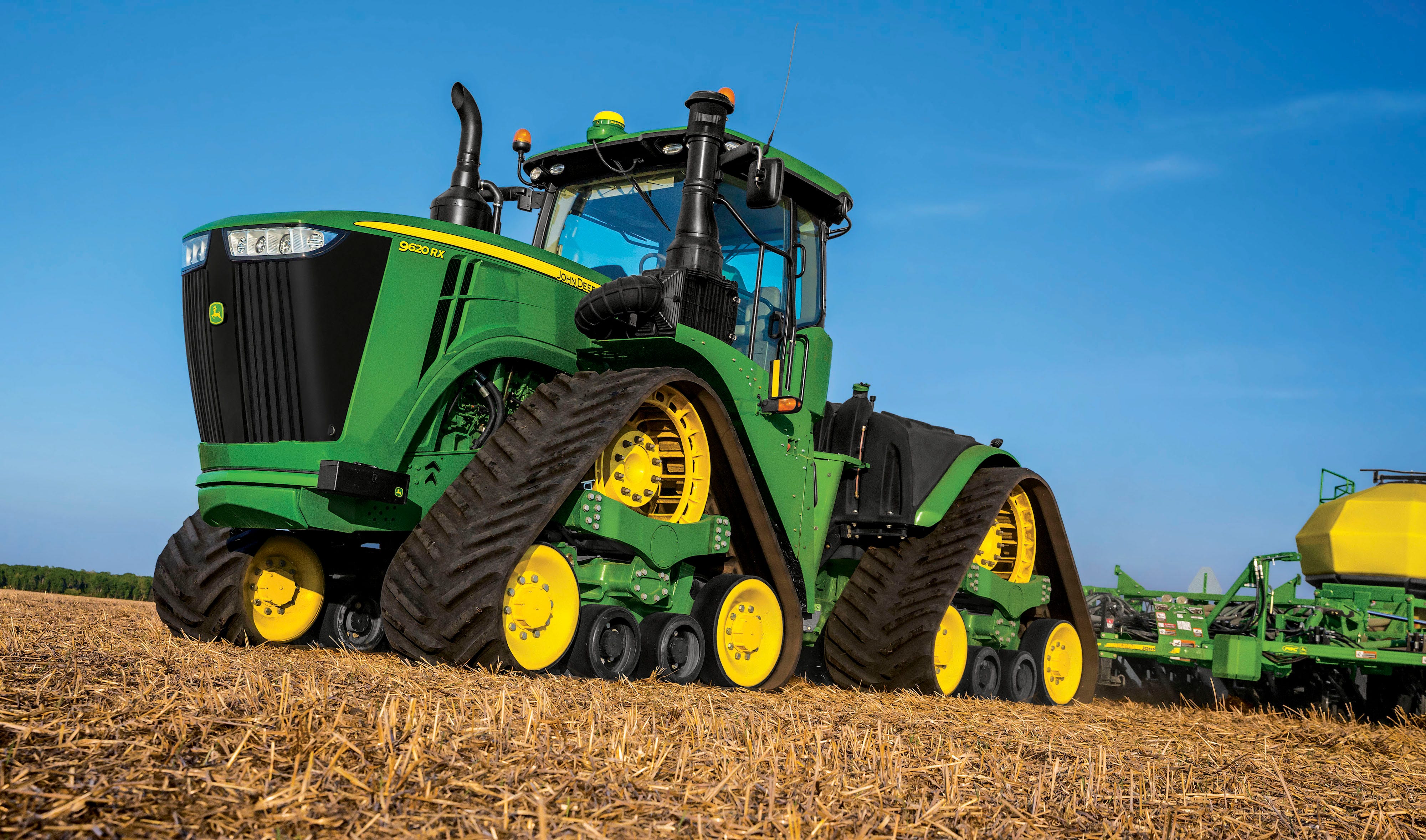
Image from the Machinefinder Blog

Who is and isn’t the working class? When you get into the nitty gritty, this is a question that confuses many newcomer leftists who may not be well read on a variety of Marxist literature and subsequently do not fully grasp the philosophy. Some people believe that other service workers, like baristas, are not representatives of the working class, yet believe that the average American farmer, rural landholders, are some of the utmost representative of the working class. We’re here to shine a light on the reality, of whose interests aligns with who, and how labor and production is distributed in this regard.
The Historical Development of Land Ownership


In slave societies and especially feudalistic societies, land was characterized by servants and serfs bound to lands who would work to generate enough produce to subside themselves as well as their overlordship or community. This was characterized by urban communities and their leadership who would demand that the peoples working the lands around them would provide food for the community, in exchange for protection and security from other communities, as well as rudimentary public services guaranteeing more free and open trade, stable currency, charity, long-term storage of goods, as well as religious institutions and consistently scheduled holidays, among other things. The political control of these lands, their trade and security, and their division, was expressed through the demarcation of and establishment of lords who obtained their lordship out of being elected leaders of their urban community, through special religious institutions, through appointment by lords of a higher agglomerate of community, or through dynastic descent, in which case they often descended originally from highly respected chiefs and warriors/soldiers who took up leadership to protect the original community and as such divided land amongst themselves, or descend from respected patricians (who were also originally elected leaders of an urban community who often also had warrior origins). This leadership, regardless of their origin, employed many practically independent artisans, merchants, and soldiers, who would help craft tools, buildings, infrastructure, ships, and defend the land and community.

As technology, the means of production developed in quality, so too did the feudal class. Polities organized into larger confederations, a larger but more clear hierarchy, and a developing sense of nationality. Ownership of land became larger and more centralized. More positions of landlordship and community leadership became positions appointed by those higher up the chain of feudal lordship; enfeoffment. This is essentially the origin of “gentrification”, in particular the landed gentry who owned large swaths of lands who had many serfs, servants, farmworkers, or even slaves, work their lands, beginning to not only generate subsistence for their community, but for other communities as well, in essence, they began seeking to generate profit and expand their power and domain. Simultaneously, the urban merchants, tradesmen, artisans, crafters and whatnot, grew in importance, began banding together forming guilds, and employing free laborers to help with their craft. Inevitably some jurisdictions even began allotting land that a free farmer or serf worked on, to said farmer and former serf, letting them privately and freely own the land they work.

With the advent of colonialism, the demarcation of territory in the Americas soon began, and Western European powers began ruling over indigenous feudal polities, conquering indigenous nomadic tribes, assimilating them, such as New Spain, or pushing them away and replacing them entirely such as the coast of South America, North America, and the Caribbean. This prevalent replacement was prolific in these locations due to their ideal locations in growing large numbers of cash crops, that is crop that is highly profitable to the landholders. These areas were characterized by the leaderships of the various European powers allotting settlers large parcels of land, whether they were newcomers seeking economic opportunity, or political and religious exiles, or from merchant families back in Europe, they were allotted these lands as long as they agreed to subdue and/or assimilate the indigenous population, maintain allegiance to the crown, and proliferate their faith and system of governance, being allowed to exist as autonomous colonial communities . This is the beginning of what we shall call a form of para-enfoeffment, in the Americas.

As these colonial communities continued to expand over territory, they began forming a greater sense of autonomy, as well a larger sense of shared identity between each other, and began consciously and purposefully pushing for greater conglomeration and centralization, autonomy, and stronger efforts to subdue indigenous communities. With greater autonomy by the small gentry, gilded merchants and artisans, from the central nobility due to the English civil war, the Spanish war of succession and other similar nearby wars in Europe (especially France, Netherlands, and lower Germany), and with the increasing antagonisms between the crown and the merchants and artisans of the Americas, and between the crown and the increasingly autonomous new landed gentry of the Americas, as a result of the ruling class of the European powers seeking further control over their colonies, in the form of controlling trade through tariffs and taxation among other things, the merchant class (early bourgeoisie) and plantation, estate, and hacienda owners began banding together with a common goal of greater political autonomy from the crown.

Much of the world’s arable land today is split between large swaths of privately owned industrialized farmland, and collectivities of small plots of land for subsistence. The Americas themselves, are characterized by a dichotomy of large swaths of public or communal land, as well as large swaths of industrialized farmland. Much of this industrialized farmland is more contiguously present in temperate regions characterized by a more continental, predictable four seasons, and black, fertile soil, such as Las Pampas region in South America of Argentina, Uruguay, and southern Brazil, as well as North America, most especially the heartland, the Great Lakes, Great Plains, and the Mississippi River Basin of the United States and Canada. These countries also have large swaths of government owned land such as natural parks, as well as military bases, land owned by various governmental and academic institutions, and indigenous community reserve lands.

More countries around Central America, from the northern Andes to Mexico, is characterized by much larger amounts communally farmed common lands. This is characterized by a much higher and more widespread prevalence of tight-nit, more food subsistence based, more traditional, and more indigenous, communities. This is a result of various struggles of land-reform, indigenous rights, and farmworker representation which led to events such as the Mexican Revolution which was a response to excessively liberal reforms. This led to the establishment of the Ejido system (communal-use lands nominally owned by the government) and Comunidads (collectively-owned land by loose indigenous communities), largely preserving the pre-Colombian communal lands common to most of rural Mexico. Of course bourgeois-liberal capitalist forces have made efforts to privatize many lands and have to a degree. Currently however, the way it works is that it is up to the community owners of communal lands to auction off their land. So most land overall remains communal however large proportions of the most fertile lands, such as in Northeastern Mexico and central Jalisco, are private, many a result of recent privitization, and many a result of pre-existing private ownership since even the establishment of the Ejido system itself.

Other countries with a largely Mixed and Indigenous population, such as Guatemala, El Salvador, Ecuador, Peru, Bolivia, among some others, have similar systems in place. There is criticism of these systems from the left and indigenous as well, who argue that these systems do not go far enough in protecting communal lands and indigenous land rights. Of course that makes Bolivia the most ideal in this regard for other states to emulate, as Bolivia is a plurinational semi-socialistic civilization state which guarantees autonomy to all ethnic groups and the land they reside on.

Other countries in the Americas, primarly the U.S., Canada, Brazil, Argentina, Uruguay, and Chile, instead of having a history of liberal assimilation and Mestizaje (encouraged or forced race mixing), and indigenismo, they have a history of displacement, genocide, war campaigns, and mobilizing European immigrants to settle the land, pacify the indigenous, and contribute to the New Economy. This leads to vary organized and large grid-like swaths of land all privately owned by individuals and corporations. Now, every country in the Americas has various different and unique policies regarding indigenous people and the Amerindian race, however the historical generalization between these two paragraphs remains largely correct.


The Petty-Bourgeois Nature of Private Farmers


The first and most essential characteristic of their petty-bourgeois nature is their relations to the means of production. They own their own capital and control their own means of production, regardless of whether they work their land alone with their family, or hire farmworkers. Though, it is worth mentioning that those own large swaths of land and employ many farmworkers (illegal, legal or otherwise), are ostensibly bourgeoisie, likely beyond mere petty-bourgeoisie.

These modern farmers are distinguished from old farmers, or rather peasants by the fact they do not produce for their own means of food subsistence, but rather produce to provide to the market, which in return generates them income, profit, which in essence is their true means of actual subsistence, living off this income and using it to provide for all their own means of actual subsistence, shelter, clothing, ulilities, and a variety of food. Furthermore, they are distinguished by the proletariat by the fact they control their own means of production and make a living, their means of actual subsistence, off of selling their product to the market in general, rather than proletarians, including farmworkers, who make their living, their means of actual subsistence off of selling their labor, recieving an income, a wage from their employer, which they then use to purchase all their necessities to subside themselves; food, shelter, clothing, utilities and whatnot.

Now, some have the erroneous belief that farmers are not petty-bourgeois, but rather an independent, stratified and “free” section of the working-class. The primary reasoning behind this belief is generalized anecdotal thought that because farmers take out loans for their equipment, home, and storage among other things, and that because society is primarily governed by the big bourgeoisie who control industrial capital and finance capital, that the farmers don’t truly own their means of production and therefore are merely a free and independent working-class producing for the general bourgeoisie of society and being alloted a wage by that society in general of which their actual means of subsistence is sourced. Aside from the fact of this notion of the degree of legal and financial ownership by farmers of their means of production is a generalization and anecdotal not based on any particular statistics, it can still be regarded as factually true for many farmers. Regardless, however of the degree of legal and financial ownership of their means of production, it is still their means of production.

We as Marxists must remember we see things through the relations to the means of production, through general political and economic control of society, not merely a piece of legal paper that declares one’s ownership over something. The majority of farmers of America, Canada, Brazil, Argentina, Uruguay, Chile, and to varying degrees in the rest of the Americas and outside of it (especially Europe), who are petty-bourgeois, own, in the sense they control and utilize their own means of production. Ultimately going back to the point that their source of actual subsistence is the product they produce for the market, using their means of production, which includes their machinery and may or may not include farmworkers.

Another characteristic which makes them of a bourgeois nature, and is the source of their independentness (not some kind of independent and “free” working-class, but their nature as independent and petite, bourgeoisie), is their collective unification and shared interest across their industry, its profitability, and their ability to negotiate with big bourgeoisie and society at large guaranteeing being paid fairly for their labor and product. One may rationalize and reduce their negotiating ability as merely a result of the fact they produce food, which is essential to the continued proliferation of society; however this is not dialectical thinking. Ultimately, the petty-bourgeois farmers are a massive subsect of society and the bourgeoisie as a whole, and as such they are alotted by the big-bourgeois apparatus the ability to form networks of farmer cooperatives so that farmers can protect their individual interests and independent nature whilst negotiating and maintaining their rate of profit from society as a whole. On the flip side, this is also the source of their often reactionary nature and political stances, as ultimately they align with the big bourgeoisie to crush farmworker unions, to maintain their rate of profit and the proliferation of their product, as the petty-bourgeois farmer who produces the raw food, and the regular bourgeoisie who cuts it up, mixes it together and packages it (a form of light-industry), are ultimately aligned in holding onto their way of living, pushing their product, exploiting the proletariat, and subsequently maintaining their rates of profit.

These petty-bourgeois farmers are largely descendant of settlers, either literally or figuratively, in the sense that ultimately they are alotted land and independence by the bourgeois state and function as the civilian frontline of the settler-colonial and bourgeois state apparatus and the territorial integrity of such; para-enfeoffment. Subsequently they align with the bourgeois state, to maintain their way of living as strictly as possible, and that is the primary essence of their reactionary politics. The control over their land is largely disimilar from proletarian American homeowners, who continue to be pushed out of the housing market as property is bought up by big landlords and corporations. The petty-bourgeois farmers maintain their farmer cooperatives and ownership over their land, and continue to support reactionary policies to prevent the linear historical progress of capitalism and the centralization of rural production.

At most, private individual landowners, the farmers, due to employing farmworkers, and especially due to increasingly more efficient and automated equipment, buy and hold larger swaths of land. Yet they maintain their control and will continue to support reactionary policies to do so, to prevent the centralization of their rural production, by either corporations, or of course by the proletariat of society as a whole. The latter of which is fundamentally the goal of socialism, where food is not expected to be profitted off of and its price controlled, the proletarian state ultimately controls and owns all land, and remaining farmers become proletarianized, operating the machinery alloted to them by the proletarian state, and working, selling their labor and producing for their actual cooperative and for society as a whole, and not for profit.


Thanks for reading The Pan-American Journal! Subscribe for free to receive new posts and consider a paid-subscritpion to support our work.


Saturday, December 20, 2025

EU delays Mercosur trade deal amid farmers' protests and political divide

PETITE BOURGEOIS LANDOWNERS

The European Union has delayed the signing of a trade deal with the South American Mercosur bloc, as protests by farmers and push back from key member states France and Italy expose the political fault lines running through Europe’s agricultural policy.


Issued on: 19/12/2025 - RFI

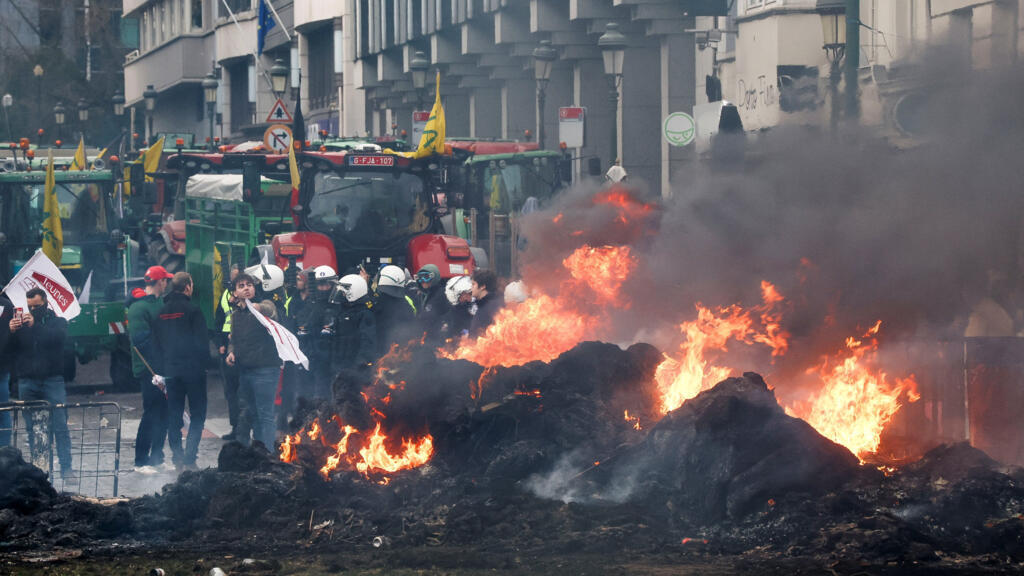
Farmers protest against the EU-Mercosur trade deal in Brussels, 18 December
. REUTERS - Yves Herman

The signing of the agreement between the EU and Mercosur, 25 years in the making, has been pushed back until January.

The European Commission informed the Mercosur countries of the delay on Friday, after opposition from France and Italy ended hopes of sealing the pact on the margins of Thursday's EU leaders’ summit.

The agreement would create the world’s largest free-trade area and boost EU exports of cars, machinery, wines and spirits to Latin America at a time of mounting global trade tensions.

But the backlash from Europe’s farming community – already simmering over subsidies, imports and disease controls – proved decisive.

Farmers descend on Brussels to protest EU Mercosur trade deal


Tractors and tear gas


Thousands of farmers descended on Brussels on Thursday, driving around 1,000 tractors into the Belgian capital as the Mercosur deal loomed over the summit.

While the protest was largely peaceful, tensions flared near the European Parliament, where fires were lit and objects including potatoes and bottles were thrown at police, who responded with tear gas and water cannons.

Paris and Rome argue that the current text does not sufficiently protect European farmers from being undercut by cheaper imports from agricultural heavyweight Brazil and its neighbours.

Together, Italy, France, Hungary and Poland account for more than the 35 percent blocking minority required in the European Council – a threshold that was reached after Italy decided on Wednesday to push back against the deal.

French President Emmanuel Macron struck a cautious note at the summit, saying it was “too soon” to say whether Paris would back the deal next month and insisting that “fundamental changes” were needed.

Italy has called for tougher safeguard clauses, tighter import controls and stricter standards for Mercosur producers.

European Commission President Ursula von der Leyen sought to project confidence despite the setback.

“This evening, we have achieved a breakthrough to pave the way for a successful completion of the Mercosur agreement in January,” she said, after abandoning plans to travel to Brazil this weekend for a signing ceremony.

Germany, Spain and the Nordic countries remain strong supporters of the pact, seeing it as a way to bolster exports as Europe grapples with Chinese competition and an unpredictable White House.

Disease outbreak deepens anger

The anger in Brussels reflects wider grievances among farmers – particularly in France, where the handling of a cattle disease outbreak has reignited protests and sharpened opposition to Mercosur.

In southern France, farmers have been blocking roads in protest at the government’s response to an outbreak of lumpy skin disease, a virus affecting cattle. This has fuelled resentment over what many see as a long-term decline in French agriculture caused by foreign competition and excessive regulation.

The government has responded by deploying the army to speed up vaccinations, flying in hundreds of thousands of doses and drafting in military veterinarians.

The aim is to vaccinate 750,000 cows within a month, as authorities seek to contain the outbreak ahead of the year-end holiday period.

The crux of the farmers' anger is a policy of slaughtering entire herds when the virus is detected – a measure the government says is necessary to prevent the disease spreading across France, home to the EU’s largest cattle herd.

Some farmers’ unions argue the policy is devastating livelihoods and compounding long-standing frustrations.

Macron has linked the domestic crisis directly to the broader trade debate, doubling down on his pledge not to endorse the Mercosur deal unless protections for European farmers are significantly strengthened.

French farmers were among those who travelled to Brussels this week to protest, as local grievances converged with fears over global trade.

(with newswires)


Sunday, February 23, 2025

France’s agriculture show, an outlet for angry farmers 

PETITE BOURGEOIS LANDOWNERS


By AFP
February 22, 2025


French farmers are feeling unloved - Copyright AFP Odd ANDERSEN
Sofia BOUDERBALA, Jurgen HECKER

France’s annual Agriculture Show has become a hotbed of protest by farmers, exasperated by low produce prices, heavy regulations and global competition, against the government they say doesn’t care for them enough.

One of the world’s largest agriculture fairs, the “Salon de l’Agriculture” that opened Saturday, attracts some 600,000 visitors over nine days.

The bonanza showcases all aspects of French agriculture which despite the country’s rapid post-war industrialisation is still a European leader in the sector.

France is the European Union’s top cereal and beef producer, the world’s second-largest producer of wine, and makes a staggering 1,200 varieties of cheese.

The sector’s gigantic economic role makes the gathering a mandatory stop for French leaders, but also a political minefield, as President Emmanuel Macron discovered to his cost at last year’s edition.

During his entire 13 hour-long visit among 1,400 exhibitors and 4,000 animals a year ago, the president was heckled as protesting farmers crashed gates and fought with police, prompting repeated temporary closures of the entire event.

Before cutting the ribbon for this year’s show Saturday, Macron met with farming associations, called for “respectful dialogue” and gave assurances that France was still fighting against a free-trade agreement between the European Union and members of South America’s Mercosur bloc that has farmers up in arms.

Macron’s advisors also urged him to spend less time at the fair than last year to limit the number of potentially hostile encounters.


– ‘Won’t shake Macron’s hand’ –


Guy Desile, a 58-year-old cereal farmer in the northwestern Eure region, told AFP ahead of the event that he feared “losing it” as his debts build up.

“I won’t shake Macron’s hand,” said Jean-Philippe Yon, a livestock farmer from northern France, accusing the government of failing to ensure sufficient income for farmers. “We expect concrete steps from the president,” he said.

Farmers in the southern Tarn area are running a campaign of turning road signs in the wrong direction in protest against the government, an illustration of the “It’s all gone topsy-turvy” slogan that the powerful farming union FNSEA has had printed on T-shirts for its members.

Such protests can be effective. In 2024, after weeks of farmers blocking motorways, then prime minister Gabriel Attal scrapped a planned fuel tax rise affecting the sector although the move turned out to do little to appease the protesters.

The French movement was copied elsewhere in Europe, including in Poland where solidarity with Ukraine began to crumble in the face of unwelcome farming imports from the eastern neighbour at war with Russia.

French statistics show that close to half of the families running farms live below the poverty line, are often deep in debt and depend heavily on government subsidies for survival.

– ‘Forced on them decades ago’ –

At the heart of the problem lies a rapid and profound change in their business conditions, ranging from new rules linked to climate change and health requirements, to price pressure brought on by big agro-business and cheaper competition from abroad.

“Farmers are being asked to change a system that was forced on them decades ago,” said Edouard Lynch, a historian, adding that government support has been insufficient to offset the impact of change.

Structural problems have been compounded by misfortune: Excessive rainfall in the autumn of 2024 caused wheat production to drop to its lowest level in four decades and wine production to fall by a quarter, while livestock was decimated by devastating epidemics.

Macron has been eager to show that the government still has farmers’ backs.

He reminded reporters that he was trying to assemble a “blocking minority” of EU members to prevent the Mercosur accord from being implemented.

“Our farmers cannot become an adjustment tool,” Macron said.

European farmers are crying foul over supposedly less stringent regulations on the sector in South America, pointing especially to the industry’s role in destroying huge swathes of the Amazon rainforest, a crucial buffer against climate change.

Macron also said on Saturday that he would tell US President Donald Trump not to make allies “suffer” with new tariffs when he meets him in Washington on Monday.

French wine and cognac exporters, who sell vast quantities of produce in the US, would be especially hard-hit if Trump makes good on his tariff threats.

burs/jh/cw

Saturday, February 14, 2026

PETITE BOURGEOIS LANDOWNERS

Tractors hit Madrid to protest EU’s trade deal with South America


By AFP
February 11, 2026


Hundreds of tractors take part in a protest by Spanish farmers in Madrid against the European Union’s trade deal with four South American countries - Copyright AFP Oscar DEL POZO

Hundreds of honking tractors rolled into Madrid on Wednesday as Spanish farmers staged a protest against the European Union’s trade deal with four South American countries.

The tractors arrived in five convoys from across Spain, converging on the city centre and moving from Plaza Colon to the Ministry of Agriculture, bringing traffic to a standstill.

Protesters carried banners reading “No to our ruin” and “The Spanish countryside is not for sale”.

Miguel Angel Aguilera, president of agricultural organisation Unaspi, warned the deal with the Mercosur bloc would affect all citizens.

“People will consume lower-quality products, we will lose food sovereignty, and there will be no competition,” he said.

Madrid authorities reported 367 tractors and around 2,500 protesters took part in the demonstration.

Prime Minister Pedro Sanchez defended the agreement in parliament, calling it “extraordinary news” for Europe.

He promised compensation for affected farmers and safeguards to limit imports if domestic producers were harmed.

The long-delayed deal, signed last month, would create one of the world’s largest free-trade areas, boosting commerce between the 27-nation EU and the Mercosur bloc, which includes Brazil, Paraguay, Argentina and Uruguay.

The pact still requires approval from lawmakers in the European Parliament, which has referred it to the EU’s top court.

Farmers in Spain and other countries fear being undercut by a flood of cheaper goods from Brazil and its neighbours.

Major Mercosur exports to the EU include agricultural products and minerals, while the EU would export machinery, chemicals, and pharmaceuticals with lower tariffs.

Tuesday, November 19, 2024

Tractor-driving French farmers protest EU-Mercosur deal

PETITE BOURGEOIS LANDOWNERS REVOLT


By AFP
November 18, 2024

French farmers staged a new wave of action to protest the adoption of a trade pact between the European Union and four South American countries - Copyright Lehtikuva/AFP Heikki Saukkomaa

French farmers launched Monday a new wave of action to protest the adoption of a trade pact between the European Union and four South American countries they fear would threaten their livelihoods.

Paris is leading resistance against ratification of the trade agreement with the Mercosur bloc of Argentina, Brazil, Paraguay and Uruguay that would create the world’s largest free trade zone.

On Sunday, French President Emmanuel Macron defended France’s resistance to the proposed blockbuster deal as he visited Argentine’s Javier Milei, ahead of a G20 summit in Rio de Janeiro. He said France would “continue to oppose” the trade deal.

On Monday, angry French farmers used tractors to block roads and erected wooden crosses during protests across the country, urging Macron and the government to do more.

“Stop the promises, start with actions”, read a sign unfurled along a road in the southeastern town of Le Cannet-des-Maures.

“Macron, your agriculture is dying and you are looking elsewhere,” read another banner.

Local farmers also placed a cross next to a mock-up gallows with a message reading “France’s agriculture in danger”.

In the eastern city of Lyon, farmers tore off municipals signs and deposited them at the stairs of a museum.

Yohann Barbe, spokesman for the FNSEA, France’s top farming union, speaking to broadcaster Europe 1, said that the scale of the protests was going “to be unprecedented”.

“Farmers are still just as irritated as ever by a government that is dragging its feet.”

The new wave of rallies came after farmers across Europe including France earlier this year mounted rolling protests over a long list of burdens they say are depressing revenue.

Life is hard for French farmers, who complain about excessive bureaucracy, low incomes, and poor harvests.

The proposed trade pact has provoked fresh anger because farmers fear any agreement would open European markets to cheaper meat and produce that are not forced to adhere to strict rules on pesticides, hormones, land use and environmental measures.

On Sunday, Interior Minister Bruno Retailleau warned farmers there would be “zero tolerance” in the event of “lasting” roadblocks.

bur-sb-kd-as/sjw/rl

Thursday, January 08, 2026

PETITE BOURGEOIS LANDOWNERS
France slams ‘illegal’ farmers protest as tractors blockade Paris landmarks

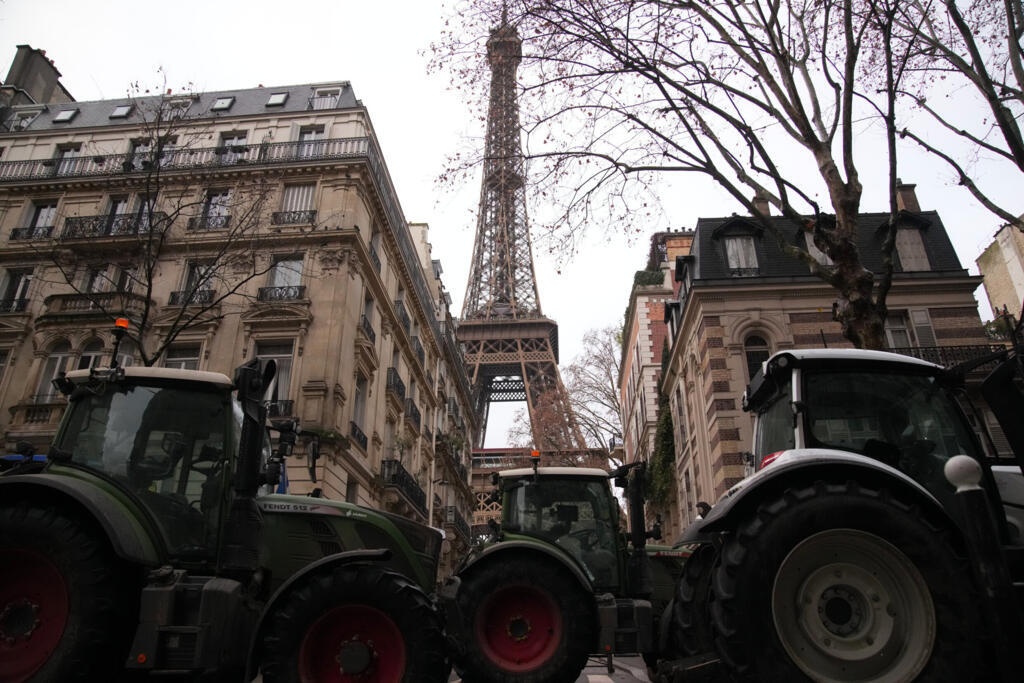
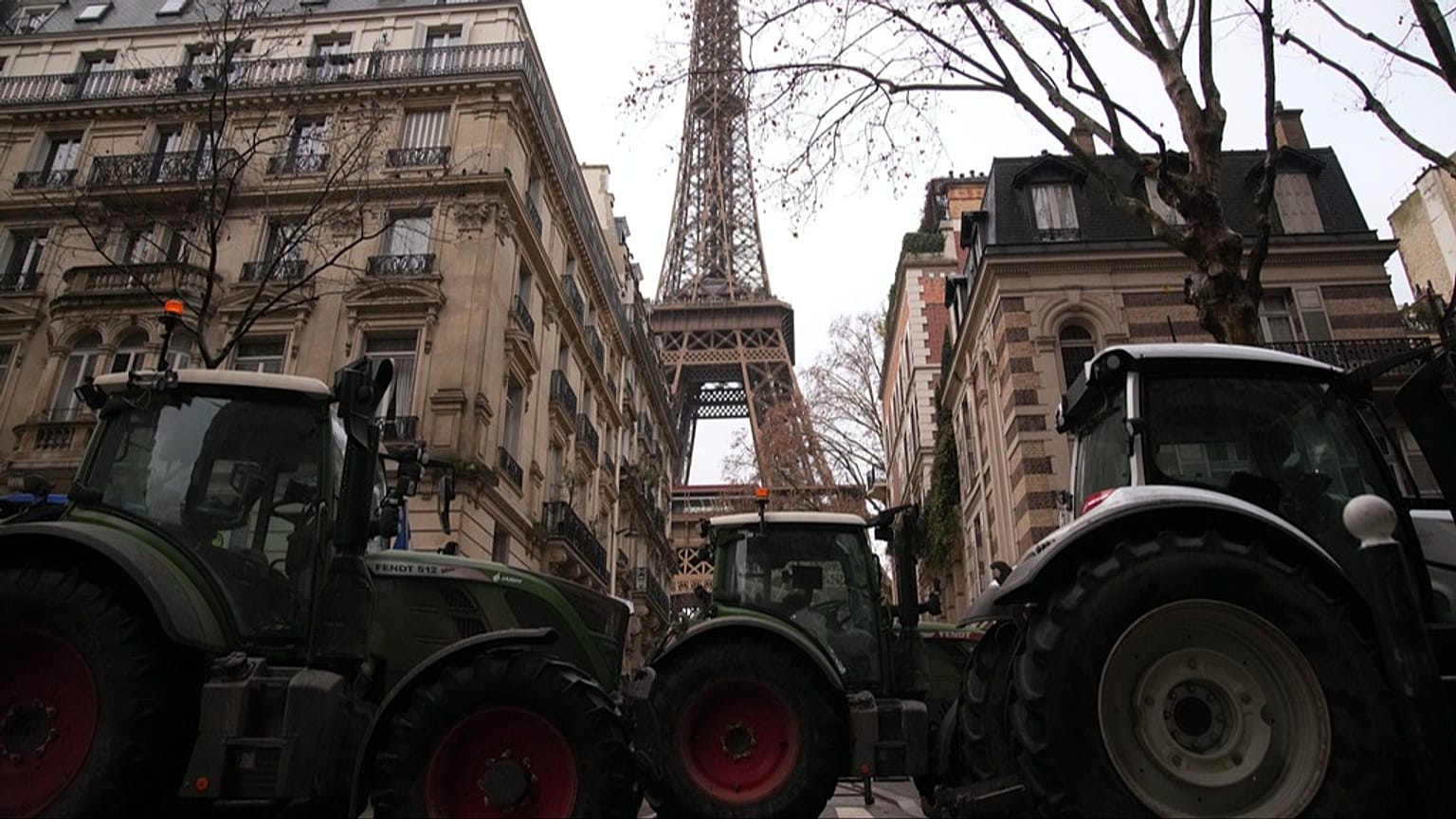
Protesting French ​farmers entered ⁠the centre of Paris and reached the ​Eiffel Tower ‍on Thursday with more ​heading to the French ​capital amid ​anger over a free trade agreement between the European ‌Union and South American ‍bloc Mercosur and the way the government is handling a cattle disease.


Issued on: 08/01/2026 
By: FRANCE 24

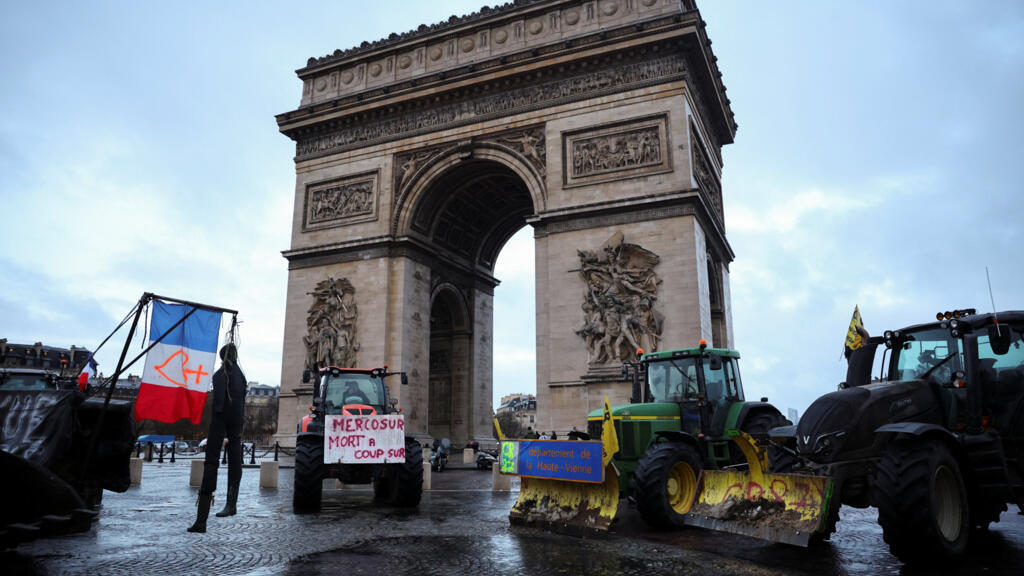
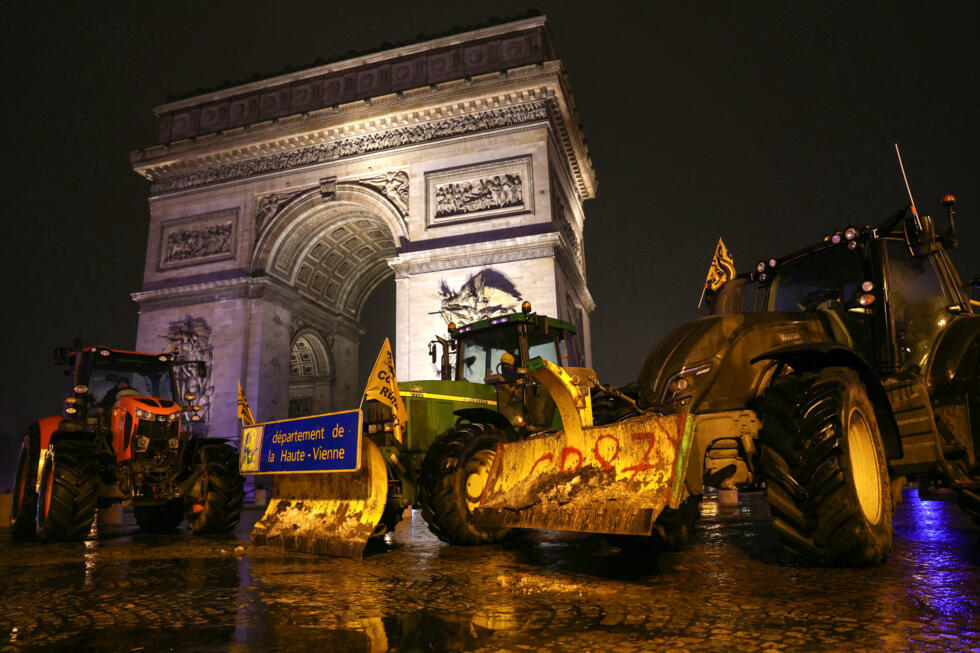
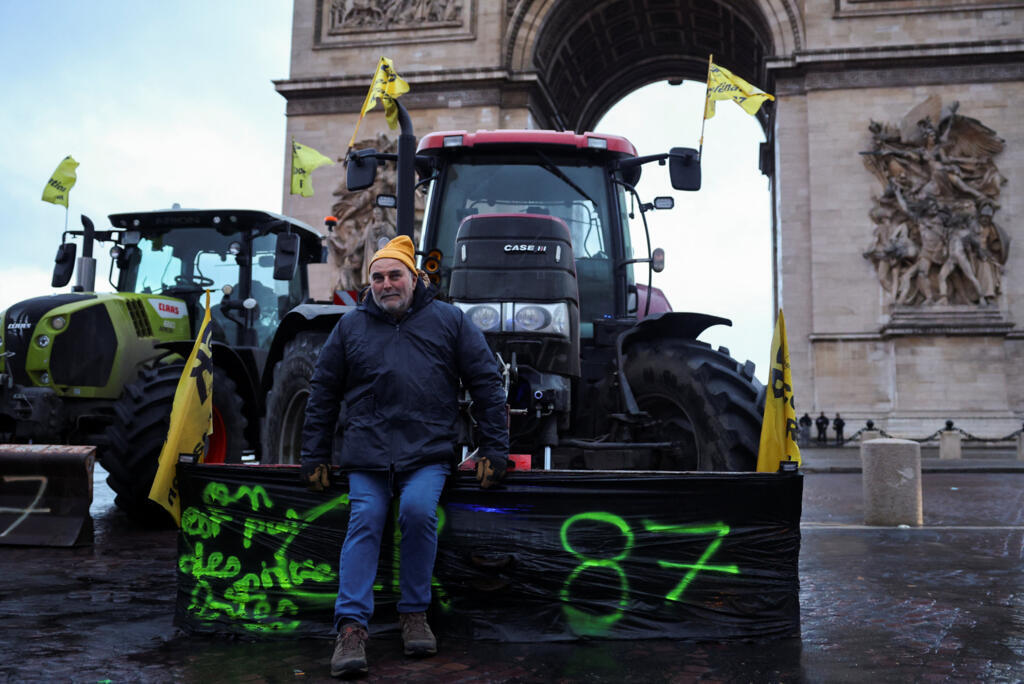
Tractors are parked in front of the Arc de Triomphe in Paris as French farmers protest against the EU-Mercosur free trade agreement on January 8, 2025. © Sarah Meyssonnier, Reuters

French farmers blockaded sites in Paris on Thursday in protest against a sweeping trade deal the European Union is poised to sign with South American nations and other local grievances.

The farmers overran police checkpoints to enter the city, driving along the Champs-Élysées avenue and blocking the road around the Arc de Triomphe monument before dawn, while police surrounded them.

The rightwing Coordination Rurale union had called for protests in the capital amid anger against a free trade agreement between the European Union and South American bloc Mercosur, which they fear may flood the country with cheap food imports, and the way the government is handling a cattle disease.

"We are between resentment and despair. We have a feeling of abandonment, like with Mercosur. We have been abandoned in favour of a space shuttle, an Airbus, or a car," Stéphane Pelletier, the deputy president of the union in Vienne, in central France, told Reuters.

French farmers rolled into Paris on tractors Thursday morning in a show of dissent against a free trade deal they fear will create unfair competition. © Thomas Samson, AFP

The action drew a swift from rebuke from the government, which warned it would "not stand by" and allow "illegal" actions.

Blocking a motorway or "attempting to gather in front of the National Assembly with all the symbolism that this entails is once again illegal", government spokeswoman Maud Bregeon told France Info Radio.

The protest comes days after the European Commission proposed making 45 billion euros of EU funding available earlier to farmers and agreed to cut import duties on some fertilizers in a bid to win over countries wavering in their support of Mercosur.
Italy poised to back deal

The EU-Mercosur deal would create the world's biggest free-trade area and help the 27-nation bloc to export more vehicles, machinery, wines and spirits to Latin America.

But farmers fear being undercut by a flow of cheaper goods from agricultural giant Brazil and its neighbours.

The deal is backed by countries such as Germany and Spain and the Commission appeared to have won Italy's backing, meaning it would have the votes needed to approve the trade accord with or without French support. A vote on the deal is expected on Friday.

READ MOREEU poised to secure Italy's backing for contentious Mercosur deal

Farmers are also demanding an end to cow culling prompted by a series of highly contagious lumpy skin disease, which they consider excessive and advocate for vaccination instead.

In another protest near the southwestern city of Bordeaux, about 40 farm vehicles blocked access to a fuel depot, according to the local authorities.

During earlier protests, farmer blocked roads, sprayed manure and dumped garbage in front of government offices to force the authorities to review their policy.

Belgian farmers have also staged mass protests against the trade deal, rolling some 1,000 tractors into Brussels in December.

(FRANCE 24 with Reuters)

Angry French farmers defy ban and block Paris streets over Mercosur deal

French farmers defied a government ban on Thursday, blockading roads into Paris and several of the city’s landmarks to protest against the Mercosur trade deal the European Union is expected to sign on Friday with South American nations.


Issued on: 08/01/2026-RFI


Around 100 tractors were positioned at several symbolic locations in the capital by 8am local time, including near the Eiffel Tower and the Arc de Triomphe, the Interior Ministry said.

Farmers overran police checkpoints to enter the city, driving along the Champs-Elysées and blocking roads around the Arc de Triomphe before dawn, while police surrounded them.

Dozens of tractors also blocked highways leading into Paris ahead of the morning rush hour, including the A13 from the western suburbs and Normandy. The transport minister said the disruption caused traffic jams stretching 150 kilometres.

“We are between resentment and despair. We have a feeling of abandonment, with Mercosur being an example,” Stephane Pelletier, a senior member of the right-wing Coordination Rurale union, told Reuters.


Tractors defy a prefectoral ban and line up in front of the Eiffel Tower on Thursday morning. © Christophe Ena / АР

Banned protest

Farmers from several unions had called for protests in Paris, fearing the planned free trade agreement with the Mercosur bloc of four South American countries would flood the European Union with cheap food imports.

They are also angry over the government's handling of an outbreak of cattle disease.

The farmers went ahead with the action despite a prefectural ban announced on Wednesday, which barred tractors from entering certain sensitive areas of the capital.

“What is happening this morning is illegal,” said government spokesperson Maud Bregeon on FranceInfo public radio.

Police sought to avoid clashes with the protesters. “Farmers are not our enemies,” said Transport Minister Philippe Tabarot.

A farmer from the Coordination Rurale union stands next to a tractor parked in front of the Arc de Triomphe. © Sarah Meyssonnier / Reuters


What to know about the EU-Mercosur deal


Eve of Mercosur vote

The protest added pressure on President Emmanuel Macron and his government, a day before European Union member states are expected to vote on the trade accord.

France has long opposed the deal and, even after last-minute concessions, Macron’s final position remained unclear.

Earlier this week, the European Commission proposed bringing forward 45 billion euros in EU funding for farmers under the bloc’s next seven-year budget. It also agreed to cut import duties on some fertilisers to win over countries wavering on the Mercosur deal.

Germany and Spain back the agreement, and the Commission appears close to securing Italy's support. That would give the EU enough votes to approve the accord, with or without France.

EU offers farmers extra funds to quell anger over Mercosur deal

A vote on the accord is expected on Friday.

“This treaty is still not acceptable,” Bregeon said on France Info, declining to say whether Macron would vote for the deal, against it or abstain.

On Wednesday, Bruno Retailleau, leader of the conservative Republicans party, warned that Macron’s support for Mercosur could put the government at risk of censure.

Farmers are also demanding an end to a government policy of culling cows to contain the highly contagious lumpy skin disease. They argue vaccination should be used instead.

(with newswires)

Farmers storm Paris with tractors to oppose EU-Mercosur free trade deal

Tractors line up near the Eiffel Tower as farmers protest the EU's intention to move forward with the Mercosur deal with South American nations, in Paris, 8 January 2026
Copyright AP Photo

By Euronews
Published on 

French farmers drove about 100 tractors into the French capital, protesting Brussels' trade deal with five South American nations. The protesters bypassed police barriers to reach landmarks like the Eiffel Tower.

French farmers forced their way into central Paris with around 100 tractors on Thursday to protest the EU's intention to sign the Mercosur free trade agreement with South American nations, despite police blockades meant to keep them out of the capital.

The French Interior Ministry said about 20 tractors reached the French capital's city centre, with some parking near the Arc de Triomphe and others demonstrating in front of the Eiffel Tower.

The convoys "bypassed and forced their way" through police barriers, the ministry said, while most tractors were stopped at key traffic arteries marking the city's limits.

The A13 motorway was closed from 5.53 am in the direction of Paris following the demonstrations.

The protest was organised by the Rural Coordination union to pressure France's government, which opposes the trade deal covering Brazil, Argentina, Bolivia, Paraguay and Uruguay. French farmers say the agreement would damage their livelihoods.

José Perez, president of Rural Coordination in the Lot-et-Garonne region, said farmers wanted to express their demands "closer to those who have the power". He told the Associated Press the demonstration was "a strong symbol".

Farmers are also angry about the government's sanitary measures to control lumpy skin disease in cattle. Near Bordeaux, around 40 farm vehicles blocked access to the DPA oil depot in Bassens from 10 pm on Wednesday, according to the Gironde prefecture.

The EU this week renewed internal negotiations over the trade agreement, with speculation a deal could be signed in Paraguay next Monday.

Germany and other supporters may be able to override objections from France and Poland, whose fierce opposition derailed the deal last month.

French Agriculture Minister Annie Genevard reaffirmed France's opposition on Wednesday, saying the agreement threatens beef, chicken, sugar, ethanol and honey production.

Rural Coordination called for a demonstration in front of the National Assembly at 10 am as part of the nationwide protest movement. Authorities have deployed a heavy police presence around central Paris landmarks.


EU offers farmers extra funds to quell anger over Mercosur deal


The EU has offered a carrot to farmers angered at a trade deal with South American bloc Mercosur, promising to unlock funds for the sector as EU agriculture ministers are due to gather in Brussels Wednesday for an extraordinary meeting to try to get the accord over the line.


Issued on: 07/01/2026 - RFI

A tractor blocks the traffic during a farmers protest against the Mercosur trade deal on 18 December, 2025 in Portet-sur-Garonne, southwestern France. AP - Fred Scheiber


The European Commission said Tuesday it plans to tweak its budget proposal for 2028-2034, which has come under fire from agricultural groups, to allow farmers early access to around 45 billion euros.

The move comes amid a push to ease the qualms of some countries over the Mercosur deal that Brussels hopes to ink on 12 January in Paraguay.

It was welcomed by Italy, which holds the deciding vote on the accord.

"This is a positive and significant step forward in the negotiations that will lead to the new EU budget," said Italian Prime Minister Giorgia Meloni.


More than 25 years in the making, the Mercosur deal would create the world's biggest free-trade area, boosting trade between the 27-nation EU and the bloc comprising Brazil, Paraguay, Argentina and Uruguay.

But it has alarmed many European farmers who fear they will be undercut by a flow of cheaper goods from agricultural giant Brazil and its neighbours.

Thousands protested in Brussels last month, venting their anger also at EU plans to overhaul its system of farm subsidies, which critics say would result in farmers receiving less money.

Farmers descend on Brussels to protest EU Mercosur trade deal
Extraordinary meeting

In a letter Tuesday, EU chief Ursula von der Leyen unveiled budget changes she said would "provide the farmers and rural communities with an unprecedented level of support".

The letter was released as EU agriculture ministers are due to gather in Brussels on Wednesday for an extraordinary meeting to try to get the Mercosur deal over the line.

Member states are expected to then vote on the text on Friday, which the commission hopes will clear the way for its signature.

Plans to seal the accord in December ran into a late roadblock as heavyweights Italy and France demanded a postponement over concerns for the farming sector.

Germany and Spain are strongly in favour of the agreement, believing it will provide a welcome boost to their industries, hampered by Chinese competition and tariffs in the United States.

Trump's tariffs come into force, upending economic ties with Europe

The deal would help the EU export more vehicles, machinery, wines and spirits to Latin America at a time of global trade tensions.

In return, it would facilitate the entry into Europe of South American meat, sugar, rice, honey and soybeans.

(with AFP)


Tuesday, December 24, 2024

Making Sense of the Second Ku Klux Klan
JACOBIN
12.22.2024


Understanding the reemergence of the Ku Klux Klan in the early twentieth century gives insight into the roots of today’s reactionary activists and policymakers.

Ku Kluz Klan imperial wizard Hiram Wesley Evans, pictured c. 1925, wrote a favorable article about Booker T. Washington the same month that the second Klan formed.
 (HUM Images / Universal Images Group via Getty Images)

THE KLAN REVIVAL ALSO OCCURED IN CANADA 
ON THE PRAIRIES BASED ON ANTI CATHOLICISM 
AND ANTI QUEBECOIS/FRENCH LANGUAGE RIGHTS,
AND BEING PRO BRITISH/ANGLO (WASP) DOMINATION 


Nancy MacLean’s newly reissued Behind the Mask of Chivalry, three decades after its original appearance, is guaranteed to interest a new generation of scholars and activists seeking to understand the second iteration of the Ku Klux Klan, the hyperpatriotic white supremacist Protestant organization that counted between two and six million members by the mid-1920s, and the broader history of organized reactionaries in America. Best known in liberal circles for her best-selling 2017 book about post–World War II conservative thinkers and policymakers, Democracy in Chains, MacLean first earned admiration for her exploration of this earlier right-wing organization. Evidence of why her prize-winning book has aged well over the last thirty years and why Oxford University Press decided to republish it is obvious: numerous instructors continue to assign it, countless historians cite it, and the best Klan scholars have given it well-deserved praise. It is, according to another subject expert, historian Thomas R. Pegram, “the best-known and most influential single book on the 1920s Klan.” And its value isn’t only to academics: the book helps us understand some of the roots of today’s reactionary activists and policymakers.

The 2024 edition, identical to the 1994 book except for a new eight-and-half-page preface, offers brilliant insights into the Klan’s activities — how members organized, why they achieved acceptability in many quarters, and why their reprehensible activities still matter today. MacLean paints a vivid picture of the period that triggered the Klan’s rebirth, noting the expansion of big business, the outbreak of class conflicts, resistance to burdensome Jim Crow laws, and women’s push for greater personal freedoms. The Klan responded to these developments with poisonous racism, nativism, antisemitism, and sexism as well as strident calls for working-class subordination to social and economic “betters” and demands for strict moral uprightness.

Formed in the Atlanta area in late 1915 under the leadership of Alabama-born former Methodist preacher William Simmons, the second Klan, inspired by the initial iteration of the post–Civil War Klan that officially went away in the wake of federal prosecutions in the early 1870s, achieved national influence in the post–World War I years. Every state in the union had Klan chapters by 1924. Growth was especially impressive in both Southern states like Alabama, Oklahoma, and Texas and Northern and Western ones like Indiana, Ohio, and Oregon. Members wore regalia, held weekly meetings, won positions in local, state, and national governments, organized marches in numerous downtowns, burned crosses in parks and on hilltops, and, most dreadfully, kidnapped, whipped, and sometimes tarred and feathered a diversity of victims.

For generations, Klan scholars have debated the reasons for its growth, its primary goals, and the organization’s class makeup. Early interpretations suggested that the Klan attracted lowbrow reactionaries from small communities, and that these ignorant men generally joined out of intense feelings of nativism and racism. Members, scholars have pointed out, were backward-looking traditionalists fearful of elites. Yet not all are in agreement. Others have shown that the organization attracted, and was led by, well-networked Protestant elites comfortable in both urban and rural settings. One important study notes that the organization provided important networking opportunities for upwardly mobile men, and that these Klansmen left a lasting legacy of bigotry. Most agree that top Klan leaders were relatively well-to-do.

Numerous community studies have stressed the way local conditions, including corruption in politics, various expressions of vice, and upticks in crime rates attracted members. Some have stressed that the Klan focused on recruiting true believers with its reactionary creed; others, as historian David J. Goldberg illustrates in a review essay, have noted the organization “attracted its share of ordinary, naïve, gullible citizens.” A few have underscored the organization’s racist ideas and violent actions. Others have emphasized that the organization was primarily interested in controlling the behavior of fellow whites, insisting that they embrace proper moral codes by remaining faithful to their spouses and avoiding alcohol. While not denying the organization’s racial and religious intolerance, such scholars have nevertheless claimed that the organization drew on Progressive Era reform traditions, especially prohibition. They were, as one scholar put it, “intolerant reformers.”
The Reactionary Populism of the Petty Bourgeoisie

Building on decades of scholarship and years of research into primary source documents, MacLean focuses chiefly on the Klan’s activities in Athens, Georgia, though her points apply beyond this region. Above all, she maintains that middle-class people in Athens and beyond, anxious about race, gender, and class-related challenges, built a durable movement that espoused what she characterizes as “reactionary populism.” Like the populists of the 1890s, the 1920s Klan, at least in Athens, consisted mostly of small businessmen, yeoman farmers, and downwardly mobile landowners, those who felt squeezed by forces from below and above. They were, she writes, “trapped between capital and labor,” distressed by the growing influence of organizations like the National Association for the Advancement of Colored People (NAACP) and appalled by the rebellious spirit shown by young women.

MacLean explores how its membership, consisting mostly of middle-class churchgoing family men, confronted questions related to class, gender, race, and morality. “The Klan’s varied attacks on African Americans, Jews, and immigrants in fact,” she explains, “converged on a common core goal: securing the power of the white petite bourgeoisie in the face of challenges stemming from modern industrial capitalism.” Her reactionary populist interpretation echoes a statement put forward by Sam Darcy in the Daily Worker in 1927. The various Klan messages, he explained, were designed to “appeal to the economic interest and social priggishness of the petty bourgeoisie of the South.”

In MacLean’s telling, significant sections of the respectable middle classes joined and participated in the Klan partially in response to the numerous class conflicts that erupted in the nation immediately after World War I. The more than four million strikers in 1919 — coal miners, longshoremen, steelworkers, sharecroppers, and even some police officers — alarmed growing numbers of small business and property owners. “A middle-class man inclined to fear,” she writes, “could see in the events of 1919 the nightmare of the republic’s founders come true: growing economic inequality had bred concentrated power above and below a great mass with little stake in society.”

This middling group lashed out at those above and below them. Klan members opposed the rising power of Wall Street and the growth of chain stores as well as labor unrest, an increasingly defiant African American community, and rebellious teenage girls. They recruited lawyers, businessmen, and especially ministers; together these men condemned vice and uncompromisingly disdained Catholicism, Communism, and Judaism. They loathed Catholics because Klansmen believed that they prioritized the Pope over the nation’s republican institutions. Klansmen expressed antisemitic views because they assumed that Jews “had a ‘stranglehold’ on finance and thereby the whole economy.” This was a view, she believes, that was embraced by numerous Populists in the 1890s, though a point that some historians maintain is exaggerated.

MacLean does a fine job prioritizing the Klan’s target list, noting that threats from below, including radical organizing, working-class struggles, and the spread of Marxist ideas represented, in members’ minds, the “foremost threat to the republic.” Such fears naturally frightened many conservatives and elites following the 1917 Bolshevik Revolution. Klansmen believed the successful revolution was part of a Jewish conspiracy, another way the organization expressed its antisemitism. Left-leaning Jews, Klan members observed with trepidation, were also active in Marxist organizations at home; these radicals built solidary with African Americans and promoted what Klansmen derisively called “negro equality.”

MacLean draws important connections well beyond Athens and the nation itself. Her final chapter is on the rise of European fascism, which coincided with the Klan’s growth. Any account, she writes, that “fails to consider” the Klan in the context of growing far-right movements in places like Italy, Germany, and Spain “is bound to yield a limited understanding of its place in history.” She explains that the Klan’s spokesperson spoke favorably about the anti-labor actions taken by fascists in Italy and Germany. And we learn that anti-Klan activists, including members of Oklahoma’s Farmer-Labor Union, warned of the parallels between Italian Fascists and domestic Klansmen.

At a time when fascism began to take off in Europe during the second part of the 1920s, the Klan experienced a steep decline in membership. While many historians attribute this to negative publicity and several noteworthy internal scandals — including cases involving high-ranking members’ marital infidelity, alcohol consumption, mismanagement of funds, and a case of rape and murder — MacLean points out that the organization lost members because it had achieved many of its goals. By the mid-1920s, the labor movement was mostly in retreat, and groups like the NAACP had far fewer members nationally and no functioning chapter in Athens. And the 1924 National Origins Act severely restricted immigration. MacLean writes, “On most fronts, Klansmen could feel, if not triumphant, at least relieved by mid-decade.” Of course, this was not the entire end of the story: the 1930s saw a resurgence of right-wing organizing, including renewed mobilizations by the Klan, in the face of a powerful labor movement.

Yet MacLean’s analysis of the nature of the Klan’s racism as well as her interpretation of members’ views of large businesses leaves something to be desired. Indeed, her belief that reactionary populism is the best way to describe the Klan works in many contexts but not all of them. Rather than reacting with discomfort and rage to the dynamics of modern industrial capitalism, many Klansmen were staunch champions of it.

First, one cannot discuss the Klan, especially its activities in the South, without confronting the question of racism, and MacLean offers the necessary context of the virtual omnipresence of white supremacy. No area in society, including housing, schooling, criminal justice, and employment, was untouched by abhorrent Jim Crow laws. None of this was acceptable to African Americans. An emboldened black population, politicized at least in part by the democratic rhetoric surrounding World War I, provoked bigoted responses from whites and triggered widespread Klan growth.

Yet MacLean fails to provide a coherent account of the Klan’s oftentimes inconstant approach to the “negro problem.” In some sections she notes, correctly, that Klansmen embraced a type of racism that served businessmen’s control and exploitation aims. The most persuasive anecdote comes from the horse’s mouth, Imperial Wizard William Simmons. Speaking in front of a boisterous crowd in a Decatur, Georgia, courthouse in 1921, Simmons thundered that the Klan was determined to ensure that “niggers get in their place and stay in their place.” Presumably, second-wave Klansmen, like those during the Reconstruction period, had clear conceptions about “their place”: in workplaces during their waking hours; in segregated communities when not working. MacLean shows a clear grasp of the relationship between capitalism and racism: “The subordination of African Americans, after all, undergirded the entire Southern economy.”

Yet she offers contradictory statements, suggesting that Klansmen “saw themselves as an army in training for a war between races, should that prove necessary to perpetuate the United States as ‘a white man’s nation.’” Simmons’s successor, Hiram Wesley Evans, in MacLean’s description, comes across as a hard-core racial exclusionist. Evans, she maintains, “agreed that different races could never share the earth in peace.” But, of course, there were plenty of peaceful interactions between whites and non-whites in the North and South. So what was it? Did Klansmen believe in removing or eliminating African Americans? Or did they demand the presence of black people, acknowledging their economic value to the white business classes? Needless to say, the Klan’s own statements were often contradictory. These contradictions have to be interrogated carefully.

To her credit, MacLean recognizes that most Klansmen did not see themselves preparing “for an imminent race war with people of color.” At a time when many African Americans in the South sought to escape racist outbursts generated by groups like the Klan for greener pastures in Northern cities, MacLean recognizes that Southern “planters sometimes came to believe things had gone too far.” This is what sociologists call the “repression paradox.” Too much repression in the form of hangings, whippings, or even intimidating marches convinced black laborers to flee, depriving owners and managers of adequate labor. For this reason, not all elites supported the Klan.

Yet readers may nevertheless find themselves confused by MacLean’s unwillingness to explore the meaningful distinctions between the paternalistic and exploitative forms of racism, on the one hand, and the hateful and murderous types, on the other. Klansmen undoubtedly believed in white supremacy, but they nevertheless had many nonhostile interactions with African Americans. MacLean does not investigate, for example, the relationships Klansmen developed with conservative black elites in both religious and secular contexts. After all, Klansmen in numerous parts of the nation donated money to black churches, met with advocates of black businesses like Marcus Garvey, and one chapter in New Jersey employed black musicians to lead a Klan parade in 1926. For his part, Imperial Wizard Evans wrote a very favorable article about Booker T. Washington, the pro-segregation and anti-labor union college head who died in November 1915, the very same month and year that the second Klan formed. Washington, like the Klansmen, demanded that black people accept Jim Crow laws and capitalist norms.

Indeed, we must not lose sight of racism’s economic foundations as well as the Klan leadership’s determination to ensure that African Americans remained a reliable source of labor. To achieve this basic goal, the leadership cultivated cross-class feelings of racial superiority, collaborated with conservative black leaders, and ensured that African Americans lived in fear — but not too much fear. Very simply, Klansmen with business interests, like landowners, wanted a stable labor force, not one eager to leave. MacLean helps us make sense of the dimensions of racism but, like other scholars and civil rights organization spokespersons, does an inadequate job distinguishing between behavioral and structural forms of it.
Elite Organizing and the Long History of Vigilantism

While MacLean’s analysis of the Klan’s class makeup seems mostly correct, she overstates the organization’s hostility to big business. The most important robber barons did not join the group, but plenty of privileged members in communities around the nation, including influential economic and political elites, did. Some Klan leaders bragged about appealing to the most prominent citizens. For example, a few months after William Simmons made a major recruitment push in late 1920, he was “swamped with letters from all sections of the county, many of them from men who stand high in the affairs of the nation, and some of them from leaders in both the Democratic and the Republican parties, expressing their belief in the true aims and purposes of the Ku Klux Klan.” Klansmen, for example, spoke highly of Henry Ford, the wealthy and powerful antisemitic auto manufacturer.

Klansmen generally sided with businessmen during industrial disputes, and they showed gratitude for their stances on several moral questions. Philadelphia Klansman Paul Winter, for instance, honored “the largest industrial groups in the country” for their work in pushing for prohibition laws. And Klan intellectuals saw wealth accumulation as an unmistakable sign of white supremacy. Lothrop Stoddard, a Klansman and prolific author of books popular with racists, made this point explicitly in 1922: “The amount of wealth amassed by the white world in general and by Europe in particular since the beginning of the nineteenth century is simply incalculable.” Presumably, Stoddard did not believe that his Klan comrades had to settle for small business ownership and petty bourgeois status.

Most importantly, traveling organizers known as Kleagles first targeted the wealthiest residents of the various communities during recruitment visits. These were typically not the Fords or the Rockefellers but were nevertheless part of local ruling classes. According to the words of a Klan critic from 1924, organizers sought out the “best citizens”: “the banker and merchant of the Chamber of Commerce.” That Kleagles organized from the top down challenges the idea that the Klan was a truly populist organization. Did fat cat bankers see themselves as “reactionary populists?”

Maybe they did. Or maybe they just wanted others to perceive them in this light. Whatever the case, the Klan was hardly the first anti–labor union organization to use populist language to hide its class interests. Two decades earlier, the Citizens’ Industrial Association of America (CIAA), consisting of employers, bankers, lawyers, religious leaders, politicians, and anti-union workers, emerged to battle the “labor problem” and promote the open-shop system of industrial relations. They conducted their political, extralegal, and public relations work under the motto “For the Protection of the Common People.” Decades later, Imperial Wizard Evans, echoing the language employed by this earlier generation of cross-class anti-labor activists, promised to help the “common people” reestablish “control of their country.” The CIAA’s use of populist rhetoric, its oath of secrecy, occasional vigilante attacks on labor unionists and leftist activists, and successes in building branches in regions throughout the country call into question MacLean’s statement that the Klan “was the first national, sustained, and self-consciously ideological vigilante movement in American history.” It simply was not.

In fact, many Klansmen were also Citizens’ Committee members. Recently, historian Kenneth Barnes has shown the ways coalitions of Citizens’ Committee and Klansmen (many held membership in both) employed vigilante techniques to destroy a two-year-long strike staged by employees of the Missouri and Northern Arkansas Railroad between 1921 and 1923. Their hideous vigilante activities involved drive-out campaigns, beatings, and the kidnapping and hanging of striker Ed C. Gregor over a bridge in 1923. Northwestern Arkansas Klansmen–Citizens Committee men did not draw tidy distinctions between different-sized businesses; they were united by their hatred of labor militancy and essentially served as the vigilante wing of a railroad corporation.

It is difficult to imagine a scenario in which northwestern Arkansas Klansmen — or Klansmen based practically anywhere else for that matter — harbored a similar desire to launch sustained campaigns to crush Wall Street investors or corporate heads. Their violent anti-labor impulses were visibly much stronger. Indeed, from the woods of Maine to the waterfronts of California, Klansmen used various forms of political coercion and vigilante brutality, including establishing coalitions with elected leaders, staging big marches, launching kidnapping raids, and engaging in group beatings. The purpose was to intimidate, defeat, and ultimately silence working-class activists and political radicals across ethnic and racial lines.

Like the employer-activists in the open-shop movement, the 1920s Klan served capitalist interests through words and deeds. In both cases, these cross-class organizations boasted about attracting the “best citizens.” Disproportionate numbers of middle-class people, including owners of modestly sized workplaces, joined these organizations mainly because they outnumbered members of the extremely rich. White Protestant middle- and upper-class men participated and led reactionary organizations because they wanted law and order in their communities and authority and stability in their workplaces.
Revisiting the Second Klan in 2024

If Maclean could go back in time, she admits she would have dug “more deeply into elite support for the Klan.” This would require acknowledging that Klan policymakers were considerably closer to the ruling class than to the working classes, even though the organization recruited across class lines. Today she understands that numerous “wealthy and powerful white Protestant men saw then (and see now) advantages in supporting such a movement — even if they don’t subscribe to all its ideas.”

This is not the only area she would revisit. Aware of the recent popularity of scholarship concerned with settler colonialism, MacLean would have taken “the analysis of Klan racism further” by examining the displacement and genocide of indigenous peoples. Furthermore, MacLean, identifying the power of today’s reactionary influencers, “would home in more on the mechanics of” the colorful Klan organizers, people who shared similarities with modern-day right-wing media personalities like the Sean Hannity, Tucker Carlson, and the late Rush Limbaugh. Finally, MacLean would have linked the Klan’s seemingly antiquarian rituals to gender politics. These rituals, she writes, “had a purpose: to reassure men who were uneasy about their standing in a changing society and culture.”

MacLean identifies many troubling signs in the years following the release of her book. Since its publication, far-right populist outbursts have periodically punctuated society: the rise of the militia movement and the 1995 Oklahoma City bombing, the emergence and popularity of the Tea Party movement, and today’s Donald Trump–inspired MAGA movement. MacLean wrote her new preface just before Trump’s second electoral triumph, a sign that right-wing populist ideas continue to appeal to large numbers of mostly middle-class — and growing numbers of working-class — Americans. “The men in white robes and hoods are few and far between,” she writes, “but the beliefs, allegations, and impulses associated with their cause are back.”

But MacLean is an optimist, encouraging readers to come to terms with earlier right-wing formations like the Klan “to better understand and contain its descendants in our own day.” She is correct: to prepare to fight, and ultimately crush, today’s reactionary populists and class enemies, we must consult books like Behind the Mask of Chivalry.

Contributors
Chad Pearson teaches history at the University of North Texas. He is the author of Capital's Terrorists: Klansmen, Lawmen, and Employers in the Long Nineteenth Century.


In the following article are presented some unusual features of the Ku Klux Klan of the 1920s, the only period in which the KKK was a mass movement. In no way should this essay be interpreted as an endorsement of any aspect of this version of the Klan or of any other parts of Klan activity. Nonetheless, the loathsome nature of the KKK of today should not blind us to what took place within the Klan 70 years ago, in various places and against the wishes and ideology of the Klan itself.

In the U.S. at least, racism is certainly one of the most crudely reified phenomena. The Ku Klux Klan of the 1920s is one of the two or three most important — and most ignored — social movements of 20th century America. These two data are the essential preface to this essay.

Writing at the beginning of 1924, Stanley Frost accurately surveyed the Klan at the crest of its power: “The Ku Klux Klan has become the most vigorous, active and effective organization in American life outside business.”[1] Depending on one’s choice of sources, KKK membership in 1924 can be estimated at anywhere between two and eight million.[2]

And yet, the nature of this movement has been largely unexplored or misunderstood. In the fairly thin literature on the subject, the Klan phenomenon is usually described simply as ‘nativism’. A favorite in the lexicon of orthodox historians, the term refers to an irrationality, racism, and backwardness supposedly endemic to the poorer and less-educated classes, and tending to break out in episodic bouts of violently-expressed prejudice. Emerson Loucks’ The Ku Klux Klan in Pennsylvania: A Study of Nativism is a typical example. Its preface begins with, “The revived KKK and its stormy career is but one chapter in the history of American nativism,” the first chapter is entitled, “Some Beginnings of Nativism,” and in the book’s concluding paragraph we learn that “Nativism has shown itself to be a perennial.”[3]

Kenneth Jackson, with his The Ku Klux Klan in the City, has been one of a very few commentators to go beyond the amorphous ‘nativism’ thesis and also challenge several of the prevailing ste- reotypes of the Klan. He argues forcefully that “the Invisible Empire of the 1920s was neither predominantly southern, nor rural, nor white supremacist, nor violent.”[4] Carl Degler’s succinct comments corroborate the non-southern characterization quite ably: “Significantly, the single piece of indisputable Klan legislation enacted anywhere was the school law in Oregon; the state most thoroughly controlled by the Klan was Indiana; and the largest Klan membership in any state was that in Ohio. On the other hand, several southern states like Mississippi, Virginia, and South Carolina hardly saw the Klan or felt its influence.”[5] Jackson’s statistics show clearly the Klan’s northern base, with only one southern state, Texas, among the eight states with the largest membership.[6] It would be difficult to even begin to cite Jackson’s evidence in favor of terming the Klan an urban phenomenon, inasmuch as his whole book testifies to this characterization. It may be interesting to note, however, the ten urban areas with the most Klansmen. Principally industrial and all but one of them outside the South, they are, in descending order: Chicago, Indianapolis, Philadelphia-Camden, Detroit, Denver, Portland, Atlanta, Los Angeles-Long Beach, Youngstown-Warren, and Pittsburgh-Carnegie.[7]

The notion of the KKK as an essentially racist organization is similarly challenged by Jackson. As Robert Moats Miller put it, “in great areas of the country where the Klan was powerful the Negro population was insignificant, and in fact, it is probable that had not a single Negro lived in the United States, a Klan-type order would have emerged.”[8] And Robert Duffus, writing for the June 1923 World’s Week, conceded: “while the racial situation contributed to a state of mind favorable to Ku Kluxism, curiously it did not figure prominently in the Klan’s career.”[9] The Klan in fact tried to organize “colored divisions” in Indiana and other states, to the amazement of historian Kathleen Blee.[10] Deg- ler, who wrongly considered vigilantism to be the core trait of the Klan, admitted that such violence as there was “was directed against white, Anglo-Saxon Protestants rather than against the minorities.”[11]

Which brings us to the fourth and last point of Jackson’s thesis, that the KKK was not predominantly violent. Again, his conclusions seem valid despite the widespread image of a lynch-mad, terroristic Klan. The post-war race riots of 1919 in Washington, Chicago, and East St. Louis, for example, occurred before there were any Klansmen in those cities,[12] and in the 1920s, when the Klan grew to its great strength, the number of lynchings in the U.S. dropped to less than half the annual average of pre-war years[13] and a far smaller fraction than that by comparison with the immediately post-war years. In the words of Preston Slosson, “By a curious anomaly, in spite of...the revival of the Ku Klux Klan, the old American custom of lynch law fell into almost complete disuse.”[14]

A survey of Literary Digest (conservative) and The Nation (liberal) for 1922–1923 reveals several reported instances in which the Klan was blamed for violence it did not perpetrate and unfairly deprived of its rights.[15] Its enemies frequently included local or state establishments, and were generally far from being meek and powerless victims.

If the Ku Klux Klan, then, was not predominantly southern, rural, racist, or violent, just what was the nature of this strange force which grew to such power so rapidly and spontaneously in the early-middle ’20s — and declined at least as quickly by 1925? The orthodox ‘nativism’ answer asserts that it was just another of the periodic, unthinking and reactionary efforts of the ignorant to turn back the clock, and therefore futile and short-lived. A post-Jackson, ‘neo-nativist’ position might even concede the points about racism and violence not being determinant, and still essentially maintain this point of view, of recurrent, blind efforts to restore an inchoate but rightist version of the past.

But a very strong pattern regarding the Klan introduces doubts about this outlook, namely, that militantly progressive or radical activities have often closely preceded, coincided with, or closely followed strong KKK efforts, and have involved the same participants. Oklahoma, for example, experienced in a mere ten years the growth and decline of the largest state branch of the Socialist Party, and the rise of one of the strongest Klan movements.[16] In Williamson County, Illinois, an interracial crowd of union coal miners stormed a mine being worked by strike-breakers and killed twenty of them. The community supported the miners’ action and refused to convict any of the participants in this so-called Herrin Massacre of 1922, which had captured the nation’s attention. Within two years, Herrin and the rest of Williamson County backed one of the very strongest local Klan organizations in the country.[17] The violently suppressed strikes of the southern Appalachian Piedmont textile workers in 1929, among the most bitterly fought in twentieth century labor history,[18] took place at the time of or immediately following great Klan strength in many of the same mill towns. The rubber workers of the huge tire-building plants of Akron, the first to widely employ the effective sit-down strike weapon in the early 1930s, formed a large part of that city’s very sizeable Klan membership,[19] or had come from Appalachian regions where the KKK was also strong. In 1934, the very militant and interracial Southern Tenant Farmers Union was formed, and would face the flight of its leaders, the indifference of organized labor, and the machine-guns of the large landholders. Many of its active members were former Klansmen.[20] And observers of the United Auto Workers have claimed that some of the most militant activists in auto were former Klansmen.[21]

The key to all these examples of apparently disparate loyalties is a simple one. As I will show, not only did some Klansmen hold relatively radical opinions while members of the Invisible Order, but in fact used the Klan, on occasion, as a vehicle for radical social change. The record in this area, though not inaccessible, has remained completely undeveloped.

The rise of the Klan began with the sharp economic depression that struck in the fall of 1920. In the South, desperate farmers organized under the Klan banner in an effort to force up the price of cotton by restricting its sale. “All throughout the fall and winter of 1920–22 masked bands roamed the countryside warning ginneries and warehouses to close until prices advanced. Sometimes they set fire to establishments that defied their edict.”[22] It was from this start that the Klan really began to grow and to spread to the North, crossing the Mason-Dixon line in the winter of 1920–21.[23]

The KKK leadership “disavowed and apparently disapproved of”[24] this aggressive economic activism, and it is important to note that more often than not there was tension or opposition between officials and members, a point I will return to later. In a southern union hall in 1933, Sherwood Anderson queried a local reporter about the use of the Klan for economic struggles: “This particular hall had formerly been used by a Ku Klux Klan organization and I asked the newspaper man, ‘How many of these people [textile workers] were in on that?’ ‘A good many,’ he said. He thought the Ku Klux Klan had been rather an outlet for the workers when America was outwardly so prosperous. ‘The boom market never got down to these,’ he said, making a sweeping movement with his arm.”[25] Klan officials never spoke in favor of such uses of the Klan, but it was the economic and social needs that often drew people to the Klan, rather than religious, patriotic, or strictly fraternal ones.[26]

This is not to say that there wasn’t a multiplicity of contributing factors usually present as the new Klan rose to prominence. There was a widespread feeling that the “Glorious Crusade” of World War I had been a swindle. There was the desperate boredom and monotony of regimented work-lives. To this latter frustration, a KKK newspaper appealed for new members with the banner, “JUST TO PEP UP THE GAME. THIS SLOW LIFE IS KILLING ME.”[27] And with these feelings, too, it is quite easy to imagine a form of progressive social or political activism being the result. As Stanley Frost commented in 1924, “the Klan movement seems to be another expression of the general unrest and dissatisfaction with both local and national conditions — the high cost of living, social injustice, inequality....”[28] Or, as Arthur Schlesinger, Jr. offhandedly revealed in a comment about Huey Long, “despite his poor white sympathies, he did not, like Hugo Black in Alabama, join the Klan.”[29]

The activities of the Klan have very commonly been referred to as “moral reform,” and certainly this kind of effort was common. Articles such as, “Behind the White Hoods: The Regeneration of Oklahoma,” and “Night-Riding Reformers,” from Fall 1923 issues of The Outlook bespeak this side of Klan motivation.[30] They tell how the Klan cleaned up gangs of organized crime and combated vice and political corruption in Oklahoma and Indiana, apparently with a minimum of violence or vigilantism. Also widespread were Klan attempts to put bootleggers out of business, though we might recall here that prohibition has frequently been endorsed by labor partisans, from the opinion that the often high alcohol consumption rates among workers weakened the labor movement. In fact, the Klan not infrequently attacked liquor and saloon interests explicitly as forces that kept working people down.

It is on the plane of ‘moral’ issues, furthermore, that another stereotype regarding the KKK — that of its total moral intolerance — dissolves at least somewhat under scrutiny. Charles Bowles, the almost successful write-in Klan candidate in the 1924 Detroit may- oralty race, was a divorce lawyer (as well as being pro-public works).It cannot be denied that anti-Catholicism was a major plank of Klan appeal in many places, such as Oregon. But at least part of this attitude stemmed from a “belief that the Catholic Church was a major obstacle in the struggle for women’s suffrage and equality.”[31]

Margaret Sanger, the birth control pioneer, gave a lecture to Klanswomen in Silver Lake, New Jersey, a speaking engagement she accepted with no little trepidation. She feared that if she “ut- tered one word, such as abortion, outside the usual vocabulary of these women they would go off into hysteria.” Actually, a real rapport was established and the evening was a great success. “A dozen invitations to speak to similar groups were profferred. The conversation went on and on, and when we were finally through it was too late to return to New York.”[32]

At any rate, a connection can be argued between ‘moral’ reform and more fundamental reform attempts. “I wonder if anybody could ever find any connection between this town’s evident immoralities and some of the plant’s evident dissatisfaction?”[33] pondered Whiting Williams in 1921. He decided in the affirmative, that vice in the community is the result of anger in the mill or factory. And Klan members often showed an interest in also combating what they saw as the causes of ‘immoralities’ rather than simply their manifestations.

Hiram Evans, a head of the Klan, admitted in a rare interview in 1923 that “There has been a widespread feeling among Klansmen that in the last few years the operation of the National Government has shown weakness indicating a possible need of rather fundamental reform.”[34] A 1923 letter to the editor of The New Republic details this awareness of the need for deep-seated changes. Written by an opponent of the Klan, the passage expresses “The Why of the Klan”:

“First: Throughout all classes there is a growing skepticism of democracy, especially of the current American brand. Many Americans believe there is little even-handed justice administered in the courts; that a poor man has little chance against a rich one; that many judges practically buy their places on the bench or are put there by powerful interests. The strong, able young man comes out of college ready to do his part in politics, but with the settled conviction that unless he can give full time there is no use ‘bucking up against the machine.’ Furthermore he believes the machines to be equally corrupt. The miner in West Virginia sees the power of the state enlisted on the side of the mine owner.”[35]

Throughout the literature there is a strongly prevailing tendency to deal with the social composition of Klan membership by ignoring it altogether, or, more commonly, by referring to it in passing as “middle class.” This approach enabled John Mecklin, whose The Ku Klux Klan: A Study of the American Mind (1924) is regarded as a classic, to say that “The average Klansman is far more in sympathy with capital than with labor.”[36]In large part this stems from looking at the top Klan officials, rather than at the rank and file members. William Simmons, D.C. Stephenson, and Hiram Evans, the men who presided over the Klan in the ’20s had been, respectively, a minister, a coal dealer, and a dentist. But the membership defi- nitely did not share this wholly “middle class” makeup.

Kenneth Jackson only partially avoids the error by terming the Klan a “lower middle-class movement,”[37] a vague appellation which he corrects shortly thereafter: “The greatest source of Klan support came from rank and file non-union, blue-collar employees of large businesses and factories.”[38]

Returning to the subject of socio-political attitudes of Klan members, available evidence strikingly confirms my contention of a sometimes quite radical frame of mind. In the spring of 1924, The Outlook magazine conducted a “Platform of the People” poll by mail. When it was found that an organizational request for ten thousand ballots came from the New Jersey and Pennsylvania Ku Klux Klan, pink ballots were supplied so that they could be separately tabulated. To quote the article, “Pink Ballots for the Ku Klux Klan”: “The ballots returned all came from towns and small cities in New Jersey and Pennsylvania. Of the total of 1,139 voters, 490 listed themselves as Republicans, only 97 as Democrats, and 552 as Independents. Among them are 243 women.”[39] Approximately two-thirds (over 700) responded regarding their occupations. “The largest single group (209) is that of skilled workmen; the next (115) is of laborers.” The rest includes workers (e.g. “railway men”) and farmers, plus a scattering of professionals and merchants. The women who listed their occupations were mainly housewives.

Despite the generally high percentages of abstention on most of the issues, the results on the following selected topics show clearly radical leanings:[40]

PercentApproved:Ignored:Condemned:
“Compulsory freight reduction”30773
“Nationalization of the railroads with cooperative administration by workers, shippers, and public”24724
“Federal Aid for Farmers” Co-operatives”30682
“Federal purchase of wheat”20682
“Price fixing of staple farm products”23755
“Further extension of farm credit”32671
“Equal social, legal, and industrial rights for women”41563
“Amendment enabling Congress to prevent exploitation of children in industry”45541
“Federal Anti-Lynching Law”38602
“Establish Federal Employment Bureau”37603
“Extension of principle of Federal aid for education”9190
“Abolition of injunctions in labor disputes”20737
“Nationalization, and democratic administration by technicians, workers, and consumers, of coal mines”23725
“Government control and distribution of high-power transmission”33643

Also favored were immigration restriction and prohibition. The Outlook, obviously displeased with the response, categorized the Klan participants as “more inclined to accept panaceas at face value, willing to go farther. In general,” they concluded, “this leads to greater radicalism, or ‘progressivism.’”[41] The Klan movement declined rapidly within a year of the poll, and research substantiates the enduring validity of The Outlook editors’ claim that “The present table provides the only analysis that has ever been made of the political views of members of the Ku Klux Klan.”[42]

With this kind of data, it is less surprising to find, for example, that the Socialist Party and the Klan formed a 1924 electoral alliance in Milwaukee to elect John Kleist, a Socialist and a Klansman, to the Wisconsin Supreme Court.[43] Robert O. Nesbitt perceived, in Wisconsin, a “tendency for German Socialists, whose most conspicuous opponents were Catholic clergy, to join the Klan.”[44] The economic populist Walter Pierce was elected governor in Oregon in 1922 by a strong agricultural protest vote, including the endorsement of the Klan and the Socialist Party. Klan candidates promised to cut taxes in half, reduce phone rates, and give aid to distressed farmers.[45] A recent study of the Klan in LaGrande, Oregon revealed that it “played a substantial role in supporting the strikers” during the nationwide railworkers’ strike of 1922.[46]

In fact, the KKK appealed not infrequently to militant workers, despite the persistent stereotype of the Klan’s anti-labor bent. An August 1923 World’s Work article described strong worker support for the Klan in Kansas; during the state-wide railroad strike there in 1922, the strikers “actually did flock into the Klan in what seems to have been large numbers.”[47]

Charles Alexander, who wrote the highly regarded The Ku Klux Klan in the Southwest, though generally subscribing to the anti-labor Klan reputation, confessed his own inability to confirm this image. Referring to himself, he said, “the writer has come across only two instances of direct conflict between southwestern Klansmen and union organizers, one in Arkansas and one in Louisiana.”[48] Writing of Oklahoma, Carter Blue Clark judged that “violence against the International (sic) Workers of the World and radical farm and labor groups was rare...”[49] He found sixty-eight incidents of Klan-related violence between 1921 and 1925, only two of which belonged to the “Unionization/Radicalism” category.[50]

Goldberg’s study of the KKK in Colorado found that “despite coal strikes in 1921, 1922, and 1927, which primarily involved foreign — born miners, the Klan never resorted to the language of the Red Scare.” During the Wobbly-led strike of 1927, in fact, the Canon City Klan formed an alliance with the IWW against their common enemy, the ruling elite.[51]

Virginia Durr, who was Henry Wallace’s Progressive Party running mate in 1948, gives us a picture of the Klan of the ’20s and labor in the Birmingham area:

“The unions were broken...So, the Ku Klux Klan was formed at that point as a kind of underground union and unless you were there and knew it, nobody will believe it. They will say, ‘Oh, but the Klan was against the unions.’ Well, it wasn’t.”[52]

Gerald Dunne found that “ninety percent of Birmingham’s union members were also involved with the Klan,”[53] and that the Klan in the state at large attacked the Alabama Power Company and the influence of the ruling Bankhead family while campaigning for pub- lic control of the Muscle Shoals dam project and government medical insurance.[54]

In the ’20s the corrupt and inert officialdom of the United Mine Workers was presided over by the autocratic John L. Lewis. Ku Kluxers in the union, though they had been officially barred from membership in 1921, formed a coalition with leftists at the 1924 convention in a fight for union democracy: “Then the radical- s...combined with the sympathizers of the hooded order to strip Mr. Lewis of the power to appoint organizers.”[55] Though this combination was narrowly defeated, “Lewis was outvoted in a first test of the question as to whether local executives and organizers should be appointed by the national officials or by the rank and file. The insurgents, headed by the deposed Alexander Howat and spurred on by the members of the Ku Klux Klan, who exerted a lobbying influence from the convention doorways, combined to carry the first vote.”[56] Though officially denied membership, strongly pro-UMW sources have admitted that, in fact, a great many union members were Klansmen. McDonald and Lynch, for example, estimated that in 1924 eighty percent of UMW District 11 (Indiana) members were enrolled in the KKK[57]. An examination of the Proceedings of the 1924 union convention supports this point; areas of Klan strength, such as Indiana, Illinois and Pennsylvania voted very decisively against Lewis, in favor of the election of organizers by the rank and file.[58]

New Republic article in March, 1924 told of the strength of the Klan in Williamson County, Illinois, scene of the “Herrin Massacre” referred to above. The anti-Klan piece sadly shook its head at this turn of events in an area of “one hundred percent unionism.”[59] Buried in the middle of the account is the key to the situation, an accurate if grudging concession that “the inaction of their local labor leaders gave to the Ku Klux Klan a following among the miners.”[60]

The following oral history account by Aaron Barkham, a West Virginia miner, is a perfect illustration of the Klan as a vehicle of class struggle — and of the reason for its official denunciation by the UMW. It is worth quoting at length:

“About that time 1929, in Logan County, West Virginia, a bunch of strike-breakers come in with shotguns and axe handles. Tried to break up union meetings. The UMW deteriorated and went back to almost no existence. It didn’t particularly get full strength till about 1949. And it don’t much today in West Virginia. So most people ganged up and formed the Ku Kluck Klan.”

The Ku Klux was the real controllin’ factor in the community. It was the law. It was in power to about 1932. My dad was one of the leaders til he died. The company called in the army to get the Ku Klux out, but it didn’t work. The union and the Ku Klux was about the same thing.”

The superintendent of the mine got the big idea of makin’ it rougher than it was. They hauled him off in a meat wagon, and about ten more of the company officials. Had the mine shut down. They didn’t kill ‘em, but they didn’t come back. They whipped one of the foremen and got him out of the county. They gave him twelve hours to get out, get his family out.”

The UMW had a field representative, he was a lawyer. They tarred and feathered ‘im for tryin’ to edge in with the company. He come around, got mad, tryin’ to tell us we were wrong, when we called a wildcat. He was takin’ the side of the company. I used a stick to help tar ‘im. And it wasn’t the first time.”

The Ku Klux was formed on behalf of people that wanted a decent living, both black and white. Half the coal camp was colored. It wasn’t anti-colored. The black people had the same responsibilities as the white. Their lawn was just as green as the white man’s. They got the same rate of pay. There was two colored who belonged to it. I remember those two niggers comin’ around my father and askin’ questions about it. They joined. The pastor of our community church was a colored man. He was Ku Klux. It was the only protection the workin’ man had.”

Sure, the company tried to play one agin’ the other. But it didn’t work. The colored and the whites lived side by side. It was somethin’ like a checkerboard. There’d be a white family and a colored family. No sir, there was no racial problem. Yeah, they had a certain feelin’ about the colored. They sure did. And they had a certain feelin’ about the white, too. Anyone come into the com- munity had unsatisfactory dealin’s, if it was colored or white, he didn’t stay.”[61]

Why have the few, standard accounts of the Klan been seemingly so far off? Principally because they have failed to look at the Klan phenomenon “from the bottom up,” to see KKK participants as historical subjects. One result of this is to have overlooked much material altogether. As most labor attention focuses on the unions at the expense of the individual workers, so has the Klan been ig- nored as a movement relevant to the history of working people. The Lean Years: A History of the American Worker, 1920–1933, by Irving Bernstein, is widely regarded as the best treatment of labor in the 1920s. It does not mention the Ku Klux Klan. Similarly, the Lynds’ Middletown, that premier sociological study of Muncie, Indiana in the ’20s, barely mentions the Klan[62] and then only in terms of a most marginal area, religious preference.[63]

Certainly no one would seriously maintain that the KKK of the ’20s was free from bigotry or injustice. There is truth in the charac- terization of the Klan as a moment of soured populism, fermented of post-war disillusion. But it is also true that when large numbers of people, feeling “a sense of defeat”[64] in an increasingly urban South, or their northern counterparts, “conscious of their growing inferiority,”[65] turned to the Klan, they did not necessarily enact some kind of sick, racist savagery. On occasion, they even turned, as we have seen, to a fairly radical activism — to the chagrin of their corrupt and conservative leadership.

In fact, it was internal dissension — plus, to a lesser extent, the return of relative prosperity in 1925[66] — that brought about the precipitous decline of the Klan. Donald Crownover’s study of the KKK in Lancaster County, Pennsylvania discussed some of the abortive efforts to form state and even national organizations alternative to the vice and autocracy prevailing at the top of the Invisible Empire.[67] “Revolt from within, not criticism from without, broke the Klan.”[68] More fundamentally, the mid-1920s, against the background of a decisive deformation provided by World War I,[69] saw the real arrival of the consumer society and the cultural displacement of militancy it represented.[70]

The above research, limited and unsystematic as it is, would seem to raise more questions than it answers. Nonetheless, it may be possible to discern here something of relevance concerning racism, spontaneity and popular values in the context of a very important social movement.[71]


[1] Stanley Frost, The Challenge of the Klan (New York, 1969), p.1.

[2] Between five and six million is probably the soundest figure. Morrison and Commager found “garnered in the Northeast and Midwest an all-time peak of six million members.” The Growth of the American Republic (New York, 1950), vol. II, p.556. Jonathon Daniels estimated that “the supposedly Southern organization had sprawled continentally from beginnings in Atlanta in 1915, up from 100,000 members in 1921 to 5,000,000 in 1924.” The Time Between the Wars (Garden City, New York, 1966), p. 108.

[3] Emerson Loucks, The Ku Klux Klan in Pennsylvania: A Study of Nativism (New York, 1936), pp. vi, 1, 198.

[4] Kenneth Jackson, The Ku Klux Klan in the City, 1915–1930 (New York, 1967), p. xi.

[5] Carl Degler, “A Century of the Klans: A Review Article,” Journal of Southern History (November 1965), pp. 442–443.

[6] Jackson, op.cit., p. 237.

[7] Ibid., p. 239.

[8] Robert Moats Miller, “The Ku Klux Klan,” from The Twenties: Change and Continuity, John Braeman, Robert H. Bremner and David Brody, eds. (Columbus, 1968), p. 218.

[9] Robert L. Duffus, “How the Ku Klux Klan Sells Hate,” World’s Week (June, 1923), p. 179.

[10] Kathleen M. Blee, Women of the Klan (Berkeley, 1991), p. 169.

[11] Degler, op.cit., p. 437.

[12] William Simmons, head of the Klan in 1921, testified — without challenge — that the post-war race riots in Washington, East St. Louis and Chicago took place before there were any Klan members in those cities. See Hearings Before the Committee on Rules: House of Representatives, Sixty-Seventh Congress (Washington, 1921), p. 75.

[13] Daniel Snowman, USA: The Twenties to Viet Nam (London, 1968), p.37.

[14] Preston W. Slosson, The Great Crusade and After (New York, 1930), p. 258.

[15] See Literary Digest: “Quaint Customs and Methods of the KKK,” (August 5, 1922) A Defense of the Ku Klux Klan,” (January 20, 1923), esp. pp. 18–19; “The Klan as the Victim of Mob Violence,” (September 8, 1923), p. 12; The Nation: “Even the Klan Has Rights,” (December 13, 1922), p. 654.

[16] See Garin Burban’s “Agrarian Radicals and Their Opponents: Political Conflicts in Southern Oklahoma, 1910–1924,” Journal of American History (June 1971). Burbank argues that the Socialist Party and the Klan had different constituencies in Oklahoma, but much of his own data contradicts this conclusion. Esp. pp. 20–21.

[17] See Paul M. Angle’s Bloody Williamson(New York, 1952), esp. pp. 4, 210 28–29, 137–138.

[18] See Irving Bernstein’s The Lean Years: A History of the American Worker, 1920–1933 (Baltimore, 1966), pp. 1–43.

[19] Jackson, op.cit, p. 239. Akron had the eighth largest member- ship of U.S. cities.

[20] See Thomas R. Brooks’ Toil and Trouble (New York, 1971), p. 368, and Jerold S. Auerbach’s Labor and Liberty: The LaFollette Committee and the New Deal (Indianapolis, 1966), p. 38.

[21] Irving Howe and B.J. Widick, The UAW and Walter Reuther (New York, 1949), p. 9.

[22] John Higham, Strangers in the Land (New York, 1968), pp. 289- 290.

[23] Donald A. Crownover, “The Ku Klux Klan in Lancaster County, 1923–1924,” Journal of the Lancaster County Historical Society (1964, No.2), p. 64.

[24] Higham, op.cit, p. 290.

[25] Sherwood Anderson, Puzzled America (New York, 1935), p. 114.

[26] Neill Herring, a veteran progressive and scholar from Atlanta, has testified to this kind of utilization of Klan organization as enabled by a structure that “left a fair measure of local indepen- dence of action.” Letter to author, March 25, 1975.

[27] Miller, op.cit., p. 224.

[28] Frost, op.cit., p. 270.

[29] Arthur M. Schlesinger, Jr., The Politics of Upheaval (Boston, 1960), p. 45.

[30] Stanley Frost, “Night-Riding Reformers,” The Outlook (November 14, 1923); Frost “Behind the White Hoods; The Regeneration of Oklahoma,” The Outlook (November 21, 1923).

[31] Robert Klan Goldberg, Hooded Empire: the Ku Klux Klan in Colorado (Urbana, 1981), p. 23.

[32] Margaret Sanger, An Autobiography (New York, 1938), pp. 366- 367.

[33] Frost, op.cit., p. 86.

[34] Frost, op.cit., p. 86.

[35] Mary H. Herring, “the Why of the Klan,” (Correspondence) The New Republic (February 23, 1923), p. 289.

[36] John Moffat Mecklin, The Ku Klux Klan: A Study of the American Mind (New York, 1924), p. 98.

[37] Jackson, op.cit., p. 240.

[38] Ibid., p. 241.

[39] “Pink Ballots for the Ku Klux Klan,” The Outlook (June 25, 1924), pp. 306–307.

[40] Ibid., p. 307–308. My percentages involve slight approxima- tions; they are based on averaging the percentages given for Republicans, Democrats, and Independents proportionally.

[41] Ibid., p. 306.

[42] Ibid., p. 308.

[43] Jackson, op.cit., p. 162.

[44] Robert O. Nesbitt, Wisconsin: A History (Madison, 1973), p. 467.

[45] George S. Turnbull, An Oregon Crusader (Portland, 1955), p. 150. “Promises and Lies,” (editorial) Capital Journal (Salem, October 31, 1922).

[46] David A. Horowitz, “The Ku Klux Klan in LaGrande, Oregon,” The Invisible Empire in the West, ed. Shawn Lay (Urbana, 1992), p. 195.

[47] Robert L. Duffus, “The Ku Klux Klan in the Middle West,” World’s Work (August, 1923), p. 365.

[48] Charles Alexander, The Ku Klux Klan in the Southwest (Louis- ville, 1965), p. 25.

[49] Carter Blue Clark, A History of the Ku Klux Klan in Oklahoma. Ph.D. Dissertation (University of Oklahoma, 1976), p. 115.

[50] Ibid., p. 147.

[51] Goldberg, op.cit., pp. 122, 146.

[52] Virginia Durr, Interview (conducted by Susan Thrasher and Jacque Hall, May 13–15, 1975), University of North Carolina Oral History project.

[53] Gerald T. Dunne, Hugo Black and the Judicial Revolution (New York, 1977), p. 114.

[54] Ibid., pp. 116, 118, 121.

[55] Cecil Carnes, John L. Lewis (New York, 1936), p. 116.

[56] Ibid., p. 114.

[57] David J. McDonald and Edward A. Lynch, Coal and Unionism (Silver Spring, Md, 1939), p. 161.

[58] United Mine Workers of America, Proceedings of the Twenty-Ninth Consecutive and Sixth Biennial Convention (Indianapolis, 1924), p. 686.

[59] “Ku Kluxing in the Miners’ Country,” The New Republic (March 26, 1924), p. 123.

[60] Ibid., p. 124.

[61] Studs Terkel, Hard Times (New York, 1970), pp. 229–230.

[62] Robert and Helen Lynd, Middletown (New York, 1929). pp. 333, 364–366, 479.

[63] George Brown Tindall, The Emergence of the New South (Baton Rouge, 1967), p. 196: “careful historians have found that neither the major church bodies and periodicals nor fundamentalist leaders ever worked closely with the Klan.” There seems to have been even less of a connection between the churches and the Klan in the North.

[64] Ibid, p. 191.

[65] George E. Mowry, The Urban Nation (New York, 1965), p. 34.

[66] Degler, op.cit., p. 441.

[67] Crownover, op. cit., pp. 69–70.

[68] Loucks, op.cit., p. 165.

[69] Zerzan, “Origins and Meaning of World War I,” Telos 49, esp. pp. 107–108.

[70] Stewart Ewen, Captains of Consciousness: Advertising and the Roots of the Consumer Society (New York, 1977). For example, pp. 189–190, 201.

[71] Special thanks to Neill Herring of Atlanta, Susan Thrasher of New Market, Tennessee, and Bob Hall of chapel Hill, North Carolina.