Showing posts sorted by relevance for query SECURITY STATE. Sort by date Show all posts

Friday, April 19, 2024

US vetoes UN resolution for Palestinian statehood in favour of never-ending negotiations
 
The United States vetoed a resolution to accept the State of Palestine as a full member of the United Nations. Of the 15 members of the security council, 12 voted in favour, 2 abstained and the US opposed.


April 19, 2024


The US has vetoed a UN Security Council (UNSC) resolution that would have paved the way for the State of Palestine to gain full membership at the UN. The vote, held during a lengthy session in New York yesterday, saw 12 countries vote in favour of the resolution, while Britain and Switzerland abstained.

Robert Wood, the US deputy envoy to the UN, defended the veto, stating that Washington believes the only path to Palestinian statehood is through direct negotiations between Israelis and Palestinians.

The US has overseen direct negotiations since the 1990s with the Oslo Accords marking the beginning of formal negotiations between Israel and the Palestinian Liberation Organisation (PLO). Direct negotiations failed to deliver Palestinians the dream of statehood and instead under US watch, Israel further entrenched its illegal occupation and annexed the very territory set aside for a Palestinian state.

The resolution’s failure was widely anticipated, as the US, a staunch ally of Israel, holds veto power at the Security Council and had previously expressed opposition to its passage. The vote comes amid the ongoing Israeli aggression in Gaza, which has claimed the lives of nearly 34,000 Palestinians, the overwhelming majority of whom are women and children, and created a humanitarian crisis in the coastal enclave.

Read: Slovenia, Spain prioritise recognition of Palestinian State

Currently, the State of Palestine holds non-member observer status at the UN. To become a full UN member, an application must be approved by the Security Council and then gain support from at least two-thirds of the General Assembly.

Ziad Abu Amr, the UN special representative for the State of Palestine, appealed for support before the vote, emphasising Palestinians’ longing for self-determination, freedom, security and peace in an independent state.

Some 139 countries have recognised the state of Palestine and a positive vote in the Security Council would have been an expression of the will of the international community. Israel, aided by the diplomatic cover of Washington, has been hostile to the international consensus.

Israel’s hostility was on display yesterday when the ambassador of the apartheid state to the UN, Gilad Erdan, slammed the council for even considering a resolution on the recognition of a Palestinian state. “If this resolution passes – God forbid – this should no longer be known as the Security Council but as the ‘terror’ council,” he said.

Abu Amr dismissed the US claim that the resolution would jeopardise political negotiations and prospects for peace, citing the establishment of the state of Israel through UN Resolution 181 as a precedent. Israel along with several other countries gained recognition through a vote in the General Assembly and according to one opinion Palestinians can bypass Washington’s obstruction in a similar manner.

Despite the setback, Abu Amr expressed hope that the international community would grant Palestinians the opportunity to become an integral part of the global effort to achieve international peace and security.
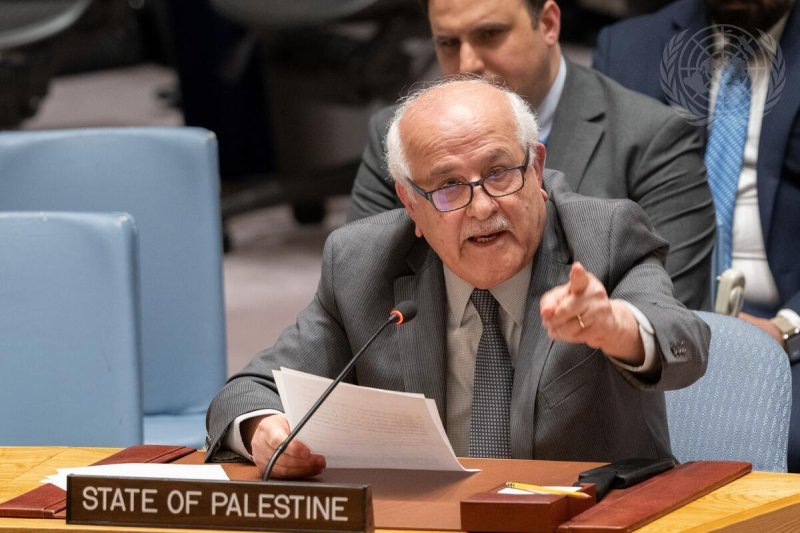

U.S. vetoes Palestinian bid for U.N. membership


Riyad H. Mansour, Permanent Observer of the State of Palestine to the United Nations, addresses the Security Council meeting on the admission of new members. He spoke after a resolution on the admission of Palestine as a UN member state failed to pass due to the veto of a permanent member of the Security Council. 
Photo by Eskinder Debebe/UN/UPI


April 19 (UPI) -- The United States blocked a U.N. Security Council resolution on Thursday to recognize the state of Palestine as a full member state of the United Nations, arguing its acceptance by the intergovernmental body will not equal statehood for the Palestinian people.

The Algeria-submitted resolution received 12 votes in favor, two abstentions from Britain and Switzerland and a vote against by the United States, which is one of five permanent members of the 15-member Security Council with veto power.

The vote prevents the resolution from moving on to the 193-member General Assembly where another round of balloting would have been held on the admission of the state of Palestine, which is one of two non-member observers of the intergovernmental organization, along with the Holy See.

An emotional Riyad Mansour, the Palestinian Authority's ambassador to the United Nations, choked back tears during his remarks following the vote.

"Our right to self-determination has never once been the subject of bargaining or negotiation. Our right to self-determination is a natural right, an historic right, a legal right to live in our homeland, Palestine as an independent state that is free and that is sovereign," he said.

"We we will not disappear. The people of Palestine will not be buried."

The state of Palestine first submitted its request to join the United Nations in 2011, which failed to get off the ground, but worked in the government receiving observer status in November the following.

Its application was revitalized amid Israel's war against Hamas in Gaza, which began Oct. 7, when the Iran proxy militia launched a brutal surprise attack on the Middle Eastern country, killing 1,200 Israelis with another 253 taken hostage.

The war has put renewed attention on the lack of a Palestinian state, as the death toll of the war in Gaza has ballooned to nearly 34,000 dead, and more than 76,000 injured. Much of the enclave has also been razed by months of bombing, and as of Sunday, some 1.7 million Gazans, or more than 75% of its population, have been displaced, according to the United Nations Palestinian relief agency.

Both the United Nations and the United States back the creation of the two separate independent and sovereign states of Israel and Palestine as the answer to the Israel-Palestinian conflict, and Washington defended its veto Thursday because acceptance into the intergovernmental body will not bring about this two-state solution.

"We also have long been clear that premature actions here in New York, even with the best intentions, will not achieve statehood for the Palestinian people," Robert Wood, U.S. deputy ambassador to the United Nations, said during the meeting.

"It remains the U.S. view that the most expeditious path toward statehood for the Palestinian people is through direct negotiations between Israel and the Palestinian Authority with the support of the United States and other partners."

He pointed out that the report the council received from the admission committee that the members lacked unanimity if the state of Palestine met the criteria for membership under the U.N. Charter.

"We have long called on the Palestinian Authority to undertake necessary reforms to help establish the attributes of readiness for statehood and note that Hamas -- a terrorist organization -- is currently exerting power and influence in Gaza, an integral part of the state envisioned in this resolution," he said.

In Washington, State Department spokesman Vedant Patel further explained that they believe the most expeditious way for the Palestinians to achieve statehood is through negotiations.

He told reporters during the press conference that due to statutory requirements, admission of the State of Palestine would require the United States to cease funding for the United Nations.

"The U.S. is committed to intensifying its engagement on this issue with the Palestinians and the rest of the region, not only to address the current crisis in Gaza but to advance a political settlement here that we think can create a path to Palestinian statehood and membership in the United Nations," he said.

Israel commended the United States for downing the resolution.

"The proposal to recognize a Palestinian state, more than 6 months after the largest massacre of Jews since the Holocaust and after the sexual crimes and other atrocities committed by Hamas terrorists, was a reward for terrorism," Israeli Foreign Affairs Minister Israel Katz said in a statement.

"Terrorism will not be rewarded."


Why did Biden block UNSC resolution for Palestine statehood? US stand Explained

ByVertika Kanaujia
Apr 19, 2024 

Why did United States block Palestine statehood bid at UNSC? Here's all you need to know


On Thursday, the United States stood alone in opposing a United Nations Security Council resolution to grant the Palestinian territories full UN membership and statehood. The U.S. vetoed the proposal put forward by Algeria on behalf of Arab nations, resulting in the resolution's failure. While twelve of the 15 council members voted in favour, Britain and Switzerland abstained.

The UN Security Council votes on a resolution allowing Palestinian UN membership at United Nations headquarters in New York, on April 18, 2024, during a United Nations Security Council meeting on the situation in the Middle East, including the Palestinian question. (AFP)

Had the resolution passed, it would have moved to the U.N. General Assembly, where a two-thirds majority among the 193 member countries would be required for approval. Currently, around 140 U.N. members recognize the Palestinian territories as a state.
HT launches Crick-it, a one stop destination to catch Cricket, anytime, anywhere. Explore now!

Why did US oppose Palestine statehood at UNSC?

U.S. officials have argued that endorsing statehood at this time could jeopardize the chances of achieving a lasting peace agreement between Israel and the Palestinians. It insists a mutually agreed-upon solution is essential.

President Biden has consistently emphasized that a lasting peace in the region hinges on a two-state solution reached through mutual agreement,” U.S. representative Robert Wood told the council. “This is the only path that ensures Israel’s security and its future as a democratic Jewish state, while also guaranteeing Palestinians can live in peace and dignity in their own state.

“We also have long been clear that a premature action here in New York, even with the best intentions, will not achieve statehood for the Palestinian people,” Wood said. The United States “fully shared responsibility with its Israeli allies for the deaths of tens of thousands of Palestinian civilians.”

Even before the vote it was widely anticipated that Biden would veto the resolution. The resolution needed nine out of 15 votes for passage and no veto from any permanent member, including the U.S. The administration had actively encouraged members to either vote against or abstain from the resolution to prevent a veto.
Council Members opposed US views on rejecting bid

Despite this stance, the majority of the council disagreed. Many argued that the U.S., due to its unwavering support for Israel, shares responsibility for the ongoing challenges faced by the Palestinian people. Russian Ambassador Vasily Nebenzya criticized the U.S. veto as an attempt to resist the inevitable course of history.

Despite the U.S.'s strong stance, even its closest allies on the council did not support the veto. Britain, for instance, explained its abstention by saying that while they support Palestinian statehood, such recognition should be part of a broader process.

Algeria, the resolution's sponsor, remained resolute, declaring their commitment to the cause until it's achieved.
How Palestine called out US bluff at UNSC

Ziad Abu Amr, representing Palestinian Authority President Mahmoud Abbas, pointed out that the same 1947 UN resolution that established Israel also called for a Palestinian state. He questioned how granting Palestinian statehood could hinder peace efforts.

“How could granting the state of Palestine full membership of the United Nations ... damage the prospects of peace between Palestinians and Israelis” or international peace? Abu Amr asked. “To those who say that recognizing a Palestinian state must happen through negotiations and not through a U.N. resolution, we wonder again, how was the state of Israel established.”


Israel’s U.N. Ambassador Gilad Erdan vehemently opposed the resolution, dismissing the idea of a Palestinian state meeting membership criteria.


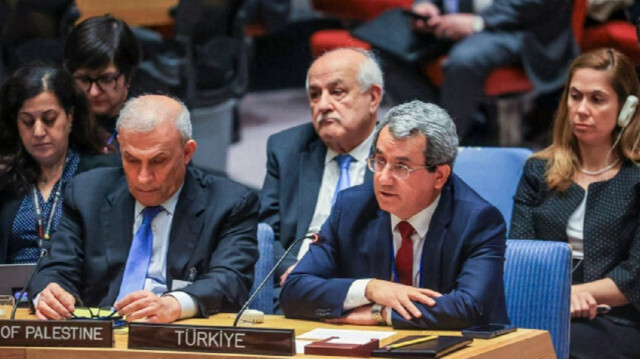
US veto of Palestine's request for full UN membership 'shameful': Türkiye

Turkish deputy foreign minister calls for cease-fire in Gaza as soon as possible, Palestine's full UN membership and two-state solution

19/04/2024 Friday
AA

Türkiye's Deputy Foreign Minister Ahmet Yildiz

Türkiye's Deputy Foreign Minister Ahmet Yildiz on Thursday criticized reports of US plans to veto a draft resolution demanding Palestine's full membership at the UN, saying it is "shameful."

Speaking to Anadolu in an exclusive interview, Yildiz commented on the possibility of a US veto prior to a meeting of the UN Security Council to vote on the resolution.

"A cease-fire (in Gaza) should be reached as soon as possible. Palestine should become a full member (of the UN), and negotiations towards a two-state solution must be initiated with the help of the international community," Yildiz said.

Yildiz said full membership would be a good start for Palestine.


"But it seems that the US will veto it, and of course, it is a shameful situation."

He further expressed deep concern over the deteriorating situation in Gaza, citing widespread destruction and a staggering death toll of nearly 40,000.

Emphasizing the urgent need for international unity in pressuring for a cease-fire, Yildiz noted that while everyone criticizes Israel, there are countries that have reservations and objections when it comes to recognizing Palestine.

He highlighted discussions surrounding the vital role of the UN agency for Palestinian refugees, or UNRWA, in supporting Palestinian refugees and denounced attempts to defund or dismantle the organization.


"The (Israeli) occupation forces in Palestine consistently violate international law and fail to meet their obligations," he said.

"It is evident that the current occupation cannot continue. We advocate for Palestine's full membership and urge the international community to initiate negotiations for a two-state solution.”

As expected, the US later vetoed the UN Security Council draft resolution.

The 15-member Council gathered in New York to vote on a draft resolution authored by Algeria recommending the admission of the State of Palestine for UN membership.

The membership was blocked with a vote of 12 in favor and two abstentions, including the UK and Switzerland.

Palestine denounces US veto blocking full UN membership bid

Move ‘unfair, unethical and unjustifiable, challenging the will of the international community,' says Palestinian Presidency

19/04/2024 Friday
AA
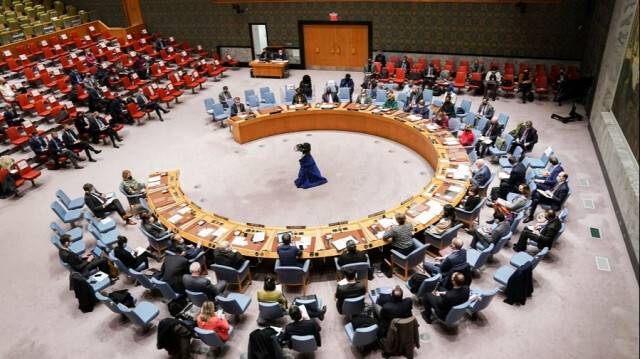
File photo

Palestine strongly condemned a decision by the US to veto a UN Security Council draft resolution Thursday demanding Palestine's full membership in the United Nations.

In a statement, the Palestinian Presidency called the move ''unfair, unethical and unjustifiable, challenging the will of the international community.''

It emphasized that this aggressive American policy towards Palestine, its people and their legitimate rights constitutes a blatant violation of international law.

It also noted that the US veto encourages the continuation of Israel's genocidal war against the Palestinian people in Gaza and the West Bank, including occupied Jerusalem.


The Presidency underscored that the veto exposes the contradictions in US policy, which claims to support a two-state solution to the Israeli-Palestinian conflict while preventing the international community from implementing this solution through its repeated use of the veto.

The 15-member UN Security Council gathered in New York to vote on a draft resolution authored by Algeria recommending the admission of the State of Palestine for UN membership.

The membership was blocked with a vote of 12 in favor and two abstentions, including the UK and Switzerland.

​​​​​​​Before the voting, Algeria's envoy to the UN Amar Bendjama said it is time for Palestine to take its rightful place among the community of nations, and seeking UN membership is a fundamental expression of Palestinian self-determination.


Palestine was accepted as an observer state of the UN General Assembly in 2012, allowing its envoy to participate in debates and UN organizations but without a vote.

States are admitted to membership in the UN by a decision of the General Assembly upon the recommendation of the Security Council, according to the UN Charter.

A council resolution needs at least nine votes in favor and no vetoes by the permanent members -- US, Britain, France, Russia or China -- to pass.

Palestine's application for full UN membership comes amid a deadly Israeli offensive on the Gaza Strip since an Oct. 7 cross-border attack by the Palestinian group Hamas, which has killed nearly 34,000 Palestinians.

UAE regrets Security Council failure to adopt full UN membership for Palestine
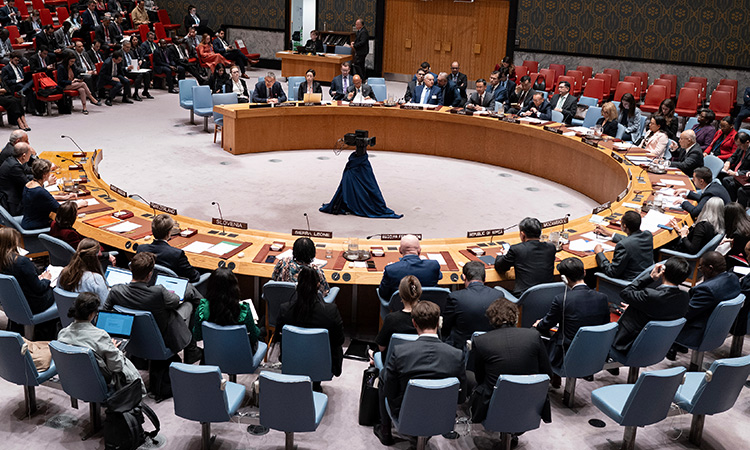
The Commissioner-General of the UN Relief and Works Agency for Palestine Refugees, Philippe Lazzarini, top centre left, addresses the UNSC meeting at UN Headquarters. AP

Gulf Today, Staff Reporter

The UAE expressed its regret at the failure of the UN Security Council to adopt the draft resolution accepting full membership of the State of Palestine in the United Nations, and stressed that granting Palestine full membership is an important step to enhance peace efforts in the region.

Khalifa Shaheen Al Marar, Minister of State, explained in a statement on Friday, that the UAE is steadfast in its commitment to promoting peace and justice and preserving the rights of the brotherly Palestinian people, achieving the two-state solution and establishing an independent and sovereign Palestinian state, in accordance with international legitimacy resolutions and relevant agreements requiring an end to the Palestinian-Israeli conflict.

He said: The UAE has always called on the international community to strengthen all efforts made to achieve comprehensive and just peace, as this is the only way for the region to emerge from the cycle of tension, violence and instability.

Al Marar stressed the UAE’s position on the necessity of supporting all regional and international efforts to advance the peace process in the Middle East, as well as putting an end to the illegal practices that threaten the two-state solution and the right to self-determination for the brotherly Palestinian people, by supporting the achievement of a just, lasting and comprehensive solution that achieves security, stability and prosperity for the Palestinian and Israeli peoples and the entire region.

Also during the day, Saudi Arabia expressed regret over the failure of the UN Security Council to adopt a draft resolution accepting full membership of the State of Palestine in the United Nations.

The Egyptian Ministry of Foreign Affairs also said in a statement on Friday that it expresses its deep regret over the inability of the Security Council to enable Palestine to become a full member of the United Nations, against the backdrop of the United States use of its veto.

The vote in the 15-member Security Council was 12 in favour, the United States opposed and two abstentions, from the United Kingdom and Switzerland. US allies France, Japan and South Korea supported the resolution.

Algerian UN Ambassador Amar Bendjama, the Arab representative on the council who introduced the resolution, called Palestine’s admission "a critical step toward rectifying a longstanding injustice" and said that "peace will come from Palestine’s inclusion, not from its exclusion.”


Draft resolution demanding Palestine's full membership at UN


'Ireland fully supports UN membership and will vote in favour of any UNGA resolution to that end,' says Irish foreign minister


Burak Bir |19.04.2024 - 
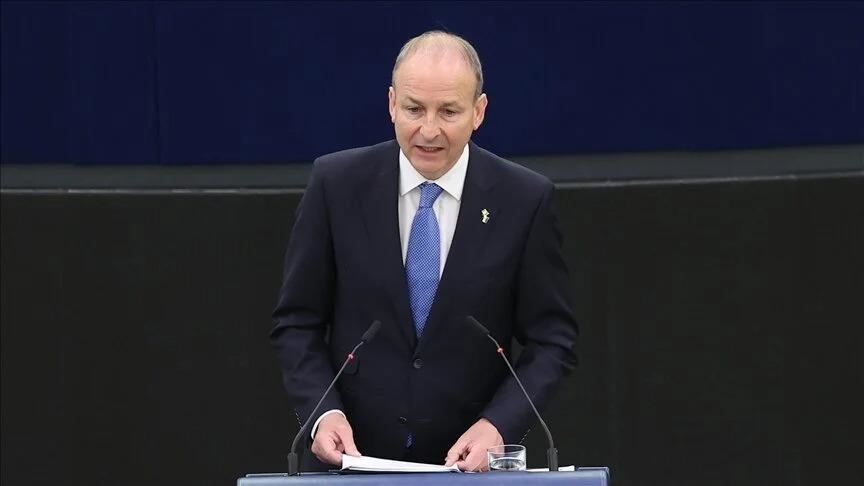
Irish Foreign Minister Michael Martin

LONDON

Ireland is "disappointed" at failure of Security Council vote demanding Palestine's full membership at UN, the country's foreign minister said Thursday.

"Disappointed at outcome of UN Security Council vote on Palestinian UN membership. It is past time for Palestine to take its rightful place amongst the nations of the world," Micheal Martin wrote on X.

His reaction came just after the US vetoes UN Security Council draft resolution that demanding Palestine's full membership at the UN.

The membership was blocked with a vote of 12 in favor and two abstentions, including the UK and Switzerland.

"Ireland fully supports UN membership and will vote in favour of any UNGA resolution to that end," he added.

Ireland is among a few European nations, including Spain that already committed to recognizing the Palestinian state.


Chinese envoy criticizes questioning of Palestine's eligibility for UN membership

Xinhua

A Chinese envoy on Thursday strongly criticized countries that question Palestine's eligibility for UN membership under the UN Charter, emphasizing that statehood is an "inalienable national right" of the Palestinian people.

During his statement following a vote in which the United States vetoed a draft resolution for Palestine's full membership to the UN, Fu Cong, China's permanent representative to the United Nations, expressed profound disappointment.

"Today is a sad day," because the US veto has ruthlessly dashed "the decades-long dream of the Palestinian people," he said.

Fu highlighted the contradiction in the arguments presented by some nations regarding Palestine's governance capabilities.

"The claim that the State of Palestine does not have the capacity to govern does not align with the reality on the ground," he said, noting significant changes over the past 13 years, including the expansion of settlements in the West Bank.

"Palestine's survival space as a state has been constantly squeezed, and the foundation of the two-state solution has been continuously eroded," he added, condemning what he described as "gangster logic that confuses right and wrong."

Additionally, Fu condemned the implications made by some countries that questioned whether Palestine is a peace-loving state, a criterion for UN membership. "Such an allegation is outrageous and a step too far," Fu said.

He further criticized the political calculations behind opposing Palestine's full membership, suggesting, "If it is out of political calculation to oppose Palestine's full membership of the UN, it would be better to simply say so, instead of making excuses to re-victimize the Palestinian people."

On the broader implications of denying Palestine full membership, Fu argued that this action puts the cart before the horse, especially as "the Israeli side is rejecting the two-state solution more and more clearly."

He advocated for Palestine's full membership as a means to grant it equal status with Israel, which could help create conditions for the resumption of negotiations.

"The wheel of history is rolling forward, and the trend of the times is irresistible," Fu said, expressing confidence that "the day will come when the State of Palestine will enjoy the same rights as other member states at the UN, and the two states of Palestine and Israel will be able to live side by side in peace."

Fu reaffirmed China's commitment to continuing its efforts and playing a constructive role in realizing this vision, hoping for a future where "the Palestinian and Israeli peoples can live in tranquility and happiness."


Monday, June 27, 2022

National Security State Censoring of Anti-Imperialist Voices

... the Latest Phase of its Long-Term Strategy to Divide and Control the Left

The US rulers use many tools to disrupt and disorganize the anti-war and anti-imperialist left. Three discussed here include: (1) corporate control of the news media gives them free reign to spread disinformation and fake news against foreign and domestic targets; (2) they use government and corporate foundation resources to fund and promote a compatible left to counter the anti-imperialist left; and (3) the rulers use their control of social media and internet to censor those voices.

Since 2016 their censorship of websites, Facebook pages, Twitter, and Paypal accounts has escalated alarmingly. They target those who counter the narratives the government and big business media feed us, whether it be US intervention and attempted overthrow of other governments, Covid, or stories of Russian interference.

With the Ukraine war, the US government and corporate media immense propaganda power has been directed against Russia and intensified on an overwhelming scale.

As the US empire began the Cold War soon after the end of World War II, with the rise of McCarthyism (which predated Joe McCarthy), news manipulation and suppression often fell under the control of the CIA’s Operation Mockingbird. The corporate media followed CIA directions in representing the interests of the US rulers. The CIA secretly funded and managed a wide range of front groups and individuals to counter what the US rulers considered its enemies. It encouraged those on the left who opposed actually existing socialism, seeking to foster splits in the left to undermine the communist and build the non-communist left.

Significant liberal and left figures who worked with the CIA included Gloria Steinem, key feminist leader, Herbert Marcuse, considered a Marxist intellectual, Walter Reuther, president of the United Auto Workers Union (1946-1970), David Dubinsky, president of the International Ladies Garment Workers Union (1932-1966). The CIA collaborated with Baynard Rustin, Socialist Party leader and close associate of Martin Luther King, with Norman Thomas and Michael Harrington, who became the fathers of the third campist (“neither Washington nor Moscow”) Democratic Socialists of America (DSA). Likewise, Carl Gershman, a founder of Social Democrats, USA, and later founding director (1983-2021) of the CIA front National Endowment for Democracy (NED).

Through  the Congress for Cultural Freedom, the CIA underwrote the publishing of leftist critics, such as Leszek Kolakowski and Milovan Djilas’ book The New Class. The CIA aided the “Western Marxism” of the Frankfurt School, which included Theodore Adorno and Max Horkheimer, former director of New School of Social Research, also subsidized by the Rockefeller Foundation.

Corporate foundations, such as the Rockefeller, FordOpen Society, and Tides foundations, among many others, funneled CIA money to progressive causes. The Cultural Cold War (pp. 134-5) noted that from 1963-66, nearly half the grants by 164 foundations in the field of international activities involved CIA money. The Ford Foundation continues as one of the main financers of progressive groups in the US; for instance, both Open Society and Ford foundations have heavily funded Black Lives Matter.

The CIA is regarded as a ruthless organization overthrowing democratic governments that US corporations considered a threat to their profits. While true, overlooked is “gentler” CIA work: underwriting and encouraging a compatible left, one which looks to forces in the Democratic Party for political leadership. This third camp left provides an alternative to an anti-imperialist or a communist left, and yet appears progressive enough to lure radicalizing youth, activists and intelligentsia. This cunning CIA strategy has fostered confusion, dissension, and divisions among these sections of the population.

These secret US government and CIA operations have been detailed in The Mighty Wurlitzer: How the CIA Played AmericaFinks: How the C.I.A. Tricked the World’s Best Writers, The Cultural Cold War, and AFL-CIO’s Secret War against Developing Country Workers: Solidarity or Sabotage?

In 1977 Carl Bernstein revealed CIA interconnections with the big business media. More than 400 journalists collaborated with the CIA, with the consent of their media bosses. Working in a propaganda alliance with the CIA included: CBS, ABC, NBC, TimeNewsweekNew York Times, Associated Press, Reuters, United Press International, Miami HeraldSaturday Evening Post and New York Herald Tribune. The New York Times still sends stories to US government for pre-publication approval, while CNN and others now employ national security state figures as “analysts.”

Reuters, BBC, and Bellingcat operate similarly, participating in covert British government funded disinformation programs to “weaken” Russia. This involves collaboration with the Counter Disinformation & Media Development section of the British Foreign Office.

The CIA pays journalists in Germany, France, Britain, Australia and New Zealand to plant fake news. Udo Ulfkotte, a former editor at Frankfurter Allgemeine Zeitung, one of the largest German newspapers, showed how the CIA controls German media in Presstitutes: Embedded in the Pay of the CIA. Ulfkotte said the CIA had him plant fake stories in his paper, such as Libyan President Gaddafi building poison gas factories in 2011.

The CIA was closely involved with the long defunct National Students Association and with the trade union leadership. The AFL-CIO’s American Institute of Free Labor Development, received funding from USAID, the State Department, and NED to undermine militant union movements overseas and help foment murderous coups, as against President Allende of Chile (1973) and Brazil (1964), as well as defended the rule of their masters at home. This continues with the AFL-CIO Solidarity Center, which receives $30 million a year from NED.

The CIA created publishing houses, such as Praeger Press, and used other companies such as John Wiley Publishing Company, Scribner’s, Ballantine Books, and Putnam to publish its books. It set up several political and literary journals such as Partisan Review. This CIA publishing amounted to over one thousand books, mostly geared to a liberal-left audience, seeking to bolster a third camp left, and undermine solidarity with the once powerful world communist movement.

That mission largely accomplished years ago, today the national security state works to undermine the anti-imperialist left and build up a left inclined towards the “lesser evil” Democratic Party.

Recent US Government and Media Thought Control Measures

CIA use of corporate media to undermine perceived threats to the national security state escalated with Obama signing NDAA 2017, which lifted formalistic restrictions on security state agencies feeding fake news directly to the US population. The Countering Disinformation and Propaganda Act in the NDAA, which went into effect in the early stages of Russiagate, created a central government propaganda organ:

to counter active measures by the Russian Federation to exert covert influence over peoples and governments (with the role of the Russian Federation hidden or not acknowledged publicly) through front groups, covert broadcasting, media manipulation, disinformation or forgeries, funding agents of influence, incitement, offensive counterintelligence, assassinations, or terrorist acts. The committee shall expose falsehoods, agents of influence, corruption, human rights abuses, terrorism, and assassinations carried out by the security services or political elites of the Russian Federation or their proxies.

Glen Ford observed:

Every category listed [above], except assassinations and terror, is actually a code word for political speech that can, and will, be used to target those engaged in ‘undermining faith in American democracy’ — such as Black Agenda Report and other left publications defamed as ‘fake news’ outlets by the Washington Post [article on PropOrNot].

This Disinformation and Propaganda Act created the innocuously named Global Engagement Center, operated by the State Department, Pentagon, USAID, the Broadcasting Board of Governors [renamed US Agency for Global Media], the Director of National Intelligence, and other spy agencies. This Center oversees production of fake news supporting US imperial interests, focused primarily against Russia and China (such as Uyghur genocide and Russiagate), but also against Nicaragua, Venezuela, Cuba, Iran, North Korea, Syria, and others. Verifiable reports exposing US regime change operations and disinformation are often outright censored or labeled pro-Russian or pro-Chinese propaganda.

The Global Engagement Center finances journalists, NGOs, think tanks, and media outlets on board with campaigns to vilify non-corporate media reporting as spreaders of foreign government disinformation. This may shed light on the origins of smears that opponents of the US regime change against Syria or in Ukraine are Putinists, Assadists, tankies, Stalinists, part of a red-brown alliance.

National security state propaganda against Russia surged after it aided Syria in thwarting the US-Saudi war against the Assad government. It reached levels of hysteria with the fabricated Russiagate stories designed to sabotage the 2016 Trump presidential campaign. Seymour Hersh disclosed that the widely covered news of Russian hacking of DNC computers in 2016 was CIA disinformation. Hersh confirmed from FBI sources that Hillary Clinton’s emails were taken by Seth Rich and offered to Wikileaks for money, and that the fake news story of Russian hacking was initiated by CIA head John Brennan. However, exposures of the Clinton-neocon-national security state Russiagate fake news were themselves written off as disinformation concocted by pro-Russian operators.

An example of Global Engagement Center work may be a recent smear against anti-imperialists as agents of Russia appeared in The Daily Beast. It targets Lee Camp, Max Blumenthal, Ben Norton, and others: “propaganda peddlers rake in cash and followers at the expense of the truth and oppressed people in Ukraine, Xinjiang, and Syria” because of their accurate reporting that goes against the US propaganda line.

Other articles may indicate this government Disinformation Center use of the third camp left in the tradition of Operation Mongoose. George Monbiot’s article in The Guardian fit the billing:

We must confront Russian propaganda – even when it comes from those we respect – The grim truth is that for years, a small part of the ‘anti-imperialist’ left has been recycling Vladimir Putin’s falsehoods.

Louis Proyect crusaded for Syria regime change, and against those opposing the US war on the country as being part of a “red-brown alliance.” Proyect often relied on British Foreign Office funded Bellingcat for his articles, writing, “The Bellingcat website is perhaps the only place where you can find fact-based reporting on chemical attacks in Syria.” Proyect defended “Syrian revolution” “socialist” Anand Gopal, of the International Security Program at the New America Foundation, funded by the State Department and corporate foundations, and run by Anne-Marie Slaughter, former State Department official.

Democracy Nowwhich also repeatedly relied on Anand Gopal as a news source, has long received foundation money, and we see the self-censoring effect this has on its former excellent anti-war journalism degenerating into compatible leftism.

Another product of this government-corporate aid for this Democratic Party “lesser evil” left may be NACLA’s articles smearing the Nicaraguan government. NACLA Board Chair Program Director is Thomas Kruse of the Rockefeller Brothers Fund. In 2018, NACLA, New York DSA, and Haymarket Books hosted anti-Sandinista youth activists while on a tour paid for by right-wing Freedom House.

In These Times, which receives hundreds of thousands in foundation money, ran similar articles smearing socialist Cuba. It claimed Cuba was “the Western Hemisphere’s most undemocratic government” – not Bolsonaro’s Brazil, Chile with its police who blinded pro-democracy protesters, not Colombia’s death squad supporting government, nor Honduras’ former coup regime, or Haiti’s hated rulers.

Haymarket Books, which produces many third camp left books, receives Democratic Party aligned think tank and nonprofit money via the pass through Center for Economic Research and Social Change. The Grayzone reported that the DSA, Jacobin Magazine, and Haymarket sponsored Socialism conference featured NED and State Department funded regime-change activists.

Jacobin editor Bhaskar Sunkara is former vice-chair of the Democratic Party’s reform oriented DSA. In 2017 the Jacobin Foundation received a $100,000 grant from the Annenberg Foundation, set up by billionaire publisher and Nixon administration U.S. Ambassador to Great Britain Walter Annenberg.

This milieu includes New York’s Left Forum, and the Rosa Luxemburg Foundation, underwritten by the German government.

Bob Feldman revealed corporate financing for the Institute of Policy Studies, The Nation, In These Times, NACLA, Middle East Research & Information Project (MERIP), Fairness & Accuracy In Reporting (FAIR), Progressive, Mother Jones, AlterNet, Institute for Public Accuracy, among others.

The US Chamber of Commerce discovered that foundations gave $106 million to workers centers between 2013-2016, and concluded that the worker center movement was “a creature of the progressive foundations that encouraged and supported it.”

These are but a few examples of US ruling class financing of anti anti-imperialist leftists, an effective means to channel and organize the left milieu into an opposition that poses no real threat to their control.

An essential characteristic of this milieu is looking to the Democratic Party as a lesser evil ally.

Alexander Cockburn  pointed out the dangers of this financing back in 2010:

The financial clout of the “non-profit” foundations, tax-exempt bodies formed by rich people to dispense their wealth according to political taste… Much of the “progressive sector” in America owes its financial survival – salaries, office accommodation etc — to the annual disbursements of these foundations which cease abruptly at the first manifestation of radical heterodoxy. In the other words, most of the progressive sector is an extrusion of the dominant corporate world, just as are the academies, similarly dependent on corporate endowments.”

Right after Trump’s surprise 2016 election win, the Washington Post cranked up the anti-Russia McCarthyism by introducing PropOrNot. ProporNot’s catalog of supposed Putin-controlled outlets sought to resurrect the witchhunts of the Red Scare era,  when 6.6 million people were investigated just between 1947-1952. The PropOrNot blacklist includes some of the most alternative and anti-war news sites on the web, including Anti-war.com, Black Agenda Report, Truthdig, Naked Capitalism, Consortium News, Truthout, Lew Rockwell.com, Global Research, Unz.com, Zero Hedge, and many others.

PropOrNot asserted 200 websites were “Russian propaganda outlets.” No evidence was offered. PropOrNot refused to reveal who they were or their funding. Alan Mcleod recently uncovered: “A scan of PropOrNot’s website showed that it was controlled by The Interpreter, a magazine of which [Michael] Weiss is editor-in-chief…[a] senior fellow of NATO think tank The Atlantic Council.” The Atlantic Council itself is financed by the US government and Middle Eastern dictatorships, weapons manufacturers Raytheon, Northrop Grumman and Lockheed Martin, Wall Street banks such as Goldman Sachs; and petrochemical giants like BP and Chevron. Mcleod concluded, “Thus, claims of a huge [foreign] state propaganda campaign were themselves state propaganda.”

Soon after PropOrNot, the German Marshall Fund, largely financed by the US government, concocted Hamilton 68: A New Tool to Track Russian Disinformation on Twitter. This identifies supposed “accounts that are involved in promoting Russian influence and disinformation goals.” Daniel McAdams of Ron Paul Liberty Report noted, “They are using US and other government money in an effort to eliminate any news organization or individual who deviates from the official neocon foreign policy line on Russia, Syria, Ukraine, etc.”

This year, the Department of Homeland Security presented a new censorship and disinformation organ, allegedly to combat pro-Russian fake news, the Disinformation Governance Board. As the Countering Disinformation and Propaganda Act and PropOrNot showed, what challenges US national security state narratives is often labeled Russian disinformation. Glenn Greenwald forewarned, “The purpose of empowering the Department of Homeland Security to decree what is and is not “disinformation” is to bestow all government assertions with a pretense of authoritative expertise and official sanction and, conversely, to officially decree dissent from government claims to be false and deceitful.”

The national security state, which lied about Russiagate, lied about National Security Agency’s 24/7 spying on the US population, lied about weapons of mass destruction in Iraq, plans to decide what is true and false, and enforce that on big business and alternative media outlets.

Thus, the CIA’s secret Operation Mongoose, devoted to encouraging hostility to actually existing socialism among the left, has morphed into official, public US government McCarthyite agencies directed at shutting down or smearing outlets and activism opposing the US empire and its wars.

What Corporate Social Media instruments are targeting which anti-war outlets?

This joint US government corporate media censorship has become an increasingly open attack. Paypal has allied itself with the Zionist Anti-Defamation League to “fight extremism and hate through the financial industry and across at-risk communities… with policymakers and law enforcement.”

Twitter has shut down many political accounts, even possessed the power to suppress the President of the United States’ account. In 2020, Twitter deleted 170,000 accounts “spreading geopolitical narratives favorable to the Communist Party of China,” and in 2021, it deleted hundreds of accounts for “undermining faith in the NATO alliance and its stability.” The company has hired a number of FBI officers for this censorship work. Twitter executive for Middle East is British Army ‘psyops’ soldier Gordon MacMillan of the 77th Brigade, which uses social media platforms such as Twitter, Instagram, and Facebook to conduct “information warfare.”

Google and Youtube executives team up with government spy agencies to censor anti-imperialist voices. Google’s “Project Owl,” designed to eradicate “fake news,” employed “algorithmic updates to surface more authoritative [compatible] content” and downgrade “offensive” [anti-imperialist] material. As a result, traffic dropped off to websites such as Mint Press News, Alternet, Global Research, Consortium News, liberal-left Common Dreams and Truthout.

Wikipedia censors articles on its website, as Ben Norton notes:

The CIAFBINew York Police DepartmentVatican, and fossil fuel colossus BP, to name just a few, have all been caught directly editing Wikipedia articles.

A minor player,  NewsGuard, “partners” with the State Department and Pentagon to tag websites that deviate from the establishment line.

Facebook relies on PropOrNot’s Atlantic Council to combat reporting contrary to the US government line. Facebook later announced it would further fight “fake news” by partnering with two propaganda organizations sponsored by the US government: the National Democratic Institute (NDI) and the International Republican Institute (IRI). The NDI was chaired by former Secretary of State Madeleine Albright, while Senator John McCain was the longtime IRI chair.

Just as The Mighty Wurlitzer, The Cultural Cold War, and Bernstein’s The CIA and the Media showed with the big business print media, we are witnessing an integration of social media companies into the national security state.

Who have been censored by this corporate media and social media integration with the national security state? 

Like with any censored book list, national security state targets provide a Who’s Who of what we should be reading and watching: The Grayzone, TeleSur,  Venezuelanalysis, Lee Camp, By Any Means Necessary, Caleb Maupin, Syria Solidarity Movement, Consortium News, Mint Press News, Abby Martin, Chris Hedges, CGTN and other Chinese media, George GallowayPepe Escobar, Scott Ritter, ASB Military News, RT America, Strategic Culture Foundation, One World Press, SouthFront, Gonzalo Lira, Oriental Review, Revolutionary Black Network, Sputnik News, Ron Paul’s Liberty Report.  Youtube warns us of watching Oliver Stone’s Ukraine on Fire. Journalists who have collaborated with a Russian media outlet are now dubbed “affiliated with the Russian government.”

The FBI directly shut down American Herald Tribune and Iran’s Press TV. RT and Sputnik are already shut down in Europe. PropOrNot listing of 200 media sites catalogs for us what the national security state doesn’t want us to read, listen to, know, or think.

Since the beginning of the first Cold War, there has been a continuous CIA-national security state operation to neutralize, marginalize, and create disunity among its opponents, often with the collaboration of the left that consider the Democratic Party a lesser evil. This strategy includes extensive foundation financing of leftist outlets and NGOs in order to tame them.

Therefore, it is mistaken to fault the US left for its weakness. The CIA and the foundations have been key players in covertly manipulating opposition to US imperial rule, in part by strengthening the left soft on the Democrats to undermine any working class or anti-US empire challenge. To date, this national security state mission has also shown considerable success.

The problems of building a working class left-wing partly results from the US rulers’ decades long campaign to disrupt the movement. This involves not just imprisoning and killing activists, such as Martin Luther King, Malcolm X, or the Black Panthers, but also big business media marketing disinformation as news, their funding of a compatible left, and the present social media and internet censorship of anti-imperialist voices. Rebuilding an anti-war and working class left wing requires us to directly address and navigate through this maze ruling class sabotage has created.FacebookTwitter

Stansfield Smith, Chicago ALBA Solidarity, is a long time Latin America solidarity activist, and presently puts out the AFGJ Venezuela Weekly. He is also the Senior Research Fellow at the Council on Hemispheric Affairs. Read other articles by Stansfield.

Wednesday, November 26, 2025

Thomas Hobbes And His Political Philosophy – Analysis

Historical, philosophical, and social foundations of Thomas Hobbes’ political thought


Thomas Hobbes by John Michael Wright

November 26, 2025 
By Dr. Vladislav B. Sotirovic

With his views within the history of political philosophy, the English political theorist Thomas Hobbes (1588–1679) became a classic representative of the school of English empiricism. He built a comprehensive political science system based on the basic thesis that in the real world, there are only individual material bodies. With this view, Hobbes began a war against the prejudices of medieval realism, for which concepts were the true reality, while things were merely derived from them. It is important to note that Hobbes believed that there were three types of individual bodies: 1) Natural bodies (i.e. bodies of nature itself that do not depend on man and his activities); 2) Man (both a body of nature and the creator of an artificial, i.e. unnatural, body); and 3) The State (an artificial body as a product of man’s activities).

Hobbes’s most important political science work is Leviathan (1651) [full and original title: Leviathan or the matter, form and authority of government, London] in which he elaborates his philosophical views on the third body, i.e., the state, of course, in the context of the time in which he lived and witnessed. In short, in this work, Hobbes elaborated on the view that the natural state of life of the human race is a war of all against all (bellum omnium contra omnes). According to him, this view is followed by a natural law that leads to the overcoming of such a state and the creation of the state (i.e. political organization) through a social contract between citizens and the government, but also a contract that finally recognizes the indivisible and unlimited power of the sovereign (king) in the polity (state organization) for the protection of citizens and their rights. In other words, citizens voluntarily give up a (large) part of their natural freedom, which they transfer to the state for the purpose of protecting themselves from external and internal enemies. This would be a political form of voluntary and contractual “escape from freedom” that was masterfully deciphered by the German philosopher Erich Fromm (1900–1980) in his eponymous work Escape from Freedom (1941), using the example of German society during the era of National Socialism.

The social and historical foundations of Hobbes’s political thought were the frequent civil wars in England, in which King Charles I Stuart (1625–1649) lost both his crown and his head (which was cut off with an axe), the emergence of two political currents in the Parliament of England, in fact later parties – the Tories (conservatives) and the Whigs (liberals), as well as the proclamation of the Commonwealth (i.e., a republic, or “welfare state”, 1649–1660) but with the dictator Oliver Cromwell (1599–1658), who from 1653 bore the title of “Protector” (“Protector of England, Scotland and Ireland”). At that time, English capitalist and even colonial-imperialist development required protection from an extremely strong and all-powerful state in the form of a monarchy, i.e., royal absolutist power.

Basically, Thomas Hobbes did not criticize the current socio-political system, but rather tried to consolidate it and strengthen it as much as possible so that the entire state with its citizens could function as well as possible and be as efficient as possible, which would be for the benefit of all citizens who first enter into a contract on bilateral relations among themselves and then with the state. Even from a European perspective (civil wars between Protestants and Catholics), given that an atmosphere of fear and personal insecurity prevailed throughout Western Europe, Hobbes desired peace, security, and the protection of private property, so that to this end he became a pronounced statist, i.e., a supporter of the strongest possible state power over individual citizens.

In the late European Renaissance and early modern period, the strengthening of monarchical power through the development of enlightened monarchical absolutism (despotism) was an expression of the need for social and state unity and harmonious functionality in order to avoid medieval political anarchy, polytheism, and powerlessness. When monarchical absolutism is emphasized, it is generally not because of the illusion of the divine rights of the ruler, but because of the practical conviction that strong political unity can only be achieved within the framework of enlightened absolutist monarchism. Thus, when Hobbes supports the centralist absolutism of the king, he does not do so because he believes in the divine rights of kings or in the divine character of the principle of legitimacy, but because he believes that the cohesion of society and national unity can primarily be achieved in this way. Hobbes believes in the natural egoism of the individual, and a natural consequence of this belief was the view that only a strong and unlimited (absolutist/despotic) central authority of a monarch is capable of restraining and overcoming the centripetal forces that lead to the disintegration of the social community and the dissolution of the state.

Leviathan (1651) – political system (state) according to the contractual state

It should be noted that the starting point of Thomas Hobbes’ political philosophy is the same as that of all other representatives of the so-called “natural law and social contract” school. Hobbes, like many others from the same school, reduces the individual man to the order in nature, and the civil state to the state of a contract between citizens and the state, but which is formed by subjects who, by the very contract with the state (monarch), should become citizens, thus freeing themselves from the position and role of medieval lawless subjects (i.e. those who had only obligations to the government but no rights in relation to the same government) at least according to the liberal political philosophy.

For Hobbes, the basis of human nature is egoism and not altruism, as well as the need for communal life, but not as some kind of drive for communal life (as in wild animals that live in packs), but a need out of purely egoistic interest. In other words, organized political society in the form of a state arises as a result of the fear of some individuals of others, and not as a result of some natural inclination of some individuals towards others. Therefore, the state is an imposed socio-political organization as a product of a rational view of life, i.e., survival, of the human community in order to preserve individual interests, including bare lives. In other words, Hobbes denied happiness and pleasure as elements of the natural state or order. On the contrary, for him, the natural state is dangerous for human existence because it is animalistically cruel and murderous. A state in which everyone wars against everyone. In a natural order that operates according to the (animal) laws of nature (the right of the stronger), the basis of inter-living relations is war based on force and deception.

The next important characteristic of the natural order is the absence of ownership of things and possessions in the sense of the absence of a clear demarcation of what is whose. In other words, everything belongs to everyone, and what is whose depends, at least for a while, on force, robbery, and coercion over others. For Hobbes, all human beings are equal both physically and intellectually, and everyone has a right to everything, striving to preserve this natural right. However, since at the same time they strive to achieve power or at least dominance over others, a war of all against all inevitably occurs, so that human life becomes unbearable. The stronger strive to become even stronger and more influential, and the weaker strive to find protection from the stronger in order to survive. On the one hand, man strives to preserve his natural freedom, but on the other hand, to gain power over others. For Hobbes, this is the dictate of the instinct for self-preservation (freedom + dominance). The human race has the same drive for all things, and therefore, all people want the same things. Therefore, all people are a constant source of danger, insecurity, and fear for others in the brutal drive for survival. Therefore, human existence is reduced to a war of all against all (man is a wolf to man).

For Hobbes, the fundamental natural law is therefore the law of egoism, which directs the human individual to preserve himself with minimal losses and maximum gains at the expense of others. Natural law (ius naturale) is, therefore, the instinct for self-preservation, i.e., the freedom for everyone to use their own strength and skill to preserve their existence. However, the fundamental meaning of the existence of the human individual is the search for security. Therefore, for Hobbes, only interest, and not altruism (the inclination of man to man), is the fundamental natural motive in the search for a way out of the state of nature because it is becoming unbearable. In other words, natural freedom is becoming an increasingly heavy burden on human shoulders that must be endured.

Hobbes opposed the teachings of Aristotle and Grotius that man himself originally has an urge to associate, i.e., a social instinct. Contrary to both of them, Hobbes believes that man is originally a completely egoistic being and possesses only one urge, which is the urge for self-preservation. This urge drives man to realize his needs, to seize as much as possible from what nature itself puts at his disposal and, in accordance with this urge, to expand the sphere of his individual power as much and as far as possible. However, according to the very logic of things, in this intention of his, man encounters resistance from other people who are guided by the same natural (innate) urge, i.e., aspirations, and thus competition, struggle, and war arise between members of the human race, which threaten the physical existence of people. Therefore, if man lives in a state of nature, he is confronted with the reality of the war of all against all, i.e. a war that is naturally caused by the need and strength of the individual and a war in which the eventual lack of physical strength, i.e. superiority, is replaced by cunning and deception according to the principle that the end justifies the means.

The state of nature does not allow human reason to do anything that can in any way physically endanger his own life, as well as to neglect what can best preserve it. Hobbes acknowledges that human nature is such that he is always in conflict with various passions and drives, among which the desire for power is predominant. However, by using reason, man realizes in practice natural laws, among which the basic aspiration for peace is (human personality = conflict of passions and reason). People, following reason and natural laws that strive for man to preserve and ensure peace by all available means, conclude a socially beneficial contract or agreement among themselves. On the basis of such a contract, people within the same living community living in the same living space unite with the aim of forming a stronger community with joint forces on the basis of general harmony, which ultimately turns into a form of statehood that would ensure peace and security for them. Thus, political organization has two basic goals, i.e., functions: the defense of the community from external enemies and the preservation of order, peace, and security within the community itself on the internal level. Thus, a state (Greek polis) is created on the basis of a contract, and politics would be defined as the art of running a state for the purpose of effectively realizing its two basic functions.

Such a (state-forming) contract prevents wars within the same (socio-political) community if the contract is fulfilled, which is in accordance with natural law. The contract imposes on each individual of the community a large number of obligations and duties in addition to rights, the fulfillment of which is necessary for the preservation of peace, order, and security. Thus, an individual, a member of a socio-political community, necessarily loses an important part of his freedom, which he transfers to the state for the sake of his own security and preservation of existence. Here, it should be noted that the law or effect of the development of civilization and the progress of the human race in the historical context is that with the development of civilization, man increasingly loses his natural freedoms and vice versa.

Thomas Hobbes believed that natural laws are, in fact, moral laws. One of the basic moral principles for the efficient and just functioning of the socio-political system, i.e., contracts, is that one should not do to others what one does not want to be done to oneself by others. Moral laws are eternal and therefore unchangeable and therefore universal for all members of a community, so all individuals strive to harmonize their behavior towards others in accordance with such moral laws. However, in the state of nature, these moral laws are powerless since they do not oblige people to behave in accordance with them, but only until real opportunities are created for all other people to be governed by them. Finally, such conditions and opportunities are created by a contract that leads to the creation and functional organization of the state.

Transition from the state of nature to the contractual state of statehood

According to Hobbes, law appears by leaving the state of nature and moving to the contractual state of statehood. Statehood is the institution that enables the creation or definition of private property between members of the community according to the principle of “mine”/“yours”. The state, as an institution, therefore, is obliged to respect the property of others. Unlike the contractual state (civilization), in the state of nature (savagery), there was no reciprocal security or guarantor of that security. By creating the state/statehood as an institution, man renounced those rights that he/she enjoyed in the state of nature. In the state of statehood, man adheres to contracts because this is the only way to ensure peace and, therefore, personal security. Thus, man shifts to fulfilling moral obligations because they contribute to the preservation of personal security.

However, as Hobbes argues, the mere contract/agreement between the members of a community is not sufficient for a state to exist and function. This requires, in addition to the contract, complete internal unity. In other words, in order to form a unified will of people, they must cease to live as independent and separate individuals, i.e., in some way they must “drown” into the general currents of the state community and thus renounce an essential part of their independence, individualism, and natural freedom. Now Hobbes moves on to the main point of his political philosophy, which has its own specific historical background, namely the time in which Hobbes lived, arguing that individuals should retain neither will nor right for themselves because all power should pass to the state as a general and superior institution. Hobbes essentially demands that individuals in a state community be subjects of the state and not citizens of it. Therefore, subjects must obey the commandments/laws of the state because only then can they distinguish good from evil. This transfer of all individual rights and powers to state bodies leads to the formation of (state) sovereignty (suma potestas/sumum imperium).

In this way, according to Hobbes, individuals are connected by a double contract/agreement:

1) A contract according to which individuals associate with each other; and

2) A contract by which, as a social collective (associated individuals), they connect themselves with a state authority to which they surrender all power with an absolute and unconditional obligation and practice of submission to it (in Hobbes’s specific historical time, this specifically meant absolutist royal authority).

The main direct consequence of this double contract is that a single entity is formed from the plurality of individuals under the auspices of state authority. This state authority, or royal absolutist authority over subjects that has support in the church, Hobbes called Leviathan. It is a biblical monster or mortal God who, in Hobbes’s illustration, holds a bishop’s crosier in one hand and a sword in the other, i.e., attributes of spiritual and worldly power. For Hobbes, the state is neither a divine nor a supernatural creation. Man is the rational and most sublime work of nature, and the state-Leviathan is the most powerful human creation. The state itself is an artificial body compared to man, who is a natural body. The soul of the state is the supreme authority, its joints are the judicial and executive organs, the nerves are rewards and punishments, memory is the counselors, the mind is justice and laws, health is civil peace, illness is rebellion, and death is civil war.

Man created the state based on the voice of reason. According to Hobbes, the state is an artificial product of a rational move of the human race and not a natural fact, as many philosophers before him believed, such as, for instance, Aristotle. According to Hobbes, the state exercises absolute sovereignty in such a way that individuals, i.e., subjects, are alienated in the state itself, that is, they renounce their natural right and condition. In other words, by the very fact that individuals have concluded an agreement to submit to the absolute state power they have chosen, they renounce their rights, which they alienate by transferring them to the sovereign. The relationship of the individual to the state is in the form of political alienation of man in the sovereign, instead of the medieval alienation in God.

Government and its forms

Hobbes believed that his theoretical system of government could be applied in practice to all forms of state power. Specifically, for him, there were three forms of state power in their pure form: Monarchy (which he preferred); Aristocracy; and Democracy. He also allowed the establishment of parliament, but under the condition of a strong and unlimited monarch’s power. The function of such a monarch’s power is to abolish the “natural state” of the human race, i.e., the general war of all against all, with its comprehensive authority and total power, and thus ensure peace and individual security for all members of the socio-political community, i.e., the state. Freedom as the basic form of democracy leads to rebellion, anarchy, and disorder. Hobbes further believes that the monarch’s supreme power must be primarily of a sovereign character, which for him specifically meant that it should not be subordinated to any external authority (domination), subject to any law outside the law of the monarchy, whether natural or ecclesiastical.

However, in the final analysis, monarchical power, at least theoretically, was not totally unlimited, since the right to exist was for him the only right that allowed for a limitation of supreme power, i.e., obligatory submission to the sovereign. This is because the foundation of state power in any form was laid on the basis of existential survival and self-preservation. This form can in principle be monarchical, aristocratic, or democratic, but in no way mixed, i.e., the division of power between individual organs. In any case, power must be exclusively in the hands of the organ to which it is handed over. In this case, Hobbes denies the basic principle of modern democratic power, which is the division of power into legislative (parliament), executive (government), and judicial (judicial organs).

It should be noted that Thomas Hobbes was a bitter opponent of the revolution, believing that crafts and trade, and therefore, in his socio-political conditions, the rising capitalist production, would flourish under the conditions of an all-powerful state administration in which all disagreements and political struggles would be eliminated. He believed that everything that contributes to the common life of people is good and that everything that helps to maintain a strong state organization should be supported. Outside the state, passion, war, fear, and brutality reign (i.e., the state of nature), while reason, peace, beauty, and sociability reign in the state organization (i.e., civilization).

The object of the care of the state administration (absolute monarchy) must be the wealth of the citizens (i.e., subjects) created by the products of the land and water (sea), as well as work and thrift. The duty of the state is to ensure the well-being of the people. Hypothetically, the interests of the monarch should be identified with the interests of his subjects for the state to function optimally.

Synthetic remarks

Thomas Hobbes’s doctrine of the omnipotent power of the enlightened absolutist monarch is a product of a time when there was a strong need to organize a centralized and absolutist state (centripetal) organization that could, above all, successfully resist papal universalism but also serve the development of capitalism and the limitation of feudal (centrifugal) elements. From a purely economic point of view, the absolutist monarchy at that time and in the following century corresponded to the interests of the capitalist bourgeoisie and its efforts to create a large internal economic market without regional-feudal taxes and sales taxes. In this way, on the other hand, national unity would automatically be created as a guarantor of the functioning of the economy within the national framework (a single state).

Hobbes believed that the terrible natural state of war of all against all could be overcome because, in addition to passions, there is also reason in man, which teaches people to seek better and safer means for their biological, material, economic, and general life than those that lead to war of all against all. In other words, in order to ensure social peace and individual security, each individual in society must renounce the unconditional right that he/she possesses in the state of nature. Ultimately, man does this because his/her instinct for self-preservation dictates it. By this renunciation, man renounces and partakes of his natural freedom, i.e., the freedom given by natural law, because the entire social community submits to the general contract to live in a political community-state. Although all individuals accept such a contract/agreement, they do so in principle for purely egoistic reasons, but reason dictates that they do so and therefore obey certain basic virtues without which the survival of the state would be impossible (fidelity, gratitude, kindness, indulgence, etc.). Outside the state contract, i.e., the state, there are affects, war, fear, poverty, filth, loneliness, barbarism, etc. Unlike the state of nature (i.e., the state of the jungle, uncivilization and barbarism, but also total freedom in the banal sense), statehood is characterized by reason, peace, security, wealth, luxury, science, art, etc., but with the condition of drastic restriction and even abolition of natural freedoms.

Only with the formation of a state organization does the distinction between right and wrong, virtue and vice, good and evil arise. For Hobbes, the conclusion of a state-forming contract among members of a social community can be tacit, that is, informal. In any case, the conclusion of a state contract for Hobbes is of historical importance because it separates pre-history from history itself. In other words, as for many other researchers of the history of mankind, the transition from the state of the jungle (anti-civilization) to the state of statehood is also the transition to civilizational development and history in general. On the one hand, Hobbes quite correctly understood the nature of the original state of nature, but he could not explain the emergence of the state outside the framework of the social contract.

What is important to note about Hobbes’s theory of contract is that he believed that by concluding a social-state contract, the individuals who concluded it automatically transfer all their power and their rights to the state administration, i.e., the absolutist monarch. The state becomes omnipotent, despotic, and absolutist, and therefore, resembles the mythical biblical monster Leviathan. The contractual transfer of power from the individual to the state must be unconditional, and therefore, the state power itself must be unconditional. To be such, power must be in the hands of only one man, and that is the absolutist monarch who is both the sole administrator and the supreme judge. Thus, Hobbes derived from his contract theory the necessity of absolute monarchy as the only form of state administration that fully corresponds to the intentions of the social contract itself. Absolute monarchy also has other advantages over other forms of political organization that make it the best form of government. Thus, for example, in an absolute monarchy, power can be abused by only one person, in an aristocracy by several families, and in a democracy by many (here Hobbes does not distinguish between the possible depths of abuse and corruption). Furthermore, in an absolute monarchy, party struggles are more easily neutralized, and in the ideal case of total despotism, party and political struggles do not exist because there is a complete unity of society, state, and politics under the rule of one person. State secrets are also easier to keep in absolute monarchies.

An absolute monarch must also have absolute power, i.e., absolute right in all political-legal and moral relations in the state (“The state, that is me”!). The monarch (in Hobbes’ case, the king) is the one who has both the first and the last word in all ecclesiastical, religious, and moral matters. Thus, the monarch determines how God is to be worshipped; otherwise, what would be worshipable to one person would be blasphemous to another, and vice versa. Thus, society within the same state would be divided into hostile parties and would wage a struggle between these parties on religious issues (like, for instance, the Holy Roman Empire during the religious wars in the 16th and 17th centuries). In other words, Thomas Hobbes was a great opponent of any religious tolerance within the same political organization. For him, it is an unacceptable revolutionary act for someone to oppose the valid and only permitted religion based on their private religious convictions, because in this way, the very survival of the state as well as its normal functioning is called into question. Therefore, what is generally good and what is bad for society and the state is decided only by the monarch. Moral conscience consists in obedience to the monarch.

Thomas Hobbes, nevertheless, later allowed for limitations on royal absolutism, and believed that every power was just if it served the people, and that this could ultimately be even a republic (Commonwealth), but headed by an in fact absolutist figure (e.g., Oliver Cromwell). Hobbes’s theory of statehood turned from the medieval theological to the anthropological interpretation of the origin and foundations of the state. Hobbes’s teaching on the emergence of state organization based on contracts and the understanding that life would be better and safer in the state was contrary to medieval theological interpretations and understandings of the state, which identified the goals of the feudal class of large landowners with divine goals. Many philosophers have seen Hobbes’ theory of the state as the doctrine of the modern totalitarian state. However, Hobbes’s political philosophy is essentially individualistic and rationalistic.

Dr. Vladislav B. Sotirovic is an ex-university professor and a Research Fellow at the Center for Geostrategic Studies in Belgrade, Serbia.