
UPDATED
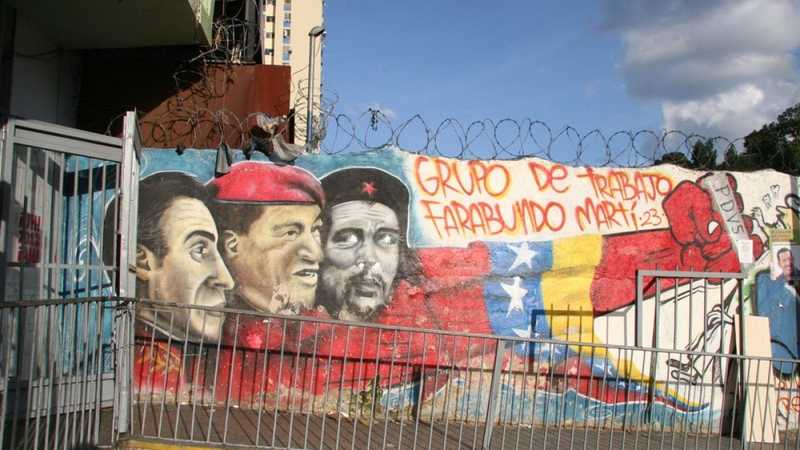
Last Saturday (January 3th), a massive US military attack, concentrating the largest naval aggressor force ever assembled in the Americas in the Caribbean, kidnapped Nicolas Maduro and decapitated the country’s government. Since then, Donald Trump and Secretary of State Marco Rubio have multiplied threats. They spoke of a “second attack.” They boasted that “any member of the government or armed forces” could suffer the same fate as Maduro. They added that Delcy Rodriguez, the acting vice president, could face “something worse .” In the most recent outburst, Trump himself “assured” in a social media post on January 6th that Washington would demand 30 to 50 million barrels of oil from Caracas (two months of production), the revenue from which he would personally manage…
On the same day this latest intimidation was uttered, Delcy Rodriguez made her first appearance on the streets of Caracas as acting president. She chose a symbolic location as the setting : the José Félix Ribas Socialist Commune, part of the Chavista project (only recently resumed by Maduro) to create institutions of power and popular economic initiative . She was categorical: “here the people govern, here there is constitutional power.” She denounced Trump’s action as “unilateral armed aggression.” She demanded that “the harassment of Venezuela and the aggression against the people of Bolívar cease,” and that the president be released.
The dice are still rolling, in Venezuela and throughout Latin America. The swift military action of the United States and Trump’s pronouncements since then mark a turning point in relations between Washington and the region. International law has been violated in multiple ways, and in an undisguised manner. The White House announces the return of the Monroe Doctrine and the Big Stick strategy, now in a worsened version (the “Donroe Doctrine” ). But a deeper examination of the facts, which will follow, reveals that its power has limits.
They appear in Trump’s own decisions. Despite the immense military power he possesses, and his effort to concentrate it in the Americas (the “western hemisphere” of the Monroe Doctrine), the president cannot launch a large-scale invasion, as his recent predecessors did in Iraq and Afghanistan. As a result, he also hesitated to take the step that would seem natural after the success of the attack: to go further and attempt regime change.
The contradiction between Trump’s plans and his actual powers opens a breach, and the main objective of this text is to explore it. Latin America, and Brazil in particular, can no longer maintain the same relations with the United States as before – but governments and public opinion are slow to realize this.
This is not about issuing protest statements (those that Brazil has sponsored or signed so far are reasonable). The Donroe Doctrine, the pioneering attack on Venezuela, and Trump’s subsequent threats to other countries in the region constitute, together, a permanent declaration of war. In this sense, the empire is naked – for it has stripped itself of the trappings that associated it, in the past, with “democracy,” “freedom,” or the “rule of law . “
But potentially aggressive powers take advantage of two kinds of vulnerabilities. The first, fundamental one, is the prolonged absence of national projects. A primary focus of neoliberalism, most Latin American countries remain subservient – even now, when this ideology is in tatters – to the belief in “market solutions.” Brazil is part of this group.
The second weakness is more specific, yet more urgent. For this very reason, it suggests a starting point for action. The gaps in the White House’s power are especially serious in three dimensions: a) information technologies, networked communication platforms, and artificial intelligence, where American big tech companies , associated with the far right, exert complete dominance; b) the Armed Forces, whose weaponry, communication, and logistics are subordinated to the United States; c) diplomacy, which remains incapable of seeing – much less exploiting – the new possibilities opened up by the decline of the Eurocentric order. It remains particularly blind, as will be seen, to the multiple overtures launched by China.
Certain risks are also opportunities. For three decades, the Brazilian left has been undergoing a process of institutionalization that has distanced it from thinking about – and projecting to the population – a historical horizon. Now there is a strident warning sign. Will it help awaken it from its lethargy?
I.
The assault
Don’t go hunting for traitors. A brutal imbalance of forces made the kidnapping possible.
Just a few hours separate the two surprising events – one dependent on the other. Around two in the morning on Saturday (January 3rd), after months of preparations, the weight of the most powerful military forces on the planet fell like a lightning bolt on Caracas. Operation Absolute Resolve was beginning , which would unfold in just over two hours. The pilots of 150 aircraft, stationed at air bases and on warships deployed to the Caribbean, finally received the order to begin the mission that had been exhaustively rehearsed for months.
In a few minutes, four strategic targets for the defense of Venezuela were destroyed – bringing the country to its knees, as reported by Carla Ferreira : Fort Tiuna , the country’s main military installation, headquarters The Ministry of Defense and the Strategic Command of the Armed Forces were destroyed; the La Carlota Air Base , the logistical hub for the protection of the capital; the General Command of the Bolivarian Militia, the brains behind the armed civilian resistance forces, located very close to the Miraflores Presidential Palace; and the Port of La Guaira , which supplies the capital with medical supplies, consumer goods, and manufactured goods. The anti-aircraft batteries that were supposed to protect Caracas were also destroyed.
As the planes moved, among them powerful F-18s, F-22s, and F-35s – opened a lethal corridor . An electronic attack, produced by specialized Boeing Growlers , put Venezuela in a “cyber blackout,” and increased its defenses by blocking interception possibilities. Through this large opening , flying at very low altitudes and invisible to radar, Chinook helicopters penetrated . Inside were hundreds of soldiers from the elite Delta Force. They had been briefed – by CIA agents, spy drones, and possibly informants within the Venezuelan security apparatus – on the precise location (Fort Tiuna) where Nicolás Maduro and his wife, Cilia Flores, were that night. They knew its interior in detail, having simulated the operation in scenarios that reproduced it, on a 1:1 scale, at the Joint Special Operations Command in the US state of Kentucky.
The final phase lasted just over half an hour. Maduro and Cilia were kidnapped, handcuffed, and taken to the small aircraft carrier USS Iwo Jima, from where they departed for the Guantanamo naval base and from there, by helicopter, to New York. About eighty members of Maduro’s security detail – including 32 Cubans – were murdered by the invaders. No American soldiers died, says the Pentagon . The US war budget , which will exceed $1 trillion in 2026, is the largest in the world, and greater than the combined budgets of the next ten countries. It is equivalent to the GDP of Colombia or Belgium. From a military point of view, the operation was a success.
II.
The nervous mouth:
All of Latin America is now under threat, Trump announces.
The paths of politics are more tortuous and complex. It was around 1:30 PM on that same Saturday (January 3rd) when Donald Trump spoke to the press for the first time, at his mansion in Florida, about Maduro’s kidnapping . How to defend the invasion and bombing of a sovereign country – which has never attacked or threatened the US – and the kidnapping of its head of state? Beyond the inherent difficulty of the problem, there were aggravating factors. The hypothesis that Venezuela supplies cocaine to the US is implausible , according to the US intelligence agencies themselves. The US has never filed any complaint about this with the UN Security Council or the International Court of Justice. And, for geopolitical and partisan reasons, Trump himself has just released international drug trafficker Juan Orlando Hernández, former president of Honduras, from prison; he was sentenced to 45 years in a New York court after extradition and due legal process.
Trump’s response will continue to shape international relations long afterward.
That the spectacular action of Delta Force in Caracas has been lost in the dust of time. On January 3rd and 4th, in successive statements by its leaders, the United States announced that it would attempt to impose, throughout the Americas, an aggravated version of the Monroe Doctrine (of 1823) and the Big Stick Ideology ( of 1904). The threat was explicit, in theory, in the new National Security Strategy made public by the White House in December 2025. But the extent of Washington’s covetousness for Latin American riches and the intention to usurp the sovereignty of the continent’s states would be brutally exposed later.
The intimidating outburst first emanated from Trump’s own throat. “The United States’ domination of the Americas will never be questioned again. [That] will not happen,” the president told reporters. Maduro’s kidnapping was, predictably, linked to his alleged involvement in cocaine production. But it soon became clear that this was merely a pretext, because the president went on to describe the fate he intends to give… to Venezuelan oil. “We will manage it professionally, we have the largest oil companies on the planet. We will invest billions and billions of dollars.” To ensure this control, under the new strategy, Trump said he did not rule out the possibility of a military invasion (boots on the ground ) [although he is very afraid to trigger it, as will be seen].
It would soon become clear that the White House’s target encompasses much more than Venezuela. On Sunday morning (January 4th), speaking to Fox News , Trump extended the threat to Mexican President Claudia Sheinbaum. Asked if the attack on Caracas suggested anything to Claudia, he promptly replied: “She’s not governing her country – it’s the cartels (…) Something needs to be done.” On the same day, in an interview with The Atlantic magazine , the vociferations turned against Greenland: “We need it, for our defense.” And later, aboard the presidential plane, his nervous mouth sought out Gustavo Petro, the president of Colombia: The country “is also very sick, governed by a sick man, who likes to produce cocaine and sell it to the United States — and he won’t continue doing that for much longer”…
III. A remote-controlled government?
Trump and Rubio want to control Venezuela from a distance.
In Trump’s regression to the Monroe Doctrine and the Big Stick ideology, there is a striking and paradoxical innovation. It is exposed in the attack on Venezuela. At least for the moment, the United States is not seeking regime change , which it has pursued throughout the world for decades, under both Republican and Democratic governments. They demand a total reorientation of policy . Maduro was kidnapped, but not killed (unlike Saddam Hussein and Muammar Gaddafi). Furthermore – and much more importantly – Trump and his advisors have said they are offering both Venezuelan Vice President Delcy Rodriguez and members of the country’s state and military apparatus a consolation prize. They can remain in their posts and enjoy their respective comforts, provided that… they obey their new masters. In this attempt at an arrangement, bizarre and extremely uncertain, lies one of the keys to understanding what is happening now in both Caracas and Washington.
The experiment began to be rehearsed in Saturday’s interview in Palm Beach. An imperial Trump expressed the White House’s intention to “run the country . ” But, to the astonishment and disappointment of many, he dismissed the possibility of installing opposition figure Maria Corina Machado in power. Identified with the international far-right, she possesses some political capital and had recently attempted to court American corporations with the promise of “massive privatization” of Venezuelan oil, gold, and infrastructure. In her own words, “a $1.9 trillion opportunity”…
Trump preferred to back Maduro’s vice president, Delcy Rodriguez, who, according to him, will govern under very special conditions. “Marco [Rubio, Secretary of State] is working on this directly and just spoke with her. Essentially, she is willing to do what I deem necessary to make Venezuela great again”… However, he threatened: “We are ready to launch a second, much larger attack if necessary.” He went further: “All political and military figures in Venezuela should understand that what happened to Maduro could happen to them as well . ” And he made it clear that the situation will persist until the US can “organize a safe transition.”
A few hours later, speaking on state television, Delcy suggested a different course of action. She called Washington’s intervention “barbaric,” reaffirmed that Maduro is “the only president of the country,” denounced his “kidnapping” (using the precise term), and called for his release. That was enough for Trump and his advisors to return to the attack. On Sunday morning, Secretary Marco Rubio announced in an interview that the US will continue blocking Venezuelan oil exports until the state-owned company that exploits most of the oil fields (PDVSA) opens itself to foreign investment – especially American investment. “[The blockade] will remain until we see changes, not only to favor the national interest of the US, which is the number one objective, but also to promote a better future for the people.”
Hours later, the president himself returned to the topic in another contact with journalists . Asked about oil, he promptly replied: “We need full access. To oil and other things in the country.” And regarding who wields power in Caracas, he assured: “We are dealing with whoever took office. Don’t ask me who is in charge , because I will answer, and that could be very controversial.” The reporter insisted: “What does that mean?” “It means we are in charge,” Trump replied.
Repeated threats made too often may reveal doubt about one’s ability to carry them out.
IV.
The limits
Contrary to what he tries to make people believe, the emperor cannot do everything.
Invading a sovereign country, kidnapping its president, and withdrawing. Renouncing “regime change.” Getting rid of an ally like Maria Corina Machado. Believing in controlling a government through coercion. What led Trump to follow, in the operation against Venezuela, a pattern so different from those normally employed in interventions carried out by the United States? The facts are recent and are developing. More time will be needed for definitive answers. However, based on an examination of objective events and trends, it is possible to formulate good hypotheses.
The first relates to one aspect of the decline of American power: the breakdown of the social consensus necessary for wars. Trump captured this sentiment. One of the key points of his speeches in the race for the White House was the denunciation of interventions abroad. In condemning them, he pointed to them as a product of the establishment’s actions. He insisted on the cost they imposed on Americans, how much they benefited the military-industrial complex, and how they diverted resources that, according to him, could have “made America great again” (MAGA). The narrative became hegemonic. In December 2025, according to polls cited by The Conversation website , 63% of American voters rejected military action against Venezuela.
This is probably the main reason for discarding Maria Corina. Putting her in power would mean a huge provocation for the supporters of Chavismo. The country would plunge into instability – the worst possible scenario for the enormous investments needed in the oil industry and its vulnerable facilities. Having installed her in the Miraflores Palace, the US would need to defend her. Trump would clash both with a large majority of the electorate and with his own discourse.
The second hypothesis relates to Trump’s particular choices in trying to counter the decline. He refuses to resort to the international institutions built after World War II to sustain American hegemony. He calls them “globalist.” In bilateral relations with other countries, he maximizes the economic and military power of the US to extract concessions. (It is worth recalling his significant victories in trade agreements with the European Union and Japan after imposing the “tariff hike”). He seeks to add to this power his personal brutality: supremacist impulses, constant harassment, insults, and the habitual use of lies and falsification. He is obsessed with restoring the power of American corporations. Aren’t these precisely the central elements of his aggression against Venezuela and his attempt to remotely control its rulers?
* * *
Will this recipe be effective in Venezuela? It is, evidently, too early to know. The US show of force was impressive and devastating. The kidnapping of Nicolás Maduro leaves Chavismo deprived of its main popular leader and the point of unity among all its factions. The notorious bureaucratization of some of its members holding positions in the State tends to make Trump’s abject proposal tempting. The pressure will be amplified by the blockade of Venezuelan oil shipments , which the US has not relaxed and which deprives the country of its main source of foreign exchange.
But there is another side to Chavismo. The one that was forged in the commander’s historical battles. The one that was inspired by the anti-imperialist project and the broad redistribution of oil wealth. The one that participated in processes such as the 1999 Popular Constituent Assembly and the multiple attempts to invent a popular democracy capable of overcoming the limits of liberal institutions. The one that was enthusiastic about Maduro’s efforts to revive the “popular communes” after the debacle in the 2024 presidential elections. Unlike what happened in the military dictatorships sponsored by Washington during the Cold War, this tradition is not being destroyed – and it is unlikely to be while Delcy Rodriguez remains at the head of the government. Trump’s project, as we have seen, is different.
What will happen when the two sides of this coin – the attempt to force Chavismo to act against what constituted it; and the continued power of a movement whose rebellious origins have not been lost – become incompatible? Trump’s intervention has once again placed Venezuela at the center of the global geopolitical stage. Everything that happens there will have repercussions. Will Trump order Delcy Rodriguez to execute his plan? Will she acquiesce? If she does, will there be a revolt? What will happen then?
The enormous shock caused by the swift action of the US on Saturday may have led some to believe that a chapter in Latin American history was closing. In Venezuela, on the contrary, a new page in the struggle for the country’s future – extremely difficult and arduous, but not lost – may be opening.
But what about Latin America as a whole, and Brazil in particular?
V.
The opportunity
: Faced with the Donroe Doctrine, Latin America and Brazil either bow down or reinvent themselves.
In May 2025, an extensive article in the digital magazine Defesanet revealed that members of the Trump administration coveted the infrastructure of Fernando de Noronha and the Natal-RN Air Force Base. The White House’s new National Security Strategy was being drafted. The publication found that diplomats from Trump’s inner circle had raised the issue in contacts with Brazilian politicians and military personnel. They intended to install surveillance and power projection structures (equipment and airports) over the South Atlantic in both locations, which would naturally require the creation of operational enclaves, shielded from Brazilian authorities. They brandished, as an argument, a bizarre “functional right of strategic reuse”—the same one the White House has used to try to regain control of the Panama Canal. Defesanet itself considered: “the name for this is colony”…
The episode reveals, almost in the form of a caricature, a new reality. Faced with the Donroe Doctrine, and what it has already produced in Venezuela, the governments and societies of Latin America have two alternatives. If they bow down or remain silent, they will deepen the lethargy and the feeling of impotence that has spread throughout the region for three decades, since the neoliberal project became hegemonic. The structural impasses – inequality, productive regression, technological backwardness, devastation of nature, institutions alienated from real life, and so many others – will remain unaddressed. The countries will be vassals of a declining power, condemned to the miseries of late capitalism and to a peripheral condition.
But Trump’s intimidation tactics and his desire to tighten the noose on colonization may, paradoxically, sound the wake-up call. In this scenario, the awareness that there is a risk of deeper subjugation leads to the identification of vulnerabilities. And the effort to remedy them triggers a national mobilization capable of reviving ideas that are currently dormant: such as national project , reconstruction , and political horizon .
In this movement, three objectives can be strategic: a) Digital Sovereignty; b) revision of the National Defense Policy; and c) foreign policy focused on building a post-Eurocentric order and partnerships with the Global South. These are challenging. They will require persistent and prolonged construction. However, they are clear, capable of mobilizing and generating positive secondary effects.
The fight for Digital Sovereignty is, of the three, the most crucial, urgent, and complex. But perhaps it is the one that can most unleash political and economic energies currently contained. The current scenario is contradictory. In some aspects, the dependence on the US is dramatic: Brazil finds itself surrendered to its big tech companies. A study conducted in 2025 by researchers Sérgio Amadeu and Jeff Xiong demonstrated that the country hosts almost all of the strategic data it generates on servers belonging to American corporations. This includes data from Brazilian universities, research and technology centers, the SUS (Unified Health System), IBGE (Brazilian Institute of Geography and Statistics), the Federal Revenue Service, and the superior courts (including the STF and TSE), for example.
The development of basic software is in the same subservient position – to the point, for example, that “ Google and Microsoft host the emails and data repositories (drive) of 154 Brazilian public universities.” Also foreign are the platforms used almost universally in the country for internet research (Google), personal communication via messaging (Whatsapp-Meta), social networks (Facebook and Instagram-Meta or TikTok-Bytedance), or for personal transportation, delivery, accommodation, one-off service contracts, and many others. All of them capture, process, distribute through algorithms, and monetize and commercialize both communication consciously generated by the population (a text or video post on a social network, for example) and data generated involuntarily (such as any form filled out online). Algorithmic programming, now reinforced by artificial intelligence, has enormous power to influence behavior – including electoral behavior. And the alignment of big tech companies with far-right policies has become blatant since Trump’s inauguration.
Conversely, the country has two enormous strengths in the same field: a large contingent of highly trained programmers and developers (who today, due to a lack of alternatives, work mainly for big tech companies ) and informed, creative social movements capable of formulating policy for the area. If the fight for digital sovereignty becomes a state priority, overcoming vulnerability could advance consistently and relatively quickly.
In 2025, hacktivist Uirá Porã outlined, in an interview with Outras Palavras , a possible roadmap: 1. Build, starting from universities, a Brazilian network of public data centers ; 2. Recover the two state-owned companies in the sector (Dataprev and Serpro), currently entangled in subservient partnerships with US big tech companies ; 3. Articulate, within these companies and regionally linked to university data centers , teams of developers willing to produce applications for municipalities, other public entities, companies, and civil society. In this design, Digital Sovereignty ceases to be merely a strategic objective of the State and begins to unfold into services to society, stimulating the mass training of qualified professionals and a space for the development of awareness and social reinvention.
* * *
A revision of the National Defense Policy is necessary to confront an even more glaring weakness. The very orientation of some of the Navy’s frigates in the oceans now depends… on Elon Musk’s Stalink. But not only that. Historian Manuel Domingos, who studies the Brazilian Armed Forces in depth, recalls in a recent text that the Brazilian Armed Forces have lived, since the time of Baron Rio Branco, with the fetish of dependence on technology purchased from Western powers. Defense is not understood as an organic action of Brazilian society – which could lead to autonomous technological development. Packages are acquired – the Swedish Gripen fighters or French submarines, for example – that subject the country to multiple dependencies.
In June 2024, for example, the US Department of Justice requested that Saab, the manufacturer of the Gripen fighter jets sold to Brazil, provide “clarifications” about the operation. The magazine Sociedade Militar warned at the time: “The move raises suspicions about possible interference aimed, in fact, at keeping Brazil in a state of dependence on the US (…) The Gripen, despite being a modern fighter jet, depends on a chain of international suppliers: the engine is American, the ejection system is British, and several other components come from different parts of the world. This means that if at any point the US or the UK decide to put the brakes on, for political or commercial reasons, these fighter jets would be grounded. And it’s not just theory – history has already shown this in several episodes…”
Freeing the country from such dependence, to prevent the Armed Forces’ own equipment from being at risk of being blocked, may be an understandable and politicized project. But, as in the case of Digital Sovereignty, it goes beyond the interests of the State. Manuel Domingos argues in his text that the National Defense Policy, published in May 2024, “turned to dust in the early hours of last Saturday,” when the US demonstrated what it is willing to do. But he recalls that a review could, in addition to technological autonomy, bring into debate other points equally important for a national project. Among them, guiding the Armed Forces towards their role of defending the territory (challenging the tendencies to turn them against “internal enemies”) and also considering, in the military field, a policy of integration of South America – including to have more strength against real threats…
The Trump threat, as we can see, may lead Brazil to reflect on itself. But in a time of global challenges – such as growing inequalities, the risks of environmental collapse, and the constant threats of war – isn’t it also necessary to rethink geopolitical alliances?
VI. Alliances
To confront the US, Latin America needs allies. China is stepping forward.
A third weakness becomes apparent when analyzing the conditions for Latin America and Brazil to confront the new threatening attitude of the US. Especially during Lula’s third term, foreign policy became timid, conventional, and incapable of envisioning partnerships and collaborations outside the Eurocentric order.
Gone are the days of Foreign Minister Celso Amorim and his bold and surprising initiatives – his central role in the creation of BRICS, the organization of a summit between South America and Arab countries (which startled Washington), or the attempt (with Turkey) to broker a peace agreement between the United States and Iran (sabotaged by Hillary Clinton). Under Mauro Vieira, what prevails in Itamaraty is what economist Paulo Nogueira Batista Jr. , with biting irony, called the “permanent visa group in the US.” These are the diplomats who fear (even since the Trump administration) any gesture that might upset the US – especially strategic rapprochements with BRICS and China.
Although the Chinese have long been Brazil’s main trading partners, the country has established a relationship with them that reproduces its colonial past and its productive regression. It exports primary products – especially soybeans and iron ore. It imports technological goods and services. Two proposals from Beijing, launched in recent months – the Global Governance Initiative , from September 2025, and the Policy Document for Latin America , from December – suggest that the bilateral agenda could be very different.
The first proposal outlines five seemingly generic propositions that directly clash with Trump’s “imperial right to intervention.” Three stand out: a) “egalitarian sovereignty” (“all countries, regardless of size, strength, or wealth, will have their sovereignty and dignity respected, their internal affairs free from external interference, and the right to independently choose their social system and level of development”), b) respect for international law and UN bodies; c) a “people-centered approach” (“the well-being of populations is the ultimate purpose of global governance”). The second, longer and more detailed proposal formulates specific collaboration proposals, encompassing, among others, areas and themes relevant to Brazil: (re)industrialization, nature preservation, clean energy, science and technology (including the internet and AI), military exchange, and others.
Neither document received significant attention in the Brazilian mainstream media. Both deserve careful examination. It’s not about proposing an “alignment with China,” as those opposed to the partnership sometimes pejoratively proclaim. Rather, it’s about recognizing that while Washington clearly announces an imperialist and aggressive stance, there is a gesture of a different nature. This gesture comes from a country in the Global South that suffered a “century of humiliation” at the hands of Eurocentric powers – but recovered through a popular revolution, built a heterodox socialism, became the world’s largest economy and factory, and in recent years, a hub for high-tech development.
There are objective reasons to believe that the gesture is in good faith. Not only because China insistently affirms its preference for the Global South, but also because, in a certain sense, it needs to do so. The polarization that marked the Cold War is rearming itself again. Trump sees Beijing as his number one target. Europe bows to the US, even though it is despised. Trade and ideological barriers against China are being erected on both sides of the North Atlantic. The choice for the old “third world” is, above all, pragmatic.
Under what conditions could such a partnership occur? In the Brazilian case, this article explores possibilities. These involve the Amazon rainforest, the internet, overcoming the dollar’s weakness, industry, and defense, among other points. But it is, in essence, an invitation to include this topic on the country’s agenda for debate. Since World War II, alliances with Washington have been seen in Brazil as natural and almost unavoidable. Is there any harm in considering other paths, now that the Donroe Doctrine weighs heavily on us? Will we adopt the same stance as the “permanent visa crowd”?
Candid Imperialism: Trump, Racketeering and Venezuelan Oil
It usually takes archival digging, the golden gaffe, an ill-considered remark, and occasional spells of candour by those in power, to admit that the United States has, in common with other imperial powers, brutal ambitions. An example of the latter was General Smedley Butler, who, at his death in 1940, had become the most decorated Marine in US history. After retiring from active service, he was frank about his role. Professing to be a “racketeer” and “gangster for capitalism”, he went on to explain how: “I helped make Mexico, especially Tampico, safe for American oil interests in 1914. I helped make Haiti and Cuba a decent place for the National City Boys to collect revenues in. I helped the raping of half a dozen Central American republics for the benefits of Wall Street.” That was just a selection.
With President Donald Trump in power, we do not need a Butler to give the game away or expose any frightful cabal. The empire is out of the closet, bolshie, bright, and more thieving than ever. While the Donroe Doctrine is intended to reprise the Monroe Doctrine, it offers nothing more than imperial rapacity, seizure under pretext. The January 9 meeting with two dozen oil executives at the White House to discuss the fate of the Venezuelan oil market showed Trump to be in full flight as cocky pip and proud procurer of corporate thieving under the cover of government protection.
Representatives from such veteran behemoths as ExxonMobil and Chevron were present to listen to calls from the president that they invest handsomely in modernising and tidying up Venezuela’s tattered oil infrastructure. Problems with the oil itself – heavy, hard to refine, and packed with sulphur, not to mention the questionable number of proven reserves – did not blight the conversation. “American companies will have the opportunity to rebuild Venezuela’s rotting energy infrastructure and eventually increase oil production to levels never seen before,” he crowed at the start of the meeting. Our giant oil companies will be spending at least $100 billion of their money.” In the course of this merry investment, Venezuela would “be very successful, and the people of the United States are going to be big beneficiaries.”
The choice of companies involved in the venture would, however, not be determined by free market wiles or any invisible hand. “We are going to be making the decision as to which oil companies can go in, which we will allow to go in.” They would mostly be American, naturally. Forget the Venezuelans, he insisted. “You’re dealing with us directly. You’re not dealing with Venezuela at all. We don’t want you to deal with Venezuela.”
Jeffery Hilderbrand of the oil and gas producer Hilcorp Energy, and noted Trump donor, was all salivation and gratitude. He was also pleased with the implausible alibi Trump had offered for controlling and pilfering Venezuelan oil for American interests: finding imagined enemies who might do the same thing. “Thank you for your great, tremendous leadership in protecting the interests in the Western Hemisphere,” he sighed with oleaginous gratitude. “The message that you have sent to China and our enemies to stay out of our backyard is absolutely fantastic… Hilcorp is fully committed and ready to rebuild the infrastructure in Venezuela.”
CEO Bill Armstrong, of the Armstrong Oil and Gas company, also smacked his lips at the plunderous prospects. “We are ready to go to Venezuela,” he declared. “In real estate terms, it is prime real estate. And it’s like West Palm about 50 years ago. Very ripe.” Fracking executive and Trump supporter Harold Hamm was tickled by the prospect of adventure, seeing Venezuela as little more than a playground to roam in and profit from. “It excites me as an explorationist.” The country was “exciting” with its abundant reserves, posing “challenges and the industry knows how to handle that.”
Chevron, which already has a presence in the country in partnership with the state-run oil company Petróleos de Venezuela SA, accounting for 240,000 barrels per day, expects to bolster its production by 50% over the next 18 to 24 months. Those at Repsol are dreaming of tripling the current daily production of 45,000 barrels over the next few years, provided the conditions are appropriate.
Not all the oil companies expressed the same level of glowing confidence. Naked plunder comes with its challenges and logistical tangles, not least the touchy issue of Venezuelan sovereignty. Exxon CEO Darren Woods was, for instance, concerned that much would have to be done to make Venezuela an appropriate recipient of capital. One way was to ensure that whoever was in control in Caracas would be eternally reliable and amenable to US oil interests. “We have had our assets seized there twice and so you can imagine to re-enter a third time would require some pretty significant changes from what we’ve historically seen and what is currently the state.” As things stood, given “legal and commercial constructs and frameworks in place”, Venezuela was “ininvestable”.
That same day, Trump further confirmed the choking of Venezuela by signing an Executive Order to prevent “the seizure of Venezuelan oil revenue that could undermine critical US efforts to ensure economic stability in Venezuela.” The Order prohibits US courts from seizing revenue collected from Venezuelan oil and any relevant holds in US Treasury accounts. The customary, absurd justifications follow: to lose control of such funds would “empower malign actors like Iran and Hezbollah while weakening efforts to bring peace, prosperity, and stability to the Venezuelan people and to the Western Hemisphere as a whole.” Were these funds to be tampered with, US objectives to stem “the influx of illegal aliens and disrupting the flood of illicit narcotics” would be compromised.
As for those befuddled figures of the Venezuelan opposition thinking that much of their country’s oil revenue will find its way into the coffers of Caracas, they had best think again. “Putting America first,” as the Order makes clear, means just that. The Venezuelan people don’t count, except as props in tawdry oratory.
Why White Supremacy Is Never Named in the Venezuela Crisis
Image by Jon Tyson.
Explanations of Venezuela that avoid white supremacy are faithful to the world that made this outcome ordinary.
Across the current debate, there is no shortage of analysis. Commentators invoke imperialism, oil, sanctions, international law, authoritarianism, corruption, diaspora exhaustion and the familiar refrain of “complexity”. These explanations often disagree sharply with one another. Yet across ideological divides, political loyalties and disciplinary boundaries, one shared omission remains: white supremacy, as a system, is almost never named. Here, white supremacy is the global system that ranks nations, people and sovereignties according to proximity to Western power and allocates legitimacy accordingly.
This absence is not accidental. When a concept explains the distribution of legitimacy, violence, and suffering across the global order and yet remains unspeakable, the silence itself becomes diagnostic. What is missing from the Venezuela discourse is not nuance. It is the system that makes the outcomes so predictable.
Much of the existing commentary is not wrong. Oil extraction has shaped Venezuela’s fate. Sanctions have deepened suffering. International law has failed repeatedly. Authoritarian repression is real. Diaspora exhaustion is palpable. But these frames function as descriptions of outcomes rather than explanations of why the same pattern recurs across time, leadership and justification. They describe harm without naming the system that renders it routine.
This is where the preference for terms like colonialism or imperialism becomes revealing. Colonialism remains a valid and necessary concept for describing historical extraction and domination. But it is also a history that can be placed safely behind us—treated as something that happened then, elsewhere or as an external force. Even when framed as “neo-colonial”, it allows contemporary institutions to appear flawed but fundamentally neutral. Imperialism, similarly, can be discussed as a geopolitical strategy or policy choice without destabilizing the legitimacy of the global system that manages it. It is often narrated as ambition rather than structure, as decision rather than governing order.
White supremacy does something different. It does not describe a historical episode or a foreign policy choice. It names an operating system—one that determines whose sovereignty is conditional, whose violence is framed as governance, whose suffering is treated as background and whose crises are allowed to fester until force becomes legible as a “solution”.
Colonialism explains what was taken. White supremacy explains who is permitted to take, intervene, sanction, abandon or “rescue”—and still be recognized as lawful, rational or humanitarian. This distinction matters because Venezuela is not the only place where this script appears. What matters is the pattern it reveals: when sanctions and diplomatic pressure stand in for real political solutions, collapse is normalized. People are worn down, conditions deteriorate and suffering becomes background noise.
Only then does overt force re-enter the conversation—as military threat, exceptional measures or “all options” rhetoric—not as escalation but as correction. White supremacy explains why this sequence is not treated as scandal. It explains why suffering can last for years without response yet only becomes actionable once it spreads beyond borders and exposes failure—and why intervention is then framed as order rather than aggression.
The term is avoided precisely because it collapses the comfort of compartmentalization. Once white supremacy is named, oil can no longer be discussed apart from sacrifice zones. Sanctions can no longer be framed as neutral tools. International law can no longer be treated as evenly applied. Expertise can no longer pretend to stand outside the system it serves. White supremacy is edited out because it turns respectable analysis into participation and converts “neutrality” into complicity. The refusal to name white supremacy is not a failure of analysis. It is a professional survival strategy.
This is not about accusing individuals of bad intent. White supremacy does not require villains. It operates through institutions, professions and legal frameworks that many in the professional class that profits from neutrality inhabit and depend upon. Naming it does not ask who is good or bad; it removes the system’s claim to neutrality. It exposes how “neutral” analysis often functions as management—administering harm while insulating those who authorize it.
That is why the discourse stops where it does. Not because the evidence is unclear but because naming the system would strip too many institutions of their innocence. It is easier to debate outcomes than to interrogate the order that guarantees their repetition. Easier to argue about leadership failures than to confront a hierarchy that renders some nations perpetually expendable. Easier to invoke “complexity” than to admit that the rules are functioning exactly as designed.
When analysis stops at symptoms, repetition is not a mistake—it is inevitable. The refusal to name white supremacy does not make the Venezuela crisis more complicated. It makes it predictable.
Until white supremacy is named as the governing logic that decides whose lives can be treated as expendable, whose sovereignty can be overridden and whose destruction can be narrated as stability, this crisis will not end.
The silence is not accidental. It is how the system protects itself.
A Lawless Regime
Photograph by Nathaniel St. Clair
There are, of course, many interesting aspects of the Trump regime’s illegal and deadly intervention in Venezuela:
1. The mainstream press’s reaction to the operation, at least in comparison to Russia’s invasion of Ukraine, is interesting. After the latter invasion, all we heard was “Aggression! Aggression! Aggression! Russia is threatening the world with its aggression!”
One does not see that terminology with respect to the military attack on Venezuela. There is detailed analysis, maybe even criticism, but there is no big emotional outburst of “Aggression! Aggression! Aggression! The United States is threatening the world with its aggression!”
Yet, as illegal and deadly as Russia’s invasion of Ukraine was, at least Russia had an excuse: That the U.S.-controlled NATO knowingly and deliberately provoked Russia into invading by threatening to absorb Ukraine into NATO, an action that U.S. officials had previously promised not to do. There was no such excuse with respect to the U.S. military aggression against Venezuela. It was pure, unadulterated aggression.
2. The U.S. government had no legal authority to attack Venezuela and kill people in the attempt to bring Maduro to the United States to stand trial for having allegedly violated U.S. drug laws. That’s what extradition agreements between nation-states are all about. Nations enter into such agreements as a mutual way to get suspected criminal defendants sent to a country to stand trial. If no extradition treaty exists, then under the law the suspected criminal simply remains where he is and there is nothing that the accusing nation can do about it.
There is actually an extradition treaty between the United States and Venezuela. The U.S. government chose not to pursue that route, no doubt because the person being accused of the crime was the president of the country, Nicolás Maduro. As a practical matter, there was never any chance that an extradition request would have been successful, but that still does not legally justify attacking the country as a way to bring a criminal suspect to the United States to stand trial.
3. The U.S. Supreme Court has held that President Trump is immune from criminal prosecution for crimes committed during the course and scope of his official duties as president. Thus, even though Trump’s orders to assassinate people on the high seas near South America who are suspected of violating U.S. drug laws are clearly illegal killings, there is no reasonable possibility that Trump will ever be convicted for ordering such killings, given the Supreme Court’s immunity ruling.
But if the U.S. president is immune from criminal prosecution, why isn’t the president of a foreign country also immune from criminal prosecution as well? The answer: Because the U.S president is head of the U.S. Empire. Foreign presidents are heads of lower-level countries and, therefore, lack the same legal protection under the U.S. system as the head of the Empire.
4. I find it interesting that the military personnel who took Maduro and his wife into custody did not simply kill them instead, even if it meant shooting them in the back. After all, that’s what they have done with those people in those little boats. It befuddles me that they treated the Maduros differently. I’m not being critical, mind you, because they did the right thing in not summarily assassinating them or executing them after arrest. I’m just pointing this out because they should have treated those defenseless people in those little boats in the same way. Legally and morally, they should have demanded their surrender, taken them into custody, brought them to the United States, and put them on trial, as they have done with Maduro and his wife.
5. So far, this hasn’t turned out to be a full regime-change operation because Trump is permitting the Maduro regime to remain in power, albeit without Maduro. The Venezuelan socialist regime is still intact, with Maduro’s vice-president, Delcy Rodríguez, now in charge, along with the Venezuelan national-security establishment, notwithstanding the fact that most everyone knows that Maduro lost the last election and was an illegitimate president. Given that he’s illegitimate, so is his vice president.
Clearly dissing the dissidents against the Maduro regime, Trump is obviously hoping to convert Rodríguez into a U.S.-controlled puppet. It is pretty obvious that if she doesn’t follow Trump’s orders, she is staring at the possibility of another military strike aimed at her, one that will bring her to the United States to stand trial for who knows what, including supposedly being labeled a “narco-terrorist.”
6. It is also clear that the drug war has been used as just a ruse to abduct Maduro and bring him to the United States, especially given Trump’s pardon of other major drug lords in the U.S. federal system. In fact, Trump has already threatened Rodríguez with another military strike if she doesn’t stop drugs from exported from Venezuela to the United States. Of course, that would just be another sham reason for another such military strike. After all, given that U.S. officials have been unable to stop the black-market transportation of drugs inside the United States or into the United States, why would anyone think that a president of a foreign country would be able to stop the black-market exportation of drugs from that country?
7. Trump continues to claim that Venezuela stole oil from U.S. oil companies, but such is simply not the case. The oil was always owned by the Venezuelan government, which leased oil-extraction rights to American oil companies long ago on terms that were very favorable to the oil companies, possibly because of some bribes being paid. Later, the Venezuelan government broke those agreements by nationalizing all the oil rights. The oil companies were later granted monetary judgements in arbitration proceedings. But given the brutal sanctions (and Maduro’s socialism) that prevented Venezuela from prospering, the Venezuelan government has been unable to pay those judgments.
8. Since this was a military attack on the sovereign and independent nation, it required a congressional declaration of war under the U.S. Constitution. I fully realize that no U.S. president has complied with that constitution requirement ever since the federal government became a national-security state. Nonetheless, it’s important that we continue to point out the manifest illegality of these types of interventions.
Martin Luther King pointed out that the U.S. government is the greatest purveyor of violence in the world. I don’t think that anyone really disputes that. But it’s also worth pointing out that it is also the greatest illegal purveyor of violence in the world.
This first appeared on Hornberger’s Explore Freedom blog.
Who’s Really Running Venezuela?
The world was mystified when President Trump first said that the United States would “run” Venezuela. He has since made it clear that he wants to control Venezuela by imposing a U.S. monopoly on selling its oil to the rest of the world, to trap the Venezuelan government in a subservient relationship with the United States.
The U.S. Energy Department has published a plan to sell Venezuelan oil already seized by the United States and then to use the same system for all future Venezuelan oil exports. The U.S. would dictate how the revenues are divided between the U.S. and Venezuela, and continue this form of control indefinitely. Trump is planning to meet with U.S. oil company executives on Friday, January 9th, to discuss his plan.
Trump’s plan would cut off Venezuela’s trade with China, Russia, Iran, and other countries, and force it to spend its oil revenues on goods and services from the United States. This new form of economic colonialism would also prevent Venezuela from continuing to spend the bulk of its oil revenues on its generous system of social spending, which has lifted millions of Venezuelans out of poverty.
However, on January 7th, the New York Times reported that Venezuela has other plans. “Venezuela’s state-run oil company, Petróleos de Venezuela, confirmed for the first time that it was negotiating the “sale” of crude oil to the United States,” the Times reported. “It said in a statement on social media that it was using “frameworks similar to those currently in effect with international companies, such as Chevron, and is based on a strictly commercial transaction.”
Trump has threatened further military action to remove acting president Delcy Rodriguez from office if she does not comply with U.S. plans for Venezuela. But Trump has already bowed to reality by cooperating with Rodriguez, recognizing that Maria Corina Machado, the previous U.S. favorite, lacks popular support in Venezuela. The very presence of Delcy Rodriguez as acting president exposes the failure of Trump’s regime change operation and his well-founded reluctance to unleash yet another unwinnable U.S. war.
After the U.S. invasion and abduction of President Maduro on January 3rd, Delcy Rodriguez was sworn in as Acting President, reaffirming her loyalty to President Maduro and taking charge of running the country in his absence. But who is Delcy Rodriguez, and how is she likely to govern Venezuela? As a compliant and coerced U.S. puppet, or as the leader of an undefeated and independent Venezuela?
Delcy Rodriguez was seven years old in 1976, when her father was tortured and beaten to death as a political prisoner in Venezuela. Jorge Antonio Rodriguez was the 34-year-old co-founder of the Socialist League, a leftist political party, whom the government accused of a leading role in the kidnapping of William Niehous, a suspected CIA officer working under cover as an Owens Corning executive.
Jorge Rodríguez was arrested and died in state custody after interrogation by Venezuelan intelligence agents. While the official cause of death was listed as a heart attack, his autopsy found that he had suffered severe injuries consistent with torture, including seven broken ribs, a collapsed chest, and a detached liver.
Delcy studied law in Caracas and Paris and became a labor lawyer, while her older brother Jorge became a psychiatrist. Delcy and her mother, Delcy Gomez, were in London during the failed U.S.-backed coup in Venezuela in 2003, and they denounced the coup from the Venezuelan embassy in interviews with the BBC and CNN.
Delcy and her older brother Jorge soon joined Hugo Chavez’s Bolivarian government, and rose to a series of senior positions under Chavez and then Maduro: Delcy served as Foreign Minister from 2014 to 2017, and Economy and Finance Minister from 2020 to 2024, as well as Oil Minister and Vice President; Jorge was Vice President for a year under Chavez and then Mayor of Caracas for 8 years.
On January 5th, 2026, it fell to Jorge, now the president of the National Assembly, to swear in his sister as acting president, after the illegal U.S. invasion and abduction of President Maduro. Delcy Rodriguez told her people and the world,
“I come as the executive vice president of the constitutional president of the Bolivarian Republic of Venezuela, Nicolas Maduro Moros, to take the oath of office. I come with pain for the suffering that has been caused to the Venezuelan people after an illegitimate military aggression against our homeland. I come with pain for the kidnapping of two heroes who are being held hostage in the United States of America, President Nicolas Maduro and the first combatant, the first lady of our country, Cilia Flores. I come with pain, but I must say that I also come with honor to swear in the name of all Venezuelans. I come to swear by our father, liberator Simon Bolivar.”
In other public statements, acting president Rodriguez has struck a fine balance between fierce assertions of Venezuela’s independence and a pragmatic readiness to cooperate peacefully with the United States.
On January 3rd, Delcy Rodriguez declared that Venezuela would “never again be anyone’s colony.” However, after chairing her first cabinet meeting the next day, she said that Venezuela was looking for a “balanced and respectful” relationship with the United States. She went on to say, “We extend an invitation to the government of the U.S. to work jointly on an agenda of cooperation, aimed at shared development, within the framework of international law, and that strengthens lasting peaceful coexistence.”
In a direct message to Trump, Rodriguez wrote, “President Donald Trump: our peoples and our region deserve peace and dialogue, not war. That has always been President Nicolás Maduro’s conviction and it is that of all Venezuela at this moment. This is the Venezuela I believe in and to which I have dedicated my life. My dream is for Venezuela to become a great power where all decent Venezuelans can come together. Venezuela has the right to peace, development, sovereignty and a future.”
Alan McPherson, who chairs the Center for the Study of Force and Diplomacy at Temple University in the U.S., calls Delcy Rodriguez “a pragmatist who helped stabilize the Venezuelan economy in recent times.” However, speaking to Al Jazeera, he cautioned that any perceived humiliation by the Trump administration or demands seen as excessive could “backfire and end the cooperation,” making the relationship a “difficult balance to achieve.”
After the U.S. invasion on January 3rd, at least a dozen oil tankers set sail from Venezuela with their location transponders turned off, carrying 12 million barrels of oil, mostly to China, effectively breaking the U.S. blockade. But then, on January 7th, U.S. forces boarded and seized two more oil tankers with links to Venezuela, one in the Caribbean and a Russian one in the north Atlantic that they had been tracking for some time, making it clear that Trump is still intent on selectively enforcing the U.S. blockade.
Chevron has recalled American employees to work in Venezuela and resumed normal shipments to U.S. refineries after a four-day pause. But other U.S. oil companies are not eager to charge into Venezuela, where Trump’s actions have so far only increased the political risks for any new U.S. investments, amid a global oil surplus, low prices, and a world transitioning to cleaner, renewable energy.
Meanwhile, the U.S. Department of Justice is scrambling to make a case against President Maduro, after Trump’s lawless war plan led to Maduro’s illegal arrest as the leader of a non-existent drug cartel in a foreign country where U.S. domestic law does not apply. In his first court appearance in New York, Maduro identified himself as the president of Venezuela and a prisoner of war.
Continuing to seize ships at sea and trying to shake down Venezuela for control of its oil revenues are not the “balanced and respectful” relationship that Delcy Rodriguez and the government of Venezuela are looking for, and the U.S. position is not as strong as Trump and Rubio’s threats suggest. Under the influence of neocons like Marco Rubio and Lindsey Graham, Trump has marched the U.S. to the brink of a war in Latin America that very few Americans support and that most of the world is united against.
Mutual respect and cooperation with Rodriguez and other progressive Latin American leaders, such as Lula in Brazil, Gustavo Petro in Colombia, and Mexico’s Claudia Scheinbaum, offer Trump face-saving ways out of the ever-escalating crisis he and his clueless advisers have blundered into.
Trump has an eminently viable alternative to being manipulated into war by Marco Rubio: what the Chinese like to call “win-win cooperation.” Most Americans would favor that over the zero-sum game of hegemonic imperialism into which Rubio and Trump are draining our hard-earned tax dollars.
The main obstacle to the peaceful cooperation that Trump says he wants is his own blind belief in U.S. militarism and military supremacy. He wants to redirect U.S. imperialism away from Europe, Asia, and Africa toward Latin America, but this is no more winnable or any more legitimate under international law, and it’s just as unpopular with the American people.
If anything, there is greater public opposition to U.S aggression “in our backyard” than to U.S. wars 10,000 miles away. Cuba, Venezuela, and Colombia are our close neighbors, and the consequences of plunging them into violence and chaos are more obvious to most Americans than the equally appalling human costs of more distant U.S. wars.
Trump understands that endless war is unpopular, but he still seems to believe that he can get away with “one and done” operations like bombing Iran and kidnapping President Maduro and his first lady. These attacks, however, have only solved imaginary problems – Iran’s non-existent nuclear weapons and Maduro’s non-existent drug cartel – while exacerbating long-standing regional crises that U.S policy is largely responsible for, and which have no military solutions.
Dealing with Trump is a difficult challenge for Delcy Rodriguez and other Latin American leaders, but they should all understand by now that caving to Trump or letting him pick them off one by one is a path to ruin. The world must stand together to deter aggression and defend the basic principles and rules of the UN Charter, under which all countries agree to settle disputes peacefully and not to threaten or use military force against each other. Any chance for a more peaceful world depends on finally taking those commitments seriously, as Trump’s predecessors also failed to do.
There is a growing movement organizing nationwide protests to tell Trump that the American people reject his wars and threats of war against our neighbors in Latin America and around the world. This is a critical moment to raise your voice and help to turn the tide against endless war.
Image by Planet Volumes.
On the morning of January 3, U.S. forces, with 150 jets, armed helicopters, and state-of-the-art drones, launched an attack on Venezuela. Strikes hit Venezuela’s largest military complex in Caracas along with targets in La Guaira, Miranda, and Aragua. Less than 90 minutes later, Maduro was kidnapped and flown out of the country.
In a subsequent press conference, Trump announced that the U.S. would “run” Venezuela until a “safe transition will take place,” meaning a neocolonial transition. In the same press conference, Marco Rubio made it clear that this was to set a precedent for all of Latin America when he said, “If I lived in Havana and were part of the government, I would be worried.”
With this act of naked imperial aggression, the Trump administration has entered a new phase of imperial assertion, one defined by open seizure of territory, resources, and political authority. The so-called rules-based order has been exposed as a hollow fiction. No longer even evoked, it has given way to the raw exercise of force justified on the pretext of narcotrafficking.
For Latin America, this is not just merely an episode of aggression but also a profound wound to regional dignity and self-determination, one whose consequences will reverberate far beyond Venezuela. The acting president, former Maduro vice president Delcy Rodriguez, has spoken of “collaboration and dialogue” with Trump and the United States, which is to be understood in terms of tutelage and cooperation with full access to oil. This so far has been endorsed by the entire executive branch, the military leadership, and the United Socialist Party of Venezuela (PSUV). It remains to be seen whether fractures will emerge.
It is important that Trump is going for this “transition” rather than turning to Venezuelan opposition leaders Edmundo Gonzalez and Maria Corina Machado because he believes it can guarantee him greater control and stabilization for his plans of colonial or semi-colonial domination.
Since returning to office, Donald Trump has dramatically escalated U.S. pressure on Venezuela. What began as sanctions and rhetorical threats has increasingly taken the form of military intimidation, maritime attacks, oil seizures, and covert dealmaking—often justified under the language of “counter-narcotics” or “national security.” At the time of this interview (before the January 3 attack and abduction), the U.S. had carried out over 30 attacks on boats in the Caribbean and eastern Pacific, killing at least 107 people.
At the same time, Trump has quietly extended Chevron’s access to Venezuelan oil under opaque and constitutionally dubious arrangements, even as his administration labels Venezuela a “terrorist state” and doubled the bounty on Nicolás Maduro’s arrest.
These developments raise urgent questions: Why is the U.S. escalating now? What explains the contradictions between sanctions, military aggression, and continued oil exploitation? How do internal divisions within Trump’s camp—between hardline regime-change advocates and energy-sector pragmatists—shape U.S. policy? And how has Maduro used U.S. threats to justify intensified repression at home, particularly against workers, left critics, and popular organizations?
To help unpack the meaning and consequences of Trump’s latest moves—and to clarify what an independent, anti-imperialist left position should be—Tempest’s Anderson Bean interviews Venezuelan socialist Gonzalo Gómez from Marea Socialista on Venezuelan politics and U.S.–Latin America relations.
Note: This interview took place before the events of January 3.
+++
Anderson Bean:Trump has intensified sanctions, deployed a massive military presence in the Caribbean, authorized lethal attacks against boats, and seized Venezuelan oil. And yet, at the same time, he has extended Chevron’s license to operate under opaque and secretive terms. How should we understand this combination of escalation and accommodation? What is genuinely new here, and what represents an acceleration of existing U.S. policy?
Gonzalo Gómez:I think there is a double game being played by both sides. Trump plays carrot and stick: They are contradictory elements and, at the same time, they combine dialectically in the service of his goals and interests.
This situation also seemed functional to the survival of Nicolás Maduro’s government under the conditions Venezuela is currently experiencing. What is new, one could say, is the intensification of military-type actions: the air-naval encirclement, the attacks on boats of alleged drug traffickers (I’ll make an observation about this later), and the restrictions on air traffic and on the movement of vessels carrying Venezuelan oil products—not Chevron’s. Now they also say they attacked a supposed drug production center on land, which is also unclear.
That represents an increase in pressure on Venezuela and on the government of Nicolás Maduro, fundamentally on military terrain. But these are still fairly limited actions, and they seem more directed at generating scenarios that force negotiations with the government, or that allow the United States—Trump—to obtain some concession from Nicolás Maduro’s government.
They are not yet decisive actions, beyond the fact that they signify an intervention or could be a prelude to something more serious that may come later. These actions are evidently an escalation compared to simple sanctions—both sanctions against regime officials and broader economic sanctions. But they also appear to be a message to the rest of Latin America and to the pro-imperialist far-right opposition demanding signals from the Trump government. They also speak to the positioning of the United States on the geopolitical and strategic plane: its increasingly intense competition with China and Russia and its attempt to prevent any Latin American government from deepening relations with these other emerging imperialist powers, which are gradually reducing U.S. space and influence.
The United States wants to reassert itself in the Caribbean and retake control. Of course, conditions have changed, and today many governments are emerging on the extreme right with neoliberal policies that are openly pro-imperialist. This also gives the Trump government opportunities to attack the Venezuelan government.
On the issue of opacity, I think it’s important to emphasize that, on the one hand, business with Chevron falls within the framework of the so-called—or rather, misnamed—Anti-Blockade Law, which in reality is not anti-blockade at all. Instead, it serves to manage operations, transactions, and contracts carried out by the Venezuelan government. In Venezuela, what exists is a process of dismantling sovereignty, of denationalization, of advancing agreements with mixed enterprises, and a historic retreat of the state-owned oil and gas company PDVSA’s sovereign capacity for oil production.
Although PDVSA still produces perhaps more than 50 percent of total oil output, today one could say that Chevron may be accounting for about one fifth, around 20 percent, of production.
This seems contradictory, because the country that is militarily attacking Venezuela maintains licenses allowing a U.S. transnational corporation to operate in the country and allows oil tankers carrying Chevron’s oil to pass through to the United States. Trump, incidentally, says that the Venezuelan government receives little direct benefit in hard currency and that the proceeds mainly go toward maintaining installations, operational and technical costs, etc. But the opposition has said—or complained—that through negotiations, agreements, or contracts with Chevron, the Venezuelan government has obtained around four billion dollars.
In any case, this serves as a negotiating tool, because Venezuela depends increasingly on U.S. oil companies.
Whether Chevron remains in Venezuela or not ends up being the object of transactions or concessions on both sides and ultimately becomes functional to this game between the Maduro government and the Trump government.
Also I think, perhaps the term “accommodation” needs clarification: Who is accommodating whom? In some way, both sides accommodate each other within the corresponding tensions, and either side may be willing to make any move in pursuit of its own interests.
The Venezuelan government accommodates the pressure from the Trump government because it maintains Chevron, despite presenting itself as anti-imperialist, as a defender of sovereignty, and as a defender of the national oil industry. Yet it maintains a petroleum company from the aggressor country and depends on it for a significant portion of production. So what kind of anti-imperialism is that?
One might say it is “realpolitik,” because PDVSA is not in a position to produce that oil, and if it did not, it would have an impact on the Venezuelan people. But in reality, I do not believe that Venezuelan oil extraction is generating better conditions for the Venezuelan people, because it is appropriated by the bureaucracy and by a policy that benefits national elites—whether from the government or local capitalism—along with imperialism itself.
No one has talked about the possibility of Venezuela taking control of the production currently handled by Chevron, or of seeking a mechanism for technical and productive recovery, as it had in the past. And nobody knows anything, because there is no way to audit what is done with PDVSA, with Venezuelan oil, and with the companies operating in Venezuela.
A revolutionary, anti-imperialist, socialist government would propose full nationalization under workers’ and social control with audits of all operations—or at least a progressive plan to achieve that. And that is not happening.
So yes, there is accommodation. It seems that what they want is to maintain this type of relationship. The Trump government is interested in not leaving space that could be occupied by China, Russia, Iran, or other countries. It is also interested in obtaining information about Venezuela’s oil industry, which Chevron allows it to do. And it holds a lever: At a certain moment it can say, “We stop producing oil” and provoke a sudden impasse for Venezuela.
The government of Nicolás Maduro does not appear to be taking preventive measures in the face of this. On the contrary, it is exposing us to an even greater vulnerability vis-à-vis imperialism.
AB:These attacks are occurring at a moment of deep exhaustion inside Venezuela: collapsing wages, mass migration, unresolved elections, and severe repression. At the international level, they also coincide with the decline of U.S. influence in Latin America and the growing presence of China, Russia, and Iran. Can you speak about the moment in which this recent escalation of attacks against Venezuela occurs, and the political and geopolitical context of that escalation?
GG:I think it occurs at a moment when U.S. imperialism—and Donald Trump as head of government—are seeking to reposition and recover U.S. power and influence, which had been declining in the face of China’s momentum and Russia’s military power.
They are doing this through force, through faits accomplis, and through dismantling the multilateral international legal system and international treaties—that is, through an abrupt, de facto approach.
To defend its space, it is striking that Trump is willing to agree to peace in Ukraine by ceding territory to Russia without European involvement. At the same time, we observe China’s actions around Taiwan, and the United States positioning itself in the Caribbean as if the world’s regions were being marked out under the primary control of one power or another. That is the scenario we are seeing.
But Venezuela’s situation, from the standpoint of the interests of the population and the working class, has not improved at all due to these pressures and actions by Trump. On the contrary, they have served to harden Nicolás Maduro’s government, to provide excuses for increased repression and authoritarianism, and to attack union sectors in order to contain any possibility of struggle, demands, or internal protest.
This repression is also directed against the left opposition. It does not represent a numerical threat, but it is a symbolic threat, because it challenges the government’s claim to be left-wing, anti-imperialist, and socialist, by pointing out that it is in fact an authoritarian government with anti-worker policies and even some neoliberal policies.
This situation has allowed the regime to sustain its rhetoric and victimization as an anti-imperialist force before certain sectors internationally. And internally, conditions have worsened: There are fewer democratic freedoms and fewer possibilities for organization and action. And I’m not referring only to the government’s claiming that it is defending itself against the far-right opposition like María Corina Machado—who supports an invasion and offers Venezuelan resources to the United States—but also against grassroots sectors and the population for making any demand at all, even for speaking on social media.
The bureaucracy is far more intolerant today than before, and it finds justification for this in the external situation.
AB:There appear to be marked divisions within Trump’s camp: One faction including the oil lobby and figures like Richard Grenell favors maintaining the Chevron channel; another, led by Marco Rubio and Florida hardliners, pushes for total isolation and regime change. How do these competing priorities explain Trump’s erratic swings and what do they tell us about his real objectives?
GG:Beyond the fact that this may reflect real sectors within Trump’s government—on one side,people close to the oil lobby, and on the other those representing Cuban migration in Florida—I think Trump arbitrates between these two seemingly opposing policies. Both serve his carrot-and-stick tactic.
At a certain moment when [U.S. special envoy Richard] Grenell arrives and presents himself in Venezuela, they explore possibilities of opening doors or flexibilizing certain things in exchange for immediate concessions, such as the release of U.S. prisoners. On the other side, [U.S. Secretary of State]Marco Rubio draws boundaries—what lines cannot be crossed—and blocks the development of Grenell’s initiatives. I think this is part of the same game. It is not contradictory; it ends up being functional to Donald Trump’s policy, and Trump is the one who arbitrates it.
AB:The Maduro government rhetorically denounces U.S. aggression, but at the same time maintains joint ventures with U.S. corporations under the Anti-Blockade Law while repression intensifies against workers, unions, and left critics. How has Maduro responded to the recent attacks, and how has this affected repression inside Venezuela?
GG:As we said before, the interventionist siege and everything the Trump government is doing have led the Venezuelan government to harden internal conditions: increasing repression, intolerance, and further restricting democratic freedoms. The union movement is caught up in this. The government always carries out cosmetic operations and puts on shows—such as the so-called “union constituent assembly”—and then says, “we’ve held tens of thousands of assemblies to consult the working class about production.”
But nobody talks about wages, collective bargaining, union freedoms, or the ability to freely form unions or act. That is completely closed.
Chevron policy goes down a path that is not that of a revolutionary government of workers or the people. The government does not talk about restoring production centered on PDVSA with democratic participation of the working class in controlling oil operations—technical workers, professionals, and so on—nor about social auditing. On the contrary, it has been increasing opacity in all economic actions and increasingly trying to work with private capital.
In Marea Socialista, we say that Venezuela today has a form of lumpen capitalism governed by a corrupt bureaucracy that, in recent years, has destroyed everything that had been advanced in the early years of the Bolivarian Revolution.
Contradictorily, this scenario is more conducive to the government maintaining the type of control it currently exercises.
And just to add one more thing: Several boats have been sunk that Trump claims belonged to drug traffickers. In some cases, the Maduro government says they were fishermen. But the Trump government presents no evidence or indications, does not confiscate recoverable goods, does not show drugs, and does not recover bodies. More than that, they have allegedly executed surviving victims, and those victims have no names.
It’s as if they were sardines, not human beings. Where did they come from? What are their communities, their families, their neighborhoods? In Venezuela, there is only diplomatic denunciation: “Boats were sunk, people were killed extrajudicially.” Fine—but where are the data, the lists, the details about these people?
There is a dehumanization of the conflict, and both sides are engaging in something similar. As for the right-wing opposition, it is appalling: They do not fundamentally question what is happening. Some may have said they oppose interventionism, but not María Corina Machado. So yes, boats were sunk—but no one really talks about the people.
AB:My final question is about what the Left’s position should be, both internationally and inside Venezuela. How can the Left oppose U.S. imperialist aggression and extrajudicial violence without aligning itself with an authoritarian, neoliberal government that is privatizing the oil sector, jailing union leaders, and crushing democratic rights? What would a genuinely anti-imperialist, working-class alternative look like at this moment?
GG:We must adopt, first and foremost, a firm anti-imperialist position: against interventionism, against any possibility of invasion, against violations of Venezuela’s territorial sovereignty. We must denounce this frontally, as well as those collaborationist sectors—such as María Corina Machado—that support, approve, or remain silent in the face of what is happening. In reality, they call for U.S. intervention and offer to hand over Venezuela’s resources. That would produce a future equal to or worse than what we have under Nicolás Maduro.
This clear anti-imperialist stance does not mean giving political support to Nicolás Maduro’s government. We must continue denouncing its anti-democratic, corrupt, and anti-worker character, and continue demanding democratic, social, and labor rights for Venezuelans and the working class. We must demand improved living conditions. The government claims there is economic growth, but it does not raise wages or comply with the Constitution regarding the minimum wage. People cannot cover the basic cost of living.
We must demand the restoration of freedoms and the ability to organize and mobilize. This is also fundamental to defending the country: You cannot defend a country based solely on the will of a bureaucracy that decides everything about the government and the military while oppressing the population and subjecting it to unacceptable conditions. That creates vulnerability to imperialism and space for the far right and for confusion among the population about those proposing intervention as a solution.
So: neither imperialist intervention nor authoritarian, oppressive, anti-worker government. We must demand our rights, organize, and mobilize to defend them, and thereby be in better conditions to defend the country against imperialism.
This also implies a truly anti-imperialist and nationalist policy toward dealings with companies like Chevron and others—even from other powers—seeking sovereign and independent alternatives for the functioning of our principal national industry, while also attempting to overcome extractivism.
Beyond the internal struggle, we must promote a sustained, deep international campaign with all forces willing to confront U.S. interventionism without aligning with the Maduro government. In Marea Socialista, this was part of a resolution approved at the recent Third Congress of the International Socialist League, presented together with sections from Ecuador and Colombia, because the aggression goes beyond Venezuela.
We propose an international solidarity campaign, with mobilizations and protests in all possible countries against Trump’s interventionism. This must also involve allies inside the United States willing to mobilize against Trump’s policies—against militarism and interventionism—and who understand that this is also part of defending the U.S. working class against the abuses of that government: its treatment of migrants, the most vulnerable sectors, and workers.
That needs to be encouraged, just as it was demonstrated that the large mobilizations against the genocide in Gaza by Israel—with the collaboration of the Trump administration—were important in helping to put a stop to what was happening.
I would like to conclude by reiterating that we oppose imperialist intervention, we oppose the pro-imperialist and pro-intervention far right, and Venezuela’s way out cannot come from either of them. Nor does it lie in unconditional defense of Nicolás Maduro’s government, whose nature we already know.
This piece first appeared at Tempest.
Image by Planet Volumes.
On the morning of January 3, U.S. forces, with 150 jets, armed helicopters, and state-of-the-art drones, launched an attack on Venezuela. Strikes hit Venezuela’s largest military complex in Caracas along with targets in La Guaira, Miranda, and Aragua. Less than 90 minutes later, Maduro was kidnapped and flown out of the country.
In a subsequent press conference, Trump announced that the U.S. would “run” Venezuela until a “safe transition will take place,” meaning a neocolonial transition. In the same press conference, Marco Rubio made it clear that this was to set a precedent for all of Latin America when he said, “If I lived in Havana and were part of the government, I would be worried.”
With this act of naked imperial aggression, the Trump administration has entered a new phase of imperial assertion, one defined by open seizure of territory, resources, and political authority. The so-called rules-based order has been exposed as a hollow fiction. No longer even evoked, it has given way to the raw exercise of force justified on the pretext of narcotrafficking.
For Latin America, this is not just merely an episode of aggression but also a profound wound to regional dignity and self-determination, one whose consequences will reverberate far beyond Venezuela. The acting president, former Maduro vice president Delcy Rodriguez, has spoken of “collaboration and dialogue” with Trump and the United States, which is to be understood in terms of tutelage and cooperation with full access to oil. This so far has been endorsed by the entire executive branch, the military leadership, and the United Socialist Party of Venezuela (PSUV). It remains to be seen whether fractures will emerge.
It is important that Trump is going for this “transition” rather than turning to Venezuelan opposition leaders Edmundo Gonzalez and Maria Corina Machado because he believes it can guarantee him greater control and stabilization for his plans of colonial or semi-colonial domination.
Since returning to office, Donald Trump has dramatically escalated U.S. pressure on Venezuela. What began as sanctions and rhetorical threats has increasingly taken the form of military intimidation, maritime attacks, oil seizures, and covert dealmaking—often justified under the language of “counter-narcotics” or “national security.” At the time of this interview (before the January 3 attack and abduction), the U.S. had carried out over 30 attacks on boats in the Caribbean and eastern Pacific, killing at least 107 people.
At the same time, Trump has quietly extended Chevron’s access to Venezuelan oil under opaque and constitutionally dubious arrangements, even as his administration labels Venezuela a “terrorist state” and doubled the bounty on Nicolás Maduro’s arrest.
These developments raise urgent questions: Why is the U.S. escalating now? What explains the contradictions between sanctions, military aggression, and continued oil exploitation? How do internal divisions within Trump’s camp—between hardline regime-change advocates and energy-sector pragmatists—shape U.S. policy? And how has Maduro used U.S. threats to justify intensified repression at home, particularly against workers, left critics, and popular organizations?
To help unpack the meaning and consequences of Trump’s latest moves—and to clarify what an independent, anti-imperialist left position should be—Tempest’s Anderson Bean interviews Venezuelan socialist Gonzalo Gómez from Marea Socialista on Venezuelan politics and U.S.–Latin America relations.
Note: This interview took place before the events of January 3.
+++
Anderson Bean:Trump has intensified sanctions, deployed a massive military presence in the Caribbean, authorized lethal attacks against boats, and seized Venezuelan oil. And yet, at the same time, he has extended Chevron’s license to operate under opaque and secretive terms. How should we understand this combination of escalation and accommodation? What is genuinely new here, and what represents an acceleration of existing U.S. policy?
Gonzalo Gómez:I think there is a double game being played by both sides. Trump plays carrot and stick: They are contradictory elements and, at the same time, they combine dialectically in the service of his goals and interests.
This situation also seemed functional to the survival of Nicolás Maduro’s government under the conditions Venezuela is currently experiencing. What is new, one could say, is the intensification of military-type actions: the air-naval encirclement, the attacks on boats of alleged drug traffickers (I’ll make an observation about this later), and the restrictions on air traffic and on the movement of vessels carrying Venezuelan oil products—not Chevron’s. Now they also say they attacked a supposed drug production center on land, which is also unclear.
That represents an increase in pressure on Venezuela and on the government of Nicolás Maduro, fundamentally on military terrain. But these are still fairly limited actions, and they seem more directed at generating scenarios that force negotiations with the government, or that allow the United States—Trump—to obtain some concession from Nicolás Maduro’s government.
They are not yet decisive actions, beyond the fact that they signify an intervention or could be a prelude to something more serious that may come later. These actions are evidently an escalation compared to simple sanctions—both sanctions against regime officials and broader economic sanctions. But they also appear to be a message to the rest of Latin America and to the pro-imperialist far-right opposition demanding signals from the Trump government. They also speak to the positioning of the United States on the geopolitical and strategic plane: its increasingly intense competition with China and Russia and its attempt to prevent any Latin American government from deepening relations with these other emerging imperialist powers, which are gradually reducing U.S. space and influence.
The United States wants to reassert itself in the Caribbean and retake control. Of course, conditions have changed, and today many governments are emerging on the extreme right with neoliberal policies that are openly pro-imperialist. This also gives the Trump government opportunities to attack the Venezuelan government.
On the issue of opacity, I think it’s important to emphasize that, on the one hand, business with Chevron falls within the framework of the so-called—or rather, misnamed—Anti-Blockade Law, which in reality is not anti-blockade at all. Instead, it serves to manage operations, transactions, and contracts carried out by the Venezuelan government. In Venezuela, what exists is a process of dismantling sovereignty, of denationalization, of advancing agreements with mixed enterprises, and a historic retreat of the state-owned oil and gas company PDVSA’s sovereign capacity for oil production.
Although PDVSA still produces perhaps more than 50 percent of total oil output, today one could say that Chevron may be accounting for about one fifth, around 20 percent, of production.
This seems contradictory, because the country that is militarily attacking Venezuela maintains licenses allowing a U.S. transnational corporation to operate in the country and allows oil tankers carrying Chevron’s oil to pass through to the United States. Trump, incidentally, says that the Venezuelan government receives little direct benefit in hard currency and that the proceeds mainly go toward maintaining installations, operational and technical costs, etc. But the opposition has said—or complained—that through negotiations, agreements, or contracts with Chevron, the Venezuelan government has obtained around four billion dollars.
In any case, this serves as a negotiating tool, because Venezuela depends increasingly on U.S. oil companies.
Whether Chevron remains in Venezuela or not ends up being the object of transactions or concessions on both sides and ultimately becomes functional to this game between the Maduro government and the Trump government.
Also I think, perhaps the term “accommodation” needs clarification: Who is accommodating whom? In some way, both sides accommodate each other within the corresponding tensions, and either side may be willing to make any move in pursuit of its own interests.
The Venezuelan government accommodates the pressure from the Trump government because it maintains Chevron, despite presenting itself as anti-imperialist, as a defender of sovereignty, and as a defender of the national oil industry. Yet it maintains a petroleum company from the aggressor country and depends on it for a significant portion of production. So what kind of anti-imperialism is that?
One might say it is “realpolitik,” because PDVSA is not in a position to produce that oil, and if it did not, it would have an impact on the Venezuelan people. But in reality, I do not believe that Venezuelan oil extraction is generating better conditions for the Venezuelan people, because it is appropriated by the bureaucracy and by a policy that benefits national elites—whether from the government or local capitalism—along with imperialism itself.
No one has talked about the possibility of Venezuela taking control of the production currently handled by Chevron, or of seeking a mechanism for technical and productive recovery, as it had in the past. And nobody knows anything, because there is no way to audit what is done with PDVSA, with Venezuelan oil, and with the companies operating in Venezuela.
A revolutionary, anti-imperialist, socialist government would propose full nationalization under workers’ and social control with audits of all operations—or at least a progressive plan to achieve that. And that is not happening.
So yes, there is accommodation. It seems that what they want is to maintain this type of relationship. The Trump government is interested in not leaving space that could be occupied by China, Russia, Iran, or other countries. It is also interested in obtaining information about Venezuela’s oil industry, which Chevron allows it to do. And it holds a lever: At a certain moment it can say, “We stop producing oil” and provoke a sudden impasse for Venezuela.
The government of Nicolás Maduro does not appear to be taking preventive measures in the face of this. On the contrary, it is exposing us to an even greater vulnerability vis-à-vis imperialism.
AB:These attacks are occurring at a moment of deep exhaustion inside Venezuela: collapsing wages, mass migration, unresolved elections, and severe repression. At the international level, they also coincide with the decline of U.S. influence in Latin America and the growing presence of China, Russia, and Iran. Can you speak about the moment in which this recent escalation of attacks against Venezuela occurs, and the political and geopolitical context of that escalation?
GG:I think it occurs at a moment when U.S. imperialism—and Donald Trump as head of government—are seeking to reposition and recover U.S. power and influence, which had been declining in the face of China’s momentum and Russia’s military power.
They are doing this through force, through faits accomplis, and through dismantling the multilateral international legal system and international treaties—that is, through an abrupt, de facto approach.
To defend its space, it is striking that Trump is willing to agree to peace in Ukraine by ceding territory to Russia without European involvement. At the same time, we observe China’s actions around Taiwan, and the United States positioning itself in the Caribbean as if the world’s regions were being marked out under the primary control of one power or another. That is the scenario we are seeing.
But Venezuela’s situation, from the standpoint of the interests of the population and the working class, has not improved at all due to these pressures and actions by Trump. On the contrary, they have served to harden Nicolás Maduro’s government, to provide excuses for increased repression and authoritarianism, and to attack union sectors in order to contain any possibility of struggle, demands, or internal protest.
This repression is also directed against the left opposition. It does not represent a numerical threat, but it is a symbolic threat, because it challenges the government’s claim to be left-wing, anti-imperialist, and socialist, by pointing out that it is in fact an authoritarian government with anti-worker policies and even some neoliberal policies.
This situation has allowed the regime to sustain its rhetoric and victimization as an anti-imperialist force before certain sectors internationally. And internally, conditions have worsened: There are fewer democratic freedoms and fewer possibilities for organization and action. And I’m not referring only to the government’s claiming that it is defending itself against the far-right opposition like María Corina Machado—who supports an invasion and offers Venezuelan resources to the United States—but also against grassroots sectors and the population for making any demand at all, even for speaking on social media.
The bureaucracy is far more intolerant today than before, and it finds justification for this in the external situation.
AB:There appear to be marked divisions within Trump’s camp: One faction including the oil lobby and figures like Richard Grenell favors maintaining the Chevron channel; another, led by Marco Rubio and Florida hardliners, pushes for total isolation and regime change. How do these competing priorities explain Trump’s erratic swings and what do they tell us about his real objectives?
GG:Beyond the fact that this may reflect real sectors within Trump’s government—on one side,people close to the oil lobby, and on the other those representing Cuban migration in Florida—I think Trump arbitrates between these two seemingly opposing policies. Both serve his carrot-and-stick tactic.
At a certain moment when [U.S. special envoy Richard] Grenell arrives and presents himself in Venezuela, they explore possibilities of opening doors or flexibilizing certain things in exchange for immediate concessions, such as the release of U.S. prisoners. On the other side, [U.S. Secretary of State]Marco Rubio draws boundaries—what lines cannot be crossed—and blocks the development of Grenell’s initiatives. I think this is part of the same game. It is not contradictory; it ends up being functional to Donald Trump’s policy, and Trump is the one who arbitrates it.
AB:The Maduro government rhetorically denounces U.S. aggression, but at the same time maintains joint ventures with U.S. corporations under the Anti-Blockade Law while repression intensifies against workers, unions, and left critics. How has Maduro responded to the recent attacks, and how has this affected repression inside Venezuela?
GG:As we said before, the interventionist siege and everything the Trump government is doing have led the Venezuelan government to harden internal conditions: increasing repression, intolerance, and further restricting democratic freedoms. The union movement is caught up in this. The government always carries out cosmetic operations and puts on shows—such as the so-called “union constituent assembly”—and then says, “we’ve held tens of thousands of assemblies to consult the working class about production.”
But nobody talks about wages, collective bargaining, union freedoms, or the ability to freely form unions or act. That is completely closed.
Chevron policy goes down a path that is not that of a revolutionary government of workers or the people. The government does not talk about restoring production centered on PDVSA with democratic participation of the working class in controlling oil operations—technical workers, professionals, and so on—nor about social auditing. On the contrary, it has been increasing opacity in all economic actions and increasingly trying to work with private capital.
In Marea Socialista, we say that Venezuela today has a form of lumpen capitalism governed by a corrupt bureaucracy that, in recent years, has destroyed everything that had been advanced in the early years of the Bolivarian Revolution.
Contradictorily, this scenario is more conducive to the government maintaining the type of control it currently exercises.
And just to add one more thing: Several boats have been sunk that Trump claims belonged to drug traffickers. In some cases, the Maduro government says they were fishermen. But the Trump government presents no evidence or indications, does not confiscate recoverable goods, does not show drugs, and does not recover bodies. More than that, they have allegedly executed surviving victims, and those victims have no names.
It’s as if they were sardines, not human beings. Where did they come from? What are their communities, their families, their neighborhoods? In Venezuela, there is only diplomatic denunciation: “Boats were sunk, people were killed extrajudicially.” Fine—but where are the data, the lists, the details about these people?
There is a dehumanization of the conflict, and both sides are engaging in something similar. As for the right-wing opposition, it is appalling: They do not fundamentally question what is happening. Some may have said they oppose interventionism, but not María Corina Machado. So yes, boats were sunk—but no one really talks about the people.
AB:My final question is about what the Left’s position should be, both internationally and inside Venezuela. How can the Left oppose U.S. imperialist aggression and extrajudicial violence without aligning itself with an authoritarian, neoliberal government that is privatizing the oil sector, jailing union leaders, and crushing democratic rights? What would a genuinely anti-imperialist, working-class alternative look like at this moment?
GG:We must adopt, first and foremost, a firm anti-imperialist position: against interventionism, against any possibility of invasion, against violations of Venezuela’s territorial sovereignty. We must denounce this frontally, as well as those collaborationist sectors—such as María Corina Machado—that support, approve, or remain silent in the face of what is happening. In reality, they call for U.S. intervention and offer to hand over Venezuela’s resources. That would produce a future equal to or worse than what we have under Nicolás Maduro.
This clear anti-imperialist stance does not mean giving political support to Nicolás Maduro’s government. We must continue denouncing its anti-democratic, corrupt, and anti-worker character, and continue demanding democratic, social, and labor rights for Venezuelans and the working class. We must demand improved living conditions. The government claims there is economic growth, but it does not raise wages or comply with the Constitution regarding the minimum wage. People cannot cover the basic cost of living.
We must demand the restoration of freedoms and the ability to organize and mobilize. This is also fundamental to defending the country: You cannot defend a country based solely on the will of a bureaucracy that decides everything about the government and the military while oppressing the population and subjecting it to unacceptable conditions. That creates vulnerability to imperialism and space for the far right and for confusion among the population about those proposing intervention as a solution.
So: neither imperialist intervention nor authoritarian, oppressive, anti-worker government. We must demand our rights, organize, and mobilize to defend them, and thereby be in better conditions to defend the country against imperialism.
This also implies a truly anti-imperialist and nationalist policy toward dealings with companies like Chevron and others—even from other powers—seeking sovereign and independent alternatives for the functioning of our principal national industry, while also attempting to overcome extractivism.
Beyond the internal struggle, we must promote a sustained, deep international campaign with all forces willing to confront U.S. interventionism without aligning with the Maduro government. In Marea Socialista, this was part of a resolution approved at the recent Third Congress of the International Socialist League, presented together with sections from Ecuador and Colombia, because the aggression goes beyond Venezuela.
We propose an international solidarity campaign, with mobilizations and protests in all possible countries against Trump’s interventionism. This must also involve allies inside the United States willing to mobilize against Trump’s policies—against militarism and interventionism—and who understand that this is also part of defending the U.S. working class against the abuses of that government: its treatment of migrants, the most vulnerable sectors, and workers.
That needs to be encouraged, just as it was demonstrated that the large mobilizations against the genocide in Gaza by Israel—with the collaboration of the Trump administration—were important in helping to put a stop to what was happening.
I would like to conclude by reiterating that we oppose imperialist intervention, we oppose the pro-imperialist and pro-intervention far right, and Venezuela’s way out cannot come from either of them. Nor does it lie in unconditional defense of Nicolás Maduro’s government, whose nature we already know.
This piece first appeared at Tempest.
Venezuela: Trump’s recolonisation project and the shape of resistance to come
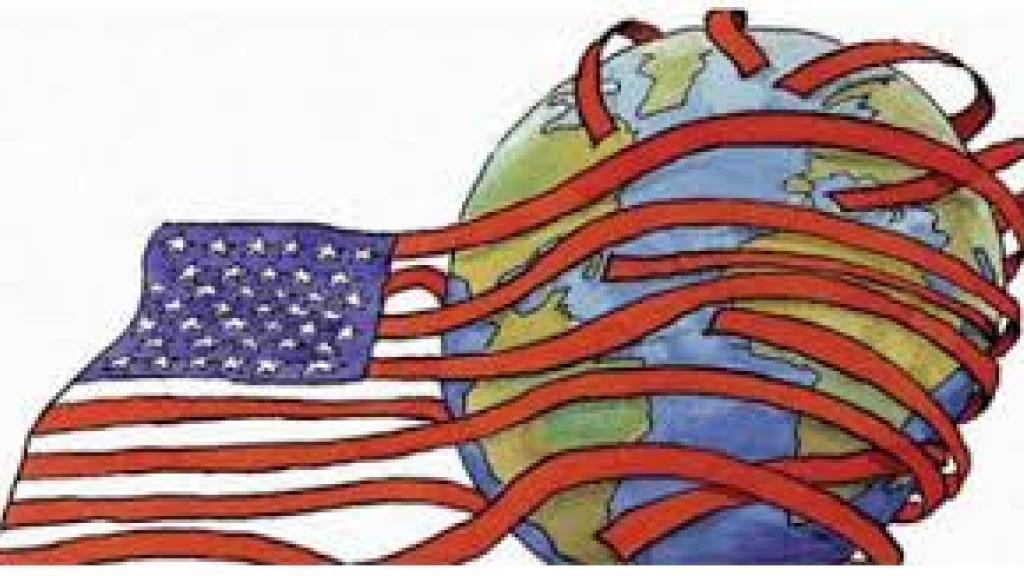
First published in Spanish at Luís Bonilla-Molina blog. Translation by LINKS International Journal of Socialist Renewal.
For the past few months I have argued that the Donald Trump administration wanted to gain political, economic and military control over Venezuela’s oil and mineral wealth, as well as to manipulate the population’s behaviour to collect data and establish a predictive control regime over the country. I maintained that the stationing of US military bases in Simón Bolívar’s homeland seemed a real possibility.
But I underestimated the situation, believing the US would do this by simply placing María Corina Machado (MCM) and Edmundo González Urrutia (EGU) at the head of the Venezuelan government: two figures historically allied with the White House and that have social support, but who are utterly incapable of governing a country as fractured as Venezuela. On January 3 — the day of the military attack on Venezuela and kidnapping of President Nicolas Maduro and Cilia Flores — Trump brought the Venezuelan right-wing opposition back down to earth by saying MCM was "not respected" in the country and would be excluded from the “transition”.
Trump declared that, from now on, Venezuela would be governed by him and his closest team: Secretary of State Marco Rubio, Secretary of War Pete Hegseth, Deputy Chief of Staff Stephen Miller, CIA Director John Ratcliffe, and Joint Chiefs of Staff General Dam Caine.
This represents a real, tangible and unprecedented colonial threat against Venezuela. What has transpired since confirms it.
The new Guipuzcoan company
Founded in 1728, the Royal Guipuzcoan Company of Caracas was a Spanish trading company that operated in Venezuela between 1730–85 for the purpose of colonial relations between the two countries. Its main activity was administrating exclusive trade between Spain and Venezuela by exporting products (cacao, tobacco, cotton, indigo and hides) while importing European goods (tools, textiles, wines, etc). It operated to halt contraband from the Netherlands, England and other countries, as well as to direct local economic development toward increasing profits for the Spanish Crown.
Trump wants to control Venezuela’s territory and trade in a manner reminiscent of this colonial-era company, but via a more modern instrument: the US embassy. Hence the rush to announce his intention to reestablish a US diplomatic mission in Caracas. The US embassy will play the role of this company, only now appropriating oil, gold, rare earth materials and other resources, alongside gathering on-the-ground data and information vital for further developing its predictive control model based on cutting-edge technologies.
White House press secretary Karoline Leavitt has said “we obviously have maximum leverage over the interim authorities in Venezuela right now.” Rubio declared “they have oil that is stuck in Venezuela; they can’t move it because of our quarantine and because it’s sanctioned” Trump complemented these statements, saying “Venezuela is going to be purchasing ONLY American Made Products”
Meanwhile rumours are circulating of threats against government officials such as Interior Minister Diosdado Cabello to ensure their obedience to the Rodríguez administration.
Three phases of colonisation
On the evening of January 5, Trump announced his late Christmas gift to Venezuela: the US was forcibly seizing 30–50 million barrels of Venezuelan oil. On January 7, Rubio followed this by announcing the three phases of Venezuela’s recolonisation.
The first phase involves seizing control of up to 50 million barrels of available oil production in the short term. This has been presented not so much as a forced purchase but rather as a publicly announced theft of Venezuelan wealth through the use of US military force, and the expectation of little local opposition.
The second phase involves assuming the role of colonial administrator, with the US selling Venezuelan oil on the world market, appropriating for itself the use and administration of the spoils of war. To soften the media impact of this blatant violation of capitalist trading practices, Rubio has said the US will use these resources to rebuild Venezuela and further US interests. They clearly want to recoup some of the costs incurred during the months-long naval blockade in the southern Caribbean and use Venezuela’s resources to repair oil infrastructure that will be used for colonial oil extraction by companies summoned by the Trump administration.
The third phase, initiating a government transition, it appears will depend on their evaluation of the Rodríguez government, as well as the process of building political relationships (with “good people”) that can ensure an ongoing colonial relationship.
Rubio knows he cannot turn a republic into a colony without facing local resistance. This foreshadows a period of US military/police/intelligence power playing a leading role, with the hope that local military/police forces will collaborate — something that remains to be seen.
Protectorate or nationalist government
The Venezuelan government that took office on January 3 will have to weather some internal storms if it is to demonstrate that it is capable of either holding back imperialism or assuming a collaborationist role. Both scenarios require consolidating its capacity to govern.
The possibility of forging a broad national unity against US colonialism hinges on overcoming the trauma of the kidnapping of the Maduro-Flores couple, which occurred with so little military resistance as to cast serious doubts about internal betrayal. The current Bolivarian administration faces the challenge of locating and disclosing the perpetrators of this treachery.
This is linked to the urgent task of boosting morale in the national armed forces, which suffered dozens of casualties — alongside the 32 Cuban combatants who were part of the president’s security detail — without inflicting any on the invading forces.
Furthermore, whether as part of his strategy or because it reflects objective reality — time will tell — Trump has repeatedly said that the interim Rodríguez government is cooperating with his administration and “doesn't want to repeat Maduro’s mistakes.” Rodríguez has timidly denied these claims, while indicating that any oil leaving Venezuela will do so under normal commercial terms of sale and payment.
This ambiguity, understandable given the ongoing impacts of the January 3 military action, must be overcome if it is to organise anti-colonial resistance or assume the role of a colonial governing body. I hope the path it chooses is the former.
Nationalist sentiment is sweeping the country, but it lacks a clear political leadership.
The Venezuelan left, in particular the Communist Party of Venezuela (PCV) and Comunes, have clearly expressed their opposition to Trump’s colonial plans, while also apportioning blame to the Maduro regime (of which Rodríguez was part of) for leading the country into this dire situation by implementing an anti-working-class program that dismantled even the most basic democratic freedoms of those who wish to organise autonomously. However, the radical left is not strong enough on its own to build a nationalist front capable of reverting the current defensive situation.
Effectively resisting US military aggression and colonialism requires building a broad national front with an unambivalent policy toward imperialism. The Rodríguez government has yet to show any willingness to fully embrace this role.
Revolutionary tasks
Up until January 2, the main task of revolutionaries had been to regain the minimum democratic freedoms that could allow the working class to express its opinions and organise against both the imperialist offensive and the Maduro government’s authoritarian drift.
After January 3 and the White House’s announcements of turning Venezuela into a US colony, the priority is defending national independence, within a framework of the broadest possible political freedoms for patriotic forces. Events will determine if the situation evolves toward a struggle for national liberation.
There is no doubt about the need to promote the broadest possible unity of action, one involving all political and social forces that today prioritise the question of national sovereignty and independence. We must focus on the common ground that unites us — that of defending the nation, its sovereignty and independence.
There’s more to oil: Why Venezuela demands a deeper analysis of US imperialism
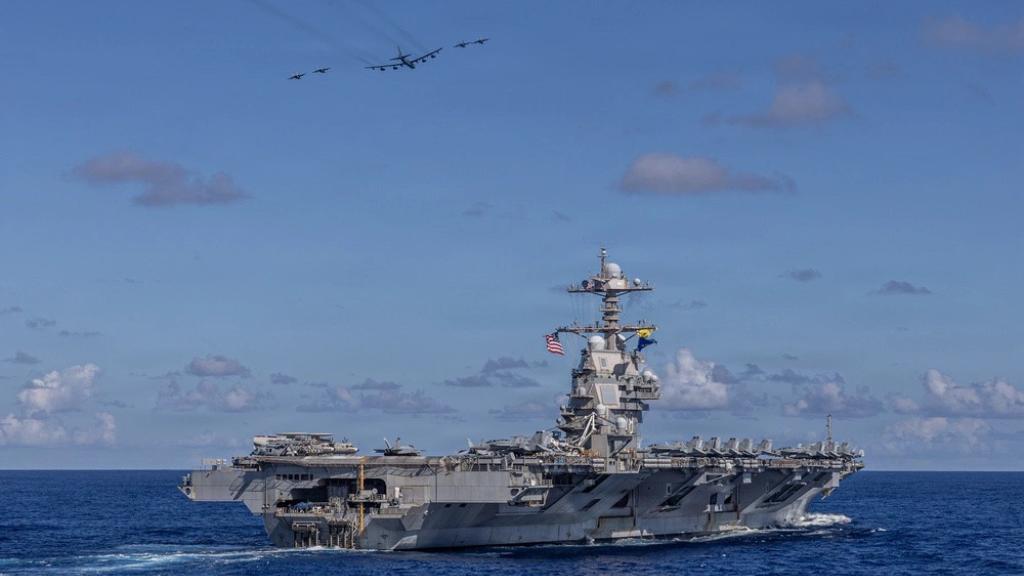
First published at TNI.
The slogan “No Blood for Oil” has echoed through anti-war demonstrations for decades, crystallising a powerful intuition about capitalist imperialism: that great powers wage war for resource control. Trump’s seizure of Nicolás Maduro invites the familiar framing. Yet the logic unfolding in Venezuela reveals something more complicated than straightforward resource extraction. Understanding it requires moving beyond the twentieth-century narrative of crude-seeking colonialism that still dominates left analysis of global politics and economics.
Marco Rubio stripped away the ambiguity. Speaking to NBC News, he declared: “We will not allow the oil industry in Venezuela to be controlled by opponents of the United States.” He named China, Russia, and Iran. The Western Hemisphere, he insisted, “belongs to us.” This is geopolitical containment language. Venezuela matters because it has become one of Beijing’s “all-weather strategic partners” in Latin America – a phrase Washington has come to regard as a regional challenge to its authority. China has extended roughly $106 billion in loans to Venezuela since 2000, placing it fourth among recipients of Chinese official credit globally. That financial binding and China’s growing influence in the region are what the US operation targets, not the oil itself.
The material reality of Venezuelan crude further complicates any straightforward extraction narrative. Three-quarters of the 300 billion barrel reserve consists of extra-heavy Orinoco crude: bituminous, viscous, heavily sulphurous, and prohibitively expensive to extract and refine. Global oil majors built the US Gulf Coast’s complex refineries specifically to process this grade, but at realistic long-term prices, the economics are punishing. When oil prices peaked during 2005-2014, Venezuela inflated its “proved reserves” on paper through optimistic assumptions that have since collapsed. Today, with institutional capacity eroded by underinvestment and purges, reconstruction would demand $185 billion over 16 years and complete confidence from international capital, unlikely under any managed transition.
The arbitration claims by ExxonMobil and ConocoPhillips, now presumably to be weaponised by Washington, add layers of legal and financial complexity. These cases rest on $45 billion in damages for contract restructuring around 2000, despite congressional conditions that unambiguously reserved Venezuela’s sovereign rights and rendered the corporate legal position indefensible. Trump’s invocation of “stolen American oil” resurrects private loss as state policy.
What matters is supply diversion and forcing Beijing to compete for alternative sources at disadvantageous terms. Currently, Venezuela exports roughly 600,000 barrels daily to China; US refineries consumed 2 million daily in the late 1990s. Even now, Venezuelan crude accounts for less than 4 per cent of China’s total oil consumption. Redirecting supply chains would force Beijing to source crude elsewhere at higher prices during an era when both superpowers compete for energy cheapness as the foundation of industrial competitiveness. This is Trump’s gambit: not extracting Venezuelan wealth but denying it to a strategic rival whilst simultaneously strengthening the US refineries concentrated in politically loyal states: an industry supporting 3 million jobs despite employing only 80,000 directly. The refinery sector has the highest employment multiplier of any US industry: each direct job supports forty-five others.
The old anti-imperialist critique captures something real but remains incomplete. Resource imperialism remains a persistent feature of global capitalism rather than a relic of the past, but Venezuela’s contemporary fate stems less from straightforward resource hunger than from geopolitical subordination within a fragmented multipolar system where control over resource flows matters as much as extraction itself. A hegemon no longer capable of competing through financial leverage reaches for direct military coercion instead. That this violence comes wrapped in claims about hemispheric property rights and restoring national assets shows how imperialism adapts rather than disappears. Understanding it demands analysis grasping the intersection of strategic competition, financial leverage, and institutional collapse, not simply equations of blood and barrels.
Washington sends a message: the Western Hemisphere remains its sphere, rivals will pay for any foothold, and authority matters more than economics. That the message requires bombing and kidnapping reveals its underlying fragility.
Daniel Chavez, a Uruguayan political economist, is an Ikerbasque Distinguished Professor at the University of the Basque Country (UPV-EHU). He is an associate of the Transnational Institute (TNI) in Amsterdam and Principal Investigator of the ERC Advanced Grant project S-OIL, which investigates the future of petroleum-dependent countries in the Global South.
Venezuela Is the Linchpin of a Radical Left
January 8, 2026
Palestine is the moral heart of global anti-colonial politics. It exposes the brutality of settler colonialism in its most naked form: land theft, ethnic cleansing, military occupation, and white supremacist domination. For many on the left, solidarity with Palestine has become a defining ethical commitment. But while Palestine functions as a moral litmus test for individuals and organizations across the political terrain from left to right, Venezuela is a structural and political one.
Recent events in Venezuela have dramatically escalated the stakes of anti-imperialist politics in a way that cannot be ignored. On January 3, 2026, the United States launched a large-scale military operation with the objective of kidnapping Venezuelan President Nicolás Maduro and his wife and transporting them back to the United States to face federal charges. This marks a decisive escalation in the forms of subversion and interventionist tactics that have characterized U.S. interventions in recent decades.
It also became a game-changer for radical politics inside the empire. The turn toward overt military force and the forcible removal of a sitting head of state signals a return to the raw practice of colonial domination — a form of power not seen so explicitly since the 2004 removal of Haitian President Jean-Bertrand Aristide by the George W. Bush administration.
The Empire has dropped the mask.
The question now is whether the left will continue to speak in the language of “liberal critique” and “class collaboration,” or whether it will finally confront bipartisan-supported imperial power in its most direct and unapologetic form.
Venezuela is the issue where anti-imperialism stops being a slogan and becomes a confrontation with one’s own state. It is therefore also the issue where U.S.-based radicals should unapologetically affirm Venezuela’s right to self-determination and openly oppose the U.S. imperial project in Venezuela. If they are not prepared to do this, it demonstrates unequivocally that their radicalism was never serious — that it was always symbolic and selective, which made it ultimately safe for the empire.
The Venezuela situation also reveals another now-normalized feature of “left” politics: the divergence between a left that is formally anti-imperialist and a liberal/left that remains fundamentally U.S.-centric and social imperialist. When this current turns to international events — especially cases of U.S. intervention — its position is shaped less by opposition to imperialism than by its assessment of the internal character of the targeted state. The legitimacy of intervention is thus implicitly judged according to whether the society under attack conforms to what amounts to Western “liberal” expectations and not the conditions and imperatives of revolutionary social transformation.
In practice, the actually existing efforts at socialist-oriented economic, social, and political development are almost always deemed inadequate, flawed, or authoritarian. This judgment then becomes the pretext for withholding solidarity. The predictable result is that these “left” forces find themselves aligned with U.S. imperialism in both analysis and effect, even as they insist that their position is informed by a “left” critique.
This is not a minor theoretical error but a political failure. It subordinates the principle of self-determination to ideological gatekeeping, and it replaces solidarity with conditional approval. In doing so, it converts anti-imperialism into a posture rather than a commitment — a language that can coexist comfortably with empire so long as empire speaks in the idiom of liberal democratic reformism and white saviorism!
Examples of this approach have emerged since the kidnapping of Maduro and his wife where sections of the collaborative left adopt the language and assumptions of U.S. policy makers about Venezuela — condemning Nicolás Maduro’s personality, legitimacy, or policies — but then attempt to separate those “left” condemnations from the brutal consequences of imperial intervention.
The first example is the familiar move: “I oppose U.S. intervention, but Maduro is an authoritarian who brought this on himself.” This framing accepts Washington’s narrative that Venezuela’s crisis is primarily the product of internal leadership failure rather than external economic warfare, sanctions, and destabilization. By centering Maduro’s alleged illegitimacy, this position reproduces the moral logic that makes intervention appear reasonable, even if the speaker claims to oppose the intervention itself. This position turns anti-imperialism into a procedural objection rather than a principled one — objecting to methods while accepting the white supremacist, colonialist premise that the U.S. has the authority to judge and discipline other societies.
The second example is the appeal to “human rights” as a neutral justification: “The U.S. shouldn’t intervene militarily, but something must be done about human rights abuses in Venezuela.” This treats human rights discourse as politically innocent, ignoring its long history as an imperial instrument used selectively against disobedient states and never against compliant ones. This framing erases the massive human rights violations produced by sanctions, economic strangulation, and political isolation — forms of violence that are invisible precisely because they are bureaucratic.
In both cases, the liberal/left position preserves U.S. moral authority while disavowing U.S. violence. This is not a contradiction but a function: it allows empire to operate with legitimacy. By accepting imperial categories and merely disputing their execution, the liberal/left becomes not an opponent of empire but one of its most useful managers.
The kidnapping of President Maduro is not simply another foreign-policy episode but a textbook case of imperial domination. In the present international context of imperial lawlessness — characterized by a form of global fascism led by the United States — it signals that these methods will be used again to attack and assert control over other sovereign nations.
Venezuela thus remains the linchpin for an authentic radical left precisely because it tests whether anti-imperialism is a principle or merely a fashionable posture. This moment demands that those committed to justice confront not only the moral obscenity of settler colonialism in Palestine but also the raw mechanisms of material power deployed abroad and domestically by their own state. Opposing empire only when it is directed at states that meet the Western left’s criteria for deserving solidarity will always fail, because such “perfect” states do not exist in reality. This logic explains how the U.S. “left” can normalize anti-anti-imperialism while continuing to present itself as radical.
“Actually existing,” concrete national projects of social transformation will always be imperfect. If the standard for solidarity is grounded in fantasies of Bernsteinian peaceful “democratic” transitions in a neocolonial context or even more idealist visions in core imperialist societies like the U.S., in which state power is seized on Friday and society becomes stateless and self-managed by local peoples’ assemblies by Monday, then no real struggle will ever qualify. These expectations function less as political standards than as mechanisms for disqualification.
The birth of new societies and their development within a disintegrating global capitalist order — and in the face of an international bourgeoisie committed to violent state terrorism and subversion to maintain Western white supremacist imperial power — constitute the objective conditions that shape the politics of those societies and should inform anti-imperialist politics in the metropoles.
Only by naming and opposing the full spectrum of imperial violence — from financial warfare to overt military conquest — can a radical left aspire to be consistent and consequential in the objective conditions we find ourselves in.
Venezuela’s struggle today lays bare the essential question: Do we oppose oppression only as distant abstractions, or do we confront empire at its most aggressive and normalized expressions?
Opposing empire in Venezuela is critical because the Venezuelan experiment at national survival with the lessons it has learned was beginning to expose the fact that even with “maximum pressure,” the possibility of an alternative political and economic trajectory outside neoliberal capitalism and U.S. hemispheric dominance was possible.
Venezuela’s ability to sell its oil, even at a diminished level after years of sanctions that resulted in its inability to reinvest in critical infrastructure, represented a critical win for its people and for all states that possessed critical resources. Its successful attempts to trade oil outside the dollar system — including in Chinese currency or digital alternatives — are significant not mainly because they threaten U.S. energy security, but because they undermine U.S. financial and geopolitical control. The real concern is the precedent: that a major resource-holding state can defy U.S. authority, weaken dollar-based systems, and still survive. The issue is thus about maintaining hegemony, not just securing fuel.
Palestine reveals the moral horror of settler-colonial domination, while Venezuela reveals the operational logic of contemporary empire abroad and in its’ domestic politics. If radical politics cannot confront that logic at its source — in the policies of the U.S. state itself — then it risks becoming a politics of outrage without consequence. Venezuela is the linchpin not because it is more important than Palestine, but because it tests whether the left is willing to oppose empire where it is most normalized, most respectable, and for some, most difficult to name.
For many U.S. radicals, this will be very difficult because the price might be too high. Unequivocal support for Venezuelan self-determination means defending a state targeted by your own ruling class, being accused of supporting “authoritarianism,” a charge that functions as an ideological weapon to discipline dissent that will result in losing access to mainstream legitimacy.
This is precisely why Venezuela is the site where left politics becomes dangerous, subversive and its practitioners materially punished — which is exactly why it is the real test of radicalism.
The charge of repression coming from a state in the grip of neofascist consolidation and a liberal/left represented by “progressives” such as Bernie Sanders and Zohran Mamdani – who will not only condemn the Bolivarian process but the revolutionary people and process of Cuba – illustrates perfectly the rightist convergence of the fascist state and the social democratic managerial “left.”
Venezuela’s Bolivarian project cannot be explained by the simplistic focus on supposed internal dysfunction and authoritarianism but by its geopolitical disobedience — the refusal to submit to the U.S. assertion of the Monroe Doctrine and the global neoliberal order. For the imperialist white supremacist policymakers, that refusal had to be punished through economic suffocation and political destabilization.
Yet, Venezuela’s ability to survive, to demonstrate that it could exist outside of the structures dominated by international capitalist financial institutions, ironically posed an existential threat to U.S. hegemony not only because it was uniquely dangerous, but because it could be contagious.
Nicolás Maduro Refused to be a Slave to Empire
January 9, 2026
Youtube screenshot.
The New York Times reported that Trump officials felt mocked by Venezuela’s president. What provoked them was not a speech or a policy, but Nicolás Maduro’s nonchalance—his dancing in the face of escalating U.S. threats.
As the Trump administration bombed fishing vessels in the Caribbean, killing at least 115 people at the time of this writing under the banner of a war on “narco-terrorists,” Maduro danced.
As Trump dispatched eleven warships, squadrons of fighter jets, and fifteen thousand troops to menace and blockade Venezuela, Maduro danced.
As Pete Hegseth railed against “fat generals,” bemoaned the decline of white American masculinity, and called for a revival of a macho “warrior ethos” in the U.S. military, Maduro danced.
As living standards fell and life expectancy declined in the United States, Maduro danced.
As Trump blamed immigrants for the decay of an empire hollowed out by addiction, alienation, and extreme inequality, Maduro danced.
And as Trump openly demanded Venezuela’s oil and resources—letting the mask slip that this was never about drugs—Maduro danced, chanting in English, “No crazy war,” as if addressing Trump directly.
The mockery could not be tolerated. So the United States followed through on its threats. Last Saturday, Trump sent special forces to kidnap Maduro and his wife, First Lady and “First Combatant” Cilia Flores, from the Miraflores Palace in Caracas, bombing and killing all who stood in their way.
It was never really about dance moves. Maduro’s real crime was refusing submission, refusing to be a slave to a white supremacist empire. And despite what the United States does or does not do, the tune continues to play. Venezuela dances the same moves as its now abducted president now with a cautious eye toward an unwanted voyeur.
Even in chains and behind bars, Maduro’s dance moves still bother Trump.
“I am the president of Venezuela, I consider myself a prisoner of war. I was captured at my home in Caracas,” Maduro told a judge in a New York courtroom, facing drug conspiracy charges that even his accusers appear to be now backing away from.
(There was no Cartel of the Sun, they admit.)
The 92-year-old white judge interrupted Maduro, perhaps afraid he and his wife might start dancing, violating the sanctity of the court and country that had stolen them away.
This piece first appeared on Red Scare.
First published at TNI.
The slogan “No Blood for Oil” has echoed through anti-war demonstrations for decades, crystallising a powerful intuition about capitalist imperialism: that great powers wage war for resource control. Trump’s seizure of Nicolás Maduro invites the familiar framing. Yet the logic unfolding in Venezuela reveals something more complicated than straightforward resource extraction. Understanding it requires moving beyond the twentieth-century narrative of crude-seeking colonialism that still dominates left analysis of global politics and economics.
Marco Rubio stripped away the ambiguity. Speaking to NBC News, he declared: “We will not allow the oil industry in Venezuela to be controlled by opponents of the United States.” He named China, Russia, and Iran. The Western Hemisphere, he insisted, “belongs to us.” This is geopolitical containment language. Venezuela matters because it has become one of Beijing’s “all-weather strategic partners” in Latin America – a phrase Washington has come to regard as a regional challenge to its authority. China has extended roughly $106 billion in loans to Venezuela since 2000, placing it fourth among recipients of Chinese official credit globally. That financial binding and China’s growing influence in the region are what the US operation targets, not the oil itself.
The material reality of Venezuelan crude further complicates any straightforward extraction narrative. Three-quarters of the 300 billion barrel reserve consists of extra-heavy Orinoco crude: bituminous, viscous, heavily sulphurous, and prohibitively expensive to extract and refine. Global oil majors built the US Gulf Coast’s complex refineries specifically to process this grade, but at realistic long-term prices, the economics are punishing. When oil prices peaked during 2005-2014, Venezuela inflated its “proved reserves” on paper through optimistic assumptions that have since collapsed. Today, with institutional capacity eroded by underinvestment and purges, reconstruction would demand $185 billion over 16 years and complete confidence from international capital, unlikely under any managed transition.
The arbitration claims by ExxonMobil and ConocoPhillips, now presumably to be weaponised by Washington, add layers of legal and financial complexity. These cases rest on $45 billion in damages for contract restructuring around 2000, despite congressional conditions that unambiguously reserved Venezuela’s sovereign rights and rendered the corporate legal position indefensible. Trump’s invocation of “stolen American oil” resurrects private loss as state policy.
What matters is supply diversion and forcing Beijing to compete for alternative sources at disadvantageous terms. Currently, Venezuela exports roughly 600,000 barrels daily to China; US refineries consumed 2 million daily in the late 1990s. Even now, Venezuelan crude accounts for less than 4 per cent of China’s total oil consumption. Redirecting supply chains would force Beijing to source crude elsewhere at higher prices during an era when both superpowers compete for energy cheapness as the foundation of industrial competitiveness. This is Trump’s gambit: not extracting Venezuelan wealth but denying it to a strategic rival whilst simultaneously strengthening the US refineries concentrated in politically loyal states: an industry supporting 3 million jobs despite employing only 80,000 directly. The refinery sector has the highest employment multiplier of any US industry: each direct job supports forty-five others.
The old anti-imperialist critique captures something real but remains incomplete. Resource imperialism remains a persistent feature of global capitalism rather than a relic of the past, but Venezuela’s contemporary fate stems less from straightforward resource hunger than from geopolitical subordination within a fragmented multipolar system where control over resource flows matters as much as extraction itself. A hegemon no longer capable of competing through financial leverage reaches for direct military coercion instead. That this violence comes wrapped in claims about hemispheric property rights and restoring national assets shows how imperialism adapts rather than disappears. Understanding it demands analysis grasping the intersection of strategic competition, financial leverage, and institutional collapse, not simply equations of blood and barrels.
Washington sends a message: the Western Hemisphere remains its sphere, rivals will pay for any foothold, and authority matters more than economics. That the message requires bombing and kidnapping reveals its underlying fragility.
Daniel Chavez, a Uruguayan political economist, is an Ikerbasque Distinguished Professor at the University of the Basque Country (UPV-EHU). He is an associate of the Transnational Institute (TNI) in Amsterdam and Principal Investigator of the ERC Advanced Grant project S-OIL, which investigates the future of petroleum-dependent countries in the Global South.
Venezuela Is the Linchpin of a Radical Left
Palestine is the moral heart of global anti-colonial politics. It exposes the brutality of settler colonialism in its most naked form: land theft, ethnic cleansing, military occupation, and white supremacist domination. For many on the left, solidarity with Palestine has become a defining ethical commitment. But while Palestine functions as a moral litmus test for individuals and organizations across the political terrain from left to right, Venezuela is a structural and political one.
Recent events in Venezuela have dramatically escalated the stakes of anti-imperialist politics in a way that cannot be ignored. On January 3, 2026, the United States launched a large-scale military operation with the objective of kidnapping Venezuelan President Nicolás Maduro and his wife and transporting them back to the United States to face federal charges. This marks a decisive escalation in the forms of subversion and interventionist tactics that have characterized U.S. interventions in recent decades.
It also became a game-changer for radical politics inside the empire. The turn toward overt military force and the forcible removal of a sitting head of state signals a return to the raw practice of colonial domination — a form of power not seen so explicitly since the 2004 removal of Haitian President Jean-Bertrand Aristide by the George W. Bush administration.
The Empire has dropped the mask.
The question now is whether the left will continue to speak in the language of “liberal critique” and “class collaboration,” or whether it will finally confront bipartisan-supported imperial power in its most direct and unapologetic form.
Venezuela is the issue where anti-imperialism stops being a slogan and becomes a confrontation with one’s own state. It is therefore also the issue where U.S.-based radicals should unapologetically affirm Venezuela’s right to self-determination and openly oppose the U.S. imperial project in Venezuela. If they are not prepared to do this, it demonstrates unequivocally that their radicalism was never serious — that it was always symbolic and selective, which made it ultimately safe for the empire.
The Venezuela situation also reveals another now-normalized feature of “left” politics: the divergence between a left that is formally anti-imperialist and a liberal/left that remains fundamentally U.S.-centric and social imperialist. When this current turns to international events — especially cases of U.S. intervention — its position is shaped less by opposition to imperialism than by its assessment of the internal character of the targeted state. The legitimacy of intervention is thus implicitly judged according to whether the society under attack conforms to what amounts to Western “liberal” expectations and not the conditions and imperatives of revolutionary social transformation.
In practice, the actually existing efforts at socialist-oriented economic, social, and political development are almost always deemed inadequate, flawed, or authoritarian. This judgment then becomes the pretext for withholding solidarity. The predictable result is that these “left” forces find themselves aligned with U.S. imperialism in both analysis and effect, even as they insist that their position is informed by a “left” critique.
This is not a minor theoretical error but a political failure. It subordinates the principle of self-determination to ideological gatekeeping, and it replaces solidarity with conditional approval. In doing so, it converts anti-imperialism into a posture rather than a commitment — a language that can coexist comfortably with empire so long as empire speaks in the idiom of liberal democratic reformism and white saviorism!
Examples of this approach have emerged since the kidnapping of Maduro and his wife where sections of the collaborative left adopt the language and assumptions of U.S. policy makers about Venezuela — condemning Nicolás Maduro’s personality, legitimacy, or policies — but then attempt to separate those “left” condemnations from the brutal consequences of imperial intervention.
The first example is the familiar move: “I oppose U.S. intervention, but Maduro is an authoritarian who brought this on himself.” This framing accepts Washington’s narrative that Venezuela’s crisis is primarily the product of internal leadership failure rather than external economic warfare, sanctions, and destabilization. By centering Maduro’s alleged illegitimacy, this position reproduces the moral logic that makes intervention appear reasonable, even if the speaker claims to oppose the intervention itself. This position turns anti-imperialism into a procedural objection rather than a principled one — objecting to methods while accepting the white supremacist, colonialist premise that the U.S. has the authority to judge and discipline other societies.
The second example is the appeal to “human rights” as a neutral justification: “The U.S. shouldn’t intervene militarily, but something must be done about human rights abuses in Venezuela.” This treats human rights discourse as politically innocent, ignoring its long history as an imperial instrument used selectively against disobedient states and never against compliant ones. This framing erases the massive human rights violations produced by sanctions, economic strangulation, and political isolation — forms of violence that are invisible precisely because they are bureaucratic.
In both cases, the liberal/left position preserves U.S. moral authority while disavowing U.S. violence. This is not a contradiction but a function: it allows empire to operate with legitimacy. By accepting imperial categories and merely disputing their execution, the liberal/left becomes not an opponent of empire but one of its most useful managers.
The kidnapping of President Maduro is not simply another foreign-policy episode but a textbook case of imperial domination. In the present international context of imperial lawlessness — characterized by a form of global fascism led by the United States — it signals that these methods will be used again to attack and assert control over other sovereign nations.
Venezuela thus remains the linchpin for an authentic radical left precisely because it tests whether anti-imperialism is a principle or merely a fashionable posture. This moment demands that those committed to justice confront not only the moral obscenity of settler colonialism in Palestine but also the raw mechanisms of material power deployed abroad and domestically by their own state. Opposing empire only when it is directed at states that meet the Western left’s criteria for deserving solidarity will always fail, because such “perfect” states do not exist in reality. This logic explains how the U.S. “left” can normalize anti-anti-imperialism while continuing to present itself as radical.
“Actually existing,” concrete national projects of social transformation will always be imperfect. If the standard for solidarity is grounded in fantasies of Bernsteinian peaceful “democratic” transitions in a neocolonial context or even more idealist visions in core imperialist societies like the U.S., in which state power is seized on Friday and society becomes stateless and self-managed by local peoples’ assemblies by Monday, then no real struggle will ever qualify. These expectations function less as political standards than as mechanisms for disqualification.
The birth of new societies and their development within a disintegrating global capitalist order — and in the face of an international bourgeoisie committed to violent state terrorism and subversion to maintain Western white supremacist imperial power — constitute the objective conditions that shape the politics of those societies and should inform anti-imperialist politics in the metropoles.
Only by naming and opposing the full spectrum of imperial violence — from financial warfare to overt military conquest — can a radical left aspire to be consistent and consequential in the objective conditions we find ourselves in.
Venezuela’s struggle today lays bare the essential question: Do we oppose oppression only as distant abstractions, or do we confront empire at its most aggressive and normalized expressions?
Opposing empire in Venezuela is critical because the Venezuelan experiment at national survival with the lessons it has learned was beginning to expose the fact that even with “maximum pressure,” the possibility of an alternative political and economic trajectory outside neoliberal capitalism and U.S. hemispheric dominance was possible.
Venezuela’s ability to sell its oil, even at a diminished level after years of sanctions that resulted in its inability to reinvest in critical infrastructure, represented a critical win for its people and for all states that possessed critical resources. Its successful attempts to trade oil outside the dollar system — including in Chinese currency or digital alternatives — are significant not mainly because they threaten U.S. energy security, but because they undermine U.S. financial and geopolitical control. The real concern is the precedent: that a major resource-holding state can defy U.S. authority, weaken dollar-based systems, and still survive. The issue is thus about maintaining hegemony, not just securing fuel.
Palestine reveals the moral horror of settler-colonial domination, while Venezuela reveals the operational logic of contemporary empire abroad and in its’ domestic politics. If radical politics cannot confront that logic at its source — in the policies of the U.S. state itself — then it risks becoming a politics of outrage without consequence. Venezuela is the linchpin not because it is more important than Palestine, but because it tests whether the left is willing to oppose empire where it is most normalized, most respectable, and for some, most difficult to name.
For many U.S. radicals, this will be very difficult because the price might be too high. Unequivocal support for Venezuelan self-determination means defending a state targeted by your own ruling class, being accused of supporting “authoritarianism,” a charge that functions as an ideological weapon to discipline dissent that will result in losing access to mainstream legitimacy.
This is precisely why Venezuela is the site where left politics becomes dangerous, subversive and its practitioners materially punished — which is exactly why it is the real test of radicalism.
The charge of repression coming from a state in the grip of neofascist consolidation and a liberal/left represented by “progressives” such as Bernie Sanders and Zohran Mamdani – who will not only condemn the Bolivarian process but the revolutionary people and process of Cuba – illustrates perfectly the rightist convergence of the fascist state and the social democratic managerial “left.”
Venezuela’s Bolivarian project cannot be explained by the simplistic focus on supposed internal dysfunction and authoritarianism but by its geopolitical disobedience — the refusal to submit to the U.S. assertion of the Monroe Doctrine and the global neoliberal order. For the imperialist white supremacist policymakers, that refusal had to be punished through economic suffocation and political destabilization.
Yet, Venezuela’s ability to survive, to demonstrate that it could exist outside of the structures dominated by international capitalist financial institutions, ironically posed an existential threat to U.S. hegemony not only because it was uniquely dangerous, but because it could be contagious.
Nicolás Maduro Refused to be a Slave to Empire
January 9, 2026
Youtube screenshot.
The New York Times reported that Trump officials felt mocked by Venezuela’s president. What provoked them was not a speech or a policy, but Nicolás Maduro’s nonchalance—his dancing in the face of escalating U.S. threats.
As the Trump administration bombed fishing vessels in the Caribbean, killing at least 115 people at the time of this writing under the banner of a war on “narco-terrorists,” Maduro danced.
As Trump dispatched eleven warships, squadrons of fighter jets, and fifteen thousand troops to menace and blockade Venezuela, Maduro danced.
As Pete Hegseth railed against “fat generals,” bemoaned the decline of white American masculinity, and called for a revival of a macho “warrior ethos” in the U.S. military, Maduro danced.
As living standards fell and life expectancy declined in the United States, Maduro danced.
As Trump blamed immigrants for the decay of an empire hollowed out by addiction, alienation, and extreme inequality, Maduro danced.
And as Trump openly demanded Venezuela’s oil and resources—letting the mask slip that this was never about drugs—Maduro danced, chanting in English, “No crazy war,” as if addressing Trump directly.
The mockery could not be tolerated. So the United States followed through on its threats. Last Saturday, Trump sent special forces to kidnap Maduro and his wife, First Lady and “First Combatant” Cilia Flores, from the Miraflores Palace in Caracas, bombing and killing all who stood in their way.
It was never really about dance moves. Maduro’s real crime was refusing submission, refusing to be a slave to a white supremacist empire. And despite what the United States does or does not do, the tune continues to play. Venezuela dances the same moves as its now abducted president now with a cautious eye toward an unwanted voyeur.
Even in chains and behind bars, Maduro’s dance moves still bother Trump.
“I am the president of Venezuela, I consider myself a prisoner of war. I was captured at my home in Caracas,” Maduro told a judge in a New York courtroom, facing drug conspiracy charges that even his accusers appear to be now backing away from.
(There was no Cartel of the Sun, they admit.)
The 92-year-old white judge interrupted Maduro, perhaps afraid he and his wife might start dancing, violating the sanctity of the court and country that had stolen them away.
This piece first appeared on Red Scare.
From Venezuelan Communes to U.S. Blocks: Same Struggle, Same Fight.
January 9, 2026
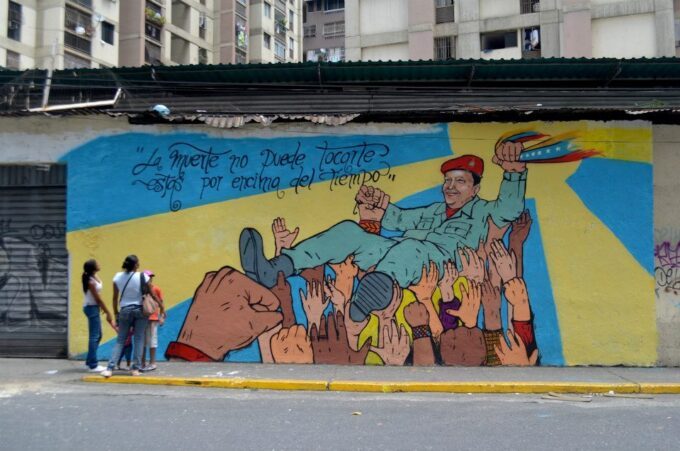
Photograph Source: NeftaliYagua – CC BY-SA 3.0
It’s a different country, but the same question: who does a government serve?
By now it seems clear that with the kidnapping of Nicolás Maduro and his wife, the Trump crime organization didn’t topple a regime in Venezuela so much as acquire one, in a deadly takeover that swapped the CEO but seems willing to keep the board in the form of Maduro’s former VP, Delcy Rodríguez and her loyalists, as long as they’ll manage the populace while the new owners raid the store.
It’s too soon to tell much about how the Trump takeover will work out, but while the money media focus entirely on the boardroom, the story with the most lessons for the rest of us lies outside of it, with Venezuela’s experiment attempting to shift who actually wields power in the state.
Chávez’s Bottom-Up Bet
In a slip, at his press conference Saturday announcing the snatch-and-grab invasion, Donald Trump said Venezuela was “a great country twenty years ago.” He didn’t mean it, but plenty might.
Twenty years ago, a popular military officer called Hugo Chávez was president. Chavez sought to redistribute power downwards by pouring state funds into bottom up architecture: “Bolivarian Circles”, communal councils, and communes were funded to manage local resources, build popular confidence and essentially, run neighborhoods. Neighbors could directly decide on projects, manage funds, and even run services like trash collection, food distribution, or security. Chavez spent hours every week on state radio talking with citizens and invested in public media to bring news from the provinces to the cities, and from around the world to Venezuelans. In the capital, the Chavez administration built Caracas’s stunning Metro systemwhich flew residents from isolated hilltop barrios down into the capital below in graceful, gap-bridging, cable cars, affordably, and fast.
Even years after his death in 2013, Chavez’s populist fire lingered. On my one and only brief trip to Caracas in 2015, I gazed at that impressive Metro and met students and artists who had been squatting in a gleaming office building without government interference for years. High above a bustling downtown street, the residents showed us proudly, how they’d turned a foreign capitalists’ suite into a collective home for former shanty town dwellers. They sent earnest messages of solidarity and encouragement to the revolutionaries of Occupy Wall Street.
Smothered
But the abandoned office was also a sign of capital flight. The US’s relentless embargo and internal destabilization campaign put Chavez under political and economic siege, and depending entirely on oil to fuel the state’s operations gradually smothered more distributed approaches not only to energy – but to governance. The communes’ budgets—and often their legal authority—were tied to central-state funding, party structures, and oil revenues far beyond neighborhood say-so. When Venezuela’s economy crashed under pressure from the Obama administration and destabilization stepped up during Trump’s first term*, the same communal structures that were supposed to empower the masses became militarized mechanisms of patronage and control.
By this fall, as Edgardo Lander, a retired professor at the Central University of Venezuela and leading thinker of the independent left, told Tempest Magazine,
“What we have is a government that long ago abandoned any political project. The whole discourse of deepening democracy, of socialism—those have simply disappeared from the horizon. The government’s practically sole objective now is its own survival in power.”
Echoes and Warnings
As anti-imperialist Americans condemn Trump’s illegal assault and defend, absolutely, Venezuela’s independence, it’s worth spending at least a moment to consider the fate of the Bolivarians. Theirs is a story the US media will never tell but we should, not to fight sectarian wars — for and against — but for the lessons we just might learn from it.
In the US, we too, are facing rogue rule, fueled by concentrated wealth, thug power, and the corrosion of local democracy. Opposition parties still stand, but the resistance to fascist consolidation is being led by the grassroots. Local mutual aid networks, neighborhood defense collectives, public defenders, workers unions, and community-based coalitions are at the forefront, not politicians.
Venezuela’s lesson, about the danger of funding traps, seems worth paying attention to. Especially, as we head into an election year with urgent enticements to co-optation. You can almost hear the Bolivarians cry: build self-reliance now, while your institutions creak but stand. Chávez’s attempt to build popular power from above didn’t fail absolutely. Huge early gains came in the form of literacy, clinics, poverty reduction and electrification. But alongside Washington’s criminal embargo and efforts to destabilize the regime, oil’s extractive curse led inevitably to conflict and repression.
Think Globally, Act Locally
In the U.S., democracy is being defended from below. The question for change-seekers here is, can it be rebuilt from below, too — sans oil overlords, or dependence on party patrons — with real resilience, and self-reliance?
Finally, and crucially, can our home front resistance movements rekindle some sense and practice of internationalism? If we’re ever going to reverse the takeovers, we’re going to need viable alternatives – and those, as we learned again this week, cannot survive long within the borders of a single nation.
Laura Flanders interviews forward-thinking people about the key questions of our time on Laura Flanders & Friends, a nationally-syndicated radio and television program also available as a podcast. A contributing writer to The Nation, Flanders is the author of several books, as well as a column on Substack.
Hugo Chávez Predicted This
Nuvpreet Kalra
January 9, 2026
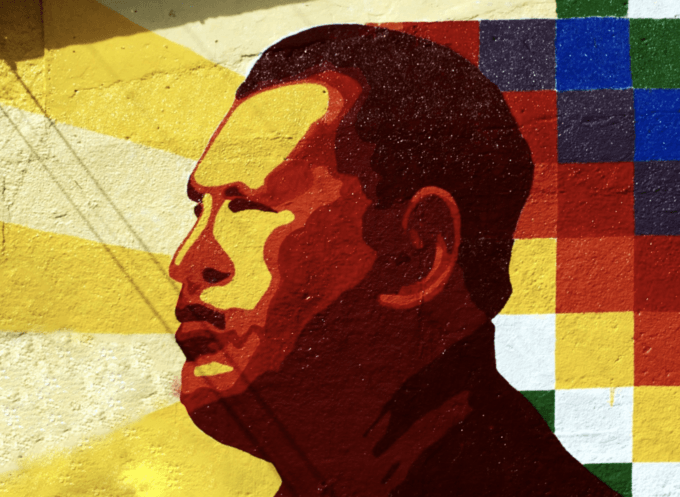
A mural of Hugo Chávez in Mérida city. Image Wikipedia.
On January 3rd, the United States invaded and bombed Venezuela and abducted President Maduro and First Lady Flores. This violent act of imperialist aggression by the Trump regime is a continuation of over two decades of hybrid warfare aimed at suppressing the Bolivarian Revolution. Over the past months, the US has been escalating aggression against Venezuela, but this abduction is the culmination of over two decades of imperialist war. In fact, it was predicted 20 years ago this year by Hugo Chávez, the first president of the Bolivarian Republic of Venezuela, at an address to the UN General Assembly.
In 2006, in what became one of his most iconic speeches, Hugo Chávez said:
“The government of the United States doesn’t want peace. It wants to exploit its system of exploitation, of pillage, of hegemony through war. It wants peace. But what’s happening in Iraq? What happened in Lebanon? In Palestine? What’s happening? What’s happened over the last 100 years in Latin America and in the world? And now threatening Venezuela — new threats against Venezuela, against Iran?”
Chávez could have made this exact speech today, last year, or really any time in the past two decades. His words are so apt for today because US foreign policy has not changed. It is the same violent maintenance and exertion of its hegemony and deadly system of exploitation and hegemony, no matter if orchestrated in blue or red. This is what we have been seeing with Israel’s genocide in Gaza, attacks on Lebanon and Yemen, regime change in Syria, threats and attacks on Iran, suffocation of Cuba, provocations and war preparation against China, proxy war in Ukraine, and continued regime change attempts against Venezuela. Chávez’s words will remain timeless as long as US imperialism remains intact and the smell of sulfur remains.
Since 1998, with the election of the revolutionary leader Hugo Chávez and the Bolivarian Revolution, the United States has been hellbent on overthrowing the government of Venezuela. Before Chávez, American companies ran wild in Venezuela, extracting and exploiting natural resources and labor. In the 1980s, Venezuela adopted US-backed neoliberal reforms, which emphasized an open oil market, deregulation, and privatization, which accumulated huge profits for US companies at the expense of the Venezuelan people. This is the Venezuela that the United States wants; in fact, this is the US’s modus operandi across Latin America.
Today, the media class is doubling down on its line of Venezuela’s fall from grace as the richest country in Latin America. This regime change propaganda has been plastered across media platforms, like CBS’s 60 Minutes, to manufacture consent for US regime change operations, impending invasion, and for continued US war crimes against small boats in the Caribbean.
Coincidentally erased from these media narratives are the impacts of suffocation with US-led sanctions, which have slashed Venezuela’s oil revenues by 213% between January 2017 and December 2024. This amounts to $77 million in losses every single day. These unilateral coercive measures are a form of warfare aimed at impoverishing the Venezuelan people, blaming the Bolivarian Revolution for hardships, and triggering regime change from utter suffering.
It is shameful, though unsurprising given these are the same media outlets justifying US-Israeli genocide, to peddle this lie, which purposefully erases the true history of neoliberal Venezuela. In this era, romanticized by these imperialist mouthpieces as a haven to which they want Venezuela to return, just 20% of the Venezuelan population was benefiting from oil wealth, while the other 80% suffered from poverty. Also erased from these narratives are the horrors of IMF austerity, which overnight locked out millions of people from basic necessities and essential services, leading to Caracazo, an uprising of hundreds of thousands of Venezuelans opposing these neoliberal reforms. It is convenient for 60 Minutes and others to erase the deaths of over 3,000 people from the military crush of these protests, just as it is to remove all traces of the neoliberal crisis that the US enforced on the country. But despite attempts, they cannot redact how the horrific neoliberalism of the 1980s and 1990s brought about the popular uprising led by Commandante Hugo Chávez, which eventually led to his successful election as president in 1998.
While Chávez’s victory did not immediately alert Washington, and the Clinton administration adopted a “wait and see” policy, in the years following, alarms certainly began to ring. Chávez’s openly anti-imperialist politik, including selling oil to Cuba and supporting anti-imperialist resistance and governments, and the imposition of Venezuela’s sovereignty, quickly made US politicians, oil tycoons, and those with stakes in the US empire tremble.
Sabotage Made in the White House (2001-4)
With the arrival of Bush in the White House in 2001, US policy towards Venezuela became more overtly aggressive, with Chávez as the target fresh from re-election victory. This shift was deepened in response to Chávez’s opposition to Bush’s so-called “war on terror” and refusal to join the “coalition of the willing, as well as Venezuela’s escalating assertion of its oil sovereignty. As the US escalated attacks across Afghanistan and Iraq, Chávez criticized and called out the terror and violence the US imposed across the world and domestically. Chávez’s bold opposition to US terror was a substantial threat to the imperialist coalition that sought to impose its violent will on the peoples of West Asia. In response, the US accelerated its hybrid warfare from a campaign of pressure and isolation to regime change.
This came to a head in 2002, when the US backed and coordinated right-wing elites to kidnap Chávez in an attempted coup where they tried to dissolve the constitution of the Bolivarian Republic. In quick succession, the US recognized the short-lived 47-hour coup , which embarrassingly failed as popular forces rallied in tandem with the military to brush off the coup. Rather than demoralize the Venezuelan people, this coup galvanized the socialist project with oil revenues now reinvested in education, healthcare, and housing rather than the pockets of US tycoons. The government built 3,000 new schools and, by 2005, eradicated illiteracy with the support of Cuba; set up 6,000 community health clinics as 15,000 Cuban doctors provided healthcare for millions of Venezuelans; and by 2009, infant mortality was cut by 40%, and the free healthcare system was caring for millions of Venezuelans.
In the face of overwhelming support for the revolution, the US changed course and used economic and technological warfare to try to strangle the revenue the government was relying on to fund its sweeping reforms. 8 months after the failed coup, the US-backed opposition groups sabotaged the nationalized oil company, PDVSA, through INTESA (majority owned by US weapons company SAIC) , a company working in PDVSA. At the same time, US-funded opposition groups provoked a “strike” at PDVSA. The strike and lockout cost the country $20 billion, which could have been used to fund the healthcare system, to build a million homes, or continue to better the lives of Venezuelan people. In 2004, US-trained thugs violently attacked and killed people in Caracas in another attempt to oust Chávez. This was quickly followed by a NED- and USAID-funded campaign, led by US puppet Maria Corina Machado, for a referendum to recall President Chávez. This was yet another attempt to impose regime change that was crushed repeatedly by the streets.
Despite relentless attempts to overthrow Chávez, the revolutionary government pushed ahead with anti-imperialist worldbuilding in forming the Bolivarian Alliance for the Peoples of Our America, or ALBA, as an anti-hegemonic alternative to the US ‘Free Trade Area of the Americas’ (FTAA) which prioritized social programme and solidarity over neoliberal, extractive “trade”; leadership of OPEC to facilitate development and constitute the progressive bloc across Latin America; and challenged US imperialist violence, with powerful statements like:
‘From Latin America, from Venezuela, we send out our heart to our brothers the Iraqi people, and the Arab peoples … who are fighting the battle against the imperialist aggressor” (Hugo Chávez, April 2004)
Second Offensive (2005-08)
As Venezuela continued using oil incomes to develop Venezuela in the interests of the people, the US imperialist aggression continued in full force. This pushed the United States into formulating a multi-pronged approach aimed at overthrowing the Bolivarian revolution. In 2005, the Bush administration imposed formal sanctions on Venezuela and funnelled millions of dollars into opposition figures to cause chaos and suffering. This approach has been tried and tested by the US empire across the world, most notably in Cuba, where a decades-long total blockade has sought to produce immense suffering amongst the Cuban people, that they support the overthrow of their own government via US-backed figures.
Between 2005 and 2012, the US used the National Endowment for Democracy to funnel $30 million into opposition parties, non-governmental organizations, and other opposition groups in Venezuela. This spiked ahead of the December 2006 presidential election with the aim of propelling figures to undermine the democratic process and provide domestic calls for US invasion. One of the key figures to emerge from this money was Maria Corina Machado, the 2025 winner of the Nobel “Peace” Prize and vocal supporter of the US imperialist invasion of Venezuela. After the Trump regime killed over 110 Venezuelans and abducted their President, totally undermining the sovereignty of a country, Machado stated the US had fulfilled its promise to enforce the law. Such figures, despite being snubbed by their puppet master, Trump, are paraded to give the sense that imperialist invasion has a domestic face.
In 2005, the US officially labelled Venezuela a “non-cooperative” country and banned the sale of all weapons, parts, and software, including maintenance of F-16 fighter jets and any regional defense cooperation. Under the guise of “terror, the Bush administration effectively imposed an embargo on the country as an attempt to suppress its international solidarity, bold policy, and socialist construction. Over the following years, the Bush administration continued imperialist attacks, including propaganda of “authoritarianism” and human rights abuses, lawfare imperialism via companies like Exxon, as well as escalating targeted sanctions, including on the financial sector, the first OFAC designations for senior Venezuelan officials, as well as other individuals and businesses at whim.
All the while, Venezuela was providing free heating oil to Americans across 25 states. The CITGO-Venezuela Heating Oil Program began in 2005 and provided over 2 million Americans with free and discounted heating services, including for homeless shelters and Native American communities. While the US was investing millions of dollars into attacking Venezuela and bringing about regime change, the Chávez government was providing aid to the American people.
This material international solidarity provided to exploited Americans was part of a wider and sweeping investment in public services in Venezuela itself. By 2008, Venezuela’s GDP grew by almost 5%, driven by the oil boom, which facilitated the massive investments in public spending. In this period, 25% of oil revenue went directly into the government’s Fonden national fund for direct investment into public projects for food sovereignty, housing, education, healthcare, transportation, cooperatives, sanitation, and socialist construction. Between 1998 and 2008, 17 large hospitals were built, primary-care physicians increased twelve-fold, infant mortality fell by more than a third, death from malnutrition cut by half, higher education enrolment more than doubled, foreign debt fell by more than half, five million people were brought into formal sanitation systems, major new transportation networkers were built, and 6,200 new cooperatives received funding. The Venezuelan people’s material conditions were vastly improved by this ambitious and socialist government, using oil revenue in the interests of the people. This, of course, motivated the United States’ coercive measures.
Coercion and control (2009-13)
The Obama regime’s first moves marked an escalation in direct attacks on revolutionary leaders in government in Venezuela. Between 2010 and 2013, Obama sanctioned 19 Venezuelan officials, froze their assets, and denied them travel, all based on lies over “drugs.” Such a turn marked a move to designate individuals as enemies of the United States and provide propaganda points for further actions. Years before, Chávez predicted this labelling of “narco-trafficking” as justification for invasion and regime change. The same formula was also imposed on Diosdado Cabello and then Maduro. In an interview in 2005, Chávez said:
“Years ago, someone told me: ‘They’re going to end up accusing you of being a drug trafficker—you personally—you, Chávez. Not just that the government supports it, or permits it—no, no, no. They’re going to try to apply the Noriega formula to you.”
In 2013, Hugo Chávez passed away, leaving behind a legacy inspiring Venezuelans and all those across the world who moved to build societies based on peace and justice. The Presidential election of 2013 set out the same playbook the US was to use in all preceding elections. The vote was won by Nicolás Maduro, who contested a NED-funded candidate, Henrique Capriles, who refused to accept his defeat and claimed it was a rigged election. The Obama regime used this opportunity to give grounds for regime change by denouncing the election results and labeling Maduro the illegitimate leader. Thus arose the newest villain in Venezuela, deemed an authoritarian human rights-abusing dictator, or whichever combination of words the US ruling class selected that day.
US-funded groups instigated violent riots across Venezuela, providing the ideal conditions for the “imperialism of peace” waged by the US on the country. The “Venezuela Defense of Human Rights and Civil Society Act” passed in 2014 provided further basis for widespread sanctions, using so-called “human rights” as the rationale for interference and punitive measures. The most prominent propaganda lines the US used to peddle during this time were over “human rights”, “corruption”, and “drugs”, all to demonize Venezuela and justify all coercive measures, just as the lies of the “terror” threat were the rationalization for the US to kill over 4.5 million people.
Lethal Actions (2015-2019)
On March 9, 2015, the Obama regime labelled Venezuela an “extraordinary threat to US national security, invoking the Emergency Economic Powers Act to do so. This Executive Order froze the assets of seven senior Venezuelan officials and banned them from the US, as well as critically providing the legal scaffolding for all further unilateral coercive measures imposed on Venezuela by subsequent administrations. Obama seamlessly set up the scaffolding that enabled Trump’s more abrasive, lethal attacks on Venezuela.
Between 2015-17, the US Treasury pressured financial institutions to cease operations in Venezuela and to close the accounts of their clients. In quick succession, this economic strangulation had deadly effects: Citibank rejected Venezuela’s payment for 300,000 doses of insulin, UBS Swiss Bank delayed a purchase of vaccines for months, Pfizer, Abbot, and Baster refused to issue certificates for cancer drugs, and a $9 million payment for dialysis supplies was blocked. The US deliberately disrupted the free healthcare the government was providing to Venezuelans.
In 2017, during Trump’s first presidency, the US imposed a more robust financial blockade on Venezuela, seeking to cut Venezuela off from financial markets. The US imposed bans on financial engagement between US and Venezuelan individuals and companies, and issued warnings of penalties for foreign banks if they did so. In an attempt to circumvent these attacks and fund public services, the Maduro government introduced the Petro, a cryptocurrency based on oil reserves. Immediately, the US sanctioned that too as it continued to stack lethal sanctions, blocks, and bans intended to destabilize, attack, and destroy the country’s ability to function on its own.
In 2019, the Trump regime escalated its terrorist maximum pressure campaign on Venezuela. They imposed a total oil embargo and de facto economic embargo, seized Venezuelan company CITGO, sanctioned the Central Bank of Venezuela, and continued to add officials to the sanctions list. While these coercive measures sought to economically strangle the country, the US continued to push opposition figures. In January, Juan Guaidó declared himself president of Venezuela. With US pressure, at least 60 governments across the world were pushed into recognizing this illegitimate statement. In order to push him to challenge Maduro’s legitimate government, the US handed Guaidó control of foreign frozen Venezuelan assets, including CITGO, as well as Venezuelan embassies. Despite being handed all of the concessions needed, Guaido failed to garner any popular support as people in Venezuela and across the world saw this as an open and weak attempt at regime change.
Between 2015 and 2019, food imports fell by 73%, which caused chronic hunger to skyrocket by 214%; 180,000 surgeries were halted due to a lack of antibiotics and anesthetics; 2.6 million children could not access vaccines; and over 60% of HIV/AIDS patients were forced to suspend their treatment. These all-out sanctions forced public services to cut their capacity by half as shortages of fuel, spare parts, and imports reduced their ability to function, according to UN Special Rapporteur Alena Douhan. US sanctions killed 40,000 people in one year, between 2017 and 2018. The true cost of US measures is in its hundreds of thousands, all victims of the US empire, hellbent on imposing its interests and will on a sovereign nation.
Suffocation (2020-2024)
In response to the Maduro government’s resilience and popular support, the US set a $15 million bounty for the capture of Maduro and four other officials, as well as imposing ridiculous charges over “narco-terrorism” and corruption against Maduro and 14 other officials. US sanctions, mercenary-backed coup attempts, and Guaido’s meddling continued to harm Venezuelan people as medicine shortages leaped, the US blocked aircraft and bullied foreign insurers to drop their coverage of oil tankers.
The sanctions regime caused a quarter of Venezuelans to leave the country, many to the United States, where they were told they would find safety. Migration has been weaponized, just like with Cuba, in order to build domestic pressure for those outside of Venezuela propagandized to believe the suffering in Venezuela is at the hands of the government, not US warfare.
Biden’s government, purporting to be interested in “democracy” in Venezuela, made a big show of easing some sanctions in the run-up to the 2024 elections. This was set up in order to feign concern, attempt to hide US hybrid warfare, and to justify the propaganda push denouncing the elections. In quick succession, the US sanctioned more officials and seized Maduro’s presidential plane.
Invasion (2025-26)
As power changed hands from Biden to Trump, the outgoing government imposed further fresh sanctions on Venezuelan officials, including Maduro, paving the way for further moves by the incoming Trump government.
The Trump regime designated US-created “drug cartels” as “foreign terrorist organizations. In August, the US raised the bounty on Maduro to $50 million and began a renewed propaganda campaign on the grounds of “narco-terrorism” and “cartels. This all provided the justification for the escalated aggression against Venezuela, with repeated war crimes as the US bombed small boats in the Caribbean and Pacific, which killed over 117 people.
Despite negotiations and diplomacy on the part of the Maduro government, including when Trump deported thousands of Venezuelans, the US only ramped up its aggression. All the while, the US has been continuing its funding and promotion of opposition candidates in elections, pushing propaganda in domestic and international media, and attempting to wrangle control of Venezuela’s oil.
In the past month, this aggression showed to the world just how the US operates without any consequence or accountability. On December 10, the US hijacked and stole 1.8 million barrels of Venezuelan oil and a tanker set for Cuba. A few weeks later, they hijacked and stole another oil tanker in international waters and tried and failed to hijack another. From December 21 until January 7, the US was chasing an empty oil tanker, which was put under Russian protection. Despite this, on January 7, the US hijacked and stole this tanker in the North Atlantic as well as another tanker in the Caribbean. These continued attacks, while the US and Israel threaten to bomb Iran, continue a slower, quieter genocide in Gaza, and threaten to attack Cuba, Nicaragua, Mexico, and Colombia, are part of the US empire’s monstrous operation. They seek to suffocate any challenge to its maintenance of an international system of plunder and exploitation.
Right now, the Venezuelan President Nicolás Maduro and First Lady Cilia Flores are captured in chains in New York, facing sham charges that are more for the spectacle than any justice. The US is continuing to steal Venezuela’s oil, broadcasting videos and cheering about hijacking another tanker. They are throwing around threats and gloating about deadly bombings that have killed over 110 people. It can feel hopeless, just as over two years of US-Israeli genocide go on without any justice for those who carry it out, who justify it, and who protect it.
All over the world, people are rising up against the US empire. Chants of “Yankee go home” have rung out across the Americas, Europe, Asia, and Africa. Venezuelans have been taking to the streets every day, chanting “Maduro, aguanta, que el pueblo se levanta / Maduro, hold on, the people are rising up”. When we take a look back at the past 20 years of US violence against Venezuela, we know that the biggest fear for the imperialists is a popular uprising. That is why they make the people suffer, that is why they fund figures to pretend to speak for them, that is why they spend billions of dollars on propaganda.
20 years ago this year, when Chávez took to the floor in the United Nations, he was not only speaking to the people of 2006 nor to Bush, but to us today as we rise up: “What is happening is that the world is waking up and people everywhere are rising up. I tell the world dictator: I have a feeling that the rest of your days will be a living nightmare, because everywhere you will see us rising up against American imperialism, demanding freedom, equality of peoples, and respect for the sovereignty of nations. Yes, we may be described as extremists, but we are rising against the empire, against the model of domination.”
Nuvpreet Kalra is CODEPINK’s Digital Content Producer. She completed a Bachelor’s in Politics & Sociology at the University of Cambridge, and an MA in Internet Equalities at the University of the Arts London. As a student, she was part of movements to divest and decolonize, as well as anti-racist and anti-imperialist groups. Nuvpreet joined CODEPINK as an intern in 2023, and now produces digital and social media content. In England, she organizes with groups for Palestinian liberation, abolition and anti-imperialism.

From Venezuelan Communes to U.S. Blocks: Same Struggle, Same Fight.
January 9, 2026
Photograph Source: NeftaliYagua – CC BY-SA 3.0
It’s a different country, but the same question: who does a government serve?
By now it seems clear that with the kidnapping of Nicolás Maduro and his wife, the Trump crime organization didn’t topple a regime in Venezuela so much as acquire one, in a deadly takeover that swapped the CEO but seems willing to keep the board in the form of Maduro’s former VP, Delcy Rodríguez and her loyalists, as long as they’ll manage the populace while the new owners raid the store.
It’s too soon to tell much about how the Trump takeover will work out, but while the money media focus entirely on the boardroom, the story with the most lessons for the rest of us lies outside of it, with Venezuela’s experiment attempting to shift who actually wields power in the state.
Chávez’s Bottom-Up Bet
In a slip, at his press conference Saturday announcing the snatch-and-grab invasion, Donald Trump said Venezuela was “a great country twenty years ago.” He didn’t mean it, but plenty might.
Twenty years ago, a popular military officer called Hugo Chávez was president. Chavez sought to redistribute power downwards by pouring state funds into bottom up architecture: “Bolivarian Circles”, communal councils, and communes were funded to manage local resources, build popular confidence and essentially, run neighborhoods. Neighbors could directly decide on projects, manage funds, and even run services like trash collection, food distribution, or security. Chavez spent hours every week on state radio talking with citizens and invested in public media to bring news from the provinces to the cities, and from around the world to Venezuelans. In the capital, the Chavez administration built Caracas’s stunning Metro systemwhich flew residents from isolated hilltop barrios down into the capital below in graceful, gap-bridging, cable cars, affordably, and fast.
Even years after his death in 2013, Chavez’s populist fire lingered. On my one and only brief trip to Caracas in 2015, I gazed at that impressive Metro and met students and artists who had been squatting in a gleaming office building without government interference for years. High above a bustling downtown street, the residents showed us proudly, how they’d turned a foreign capitalists’ suite into a collective home for former shanty town dwellers. They sent earnest messages of solidarity and encouragement to the revolutionaries of Occupy Wall Street.
Smothered
But the abandoned office was also a sign of capital flight. The US’s relentless embargo and internal destabilization campaign put Chavez under political and economic siege, and depending entirely on oil to fuel the state’s operations gradually smothered more distributed approaches not only to energy – but to governance. The communes’ budgets—and often their legal authority—were tied to central-state funding, party structures, and oil revenues far beyond neighborhood say-so. When Venezuela’s economy crashed under pressure from the Obama administration and destabilization stepped up during Trump’s first term*, the same communal structures that were supposed to empower the masses became militarized mechanisms of patronage and control.
By this fall, as Edgardo Lander, a retired professor at the Central University of Venezuela and leading thinker of the independent left, told Tempest Magazine,
“What we have is a government that long ago abandoned any political project. The whole discourse of deepening democracy, of socialism—those have simply disappeared from the horizon. The government’s practically sole objective now is its own survival in power.”
Echoes and Warnings
As anti-imperialist Americans condemn Trump’s illegal assault and defend, absolutely, Venezuela’s independence, it’s worth spending at least a moment to consider the fate of the Bolivarians. Theirs is a story the US media will never tell but we should, not to fight sectarian wars — for and against — but for the lessons we just might learn from it.
In the US, we too, are facing rogue rule, fueled by concentrated wealth, thug power, and the corrosion of local democracy. Opposition parties still stand, but the resistance to fascist consolidation is being led by the grassroots. Local mutual aid networks, neighborhood defense collectives, public defenders, workers unions, and community-based coalitions are at the forefront, not politicians.
Venezuela’s lesson, about the danger of funding traps, seems worth paying attention to. Especially, as we head into an election year with urgent enticements to co-optation. You can almost hear the Bolivarians cry: build self-reliance now, while your institutions creak but stand. Chávez’s attempt to build popular power from above didn’t fail absolutely. Huge early gains came in the form of literacy, clinics, poverty reduction and electrification. But alongside Washington’s criminal embargo and efforts to destabilize the regime, oil’s extractive curse led inevitably to conflict and repression.
Think Globally, Act Locally
In the U.S., democracy is being defended from below. The question for change-seekers here is, can it be rebuilt from below, too — sans oil overlords, or dependence on party patrons — with real resilience, and self-reliance?
Finally, and crucially, can our home front resistance movements rekindle some sense and practice of internationalism? If we’re ever going to reverse the takeovers, we’re going to need viable alternatives – and those, as we learned again this week, cannot survive long within the borders of a single nation.
Nuvpreet Kalra
January 9, 2026
A mural of Hugo Chávez in Mérida city. Image Wikipedia.
On January 3rd, the United States invaded and bombed Venezuela and abducted President Maduro and First Lady Flores. This violent act of imperialist aggression by the Trump regime is a continuation of over two decades of hybrid warfare aimed at suppressing the Bolivarian Revolution. Over the past months, the US has been escalating aggression against Venezuela, but this abduction is the culmination of over two decades of imperialist war. In fact, it was predicted 20 years ago this year by Hugo Chávez, the first president of the Bolivarian Republic of Venezuela, at an address to the UN General Assembly.
In 2006, in what became one of his most iconic speeches, Hugo Chávez said:
“The government of the United States doesn’t want peace. It wants to exploit its system of exploitation, of pillage, of hegemony through war. It wants peace. But what’s happening in Iraq? What happened in Lebanon? In Palestine? What’s happening? What’s happened over the last 100 years in Latin America and in the world? And now threatening Venezuela — new threats against Venezuela, against Iran?”
Chávez could have made this exact speech today, last year, or really any time in the past two decades. His words are so apt for today because US foreign policy has not changed. It is the same violent maintenance and exertion of its hegemony and deadly system of exploitation and hegemony, no matter if orchestrated in blue or red. This is what we have been seeing with Israel’s genocide in Gaza, attacks on Lebanon and Yemen, regime change in Syria, threats and attacks on Iran, suffocation of Cuba, provocations and war preparation against China, proxy war in Ukraine, and continued regime change attempts against Venezuela. Chávez’s words will remain timeless as long as US imperialism remains intact and the smell of sulfur remains.
Since 1998, with the election of the revolutionary leader Hugo Chávez and the Bolivarian Revolution, the United States has been hellbent on overthrowing the government of Venezuela. Before Chávez, American companies ran wild in Venezuela, extracting and exploiting natural resources and labor. In the 1980s, Venezuela adopted US-backed neoliberal reforms, which emphasized an open oil market, deregulation, and privatization, which accumulated huge profits for US companies at the expense of the Venezuelan people. This is the Venezuela that the United States wants; in fact, this is the US’s modus operandi across Latin America.
Today, the media class is doubling down on its line of Venezuela’s fall from grace as the richest country in Latin America. This regime change propaganda has been plastered across media platforms, like CBS’s 60 Minutes, to manufacture consent for US regime change operations, impending invasion, and for continued US war crimes against small boats in the Caribbean.
Coincidentally erased from these media narratives are the impacts of suffocation with US-led sanctions, which have slashed Venezuela’s oil revenues by 213% between January 2017 and December 2024. This amounts to $77 million in losses every single day. These unilateral coercive measures are a form of warfare aimed at impoverishing the Venezuelan people, blaming the Bolivarian Revolution for hardships, and triggering regime change from utter suffering.
It is shameful, though unsurprising given these are the same media outlets justifying US-Israeli genocide, to peddle this lie, which purposefully erases the true history of neoliberal Venezuela. In this era, romanticized by these imperialist mouthpieces as a haven to which they want Venezuela to return, just 20% of the Venezuelan population was benefiting from oil wealth, while the other 80% suffered from poverty. Also erased from these narratives are the horrors of IMF austerity, which overnight locked out millions of people from basic necessities and essential services, leading to Caracazo, an uprising of hundreds of thousands of Venezuelans opposing these neoliberal reforms. It is convenient for 60 Minutes and others to erase the deaths of over 3,000 people from the military crush of these protests, just as it is to remove all traces of the neoliberal crisis that the US enforced on the country. But despite attempts, they cannot redact how the horrific neoliberalism of the 1980s and 1990s brought about the popular uprising led by Commandante Hugo Chávez, which eventually led to his successful election as president in 1998.
While Chávez’s victory did not immediately alert Washington, and the Clinton administration adopted a “wait and see” policy, in the years following, alarms certainly began to ring. Chávez’s openly anti-imperialist politik, including selling oil to Cuba and supporting anti-imperialist resistance and governments, and the imposition of Venezuela’s sovereignty, quickly made US politicians, oil tycoons, and those with stakes in the US empire tremble.
Sabotage Made in the White House (2001-4)
With the arrival of Bush in the White House in 2001, US policy towards Venezuela became more overtly aggressive, with Chávez as the target fresh from re-election victory. This shift was deepened in response to Chávez’s opposition to Bush’s so-called “war on terror” and refusal to join the “coalition of the willing, as well as Venezuela’s escalating assertion of its oil sovereignty. As the US escalated attacks across Afghanistan and Iraq, Chávez criticized and called out the terror and violence the US imposed across the world and domestically. Chávez’s bold opposition to US terror was a substantial threat to the imperialist coalition that sought to impose its violent will on the peoples of West Asia. In response, the US accelerated its hybrid warfare from a campaign of pressure and isolation to regime change.
This came to a head in 2002, when the US backed and coordinated right-wing elites to kidnap Chávez in an attempted coup where they tried to dissolve the constitution of the Bolivarian Republic. In quick succession, the US recognized the short-lived 47-hour coup , which embarrassingly failed as popular forces rallied in tandem with the military to brush off the coup. Rather than demoralize the Venezuelan people, this coup galvanized the socialist project with oil revenues now reinvested in education, healthcare, and housing rather than the pockets of US tycoons. The government built 3,000 new schools and, by 2005, eradicated illiteracy with the support of Cuba; set up 6,000 community health clinics as 15,000 Cuban doctors provided healthcare for millions of Venezuelans; and by 2009, infant mortality was cut by 40%, and the free healthcare system was caring for millions of Venezuelans.
In the face of overwhelming support for the revolution, the US changed course and used economic and technological warfare to try to strangle the revenue the government was relying on to fund its sweeping reforms. 8 months after the failed coup, the US-backed opposition groups sabotaged the nationalized oil company, PDVSA, through INTESA (majority owned by US weapons company SAIC) , a company working in PDVSA. At the same time, US-funded opposition groups provoked a “strike” at PDVSA. The strike and lockout cost the country $20 billion, which could have been used to fund the healthcare system, to build a million homes, or continue to better the lives of Venezuelan people. In 2004, US-trained thugs violently attacked and killed people in Caracas in another attempt to oust Chávez. This was quickly followed by a NED- and USAID-funded campaign, led by US puppet Maria Corina Machado, for a referendum to recall President Chávez. This was yet another attempt to impose regime change that was crushed repeatedly by the streets.
Despite relentless attempts to overthrow Chávez, the revolutionary government pushed ahead with anti-imperialist worldbuilding in forming the Bolivarian Alliance for the Peoples of Our America, or ALBA, as an anti-hegemonic alternative to the US ‘Free Trade Area of the Americas’ (FTAA) which prioritized social programme and solidarity over neoliberal, extractive “trade”; leadership of OPEC to facilitate development and constitute the progressive bloc across Latin America; and challenged US imperialist violence, with powerful statements like:
‘From Latin America, from Venezuela, we send out our heart to our brothers the Iraqi people, and the Arab peoples … who are fighting the battle against the imperialist aggressor” (Hugo Chávez, April 2004)
Second Offensive (2005-08)
As Venezuela continued using oil incomes to develop Venezuela in the interests of the people, the US imperialist aggression continued in full force. This pushed the United States into formulating a multi-pronged approach aimed at overthrowing the Bolivarian revolution. In 2005, the Bush administration imposed formal sanctions on Venezuela and funnelled millions of dollars into opposition figures to cause chaos and suffering. This approach has been tried and tested by the US empire across the world, most notably in Cuba, where a decades-long total blockade has sought to produce immense suffering amongst the Cuban people, that they support the overthrow of their own government via US-backed figures.
Between 2005 and 2012, the US used the National Endowment for Democracy to funnel $30 million into opposition parties, non-governmental organizations, and other opposition groups in Venezuela. This spiked ahead of the December 2006 presidential election with the aim of propelling figures to undermine the democratic process and provide domestic calls for US invasion. One of the key figures to emerge from this money was Maria Corina Machado, the 2025 winner of the Nobel “Peace” Prize and vocal supporter of the US imperialist invasion of Venezuela. After the Trump regime killed over 110 Venezuelans and abducted their President, totally undermining the sovereignty of a country, Machado stated the US had fulfilled its promise to enforce the law. Such figures, despite being snubbed by their puppet master, Trump, are paraded to give the sense that imperialist invasion has a domestic face.
In 2005, the US officially labelled Venezuela a “non-cooperative” country and banned the sale of all weapons, parts, and software, including maintenance of F-16 fighter jets and any regional defense cooperation. Under the guise of “terror, the Bush administration effectively imposed an embargo on the country as an attempt to suppress its international solidarity, bold policy, and socialist construction. Over the following years, the Bush administration continued imperialist attacks, including propaganda of “authoritarianism” and human rights abuses, lawfare imperialism via companies like Exxon, as well as escalating targeted sanctions, including on the financial sector, the first OFAC designations for senior Venezuelan officials, as well as other individuals and businesses at whim.
All the while, Venezuela was providing free heating oil to Americans across 25 states. The CITGO-Venezuela Heating Oil Program began in 2005 and provided over 2 million Americans with free and discounted heating services, including for homeless shelters and Native American communities. While the US was investing millions of dollars into attacking Venezuela and bringing about regime change, the Chávez government was providing aid to the American people.
This material international solidarity provided to exploited Americans was part of a wider and sweeping investment in public services in Venezuela itself. By 2008, Venezuela’s GDP grew by almost 5%, driven by the oil boom, which facilitated the massive investments in public spending. In this period, 25% of oil revenue went directly into the government’s Fonden national fund for direct investment into public projects for food sovereignty, housing, education, healthcare, transportation, cooperatives, sanitation, and socialist construction. Between 1998 and 2008, 17 large hospitals were built, primary-care physicians increased twelve-fold, infant mortality fell by more than a third, death from malnutrition cut by half, higher education enrolment more than doubled, foreign debt fell by more than half, five million people were brought into formal sanitation systems, major new transportation networkers were built, and 6,200 new cooperatives received funding. The Venezuelan people’s material conditions were vastly improved by this ambitious and socialist government, using oil revenue in the interests of the people. This, of course, motivated the United States’ coercive measures.
Coercion and control (2009-13)
The Obama regime’s first moves marked an escalation in direct attacks on revolutionary leaders in government in Venezuela. Between 2010 and 2013, Obama sanctioned 19 Venezuelan officials, froze their assets, and denied them travel, all based on lies over “drugs.” Such a turn marked a move to designate individuals as enemies of the United States and provide propaganda points for further actions. Years before, Chávez predicted this labelling of “narco-trafficking” as justification for invasion and regime change. The same formula was also imposed on Diosdado Cabello and then Maduro. In an interview in 2005, Chávez said:
“Years ago, someone told me: ‘They’re going to end up accusing you of being a drug trafficker—you personally—you, Chávez. Not just that the government supports it, or permits it—no, no, no. They’re going to try to apply the Noriega formula to you.”
In 2013, Hugo Chávez passed away, leaving behind a legacy inspiring Venezuelans and all those across the world who moved to build societies based on peace and justice. The Presidential election of 2013 set out the same playbook the US was to use in all preceding elections. The vote was won by Nicolás Maduro, who contested a NED-funded candidate, Henrique Capriles, who refused to accept his defeat and claimed it was a rigged election. The Obama regime used this opportunity to give grounds for regime change by denouncing the election results and labeling Maduro the illegitimate leader. Thus arose the newest villain in Venezuela, deemed an authoritarian human rights-abusing dictator, or whichever combination of words the US ruling class selected that day.
US-funded groups instigated violent riots across Venezuela, providing the ideal conditions for the “imperialism of peace” waged by the US on the country. The “Venezuela Defense of Human Rights and Civil Society Act” passed in 2014 provided further basis for widespread sanctions, using so-called “human rights” as the rationale for interference and punitive measures. The most prominent propaganda lines the US used to peddle during this time were over “human rights”, “corruption”, and “drugs”, all to demonize Venezuela and justify all coercive measures, just as the lies of the “terror” threat were the rationalization for the US to kill over 4.5 million people.
Lethal Actions (2015-2019)
On March 9, 2015, the Obama regime labelled Venezuela an “extraordinary threat to US national security, invoking the Emergency Economic Powers Act to do so. This Executive Order froze the assets of seven senior Venezuelan officials and banned them from the US, as well as critically providing the legal scaffolding for all further unilateral coercive measures imposed on Venezuela by subsequent administrations. Obama seamlessly set up the scaffolding that enabled Trump’s more abrasive, lethal attacks on Venezuela.
Between 2015-17, the US Treasury pressured financial institutions to cease operations in Venezuela and to close the accounts of their clients. In quick succession, this economic strangulation had deadly effects: Citibank rejected Venezuela’s payment for 300,000 doses of insulin, UBS Swiss Bank delayed a purchase of vaccines for months, Pfizer, Abbot, and Baster refused to issue certificates for cancer drugs, and a $9 million payment for dialysis supplies was blocked. The US deliberately disrupted the free healthcare the government was providing to Venezuelans.
In 2017, during Trump’s first presidency, the US imposed a more robust financial blockade on Venezuela, seeking to cut Venezuela off from financial markets. The US imposed bans on financial engagement between US and Venezuelan individuals and companies, and issued warnings of penalties for foreign banks if they did so. In an attempt to circumvent these attacks and fund public services, the Maduro government introduced the Petro, a cryptocurrency based on oil reserves. Immediately, the US sanctioned that too as it continued to stack lethal sanctions, blocks, and bans intended to destabilize, attack, and destroy the country’s ability to function on its own.
In 2019, the Trump regime escalated its terrorist maximum pressure campaign on Venezuela. They imposed a total oil embargo and de facto economic embargo, seized Venezuelan company CITGO, sanctioned the Central Bank of Venezuela, and continued to add officials to the sanctions list. While these coercive measures sought to economically strangle the country, the US continued to push opposition figures. In January, Juan Guaidó declared himself president of Venezuela. With US pressure, at least 60 governments across the world were pushed into recognizing this illegitimate statement. In order to push him to challenge Maduro’s legitimate government, the US handed Guaidó control of foreign frozen Venezuelan assets, including CITGO, as well as Venezuelan embassies. Despite being handed all of the concessions needed, Guaido failed to garner any popular support as people in Venezuela and across the world saw this as an open and weak attempt at regime change.
Between 2015 and 2019, food imports fell by 73%, which caused chronic hunger to skyrocket by 214%; 180,000 surgeries were halted due to a lack of antibiotics and anesthetics; 2.6 million children could not access vaccines; and over 60% of HIV/AIDS patients were forced to suspend their treatment. These all-out sanctions forced public services to cut their capacity by half as shortages of fuel, spare parts, and imports reduced their ability to function, according to UN Special Rapporteur Alena Douhan. US sanctions killed 40,000 people in one year, between 2017 and 2018. The true cost of US measures is in its hundreds of thousands, all victims of the US empire, hellbent on imposing its interests and will on a sovereign nation.
Suffocation (2020-2024)
In response to the Maduro government’s resilience and popular support, the US set a $15 million bounty for the capture of Maduro and four other officials, as well as imposing ridiculous charges over “narco-terrorism” and corruption against Maduro and 14 other officials. US sanctions, mercenary-backed coup attempts, and Guaido’s meddling continued to harm Venezuelan people as medicine shortages leaped, the US blocked aircraft and bullied foreign insurers to drop their coverage of oil tankers.
The sanctions regime caused a quarter of Venezuelans to leave the country, many to the United States, where they were told they would find safety. Migration has been weaponized, just like with Cuba, in order to build domestic pressure for those outside of Venezuela propagandized to believe the suffering in Venezuela is at the hands of the government, not US warfare.
Biden’s government, purporting to be interested in “democracy” in Venezuela, made a big show of easing some sanctions in the run-up to the 2024 elections. This was set up in order to feign concern, attempt to hide US hybrid warfare, and to justify the propaganda push denouncing the elections. In quick succession, the US sanctioned more officials and seized Maduro’s presidential plane.
Invasion (2025-26)
As power changed hands from Biden to Trump, the outgoing government imposed further fresh sanctions on Venezuelan officials, including Maduro, paving the way for further moves by the incoming Trump government.
The Trump regime designated US-created “drug cartels” as “foreign terrorist organizations. In August, the US raised the bounty on Maduro to $50 million and began a renewed propaganda campaign on the grounds of “narco-terrorism” and “cartels. This all provided the justification for the escalated aggression against Venezuela, with repeated war crimes as the US bombed small boats in the Caribbean and Pacific, which killed over 117 people.
Despite negotiations and diplomacy on the part of the Maduro government, including when Trump deported thousands of Venezuelans, the US only ramped up its aggression. All the while, the US has been continuing its funding and promotion of opposition candidates in elections, pushing propaganda in domestic and international media, and attempting to wrangle control of Venezuela’s oil.
In the past month, this aggression showed to the world just how the US operates without any consequence or accountability. On December 10, the US hijacked and stole 1.8 million barrels of Venezuelan oil and a tanker set for Cuba. A few weeks later, they hijacked and stole another oil tanker in international waters and tried and failed to hijack another. From December 21 until January 7, the US was chasing an empty oil tanker, which was put under Russian protection. Despite this, on January 7, the US hijacked and stole this tanker in the North Atlantic as well as another tanker in the Caribbean. These continued attacks, while the US and Israel threaten to bomb Iran, continue a slower, quieter genocide in Gaza, and threaten to attack Cuba, Nicaragua, Mexico, and Colombia, are part of the US empire’s monstrous operation. They seek to suffocate any challenge to its maintenance of an international system of plunder and exploitation.
Right now, the Venezuelan President Nicolás Maduro and First Lady Cilia Flores are captured in chains in New York, facing sham charges that are more for the spectacle than any justice. The US is continuing to steal Venezuela’s oil, broadcasting videos and cheering about hijacking another tanker. They are throwing around threats and gloating about deadly bombings that have killed over 110 people. It can feel hopeless, just as over two years of US-Israeli genocide go on without any justice for those who carry it out, who justify it, and who protect it.
All over the world, people are rising up against the US empire. Chants of “Yankee go home” have rung out across the Americas, Europe, Asia, and Africa. Venezuelans have been taking to the streets every day, chanting “Maduro, aguanta, que el pueblo se levanta / Maduro, hold on, the people are rising up”. When we take a look back at the past 20 years of US violence against Venezuela, we know that the biggest fear for the imperialists is a popular uprising. That is why they make the people suffer, that is why they fund figures to pretend to speak for them, that is why they spend billions of dollars on propaganda.
20 years ago this year, when Chávez took to the floor in the United Nations, he was not only speaking to the people of 2006 nor to Bush, but to us today as we rise up: “What is happening is that the world is waking up and people everywhere are rising up. I tell the world dictator: I have a feeling that the rest of your days will be a living nightmare, because everywhere you will see us rising up against American imperialism, demanding freedom, equality of peoples, and respect for the sovereignty of nations. Yes, we may be described as extremists, but we are rising against the empire, against the model of domination.”
Nuvpreet Kalra is CODEPINK’s Digital Content Producer. She completed a Bachelor’s in Politics & Sociology at the University of Cambridge, and an MA in Internet Equalities at the University of the Arts London. As a student, she was part of movements to divest and decolonize, as well as anti-racist and anti-imperialist groups. Nuvpreet joined CODEPINK as an intern in 2023, and now produces digital and social media content. In England, she organizes with groups for Palestinian liberation, abolition and anti-imperialism.

(Statements): Oppose US imperialism’s assault on Venezuela
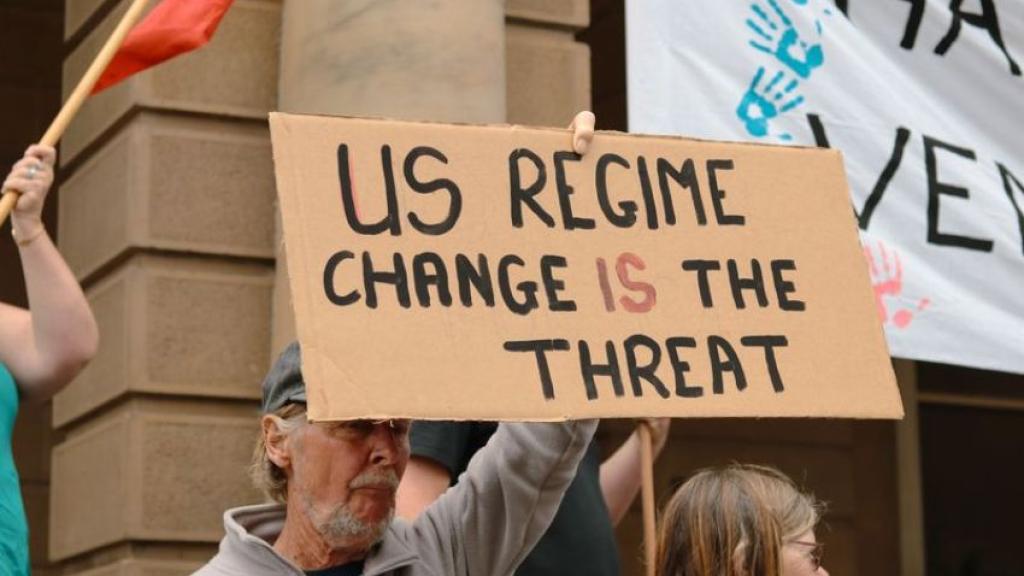
Statements opposing the US military assault on Venezuela and kidnapping of President Nicolas Maduro and National Assembly MP Cilia Adela Flores de Maduro from Socialist Alliance (Australia), United Left Platform (United States), Indonesian left groups and trade unions, Partido Lakas ng Masa (The Philippines), Socialist Party of Malaysia, Communist Party of India (Marxist-Leninist) Liberation, and Social Movement (Ukraine)
Australia: No war on Venezuela! Scrap AUKUS!
Socialist Alliance, January 4
Socialist Alliance strongly condemns United States President Donald Trump’s military invasion of Venezuela and demands that the Australian Labor government rejects the US’ flouting of international law and breaks the AUKUS war alliance.
We stand with the people of Venezuela who are defending their sovereignty and support the emergency protests being organised across the country.
The US’ bombing of at least two military bases in Venezuela’s capital, Caracas, and its abduction of Venezuelan President Nicolás Maduro and his wife Cilia Adela Flores de Maduro is a reminder of Trump’s lawlessness and lack of commitment to democracy.
This latest act of war comes after illegal attacks over the past few months, including the US navy blowing up small boats near the Venezuelan coast and Colombia’s Pacific coast. More than 100 people have been killed this way.
The US military build-up, including warships, planes and soldiers in the Caribbean, is being posed as necessary to fight drug trafficking and narcoterrorists, despite no evidence being produced.
US imperialism’s plan is to impose full dominance through various means including: military (target strikes, threats of war); economic (tariffs, naval blockade); and political (support for far-right allies).
For more than 20 years, the US has been trying to overthrow the government of Venezuela, which was led by President Hugo Chavez from 1999 until his death in 2013, and which is now led by Maduro.
It has supported attempted coups and imposed an economic blockade preventing Venezuela from participating in international trade. The US sanctions have caused great suffering to the Venezuelan people.
The attack on Venezuela is US imperialism’s latest attempt to install a pro-US government there, even though the Trump administration has said it would rule Venezuela for now.
Venezuela and Colombia have criticised Trump’s policies in the Middle East, including US support for Israel’s genocide in Gaza.
The US has repeatedly declared it wants control of Venezuela’s oil deposits - one of the largest in the world. It also made this clear by seizing Venezuelan oil tankers.
Socialist Alliance is also deeply concerned by the outright flouting of international law this attack represents and the lack of criticism from the Labor government.
Labor must immediately condemn the US extrajudicial attacks and break the US war alliance – which AUKUS represents.
The US has said Colombia, Mexico and Cuba are next in line for such aggression. Australia must not agree to Trump’s new Monroe doctrine. Albanese must call out the US’s attack on a sovereign country.
All those who support democracy and the rule of law should step up solidarity with the peoples of the Americas and help build the broadest possible campaigns to defend self-determination there.
We must also pressure Labor to break its alliance with US imperialism, including cancelling the AUKUS agreement and closing US military bases.
Socialist Alliance encourages you to join your local “Hands off Venezuela” rallies.
We support a foreign policy based on peace and justice therefore we demand;
- Stop US attacks on Venezuela!
- Stop the US military operations in the Caribbean and withdraw all warships, planes and troops!
- Stop all US interference and interventions in Latin American domestic politics!
- Shut down US military bases in Australia!
- Scrap AUKUS now and break from the US military alliance!
- Immediate release of Nicholas Maduro and his wife Cilia Adela Flores de Maduro
United States: United Left Platform calls for mass resistance to US imperialist attack on Venezuela
The United Left Platform, January 6
The United Left Platform, a coalition of revolutionary socialist organizations in the U.S., completely and unequivocably condemns the Trump administration’s illegal and unwarranted military attack on Venezuela and kidnapping of President Nicolás Maduro and his wife, Cilia Flores, the former President of Venezuela’s National Assembly. This aggression poses an ominous threat to any power or person that stands in the way of Trump’s effort to secure U.S. imperial control over Latin America, its most important “sphere of influence.”
In the dead of night in the early morning of January 3, U.S. military forces attacked the Fuerte Tiuna military base in Caracas where Maduro was thought to be residing as well at the La Carlota airport and Higuerote airport to the east of Caracas. Air strikes by planes and helicopters were also reported at La Guaira and Aragua states. The elite army unit Delta Force captured Maduro and Flores and flew them in chains to a prison in New York.
In comments made hours after the assault, code-named Operation Absolute Resolve, Trump made it clear that the attack is but the beginning of his effort to take direct control of Venezuela. “We will run the country until we have a just transition—we can’t take the chance that someone other than us takes over Venezuela,” he stated, adding, “we are willing to wage a second and much larger attack—we are ready to do so right now.”
We should be under no illusions that Trump intends to allow any political power or personage to run Venezuela that is not under the control of the U.S. This is not just regime change—it is a formula for possible occupation, beginning with the U.S. taking total control of Venezuela’s oil and mineral resources.
Whether or not the Trump regime succeeds in this outrageous display of imperial arrogance depends on developing the strongest and broadest possible opposition to his efforts by those of us in the U.S., in Venezuela, and internationally. We urge everyone opposed to war and neocolonial domination to make your voices of opposition heard in the streets, workplaces, and unions.
As revolutionary socialists, we have no illusions about the nature of the Maduro regime, which was neither revolutionary nor socialist. However, the present and future of Venezuela is not for anyone to decide other than the people of Venezuela. We stand with all who seek to defend its right to self-determination.
Trump’s claim that the administration is motivated by controlling the shipment of drugs to the U.S. has no more basis in reality that his assertion that “crime has been totally eliminated” in Washington, DC and other cities by sending in the national guard. Less than 10% of drugs entering the U.S. come from Venezuela, while Trump recently pardoned one of the biggest drug kingpins in Central America, former President Juan Orlando Hernández of Honduras. His attacks on vessels off the coast Venezuela that have killed 110 people in recent months, like the January 3 assault and kidnapping that has killed untold numbers of others, is largely driven by his desire to obtain control of a country with the largest known oil reserves on earth.
However, the attack on Venezuela is not only about oil. Also in play is the effort to enact the Trump Doctrine that proclaims the U.S. now has the right to intervene anywhere it wishes at any time to secure total control of its most important spheres influence—while acknowledging Russia’s and China’s efforts to dominate their respective spheres so long as it coincides with U.S. interests. This is the multipolar imperialism that has now emerged with the collapse of the much heralded (but failed) neoliberal world order. As Trump declared in boasting of the U.S. seizure of Maduro, “America will never again allow foreign powers to drive us out of our own hemisphere.” We must combat this reactionary agenda by engaging in mass resistance to the U.S. attack on Venezuela.
Indonesia: Stop US imperialist military aggression, free Maduro!
Initiated by GEBRAK, January 8
On Saturday, January 3, 2026, at 2:00 a.m. local time, the United States (US) imperialists launched a military attack on Caracas, El Higuerote, Miranda, La Guaira, and Aragua, Venezuela. The attack was accompanied by the kidnapping of President Maduro and his wife. The attack killed at least 40 Venezuelans. US President Donald Trump also ordered a blockade of all oil distribution in and out of Venezuela. This demonstrates the true intentions of the US imperialists in attacking Venezuela. This step is the culmination of a series of criminal acts by US imperialists against the sovereign nation of Venezuela, which has never provoked and has never posed a direct military threat to the United States.
A series of recent US imperialist operations have included outright piracy on the high seas, bombing and shooting at small boats in the Caribbean, and the massacre of Venezuelan citizens on board. These victims were almost certainly innocent fishermen. These actions also included the seizure of tankers carrying Venezuelan oil – and the seizure (read: theft) by the United States. All of these operations were carried out under the pretext of eradicating Venezuelan drug gangs, culminating in Maduro being accused of being a ' narcoterrorist'. Although there has never been any hard evidence to prove this.
The US monopoly seeks to impose its interests through threats, economic warfare, illegal blockades, political pressure, and brutal military force. These plans constitute coercive measures that not only violate sovereignty and international law but also threaten the peace, stability, and right to life of the Venezuelan people and the security of the Latin American region as a whole. These actions are the most blatant manifestation of modern imperialism, which seeks to shackle a free nation.
Equally important, as members of the working class and people's movements, we affirm that imperialism, war, and blockades have deepened the oppression of women. The US stranglehold has worsened access to food and healthcare, increased the burden of unpaid care work, and increased the risk of sexual violence, reproductive health damage, and structural impoverishment.
War and militarism are the most extreme manifestations of women's oppression, a system that normalizes violence, domination, and conquest. Within the framework of imperialism, women's bodies, the bodies of the people, and nature are treated as legitimate objects to be controlled, exploited, and sacrificed for the sake of power and capital accumulation. US imperialists openly stated in front of the mass media that they were targeting Cuba, Mexico, and also Colombia. This is an alarm for world democracy and international law. US imperialists clearly violated Article 2 paragraph (4) of the UN Charter which states:
Each member state is prohibited from using or threatening the use of force against the territorial integrity or political independence of any other state, or in any manner inconsistent with the purposes of the United Nations.
The military attack on Venezuela and the statement sent a clear message that the US intends to dominate and subjugate the entire continent by mercilessly punishing any government that stands in its way. A method more akin to the mafia than to international peace.
Today, we must face the reality that Venezuela, a small Latin American country, is at a significant disadvantage when confronted with the overwhelming military might of US imperialism. The solidarity of the working class and people worldwide is urgently needed to delegitimize US imperialist aggression. Therefore, GEBRAK and the organizations listed in this statement declare:
- Reject military intervention against Venezuela!
- Free Maduro immediately!
- Stop the US economic embargo on Venezuela!
- Stop cooperation with US imperialists!
On behalf of the Labor Movement with the People and supported by:
KASBI CONFEDERATION, KPBI, SGBN, KSN, SYNDICATION, JARKOM SP BANKING, KPA, SEMPRO, KPR, FPBI, SMI, LMID, FIJAR, LBH JAKARTA, YLBHI, FSBMM, FSPM, FKI, SPAI, WALHI, GREENPEACE, TREND ASIA, COMRADE, ALLIANCE OF INDEPENDENT JOURNALISTS, KONTRAS, BEM STIH JENTERA, SPK, RUMAH AMARTYA, PEMBEBASAN, LIPS, MAHARDHIKA WOMEN, KSPTMKI, DFW, PKBI, SOCIALIST UNION, SOCIALIST YOUTH ORGANIZATION, PPR, FMN, GMNI JAKSEL, SPRI, SEMARAK UPNVJ, AMP.
The Philippines: Oppose the criminal US attacks on Venezuela!
Partido Lakas ng Masa, January 4
There is only one word to describe the United States’ attack on Venezuela: criminal. Invading a sovereign country, bombing its cities, and kidnapping its elected president are crimes under international law. These actions are not an aberration—they express the true character of the US empire, which rules through war, coercion, and terror.
A bipartisan war on Venezuelan sovereignty
The current assault is the product of a US bipartisan politics of decades-long campaign to destroy Venezuelan sovereignty since the people elected Hugo Chávez in 1998. That democratic choice initiated a redistribution of wealth, expanded popular education, and guaranteed free healthcare to millions long denied these rights—directly challenging imperial control over Venezuela’s resources and future.
The Clinton administration applied political pressure and financed right-wing opposition forces. The George W. Bush administration backed the failed 2002 coup. After Chávez’s death, the Obama administration escalated sanctions and in 2015 branded Venezuela an “extraordinary threat.”
Trump intensified economic warfare and open threats, while the Biden administration largely preserved the sanctions regime that devastated popular living conditions. Trump pulled the trigger, but every administration before him loaded the gun.
The Monroe Doctrine reborn: NSS 2025
This aggression is now openly codified in US doctrine. The 2025 National Security Strategy explicitly revives and hardens the Monroe Doctrine:
After years of neglect, the United States will reassert and enforce the Monroe Doctrine to restore American preeminence in the Western Hemisphere… We will deny non-Hemispheric competitors the ability to own or control strategically vital assets in our Hemisphere.
The “Trump Corollary” on the Monroe Doctrine is clear: total domination of the Americas, control of strategic assets and supply chains, and the replacement of independent governments with compliant ones. Venezuela—rich in oil, minerals, and strategic position—is a primary target.
Sanctions as economic warfare
Sanctions have been a central weapon in this war. They were designed to strangle the economy, deepen hardship, and break popular resistance. Yet despite immense suffering, Venezuela has endured, reorganized, and pursued greater self-sufficiency under siege.
War for profit: US corporations move in
The motives are no longer hidden. Even as bombs fall, US corporations are already circling like vultures.
According to the Wall Street Journal, senior figures from hedge funds and asset management firms are preparing a trip to Venezuela to scope out “investment opportunities,” particularly in energy and infrastructure.
This is imperial war in practice: destruction first, privatization and plunder next.
Escalation across Latin America
The danger does not stop at Venezuela. According to the New York Times, the real problem is not Washington’s aggression, sanctions, or regime-change policy—but Cuba. In a familiar Cold War reflex, socialist Cuba is once again cast as the hidden hand behind Venezuelan resistance, blamed for undermining “democracy” and obstructing US objectives.
This serves one purpose: to deflect responsibility from US imperialism and reassert the doctrine that no independent political project in Latin America is acceptable unless approved by Washington.
Trump is now openly threatening Mexico and Colombia, laying the groundwork for further intervention. He has declared: “The cartels are running Mexico… something is gonna have to be done with Mexico.”
Trump called out Colombian President Gustavo Petro by name, accusing him without evidence of “making cocaine and sending it to the United States.” “So he does have to watch his ass,” the US president said of Petro, who condemned the Trump administration’s Saturday attack on Venezuela as “aggression against the sovereignty of Venezuela and Latin America.”
This is the language of imperialist prerogative—the assertion that Washington alone decides which governments are legitimate and which countries require US military action. It signals a widening assault on sovereignty across the hemisphere.
Kidnapping, killings, and lies
We denounce the US kidnapping of President Nicolás Maduro and First Lady Cilia Flores. Maduro is now being paraded in Trump’s media establishment in a dehumanizing way as an example to threaten other countries’ opposition to the US imperial might. Any detention, disappearance, or removal of Venezuela’s elected leadership is a grave crime and an act of war.
We condemn the killing of Venezuelan civilians and military personnel and honor those who have died defending their homeland.
We categorically reject the use of fabricated pretexts—including false drug accusations and recycled anti-Cuba hysteria—to justify imperialist violence. These lies are standard tools of intervention and plunder.
A call to oppose imperialist war
This attack must be opposed by all who claim to stand for peace.
Those on the Left who have disagreements with the Maduro government must set them aside and oppose imperialist aggression without qualification.
The assault on Venezuela is part of a wider global escalation. The United States has attacked Nigeria, threatened Iran, and continues to arm Israel as it carries out genocidal violence against Palestinians while bombing Lebanon and Syria. The world is being driven toward a broader war.
History shows where unchecked imperial aggression leads. The last time the world stood this close to catastrophe was when fascist powers invaded their neighbors with impunity. Those acts were rightly condemned as reckless and criminal. The same judgment applies today.
Our demands
We call on peoples and movements worldwide to mobilize in active solidarity with Venezuela—with Latin America, and all nations under threat—to resist this criminal assault on sovereignty, peace, and self-determination.
Now is the time for Left and progressive forces worldwide to unite against imperialist aggression.
We specifically demand that the Government of the Philippines publicly condemn this attack and uphold the principles of national sovereignty and non-intervention.
US Hands Off Venezuela!
Release Maduro Now!
Hands Off Latin America!
No More Wars for Oil!
Imperialism Will Not Prevail!
Malaysia: PSM condemns the US invasion of Venezuela
Parti Sosialis Malaysia, January 3
Parti Sosialis Malaysia (PSM) condemns in the strongest terms the United States’ blatant military invasion of Venezuela- a sovereign country. This act is a violation of international law, the UN Charter, and the fundamental right of nations to self-determination.
The United States has once again revealed its true face , a global bully driven not by human rights or democracy, but by an insatiable greed for oil and minerals. Venezuela’s only “crime” in the eyes of Washington is its vast natural wealth, which the American empire now seeks to plunder by force.
This is not an isolated incident but part of a long, brutal pattern: the U.S. destabilizes, invades, and installs puppet regimes across the world from Iraq and Libya to Latin America; leaving behind chaos, suffering, and broken nations.
We stand in solidarity with the people of Venezuela and their legitimately elected government. We reject all forms of foreign intervention, subversion, and regime-change operations orchestrated by Washington and its allies.
We call on the international community, the United Nations, and all justice-loving nations to support Venezuela’s sovereign right and Demand an unconditional U.S. withdrawal from Venezuelan territory.
If the world remains silent today, no sovereign nation will be safe tomorrow. This is not just Venezuela’s fight from American imperialism. Either we unite to resist this aggression, or we risk neocolonial subjugation once again.
The time for solidarity is now. Stop the invasion. End U.S. imperialism.
S. Arutchelvan
Deputy Chairperson
India: Condemn the US imperialist war on Venezuela! Stand with the people of Venezuela in defence of their sovereignty!
CPI(ML) Liberation, January 3
The people of Venezuela are under attack! In the early hours of January 3, U.S. under the Trump administration unleashed a criminal war of aggression against the people of Venezuela. Reports confirm brutal bombing and military invasion targeting the capital city of Caracas. A social media post by Donald Trump even claims that President Maduro and his wife have been captured and flown out of Venezuela.
This war is not just against Venezuela, but an open threat against every people in the region and across the world who strive to determine their own future free from imperialist dictates.
The same lies used to justify the invasion of Iraq, the seizure of its oil, and the devastation of its people are now recycled as so-called “narco-terrorism” to justify a regime-change operation against President Maduro and the plunder of Venezuela, a country with largest oil reserves in the world.
Trump’s war on the people of Venezuela aims to impose a U.S.-backed colonial order. It seeks to crush the Bolivarian Revolution that overthrew a U.S.-supported oligarchy and returned the nation’s oil wealth to the people. The war is to seize Venezuela’s oil once again for U.S. multinational corporations and install a puppet government to serve imperialist interests.
This war is the latest chapter in the bloody history of U.S. intervention across Latin America and the Caribbean, manipulating elections, overthrowing democratically elected governments, subjugating people’s movements, unleashing bloodshed, and imposing destruction. From Guatemala to Chile, from Grenada to Panama, the U.S. Monroe Doctrine, which treats the Latin American region as its “personal backyard” and which Trump seeks to reinforce, has always meant subjugation, exploitation, and repression, denying the peoples of the region their right to sovereignty and self-determination.
Stand in unyielding solidarity with the people of Venezuela as they defend their sovereignty and their right to determine their own political and economic course, free from imperialist interference.
We call upon all democratic and peace-loving forces worldwide to stand against this imperialist aggression and the attempts to impose a new order of colonial subjugation under the Trump regime.
Hands off Venezuela!
Down with U.S. imperialism!
Ukraine: Oppose US aggression against Venezuela
Social Movement, January 3
The morning of 3 January marks the beginning of a widespread attack on democracy and the relative peace of the peoples of Latin America – and far beyond.
The events in Venezuela, where US military operations led to the capture of President Nicolás Maduro and the declaration of a state of emergency with mobilisation, are yet another manifestation of the escalating imperialist confrontation, the consequences of which will be felt by millions of people across the continent.
The actions of Donald Trump’s administration cannot be viewed as an isolated incident or a ‘forced response’ to the crisis. As before – from the bombing of small vessels in the Caribbean and Pacific Oceans to the sanctions blockade – this is a demonstration of the United States’ power and complete readiness to use violence without trial, investigation or any regard for international law. Pretexts such as the fight against drug trafficking and cartels are used to legitimise aggression. Until recently, the majority of drug precursors were produced in China. The share of drug trafficking through Venezuela is negligible compared to other countries in the region and sea routes.
Excuses about fighting against the ‘drug cartel-linked leadership’ seem particularly cynical in light of Trump’s recent amnesty of former Honduran President Hernández from an American prison – he was sentenced to a long term for involvement in cocaine trafficking, but was released to help his allies in the last election. As in the case of the ‘fight against terrorism,’ the real goal is not protection, but control over oil and mineral resources and the establishment of a regime loyal to Washington.
At the same time, it is necessary to call a spade a spade: Nicolas Maduro’s regime is authoritarian, repressive and deeply corrupt. It has nothing to do with socialist democracy, hiding behind the legacy of Hugo Chavez and Bolivarian rhetoric. Along with the devastating US sanctions, it is the Maduro government’s policies that are responsible for the economic collapse, social catastrophe, extrajudicial killings, malnutrition and mass emigration of millions of Venezuelans. The Maduro leadership has nullified the achievements of the mass movements and social programmes of the Chávez era, instead discrediting left-wing ideas in the region. Parasitising on the population, the regime is sustained by the security forces, restrictions on freedoms and external support, primarily from Russia.
The Kremlin has become one of Caracas’ key allies in maintaining its authoritarian model of government. Russian Foreign Minister Sergey Lavrov has visited Venezuela on numerous occasions, including in April 2023, as part of a tour of Brazil, Venezuela, Nicaragua and Cuba aimed at mobilising political support for Russia’s war against Ukraine. Although not as notorious as Daniel Ortega, the traitor of the Sandinista revolution in Nicaragua, President Maduro declared his ‘full support’ for Russia from the very beginning of the full-scale invasion, and state institutions and the media actively promoted the Kremlin’s interpretation of events.
However, it would be a grave mistake to equate the Maduro regime with Venezuelan society.
Despite widespread propaganda, most Venezuelans did not accept pro-Russian narratives. In the early days of Russia’s invasion of Ukraine in 2022, people took to the streets to protest against the aggression – in a country where demonstrations are regularly criminalised and dispersed. Venezuelans carried Ukrainian flags, chanted ‘Stop Putin’ and openly criticised their government’s alliance with the Kremlin.
This solidarity with Ukraine has deep roots. Since the days of Euromaidan, many Venezuelans have seen the Ukrainian struggle as close and understandable – a struggle against corrupt authorities, external control and authoritarianism. Sympathy for Ukraine stems not only from anti-war sentiments, but also from a rejection of foreign influence, which is crucial to the survival of Maduro’s regime, as well as that of Vladimir Putin – both of whom are under investigation by the International Criminal Court.
Despite widespread propaganda, most Venezuelans did not accept pro-Russian narratives. In the early days of Russia’s invasion of Ukraine in 2022, people took to the streets to protest against the aggression – in a country where demonstrations are regularly criminalised and dispersed.
Since 1999, Ukraine and Venezuela have been building friendly relations, which began under Ukrainian Foreign Minister Borys Tarasyuk, who was received by then-Venezuelan President Hugo Chávez. It is noteworthy that José David Chaparro, the Venezuelan consul in Russia during Chávez’s time, joined the International Legion of Territorial Defence of Ukraine in 2022 and was involved in rebuilding cities destroyed by Russian troops.
That is why the current US aggression cannot be justified even by criticism of Maduro. By proclaiming in its recent National Security Strategy its desire to return Latin America and the Caribbean to the role of a subordinate ‘backyard’ in the spirit of the Monroe Doctrine, American imperialism seeks to ‘clean up’ the region of any regimes that do not fit in with its economic and geopolitical interests, while at the same time strengthening the far-right forces.
That is why the current aggression of the United States cannot be justified even by criticism of Maduro. By proclaiming in its recent National Security Strategy its desire to return Latin America and the Caribbean to the role of a subordinate ‘backyard’ in the spirit of the Monroe Doctrine, American imperialism seeks to ‘clean up’ the region of any regimes that do not fit in with its economic and geopolitical interests, while strengthening ultra-right forces.
The isolation of Colombia’s progressive government and threats to a similar government in Mexico, the strengthening of an alliance with the far-right regime in Argentina at the expense of American taxpayers, support for neo-fascist revanchists in Brazil led by Jair Bolsonaro, and the use of Bukele’s notorious mega-prison in El Salvador to hold deportees from the United States are all part of a single strategy to restore Washington’s hegemony in Latin America.
It is significant that during Trump’s previous term, Venezuelan affairs were overseen by the same Elliot Abrams who was responsible for training, during the Reagan era, the ‘death squads’ of anti-communist dictatorships that carried out more than 90% of the crimes of civil wars in Central American states, such as the murder of about a thousand residents of the village of Mosote in El Salvador.
An externally imposed ‘regime change’ will only deepen the social catastrophe. Like Trump’s racist policy towards Venezuelan refugees, this war is a continuation of a policy of contempt for human life. Even if there are no immediate mass casualties (the 1989 invasion by US Marines to remove the dictator and drug trafficker Noriega, who until recently had been a CIA client in the fight against revolutionary movements in the region, resulted in at least hundreds of civilian deaths), external destabilisation will result in further internal turmoil.
In addition, the potential rise to power of the ‘Trumpist’ wing of the opposition poses a danger. Just as Maduro is a caricature of socialism, the ultra-right and ultra-capitalist course of María Corina Machado is a caricature of the democratic movement. After receiving the Nobel Peace Prize, she emphasised in every way possible that she would prefer to give it to Trump and would support his intervention against her own country. In contrast, the left-wing opposition to Madurism, which is increasingly attracting disillusioned former supporters of the Bolivarian revolution, emphasises the unacceptability of a military scenario and the fact that the fate of Venezuela should be decided by Venezuelans themselves, not by imperialist leaders.
The struggle against Maduro’s dictatorship and the struggle against American imperialism are not mutually exclusive. These are two sides of the same conflict, in which nations become hostages to geopolitical games. That is why today we must speak of solidarity with the people of Venezuela – the same solidarity that Venezuelans showed towards Ukraine in its resistance to Russian aggression.
The people of Venezuela are fighting against the imperialist yoke and are hostages of Maduro’s predatory regime.
Venezuela, we too are resisting imperialism!


No comments:
Post a Comment