
Big Oil’s Win in Venezuela
January 16, 2026
Photograph by Nathaniel St. Clair
Is the illegal U.S. invasion of Venezuela, and kidnapping of its president, a “war for oil”?
To some extent, this is a reductionist debate. There are often multiple motivations for war, and there clearly are several here. Some in the administration are stuck in Cold War ideology and will use any pretext to undermine and even overthrow governments they perceive as left-leaning, as seen from Trump’s threats against Colombia, Cuba, and Mexico.
Beyond those governments, the latest Trump National Security Strategy proclaims a desire to “reassert and enforce the Monroe Doctrine to restore American preeminence in the Western Hemisphere.”
Still, it’s hard to ignore the role of oil. Venezuela likely has the world’s largest proven oil reserves, and Trump has repeatedly declared his intention to seize Venezuela’s oil, partly for the benefit of the United States and U.S. oil companies.
There are reasonable doubts about whether U.S. oil companies would be willing to invest in Venezuela. The poor state of the country’s oil infrastructure would necessitate major investments to upgrade it. It’s estimated to cost $110 billion to restore production to mid-2010s levels, and there’s a high likelihood of political instability in the country over the next few years.
Reportedly, many U.S. oil companies are reluctant to invest in Venezuela despite pressure from the U.S. government. Either way, the web of business interests that benefit, directly or indirectly, from the oil and gas industry still stand to come out ahead — and in some ways are already benefiting — from Trump’s aggression.
Stock prices for U.S. refiners (such as Chevron and Valero Energy) and oilfield services companies (such as Halliburton) have soared in response to the U.S. attack, with an immediate spike on the first trading day after the attack. While prices have decreased since, they remain at their highest levels in recent weeks.
Oil companies can benefit directly, even if they don’t invest in Venezuela. Crude oil prices have been on a downward trajectoryover the last year due to oversupply.
This is one of the reasons the industry is skeptical about entering Venezuela — and, indeed, their short-term objectives appear to be at odds with those of the Trump administration, which claims to want more production and lower pump prices.
There’s always the possibility that Trump could use U.S. control of Venezuela to reduce its oil production.
After all, the administration has always been friendly to the interests of the fossil fuel industry, whose leaders were amongTrump’s major backers. If the U.S. clamps down on oil production in Venezuela, that would at least somewhat alleviate the downward pressure on oil prices, benefiting the industry.
The Trump regime has openly stated its intent to “run” Venezuela, with “boots on the ground” if needed. This gives them the power to enforce further cuts in Venezuelan oil production, if they choose to do so.
Finally, we shouldn’t discount the possibility that the administration will offer enough sweeteners to make investment in Venezuela lucrative for the industry. The administration has already signaled that it may be willing to reimburse oil companies for their investment and escalate U.S. military intervention to provide security for the U.S. oil and gas industry. That essentially kicks the cost of production to U.S. taxpayers.
This may not be enough to persuade the industry to invest in Venezuela. If it is, we may eventually see U.S. oil companies grab some of the largest oil reserves in the world, with huge direct public subsidies in the form of investment reimbursements, and indirect subsidies in the form of the U.S. military acting as their free private security force.
Setting aside the limiting debate about whether this is a “war for oil,” it’s clear that fossil fuel capitalism is already profiting from the attack on Venezuela — and may profit more in the future. If climate change isn’t reason enough to break the political power of this industry, its role in incentivizing war and conflict is another.
Photograph by Nathaniel St. Clair
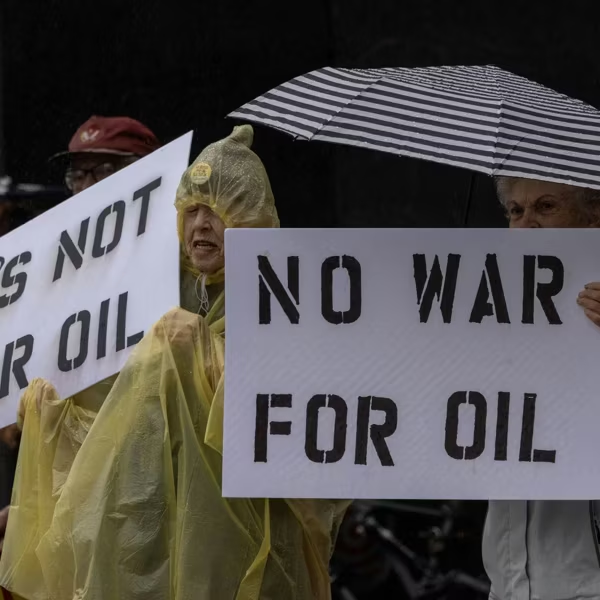
Is the illegal U.S. invasion of Venezuela, and kidnapping of its president, a “war for oil”?
To some extent, this is a reductionist debate. There are often multiple motivations for war, and there clearly are several here. Some in the administration are stuck in Cold War ideology and will use any pretext to undermine and even overthrow governments they perceive as left-leaning, as seen from Trump’s threats against Colombia, Cuba, and Mexico.
Beyond those governments, the latest Trump National Security Strategy proclaims a desire to “reassert and enforce the Monroe Doctrine to restore American preeminence in the Western Hemisphere.”
Still, it’s hard to ignore the role of oil. Venezuela likely has the world’s largest proven oil reserves, and Trump has repeatedly declared his intention to seize Venezuela’s oil, partly for the benefit of the United States and U.S. oil companies.
There are reasonable doubts about whether U.S. oil companies would be willing to invest in Venezuela. The poor state of the country’s oil infrastructure would necessitate major investments to upgrade it. It’s estimated to cost $110 billion to restore production to mid-2010s levels, and there’s a high likelihood of political instability in the country over the next few years.
Reportedly, many U.S. oil companies are reluctant to invest in Venezuela despite pressure from the U.S. government. Either way, the web of business interests that benefit, directly or indirectly, from the oil and gas industry still stand to come out ahead — and in some ways are already benefiting — from Trump’s aggression.
Stock prices for U.S. refiners (such as Chevron and Valero Energy) and oilfield services companies (such as Halliburton) have soared in response to the U.S. attack, with an immediate spike on the first trading day after the attack. While prices have decreased since, they remain at their highest levels in recent weeks.
Oil companies can benefit directly, even if they don’t invest in Venezuela. Crude oil prices have been on a downward trajectoryover the last year due to oversupply.
This is one of the reasons the industry is skeptical about entering Venezuela — and, indeed, their short-term objectives appear to be at odds with those of the Trump administration, which claims to want more production and lower pump prices.
There’s always the possibility that Trump could use U.S. control of Venezuela to reduce its oil production.
After all, the administration has always been friendly to the interests of the fossil fuel industry, whose leaders were amongTrump’s major backers. If the U.S. clamps down on oil production in Venezuela, that would at least somewhat alleviate the downward pressure on oil prices, benefiting the industry.
The Trump regime has openly stated its intent to “run” Venezuela, with “boots on the ground” if needed. This gives them the power to enforce further cuts in Venezuelan oil production, if they choose to do so.
Finally, we shouldn’t discount the possibility that the administration will offer enough sweeteners to make investment in Venezuela lucrative for the industry. The administration has already signaled that it may be willing to reimburse oil companies for their investment and escalate U.S. military intervention to provide security for the U.S. oil and gas industry. That essentially kicks the cost of production to U.S. taxpayers.
This may not be enough to persuade the industry to invest in Venezuela. If it is, we may eventually see U.S. oil companies grab some of the largest oil reserves in the world, with huge direct public subsidies in the form of investment reimbursements, and indirect subsidies in the form of the U.S. military acting as their free private security force.
Setting aside the limiting debate about whether this is a “war for oil,” it’s clear that fossil fuel capitalism is already profiting from the attack on Venezuela — and may profit more in the future. If climate change isn’t reason enough to break the political power of this industry, its role in incentivizing war and conflict is another.
Venezuela – the Petroleum Fortress: Power, Profits, and the Dismantling of a Nation
The history of Venezuela is often reduced to a cautionary tale of a single charismatic leader or a sudden economic collapse, yet the reality is a far more harrowing chronicle of structural extraction and imperial oversight. For over a century, the nation has served as a primary laboratory for a specific kind of Western imperialism – one where the democratic aspirations of a people are routinely sacrificed at the altar of energy security and corporate profit. In his meticulously researched volume, Venezuela: What Everyone Needs to Know, the author provides an evidentiary excavation of this history, revealing how the machinery of international finance and foreign military attaches have historically dictated the boundaries of Venezuelan sovereignty.
Miguel Tinker Salas is a Venezuelan-born historian and professor of history at Pomona College who is a leading authority on modern Latin American history and the historical impact of the oil industry in Venezuela. The book functions not only as a political primer, but also as a moral investigation into how a nation’s subterranean wealth became its geopolitical curse. While the volume was published in late 2015 and thus concludes before the most acute stages of the current economic downfall and the consolidation of the Maduro presidency, its value lies in its ability to show that the current crisis is not a sudden deviation, but the predictable result of a century of foreign interference and conflicts over the massive oil wealth.
To understand the modern Venezuelan state, one must first confront the ghost of Simón Bolívar and the fractured legacy of the independence struggle. The liberation of Venezuela from Spanish rule in the early nineteenth century was not a clean break into modernity but the beginning of a long, bloody search for identity. Following the 1811 declaration of independence, the country was consumed by a series of civil wars that decimated the population and left the economy in ruins. The dream of Gran Colombia – a unified Andean superstate – collapsed under the weight of regionalism and the ambitions of local caudillos. Throughout the 1800s, Venezuela was defined by instability, undergoing more than twenty changes in its constitution as various military strongmen competed for control of the agrarian economy. Yet, even in this era of internal chaos, the hand of the West was present. The fledgling republic was born into a debt trap, owing massive sums to British creditors who had financed the wars of liberation. This financial leverage became the primary tool of Western influence long before the first drop of oil was discovered.
The transition from a fractured agrarian society to a modern “petro-state” began in earnest under the long, dark tenure of Juan Vicente Gómez. Ruling from 1908 to 1935, Gómez was the archetype of the Western-backed autocrat. He understood with cynical clarity that his domestic survival depended entirely on his utility to foreign interests. In the early 1900s, Venezuela was still recovering from the 1902 naval blockade, where Britain, Germany, and Italy had used gunboats to collect debts. Gómez realized that by opening the country’s newly discovered oil reserves to Western firms, he could secure the diplomatic and military support needed to crush his internal rivals. Under his watch, the modern architecture of the state was built for the convenience of extraction. He granted staggering concessions to companies like Royal Dutch Shell and Standard Oil, often handing over thousands of square miles of territory under terms that allowed the firms to operate as sovereign entities. By 1928, Venezuela had become the world’s leading oil exporter, but the wealth never reached the population. Instead, it funded a sophisticated secret police and a military that was increasingly trained and equipped by the US.
US support for the Gómez dictatorship was an active and essential component of his rule. Gómez represented “stability”—a word that in the lexicon of imperialism serves as a euphemism for the uninterrupted flow of resources. As long as the oil camps remained open and the labor force was suppressed, the West was willing to ignore the torture chambers and the total absence of civil liberties. This established a recurring pattern where the moral character of a regime was irrelevant so long as its economic policy remained submissive. The oil companies became the primary financiers of the Venezuelan state, and in doing so, they ensured that the government would never be accountable to its own citizens, only to its foreign patrons. This “Great Wall of Foreigners” created a state within a state, where oil enclaves became islands of Western luxury surrounded by a sea of rural poverty.
The first genuine attempt to reclaim the nation’s resources occurred during the brief democratic opening known as the Trienio between 1945 and 1948. For three years, a government led by the novelist Rómulo Gallegos attempted to implement a “fifty-fifty” profit-sharing plan, insisting that at least half of all oil revenues remain within Venezuela to fund education and infrastructure. This was a radical departure from the Gómez era, and it was met with immediate hostility from the oil majors and their domestic allies. In 1948, a military coup brought this democratic experiment to a violent end. Tinker Salas highlights the presence of US military attaches in the very circles where the coup was being planned, signaling to the conspirators that a return to military rule would not only be tolerated but welcomed by Washington.
The decade of dictatorship that followed under Marcos Pérez Jiménez in the 1950s served as the ultimate proof of Western priorities. Pérez Jiménez was a man who spoke the language of “modernization,” using oil wealth to build grand highways and modernist architecture in Caracas while brutally suppressing the democratic opposition. The United States rewarded this behavior with the Legion of Merit, one of its highest honors for foreign leaders. To the Eisenhower administration, Pérez Jiménez was the model ally: he was fiercely anti-communist, he welcomed foreign investment without reservation, and he maintained “order.” The fact that his regime was built on a foundation of political killings and systematic corruption was treated as a domestic detail of no concern to the international community. The importance of this Western support cannot be overstated; it provided the regime with the international legitimacy and the military hardware necessary to sustain itself against the will of its own people for nearly a decade. Tinker Salas summarizes the results: “Increasingly, two Venezuelas took shape: one that benefitted from the oil economy, and the other that lived in the shadow of the industry, for which conditions had not fundamentally changed. One was a modern oil-producing nation closely allied to the United States, and the other a Latin American country where exports, even one as strategic as oil, had failed to solve the persistent problems of poverty and inequality for a large majority of the population.”
When democracy finally returned in 1958, it was a managed and curated version. The “Pacto de Punto Fijo” was an agreement between the country’s three main political parties to share power and oil revenues while banning parties of the left. For forty years, the West pointed to Venezuela as a “model democracy” in a region plagued by coups, but this stability was purchased through the marginalization of the poor and often brutal repression. The state became a patronage machine, and as oil prices fluctuated, the cracks in this model became apparent. Tinker Salas describes the social consequences: “A significant percentage of the population had slowly experienced an improved standard of living and, as of 1974, Venezuela boasted the highest per capita income in Latin America. However, distribution of income was one of the most lopsided in the continent. According to a study in 1974, while campesinos, the rural population, survived on five hundred bolívares a year, professional sectors earned 72,000 bolívares a year, or 144 times what the poor earned”. The book explains that when Venezuela nationalized its oil industry in 1976, the government utilized a “generous formula” to ensure that foreign firms were “fully compensated,” a process that was criticized by many domestic observers as a “watered-down” measure that left significant loopholes for continued exploitation.
By the late 1980s, the myth of the “model democracy” collapsed under the weight of a massive debt crisis. In February 1989, under pressure from the International Monetary Fund to implement a series of “shock therapy” austerity measures, the government of Carlos Andrés Pérez turned its guns on its own people. The social explosion, known as the Caracazo, remains one of the most significant and under-reported massacres in modern Latin American history. When the price of basic transportation and fuel spiked overnight, the poor neighborhoods of Caracas rose in protest. The military responded with live ammunition. While official figures placed the death toll in the hundreds, human rights organizations and subsequent forensic investigations suggested that thousands of people were killed in a matter of days. Many were shot during a state-mandated curfew. The silence of the Western democratic community during this massacre was a damning testament to its hierarchy of values. Because the Pérez government was implementing the neoliberal reforms demanded by the IMF and Washington, its slaughter of thousands of civilians was treated as a regrettable necessity for “fiscal responsibility.”
The rise of Hugo Chávez in the late 1990s must be understood as the direct consequence of the Caracazo and the decades of exclusion that preceded it. However, the book focuses our attention on the reaction of the international order to his attempts to reclaim national sovereignty. The most contemporary and perhaps most revealing case of this imperial impulse is the failed coup of April 2002. It was orchestrated by the traditional business elite, the military high command, and most importantly, the private media conglomerates. Tinker Salas provides a granular account of how television stations like RCTV and Venevisión became operational hubs for the opposition, broadcasting carefully edited footage to make it appear as though the government was firing on unarmed protesters.
When the coup briefly succeeded and installed Pedro Carmona, the head of the nation’s largest business federation, the masks of “democracy promotion” fell away in the West. The US State Department immediately signaled its support for the “transitional” government, blaming the elected president for his own ouster and ignoring the fact that the Carmona decree had dissolved the National Assembly and the Supreme Court in a single afternoon. This endorsement of a military takeover against a constitutional democracy revealed that for the architects of the regional order, the primary sin of the Venezuelan government was not authoritarianism, but its attempts to reclaim oversight of its national oil company and redirect those profits toward social “missions” for the poor.
Between 1998 and 2013, Hugo Chávez and his movement participated over a dozen different elections and referendums—including the 2004 recall election that was audited and validated by international observers such as the Carter Center and the Organization of American States – consistently maintaining a democratic mandate through high levels of audited civic participation. This never stopped the US and its allies in their regime change attempts.
The scale of the human stakes is captured in the statistical shift that followed the government’s successful assertion of control over the national oil conglomerate, PdVSA. In the decade after 2003, social spending as a percentage of GDP rose dramatically. Millions of people who had been invisible to the state for a century were suddenly given access to primary health care, literacy programs, subsidized food and housing. Poverty rates were cut in half, and extreme poverty dropped by over seventy percent. These “missions” addressed the very structural inequalities that the previous century of Western-backed regimes had ignored. Yet, this shift was treated as a threat to international security. The pursuit of regional integration was interpreted by Washington as an act of hostility rather than an exercise in sovereign diplomacy.
It is important to note that because this book was published in 2015, it captures the Venezuelan state at a pivot point. It documents the height of the social gains but can only foreshadow the catastrophic economic decline that would follow. However, the history Tinker Salas provides makes the subsequent downfall more intelligible. It shows how the reliance on a single commodity, a structure imposed by foreign firms a century ago, left the country uniquely vulnerable to the collapse of oil prices and the subsequent imposition of a draconian sanctions regime. The economic warfare of the late 2010s was built upon the foundations of the 1902 blockade and the 1989 IMF mandates.
From the gunboats of the early twentieth century to the media-driven coups of the twenty-first, the tools of intervention have evolved, but the objective has remained remarkably consistent: the preservation of a system where Venezuelan sovereignty is always conditional. The review of this history forces us to confront the moral complicity of Western democracies that have consistently favored the “stability” of a profitable status quo over the messy, often confrontational process of genuine national self-determination. We are left with the resonant insight that as long as the international order views the Global South as an archive of resources to be managed rather than as societies with the inherent right to rule themselves, the Venezuelan people will remain trapped in a cycle where their sovereignty is always conditional and their future is never truly their own.
You can find Michael’s interviews with Jeffrey Sachs, Trita Parsi, Scott Horton, and other antiwar voices on his author’s page for NachDenkSeiten — the videos are in English!
Michael Holmes is a German-American freelance journalist specializing in global conflicts and modern history. His work has appeared in Neue Zürcher Zeitung – the Swiss newspaper of record – Responsible Statecraft, Psychologie Heute, taz, Welt, and other outlets. He regularly conducts interviews for NachDenkSeiten. He has reported on and travelled to over 70 countries, including Iraq, Iran, Palestine, Lebanon, Ukraine, Kashmir, Hong Kong, Mexico, and Uganda. He is based in Potsdam, Germany.
The global meaning of the US attack on Venezuela
First published at NACLA.
Historians will likely look back at the January 3, 2026 attack on Venezuela, the kidnapping of its president, and the takeover of the country as marking the definitive crack up of the post-WWII international order as the world descends into transnational conflagration. The U.S.-Caribbean venture is inscribed within the broader logic of the epochal crisis of global capitalism that also encompasses the United States’ threat to take over Greenland, ICE assassinations in U.S. cities, the ongoing genocide in Palestine, the wars in Ukraine and Sudan, the bombing of Nigeria, mass displacement and the seizure of mineral deposits in the Congo, and other headlines that are reverberating around the world.
In times of epochal crisis, we can only make sense of events by framing them within their world-historic context. The United States’ position as the hegemonic anchor of world capitalism has been in decline for some time as the world fragments into competing political and geoeconomic centers. Yet all countries are integrated into a single globalized system of production, finance, and services—and no one state, however powerful, can control the process of global accumulation. In earlier epochs, the breakdown of hegemonic order during periods of capitalist crisis was marked by political instability, intense class and social struggles, wars, and ruptures in the established international system.
We have entered anew a period of worldwide upheaval. Key turning points include Russia’s 2022 invasion of Ukraine and the West’s radical political, military, and economic response to it, as well as Israel’s genocidal assault on Gaza beginning in 2023 and the West’s complicity in it. Major crises of world capitalism have historically involved the breakdown of state legitimacy, widespread social conflict, political upheaval, and war. But the current crisis is like no other, given the social and biospheric limits to further expansion and the destructive power of the global arsenal. An epochal crisis signals the irreversible decline of capitalism’s capacity to reproduce itself through time and space. The different dimensions of this crisis — economic, social, political, and ecological — are coming together in an explosive mix that is generating conflict in every direction.
Structurally, global capitalism faces a crisis of overaccumulation, chronic stagnation, and a secular decline in the rate of profit that generates intense pressure for expansion. The capitalist system is by its nature expansionary, and cycles of crisis have always involved waves of violent expansion. The transnational capitalist class has accumulated more wealth than it can spend, much less reinvest. In its desperate search for outlets for these surpluses and new spaces for transnational accumulation, it has launched a new round of predatory expansion around the world involving the seizure of markets and resources — especially energy and mineral resources — through war, displacement, and repression. The U.S. state in its Trumpist form and beyond it, what I will call Global Trumpism, has become the out-of-control instrument of this expansionary wave.
Transnational capital is penetrating ever deeper into the Latin American countryside, where land and resources must be tapped to fuel this expansion. Autonomous peasant and Indigenous communities stand as barriers and must be dispossessed. The so-called “War on Drugs” has nothing to do with combatting drugs, yet provides a pretext for the application of state and paramilitary violence to access this wealth and contain resistance to the plunder. The Gaza genocide has set a precedent for the impunity with which ruling classes can unleash death and destruction in complete disregard for any legal order.
This is the larger context for the U.S. takeover of Venezuela, intended as much as a disciplinary projection of power in Latin America as it is as a seizure of the country’s oil and mineral resources, as well as a show of force on the world stage. As part of its playbook, the emerging U.S. fascist state seeks to normalize the use of violence beyond borders with absolute arrogance and impunity. Trump’s 2025 National Security Strategy evoked a “Trump Corollary” to the 1823 Monroe Doctrine, prioritizing tech and financial sector dominance by redirecting U.S. military power to the Western Hemisphere, expanding access to critical resources, and propping up regimes aligned with the Trump agenda.
Thirdworldization and the global oil market
While Venezuela is the first casualty of this “Donroe Doctrine,” we must note that the Bolivarian Revolution has been neither democratic nor socialist. The Venezuelan state has served as a machine for plunder and corruption by political, military, and economic elites. As it has shifted state policies to favor employers, it has increasingly repressed workers and opened the floodgates to corporate predation by both Chinese and Western transnational capital. As the state has increasingly taken on mafioso dimensions, different Chavista factions have engaged in fierce internal struggles over power, fiefdoms, and plundering rights. Newly appointed interim President Delcy Rodríguez and her brother, National Assembly President Jorge Rodríguez, appear to have won out over Interior Minister Diosdado Cabello and army chief Vladamir Padrino López, as charges of “betrayal” flew around Caracas in the aftermath of the incursion — including from Maduro’s son “Nicolasito,” who promised, according to the Associated Press, that “history will reveal who the traitors were.”
Venezuela will likely face a period of prolonged instability and conflict. Transnational investors will need a strong and compliant state to extract hydrocarbons and minerals. In the lead up to January 3, the CIA reportedly determined that Chavismo needed to be preserved and that Rodríguez was best positioned during a transition period to hold together the Venezuelan state and military apparatus, necessary to provide investment guarantees for transnational capital and to exercise social control in the face of mass discontent and popular protest. Reportedly engaged in secret negotiations with the White House since April 2025, Rodríguez announced, the day after being sworn in as the country’s interim president on January 5, that she would work with Washington on an “agenda of cooperation.”
If Latin American immigrants in the United States are as much a target of the fascist state as Latin America itself, another crucial link emerges between the U.S. takeover of Venezuela and domestic policy. As the global crisis deepens, working classes in the rich countries that had enjoyed some protection from the worst ravages of exploitation are now undergoing a process of “thirdworldization,” whereby their living standards are plummeting as they begin to experience the unemployment, precariousness, and impoverishment of their counterparts in the Global South. In the larger picture, this thirdworldization is essential to understanding the U.S. seizure of Venezuela’s oil.
In 1974, three years after Washington abandoned the gold standard, the United States and Saudi Arabia worked out the Petrodollar Agreement, which established a dollar denominated global oil market. For half a century, pricing oil exclusively in U.S. dollars forced the rest of the world to sell and buy oil in U.S. currency, making the dollar the reserve currency for global trade and investment. This gave Washington enormous political and economic clout, allowing the U.S. Treasury to finance deficits by printing dollars and emitting trillions of dollars in bonds snatched up by global investors. The petrodollars arrangement thus helped to keep the U.S. domestic economy afloat, buoyed national living standards, and stabilized the domestic social order.
But the U.S.-Saudi agreement expired in 2024, and the Saudis did not renew it. To the contrary, the BRICS bloc and other countries have increasingly traded in currencies other than the U.S. dollar, while the global oil market has moved slowly but steadily away from exclusive dollar denomination. The end of dollar hegemony in global financial markets threatens to destabilize the entire U.S. political economy, spark hyperinflation, and plunge living standards in the United States — conditions likely to spark widespread political and social unrest.
The January 3 attack on Venezuela and the takeover of its oil is nothing less than a barefaced bid to maintain the petrodollar through international violence, piracy, and fraud.
The global police state
If the global oil market is one part of the Caribbean saga, another is the centrality of the the new digital technologies, led by artificial intelligence (AI), to the global economy and society. These technologies and the billionaires who control them are driving a radical new round of worldwide restructuring and transformation. Big Tech controls the entire ecosystem of global digitalized capitalism, which gives tech capital enormous structural power that is now being converted into direct political power through the fascist state. The new digital technologies require a massive expansion of data centers in the United States and around the world to fuel the AI revolution, demanding enormous increases in the supply of electricity, and, in turn, the seizure of energy resources and critical minerals such as lithium and cobalt.
As the crisis of global capitalism deepens, political power is hardening and social disintegration is spreading. Global inequality and deprivation have reached obscene levels and are driving conflicts everywhere. Rising inequality, impoverishment, and insecurity undermine state legitimacy, destabilize national political systems, jeopardize elite control, and give impetus to authoritarian, dictatorial, and fascist forms of government. Ruling groups now face a crisis of social control that is leading many countries towards authoritarianism and neofascism. We are moving into an era of civil and interstate wars, permanent political upheaval, and outright chaos.
In this context, the U.S. attack on Venezuela reflects the increasing centrality of warfare and systems of transnational social control and repression to the entire global economy and society. An expanding global police state that goes well beyond state militaries is on full display in the U.S. militarization of the Caribbean. Digitalization has vastly enhanced states’ capacity for surveillance and control; war itself has become digitalized. The global police state serves a triple purpose for the ruling classes. First, it is an instrument of social control and repression at a time when capitalist states face acute crises of legitimacy, mass discontent with the status quo, and widespread spontaneous and organized resistance. Second, the global police state is an instrument to smash open new spaces for accumulation by attacking states and displacing communities standing in the way of the seizure of resources, from the Congo and Burma to Palestine, Ecuador, and now Venezuela. Third, investing in systems of warfare, social control, and repression provides an increasingly important outlet for unloading surplus accumulated capital.
It is therefore unsurprising that defense stocks spiked after Trump announced on January 8 that he would seek an increase in the U.S. military budget to $1.5 trillion, up from $901 billion slated for 2026. Likewise, stocks in CoreCivic and GEO Group, two of the leading corporations that run private, for-profit immigrant concentration camps, shot up as Trump expanded the war on immigrants and raised the anti-immigrant budget to $170 billion. Around the world, military spending is skyrocketing amid a bleak industrial landscape and chronic stagnation in the civilian economy. There has been an explosion in the value of aerospace and defense stocks, which have outperformed the S&P500 over the last few decades, alongside massive new investment in tech firms that are pivoting towards digital technologies for warfare and repression
In Latin America, the Brazilian, Bolivian, Mexican, and Venezuelan militaries doubled in size from the turn of the century to the 2020s. Central American militaries grew by 20 percent, Colombia’s military quadrupled, and the rest of the region’s armed forces expanded by an average of 35 percent. This militarized accumulation and accumulation by repression are integral to the political economy of fascism. They throw fresh firewood on the embers of a global economy sinking into long-term stagnation, even as these means of accumulation escalate tensions within and among states. Venezuela is thus a frightening harbinger of a new era of permanent global warfare.
The “rules based” international order put in place at the close of WWII reflected the global balance of power of the post-war period, with the United States as the hegemonic anchor of an expanding world capitalism that enjoyed several decades of prosperity. But that order increasingly became an anachronism as the global economy shifted economic power to new centers and the system entered a deep structural crisis, especially in the wake of the 2008 global financial collapse. The attack on Venezuela spells the death knell of this order. Not surprisingly, Trump withdrew the United States from more than 60 international organizations on January 8. “I don’t need international law,” he declared in an interview with The New York Times, adding that his “own morality” is “the only thing” restraining him around the world.
That is not true. The only force that is capable of restraining Global Trumpism and the crisis-ridden system it represents is mass resistance from below by the global working and popular classes. Our resistance.
William I. Robinson is a distinguished professor of Sociology, Global Studies, and Latin American Studies at the University of California at Santa Barbara. His latest book is Epochal Crisis: The Exhaustion of Global Capitalism (2025).
Venezuela’s oil in the grip of US empire
First published at Verso.
The Trump administration’s kidnapping of Nicolás Maduro has refocused global attention on Venezuela and its enormous oil reserves. Yet to simply accept Trump’s bellicose language at face value – including claims that the US wants “to take back the oil … we should’ve taken back a long time ago” – can cause us to miss some of the deeper dynamics at play in the US invasion. Oil is unquestionably key to understanding what is going on, but in ways that go far beyond the direct control of Venezuela’s crude reserves.
Oil has little immediate use in its crude form, it must be transformed through refining into a myriad of saleable commodities that can then enter the accumulation process. From the early twentieth century onwards, the major Western firms understood that commanding the entire value chain (extraction, refining, petrochemical production, transport, and marketing) was the key to shaping markets, setting prices, and disciplining competitors. [1] Their dominance rested not simply on owning wells, but on controlling the infrastructures and distribution networks that determined how oil moved and who profited from it.
Historically, this strategy of vertical integration gave the biggest Western firms ultimate power over the world oil industry. But this power has begun to be challenged over the last two decades, with large state-run firms emerging in the Middle East, Latin America and China that rivalled their Western counterparts. Crucially, these firms – notably Saudi Aramco and China’s state-owned oil giants – have followed the path taken by Western firms across the twentieth century, becoming vertically integrated with unified control over upstream reserves and downstream activities such as pipelines, shipping, refining, and petrochemical production.
Venezuela, however, stands in stark contrast to this global trend. Rather than consolidating control over the full value chain, its state-owned company, Petróleos de Venezuela S.A. (PDVSA), has been systematically stripped of its downstream capacities. Nowhere is this more evident than in refining, the crucial stage at which crude is converted into higher-value products. Years of US sanctions, compounded by PDVSA’s internal deterioration, severed access to spare parts, catalysts, financing, and technical inputs essential for maintaining refinery operations. The consequences have been catastrophic: in 2014, Venezuela accounted for roughly one-fifth of South and Central American refining throughput; by 2024, its share had collapsed to just 6 percent. Today, the country’s five major refineries run at well below 20 percent of capacity, compared with around 70 percent a decade earlier.
This degradation of Venezuela’s refining system is essential to understanding the current moment. Without functional refineries, Venezuelan crude cannot be valorised inside the country. Instead, it accumulates in storage or is sold at steep discounts to independent buyers (such as those in China) willing to navigate the sanctions regime. At the same time, Venezuela’s exports of refined products have imploded, falling by nearly 80 percent over two decades. In 2005, the United States was still a net importer of Venezuelan gasoline, diesel and jet fuel; by 2012, Venezuela had become reliant on imported refined products from the very same US Gulf Coast refineries that once depended on its crude. As such, Venezuela has come to hold a deeply subordinate position vis-à-vis the US – forced to export discounted crude while importing higher-value fuels it can no longer produce at home.
This kind of structural dependency will be further deepened by the US intervention. Restoring Venezuela’s downstream sector is not a matter of simply “switching on” mothballed facilities once political conditions change. Petroleum refining is among the most capital-intensive and technically demanding segments of the oil chain: it requires a stable power grid, functioning utilities, continuous supplies of chemical inputs, and a skilled workforce capable of maintaining and operating highly complex machinery. When refineries sit idle or operate intermittently, corrosion spreads, catalysts degrade, pumps and compressors seize, and control systems fail. The experiences of Iraq, Iran and Libya demonstrate that, once a refining sector collapses under sanctions or war, restart costs can rival or exceed the cost of building new facilities outright.
In this context, Venezuela’s future under US suzerainty becomes clear. Deprived of a functioning refining sector, denied access to the inputs needed to process its own crude and lacking the capital required to rebuild its shattered infrastructure, the country is structurally confined to the role of a supplier of low-value raw crude to US-based refiners. This is the culmination of a strategy Washington has pursued for two decades: to push Venezuela back into the extractive periphery of a hemispheric energy system dominated by the United States. In effect, the country is returning to the subordinate position it occupied in the early 20th century – rich in crude, but dependent on American capital and American refineries to turn that crude into value.
Issued on: 14/01/2026
Play (12:54 min)

In an exclusive interview with FRANCE 24, Venezuela's Attorney General Tarek William Saab condemned the January 3 capture of Nicolas Maduro by US special forces as "an unprecedented event" that violated the country's airspace and sovereignty. "International law has died at this time," he declared.
Venezuela's attorney general described the US operation in Caracas as "an invasion", noting that more than 100 people were killed in what he called a bid "to seize the natural resources" of Venezuela, "in violation of a country's airspace and in violation of its sovereignty".
When asked whether Donald Trump is effectively Venezuela's president, given his control over the situation in the country, Saab insisted that acting leader Delcy Rodriguez is the president of Venezuela.
Despite condemning Maduro's capture, Saab expressed openness to negotiations with Washington. "This is what I've been saying from the beginning. Peace, dialogue – this is what we need," he concluded.

No comments:
Post a Comment