SPACE/COSMOS
Franco-German space company ArianeGroup to double launches in 2026
dpa 16.01.2026

Franco-German space company ArianeGroup is intending to double the number of launches of its Ariane 6 rocket carrier this year.
Boss Pierre Godart said on Friday that seven or eight flights are planned after four launches in 2025.
By 2027, the company is expected to boost capacity to around 10 flights per year, he added, with further development possible if the market holds.
"We will invest if it makes economic sense," Godart said.
ArianeGroup currently has around 30 launches under contract, with some slots still available in the coming years.
In February, the company is set to launch the most powerful version of the Ariane 6 rocket with four booster engines, enabling it to carry payloads of up to 20 tonnes.
The launch is expected to carry 32 satellites for Amazon's Leo high-speed internet network into space, in the first of 18 launches commissioned by the US giant.
Godart emphasized that ramping up production would guarantee Europe its own access to space, including for the German military.
ArianeGroup is active in the military sector, manufacturing ballistic missiles for French nuclear weapons.
The chief executive is also calling for European governments and state-financed actors to instigate a preference for European-made rockets.
Godart also commented on whether Ariane is aiming to use reusable rockets. He said the matter is a question of economic efficiency, because in order to enable the rockets to return, more fuel is needed, reducing the payload by 30 to 40%.
ISS crew returns to Earth in first-ever medical evacuation
For the first time in the International Space Station's history, NASA safely returned a crew of four astronauts to Earth ahead of schedule due to medical issues affecting one of the group.

A SpaceX capsule named Endeavour, carrying a four-member International Space Station (ISS) crew home from orbit splashed down safely in the Pacific Ocean off California early on Thursday.
This marked the first time NASA cut short an ISS crew's mission due to a health emergency, bringing the austronauts back a few weeks ahead of schedule.
A joint NASA-SpaceX webcast presented live infrared video showing the deployment of two sets of parachutes from the nose of the free-falling capsule. The parachutes slowed the capsule's descent rate to about 15 miles per hour (25 kilometers per hour) before it gently hit the water.
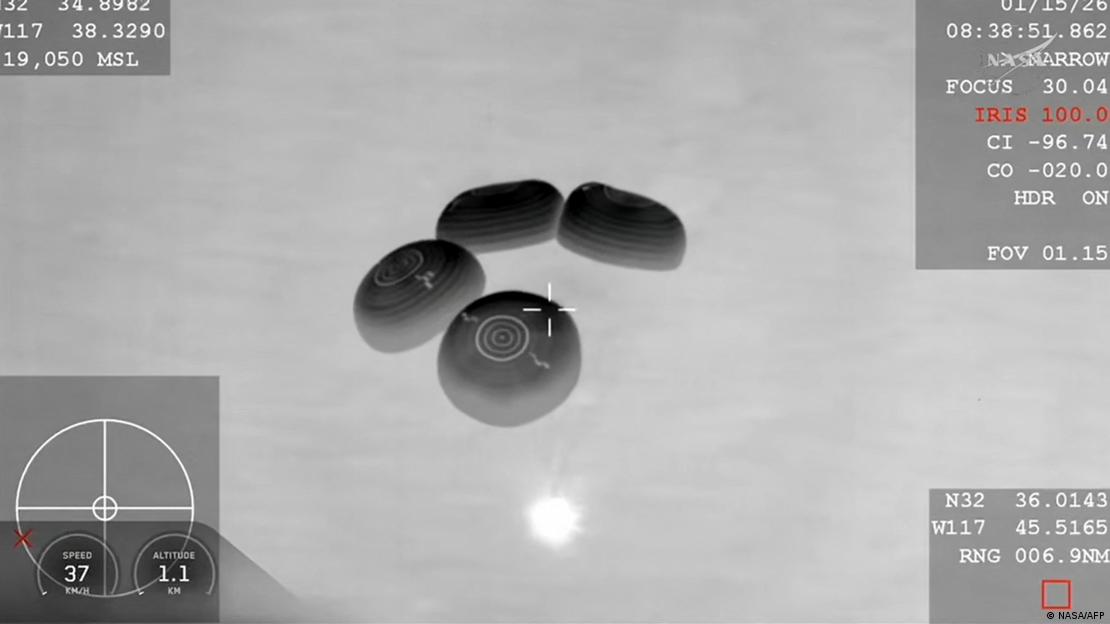
During a radio transmission to the SpaceX flight control center near Los Angeles, Endeavour's commander, NASA astronaut Zena Cardman, said, "It's good to be home." Fellow US astronaut Mike Fincke, Japanese astronaut Kimiya Yui, and Russian cosmonaut Oleg Platonov joined her on the flight home.
Less than an hour after splashdown, the four astronauts were helped out of the capsule one by one. They were accompanied by the cheers and applause of SpaceX employees aboard a ship.
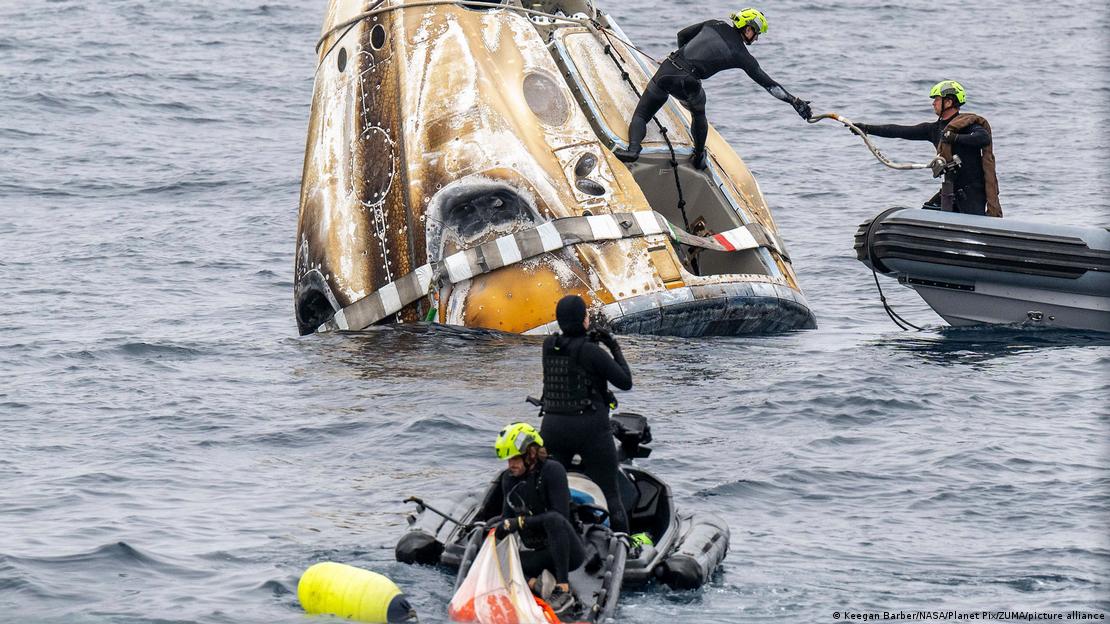
The ISS crew made an early emergency return to Earth due to an undisclosed serious medical condition affecting one of the astronauts.
Last week, NASA announced that it had canceled a spacewalk at the last minute due to health concerns involving one of the crew members. On January 8, the agency announced the decision to bring all four Crew-11 members home early.
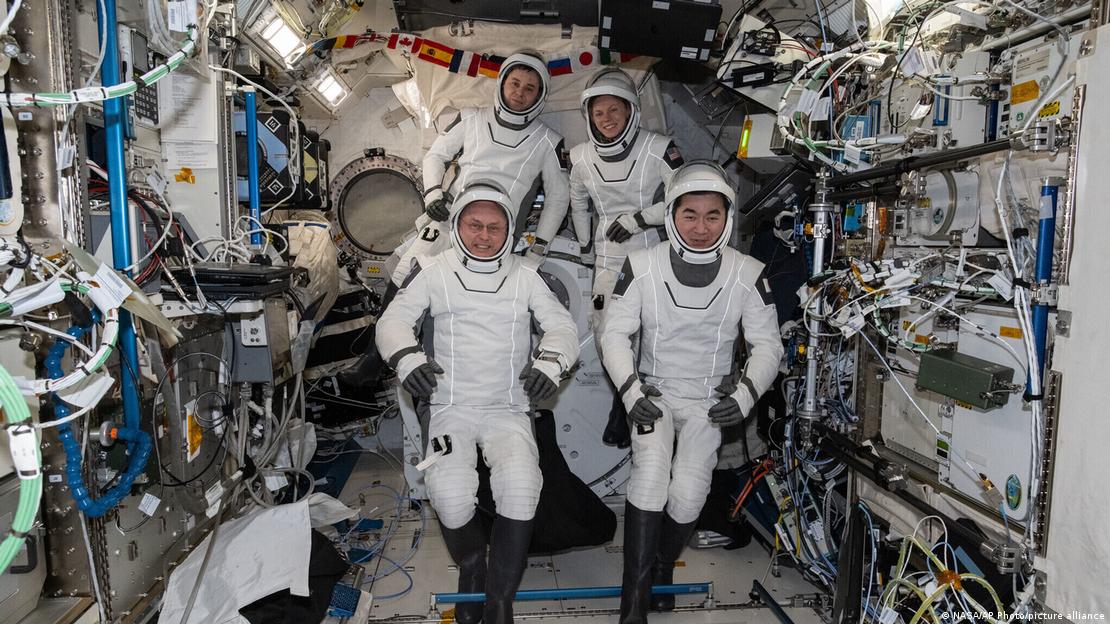
According to NASA Administrator Jared Isaacman, one of the astronauts was facing a "serious medical condition" that required immediate medical attention on the ground.
NASA officials have not disclosed which crew member was affected or described the nature of the issue, citing privacy concerns. Later, NASA Chief Health and Medical Officer James Polk said the medical emergency was not caused by an injury that occurred during operations.
Having arrived together in August from Florida, the astronauts spent 167 days aboard the International Space Station.
Edited by: Elizabeth Schumacher
Dmytro Hubenko Dmytro covers stories in DW's newsroom from around the world with a particular focus on Ukraine.
Born In Brightness, Leading To Darkness

The image of the supernova SN 2022esa (marked by the cross) with its host galaxy, 2MFGC 13525, taken by the Subaru telescope on 2023 June 13. At this late phase (about a year after the discovery), the SN became fainter than its initial brightness by more than a factor of 100. The spectral identity of SNe Ic-CSM can be extracted only in such a late phase in most cases, requiring dedicated observations with 8 meter-class telescope such as the Subaru telescope. CREDIT: KyotoU / Keiichi Maeda
What we know of the birth of a black hole has traditionally aligned with our perception of black holes themselves: dark, mysterious, and eerily quiet, despite their mass and influence. Stellar-mass black holes are born from the final gravitational collapse of massive stars several tens of the mass of our Sun which, unlike less massive stars, do not produce bright, supernova explosions.
Or at least, this is what astronomers had previously thought, because no one had observed in real time the collapse of a massive star leading to a supernova and forming a black hole. That is, until a team of researchers at Kyoto University reported their observations of SN 2022esa.
The Kyoto team had wondered whether all massive stars — those that are at least 30 times the mass of the Sun — die quietly without a supernova explosion, or if in some cases they are accompanied by an energetic and bright, special type of supernova explosion. The astronomers then discovered a type Ic-CSM class supernova that appeared to be an explosion of a Wolf-Rayet star, which are so incomprehensibly massive and luminous that astronomers believe them to be the progenitors of black hole formation.
To investigate the nature of this peculiar supernova, the research team utilized both the Seimei telescope in Okayama and the Subaru telescope in Hawaii. The team was able to observe and classify SN 2022esa as an Ic-CSM type supernova, demonstrating that the birth of a black hole is not necessarily quiet since this one could be observed with electro-magnetic signals.
They also discovered something else: the supernova shows a clear and stable period of about a month in its light-curve evolution, leading the team to conclude that it had been created by stable periodic eruptions of the star system once each year before the explosion. Such stable periodicity is only possible in a binary system, so the progenitor must have been a Wolf-Rayet star forming a binary with another massive star, or even a black hole. The fate of such a system, they determined, must be a twin of black holes.
“The fates of massive stars, the birth of a black hole, or even a black hole binary, are very important questions in astronomy,” says first author Keiichi Maeda. “Our study provides a new direction to understand the whole evolutional history of massive stars toward the formation of black hole binaries.”
This study also demonstrates the benefits of using two different telescopes that possess different observational properties. In this case, Seimei’s flexibility and promptness combined with Subaru’s high sensitivity proved to be an effective combination. The team plans to continue conducting research utilizing both telescopes in the coming years.
“We expect many interesting discoveries on the nature of astronomical transients and explosions like supernova,” says Maeda.
Naturally Occurring ‘Space Weather Station’ Elucidates New Way To Study Habitability Of Planets Orbiting M Dwarf Stars

January 11, 2026
By Eurasia Review
How does a star affect the makeup of its planets? And what does this mean for the habitability of distant worlds? Carnegie’s Luke Bouma is exploring a new way to probe this critical question—using naturally occurring space weather stations that orbit at least 10 percent of M dwarf stars during their early lives. He is presenting his work at the American Astronomical Society meeting this week.
We know that most M dwarf stars—which are smaller, cooler, and dimmer than our own Sun—host at least one Earth-sized rocky planet. Most of them are inhospitable—too hot for liquid water or atmospheres, or hit with frequent stellar flares and intense radiation. But they could still prove to be interesting laboratories for understanding the many ways that stars shape the surroundings in which their planets exist.
“Stars influence their planets. That’s obvious. They do so both through light, which we’re great at observing, and through particles—or space weather—like solar winds and magnetic storms, which are more challenging to study at great distances,” Bouma explained. “And that’s very frustrating, because we know in our own Solar System that particles can sometimes be more important for what happens to planets.”
But astronomers can’t set up a space weather station around a distant star.
Or can they?
Working with Moira Jardine of the University of St. Andrews, Bouma homed in on a strange type of M dwarf called a complex periodic variable. They are young, rapidly rotating stars that observations show experience recurring dips in brightness. Astronomers weren’t sure if these dips in brightness were caused by starspots or by material orbiting the star.
“For a long time, no one knew quite what to make of these oddball little blips of dimming,” Bouma said. “But we were able to demonstrate that they can tell us something about the environment right above the star’s surface.”
Bouma and Jardine answered that question by creating “spectroscopic movies” of one of these complex periodic variable stars. They were able to demonstrate that they are large clumps of cool plasma that are trapped in the star’s magnetosphere—basically being dragged around with the star by its magnetic field—forming a kind of doughnut shape called a torus.
“Once we understood this, the blips in dimming stopped being weird little mysteries and became a space weather station,” Bouma exclaimed. “The plasma torus gives us a way to know what’s happening to the material near these stars, including where it’s concentrated, how it’s moving, and how strongly it is influenced by the star’s magnetic field.”
Bouma and Jardine estimate that at least 10 percent of M dwarfs could have plasma features like this early in their lives. So, these space weather stations could help astronomers learn a great deal about particles from stars contribute to planetary conditions.
Next, Bouma hopes to reveal where the material in the torus comes from—the star itself or an external source.
“This is a great example of a serendipitous discovery, something we didn’t expect to find but that will give us a new window into understanding planet-star relationships,” Bouma concluded. “We don’t know yet if any planets orbiting M dwarfs are hospitable to life, but I feel confident that space weather is going to be an important part of answering that question.”

No comments:
Post a Comment