Iran's ongoing internet blackout has exceeded 182 hours of continuous disruption, surpassing the core duration of the 2019 shutdown, according to NetBlocks' monitoring data.
Most Iranian government websites still exist and function over the "National Information Network" or local intranet, but foreign networks, users will only reliably see stubs or gated front pages for a handful of top‑level portals and state media mirrors, with the bulk of .ir government content effectively dark to the outside world at present.
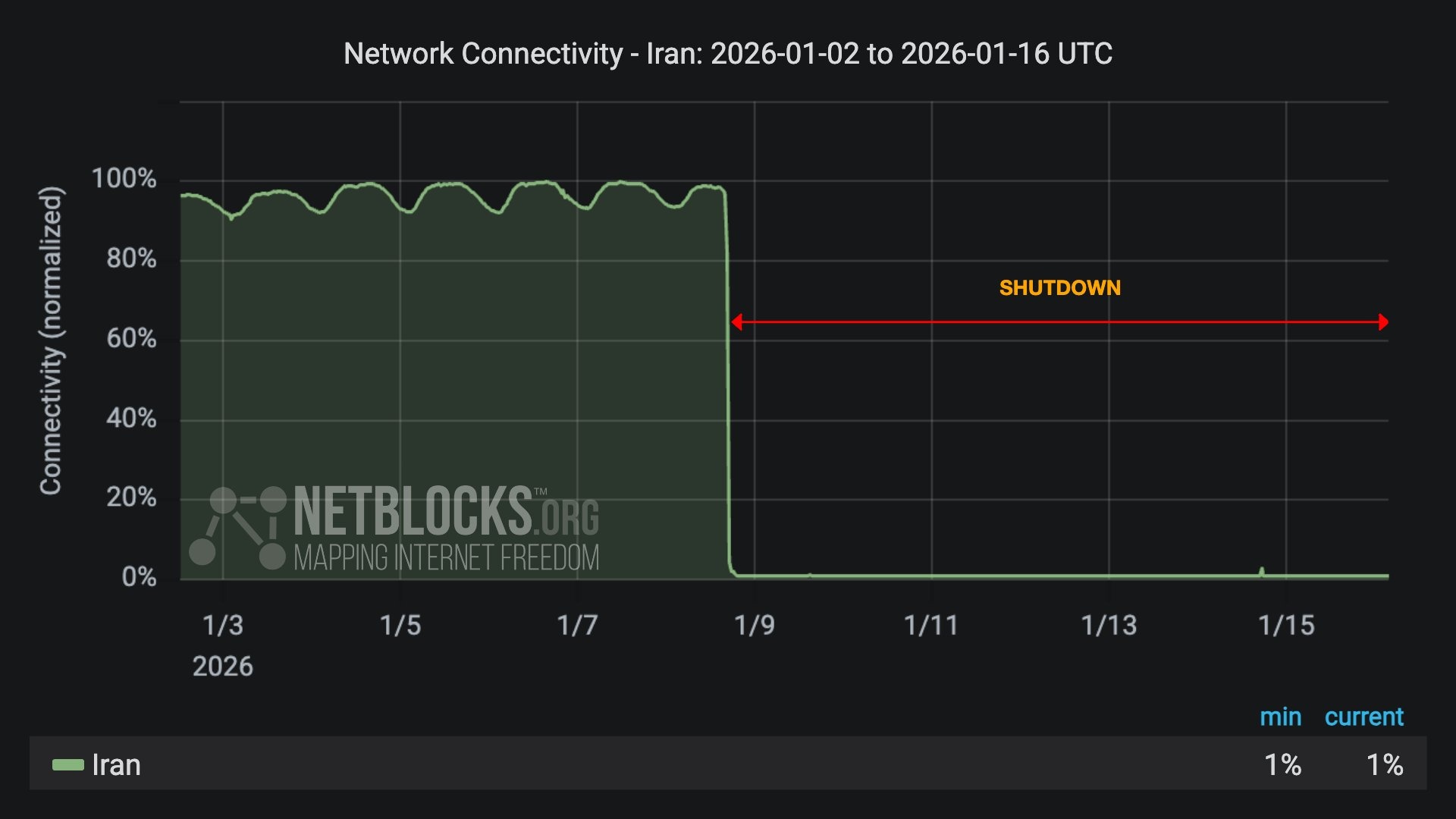
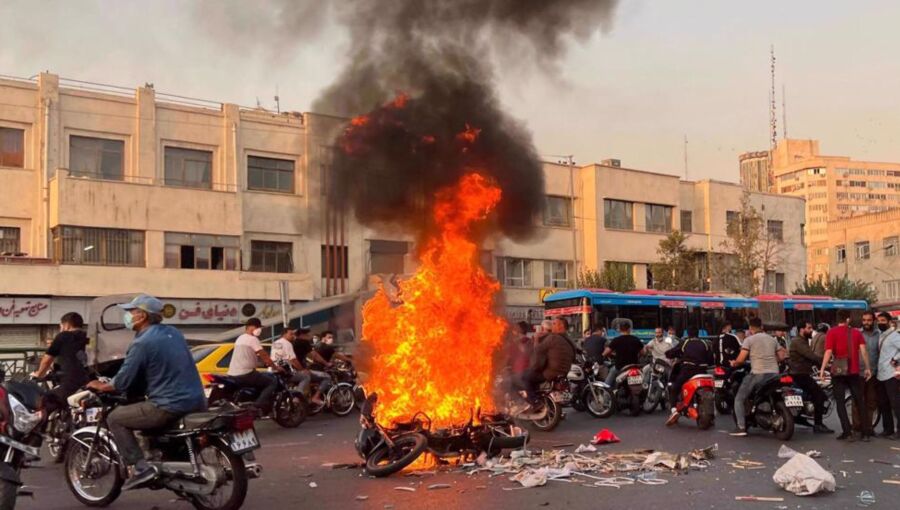
The nationwide connectivity cut commenced on January 8, following twelve days of nationwide protests. Following the government’s internet crackdown, protests continued to swell across major cities, including Astara, Shiraz, Ketar, Isfahan, and the capital of Tehran.
On January 12, Iranian security forces reportedly escalated their crackdown by conducting house-to-house searches to confiscate satellite dishes and Starlink internet equipment, targeting the limited technological resources available to citizens for accessing external communications.
This prolonged blackout showcases the Iranian state's willingness to impose comprehensive digital isolation to suppress domestic unrest, even as it risks further alienating the population and attracting international condemnation.
According to calls attempted by bne IntelliNews on January 14, Iranian residents were entirely unreachable, though several reports indicate one-way calls to foreign telephone numbers remained possible.
Social messaging applications have been completely disabled, while Iranian newspapers face mixed outcomes: some remain entirely disconnected, while others have maintained a limited online presence through government-controlled internet networks.
The US Agency for Global Media has responded by expanding its broadcasting capabilities into Iran through a partnership with Radio Free Europe/Radio Liberty, complementing private sector efforts like Starlink to maintain information flows into the country.
According to reliable sources who recently left Iran, the Iranian government, using Russian scrambling technology imported from Belarus earlier in December have succesfully managed to scramble internet signals via geo-stationary satellites over Iranian cities.
One Iranian website that has managed to stay online is the state-owned Press TV, which, citing the President of Iran’s National Centre for Cyberspace, Mohammad Amin Aghamiri, said the internet blackout will continue for the "time being."
He added that the exact timeline for lifting the restrictions will be announced once authorities have completed their security assessments.
“The time to return to normal conditions will be announced in the future, and authorities must certainly brief us on security considerations,” Aqamiri said, as quoted by the IRNA news agency.
The Iranian government has kept only a few websites online, including the President of Iran's website, Masoud Pezeshkian, and government news websites, including their Arabic and English-language services.
English-language newspapers in Tehran continue to publish content, including the Tehran Times and Iran Daily, both owned by different sections of the Iranian state. However, due to the disconnection from the outside world, according to analytical data seen by IntelliNews, only a handful of readers inside Iran are seeing their content.
Day 19 Of Iran Uprising: PMOI Reveals 50,000 Arrests As Internet Blackout Marks A Full Week – OpEd

The nationwide uprising against the religious dictatorship in Iran has reached its nineteenth day on Thursday, January 15, 2026. Following a bloody eighteenth day, where the Judiciary Chief ordered “speedy” executions and the confirmed death toll surpassed 3,000, the regime has escalated its crackdown to unprecedented levels.
On Thursday, the People’s Mojahedin Organization of Iran (PMOI/MEK) revealed shocking statistics regarding the scale of the regime’s repression, while the international community, from the G7 to former European leaders, rallied to support the Iranian people’s right to establish a democratic republic.
Day 19 Roundup: Over 50,000 arrests, drone surveillance, and global calls to blacklist IRGC
On Thursday, January 15, 2026, the nineteenth day of the uprising, the regime’s desperation became evident as arrest numbers soared and high-tech surveillance was deployed against unarmed protesters. Iran has now been in a full week of total internet blackout.
Key highlights from today include:
- 50,000 Arrests: The PMOI/MEK announced that over 50,000 people have been arrested since the uprising began on December 28, with security forces conducting surprise raids on homes and workplaces.
- Former EU Leaders’ Letter: Twelve former European leaders, including former Prime Ministers of Belgium, Greece, and Ireland, signed an open letter urging the EU to recognize the Iranian people’s right to resist tyranny and to blacklist the IRGC.
- G7 Condemnation: Foreign Ministers of the G7 nations issued a joint statement strongly opposing the “brutal repression” and warning of additional restrictive measures.
- Drones Hunting Civilians: Reports confirm the regime is using military-grade drones to identify, track, and arrest peaceful protesters, treating citizens as “enemy combatants.”
- Call for UN Action: Mrs. Maryam Rajavi urged the immediate dispatch of an international fact-finding mission to visit the regime’s prisons, warning that the mullahs recognize no limits in their cruelty.
PMOI confirms 50,000 arrests; Mrs. Rajavi warns of “Khamenei’s desperation”
In a harrowing update on the scale of the state crackdown, the PMOI has confirmed that the number of detainees has exceeded 50,000 between December 28, 2025, and January 14, 2026. This figure is based on detailed investigations across 144 cities and inquiries in 76 others.
The arrests are being carried out through surprise raids on neighborhoods, homes, and workplaces. Mrs. Maryam Rajavi, President-elect of the National Council of Resistance of Iran (NCRI), described this mass incarceration as a sign of Supreme Leader Ali Khamenei’s “desperation in the face of the people’s uprising.” She warned that the regime “will stop at no crime” to preserve its rule and called for an urgent international fact-finding mission to inspect the prisons.
The scale of these arrests echoes the 2022 uprising, where the regime’s Judiciary Chief eventually admitted to filing nearly 90,000 cases against protesters.
Former EU leaders to EU Presidency: Recognize right to resist, reject Shah and Mullahs
In a significant diplomatic development, 12 former European leaders—including former Prime Ministers of Belgium, Greece, Ireland, and the Czech Republic—sent an open letter to the leadership of the European Union.
The signatories urged the EU to “recognize the right of the Iranian people to resist tyranny and establish a democratic republic.” Crucially, the letter addressed the regime’s disinformation campaigns, clarifying that the Iranian people reject any return to the Pahlavi dictatorship. They cited the popular chant, “Down with the oppressor, be it the Shah or the Supreme Leader,” as proof that the people seek a future free of all dictatorships.
The leaders also called for the immediate blacklisting of the Revolutionary Guards (IRGC) as a terrorist organization.
Regime wages war with drones; G7 and US lawmakers condemn “barbaric tyranny”
Reports have emerged that the regime is treating its own citizens as enemy combatants by deploying military drone technology to identify and track peaceful protesters for arrest. This surveillance tactic highlights the militarization of the crackdown.
Meanwhile, international pressure is mounting. The G7 Foreign Ministers issued a joint statement condemning the “deliberate use of violence” and the killing of protesters. In the United States, lawmakers from both parties expressed solidarity. Senator Ted Cruz stated that “The people of Iran taking out their tyrannical regime would make America much, much safer,” while Senator Dave McCormick praised the courage of Iranians standing up to “barbaric tyranny.”
Global solidarity: Lawmakers from US to New Zealand stand with the uprising
As the regime attempts to hide its crimes behind a digital blackout, political figures from across the globe are breaking the silence, offering unwavering support to the Iranian people and condemning the mullahs’ brutality.
In New Zealand, Foreign Minister Winston Peters expressed that his government is “appalled by the escalation of violence and repression.” He condemned the killing of protesters and emphasized that Iranians have a fundamental right to peaceful protest and access to information. Peters also issued a stern warning to New Zealanders currently in Iran to “leave now.”
In the United States, support for the uprising remains bipartisan and vocal:
- Senator Deb Fischer took to the Senate floor to reaffirm her solidarity with the Iranian people against the regime’s “flagrant economic mismanagement and brutal treatment.”
- Rep. Nancy Mace highlighted the lethal nature of the crackdown, stating, “Thousands of Iranians murdered the last few days. Praying for their safe keeping tonight.”
- Rep. Laura Friedman declared her stance with the protesters, noting they are simply asking for “freedom for themselves and future generations.”
- Rep. Lois Frankel emphasized that the “suppression of fundamental rights anywhere threatens democracy everywhere,” pledging support for the students, women, and workers fighting the “murderous regime.”
- Congressman Jim Himes praised the “enormous courage” of the people taking to the streets to fight for self-determination after years of tyranny.
- Congressman Raja Krishnamoorthi called for “forceful diplomacy and coordinated international pressure” to support those fighting for change, rejecting the regime’s response of mass killings.
Mahmoud Hakamian
Mahmoud Hakamian writes for The People’s Mojahedin Organization of Iran (PMOI), also known as Mujahedin-e-Khalgh (MEK)
Protesters are putting their lives on the line in Iran as the state mounts a coordinated and brutal response to the unrest. As the death toll grows, hopes of outside help seem faint.

The field in front of Tehran's Kahrizak Forensic Institute seems to be loaded with dead bodies. Amid widespread protests and a communications blackout, images of the site are only available in videos physically smuggled out of Iran or uploaded to the Internet via Starlink satellites.
"I would guess there are thousands dead, at any case," an eyewitness who recently visited Iran told DW.
The man described going to Kahrizak with a friend to identify and retrieve his friend's wife's body.
"On the previous evening, you could hear automatic gunfire in the part of the city I was visiting. My friend and his wife were at a protest. The wife was shot," he told DW.
It is impossible to know how many people have been killed in the Iranian protests, which started over two weeks ago. The internet has been down for days, and any communication with the outside world is severely limited.
An Iranian official told the Reuters news agency on Tuesday that some 2,000 people were dead. However, the Oslo-based Iran Human Rights organization reported a death toll of at least 3,379 people on Wednesday. Activists believe that the actual number of protesters killed across Iran is much higher.
The Iranian authorities also detained over 10,000 people in the latest wave of protests. Government critics are worried that many of the detainees could be put on show trials and sentenced to death.
Iran's regime wants to fast-track trials of protesters 03:21
Regime decries protesters as 'criminals'
Meanwhile, pro-regime media in Iran regularly label the protesters as "terrorists" and foreign agents. This week, Iranian Justice Minister Amin Hossein Rahimi referred to people arrested between January 8 and 11 as "criminals."
Iranian authorities don't rely only on the police to suppress the protests. The Basij — a volunteer paramilitary faction controlled by the Islamic Revolutionary Guard Corps (IRGC) — was established specifically to deal with street protests. The IRGC itself is directly controlled by the country's Supreme Leader, Ayatollah Ali Khamenei, with the main goal of protecting the Islamic Revolution and its achievements.
Basij militants attend religious indoctrination programs to ensure their commitment to the idea of morality preached by the regime. They have a reputation for being especially loyal to the political system and also provide Iran's hardliners with a stable voter base.
Is there any hope of reform in Iran?
"We have tried everything to achieve change in this system," religious scholar and journalist Mohammad Javad Akbarin told DW. Akbarin, who now lives in France, previously worked for 15 pro-reform papers in Iran and was arrested multiple times when he still lived in his home country.
He does not see any possibility of reforming the Iranian regime. Together with Nobel Prize laureate Shirin Ebadi and four other prominent government critics, he has demanded a US intervention in Iran.
"The protesters are stuck behind closed doors and under a digital blackout, without a realistic way of escaping this situation," he said. "As soon as the internet comes back online, we will see horrible images."
Trump says killing in Iran 'stopped'
The fact that protesters are willing to defy massive repression and still take to the streets shows the depth of popular discontent. At the same time, Iran's power structure is not showing visible cracks and fast, wide-reaching changes appear unlikely.
On Wednesday January 14, Donald Trump announced that "the killing in Iran is stopping, it's stopped." Trump cited "very important sources on the other side" and said there was "no plan for executions."
The comments came only a day after Trump urged Iranians to "keep protesting" and take over Iranian institutions, assuring them that "help is on its way."
Whether Trump is willing to actually help the protesters, and what kind of help he would be willing to provide, is anyone's guess.
Trump says he was told the 'killing in Iran is stopping' 06:07
Amnesty calls on UN Security Council to act
Human rights watchdog Amnesty International has called on the UN and its members to coordinate a response and prevent further bloodshed. This call also included an appeal to the UN Security Council to refer the situation in Iran to the International Criminal Court.
The US has called an emergency session of the Security Council on Thursday to discuss the deadly unrest in Iran. But any resolution or decision condemning Tehran is likely to be vetoed by China and Russia.
"We have seen this in similar cases, including Syria and Bashar Assad, despite hundreds of thousands of deaths," says lawyer Payam Akhavan.
The international law expert served as an adviser to the prosecutors working for international courts dealing with war crimes in former Yugoslavia and Rwanda.
"Under such circumstances, the focus should be on systematically gathering evidence and documents for future trials," he told DW. "The actual legal process can realistically only happen in a future democratic Iran."
The deadly repression meted out against protesters makes the prospects of democracy taking hold in Iran seem faint. But if Iran's recent history is anything to go by, brutally suppressing one uprising is not an effective way of averting the next one.
This article was originally written in German.
After shutting down the internet, the Iranian government is now attempting to jam the Starlink satellite service made free to Iranians by the company. Iranians are now seeking ways to circumvent this latest wave of censorship.
Issued on: 14/01/2026
By: The FRANCE 24 Observers/Quang Pham
Iranian authorities cut the public's access to the internet and telephone communications on January 8. The networks were later partially reinstated, but with severe restrictions. The Iranian regime has been facing a series of protests since late December. In an attempt to crush the movement, the Iranian government also tried to break the last international communication link available to Iranians: Starlink.
Starlink, which provides internet access through a constellation of satellites, was thought to be out of the Iranian authorities' reach for censorship. However, in recent days, Starlink has been subject to a jamming campaign that has seriously impaired its use.
Can you get around this GPS jam?
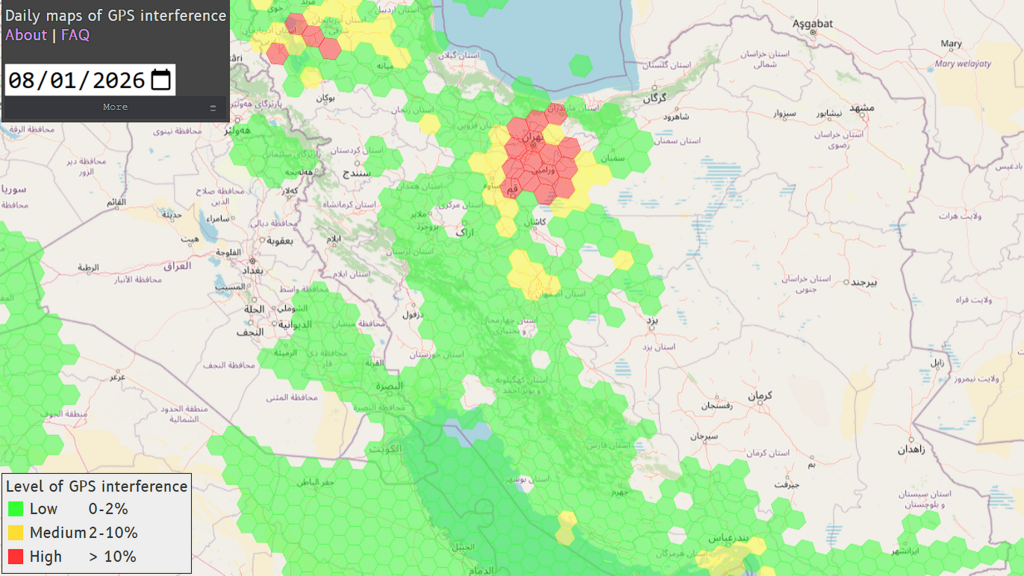
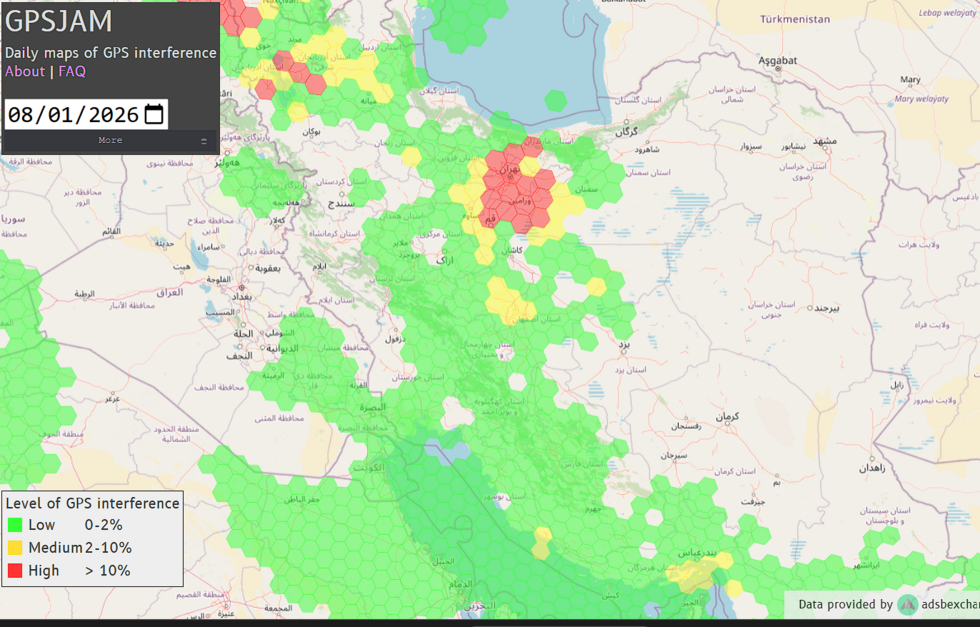
GPS interference was observed in Tehran and surrounding regions on January 8, the day that the internet more widely was cut across Iran, according to the monitoring site gpsjam.org. Though we don’t know with certainty why this jamming occurred, it did partially affect Starlink’s service.
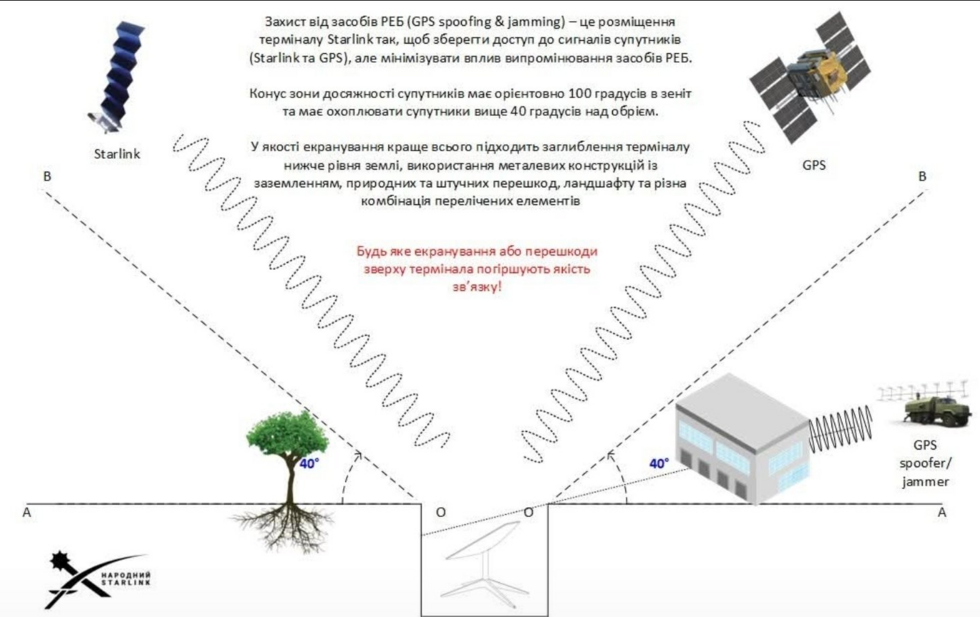
A Starlink terminal usually needs GPS in order to establish a geographic location so as to communicate with the network’s satellites.
"[Starlink uses] the GPS position of the terminals to point their antennas towards the satellites," the people behind the X account @giammaiot2, a group of telecommunications researchers, told our team.
"Jamming GPS signals was the classic way to jam Starlink," Kave Salamatian, a professor at the University of Savoie in France, who specialises in the geopolitics of the internet, told our team. "But a Starlink update, which was added after Russia jammed signals in Ukraine and in the Black Sea, [now] enables users to bypass a GPS signal by relying on Starlink’s own satellites to identify a location using triangulation.”
This solution, which enables users to get around GPS interference, does have some limits, says Radim Badsi, CEO of the French company Ground Space, which specialises in satellite constellation surveillance. This can make Starlink users less mobile: “Starlink’s alternate [to establishing locations using GPS] constantly sweeps the sky to try to find a satellite that is passing by.”
But in this mode, the civilian version of a Starlink terminal can’t be used on the move, Badsi says.
‘Active interference’
The worsening of the Starlink connection observed in Iran in recent days has resulted in a data "packet loss of 30 to 80 percent", according to Victoria Samson, the Chief Director of Space Security and Stability at the Secure World Foundation, a Washington-based think tank. Savoie professor Kave Salamatian says that this loss likely comes from a more sophisticated form of jamming, an “active interference”.
Active interference involves saturating a satellite’s transmission channel. If you send “noise” or a fake signal to a satellite for long enough, then it is possible to disconnect its associated terminals.
"In theory, this could render the satellite unusable [for the terminal]. So you can just jam, one after another, all of the visible [Starlink] satellites," says Badsi.
But it is “technically quite difficult to jam Starlink’s main channel because the Starlink network is made up of multiple moving satellites”, says Oleg Kutkov, a Ukrainian engineer who is an expert in the Starlink network. He says, “directing a powerful noise beam directly to the satellite in the sky requires multiple large-dish antennas constantly tracking satellites. Russians tried this approach [in Ukraine], but the jammers were destroyed because it's hard to hide them.”
Technology that could be home-grown or imported from Russia
So how were Iranian authorities able to set up this level of interference?
The specialists who spoke to our team had a number of theories.
Iran does have in its arsenal Russian military jammers like the Murmansk-BN, which is able to interfere with GPS signals.
The experts behind the account @giammaiot2 think that the Cobra-V8, an Iranian electronic warfare system which is similar to the Russian-made 1RL257E Krasukha-4, might have been used to jam the transmission frequencies from Starlink terminals.
The Starlink interference may also have been created using civilian technology that is not necessarily foreign.
"The simplest explanation is that they did it internally. The Iranians have the skills to jam Starlink. All the more so because the interference we are currently seeing in Iran is different to what we saw in the war in Ukraine,” says Salamatian. "Iran has very good universities that are specialised in telecom like Imam Hossein University, which is the university for the Islamic Revolutionary Guard Corps, as well as Sharif University.”
How exactly is this jamming impacting Starlink service in Iran?
Speaking to our team on condition of anonymity, a representative for Nasnet, the largest Starlink community in Iran, described a partial degradation of service:
“It is important to note first that disruptions to this service are not a new phenomenon. Similar issues were observed in Tehran approximately one month prior to the outbreak of the war between Iran and Israel in June 2025. Following that period, service remained stable until the past few days.
[...] What users are experiencing is better described as intermittent and non-persistent interference rather than a complete service outage. Connectivity remains available; however, at its peak, packet loss reached approximately 35 percent, resulting in frequent short disconnections and a noticeable degradation in user experience. Despite these conditions, the service has remained usable.
Based on our field assessments, these disruptions are geographically limited to Tehran. Starlink service in other parts of Iran has remained unaffected and continues to operate normally.”
The NasNet representative said Starlink users were able to temporarily bypass the jamming, thanks in part to the technical support provided by Starlink:
“A [Starlink] software update released on the second day of the disruptions [Editor’s note: on January 10] significantly reduced packet loss to approximately 10 percent. That said, network conditions remain unstable, with periodic fluctuations and occasional deterioration. This reflects an ongoing ‘cat-and-mouse’ dynamic in which both sides continuously adjust their technical approaches.”
Thanks to this update of the firmware (the software powering Starlink terminals), Salamatian explains that "Starlink now has the ability, if a satellite is being jammed, to transfer the signal to another satellite. This allows internet traffic to be rerouted from a jammed satellite to another satellite. By doing so, they have successfully mitigated the impact of the jamming. Signal loss previously reached 70 percent due to jamming; it has now been reduced to 30 percent."
However, the Starlink network is no silver bullet for bypassing the regime’s orchestrated blackouts. According to Amir Rashidi, an Iranian digital rights expert, there are only 50,000 Starlink terminals in Iran, serving only a tiny fraction of the country’s 90 million inhabitants.
This article has been translated from the original in French by Brenna Daldorph.

No comments:
Post a Comment