Why France's agriculture law may not help the farmers it claims to defend
France’s parliament on Wednesday debates a petition against the Duplomb agriculture law, which would reauthorise the use of a pesticide banned in 2018. The issue has become a flashpoint between farming unions, scientists and environmental groups – with concerns for biodiversity and human health.
Issued on: 11/02/2026 - RFI
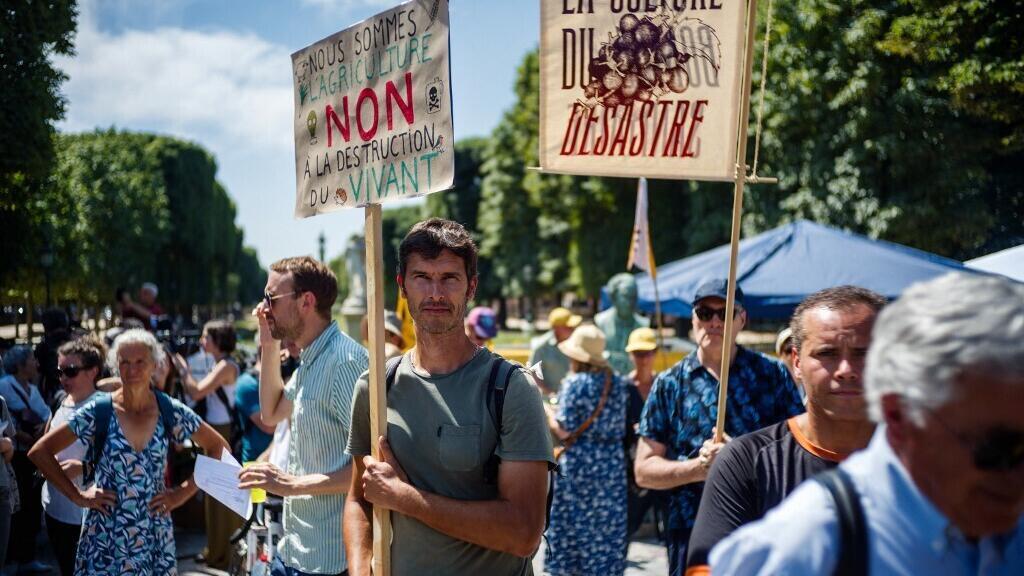
Farmers, scientists, beekeepers and citizens protest the Duplomb agricultural bill, which aims to ease access to pesticides. AFP - DIMITAR DILKOFF
By: Alison Hird
The Loi Duplomb, named after conservative senator Laurent Duplomb who proposed it, claims to ease pressure on farmers by loosening rules on pesticide use, large-scale livestock farming and water storage projects.
Backed by the government and major farming unions, the law was passed on 8 July 2025.
It was immediately contested by some scientists, health experts and environmental groups because it reauthorised acetamiprid, part of the neonicotinoid group of pesticides banned in France in 2018 for harming bees and other pollinators.
Within days, a student-led petition denouncing the law as a “public health and environmental aberration” gathered more than 500,000 signatures. By the end of 2025, more than 2 million people had signed the petition – a record in France.
In August, opponents of the law brought it before France's constitutional council, which ruled against reintroducing the pesticide, arguing it flouted France’s environmental charter, which guarantees the “right to live in a balanced and healthy environment”.
However, all the other provisions in the law, such as easing authorisations for livestock farming and irrigation reservoirs, remained in place.
By: Alison Hird
The Loi Duplomb, named after conservative senator Laurent Duplomb who proposed it, claims to ease pressure on farmers by loosening rules on pesticide use, large-scale livestock farming and water storage projects.
Backed by the government and major farming unions, the law was passed on 8 July 2025.
It was immediately contested by some scientists, health experts and environmental groups because it reauthorised acetamiprid, part of the neonicotinoid group of pesticides banned in France in 2018 for harming bees and other pollinators.
Within days, a student-led petition denouncing the law as a “public health and environmental aberration” gathered more than 500,000 signatures. By the end of 2025, more than 2 million people had signed the petition – a record in France.
In August, opponents of the law brought it before France's constitutional council, which ruled against reintroducing the pesticide, arguing it flouted France’s environmental charter, which guarantees the “right to live in a balanced and healthy environment”.
However, all the other provisions in the law, such as easing authorisations for livestock farming and irrigation reservoirs, remained in place.
Brain disorders
Senator Duplomb is continuing to push for a derogation on pesticides. In early February, he submitted a revised version of the censured article maintaining the reintroduction of acetamiprid, along with another insecticide, flupyradifurone, in a limited number of cases.
“No serious study has shown that acetamiprid is carcinogenic,” Duplomb told French public radio on Monday, defending the measure and underlining that France is the only country in the EU to have banned acetamiprid.
"We are banning molecules that are authorised in Europe whereas independent agencies have shown that [acetamiprid] was dangerous neither for people nor the environment. Today in France, through a particular kind of obscurantism, we would like to have people believe the opposite."
Chemist and toxicologist Jean-Marc Bonmatin said the lack of studies means there is no “formal proof” that acetamiprid causes cancer. However, “there are serious indications showing acetamiprid could be carcinogenic, notably for breast and testicular cancer because all neonicotinoids have been found to be endocrine disruptors,” he told RFI.
French health experts oppose bill that could reintroduce banned pesticides
There is no doubt, however, about the molecule’s impact on the brain.
“The main concern with neonicotinoids, and acetamiprid in particular, is the action of these neurotoxic molecules on the central nervous system”, Bonmatin said – adding that they affect neurodevelopment, notably in unborn babies and young children.
He pointed to “extremely important diseases” such as autistic spectrum disorders in children, and neurological disorders in the elderly.
“That’s why we scientists and doctors are taking action on this issue,” the chemist said.
In 2021, Bonmatin and colleagues at France’s Centre for scientific research (CNRS) published a list of the effects of neonicotinoids, including acetamiprid, on human health “so that doctors can recognise the symptoms of poisoning and the cases”.
While scientists often invoke the principle of precaution when studies are not clear, Bonmatin says that in this case the principle of prevention has to apply.
“We know very well what these pesticides will do to the population, to biodiversity, to the environment, so we have an obligation to protect people from future illnesses,” he said.
Even the European Food Safety Authority (EFSA) – often cited by supporters of acetamiprid – said in 2024 that there were "major uncertainties in the body of evidence for the developmental neurotoxicity (DNT) properties of acetamiprid".
It proposed reducing the acceptable daily intake by a factor of five.
French health watchdog warns of pesticide dangers to young children
Existing alternatives
Duplomb said the revised law would allow the use of the pesticide only where farmers have no alternative.
“We have focused on those sectors that INRAE considers to be in a complete dead end – where plant protection products are the only solution, such as hazelnuts, apples, cherries and sugar beet,” he said on Monday – referring to the National Research Institute for Agriculture, Food and the Environment.
The Loi Duplomb is backed by France’s largest farming union, the FNSEA, which is dominated by large cereal and sugar beet farmers and agribusinesses. It says sugar beet farmers in particular have no alternative to neonicotinoids when faced with the jaundice virus transmitted by aphids.
Bonmartin cites a 2021 report by Anses – France's food, environmental and occupational health and safety body – which specifically adressed the sugar beet issue and which found there were in fact around 20 alternatives.
“There are even varieties of sugar beet that resist the jaundice disease transmitted by flies,” he said. “So saying there is no alternative amounts to fake news to allow the reintroduction of neonicotinoids.”
“When the FNSEA says there is no alternative what they mean is that there is no alternative as easy as using pesticides.
"So the choice is either I take the easier solution through pesticides – the worst in terms of poisoning people – or I use alternatives and I preserve the environment, biodiversity and public health.”
'Farmers are main victims'
The Loi Duplomb was presented as a way to “lift the constraints on the profession of agriculture” in response to farmers' protests in January 2024. One of their key demands was simpler rules and less paperwork.
Supporting the law, the FNSEA has denounced unfair competition linked to France’s ban on some pesticides and weedkillers allowed in other EU countries.
Other unions, including the Confédération paysanne, which represents smaller farmers and supports an agroecological transition, oppose the bill.
Eve Fouilleux, a researcher at the Centre for Agricultural Research for Development (Cirad), says farmers themselves are the main victims of pesticides, but they're not always aware of the danger.
She said the issue is not regulations but agricultural economics.
“The root of the problem is income – the price paid to farmers – the economic system is crushing them,” she told RFI. “When you spend €100 on food in the supermarket, only €6.90 goes to the farmer.
“It’s a system where farmers are being asked to produce more and more with very little added value. So for them, pesticides are a guarantee of being able to produce a few percent more yield. And what is tragic is that this few percent means a little more money for them, but it's a disaster for the groundwater, for water quality and for taxpayers' bills."
Fouilleux cited surveys showing farmers are “overwhelmingly in favour of the ecological transition in agriculture, but they’re asking for support”.
While the French government is spending a lot of money on the food system, 60 percent goes to manufacturers, supermarkets and commercial caterers, she explained.
Around 20 percent goes to farmers through subsidies from the EU’s Common Agricultural Policy (CAP), but these are paid per acre. “So the bigger you are, the more support you get.”
Fouilleux said the existing productivist system contributes to the economic marginalisation of farmers in the food system. “That’s the problem, it’s not about standards at all. It’s really a discursive strategy by the FNSEA union, which is in fact run by agri-food industrialists,” she said.
Economic interests
Duplomb himself is a large dairy farmer and a senior member of the FNSEA union. He is also a former agro-industry executive.
From 2014 to 2017 he was regional president of the dairy group Sodiaal – a major French cooperative that owns brands such as Yoplait, Candia and others – and has been a member of Candia’s supervisory board.
“There’s a conflict of interest. He defends bills that will benefit his farm,” said Guillaume Gontard, president of the Senate’s environmentalist group. “He’s a representative of agribusiness who lives off exports.”
The environmental NGO Terre de Liens has described the Duplomb law as “tailor-made for FNSEA and agro-industry”.
“Duplomb has very strong ties to the agrochemical industry,” Bonmatin said. “There’s a denial of scientific facts in favour of economic interests.”
"He's chosen private economic interest, he’s not defending the farming community at all. To do so, you just have to help it make the necessary transitions."

No comments:
Post a Comment