The Doomsday Clock 80-Year Low

Albert Einstein, Robert Oppenheimer, and University of Chicago scientists founded the Bulletin of the Atomic Scientists in 1945. The famous Doomsday Clock was created two years later and reset every year by the Bulletin’s Science and Security Board in consultation with the Board of Sponsors, including eight Nobel laureates.
Manhattan Project scientists felt obligated to educate the public about the catastrophic implications of nuclear weapons, especially after US bombings of Hiroshima (Aug.6, 1945 – 80,000 instant deaths, 140,000 by year end) and Nagasaki (Aug. 9, 1945 – approximately 40,000 instant deaths, 80,000 by year end).”Little Boy” dropped on Hiroshima was 15-kilotons. Today’s thermonuclear weapons are well over 100-kilotons up to a megaton (a megaton equals 1,000 kilotons).
According to data provided by ICAN, one thermonuclear weapon detonated over NYC would ignite a fireball wider than one mile instantly vaporizing people and buildings on initial impact within that radius. Additionally, the thermal pulse or intense flash of light and heat would cause third-degree burns and inflame infrastructure 7-8 miles away. Then a firestorm would consume the city for as much as 150 square miles.
The initial setting for the iconic clock in 1947 was seven (7) minutes to midnight. The world-famous clock symbolizes the vulnerability to global catastrophe via human-made technology. The scientists were hopeful of preventing a nuclear arms race. Oops! As of 2026, nine nations possess approximately 12,330 nuclear warheads (Russia 5459; US 5277; China 600; France 290; UK 225; India 180; Pakistan 170; Israel 90; No. Korea 50).
Risks never looked so ominous. In plain English, as of January 27th, 2026, the new clock setting is more foreboding than ever before at 85 seconds to midnight. Accordingly, since the onset of the clock in 1947, world affairs have succumbed to the lowest level in generations. It’s as if the world is trapped in a vortex of blundering, ineptitude, and clownishness.
The Board’s Summary of World Affairs
“A year ago, we warned that the world was perilously close to global disaster and that any delay in reversing course increased the probability of catastrophe. Rather than heed this warning, Russia, China, the United States, and other major countries have instead become increasingly aggressive, adversarial, and nationalistic. Hard-won global understandings are collapsing, accelerating a winner-takes-all great power competition and undermining the international cooperation critical to reducing the risks of nuclear war, climate change, the misuse of biotechnology, the potential threat of artificial intelligence, and other apocalyptic dangers. Far too many leaders have grown complacent and indifferent, in many cases adopting rhetoric and policies that accelerate rather than mitigate these existential Risks.”
By setting the famous clock at 85 seconds to midnight, the Board recognizes the failure of leadership of the world as the principal reason for the lowest reading ever. World leadership lacks vision and horribly deficient in historical perspective of missteps among nations often leading to unnecessary combativeness with nuclear in the hotseat.
Nuclear Risks
From day one, nuclear risks have been paramount. Living up to that concern, 2025 experienced three regional conflicts involving nuclear powers, all threatening to escalate (1) Russia-Ukraine (2) India-Pakistan (3) US/Israel-Iran.
However, according to the Board, the biggest turn of events is the onset of a full-blown arms race. China has dramatically increased nuclear warheads, in 2025 China completed or was near completing around 350 new intercontinental ballistic missile (ICBM) silos across multiple desert and mountain sites, and the US, Russia, and China have modernized their nuclear delivery systems. But none of the big three appears to feel as threatened as does the United States, which plans to build a Golden Dome, including space-based interceptors. This defensive maneuver by the US guarantees a new space-based arms race that’s certain to spread alarm around the world.
Of additional concern, the nuclear weapon countries are not talking about strategic stability or arms control. The US commitment, or lack of commitment, for allies in Europe and in Asia is pushing countries sans nuclear weapons to acquiring them. Indeed, this enhances an incipient new arms race across the world.
Making matters even worse yet, the two biggest gorillas in the room the US and Russia START agreement that limits the number of nuclear weapons is set to expire after 60 years The treaty is set to end on February 5, and without it there will be no constraints on long-range nuclear arsenals for the first time since Richard Nixon and Soviet leader Leonid Brezhnev signed historic agreements in 1972 on the first-ever trip by a U.S. president to Moscow
Climate Change on Bad Footing
The Board sees climate change on a downhill trajectory that threatens civilization: “The national and international responses to the climate emergency went from wholly insufficient to profoundly destructive. None of the three most recent UN climate summits emphasized phasing out fossil fuels or monitoring carbon dioxide emissions. In the United States, the Trump administration has essentially declared war on renewable energy and sensible climate policies, relentlessly gutting national efforts to combat climate change.”
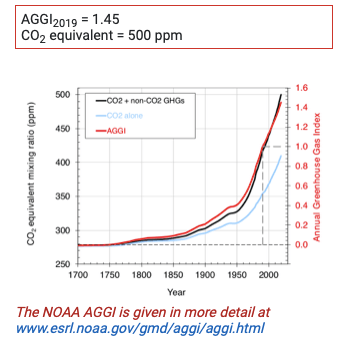
The graph below demonstrates the post-industrial trend in greenhouse gases, which are the primary drivers of global warming: The steeper/ the longer/ the more Earth heats up. Trump administration focus on fossil fuels at the expense of renewables steepens the vertical ascent eventually to Hot House Earth, unless CO2 is stopped and also removed to a certain extent. Removal of CO2 from the atmosphere is extremely challenging as current technology is anemic.
Synthetic Biology “Mirror Life” Threatens All Life
The past year witnessed a life sciences artificial development that threatens all life. Scientists from nine countries have warned about the creation of “Mirror Life” via laboratory synthesis, consisting of “mirror bacteria” and other “mirror cells” that scientists warn should not be allowed to continue. Mirror Life is composed of chemically synthesized molecules that are “mirror-images” of molecules naturally found on Earth. According to the Board: “A self-replicating mirror cell could plausibly evade normal controls on growth, spread throughout all ecosystems, and eventually cause the widespread death of humans, other animals, and plants, potentially disrupting all life on Earth. So far, however, the international community has not arrived at a plan to address this risk.”
AI
“The AI revolution has the potential to accelerate the existing chaos and dysfunction in the world’s information ecosystem, supercharging mis- and disinformation campaigns and undermining the fact-based public discussions required to address urgent major threats like nuclear war, pandemics, and climate change.” AI-aided design of new pathogens harmful to humans is of concern as state-sponsored biological weapons.
US Degradation of Public Health
The Board takes special aim at the US: “Perhaps of most immediate concern is the rapid degradation of US public health infrastructure and expertise. This dangerously reduces the ability of the United States and other nations to respond to pandemics and other biological threats.”
Autocratic Trends
Overlaying the above-mentioned flash points, the ongoing autocratic trend of world governments impedes international cooperation. It reduces accountability. And it acts like a “threat accelerant.” Autocrats are not reliable negotiators and can easily upset the proverbial apple cart, triggering unforeseen domino-effect disaster scenarios.
In the final analysis, eighty-five (85) seconds to midnight doesn’t leave much room for error.
On the Road to Nuclear War

On January 27, 2026, the editors of the Bulletin of the Atomic Scientists moved the hands of their famous “Doomsday Clock” to 85 seconds to midnight―the closest setting, since the appearance of the clock in 1946, to nuclear annihilation.
This grim appraisal has impressive evidence to support it.
The New Start Treaty, the last of the major nuclear arms control and disarmament treaties between the United States and Russia, expired on February 5, without any serious attempt to replace it. New Start’s demise enables both nations, which possess about 86 percent of the world’s 12,321 nuclear weapons, to move beyond the strict limits set by the treaty on the number of their strategic nuclear weapons (the most powerful, most devastating kind), thus enhancing the ability of their governments to reduce the world to a charred wasteland.
Actually, a nuclear arms race has been gathering steam for years, as nearly all the governments of the nine nuclear powers (which, in addition to Russia and the United States, include China, Britain, France, Israel, India, Pakistan, and North Korea) scramble to upgrade existing weapons systems and add newer versions. China’s nuclear arsenal is the fastest-growing among them. “The era of reductions in the number of nuclear weapons in the world . . . is coming to an end,” observed Hans Kristensen, a highly regarded expert on nuclear armament and disarmament. “Instead, we see a clear trend of growing nuclear arsenals, sharpened nuclear rhetoric, and the abandonment of arms control agreements.”
The U.S. government is currently immersed in a $1.7 trillion nuclear “modernization” program that President Donald Trump has championed and repeatedly lauded. As early as February 2018, he boasted that his administration was “creating a brand-new nuclear force. We’re gonna be so far ahead of everybody else in nuclear like you’ve never seen before.” In late October 2025, to facilitate the U.S. nuclear buildup, Trump ordered the Pentagon to prepare to resume U.S. nuclear weapons testing, which had ceased 33 years before. In line with the Comprehensive Test Ban Treaty of 1996, signed by 187 nations (including the United States), no nuclear power (other than the rogue nation of North Korea) has conducted explosive nuclear testing in over 25 years.
Another sign of the escalating nuclear danger is the revival of implicit and explicit threats to initiate nuclear war. Such threats, which declined with the end of the Cold War, have resurfaced in recent years. When angered by the policies of other nations, Donald Trump, Kim Jong Un, and Vladimir Putin have repeatedly and publicly threatened them with nuclear destruction. According to the U.S. government’s Voice of America, the Russian government, in the context of its invasion of Ukraine, issued 135 nuclear threats between February 2022 and December 17, 2024. Although some national security experts have discounted most Russian threats as manipulative rather than serious, in November 2022 Chinese leader Xi Jinping thought the matter serious enough to publicly chide his professed ally, Putin, for threatening to resort to nuclear arms in Ukraine.
Underlying this drift toward nuclear war are the growing conflicts among nations―conflicts that have significantly weakened international cooperation and the United Nations. As the editors of the Bulletin of the Atomic Scientists put it, rather than heed past warnings of catastrophe, “Russia, China, the United States, and other major countries have instead become increasingly aggressive, adversarial, and nationalistic.” Consequently, “hard-won global understandings are collapsing, accelerating a winner-takes-all great power competition and undermining the international cooperation critical to reducing the risks of nuclear war.”
But this is not necessarily the end of the story―or of the world.
After all, much the same situation existed in the second half of the twentieth century, when conflicts among the great powers fueled a dangerous nuclear arms race that, at numerous junctures, threatened to spiral into full-scale nuclear war. And, in response, a massive grassroots campaign emerged to save the world from nuclear annihilation. Although that campaign did not succeed in banning the bomb, it did manage to curb the nuclear arms race, reduce the number of nuclear weapons by more than 80 percent, and prevent a much-feared nuclear catastrophe.
Furthermore, in the early twenty-first century, there have been new and important developments. The worldwide remnants of the nuclear disarmament movement regrouped as the International Campaign to Abolish Nuclear Weapons and, joined by farsighted officials in smaller, non-nuclear nations, drew upon the United Nations to sponsor a series of antinuclear conferences. In 2017, by a vote of 122 to 1 (with 1 abstention), delegates at one of these UN conferences adopted the Treaty on the Prohibition of Nuclear Weapons (TPNW). Although all nine nuclear powers strongly opposed the TPNW―which banned the use, threatened use, development, manufacture, acquisition, possession, stockpiling, stationing, and installation of nuclear weapons―the treaty secured sufficient national backing to enter into force in January 2021. Thus far, it has been signed by 99 countries―a majority of the world’s nations.
In addition to the efficacy of public pressure for nuclear disarmament and the existence of a treaty banning nuclear weapons, at least one other factor points the way toward a non-nuclear future: the self-defeating nature—indeed, the insanity―of nuclear war. With even a single nuclear bomb capable of killing millions of people and leaving the desperate survivors crawling painfully through a burnt-out, radioactive hell, even a nuclear “victory” is a defeat. In the aftermath of a nuclear war, as Soviet leader Nikita Khrushchev is believed to have said, “the survivors would envy the dead.” It’s a lesson that most people around the world have learned, although not perhaps the lunatics.
Lunatics, of course, exist, and some of them, unfortunately, govern modern nations and ignore international law.
Even so, although we are on the road to nuclear war, there is still time to take a deep breath, think about where we are going, and turn around.


No comments:
Post a Comment