Protests that erupted across Iran and Eastern Kurdistan (Rojhilat) have now entered their second week, marked by mass participation. In cities across the country, people remain in the streets day and night. On the previous night, millions took to the streets in dozens of cities across Iran and Eastern Kurdistan, including Tehran, Isfahan, Shiraz, Qazvin, Rasht, Qom and Urmia.
Because of widespread internet shutdowns imposed by the authorities, access to real-time and verified information has become almost impossible. Independent human rights organizations say they are facing serious difficulties in collecting data from the field. Iran’s state-run television channels, meanwhile, have provided no information at all about the scale of the protests.
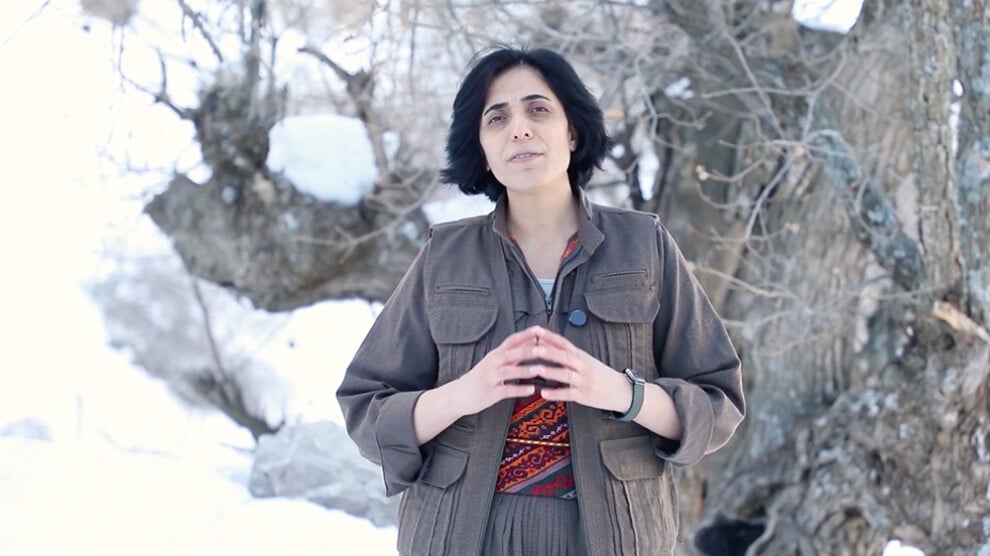
Peyman Viyan, Co-Chair of the Kurdistan Free Life Party (PJAK), said the latest wave of demonstrations has pushed Iran into a new phase in which the “Women, Life, Freedom (Jin, jiyan, azadî)” revolution is beginning to take concrete shape. She said the people no longer have even a second of tolerance left for the clerical regime.
Viyan said it is vital for the Kurdish people to act together and spoke to Yeni Özgür Politika about the protests in Iran and Eastern Kurdistan and about the future that now awaits the country.
The cycle of repression, uprising, violence and resistance in Iran has never stopped. As of December 28, 2025, the situation has entered a new phase. The protests that began in the Grand Bazaar in Tehran have spread across the country. What is happening in Iran? How do you assess these developments?
The peoples of Iran have expressed their demand for democratic governance and freedom at every opportunity throughout the entire history of the clerical regime. Especially over the past decade, even when public dissent appeared to subside at certain moments, it has in reality continued to exist through new forms and methods of resistance. Political, social, cultural, economic and freedom-seeking struggles against the forty-seven-year-old clerical regime have never stopped. I want to emphasize this clearly. The latest protests reflect a profound and widespread discontent among all the peoples living in Iran. These protests do not represent only bazaar merchants or segments of the middle class. There is a reality of an uprising (serhildan), a mass popular uprising, in which internal opposition forces, women and all forces of social resistance are taking part. The fundamental cause of this uprising is the regime’s policies of repression and brutality against the people. It is the uprising of societies that the regime seeks to strip of their will. This uprising can no longer be suppressed or ignored in any way. Yes, this uprising may have begun with the merchants in Tehran’s bazaar, but in essence it is an expression of the peoples’ collective rejection. Those who fail to read this reality correctly will be thrown into the dustbin of history.
This uprising has spread in waves to nearly all cities across Iran. With the people of Lorestan, Ilam and Malekshah rising up in protest, parallel actions also began in Kermanshah. The most striking feature of this phase is that all the peoples of Iran have become one voice. It is clear that this is not merely an economic issue; it represents a broader social stance and collective position. There is an uprising that goes far beyond shaking the execution-based regime. It reveals that in building what comes next, the decisive social force will be the peoples, women and youth. For this reason, they are in the streets day and night, ready to risk everything, including martyrdom, through democratic actions. We salute this magnificent and hope-filled stance of the peoples.
It is clear that all societies in Iran are openly and without hesitation calling for the overthrow, dismantling and transformation of Ayatollah Khamenei and the system of Velayat-e Faqih. Today, in cities, villages and universities across Iran, women, shopkeepers and young people are raising the slogan “Women, Life, Freedom” in every protest.
Even though the Iranian regime is attempting, through violence, to fracture the people’s unified stance and suppress their organized resistance, it will fail. Claims that this uprising is being provoked by external powers are an attempt to turn the truth upside down. The peoples of Iran have never accepted direction or intervention by outside forces. The regime may try to conceal this reality through various diplomatic contacts and relationships, but it cannot change the truth. The greatest weakness of the Iranian regime is the power of the people to stand against it from within.
For this reason, the regime is expending all its energy to manipulate the people’s just uprising. These actions should not be seen either as merely a revolt by bazaar merchants or as a single isolated uprising. This development is a continuation of the “Women, Life, Freedom” revolution. The people are fighting to free themselves once and for all from this dark system, which has lost its power in the Middle East and offers nothing to its own people except repression and violence. In this struggle, the Kurdish people are a decisive and influential force.
Iranian President Masoud Pezeshkian says the government is responsible for the current problems, while Ayatollah Ali Khamenei links the protests to economic hardship. Although he accepts that the protests are ‘legitimate,’ he also says those taking part will be ‘given the necessary response.’ If the government is being held responsible and the protests are legitimate, is it not contradictory to suppress the uprising through violence?
The Iranian regime has sustained itself through violence, repression and executions since the day it was founded. It is an execution-based regime, and its head is Ayatollah Ali Khamenei. Since taking office, the Iranian president has tried to conceal the truth and present a softer face to the people. Even when he speaks of solutions, his real aim is to calm public anger and prolong the life of the clerical regime. He has no legitimacy, and he has not been able to rescue Iran from this situation. His latest statements follow the same pattern. They are meant to dampen social reactions. What I am saying is this: the history of the Iranian regime is filled with massacres of the people. What else can one call the policies imposed on such a diverse society if not massacre and genocide? They have never understood the people’s uprisings. They have tried to subdue society through repression, torture, and execution. The people no longer have even a second of tolerance left for this regime. Through these uprisings, the regime has lost all legitimacy. Soft statements will no longer work. Most importantly, the most powerful blow to the Iranian regime has come through women’s leadership.
The people in no way want this regime and are moving toward revolution. Here, the model of the Democratic Nation gains even greater importance. Iran has a highly diverse social fabric; it is, in a sense, a geography of Aryan peoples and nations. The solution for the twenty-first century is the Democratic Nation model and path, in which peoples and women can live together in freedom and democracy. Women and all segments of society will succeed and win through this path. The people are now in victory.
In its latest statement, the PJAK said the root cause of the economic crisis is the regime’s plundering of Iran’s wealth, and that this wealth is being used to finance wars and to support radical groups in other countries. In your view, is this a structural crisis or a temporary one? What kind of solution do you propose?
This social crisis unfolding in Iran is certainly not short-term; it is the outcome of a long and deep-rooted struggle. all the country’s underground and above-ground wealth has been turned by the Iranian regime into an instrument of war. Even though the regime has continued trying to rebuild and strengthen its external networks after the most recent Israel–Iran war, it has failed. While it still feeds certain forces abroad, the rapidly weakening Iranian regime has not been able to regain its strength. Iran’s wealth has not been turned into a strategy that would benefit its own people, nor has it been placed in their service. Instead, it has been used to impose hegemony in the Middle East, to build what it calls a Shiite crescent, and to preserve its dominance in the region’s new geopolitical design. At home, this same wealth has been spent on forces such as the Islamic Revolutionary Guard Corps (Sipah-i Pasdaran), which have been turned into instruments of repression against the people. In this way, the regime has used these forces to keep society under control. The people have lost all their trust in this system. This is a continuation of the “Women, Life, Freedom (Jin, jiyan, azadî)” revolution, and it is laying the groundwork for a democratic Iran. The real solution is a democratic Iran. In this context, Abdullah Öcalan’s call for a Democratic Society is of critical importance. Only a democratic solution, in other words, the project of the Democratic Nation, can respond to the chaotic deadlock in Iran and to this uprising of the people.
In Iran, the Kurdish people are the fundamental force of freedom and the most advanced vanguard of democracy. No one can develop a genuine solution project without the Kurds. They are a central dynamic in shaping the Middle East and a decisive force for democracy. In Iran and Eastern Kurdistan, they are at the forefront of these uprisings.
We also say this to all forces in Eastern Kurdistan: we are determined to lead the people through the project of the Democratic Nation. Let us not shy away from unity and collective solidarity. We are living through a strategic period, a time that will determine the fate and future of the people. We attach great importance to standing together and acting jointly. There have already been some common statements in this direction, and they have had a positive impact on our people. As PJAK, we possess this strength and this perspective, and we are open to cooperation. Let us expand our joint march on the road to freedom.
In your latest statement, you say that your core philosophy is ‘Women, Life, Freedom,’ that you are pluralistic, and that you support all democratic forces against dictatorship. What remains today from the ‘Women, Life, Freedom’ resistance? What is needed to build a lasting and democratic system against dictatorship in Iran?
The past, the present and the future constantly illuminate one another. When viewed through historical consciousness, what is happening in Iran today becomes clear. As PJAK, Abdullah Öcalan’s profound perspective for this dark age is a major guide for us. It offers a clear path for building both the present and the future of Iran through the free future of women and of the peoples. Only this approach can give direction to the “Women, Life, Freedom” revolution and to its historical course. Today, the revolution in Iran has entered a phase in which it is taking concrete shape. It is moving at an irreversible pace. The “Women, Life, Freedom” revolution has laid out all the foundations of the real revolution. It has struck blows against sexism, nationalism, religious dogmatism and the pseudo-scientific ideologies built upon them. The mentality of the Iranian regime has been shaken and brought to the edge of collapse. The regime targets women most of all because it fears a future of freedom being shaped by women’s hands. They are the ones determining the future, the revolution and the uprising. Women’s freedom is the freedom of all society and all people. In the uprising of “Women, Life, Freedom” that began in 2022, the Kurdish, Persian, Azerbaijani, Baloch, Arab, Mazandarani and Talysh peoples of Iran rose up. Today, these people are still standing. In all the actions that developed during this process, the same slogan was raised. These protests spread from Eastern Kurdistan across Iran and then to the whole world. Women supported the movement by burning their headscarves and cutting their hair under this slogan, and today they continue to give it life in the same way. Abdullah Öcalan’s powerful formula has become the philosophy and guiding principle of a new women’s revolution around the world. Attempts by various circles to appropriate this slogan or replace it with new ones are empty. As PJAK, we have the strength to lead this new hope for revolution, spreading from Eastern Kurdistan across Iran.
As PJAK, what is your message to the Kurdish people and the peoples of Iran for the future?
We have entered 2026 through this uprising. We have stepped into the new year by raising the struggle through the shared stance and demands of the peoples living across Iran. Only through this spirit of resistance can real gain be achieved based on freedom. No one should remain a bystander to this people’s uprising; everyone must take part. All segments of society, peoples, women, feminists and ecological movements, must be present in the squares of freedom. They must take their place within the growing resistance and must not abandon the spaces of struggle. Let us fill the streets with many colors of our social power. This uprising must not be treated as a short-term moment but must be transformed into organized struggle. We believe that everyone will be in the streets and in action, organized around the demand for freedom and democracy. Together with all the peoples of Iran, we must organize ourselves on the basis self-defense. This process has now reached a point of no return. The peoples, women and youth of Iran see their future in a democratic system of governance. For this reason, all the peoples who are leading the uprising in Iran must come together. We are determined to provide leadership, and we stand with our people. We have the strength to lead the construction of a democratic Iran. The people will secure their freedom by governing themselves through democratic administrations based on the Democratic Nation model.


No comments:
Post a Comment