.png)
Just Peace Advocates (CANADA) strongly condemns the imminent war on Iran planned by the United States of America. Just Peace Advocates stated that such an action is both illegal and unjust, representing a serious threat to peace and stability in the region.
The Threat of War
The United States is currently threatening to launch a devastating war on Iran in the near future. Just Peace Advocates expresses deep concern over these developments and calls for an immediate halt to any military escalation.
In the last month, the United States and Israel have made unjust demands on Iran which, if not met, a US war on Iran will ensue.
The three demands, zero uranium enrichment, curbing Iranian missile defense capacities to three hundred kilometers and ending support for the axis of resistance to the Zionist entity in western Asia. These demands are echoed by the Zionist entity, Israel.
The United States and Israel are nuclear powers and have no right to impose nuclear limits on the sovereign nation of Iran. It is common knowledge that Iran does not want nuclear arms and is ready to limit uranium enrichment with international supervision. These issues should be resolved by diplomatic means: war and the threat of war must be abandoned by the US President, Donald Trump.
Iranian missile defences are capable of hitting Israel and all American military bases in western Asia. Iran as a sovereign nation has the unalienable right to defend itself under article 51 of the United Nations Charter by any means necessary, particularly in the light of Israeli and American threats to attack and impose an illegal regime change.
It is illegal and unreasonable for the United States and Israel to require Iran to stop all support granted to the Resistance Axis in Lebanon, Yemen, Gaza, Syria, and Iraq. This support, as it exists, results from its agreements with the Resistance movements against the illegitimate Zionist entity. Opposition to Zionist colonialism, and all settler colonialism, should be commended.
Just Peace Advocates calls for deescalation, negotiations which respect international law, including the sovereign right of Iran to defend itself with all its advanced military assets and the right to work in tandem with all military and political opponents to the illegitimate Zionist occupation of Palestine.
A war on Iran would violate its sovereignty and the principals of Nuremberg established by the International Military Tribunal which established the legal precedent that launching a war of aggression is the “supreme international crime”. Defined as “crimes against peace,” this included planning, preparing, or initiating wars in violation of international treaties and sovereign nations.
The United States must abandon it role as an aggressor and negotiate with Iran respecting its sovereignty recognized by International Law.
.png)
Mark Carney has endorsed the US/Israeli war on Iran. Please tell the Prime Minister to condemn this effort to overthrow Iran's government or even balkanize the country in service of US imperialism and genocidal Jewish supremacy.
Just Peace Advocates
Copy and paste this email to friends to spread the word:
Subject: Send a letter: Condemn Canadian support for US/Israeli war on Iran
Body:
Friend,
I wrote a letter for the Action Network letter campaign: Condemn Canadian support for US/Israeli war on Iran .
Mark Carney has endorsed the US/Israeli war on Iran. Tell the Prime Minister to condemn this effort to balkanize Iran in service of US imperialism and genocidal Jewish supremacy.
Can you join me and write a letter? Click here: https://actionnetwork.org/
Thanks!
“We are going to destroy their missiles and raze their missile industry to the ground. It will be totally, again, obliterated,” Trump said.
February 28, 2026 at 8:22 am

As explosions rocked Tehran and Israel announced “preemptive” strikes against Iran, US President Donald Trump also confirmed launching “major combat operations” in the Islamic republic, Anadolu reports.
“Our objective is to defend the American people by eliminating imminent threats from the Iranian regime,” Trump said in a video posted on his Truth Social account.
The president vowed to destroy Iran’s missiles, raze its missile industry to the ground and annihilate the navy, reiterating that it cannot have a nuclear weapon.
“We are going to destroy their missiles and raze their missile industry to the ground. It will be totally, again, obliterated,” Trump said.
The attacks come as talks over Iran’s nuclear program have been ongoing under Oman’s mediation. A new round of talks in Geneva ended on Thursday.
Last June, the US struck three Iranian nuclear sites towards the end of the 12-day Israel-Iran war.
Iran termed the strikes a violation of sovereignty, vowed to respond and launched retaliatory strikes.
At least 85 people, including students, were killed after Israeli strikes targeted a girls’ primary school in the city of Minab in southern Iran’s Hormozgan province on Saturday, Feb. 28, according to Iranian officials.
Footage from the aftermath of the attack was released by the Iran Ministry of Culture and Islamic Guidance, showing the destroyed school building and smoke rising at the site.
The US and Israel launched a joint attack on Iran early Saturday, claiming it was meant to remove “threats” posed by the Iranian “regime.” Separate video statements were released by Israeli Prime Minister Benjamin Netanyahu and US President Donald Trump, which also hinted at supporting efforts for a change in government in Tehran.
Iran termed the strikes a violation of sovereignty, vowed to respond and launched retaliatory strikes.
The developments came as Oman was mediating talks between Washington and Tehran on Iran’s nuclear program, and the latest round was held in Geneva on Thursday.
The death toll in a US-Israeli strike on a girls school in southern Iran has risen to 115, Iran's state-run FARSNA has reported
28 February, 2026 23:26 PM

Videos circulating online showed extensive destruction to the school building
The death toll from an attack Saturday on a school in Iran's south has risen to 115, according to state-affiliated Farsna, after the US and Israel launched strikes on the Islamic republic.
Previously, the Iranian Red Crescent said the death toll from a strike on Saturday that hit a school in the country's south had risen to 108.
"The number of student martyrs at Minab School has reached 108, and relief and debris removal operations are still ongoing," a spokesperson for the organisation said.
The Pentagon did not immediately respond to a request for comment, but a CENTCOM spokesperson was quoted by The New York Times as saying: "We are aware of reports concerning civilian harm resulting from ongoing military operations. We take these reports seriously and are looking into them.
"The protection of civilians is of utmost importance, and we will continue to take all precautions available to minimise the risk of unintended harm."
Iran's President Masoud Pezeshkian said "this barbaric act is another black page in the record of countless crimes committed by the aggressors".
The Iranian Red Crescent said on Saturday evening that at least 201 people had been killed and 747 injured in the attacks.
Iran’s Tasnim News Agency had earlier reported that a girls' primary school in the province was attacked, while videos circulating online showed extensive destruction to the school building.
Reports indicated that approximately 170 students were inside the school at the time of the strike.
Iranian Foreign Ministry spokesperson Esmail Baghaei also spoke about the deadly attack on the school.
Hormozgan Province hosts several Iranian naval bases.
Madmen Trump and Netanyahu set the Middle East on fire
In a reckless push for regime change, Donald Trump and Benjamin Netanyahu set the Middle East on a dangerous path to a long and bloody war.
The New Arab Editorial
28 Feb, 2026

Trump, a self-styled peace president who had campaigned for years against further military entanglements in the Middle East, has proven himself every bit as warmongering as the worst of the neoconservatives.
In the early hours of Sunday, America’s madman-in-chief Donald Trump and his foreign policy handler Benjamin Netanyahu launched an unprovoked war on Iran, setting the entire Middle East ablaze in a strategic gamble that is both criminal and potentially self-defeating.
The opening salvo, aimed at decapitating the regime in Tehran, appears to have failed, with the top leaders of the Islamic Republic said to be alive and unharmed.
That situation could still change. While Trump donned a USA baseball cap in his declaration of war, Netanyahu vowed in a speech infused with biblical verses to pursue regime change in Iran, warning the war could cost American and Israeli lives. In other words, this points to a relentless, all-in war, one far closer in scale to the US-led invasion of Iraq in 2003 than to any limited or symbolic strike.
This escalation comes after weeks of diplomatic talks that, while slow, had been making incremental progress, raising the inevitable question of whether war was the intention all along.
It also comes barely a year after the 12-day war with Iran in 2025, which Trump repeatedly claimed as a decisive success. If that campaign achieved its stated objectives, the question now then is why return to war at all?
Iran has responded by striking targets across the region, including in Abu Dhabi and Bahrain, and reportedly in Iraq and Saudi Arabia.
The Iranian objective is clear: to raise the cost for the US and its allies of continuing this campaign, and to pressure regional actors to dissuade Trump from pursuing his regime-change project to the bitter end.
Trump, a self-styled peace president who had campaigned for years against further military entanglements in the Middle East, has proven himself every bit as warmongering as the worst of the neoconservatives. While he and Netanyahu speak of helping the Iranian people overthrow their “tyrannical” rulers, using the language of colonial hubris that has learned nothing from history, US and Israeli strikes have hit civilian sites, with dozens said to have been killed at an Iranian school on Saturday.
Netanyahu, for his part, has recycled the familiar rhetoric of the US, Israel and the so-called “free world” joining forces to defeat terror. Yet the domestic fronts in the United States and Israel are deeply divided over this war, and over the fate of the regime in Tehran. There is no clear popular mandate in any of these three countries for foreign-imposed regime change.
Alborz Ghandehari
This war also reinforces a growing suspicion, including within segments of Trump’s own MAGA base, that he is waging conflict on Israel’s behalf without a clearly defined American strategic interest. Far from strengthening Washington’s position, such a war risks draining US military resources, undermining its ability to confront peer competitors, and further destabilising its already fragile standing in the Middle East.
What exists instead is uncertainty and the real prospect of a protracted, deadly conflict that could drag on for years rather than the days or weeks imagined in the fantasies of Trump and Netanyahu.
It is also legitimate to ask whether this war serves domestic political purposes. With both men facing mounting crises and scandals at home, the temptation to escalate abroad cannot be dismissed. For leaders who routinely conflate national interest with personal survival, the distinction between the two is often blurred.
We are still in the opening hours of this onslaught and its repercussions. But one fact is already evident: two Western leaders have launched yet another war on a Muslim country on dubious grounds, once again setting the region alight. And the worst may still lie ahead.
The New Arab Editorial represents the collective voice of The New Arab’s editorial team, presenting views that promote authentic discourses on the MENA region and beyond.
Ali Abunimah
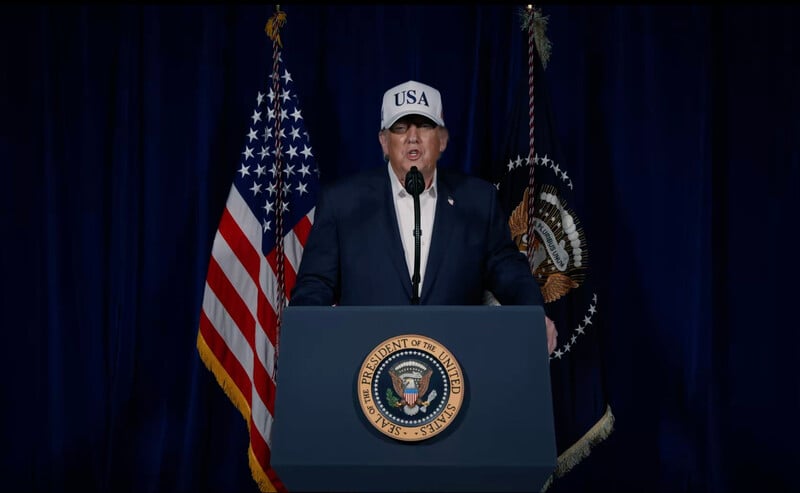
US President Donald Trump announced the joint Israeli-American attack on Iran, early Saturday, 28 February. @realDonaldTrump via CNP
As the US and Israel launched an all-out war on Iran, they did so amid shrinking American public support.
As recently as last week, a YouGov poll found that just a quarter of Americans wanted a war against Iran.
On Friday, a Gallup survey showed American sentiment shifting decisively towards the Palestinian people and away from Israel.
Forty-one percent of Americans now sympathize more with the Palestinians, while 36 percent sympathize more with the Israelis, according to a new Gallup survey.
The poll reverses the firm’s findings from a year ago and confirms long-term trends.
Last year, a Pew survey indicated that more than half of people in the United States held a negative view of Israel – an 11-point surge since 2022, according to that organization.
Loss of support across the board
Gallup notes that over the last 25 years, “Israelis consistently held double-digit leads in Americans’ Middle East sympathies, with the gap averaging 43 points between 2001 and 2018.”
But that lead began to erode from around 2019, and Israel’s dramatic loss of support has only accelerated during Israel’s US-backed genocide in Gaza.
Fifty-seven percent of Americans favor an independent Palestinian state, according to Gallup, close to the highest level of support ever recorded by the firm.
There remains a clear partisan gap: a whopping 65 percent of Democrats sympathize more with Palestinians, while just 17 percent favor the Israelis.
Support for Israel among Republicans remains strong: Those sympathizing more with Israelis peaked at 87 percent in 2018, but that number now stands at 70 percent – the lowest level since 2004.
The greatest shift has been among so-called independents, according to Gallup: “By 41 percent to 30 percent, independents say they sympathize more with the Palestinians than the Israelis, whereas in all prior years, they were more sympathetic toward the Israelis, including by 42 percent to 34 percent last year.”
In recent years, a clear generational shift has emerged, with younger Americans tending to support Palestinians. But as Gallup notes in its new survey, “Americans of all age groups have grown more sympathetic to the Palestinians in recent years.”
Yet younger Americans remain the strongest reservoir of support for Palestine. “Among those aged 18 to 34, 53 percent say they sympathize more with the Palestinians, marking the first time a majority of this age group has expressed this view,” according to Gallup.
Meanwhile, a record low of 23 percent of young adults now sympathize more with the Israelis.
Democrats chose genocide over White House
Eroding support for Israel should shape policy – if democracy works as taught in civics class.
But the Democratic Party under President Joe Biden preferred to sacrifice its chances of re-election in 2024 to maintain its support for Israel’s genocide despite an overwhelming majority of Democratic voters favoring an arms embargo.
An internal “autopsy” of the 2024 Democratic campaign has reportedly concluded that the party’s support for the Gaza genocide played a major role in its candidate Kamala Harris losing the election.
The American-Arab Anti-Discrimination Committee is demanding that the party release the report, noting that the advocacy group had “repeatedly warned that a political reckoning would be inevitable if the US did not end its financial, military and diplomatic backing of Israel’s indiscriminate bombing of Gaza.”
Still, the most senior elected Democrat, New York Senator Chuck Schumer, recently made clear that his priority remains ensuring that American money and weapons keep flowing to the genocidal regime in Tel Aviv.
The “Epstein regime” does what it wants
Eroding support for Israel may eventually affect policy, but public opposition has not restrained President Donald Trump from launching another American war.
Trita Parsi of the Quincy Institute argued that Israel’s dwindling support pushed Washington and Tel Aviv to speed up their attack.
“It is difficult to overstate the significance of this,” Parsi commented regarding the Gallup poll the day before the American-Israeli joint assault. “This is a key reason why Israel – and its supporters in the US – have a sense of desperate urgency when it comes to war with Iran and annexation of Palestine.”
“The window for these aggressions with US support is closing,” Parsi added.
Tehran University professor Mohammad Marandi – speaking from the Iranian capital under attack – called the unaccountable elite responsible for this war the “Epstein regime.”
From Munich to Tehran: Echoes of appeasement and lessons of power drift

Security teams on duty as hundreds of citizens participate in the celebrations marking the 47th anniversary of the 1979 revolution led by Ayatollah Ruhollah Khomeini in Iran, gathering at Tehran’s Azadi Square on February 11, 2026. [Fatemeh Bahrami – Anadolu Agency]
by Jasim Al-Azzawi
February 28, 2026

The uneasy negotiations between the United States and Iran are unfolding under the shadow of a long historical truth: great-power systems rarely collapse in a single dramatic moment. They erode. They drift. They unravel—through hesitation, miscalculation, and the quiet accumulation of small crises that go unanswered until answering them becomes catastrophic.
The European descent into war in the 1930s remains the starkest example of how incremental provocations, when met with divided or delayed responses, can push nations toward a confrontation none of them originally sought. As the historian A.J.P. Taylor observed, WWII was a war that no one willed, planned, or wanted. Yet it came anyway, because those with the power to stop it chose ambiguity over clarity at every critical juncture.
The comparison with today is not moral. Iran is not Nazi Germany, and the multipolar world of 2026 is not the shattered post-Versailles order. But the incremental escalation and the seductive trap of strategic ambiguity echo with unsettling clarity.
The 1930s: A study in calibrated provocation
When Hitler came to power in 1933, he did not plunge Europe into war. He probed it. Step by step, test by test, each gamble bolder than the last and advanced because he was permitted to advance.
In 1936, German troops marched into the demilitarized Rhineland—a zone the Treaty of Versailles had explicitly forbidden them to enter. Hitler’s own generals warned him that Germany was unprepared for war; he reportedly told them to reverse course if France intervened. France did not intervene. Britain expressed concern. The gamble paid off.
In 1938, the Anschluss of Austria was carried out without resistance. The Sudetenland crisis ended at Munich with Neville Chamberlain’s infamous “peace for our time.” By 1939, the dismantling of all Czechoslovakia revealed the truth that the historian Ian Kershaw would later crystallize: appeasement did not buy peace. It bought momentum.
By September 1939, when Hitler crossed into Poland, and the Allies finally drew a line, it was too late. The crisis had grown into something far more dangerous than it had been at the start—not because the Allies lacked intelligence or understanding, but because they lacked the will to act when the cost of action was still manageable.
The tragedy of the 1930s was not a failure of intelligence. It was a failure of clarity and resolve.
READ: Why Trump’s war on Iran will fail
The modern parallel: Incrementalism in the US–Iran standoff
The US–Iran confrontation today is shaped by a structurally similar logic. Iran does not seek open war. It probes. It tests. It advances in calibrated steps to shift the balance of power, while remaining below the threshold that would trigger a decisive American response.
Consider the pattern: increasing uranium enrichment to near-weapons-grade levels; installing advanced IR-6 and IR-8 centrifuges; restricting IAEA inspectors while stockpiling enriched material; expanding proxy networks across Iraq, Yemen, Syria, and Lebanon; probing American red lines through deniable attacks on US-linked assets. Each move is significant, and in theory, each move is reversible. Each move, as Chicago University Professor of Political Science Mearsheimer would frame it, is designed to maximize leverage while minimizing the risk of catastrophic retaliation.
“States that are not satisfied with the existing distribution of power are called revisionist states. They want to change the rules of the international order in their favor.” — John Mearsheimer, The Tragedy of Great Power Politics.
Iran is a revisionist state operating within a system still dominated by American power. Its strategy is not suicidal boldness but patient, incremental pressure, similar to the pressure Hitler applied between 1933 and 1939. Not confrontation but erosion.
Meanwhile, Washington oscillates. Review the US sequence: Pressure, then diplomacy; withdrawal from the JCPOA, then attempted re-engagement; targeted strikes, then strategic restraint. Domestic divisions, shifting administrations, and the perpetual fear of a wider regional war have produced exactly what the 1930s produced: mixed signals that each side interprets differently. For the United States, it is a restraint. For Tehran, it reads as hesitation. What America calls prudence, Iran calls permission.
The result is a strategic ambiguity that serves neither side and emboldens the wrong calculations.
The risk of a modern “Poland moment”
The takeaway from 1939 isn’t the inevitability of war, but the fragility of systems. A structure can only withstand a finite number of shocks before a single miscalculation triggers a collapse that no one intended.
“Wars begin when governments believe the price of aggression is cheap.”
— Robert Gilpin, War and Change in World Politics.
In the US–Iran context, analysts warn that such a moment could materialize through any one of three vectors: a nuclear threshold crossing that eliminates Washington’s strategic window; a miscalculated proxy attack that kills Americans in numbers that make restraint politically untenable; or an escalation in the Strait of Hormuz—the chokepoint through which roughly 20% of the world’s oil passes—that draws in regional actors faster than diplomacy can contain.
The ‘brinkmanship’ strategy with Iran: A calculated approach
None of these scenarios requires deliberate intent. Like the events of the late 1930s, they could emerge from accumulated misjudgements. If Tehran misreads American tolerance, Washington misreads Iranian resolve, or a third party triggers a spiral beyond Washington’s or Tehran’s control. As the political scientist Graham Allison warned in the context of great-power rivalry, the structural forces at play are often more powerful than the intentions of the actors within them.
“The Thucydides Trap is the severe structural stress caused when a rising power threatens to displace a ruling power.” — Graham Allison, Destined for War.
Clarity as strategy—not confrontation as destiny
The 1930s teach a single, insightful lesson: ambiguity is not a strategy. It is a drift. And drift is what transforms manageable crises into unmanageable ones, local provocations into continental wars, and miscalculations into catastrophes.
For today’s policymakers, the historical imperative is to choose clarity over confrontation: clear boundaries, clear consequences, and clear diplomatic objectives. Negotiations with Iran may succeed or fail on their own merits. But they cannot succeed when conducted through wishful thinking, when red lines mean nothing, when each concession is rationalized as buying time rather than acknowledged as surrendering ground.
“You can always count on Americans to do the right thing—after they’ve tried everything else.” — attributed to Winston Churchill.
The European powers of the 1930s believed each concession would buy peace. In reality, each concession bought momentum—momentum toward a war they could have prevented had they chosen clarity over comfort even once, before it was too late.
The cost of clarity, then as now, is always lower than the cost of waiting for the next step.
The views expressed in this article belong to the author and do not necessarily reflect the editorial policy of Middle East Monitor.
