The “War on Drugs” Had More to Do With War Than With Drugs
On July 14, at a summit in Orlando, U.S. Drug Enforcement Administration (DEA) Director Terrance Cole declared that Mexican cartels and the Mexican government are “one and the same.” He offered no evidence. Mayor Claudia Sheinbaum demanded that evidence be presented; none was. Mexico’s Security Cabinet responded with figures—tens of thousands of arrests, hundreds of tons of narcotics seized—while Cole’s office remained silent. The accusation was never intended to be verified. It was merely meant to be made.
Anyone who has studied the half-century arc of Washington’s “war on drugs” recognizes this maneuver instantly. The research notebooks Addicted to Imperialism , produced by the Tricontinental Institute in conjunction with partner research centers across Latin America, document the pattern with precision: the “narco-state” label is not a discovery, but a weapon, aimed with remarkable consistency at governments that assert their sovereignty and omitted, with equal consistency, in the case of governments that submit. Declaring a state indistinguishable from a cartel is the prerequisite for treating it as a target. When the White House asserted in early 2025 that Mexican traffickers maintained an “ intolerable alliance ” with the Mexican government, and when Cole now elevates that to the level of identity—government and cartel as a single entity—the groundwork is being laid, publicly, for intervention against a sovereign neighbor governed by a party that Washington cannot control.
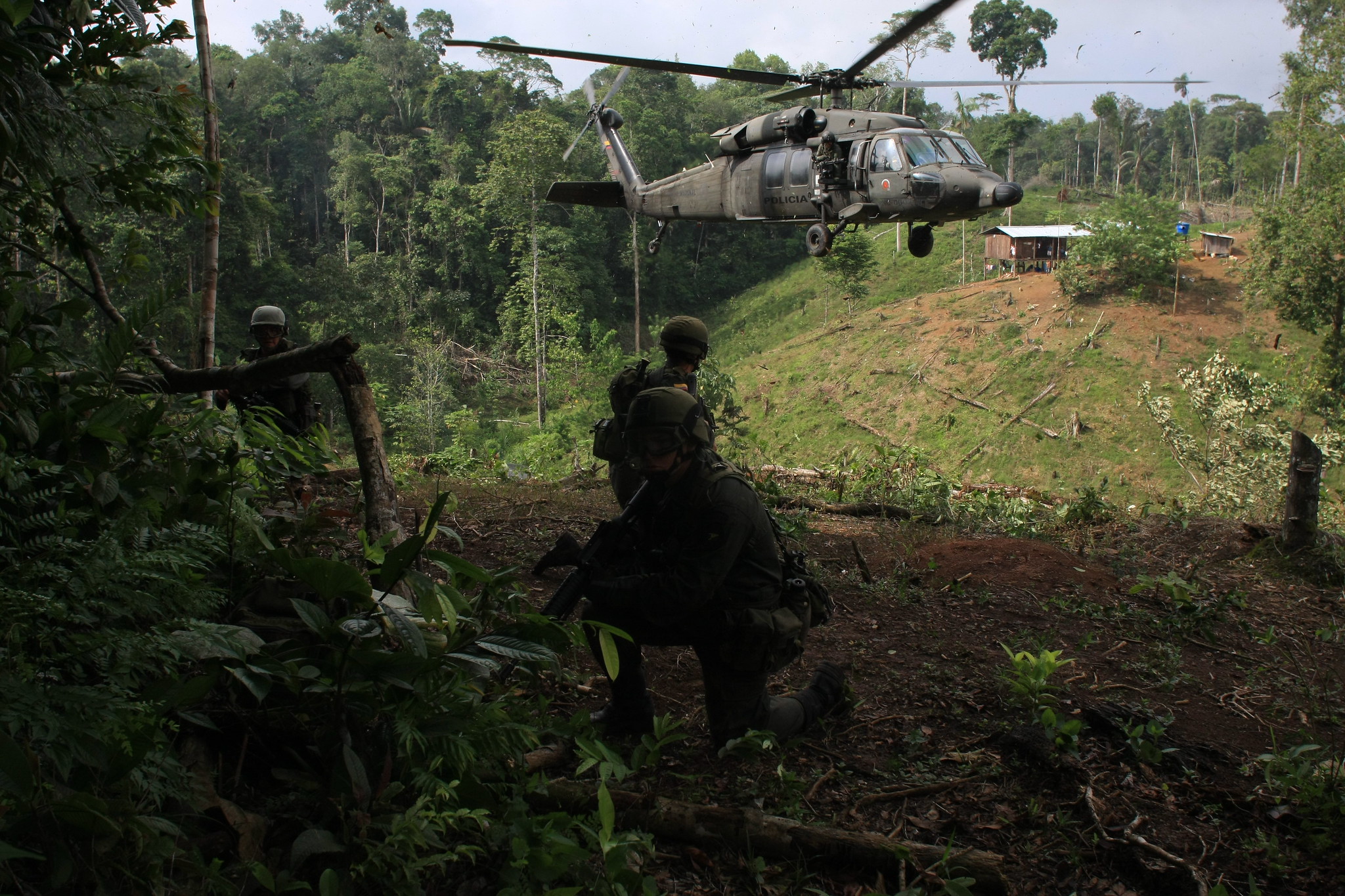
Let us first consider what fifty years of this “war” have actually produced. The DEA’s own leadership reported in May 2024 that the Sinaloa and Jalisco cartels alone have associates and facilitators in all fifty U.S. states. Following Plan Colombia—the largest anti-narcotics program in history, which consumed more than ten billion U.S. dollars—potential cocaine production in Colombia increased from 1,053 tons in 2016 to 1,738 tons in 2022, along with a record amount of land dedicated to coca cultivation. Between 2001 and 2024, Washington channeled more than twenty billion dollars in “counter-narcotics assistance” to Latin America and the Caribbean—three-quarters of that sum through the Pentagon. That last figure says it all: this was never a failed public health program. Rather, it was a military assistance program that succeeded: it managed to militarize the hemisphere, integrate US agencies and troops into the internal security of nominally sovereign states, and criminalize the peasantry, while the profits were laundered north.
Venezuela is the definitive case. In March 2020, Attorney General William Barr displayed “Wanted” posters of President Nicolás Maduro, offering fifteen million dollars for the head of a head of state and accusing him of leading a “ Cartel of the Suns ” that serious analysts have never been able to locate outside of US accusations. The evidence was gathered by the DEA itself through Operation Money Badger , a clandestine infiltration of Venezuela carried out—according to the agency’s own internal memos—unilaterally and without notifying Venezuelan authorities; that is, illegally. These fabricated accusations became the justification for the assault on Caracas in January 2026 and the kidnapping of a sitting president.
And what followed the kidnapping? Not a single gram less of cocaine reached the streets of the United States: UN data itself shows that Venezuela was never a significant production or transit route compared to the Pacific corridor that runs through Washington’s closest allies. What followed, instead, was oil. Within days, the White House announced that Venezuela would deliver between 30 and 50 million barrels of crude, traded by US officials, with the proceeds deposited into accounts controlled by the United States. New Treasury licenses opened Venezuelan oil fields to Chevron, ExxonMobil, BP, and Shell. Trump himself dispensed with the pretext, promising that the largest US oil companies would come in, invest billions, and begin extracting from the largest proven reserves on the planet. Executives were welcomed at the White House as the true dividends of the “anti-drug” operation were divided. Rarely has an empire confessed its motive so quickly.
Brazil exhibits the same mechanism in its legal form. In May, Washington designated Comando Vermelho and the PCC as “foreign terrorist organizations,” placing Brazilian criminal gangs in the same legal category as Hamas; in July, Treasury sanctions were imposed. Brazil did not request this “assistance.” The designations unilaterally extend US anti-terrorism law over the Brazilian economy—any bank, company, or citizen with an indirect link now risks prosecution in the US—and coincide with punitive tariffs and sanctions against a Brazilian Supreme Court justice, all directed against a progressive government that dared to prosecute a former president who was plotting a coup and to strengthen ties with the BRICS. The “fight against organized crime” here functions as a jurisdictional appropriation of South America’s largest economy.
Now compare this severity with Washington’s attitude toward its allies. Juan Orlando Hernández, president of Honduras from 2014 to 2022, was convicted by a U.S. federal jury of conspiring to import hundreds of tons of cocaine—a man prosecutors claimed had received bribes from El Chapo himself—and sentenced to 45 years. On December 1, 2025, Trump granted him a full pardon , freeing him while simultaneously endorsing Hernández’s party in the Honduran elections and labeling the Honduran left “narco-communists.” The cornerstone of the most ambitious drug trafficking prosecution in the history of the U.S. Department of Justice was demolished overnight, for electoral expediency. In Ecuador, meanwhile, Daniel Noboa—whose “Plan Ecuador” has brought with it states of emergency, immunity for U.S. military personnel, a mercenary alliance with Erik Prince of Blackwater, and record cocaine exports through the country’s ports, amid persistent allegations of official complicity with drug trafficking and electoral manipulation—is hailed as Washington’s model partner, despite troubling events such as the June 14 assassination of the prosecutor investigating the extrajudicial killings of Ecuadorian fishermen by U.S. forces. The lesson could not be clearer: drug trafficking is forgivable, even excusable, in an ally. Sovereignty is the only unforgivable crime.
That is the pattern, and it holds true throughout a century of cases documented in the notebooks of *Addicts to Imperialism *: Bolivia and Venezuela expelled the DEA for its role in attempted coups and quickly became “narco-states”; Honduras, under the rule of a drug trafficker, and Ecuador, under that of a complacent heir, remained “security partners.” The severity of the accusation corresponds to a government’s independence, never to its relationship with drugs.
According to all the indicators it has set—production, consumption, cartel power, deaths—the United States’ War on Drugs is a failure of historic proportions, and its architects know it: consumption has increased, production has increased, and cartels operate in every U.S. state, financed by American financial institutions and armed by American gun manufacturers. But judging by its actual function, it has been a fifty-year success: a permanent and elastic pretext for surveillance, sanctions, lawfare, the establishment of military bases, and now, invasion. Today, that pretext is being weaponized more brazenly than ever: to kidnap a president and seize his country’s oil, to subject Brazil’s economy to anti-terrorism legislation, to declare Mexico’s elected government a cartel. A serious war on the drug economy would begin in Washington, on Wall Street, and in the gun shops of the southern United States. Instead, what Latin America faces is a war against its right to self-governance—and the region’s independent governments, from Mexico City to Brasilia and Caracas, are not the accused. They are the intended victims.
This article was produced by Globetrotter.

No comments:
Post a Comment