AU
Dirty gold overtakes cocaine as crime’s cash machine

Illegal gold mining has become one of organized crime’s most profitable businesses, surpassing cocaine as a source of revenue for some criminal groups and exposing financial institutions, refiners and governments to a rapidly growing illicit finance threat.

For decades, cocaine defined organized crime across Latin America. Today, soaring gold prices and weaker enforcement have transformed illegal mining into a lower-risk, higher-return enterprise, according to Julia Yansura, Program Director for Environmental Crime and Illicit Finance at the FACT Coalition.
“Illicit gold has become a low-risk, high-reward business,” Yansura told MINING.COM. “It generates enormous profits with a much lower likelihood of detection or prosecution than the illicit drug trade.”
The shift reflects a broader transformation in organized crime. Rather than relying primarily on narcotics, criminal organizations have diversified into businesses that include illegal mining, extortion, weapons trafficking and other illicit activities, choosing whichever markets offer the highest returns with the lowest chance of detection.
Governments, however, have been slower to adapt. Decades of investment in anti-narcotics enforcement have left illegal mining comparatively overlooked, allowing criminal groups to expand into a business that finances broader criminal operations while causing extensive environmental damage.
Ecuador has become one of the clearest examples of that shift. The country’s 2026-2029 National Security Plan elevates illegal mining from an environmental and regulatory problem to a national security threat after concluding criminal gangs have infiltrated the gold supply chain from extraction to export.
Authorities say illicit gold now finances organized crime, fuels money laundering and is increasingly replacing cocaine as a key source of criminal revenue.
Laundering gold
Unlike cocaine, illegally mined gold can be integrated into legitimate supply chains, making it uniquely attractive to organized crime.
Yansura said illicit gold is often laundered close to the mine using forged paperwork or false identities before entering legitimate markets. By the time refiners, traders or banks encounter the metal, it frequently appears legitimate on paper.
Another vulnerability is what she calls the “hand-carry” loophole. While travellers entering or leaving the US must declare cash exceeding $10,000, comparable reporting requirements do not apply to gold bars, allowing criminal organizations to move high-value gold across borders with far less scrutiny.
The financial risks extend well beyond mining regions. Although transactions near illegal mines often involve cash, gold or cryptocurrency, exports are typically financed through the international banking system, exposing financial institutions to illicit finance risk.
A recent WWF-UK and Themis survey of more than 600 financial professionals in 22 countries found that more than 80% of financial institutions are exposed to illicit finance risks linked to illegal mining, yet 40% have not taken steps to address them.
The exposure is particularly significant in the US. FACT Coalition research found the country is the largest destination for Colombian gold exports, even though an estimated 80% of Colombia’s gold is believed to be illegally or criminally sourced.
Yansura said the response should focus as much on financial crime as environmental enforcement. She called for stronger beneficial ownership rules to prevent shell companies from concealing illicit transactions, making transnational illegal gold mining a predicate offence for money laundering under US law and closing customs loopholes that allow high-value gold to cross borders with limited disclosure.
“Governments need to follow not just the gold, but the money,” Yansura said. “That’s how we disrupt the criminal networks behind this trade rather than simply addressing the immediate environmental consequences.”
Gangs hijack Ecuador’s gold mining supply chain
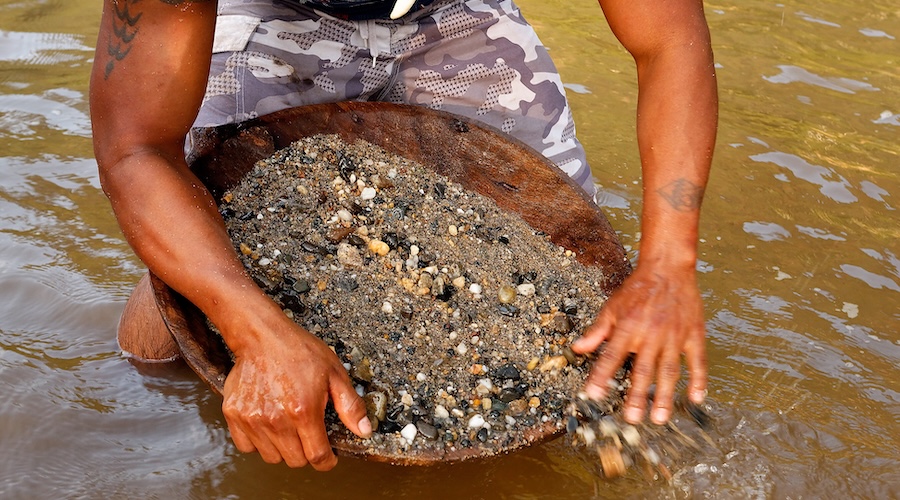
Ecuador has elevated illegal mining to a national security threat after concluding that criminal gangs have infiltrated the country’s gold supply chain, from extraction to export, turning the sector into a major source of financing for organized crime.
The 2026-2029 National Security Plan identifies illegal mining as a strategic security challenge rather than simply an environmental or regulatory issue.
The government says criminal organizations use illicit gold production to launder drug trafficking proceeds, while financing mining operations with machinery, chemical supplies and armed protection.
Ecuador’s new strategy reflects growing concern that illegal mining has become one of organized crime’s most lucrative businesses in the country, fuelling violence, money laundering and environmental destruction while exposing weaknesses across the local mineral supply chain.
Entering supply chains
The plan identifies Los Lobos as Ecuador’s dominant criminal organization in illegal mining and says the gang has expanded across the gold value chain. A report by the Global Initiative Against Transnational Organized Crime (GI-TOC) similarly concludes that Los Lobos is involved from extraction through exports via the ports of Guayaquil and Puerto Bolívar.
Authorities say illegally mined gold is blended with legally produced metal before entering formal markets, allowing criminal groups to launder proceeds from drug trafficking. The plan also links illegal mining to fuel theft, saying stolen diesel powers mining equipment used at illicit sites.
Official figures illustrate the industry’s rapid growth. Complaints of illegal mining rose to 393 in 2025 from 249 in 2021, an increase of about 58%, according to the Office of the Attorney General.
GI-TOC estimates the number of illegal mining sites expanded from fewer than 60 before 2018 to more than 600 by 2024.
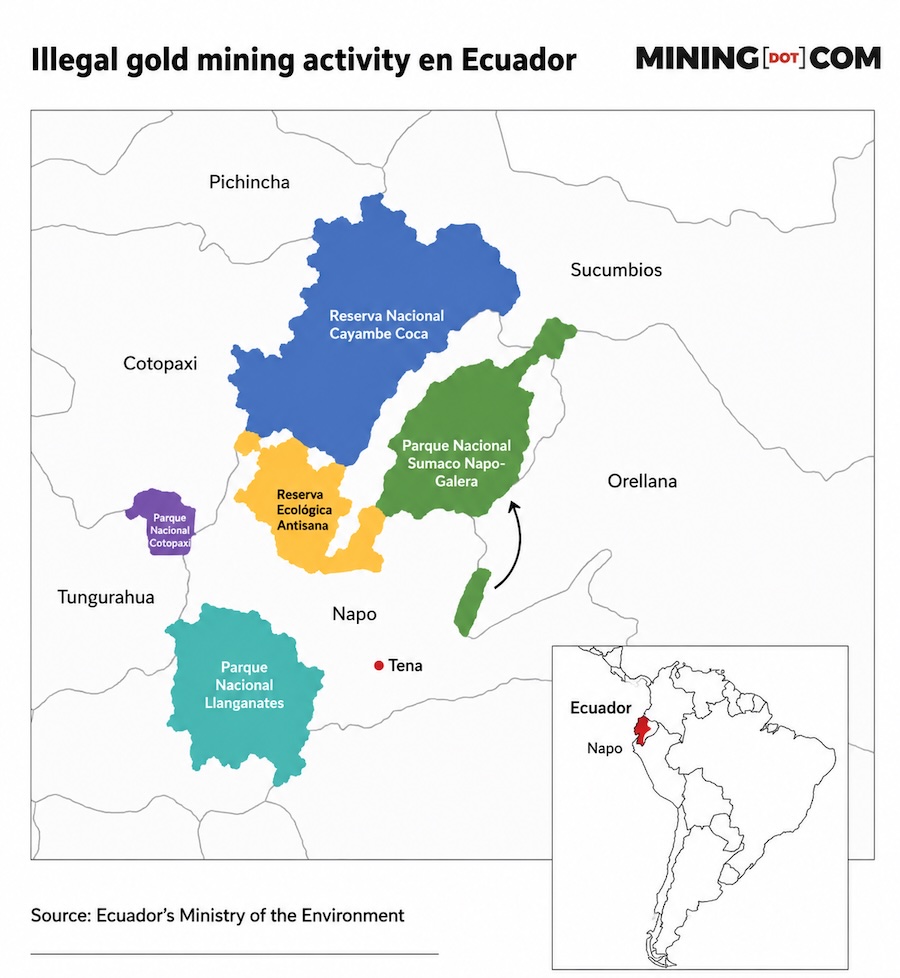
Trade data also point to booming exports. UN Comtrade shows Ecuador exported 19.2 tonnes of gold worth more than $900 million in 2022, while the country’s central bank recorded exports of more than 27 tonnes of doré gold in 2023.
Ongoing crackdown
Ecuador has already intensified its campaign against illegal mining over the past year, particularly after 11 soldiers were killed in an ambush in the Amazon last year during an operation targeting illegal mining groups.
The government blamed the attack on the Border Commandos, a dissident faction of Colombia’s former Revolutionary Armed Forces of Colombia (FARC) guerrillas, which authorities say operates alongside local criminal organizations.
To combat the surge, the government plans to tighten controls across the mining logistics chain, formalize artisanal mining, dismantle illegal fuel networks and expand military operations against illicit mines.
It also aims to establish a nationwide monitoring system by 2027 and introduce a mineral traceability system between 2028 and 2029 covering all mining resources transported to ports and processing plants. The broader goal is to disrupt 88% of organized crime structures by 2029.
Gold flows to Hong Kong hit decade-high before clearing launch

Hong Kong’s imports of gold surged to the most since late-2014 in June, driven by preparations for the city’s recently launched clearing system as well as solid demand from mainland China.
Bullion inflows surged to more than 130 tons, according to the city’s customs authority. Net imports, which indicate how much of the precious metal is staying within Hong Kong, were at their highest since December 2023.

Hong Kong began trial operations earlier this month for a clearing mechanism aimed at boosting the city’s role in global trading and pricing of bullion. Ahead of that, banks had to build up inventories of large gold bars to allow physical delivery into the system.
But part of the increase was also likely driven by appetite for bullion over the border in mainland China. The city functions as a key transit point for gold to be processed or traded before being re-exported, and the mainland accounts for the bulk of outbound volumes.
China’s gold imports hit a two-year high last month, as cheaper prices and a stronger yuan kept investors interested, while banks were motivated to use up import quotas and stock up on bullion to meet retail commitments.
(By Yihui Xie)
Zijin’s $4B Allied Gold takeover collapses, but it still buys in
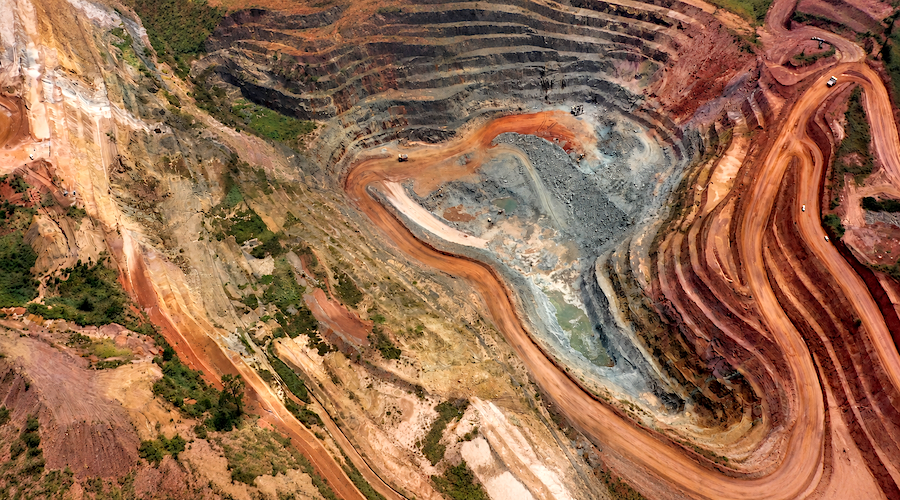
Zijin Gold’s planned $4 billion acquisition of Allied Gold (TSX, NYSE: AAUC) has collapsed after Chinese regulators failed to approve the transaction before the deadline, leaving the state-backed miner with a 9.2% stake instead.
Shares of Allied fell nearly 18% in early morning trading in Toronto after the companies said Wednesday they had mutually agreed to let the July 29 deadline expire because there was “no reasonable likelihood” the remaining closing conditions would be satisfied within a reasonable period.
The stock dropped to C$24.27, valuing the Canadian gold miner at just over C$3 billion ($2.1 billion). In New York, the shares were down 16% at $17.68 as of 10 a.m. local time.
While the deal secured approvals in Canada and other international jurisdictions, it remained stalled in China. Other outstanding issues, including security and streaming arrangements, capital investments and lending agreements, also remained unresolved.
The collapse ends what would have been one of this year’s largest gold mining acquisitions. Zijin, which is indirectly owned by the Chinese government, offered $44 a share in cash for the Toronto-based miner in January, valuing Allied at about $4 billion and marking an all-time high for its stock.
Instead, Zijin agreed to subscribe for about 12.8 million newly issued Allied shares at C$32.55 each in a private placement worth about $295 million, with the transaction expected to close on or about Aug. 10.
The failed takeover underscores the growing challenges facing large cross-border mining transactions as geopolitical tensions and regulatory scrutiny increasingly complicate deals involving Chinese buyers. The financing nevertheless provides Allied with fresh capital as it ramps up production across Africa.
Growth plans
Allied said it will use the proceeds to complete and ramp up the Kurmuk mine in Ethiopia, expand the Sadiola mine in Mali, increase production at its Côte d’Ivoire operations and fund exploration across its portfolio.
The company operates gold mines in Mali and Côte d’Ivoire that produce about 375,000 oz. of gold annually and is preparing to begin production at Kurmuk. Allied went public in 2023, with executive chairman Peter Marrone investing about $50 million of his own money.
Marrone founded Yamana Gold in 2003 and later oversaw its $4.8 billion sale to Agnico Eagle Mines (TSX: AEM)(NYSE: AEM) and Pan American Silver (TSX: PAAS)(NYSE: PAAS) in 2023.
Brazil court issued final ruling on Belo Sun gold mining project
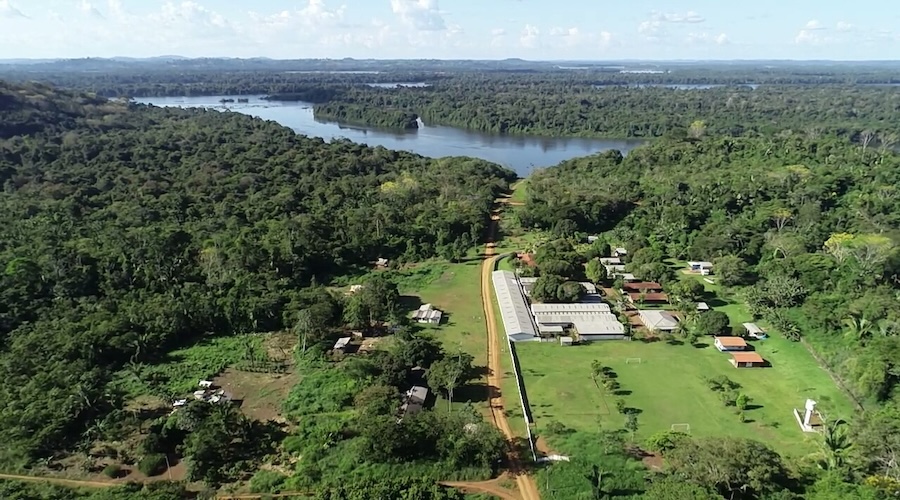
Canadian miner Belo Sun Mining Corp. (TSX: BSX) has secured a final court ruling that permanently dismisses a class action challenging the Indigenous licensing process for its proposed $300 million Volta Grande gold project in Brazil.
Brazil’s Federal Regional Court of the 1st Region unanimously ruled the lawsuit must be dismissed because it duplicated an earlier case involving the same claims and requested remedies.
The Federal Public Defender’s Office (DPU), which sought to suspend the project’s installation licence pending additional consultations and studies with the Araras da Volta Grande and Jurunas da Paquiçamba Indigenous communities, did not appeal before the statutory deadline, making the decision final and binding.
“This final court ruling is a major milestone for Belo Sun and a clear validation of our legal position,” CEO Clovis Torres said. “Other repetitive lawsuits will certainly have the same fate. It reinforces our confidence in Brazil’s judicial framework as we remain focused on advancing the project responsibly, while maintaining open communication with local stakeholders, and delivering long-term value for our shareholders.”
The decision removes a significant legal obstacle for the Volta Grande project, which Belo Sun says has the potential to become Brazil’s largest open-pit gold mine. The ruling also strengthens the company’s position against similar legal challenges as it continues to pursue environmental licensing and project development.
Belo Sun said it will continue defending its legal position in Brazilian courts while advancing the project through the remaining permitting process. The company said it will provide further updates as developments warrant.

No comments:
Post a Comment