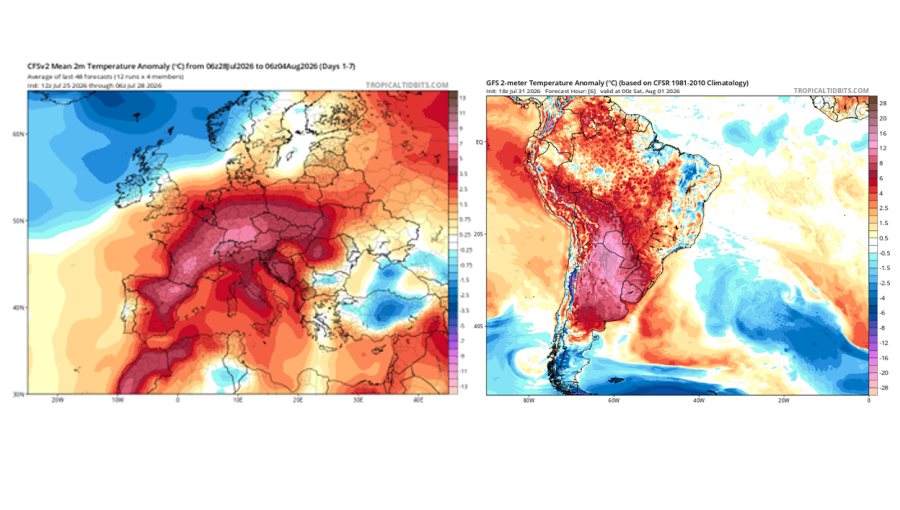
Several European countries are having their worst wildfire year in more than a decade and worst than last year’s record wildfires that burnt over one million hectares, according to data from the EU's Global Wildfire Information System published this week.
France's cumulative burnt area through July 29 is running 4.1 times its 2012-2025 median for the same point in the season, Spain 3.5 times, Germany 3 times, Portugal 2.3 times and the UK 1.8 times. The Balkans, by contrast, have had a quieter year, with Bosnia and Herzegovina, Serbia, Montenegro and North Macedonia all below their historical median.
The World Meteorological Organization's Global Seasonal Climate Update for August-October 2026, issued in July, forecasts above-normal temperatures across most of the world alongside a strengthening super El Niño and a developing positive Indian Ocean Dipole - a combination that tends to amplify, rather than offset, extreme rainfall swings in both directions: worse flooding in some regions, worse drought in others.
And it’s going to get worse. Europe's wildfire season is one of the first visible symptoms of a pattern the WMO is only now confirming officially for the months ahead\ through to October.
Markets have not waited for the official confirmation. IntelliNews has tracked a string of El Nino-linked commodity and inflation stories through the second and third quarters of 2026, from Latin American central banks to Southeast Asian crop belts - evidence that the economic transmission channel identified by the WMO's forecast is already live, not merely forecast.
A hotter, more extreme world for three months
The WMO's probabilistic model, built from a multi-model ensemble, shows above-normal temperature probability across almost the entire globe for August-October, with the strongest confidence in the tropics and mid-latitudes. Changes in rainfall patterns is going to make the biggest difference. The same forecast shows a mixed but pronounced pattern of above-normal rainfall probability across parts of South Asia and the tropical Pacific, and below-normal probability across swathes of southern Africa, parts of South America and the Mediterranean basin – a divergence that turns a single global weather pattern into a series of very different regional economic stories.
Already pricing in
Swiss bank UBS warned in mid-July that a strong El Nino threatens to reignite inflation and delay interest rate cuts across Latin America, singling out Colombia as most exposed given its high inflation and weak fiscal position, with Brazil and Peru also flagged and Venezuela's hydropower-dependent grid seen as vulnerable to drought. The US National Oceanic and Atmospheric Administration puts the probability of the current episode being powerful at 63%, with effects expected to persist into early 2027.
The pattern has already hit agricultural commodities further east. In June that Malaysia issued a sovereign warning over crop damage risk to its palm oil plantations even as near-term prices fell on unrelated demand weakness - agricultural economists note the biological lag between an El Nino heatwave and reduced fresh fruit bunch extraction typically runs several months, meaning any supply hit shows up closer to early 2027. Rice told a faster-moving version of the same story: Vietnam's rice export price for 5% broken rice rose to $412 a tonne in May on El Nino-linked drought fears across India, Thailand, Indonesia and Australia, with the UN's FAO Rice Price Index up 2.7% on the month.
Burning in Europe
Europe's wildfire numbers are the clearest evidence yet that this year's pattern is not merely a forecasting exercise. The divergence within Europe itself - a very bad year in France, Spain, Germany, Portugal and the UK against a calmer one in the Balkans - illustrates the WMO's own point about the Mediterranean basin sitting in the below-normal rainfall probability band, a dry bias that raises fire risk independent of any single heatwave.
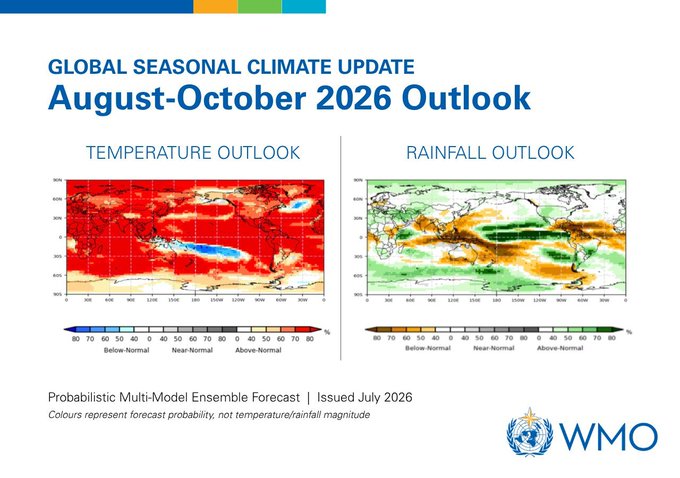
WMO Global Seasonal Climate Update: temperature and rainfall outlook for August-October 2026. Source: World Meteorological Organization.
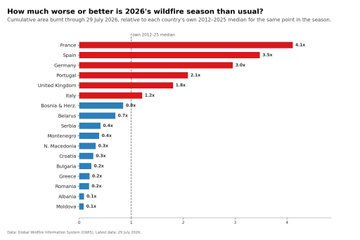
Cumulative burnt area, 2026 season to July 29, relative to each country's 2012-2025 median. Source: Global Wildfire Information System.
None of this guarantees a repeat performance for the rest of the WMO's three-month window - seasonal probabilistic forecasts describe likelihoods, not certainties, and the report itself stresses that its colours represent forecast probability rather than magnitude. But taken together with the commodity moves already logged this quarter, the wildfire data is the strongest sign yet that 2026's El Nino is behaving as advertised rather than fading, as some earlier and weaker episodes have done.
'Climate change is really here: We should seize this crisis moment to create a new momentum'
Issued on: 29/07/2026 - FRANCE24
Oliver Farry is pleased to welcome Jean-Pascal van Ypersele, Climate Scientist and Professor at the Universities of Louvain and Liège in Belgium. Europe's latest heatwave is further evidence of a structural transformation of the continent's climate, warns Professor van Ypersele. His central argument rejects both fatalism and complacency. While insisting that humanity has not yet reached "the point of no return," he argues that the world has entered a period of exceptional urgency in which the costs of delaying climate action are escalating rapidly. He develops three interconnected themes: extreme heat, wildfires and public health crises as manifestations of a changing climate; he criticises the inadequacy of current political responses, suggesting that governments continue to underestimate the scale and immediacy of the challenge despite mounting scientific evidence; and he argues that adaptation and mitigation must proceed simultaneously: societies must become more resilient to unavoidable climate impacts while accelerating the transition away from fossil fuels to prevent even greater disruption.
Video by: Oliver FARRY
France's unprecedented wildfires: Convergence of climate change and historical landscape engineering
Issued on: 30/07/2026 - FRANCE24
Delano D'Souza is pleased to welcome Dr. Melissa Sterry, Scientist, Designer, Strategist and Founding Director of Panarchic Codex® : Design for Living with Wildfire. Dr. Sterry reframes wildfire as a systemic phenomenon: climate change intensifies heat and drought, nineteenth century land engineering has produced highly combustible plantation forests, and expanding human activity increases ignition opportunities. Once these factors align, fires can evolve into autonomous systems that generate their own weather and even create new ignition sources. While she praises France's emergency response, Dr. Sterry contends that prevention and firefighting alone cannot solve the problem. The real challenge lies in redesigning landscapes before fires gain momentum, shifting policy from reacting to disasters towards preventing them through long-term ecological resistance and resilience.
'Rethink the forest' amid unprecedented wildfires: Return to 'ancestral ways of managing the land'?
Issued on: 29/07/2026 - FRANCE24
Stuart Norval welcomes Jean-Luc Gleyze, President of the Departmental Council of the Gironde, and Stéphane Delpeyrat-Vincent, former firefighter and founder of WARUCENE, a research firm specialising in wildfire prevention. The Gironde wildfires expose the growing challenges of land management in a warming world. Offering complementary perspectives, Jean-Luc Gleyze, speaking from the front line of the emergency response, presents the fires as a test of social solidarity, institutional coordination, and public resilience. By contrast, Stéphane Delpeyrat-Vincent argues that increasingly destructive wildfires are not simply emergencies to be fought, but symptoms of a deeper structural failure: landscapes managed for a climate that no longer exists. Together, their analysis suggests that the challenge is no longer simply to improve firefighting capacity, but to rethink forests, communities, and urban planning in an era of accelerating climate change.
As France battles unprecedented wildfires, Caroit urges collective global action on climate change
Issued on: 30/07/2026 - FRANCE24
Delano D'Souza is pleased to welcome French Deputy Foreign Affairs Minister Éléonore Caroit. She frames France's response to unprecedented heatwaves and wildfires through three lenses: crisis management, international solidarity, and climate governance. Caroit distinguishes between the immediate demands of emergency response and the longer term structural challenges posed by climate change, including adaptation, infrastructure resilience, and urban planning. While arguing that governments must continually strengthen preparedness and invest in prevention and adaptation, she maintains that domestic policy must be matched by sustained international climate cooperation, making collective global engagement an essential component of both disaster response and long term climate resilience.
Video by: Delano D'SOUZA
In blazing Greece, anger grows among residents forced to evacuate
Issued on: 03/08/2026 - FRANCE24
Greece is facing a growing wildfire catastrophe after a week of destructive blazes across the country was compounded by a deadly mid-air collision between two firefighting helicopters. Fires have sparked across the country, including just seventy kilometres from Athens, forcing many residents to flee as countless homes were damaged or destroyed.

No comments:
Post a Comment