‘Unworthy of Comment’: DPRK Rebuffs Trump’s Overtures

An unexpected announcement from US President Trump has thrust the Korean Peninsula back into the international spotlight. Just as the annual Ulchi Freedom Shield joint military exercises were scheduled to begin on August 17, Trump shared on Truth Social that he had directed the Department of War to “significantly reduce” the war drills, citing his “very good relationship with Kim Jong Un.”
The Democratic People’s Republic of Korea (DPRK, also known as North Korea) has now issued an official response through Kim Yo Jong, deputy director of the Central Committee of the Workers Party of Korea: “As for the reduction of the US-ROK joint military drill abruptly announced by the US president a few days ago, we regard it as the one unworthy of comment and have no interest in it at all.”
Kim Yo Jong continued, “We are paying more attention to the fact that the joint military drills between the US and the ROK have been steadily staged and are still under way, not to the reduction or shortening of individual drills, and we are correctly seeing through the fact that this is an obvious expression of their obvious hostility toward the DPRK.”
On Tuesday, August 19, the Ministry of Defense of the Republic of Korea (ROK, also known as South Korea) confirmed reports from KBS News that the Ulchi Freedom Shield drills would end early at the request of the US on August 21, instead of the originally scheduled date of August 27. This will entirely remove the portion of “counter-offensive” drills scheduled for the second half of the war games series. An unconfirmed number of field exercises are also reportedly being removed.
Joint Chiefs of Staff Spokesperson held a press conference in Seoul South Korea to announce the annual Ulchi Freedom Shield joint military exercises Photo US Forces Korea
Ulchi Freedom Shield and other major US-ROK war drills have been a point of serious contention between the US and the DPRK since these drills first began in 1955. Cancellations of these drills have been important in the past to facilitating dialogue between Washington and Pyongyang, including in 1993 when the cancellation of the Team Spirit war drills helped facilitate the prior Agreed Framework, in which North Korea agreed to dismantle its civilian nuclear energy program. The cancellation of Ulchi Freedom Shield in 2018 under the first Trump administration was also crucial to facilitating dialogue in that period.
Speculation began to grow as to whether a new round of talks between Pyongyang and Washington could be imminent. A Wall Street Journal report has cited Trump officials who say that a meeting with Kim could come as early as this fall. But the likelihood of such talks cannot be assessed based on the optimistic predictions of officials in Washington alone. North Korea must first agree, and the Trump administration has yet to meet its preconditions.
What does the DPRK want?
Trump told reporters on Monday that Kim has responded to his attempts to establish dialogue, describing the exchanges as “very positive.” However, given the president’s record of misrepresenting his communications with Iran, many argue that such claims cannot be taken at face value. The DPRK has now officially responded and clarified that while the relationship between Trump and Kim is “excellent,” communications between the two leaders was neither confirmed nor denied.
While Trump often stresses his personal relationship with Kim, this does not in fact have any bearing on the state of US-DPRK relations. As North Korea’s state media agency put it during the 2024 US presidential elections, “The foreign policy of a state and personal feelings must be strictly distinguished. For nearly 80 years since the founding of the DPRK, the US has pursued the most vicious and persistent hostile policy toward it.”
Since the failure of diplomatic exchanges in Trump’s first term, Pyongyang has made considerable changes to its policy on future engagement with Washington. While talks remain a possibility, the past paradigm of denuclearization as an outcome of talks has been totally rejected and enshrined into law by the DPRK’s national legislature, the Supreme People’s Assembly. This point has been reiterated on numerous occasions, including at the recent 9th Congress of the Workers’ Party of Korea earlier this year.
A number of influential foreign policy voices in Washington, including Victor Cha of the Center for Strategic and International Studies, have since conceded that denuclearizing the DPRK can no longer be treated as the primary goal of diplomatic engagement. For its part, the Trump administration has been slow to fully embrace such a view. While the president and other officials have more casually referred to the DPRK as a nuclear state, all official pronouncements from Washington regarding the Korean Peninsula have continued to enshrine denuclearization of the DPRK as the primary goal – including at the recent G7 meeting in June, as well as the annual trilateral meeting of the military chiefs of Japan, the US, and ROK in July.
In this context, the reduction in Ulchi Freedom Shield is likely insufficient of an overture to restart dialogue on its own. Now, changing the conversation on denuclearization is likely a higher priority in order for progress to occur. Moreover, US war drills in Korea extend far beyond the Ulchi Freedom Shield series that takes place in August. US Forces Korea, the command of the US Army in Korea with 28,000 US service members stationed on the peninsula, engaged in 274 days of war drills in 2025 and 275 days of war drills in 2024.
Choi Eun-Ha, secretary general of the ROK civil society organization Korean Peace Solidarity for Sovereignty and Reunification, told BreakThrough News, “It is difficult to regard this as a meaningful reduction. It may simply be a dispersion rather than a reduction in number,” referring to the possibility that Washington could simply reschedule key drills for other parts of the year, a trend she noted has already been taking place since 2024.
Given the sudden nature of his announcement, it seems likely that Trump’s move was unplanned. Reports of a growing shortage of missiles and interceptors have dogged the Pentagon since the start of the Iran War, and the last aircraft carrier left in the Pacific was also recently diverted towards the Persian Gulf. If the administration were really pursuing detente with the DPRK, Trump also could have cancelled the exercises altogether weeks in advance.
“I think it is hard to believe that it will lead to the restoration of dialogue [with the DPRK],” Choi said. “Because compared to what was halted in 2018, it is only a far, far smaller change.”
Kim Yo Jong’s official statement regarding Ulchi Freedom Shield confirmed Choi’s assessment, which was made before the publication of the DPRK’s response: “We are paying more attention to the fact that the joint military drills between the US and the ROK have been steadily staged and are still under way, not to the reduction or shortening of individual drills.”
Explaining Trump’s digs at South Korea
Trump has attempted to frame the decision to cut back Ulchi Freedom Shield as not just a consequence of his “very good relationship” with Pyongyang, but as a way to castigate Seoul. Trump accused South Korean President Lee Jae Myung of refusing to deploy military units to the Iran War. In reality, the ROK has avoided directly denying Trump’s requests, instead saying on multiple occasions that it would “consider” naval deployments to the Hormuz, but failing to make commitments.
Trump has also complained about the ROK turning down past requests from Washington to pay annual fees to the US military of $10 billion a year. Starting in 2026, Seoul raised its annual payment to $1.13 billion from an initial $800 million payment started under Obama. According to an ROK Defense Ministry white paper released in 2022, the country’s total annual payments for US military expenditures in that year amounted to 3 trillion KRW or about 2 billion USD.
These statements align with past rhetoric from the president that US allies are exploiting Washington’s military largesse. When speaking to BreakThrough News, Choi firmly rejected Trump’s suggestion that US troops were benefitting Korea. “The presence of US troops is not ‘protecting’ Korea, but endangering Korea’s security,” she said. “Trump gives off the impression that he might even reduce US troops if his demands are not met, but this is merely pressure to extract more from South Korea,” she added, noting how Trump’s tariff pressure has already yielded hundreds of billions of dollars in pledged investments to the US.
With 28,500 soldiers spread across 80 bases (62 of which are US military bases), the US military occupation of the Republic of Korea is the third largest on earth. Numerous current and former base sites have become areas where military sexual violence, crime, training accidents, and environmental destruction have become concentrated.
Choi also noted that while Trump’s narrative emphasizes a kind of American victimhood, it is in fact Washington that benefits the most from the occupation of Korea. “The United States, out of its own military necessity, has stationed US troops in various overseas locations, and treats this as if it were an act of ‘mercy.”
She added that if anything, Trump’s conduct and the worsening situation in West Asia throw the necessity of the US-ROK alliance into doubt. “Since it has been confirmed that the presence of US troops and the military alliance with the United States have instead increased the security burden due to the Iran War, I believe we must make even greater efforts to eliminate the US troop presence and the Korea-US war alliance,” she said.
Beyond applying pressure to make further economic and military concessions to Washington, Trump’s rhetoric is also being used by pro-US elements within the ROK to attempt to exploit security concerns. The right-wing People’s Power Party (PPP) has seized the moment to accuse the Lee administration of losing Washington’s trust. US allies of the PPP like Young Kim, who serves in the California state legislature, echoed these sentiments as well, calling on Lee to “treat the US as the critical, longstanding ally it is.”
Some members of the PPP are taking the offensive further, calling for the ROK to acquire its own nuclear weapons. Similar calls have emanated from the PPP in the past, including from ousted former president Yoon Seok Yeol. If the ROK were to pursue the path of nuclear armament, it would require amendments to Seoul’s “123 Agreement” with Washington, which currently restricts its ability to enrich uranium.
The Lee government is also going on the offensive, leveraging the occasion to renew calls for the return of wartime operational control (OPCON) to the Republic of Korea, which is the only country in the world to have its armed forces directed by a foreign power: the United States. Lee has been attempting to secure the transfer of OPCON by the end of his term in 2030.
While discussions on OPCON have taken place since the Kim Dae Jung presidency at the turn of the 21st century, the US has conditioned its return on the successful performance of the ROK Armed Forces in US-directed war drills like Ulchi Freedom Shield. No statements have yet been made on how Trump’s partial cancellation of Ulchi Freedom Shield could affect OPCON transfer, but the possibility that Washington could leverage this moment to deny or delay the process should not be ignored.
What next?
The sudden nature of Trump’s announcement to scale back Ulchi Freedom Shield suggests what is playing out was not premeditated, but an improvised response to material constraints on the US military caused by the Iran War. In the absence of a clear plan, the Trump administration is leaning on two rhetorical trends it has relied on to try to enhance the US position in Korea.
First, by calling for peace talks without engaging in the steps needed to achieve them, Washington is effectively applying a form of diplomatic pressure on Pyongyang. By loudly calling for negotiations without offering concessions, the US can mask its status as the aggressor in Korea and set the DPRK up to be viewed as intransigent and unreasonable. While military escalation at this time likely isn’t possible, this narrative ploy helps keep the option open in the future. As in Iran and Venezuela, Washington may use negotiations as a cover for attacks. Even with its nuclear deterrent, the DPRK may be vulnerable to opportunistic US aggression. In 2019, Trump ordered a Navy SEAL raid on the DPRK that killed an unknown number of local fishermen before his meeting with Kim in Hanoi.
Second, by raising the issue of military fees and participation in the Iran War, Trump is fomenting political confusion within South Korea in an attempt to undermine the Lee government and empower the more stalwartly pro-US forces in the PPP. The move also reflects a growing trend of the US leveraging its military bases abroad as a bargaining chip to secure economic concessions, and may increase pressure on other governments.
Courtesy: BreakThrough News

Trump offered to scale down the Ulchi Freedom Shield exercise (carried out annually by the US Forces in Korea (USFK) and Republic of Korea (ROK) military). In Trumpian style, the decision was framed as everything all at once: punishment against South Korea for its tepid response on Iran; and as a conciliatory gesture to North Korea. And, the decision, in Trumpian fashion, fell flat on its face. Rather than feeling the pressure, the Lee Administration embraced the decision. Rather than embracing the decision as a conciliatory gesture, North Korea rejected it. So, what happened?
First of all, it’s important to note that Lee’s Democratic Party has always attempted to improve inter-Korean relations. Reducing the scale of USFK-ROK military exercises was always one way to achieve this. If Korean Democratic Party administrations don’t explicitly ask for a scaling down from the US, it is for fear of raising eyebrows in the US and triggering backlash among South Korea’s conservatives. From Lee’s perspective, Trump reducing the scale of the military exercises is not a punishment. It’s a gift.
Why has North Korea rejected this gesture as insufficient? Well, first of all, the haphazard, last minute (the day before) aspect of the decision marks it more as a tacked on after thought rather than a well placed gesture. Nonetheless, in the past North Korea embraced such small gestures.
This is because military exercises have a social impact on North Korea. A simple hypothetical elucidates this point. If China together with Canada conducted military exercises with tens of thousands of soldiers using live ammunition and simulating decapitation tactics against the White House, it’s hard to imagine the US going about its day dismissing the military exercises as a routine measure to freshen up military readiness. After all, as the Center for Strategic and International Studies notes: an actual attack could start off masked as an exercise.
If the US would feel threatened in such a scenario, then North Korea feels the very real threat exponentially more. Not only does the United States have the strongest military in the world, South Korea’s military budget is 27 times greater. Furthermore, North Korea still remembers the utter destruction the US inflicted upon it. US planes dropped more bombs during the Korean war—overwhelmingly in North Korea—than in all of the Pacific Theater combined. By 1952, there were no targets for US planes to bomb.
And while the Ulchi Freedom Shield and the Freedom Shield exercises are the biggest, military exercises against North Korea are carried all year round. The largest of these exercises put North Korea into maximum alert bringing its society to a halt. This is because North Korea’s military isn’t simply for defense, they are also employed in construction and in industry. Furthermore, counter-measures have to be mobilized, expending even more of its energy and resources.
So, if it accepted these gestures in the past, why did North Korea reject it this time? This can partly be explained by the dramatic improvement in North Korea’s geopolitical and economic position in the region. As the US-led San Francisco System of regional bilateral alliances and NATO are fracturing the world into competing blocs, North Korea consolidated a “blood alliance” with Russia by sending North Korean troops to Russia. As a result, the once crippling US sanctions can no longer isolate and pressure North Korea. In other words, as North Korea aligns with China and Russia, the US leverage and pressure against it decreases. In fact, North Korea’s economy is booming.
Faced with his disastrous war in Iran, Trump is trying to win some PR points before the US November election. In the long-run, he wants to pull North Korea away from China’s camp. Yet, there is little reason for North Korea to break with these relations in exchange for promises that the US might never carry out, as history overwhelmingly shows, including Trump pulling out of negotiations with Kim Jong-un at the last minute in 2019. Furthermore, nothing guarantees that an agreement will be approved by Congress. And, even as it does, that it could survive a post-Trump Administration. The US Democrats are already showing themselves to be worse hawks against North Korea than the Trump administration.
Ultimately, none of this rules out the possibility of Trump and Kim meeting or even of coming to some sort of agreement. North Korea is a fiercely independent country that refuses to be beholden to any country. Thus, it does not want its national sovereignty dependent on any other country, even if it is Russia or China. Thus, meaningful relations with the US would allow it greater independence.
The scaling down of the USFK and ROK military exercises should be welcomed. Yet, on its own, it is simply not enough against the US history of broken promises and against the US drumming for war in the region. Ultimately, peace in Korea will have to depend on peace in the region. Peace in the region can only be achieved by dismantling the US San Francisco System of bilateral military alliances.
This article was produced by Globetrotter.

Photograph Source: Jeff Schmaltz, MODIS Rapid Response Team, NASA/GSFC – Public Domain
In a fit of pique, Donald Trump recently scaled back the big annual military exercise between the United States and South Korea. He would have canceled it altogether if the 11-day Ulchi Freedom Shield training hadn’t already started. The U.S. president cited as the reasons for his action the cost of the exercise and that it was “totally inappropriate and hostile” toward North Korea.
Trump also rationalized his show of disrespect for South Korea—or, at least, for the South Korean military—by complaining that Seoul hadn’t given him enough support for the U.S.-Israeli war against Iran. Back in April, at a press conference where he lambasted NATO for not sending warships to help open up the Strait of Hormuz, Trump said, “Who else didn’t help us? South Korea.”
Of course, neither did North Korea. In fact, Pyongyang quickly sided with Tehran after the initial attacks, denouncing the “illegal and reckless act of aggression” and adding that “the growing acts of U.S. hegemony witnessed by the international community are a clear example of its destructive role in undermining world peace and stability and the grave consequences that follow.”
Although accurate, Pyongyang’s statement was not exactly the basis for a warm relationship with an American president.
The strong bond North Korea has with Iran and the ritual anti-Americanism in Pyongyang’s official statements didn’t stop Trump from once again proclaiming his undying friendship with North Korean leader Kim Jong Un. Nor did the two ballistic missile tests that North Korea just conducted across the East Sea seem to have any effect on Trump’s affections. Just before the decision to scale back the military exercises with South Korea, Trump posted that “Kim Jong Un and I get along GREAT!”
Trump’s moves immediately elicited outrage among policymakers and commentators. “China and Russia are watching how easily this president abandons America’s allies, and they will remember it the next time they test us,” declared Senator Jack Reed, a top-ranking Democrat on the Armed Services Committee. “A handshake with Kim may make compelling television,” writes Shim Jae-yun in The Korea Times. “A weakened alliance with South Korea would leave a far more dangerous legacy.”
No one should be surprised by Trump’s moves. During his first term, he consistently bent over backwards to make a deal with North Korea and frequently berated South Korea for not spending more on its alliance commitments. In the end, not much changed. North Korea didn’t give up its nukes, and U.S. military exercises with South Korea continued. Frustrated by the lack of a win, Trump refocused on other less intractable conflicts.
This time around, the South Korean government is in the hands of a progressive, Lee Jae Myung, who is also eager to mend fences with North Korea. Indeed, the Blue House’s response to Trump’s declarations has been remarkably positive. The president’s office “hopes that the friendly relationship between the U.S. and North Korean leaders will lead to meaningful dialogue between the two countries, opening discussions aimed at advancing peace and stability on the Korean Peninsula,” according to a press statement.
Lee Jae Myung has pushed hard to improve inter-Korean relations. He has acknowledged North Korea’s nuclear capabilities even as he has outlined a three-stage process of denuclearization. He has renounced any path to reunification that involves the absorption of North Korea into South Korea. With no signs of progress in bilateral discussions, Lee has gone so far as to call for the resumption of a multilateral approach in his National Liberation Day speech on August 15.
Trump’s statements would seem to encourage such steps forward in reunification. His reduction of U.S. participation in military exercises could also function as a good-will gesture to coax North Korea back to the regional discussions that Lee proposes.
But none of this speculation takes into account North Korea’s perspective.
The bottom line is that Kim Jong Un no longer seems to trust either the United States or South Korea to live up to their promises. From Pyongyang’s perspective, democracies are inherently untrustworthy because different parties rotate in and out of power. The commitment of the Clinton administration to the first nuclear deal—the Agreed Framework of 1994—was eventually undercut by a Republican-controlled Congress. The deals negotiated by South Korean leaders Kim Dae Jung and Roh Moo Hyun were diluted by their conservative successors.
Compared to the United States and South Korea, Russia and China are reliable allies. Vladimir Putin has been in power for more than a quarter of a century, and he has delivered on his promises of economic and military assistance to Pyongyang. Xi Jinping is effectively leader for life in China, and he too has been more-or-less consistent in his support for the North Korean system (despite frustrations concerning Pyongyang’s nukes and its refusal to follow the Chinese version of economic reform).
Don’t judge Kim Jong Un’s intentions simply by his proclamations, like when he promised earlier this year to completely destroy South Korea if it threatens the north. His administration has destroyed virtually every symbol and initiative of peaceful reunification negotiated with South Korean leaders, from the Arch of Reunification that once stretched across the “Reunification Highway” in Pyongyang to the inter-Korean liaison office that once stood in the ancient capital of Kaesong. Thanks to Kim, the North Korean constitution no longer mentions peaceful reunification and identifies the South as a permanent enemy.
Meanwhile, despite all the love Donald Trump has shown the North Korean leader, there’s no indication of reciprocity, at least not since those first three meetings in Trump’s first term went nowhere. Trump, of course, has insisted that Kim has responded positively to his overtures, but he has provided no proof.
On top of the general unpredictability of U.S. policy, there’s no reason for Kim to think of Trump as reliable. The U.S. president has threatened allies like Canada and Denmark. He has gone back and forth in his attitudes toward adversaries, lambasting the Maduro regime in Venezuela and then elevating Maduro loyalist Delcy Rodriguez to the leadership. Trump has repeatedly changed his mind about helping Ukraine, resolving the conflict in Gaza, and handling the ongoing war with Iran.
As for Lee Jae Myung, North Korea has seen its share of progressive leaders come and go. What hasn’t changed in South Korea is a sizable and powerful hardline constituency that demands reunification exclusively on South Korean terms. For their part, progressive leaders have routinely presided over significant increases in military spending that the North sees as threatening. Also, these South Korean leaders have almost always deferred to U.S. military decisions, as required by alliance commitments.
Lee Jae Myung, for all the perspicacity of his policy recommendations, has had little effect on inter-Korean relations. And Donald Trump is largely irrelevant to developments on the Korean peninsula. The tenor of the relationships—across the peninsula and between Washington and Pyongyang—is determined largely by North Korea. And right now, Kim Jong Un prefers the predictability of Moscow and Beijing to the policies of hot and cold coming out of Washington and Seoul.
That could change in the future—but it won’t likely result from anything that Donald Trump says or does, no matter how fervent his social media posts or the “love letters” he exchanges with Kim Jong Un. The North Korean leader is not going to give up his nuclear deterrence just because his number one American fan asks him to do so.
Trump Moves to Scale Back US War Drills in Korea. We Should Support That.
While any diplomatic overture from Trump should be viewed with skepticism, we should welcome a chance to advance peace.
By Christine Ahn ,
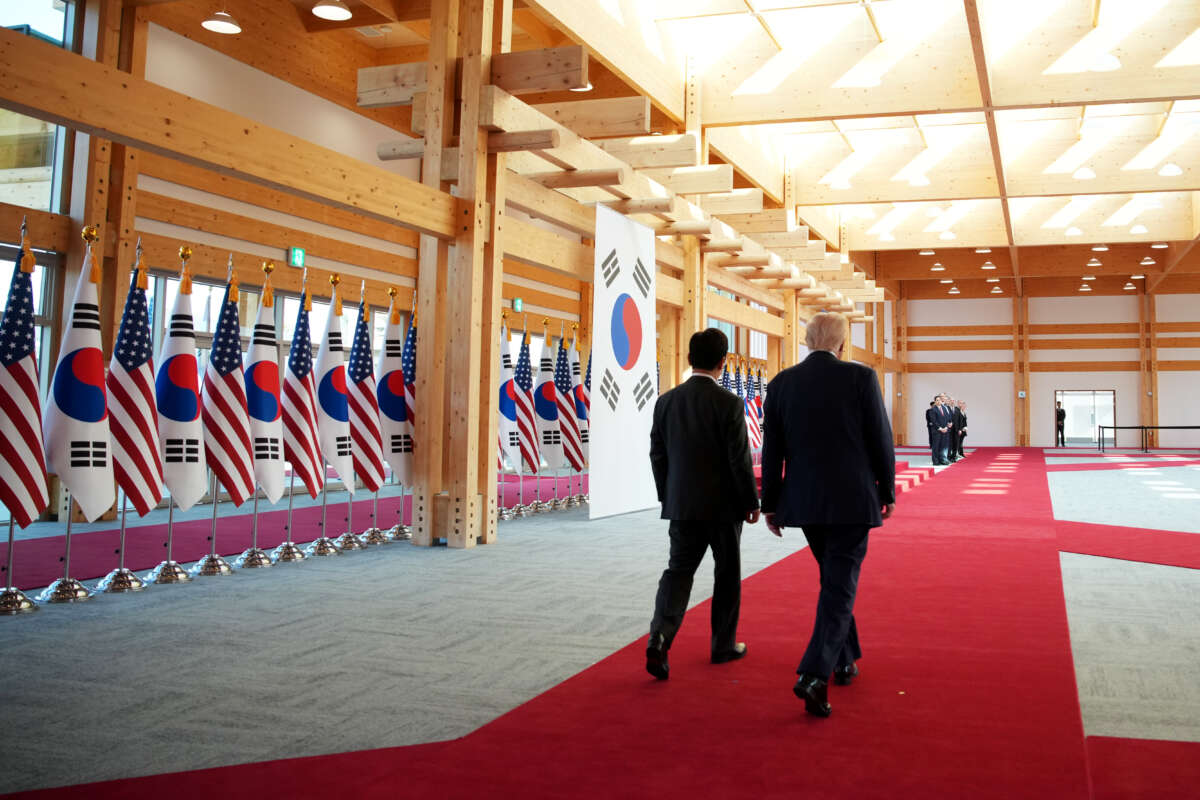
President Donald Trump’s social media post on August 16 calling for a substantial reduction in U.S.-South Korea military exercises triggered panic across partisan lines. Instead of just pointing to the high costs of the exercises and unnecessarily hostile approach towards North Korea, Trump also highlighted his “very good relationship with Kim Jong Un” and chastised South Korea for refusing to join the disastrous U.S.-Israel war on Iran. Attacks came from Republicans, including North Carolina Sen. Thom Tillis, who defended South Korea as “a solid military ally for over 70 years,” but then made the bizarre claim that reducing joint war drills frees up North Korean troops “to support Putin’s” war on Ukraine.
Democrats, naturally, piled on, attacking Trump for undermining yet another major ally to side with an authoritarian leader. Hillary Clinton, the champion of the failed policy of “strategic patience” during the Obama administration, posted: “The president is making US policy friendlier to North Korea and Russia than Canada and Oman. Are you kidding me?”
While any diplomatic overture from this administration should be viewed with skepticism — this is, after all, the same White House that condemned South Korea for declining to join its war against Iran — progressives shouldn’t miss an opportunity to take a principled position that advances peace, a reduced U.S. military footprint, and the security of the American and Korean people.
First and foremost, reducing tensions with North Korea is the right policy. Period. The United States has been at war with North Korea since the Korean War was temporarily halted in 1953 when the United States signed a ceasefire. This has meant that the United States is still technically at war with North Korea, justifying the presence of roughly 28,500 U.S. troops on dozens of U.S. military bases and installations on the Korean Peninsula. To maintain “readiness,” the U.S. and South Korean militaries regularly conduct provocative war drills involving tens of thousands of troops simulating the invasion of North Korea with the use of B-2 nuclear bombers, nuclear-powered aircraft carriers, and submarines. These joint military exercises are a well-known source of tension with North Korea as they have included training for “decapitation” strikes against the leadership, invasions, and preemptive strikes. Far from deterring North Korea, these exercises may do the opposite. Research suggests that these war drills tend to escalate rather than ease tensions, provoking a more threatening security environment instead of the deterrent effect they’re intended to have.
Second, Seoul has been calling for peaceful coexistence with Pyongyang and has abandoned the idea that North Korea would have to give up its nuclear program before dialogue. On July 23, Unification Minister Chung Dong-young announced South Korea’s “peace-first” approach, which aims instead at freezing North Korea’s nuclear program through a three-step process: halt the production of new weapons, reduce the stockpile, and end with dismantlement. South Korean President Lee Jae Myung has a phrase for the fact that North Korea is never going to give up its nuclear weapons: “harsh reality.”
Given this reality, President Lee has been nudging Trump to do exactly this. At the June 2026 G7 summit in Evian, France, a 90-minute dinner conversation between Presidents Trump and Lee produced commitments from both leaders to a peaceful resolution of North Korean issues — notably, without invoking denuclearization.
Seoul, then, is not an ally being blindsided, regardless of Trump’s lashing out about the Iran war. This is an ally that has been asking for exactly this shift, and finally has a U.S. president willing to upend the Washington political-military-industrial complex establishment that views South Korea as its floating aircraft carrier.
That’s where the so-called sacrament of the “alliance” deserves scrutiny. The narrative that Trump is abandoning South Korea obscures a longer, less flattering story about the actual purpose of the U.S. military presence there. Since 2006, when Washington and Seoul formalized the concept of “strategic flexibility” for U.S. Forces Korea (USFK), the U.S. mission has quietly been shifting toward preparation for a potential war with China. The USFK commander, Xavier Brunson, has publicly described South Korea as a “fixed aircraft carrier,” and more recently, relayed how China itself views the peninsula: “the dagger in the heart of Asia” when Beijing looks out from its east coast. It’s the same imagery a Prussian military adviser used over a century ago, when he warned Meiji Japan that Korea was “a dagger pointed at the heart of Japan.” Only now the metaphor has been repurposed as a geographic fact rather than as a rhetorical warning of Korea’s fate as the flashpoint where great power conflict would begin. Brunson also described the peninsula as a future node in a “kill web” aimed at Beijing, which happens to be South Korea’s largest trading partner. Seoul has protested, but the framing hasn’t changed. In February, 10 U.S. F-16s flew from Osan Air Base toward China’s air defense zone; USFK had told the South Korean military the exercise would happen but withheld its operational plan and purpose. Seoul’s defense ministry confirmed afterward that its military “wasn’t part of the latest training exercise and was not aware of the flight details in advance.” Reducing war drills tied to that broader mission of confronting China is not the same as abandoning South Korea’s defense.
For these reasons, as well as Trump’s push for South Korea to send warships to the Strait of Hormuz as U.S. armaments dwindle, President Lee has been prioritizing clawing back South Korea’s wartime operational control from U.S. Forces Korea. Since the Korean War, wartime command of South Korea’s military has rested with an American general: If hostilities broke out today, South Korean troops would fall under the operational control of the U.S.-led Combined Forces Command, not their own government. Seoul regained peacetime control in 1994; wartime control is the piece they want back. It may have made sense for the U.S. to hold operational control when South Korea was a poor, unstable fledgling state; it makes less sense now, with South Korea the world’s sixth-largest military power and 10th-largest economy. This lopsided arrangement even compelled former USFK Commander Richard Stilwell to describe the perpetuation of South Korea’s operational control delegation as “the most remarkable concession of sovereignty in the entire world.”
This week, in the wake of Trump’s unpredictability, President Lee said that South Korea should quickly press ahead, without disruption, on the planned transfer of operational control during his term.
This brings us back to the economy. These military exercises are absurdly costly. According to a new study by David Vine for the Center for International Policy, the true cost of U.S. bases and troops in South Korea was around $5.58 billion in the 2024 fiscal year, not including South Korea’s direct and in-kind contributions, and may run higher still, given the Pentagon’s well-documented inability to track its own spending.
At a time when most Americans can barely afford to survive, U.S. taxpayers should question why our government spends $5.6 billion every year maintaining a permanent U.S. war footing on the Korean Peninsula — money that could instead fund universal school lunch for every child in the country.
Instead of parroting the political establishment that benefits from forever wars, progressives should challenge the fundamental tenet at the core of this bipartisan backlash: the belief that military superiority produces security, that militaristic “deterrence” is stabilizing, and that allies exist for the U.S. to position them. This is not producing peace, and in the case of the Korean Peninsula, it is producing exactly the escalatory spiral it claims to prevent.
Diplomacy doesn’t have to be principled to be worth pursuing.
As a new generation of progressive lawmakers win primaries and challenge both neoconservatives and Cold War Democrats, peace on the Korean Peninsula should be a no-brainer. Trump wants to talk to Kim Jong Un, and for all its contradictions, this represents something decades of sanctions and military pressure failed to produce: a U.S. president willing to engage Pyongyang without demanding surrender as the price of entry.
None of this requires pretending the optics feel right. Watching two men — each of whom has, at different points, governed in ways widely described as authoritarian — sit down to negotiate the fate of a peninsula at war offends much of the world. Trump may want this for the Nobel Peace Prize, a hotel in Pyongyang, or a Nixon-to-China legacy. None of those motives are admirable. But the people who would actually live with the outcome of an end to the Korean War — the longest-running conflict in modern U.S. history — aren’t basing their positions on ending this war on Trump’s character.
While the Pentagon has spent roughly a billion dollars a day on the U.S. war against Iran, more than 770,000 low-income American children were cut from food assistance. That is not just a budget, it is a statement of values — and progressive candidates who won primaries this summer running on “babies, not bombs” clearly understand that voters are starting to notice.
A deal between Trump and Kim, motivated by whatever mix of vanity and self-interest, isn’t something the left should reflexively oppose just because Trump is the one making it. If it ends decades of war footing on the Korean Peninsula, reduces the risk of a war against North Korea or China, and redirects even a fraction of that nearly $5.6 billion toward people instead of militarization, it is worth taking seriously. Diplomacy doesn’t have to be principled to be worth pursuing.
Trump’s transactional instincts may provide him with a benefit, but they also provide progressives with an opening. A messy, transactional peace beats a permanent war footing that no longer reflects the reality on the Korean Peninsula. Washington should walk through this opening before it loses what leverage it still has.
This article is licensed under Creative Commons (CC BY-NC-ND 4.0), and you are free to share and republish under the terms of the license.

Christine Ahn
Christine Ahn is a fellow at the Institute for Policy Studies.

No comments:
Post a Comment