The Mecca Pact Wasn’t Built to Corner Iran
Source: FPIF Image by Ayoub Hosseinsangi/Wikimediacommons, licensed via CC BY 4.0
When Saudi Crown Prince Mohammed bin Salman, Turkish President Recep Tayyip Erdogan, and Pakistani Prime Minister Shehbaz Sharif signed the Mecca Joint Defense Agreement on August 7, they bound each state to treat an armed attack on any one of them as “an attack against them all.” In Gulf capitals the clause was read almost at once as a barricade against Iran. It looks like a Sunni cordon around Iran while the wreckage of this year’s war is still smoldering: after the assassination of Ali Khamenei and the American and Israeli strikes that opened the fighting on February 28, after Iranian missiles fell on Kuwait, Abu Dhabi and Riyadh, after the Strait of Hormuz was blockaded.
That reading is intuitive. It is also the least persuasive one available, and Washington should know that before it decides what the pact means for U.S. strategy in the Gulf.
The clearest evidence against such an interpretation came from Tehran itself. Foreign Minister Abbas Araghchi answered the signing not with threats but with a call for Muslim states to close ranks and rely on their own capabilities. Days later, foreign ministry spokesman Esmaeil Baghaei said that Iran saw no reason to see itself as the target of the pact, reading it instead as a “change in perception” about Washington. The one sharp note came from hardline lawmaker Ebrahim Rezaei, who dismissed the accord as a paper agreement that would do as little for Saudi security as decades of leaning on the Americans had.
A government that believes the pact is a knife at its throat does not respond with a sermon about brotherhood. It responds with mobilization. Tehran did the opposite.
Islamabad’s intent was harder to dispute a few days later, when Pakistan’s interior minister flew directly to Tehran to brief Iranian leadership on the pact’s parameters. A state acting as the tip of an anti-Iranian spear does not send its top security minister to reassure the target capital in person.
Consider who signed it. When the war broke out in late February, Islamabad became the line both Washington and Tehran used to reach each other, relaying American terms and brokering the April ceasefire that gave negotiations room. A state does not spend months shielding a neighbor from an existential war, then sign a pact designed to corner that same neighbor.
Intent and effect are not identical, and a skeptical reader is right to object that a Sunni mutual-defense bloc raises Iran’s threat environment whether or not it names Iran. But Pakistan’s position bounds how far that effect travels: a 900 kilometer border with Iran, a Shia population at home it cannot afford to inflame, and a spring spent as the most dependable channel between Tehran and the Western coalition. A pact that recasts Islamabad as an anti-Iranian spearhead would cost it the very role that has made it useful.
The “Muslim NATO” label obscures more than it reveals. No alliance can credibly claim to embody Islamic collective defense while the region’s largest Shia power sits outside it. The pact is Sunni by geography and demography, not by any doctrinal test written into its text. Turkish Foreign Minister Hakan Fidan has already said that Egypt could join once technical questions are settled. A bloc defined by doctrine would lock Iran out permanently. A bloc defined by circumstance is shut to Iran today, not sealed against it forever.
Tehran grasps that distinction, because it tried to build the other half of it. In August 2025, President Masoud Pezeshkian went to Islamabad to revive a long-dormant framework linking Iran, Pakistan and Turkey, complaining that those commitments had gone unfulfilled for decades. A year on, two of those three partners—with the Gulf’s largest economy added—assembled a security architecture without him. Iran’s grievance is not that the structure exists. It is that it was built while Iran was kept out of the room.
The nuclear question points the same way, and it’s the one that should worry arms-control watchers in Washington more than Tehran. Pakistan’s roughly 170 warheads are built, deployed, and doctrinally fixed on India. Nothing signed in Mecca redraws that posture to stretch an Islamabad umbrella over Riyadh against Tehran. But a formal defense pact between a nuclear-armed state and two of the region’s biggest buyers of American weapons deserves scrutiny in its own right, independent of what it means for Iran.
The economics argument collapses the cordon theory entirely. Iran did much of its own strategic damage in the fighting. Closing the Strait of Hormuz throttled the artery carrying close to a fifth of the world’s oil and produced the largest disruption on record. Gulf producers lost revenue but Iran, already under sanctions and a naval blockade, was least able of any of them to absorb the bleeding. A state that just lost its supreme leader and watched its main export route collapse does not open a second front against the one neighbor, Pakistan, whose foreign ministry remains its working line to the outside world.
This, for a Washington audience, is the bottom line. The Gulf’s turn toward strategic autonomy did not begin in Mecca. It began when states that had outsourced their security to the United States learned how little that purchased. Riyadh signed its September 2025 pact with Pakistan days after an Israeli strike on Doha, an attack on a Gulf capital hosting a major U.S. base that the American umbrella did nothing to stop. Qatar, which co-mediated the Iran ceasefire alongside Pakistan, drew the same lesson. Turkey, a NATO member, is hedging against the alliance it already belongs to.
Trump himself welcomed the pact on Sunday, calling it evidence that Middle Eastern states will “finally be able to defend themselves in a more meaningful way.” That is not the language of an alliance manager alarmed at being cut out. It is the language of a president who has spent a decade telling allies to stop expecting Washington to show up, and who is now watching three of them take him at his word.
Seen from Tehran, the pact is not a cordon. It is an insurance policy whose fine print leaves the door unbolted. Seen from Washington, it should be read differently: not as a Sunni bloc closing in on Iran, but as three American security partners building a deterrent that doesn’t need American permission. The measure of the Mecca agreement won’t be its legal text but whether Riyadh, Ankara, and Islamabad hold together once the war recedes, and whether the arms and reassurances Washington still supplies to all three buy it any say in that outcome.
This article was originally published by FPIF; please consider supporting the original publication, and read the original version at the link above.
When Saudi Crown Prince Mohammed bin Salman, Turkish President Recep Tayyip Erdogan, and Pakistani Prime Minister Shehbaz Sharif signed the Mecca Joint Defense Agreement on August 7, they bound each state to treat an armed attack on any one of them as “an attack against them all.” In Gulf capitals the clause was read almost at once as a barricade against Iran. It looks like a Sunni cordon around Iran while the wreckage of this year’s war is still smoldering: after the assassination of Ali Khamenei and the American and Israeli strikes that opened the fighting on February 28, after Iranian missiles fell on Kuwait, Abu Dhabi and Riyadh, after the Strait of Hormuz was blockaded.
That reading is intuitive. It is also the least persuasive one available, and Washington should know that before it decides what the pact means for U.S. strategy in the Gulf.
The clearest evidence against such an interpretation came from Tehran itself. Foreign Minister Abbas Araghchi answered the signing not with threats but with a call for Muslim states to close ranks and rely on their own capabilities. Days later, foreign ministry spokesman Esmaeil Baghaei said that Iran saw no reason to see itself as the target of the pact, reading it instead as a “change in perception” about Washington. The one sharp note came from hardline lawmaker Ebrahim Rezaei, who dismissed the accord as a paper agreement that would do as little for Saudi security as decades of leaning on the Americans had.
A government that believes the pact is a knife at its throat does not respond with a sermon about brotherhood. It responds with mobilization. Tehran did the opposite.
Islamabad’s intent was harder to dispute a few days later, when Pakistan’s interior minister flew directly to Tehran to brief Iranian leadership on the pact’s parameters. A state acting as the tip of an anti-Iranian spear does not send its top security minister to reassure the target capital in person.
Consider who signed it. When the war broke out in late February, Islamabad became the line both Washington and Tehran used to reach each other, relaying American terms and brokering the April ceasefire that gave negotiations room. A state does not spend months shielding a neighbor from an existential war, then sign a pact designed to corner that same neighbor.
Intent and effect are not identical, and a skeptical reader is right to object that a Sunni mutual-defense bloc raises Iran’s threat environment whether or not it names Iran. But Pakistan’s position bounds how far that effect travels: a 900 kilometer border with Iran, a Shia population at home it cannot afford to inflame, and a spring spent as the most dependable channel between Tehran and the Western coalition. A pact that recasts Islamabad as an anti-Iranian spearhead would cost it the very role that has made it useful.
The “Muslim NATO” label obscures more than it reveals. No alliance can credibly claim to embody Islamic collective defense while the region’s largest Shia power sits outside it. The pact is Sunni by geography and demography, not by any doctrinal test written into its text. Turkish Foreign Minister Hakan Fidan has already said that Egypt could join once technical questions are settled. A bloc defined by doctrine would lock Iran out permanently. A bloc defined by circumstance is shut to Iran today, not sealed against it forever.
Tehran grasps that distinction, because it tried to build the other half of it. In August 2025, President Masoud Pezeshkian went to Islamabad to revive a long-dormant framework linking Iran, Pakistan and Turkey, complaining that those commitments had gone unfulfilled for decades. A year on, two of those three partners—with the Gulf’s largest economy added—assembled a security architecture without him. Iran’s grievance is not that the structure exists. It is that it was built while Iran was kept out of the room.
The nuclear question points the same way, and it’s the one that should worry arms-control watchers in Washington more than Tehran. Pakistan’s roughly 170 warheads are built, deployed, and doctrinally fixed on India. Nothing signed in Mecca redraws that posture to stretch an Islamabad umbrella over Riyadh against Tehran. But a formal defense pact between a nuclear-armed state and two of the region’s biggest buyers of American weapons deserves scrutiny in its own right, independent of what it means for Iran.
The economics argument collapses the cordon theory entirely. Iran did much of its own strategic damage in the fighting. Closing the Strait of Hormuz throttled the artery carrying close to a fifth of the world’s oil and produced the largest disruption on record. Gulf producers lost revenue but Iran, already under sanctions and a naval blockade, was least able of any of them to absorb the bleeding. A state that just lost its supreme leader and watched its main export route collapse does not open a second front against the one neighbor, Pakistan, whose foreign ministry remains its working line to the outside world.
This, for a Washington audience, is the bottom line. The Gulf’s turn toward strategic autonomy did not begin in Mecca. It began when states that had outsourced their security to the United States learned how little that purchased. Riyadh signed its September 2025 pact with Pakistan days after an Israeli strike on Doha, an attack on a Gulf capital hosting a major U.S. base that the American umbrella did nothing to stop. Qatar, which co-mediated the Iran ceasefire alongside Pakistan, drew the same lesson. Turkey, a NATO member, is hedging against the alliance it already belongs to.
Trump himself welcomed the pact on Sunday, calling it evidence that Middle Eastern states will “finally be able to defend themselves in a more meaningful way.” That is not the language of an alliance manager alarmed at being cut out. It is the language of a president who has spent a decade telling allies to stop expecting Washington to show up, and who is now watching three of them take him at his word.
Seen from Tehran, the pact is not a cordon. It is an insurance policy whose fine print leaves the door unbolted. Seen from Washington, it should be read differently: not as a Sunni bloc closing in on Iran, but as three American security partners building a deterrent that doesn’t need American permission. The measure of the Mecca agreement won’t be its legal text but whether Riyadh, Ankara, and Islamabad hold together once the war recedes, and whether the arms and reassurances Washington still supplies to all three buy it any say in that outcome.
The meaning of the Mecca Pact
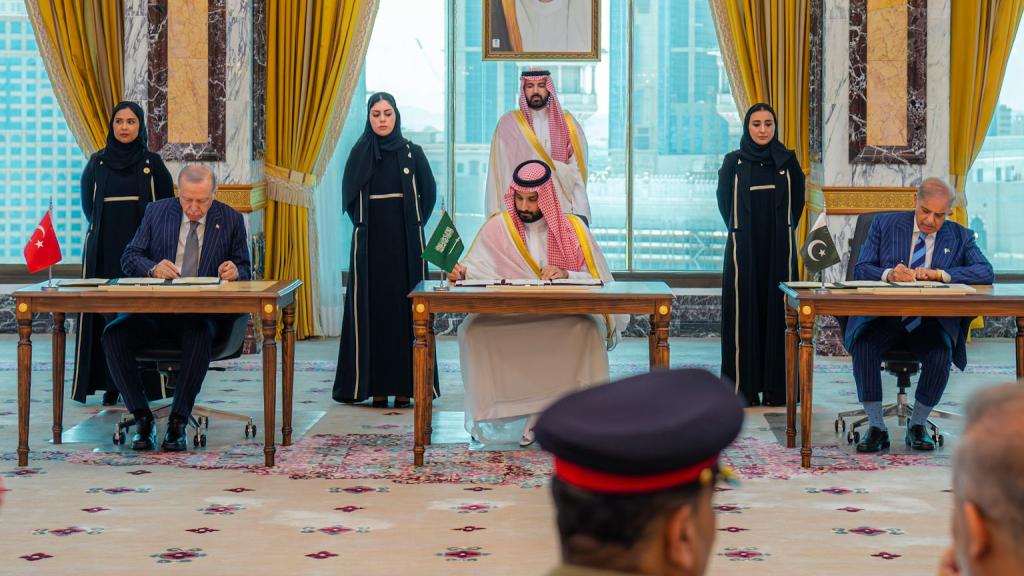
Türkiye, Saudi Arabia and Pakistan signed the Mecca Joint Defence Agreement, also called the Mecca Pact, on August 7. It is a political-military agreement between the three regional powers. While the full agreement has not yet been published, it specifies, among other things, that “any armed attack against any one of the three states shall be regarded as an attack against them all.”
At first glance, the Mecca Pact looks impressive, involving three regional powers with different strengths. Türkiye, with a population 86 million people, has a strong army (the second-largest in NATO behind the United States) and a relatively developed arms industry (including powerful armed drones, such as the TB-2 Bayraktar, and the fifth-generation stealth warplane TAI TF Kaan). Pakistan has a population of 242 million people and is the only Muslim country that possesses nuclear arms (about 170 warheads). Saudi Arabia, the largest Arab Gulf state with 33 million people, is one of the world’s largest oil and gas exporters —an “energy superpower” — and has huge financial resources.
To understand the Mecca Pact’s relevance, we need to look at the background to its formation.
Background
The process behind the Mecca Pact is characterised by three developments: a) the US’ decline as the hegemonic power; b) the Zionist state’s unrestrained expansionism, particularly after October 7; and c) the consequences of the Iran War. The three factors are interrelated.
The most important factor is US imperialism’s decline as the global hegemonic power. The US’ decline — which went hand in hand with China’s rise as a new imperialist power — resulted in its increasing inability to resist the emergence of rivals and dominate allies. The Trump administration’s new foreign policy doctrine — outlined in its National Security Strategy document — recognises this decline and concludes that Washington should no longer attempt to be the global hegemon, but rather focus on fully dominating the Western hemisphere.1
A consequence of this new foreign policy doctrine has been deprioritising the Middle East. Despite being where US imperialism fought most of its wars since 1991, the Trump administration has always emphasised its desire to reduce its military presence in this key region. This reorientation has been challenged from within the ruling class, with significant sectors (particularly those closely connected to Israel) opposing it.
The US and Israel losing their war against Iran was not so much the result of the White House’s strategic plan but rather conjunctural factors — most importantly, Trump’s desperate desire to have a “small, victorious war” given his huge unpopularity and manipulations by Israeli Prime Minister Benjamin Netanyahu and the Zionist lobby.2
Israel’s unrestrained expansionism is related to the US’ decline. The Zionists want to exploit the sympathy they enjoyed in the US establishment after October 7 to advance their position in the Middle East. They also want to stop Washington’s retreat from the Middle East by involving it in their local wars of aggression.
However, the failure to defeat Iran — in fact, Tehran, which now controls the Strait of Hormuz, emerged strengthened from this war — has shattered Washington’s prestige globally, and particularly in the Middle East. US troop withdrawals from Syria and Iraq (by September 2026), and the likely reduction of US military bases in Gulf states (which were hit hard by Iranian missiles and drones), will damage the US’ standing in the region even more.3
The Iran War was a sobering experience for US-allied Arab states. Despite its local military bases, impressive navy and air force, and superior military technology, the US has been incapable of defeating Iran and even defending its allies’ territories. These developments have pushed several Arab allies to look for additional security guarantees and a compromise with Iran.4
Likewise, pro-US Arab regimes are increasingly worried about Israel’s forever wars, which are destabilising the region. Israel’s incessant attacks against Palestinians, Lebanon, Iran and Syria, its (failed) attack on Hamas leaders in Qatar, and its projects to expand its military presence (for example in Somaliland), all ensure that the region is a constant trouble spot.
While these corrupt dictators do not care much about the Palestinian people or other victims of Zionist aggression, their populations do. They despise coward Arab rulers who do not dare to lift a finger to support those resisting the US-Zionist monster. An open letter by hundreds of Jordanian high-profile figures calling for the withdrawal of US forces from Jordan, despite the regime’s harsh repression, is just the latest example of the Arab masses’s sentiment.5
The Arab rulers are also worried about Iran’s rise as a regional power. Tehran has demonstrated its military power and gained huge political prestige among the masses as a state that withstood US-Zionist aggression.
For these reasons, the Arab regimes understand things cannot go on as they were. The US is obviously no longer in a position to guarantee their territorial safety (even less so under Trump, who lacks any ability for strategic planning), restrain Israel or defeat Iran. Hence, they want to increase their political weight and create additional security guarantees, such as the Mecca Pact.
The three signatories want other countries to join. Türkiye hopes that Egypt — the most populous Arab country — will sign up. However, Saudi Arabia has opposed this for now, because it considers Cairo as too close to the United Arab Emirates, which Riyadh sees as allied with Israel and with whom it has had rising tensions since last year (over their sphere of influence in Sudan, Yemen, Somalia, etc).
Specific motives and problems
What are the specific motives and driving factors for the Mecca Pact? Saudi Arabia certainly played a crucial role in this process, for the reasons mentioned above. It desperately wants additional security guarantees, as it has directly suffered the consequences of the Iran War with Tehran hugely impacting Saudi Arabia’s oil exports through its blockade of the Strait of Hormuz and attacks on infrastructure. The country’s real gross domestic product fell 4.8% in the second quarter compared to the same period last year. While Riyadh seems to have found a modus vivendi with Iran for now, it has reopened the conflict with the Houthis (officially Ansar Allah) in Yemen.6
The Trump administration recently tried to reconcile Saudi Arabia by offering a deal for the civilian use of nuclear power. However, it combined this offer with the condition that Riyadh sign the Abraham Accords — that is, establish official diplomatic relations with Israel. But Crown Prince Mohammed bin Salman is fully aware that such a move would be extremely unpopular among his people and could endanger his dictatorship. Hence, he rejected Washington’s demand and the deal has collapsed (at least for now).
Bin Salman hopes the Mecca Pact will have a deterring effect against future Israeli or Iranian attacks. He also expects support from its allies in its conflict with the Houthis.
Türkiye has been less affected by the Iran War and played a pro-active role in limiting US-Zionist aggression. The US president publicly claimed in late June that Turkish President Recep Tayyip Erdogan had considered entering the conflict on Iran's side but ultimately refrained after Trump urged him to stay out:
You know, he was a leading candidate to go into the war with Iran, maybe even on Iran's side, because he is not a big fan of Israel, as you know. I asked him to stay out of it, and he stayed out of it.
The reason was that Israel had pushed for the military participation of Kurdish militias in the US-Zionist war against Iran. If such an attack against Iran had been successful, it would have likely resulted in Iran’s fragmentation and the creation of a (semi-)independent Kurdish entity under US and Israeli protection. This, in turn, could have had huge consequences for Kurdish forces in Syria and Türkiye. According to Israeli public broadcaster Kan, Turkey threatened to provide Iran with air support if Kurdish forces invaded the country as part of Mossad's ground operations.7
Türkiye feels increasingly threatened by Netanyahu’s expansionist Greater Israel policy. An increasing number of Israeli officials and public figures call Türkiye “the new Iran” and a major threat to Israel’s security. This is hardly surprising as Türkiye is a “natural” enemy of Israel, given it is a strong Muslim state and, as such, inevitably comes into the Zionist monster’s crosshair. This is even more the case as: a) Erdoğan has publicly expressed solidarity with Hamas and denounced Israel’s wars of aggression (albeit he was slower and inconsistent in joining the economic boycott of the Zionist state); and b) Ankara is closely aligned with the Al-Sharaa government in Syria, where the Zionists occupy territory in the south.
Türkiye is interested in the Mecca Pact because it would help expand its political influence in the Middle East. Ankara expects the new alliance will also provide its arms industry with an expanded market. All in all, one could say Türkiye is the strongest part of the new alliance.
In contrast, Pakistan is probably the weakest part, despite the fact it is the largest of the three in terms of population and the only nuclear power. At the same time, it is also the most “desperate” state in the alliance. Pakistan is the poorest of the three countries, with many of its citizens working as migrant labour in Gulf states. The country is wracked by huge social, political and ethnic divisions, including civil wars in two provinces (Balochistan and Khyber Pakhtunkhwa).
In itself, Pakistan has no interest in intervening in Middle East politics. It wants its migrants to continue working in the region so they can send remittances home. Pakistan also desires stable relations on its western border with Iran. This is why it wants the Iran War to stop as soon as possible. Its main motivations for joining the pact are: a) the need for new loans (from Saudi Arabia), and b) the hope it may receive support from these new partners in terms of its own conflicts with India,8 Afghanistan and Tehrik-e-Taliban Pakistan (TTP).9
The Mecca Pact’s impact
In the short-term, the Mecca Pact will probably not have much military impact. It is no accident the text says any armed attack “shall” be regarded as an attack on all three countries, rather than must. This means signatory states are not obligated to intervene in a conflict if an ally is involved.
It is difficult to imagine — at least in the foreseeable future — that Türkiye, which enjoys stable relations with neighbouring Iran, would join a war between Tehran and Riyadh. The same is most likely true for Pakistan, which would not want to risk relations with Iran. Likewise, it is nearly impossible that Saudi Arabia and Türkiye would join a war on Pakistan’s side against India (which has nuclear weapons).
It is more likely, however, that signatories might join a conflict against a smaller, weaker adversary — for example, by supporting Pakistan against Afghanistan or TTP, or supporting Saudi Arabia against the Houthis. However, even this seems unrealistic, at least for now. It is telling that when the Houthis bombed Saudi infrastructure just a day after the Mecca Pact’s announcement, both Pakistan and Türkiye remained silent and have expressed no interest in actively joining the conflict.
The Mecca Pact, at least for now, seems primarily a political alliance of three major Sunni Muslim powers. It is not an anti-US alliance, as the countries remain Washington’s allies. However, neither is it part of the Trump administration’s plan, despite his favourable statement on Social Truth welcoming the “big, bold” defence pact.10 One should not pay too much attention to such messages, which appear between statements about making the Strait of Hormuz “American territory” and his close relations with North Korea’s dictator Kim Jong Un. Irrespective of Trump’s social media posts, it is clear that for Türkiye, Saudi Arabia and Pakistan, the relevance of their alliance with the US is decreasing.
Furthermore, this alliance is a severe political blow for Israel. Trump’s plan, after the US’ semi-retreat from the region, is to build a regional order based on expanding the Abraham Accords — essentially a pro-US order under Zionist leadership. Instead of orienting to Israel, Arab states are looking to build alliances among themselves and, perhaps in the future, with China and Russia.
While the alliance may not have much military relevance today, this could change in the future. If the US closes, or hugely reduces, its military bases in the Gulf states; if it focuses more on conflicts in other regions; if Israel continues waging one war after the other and occupying neighbour states; if Iran continues rising as a regional power; if current conflicts in Iran, Lebanon, Yemen, etc, explode into a full-fledged regional war — all such developments could result in the Mecca Pact expanding and deepening into a more effective military alliance.
In sum, the Mecca Pact’s real meaning lies not in what it is today, but in what it reflects and could become in the future.
Michael Pröbsting is a socialist activist and writer. He is the editor of the website thecommunists.net, where a version of this article first appeared.
- 1
For further analysis of the new US foreign policy doctrine see by Michael Pröbsting: Trump and the Political Crisis of European Imperialism. On the inner contradictions and challenges of Europe's ruling class in face of Trump’s new foreign policy doctrine, the opportunist position of left reformism and the tasks of socialists, 28 January 2026, https://www.thecommunists.net/theory/trump-and-the-political-crisis-of-european-imperialism/; Trump’s Donroe Doctrine and its Consequences for Venezuela, Latin America and the World Part 1 https://www.thecommunists.net/worldwide/latin-america/trump-s-assault-on-venezuela-and-his-plan-to-recolonise-latin-america/and Part 2 https://www.thecommunists.net/worldwide/latin-america/trump-s-assault-on-venezuela-and-his-plan-to-recolonise-latin-america/#anker_3); An Official Confirmation that the U.S. Is No Longer the Global Hegemon. Trump’s new National Security Strategy outlines a strategy for U.S. imperialism for a multi-polar world, 11 December 2025, https://www.thecommunists.net/worldwide/global/an-official-confirmation-that-the-u-s-is-no-longer-the-global-hegemon/; A Major Shift in Washington’s Foreign Policy Doctrine. The draft of the Pentagon’s newest National Defense Strategy reflects the dramatic decline of U.S. imperialism, 10 September 2025, https://www.thecommunists.net/worldwide/global/a-major-shift-in-washington-s-foreign-policy-doctrine/.
- 2
See Michael Pröbsting: What Makes America’s War against Iran Different from Its Past Wars since 1945? Notes about Trump’s adventurous attack which is in contrast to Washington’s strategy, 5 March 2026, https://www.thecommunists.net/worldwide/africa-and-middle-east/what-makes-america-s-war-against-iran-different-from-its-past-wars-since-1945/
- 3
On the outcome of the Iran War see: RCIT, Iran Humiliates the American-Zionist Monster! The Memorandum of Understanding to end the Iran War represents a strategic defeat for the U.S. and Israel, 15 June 2026, https://www.thecommunists.net/worldwide/africa-and-middle-east/the-memorandum-of-understanding-iran-humiliates-the-american-zionist-monster/; Michael Pröbsting, Iran War: The Lessons of the Ceasefire Deal, 18 June 2026, https://www.thecommunists.net/worldwide/africa-and-middle-east/iran-war-the-lessons-of-the-ceasefire-deal/; Michael Pröbsting, A Renewal of the Iran War? On the causes, contradictions and perspectives for the new military escalation in the Middle East, 15 July 2026, https://www.thecommunists.net/worldwide/africa-and-middle-east/a-renewal-of-the-iran-war; Yossi Schwartz, Three liars in the White House are trying to convince the world that the failure of the United States is in fact a huge victory, 25 June 2026, https://the-isleague.com/three-liars-in-the-white-house-are-trying-to-convince-the-world-that-the-failure-of-the-united-states-is-in-fact-a-huge-victory/.
- 4
On the Iran War 2026, see https://www.thecommunists.net/worldwide/africa-and-middle-east/compilation-of-articles-on-the-iran-war-2026/.
- 5
New York Times, Jordanians’ Rare Challenge to Their Leaders: Tell the U.S. to Leave, 29 July 2026, https://www.nytimes.com/2026/07/29/world/middleeast/jordan-us-military-iran-war.html
- 6
RCIT, Yemen Joins the War against the American-Zionist Monster. Houthis announce maritime blockade against Saudi Arabia at the Bab el-Mandeb Strait, 21 July 2026, https://www.thecommunists.net/worldwide/africa-and-middle-east/yemen-joins-the-war-against-the-american-zionist-monster/
- 7
Al-Monitor, Iran's Araghchi reveals Turkey's role in thwarting Kurdish offensive, 20 July 2026, https://www.al-monitor.com/originals/2026/07/irans-araghchi-reveals-turkeys-role-thwarting-kurdish-offensive
- 8
See RCIT, No to the Reactionary Warmongering between India and Pakistan! Solidarity with the national liberation struggle of the Kashmiri people! 24 April 2025, https://www.thecommunists.net/worldwide/asia/no-to-the-reactionary-warmongering-between-india-and-pakistan/; Michael Pröbsting, Some Insights from the Latest Military Conflict between India and Pakistan, 13 May 2025, https://www.thecommunists.net/worldwide/asia/some-insights-from-the-latest-military-conflict-between-india-and-pakistan/
- 9
See RCIT, Down with Pakistan’s Aggression against Afghanistan! Support the right of national self-determination for all peoples oppressed by the Pakistani state! 13 October 2025, https://www.thecommunists.net/worldwide/asia/down-with-pakistan-s-aggression-against-afghanistan/; Sayyed Khan, War Drums in South Asia. No reactionary war between India and Pakistan! Defend Afghanistan against Islamabad’s aggression! 11 November 2025, https://www.thecommunists.net/worldwide/asia/war-drums-in-south-asia/
- 10
The New Arab, Trump welcomes 'big, bold' defence pact between Saudi Arabia, Turkey and Pakistan, 17 August, 2026, https://www.newarab.com/news/trump-welcomes-defene-pact-between-saudi-turkey-and-pakistan

No comments:
Post a Comment