Houthis Being Pushed Back from Bab el-Mandeb
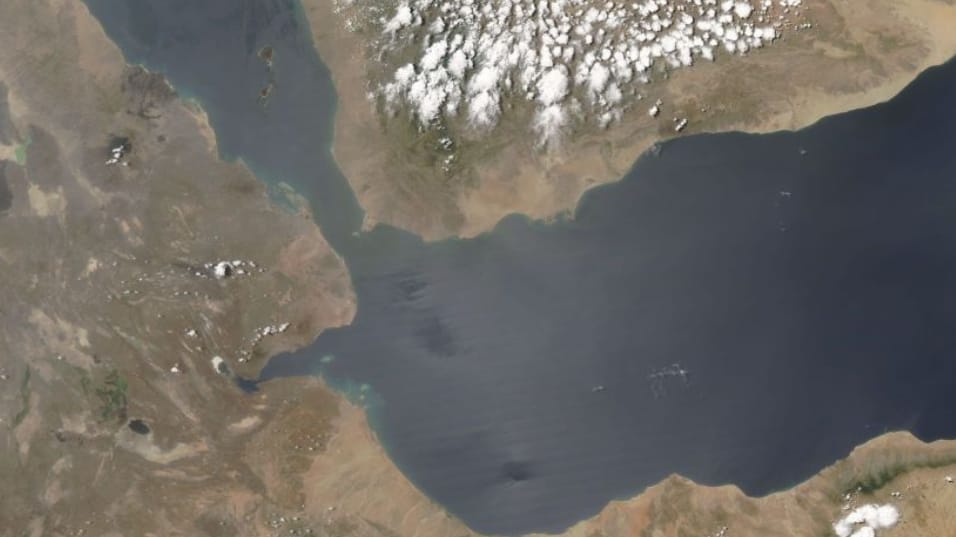
The Houthis appear to have overextended themselves in their rapid advance in SW Yemen, which saw them capture the Ras Menhali peninsula and Perim Island just offshore in the Bab el-Mandeb.
The Houthis were able to advance so quickly down the coastal strip and the Tihama plain for evidently two reasons. They had good intelligence on the disunity within the forces of the Internationally Recognized Government (IRG), which they were able to exploit. It is now apparent that the unity within the IRG had not improved to the extent portrayed, and the Houthis were able to exploit divisions between the semi-autonomous force components, which the IRG had not welded into a sufficiently combined force. The Houthis were also able to exploit the lack of any meaningful threat from the air as they advanced across the open country of the Tihama plain.
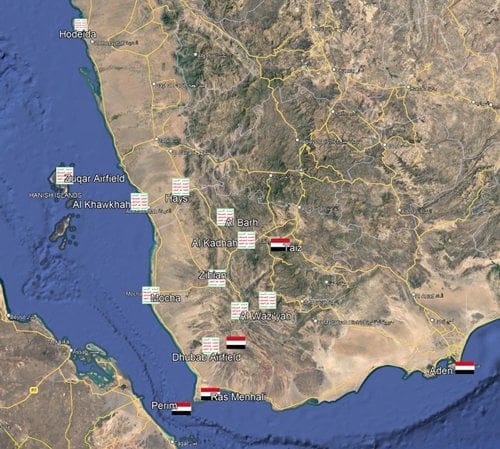
Battle still fluid, latest indications of positions held in SW Yemen, as of September 14
(Google Earth/CJRC)
The balance of advantage is now shifting, and the Houthi force in the newly occupied areas – mostly light infantry - is exposed. It is dangerously dependent on a single supply line to the north, the N2 coastal highway, which is straight, flat, and completely exposed. Houthi movements on the N2 are now being attacked from the air, with civilians having been warned that any movement on the road will be considered to be a legitimate military target. The air attacks are supposedly being carried out by the IRG, although the Yemeni Air Force of late has been presumed to be moribund. Most probably the Royal Saudi Air Force has now become engaged, heavily so, and a large-scale Houthi missile attack on the Saudi airbase at Khamis Mushayt on the morning of September 13 was presumably designed to inhibit such attacks.
Being a largely pick-up and motor bike mounted light infantry force, the Houthis in the area are also now exposed to the much better equipped forces of the IRG moving up from Lahj, the neighboring province, where units are still in good order. Southern Giants Forces, displaying the flags of the erstwhile South Yemen, have been seen in coverage of attacks being mounted on the road towards Dhubab, and there have noticeably been no indication of a continuing Houthi presence on Perim or at the Ras Menhali port across the water.
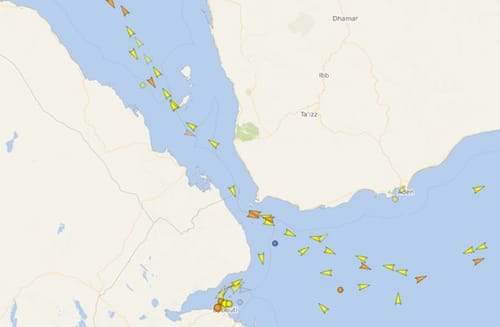
Traffic through the Bab el-Mandeb is continuing, but appears to be somewhat reduced based on AIS feeds visible early on September 14 (VesselFinder)
The tactical situation remains highly fluid, and the Houthi forward forces are exposed if the IRG can mount an effective counter-attack. It is feasible that by the end of the week the situation will have been reversed and the IRG could be back in Mocha. But the forces of the IRG have lost units and some sophisticated equipment in their earlier retreat, including modern radar systems, advanced surveillance cameras, coastal artillery, medium-range weapons, and anti-tank missile systems, some of which the Houthis will turn against the IRG.
Having temporarily seized control over Perim and the coast overlooking the Bab el-Mandeb, the Houthis attempted to exploit this politically by approaching the Egyptians to coordinate a joint approach to sea traffic in the Red Sea. The Egyptians did not reply to the Houthi messaging, making it clear that they recognize the authority of the IRG and would not enter into any form of discussion with an illegitimate authority. Whereas General Tareq Saleh bemoaned the lack of close support as he fell back during the original Houthi assault, belatedly, this support is now forthcoming as the threat to international shipping is now appreciated.
Key Saudi Pipeline Could Be Slowed for Weeks, Affecting Global Oil Trade
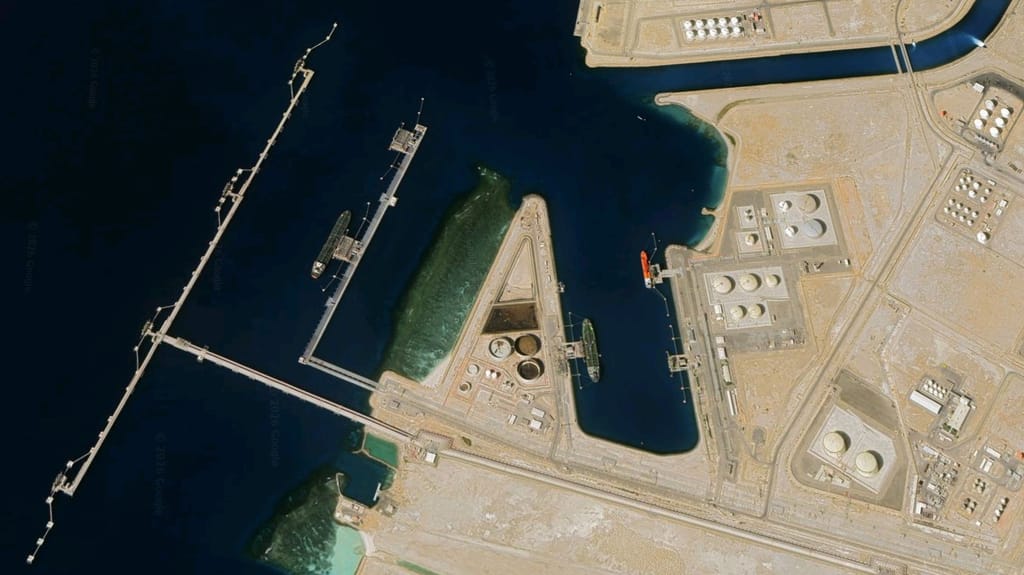
Recent attacks on Saudi Aramco's East-West Pipeline have raised concerns in the oil market about the continued availability of cargoes. The concern appears to be justified: officials familiar with the damage assessment believe that it will take 3-5 weeks for pipeline flow to be fully restored, according to the AP. Given the size of the oil supply in storage sites to seaward of the pipeline damage, Aramco's Red Sea stockpiles could run low and its export loadings could begin to slow by the end of the week.
The most significant impact of the pipeline attack was the destruction of a large pumping station, which is needed to maintain pressures and flow rates over the 750-mile length of the line. The station was thoroughly destroyed in the attack, officials say. Satellite imaging shows construction under way on a bypass line around the pumping station, which may allow operations to resume at a lower rate while repairs are under way. Officials told AP that they were not certain just how much oil the line would be able to move without the station to boost pressure.
Saudi Red Sea loading terminals, which have lately accounted for about four percent of the total global oil supply, will be closely watched in the week ahead. Benchmark Brent crude settled at $106 on Monday, reflecting expectations of a tight market in months to come.
As predicted by many analysts, a Saudi official confirmed to Bloomberg on Monday that Saudi Aramco's efforts to ship oil through the contested Strait of Hormuz would be increased in order to offset the impact of the pipeline shutdown, despite the risk of Iranian attack in the narrow waterway. Hormuz flows have ticked radically upward over the past week on the back of increased "shuttle tanker" activity between the Arabian Gulf and the Gulf of Oman. Increased Saudi activity on this route would help offset any impact from a slowdown at Yanbu.

No comments:
Post a Comment