Saturday, October 10, 2026

'The Orange Plague': Naked Trump statue on display at European Parliament in Strasbourg
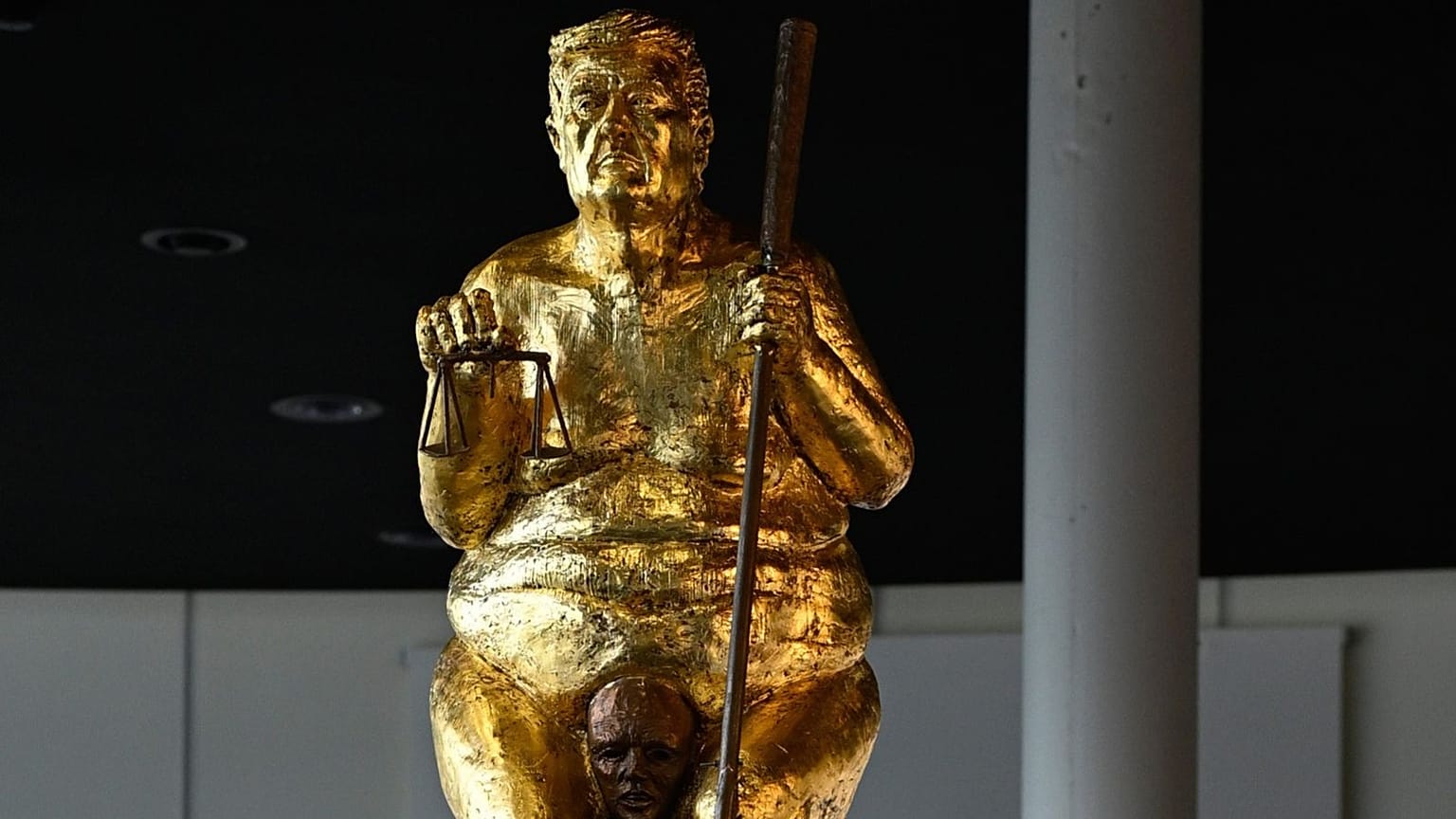
"The Orange Plague": Naked Trump statue on display at European Parliament in Strasbourg
Copyright AP Photo
By David Mouriquand
Published on


A gold statue depicting Donald Trump fully naked and crushing a smaller man’s shoulders has been unveiled in the European Parliament building in Strasbourg, France.

A new statue has been introduced to the European Parliament building in Strasbourg, and it’s all kinds of satirical and naked.

Titled "The Orange Plague," the 2.6-meter statue by Danish artist Jens Galschiøt, is a depiction of a nude Donald Trump holding a comically sized golf club in one hand, a set of scales in the other, all while sitting on the back of a smaller, frailer man.

The artist said it is coated with 23-karat gold and that his work is also known by the name "King of Injustice."

Jens Galschiøt next to his statue "The Orange Plague" in Strasbourg - 7 October 2026
Jens Galschiøt next to his statue "The Orange Plague" in Strasbourg - 7 October 2026 AP Photo

Beneath the statue is a plaque which reads:

"I am sitting on the back of a man.

He is sinking under my burden

I will do anything to help him.

Except stepping down from his back.

- The King of Injustice."
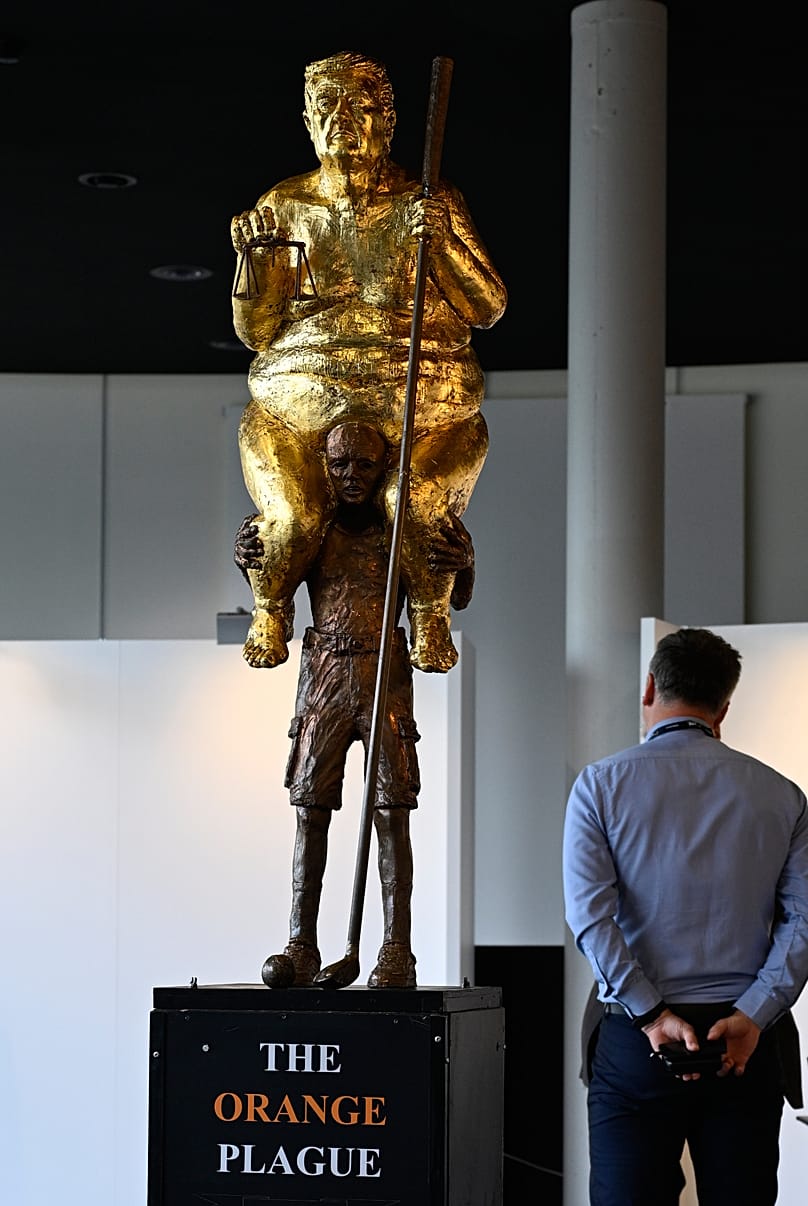
"The Orange Plague" in Strasbourg
"The Orange Plague" in Strasbourg AP Photo

According to Galschiøt, the work was inspired by Hans Christian Andersen’s The Emperor’s New Clothes, and is a “satirical outcry” against Trump’s volatile climate and foreign policies.

“Nations as well as NGOs are afraid to openly raise the subject [of] how to deal with Trump and his policies, fearing tariffs, fund-cuts, deportations or the like,” Galschiøt wrote on his website. “As an independent art workshop we are not restricted by such bonds. This sculpture has been made to address ‘the elephant in the room’ and start a necessary debate [about] how the US is destroying the world’s only chance to counter the climate catastrophe.”

"The Orange Plague"
"The Orange Plague" AP Photo

All visitors receive a 3D-printed miniature of the sculpture to take home.

Galschiøt has said he printed around 20,000 sculptures that he distributed not only to visitors but also to staff throughout the European Parliament.

Left-wing Danish European Parliament member Per Clausen, who invited the artist, said he is not worried about a potential reaction by Trump.

"If someone is so thin-skinned that they cannot tolerate this sculpture being exhibited in the European Parliament, then they have no place on the world stage," Clausen said.

As of yet, no reaction from the subject of “The Orange Plague", who is usually reactive online and not known for his thick skin in these matters.

The statue was previously displayed at the “hands off Greenland” demonstrations in Copenhagen earlier this year and the COP30 UN Climate Summit in Belém, Brazil last year.

After the present installation in Strasbourg, Galschiøt plans to exhibit "The Orange Plague" again at the COP31 UN Climate Conference next month Antalya, Türkiye.


'Saint or Sinner'? British artist Mason Storm crucifies Donald Trump in sculpture on show in Basel
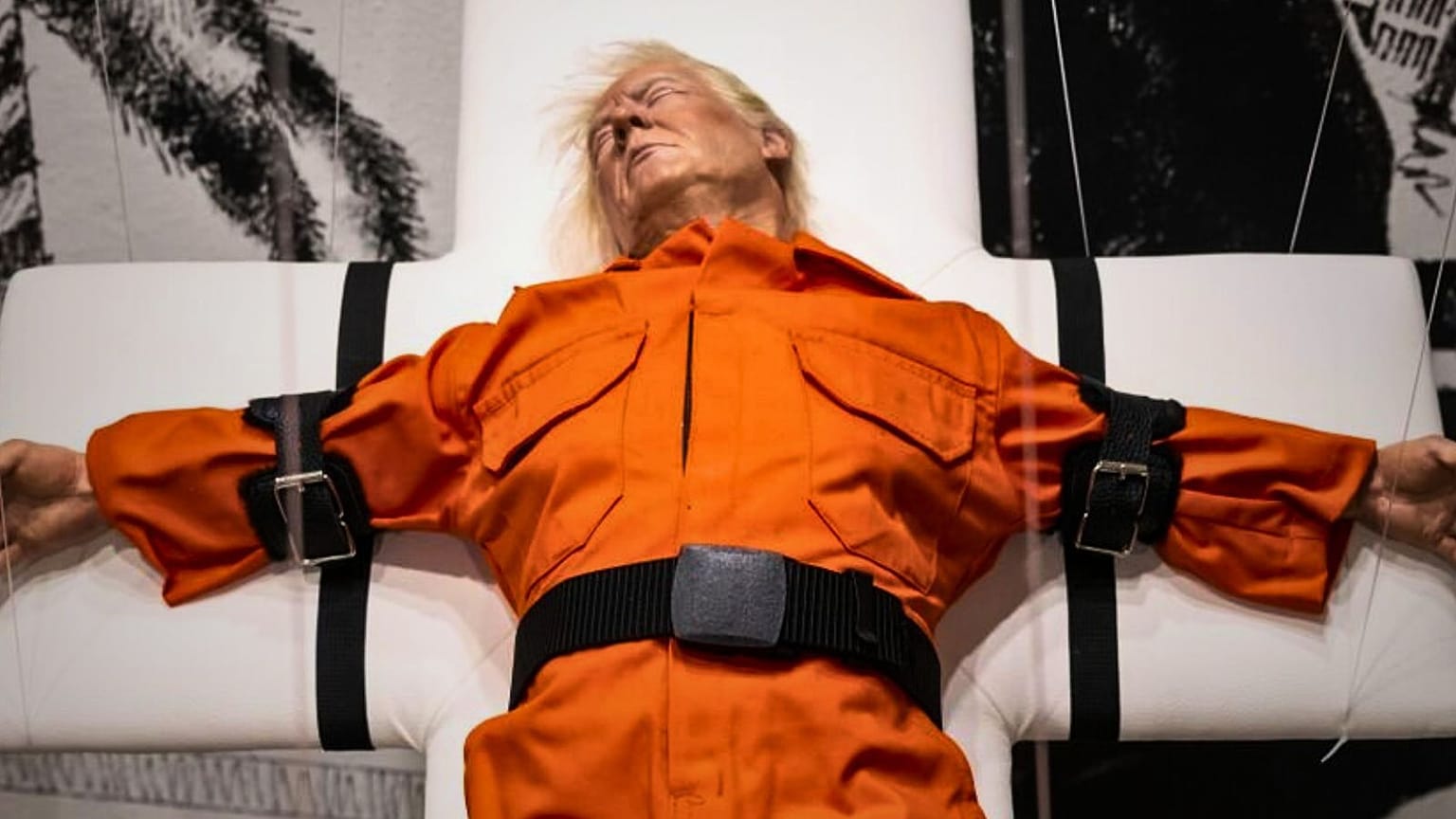
'Saint or Sinner?': British artist crucifies Donald Trump in new sculpture
Copyright X screenshot - Basler Kunstmeile / Mason Storm

By David Mouriquand
Published on

Hero or villain? Martyr or criminal? “Saint or Sinner”?

A hyperrealistic sculpture depicting Donald Trump nailed to a cross while wearing an orange prison jumpsuit has gone on display at the Basler Kunstmeile in Switzerland, weeks after its debut near Basel Central Station was postponed over fears of public backlash.

The sculpture, titled “Saint or Sinner”, is by British artist Mason Storm, who is celebrated for his satirical and often politically charged art. And like Banksy, he cultivates a sense of anonymity by wearing masks and balaclavas.

Here, he plays on the dichotomy between a vertical crucifixion and a horizontal execution gurney, leaving a provocative space where religion and politics mix to better question whether the current US president deserves entry to heaven or a lethal injection.

The sculpture is eerily realistic – something which Konrad Breznik, owner of the Gleis 4 gallery, marvels at.


“You can see every wrinkle, the skin is so realistic, it's really disturbing,” he told AFP.

Breznik even said he believed that Trump might actually appreciate the piece.

“I do absolutely think that Mr Trump might see himself very well in the role of a modern Jesus,” he said. “I’m pretty sure he is very much convinced that he is doing the right thing.”

Appropriately, Trump himself said last month, aboard Air Force One: "I don't think there's anything that's going to get me into heaven. I think I'm not maybe heaven-bound."

Well, there we have it, folks.

Whether or not the artwork could be exhibited in the US remains another matter... It has already sold to an “internationally renowned” European collector, whose name remains confidential, according to the gallery.

“Saint or Sinner” is proudly on display in Basel until mid-November.


Trump aide daughter's visit to Bosnia's Republika Srpska sparks scandal over US ties to Russia-linked politicians

Trump aide daughter's visit to Bosnia's Republika Srpska sparks scandal over US ties to Russia-linked politicians
Activist Evi Kokalari shares screenshots from Katie Wiles' social media. / Evi Kokalari via XFacebook

By IntelliNews October 9, 2026

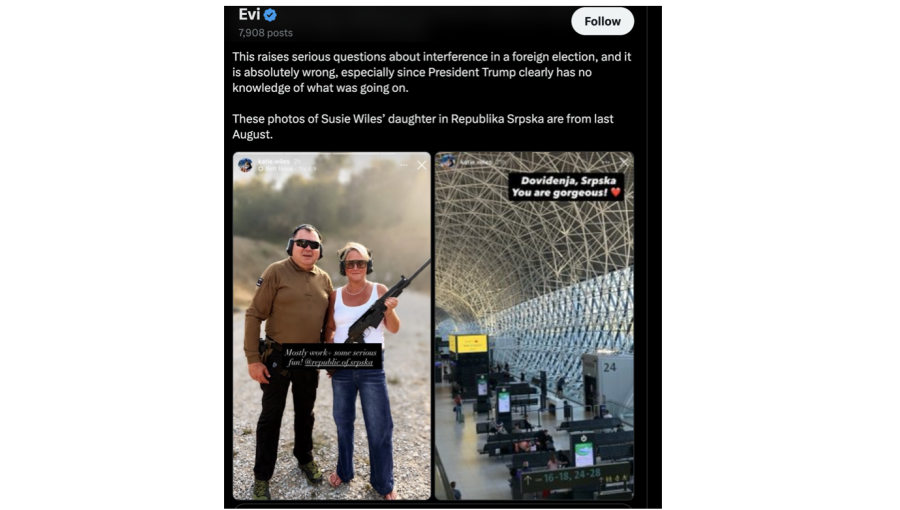
The daughter of White House Chief of Staff Susie Wiles visited Bosnia & Herzegovina's predominantly Serb entity Republika Srpska in August and was photographed with its interior minister, sparking a political scandal after photos posted by Katie Wiles on social media were shared by Albanian-American activist Evi Kokalari. 

The disclosures have intensified scrutiny of how Republika Srpska has used US lobbying firms to cultivate relationships with figures close to US President Donald Trump, as Washington recalibrates its policy towards the Western Balkans.

Katie Wiles, a partner at Washington lobbying firm Continental Strategy, was pictured holding a rifle beside Republika Srpska Interior Minister Željko Budimir at a shooting range in Republika Srpska. CBS News said it had verified the image using satellite imagery and earlier social media posts.

The photograph shared by Kokalari appeared to be a screenshot from Wiles' personal Instagram account, with the caption "mostly work + some serious fun!"

"People from the region are reporting to me that Katie Wiles has been working for months for @MiloradDodik , and there’s a huge conflict of interest here," Kokalari wrote on October 7, when she shared the screenshots. 

"This would explain why Željka Cvijanović, the Serbian candidate who “won” the Presidential election a few days ago in Bosnia, was at the White House on September 21st, meeting with Susie Wiles and taking pictures that she used for her election a few days ago," she added. 

"This raises serious questions about interference in a foreign election, and it is absolutely wrong, especially since President Trump clearly has no knowledge of what was going on."

Kokalari has since posted extensively on the story, including an October 8 X post in which she suggests Susie Wiles has "installed all her people around @realDonaldTrump, fully isolating him from his original loyalists while her people do whatever the hell they want? That would explain why US foreign policy in the Balkans is changing in favour of our enemies." 

Continental Strategy confirmed that Wiles visited the territory for two days in mid-August, but said her trip was connected to a separate client rather than the Republika Srpska government.

"Katie Wiles visited the country in mid-August for two days with a US-based company who was invited to do a feasibility study in the region," a company spokesperson told CBS News. "Wiles provides strategic communications support to this US company and has done so for over two years. Wiles has not spoken with any United States Government official regarding Srpska."

A White House official told CBS News: "Susie does not discuss work matters with her daughters."

Questions have already been raised over the activities of US political operatives who reportedly advised Republika Srpska's ruling party ahead of elections in Bosnia on October 4, and the business interests of people connected to the Trump administration.

Continental Strategy had a $35,000-a-month contract to lobby for Republika Srpska, according to US Foreign Agents Registration Act filings. The agreement provided for the firm to organise meetings and cultivate relationships with senior figures in the US executive and legislative branches.

The firm helped arrange a visit by Republican strategists Chris LaCivita and James Blair, who travelled to the territory ahead of the elections, Semafor reported, citing people familiar with the trip. The New York Times first reported their visit.

Responding to Republican congressman Richard Hudson's defence of the two strategists, Kokalari accused them of "helping Russian proxies cheat the Bosniaks out of their election".

The firm's partner Alejandro Garcia, a former deputy political director for Trump's presidential campaign, was involved in lobbying for Republika Srpska and arranging contacts with White House officials, according to media reports and registration documents.

Continental Strategy said Garcia was its only employee present in Republika Srpska on election day and the only team member who had interacted with the US government on behalf of the territory.

Trump distanced himself from LaCivita and Blair on October 7, saying on Truth Social that he did not "have any idea" who they had been working for and pledging that "if there's a conflict, I will terminate them, immediately!" He later said the two men were independent consultants who did not work for him.. 

Dodik, who until recently served as Republika Srpska's president, has maintained close ties with Russian President Vladimir Putin and repeatedly challenged Bosnia's central institutions. A Sarajevo court last year convicted him of failing to comply with the terms of the country's 1995 peace accords, leading to his removal from office and a ban on holding political office.

The German-based Society for Threatened Peoples on October 9 urged the European Union to impose targeted sanctions on Dodik and his associates and investigate political and economic links between Republika Srpska authorities and Trump's circle. The rights group also called for greater scrutiny of lobbying agreements, investment projects and potential conflicts of interest, warning that Bosnia's sovereignty and territorial integrity must not become bargaining chips in political or commercial arrangements.

The EU has not imposed sanctions on Dodik, although the UK, Germany and Austria have taken measures against him or people in his network.

The scrutiny of Trump-linked businesspeople in Bosnia extends to a planned gas pipeline linking Bosnia and Croatia, a project valued at more than $1.5bn. US company AAFS Infrastructure & Energy, headed by former Trump personal attorney Jesse Binnall and Joseph Flynn, brother of former Trump national security adviser Michael Flynn, was named lead developer of the project after Washington lifted sanctions against Dodik and associated individuals in October 2025.

The pipeline has drawn criticism from anti-corruption watchdogs and energy experts as well as the European Union. Transparency International Bosnia and Herzegovina warned that proposed legal amendments tied to the project “eliminates any possibility of competition” and could create a “dangerous precedent” by directly designating a private investor. A CEE Bankwatch representative said the arrangements could breach concession laws and rely on “opaque negotiations between the [Bosnian] Federation government and AAFS, raising red flags for corruption and excessive transfer of financial risks to the Federation”


Zelenskyy hits out at 'gifts to Putin' after Trump announces deal for Russian diesel

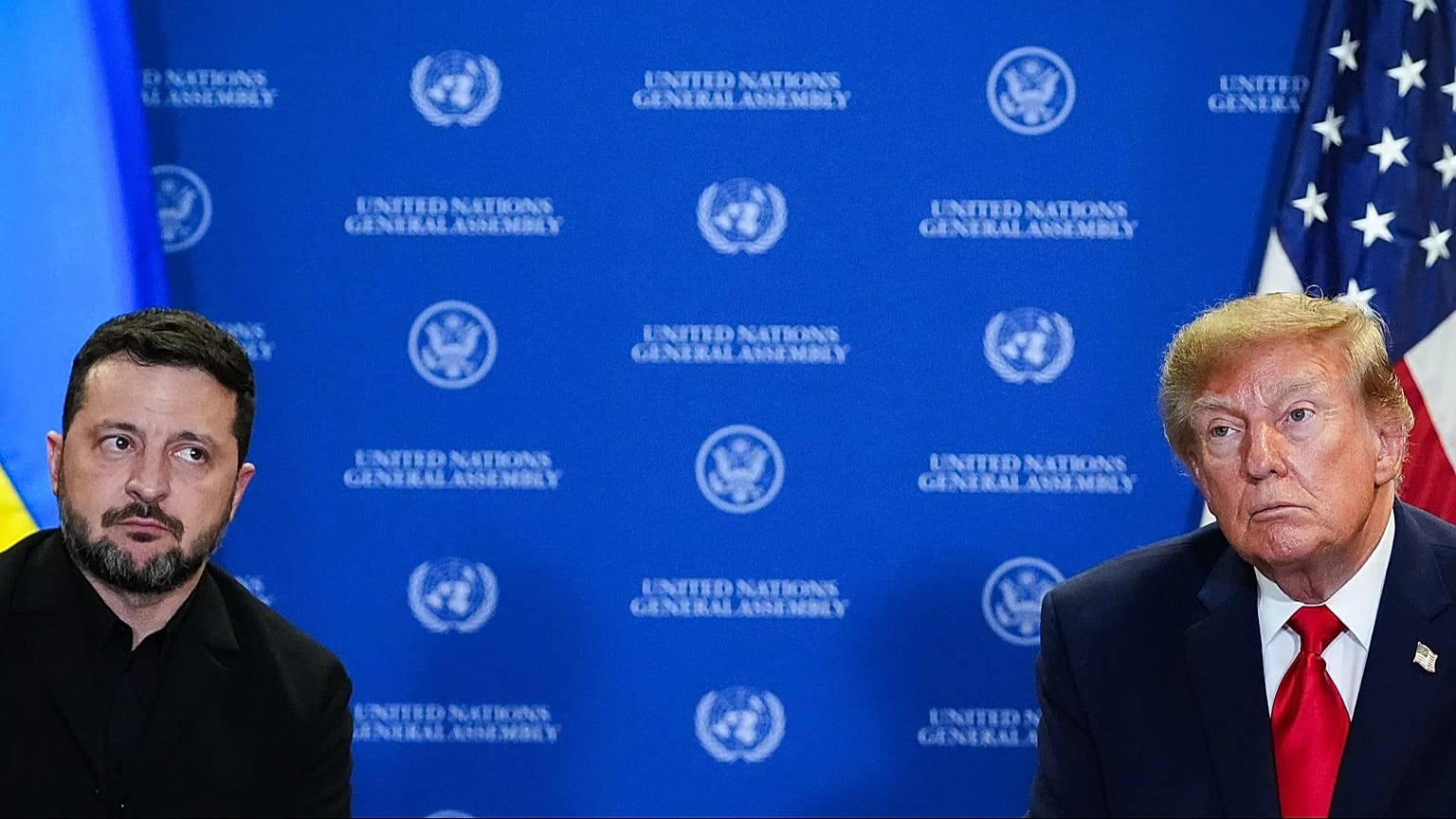
President Donald Trump meets with Ukraine's President Volodymyr Zelenskyy during the United Nations General Assembly, Tuesday, Sept. 22, 2026.
Copyright AP Photo

By Greta Ruffino
Updated

US President Donald Trump said on Friday that Russian leader Vladimir Putin had agreed to release diesel into US and global markets.

Ukrainian President Volodymyr Zelenskyy has hit out at what he called "gifts to Putin" after the US announced a deal to buy Russian diesel.

US President Donald Trump said on Friday that Russian President Vladimir Putin had agreed to release diesel into US and global markets, a move he said would help ease soaring energy costs amid the war with Iran.

"Russia will immediately supply over 300,000 tons of Diesel Fuel to the American and Global Marketplace, another 500,000 tons during the month of November," Trump said following talks with Putin.

Responding to the announcement in a post on X, Zelenskyy wrote: "Gifts to Putin will not bring peace or any benefit to the civilized world."

"Allowing Russia to sell petroleum products is an investment in a war that must be ended, not prolonged. What is needed is real de-escalation with Russia on a reciprocal basis," he added.

The US Treasury Department also said it was issuing a temporary licence allowing Russian diesel to enter global markets.

The White House did not immediately clarify who would pay for the Russian diesel or when supplies under the agreement would become available. It also did not say whether further deliveries expected next month would arrive before the 3 November midterm elections.

Trump's announcement comes just a month after he signed sweeping sanctions against Russia aimed at targeting its energy sector and other industries helping finance its war in Ukraine.

The move raises questions over whether the White House will impose further sanctions on Russia this month, as required by bipartisan legislation targeting major importers of Russian oil and gas.

Trump made no mention of the sanctions or Russia's war in Ukraine, instead saying: “Lower prices for Americans, especially our Great Farmers, Ranchers, and Truckers, is my Greatest Priority.”

Russian presidential envoy Kirill Dmitriev reposted the Treasury Department’s announcement on X Friday and said that “Russia-US cooperation on diesel and energy will benefit the world.”


Trump strikes diesel deal with Putin, reversing years of pressure on Russia over Ukraine war

US President Donald Trump said Friday that Russia had agreed to immediately supply more than 300,000 tonnes of diesel to US and global markets in an effort to cut fuel prices before November's midterm elections. The move marks a stunning change of policy after the US and its allies hit Russia with waves of sanctions over its invasion of Ukraine.


Issued on: 09/10/2026 - 
By:FRANCE 24


The US president said he struck the deal with Putin in a phone call in which he was expected to discuss a suspected case of plague in Russia. © Jim Watson, Kristina Solovyova, AFP


US President Donald Trump said that he has struck a deal to obtain diesel from Russia, a stunning reversal of years of US pressure on Moscow over its war with Ukraine and an attempt to address high fuel prices ahead of the US midterm elections.

Trump said on social media on Friday that he struck the deal with Russian President Vladimir Putin in a phone call in which he was expected to discuss a suspected case of plague in Russia. Instead, Trump announced that Russia will immediately supply more than 300,000 tonnes of diesel, followed by an additional 500,000 tonnes in November and 1 million tonnes “immediately thereafter.” Russia will deliver another 3 million tonnes “within a short period of time” after that, he wrote.

Trump’s shocking announcement comes after he signed a sweeping Russia sanctions law last month that aimed at clamping down on Russia’s energy economy, among other areas, that fuel its war against Ukraine.

His move casts doubt on the likelihood of the White House imposing sanctions on Russia this month, given that a bipartisan law passed by Congress directs the administration to target the top importers of Russian oil and gas.

Trump, in his announcement, did not address the sanctions or Russia’s war but said, “Lower prices for Americans, especially our Great Farmers, Ranchers, and Truckers, is my Greatest Priority.”

The White House did not immediately respond to questions about who was paying for the diesel from Russia and when the fuel being supplied under the agreement would become available. It also did not clarify whether subsequent supplies of Russian diesel set to come next month would be supplied prior to Election Day on November 3.

Russian presidential envoy Kirill Dmitriev reposted the Treasury Department’s announcement on X Friday and said that “Russia-US cooperation on diesel and energy will benefit the world”.

The law Trump signed last month envisions sanctions on Russian officials, banks and a shadow fleet of tankers and bans all new US investment in Russia and the handling of sovereign debt.

It also directed Trump to impose tariffs of up to 100% on the top five importers of Russian oil or natural gas, with an exception for countries that import less than 15% of Russia’s natural gas exports and have taken significant steps to reduce those imports.

The US has not imported Russian oil or gas since 2022, when the Biden administration banned them because of Moscow’s invasion of Ukraine, according to the US Energy Information Administration.

Shortly after Trump made the announcement, the Treasury Department said it was immediately issuing a temporary license allowing Russian diesel to be supplied to the global market.

Gas prices globally have surged as the war in Iran upends the energy sector. The national average for a gallon of diesel in the US was $6.23 on Friday, according to AAA, after hitting a record $6.52 on September 22.

(FRANCE 24 with AP)


EU paid €7.9bn for Russian Arctic LNG amid record imports


By Marta Pacheco
Published on

Continued Russian LNG imports undermine the credibility of the EU’s promise to sever its energy ties with Moscow, particularly as Russia continues its war against Ukraine.

Europe paid around €7.88 billion for liquefied natural gas (LNG) from Russia’s Arctic energy project in the first nine months of 2026 despite Brussels’ efforts to phase out gas from Moscow, according to the campaign group Urgewald.

The figures, compiled by Urgewald using data from the market intelligence firm Kpler, expose just how reliant the EU remains on Russian energy, with a record of 12.18 million tonnes reaching European ports between January and September this year.

The EU has been trying to wean itself off Russian energy for a while, and this year introduced a number of measures to end its reliance on Moscow. Brussels introduced a ban on new Russian energy contracts at the beginning of 2026, with a complete ban on Russian LNG taking effect on 1 January 2027.

Meanwhile, the Trump administration recently announced the Lindsey Graham Act, giving the US the power to sanction Russian LNG deliveries to Europe before the EU's import ban kicks in.

This comes at a time when Europe's gas storage levels are at a record low, and the bloc faces a brutal energy crisis, leaving Brussels increasingly vulnerable to decisions from Washington, the EU's major LNG supplier.

European LNG imports from the Russian Yamal project rose 9.5% year-on-year between January and September, with EU ports receiving 85% of Yamal’s recorded deliveries.

France received nearly three-quarters of September’s EU deliveries, with the Dunkirk and Montoir ports receiving 571.716 million tonnes of Arctic LNG, according to Kpler.

The Netherlands imported 146.461 million tonnes of LNG and Portugal 74.263 million tonnes. No cargoes were recorded in Spain or at Belgium’s Zeebrugge terminal.

The persistence of the Arctic LNG trade into Europe shows the difficulty of translating a long-term phase-out commitment into an immediate commercial break.

Ineffective short-term bans

The figures also raise questions about the effectiveness of the EU’s initial restrictions on Russian LNG.

A ban on imports under existing short-term contracts took effect on 25 April, but September deliveries reached 792,440 tonnes, slightly above the level a year earlier.

The EU’s full ban on Russian LNG under eligible existing long-term contracts is scheduled to take effect on 1 January 2027.

Until then, continued purchases generate revenue for Russia's war against Ukraine and expose the limits of restrictions that target some contracts without immediately stopping the wider trade.

"We have always assumed that the impact would not be particularly significant, since most of the export capacity is tied up in long-term contracts anyway," Sebastian Rötters, energy campaigner at Urgewald, told Euronews.

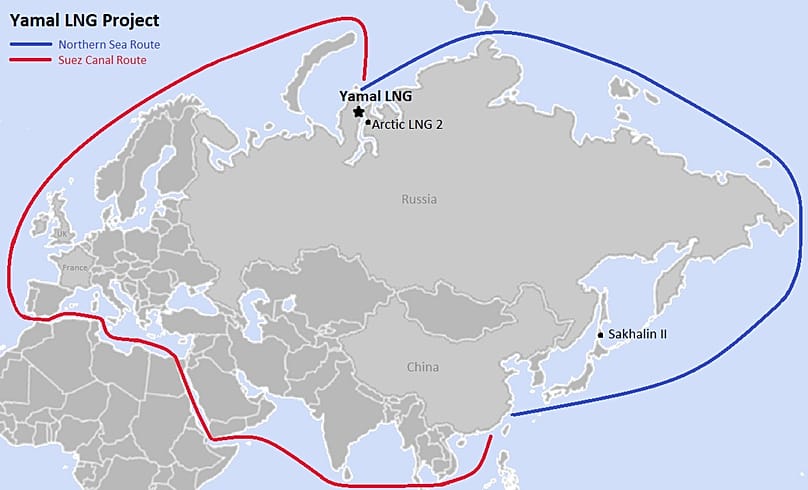
"In addition, export volumes are generally lower in the summer due to maintenance work at the terminal and LNG shipments to Asia via the Northern Sea Route," Rötters added.

The real litmus test for Yamal will be the EU’s phase-out starting in 2027, Rötters said, noting it may lead to noticeable reductions in exports due to the increased logistical challenges


Nina Lavrenteva / Liège University Yamal LNG project.


Call to strengthen 22nd sanctions package

The German-based NGO Urgewald is calling for the upcoming 22nd EU sanctions package to close loopholes, particularly those supporting the specialised Arc7 ice-class tanker fleet needed to transport LNG from the Arctic.

Yamal’s reliance on specialised vessels makes its export system vulnerable to restrictions on transport and associated services.

European ports are also geographically convenient destinations, allowing tankers to unload and return to the project relatively quickly.

Urgewald argues that disrupting those logistics could pile pressure on Russia’s ability to sustain Arctic LNG exports.

"The EU should not wait passively for the 2027 embargo to take effect. The next sanctions package should close the remaining loopholes, above all those that keep the indispensable Arc7 LNG tanker fleet operating. Washington, meanwhile, now has the power to sanction this trade at any time before then,” reads Urgewald's statement.

However, such measures would require political coordination among the EU and its member states and could complicate European gas procurement before the import ban takes effect and ahead of an unpredictable winter season.

The data provided does not establish how much of the trade could be redirected to other buyers or what the consequences would be for European gas prices, but any additional trade disruption on top of the loss of LNG from the Middle East would have an impact.

Trump gains another lever over the EU’s energy security

US sanctions under the Lindsey Graham Act could disrupt trade before the EU's ban on Russian LNG takes effect, forcing European governments and buyers to respond.

The US administration faces an 18 October deadline for its first review under the law. However, the deadline should not be mistaken for an automatic ban on Yamal deliveries, Urgewald say, as the law’s practical impact depends on how the administration exercises its powers.

"The US President must compile a list of ships transporting Russian LNG by October 18. These ships will then be subject to sanctions unless Trump issues so-called waivers. This is possible and, given Trump’s track record regarding Russia, not unlikely," Rötters told Euronews.

EU imports from Yamal will depend on the goodwill of the US President from 18 October until the final embargo takes effect in 2027, Rötters stressed.

US sanctions have already severely restricted Russia’s Arctic LNG 2 project and the Northern Sea Route, while Yamal LNG continues to supply Europe.

Data from Kpler shows that 706.473 million tonnes of LNG were destined for China, South Korea and Taiwan in September this year.


Ukrainians expect bleak winter as most back negotiated peace, poll finds

Ukrainians expect bleak winter as most back negotiated peace, poll finds
A Rating Group survey found 83% back a negotiated compromise, while 56% would accept territorial concessions with real Western security guarantees. / bne IntelliNewsFacebook
By Ben Aris in Toulouse October 9, 2026

More than half of Ukrainians, 55%, expect the situation in their country to get worse this winter and 71% expect the economy to deteriorate, a Rating Group poll published on October 8 found.

Some 63% of respondents expect the energy sector to get worse over the coming months. Asked about electricity at home, 47% expect supply to be about the same as last winter, 39% expect it to be worse and only 9% expect an improvement. Just 12% think the overall situation will improve, while 25% expect little change.

Few Ukrainians think either side is winning. Some 62% said neither Russia nor Ukraine currently has the upper hand, 26% said Ukraine does and 6% said Russia does. Half agreed that "any peace is more important than any victory", against 41% who said victory matters more than any peace. Rating Group noted that the share putting victory first has risen as Russian strikes have intensified in recent months.

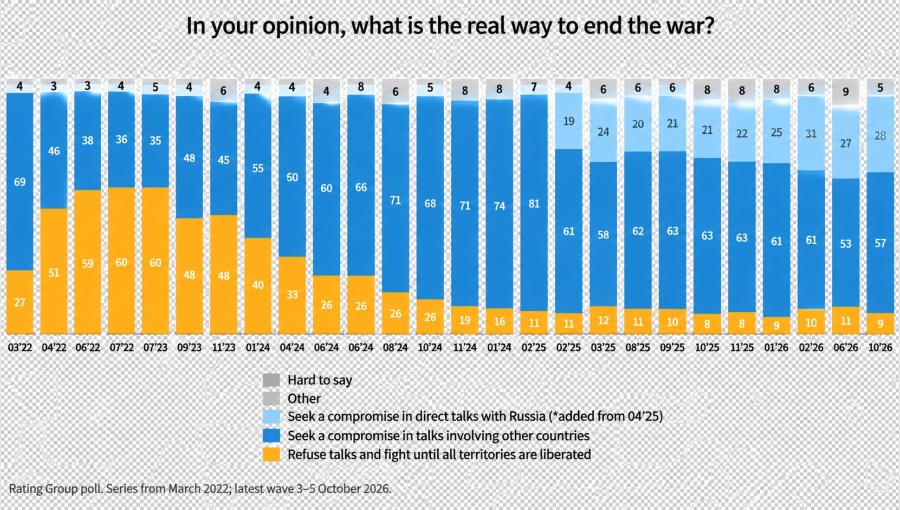
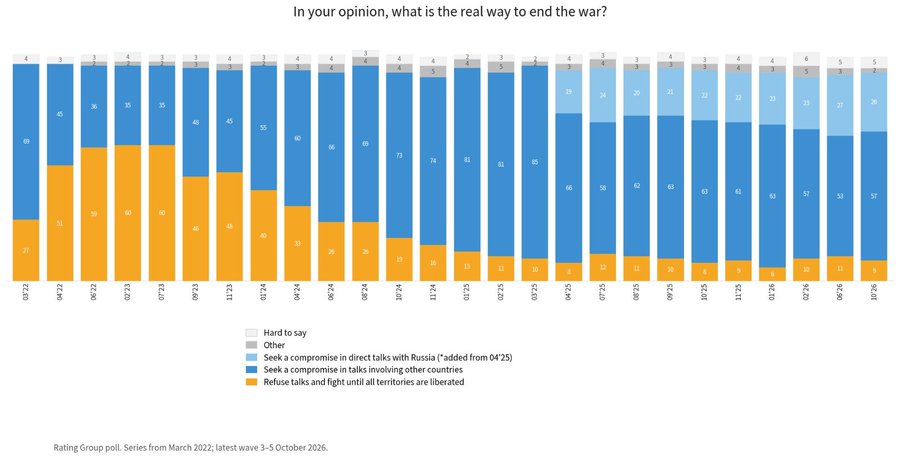
Support for ending the war at the negotiating table is overwhelming. Asked about the realistic way to end the war, 57% backed seeking a compromise in talks involving other countries and 26% a compromise in direct talks with Russia, a combined 83%. Only 9% wanted to refuse talks and fight until all territories are liberated, against 51% in April 2022, according to the pollster's tracking series.

"In your opinion, what is the real way to end the war?" Rating Group tracking series, March 2022 to October 2026. Source: Rating Group

On war aims, 57% support ending hostilities and seeking a compromise through negotiations, 13% favour fighting until Ukraine restores the line of control of February 23, 2022, and 21% want to fight on until Donbas and Crimea are returned.

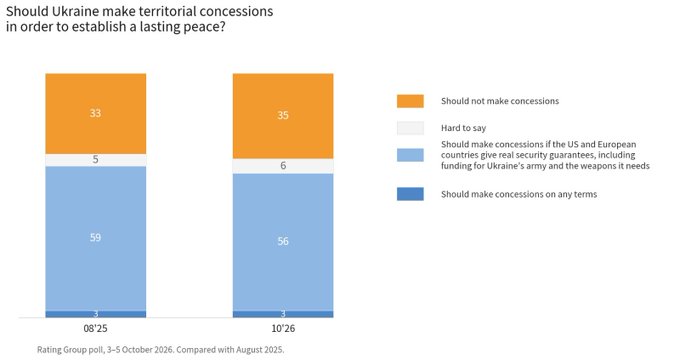
Territory remains the hardest question. Some 56% would accept territorial concessions to secure a lasting peace, but only if the US and European countries provide real security guarantees, including funding for Ukraine's army and the weapons it needs. A further 35% reject concessions on any terms and 3% would accept them unconditionally. In August 2025 the figures were 59% and 33%. If concessions became a condition for peace, 68% want the decision taken in a nationwide referendum, 17% would leave it to the president and 9% to parliament.

"Should Ukraine make territorial concessions in order to establish a lasting peace?" August 2025 against October 2026. Source: Rating Group


Ukraine’s Operation Vivaldi foils Russia’s plan to encircle the Donbas, ISW analysis shows

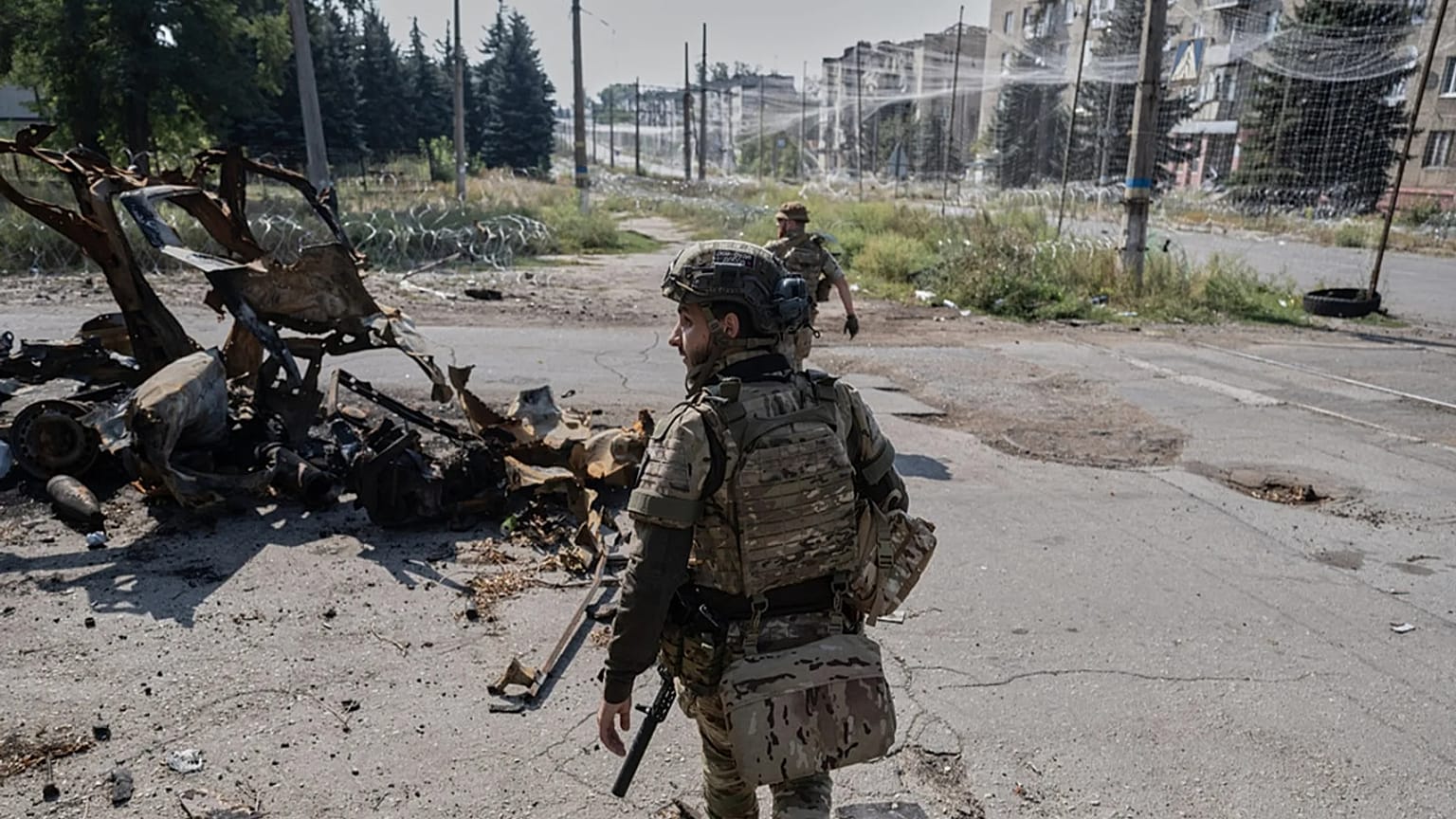
A Ukrainian soldier walks down a street in front-line Druzhkivka (Donetsk region), 12 September 2026.
Copyright Ирина Рыбакова/93-я отдельная механизированная бригада «Холодный Яр» ВСУ\

By Serguei Doubine
Published on

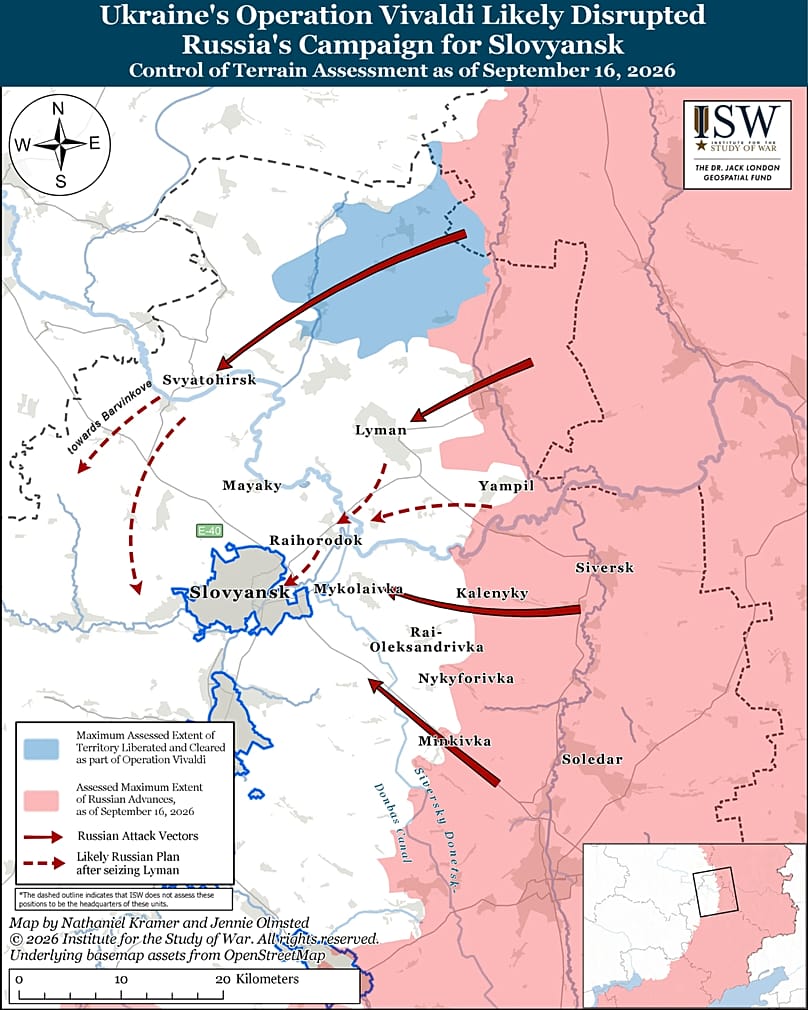
Ukraine’s counter-offensive on the Lyman axis collapsed the northern arm of a Russian pincer movement aimed at surrounding Ukrainian-held Donetsk, liberating up to 176 square kilometres and forcing Russian units onto the defensive, the Washington-based think tank said.

Ukrainian forces have derailed Russia’s plan to encircle and occupy the remaining Ukrainian-controlled territory of the Donetsk region this year, the Washington-based think tank Institute for the Study of War (ISW) concluded in an assessment based primarily on open-source intelligence

The Russian campaign centred on a deep pincer movement targeting what the report calls the “fortress belt” — a defensive and logistical network protecting the Ukrainian-held portion of the Donbas — advancing from Lyman in the north and Dobropillia in the south-west, with both arms intended to link up near Barvinkove in the Kharkiv region.

Completing such an encirclement would have gone a long way towards Moscow’s longstanding objective of occupying all of Donetsk region and would have given the Kremlin something to show Russian society for the costs of the war.

Ukraine foils Russian offensive in Donetsk
Ukraine foils Russian offensive in Donetsk ISW

Ukraine’s counter-offensive on the Lyman axis, dubbed Operation Vivaldi, dismantled the northern arm of that pincer.

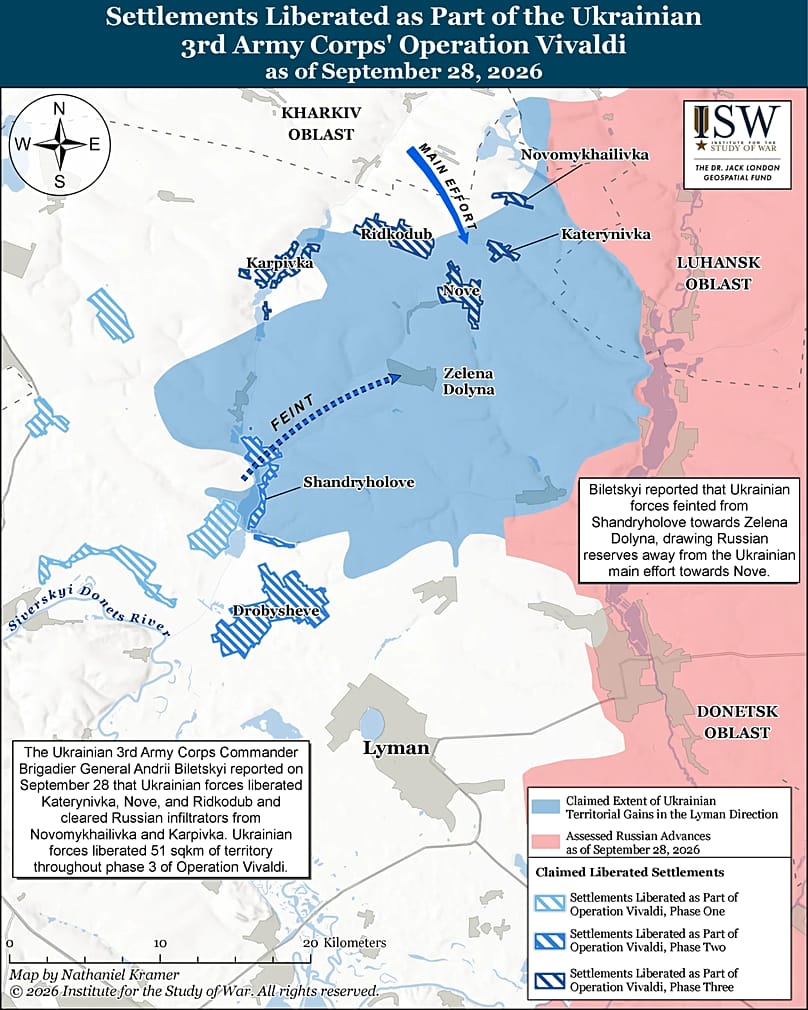
Ukrainian forces advanced along the Ridkodub–Nove–Novomykhailivka line in the north and the Yarova–Drobysheve–Stavky line in the south, collapsing the salient Russia had built to threaten Sloviansk from the north-east and forcing Russian units onto the defensive.

Commander of Ukraine’s 3rd Army Corps Andrii Biletskyi said the first three phases of the operation in mid- to late September liberated 176 square kilometres of territory.

Ukraine's President Volodymyr Zelenskyy put the figure at between 125 and 140 square kilometres as of 3 October, adding that Russian losses had risen sharply over the preceding two to three months.

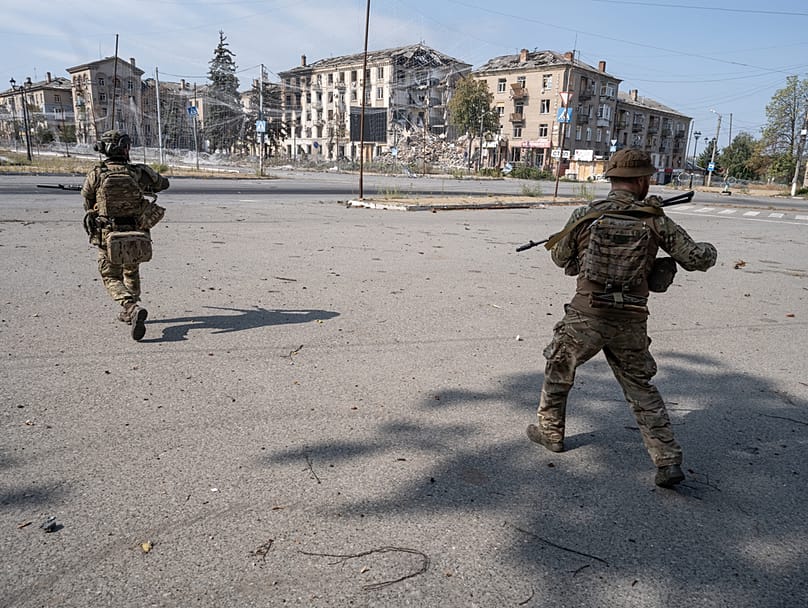
Ukrainian servicemen run along a street in Druzhkivka; photo provided by the press service of Ukraine's 93rd Separate Mechanised Brigade
Ukrainian servicemen run along a street in Druzhkivka; photo provided by the press service of Ukraine's 93rd Separate Mechanised Brigade Iryna Rybakova/Ukrainian 93rd Mechanized brigade

ISW suggested the operation may have been more successful than Kyiv’s official figures reflect.

The defeat of the northern pincer forced Russia to abandon its plans to advance on Sloviansk from the north-east and deprived it of positions intended to threaten northern approaches to the fortress belt.

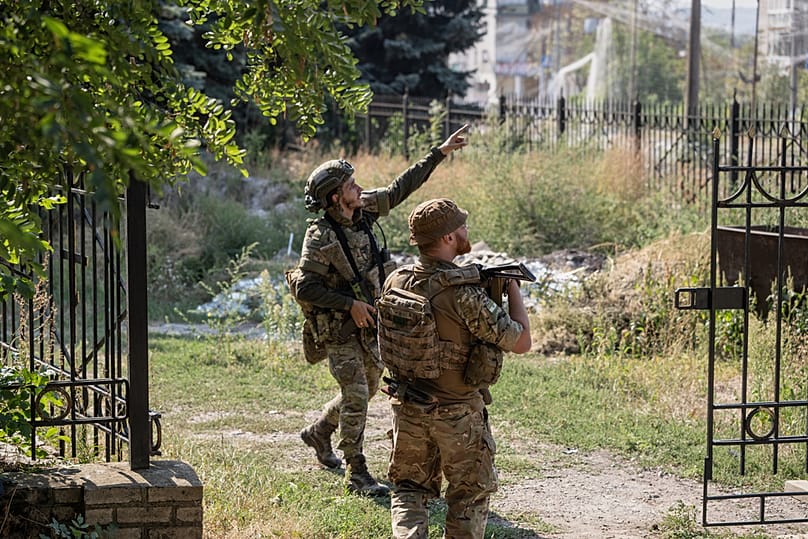
Ukrainian servicemen watch a first-person-view (FPV) drone in Druzhkivka on 12 September 2026.
Ukrainian servicemen watch a first-person-view (FPV) drone in Druzhkivka on 12 September 2026. Iryna Rybakova/Ukrainian 93rd Mechanized brigade

Ukraine’s retained control over the Lyman area also preserved key supply routes. Russian units on other parts of the front may have been redeployed to reinforce the northern sector.

Russia’s south-western advance from the Pokrovsk–Dobropillia area — the surviving arm of the original encirclement — now faces far more ambitious objectives on its own.

ISW regards the collapse of the northern pincer as an operational failure, as Russia has not just lost ground around Lyman but also a key component of the campaign plan for the fortress belt.

Russian forces retain limited gains around Kostyantynivka and east of Sloviansk but have struggled to sustain the pace of advance in both areas.

Settlements liberated in Operation
Settlements liberated in Operation ISW

ISW argued that their reliance on infantry infiltration, drones and bombardment can produce gradual attrition but cannot generate the fast mechanised manoeuvres required to collapse Ukraine’s defences at the scale Moscow needs.

The situation remains fluid, the institute added, and Russian forces will probably adapt over time, but for now, Ukraine appears to have halted the advance.

A further Russian mobilisation and technological adaptation could alter the balance, although neither would necessarily enable a breakthrough.

Putin’s September figures challenged

ISW also challenged claims, widely circulated in pro-government Russian media, that Russian forces occupied further 1,301 square kilometres of Ukrainian territory in September alone, roughly two and a half times the figure reported in previous months.

Based on geolocated photo and video footage, satellite imagery and visually confirmed data, the institute calculated that Russian assault units had in reality been pushed out of at least 80 square kilometres in September.

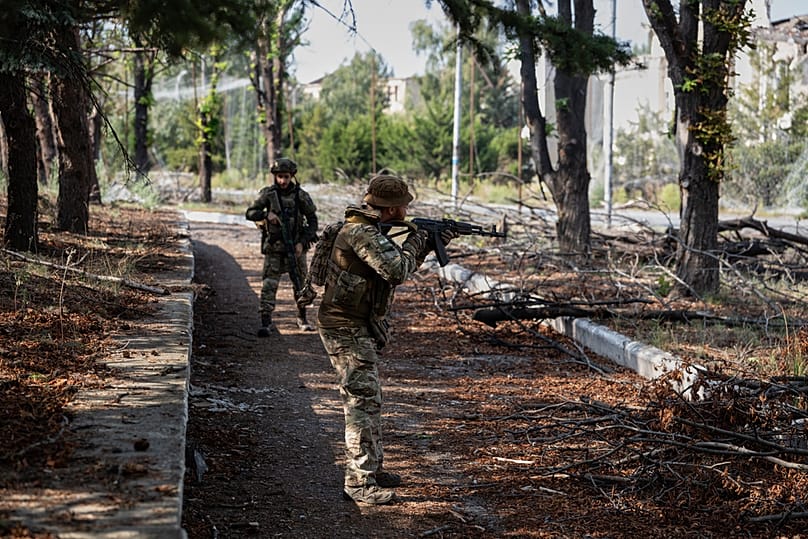
Ukrainian servicemen in front-line Druzhkivka; photo provided by the press service of Ukraine's 93rd Separate Mechanised Brigade
Ukrainian servicemen in front-line Druzhkivka; photo provided by the press service of Ukraine's 93rd Separate Mechanised Brigade Iryna Rybakova/Ukrainian 93rd Mechanized brigade

Russia's net retreat in September rose to 175.18 square kilometres, including areas it temporarily penetrated but did not hold.

Putin told the Valdai Club last week that Russia now occupies 89% of Donetsk region. ISW puts the figure of Russian-occupied territory in the Ukrainian region at no more than 81%.

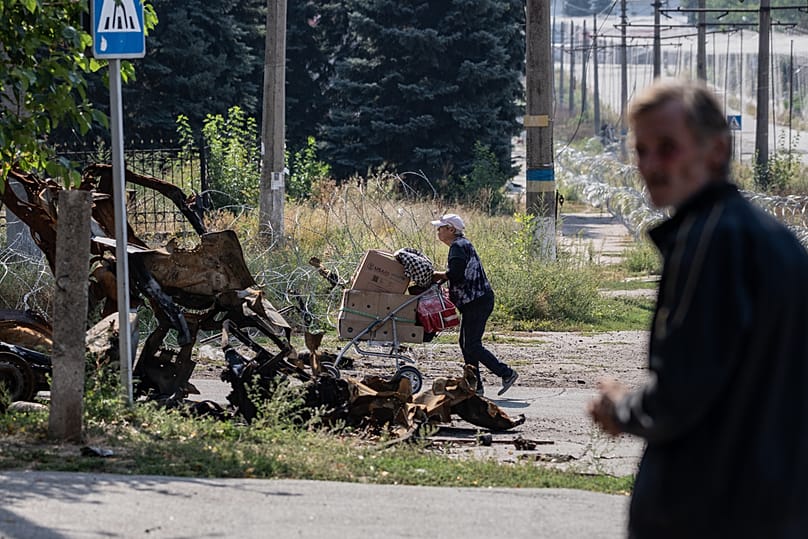
A local resident pushes her belongings in a cart along the streets of Druzhkivka in Ukraine's Donetsk region on 12 September 2026.
A local resident pushes her belongings in a cart along the streets of Druzhkivka in Ukraine's Donetsk region on 12 September 2026. Iryna Rybakova/Ukrainian 93rd Mechanized brigade

The institute assessed that Putin’s claims of Russian breakthroughs in September were “so far removed from reality that they resemble hallucinations.”

It could not determine whether Putin knows the figures he cites are false or has come to believe the fabricated frontline data he receives, a product of what ISW describes as a deeply embedded culture of dishonesty in the Russian military command.