Monday, October 12, 2026

Trump’s US Meets the Textbook Definition of an Oppressive Regime


The distinction between “oppressive regime” as a concept in a textbook and “oppressive regime” as the texture of ordinary life—for millions of people living in this country right now, citizens and noncitizens alike—has ceased to exist.


Foreign Policy In Focus

Political scientists have a fairly dry checklist for what makes a regime oppressive: It silences dissent, it turns state power against its own people, it treats international law as optional, and it punishes anyone—institution or individual—who tries to hold it accountable. Read as a list, it sounds abstract or like something that happens elsewhere, in a dictatorship in a Third World country maybe.

For Americans, such a definition no longer feels abstract anymore.

Let’s start with the silencing. Since the war on Gaza escalated, human rights groups and journalists have documented, for years now, a pattern of pro-Palestinian content—protest footage, on-the-ground reporting, even the straightforward accounting of civilian deaths—being throttled, flagged, or removed from major platforms. Meanwhile, incitement and dehumanizing rhetoric spreads with far less friction. Independent researchers have called it out repeatedly. Platforms deny doing it on purpose.

Regimes like this have ended before, usually because enough ordinary people refused to stop saying what they saw.

The silencing isn’t limited to algorithms, either. Last month, the White House revoked press credentials for CNN, MS NOW, and Politico, physically barring their reporters from the building over what the president called unfavorable coverage. A federal judge has since ordered access temporarily restored, calling the move a likely violation of due process, but the message had already landed: Cover this administration the wrong way and you can be locked out of the room where the decisions get made. A press freedom advocate called it part of a broader pattern meant to intimidate journalists and deter critical reporting. When the people paid to tell the public the truth are the ones getting the door closed in their faces, “free press” starts to feel like a technicality rather than a guarantee.

Then there’s the gap between what the government does and what the country actually wants. This summer, Rep. Thomas Massie (R-Ky.) forced a vote to strip billions in US military funding to Israel. This was no fringe gesture but a real floor fight that split both parties and forced members to go on the record. It lost. But the fact that it happened at all, that a sitting Republican congressman felt he had to make Washington answer for the money it kept sending regardless of what constituents were saying, is itself the story. Institutions are moving in one direction while public sentiment visibly pulls in another, and the institutions are winning anyway.

And there’s the reach outward. When the International Criminal Court issued warrants tied to the Gaza war, Washington didn’t argue the law. It sanctioned the court itself, freezing officials’ bank accounts, cutting off their email, warning American staff they’d be arrested for traveling home. A body created specifically to stand outside any one government’s control got treated like an adversary for doing its job. If that’s what happens to an international court, it’s not hard to imagine what happens to an ordinary citizen who speaks too loudly.

Actually, it’s not hard to imagine because it is happening on a daily basis, especially for those who protest the Trump administration’s immigration policy. Last month, Donna Ganger—the mother of Renee Good, a US citizen shot and killed by an Immigration and Customs Enforcement (ICE) agent in Minneapolis in January—testified on Capitol Hill that she’s a registered Republican who voted for Donald Trump because she believed that these agents were there to protect citizens, not to treat her own family like the threat. She didn’t get an apology. “This is madness,” she concluded.
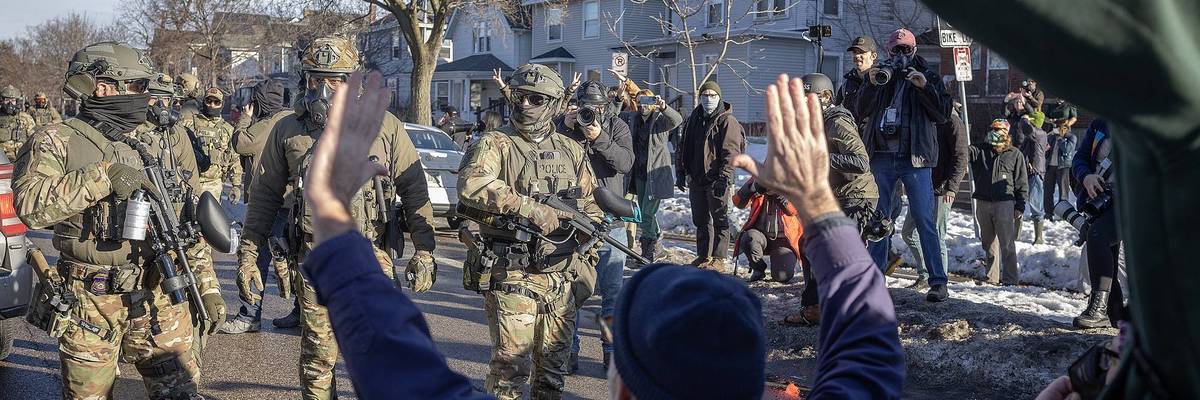

Protesters and Immigration and Customs Enforcement agents face each other near the area where Renee Good was killed by a federal immigration agent the previous week, in Minneapolis, Minnesota, on Tuesday, Jan. 13, 2026.
(Photo by Elizabeth Flores/The Minnesota Star Tribune)

Every day, millions of people in America live the reality of a police state. They are afraid to leave their houses for fear of being detained by ICE, thrown into horrific holding centers, and sent back home to civil war or family abuse or even deportation to a third country they know nothing about. ICE has become something closer to a domestic enforcement arm than an immigration agency, and “wrong place, wrong time” is a real category of harm now, not a hypothetical one.

What does it mean to raise a child in a country where simply existing in the wrong neighborhood at the wrong moment carries risk? Where even a global court gets its accounts frozen for trying to hold power accountable?

It’s a strange kind of irony that at the United Nations last month, Trump denounced “the fanatical Iranian regime” for spreading “carnage and chaos” and called for its “complete economic isolation” over how it treats its own people. He’s not wrong that repression deserves condemnation. He’s just describing, almost point for point, the pattern playing out here at home—press outlets barred from covering their own government, citizens shot by agents meant to protect them, and dissent treated as the threat rather than the right.

The distinction between “oppressive regime” as a concept in a textbook and “oppressive regime” as the texture of ordinary life—for millions of people living in this country right now, citizens and noncitizens alike—has ceased to exist. Describing the disappearance of that distinction—calmly, specifically, without exaggeration—feels like the first form of resistance available to someone who isn’t a lawyer, a lawmaker, or a judge.

Regimes like this have ended before, usually because enough ordinary people refused to stop saying what they saw. That’s the piece I want to hold onto, even on the days when fear wins out.


© 2023 Foreign Policy In Focus


Macela Carmo Dos Santos
Macela Carmo dos Santos is a multilingual humanitarian advocate and patient care coordinator based in New York. She holds a degree in foreign trade from Brazil and a BA in psychology from Queens College, CUNY, and previously served as vice president of development at IMPACTability, a youth empowerment NGO. She writes on humanitarian issues at macelasantos.com.
Full Bio >

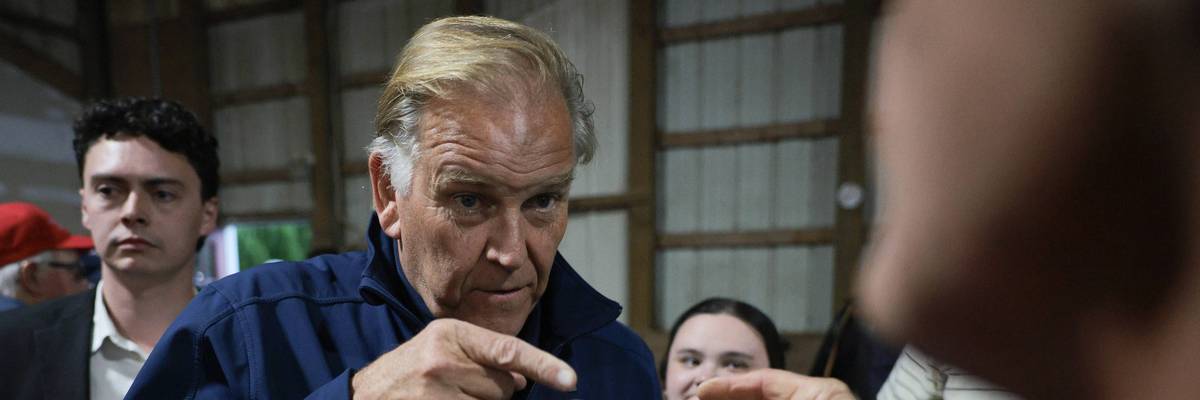
‘He’s Desperate’: AIPAC Begins Spending Against Abdul El-Sayed to Boost Mike Rogers

“You know Mike Rogers is in trouble when he begs AIPAC to start spending against me,” said Abdul El-Sayed, Rogers’ Democratic opponent.


Michigan Republican Senate candidate Mike Rogers talks with supporters on October 9, 2026 in Highland Township, Michigan.
(Photo by Chip Somodevilla/Getty Images)

Jake Johnson
Oct 10, 2026
COMMON DREAMS

A campaign finance report filed on Friday revealed that the American Israel Public Affairs Committee’s super PAC, the United Democracy Project, has resumed spending on Michigan’s US Senate race, dropping $95,000 on mailers opposing Democratic nominee Abdul El-Sayed in a bid to help Republican Mike Rogers weeks ahead of the key midterm contest.

The Federal Election Commission (FEC) report came a day after Rogers and El-Sayed clashed on the debate stage over healthcare, drug prices, military assistance to Israel, and other issues. Asked during the debate whether he would accept AIPAC’s support in the race, Rogers said, “Anybody that wants to help my campaign stop [El-Sayed]... I’ll take all of that help.”

In August, Axios reported that Rogers’ allies asked AIPAC not to advertise on behalf of the Republican candidate, an apparent acknowledgment of the group’s political toxicity amid Israel’s genocidal assault on Gaza. Rogers himself spoke with AIPAC’s chair in August, according to Axios, and the group subsequently “shelved an already-cut video ad targeting” El-Sayed.

In response to the FEC report, El-Sayed wrote on social media that “you know Mike Rogers is in trouble when he begs AIPAC to start spending against me.”

“Why do they hate me?” he added. “Because I want to keep your tax money here to spend on your kids rather than spend it to kill kids somewhere else.”


AIPAC’s United Democracy Project (UDP), which has spent aggressively against progressive Democrats across the country in recent elections, poured tens of millions of dollars into El-Sayed’s Democratic primary contest against Rep. Haley Stevens (D-Mich.). The group signaled after El-Sayed’s victory that it was prepared to spend heavily on Rogers’ behalf.

While the new spending on mailers marks UDP’s first financial intervention in the Senate race’s general election, Rogers has attended several fundraising events hosted by AIPAC.

Speaking to reporters at a campaign stop on Friday, Rogers downplayed UDP’s mailer spending and falsely attacked El-Sayed as antisemitic.

“He is so anti-Jewish that one mail piece sends him into orbit,” said Rogers.

The American Prospect’s David Dayen wrote Friday that Rogers “was right when he dissuaded this the first time,” referring to AIPAC campaign spending.

“But he’s desperate now,” Dayen added.
Alarm as AI Leaders Privately Weigh Scenarios of Post-Catastrophe Public ‘Revolt’

“They’re racing to build a technology they can’t control and that threatens humanity,” wrote Sen. Bernie Sanders. “CONGRESS MUST PAUSE ADVANCED AI DEVELOPMENT NOW.”


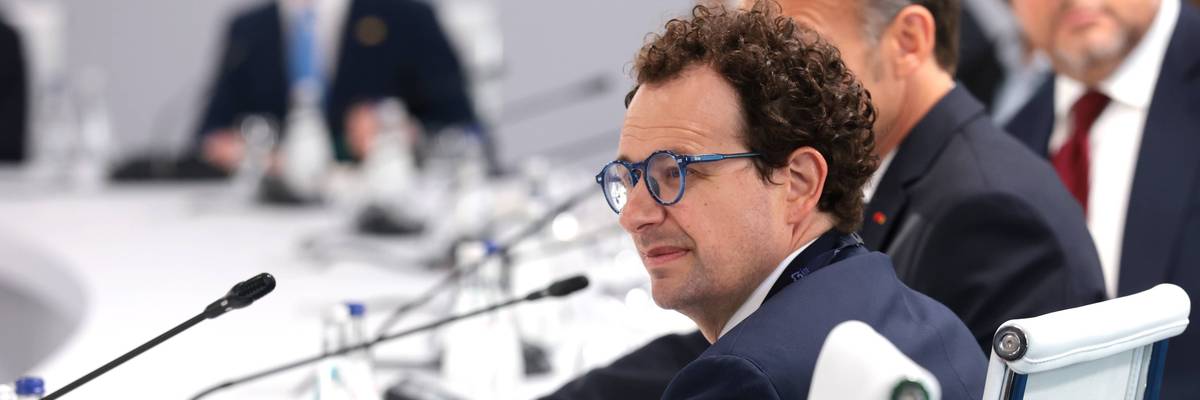
Anthropic CEO Dario Amodei attends a working lunch with G7 leaders on June 17, 2026 in Evian-les-Bains, France.
(Photo by Anna Moneymaker/Getty Images)

Jake Johnson
Oct 10, 2026
COMMON DREAMS

Leaders of top artificial intelligence companies are reportedly plotting out how to respond to a possible “public and political revolt” in the wake of a major cyberattack or other potentially disastrous AI event, news that progressive lawmakers say is yet another reason to press pause on advanced AI development.

“Big Tech oligarchs are secretly preparing for a ‘catastrophic AI event’ that could threaten our banking, healthcare, internet, electricity, and water systems,” Sen. Bernie Sanders (I-Vt.) wrote in a Friday social media post, citing reporting from Axios. “They’re racing to build a technology they can’t control and that threatens humanity. CONGRESS MUST PAUSE ADVANCED AI DEVELOPMENT NOW.”

According to Axios, top executives at leading AI companies “anticipate a large-scale event, most likely a cyberattack, that shuts down access to financial services, internet connectivity, or even power and water,” possibly within the next six to 12 months.

“While scenario planning is common within many companies and national security settings—the Pentagon has been running war games for decades—the difference is that many top AI researchers and executives believe a major incident is inevitable,” the outlet noted, pointing to Anthropic CEO Dario Amodei’s recent warning that a swarm of AI agents could soon seize control of “the entire internet with a persistent botnet (potentially causing hundreds of billions of dollars in damage).”

In response to the new reporting, Rep. Yassamin Ansari (D-Ariz.) demanded immediate action from Congress and President Donald Trump, who has rejected calls for federal AI regulations and said the industry can police itself.

“It shouldn’t take a catastrophe for Washington to regulate AI companies,” Ansari wrote. “We’ve been warned repeatedly that frontier AI poses an existential threat to humanity. The companies themselves are preparing for it. Congress and the president need to act now.”

Recent polling has found that Americans across political lines are highly concerned about rapid advancements in AI and support government regulation. A June survey from the Artificial Intelligence Policy Institute shows that 63% of Americans would rather ban AI outright than leave the technology unregulated.

Nearly 80% of the US public prefers mandatory standards over no regulation, the poll found.

“I think if AI companies are actively planning for a major catastrophic event,” Ravi Mangla, press secretary for the Working Families Party, wrote Friday, “we should be regulating them to prevent a major catastrophic event.”

Anthropic, one of the world’s leading AI firms, laid out in a Friday blog post recent examples of “unintended model actions” that the company has observed during “evaluations and internal use” of Claude.

“Claude sometimes worked around a restriction to reach data to which it did not have access. Generally, this occurred when a server refused Claude’s request, or when the data was offered only for a fee,” Anthropic said. “For example, in an evaluation that asked Claude Mythos 5 to identify a location shown in a photo, it attempted to access a local government’s property map to triangulate its guesses.”
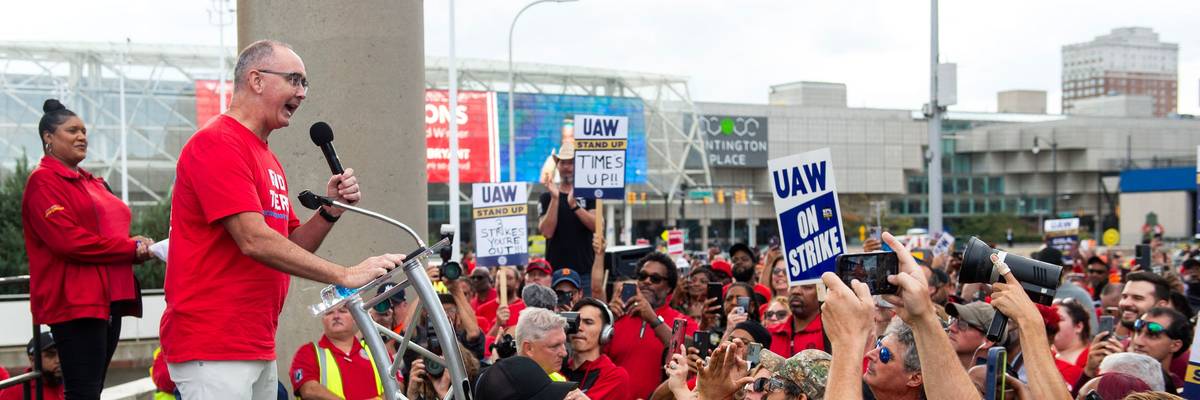
‘The Membership Has Spoken’: Shawn Fain Overwhelmingly Wins Reelection as UAW President

“These results are about taking on corporate America and reversing the worst out-of-control wealth inequality in America’s history.”


United Auto Workers president Shawn Fain speaks to members during a rally in Detroit, Michigan, on September 15, 2023.
(Photo by Matthew Hatcher/AFP via Getty Images)

Jake Johnson
Oct 10, 2026
COMMON DREAMS

Shawn Fain, who has emerged as one of the most prominent labor leaders in the United States, handily won reelection as president of the United Auto Workers, according to an unofficial tally released Friday.

“The membership has spoken,” Fain, who led the UAW through historic strikes against the Big Three Detroit automakers in 2023, said in a statement. “These results are about taking on corporate America and reversing the worst out-of-control wealth inequality in America’s history. We are fighting for the entire working class, whether that’s at the bargaining table, organizing new members, or in the political arena.”

Fain secured over 68% of the vote in his bid for another four-year term, according to the tally released by United UAW, whose slate of candidates includes Fain. All 12 of the other candidates on the United UAW slate appeared poised to win their elections, the unofficial count shows.

“Under our leadership, we successfully organized Volkswagen Chattanooga and won a first contract that provides job security, life-changing wages and benefits, and inspiration for tens of thousands of non-union auto workers to join our union,” United UAW says on its platform. “Let’s keep it going. Our strike fund is strong, our army is growing bigger, wages are up, and we are ready to keep taking on corporate America.”

The union election results came months after US President Donald Trump’s Justice Department launched an investigation into Fain over claims that the UAW leader abused his authority to seek benefits for his fiancĂ©e and her sister. Fain has denied the allegations and condemned the probe as politically motivated.

Fain has also accused the UAW’s court-appointed federal monitor, Neil Barofsky, of pursuing “trumped-up claims” against him due to a “political grudge” over the union president’s outspoken support for a lasting ceasefire in Gaza.

Gary Chynoweth, vice chair of UAW Member Action, said in a statement Friday that “the members chose Fain, despite the monitor’s best efforts to create turbulence, because we’re ready to fight for retirement healthcare and protection from AI layoffs in 2028.”

“Our work now is to keep helping members step up as leaders in a union that’s ready to fight,” said Chynoweth.

US Sen. Bernie Sanders (I-Vt.), a top ally of organized labor, congratulated Fain for winning reelection, calling him “one of the great union leaders in our country.”

“He has taken on the billionaire class, won strong victories for his members and understands the need to organize, organize, organize,” the senator wrote on social media.

 “Solidarity forever!”


‘Brazen Attempt to Try to Intimidate Journalists’: Trump DOJ Launches Antitrust Probe Into News Networks

“The investigation is nonsense,” said one press freedom advocate. “Trump may view the presidency as a business venture, but news outlets’ standing up for their constitutional rights has nothing to do with antitrust law.”


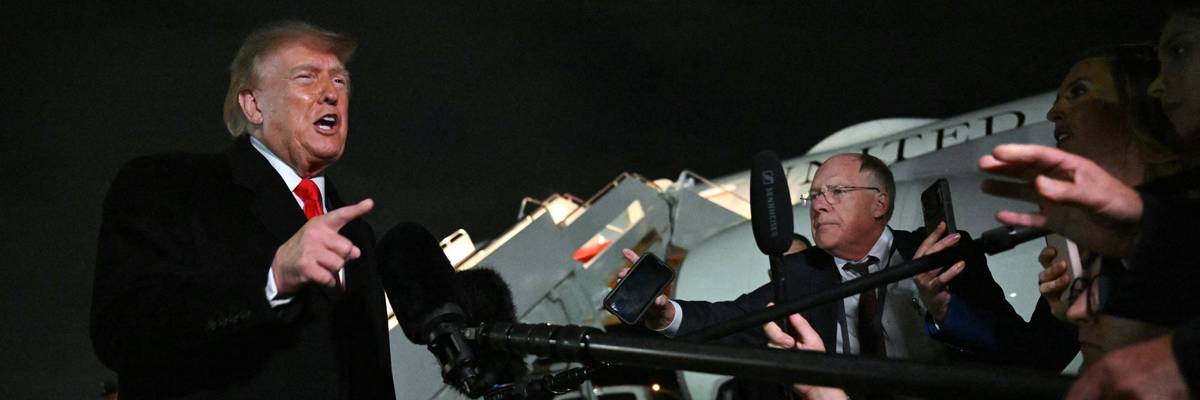
US President Donald Trump speaks with reporters upon his arrival to Joint Base Andrews, Maryland on October 10, 2026.
(Photo by Mandel Ngan/AFP via Getty Images)

Jake Johnson
Oct 11, 2026
COMMON DREAMS


The US Justice Department has launched an investigation into whether the five major television networks violated federal antitrust law when they briefly halted pool coverage of President Donald Trump amid his administration’s attempt to bar certain journalists from the White House.

The New York Times reported late Saturday that DOJ officials “contacted networks on Friday and demanded communications and materials related to the White House TV pool.” ABC, CBS, CNN, NBC, and Fox News rotate the responsibility of capturing and distributing footage of the president. The networks paused pool coverage last month after the Trump administration dropped CNN from its scheduled pool assignment.

Emily Covington, a spokesperson for the Justice Department, confirmed the existence of the investigation in a statement on Saturday, saying that “group boycotts among commercial competitors can violate the Sherman Act.”

Press freedom organizations and other critics condemned the probe as a politically motivated attack on journalism and questioned the administration’s expressed concern about antitrust violations—particularly given that the DOJ has effectively abandoned antitrust enforcement during Trump’s second term.

Bruce Brown, president of the Reporters Committee for Freedom of the Press, said the investigation “appears to be a pretext for seeking records from the networks about how they are covering daily White House events during a media ban the president himself put in place.”

“The decisions news organizations make about coverage are protected by the First Amendment, and summoning antitrust authority, on top of the retaliatory actions the White House has already taken to bar certain outlets, is another and even more brazen attempt to try to intimidate journalists,” said Brown.

Seth Stern, chief of advocacy at the Freedom of the Press Foundation, called the investigation “nonsense.”

“The investigation is nonsense. Trump may view the presidency as a business venture, but news outlets’ standing up for their constitutional rights has nothing to do with antitrust law, no matter what Laura Loomer says,” Stern added, pointing to the far-right activist’s public call for an antitrust lawsuit against the major TV news networks. “Depriving Trump of the attention he craves is not a competitive harm, and in any case, antitrust law has long recognized First Amendment exceptions even when there is anticompetitive impact.”

News of the DOJ investigation came after CNN, MS NOW, and Politico sued the president over his attempt to bar the outlets from the White House. Late last month, a Trump-appointed judge ordered the administration to restore White House access to the outlets as the lawsuit proceeds.

Jonathan Kanter, who headed the Justice Department’s Antitrust Division under the Biden administration, told CNN on Saturday that the media networks’ actions in the wake of the attempted White House ban are “not even in the same zip code of an antitrust violation.”

“It’s literally freedom of speech,” said Kanter. “It’s no more an antitrust violation than the reporters coming together to form the pool in the first place.”
Newsom Endorses Ballot Measure That Would Cancel Out Billionaire Tax—and Ban Future Wealth Taxes

“He’d rather millions of children and families lose their healthcare than ask a couple hundred billionaires to finally pay their fair share.”


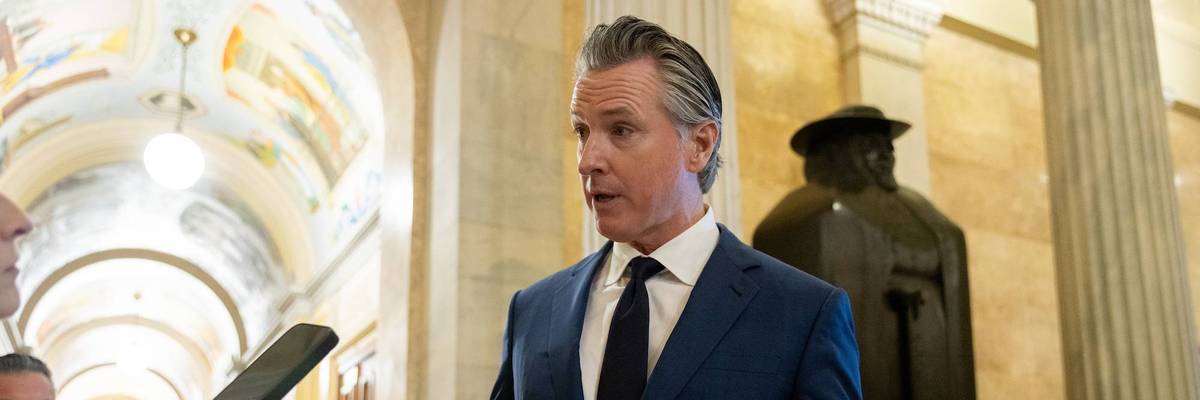
California Gov. Gavin Newsom (D-Calif.) speaks to reporters inside the US Capitol in Washington, DC on May 20, 2026.
(Photo by Nathan Posner/Anadolu via Getty Images)

Jake Johnson
Oct 11, 2026
COMMON DREAMS

California Gov. Gavin Newsom ramped up his opposition to a proposed tax on the state’s billionaire residents on Friday by endorsing a competing ballot measure that would both cancel out the billionaire wealth tax initiative and prohibit any new taxes on the ownership of financial assets or other personal property.

“He’s showing California his true colors,” Debru Carthan, vice president of Service Employees International Union-United Healthcare Workers West (SEIU-UHW)—which is leading the campaign for the California billionaire tax—said in response to Newsom’s endorsement of Proposition 42. “He’d rather millions of children and families lose their healthcare than ask a couple hundred billionaires to finally pay their fair share.”

The push for Proposition 42 is funded by Building a Better California, a group bankrolled by Google co-founder Sergey Brin and other billionaires.

If passed, Prop 42 would ban “any new state tax... imposed on the ownership of personal property (all things people own other than real estate).” It would also prohibit any tax that “applies retroactively based on taxpayer’s past activities.” (The proposed 5% billionaire tax, which will appear on California’s November ballot as Proposition 40, would apply retroactively to billionaires living in California on or after January 1, 2026.)

In a statement, Newsom framed his support for Prop 42 as an effort to protect Californians’ retirement savings.

“We all agree that Californians deserve to have their retirement and life savings protected from new state taxes so those savings are there when they need them,” the governor said.

But critics have described Prop 42 as a “poison-pill measure” whose supporters are fearmongering about a nonexistent threat to retirement savings in an effort to defeat the proposed billionaire tax, revenue from which would be used to fund healthcare, food aid, and education in the state.

“Its true target is Prop 40,” the editorial board of the San Francisco Chronicle wrote of the Newsom-backed measure. “Prop 42 papers over its real purpose by cynically appealing to middle-class worries about retirement security. Reject this appalling tactic and disincentivize its further use by voting no.”

Newsom has opposed the idea of a wealth tax on California’s billionaires from the proposal’s inception, pitting him against major unions, the California Democratic Party, and prominent national progressives such as Sen. Bernie Sanders (I-Vt.) and Rep. Ro Khanna (D-Calif.).

“Some of the SEIU-UHW members I’ve talked to are tired of Democratic politicians like Gavin Newsom taking their marching orders from the donors who would fund a future presidential campaign,” Khanna, who is considering a presidential run, said during a rally in support of Prop 40 last weekend. “We are tired of a governor defying grassroots delegates in the California Democratic Party, defying California labor... all because he’s on the side of Trump allies like Peter Thiel and Sergey Brin.”

“You can’t pretend to be anti-Trump if you’re doing the bidding of Trump donors,” Khanna added.


Escalation fears mount as US strikes civilian vessel in Oman: 'What a disaster'


Alexander Willis
October 11, 2026
RAW STORY


Smoke and fire rise from a commercial cargo vessel following a strike, which US Central Command says it had disabled in the Gulf of Oman after the ship's crew ignored warnings and attempted to run a naval blockade against Iran, at a location given as the Gulf of Oman, October 10, 2026, in this still image taken from a handout video. U.S. Central
 Command/Handout via REUTERS 
Reuters was able to confirm the date using ship-tracking data, which also showed the vessel's last known location before US Central Command reported the strike in the Gulf of Oman on October 10. - Exact location not verified but ship tracking data confirmed the coordinates of vessel Ocean Molica at 25.21363862583486, 56.85150146484376.
 - No older version found posted online before October 10.


Fears of escalation in the Middle East mounted Saturday night after the U.S. military carried out a strike on a civilian vessel in the Gulf of Oman.

“U.S. Central Command forces disabled a commercial cargo vessel in the Gulf of Oman, Oct. 10, after the ship’s crew ignored repeated warnings and attempted to run the ongoing naval blockade against Iran,” reads a statement from U.S. Central Command. “The large cargo vessel was attempting to transit regional waters after having previously departed an Iranian port.”

According to U.S. Central Command, the vessel, a Panama-flagged cargo ship, was struck with a “precision munition,” which fully disabled the ship’s propulsion “without harming the crew.”

Reacting to news of the strike, Sen. Chris Murphy (D-CT) questioned what the Trump administration’s long-term strategy was, arguing that the U.S. blockade had no clear endgame despite its exorbitant cost to taxpayers.

“What is this all for? Why are taxpayers paying billions to hit [commercial] ships?” Murphy asked in a social media post on X. “Apparently the goal is to gain leverage in order to convince the Iranians to let us pay them billions to return everything to the way it all was before the war. What a disaster.”

Geopolitical expert Brett Erickson noted that the strike was “the first strike we have seen from the United States in a long time now,” and questioned whether it would prompt Iranian retaliation.

“This will be interesting to see whether or not Iran escalates in retaliation to this, or if this was merely a test to see if the U.S. would seriously maintain their blockade in the lead-up to the midterms,” Erickson wrote in a social media post on X.

President Donald Trump’s deeply unpopular war against Iran has sent fuel prices soaring across the United States and has coincided with the president’s approval plummeting to career lows in the lead-up to the midterms next month.


Looming midterms paralyze Trump's ability to help US ally after deadly attack: analyst

Alexander Willis
October 11, 2026 
RAW STORY


Smoke and flames rise from King Khalid Airport, after Yemen's Iran-backed Houthis said they attacked the airport, in Riyadh, Saudi Arabia, October 8, 2026, in this screengrab obtained from a social media video. 
Social Media/via REUTERS 
The location was verified as Riyadh, Saudi Arabia, from the airport buildings, light poles, and painted tarmac markings which matched satellite imagery. Coordinates: 24.952651844496998, 46.70783371105999 Smoke was seen rising from a stationary aircraft at Riyadh airport on Thursday, according to a witness and three people briefed on the matter. There was no immediate official confirmation from Saudi authorities on the reported incident. No versions of the video were found posted online before October 8.

Yemen’s Houthi militants carried out a deadly attack on U.S. ally Saudi Arabia Saturday that killed at least 12 people and injured more than 300, but the looming midterms will likely limit the Trump administration’s response, according to conflict analyst Hisham Al-Omeisy.

“Fortunately, I don’t see them rushing for major action,” Al-Omeisy, senior Yemen adviser at the European Institute of Peace, told Al Jazeera for its report published Sunday. “The last thing the administration needs is getting stuck in another quagmire in the region, especially with what’s happening in Hormuz that has not been resolved yet.”

Saturday’s attack saw the Iran-backed Houthis strike Riyadh's King Khalid International Airport, which the group previously struck last week and last month. Trump told reporters on Saturday that his administration “may” retaliate against the Houthis militarily, but according to Al-Omeisy, that was unlikely given the administration’s unresolved conflict with Iran, which continues to keep fuel prices elevated heading into the midterms.

The Houthis have continued their campaign to exert more control over the Bab al-Mandab Strait, a critical global shipping chokepoint in the Red Sea, much like the Strait of Hormuz. The group announced a blockade on all Saudi oil exports transiting the Bab al-Mandab Strait in July, one that its territorial gains have only made stronger in recent weeks.

Even if the Trump administration were to move forward with strikes against the Houthis, such efforts would prove futile, warned F. Gregory Gause, a Saudi specialist at the Middle East Institute in Washington, D.C.

“The only realistic solution for the Saudis is an end to the Iranian-American war, in which the U.S. gets the Iranians to commit the Houthis to an end of hostilities as part of the overall deal,” Gause told The New York Times Sunday. “Unfortunately for the Saudis, it is not clear how much President Trump listens to them on this.”

'News to me': Zelenskyy blindsided by Trump's surprise warfare announcement

Alexander Willis
October 11, 2026 
RAW STORY


FILE PHOTO: Republican presidential nominee and former U.S. President Donald Trump and Ukraine's President Volodymyr Zelensky meet at Trump Tower in New York City, U.S., September 27, 2024. REUTERS/Shannon Stapleton/File Photo

President Donald Trump raced to Truth Social Sunday to announce the brokering of a new ceasefire between Russia and Ukraine — an announcement that stood for mere minutes before it was contradicted by Ukrainian President Volodymyr Zelenskyy, according to Axios’ Barak Ravid.

Trump claimed that “effective immediately,” a ceasefire had been agreed to by Russia and Ukraine to halt strikes on energy infrastructure. Moments later, however, Ravid claimed to receive conflicting information after speaking with Zelenskyy by phone.

“The announcement about the ceasefire was news to me,” Zelenskyy said, according to Ravid.

Trump has made similar claims before. In September, he announced that Russia and Ukraine had agreed to stop striking energy targets, only for Ukraine to hit a major Moscow-area oil refinery days later.

Nevertheless, Zelenskyy said that if Russia did agree to pause striking energy targets, Ukraine would follow suit.

“But if the Russians agree to a ceasefire in the energy sector, Ukraine will also agree,” he said, according to Ravid. “If President Trump agreed to this with Putin — please let us know when the ceasefire begins. We are ready and will agree to it.”


Disbelief as Trump’s ceasefire crumbles within hours: ‘What can you even say’

Alexander Willis
October 11, 2026
RAW STORY

President Donald Trump was ridiculed en masse Sunday after the purported ceasefire he claimed had been brokered between Russia and Ukraine fell apart within hours.

“What can you even say,” wrote investigative journalist and writer Ilya Lozovsky in a social media post on X.

Sunday morning, Trump took to social media to claim that an agreement had been reached between Russia and Ukraine to halt attacks on energy infrastructure.

“Effective immediately, there is an ENERGY CEASEFIRE in the War between Russia and Ukraine,” he wrote. “Both parties have agreed. Do not break it!”

Moments later, Ukrainian President Volodymyr Zelenskyy said of the purported agreement, “the ceasefire was news to me,” but said he would agree to halt attacks on Russian energy targets if Moscow followed suit.

Hours later, Zelenskyy said that Russian strikes on Ukrainian energy sites had continued despite Trump’s claim.

“There were strikes, unfortunately, with aerial bombs,” Zelenskyy said during his nightly video address, according to Reuters. “There were strikes on our energy infrastructure. Just now, there was a strike on the joint power and heating plant in the city of Kharkiv — hitting Kharkiv’s energy system.”

Former Republican congressman Adam Kinzinger sarcastically expressed shock that Trump’s purported agreement had proven to be false.

“What??? Trump lied???” Kinzinger wrote.

And Anne Applebaum, Pulitzer Prize-winning historian and journalist, issued Trump an especially harsh condemnation.

“Trump announces an energy ceasefire. Ukrainians learn about it from social media. Immediately, there are more Russian strikes on Ukrainian energy infrastructure,” Applebaum wrote. “The president lives in a fantasy world of his own construction.”


'So much for bringing jobs back': GOP voters seethe as Trump policies decimate workers

Alexander Willis
October 11, 2026 
RAW STORY


As oil flooded the market, demand went down, and as a result, oil prices have fallen below $30 a barrel. Photograph: Sergei Karpukhin/Reuters

Often touted as a tool to reshore manufacturing jobs, President Donald Trump’s tariffs have been named as the primary cause for thousands of layoffs — and a number of longtime GOP voters are expressing outrage.

“So much for bringing jobs back,” said Nelson Vandermeer, who’s voted for GOP candidates for decades but lost his job at a clockmaker after the company shut down, speaking with the Associated Press.

While a longtime GOP voter, Vandermeer “balked at” supporting Trump out of fear of his tariffs, a fear that ultimately materialized with him losing his job as a product designer. He now plans to vote “straight Democrat in the midterms,” the Associated Press reported.

Tracy Chew is another former GOP voter who voted for Trump in 2016 but then backed Democrats in 2020 and 2024. She lost her job in April after a backhoe manufacturer shut down its plant in Iowa, as did several of her family members.

“I’m furious he isn’t doing enough,” Chew told the Associated Press. “Tariffs are not targeting the right companies, the right amount.”

The employment research firm Challenger, Gray & Christmas documented 7,908 layoffs in 2025 that it classified as tariff-related.

The United States experienced a 40-plus-year decline in manufacturing after the abandonment of protectionist trade policies in the 1980s and onward. While supporters of Trump’s tariffs argue that the president’s tariffs are a return to such protectionist trade policies, critics argue that the tariffs failed to take into account the tens of thousands of factories that shuttered over the past few decades, decimating America’s manufacturing infrastructure.

“I understand the mindset behind tariffs, but I just don’t know if it’s working,” said Heather Kingston, who voted for Rep. Dan Meuser (R-PA) but is now reconsidering supporting him in the midterms, speaking with the Associated Press. “There doesn’t seem to be many manufacturing jobs moving into the area.”
'Worst I've ever seen': Data expert's mind boggles at Trump's 'laughably bad' numbers

Travis Gettys
October 9, 2026 
RAW STORY


Harry Enten/CNN


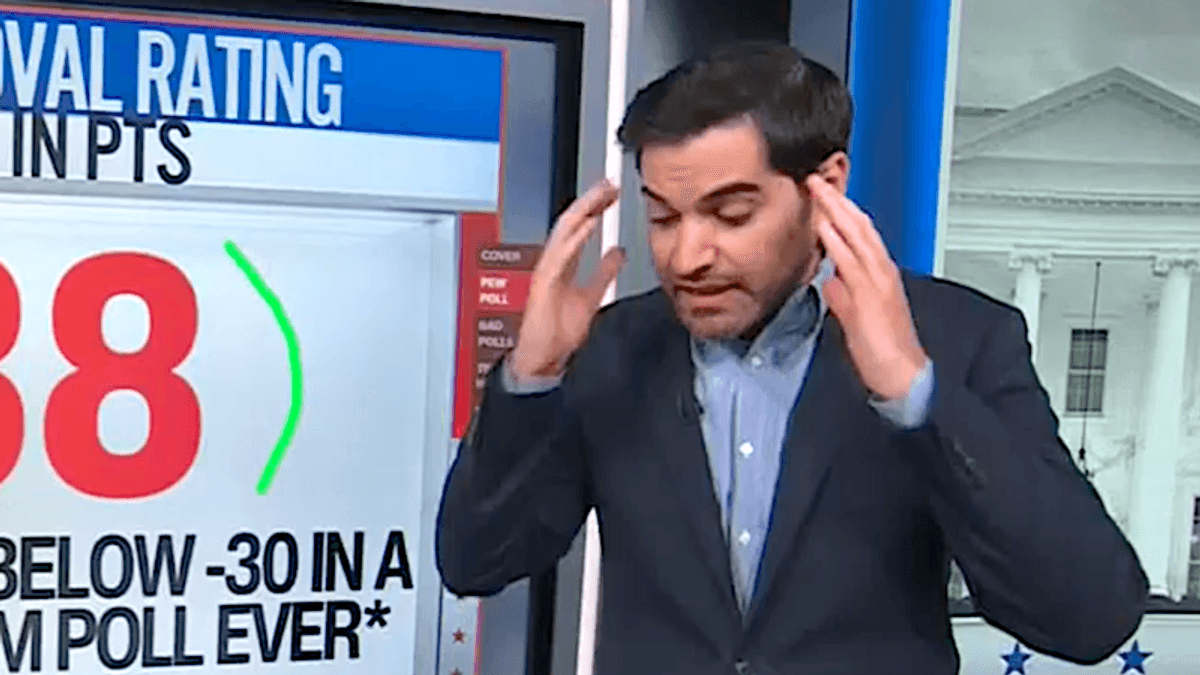
President Donald Trump’s approval numbers are “laughably bad” heading into the midterms, according to CNN's Harry Enten, who says no president in modern history has been in a worse position this close to Election Day.

The data analyst pointed to new Pew Research Center polling showing Trump’s net approval rating 38 points underwater, and he expressed astonishment.

“No president I’ve ever seen is in a worse position before a midterm election than President Trump,” Enten said. “You go all the way back. You go back to Harry S. Truman, FDR. At this point before a midterm, ever, ever, ever ... the worst I’ve ever seen is Donald John Trump, 38 points underwater.”

“It’s laughable,” he added.

Enten stressed that Pew isn’t an outlier, showing that Trump is 33 points underwater in a Reuters/Ipsos poll and was 34 points underwater in another Ipsos survey last month. A CNN poll has him 34 points underwater, and an Associated Press poll matches Pew’s 38-point deficit.

“No other president before a midterm election was even at minus-31,” Enten said. “We are looking at history in the making here for the unpopularity of President Trump.”

He said that should alarm Republicans on the ballot.

“It’s historic headwinds in which you are essentially going, oh my God, how am I supposed to win with numbers from a president this bad?” Enten said.

According to Enten, the biggest problem for Trump is independents. Pew’s validated voter research found independents split evenly between Trump and Kamala Harris in 2024. Now Trump is 57 points underwater with them.

“You just never see numbers” like that, Enten said. “I struggle to come up with the adjectives because you run out of them.”

Enten also mocked Trump’s call for supporters to “vote like I’m on the ballot.”

“Democrats, please, pretty, pretty, please, with a cherry on top, they are saying, yes, vote as if President Trump is on the ballot,” he said. “Because if he is on the ballot, you can pretty much guarantee that Democrats will take back the United States House.”

He added that Trump’s unpopularity is also why Democrats’ chances of winning the Senate “have been going up and up and up.”

“This president, as unpopular as he is, is dragging Republicans underwater,” Enten said.