Showing posts sorted by date for query DIGGERS LEVELLERS. Sort by relevance Show all posts

Thursday, February 27, 2025

Faith that the Protestant Reformation stood for freedom was dashed by Martin Luther and the nobility

(The Conversation) — The German peasants were among the first to try to unlock the revolutionary potential of Reformation teachings to fight social and economic injustice.
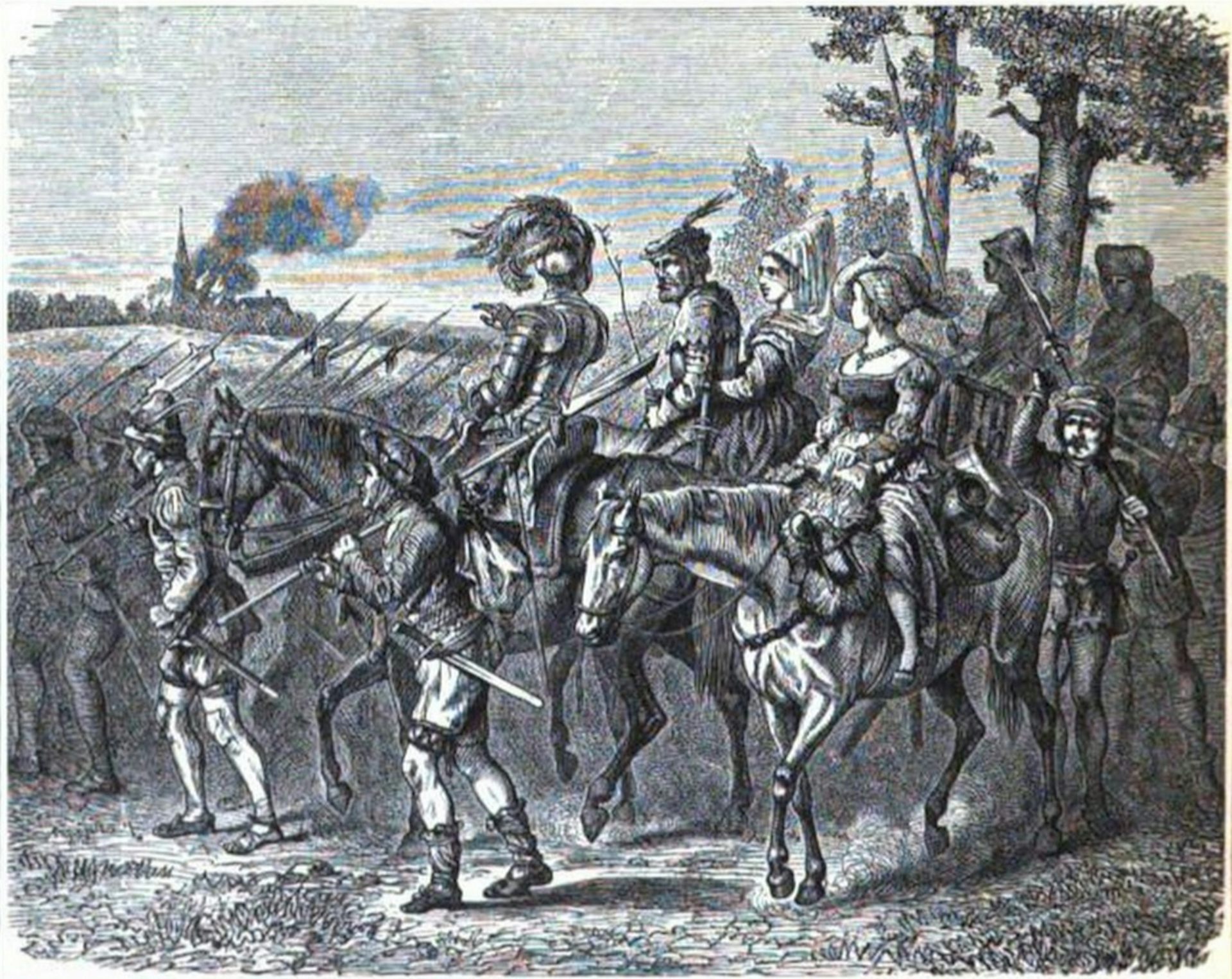


A sketch of groups of peasants wandering around the countryside during the German Peasants' War. (Warwick Press via Wikimedia Commons.)
Michael Bruening
February 26, 2025

(The Conversation) — Five hundred years ago, in the winter of 1524-1525, bands of peasants roamed the German countryside seeking recruits. It was the start of the German Peasants’ War, the largest uprising in Europe before the French Revolution. The peasants’ goal was to overturn serfdom and create a fairer society grounded on the Christian Bible.

For months, they seized their landlords’ monasteries and castles. By March 1525, the peasant armies had grown to encompass tens of thousands of peasants from Alsace to Austria and from Switzerland to Saxony.

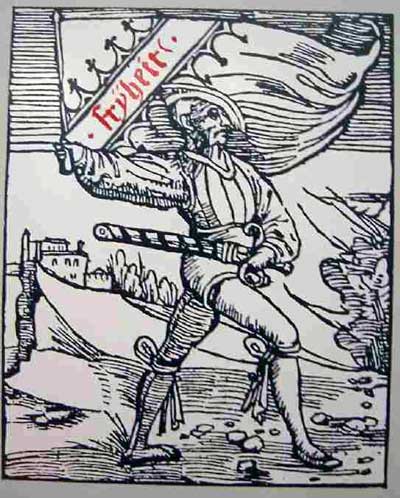
The peasants had economic grievances, to be sure, but they also drew inspiration from the message of freedom, or “Fryheit” in German, being preached by theologian Martin Luther, who had recently launched the Protestant Reformation

Luther’s rejection of the peasants’ cause, however, would help lead to their crushing defeat.

I am a scholar of the Reformation, and I included the peasants’ list of demands in my book on the debates of the era. The question of the legitimacy of the peasants’ uprising was one of the most consequential debates of the era.
Luther’s message of freedom

In 1517, eight years before the German Peasants’ War, Luther launched the Reformation with his 95 Theses. The theses reflected Luther’s belief that the pope and the Catholic Church were preying on the poor by selling them indulgences, taking their money for a false promise that their sins would be forgiven.

Luther taught instead that God freely forgives the sins of believers. In one of his most famous early treatises, “The Freedom of a Christian,” written in 1520, Luther argued that because they are saved or “justified” by faith alone, Christians are entirely free from the need to do works to merit salvation. This included fasting, going on pilgrimages and buying indulgences.

Luther’s attacks on the Catholic Church, clergy and monks quickly grew more vehement. He and his allies lambasted them for fleecing the peasants and the poor through usury, a practice of lending money at high rates of interest. Since the Bible provided no support for such practices, they argued, the poor should be free of them.
The Twelve Articles

In her 2025 book “Summer of Fire and Blood,” Reformation scholar Lyndal Roper argues that the religious element of the peasants’ war was central. The German peasants were among the first to try to unlock the revolutionary potential of Reformation teachings to fight social and economic injustice.

The peasants’ efforts to do so can be seen in the most important statement of their demands: The Twelve Articles. The articles are rooted in Reformation ideas and demanded, among other things, each village’s right to elect its own pastor and to be exempt from payments and duties not found in the Bible.
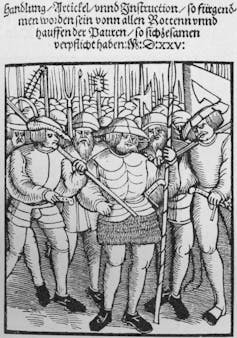

A pamphlet that peasants distributed with their Twelve Articles in 1525.
Otto Henne am Rhyn: Cultural History of the German People, via Wikimedia Commons

Most important was the message of freedom in the third article: “Considering that Christ has delivered and redeemed us all, without exception … it is consistent with Scripture that we should be free.” It was a cry for equality based on Christ’s redemption of all, rich and poor alike.

The Twelve Articles were hugely successful, going through 25 printings in just two months. Since the vast majority of peasants were illiterate, this was an astounding number.

For the lower classes, the Reformation promised to break up not just the spiritual monopoly held by the Catholic Church but the entrenched feudal system that kept them oppressed. Their desire for freedom was at the same time a denunciation of serfdom.

The peasants were willing to take up arms to secure their freedom. In winter 1524-1525, the peasants were able to capture castles and monasteries without much bloodshed. But starting in the spring of 1525, the uprising became increasingly violent. On Easter Sunday, the peasants shockingly slaughtered two dozen knights in the city of Weinsberg, Germany. A torrent of bloodshed would follow.
Luther’s rejection of the peasants

Although Luther may have provided the initial inspiration for the peasants, he denounced their revolt in the harshest terms. In his treatise “Admonition to Peace,” Luther complained that the peasants had made “Christian liberty an utterly carnal thing,” which “would make all men equal … and that is impossible.”

Responding to the revolt, Luther produced a tract entitled “Against the Murdering and Robbing Hordes of Peasants.” “Let everyone who can,” he infamously wrote, “smite, slay, and stab” the rebellious peasants. The rulers did just that.

The nobility had been slow to react to the peasants’ initial incursions, but when they finally organized their own armies, the peasants didn’t stand a chance. On the battlefield, the nobles’ cavalry and superior artillery brutally cut down the rebels. Many who escaped the battlefield were hunted down and executed.

The exact number of those killed are not known, but estimates place the number at around 100,000. As Roper notes, “this was slaughter on a vast scale.”

Consequences for the Reformation

English historian A. G. Dickens famously described the Reformation as an “urban event”, meaning that the movement’s important developments took place in cities. The German Peasants’ War shows the idea to be wrong.

In its first years, the Reformation galvanized the hopes and dreams of Germans in both town and country. To peasants and townsfolk, it seemed to promise the chance for a complete reordering of an unjust society.


Luther’s rejection of the peasants had important long-term consequences. His decision to side with the princes transformed the Reformation from a grassroots movement into an act of state. Everywhere the Protestant reformers went, they sought to work with the proper authorities. The close cooperation of Christian leaders and secular authorities would last for centuries.

For their part, the European peasantry grew wary of the Christian leaders who seemed to have abandoned them. Social uprisings over the next centuries lost the religious character of the 1525 conflict and would climax in the decidedly secular French Revolution.

(Michael Bruening, Professor of History, Missouri University of Science and Technology. The views expressed in this commentary do not necessarily reflect those of Religion News Service.)


The Conversation religion coverage receives support through the AP’s collaboration with The Conversation US, with funding from Lilly Endowment Inc. The Conversation is solely responsible for this content.


LA REVUE GAUCHE - Left Comment: Search results for PEASANT WAR GERMANY


Marxists.org
https://www.marxists.org/archive/marx/works/1850/peasant-war-germany/index.htm

The Peasant War in Germany by Frederick Engels 1850

Jun 6, 2023 ... The Peasant War in Germany was the first history book to assert that the real motivating force behind the Reformation and 16th-century peasant ...


Libcom.org
https://libcom.org/article/third-revolution-popular-movements-revolutionary-era

The Third Revolution: Popular Movements in the Revolutionary...

Jun 15, 2020 ... pdf (17.78 MB). ThirdRevVol2Pt1.pdf (12.23 MB). ThirdRevVol2Pt2.pdf (28.3 MB) ... Audiobook of Murray Bookchin's Ecology and Revolutionary Thought.

Sunday, December 29, 2024

UK

Can the Commons be the Left’s Ethical Ground?

DECEMBER 29, 2024

Guy Standing explains the background to the first of a series of meetings next year that aim to reintegrate an important idea into the left’s thinking.

Those who see themselves on the political left of the spectrum favour a reduction in inequalities, a strengthening of democracy and rising living standards for lower-income groups in society. Nothing controversial about that. It should be widely popular.

However, today, across the world, the left is in deep trouble, and must relearn an essential lesson of history. The left has flourished only when it offers an uplifting vision of a Good Society. In honesty, one has to admit that in the past the vision offered has turned out to be a false one or one that allowed dictatorial trends to overcome personal freedom.

However, without a vision, politics risks becoming at best a stepping stone occupation for self-advancing individuals to do for a few years before they take lucrative positions in other sectors. Today, we are in that situation, in which there is ‘think tank politics’ on the left, driven by a utilitarian mentality, focus groups and personal ambition. It will fail.

Currently, the Labour Party and Government is not offering a transformative vision, merely a short-term future of slightly higher GDP growth, which it hopes will yield modest rises in living standards for everybody. It is not being sectarian to say that this has a high probability of being a mirage, one doomed to offend the ecologically minded while preparing the ground for the far right to gain power. At the very least, that risk suggests there should be a parallel narrative and agenda, one to lift the spirits, escape from the current dourness and inspire those working for the cause.  

I want to suggest that the core of a sensible Vision for all shades of the left today should be a revival of the commons and commoning. The commons may be described as all that belongs to all of us as commoners, as citizens in the proper sense of that word, as people who have a broadening range of human rights. The commons reflects and nurtures a culture of mutual support and generalised reciprocity, of social solidarity and informal social protection, or what some have called ‘the poor’s overcoat’.

They are intrinsically ecological, emphasising ‘the gift economy’ and values of reproduction, rather than accumulation and acquisitiveness. These are surely the values that unite all shades of the progressive left, and are what are sorely lacking in today’s financialised capitalism.

The commons have always been the bedrock of society, and commoning (that is, shared activities in the commons) have always been desired forms of activity by the world’s commoners. The commons, commoning and commoners have been at the heart of all progressive transformations throughout history. They are deeply ingrained in the human condition, giving people Robustness and Resilience, twin feelings in short supply at the moment.

All the great rebellions in British history have been about defending the commons and have been in response to the taking of them, beginning with the social strife that led to the Charter of the Forest and the Magna Carta in November 1217, and going on to the Peasants’ Revolt in 1381, Kett’s Rebellion in 1549, the Civil War in the seventeenth century, the Diggers and Levellers of 1649 whose activities culminated in the great Putney debates, the ‘blacking’ actions of the early 1720s (when commoners blackened their faces to conceal themselves when taking deer from enclosed land), which prompted the most savage legislation in British history, the Luddites of the early nineteenth century (ideologically misrepresented ever since), and the Chartists in the 1830s. All were about the defence of the commons and the radical emancipatory lifestyle that they have embodied.   

Perhaps most durably, the commons as the fulcrum of progressive politics was lost in the defeat of William Morris’ Socialist League in the 1890s, this time not a defeat by capital plundering the commons, but by the twin juggernauts of communism and labourist social democracy, both of which pinned all their hopes and intellectual energy on eulogising the ‘state’ as the saviour of society, rescuing ‘the working class’ from industrial capitalism. In doing so, they both dismissed the commons, as quaint historical relics.

Throughout the twentieth century, the core of political struggle was between those who favoured state control, through such mechanisms as nationalisation and state ownership of ‘the means of production’, and those who believed in ‘free markets’. The commons ceased to figure in political discourse, reduced to little more than amenities for recreation. They disappeared as the locus for socio-political struggle.

It is time to escape from that simplistic dualism. We should develop an agenda around the commons and set up a series of discussions around the country to develop a strategy to revive all types of commons, one that should not be party-political or even factional in any sense.

The context could not be more urgent or dire. We are in a transformational crisis, and as Karl Polanyi put it that brings a “threat of annihilation of civilisation”. That is growing in 2025. We are entering the era of Trumpism, and what might be called a plutarchy, which is more threatening than the earlier version of populism associated with Peronism in Latin America.

Plutarchy is a society controlled by the extremely rich, the plutocracy. The plutocracy is a definable group, the plutarchy a definable political system. The libertarian right plutocracy, led by Elon Musk, Peter Theil, Charles Koch et al, have created the conditions for Trumpism and the plutarchy, and predictably the rest of the American plutocracy are lining up to show they now want to be an integral part of what that offers them.

They want to demolish what is left of the progressive side of democratic politics, and unless progressives offer a transformative alternative vision, we will be among the victims. Every person of whatever shade of left they might have should pin on their proverbial wall – the plutocracy does not do compromise. You are Little Red Ridinghood if you enter their den. 

What is happening in America today could spill over this side of the Atlantic tomorrow. It is already doing so. The plutarchy is the outcome of rentier capitalism, which the left must understand and confront. There is nothing like a free market economy today. More and more of the income, wealth, status and power flows to the owners of private property (physical, financial and intellectual). Plundering what remains of the commons is an integral part of that process. Conventional policies to promote GDP growth only increase inequalities and economic insecurity, while increasing the devastation of our natural world.

Over the centuries, all forms of Commons (natural, civil, social, cultural and intellectual) have been plundered, and in much the same sequence – through encroachment, neglect, enclosure, privatisation, commodification and financialisation. But globally and in Britain, the plunder has been accelerated since the neoliberal economics revolution of the 1980s, under Thatcherism and above all in the austerity era.

This must be reversed. In an attempt to start a conversation between similarly minded activists and the politically minded, the conversational society Kairos is planning on organising a series of conversational meetings during the course of 2025 or different areas of the commons, starting with one on January 16th in Kairos’ conference rooms in Tottenham Court Road. The event is open to everyone who is interested, via registration.

The first meeting will outline the meaning and significance of the commons, drawing in part on the work of Elinor Ostrom, who won the Nobel Prize in economics in 2009, and on three recent books on different aspects of the commons. It will conclude with a focus on a sphere of commons that receives insufficient attention, the knowledge commons.

The principles and practices of the education commons were established in ancient Athens. Over the ages they have been shredded, first by religious and class-based bigotries and latterly by the neo-liberal emphasis on ‘human capital’ and the construction of a globalised education industry dominated by financial capital and by the plutocracy. It is scarcely an exaggeration to say that it has turned into an instrument for weakening progressive thinking. The tragedy of education de-commoning must be overcome if the plutarchy is to be overcome.  

Depending on the development of commons conversations in Kairos and elsewhere over the coming months, one outcome might be the drafting of a modern Charter of the Commons that could form the basis for a public campaign. Meanwhile, let a thousand commons bloom.

Guy Standing is Professorial Research Associate, SOAS, University of London, and co-president of BIEN, the Basic Income Earth Network.

EVENT DETAILS
Thursday January 16th 2025
Doors open 6.30pm, Talk starts 7pm

Reviving the Commons: A Unifying Vision for Our Common Wealth with Guy Standing 

Talk followed by supper at 8pm and discussion until 9.15pm
Kairos, 84 Tottenham Court Road, London W1T 4TG

Find out more and reserve a place.

Image: https://www.picpedia.org/highway-signs/v/vision.html License: Creative Commons 3 – CC BY-SA 3.0 Attribution: Alpha Stock Images – http://alphastockimages.com/ Original Author: Nick Youngson – link to – http://www.nyphotographic.com/ Original Image: https://www.picpedia.org/highway-signs/v/vision.html

Sunday, December 08, 2024


Why we need a history from below

DECEMBER 5, 2024

In our last episode of 2024, the Labour Left Podcast  delves into why we need a bottom-up history with Prof Harvey J Kaye – who wrote the important book The British Marxist Historians. In the second half of the podcast, we turn our attention to the aftermath of the Trump tragedy and ask the question – How can we make America radical again?

Harvey J Kaye is an important socialist figure. Christopher Hill described him as “easily the world’s greatest authority on the British Marxist historians,” the group who coined the important phrase “a history from below”.  The British Marxist historians included Rodney Hilton who wrote about the Peasants’ Revolt of 1381 and introduced us to the likes of Watt Tyler and Colchester’s John Ball; Christopher Hill himself who wrote about the English Revolution of the 17th Century and introduced us to the Levellers and the Diggers; Eric Hobsbawm, whose best-known works spanned the long 19th Century; and, EP Thompson who wrote the seminal The Making of the English Working Class.

The podcast considers why the ruling classes fear history – which takes us straight back to the podcast with Corinne Fowler, who was inspired by EP Thompson, and helped us consider how our colonial and labour histories are very much two sides of the same coin.

The podcast includes some fascinating insights into the history of the British left.  Harvey describes the pivotal moment of 1956 when Soviet tanks destroyed a workers’ uprising and the British Marxists broke from the Stalinist Communist Party. The British Marxists went on to play an important role in the creation of a New Left and later the introduction of Antonio Gramsci to our country.  The leaders of what we might call a humanitarian Marxism or New Left went on to play a decisive role in the formation of a mass movement and against the siting of American nuclear weapons in the 1980s.  It is impossible to understand the story of the British left without grasping the intellectual contribution made by the subjects of this podcast. 

The podcast with Harvey not only explores why we need a history from below but why it is so important to us today.  In the second half of the podcast, we move on to examine how the Democrats were defeated by Donald Trump.  Drawing on the legacy of Tom Paine and Roosevelt, Harvey explains why we might need an economic Bill of Rights on both sides of the Atlantic to bring about the defeat of the world’s resurgent populist right.  In my last article for Labour Hub (link here), I argued that “if we can’t deliver noticeable improvements for our British working-class voters, who feel abandoned, no number of pleas for patience or references to the terrible Tory legacy will help us one jot.  Trump’s victory means that we know exactly where a failure to deliver will lead.” It is for this reason that I think we need to focus on the economic issues that matter to our working-class voters on both sides of the Atlantic and give a clear political offer and Harvey explains a compelling case for the Economic Bill of Rights (see below).

To accompany our deep dive into our history from below we’ve created a Spotify playlist with songs from the likes of Norma Waterson, the Young Uns, Chumbawamba, Leon Rosselson and of course Billy Bragg. Link here

If you’re new to the Labour Left Podcast – maybe an American listener to Harvey J Kaye – and want to find more about Britain’s history, please have a look at our back catalogue. Previous episodes have included historian Prof Corinne Fowler, talking about her book Our Island Stories: Country Walks Through Colonial Britain; Jeremy Gilbert, a Professor of Cultural and Political Theory, a champion of Gramsci talking about Thatcherism; Mike Jackson, co-founder of Lesbians and Gays Support the Miners, on the Great 1984-85 Miners’ Strike; political activist Liz Davies telling her story as the dissenter within Blair’s New Labour; Rachel Garnham, a current co-Chair of the Campaign for Labour Party Democracy looking back at the history of the fight for democracy in the British Labour Party; and finally myself telling the story of Brighton Labour Briefing, a local Bennite magazine in the early 1980s.

If you are enjoying the podcast please subscribe on YouTube or your favourite podcast platform so you never miss a future episode.  If you like what the Labour Left Podcast is trying to achieve, please help us to get the podcast in front of more people by sharing, following, rating and commenting on every episode you watch.

You can watch the podcast on YouTube, Apple podcasts here, Audible here and listen to it on Spotify here  If your favourite podcast site isn’t listed, just search for the Labour Left Podcast

Bryn Griffiths is an activist in Colchester Labour Party and North Essex World Transformed. He is a member of both Momentum’s National Coordinating Group and the Campaign for Labour Party Democracy’s Executive. 

Bryn hosts Labour Hub’s spin off – the Labour Left Podcast.  You can find all the episodes of the Labour left Podcast here or if you prefer audio platforms (for example. Amazon, Audible Spotify, Apple, etc.,) go to your favourite podcast provider and just search for Labour Left Podcast.


Thursday, November 21, 2024


In 1649…


This is an extract from the author’s new book Power Play: The Future of Food.

In the annals of agrarian history, one particular movement has left a profound impact on the collective imagination of food sovereignty advocates. The Diggers in 17th century England were led by the visionary Gerrard Winstanley. This radical group emerged during a period of intense social and political upheaval, offering a revolutionary perspective on land ownership and food production that continues to resonate with modern struggles for (food) justice.

The Diggers, also known as the True Levellers, arose in 1649, a time when England was reeling from the aftermath of civil war. Winstanley and his followers dared to imagine a different world. The group challenged the very foundations of the emerging capitalist system and the enclosure movement that was rapidly privatising previously common lands. But Winstanley’s vision was not merely theoretical.

On 1 April 1649, the Diggers began their most famous action, occupying St. George’s Hill in Surrey, where they established a commune, cultivating the land collectively and distributing food freely to all who needed it. This act of direct action was a powerful demonstration of their philosophy in practice.

As Winstanley declared:

“The earth was made to be a common treasury for all, not a private treasury for some.”

The Diggers, true to their name, began their movement by literally digging up unused common lands and planting crops. According to Professor Justin Champion, they planted “peas and carrots and pulses” and let their cows graze on the fields.

While the Diggers saw their actions as relatively harmless (Champion compares it to having an allotment), local property owners viewed it as a serious threat, likening it to “village terrorism”, according to Champion.

The local landowners called in troops to suppress these actions. Despite their relatively small numbers and short-lived experiments, which spread across parts of England, Champion suggests that the Diggers posed a significant ideological threat to the existing social order, challenging notions of private property and social hierarchy.

Winstanley declared:

“Those that Buy and Sell Land, and are landlords, have got it either by Oppression, or Murther, or Theft”.

He added:

The Work we are going about is this, To dig up Georges-Hill and the waste Ground thereabouts, and to Sow Corn, and to eat our bread together by the sweat of our brows. And the First Reason is this, That we may work in righteousness, and lay the Foundation of making the Earth a Common Treasury for All, both Rich and Poor, That every one that is born in the land, may be fed by the Earth his Mother that brought him forth, according to the Reason that rules in the Creation.

The backlash from local landlords was systematic. The Diggers faced beatings and arson, forcing them to move from St George’s Hill to a second site in Cobham, until they were finally driven off the land entirely.

Writing in 1972 in his book The World Turned Upside Down, Christopher Hill, a prominent historian of the English Civil War period, suggested that the Diggers’ influence was more widespread than just their most famous colony at St. George’s Hill. He argued that from Nottinghamshire and Northamptonshire to Gloucestershire and Kent, Digger influence spread all over southern and central England.

While the actual number of people involved in Digger experiments was relatively small (estimated at 100-200 people across England) and ended in 1651, their ideas spread more widely through pamphlets and word of mouth.

This widespread influence, as described by Hill, suggests that the Diggers’ ideas resonated with people across a significant portion of England, even if actual Digger colonies were few in number.

The Diggers were a radical, biblically inspired movement that practically implemented their beliefs about common ownership of land, provoking strong opposition from the established landowners despite their generally peaceful methods.

The St. George’s Hill experiment represented a radical alternative to the prevailing economic and social order. It was an early example of what we might today call a food sovereignty project, emphasising local control over food production and distribution.

In today’s era of industrial agriculture and corporate food systems, the Diggers’ ideas remain highly significant. Their resistance to the enclosure of common lands in the 17th century mirrors today’s struggles against corporate land grabs — and the colonising actions that underpin the likes of Bayer’s corporate jargon about the unlocking of ‘business growth’, ‘driving change management’, ‘driving market share’ and ‘creating business value’ — as well as the privatisation of seeds and genetic resources.

The consolidation of the global agri-food chain in the hands of a few powerful corporations represents a modern form of enclosure, concentrating control over food production and distribution in ways that would have been all too familiar to Winstanley and his followers.

The Diggers’ emphasis on local, community-controlled food production offers a stark alternative to the industrial agriculture model promoted by agribusiness giants and their allies in institutions like the World Bank and the WTO. Where the dominant paradigm prioritises large-scale monocultures, global supply chains and market-driven food security, the Diggers’ vision aligns more closely with concepts of food sovereignty and agroecology.

Food sovereignty, a concept developed by the international peasant movement La Via Campesina, shares much with the Diggers’ philosophy. Both emphasise the right of communities to define their own food and agriculture systems.

The Diggers’ legacy can be seen in various contemporary movements challenging the corporate food regime. From La Via Campesina’s global struggle for peasant rights to local community garden initiatives and the work of the Agrarian Trust in the US (which provides good insight into the Diggers and their continued relevance in The Diggers Today: Enclosure, Manure and Resistance), we see echoes of the Diggers’ vision.

Modern projects to create community-owned farms, seed banks and food cooperatives can be seen as spiritual descendants of the Diggers’ movement, aiming to reclaim food production from corporate control and put it back in the hands of communities.

However, realising the Diggers’ vision in the current context faces significant obstacles.

The influence of agribusiness conglomerates over key institutions and policymaking bodies presents a formidable challenge. From the World Bank to national agriculture ministries, corporate interests often shape policies that prioritise industrial agriculture and global markets over local food systems. International trade agreements and memoranda of understanding, often negotiated with minimal public scrutiny, frequently benefit large agribusiness at the expense of small farmers and local food sovereignty.

Moreover, proponents of industrial agriculture often argue that it is the only way to feed the world. This narrative, however, ignores the environmental and social costs of this model, as well as the proven productivity of small-scale, agroecological farming methods.

The Diggers didn’t just theorise about an alternative society; they attempted to build it by taking direct action, occupying land and implementing their vision of communal agriculture.

The Diggers also understood that changing the food system required challenging broader power structures. Today’s food sovereignty movements similarly recognise the need for systemic change, addressing issues of land rights, trade policies and economic justice alongside agricultural practices.

In this era of corporate-dominated agriculture, the Diggers’ vision of a “common treasury for all” remains as radical and necessary as ever.

By reclaiming the commons, promoting agroecological practices and building food sovereignty, ordinary people can work towards a world where food is truly a common treasury for all.

The Diggers recognised that true freedom and equality could not be achieved without addressing the fundamental question of who controls the land and the means of production. This understanding is crucial in the current context, where corporate control over the food system extends from land, seeds and inputs to distribution and retail.

This vision also challenges us to rethink our relationship with the land and with each other. In a world increasingly dominated by individualism and market relations, the emphasis on communal ownership and collective labour offers a radical alternative.

The Diggers’ legacy challenges us to think beyond the confines of the prevailing food regime, to envision and create a world where food and land are not commodities to be bought and sold but common resources to be shared and stewarded for the benefit of all.

Their vision of a world where “the earth becomes a common treasury again” is not a quaint historical curiosity, but a vital and necessary alternative to the destructive practices of those who dominate the current food system.

Colin Todhunter is an independent writer. Power Play: The Future of Food is the third book in a series of open-access ebooks on the global food system by the author (Global Research, 2024). Read it on Global Research (or here). Read other articles by Colin.

Sunday, May 26, 2024

UK

The Levellers, Labour and defending democracy under threat – by Beth Winter MP

“The period saw an explosion of political discussion in inns and taverns of the growing towns. The rise of the printing press and production of political pamphlets – some of which survive – tell us much of the development of Leveller ideas through argument and discussion.”


The following article is based on a speech Beth Winter gave to the Levellers Day event at Burford on Saturday 18th May at a panel discussion on Democracy Under Threat, with Gawain Little of the GFTU and John Rees, author of The Leveller Revolution.

The theme of today’s discussion – of democracy being under threat – is as true today, as it was when the Levellers organised in the 1640s.

Just then, as now, there was a titanic struggle between two major factions, to rule the country – the Royalists and the Parliamentarians. We too today have a struggle between two great established parties of state, to rule the country – the Conservative Party and the Labour Party.

We know that that only reflects one dynamic. It is to a great extent about who holds executive power. Who occupies the offices of state. The Conservatives defeat we would welcome. Labour’s victory would be a step forward.

But we recognise too, that in either result, there are factors that limit how it affects the wider population.

Labour defeating the Conservatives does not guarantee there will be a change in the balance of class forces. It does not necessarily mean a transformative redistribution of power and wealth.

In the 1640s, the victory of the Parliamentarians over the Royalists demonstrated the forward march of society. The continued shift from a rural country governed by feudal power to the earliest beginnings of an increasingly urbanised country with developing industry.

This change that began gathered its own momentum as the early urbanised population and the beginnings of a socialised working class, in London and the other growing towns such as Norwich, Cambridge, Bristol and Newcastle, shared their ideas for progress and wanted to go further than their leaders wanted them to.

That discussion and debate was reflected within the Parliamentarian cause as it is in the Labour Party and increasingly outside that party in the wider labour and progressive movements today.

Democracy was under attack by Charles I. Today, democracy is under attack by the Conservatives.

Parliament sought to shackle Charles’ powers. But sought to do so in agreement with him. Today, Labour will challenge Conservative powers. But how much will it transform them?

In the 1640s, the Levellers, and also the True Levellers –known as the Diggers – organised amongst the rank and file of Parliament’s New Model Army.

Those like John Lilburne and Thomas Rainsborough, wished to change society a great deal more than Oliver Cromwell, or Henry Ireton did. They wanted the revolution that the civil war reflected to go further than the so-called ‘Grandees’ of the New Model Army.

The period saw an explosion of political discussion in inns and taverns of the growing towns. The rise of the printing press and production of political pamphlets – some of which survive – tell us much of the development of Leveller ideas through argument and discussion.

The pamphlet, ‘The Case of the Armie Truly stated’, which formed the basis of a later series of manifestos entitled, ‘An Agreement of the People’, was advocated by the Levellers at the Putney Debates, whilst Ireton advocated a more moderate ‘Heads of Proposals’ that sought accommodation with the king.

Some of those demands in key Leveller texts set out the basic tenets of a modern democratic process.

Extending suffrage and the right to stand for election to all ‘freeborn’ men, was set out as, “all men of the age of one and twenty veers and upwards (not being servants, or receiving alms, or having served in the late King in Arms or voluntary Contributions) shall have their voices; and be capable of being elected to that Supreme Trust”.

An end to political corruption and excessive high pay, described as, “to the end all publick Officers may be certainly accountable, and no Factions made to maintain corrupt Interests”.

Using taxation for the public good, “the raining of moneys, and generally to all things as shall be evidently conducing to those ends, or to the enlargement of our freedom, redress of grievances, and prosperity of the Common-wealth”.

And since the scale of military mobilisation of the English Civil War meant that an estimated one in seven men were recruited into the armed forces – they became the first mass great mass of public servants – and much of the Leveller agitation – as we see with public servants today – was around wages. In the 1640s, the New Model Army was left unpaid for several months, leading to agitation that became a political concern to Parliament.

In the pamphlet, ‘The Case of the Armie Truly Stated’, the Levellers argued, “the Soldier hath had no pay constantly provided, nor any security for Arreers given them, & that hitherto they could not obtain so much, as to be paid up equally with those that did desert the Army, …  It was declared, that it should be insisted upon resolvedly, to be done before the Thursday night after the sending the Remonstrance, and its now many moneths since.”

And these demands to improve pay and living conditions continue today. And as the movement organises today to advance its cause, so does the establishment create new measures to hold us in check.

The reverses for the progressive movement and the challenges facing us – as did the Levellers – are clear.

The corruption of ministers is a source of discussion today – just look at the Covid-19 fast-track contracts , or look at the ‘revolving door’ of leaving a ministry and securing a job in the city or on the board of a FTSE-100 company.

The use of taxation for good, as we continue to debate how public money is spent, and how much is available to government, and how much is levied on the super-wealthy, rather those on low incomes – is alive today.

And on the withholding of pay – as with the New Model Army – the public servants of the day – we have seen railway workers, teachers, nurses and doctors, civil servants and postal workers have their pay cut over many years of Conservative Government.

And the opportunity to express our opposition, just as Leveller pamphlets were suppressed and the protests at Putney, or at Burford, are today clamped down on through the Elections Act, the Strikes Act and the Public Order Act.

So whilst we can oversimplify the comparisons – and we should be thankful Britain is not in civil war – there are parallels today between the struggles of the past and the campaigns we will wage in the future.

We want to throw out this Conservative Government. But we will not be satisfied without real change in Westminster and Whitehall.

We campaign for real change, for transformative change, for the extension power and wealth to our own class, as did the Levellers so that we can decide our own futures and not wait for those on high to decide it for us.

And so in concluding, and with democracy under threat, it is worth recalling perhaps the most famous quote of the Levellers – that put by Thomas Rainsborough during the Putney Debates:

‘I think that the poorest he that is in England hath a life to live as the greatest he, and therefore truly, sir, I think it is clear to every man that is to live under a government ought first by his own consent to put himself under that government.’


  • Beth Winter is the MP for Cynon Valley and a regular contributor to Labour Outlook, you can follow her on Facebook, Instagram and Twitter/X.
  • The article is based on a speech Beth Winter gave to the Levellers Day event at Burford on Saturday 18th May at a panel discussion on Democracy Under Threat, with Gawain Little of the GFTU and John Rees, author of The Leveller Revolution.

Thursday, February 08, 2024

E.P. Thompson at 100

An interview with
06.02.2024

At Saturday’s Palestine solidarity protest — which took place on E.P. Thompson's centenary — Jeremy Corbyn, the Campaign for Nuclear Disarmament's Kate Hudson and John McDonnell remember the pioneer of ‘history from below’ and the debt owed to him by the anti-war movement.


E.P. Thompson speaks from the Pyramid Stage at Glastonbury Festival, 1986.


INTERVIEW BY Owen Dowling

This Saturday, the 3 of February 2024, saw a diverse crowd of 200,000 people descend upon Whitehall in the Eighth National March for Palestine since the onset of Israel’s genocidal latest assault upon the people of Gaza. Mustered by the longstanding coalition around the Palestine Solidarity Campaign, including the Campaign for Nuclear Disarmament, the bustling demonstration demanded a ceasefire in Gaza as a step towards negotiations for a just political settlement, and for Britain to withdraw all military and diplomatic succour for Israel following the ICJ’s ruling last week.

Joining a platform hosting Palestinian representatives and campaigners, and progressive British activists, MPs, and trade unionists, RMT general secretary Mick Lynch addressed the impassioned crowd:


No matter what our background, no matter what our community, no matter what our religion, we are all working people together. They are working people in Gaza and in the West Bank, and we must show our solidarity. We call on all of the trade unions, and all of the socialist movement, and our Labour Party: stand up and support the people who are being massacred, stand up against the slaughter, stand up against genocide — and build the bridges of peace on behalf of the people of the world, and especially the people of Palestine!

The mobilisation of the working-class movement in its tradition of internationalism against war and oppression and for peace and freedom was also a paramount concern for the celebrated Marxist historian E.P. Thompson (1924-1993), whose centennial birthday fell upon the same Saturday as London’s latest Palestine march. Author of a foundational classic of radical history-from-below, The Making of the English Working Class (1963), Thompson was also a leading champion and protagonist of popular protest in his own time — against exploitation, war, state repression, and the threat of nuclear annihilation.

With centenary celebrations for this legendary founder member and former vice-president of the Campaign for Nuclear Disarmament coinciding serendipitously with the occasion of another massive national demonstration against the greatest international injustice of our own age, co-organised by the CND of today, Tribune’s Owen Dowling spoke to several of the rally’s speakers about Thompson, his tradition as both historian and campaigner, and his significance for Britain’s socialist movement in its solidarity with Palestine today.
Jeremy Corbyn
OD


Looking back today, on the centenary of his birth, what has been the significance for you and your socialist and antiwar commitments of Edward Thompson, as a historian and as a peace campaigner?
JC


I always thought of him as E.P. rather than Edward; his children lived in my constituency and I obviously knew them. His role in political history and historical writing was fantastic, and I was brought up on his books, if you like, politically. And then when he wrote that absolutely brilliant polemic, Protest and Survive, against the government’s ludicrous Protect and Survive pamphlet in 1980, an absolutely brilliant riposte, that inspired a whole movement of people.

We should remember that the intellectual, academic, challenging historian has an incredibly powerful place in our movement and in our society, because if we don’t look at history from the point of view of popular movements and the growth of common causes, and only look at it through the prism of the interests of states, the military, royalty, and establishments, then we lose so much. And I think that Edward Thompson was one who did that. I thank him for that, and his legacy will last forever for all of that.

Dorothy Thompson [socialist historian and campaigner, author of The Dignity of Chartism among other works, and Edward’s wife] I also knew quite well. Dorothy and I had a very interesting relationship; we used to go to a secondary school in Marleybone, Quintin Kynaston School, which had an annual ‘balloon debate’ where you had to go into ‘the balloon’ playing a particular character, and then would vote on who would be ‘thrown out’ and who would ‘survive’ to the end. I was there being Karl Marx, and Dorothy was there playing Queen Victoria. She was absolutely brilliant at being Queen Victoria, and managed to create a sort of almost feminist narrative around Queen Victoria’s life. At one point we got into a sort of repartee, she was saying: ‘Mr Marx, you don’t even want my head to be on my shoulders’, and I was just saying: ‘Your Majesty — no, I’m not calling you “Your Majesty”, you’re just a person, you’re Mrs Saxe-Coburg-Gotha!’ It became a big joke, the whole thing, and we got on really well. She was actually brilliant at bringing out Queen Victoria in the role of the monarch during all the social movements of the nineteenth century; she would say things like: ‘I suppose, Mr Marx, you support the Chartists?!’
OD


Do you think E.P. Thompson’s life and work has an importance for those of us in Britain marching for peace and in solidarity with Palestine today?
JC


E.P. Thompson would absolutely be here today, right at the front of the march, because he would see the connection — as there is an obvious connection — between the Campaign for Nuclear Disarmament to bring about a nuclear-free world, and the cause of Palestine solidarity. Israel is an undeclared holder of nuclear weapons; Mordechai Vanunu suffered eighteen years imprisonment for revealing the truth about Israel’s nuclear aspirations. And Thompson would also have been supportive of a campaign which for many years many of us raised at the Nuclear Non-Proliferation Treaty of a Middle East weapons-of-mass-destruction-free zone, in order to bring about the possibility of talks between Iran and Israel, about Israel getting rid of its nuclear weapons in order to discourage Iran from developing them. So yes he would absolutely be at the front of it.

I think the whole peace movement, the labour movement, the socialist movement needs to thank people like Edward Thompson.
Kate Hudson
OD


As General Secretary of CND, which is one of the cohosts of today’s march and has been part of the coalition behind these Palestine demonstrations for some years, how do you see the politics of the Campaign for Nuclear Disarmament aligning with those of the movement for solidarity with Palestine?
KH


Well this movement is overwhelmingly for peace, for justice, for a negotiated political solution to the crisis for the Palestinians, and that is fundamental to the type of politics that CND has. We’re always looking for a peaceful solution, we’re always looking for an end to weapons use, to the weapons trade, and so on, so it aligns very closely. Of course for us, one of the points which we do try and draw out is that Israel is a nuclear-armed state, it has nuclear weapons, and there is a danger if the conflict spreads more widely in the region that nuclear weapons may be used.
OD


From the time of its inception in 1958 through the 1980s to today, CND’s politics have also had an anti-imperialist orientation. Do you see that as reflected in its contemporary solidarity with Palestine?
KH


Well, very, very clearly; we draw out a number of strands around this. There’s a really strong developing movement against nuclear colonialism, raising the question of where nuclear weapons have been tested in the past, where uranium is mined — largely on the lands of indigenous people — so there’s a big issue around that. But again it comes back to the question of justice and freedom. If a small number of countries, maybe they have nuclear weapons, maybe they go around invading other countries, start stamping on other people’s rights — we’re absolutely opposed to that, because you can’t have a world of peace while you continue to have that kind of power inequality in the world.
OD


On the centenary of E.P. Thompson’s birth, how do you see his legacy in relation to the internationalist and antiwar practice of CND today?
KH


It’s really fundamental to it, E.P. Thompson was one of the great figures in our history. But he’s not just a historical figure; his values, his whole ethos, everything he fought for is central to our movement today, absolutely. Those concepts of peace, socialism, and internationalism — those are at the heart of the labour movement, and that’s what we want to ensure, that peace and anti-imperialism remain central to the labour movement.
OD


Since the 1950s CND, and in the 21st century the Palestine Solidarity Campaign have both entered into the canon of British popular social movements from below that E.P. Thompson of course helped recover historically: from the Levellers and the Diggers through the Chartists, the trade union movement, support for Republican Spain, and beyond. Do you think Thompson would be marching with us today if he were here?
KH


100 percent. He was in that fantastic tradition — of the people, from the grassroots, organising, working together, solidarity. He would have been here now.
John McDonnell
OD


Today would mark the 100th birthday of Edward Thompson, author of The Making of the English Working Class and lifelong CND and peace activist. You’ve written on and engaged publicly with that school of history-writing. What has been the significance for your politics and conception of radical history of E.P. Thompson?
JM


When I was a student, I came off the shop floor and then went to a university after night school, and one of the key texts you did in politics and political theory and history was E.P. Thompson’s book. It was one of the most fundamental analyses of how the working class was forming itself, how it was recognising itself in all its different strands. And then for a number of years it was one of those books that you read as a text that were so enjoyable, so enlightening.

Then years after, during the pandemic, I discovered a reading group [‘Casualties of History’ (2020) with Alex Press and Gabriel Winant, from Jacobin Magazine] reading a chapter a month of Thompson’s book, and it was so enjoyable re-exploring it all again. It shaped an understanding of the class relations of our society, about how they were formed from their origins, and the very title — The Making of the English Working Class — about how the working class were making themselves, and they still are.
OD


In the 1980s, when you were on the Greater London Council, did you have any involvement with the CND movements of the time in which Thompson was prominent as a campaigner?
JM


You and I are talking outside in Whitehall at the moment. When I was a GLC councillor I came out of County Hall to greet a CND demonstration, and they had a band, and they decided as part of the protest that they would sit down in Whitehall. So I was arrested and spent the night in the cells and came out the next day, and it was one of those occasions which you always remember — because at that point in time we were again on the edge of a nuclear war because of the rearmament that was taking place. And it was people like Thompson and others who held fast in convincing people that that wasn’t the way to go and that we needed peace.
OD


Having led several enormous demonstrations through these London streets against NATO’s installation of US cruise missiles on British soil during his time, would Thompson have been in support of today’s demonstration for Palestine?
JM


Yes he would, he was an internationalist, an antiwar internationalist. He was about changing society, transforming society, but not just here in terms of British politics: he was an internationalist who wanted a global transformation. That whole generation of the New Left would be here, definitely. Because one of the things that they emphasised was how working people can come together and then exert their power to secure peace.

We haven’t come as far as we wanted to in terms of the CND campaign, but people haven’t gone away; the concerns that people have about war and instability in the world at the moment demonstrates how necessary it is to get rid of nuclear weapons, and I think that’ll come back on the agenda. There’s a new wave, a new generation of political activity now, and I think it’s important that we seize this opportunity and insert again the nuclear weapons debate into that.


About the Authors

Jeremy Corbyn is the member of parliament for Islington North.

John McDonnell is the Labour Party member of parliament for Hayes and Harlington.

Kate Hudson is the General Secretary of the Campaign for Nuclear Disarmament (CND).
About the Interviewer

Owen Dowling is a historian and archival researcher at Tribune.