Showing posts sorted by date for query ECOFASCISM. Sort by relevance Show all posts

Thursday, January 01, 2026

Political split over Bardot funeral with Le Pen to attend but not Macron

French President Emmanuel Macron will not attend Brigitte Bardot’s funeral next week in Saint-Tropez, while far-right leader Marine Le Pen will be present, after the late actress’s family declined the idea of an official state tribute.


Issued on: 31/12/2025 - RFI

Former French actress and animal rights activist Brigitte Bardot in February 2004. © Charles Platiau / Reuters

The Élysée Palace said on Tuesday it had been in contact with Bardot’s family following the announcement of her death on Sunday, and that a national tribute had been proposed but not accepted.

The presidency said the proposal followed “republican custom”, adding that such tributes are “systematically decided by mutual agreement with the deceased’s relatives”.

No agreement was reached in this case.


Right-left divide

The question of whether France should honour one of its most famous film stars in an official capacity has nonetheless divided the political class.

Since Bardot’s death was announced, debate has largely followed right-left lines.

Eric Ciotti, president of the UDR, a right-wing party allied with the National Rally, launched a petition calling for a national tribute. Bardot had long-standing ties to the far right and was openly close to the party.

On the left, the response was more cautious. Olivier Faure, leader of the Socialist Party, described Bardot as “an iconic actress” but said national honours were reserved for those who had rendered “exceptional services to the nation”.

He also referred to her repeated convictions for racist and homophobic remarks, saying she had ultimately “turned her back on republican values”.

In any case, Macron will not attend the funeral, scheduled for 7 January in Saint-Tropez, which will be held in private.

Relations between Bardot and the president had long been strained. In 2023, she sent him an open letter accusing him of failing to act on animal welfare. “I am angry at your inaction, your cowardice, your contempt for the French people, who, it is true, treat you well in return,” she wrote.
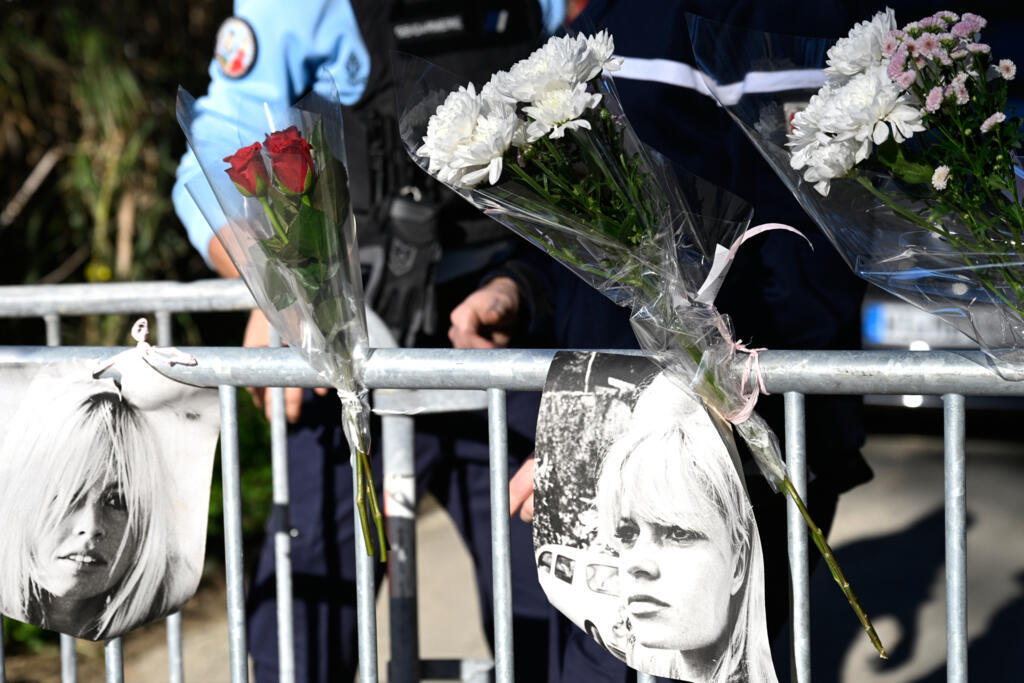
Photos of Brigitte Bardot hang on a security barrier near her home in Saint-Tropez, southern France, 28 December 2025. © Philippe Magoni / AP

Personal ties

Relations were far warmer with Marine Le Pen, who has been invited to the funeral and will attend “in a personal and friendly capacity”, according to her entourage.

Bardot had been close to Le Pen’s father, Jean-Marie Le Pen, and was married for three decades to a former adviser to the founder of the National Front.

She shared many of the movement’s views, including her opposition to what she once described as “the terrifying rise of immigration”.

Her support was not limited to private sympathy. In 2012, she publicly urged mayors to sponsor Marine Le Pen’s first presidential bid.

After Bardot’s death was announced on Sunday, the National Rally leader responded by praising an “exceptional woman” who was “incredibly French – free, indomitable, wholehearted”.

Bardot backs far-right leader Le Pen's attempt to stand for president


Funeral arrangements

Beyond politics, the two women were also linked by a shared commitment to animal welfare. Bardot devoted herself to the cause through the Brigitte Bardot Foundation, while Marine Le Pen is known to have studied cat breeding.

The foundation said the funeral ceremony at the Notre-Dame de l’Assomption church would be broadcast on large screens outside.

This will be followed by a private burial at the marine cemetery, ahead of a “tribute open to all the residents of Saint-Tropez and her admirers”.

Speaking to the local daily Var-Matin on Tuesday, the town’s mayor Sylvie Siri said: “Come that time, everyone will talk about her and share their fondest memories of her.”

“It will be a great moment of communion – simple, just like her,” she added.

(with newswires)


Ecofascism, sometimes spelled eco-fascism, is a term used to describe individuals and groups which combine environmentalism with fascism.

Aug 17, 2021 ... A strain of eco-fascism was also found in Nazi ideology. As one of ... Ecofascism poses a real threat even today. Two mass killings ...

Sep 7, 2022 ... A Darker Shade of Green: Understanding Ecofascism. A UConn expert ... fascism, which many political theorists say is less about ideology ...

Apr 30, 2025 ... As such, the Siege pill (accelerationism) may follow the green pill (eco-fascism).” A combination of eco-fascist ideals and accelerationism ...

Oct 28, 2022 ... As an ideology, eco-fascism promotes “authoritarian, hierarchical, and racist analyses and solutions to environmental problems.” Eco-fascists ...

This article explores the use of the term “eco-fascism” in connection with the climate crisis and considers the political relationship between ecologism and ...

May 24, 2023 ... Ecofascism creates a twisted and corrupted view of environmentalism, where authoritarianism, nationalism, and racial purity become primary tools and solutions.


Saturday, May 18, 2024

Extreme rights 2.0: A big global family

Steven Forti
2 May, 2024


First published at NACLA.


The victory of Javier Milei in Argentina’s presidential elections last November exploded a veritable atomic bomb, whose shockwaves reach far beyond the Latin American country. The paleolibertarian economist, known for his crude insults against “lefties,” immediately received congratulations from the members of what the Spanish philosopher and politician Clara Ramas has called the new Reactionary International. Although they have never brandished chainsaws at their rallies, for Donald Trump, Jair Bolsonaro, Viktor Orbán, Giorgia Meloni, José Antonio Kast, and Santiago Abascal, Milei is one of their own.

The arrival of Milei and his La Libertad Avanza party to the Casa Rosada is just the latest example of a process that has been developing over at least three decades and that has accelerated in the wake of the 2008 economic crisis. Currently, in addition to Argentina, the extreme right governs in four European countries (Italy, Hungary, Finland, and the Czech Republic), externally supports a conservative executive in Sweden, and could soon reach the government in the Netherlands, after the success of Geert Wilders in the November elections. As is known, the far right also ruled in Poland for two terms and in Brazil and the United States for one. In 2024, elections could propel far-right formations into governments in Portugal and Austria, not to mention the political earthquake that would come with electoral gains for the far right in the European Parliament elections in June and, above all, in the United States in November, with the possible return of Trump to the White House.

In short, as the Dutch political scientist Cas Mudde has pointed out, these political forces have become demarginalized. That is, on the one hand, they have become relevant political actors and accessed the government in various countries. On the other hand, their ideas have become normalized, shaping political agendas while being shared within conventional spaces. The radicalization of mainstream right-wing parties is reliable proof of this shift, as is the extreme right’s “conquest of the streets,” which has even included violence against political institutions or party headquarters in the United States, Brazil, and Spain.

In this early 21st century, a new spectre haunts the world. It is not the spectre of communism, as Karl Marx and Friedrich Engels explained in the mid-19th century, but the spectre of the extreme right. Although there are still no leading intellectuals nor a manifesto of a worldwide far-right party, this does not mean that it is not a globally organized, albeit heterogeneous, political force. On both sides of the Atlantic, recent events clearly show this is the case.

Fascist, populist, or radical right?

The rise of these political formations has led to a whole series of public and academic debates. The first is related to the definition of this phenomenon. It is often said that fascism has returned. In this regard, the thesis of eternal fascism or Ur-Fascism put forward by the Italian intellectual Umberto Eco has notably circulated in recent years. According to Eco, the creation of a “fascist nebula” requires the presence of only one of the 14 characteristics he detailed in his essay, among which are the cult of tradition, fear of the other, or the appeal to frustrated middle classes. Is this true? The question is not trivial, because the ability to define a political phenomenon is the first essential step to being able to understand and, by extension, combat it.

There is no doubt that these new extreme rights— or, as I will explain later, extreme rights 2.0—are the greatest threat to democratic values and the very survival of pluralist liberal democracies today. That does not mean it is correct to interpret them through the lens of fascism. As the Italian historian Emilio Gentile has pointed out, the thesis of eternal fascism is a consequence of the banalization of fascism. This banalization, on the one hand, has turned the concept into an insult, a synonym for “absolute evil.” On the other, it has led to a kind of ahistoriology “in which the historical past continually adapts to current desires, hopes, and fears.”

In short, what Gentile calls historical fascism was not only an ultranationalist, racist, and xenophobic political movement. Fascism, created in Europe after World War I, also had other core characteristics that we do not find in the extreme right today, such as its militia party organization, totalitarianism as a form of government, imperialism as a project of military expansion, regimenting of the population into large mass organizations, and self-presentation as a revolutionary rebirth and political religion. This does not mean that there are no elements of continuity between those experiences and current ones. However, fascism was a different creature. Today, neofascist and neo-Nazi groups still exist, but they are an ultra-minority.

Along with fascism, there is another obstacle that prevents us from defining and understanding the new extreme rights: populism. The debate on this topic has been endless over the last two decades. A consensus has not yet been reached on what populism is, beyond having become a kind of catch-all into which everything that does not fit within traditional political ideologies can fall. Some consider populism an ideology, albeit a thin one. Others, however, prefer to talk about it as a strategy or a political style. Given the absence of a defining doctrine, I believe that the second interpretation is more accurate. Add to this the fact that we are living in a time when populism permeates everything. If Milei, Gustavo Petro, and even French President Emmanuel Macron are populists, what good is this concept? Rather, this trend is the hallmark of our times, and it would be appropriate to talk, as Marc Lazar and Ilvo Diamanti have proposed, about “peoplecracy.” The extreme right uses the rhetorical and linguistic tools of populism, but populism in and of itself does not help us define and understand it.

That said, what concept should we use to define the political parties or movements led by Trump, Milei, Bolsonaro, Kast, Meloni, Le Pen, Orbán, or Abascal? Some speak of national populism and others opt for post-fascism, neither of which allow us, in the end, to move beyond the conceptual obstacles mentioned above. The term that has perhaps gotten the most traction is radical right. According to Mudde, unlike the extreme right, which rejects the very essence of democracy, the radical right accepts “the essence of democracy but opposes fundamental elements of liberal democracy, most notably minority rights, rule of law, and separation of powers.” In practice, the radical right accepts free, albeit not fair, elections— consider the case of Orbán’s Hungary in the last 12 years—and what ultimately is a simulacrum of democracy as we know it.

However, this proposal is problematic. On the one hand, is it correct to use the same adjective—radical— to define formations of the new extreme right and leftist forces such as Podemos, Syriza, the Broad Front of Chile, or La France Insoumise, as if there were some kind of symmetry? Personally, I think it is a mistake. The radical left criticizes existing liberal systems, focusing above all on the neoliberal model and economic issues, but it does not question the separation of powers, nor the democratic rights and gains guaranteed by these same systems. Rather, the radical left calls for an expansion and deepening of these rights, along with a reduction in inequalities.

On the other hand, as Beatriz Acha Ugarte notes: “Can we conceive of a non-pluralist democracy? Can we describe as democratic—albeit not in its ‘liberal version’—forces that, in their treatment of the ‘other’ (immigrant, foreigner), show their contempt for the democratic principle of equality?” By defending an ideology of exclusion incompatible even with the procedural version of democracy, and by calling into question the very existence of the rule of law, we should be cautious in considering these forces democratic.

Why do people vote for the far right?

The second debate has to do with the causes behind these political forces’ electoral advances. Why do people vote for them? In sum, three major causes have been identified, which are never exclusive, but rather must be considered alongside the peculiarities of each national context. First, the increase in inequalities, as well as the precariousness of work, weakening of the welfare state, and shrinking of the middle class, have pushed some voters who are dissatisfied with neoliberal economic recipes to choose the options on the ballot that criticize the existing order.

The second is what has been called cultural backlash—that is, the cultural reaction to liberal globalization. Our societies have gradually become multicultural, and in recent decades, many demands labeled post-materialist have become rights, from divorce to abortion to marriage equality. This shift has led, according to experts, to a reaction from sectors of the population who see their positions in society and even their identities threatened. They then vote for parties that reject immigration, criticize what they consider progressive excesses, and defend the traditional family.

Third, liberal democracies are experiencing a profound crisis. Our societies have become frayed—they are more liquid and atomized due to the prevailing neoliberal model and technological revolution, political parties no longer serve as an effective conduit between territories and institutions, unions face enormous difficulties in adapting to a fully post-Fordist reality, and citizen distrust continues to increase. In such atomized societies, where trust in institutions seems to have disappeared, it is not unreasonable to imagine that part of the electorate opts for parties that say they want to destroy everything or, at the very least, that oppose the establishment and criticize the functioning of democracies that they consider slow, ineffective, or disconnected from the will of the people.

To these three causes, we could add a fourth that has even more to do with the perceptions of the population. In a world that’s difficult to understand, demand for protection and security has increased. What will happen to my job in 10 years with artificial intelligence? What will happen in our neighborhoods if migrants from other continents keep arriving? What will come of the family model in which many of us have grown up if queer couples are allowed to adopt children or gender fluidity is accepted? What will come of our social relationships in times of virtual reality with projects like the Metaverse? In their own way, the extreme rights 2.0 know they need to offer security and protection to many people who live in fear of what the future may bring, giving simple answers to complex problems.

Understanding the extreme rights 2.0

To recap, there is considerable confusion about what to call these political formations and a series of causes to explain their electoral gains on both sides of the Atlantic. Some of these causes may outweigh others in a specific country, region, or municipality. We must, however, always take them all into account. Is Milei’s victory explained only by the economic crisis and increasing inequalities in Argentina? Without denying the importance of these factors, it would be wrong to relegate to a second or third place the high levels of citizen distrust towards traditional political parties and institutions, as well as the cultural reaction to the so-called “progressive consensus.”

It is often said that the European and Latin American contexts are not comparable. However, I do not believe we should keep the analyses and, consequently, the definitions of these phenomena separate. The fact that there are some differences or national peculiarities among the causes of the far rights’ electoral advances does not invalidate the possibility of conceiving of and using a concept on a global scale. On the contrary, it is useful to forge a macro-category that is elastic enough to include all these political formations. Based on these considerations, I have proposed the perhaps somewhat provocative concept of extreme rights 2.0.

With this concept, in the plural, I seek to highlight not only that the Trumps, Le Pens, Mileis, and Orbáns represent a phenomenon distinct from historical fascism, with radically new elements compared to the past, but also that new technologies have played a crucial role in the rise of these political formations. Likewise, I wish to highlight that, despite some divergences, they share much in common, in terms of both ideological basis and political and communications strategies. Last but not least, all of these figures not only know each other and maintain relationships with some frequency, but they also consider themselves part of the same global family.

Among their common ideological reference points are a marked nationalism, a deep criticism of multilateralism and the liberal order, anti-globalism, defense of conservative values, defense of law and order, criticism of multiculturalism and open societies, anti-progressivism, anti-intellectualism, and a formal distancing from past experiences of fascism, without rejecting so-called dog whistle politics— winks or references to authoritarian regimes of the past. In Europe and the United States, identitarianism, nativism, condemnation of immigration as an “invasion,” xenophobia, and more specifically Islamophobia, certainly play a crucial role. Within Latin America, there is no shortage of cases—consider Chile—where the extreme right also has clearly leveraged rhetoric rejecting immigration, mainly of Venezuelans. That said, those in Latin America who José Antonio Sanahuja and Camilo López Burian have proposed calling the neopatriotic right have most in common with the European far right.

The European extreme rights are not all exactly the same either. Neither were the fascisms of the interwar era, and this does not mean we cannot use a macro-category to talk about the regimes of Hitler, Mussolini, and Franco. Among these divergences today it is worth first mentioning their economic programs. There are forces, like Vox in Spain or Chega in Portugal, that are ultra-liberal, and those, like Le Pen in France, that defend so-called welfare chauvinism, without calling into question the neoliberal model. Second, when it comes to values, positions are much more ultra-conservative in the south and east of Europe compared to the extreme right of the Netherlands or Scandinavia, which are a bit more open on issues such as LGBTQIA+ rights and abortion. Finally, there are geopolitical differences since there are some Russophile parties and other Atlanticist parties.

At the same time, there are commonalities. One is exacerbated tacticism—that is, the ability to quickly change positions on crucial issues, without having any qualms about appearing incoherent, such as on the question of the European Union or measures to confront Covid-19—with the aim of setting the media agenda. Similarly, they share the ability to use new technologies and social media to make their messages go viral, gather citizen data, and further polarize society with culture wars. Another element, as the Argentine historian Pablo Stefanoni explains, is the willingness to present themselves as transgressors and rebels against a system supposedly dominated by a left that has established a progressive or politically correct dictatorship. The new far rights have not only made themselves more “presentable,” they are also trying to appropriate progressive and left-wing banners—think about the use of the concept of freedom or phenomena such as homonationalism or ecofascism—in a historical moment marked by what the French sociologist Philippe Corcuff has called ideological confusionism.

A big global family

To paraphrase the historian Ricardo Chueca, who studied the Spanish Falange during the Franco regime, each country gives life to the extreme right 2.0 that it needs. We can add that each extreme right is the offspring of the political cultures present in each national context. Thus, their peculiarities do not prevent them from being considered part of a large global family since, in addition, there are transnational networks that work to strengthen existing ties, develop a common agenda, and finance these political parties.

On the one hand, all these political leaders share personal relationships. They know each other, talk often, congratulate each other on social media, and meet and participate in gatherings organized by the other parties. In the European Union, the existence of the political groups Identity and Democracy (ID) and European Conservatives and Reformists (ECR), which bring together the continent’s far-right parties, offers space for the right to share ideas and experiences. It is true that the extreme right has not managed, neither in the past nor the present, to unify into a single group in the European Parliament, nor into a single community-wide party. But the parties both in the ID and in the ECR share a considerable understanding of the landscape and can reach compromises, as has been demonstrated by the manifesto in defense of a Christian Europe that the majority of these parties signed in July 2021.

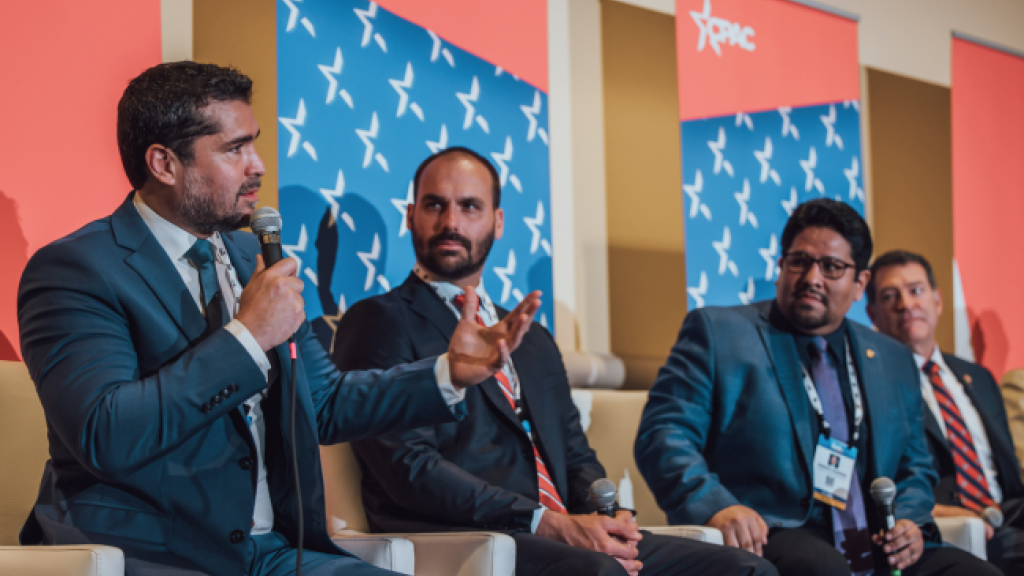
On the other hand, global networks woven by foundations and conservative think tanks are gaining importance. One of these is the Conservative Political Action Conference (CPAC), linked to the U.S. Republican Party, which has tentacles in Australia, Japan, Brazil, Mexico, and Hungary. Likewise, there is the Atlas Network, a promoter of free-market ideas based in DC, and the Edmund Burke Foundation, a conservative research institute founded in the Netherlands in 2019 and linked to ultra-conservative Israeli, U.S., and European sectors. One of its key figures is the Israeli philosopher Yoram Hazony, author of the 2018 book The Virtue of Nationalism and president of the Herzl Institute, a main animator of what is presented as “national conservatism.”

At the same time, many of these parties have created political training schools whose teachers often include members of the extreme right from other countries. Marion Maréchal Le Pen, niece of Marine Le Pen, created in France the Higher Institute of Sociology, Economics, and Politics, which, together with Vox, also opened a headquarters in Madrid. Among the many pro-government organizations created by Orbán in Hungary, it is worth mentioning the Mathias Corvinus Collegium, which currently has more than 20 locations in Hungary, Romania, and Brussels, and around 7,000 students. Among its guest speakers last year was former Fox News host Tucker Carlson. The director of the Collegium’s Center for European Studies is Rodrigo Ballester of Spain, who is linked to Vox and its think tank, the Disenso Foundation. Meanwhile, in Poland, the far-right Law and Justice party has promoted its university, the Collegium Intermarium, which is linked to the ultra-Catholic think tank Ordo Iuris. In addition, the ECR organizes courses for “future leaders” throughout Europe through its foundation, New Direction.

Connections are increasingly transatlantic. These connections are not only thanks to CPAC or the activism of Orbán’s Hungary, which organizes forums such as the Budapest Demographic Summit, but also because of the role that Vox, headed by Santiago Abascal, is playing in relation to Latin America. Through the Disenso Foundation, the party has developed the notion of Iberosphere, which promotes ties between right-wing parties on both sides of the Atlantic, in the Iberian Peninsula and Latin America. In 2020, Vox launched the Madrid Charter, a programmatic manifesto that made the Iberosphere concept official and enabled the creation of the Madrid Forum. This organization, which presents itself as a counterweight to the São Paulo Forum and the Puebla Group, has organized several meetings in the region, including in Bogotá in 2022 and Lima in 2023, in addition to the Iberosphere summits. In this way, Vox has strengthened relations with the Latin American far right, from Brazil to Chile, passing through Argentina, Peru, Colombia, and Mexico, offering meeting spaces to share a common agenda. One of the main links has been Vox European Parliament member Hermann Tertsch, third vice chair of the Euro-Latin American Parliamentary Assembly (EuroLat), which shows once again the importance of the networks being woven from Brussels.

To all this activity we must add the networks created in Christian fundamentalist orbits, which have been very active since at least the late 1990s. One of the best-known examples is the World Congress of Families, an organization founded between the United States and Russia in 1997 that now has branches throughout the globe. Among its participants is HazteOír, an organization founded in 2001 by Spanish lawyer Ignacio Arsuaga, who went on in 2013 to launch the international lobby group CitizenGo. Likewise, the Political Network for Values, headed by José Antonio Kast, has been organizing transatlantic meetings for a decade. Among its leading members is Jaime Mayor Oreja, former minister in the Spanish government under the Popular Party’s José María Aznar and founder of the “cultural platform” One of Us, a Catholic think tank that defends the prohibition of abortion, euthanasia, gay marriage, and “gender ideology.” This brief overview offers just a small sample of a very well-organized and dense network.

Electoral autocracies

Taking all this into account, it is difficult not to consider these political formations as part of the same political family. They defend largely the same ideas, promote similar policies, and share the same forums internationally. They also have the same objectives. First, they seek to shift the public debate to the far right—that is, to move the Overton window, making acceptable rhetoric and narratives that up until a few years ago were unacceptable. Second, they seek to radicalize the traditional right either by conquering them from within or by forcing them to become allies. Third, they seek to come to power to establish an illiberal democracy following the Orbán model. Today’s Hungary is not a full democracy, but a “hybrid regime of electoral autocracy,” as the European Parliament defined it in September 2022.

And Hungary is a model. It is no coincidence that Orbán traveled to Buenos Aires on December 10 for Milei’s inauguration and met with the new Argentine president. Likewise, far-right European, U.S., and Latin American politicians have often traveled to Budapest to learn how to hollow out democracy from within. When they fail to do so, they call the elections fraudulent and promote violent actions against institutions, as we saw in Washington in January 2021 and, two years later, in Brasília. The extreme rights 2.0 are not historical fascism, but they are, without a doubt, the greatest existing threat to democratic values.

Just look at the policies approved by Milei after his inauguration. In the first weeks of his administration, he introduced measures aimed at deregulating the economy, along with brutal cuts to social assistance, indiscriminate attacks on civil rights, and the criminalization of unions and protests to the point of eliminating freedom of assembly and demonstration. In this context, it is not unreasonable to draw a parallel between the Decree of Necessity and Urgency signed by Milei to implement his “shock therapy,” and especially his proposed omnibus “Law of bases and starting points for the freedom of Argentines,” and the “Enabling Law” approved by the German parliament in March 1933. In practice, the overturning of Congress that Milei seeks to impose in his omnibus bill would mean the end of the separation of powers and the rule of law itself. In other words, the death of democracy—exactly what happened in Germany with Hitler’s arrival to power.


Steven Forti is a professor of Contemporary History at the Autonomous University of Barcelona. Among other works, he is the author of Extrema derecha 2.0 (2021) and editor of Mitos y cuentos de la extrema derecha (2023). He is a member of the editorial boards of Spagna Contemporanea, CTXT, and Política & Prosa.


Tuesday, May 07, 2024

Extreme rights 2.0: A big global family

Steven Forti
LINKS
2 May, 2024


First published at NACLA.

The victory of Javier Milei in Argentina’s presidential elections last November exploded a veritable atomic bomb, whose shockwaves reach far beyond the Latin American country. The paleolibertarian economist, known for his crude insults against “lefties,” immediately received congratulations from the members of what the Spanish philosopher and politician Clara Ramas has called the new Reactionary International. Although they have never brandished chainsaws at their rallies, for Donald Trump, Jair Bolsonaro, Viktor Orbán, Giorgia Meloni, José Antonio Kast, and Santiago Abascal, Milei is one of their own.

The arrival of Milei and his La Libertad Avanza party to the Casa Rosada is just the latest example of a process that has been developing over at least three decades and that has accelerated in the wake of the 2008 economic crisis. Currently, in addition to Argentina, the extreme right governs in four European countries (Italy, Hungary, Finland, and the Czech Republic), externally supports a conservative executive in Sweden, and could soon reach the government in the Netherlands, after the success of Geert Wilders in the November elections. As is known, the far right also ruled in Poland for two terms and in Brazil and the United States for one. In 2024, elections could propel far-right formations into governments in Portugal and Austria, not to mention the political earthquake that would come with electoral gains for the far right in the European Parliament elections in June and, above all, in the United States in November, with the possible return of Trump to the White House.

In short, as the Dutch political scientist Cas Mudde has pointed out, these political forces have become demarginalized. That is, on the one hand, they have become relevant political actors and accessed the government in various countries. On the other hand, their ideas have become normalized, shaping political agendas while being shared within conventional spaces. The radicalization of mainstream right-wing parties is reliable proof of this shift, as is the extreme right’s “conquest of the streets,” which has even included violence against political institutions or party headquarters in the United States, Brazil, and Spain.

In this early 21st century, a new spectre haunts the world. It is not the spectre of communism, as Karl Marx and Friedrich Engels explained in the mid-19th century, but the spectre of the extreme right. Although there are still no leading intellectuals nor a manifesto of a worldwide far-right party, this does not mean that it is not a globally organized, albeit heterogeneous, political force. On both sides of the Atlantic, recent events clearly show this is the case.

Fascist, populist, or radical right?

The rise of these political formations has led to a whole series of public and academic debates. The first is related to the definition of this phenomenon. It is often said that fascism has returned. In this regard, the thesis of eternal fascism or Ur-Fascism put forward by the Italian intellectual Umberto Eco has notably circulated in recent years. According to Eco, the creation of a “fascist nebula” requires the presence of only one of the 14 characteristics he detailed in his essay, among which are the cult of tradition, fear of the other, or the appeal to frustrated middle classes. Is this true? The question is not trivial, because the ability to define a political phenomenon is the first essential step to being able to understand and, by extension, combat it.

There is no doubt that these new extreme rights— or, as I will explain later, extreme rights 2.0—are the greatest threat to democratic values and the very survival of pluralist liberal democracies today. That does not mean it is correct to interpret them through the lens of fascism. As the Italian historian Emilio Gentile has pointed out, the thesis of eternal fascism is a consequence of the banalization of fascism. This banalization, on the one hand, has turned the concept into an insult, a synonym for “absolute evil.” On the other, it has led to a kind of ahistoriology “in which the historical past continually adapts to current desires, hopes, and fears.”

In short, what Gentile calls historical fascism was not only an ultranationalist, racist, and xenophobic political movement. Fascism, created in Europe after World War I, also had other core characteristics that we do not find in the extreme right today, such as its militia party organization, totalitarianism as a form of government, imperialism as a project of military expansion, regimenting of the population into large mass organizations, and self-presentation as a revolutionary rebirth and political religion. This does not mean that there are no elements of continuity between those experiences and current ones. However, fascism was a different creature. Today, neofascist and neo-Nazi groups still exist, but they are an ultra-minority.

Along with fascism, there is another obstacle that prevents us from defining and understanding the new extreme rights: populism. The debate on this topic has been endless over the last two decades. A consensus has not yet been reached on what populism is, beyond having become a kind of catch-all into which everything that does not fit within traditional political ideologies can fall. Some consider populism an ideology, albeit a thin one. Others, however, prefer to talk about it as a strategy or a political style. Given the absence of a defining doctrine, I believe that the second interpretation is more accurate. Add to this the fact that we are living in a time when populism permeates everything. If Milei, Gustavo Petro, and even French President Emmanuel Macron are populists, what good is this concept? Rather, this trend is the hallmark of our times, and it would be appropriate to talk, as Marc Lazar and Ilvo Diamanti have proposed, about “peoplecracy.” The extreme right uses the rhetorical and linguistic tools of populism, but populism in and of itself does not help us define and understand it.

That said, what concept should we use to define the political parties or movements led by Trump, Milei, Bolsonaro, Kast, Meloni, Le Pen, Orbán, or Abascal? Some speak of national populism and others opt for post-fascism, neither of which allow us, in the end, to move beyond the conceptual obstacles mentioned above. The term that has perhaps gotten the most traction is radical right. According to Mudde, unlike the extreme right, which rejects the very essence of democracy, the radical right accepts “the essence of democracy but opposes fundamental elements of liberal democracy, most notably minority rights, rule of law, and separation of powers.” In practice, the radical right accepts free, albeit not fair, elections— consider the case of Orbán’s Hungary in the last 12 years—and what ultimately is a simulacrum of democracy as we know it.

However, this proposal is problematic. On the one hand, is it correct to use the same adjective—radical— to define formations of the new extreme right and leftist forces such as Podemos, Syriza, the Broad Front of Chile, or La France Insoumise, as if there were some kind of symmetry? Personally, I think it is a mistake. The radical left criticizes existing liberal systems, focusing above all on the neoliberal model and economic issues, but it does not question the separation of powers, nor the democratic rights and gains guaranteed by these same systems. Rather, the radical left calls for an expansion and deepening of these rights, along with a reduction in inequalities.

On the other hand, as Beatriz Acha Ugarte notes: “Can we conceive of a non-pluralist democracy? Can we describe as democratic—albeit not in its ‘liberal version’—forces that, in their treatment of the ‘other’ (immigrant, foreigner), show their contempt for the democratic principle of equality?” By defending an ideology of exclusion incompatible even with the procedural version of democracy, and by calling into question the very existence of the rule of law, we should be cautious in considering these forces democratic.

Why do people vote for the far right?

The second debate has to do with the causes behind these political forces’ electoral advances. Why do people vote for them? In sum, three major causes have been identified, which are never exclusive, but rather must be considered alongside the peculiarities of each national context. First, the increase in inequalities, as well as the precariousness of work, weakening of the welfare state, and shrinking of the middle class, have pushed some voters who are dissatisfied with neoliberal economic recipes to choose the options on the ballot that criticize the existing order.

The second is what has been called cultural backlash—that is, the cultural reaction to liberal globalization. Our societies have gradually become multicultural, and in recent decades, many demands labeled post-materialist have become rights, from divorce to abortion to marriage equality. This shift has led, according to experts, to a reaction from sectors of the population who see their positions in society and even their identities threatened. They then vote for parties that reject immigration, criticize what they consider progressive excesses, and defend the traditional family.

Third, liberal democracies are experiencing a profound crisis. Our societies have become frayed—they are more liquid and atomized due to the prevailing neoliberal model and technological revolution, political parties no longer serve as an effective conduit between territories and institutions, unions face enormous difficulties in adapting to a fully post-Fordist reality, and citizen distrust continues to increase. In such atomized societies, where trust in institutions seems to have disappeared, it is not unreasonable to imagine that part of the electorate opts for parties that say they want to destroy everything or, at the very least, that oppose the establishment and criticize the functioning of democracies that they consider slow, ineffective, or disconnected from the will of the people.

To these three causes, we could add a fourth that has even more to do with the perceptions of the population. In a world that’s difficult to understand, demand for protection and security has increased. What will happen to my job in 10 years with artificial intelligence? What will happen in our neighborhoods if migrants from other continents keep arriving? What will come of the family model in which many of us have grown up if queer couples are allowed to adopt children or gender fluidity is accepted? What will come of our social relationships in times of virtual reality with projects like the Metaverse? In their own way, the extreme rights 2.0 know they need to offer security and protection to many people who live in fear of what the future may bring, giving simple answers to complex problems.

Understanding the extreme rights 2.0

To recap, there is considerable confusion about what to call these political formations and a series of causes to explain their electoral gains on both sides of the Atlantic. Some of these causes may outweigh others in a specific country, region, or municipality. We must, however, always take them all into account. Is Milei’s victory explained only by the economic crisis and increasing inequalities in Argentina? Without denying the importance of these factors, it would be wrong to relegate to a second or third place the high levels of citizen distrust towards traditional political parties and institutions, as well as the cultural reaction to the so-called “progressive consensus.”

It is often said that the European and Latin American contexts are not comparable. However, I do not believe we should keep the analyses and, consequently, the definitions of these phenomena separate. The fact that there are some differences or national peculiarities among the causes of the far rights’ electoral advances does not invalidate the possibility of conceiving of and using a concept on a global scale. On the contrary, it is useful to forge a macro-category that is elastic enough to include all these political formations. Based on these considerations, I have proposed the perhaps somewhat provocative concept of extreme rights 2.0.

With this concept, in the plural, I seek to highlight not only that the Trumps, Le Pens, Mileis, and Orbáns represent a phenomenon distinct from historical fascism, with radically new elements compared to the past, but also that new technologies have played a crucial role in the rise of these political formations. Likewise, I wish to highlight that, despite some divergences, they share much in common, in terms of both ideological basis and political and communications strategies. Last but not least, all of these figures not only know each other and maintain relationships with some frequency, but they also consider themselves part of the same global family.

Among their common ideological reference points are a marked nationalism, a deep criticism of multilateralism and the liberal order, anti-globalism, defense of conservative values, defense of law and order, criticism of multiculturalism and open societies, anti-progressivism, anti-intellectualism, and a formal distancing from past experiences of fascism, without rejecting so-called dog whistle politics— winks or references to authoritarian regimes of the past. In Europe and the United States, identitarianism, nativism, condemnation of immigration as an “invasion,” xenophobia, and more specifically Islamophobia, certainly play a crucial role. Within Latin America, there is no shortage of cases—consider Chile—where the extreme right also has clearly leveraged rhetoric rejecting immigration, mainly of Venezuelans. That said, those in Latin America who José Antonio Sanahuja and Camilo López Burian have proposed calling the neopatriotic right have most in common with the European far right.

The European extreme rights are not all exactly the same either. Neither were the fascisms of the interwar era, and this does not mean we cannot use a macro-category to talk about the regimes of Hitler, Mussolini, and Franco. Among these divergences today it is worth first mentioning their economic programs. There are forces, like Vox in Spain or Chega in Portugal, that are ultra-liberal, and those, like Le Pen in France, that defend so-called welfare chauvinism, without calling into question the neoliberal model. Second, when it comes to values, positions are much more ultra-conservative in the south and east of Europe compared to the extreme right of the Netherlands or Scandinavia, which are a bit more open on issues such as LGBTQIA+ rights and abortion. Finally, there are geopolitical differences since there are some Russophile parties and other Atlanticist parties.

At the same time, there are commonalities. One is exacerbated tacticism—that is, the ability to quickly change positions on crucial issues, without having any qualms about appearing incoherent, such as on the question of the European Union or measures to confront Covid-19—with the aim of setting the media agenda. Similarly, they share the ability to use new technologies and social media to make their messages go viral, gather citizen data, and further polarize society with culture wars. Another element, as the Argentine historian Pablo Stefanoni explains, is the willingness to present themselves as transgressors and rebels against a system supposedly dominated by a left that has established a progressive or politically correct dictatorship. The new far rights have not only made themselves more “presentable,” they are also trying to appropriate progressive and left-wing banners—think about the use of the concept of freedom or phenomena such as homonationalism or ecofascism—in a historical moment marked by what the French sociologist Philippe Corcuff has called ideological confusionism.

A big global family

To paraphrase the historian Ricardo Chueca, who studied the Spanish Falange during the Franco regime, each country gives life to the extreme right 2.0 that it needs. We can add that each extreme right is the offspring of the political cultures present in each national context. Thus, their peculiarities do not prevent them from being considered part of a large global family since, in addition, there are transnational networks that work to strengthen existing ties, develop a common agenda, and finance these political parties.

On the one hand, all these political leaders share personal relationships. They know each other, talk often, congratulate each other on social media, and meet and participate in gatherings organized by the other parties. In the European Union, the existence of the political groups Identity and Democracy (ID) and European Conservatives and Reformists (ECR), which bring together the continent’s far-right parties, offers space for the right to share ideas and experiences. It is true that the extreme right has not managed, neither in the past nor the present, to unify into a single group in the European Parliament, nor into a single community-wide party. But the parties both in the ID and in the ECR share a considerable understanding of the landscape and can reach compromises, as has been demonstrated by the manifesto in defense of a Christian Europe that the majority of these parties signed in July 2021.

On the other hand, global networks woven by foundations and conservative think tanks are gaining importance. One of these is the Conservative Political Action Conference (CPAC), linked to the U.S. Republican Party, which has tentacles in Australia, Japan, Brazil, Mexico, and Hungary. Likewise, there is the Atlas Network, a promoter of free-market ideas based in DC, and the Edmund Burke Foundation, a conservative research institute founded in the Netherlands in 2019 and linked to ultra-conservative Israeli, U.S., and European sectors. One of its key figures is the Israeli philosopher Yoram Hazony, author of the 2018 book The Virtue of Nationalism and president of the Herzl Institute, a main animator of what is presented as “national conservatism.”

At the same time, many of these parties have created political training schools whose teachers often include members of the extreme right from other countries. Marion Maréchal Le Pen, niece of Marine Le Pen, created in France the Higher Institute of Sociology, Economics, and Politics, which, together with Vox, also opened a headquarters in Madrid. Among the many pro-government organizations created by Orbán in Hungary, it is worth mentioning the Mathias Corvinus Collegium, which currently has more than 20 locations in Hungary, Romania, and Brussels, and around 7,000 students. Among its guest speakers last year was former Fox News host Tucker Carlson. The director of the Collegium’s Center for European Studies is Rodrigo Ballester of Spain, who is linked to Vox and its think tank, the Disenso Foundation. Meanwhile, in Poland, the far-right Law and Justice party has promoted its university, the Collegium Intermarium, which is linked to the ultra-Catholic think tank Ordo Iuris. In addition, the ECR organizes courses for “future leaders” throughout Europe through its foundation, New Direction.

Connections are increasingly transatlantic. These connections are not only thanks to CPAC or the activism of Orbán’s Hungary, which organizes forums such as the Budapest Demographic Summit, but also because of the role that Vox, headed by Santiago Abascal, is playing in relation to Latin America. Through the Disenso Foundation, the party has developed the notion of Iberosphere, which promotes ties between right-wing parties on both sides of the Atlantic, in the Iberian Peninsula and Latin America. In 2020, Vox launched the Madrid Charter, a programmatic manifesto that made the Iberosphere concept official and enabled the creation of the Madrid Forum. This organization, which presents itself as a counterweight to the São Paulo Forum and the Puebla Group, has organized several meetings in the region, including in Bogotá in 2022 and Lima in 2023, in addition to the Iberosphere summits. In this way, Vox has strengthened relations with the Latin American far right, from Brazil to Chile, passing through Argentina, Peru, Colombia, and Mexico, offering meeting spaces to share a common agenda. One of the main links has been Vox European Parliament member Hermann Tertsch, third vice chair of the Euro-Latin American Parliamentary Assembly (EuroLat), which shows once again the importance of the networks being woven from Brussels.

To all this activity we must add the networks created in Christian fundamentalist orbits, which have been very active since at least the late 1990s. One of the best-known examples is the World Congress of Families, an organization founded between the United States and Russia in 1997 that now has branches throughout the globe. Among its participants is HazteOír, an organization founded in 2001 by Spanish lawyer Ignacio Arsuaga, who went on in 2013 to launch the international lobby group CitizenGo. Likewise, the Political Network for Values, headed by José Antonio Kast, has been organizing transatlantic meetings for a decade. Among its leading members is Jaime Mayor Oreja, former minister in the Spanish government under the Popular Party’s José María Aznar and founder of the “cultural platform” One of Us, a Catholic think tank that defends the prohibition of abortion, euthanasia, gay marriage, and “gender ideology.” This brief overview offers just a small sample of a very well-organized and dense network.

Electoral autocracies

Taking all this into account, it is difficult not to consider these political formations as part of the same political family. They defend largely the same ideas, promote similar policies, and share the same forums internationally. They also have the same objectives. First, they seek to shift the public debate to the far right—that is, to move the Overton window, making acceptable rhetoric and narratives that up until a few years ago were unacceptable. Second, they seek to radicalize the traditional right either by conquering them from within or by forcing them to become allies. Third, they seek to come to power to establish an illiberal democracy following the Orbán model. Today’s Hungary is not a full democracy, but a “hybrid regime of electoral autocracy,” as the European Parliament defined it in September 2022.

And Hungary is a model. It is no coincidence that Orbán traveled to Buenos Aires on December 10 for Milei’s inauguration and met with the new Argentine president. Likewise, far-right European, U.S., and Latin American politicians have often traveled to Budapest to learn how to hollow out democracy from within. When they fail to do so, they call the elections fraudulent and promote violent actions against institutions, as we saw in Washington in January 2021 and, two years later, in Brasília. The extreme rights 2.0 are not historical fascism, but they are, without a doubt, the greatest existing threat to democratic values.

Just look at the policies approved by Milei after his inauguration. In the first weeks of his administration, he introduced measures aimed at deregulating the economy, along with brutal cuts to social assistance, indiscriminate attacks on civil rights, and the criminalization of unions and protests to the point of eliminating freedom of assembly and demonstration. In this context, it is not unreasonable to draw a parallel between the Decree of Necessity and Urgency signed by Milei to implement his “shock therapy,” and especially his proposed omnibus “Law of bases and starting points for the freedom of Argentines,” and the “Enabling Law” approved by the German parliament in March 1933. In practice, the overturning of Congress that Milei seeks to impose in his omnibus bill would mean the end of the separation of powers and the rule of law itself. In other words, the death of democracy—exactly what happened in Germany with Hitler’s arrival to power.


Steven Forti is a professor of Contemporary History at the Autonomous University of Barcelona. Among other works, he is the author of Extrema derecha 2.0 (2021) and editor of Mitos y cuentos de la extrema derecha (2023). He is a member of the editorial boards of Spagna Contemporanea, CTXT, and Política & Prosa.

Friday, May 27, 2022

COMMENTARY
After Buffalo and Uvalde, America feels broken: Where do we go from here?

Feeling grief, confusion and despair right now is normal. How do we turn that into something constructive?


By CHAUNCEY DEVEGA
SALON
PUBLISHED MAY 27, 2022 

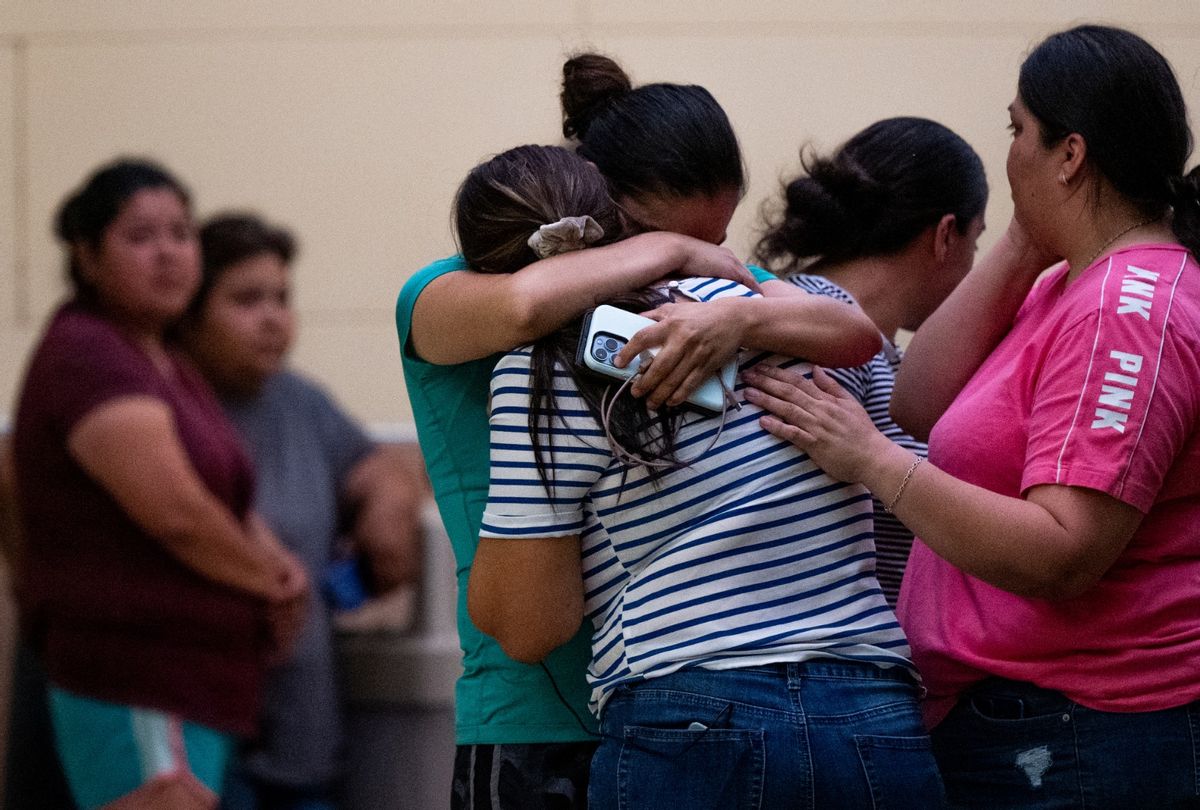
MAY 24: People mourn outside of the SSGT Willie de Leon Civic Center following the mass shooting at Robb Elementary School on May 24, 2022 in Uvalde, Texas. (Photo by Brandon Bell/Getty Images)

America is in big trouble. I think we all feel that way.

The country will not somehow "be fine" or find healing any time soon. Do not listen to anyone who tells you otherwise. They are lying to you. Although the clinical language may not apply perfectly, it feels as though we are experiencing a national nervous breakdown, a collective mental health crisis on a grand scale. It feels both societal and personal.

Less than two weeks ago in Buffalo, an apparent white supremacist terrorist killed 10 Black people at a supermarket. Ten days later in Uvalde, Texas, a deranged gunman attacked an elementary School, killing 19 children and two teachers. In both cases, the shooters used the AR-15 assault-style rifle, for all intents and purposes the same weapon used by the U.S. military. It fires standard 5.56mm bullets, which would typically strike the human body at a speed of 3,251 feet per second with 1,300 foot-pounds of kinetic energy. Some of the parents in Uvalde had to provide DNA samples so their children could be identified.


Both alleged killers were 18 years old. What personal, social or psychological emptiness leads such a young person to commit such a horrific act? We look for answers and do not find them.

We know that too many Americans love guns more than they love children, or life itself. They are possessed by the totemic power of the gun and what it represents in American history and society. Guns provide a temporary cure for death anxiety by conferring the ability to deliver death to others. These pathological attachments are camouflaged by all sorts of nonsensical rhetoric about "freedom." It is almost too perverse to be credible: The "freedom" to own as many guns as one wants trumps the freedom to live without reasonable fear of dying by gunfire.

Too many Americans love guns more than they love children. The mass murder of children at their schools is now a feature of American society, which hardly happens anywhere else.

The mass murder of children and young people at their schools is now a feature of American society. No other country experiences such gun violence anywhere near so frequently. It has become something we "must learn to live with" as the price of "freedom."

After the Sandy Hook massacre in 2012 — the only school shooting with more dead than in Uvalde — Garry Wills wrote a memorable essay for the New York Review of Books, describing the dead children in Connecticut as "the sacrifice we as a culture made, and continually make, to our demonic god":

We guarantee that crazed man after crazed man will have a flood of killing power readily supplied him. We have to make that offering, out of devotion to our Moloch, our god. The gun is our Moloch. We sacrifice children to him daily — sometimes, as at Sandy Hook, by directly throwing them into the fire-hose of bullets from our protected private killing machines, sometimes by blighting our children's lives by the death of a parent, a schoolmate, a teacher, a protector. Sometimes this is done by mass killings (eight this year), sometimes by private offerings to the god (thousands this year)….

Adoration of Moloch permeates the country, imposing a hushed silence as he works his will. One cannot question his rites, even as the blood is gushing through the idol's teeth. The White House spokesman invokes the silence of traditional religious ceremony. "It is not the time" to question Moloch. No time is right for showing disrespect for Moloch.

As others have observed, perhaps the only way for America to achieve effective gun control measures, or for gun violence is treated as a public health emergency is for Black and brown people and Muslims to buy AR-15s and other guns in large numbers, and then carry them openly everywhere it is legal to do so.

For many of us who think and write publicly about politics and other social concerns, there is considerable pressure to have "something to say." That punishes contemplation, deep thinking and true expertise, and rewards 30-second soundbites and "hot takes." Sometimes it's better to say simply that we feel lost and broken, that we feel doom and despair, that we feel America's myths, fantasies and falsehoods coming unglued.

For me, that answer is to ask more questions and to be admit that I don't know. I am hurting just like everyone else and I am likely no less than most people in America, We are all trying toward a destination that has not yet been determined. In an effort to orient myself after Buffalo and Texas, amid this moment of apparent implosion in America, I reached out to several people from a range of backgrounds whose voices I respect most.
ward for his work on "March," becoming the first cartoonist to win that award.

It's now considered cliché to state that Americans have been forced to become numb to this atrocity — but that notion is also false. The overwhelming majority of us are absolutely not numb to regular mass shootings in our schools and public spaces. Lawmakers, lobbyists and capital tied to the gun industry want us to be numb to it so badly that they reinforce how we already are — when in fact it's their inaction, their exploitation of fear and violence which reveals the depths of their own numbness, their own cynicism, their own inhumanity.

This is an everyday dread for every parent as their kids go to school. That fear isn't abstract: America has been forced to accept that regularly occurring mass death is unpreventable.

This is an everyday dread for every parent as their kids go to school. That fear isn't abstract. We can go about our daily lives, but we're just waiting for each day to bring the worst news because America has been forced to accept this bleak reality of regularly occurring mass death as unpreventable, making it easier to normalize death and lethal militarized force in every facet of life. If the humans controlling legislation cannot or will not implement measures to prevent this everyday nightmare, they should be expunged from power.

My opinion and experiences here are not unique at all, and that's the point. There's truly nothing left to say. It is fundamentally unacceptable for the young people of America and their loved ones to live in a merciless grinder of death and power.

Jared Yates Sexton is a political commentator and analyst. He is the author of "The People Are Going to Rise Like the Waters Upon Your Shore: A Story of American Rage." His most recent book is "American Rule: How a Nation Conquered the World But Failed Its People."

Yet again, Americans see the consequences of valuing their guns and their conspiracy theories over safety and peace and generally open society. Each of these tragedies takes on a new and awful dimension. Children. Mothers. Friends. Neighbors. And each of them come and go, erasing what little hope there is that something, anything, could be done by those in power.

I'm heartbroken. Because we deserve better. Because these children, these families, deserved so, so much better.

Thomas Lecaque is an associate professor of history at Grand View University where he specializes in apocalyptic religion and political violence. His essays and other writing have been featured in the Washington Post, Religion Dispatches, the Bulwark and Foreign Policy.

We live in a country where half of the 500 or so people who make all the laws that govern this nation are begging the other half to help them save lives, and yet, no matter how many children die in a classroom, no matter how many people are murdered in a grocery store, no matter how many bodies pile up, the other half will say "thoughts and prayers," wash their hands of the whole affair and collect their 30 pieces of silver from the NRA. And we accept that this is a society. That this is a nation worth saving. That the Golden Calf that the Second Amendment has become to the right is worthy of the 

And when anyone yells at them to do something, they look down over the coffins and tell us not to politicize it, not yet, not now. But there is never a time, because in America in the 21st century, the next mass shooting is already happening before we've had a chance to process and grieve for the last. And so it remains, over and over and over again.

A nation that accepts the murder of children as the reasonable price for people owning a gun is not a nation that gets to claim morality or righteousness. It's not a city on a hill, it's a beacon of horror.

The Rev. Dr. William J. Barber II is president and senior lecturer at Repairers of the Breach. He is also the architect of the Forward Together Moral Movement, co-chair of the Poor People's Campaign and author of several books, including his most recent, "We Are Called to Be a Movement." He is a frequent guest on CNN, ABC and MSNBC as well as Democracy Now! His essays and other writing have been featured in leading publications, including the Washington Post and the New York Times.

As a nation, we must connect our tears and pain to a mass movement that creates a flood of transformation. In the Bible, the prophet Jeremiah says, "A voice is heard in Ramah, mourning and great weeping, Rachel weeping for her children and refusing to be comforted, because they are no more." We have to mourn, but like Emmett Till's mother, we have to turn our mourning into organizing and refuse to be consoled until change comes.

The tears of our pain from all this death must be united into a lament that invokes the assistance of God and makes possible the kind of change where justice rolls down like water and righteousness like a mighty stream.

The same extremism that refuses to protect voting rights also refuses to pass common-sense gun laws. It's the same people who refuse health care, a living wage and protection of a woman's right to choose.

The same political extremism that refuses to expand and protect voting rights also refuses to pass common sense gun laws. It's the same politicians who refuse health care, living wages and protection of a woman's right to choose. The same forces that refuse to address poverty also pretend we can ignore the climate crisis. The policies and politicians that create the very context for so many of our tears are the same.

If we know this, we need to come together, unite our tears and refuse to be comforted until change comes. As hard as these moments are, we know that throughout history, great weeping and great mourning often bring about movements that force monumental change — which isn't possible until the heartbroken become the heart of the movement of transformation.

The greatest danger right now is for people to cry for a moment and then put their tears away, or to cry about this and not connect it to the other tears cried by those who have been victims of all the regressive and extreme policies existing today. If we ever needed moral fusion, we sure do need it now. We need the Mass Poor People's and Low-Wage Workers' Assembly and Moral March on Washington. We need a mass nonviolent movement that collectively challenges all this violence with one mighty, long-term chorus of repentance.

Read more on gun violence and mass shootings in America:

What is "ecofascism" — and what does it have to do with the Buffalo shooting?

CHAUNCEY DEVEGA
Chauncey DeVega is a senior politics writer for Salon. His essays can also be found at Chaunceydevega.com. He also hosts a weekly podcast, The Chauncey DeVega Show. Chauncey can be followed on Twitter and Facebook.