Sunday, March 15, 2020

Black Sky Thinking

Beyond The Iron Gates: How Nazi-Satanists Infiltrated the UK Underground
Dylan Miller , November 27th, 2018 08:53


In the second in our series exploring the connections between far right politics and music, Dylan Miller investigates the satanic-fascist Order Of Nine Angles and how, via musician and artist Richard Moult and the experimental folk scene, they have connected with the UK underground. Please note - this article contains imagery that some readers might find disturbing.
A member of Nazi organisation the O9A posing with a WWII-era German machinegun and an artwork by Richard Moult
"Let us not be mis-understood: genuine Satanists are evil… They cause, and strive to cause, Chaos, disruption, revolution... they bring joy, ecstasy and laughter, but perhaps most of all they bring death… death to those who have shown by their actions that they have a weak character or are a nuisance, or a hindrance to the spread of darkness." (O9A - 'Satanism - Epitome of Evil' ca. 2008)
What connects a convicted rapist in Yorkshire, a racist murderer in California, a critically-acclaimed underground experimental band from Ireland and a hip US "black metal chamber music" group? The answer is the once-obscure – and now influential – forty-year-old Satanic Neo-Nazi organization, The Order of Nine Angles (O9A), whose membership over the past decade has grown from a handful to an estimated 2000 adherents worldwide.
A number of O9A members are actively involved with the new generation of white-supremacist, neo-fascist and neo-Nazi organisations. This includes the UK's National Action, which was founded in 2013 and is now banned under the Terrorism Act, and international neo-Nazi group The Black Order. In the US, it includes the Atomwaffen Division, one of whose members has been convicted of murder, while the group is implicated in four more deaths.
"Musick creates itself… the composer, if naturally gifted, is a living NEXION. Thus, like any numinous form, Musick has the capability to presence forces and so alter the causal." (Christos Beest, aka Richard Moult, pictured below)
In early autumn of 2018 an anonymous document began to circulate within occult and musical underground circles accusing Newcastle-born artist and musician Richard Moult of using his connections with respected leftfield musicians to gain a wider audience for the Order of Nine Angles. Usually photographed in unassuming knitwear and spectacles, Moult is an accomplished, well-regarded musician; he was a regular member of Irish avant-folk band United Bible Studies and his own music has appeared on labels including A Year in The Country and Fort Evil Fruit. For at least two decades, however, Moult, under pseudonyms including Christos Beest, Beesty Boy and Audun, was a core member of The Order of Nine Angles, and for some years effectively ran it as its 'Outer Representative', training and initiating new members, editing its journal, Fenrir, and "giving a direction to [its] strategies".
Moult publicly left the O9A in 2001, but according to the circulated PDF, he returned in 2008, at a time when he was actively involved with United Bible Studies and other musicians – some of whom he collaborates with to this day. In The Dreccian Way, a handbook for the new generation of O9A members dated "yf 120" (2009), one of Moult's O9A aliases, 'Audun', sets out the goals for the revitalised organisation:
"At this time of writing the ONA is concerned with several major undertakings in preparedness for the return of the Dark Gods, three of which are… to create new forms, in image, word and musick, which depict and presence the manifesting acausal dark – the essence of the Dark Gods."

The Sinister Game

"Culling is natural and necessary. To cull humans is to be ONA. To cull – according to our guidelines and tests – is what makes us ONA." (The Dreccian Way, ONA, 2009)
The Order of Nine Angles originated as an obscure British 'Traditional' Satanism group in the 1970s, but over the next decades, under the leadership of David Myatt, would become an avowedly neo-Nazi organization, sharing roots and members with two of the most extreme British fascist groups of recent history, Combat 18 and the National Socialist Movement. Myatt, a former mercenary and bodyguard to fascist British Movement leader Colin Jordan, wrote reams of O9A literature under his own name and a variety of pseudonyms, such as Anton Long and – on far-right message boards – Darklogos. Myatt saw the Order as a tool to further his dream of overthrowing "Magian" (liberal, Judeo-Christian) civilization.
Although the O9A set itself apart – and still does – from 'mundane', exoteric fascism, in the late 1990s Myatt, along with fellow members of Combat 18, founded the National Socialist Movement. This organisation had as a member David Copeland, who killed three people and seriously injured over a hundred more during his 1999 London bombing spree. As if running two fascist organisations wasn't enough for one man, around the same time, Myatt also founded Reichsfolk, a cultural and religious National Socialist faction, many of whose codes and ideas have been folded into the current phase of O9A ideology. Now in his late 60s, Myatt converted to Islam in 1998 before renouncing it in 2010, and now claims to have rejected violent extremism altogether, though he does appear to maintain links to the O9A, whose most prominent voices continue to promote his philosophical developments in Satanic terms.
Our view – as supporters of our Western culture – is that a resurgent National Socialism, or a resurgent fascism, or something politically similar, embodies what is necessary to bring down the Old Order from whose ruins a New Order will emerge. (O9A, TWS Nexion)
That the O9A is at heart a neo-Nazi organisation is unequivocal. Even its calendrical system of Fayens, or yF – from the Anglo Saxon word for rejoicing – is dated from 1889, Adolf Hitler's birthday, perhaps a hangover from Myatt's National Socialist Movement, in which yF stood for Year of the Fuhrer. While O9A members like to differentiate themselves from 'mundane' fascists and neo-nazis, their ultimate aim, to overthrow democratic Magian civilization by spreading chaos and crime, succeeded by the establishment of an Aryan culture on Earth, is shared by many such groups. Ever ambitious, the O9A seek to take things much further. They envisage being led, by a messiah-like figure known as Vindex, deep into the cosmos, where they will establish a Galactic Reich "to champion and make known our unique human Destiny of Galactic exploration and the colonization of Outer Space" (The Dreccian Way).
Creating a perfectly sinister world, however, requires creating perfectly sinister humans, and this aim, they believe, can be achieved through the practice of "genuine modern heresies", rigorous mental and physical trials and the enactment of ritual magick. Progression within the Order requires the successful completion of a number of tasks, undertaken over years, even decades, several of them concerned with occult self-mastery and the honing of one's physical and magickal abilities. But many O9A initiation rites are far more sinister in practice. The Dreccian Way, a training manual for the O9A's 'dreccian' tribe, introduced by "Audun" (one of Moult's O9A identities), and shaped by Myatt's ideas, exhorts readers not just to commit crime, but to "spread it, encourage it, incite it, support it". Within their literature they advocate ritualised rape, lynching, random attacks on innocent victims and what they describe as "human culling". "Culling" is one of a number of "Sinister Standards" which must be met in order to become a true initiate.
The Dreccian Way advises initiates on the culling of carefully selected 'opfers' (human sacrifices, named after the rune for self-sacrifice, used by the Nazis), discussing in detail the code to which O9A members and affiliated "dreccs" must adhere. In another text, initiates are commanded to "Find, and test… a suitable mundane, and then cull that mundane. If you cannot do this – you failed."
Also central to a serious O9A initiate's experience is the 'Insight Role', whereby they are encouraged to infiltrate and rise through the ranks of organisations as far from their prior life-experience as possible, typically for somewhere between six months to a year. One document suggests such roles may include joining the police force or the military – which, it is suggested, might also facilitate human culling – becoming a professional burglar or travelling the world by foot. Such roles should hone an initiate's physical and mental skills, as part of their transformation into an Aryan-Satanic ubermensch. More often than not, O9A members are encouraged to take insight roles in groups defined by Magian standards as 'heretical', such as neo-nazi or jihadist organisations.

Jackboots On The Ground

"Two acts of assault are most commonly recommended: lynching, and sexual assault." (The Dreccian Way)
One only has to briefly consider the real-world consequences of the propaganda spread by the ONA and its affiliates to understand the genuine threat that they pose. How many unsolved hate crimes in Europe and the US are O9A style 'opfers' or initiations we will never know, but at least two in the past year can be directly traced to O9A membership.
The US-based neo-Nazi group Attomwaffen Division contains a large number of O9A adherents; earlier this year AWD member Samuel Woodward was convicted of the murder of Blaze Bernstein, a gay Jewish student, in Orange County, California. AWD are currently linked to at least four other murders.
In the UK Ryan Fleming (aka A.A. Morain) of the Yorkshire-based O9A nexion Drakon Covenant, as well as the banned fascist group National Action, is currently serving a three-year jail sentence for sexually assaulting a 14-year-old girl who he had groomed online. He has also previously served time for the physical abuse of a mentally-disabled teenage boy. Described by a judge as "boastful and arrogant", Fleming believes himself to be part of a Satanic elite that is above and beyond 'mundane' laws. Under his A.A. Morain pseudonym, Fleming has written several books of vampiric/satanic fiction and non-fiction published by Martinet Press, run by Jillian Hoy in South Carolina, USA.
As well as reflecting O9A initiation rites, the crimes of Fleming and Woodward mirror the content of an emerging culture of Nazi-Satanist fan fictions, whose writing is encouraged as part of an O9A initiate's practice. A key text is Iron Gates, also published by Hoy's Martinet and credited to the 'Tempel ov Blood', an O9A-affiliated group headed by Hoy and Joshua Caleb Sutter. (Something of a neo-fascist power-couple, Hoy and Sutter previously operated as North Korean propagandists and Hindu Ultra-Nationlists/Esoteric Hitlerists, before turning to the O9A.) The book, which is freely available on Amazon, depicts a grim post-Magian future, set largely in concentration camps, in which opfers and child rape are carried out with post-messianic zeal. Iron Gates and other Martinet Press output provide us with disturbing insights into the mindset and desires of the new Satanic far right – "Iron Gates, NOW!", meanwhile, has become a rallying cry for Atomwaffen Division.

The Crooked Path of Christos Beest

Richard Moult's involvement in the O9A dates back to the late 1980s. In a privately-circulated memoir, Myndsquilver (written in 2011), Moult describes a youth spent as something of a 'seeker' – an outsider figure searching for spiritual fulfilment through a number of occult, esoteric and political subcultures. He describes "a disposition towards finding beauty in melancholia" and reveals that his involvement in occult groups was often marred by difficulties assimilating with fellow members as he himself sought a more extreme, sinister path. He writes: "the Temple of Set and the Church of Satan… were contrived gothic circuses… they held for me nothing of the arcane darkness I was searching for." But the Order of Nine Angles was able to offer just that.
After a lengthy involvement in the movement, during which he developed several key O9A texts, Moult appeared to abandon the order in 2001 and publicly considered converting to Catholicism (the branch of Christianity most often favoured by recovering occultists). During this time his musical career flourished and he released material both as a solo artist and through collaborations with, amongst others, United Bible Studies and Michael Lawrence. He also worked with David Tibet of Current 93 – though these recordings were were never formally released – and Tony Wakeford of Sol Invictus, Death in June and Above The Ruins.
Moult didn't hide his "colourful" past from his new collaborators but emphasised that his life as a Satanic neo-Nazi was well and truly behind him. He was now more likely to be found tending his garden or meditating in church than encouraging violent 'opferings', and he gained the trust of members of this new community. In recent years Moult has married and settled down with children in the Hebrides. But, despite his assurances, the O9A was never far away.
In 2011, to the consternation of some of his musical collaborators, Moult published The Emanations Tarot, a deck reflecting the myths, symbols and imagery of the O9A, in collaboration with Ryan Anschauung (allegedly Kris McDermott), founder of the Australian O9A-offshoot Temple of Them. The deck, also known as The Sinister Tarot seemed designed to trade upon his lingering status within the growing Order and sold well. Moult's artwork depicted typical O9A imagery, including a portrait of founder David Myatt and an image of the decapitated head of German officer Claus von Stauffenberg, who led the plot to assassinate Hitler in 1944. The opening image of this article, taken from the cover of the ONA journal Fenrir, shows a masked O9A member holding up card 16, 'War', from Moult's tarot deck; next to him is a WWII-era MG-42 machine gun favoured by the SS – the image is captioned "Seth, ONA, Afghanistan, 2011" – was "Seth" serving in the UK or US military? At least one Atomwaffen Division member, Vasillios Pistolis, has served in the US Marines.
Stauffenberg tarot card
Myatt portrait by Moult
Whatever reasoning lay behind the publication of The Sinister Tarot, and despite his alleged renunciation of the Order, Moult's own memoir, Myndsquilver, published the same year as the deck, makes clear that he had never fully abandoned the O9A, and continued to author texts and advise initiates long after his alleged exile. "It struck me then that this immersion in 'the Light' [i.e. His experimentation with Christianity] was exactly the process described by the stage of post Internal Adept/pre-Abyss," wrote Moult, "That beyond the Abyss there would be a synthesis of opposites."
So, Moult explicitly states that his leaving the O9A and becoming Catholic were merely further stages in his development along the path of the Nine Angles – and he began working with its members again, in secret: "I began to slowly play a hidden role within the ONA, guiding/advising one or two individuals, writing the odd article... At this time my musical life flourished and I was working with several reasonably well-known groups and individuals. In order to protect their reputation… two articles were written by the Order… underplaying my involvement."
Tellingly, this last paragraph is omitted from the version of Myndsquilver circulated amongst his musical collaborators, but is present in the version given to O9A members (both were eventually leaked online). Amongst the individuals that Moult advised were Chloe Ortega and Kayla DiGiovanni, who operated as White Star Acception and sought to develop a version of the O9A modelled on skinhead gangs – the aforementioned 'Dreccian Way'. During this period, the 'Old Guard' (Moult and Myatt) also encouraged O9A members to engage exhaustively with social media, growing the O9A's online presence until it became a self-sufficient online subculture with a considerably expanded membership.
In my limited correspondence with Richard Moult for this article, he presents himself as a left-leaning libertarian who champions "individual freedoms" above all – "as long as those freedoms do not cause harm or suffering to others". When questioned over the overt Nazi imagery in his Tarot paintings, Moult claims; "There is no political content in my painting, music or poetry," instead arguing that the subjects of his paintings are "broad, mystical ones based upon Jungian archetypes."
While he admits to maintaining an "ongoing close friendship with David Myatt", Moult closed our exchange with an insistent renunciation of the O9A: "I utterly condemn, reject and denounce any individual or organisation - INCLUDING THE ONA/O9A - which glorifies and/or encourages acts of suffering and destruction."
This is the first time Moult has explicitly and publicly rejected the order. Perhaps he does genuinely regret his past and believes, sincerely, that the activities he promoted and advocated were wrong. Although his history of deception doesn't do him any favours, we can only take him at his word.
Moult's musical collaborators certainly believed him the first time he renounced the O9A. David Colohan of United Bible Studies claims that when Moult began working with the band in 2008, "in conversations with several members of UBS Richard intimated that he had severed links with and ceased participating in both the ONA specifically and far right politics generally, and that he essentially regretted his involvement in those organisations as the mistakes of a younger and much more foolish man."
Moult (right) with United Bible Studies
Rebuffing accusations that he might have enjoyed the edginess that Moult's presence brought to his band, which presents itself as within the sinister folk tradition, Colohan continues: "The far right is morally, spiritually and intellectually repugnant, and anyone who actively participates in or supports far right groups or movements is not someone the members of United Bible Studies wish to be associated with." When Colohan learned last year that Moult had deceived UBS and was, at some level still involved with the ONA, "it was mutually decided that Richard would no longer work with United Bible Studies".
Similarly, Fort Evil Fruit, one of the labels under which Moult released material, removed his releases once they were made aware of his beliefs and the true nature of the ONA. Upon seeing the circulated PDF, Paul Condon who runs the label claims he "didn't want to deal with anything with far right connections". As well as dropping Moult and removing his work from the label's Bandcamp page, Condon removed the work of his collaborator, the West Country musician known as 'Michael Morthwork'.
Michael Morthwork, MMP Temple image, removed from (not by) Facebook
For a man who has supposedly left the world of Nazi-Satanism behind, Moult keeps some surprising company. As recently as September 2017 he collaborated with 'Morthwork' on a cassette album of eerie pastoral guitar music, The Man Whom The Trees Loved (named after the 1912 novella by Algernon Blackwood). 'Morthwork' runs the label MMP Temple and, perhaps emboldened by his anonymity, is explicit about his ties to O9A and affiliate National Socialist organisations like The Black Order.
MMP Temple's Bandcamp page also contained releases credited to the Order of Nine Angles, many of which featured artwork and compositions by Moult, as well as Morthwork's own music: scratchy Black Metal and sinister O9A chants released under his 'Hammemit' and 'Deverills Nexion' monikers (a Nexion is a regional O9A cell).
Following my approach for an interview, MMP Temple took down both their Bandcamp and Facebook pages – the latter containing images (see below) of desecrated human remains, including a rotting human head (grave robbing is an offence under the 1984 Anatomy Act), swastikas, and images celebrating other neo-Nazi groups including The Black Order (referred to as "comrades"):
MMP Temple image, removed from (not by) Facebook
Explaining his decision when asked for this article, Morthwork told me: "It is inevitable that in the wake of such an article as yours, some self-declared guardian of morality will make it their business to have our Facebook page reported and shut down, we therefore deny them the satisfaction of having done so. A social media presence or indeed any related internet page is of no great importance to us in any case."
In keeping with O9A doctrine, Morthwork also sought to distance himself from the "so-called alt-right," whose politics he described as "meaningless abstraction"; "call us neo-Nazis if you will, but do not make assumptions otherwise about our motives or alignments… All hail darkness and evil!"
Morthwork himself was, and still is, an active member of the Order, maintaining his Deverills Nexion (the Deverills are a collection of villages in West Wiltshire) and contributing to the O9A journal Fenrir, which for a while appeared in a glossy print edition, as well as online PDFs. Fenrir features Dreccian fiction and artwork and interviews with the likes of Moult and hero of National Socialist Black Metal, Varg Vikernes. Collaborating with Morthwork would not appear to be the actions of a man trying to distance himself from the O9A…

Towards The Galactic Reich

As we move toward the beginning of our new sinister Aeon with the emergence of sinister tribes in place of nation-States – that we are beginning to shed the term satanism and instead describe ourselves as sinister, as Dreccian, as Dark Warriors of The Sinister Way, as assassins of Baphomet, as the sorcerers, and the warriors, of Vindex; among other terms." (O9A Questions, 2016)
In occult circles, the O9A was once jokingly referred to as 'The Order of No Members,' since for many years its membership appeared to be limited to Myatt and Moult. This is no longer the case. The twenty-first-century O9A is made up of a global network of loosely-affiliated 'nexions', united by their ultimate goal to overthrow Magian democratic society. O9A Nexions now operate locally and independently, recruiting via online occult and fascist messageboards, while new sacred texts are regularly added to the corpus. The Order is also making inroads into the global black metal scene, with a number of musicians and labels drawing on its own substantial legacy, imagery, terminology and mythology – most of it originating in texts written by David Myatt in the 1980s – to bolster their own sinister 'authenticity'.
In May 2018 LA Weekly reviewed a gig by 'Hvile I Kaos,' a Californian "black metal chamber music" group. The band's leader, 26-year-old Kakaphonix, discussed how he drew spiritual insight and inspiration from O9A, while the band's music is released via the Deathwave Nexion label, a US vehicle for O9A-related music, some of which proudly features cover art by Richard Moult. Hvile I Kaos themselves made this Facebook statement about their beliefs on 7th November, which are in line with aspects of O9A's vision of ubermensch, if not that of the White Nationalists amongst the Order: "The Western Aeon is at an end, and attempting to preserve its trappings and hierarchies is ultimately futile. The race of the future is not white, black, brown, yellow, or red. ALL must be replaced with an archetype more majestic and terrifying than anything the failed human race has birthed thus far."
While praising their chamber-music take on black metal, the LA Weekly piece makes no mention of the O9A's wider fascist agenda – presumably the work of hurried newspaper music journalists and editors having neither the time, nor the disposition, to dig deeper into their hip new discovery. Whether by accident or design, the result is the same – the O9A is now getting mentioned, without comment, in the arts pages of one of America's best-known publications.
In July 2018, on the hugely popular Folk Horror Revival Facebook Group, Marc O'Connor posted 'River Redlake', a track by 'The Order of The Nine Angles' (written and performed by Christos Beest, aka Richard Moult) and hosted on Morthwork's MMP Temple Bandcamp page (now closed).
He also recommended giving Morthwork's musical project Deverill's Nexion a listen. O'Connor's own Facebook page displays the Algiz rune within a laurel wreath, the symbol of National Alliance, an American Neo-Nazi group. This social media sharing builds pathways between the blossoming Folk Horror movement which, like the wider folkloric and pagan scenes, implicitly contains the potential for retrogressive, traditionalist and nationalistic readings, and the O9A's own fascistic, sinister mythos.
These instances represent entryism in action – the process of infiltrating existing communities or cultures, especially fringe groups and subcultures, to propagate your ideas. Every aesthetic expression of the Order of the Nine Angles – every text, every image, and every piece of music – is propaganda for the Order and its associates, and with it comes the potential for recruiting new members.
Far right groups have long attempted to make headway into other outsider or underground scenes – particularly punk, noise, black metal and neo-folk music or heathen strands of paganism – it's now almost impossible to differentiate a white nationalist's use of runic symbols from those of a peace-loving heathen. The next stage of development following such an infiltration is the normalisation of extreme ideas and memes within the targeted subculture followed by, as we are now seeing all around the world, the normalisation and acceptance of once unacceptable ideas within mainstream political discourse. The slow-burning far right infiltration of the online geek cultures surrounding the 4chan message boards over the past decade proved instrumental in the evolution of the American alt-right and, ultimately, the election of Donald Trump.
While the superior, space-faring O9A like to distance themselves from ordinary fascist groups, their call to "cull the mundanes" is essentially the same as the 4channer drive to "kill all normies"; but we shouldn't let their inherent absurdities undermine the seriousness with which we treat them. As Robert Evans noted in a recent Bellingcat article: "one of the more frustrating elements about covering the fascist right is that much of what they say sounds ridiculous and makes them appear less than serious. This is why it is important to remember that these groups have a body count and represent a real threat. Their absurdity does not negate their danger."
We are as we are, representing as we do a specific new type, a new breed, of human being, a specific new and expanding tribal family of human beings. (O9A 'Fenrir' magazine, 2010)
The O9A is now an institution with a literature and mythology to rival Scientology, and has far outgrown Moult and Myatt's original vision, and their ability, or desire, to manage it. It's unsettling to say it, but it is also an institution whose time is now – as autocrats, oligarchs and dictators seize power around the world, Myatt must be hoping that he may yet live to see the collapse of Western democracy.
Myatt, and Richard Moult after him, opened themselves up to the darkest forces that they could envisage. If we are generous we could view Moult as simply a vessel – an occult seeker deceived and exploited by the O9A's chief architect, David Myatt, to further his lifelong aim of destroying Judeo-Christian culture. Indeed Myatt has stated in the past that his occult groups were simply a means to propagate his political ideas: "my occult involvement, such as it was in the 1970's (sic) and later, was for the singular purpose of subversion and infiltration in the cause of National-Socialism".
But it's hard to take anything Myatt says at face value, so successfully has he enshrouded himself in self-contradictory disinformation – something he has mythologised as the Order's 'Labyrinthos Mythologicus'. Moult, meanwhile, may genuinely regret the actions of his past, but between them, he and Myatt have opened Pandora's Box, and created a global, leaderless collective whose presence is now far more threatening than one could have foreseen in the ONA's formative years.
The question remains: what can we, as music fans and music makers, do about organisations like the Order of Nine Angles? As I hope this article makes clear, the first thing to do it to inform ourselves of their goals and their history. The next, unless you want to become one of them, is to reject them outright. By welcoming the music of Moult, Morthwork, Hvile I Kaos or any other O9A bands into your culture or scene, you welcome their poison, and their four-decade-long legacy of hate, with it.
You may argue that the music in itself is harmless, that there is no explicit O9A, crypto-facist message within it, but that is exactly the point – their music creates an intriguing and seemingly authentic 'sinister' atmosphere: a lure that will encourage some listeners to explore further. Most will probably be repelled – or simply puzzled – by what they find when exposed to the O9A's 'Labyrinthos Mythologicus'; but a handful won't be.
And even a single new member for a group that incites its followers to kill, rape and hate the rest of us, is one member too many.
Follow ups on this piece.
Richard Moult declared that:
There is no political content in my work, nor in that resulting from collaborations. I hold no political views save that of championing individual freedoms, as long as those freedoms do not seek to cause suffering to others – with these “others” also including all the non-human life forms we share this planet with…
While we accept his statement, we also still believe that Moult is either naive or disingenuous if he thinks that collaborating with the likes of Michael Morthwork is compatible with his sentiment. Little has been heard of Morthwork since he removed his internet presence, though we are aware that the local police have taken an interest in his activities.
After initially attempting to defend his involvement with the Order of Nine Angles, Christopher Edward Brown, aka Kakophonix of Hvile I Kaos formally disengaged from the group:
In light of recent circumstances, public and private, I am taking this opportunity to announce my departure from the Order of Nine Angles. This decision comes not only due to the recent media scrutiny, but also from a place of honest self-evaluation, as well as some needed consultation from those closest to me. In short, my continued involvement with the O9A praxis is no longer compatible with the artistic and spiritual goals that propel me, and Hvile I Kaos, forward.
The band have gigs planned for this year and we wish them well with their lives and their music.
In the article's wake Deathwave Nexion the O9A label behind Hvile I Kaos, Nameless Theirein, Serpent ov Old and publisher and promoter of other O9A-related materials, closed down without explanation, removing all its websites and social media presence.
The Order of Nine Angles and its supporters rolled out its usual line, that the O9A’s philosophy is anarchist rather than fascist, that Myatt’s path of pathei mathos allows O9A’s followers to judge their actions based upon their own ethical and moral codes. We encourage readers to decide for themselves what the O9A and its many affiliates represent. A reminder of the Order's true face came in an online post incorporating a not so subtle threat of violence against us (later edited out):
Would some zealous person associating themselves with the O9A – having reached the stage of External Adept on the O9A Seven Fold Way – therefore consider someone such as “D” as a suitable opfer? Is that one of the reasons why “D” chose to write their tendentious anti-O9A article using a pseudonym? Or perhaps “D” feared some zealous, O9A-alinged, neo-nazis might do violence to D and/or to D’s family?
As if to reinforce this point, just days after our piece was published, the BBC reported that Andrew Dymock, 21, and Oskar Dunn-Koczorowki, 17, leading members of Sonnenkrieg Division, a British offshoot of National Action with strong ties to Atomwaffen Division and the O9A, were arrested and charged with terrorist offences after distributing memes suggesting that Prince Harry should be shot as a race traitor.
Black Sky Thinking

Why We're Investigating Extreme Politics in Underground Music
Dylan Miller , November 26th, 2018

With the far right in ascendence across the globe, there's never been a more necessary time to investigate fascist and racist infiltration, current and historical, into the underground culture we love. In an introductory essay to a new Quietus series, Dylan Miller explains why we're doing it
For over 10 years now this website has championed underground music, art and culture which seeks to challenge its audience, provoke thought and subvert mainstream ideas. Part of our purpose is to celebrate artists who have left a unique stamp on the world through uncompromising vision and determination, artists like The Fall, Sunn O))), Coil, Throbbing Gristle, Current 93, Nurse With Wound, Gnaw Their Tongues, Dragged Into Sunlight, Death Grips, Fat White Family and The Body. Whilst sonically dissimilar, all these bands share a disregard for convention and a sincere desire to push artistic and intellectual boundaries.
Artistic transgression and subversion are vital elements of any socially progressive culture, but mindlessly pushing against the boundaries of what is considered acceptable, artistically, politically, or socially, is not necessarily progress.
In his excellent book England’s Hidden Reverse (2015), David Keenan argues: “to take morality so seriously you have to pick it apart yourself in order to rebuild it in the face of the truth of existence, in all its horror and beauty, is intensely moral”. To push limits of expression in such a way that boundaries are questioned and moral lines are overstepped (either intentionally or by sheer accident and experimentation) is a moral endeavour. But, through this process of picking apart the fabric of morality, the more positive and vital elements of our communities may, if we are not vigilant, be exposed to the threat of entryism – infiltration and appropriation – by those whose motives and beliefs are regressive and altogether more sinister.
Underground culture has frequently utilised the aesthetics and imagery of fascist or extremist ideologies as a means to subvert, satirise or mirror social, cultural and political trends. In the immediate post-war period we witnessed this in the biker gangs of the 50s, who openly flaunted swastikas and iron crosses brought home from WWII by their fathers, wearing them as an act of generational rebellion and, perhaps, twisted patriotism. They simultaneously celebrated the Allied victory over the Nazis whilst shocking the ‘straight,’ law-abiding citizens they sought to differentiate themselves from, and challenging the dour post-war values they sought to liberate themselves from.
Gradually – culture moved slowly in those days – these underground, potentially dangerous acts of social defiance manifested themselves in the new pop culture. Many have interpreted the wave David Bowie made outside Victoria Station on returning from Sweden in 1976 as a Nazi salute, while his coke-fuelled fascination with fascism rose to the surface on that year’s Station To Station, a record peppered with references to Nietzsche and the occultist Aleister Crowley. “I believe Britain could benefit from a Fascist leader. After all, Fascism is really nationalism” Bowie told a journalist that year, while musing to another that Hitler was “one of the first rock stars”. Bowie, to his credit, was publicly contrite the following year: “I have made my two or three glib, theatrical observations on English society and the only thing I can now counter with is to state that I am NOT a fascist.”
At that point, racism was part of mainstream culture. Later in 1976, Eric Clapton drunkenly declared his support for anti-immigrant firebrand Enoch Powell to an audience in Birmingham, who probably wanted to hear him yell “Laaaaylaaaaa”, rather than “get the foreigners out, get the wogs out, get the coons out" and "keep Britain white". That year, a shit one for Britain, which was plunging fast into and social and economic doldrums, saw a surge of support for the Far Right, in the shape of the National Front, and the formation of Rock Against Racism as a response from the musical underground.
But not everyone got the message. High street punks, following the lead of Siouxsie Sioux and Sid Vicious, adopted the Nazi swastika as a symbolic rejection of the suburban society they wanted no part of. In Manchester, Joy Division’s Hitler Youth stylings and references to Rudolph Hess – not to mention the fact they were named after a concentration camp brothel from the novel House Of Dolls – can, perhaps generously, be read as clumsy, yet powerful attempts to find beauty in the macabre and to hold a mirror up to Britain’s own psychic ills. In London, Throbbing Gristle brought extreme performance art to the music scene and invented “industrial” music, creating the blueprint for four decades, and counting, of electronic noise outfits. TG’s logo cleverly merged Oswald Mosley’s British Union of Fascists lightning bolt with Bowie’s glam fash-flash from the cover of 1973’s Aladdin Sane. TG called their Martello Street studio the Death Factory, an overt reference to the Nazis’ wartime death camps and titled tracks ‘Zyklon B Zombie’ (a reference to the gas used to exterminate their victims) and ‘Subhuman’. Initially oblique, the reasoning behind their extreme references were gradually made explicit: an attempt to expose the hypocrisies of politicians and the conservative media, and to draw parallels between the mundane brutalities of day-to-day life and the horrors that mankind so often inflicts upon itself.
Following in TG’s wake came a grimly-determined race to the bottom, as the early 1980s experimental noise scene entirely blurred, or perhaps simply erased, the lines between provocative art and outright political incitement. Whitehouse, Sutcliffe Jugend, Death in June and others sought to out-outrage audiences, and each other, with visual and lyrical preoccupations with far right politics, serial killers, rape and sadism. The deliberate obfuscation of motive was a standard technique for generating mystique amongst many of these groups – did they really want to move in with the Moors Murderers and bring about a new Holocaust, or did they just like shouting about it? Many of these early noiseboys, now older and perhaps wiser, put it down to youthful indiscretion; some have chosen to maintain their tired mystique, while others remain defiantly unapologetic.
In America Boyd Rice, aka American noise artist Non, still supported by Mute Records, has spoken publicly about amongst other things, his Social Darwinism, his misogyny and his unusual beliefs about rape and, over four decades, surrounded himself with a wretched pantheon that includes Tom Metzger (leader of US neo-Nazi organisation White Aryan Resistance), Bob Heick (founder of American Front, another White Nationalist order), Charles Manson (whom he visited in prison on a number of occasions) and Michael Moynihan, of neo-folk/martial band Blood Axis, himself for many years an intellectual influencer for America’s new right.
In Europe, cryptic references to the ‘metapolitical’ fascism of European New Right ideologues like Julius Evola, Alan de Benoist and Aleksandr Dugin are de rigeur for the neo-folk/martial post industrial music popularised by Death in June, whose only core member Douglas Pearce is, shall we say, unguarded in his vituperation of racial diversity and multiculturalism – greatest hits include “The West’s liberalism will be its death” and “Britain imported millions of unskilled labourers from the colonies for that kind of work and look what a huge success that was”. Former DIJ member Tony Wakeford was at one time a British National Front activist (though he recanted his racist past in 2007), while his follow up groups Above the Ruins and Sol Invictus have included members – like Gary Smith and Ian Read – with direct links to right-wing extremism. It’s hardly surprising then that convicted National Action activist Claudia Patatas should be seen photographed, a beaming fan, alongside Pearce, or that a member of the murderous American neo-nazi organisation Atomwaffen Division, is seen sporting a striking Death In June totenkopf T Shirt.
In Scandinavia during the early 1990s, young Black Metallers prioritised the visceral impact of their look and their music over intellectual considerations. And, within the largely equal-opportunities misanthropy central to the ethos of the scene, a vein of explicitly National Socialist Black Metal emerged. Its poster boy was, and still is, Varg Vikernes of Burzum, whose beliefs that “true Norwegian culture” was being eroded by Judeo-Christian values were backed up with a series of notorious church burnings. Having served 14 years for the murder of Mayhem guitarist Euronymous, Vikernes now lives in France, spreading far right propaganda via his ‘Thulean Perspective’ YouTube channel. Countless National Socialist black metal bands have since sprung up across the globe, and as with the noise and neofolk scenes before it, it’s perhaps no surprise that fans of a musical aesthetic which thrives on darkness, misanthropy and sonic brutality, should be drawn to the outer edges of politics and occultism. Membership of organisations like the crypto-nazi-satanic Order Of Nine Angles have grown dramatically as a result.
The latter’s infiltration of the UK underground music will be the the subject of the first in an irregular series of features examining the ways in which extremist political ideas have entered (predominantly) underground music cultures. Looking at bands, albums, labels and movements the articles will attempt to understand, and present clearly, the motives of the players involved, the ideologies they address, the historical contexts within which they were formed and the problems that they may raise today.
We hope to discover why some people think it acceptable to wear a Burzum or Death in June t-shirt in public, when they would never dream of wearing of wearing the slogans of a White Nationalist organisation, or a far right political party; and we hope to understand why it might have been OK for Siouxsie Sioux to wear a swastika armband in 1976, but Christine and the Queens probably wouldn’t get away with it now (nor, presumably, would she want to).
Fear not, this isn’t the birth of a new, conservative era for the Quietus. We aren’t going to fall into the kneejerk-triggered traps that state that artists should be held responsible for the actions of their fans, or that participation in ‘negative’, misanthropic music scenes leads one to acts of violence. Real world atrocities are the result of a multitude of inter-related social, economic and psychological factors – culture can, of course, play a part in shaping and influencing events, normalising certain destructive attitudes and beliefs for example, but we know from years of experience that listening to heavy metal won’t make you a satanic murderer, that listening to Marilyn Manson didn’t cause the Columbine school shootings, and that rap, grime and drill aren’t the cause of gang violence.
But, what (if any) responsibility do we have to police our musical and cultural scenes? What responsibility do artists have to police their fanbase? Are an artist's personality defects, behavioural flaws or political beliefs reason enough not to at least explore their work?
There is an argument to be made that music scenes and artistic communities are self-policing, that the majority of small underground and experimental scenes are populated by reasonable people, that arseholes are usually pushed out simply because nobody wants to be around them. Following this logic, any attempts at political entryism by, say, a far right element would simply be excluded or ignored. Sadly, however, history has shown that this is an idealised, romantic vision of the cultural underground and arseholes, especially arseholes with bands or a following, are always amongst us, along with the same bigotry and ignorance that exist in the wider world.
Our task is not an easy one. At a time when the notion of objective truth is regularly called into question and the Orwellian practice of ‘doublethink’ is becoming an everyday reality, separating ‘difficult’ or ‘provocative’ art from genuinely anti-democratic far right sentiments becomes an increasingly difficult task. The xenophobic rhetoric of the far right filters down into the underground just as ideas emerging from the underground influence mainstream politics and culture.
Boyd Rice and Douglas Pearce might be brushed off as hipster pranksters using confrontational, dadaist or situationist methods to achieve their artistic ends, in part because underground culture audiences – who are, predominantly, good people – find it hard to accept that people like them mingle with people like us. The same blend of ignorance and denial means wearing a Burzum or Death In June T-shirt can be considered a harmless, edgier-than-thou exercise in naughty provocation, rather than the end result of an exchange that involves paying economic and cultural capital to people who would likely do many of us harm if so empowered.
The times have changed. Playing into the myth of harmless artistic provocation in the name of cultural libertarianism is simply feeding a beast that would remove many of our own personal, social and cultural freedoms. As music fans and supporters of underground cultures in all their raging complexity and beautiful diversity, we have a duty, and an imperative, to question, reappraise and, where necessary, hold to account, the artists who we listen to and support.
Prepare for the coronavirus global recession
Larry Elliott


What initially seemed localised is worldwide and economic pain will go on for longer than first thought

Mon 16 Mar 2020


If people do not go out to their weekly meal
 at their favourite local restaurant for the next
 two months they are not going to eat out four
 times a week when the fear of infection has
 been lifted. Photograph: Andy Rain/EPA


Travel bans. Sporting events cancelled. Mass gatherings prohibited. Stock markets in freefall. Deserted shopping malls. Get ready for the Covid-19 global recession.

Up until a month ago this seemed far-fetched. It was assumed that the coronavirus outbreak would be a localised problem for China and that any spillover effects to the rest of the world could be comfortably managed by a bit of policy easing by central banks.

When it became clear that Covid-19 was not confined to China and that the economic effects would be more widespread, forecasts started to be revised down. But central banks, finance ministries and independent economists took comfort from the fact that there would be a sharp but short hit to activity followed by a rapid return to business as usual.

This line of thinking has exact parallels with the events of 2007, when it was initially assumed that the subprime mortgage crisis was a minor and manageable problem affecting only the US – and nobody needs reminding how that ended.

If history is any guide, the global economy will eventually recover from the Covid-19 pandemic, but the idea that this is going to be a V-shaped recession in the first half of 2020 followed by a recovery in the second half of the year looks absurd after the tumultuous events of the past week.

What’s more, policymakers know as much. The Federal Reserve – the US central bank – did not need to be told by Donald Trump that it needed to cut interest rates and resume large-scale asset purchases known as quantitative easing. The world’s most powerful central bank pulled out the stops on Sunday night by slashing rates to nearly zero and pledging to expand its balance sheet by $700bn.

In the coming weeks the Bank of England can be expected to cut interest rates to 0.1%

In the UK the coordinated response by the Bank of England and the Treasury last week was seen as a textbook example of how policymakers ought to respond to the crisis. It was, though, only the start. Airline companies will quickly go bust unless they receive financial assistance. The same goes for retailers, many of them hanging on by their fingertips even before Covid-19. Britain has a new chancellor of the exchequer in Rishi Sunak and, from Monday, a new governor of the Bank of England in Andrew Bailey, and they will both be aware that the risks of doing too little too late are far greater than those of doing too much too soon.

So, in the coming weeks the Bank can be expected to cut interest rates to 0.1% – the lowest they have ever been – and to resume its QE programme. Sunak will have to add to the £12bn he has set aside to deal with Covid-19.

As in 2008-09, the authorities in the eurozone have been slowest to act but there have been welcome signs in recent days – from Germany, most significantly – of the need for governments to spend, and spend big.

It has been clear from the start that Covid-19 affects both sides of the economy: supply and demand. The supply of goods and services is impaired because factories and offices are shut and output falls as a result. But demand also falls because consumers stay at home and stop spending, and businesses mothball investment.

Conventional policy measures – such as cutting the cost of borrowing or reducing taxes – tend to work better when there is a demand shock. There is a limit to what they can do in the event of a combined supply and demand shock.
 Italy is in lockdown because of the coronavirus. 
Photograph: Antonio Masiello/Getty Images

Policymakers know that, which is why Sunak stressed in his budget speech that the economy faced a tough period. The aim is make the downturn as short and shallow as possible, even though the chances of this look vanishingly small.


One reason for that is because the economic disruption caused by Covid-19 is enormous. Entire countries – Italy and Spain – are in lockdown. The problems facing airline companies are symptomatic of a crisis facing the global travel industry, from cruise companies to hotels that cater for tourists. Discretionary spending by consumers appears to have collapsed in recent days.

Despite globalisation, much economic activity remains local but here, too, there will be an impact as people cancel appointments at the dentist, put off having their hair cut and wait to put their house on the market.

Paul Dales, the chief UK economist at Capital Economics, has estimated that output in Britain will shrink by 2.5% in the second quarter but says a 5% fall is possible. The more pessimistic estimate looks quite plausible.Sign up to the daily Business Today email or follow Guardian Business on Twitter at @BusinessDesk

What’s more, in a service-sector dominated economy much of the lost output is never going to be recovered. If people do not go out to their weekly meal at their favourite local restaurant for the next two months they are not going to eat out four times a week when the fear of infection has been lifted.

It also seems likely that the economic pain will go on for longer than originally estimated. Having imposed bans and restrictions, governments and private-sector bodies will be cautious about removing them. Countries such as Italy will be wary of opening their borders while there is a fear of reinfection. The idea that Premier League football will be back by early April is fanciful.

There is also a question of how long it will take consumer and business confidence to recover. Policy action by central banks and finance ministries can help in this respect but only so much. The chances are that the imminent recession will be U-shaped: a steep decline followed by a period of bumping along the bottom. There will be recovery but it will take time and only after much damage has been caused.
America has no real public health system – coronavirus has a clear run

Trump’s response has been inadequate but the system is rigged anyway. As always, the poor will be hit hardest


Sun 15 Mar 2020 
Robert Reich
 
‘Almost 30% of American workers have no 
paid sick leave from their employers, including
 70% of low-income workers earning less than 
$10.49 an hour.’ Photograph: Brian Snyder/Reuters

Dr Anthony S Fauci, director of the National Institute of Allergy and Infectious Diseases and just about the only official in the Trump administration trusted to tell the truth about the coronavirus, said last Thursday: “The system does not, is not really geared to what we need right now … It is a failing, let’s admit it.”


While we’re at it, let’s admit something more basic. The system would be failing even under a halfway competent president. The dirty little secret, which will soon become apparent to all, is that there is no real public health system in the United States.

The ad hoc response fashioned late Friday by House Democrats and the White House may help a bit, although it’s skimpy, as I’ll explain.

As the coronavirus outbreak in the US follows the same grim exponential growth path first displayed in Wuhan, China, before herculean measures were put in place to slow its spread there, America is waking up to the fact that it has almost no public capacity to deal with it.


n America, the word 'public' means a sum total of individual needs, not the common good

Instead of a public health system, we have a private for-profit system for individuals lucky enough to afford it and a rickety social insurance system for people fortunate enough to have a full-time job.

At their best, both systems respond to the needs of individuals rather than the needs of the public as a whole. In America, the word “public” – as in public health, public education or public welfare – means a sum total of individual needs, not the common good.


Contrast this with America’s financial system. The Federal Reserve concerns itself with the health of financial markets as a whole. Late last week the Fed made $1.5tn available to banks, at the slightest hint of difficulties making trades. No one batted an eye.

When it comes to the health of the nation as a whole, money like this isn’t available. And there are no institutions analogous to the Fed with responsibility for overseeing and managing the public’s health – able to whip out a giant checkbook at a moment’s notice to prevent human, rather than financial, devastation.

Even if a test for the Covid-19 virus had been developed and approved in time, no institutions are in place to administer it to tens of millions of Americans free of charge. Local and state health departments are already bare bones, having lost nearly a quarter of their workforce since 2008, according to the National Association of County and City Health Officials.

Healthcare in America is delivered mainly by private for-profit corporations which, unlike financial institutions, are not required to maintain reserve capacity. As a result, the nation’s supply of ventilators isn’t nearly large enough to care for projected numbers of critically ill coronavirus victims unable to breathe for themselves. Its 45,000 intensive care unit beds fall woefully short of the 2.9 million likely to be needed.

The Fed can close banks to quarantine financial crises but the US can’t close workplaces because the nation’s social insurance system depends on people going to work.

Almost 30% of American workers have no paid sick leave from their employers, including 70% of low-income workers earning less than $10.49 an hour. Vast numbers of self-employed workers cannot afford sick leave. Friday’s deal between House Democrats and the White House won’t have much effect because it exempts large employers and offers waivers to smaller ones.


Most jobless Americans don’t qualify for unemployment insurance because they haven’t worked long enough in a steady job and the ad-hoc deal doesn’t alter this. Meanwhile, more than 30 million Americans have no health insurance. Eligibility for Medicaid, food stamps and other public assistance is now linked to having or actively looking for work.

It’s hard to close public schools because most working parents cannot afford childcare. Many poor children rely on school lunches for their only square meal a day. In Los Angeles, about 80% of students qualify for free or reduced lunches and just under 20,000 are homeless at some point during the school year.

There is no public health system in the US, in short, because the richest nation in the world has no capacity to protect the public as a whole, apart from national defense. Ad-hoc remedies such as House Democrats and the White House fashioned on Friday are better than nothing, but they don’t come close to filling this void.


Robert Reich, a former US secretary of labor, is professor of public policy at the University of California at Berkeley and the author of Saving Capitalism: For the Many, Not the Few and The Common Good. His next book, The System: Who Rigged It, How We Fix It, will be out in March. He is a columnist for Guardian US

THROBBING GRISTLE AND PSYCHIC TV


Throbbing Gristle

'I smeared Gen in flour paste and whipped him hard': an extract from Cosey Fanni Tutti's book

The art provocateur recalls life in an art commune in Hull, fighting the Hells Angels and thrashing Genesis P Orridge on stage in Amsterdam


Cosey Fanni Tutti
 Thu 22 Feb 2018
 

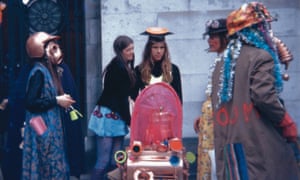
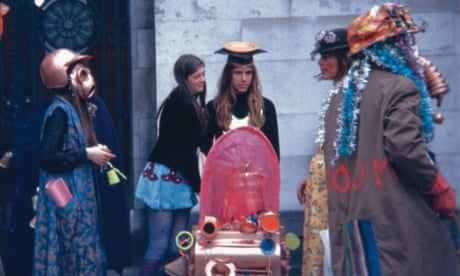
A COUM performance outside Ferens art gallery in 
Hull in 1971 (Tutti second from left). Photograph:
Courtesy: Cosey Fanni Tutti


I’d gone to an “acid test” at the union at Hull University. I walked in, paid my entrance fee and received my tab. People were already tripping when I arrived: they were on the floor groping one another or playing with a bathtub of coloured jelly. A guy was playing the saxophone, free jazz-style. The notes were so jarring, fast and scatty that it drove me crazy. As I went to leave, I saw what I thought was a hallucination: a small, beautiful guy dressed in a black graduation gown, complete with mortarboard and a wispy, pale-lilac goatee beard.

About a week later, I was out dancing when a guy came over to me and said: “Cosmosis, Genesis would like to see you.” “What?” It was explained to me that a guy called Genesis had seen me and named me Cosmosis. It was the man I thought I had hallucinated, and he wanted us to get together. “Gen was so beautiful,” reads an entry in my diary for November 1969. “His eyes were a clear blue, his hair dark brown and his skin a clear, golden colour. He smiled so beautifully.”

I started seeing Gen. I’d never met anyone like him. He was very well read, quite the archetypal revolutionary-cum-bohemian artist. He’d moved into a flat in Spring Bank, where my friend Graham also lived. Gen slept under the kitchen table, in a sleeping bag inside a polythene tunnel he called his rainshell. It was a strange and unromantic place to conduct our liaisons, but it made some sense: it was free, and warm from the cooker. My visits weren’t the hot, lusty love affair I’d come to expect from previous relationships, and there were arguments, unexpected at such an early stage. I put it down to Gen being very sensitive, and also his liberal view of relationships: that “no ties” posturing.

The Ho Ho Funhouse, which we later moved in to, was my first home away from home – a far cry from Bilton Grange housing estate. It was part of Wellington House, a Victorian building close to the fruit market on Queen Street. My room, which was small and dark, faced on to a dank alley at the back. Moses, as we called him due to the way he looked, and Gen shared a room opposite. Among all the other people living there was Roger, who had escaped from prison, taking the Midnight Express from Turkey and arriving back at the Funhouse after being severely beaten on the soles of his feet and suffering from dysentery. .

Genesis P-Orridge and Cosey Fanni Tutti in 1969. 
Photograph: John Krivine

At first I felt a little out of my depth, being the youngest, and the only person who hadn’t gone to university. I was slightly in awe of Gen. I learned that he’d won a poetry prize while studying English at Hull University, that he and radical student friends had started Worm, a student magazine that was free from editorial control but shortlived because of its obscene and “dangerous” content. After he’d dropped out, he’d joined an artists’ commune in London, called Transmedia Explorations. Gen learned a lot from his short time with them – but he never mentioned to me the fact that much of what he presented as “his” concept for his new project, COUM Transmissions, came from Transmedia Explorations and its predecessor, the Exploding Galaxy: life as art, communal creativity, everyone is an artist, costumes, rituals, play, artworks, scavenging for art materials, street theatre, rejection of conventions, and the advocation of sexual liberation.


Gen and his friends would go on shopping trips, returning with a holdall full of books and other items “liberated” from various sources. I went shopping with Gen and a friend one day to the food hall in Hammonds (the Harrods of Hull). When we paid and went to leave, store detectives escorted us to a side room. I hadn’t taken anything, so handed my bag over without a second thought. They emptied our bags to reveal stolen food. I was gobsmacked. My attempts to explain that I hadn’t known or done anything fell on deaf ears.

We were all taken to the police station and charged with shoplifting. We were asked our address, but gave “no fixed abode”. If we’d given the Ho Ho Funhouse address, the police would have gone there and found drugs. They put us in cells for the night. After an hour, my door opened and I was taken to the front desk. I saw Mum, her eyes red from crying. She held me tight. I asked her how she knew I was there. The police had rung Dad and said: “We have your daughter. She’s been sleeping rough with two young men.”

Dad was appalled. She’d begged him to drive her to the police station, but he wouldn’t come inside. I assured her I was fine, that I wasn’t sleeping rough, or with two men. She left feeling relatively comforted. I went back to my cell and the next morning me, Gen and John were found guilty, fined £10 each (despite pleading poverty), and set free. The air had never smelled so good.
Photobooth snaps of Tutti and friends

One night at the Funhouse, we were enjoying having the building to ourselves, when we heard the roar of motorbikes, followed swiftly by a smashing sound as the Hells Angels broke in through our front door and tore through the house, spraypainting the walls and ransacking the place. For some reason, they didn’t make it as far as us on the top floor. When the noise subsided, we quietly made our way downstairs to find they’d congregated in the communal room and were giving one of their “prospects” a mouth-scrubbing with Ajax toilet cleaner.


My background meant I was more savvy at handling Hull hardcases than the others. I was confronted by one of the bikers’ girlfriends, a tough blonde girl they all called Glob. She was surprised at my combative response to her threats. I entered into a dialogue with a couple of the guys. Some of them came from Longhill Estate, near my family home. That was our saving grace. We ended up having a half-civil conversation, sparring until we arrived at an amicable kind of “understanding”, and they left.

When the other commune members returned, Bronwyn was particularly pissed off as the bikers had sprayed “Bronwyn pulls a train” in huge letters across her room. This is a term used by the Angels for women who had sex with one man after another to gain status. It wasn’t the nicest thing to come home to.

In the mid-1970s, the COUM team took a show to Amsterdam. Being a sexually liberated place, Amsterdam seemed an opportunity to indulge ourselves, and we took the brakes off. To start, Foxtrot walked on looking menacing in his SS leather coat and hat, his riding boots and sunglasses, and wielding a blowtorch, which he used to light the torches on the stage. He and I had a scene together, both dressed as homosexual soldiers, kissing and groping.

Gen had wanted me to give Foxtrot a blowjob, but I refused. Biggles was on a table being massaged by Fizzy in his “Shirley Shassey” dress and he offered Biggles the “extra” service, then turned to the audience, smiling, and proceeded to oil Biggles’ bits – rather too vigorously for comfort, judging by Biggles’ face.

Sleazy was positioned to one side of the stage, fully dressed, seated alone on a chair, softly lit, reading aloud his public-schoolboy sexual fantasies from handwritten notes. I had a much more full-on time. I strode on stage, dominatrix-style, in high heels but otherwise naked save for a strap costume that didn’t cover much. I’d made it from strips of black PVC and gold buckles I’d found in a bin.

I stood watching a naked Gen being chained to a cross. I daubed him in flour paste and chicken’s feet and whipped him hard. Gen had told me to whip him properly – it had to be real. I don’t think he’d really thought about what being whipped meant in terms of pain, or that I’d actually do it, but I really got into it, and Fizzy was itching to have a go, too. I had to hold back a bit the second night because of the welts that I’d inflicted.


We’d performed to 1,500 people each night. We’d had little sleep but felt elated at what we’d done. Whipping Gen crucified on the cross worked so well that we restaged it back in Britain for a new COUM poster image. Sleazy did some photographs with Gen drunk, cuffed and chained to the cross, and me in the foreground in my strap costume clutching the whip. Me and Sleazy loved it, but Gen wasn’t too keen. I thought it reflected a shift in the dynamics of my and Gen’s personal and working relationship. For the first time I was in the dominant position.

I was constantly having to second-guess Gen’s mood swings. Nothing I did was enough. He showed no empathy towards me – it was always about him. If I had an early start for a photo or film shoot, he’d keep me up late, talking about himself, saying he was depressed and needing reassurance. He fed off me like a parasite. I knew my life with Gen couldn’t continue.
Throbbing Gristle in the 1970s. Photograph: Michael Ochs Archives/Getty Images

On 1 August 1978, as we lay in bed, I told Gen I thought that we should separate. First there were tears, from us both. I held him close. I hated making him so sad. When he realised he couldn’t talk me round, the reality hit home. “But you’re my battery – I feed off you,” he said. No mention of love. “That’s why I have to leave,” I said. “I feel like I’m being eaten away.”

He leapt on top of me and started strangling me. “If I can’t have you, nobody can!” I was strong enough to get him off me and hold him down until his temper subsided a bit. He was wild-eyed, and I suspected that as soon as I let go of him, he’d flip again. I jumped up, ran through to the front bedroom, dressed as quickly as I could, and grabbed the bag of essentials that I’d thankfully packed ages ago. I heard Gen get out of bed and turned as he came running after me. He was so fast. “All because of THAT!” he screamed at me as he kicked me so hard in my crotch that it almost lifted me off the ground. I was doubled over in pain, holding myself. I couldn’t move. Then he unleashed a torrent of punches and kicks and delivered a verbal blow that hurt me more: “I’d never have let you kill my baby if I’d known you’d leave me.” I was stunned to hear him use the termination I’d had in this way. “My baby”? Not “our baby”? How cruel to use the child I’d mourned against me.

Me and Gen living apart didn’t seem to adversely affect Throbbing Gristle, the band that evolved from COUM. We were on fire with ideas. The band took a trip to visit our friend Monte, who was now living in San Francisco. We all slept on the floor of his living room, which was difficult as Gen kept wanting to sleep with me.


Cosey Fanni Tutti: 'I don’t like acceptance. It makes me think I've done something wrong'


I took the opportunity to get an all-over tan. I hated bikini marks – they didn’t look good when I was stripping. I was on my own in the garden, lying on my front in a red G-string, half-asleep. Suddenly there was a great thud. I sprang up to see that a large cement block had landed about six inches from my head. Gen had thrown it from Monte’s balcony and was standing there staring down in silence.

He could have killed me. I shouted at him and Monte came out to see what was going on. He was horrified, but Gen carried on like nothing had happened. With hindsight, it’s unbelievable that Gen wasn’t brought to account. Maybe Monte made him realise what a narrow escape he – and I – had had. That put a halt to any more sunbathing for me when Gen was around.

• This is an edited extract from Art Sex Music by Cosey Fanni Tutti, which is published by Faber & Faber on 6 April at £14.99. Order it for £12.74 at bookshop.theguardian.com. COUM Transmissions is a series of events at Hull 2017 UK City of Culture


Interview

Cosey Fanni Tutti: 'I don’t like acceptance. It makes me think I've done something wrong'

Alexis Petridis


As a member of COUM and Throbbing Gristle, Cosey Fanni Tutti made art that was so shocking, the police ran them out of Hull. But now they’re being invited back – and celebrated in galleries. Here she talks about how they survived


Tue 14 Mar 2017 modified on Thu 22 Feb 2018

 
‘COUM were never confrontational. People might think we were, but we weren’t. We were just sharing something, if you like’ … Cosey Fanni Tutti. Photograph: Linda Nylind/The Guardian


There’s no getting around the fact that meeting Cosey Fanni Tutti after you’ve read her autobiography is a slightly disconcerting experience. It’s not just that she’s so nice, in a way that’s entirely at odds with the fearsome reputation of notorious 70s performance art collective COUM and Throbbing Gristle, the groundbreaking, wildly influential band COUM begat – although she certainly is.

At 65, there’s a certain formidable doesn’t-suffer-fools air about her. Even so, it’s hard to square the woman in whose kitchen I’m eating biscuits and drinking tea with the person who did the more shocking stuff described in Art Sex Music: performances so transgressive that other transgressive performance artists tended to walk out in disgust (“We ended up locked together, lying in piss, blood and vomit,” ends one characteristic description); exhibitions involving used tampons and blood-smeared dildos that caused one fulminating Tory MP to dub Tutti and the rest of COUM “wreckers of civilisation”; game plunges into the world of porn modelling and stripping as part of her art practice; music that screamed about serial killers and death camps and frequently caused uncomprehending audiences to erupt in rage and horror.

It’s more that she seems so normal, so unscathed by the extraordinary life depicted in the book. There are moments of deadpan humour in it – not least when her then-teenage son Nick comes face-to-face with some of her old work during an exhibition at the ICA (whatever parenting problems you may have encountered, it seems doubtful that you’ve ever had to, as Tutti puts it, “explain to Nick a film in which I castrated his dad”) – but it is an often harrowing read, pockmarked by familial dysfunction and violence. Between the art actions, the Throbbing Gristle gigs at which audiences tried to attack the band, the striptease bookings in dubious pubs and her turbulent, abusive relationship with COUM founder and Throbbing Gristle frontman Genesis P-Orridge, it’s hard not to be struck by how much physical danger she regularly found herself in. She looks a bit surprised when I mention it. “I didn’t think of it in the way you say it,” she shrugs. “It’s funny, isn’t it, when someone outside points it out?”

She says she’s not sure where her non-conformist streak came from, although it was there from the start, when she was still Christine Newby, the daughter of a fireman and a wages clerk from Hull’s Bilton Grange council estate. Her home life was strained: her father was emotionally distant, domineering and frequently violent; moreover he refused point-blank to let her go to art school. “That little thing I can thank him for,” she nods, “because it meant that I had to go out there and do it, not be taught it, which was brilliant. My imagination was free.”

Tutti with Throbbing Gristle in the 1970s

She immersed herself in Hull’s late-60s counterculture. It was at an LSD-fuelled happening in Hull University student union that she first met Genesis P-Orridge, who announced that he had rechristened her Cosmosis and that they should be together. Within weeks, she’d been thrown out of home by her father, was living with P-Orridge in a commune and was an active member of COUM. In many ways, she says, it was a liberating social and artistic experiment: “Just working with what presented itself, you know, going to jumble sales and finding these fantastic hoards, bringing it home and creating a small art work in the house, or costumes that would suggest something we could do, all ad hoc, based on chance, the way I still like it.”

But it’s hard not to notice that, despite the supposedly liberated lifestyle of the commune, it still fell to Tutti, the most prominent female member, to do all the cleaning, cooking and washing. “Another member of COUM, Spydeee, said to me recently, ‘People don’t realise how rife sexism was then, the misogyny there was even among liberal people’,” she says. “I was doing everything. Not that I didn’t see anything wrong with the role, it’s just that I was surviving. I had no home, no family to go back to, so I had to make my home as near as dammit to what was comfortable to me, and if that meant cooking, cleaning … I saw a photo from back then recently and thought, ‘What’s that around my neck?’ It was a police whistle that somebody had given me because I was always making sure that everybody did what they were supposed to do. Someone had to organise at some point.”


Initially, COUM’s art was funny and playful. There is footage of them, covered in tinsel, performing actions on the streets of Hull to crowds of apparently entranced children; they formed a band in which “everybody got on stage and did what they wanted, which was absolute chaos”, entering talent competitions and chanting “off, off” to pre-empt the inevitable audience reaction.

But gradually, their tone changed. By the mid-70s, their performances often involved nudity, live sex acts and bodily fluids: crowds of entranced children were noticeable by their absence. Tutti thinks her increasing fascination with and involvement in the world of pornography had something to do with it. She’d been including images from porn magazines in collages, she says. “I just thought: ‘It’s a bit rotten using them like this.’ I’d sooner get in there and do it myself, so I know the background behind it and how it’s made. And then, once you enter that world, things do change, they get less playful.”

Encouraged by P-Orridge, she began modelling for top-shelf magazines, then appearing in both hardcore and softcore films, and stripping. The 70s porn industry sounds pretty grim, but she says she thinks it might be worse today. “Back then, there was an unwritten code, that you treated the girls as good as you could. Nowadays … I think I expected it would be different, because of feminism for a start, and because now there are female porn sites; it seems quite liberated. But I watched that documentary about [latterday porn star] Annabel Chong that came out about 15 years ago, and it really shocked me. It might have been bad in the 70s, underground and a bit seedy, but it wasn’t violent in that way, it wasn’t treating you like a piece of meat, literally.”
 
‘We were playing with ideas all the time’ … 
Cosey Fanni Tutti. Photograph: Linda Nylind/The Guardian

She included framed centrefolds from the magazines in COUM’s 1976 retrospective show, Prostitution. When it opened, the tabloids went berserk – as a result of the coverage, Tutti’s mother never spoke to her again – questions were asked in the House of Commons and the ICA’s public funding was threatened. In her telling of it, Tutti and the rest of COUM were genuinely hurt and bewildered by the furore: “COUM were never confrontational,” she shrugs. “People might think we were, but we weren’t, we were just … sharing something, if you like.”

Oh, come off it. It was an exhibition full of used tampons and photos from porn mags. You must have realised it was a provocative thing to do? “No. Strange isn’t it? That’s the bubble, I suppose. It was what we did every day in the studio, it was just part of my daily life, my routine: saving my Tampax for it, trying to stop the dog from eating them.” She laughs. “She was terrible for that.”

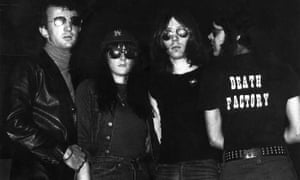
The opening of Prostitution marked the launch of Throbbing Gristle, the band formed when Tutti, P-Orridge and fellow COUM member Peter Christopherson met electronics wizard Chris Carter. If the musical results were no closer to traditional rock and pop than COUM’s free-for-all experiments, they now had a new potency and focus: the churning, terrifying noise they created gradually attracted an ever-increasing group of intense devotees, much to the band’s apparent horror. “We wore uniforms because we were playing with ideas all the time, investigating that concept of how uniformity sells a product, that was fascinating to us,” says Tutti. “That started out as an interest and then it actually worked: eventually, we played the Lyceum in London and the whole audience was wearing military uniforms. No, no, no, no: we don’t want followers.”

For all the talk of investigating concepts, Art Sex Music makes their sound seem less like an artistic exercise than an expression of the chaos in their personal lives: Tutti and Carter fell in love, which caused her relationship with P-Orridge, always fraught, to collapse in acrimony: at one juncture, he threw a breeze block at her from a balcony, narrowly missing her head. It seems a miracle the band managed to achieve anything, let alone a series of albums that spawned an entire musical genre named after their record label, Industrial: “Well, it was a struggle, it really was. I don’t know how it held together.”

Throbbing Gristle finally split up in 1981. (An attempt to regroup in the 00s was an acclaimed artistic triumph but, by all accounts, as much of a psychological nightmare as the old days.) Tutti and Carter continued to work together, as Chris and Cosey, CTI and Carter Tutti. And after almost a decade’s absence, Tutti made a triumphant return to the art world in the mid-90s.

In the interim, something deeply improbable had happened. Her work had gone from reviled to revered. In recent years, her art has been widely exhibited, bought by the Tate and the subject of a day-long festival at the ICA. Throbbing Gristle are routinely hailed as one of the most important bands of their era, while – initially unbeknownst to the pair – the music she and Carter made turned out to be a huge influence on subsequent electronic music: shows they played revisiting old material and their “cross-generational” collaboration with Nik Void of Factory Floor were rapturously received.


Most recently, nearly 45 years after COUM were effectively run out of Hull by the police, they were invited back: an exhibition of their work and a series of events based on it form a major part of the programme for Hull’s year as UK City of Culture. When I mention that she seems to have become accepted, Tutti frowns and says “I know,” in the way you might say “I know” if someone pointed out you’d just stepped in something disgusting. You’re not keen on the idea?

“I look at it like it’s retrospective acceptance, so what I feel about the work when it was done is still there, it still has meaning for me. Of its time, it was unacceptable. I don’t like acceptance, I distrust it completely, I think I’ve done something wrong, like I’ve gone off on a bad tangent and need to get back on track.” She pauses. “I mean, I understand why certain things have found their place in history, so I can accept that. But I don’t see it as acceptance of what I did then, because it wasn’t. It’s still loaded with that unacceptance.”

• Art Sex Music by Cosey Fanni Tutti is published by Faber & Faber on 6 April at £14.99. Order it for £12.74 at bookshop.theguardian.com. COUM Transmissions is a series of events at Hull 2017 UK City of Culture