Thursday, July 15, 2021


Virtual schooling exposes digital challenges for Black families, MU study finds

UNIVERSITY OF MISSOURI-COLUMBIA

Research News

IMAGE

IMAGE: ADAOBI ANAKWE IS A POST-DOCTORAL FELLOW AT THE UNIVERSITY OF MISSOURI SCHOOL OF HEALTH PROFESSIONS. view more 

CREDIT: MU SCHOOL OF HEALTH PROFESSIONS

COLUMBIA, Mo. -- A new study from the University of Missouri found the unanticipated transitions to virtual schooling due to COVID-19 exposed the lack of digital resources among Black families in the United States, including access to Wi-Fi and technological savviness. As two-thirds of the country's Black children are born into single-parent households, the findings help explain the extensive stress virtual schooling caused for many Black families trying to keep their children learning and engaged online while at home during the pandemic.

"What we found was parents and caregivers often felt disempowered in the rapidly changing environment, as they did not necessarily feel equipped with the tools or technological savviness to effectively engage in their children's education the way they felt they needed to," said Adaobi Anakwe, an MU post-doctoral fellow and the study's lead author. "Schools were sending students home with devices for online learning without first ensuring families had reliable, consistent internet access to utilize those devices, and this was a big contributor to parental stress and burnout."

Anakwe and Wilson Majee, an associate professor in the MU School of Health Professions, interviewed parents and primary caregivers of Black families in Missouri with school-aged children to better understand their experiences suddenly shifting to virtual schooling due to COVID-19.

Anakwe explained the sudden shift to virtual schooling highlighted the digital divide that already existed for many Black families, as a lack of access to reliable internet can have long-term negative impacts on learning and health outcomes.

"The COVID-19 vaccine rollout showcased how important technological resources can be for making an appointment online," Anakwe said. "And the sudden shift from in-person health care visits to telehealth highlights the role technology can play in facilitating access to health care as well as education."

Anakwe added that even before the pandemic, Black families were already disproportionately faced with single-parent households, disparities in income and unequal access to transportation, housing, healthy foods and recreational facilities.

"We already have a cafeteria menu of social determinants of health that impact Black and minority populations," Anakwe said. "We need to be proactive to prevent the digital divide from becoming another issue that gets added on to an already very long list of challenges Black families deal with."

The COVID-19 pandemic also caused an increase in technology use among students, causing some Black parents to worry about the potential impact on their children's mental health.

"Before the pandemic, parents were tasked with minimizing screen time for their kids and ensuring they spent enough time outside engaged in physical activity," Anakwe said. "Then all of a sudden, parents were forced to encourage their children to use technology to stay engaged in their school work while at home. As COVID-19 lockdowns are starting to end, it will be interesting to see how the messaging around screen time evolves."

Majee said MU Extension and the University of Missouri System Broadband Initiative have helped increase access to broadband internet for rural Missourians, but more collaborative partnerships among community leaders, schools, local governments and families are needed to assist underprivileged Black families.

"Technology is becoming increasingly necessary for success in our lives, so this research can help us better understand the technological challenges facing Black families," Majee said. "Our overall goal is to improve the health of Black families by helping our community members who are most disadvantaged - it's a labor of love."

###

"Sink or swim: Virtual life challenges among African American families during COVID-19 lockdown" was recently published in the International Journal of Environmental Research and Public Health. This project was done in collaboration with Saint Louis University, where Anakwe completed her doctoral studies.

She Was Sent To Prison For Losing Her Baby. Now She Wants To Clear Her Name.

In 2012, Sara was sentenced to 30 years in prison under El Salvador’s strict anti-abortion laws. Last month, she was freed thanks to a growing movement to defend the women facing decades in prison on similar charges. Now she hopes to clear other women’s names.

Karla ZabludovskyBuzzFeed News Reporter
Reporting From
Mexico City
Posted on July 13, 2021,

Erica Canepa for BuzzFeed News
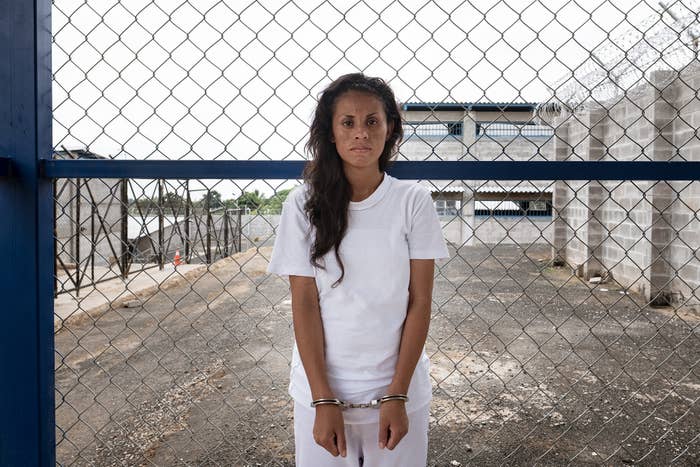
Sara inside the Izalco Prison in San Salvador, El Salvador, on Sep. 14, 2019.

MEXICO CITY — On June 7, nearly nine years after police had detained her, Sara was getting ready to leave prison. After lunch, she slipped out of her white uniform and into civilian clothes, eager to get to the other side of the walls and hug her family.

The close friends she had made in prison walked her as far as they could inside the facility, crying. They begged her to speak out for them and the particular plight they all shared: Following miscarriages or stillbirths, the women had been convicted of homicide and sentenced to 30 years in prison in El Salvador under the country’s strict anti-abortion laws.

“It hurts to have left them behind,” Sara, 29, told BuzzFeed News during a Zoom interview from San Salvador, the country's capital.

Sara, who asked that her last name be withheld to protect her family’s privacy, is the latest in a slow trickle of women convicted on similar charges who are having their sentences commuted — 11 since 2017, according to the Agrupación Ciudadana por la Despenalización del Aborto, a pro–abortion rights advocacy group. The country has filed aggravated homicide charges against at least 129 women for alleged abortions since 2000. At least a dozen remain in prison.

But even as they hail each new release as a victory, women’s rights groups warn that the state’s insistence on treating each case as unique rather than grouping them together means that many people remain behind bars for crimes that others are being freed for, resulting in a patchwork and somewhat arbitrary rollback of severe sentences.

El Salvador has one of the harshest anti-abortion laws in the world, with no exceptions made even when the pregnant person’s life is in danger. Virtually all of those who have been jailed for abortion-related crimes have been poor, and many have lacked access to prenatal care. Some have said they were handcuffed to their hospital beds and then taken straight to prison.

Some countries in Latin America have loosened abortion restrictions over the last decade. Uruguay legalized it in 2012. In Mexico, the state of Oaxaca became the second area in the country to permit it in 2019. And in December, Argentina’s senate approved it for the first 14 weeks of pregnancy.

But others, including El Salvador, have skirted the trend. And as legislation loosening abortion restrictions has spread across the region, so has the backlash. Evangelical politicians have gained influence, powerful segments of civil society have successfully fought back against sex education in public schools, and the Catholic Church has quietly forced young rape victims to carry their pregnancies to term even after they’ve sought legal abortions.

“It’s painful to see the state punishing girls so unjustly” in El Salvador, said Paula Ávila-Guillén, executive director of the Women’s Equality Center, a New York–based organization that monitors reproductive rights in Latin America. Those facing charges are often young people who have little access to healthcare and education, she added: “Girls who were marginalized and abandoned by the state to begin with.”


Jose Cabezas / Reuter

A woman holds a placard that reads, "Justice for Sara" as Sara, who was sentenced to 30 years in prison for a suspected abortion, attends a hearing in Cojutepeque, El Salvador, on May 31, 2

In prisons in El Salvador, a staunchly Catholic country, people believed to have undergone abortions have been shunned and beaten by other incarcerated people, according to women who have been released from prison.

In September 2019, BuzzFeed News visited Sara and two women convicted of killing their newborn babies, who were serving time at the Centro de Detención Menor para Mujeres in Izalco, a women’s prison near the country’s Pacific coast. During a 90-minute interview in a gated-off area near the main courtyard, Sara sat on a white plastic chair as Kenia Hernández, then 24, braided her hair. With a handful of guards hovering nearby, Sara whispered her story: In 2012, nearing her due date, she slipped as she was washing dishes and passed out. Sara woke up in a hospital bed, her baby was dead, and a police officer was getting ready to detain her. A court sentenced her to 30 years in prison for aggravated homicide.

The women said they rarely had access to sanitary pads and soap, and the previous months had been particularly tough: President Nayib Bukele had declared a state of emergency in the country’s prisons in order to curb gang activity, tightening confinement measures — including banning all visitors. Sara had bags under her deep-set eyes, and her voice was heavy with yearslong exhaustion.

Bukele has said women should not be jailed for suffering “spontaneous abortions,” but two years into his presidency, he has not pardoned any.

One of them, Hernandez, was 17 when she got pregnant. One day in 2014, her father, a strict man who she frequently feared would beat her, became irate at Hernandez for not cleaning the house sufficiently and started chasing her, she said. Hernandez tripped and fell and went into labor shortly after. Her father fled, and her baby died. She, too, was sentenced to 30 years.

Attorneys for Hernandez presented a petition to have her sentence commuted in 2018. It was approved in 2020, but she will not finish her shortened sentence until June 2023.

Each case is analyzed individually by the Justice Ministry, a criminological team that includes psychologists, and the Supreme Court.

Last year, the Working Group on Arbitrary Detentions, a United Nations human rights panel, published a report on the case of Sara and two other women imprisoned in El Salvador under similar circumstances, Berta Margarita Arana, 28, and Evelyn Beatriz Hernández, 23. It concluded that the three women had been arbitrarily detained and urged El Salvador to free them immediately and provide financial compensation.


Jose Cabezas / Reuters
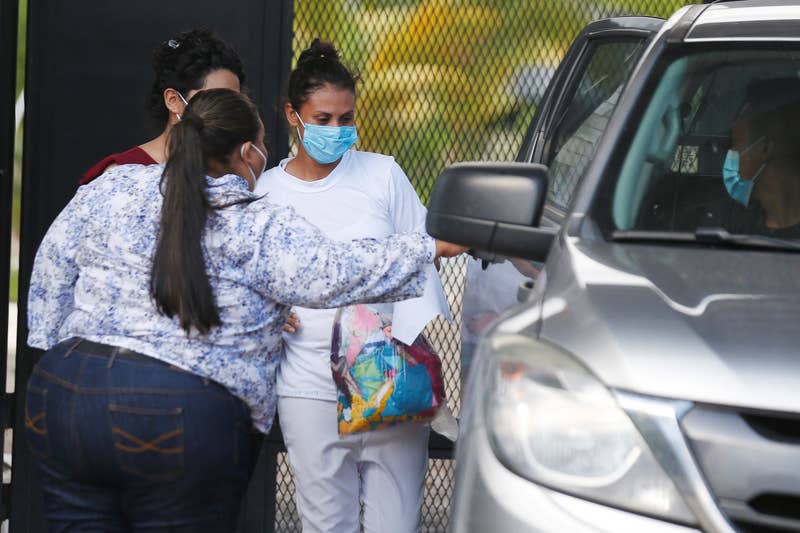
Sara is embraced by her mother as she is released from jail in Zacatecoluca, El Salvador, on June 7, 2021.

Sara's lawyers petitioned for the state to commute her sentence, which was approved in February 2020. Shortly after, they requested that she be released early on parole.

On her final day in prison, Sara awoke to take her regular 4 a.m. shower, had breakfast, went to work mowing grass, sat through lunch, and attended a crocheting workshop. She hadn't known she was getting out that day until the afternoon, when the guards told her to get ready to go home.

Her attorneys say they are going to request a revision of Sara’s sentencing in order to have her declared not guilty — until then, she worries that her criminal record will make it hard for her to find a job.
In the four weeks since her release, Sara has been spending time at home with her family. So much has changed, she said. Her stuffed animals and school books are no longer there. Her brother died just as she was sent to prison. Now able to rebuild her life, she wants to go back to school to become a nurse.

Looking a decade younger than during her interview at Izalco two years earlier, with her hair in a tight bun and her eyes sparkling under blue eyeshadow, Sara described her hopes for the future: to clear her name and help free her friends still behind bars.

The women she left behind “are in bad shape, sad and desperate,” said Sara. Many of them have children they are eager to get back to, she added, “to take care, to raise.”
Want to see more from Inequality?
No Yes

MORE ON THIS
This Woman Had A Stillbirth And Is On Trial For It — AgainKarla Zabludovsky · Aug. 14, 2019
When The Horror Of Losing Your Baby Turns Into Years Behind BarsKarla Zabludovsky · Oct. 24, 2019


Karla Zabludovsky is the Mexico bureau chief and Latin America correspondent for BuzzFeed News and is based in Mexico City


'Get out of the water!' Monster shark movies massacre shark conservation

UNIVERSITY OF SOUTH AUSTRALIA

Research News

IMAGE

IMAGE: 96% OF SHARK MOVIES OVERTLY PORTRAY SHARKS AS A THREAT TO HUMANS. view more 

CREDIT: UNSPLASH

Undeniably the shark movie to end all shark movies, the 1975 blockbuster, Jaws, not only smashed box office expectations, but forever changed the way we felt about going into the water - and how we think about sharks.

Now, more than 40 years (and 100+ shark movies) on, people's fear of sharks persists, with researchers at the University of South Australia concerned about the negative impact that shark movies are having on conservation efforts of this often-endangered animal.

In a world-first study, conservation psychology researchers, UniSA's Dr Briana Le Busque and Associate Professor Carla Litchfield have evaluated how sharks are portrayed in movies, finding that 96 per cent of shark films are overtly portraying sharks as a threat to humans.

Dr Le Busque says sensationalised depictions of sharks in popular media can unfairly influence how people perceive sharks and harm conservation efforts.

"Most of what people know about sharks is obtained through movies, or the news, where sharks are typically presented as something to be deeply feared," Dr Le Busque says.

"Since Jaws, we've seen a proliferation of monster shark movies - Open Water, The Meg, 47 Metres Down, Sharknado - all of which overtly present sharks as terrifying creatures with an insatiable appetite for human flesh. This is just not true.

"Sharks are at much greater risk of harm from humans, than humans from sharks, with global shark populations in rapid decline, and many species at risk of extinction.

"Exacerbating a fear of sharks that's disproportionate to their actual threat, damages conservation efforts, often influencing people to support potentially harmful mitigation strategies.

"There's no doubt that the legacy of Jaws persists, but we must be mindful of how films portray sharks to capture movie-goers. This is an important step to debunk shark myths and build shark conservation."

###

Notes to editors:

* Shark Week is 12-18 July 2021

* Shark Awareness Day is 14 July 2021


Monster, book review: Technology rules our lives - but what to do about it?

Mary Branscombe 


© Provided by ZDNet
 Monster: A Tough Love Letter On Taming the Machines that Rule our Jobs, Lives, and Future • By Paul Roehrig & Ben Pring • Wiley • 176 pages • ISBN 9781119785910 • $25 / £18.99

Have we inadvertently created a technological 'monster' that is, in some nebulous sense, making everything worse -- and if so, what can we do about that?

If you have any technology-related worries -- from your kids being glued to their phone, to the influence of the Chinese government and the role of technology in the 2016 and 2020 US elections -- the authors of Monster: A Tough Love Letter On Taming the Machines that Rule our Jobs, Lives, and Future are worried about it too. And if you weren't already concerned, they'll tell you why you should be.

As IT consultants and futurists who fear that, in the past, they have avoided difficult questions in their enthusiasm for technology, Paul Roehrig and Ben Pring are trying to distil the entire modern world into a somewhat simplistic formula: that the economic incentives for some kinds of technology are out of balance, and that's dragging everything down.

"Once cool disruptive 'tech rock stars' are being exposed as nothing more than the latest robber barons", they say. The security of cars, pacemakers and elections are all poor (although driverless technology is apparently "working very well"), while democracy, privacy and being polite to other people are all going out of fashion.

Decrying the loss of civility, blaming social media echo chambers rather than societal inequities, and talking about income inequality as if it's produced only by technology rather than socioeconomic systems, suggests that technology is somehow created outside of society rather than all-too-intimately enmeshed with it. Some interesting questions about the role of technology in society are obscured by the authors' enthusiasm for new technology like quantum computing, and the dystopian fantasies they entertain about the impact of the technology we already have.

© ZDNet

Treating Amazon, Apple, Facebook, Google and Microsoft as if they all have the identical business model of "snorkel[ing] code from every move we make" simply because they have stock market valuations that outweigh most other companies ignores the different impacts they have, and the different issues that will need to be addressed in dealing with them.

The authors rightly point out that widely used technologies are developed in relatively few countries, which may be driving a global power shift. But there's no discussion of what it means if tech giants gain some of the powers of nation states, or how bytes might have a different impact from bullets in terms of how their influence is applied.

There's no mention of Russia or ransomware in the book at all (except for noting that Ukraine attracts an unusual level of cyberattacks), and no analysis of where the line of separation might fall between the Chinese government, whose approach Roehrig and Pring dub 'surveillance communism', and Chinese technology companies.

The usual misunderstanding of the original Luddites -- who were protesting not the machinery itself but the business models of the mill owners who refused to share the fruits of improved productivity with workers, and targeted their destruction appropriately -- actually undermines the point the authors try to make about the drivers of modern Luddism: inequality and exclusion caused by the irresponsible deployment of technology.
Cyber war & social tech addiction

Suggesting we're already engaged in a cyber war, given the current level of attacks, ransomware and nation-state hacking, would be more plausible if the authors didn't maintain that Advanced Persistent Threats (APTs) are "technologically very advanced" when they often target very basic security mistakes and long-patched vulnerabilities. Talking about how poorly security is implemented across government, industry and society isn't nearly as exciting as talking about Stuxnet and hackers in basements, but it would paint a truer picture of the issues.

Despite admitting there's "no solid causal link between tech and our aching heads yet", the authors spend a chapter calling smartphones and social media "digital fentanyl", suggesting that social technology is an addiction that's destroying a generation of children and claiming tech is changing how our minds work. Evolutionary psychology combines with nostalgia for the days when commuters were staring at newspapers rather than phones, resulting in the usual suggestions about limiting your screen time. After the last 18 months, asserting that community, faith and friendship can't be found online is as unhelpful as the latest 'technology rock stars' announcing that there's an app for mindfulness. It might also be more useful to explain how Elon Musk's Neuralink isn't actually that revolutionary compared to existing medical devices than to announce that it's the equivalent of Theranos.

SEE: Network security policy (TechRepublic Premium)

In the middle of all this, there's a fictional account of a naïve and inflammatory startup that will confirm the prejudices of everyone who dislikes Facebook without ringing true to anyone with actual startup experience.

Similarly, the book ends with a poorly conceived 'debate' between the two authors about whether we shouldn't just turn this whole disturbing internet social media thing off that would get roundly ratioed if they were to perform it on social media. It may be intended to satirise the kind of inconsequential arguments often found online, because it's formatted as if it was a sequence of texts or private messages (without noting the irony), but a more comprehensive chapter would be welcome. The potted history of guns in Japan is mildly interesting, but it ends the book on a strangely flat note that makes you long for the substance of an expert explaining their field in a Twitter thread.
Manifesto, or wish-list?

What you would hope would be the meat of the book -- a manifesto for 'taming the machines -- is more of a wish-list. You'll probably skim past the actual suggestions for how to tackle the very real problems Roehrig and Pring are rightly concerned about in the introduction, unless you're used to the way executive reports put the actionable items right at the beginning. The suggestions range from sensible (legislation for data portability and audits of algorithms) to knee jerk (overriding anonymity on social media, doing away with Section 230 and creating a 'driver's licence' for getting on social media at the age of 18).

The discussion of the complex and difficult task of regulating technology is probably the most realistic part of the book. However, it's disappointing that the authors' obvious concern and desire to provoke a reaction leads them to focus more on listing the harms that technology has already created, rather than digging further into the "many types of law, policy and regulation: net neutrality, privacy, patent and IP law, taxation, data protection, industry regulation, AI ethics, labor laws, health data laws, job licensure [and] sharing economy regulation".

It might be harder to enliven these critical but "mind-numbingly dull" issues than to point out that Facebook makes a lot of money and that it's hard to stop your family accessing TikTok. But doing so would make for a more meaningful discussion about 'Taming the Machines'.

RECENT AND RELATED CONTENT

France fines Google €500m for repeat failure to negotiate in good faith with publishers

China reportedly warns local tech companies of increased cybersecurity oversight

Tech giants warn changes to Hong Kong privacy laws may see them exit the market

US Federal Court dismisses FTC call for Facebook to divest Instagram and WhatsApp

New 'safety by design' toolkit to help the global tech industry care a little bit more

Read more book reviews
Crypto Dictionary, book review: A useful A-Z of cryptography definitions
People Count, book review: Technology, data, privacy and contact-tracing apps
Atlas of AI, book review: Mapping out the total cost of artificial intelligence
Silicon Values, book review: A history of online censorship in the Big Tech era
The Hype Machine, book review: Inside the 'social media industrial complex'
SHE IS INFORMED NOT BIASED
Facebook joins Amazon in requesting the FTC's new chairwoman be removed from any investigations, saying she's biased

insider@insider.com (Katie Canales) 
© Provided by Business Insider NICHOLAS KAMM/AFP via Getty Images; GRAEME JENNINGS/POOL/AFP via Getty Images; Insider

Facebook filed a petition with the FTC to have its chair removed from any company deliberations.

Both companies said Khan is biased given her past criticism of Big Tech.


Facebook wants Federal Trade Commission Chair Lina Khan removed from any investigation of the company and has accused her of bias, citing her past criticisms of the tech industry.

Facebook filed a petition on Wednesday with the agency, arguing that Khan should recuse herself since she "has already drawn factual and legal conclusions and deemed the target a lawbreaker." The company shared the petition with Insider as the FTC does not make them public. The Wall Street Journal first reported the news.

A Facebook spokesperson told Insider: "Chair Khan has consistently made well-documented statements about Facebook and antitrust matters that would lead any reasonable observer to conclude that she has prejudged the Facebook antitrust case brought by the FTC."

"To protect the fairness and impartiality of these proceedings, we have requested that Chair Khan recuse herself from involvement with the FTC's antitrust case against Facebook," Facebook continued.

The FTC filed an antitrust lawsuit against Facebook in December, but a judge threw it out in late June since he said the agency failed to show evidence that Facebook had monopoly power in the online market. The FTC is now deliberating about filing a new lawsuit against the company.

Facebook's request to have Khan removed from any deliberations involving the company comes two weeks after Amazon made a similar plea as the e-commerce giant remained under investigation at the FTC.

Amazon argued in June that "Chair Khan's body of work and public statements demonstrate that she has prejudged the outcome of matters the FTC may examine during her term and, under established law, preclude her from participating in such matters."

President Joe Biden appointed Khan to FTC Chair in June, and her extensive background in antitrust law paired with her new role has made waves in the tech and antitrust worlds. Khan wrote an influential paper in 2017 drawing attention to how today's outdated antitrust framework allowed Amazon to escape scrutiny.

She also helped the House investigate Facebook, Amazon, Google, and Apple over antitrust concerns in online competition.

Read the original article on Business Insider
Study using laser technology suggests Canada overlooks key sources of methane emissions

Inayat Singh 
CBC
© Submitted by Matthew Johnson A plane equipped with laser technology from methane-detection company Bridger Photonics flies over a storage tank at an oil and gas site in B.C.

The largest sources of methane emissions from oil and gas sites are not the pieces of equipment commonly thought to be the main culprits, a new study from a leading Canadian researcher suggests.

The result is that Canada may be underestimating its emissions of the potent greenhouse gas and may be overlooking effective ways to meet its reduction targets, says Matthew Johnson, director of the Energy and Emissions Lab at Carleton University and co-author of the paper.

"This is suggesting it is time for a rethink," he told CBC News.

"Maybe we can be a little bit more efficient in achieving reductions in going after the things that matter."

The research, which relied on laser technology mounted on a plane that flew over oil and gas sites in British Columbia in 2019, suggests methane emissions are 1.6 to 2.2 times higher than current federal estimates.

Methane, the chief component of natural gas, is released during oil and gas extraction from various pieces of equipment on a production site. It is about 70 times more potent as a heat-trapping greenhouse gas than carbon dioxide, but only lasts in the atmosphere for about nine years. Canada's goal is to reduce methane emissions 40-45 per cent below 2012 levels by 2025.

Cutting down on methane is seen as a way to get more immediate positive benefits in the fight against climate change, but Canada can only do that if it knows where the colourless and odourless gas is coming from.

Large methane sources being missed


Regulations in Canada are mostly based on surveys that use optical gas imaging (OGI) cameras at oil and gas sites to detect sources of methane leaks. But the study suggests there is a "stark difference" between what the OGI surveys find and what the new airplane-mounted technology can see, and "policy and regulations relying on OGI surveys alone may risk missing a significant portion of emissions."

More than half of methane emissions were attributed to storage tanks, reciprocating compressors and unlit flares, according to the study. Storage tanks were found to be a particularly concerning source of emissions, since they alone accounted for a quarter of methane emissions at oil and gas sites.

These sources are harder to detect with OGI surveys because they are elevated and might be missed by a camera at ground level.

"So those three sources tend to be really quite important," Johnson said. "And if your entire inventory is based on camera work, then it starts to make sense why we keep seeing these persistent differences."

Total emissions likely undercounted

Methane currently accounts for 13 per cent of Canada's total greenhouse gas emissions, based on official estimates, but multiple studies that rely on field measurements have suggested the actual amount of methane emitted is much higher. Until this new study, it was not known exactly which pieces of equipment were causing this discrepancy.

Tom Green, policy analyst at the David Suzuki Foundation in Vancouver, has been following the methane issue closely. He says the new study's finding that methane emissions are likely much higher than the official estimates is unsurprising but still "alarming" due to the potential climate impact.

"Right now, we're doing something quite unfair, which is that we're reporting relatively low methane emissions to the United Nations," Green said.

"For such a large country globally, in terms of where we fit in the natural gas exports, we should be doing much, much more and we should be showing leadership in this file."

Green said a key issue is that the current regulations put too much emphasis on looking for leaks in general rather than identifying more basic problems.

"When you see that like a quarter of emissions are coming from tanks, that's not a leak," Green said.

"That's the tank is designed to allow the methane to off-gas. So that's a design problem."

Regulations under review


B.C. has brought in limits for the leaks from tanks, but the study found leak rates with tanks that are much higher than the limits. Federal methane regulations, which form a backstop to provincial regulations, don't directly regulate the leaks from compressors and unlit flares.

The study was done in collaboration with the B.C. government, which along with Alberta and Saskatchewan, has its own methane regulations. The federal government has granted the three provinces equivalency agreements to have their own regulations rather than have the federal regulations imposed on them.

"The results of the new methane study require additional research and measurement to ensure we have the most accurate estimate of total emissions from the sector and we're continuing to support that effort," the B.C. Ministry of Environment and Climate Change Strategy said in a statement.

The ministry said it will consider the new information while developing its detailed plan to meet its 2030 emissions targets, to be released later this year.

In a statement to CBC News, Environment and Climate Change Canada acknowledged the uncertainties in estimating methane emissions and said it is working on improving the methodology of its official estimates.

"ECCC will review the author's research for its relevance for both the evaluation of existing regulations, and regarding the development of new policy options to further reduce methane emissions from the oil and gas sectors."
Firm hacked to spread ransomware had previous security flaws


For 21 years, the software company Kaseya labored in relative obscurity — at least until cybercriminals exploited it in early July for a massive ransomware attack that snarled businesses around the world and escalated U.S.-Russia diplomatic tensions.  
© Provided by The Canadian Press

But it turns out that the recent hack wasn't the first major cybersecurity problem to hit the Miami-based company and its core product, which IT teams use to remotely monitor and administer workplace computer systems and other devices.

“It feels a little like déjà vu,” said Allie Mellen, a security analyst at Forrester Research.

In 2018, for instance, hackers managed to infiltrate Kaseya's remote tool to run a “cryptojacking” operation, which channels the power of afflicted computers to mine cryptocurrency — often without its victims noticing. It was a less harmful breach than the recent ransomware attack, which was impossible to miss since it crippled affected systems until their owners paid up. But it similarly relied on Kaseya's Virtual System Administrator product, or VSA, as a vehicle to get access to the companies that rely on it.

A 2019 ransomware attack also rode into computers through another company's add-on software component to the Kaseya VSA, causing more limited damage than the recent attack. Some experts have tied that earlier assault to some of the same hackers who later formed REvil, the Russian-language syndicate blamed for the latest attack.

And in 2014, Kaseya’s own founders sued the company in a dispute over responsibility for a VSA security flaw that allowed hackers to launch a separate cryptocurrency scheme. The court case does not appear to have been previously reported outside of a brief 2015 mention in a technical blog post. At the time, the founders denied responsibility for the vulnerability, calling the company's charges against them a “bogus assertion.”

Nearly all of Kaseya's security problems have as their root cause well-understood coding vulnerabilities that should have been addressed earlier, said cybersecurity expert Katie Moussouris, the founder and CEO of Luta Security.

“Kaseya needs to shape up, as does the entire software industry," she said. “This is a failure to incorporate the lessons the bugs were teaching you. Kaseya, like a lot of companies, is failing to learn those lessons.”

Many of the attacks relied at least in part on what's known as SQL injection, a technique hackers use to inject malicious code into web queries. It's an old technique that Mellen said has been considered a “solved problem” in the cybersecurity world for a decade.

“It points to a chronic product security issue in Kaseya’s software that remains unaddressed seven years later," she said. “When organizations choose to brush over security challenges, the incidents continue, and, as in this case, get worse."

Kaseya has noted that it's long been a target because many of its direct customers are “managed-services providers” that host IT infrastructure for hundreds, if not thousands, of other businesses.

“In the business we’re in, and the number of endpoints we manage around the world, as you might expect, we take security extremely seriously," Ronan Kirby, president of the company's European operations, said at a Belgian cybersecurity conference Thursday. “You attack a company, you get into the company. You attack a service provider, you get into all their customers. You get into Kaseya, that’s a very different proposition. So obviously we’re an attractive target.”

Kaseya declined to answer questions from The Associated Press about the previous hacks or the legal dispute involving its founders.

Mark Sutherland and Paul Wong co-founded Kaseya in California in 2000. They had previously worked together on a project protecting the email accounts of U.S. intelligence workers at the National Security Agency, according to an account on the company's website.


But more than a year after selling Kaseya in June 2013, court records show that Sutherland, Wong and two other former top executives sued the company to recoup $5.5 million in stock buybacks they said they were unfairly denied.

At the heart of the dispute was an attack by hackers who used Kaseya's VSA as a conduit to deploy Litecoin mining malware that secretly hijacks a victim computer's power to make money for the hacker by processing cryptocurrency payments.

Kaseya publicly disclosed the attacks in a March 2014 notice to customers. Privately, it was blaming the company's previous leadership for not warning about “serious vulnerabilities” in Kaseya's software. It sought to deprive them of the final $5.5 million of the acquisition price to compensate for the loss of business and damaged reputation.

The founders, in turn, blamed the new leadership for scaling back on coding expertise and eliminating a “hotfix” system for rapidly fixing bugs, according to the lawsuit from Sutherland, Wong, former CEO Gerald Blackie and former Chief Operating Officer Timothy McMullen.

They also argued that the SQL injection technique used by the hackers was highly common and “inherent in any computer code" that uses the SQL programming language.

“Ensuring that each and every piece of database access code is immune to SQL injection is essentially impossible," said their lawsuit. Mellen and Moussouris both rejected that assertion.

“That is a bold statement and provably false,” Moussouris said. “It highlights the fact they lacked the security knowledge and sophistication to protect their users.”

None of the plaintiffs or their lawyers responded to requests for comment. They agreed to dismiss the case in December 2013, just a month after they filed it. It's not clear how it was settled. Kaseya is privately held.

LinkedIn profiles for Sutherland and Wong list them as retired. Blackie went on to become CEO of another Miami-based provider of remote-control software, Pilixo, where he was joined by McMullen. Pilixo didn't return a request for comment.

New vulnerabilities affecting Kaseya's VSA — including the one exploited by the REvil ransomware gang — were discovered this year by a Dutch cybersecurity research group that says it confidentially warned Kaseya in early April. "In the wrong hands, these vulnerabilities could lead to the compromise of large numbers of computers managed by Kaseya VSA,” the Dutch Institute for Vulnerability Disclosure said in a blog post last week explaining the timeline of its actions.

Some of those Kaseya fixed by May, including another SQL injection flaw, but the Dutch group said others were still unpatched when ransomware started hitting hundreds of businesses in early July. Kaseya has said up to 1,500 businesses have been compromised as a result of the attack. Kaseya on Sunday rolled out patches to the vulnerabilities used in the REvil attack.

With Kaseya in the spotlight, a cybersecurity responder assisting clients stricken by the July 2 ransomware attack discovered what he called a glaring Kaseya security omission: a vulnerability in a public-facing customer portal that had been identified in 2015 but left unpatched.

Alex Holden of Hold Security said he notified Kaseya and that the portal was quickly taken down. But the vulnerability troubled him, he said, because it granted unauthenticated users access to a configuration file that is highly protected on Microsoft web servers — one that often contains passwords and can grant access to core functions.

Moussouris said there's a pattern of ransomware syndicates going after easily detectable software flaws.

“It’s collective technical debt around the world and the ransomware gangs are technical debt collectors,” she said. “They’re coming after organizations like Kaseya" and others that haven't invested in better security.

__

This article has been corrected to note that news of a court case involving Kaseya and its founders was previously described in a 2015 technical blog post.

___

AP technology reporter Frank Bajak contributed to this article.

Matt O'brien, The Associated Press
A POLITE NAME FOR FACISM
Authoritarianism advances as world battles the pandemic


LONDON (AP) — Here’s some of what happened while the world was distracted by the coronavirus: Hungary banned the public depiction of homosexuality. China shut Hong Kong’s last pro-democracy newspaper. Brazil’s government extolled dictatorship. And Belarus hijacked a passenger plane to arrest a journalist.

© Provided by The Canadian Press

COVID-19 has absorbed the world’s energies and isolated countries from one another, which may have accelerated the creep of authoritarianism and extremism across the globe, some researchers and activists believe.


“COVID is a dictator’s dream opportunity,” said Theary Seng, a Cambodian-American human rights lawyer who has been indicted on charges including treason in the ostensibly democratic southeast Asian nation, where Prime Minister Hun Sen has been in power for more than three decades.

Human Rights Watch accuses Cambodia’s government of using the pandemic as cover to imprison political opponents without due process. Scores have been indicted and face mass trials.

When it comes to government opposition, “the fear of COVID, on its own and as a political weapon, has substantially restricted mobility for a gathering or movement to take shape,” Seng said.

The biggest global public health emergency in a century has handed power to government authorities and restricted life for billions of people.

Luke Cooper, a London School of Economics researcher and author of the book “Authoritarian Contagion,” said the vast economic, health and social resources poured into fighting the pandemic mean “the state is back as a force to manage society and to deliver public goods.”

Restrictions on civil liberties or political opponents have been stepped up during the pandemic on several continents.

For a decade in Hungary, conservative nationalist Prime Minister Viktor Orban has curtailed media and judicial freedom, criticized multiculturalism and attacked Muslim migrants as a threat to Europe’s Christian identity.

During the pandemic, Orban’s government brought in an emergency powers bill allowing it to implement resolutions without parliamentary approval -- effectively a license to rule by decree. In June, it passed a law prohibiting the sharing of content portraying homosexuality or sex reassignment with anyone under 18. The government claims the purpose is to protect children from pedophiles, but it effectively outlawed discussion of sexual orientation and gender identity in schools and the media.

Poland’s conservative government has chipped away at the rights of women and gay people. A ruling last year by a government-controlled court that imposed a near-total ban on abortion triggered a wave of protests that defied a ban on mass gatherings during the virus outbreak.

In India, the world’s biggest democracy, populist Prime Minister Narendra Modi has been accused of trying to silence voices critical of his administration’s response to a brutal pandemic wave that tore through the country in April and May. His government has arrested journalists and ordered Twitter to remove posts that criticized its handling of the outbreak after introducing sweeping regulations that give it more power to police online content.

Even before the pandemic, Modi’s ruling Hindu nationalist Bharatiya Janata Party was accused by opponents of squashing dissent and introducing policies aimed at refashioning a multifaith democracy into a Hindu nation that discriminates against Muslims and other minorities.

In Russia, the government of President Vladimir Putin has used the pandemic as its latest excuse to arrest opposition figures. Associates of jailed opposition figure Alexei Navalny have been subjected to house arrest and charges that the mass protests against his arrest violated regulations on mass gatherings.

In neighboring Belarus, authoritarian President Alexander Lukashenko extended his quarter-century iron grip on power by winning an August 2020 election that the opposition -- and many Western countries -- said was rigged. The huge protests that erupted were met with tear gas, rubber bullets and mass arrests.

Then, in May, a Ryanair plane flying from Athens to Vilnius was forced to land in the Belarusian capital of Minsk after the crew was told of an alleged threat. Opposition journalist Raman Pratasevic, a passenger, was taken off the plane along with his girlfriend and arrested.

Western nations called the forced diversion a brazen hijacking and slapped sanctions on Belarus, but those seem unlikely to induce Lukashenko to change his ways and underscore the weakness of democracies in confronting hardline regimes. Hungary’s acts have drawn sharp words from fellow European Union leaders, but the 27-nation bloc has no unified response to restrictive regimes like those in Hungary or Poland.

Even before COVID-19 came along, extremism was on the march.

“Over the last 15 years, authoritarian politics has replicated all over the world,” Cooper said.

“Democracy feels very fragile. Democracy doesn’t have a clear vision for what it’s trying to do in the 21st century.”

The 2008 global financial crisis, which saw governments pump billions into teetering banks, shook confidence in the Western world order. And the years of recession and government austerity that followed boosted populism in Europe and North America.

In China, authorities saw the 2008 economic crash as evidence that they, and not the world’s democracies, were on the right path.

Historian Rana Mitter, director of the University of Oxford China Center, said the crisis persuaded China’s communist government that “the West no longer had lessons to teach them.” Since then, Beijing has increasingly flexed China’s economic muscle abroad while cracking down on opposition inside its borders.

In recent years, hundreds of thousands of Muslim Uyghurs have been confined in re-education camps in China’s western Xinjiang region, where activists and former detainees accuse authorities of imposing forced labor, systematic forced birth control and torture. Beijing instead characterizes the camps as vocational training centers.

Beijing also has tightened control on Hong Kong, stifling dissent in the former British colony. Protesters, publishers and journalists critical of Beijing have been jailed and the last remaining pro-democracy newspaper, Apple Daily, stopped publishing in June after the arrest of its top editors and executives.

When the coronavirus first emerged in the Chinese city of Wuhan, authorities responded firmly -- though far from transparently -- with draconian lockdowns that got the virus in check.

Mitter said the pandemic has cemented a view -- among many ordinary Chinese, as well as the country’s leaders -- “that something had gone very wrong in terms of the way in which the democratic world had dealt with the virus, and something had gone right in China.”

“That is now being used very much as a lesson, not just about the pandemic, but about the virtues of China’s system as opposed to the systems of liberal countries,” he said.

Last year, curfews and travel restrictions also became commonplace across Europe. People in France needed to show a signed declaration to travel more than 1 kilometer (just over a half-mile) from home. And Britons were banned by law from going on vacation abroad, while some attendees at a London vigil for a murdered woman were arrested for gathering illegally.

British lawmakers have expressed concern about the scope of the Conservative government’s emergency powers, many passed without debate in Parliament.

“Since March 2020, the government has introduced a large volume of new legislation, much of it transforming everyday life and introducing unprecedented restrictions on ordinary activities,” said Ann Taylor, an opposition Labour Party politician who chairs the House of Lords Constitution Committee. “Yet parliamentary oversight of these significant policy decisions has been extremely limited.”

Politicians and intelligence agencies in the West also have warned of the threat from coronavirus conspiracy theories that dovetail with existing extremist narratives. Many countries have seen large anti-lockdown, anti-mask, anti-vaccine protests attended by a mix of the far right, the far left and assorted conspiracists.

The British government has warned of “extremists exploiting the crisis to sow division and undermine the social fabric of our country,” with different hate groups variously blaming Muslims, Jews and 5G phone technology for the pandemic.

But there are signs of fighting back. The pandemic also has boosted trust in scientists and spurred demands for more accountable political leadership.

In Hungary, which has one of the world’s highest per-capita coronavirus death rates, there is growing opposition both to the government’s pandemic policies and to its wider authoritarian thrust, and thousands have taken to the streets in support of academic freedom and LGBT rights. With an election due in 2022, a six-party opposition coalition has united to try to unseat Orban’s Fidesz party.

Both extremism and resistance can be seen in Brazil, where the far-right President Jair Bolsonaro has expressed nostalgia for the country’s two-decade military dictatorship and last year attended protests against the country’s courts and Congress. He dismissed the virus as a “little flu,” cast doubt on the effectiveness of vaccines and opposed social and economic restrictions.

Renato Meirelles, director of Brazilian polling company Locomotive Institute, said authoritarianism had advanced through “a strategy of fake news and attacks on factual truth.” “The next step will be questioning the electronic vote and, as such, the result of the next election,” he said.

Bolsonaro has so far been held in check by Brazil’s institutions, especially the Supreme Court, which stopped him from preventing states and cities from implementing restrictions to curb COVID-19 and has ordered an inquiry into the government’s pandemic response. And protests have finally spilled out onto the streets. Twice over the past month, demonstrators marched in dozens of cities across the country.

“I’m here to fight for the rights of those in need, for the rights of my children, for my right to live, to have vaccines for all,” said Claudia Maria, a protester in Rio de Janeiro.

In the United States, President Joe Biden has veered away from the populism of Donald Trump, but a Republican Party radicalized by the former president’s supporters has every chance of winning power again.

Cooper, of the LSE, said the authoritarian tide was unlikely to recede soon.

“This is a struggle between democracy and authoritarianism that’s going to last decades,” he said.

___

Associated Press Writers Jim Heintz in Moscow, Justin Spike in Budapest, David Biller in Rio de Janeiro, Christopher Bodeen in Beijing, Sheikh Saaliq in New Delhi and Grant Peck in Bangkok contributed.

Jill Lawless, The Associated Press
Spreading wildlife disease threatens deer, elk — and maybe humans, new research says

EDMONTON — The continuing spread of a fatal wildlife disease in Alberta and Saskatchewan has a federal agency recommending a deer cull across a wide swath of the Prairies.

© Provided by The Canadian Press

And soon-to-be-published research on chronic wasting disease has raised new fears about whether the illness could infect humans.

"I would say this question was answered with 'yes,'" said Hermann Schaetzl, a veterinary scientist at the University of Calgary.

Schaetzl's work was discussed in a recent report from the Canadian Agri-Food Policy Institute, which advises the federal government on agriculture policy. Earlier this month, the institute concluded that in addition to human health concerns, the disease's spread over the last decade threatens Western Canada's agriculture, wildlife and food security.

"It's continuing to increase in its spread and the speed of its spread," said Ted Bilyea, the institute's strategy officer.

Chronic wasting disease affects animals such as deer, caribou, moose and elk, attacking nervous systems with universally fatal results. Like mad cow disease or Creutzfeldt-Jakob disease in humans, it is caused by prions — misshapen proteins that can persist in the environment for up to a decade, able to transfer their shape to healthy proteins.

It was first found in Canada in 1996. Since then, it has appeared in deer and elk in Saskatchewan, Alberta and Quebec.

In 2019, Alberta found 11 per cent of animals submitted by hunters tested positive, up from seven per cent in previous years. It was also found in moose for the first time.

Maps in the report show that in 2008 the disease was limited to isolated outbreaks in Alberta and Saskatchewan. Now, it's considered well-established throughout Alberta's southeast quarter and Saskatchewan's southern half.

The report also discussed an experiment conducted on macaque monkeys, considered the closest animal analog to humans.

In 2006, German scientists began feeding macaques with meat from animals infected with the disease. Because it can take years for the disease to show, the monkeys weren't euthanized and tested until two years ago.

The first tests were ambiguous. But Schaetzl, who helped conduct confirmatory tests, said it became clear the monkeys had developed low-level infections.

"The more we did, the more we could confirm the macaques were infected."

Although Schaetzl's work is still being peer-reviewed, it has been presented in conferences and is widely discussed among disease experts.

"I was shocked when we first learned of the results," said Neil Cashman, a leading prion expert at the University of British Columbia. "It's absolutely confirmative that this happened — you could give macaques a prion disease through oral consumption of contaminated meat."

Because the disease is so new and takes so long to develop, Cashman said there could already be people suffering from a human form of chronic wasting disease.

"(For) many people with a spinal cord syndrome, it wouldn't even occur to the treating neurologist that this could be a prion disease," he said. "It's going to take some education and alertness to even think of the diagnosis."

To keep tainted meat out of the food supply, Saskatchewan and Alberta require deer and elk farmers to test every animal that dies on their farms, including slaughtered animals. If the disease is found on an Alberta farm, the herd is depopulated and the farmer is prohibited from restocking with animals susceptible to it.

There have been no cases of cattle catching the disease from wild animals.

"It's easy to go down a doomsday scenario but I don't think we're there yet," said Neil Lehman, Alberta's provincial veterinarian. "I think it's low-risk."

He points out macaques may be close to humans, but they're still a different species.

Still, Bilyea warns chronic wasting disease threatens Alberta's wildlife. It's already shrinking Montana deer herds.

It also threatens hunters — especially those who depend on game to fill the freezer. The report warns of dire consequences if the disease gets into caribou, a threatened species in the mountains and a staple for many northern First Nations.

"The southern range (of caribou) is pretty much the northern range for our survey," Bilyea said. "If (prions) pass through that, then we have a genuine food security problem for our northern people."

The report's first recommendation is the creation of a deer-depopulated buffer zone to separate caribou range from infected animals.

"We don't have any buffer zone," said Bilyea. "It's not a very pleasant idea, but this is not a very pleasant topic."

Alberta has previously tried deer culls in an effort to keep the disease confined to Saskatchewan. But Lehman said it might be time to try again.

"It's worth considering," he said. "I think it's justified."

Chronic wasting disease also threatens the reputation of Canadian agriculture.

A 2003 outbreak of mad cow disease in northern Alberta damaged Canadian food exports for years. Norway has already passed regulations prohibiting the import of Canadian hay and straw from jurisdictions with chronic wasting disease.

Cashman said he no longer eats deer or elk.

"I hear the alarm bells going off," he said.

"I would have expected a human case to emerge in the U.S. before Canada. But on the weight of evidence, I think it's not only not impossible, it's kind of expected at this point."

This report by The Canadian Press was first published July 15, 2021.

— Follow Bob Weber on Twitter at @row1960

Bob Weber, The Canadian Press
NFLD
Food security was a burning issue a century ago

On the evening of Nov. 1, 1937, hundreds of delegates and other residents from all along the west coast packed a hall in Port au Port to hear speeches during the region’s first ever co-operative conference.

Among those giving “stirring addresses,” writes a Western Star correspondent, was Rev. Oliver Jackson, superintendent of missions for the United Church, who happened to be in the district.

Jackson was one of the earliest boosters of the co-operative movement, and likely had a spring in his step as he left that Monday night meeting.

Less than 48 hours later, he was dead — drowned after falling overboard in rough seas moments after leaving the tiny south coast community of West Point.

A farewell party watched in horror from the shore as his protégé, student missionary Wallace Harris, also perished while trying to rescue him.

Their small open boat, the Mitzpah, was later found wrecked on nearby rocks.

Jackson had spent the better part of 25 years visiting isolated outports across Newfoundland, encouraging education and self-sufficiency among the poor population. He had an energetic and engaging personality, and was welcomed openly by most he met. But he didn’t hesitate to ruffle a few feathers, calling to task business and political leaders who he felt were resisting the need for change.


In his short book “Apostle of the Outports,” a tribute to his predecessor, Max Dawe describes how Jackson, who first arrived in Newfoundland from Wales as a young Methodist missionary in 1911, became increasingly passionate about the economic state of the population.

“The dreadful conditions under which so many of the Newfoundland people have been living for years because of economic impoverishment and isolation impressed themselves upon his sensitive soul more and more as the years went by, so that he who began his work as friend and counsellor of youth, now became an ardent champion of the rights of the common people,” Dawe wrote.


To quote from the reverend’s own log: “How has it come to pass in Newfoundland that the producers all around her coast, in schooners or on land, fishermen, sailors, small farmers or loggers, are now dumb slave of a truck system which deprives them of their economic freedom? They are afraid to speak out because to do so would mean suffering for their families, but a hot sense of injustice can be felt and a good deal of ominous grumbling heard among the men themselves.”

Jackson wrote several columns and articles about farming — a popular one was titled “Our Friend the Pig” — and inspired many young people to take up the torch along the way.

His ministry 100 years ago paints an interesting parallel to today’s explosion of interest in community gardens and food self-sufficiency.

Then, like now, it was external forces that threatened the livelihood of communities. Today’s challenges are more global and in some ways more ominous — climate change, the factory food system — but in both cases it took a grassroots movement to exact change.

As retired religious studies professor Hans Rollmann points out, Jackson wasn’t the first local clergyman to promote horticulture.

The Moravian missionaries, who settled in Inuit territory in the 1700s, managed to supplement their diet and that of the locals with fresh vegetables.

“Determined to succeed with horticulture, the Moravians developed gardening methods best suited for a climate such as Labrador,” Rollmann wrote in one of his regular Telegram columns several years ago. “Even in Hebron, there were eventually thriving gardens, and in Ramah, north of Hebron, they built a greenhouse.”

Rollmann also highlights the efforts of Bishop Ronald MacDonald — yes, his real name — of Harbour Grace, “a progressive Roman Catholic (and) an ardent proponent of gardening and agriculture.”

MacDonald was essentially the grandfather of home-grown agricultural research. He was appointed by the government in 1899 to lead a commission to look into the matter. His recommendations? The creation of a ministry of agriculture and industries, division of Newfoundland into agricultural districts, and establishment of agricultural colleges, farming schools, model farms and experimental stations.

MacDonald and his commissioners felt the government could provide more than just guidance.

Said Rollmann: “Support of agriculture by the government, they thought, was not confined to practical know-how but had a more far-reaching ethical intent, in that it was to awaken a spirit of initiative, independence and self-help throughout Newfoundland and Labrador.”

It was, perhaps, their deep faith that helped religious pioneers such as MacDonald and Jackson see great potential where countless other visitors to Newfoundland saw nothing but rocks and barrens.

As Jackson put it, "We have fine natural resources in our fisheries and our minerals, and I have found deep valleys, broad rivers, timber and grassland and good soil. Let us go out and defy the depression. Let us have faith in our country's resources, in ourselves, in God. Let us prove our mettle by digging deeper into the soil."

Peter Jackson, Local Journalism Initiative Reporter, The Telegram