Thursday, August 05, 2021


Japanese gas-cooled reactor restarts

03 August 2021

The Japan Atomic Energy Agency (JAEA) has resumed operation of the High-Temperature Test Reactor (HTTR) in Oarai, Ibaraki Prefecture. The small prototype reactor becomes the first Japanese gas-cooled reactor to restart following the introduction of new safety regulations.

The HTTR reactor (Image: JAEA)

The 30 MWt graphite-moderated helium gas-cooled reactor achieved first criticality in November 1998 and reached full power operation in 2001. It demonstrated stable heat at 950°C over 50 days in 2010. Its fuel is ceramic-coated particles with low-enriched (average 6%) uranium incorporated into hexagonal graphite prisms, giving it a high level of inherent safety. It is designed to establish a basis for the commercialisation of second-generation helium-cooled plants running at high temperatures for either industrial applications or to drive direct cycle gas turbines. JAEA plans to construct a hydrogen production system linked to the HTTR, which had been idle since February 2011 when it was taken offline for planned inspections.

Revised regulations were announced by the Nuclear Regulation Authority (NRA) in July 2013, which must be met before reactors can receive permission to restart. These set out requirements for plants to be able to respond to a variety of natural phenomena as well as establishing new measures to mitigate the effects of severe accidents, such as reactor core damage caused by beyond design basis events. JAEA applied to the NRA in November 2014 for inspections to verify whether measures taken at the HTTR met the new safety standards.

In June 2020, JAEA received permission from the NRA to make minor changes to the reactor installation of the HTTR in conformity with revised safety requirements. The upgrade work the NRA approved included the installation of systems against internal and external fire.

The HTTR resumed operation on 30 July, JAEA announced.

JAEA said it will now carry out safety demonstration tests by using the HTTR under the framework of an OECD Nuclear Energy Agency project. In addition, JAEA plans to conduct various tests to confirm safety, core physics and thermal-fluid characteristics, and fuel performance. Furthermore, it said the demonstration plan of hydrogen production by the HTTR is under discussion.

"Through those tests utilising the HTTR and the efforts on the establishment of global safety standard, we will make a contribution to the international community," JAEA said.

Researched and written by World Nuclear News


The Real Reason Big Oil Is Betting On The Hydrogen Boom

Japan has been making headlines with its plans to significantly increase its reliance on hydrogen to satisfy its energy needs. Right now, it is demonstrating its transformation into a hydrogen economy by showcasing hydrogen buses and cars used in the Olympics. But there is a problem with that for those nit-picky enough to notice. This hydrogen is not green. In a recent article for Forbes, tech journalist James Morris noted that the hydrogen used in Japan right now is made from natural gas rather than through the electrolysis of water. Green hydrogen—the one produced through hydrolysis using electricity from renewable sources—is an ideal case scenario, he said, but it’s still far in the future. So Big Oil is pushing the other kind of hydrogen.

The argument Morris puts forward is that Big Oil is feeling threatened by electric cars, so it is doing whatever it can to keep the world running on its hydrocarbons even if they are used to produce a fuel that could be an alternative to gasoline and diesel. In fact, according to the tech journalist, who is also the editor of a website dedicated to electric cars, hydrogen as a fuel is no viable alternative to either combustion engine cars or EVs. They are still a lot more expensive than either, and fueling stations are few and far between.

That Big Oil is pushing grey hydrogen to keep itself alive is a refreshing argument in a discourse dominated by oppositions like EVs vs Gas Guzzlers and Hydrogen vs Gasoline. Yet this argument misses the point of the bigger hydrogen argument, and that point is that the only hydrogen that will have a place in the net-zero world would be green hydrogen.

Related: Libya: Shell Considers Resuming Activities In Country
That kind of hydrogen is currently a lot more expensive than grey hydrogen, and some argue that it will never become as cheap as the gas-derived version of the gas. Yet dozens of companies are putting together mega-plans for green hydrogen production, confident it will be economically viable within years.

The list of these plans, recently compiled by Recharge News, makes for interesting reading for sure. Take the HyDeal Ambition project, for example. The project envisages building 95 GW of solar power capacity to provide electricity for 67 GW worth of electrolyzers located in Spain, France, and Germany. Plans are to have the green hydrogen produced for 1.50 euro per kg, or about $1.19 before 2030. To compare, a kilo of green hydrogen currently costs about $5 to produce.

Interestingly, the companies involved in the project do not give a cost estimate for it, but those behind another green hydrogen project do: the Australian Western Green Energy Hub that will use 50 GW of wind and solar capacity to power 28 GW of electrolyzers will cost $70 billion to build. That’s about the same as the cost—including delays and overruns—of a large-scale LNG project. Yet the goal is noble: reduce the use of hydrocarbons and switch to clean hydrogen.

Related: Santos, Oil Search Merger Creates $16 Billion Giant

When it comes to cars, EVs are certainly further along in their evolution than fuel-cell cars. And yet, even EVs still need heavy government subsidies to compete on cost with ICE cars. This will need to change if EVs are to become the dominant mode of transportation for humans because heavy subsidies are not a practical long-term strategy. Competition from fuel-cell cars, however, minuscule though their number may be, could be good for the EV industry, where internal competition is heating up too.

Outside EVs, the argument of Big Oil sponsoring hydrogen as a way to stay in the energy game might make sense for those who cheered President Biden killing the Keystone XL pipeline, forgetting that this would have no effect whatsoever on the amount of Canadian oil the U.S. consumes. In fact, exports of Canadian oil to the U.S. rose. The oil was simply transported by train rather than a pipeline.

Those who look beyond the ideology would see that Big Oil might indeed be in favor of hydrogen as long as it’s grey hydrogen since that involves the use of natural gas, but they would also see that it is just one of many uses for natural gas—and crude oil, for that matter. And these uses would be a lot harder to eliminate than by promoting affordable EVs for everyone.

By Irina Slav for Oilprice.com

GREENWASHING
Gas could act as 'second pillar of decarbonisation' alongside renewables: report


Path to decarbonisation: new study claims using gas in 
the near term could help support deeper decarbonisation 
over the long term Photo: REUTERS/SCANPIX

Gas can help bring down emissions in the near term while infrastructure can be repurposed for low-carbon fuels in the future


By Josh Lewis
in Perth


Investment in gas infrastructure in the near term could help support deeper decarbonisation of the energy system over the long term, according to new research by IHS Markit.


The study, titled ‘A Sustainable Flame: The Role of Gas in Net Zero’, claims that replacing older and less efficient power plants with "best-in-class" natural gas generation would reduce emissions by 50% per unit of electricity.

Mubadala cuts emissions by 25% with focus on gas
Read more

IHS found that by increasing gas use in Asia to displace coal in power generation could cut emissions by about 1 gigatonne, however this is only equivalent to about 3% of all greenhouse gas emissions from the energy sector, according to the report.

It would also require an increase in global gas production of about 15%, from current levels, in order to meet that rise in demand.

Supporting low-carbon fuels


IHS also noted existing concern that investing in gas could embed or lock in future emissions for several decades, however, its study found that need not be the case as the infrastructure could be repurposed to carry low-carbon fuels.

“The versatility of natural gas infrastructure presents an opportunity to seize the low-hanging fruit of emissions reduction in the near term while also making a down payment for deeper decarbonisation,” said Michael Stoppard, chief strategist, global gas, IHS Markit.

“Switching to natural gas can support vital early action by replacing coal and oil and their associated higher emissions while also acting as a pre-build of energy carriers for a low-carbon future.”

The IHS study claims gas could act as a “second pillar of decarbonisation” over the long term, due to its versatility and the ability of its related infrastructure to be converted to carry low-carbon fuels such as ammonia, hydrogen, synthetic methane and renewable natural gas in the future.


China urges an end to 'whirlwind campaigns' for carbon reduction
Read more

The study noted that gas pipelines could ship renewable natural gas, with “green” gases able to be blended in at an early stage to reduce emissions, while over the longer term they could be repurposed for shipping 100% hydrogen.

The study also found that low-carbon gas could be viable with a carbon price of between $40 and $60 per tonne, which it noted was close to levels already found in some markets today.


It also highlighted the fact that gas-fired power plants could be converted to run on hydrogen or sustainable ammonia, while in some circumstances existing plants can also be retrofitted for carbon capture, utilisation and storage to lower emissions.


Meanwhile, liquefied natural gas plants could be converted in the future to liquefy hydrogen, “likely” at a lower cost than building a new hydrogen liquefaction plant from scratch.

“Repurposing infrastructure has technical challenges but the costs, while significant, are still lower than building entirely new facilities,” said Shankari Srinivasan, vice president, global and renewable gas, IHS Markit.

“And it provides flexibility to policymakers and lenders who could structure authorisations and loans such that any newbuild infrastructure be conversion-ready and have defined performance standards with limits on the life that the asset can operate before being converted.”

Heating dilemma


The study also added fuel to the ongoing debate over the electrification of heating, which could be done using zero emission renewable energy.


Extreme weather unlikely to wash away Chinese appetite for fossil fuels, for now
Read more

However, the study by IHS claims electricity delivered by wire is less suited for meeting the need to produce heat, either for industrial processes or for heating buildings, compared to gas.

Using a case study of New York, IHS noted the US city’s current power system was currently sized at 31 gigawatts.

However, it claims a system sized to more than 150 GW would be required for the full electrification of heating in the Big Apple. Even taking into account the full deployment of air-sourced heat pumps, IHS found the system would still need to be 133 GW, more than four times its current capacity.

“Renewable capacity will continue to grow, electrification will broaden its reach and improvements in battery storage will make a decarbonised grid more reliable,” said Stoppard.

“But the transition to a low-carbon gas supply will also be needed to serve the sectors beyond the reach of electrification and wires.”(Copyright)


Bipartisan Infrastructure Bill 'Doubling Down on Support for Carbon Polluters' With $25 Billion in Subsidies, Critics Warn

"We need massive investments in proven renewable solutions, not carbon capture fantasies."


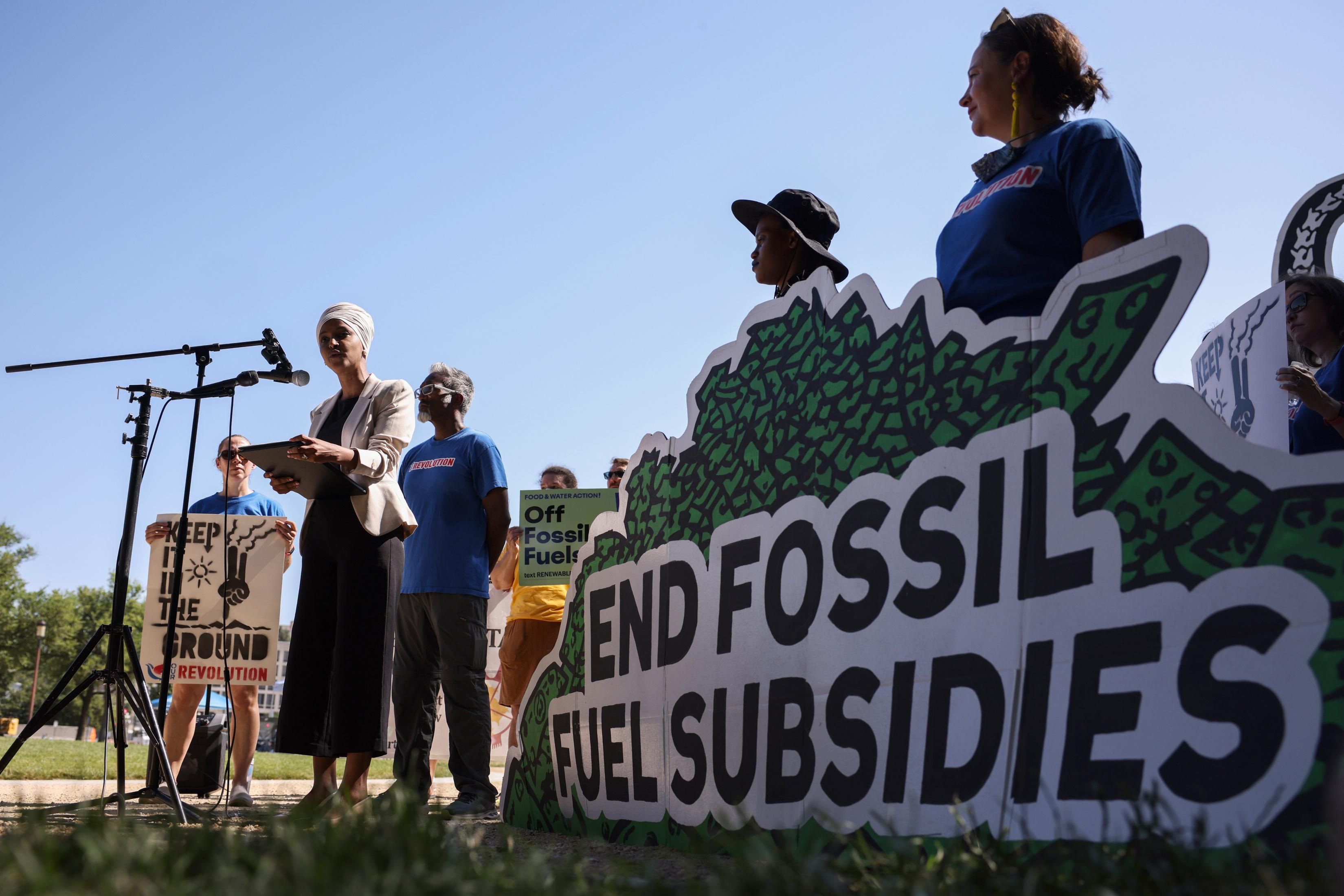
Rep. Ilhan Omar (D-Minn.) speaks at an "End Fossil Fuel" rally organized by Our Revolution near the U.S. Capitol on June 29, 2021 in Washington, D.C. Demonstrators called on Congress to take action in ending fossil fuel subsidies. 
(Photo: Anna Moneymaker via Getty Images)

KENNY STANCIL
August 3, 2021

While Democratic leaders have described the Senate's bipartisan infrastructure bill as "a significant down payment" toward addressing the climate emergency, environmental justice advocates are warning that the proposed legislation—which reportedly includes billions of dollars in potential new subsidies for dirty energy projects disguised as solutions—threatens to prolong the life of the planet-wrecking fossil fuel industry.

"The Senate is proposing that we spend tens of billions of dollars propping up fossil fuel corporations."
—Mitch Jones, Food & Water Watch

Citing an analysis by the Center for International Environmental Law, The Intercept reported Tuesday that "the latest draft bill would make fossil fuel companies eligible for at least $25 billion in new subsidies." According to the news outlet, public money would go toward unproven technologies, including carbon capture and so-called clean hydrogen, that are "sold as dream fixes for ending the nightmare of the climate crisis without the colossal political hurdle of dislodging the fossil fuel industry from the U.S. economy."

Given that energy policy experts have called for transitioning as quickly as possible to a completely renewable energy system, critics warn that investments of the kind included in the bipartisan infrastructure bill could exacerbate coal, gas, and oil extraction, condemning vulnerable populations and future generations to the most catastrophic effects of the climate emergency.

"We will never be able to meet the Paris agreement if we fund these kind of programs," Jim Walsh, senior policy analyst at Food & Water Watch, told The Intercept, referring to the international climate accord that seeks to limit global temperature rise this century to 1.5°C above preindustrial levels by cutting the emission of heat-trapping greenhouse gases in half by 2030 on the way to "net-zero" by 2050.

The bipartisan infrastructure bill "would support the development of four petrochemical hubs that would create profit incentives for greenhouse gas emission production and would be focused on finding new ways of integrating fossil fuels into our economy for transportation, energy, petrochemical development, and plastics," according to Walsh. He added that "this deal envisions a world where we will use fossil fuels into perpetuity."

Sen. Joe Manchin (D-W.Va.)—the same lawmaker who has made more than $4.5 million from his family's coal business since joining the Senate in 2010 and received praise from an ExxonMobil lobbyist for weakening the climate provisions in President Joe Biden's infrastructure proposal—is the chief architect of the energy-related measures in the bipartisan infrastructure bill.

An amended version of Manchin's Energy Infrastructure Act—which progressives denounced last month for proposing to spend 70 times more on fossil fuels than renewables—"will serve as the legislative text for key portions" of the bipartisan infrastructure bill, according to the Senate Committee on Energy and Natural Resources that the West Virginia Democrat chairs.

Food & Water Watch policy director Mitch Jones said Tuesday in a statement that the bipartisan infrastructure bill "is not a down payment on real climate action—it is doubling down on support for climate polluters."

"The Senate is proposing that we spend tens of billions of dollars propping up fossil fuel corporations—this is on top of the $15 billion these companies already receive every year from the federal government," said Jones. "A substantial share of this new money—about $12 billion—would go to promoting carbon capture, which does absolutely nothing but extend the life of the fossil fuel era."

Some progressive critics have characterized carbon capture and storage (CCS) and carbon capture, utilization, and storage (CCUS) as polluter-friendly schemes that allow the fossil fuel industry to benefit from additional public subsidies while undermining efforts to slash emissions as thoroughly and rapidly as possible.

In addition to the possibility of leaks and contamination, progressives warn that large-scale sequestration efforts are "false solutions" that could legitimate further fossil fuel extraction and forestall robust climate action. If CCS is treated as an alternative to ambitious mitigation and adaptation policies, critics argue, then it could divert attention from the pressing need for decarbonization.

Other progressives, including Christian Parenti, associate professor of Economics at John Jay College, City University of New York, have argued that even if we stopped emitting carbon dioxide today, the concentration of greenhouse gases in the atmosphere is so high that certain negative consequences can only be avoided if carbon is removed.

However, Parenti, who has long emphasized the need to "euthanize the fossil fuel industry," stresses that the state should only implement CCS or CCUS as public utilities to strip excess carbon from the atmosphere while the rest is kept underground—not to justify a continuation of the status quo.

In addition to carbon capture, the bipartisan infrastructure bill includes billions of dollars in public funding for "hydrogen fuel made from natural gas and 'low emissions buses' that could run on fuels including hydrogen and natural gas," The Intercept reported. "It also encourages subsidies that go unquantified in the legislation, for example urging states to waive property taxes for pipelines to transport captured carbon."

According to The Intercept:

So-called clean or "blue" hydrogen would use carbon capture and storage to neutralize the greenhouse gas emissions associated with the process. Another type of the fuel, called "green" hydrogen, uses electricity drawn from renewables.

Neither "blue" nor "green" means of hydrogen production, however, are widely used. For instance, only two facilities in the world have tried to commercially produce decarbonized "blue" hydrogen. As a result, 96% of hydrogen fuel globally comes from carbon-intensive means of production, according to a 2019 report. Research out of Stanford and Cornell universities indicates hydrogen produces more climate-warming gases than simply using natural gas directly.

At a time when "the survival of the fossil fuel industry depends on its ability to convince the public that corporations are taking steps to address the climate crisis," The Intercept noted, "ExxonMobilRoyal Dutch Shell, and Chevron, just to name a few, have touted their investments in hydrogen and carbon capture."

The irony, as the news outlet pointed out, is that "long-shot, industry-supported 'climate' projects" and "the rapid scale-up of renewable energy sources already proven to meaningfully slow down the spiraling climate crisis" both depend on government subsidies. The key difference, however, is that "wind and solar work as climate fixes right now, while carbon capture and 'decarbonized' hydrogen do not."

Jones emphasized that "while handing money to dirty energy companies might help win votes in the Senate, it fails the only test that matters: Whether or not we are taking meaningful action to address our mounting climate crisis."

"Throwing away money is not going to reduce emissions," he added. "We need massive investments in proven renewable solutions, not carbon capture fantasies. If the Senate cannot manage to get this right, climate champions in the House will need to strip out these wasteful dirty energy subsidies."


BIPARTISAN INFRASTRUCTURE BILL INCLUDES $25 BILLION IN POTENTIAL NEW SUBSIDIES FOR FOSSIL FUELS

Alleen Brown
Aug. 03 2021, 11:00 AM

Photo: Drew Angerer/Getty Images

THE SENATE’S NEW bipartisan infrastructure bill is being sold as a down payment on addressing the climate crisis. But environmental advocates and academics are warning the proposed spending bill is full of new fossil fuel industry subsidies masked as climate solutions. The latest draft bill would make fossil fuel companies eligible for at least $25 billion in new subsidies, according to an analysis by the Center for International Environmental Law.

“This is billions upon billions of dollars in additional fossil fuel industry subsidies in addition to the $15 billion that we already hand out to this industry to support and fund this industry,” said Jim Walsh, Food and Water Watch’s senior policy analyst. Scientists say that to meet the goals of the international Paris climate accord, the U.S would need to reach net-zero emissions by 2050 — and be well on the way there by 2030. With subsidies that keep fossil fuel industries going, Walsh said, “We will never be able to meet the Paris agreement if we fund these kind of programs.”

Just as concerning is the new economy the subsidies could entrench, said Walsh, through the creation of new fossil fuel infrastructure. “This would support the development of four petrochemical hubs that would create profit incentives for greenhouse gas emission production and would be focused on finding new ways of integrating fossil fuels into our economy for transportation, energy, petrochemical development, and plastics.”

In short, he added, “This deal envisions a world where we will use fossil fuels into perpetuity.”

Industry-Backed “Climate” Projects

The subsidies would go toward technologies sold as dream fixes for ending the nightmare of the climate crisis without the colossal political hurdle of dislodging the fossil fuel industry from the U.S. economy. Such technologies include carbon capture and decarbonized hydrogen fuel. Both purported solutions in practice help fossil fuel companies mask the continued release of climate-warming gases. Neither of the technologies are currently commercially viable at a large scale, so the energy industry requires government help to carry out what critics see as a public relations scheme.

The bill includes billions of dollars for carbon capture, utilization, and storage; hydrogen fuel made from natural gas; and “low emissions buses” that could run on fuels including hydrogen and natural gas. It also encourages subsidies that go unquantified in the legislation, for example urging states to waive property taxes for pipelines to transport captured carbon.

The devil is in the details. The vast majority of clean-sounding hydrogen is made from natural gas and produces the greenhouse gas carbon dioxide as a waste product. The process itself requires energy, typically supplied by burning more natural gas, which also produces greenhouse gases. Meanwhile, carbon capture and storage are promoted primarily as a means to clean up continued emissions from fossil fuel processing facilities. Carbon capture would do nothing to resolve the array of severe environmental problems caused upstream by drilling, fracking, and mining — let alone the downstream burning of the fuels for energy.

The survival of the fossil fuel industry depends on its ability to convince the public that corporations are taking steps to address the climate crisis. Hydrogen and carbon capture, utilization, and storage have been two of the industry’s key strategies for achieving that goal. Exxon Mobil, Royal Dutch Shell, and Chevron, just to name a few, have touted their investments in hydrogen and carbon capture.

While long-shot, industry-supported “climate” projects depend on government subsidies, so does the rapid scale-up of renewable energy sources already proven to meaningfully slow down the spiraling climate crisis. Put simply, wind and solar work as climate fixes right now, while carbon capture and “decarbonized” hydrogen do not.

Yet the Democrats and Republicans pushing the infrastructure compromise are choosing to give the fossil fuel industry a lifeline instead of providing funding for proven renewable energy technology. Even bill provisions that facilitate renewable energy development contain language that could allow funds to go instead to fossil fuel industry “solutions.”

“Any legislation funding carbon capture and storage or use or direct air capture is legalizing the funding of scam technologies that merely increase air pollution death and illness, mining and its damage, and fossil-fuel infrastructure, and they have no provable carbon benefit,” said Mark Jacobson, a professor of civil and environmental engineering at Stanford University. “By far, the best thing to do with the subsidy money for this is to purchase wind, solar, and storage to eliminate fossil fuels.”
Little-Understood Technologies

Senate Majority Leader Chuck Schumer, D-N.Y., hopes to finalize the latest $550 billion bipartisan iteration of the infrastructure bill by the end of the week. The legislation will also have to make it through the House and will ultimately be complimented by hundreds of billions in additional provisions to be hammered out though a separate process called reconciliation, which requires no Republican support.

President Joe Biden kicked off the process with his own blueprint, the $2.5 trillion American Jobs Plan. Republicans, however, didn’t come up with the carbon capture and hydrogen spending: Many of the industry-friendly proposals were part of Biden’s plan from the start. “It’s truly bipartisan, which makes me cringe,” said Walsh.

The bill is moving fast, and the billions in funding are set to become law at a time when policymakers and the public still lack a firm grasp on how the technologies work.

Hydrogen has become the latest darling of the fossil fuel industry. So-called clean or “blue” hydrogen would use carbon capture and storage to neutralize the greenhouse gas emissions associated with the process. Another type of the fuel, called “green” hydrogen, uses electricity drawn from renewables.

Neither “blue” nor “green” means of hydrogen production, however, are widely used. For instance, only two facilities in the world have tried to commercially produce decarbonized “blue” hydrogen. As a result, 96 percent of hydrogen fuel globally comes from carbon-intensive means of production, according to a 2019 report. Research out of Stanford and Cornell Universities indicates hydrogen produces more climate-warming gases than simply using natural gas directly.

The infrastructure bill calls for a national strategy to put “clean hydrogen” into action, including four regional hydrogen hubs. The provision explicitly ties one hub to fossil fuels and calls for two others to be near natural gas resources.

Likewise, the carbon capture measure in the bill ties government investment to areas “with high levels of coal, oil, or natural gas resources.”

Existing carbon capture projects have repeatedly run into problems, including a heavily subsidized Chevron facility dubbed the largest carbon capture project in the world, which was attached to a liquid natural gas export facility in Australia and recently deemed a technological failure. Exacerbating the problem is that there is no real market for captured carbon — except to use captured gases to produce even more oil from old wells. While the legislation puts money toward creating new uses for the trapped gases, large-scale markets are a far-off prospect.

Some proponents argue that carbon capture and hydrogen fuels could ultimately be beneficial for the climate if used for narrow purposes, like capturing carbon from steel production. But there is nothing in the bill preventing the fossil fuel industry from using the purportedly climate-friendly technologies to shore up its image while continuing to release emissions — a tactic known as “greenwashing.”

Environmental justice groups are clear about where they stand. Biden’s Environmental Justice Advisory Council issued a report in May that included carbon capture and storage among a list of technologies that will not benefit communities. Separately, a group of hundreds of organizations, ranging from Ben & Jerry’s to 350.org, sent a letter to Democratic leaders on July 19 urging them to resist energy strategies reliant on carbon capture, utilization, and storage.

The letter reads, “Investing in carbon capture delays the needed transition away from fossil fuels and other combustible energy sources, and poses significant new environmental, health, and safety risks, particularly to Black, Brown, and Indigenous communities already overburdened by industrial pollution, dispossession, and the impacts of climate change.”

Congress proposes "clean hydrogen" production hubs—with coal as a potential source


AUGUST 3, 2021

The bipartisan infrastructure bill headed for a Senate vote includes provisions for "clean hydrogen" hubs that would use fossil fuels, Bloomberg reported Monday.

The bill earmarks $8 billion to build at least four "regional clean hydrogen hubs" that would produce hydrogen for uses such as heating, manufacturing and transportation.

At least two of these hubs would be located in regions "with the greatest natural gas resources," according to the bill, and renewable energy, nuclear energy, and biomass are discussed as potential energy sources. However, so is coal.


Toyota 'Project Portal' proof-of-concept hydrogen fuel-cell powered semi tractor, for Port of LA

As Bloomberg points out, hydrogen can be stripped from water using electrolyzer devices, which seems to be the plan here, as the bill also includes $1 billion for grants to improve the efficiency of these devices. But that requires a lot of electricity, and the source of that electricity can affect the overall environmental impact of hydrogen production.

If the electricity comes from renewable sources, the hydrogen-production process does not generate greenhouse-gas emissions, Bloomberg noted. This so-called "green hydrogen" is currently more expensive than hydrogen produced using natural gas, but costs are expected to fall within a decade, to the point where green sources cost less than fossil fuels, according to Bloomberg. That in turn could make coal-powered hydrogen hubs uncompetitive.

A 2020 IHS Markit study predicted that green hydrogen produced using renewable energy could be cost-competitive with hydrogen made from natural gas by 2030. The California Energy Commission came to a similar conclusion, saying in its own 2020 report that hydrogen fuel-cell cars could reach price parity with gasoline by 2025.


2021 Hyundai Nexo

That's a more encouraging picture than just a few years ago. A 2014 University of California-Davis study predicted that cheap natural gas would be needed to make hydrogen cost competitive with gasoline.

Hyundai has been one of the biggest cheerleaders for a big-picture hydrogen policy, and has cited a McKinsey analysis suggesting hydrogen (assumed to be green in this analysis) could make up 18% of global "final energy demand" by 2050.

However, infrastructure remains a big barrier— and that's led to some very creative proposals on how to transport hydrogen from clean energy sources to end points—including using the existing fossil-fuel infrastructure.

INFRASTRUCTURE
Billions for carbon capture, hydrogen, advanced nuclear included in bipartisan infrastructure plan


Dave Gribble of TDA Research gives a tour of the first carbon capture research project on the ground at the Integrated Test Center outside Gillette in August 2020. The infrastructure package now in the Senate includes money for emerging energy technologies. Cayla Nimmo, Star-Tribune▲


Nicole Pollack 
Aug 3, 2021


The $1 trillion bipartisan infrastructure package completed over the weekend includes billions in funding for three emerging energy technologies that Wyoming is already exploring: clean hydrogen, carbon capture and advanced nuclear power.

After a precarious, monthslong negotiation process that saw the bipartisan deal nearly fall through, the Senate voted Wednesday to open debate on the infrastructure plan by a margin of 67-32. Wyoming Sens. John Barrasso and Cynthia Lummis both voted against advancing the bill.

In a statement, Barrasso characterized the legislation as governmental overreach — calling it “the Biden administration’s takeover of America’s electric system” — and expressed concern about where the funding would come from.

“We should be investing in our infrastructure responsibly. Instead, this bill spends too much and mandates policies that are bad for Wyoming,” he said.

Despite the senators’ misgivings about the infrastructure plan, some of the programs covered under its hefty price tag would support the development of advanced energy sources, which many in Wyoming say are key to revitalizing the state’s economy as natural resource revenue continues to decline.


According to a summary of the 2,700-page bill, the package would allocate more than $8 billion toward carbon capture efforts through 2026, including $100 million for the Department of Energy’s Carbon Capture Technology Program, $300 million for the development of carbon oxide products, $2 billion for carbon dioxide transport infrastructure, $2.5 billion for the commercialization of carbon sequestration projects and $3.5 billion for four regional direct air capture hubs.

The influx of federal spending could boost Wyoming’s existing carbon capture, utilization and storage efforts, including the University of Wyoming’s CarbonSAFE sequestration project and other initiatives at UW and throughout the state.

For hydrogen, the bill would reestablish and expand the DOE Hydrogen Program to include additional clean hydrogen programs as well as a national strategy for advancing clean hydrogen.

It authorizes $500 million to support a domestic clean hydrogen supply chain, $1 billion for a hydrogen commercialization program and $8 billion for four clean hydrogen hubs that “demonstrate the production, processing, delivery, storage, and end-use of clean hydrogen” and “can be developed into a national clean hydrogen network to facilitate a clean hydrogen economy.”

Under the bill, both blue and green hydrogen qualify as clean, though there is some disagreement about whether blue hydrogen — a classification for hydrogen generated using natural gas that requires that the carbon released as a byproduct be sequestered — can be considered as clean as green hydrogen, which is produced using renewable energy.

Many in Wyoming, including the oil and gas industry, see blue hydrogen as a way to keep the state’s gas production competitive as power plants’ demand for natural gas wanes. Several energy companies received grants last month from the Wyoming Energy Authority to support feasibility studies on the production and use of both blue and green hydrogen.

The bill also directs the DOE to conduct a report on the feasibility of using advanced nuclear technologies to meet U.S. climate goals, and introduces a $6 billion civil nuclear credit program to help keep existing nuclear reactors operating.

That expanded federal support for nuclear power would come as nuclear design company TerraPower begins the permitting process for the advanced reactor it plans to build at one of four retiring Wyoming coal plants.

Majority Leader Chuck Schumer has said he hopes to finalize amendments to the bill and pass it through the Senate before the monthlong August recess starts next week.

 NATO'S OIL WAR

Spanish Oil Major Repsol May Resume Oil Exploration In Libya

Spain’s Repsol is willing to resume oil exploration activities in Libya in light of the improved security situation in the African OPEC member, Libya’s National Oil Corporation (NOC) said on Wednesday after a meeting between Repsol representatives and NOC chairman Mustafa Sanalla in Tripoli.

Repsol is a joint venture partner in the company Akakus Oil—along with NOC, France’s TotalEnergies, Norway’s Equinor, and Austria’s OMV—which operates the largest oilfield in Libya, Sharara, with a capacity to pump more than 300,000 barrels per day (bpd).   

Repsol, which started oil exploration activities in Libya in the 1970s, suspended exploration of oil blocks in 2011 during the uprising that toppled Muammar Gaddafi.

Repsol and NOC discussed at the meeting this week the need to carry out regular maintenance work on the surface equipment at the Sharara oilfield, which has stopped operations too many times in recent years because of port or oilfield blockades.

The possible return of Repsol to Libya’s upstream could be another oil major resuming operations in the country.

Earlier this week, Libya Herald reported, citing NOC, that Shell is considering resuming operations in Libya by contributing to oilfield developments and increasing marketing and refining activities.

Shell had suspended its upstream operations in Libya in 2012, abandoning exploration activities in two blocks in the country because of disappointing results. At the time, NOC said that Shell’s negative assessment of the blocks’ prospects did not reflect reality.

Now Shell, whose representatives visited Libya, discussed the possibility to help oilfield development in the African OPEC member, NOC said, as quoted by Libya Herald.

At the end of last year, NOC said that another European major, France’s TotalEnergies, planned to increase its investments in Libya’s oil industry.

NOC added it had discussed with the company raising Libya’s production to “the highest levels.”

TotalEnergies, the new name of Total, has stakes in several Libyan oil fields, including Sharara.  

By Charles Kennedy for Oilprice.com

Tokyo Olympics: Canadian Diver Pamela Ware Scores Rare 0.0 at Olympics After Landing Feet First

Canadian Diver Pamela Ware crashed out of the semifinal event at the Tokyo Olympics
Pamela took a misstep while approaching for a 3.5 difficulty dive and was forced to abort her planned attempt the second she jumped. As a result, she landed in the pool on her feet and scored a rare 0.0 at the Olympics.

Updated: August 03, 2021, 20:47 IST

Athletes train all their lives for that one chance to represent their country and showcase their talent on the world stage during the Olympics. However, when the stage is bigger, even the smallest mistakes and accidents can overshadow your hard work for years. Something similar happened to Canadian Diver Pamela Ware who crashed out of the semifinal event at the Tokyo Olympics after a rare score of 0.0 in her last attempt at the semifinal event.

Pamela took a misstep while approaching for a 3.5 difficulty dive and was forced to abort her planned attempt the second she jumped. As a result, she landed in the pool on her feet and scored a rare 0.0 at the Olympics. Her low dive score eliminated her from the race to podium finish and she exited the tournament after this miscue.

Speaking to Canadian broadcaster CBC, the athlete said that had she gone for the dive, she would have ended up hurting herself. Pamela later posted an Instagram video thanking her fans for the support and said that she was proud of her journey despite the failure at Tokyo Olympics 2020.

She started off the video by thanking her fans for their encouragement during this time and said that she was proud to have come some far. Overwhelmed by emotions, Pamela’s voice choked, and she added that what people see at the competition is only a fraction of the effort it takes to reach this point and she was completely ready for the big day. However, she made a mistake and that could have happened to anyone. She reemphasized fact that she was proud of her journey and hoped to make a comeback soon.

Pamela's video has so far got over 70 thousand views along with several comments on the platform. Her fans and fellow athletes expressed their solidarity with her and said that it was just bad luck, and she would soon make a comeback like a champion.

Canadian Pamela Ware botches dive in spectacular fashion

Daniel Rainbird
·Writer
Wed., August 4, 2021, 

Pamela Ware's podium dreams were squashed in the blink of an eye. (Photo via @EmilyBenammar/Twitter)

The Olympic Games are a collection of events filled with Herculean athletes who can run faster, jump higher and throw further than seems humanly possible.

But Canadian diver Pamela Ware just reminded us that Olympians are mortals, after all.

Ware entered the 3-metre seminal at Tokyo 2020 in fourth place, but all hopes of a podium finish sank after the 28-year-old scored 0.0 on her final dive.

The Greenfield, Que., native ran up the plank, bounced twice, and just as she was about to spring into action… aborted mission.

Ware explained after the competition that attempting the dive could have put her at risk of injury.

Despite the devastating result, the 2019 Pan American gold medalist kept a positive mindset, thanked fans for “beautiful messages of encouragement” and promised to come back stronger.

"I am very proud of myself,” Ware said in an Instagram video. “What you see in the competition is just a tiny factor of what we actually do to get to where we are. I was so ready for this competition and I made a mistake, it could have happened to anybody, but it happened to me at the wrong time.

"I hope you guys are gonna get used to having me around because I’m not going anywhere. I’m not giving up. This competition doesn’t define me, and I’m not letting it defeat me."

Ware was right, it could have happened to anybody, and it actually did before she even failed that dive. Mexican Arantxa Chavez scored zero in the earlier preliminary round after messing up in nearly identical fashion

DISAPPERANCE OF BC ORCAS


Opinion
Our leaders look climate change in the eyes, and shrug

It is not good to be too pessimistic on the climate crisis.

 That said, it sure does seem like we’re screwed

Hamilton Nolan

Wed 4 Aug 2021 11.12 BST

If you have cultivated an Edgar Allen Poe-like appreciation for the macabre, there is a certain sort of amusement to be had in watching the developed world deal with the insistent onslaught of climate change. Like many horror stories, this one features a main character full of futile determination to maintain a sense of normalcy even as the ominous signs of doom become ever more impossible to ignore. We can chuckle knowing that the monster is going to come for our designated protectors. We stop chuckling knowing that it’s coming for all of us next.Wildfire fighters advance against biggest US blaze amid dire warnings

It is easy to imagine that a real live existential threat to our way of life would prompt any society to assume war footing and marshal everything it has to fight for survival. Unfortunately, this response only takes hold in actual war situations, where the threat is “other people that we can shoot and kill in glorious fashion”. When the threat comes not from enemy people, but from our own nature, we find it much harder to rise to the occasion. Where is the glory in recognizing the folly of our own greed and profligacy? Leaders are not elected on such things. We want leaders who will give us more, leading us ever onwards, upwards and into the grave.


The latest demonstration of this comes from the G20, that coalition that is as good a proxy as any for the combined will of the world’s richest countries. The latest G20 meeting wrapped up last week without firm commitments on phasing out coal power, or on what steps nations will promise to take to try to hold global warming to 1.5C. This goal is both necessary and, perhaps, unlikely – a report by scientists found that China, Russia, Brazil and Australia are all pursuing policies that could lead to a cataclysmic five degrees of warming.

The G20 is a perfect model of our collective failure to build institutions capable of coping with deep, long-term, existential problems that cannot be solved by building more weapons. On the one hand, the head of the United Nations says that there is no way for the world to meet its 1.5C warming goal without the leadership of the G20; on the other hand, a recent analysis found that G20 members have, in the past five years, paid $3.3tn in subsidies for fossil fuel production and consumption. The same group that claims to be bailing out humanity’s sinking ship with one hand is busily setting it aflame with the other hand. It is not good to be too pessimistic on climate change, because we must maintain the belief that we can win this battle if we are to have any hope at all. That said, it sure does seem like we’re screwed.

As overwhelming and omnipresent as the climate crisis is, it is not the core issue. The core issue is capitalism. Capitalism’s unfettered pursuit of economic growth is what caused climate change, and capitalism’s inability to reckon with externalities – the economic term for a cost that falls onto third parties – is what is preventing us from solving climate change. Indeed, climate change itself is the ultimate negative externality: fossil-fuel companies and assorted polluting corporations and their investors get all the benefits, and the rest of the world pays the price. Now the entire globe finds itself trapped in the gruesome logic of capitalism, where it is perfectly rational for the rich to continue doing something that is destroying the earth, as long as the profits they reap will allow them to insulate themselves from the consequences. Capitalism is a machine made to squeeze every last cent out of this planet until there is nothing left

Congratulations, free market evangelists: this is the system you have built. It doesn’t work. I don’t want to lean too heavily on the touchy-feely, Gaia-esque interpretation of global warming as the inevitable wounds of an omniscient Mother Earth, but you must admit that viewing humanity and its pollution as a malicious virus set to be eradicated by nature is now a fairly compelling metaphor. Homo sapiens rose above the lesser animals thanks to our ability to wield logic and reason, yet we have somehow gotten ourselves to a place where the knowledge of what is driving all these wildfires and floods is not enough to enable us to do anything meaningful to stop it. The keystone experience of global capitalism is to gape at a drought-fueled fire as it consumes your home, and then go buy a bigger SUV to console yourself.

This year, the G20 is patting itself on the back for “[recognizing] carbon pricing as a potential tool to address climate change for the first time in an official communique”. This would have been encouraging 30 years ago, when we should have established a carbon tax after it became clear that carbon emissions cause tangible damage to the environment. In 2021, this sort of diplomatic marginalia is the equivalent of a child on the Titanic proudly showing his parents his completed homework, just as the ship slips beneath the waves.

Of course we need a price on carbon. Of course we need extremely strict emissions regulations, massive green energy investments, and a maniacal focus on sustainability fierce enough to radically change a society that is built to promote unlimited consumption. But, to be honest, there is little indication that we will get those things any time soon. The path we are on, still, is not one that leads to a happy ending. Rather, it is one that leads to the last billionaire standing on dry land blasting off in his private rocket as the rest of us drown in rising seas.

Capitalism is a machine made to squeeze every last cent out of this planet until there is nothing left. We can either fool ourselves about that until it kills us, or we can change it.


Hamilton Nolan is a writer based in New York
Here is why the EU should sanction Lebanon’s bankers

The banking sector is responsible for the current crisis in Lebanon. Sanctioning its leaders can help effect a solution.


Sami Halabi
Director of Policy at the Beirut-based think tank Triangle
4 Aug 2021


This picture taken on November 27, 2019 shows a banner in Arabic, reading "we will not pay the price", hanging outside the headquarters of the Banque du Liban in Beirut [File: AFP/Joseph Eid]

One year has passed since the Beirut Port explosion of August 4, 2020. As summer temperatures are hitting record highs, so is the political temperature in Lebanon. The families of explosion victims have endured 12 months of lack of accountability and blatant interference in the judicial process. Public anger is simmering and threatening to boil over into another wave of unrest.

As the painful anniversary was drawing nearer, the European Union announced a framework that “provides for the possibility of imposing sanctions against persons and entities who are responsible for undermining democracy or the rule of law in Lebanon”. The long-anticipated move is effectively a warning shot aimed at pressuring Lebanon’s intransigent elites into undertaking reforms.

KEEP READING
Beirut Blast: A Year On

Those same elites who presided over the explosion have shirked responsibility for Lebanon’s spiralling economic crisis – assessed by the World Bank as among the worst ever recorded. Political leaders have prioritised partisan squabbles over rebuilding the country, failing to replace the government that resigned after the explosion.

While pressure from the West is welcome, targeted sanctions on Lebanon’s politicians risk missing the mark unless they are more effective in their attack on the actual power structure of the country. And in Lebanon, true power – and culpability – lies in the nation’s banking sector, which is responsible for the ongoing economic demise of the country.

Together with the Banque du Liban (BDL), Lebanon’s central bank, commercial banks engaged in a regulated national Ponzi scheme that dug an $80bn public debt hole in the country’s finances. Instead of instituting capital controls and enacting a recovery plan, the BDL and the banking sector devised their own shadow financial plan, which employed blatantly illegal multiple exchange rates, informal capital controls, and the printing of vast amounts of local currency.

This current arrangement, which would surely qualify as misconduct under the EU sanctions framework, shunts the crushing burden of the crisis onto ordinary Lebanese, who have to take an up to 80-percent cut on their cash withdrawals.

These non-solutions have obliterated the life savings of the Lebanese people and left them struggling with chronic shortages of electricity, food, and pharmaceuticals – the import of which the BDL can no longer afford to subsidise from the country’s fast-dwindling foreign currency reserves. Yet, those with sufficient connections to the banking sector have already moved their money offshore, with an estimated $30bn leaving the country since mid-2019.

Sanctioning the banking sector would offer Western policymakers a technically sound and more effective regime than the “framework” proposed by the EU. That is because, to function effectively, sanctions need to be directed at a clearly defined group of individuals and entities that are culpable, have the power to influence change, and feel threatened by sanctions.

At present, the proposed EU sanctions target Lebanon’s political leaders, many of whom do not necessarily meet those criteria or who have demonstrated that they are unwilling to challenge the BDL or the banking sector, not least because of current or previous business ties to the industry.

A seminal study from 2016 found that individuals closely linked to the political elite controlled 43 percent of assets in Lebanon’s commercial banking sector. The same research found that eight families controlled 29 percent of the banking sector’s assets, led by the family of former Prime Minister Saad Hariri.

Through the investment company GroupMed Holding, the Hariri family currently controls the majority stake in BankMed, one of the largest banks in Lebanon. Saad Hariri’s successor as premier-designate, fellow billionaire Najib Mikati, who was under investigation for embezzling a state-backed housing fund, has close ties to Bank Audi, Lebanon’s largest bank by assets. Mikati’s brother and business associate, Taha, has a stake in Bank Audi through his investment company, Investment & Business Holding.

Both Hariri and Mikati have had ample chances to reform the banking sector and public finances when they were premiers. They did not do so and there is no reason to think they will do it in the future.

That is why direct sanctions on financial leaders might be more effective. For example, sanctions on BDL officials could help Lebanon strike a fair bailout deal with the International Monetary Fund. Currently, the main stumbling block before securing a loan programme is the need for an audit of the BDL. In the past, the central bank has repeatedly obstructed this process and would continue to do so until the current BDL governor and commercial banks have a real incentive to facilitate it – something which targeted EU sanctions could provide.

Smarter sanctions against Lebanese banks and bankers would also compel foreign institutions and businesses to stay away from Lebanon’s tainted banks. Years of soaring, irresponsible interest rates have attracted all sorts of hungry investors, including Arabian Gulf royals, the European Bank for Reconstruction and Development (EBRD), the World Bank-affiliated International Finance Corporation (IFC), and France’s official development agency, Agence Française de Développement (AFD).


At least for Western institutions, retaining stakes in banks directly involved in the “deliberate” economic meltdown of an entire nation should be an obvious moral hazard. The threat of Western sanctions would surely encourage them to pull out of Lebanon’s banking system.

While sanctions as an international pressure tool have sometimes been criticised for resulting in unfair collective punishment of whole nations, fears that the Lebanese people would suffer from such measures imposed on their financial leaders are also unfounded. It is hard to conceive how sanctioning the banks that devour people’s deposits could worsen the situation. If the sanctions are targeting specific individuals within the country’s financial elite, this would prevent any spillover that could affect the Lebanese public.

Furthermore, sanctions on the Lebanese financial sector have already proven effective in immediately producing change in the country. Over the past decade, two Lebanese banks were brought down by a simple edict from the US Department of the Treasury over suspected money laundering for Hezbollah.

Pressure from the US also cracked open Lebanon’s antiquated banking secrecy regime for the first time, as Lebanese banks sought to comply with Washington’s Foreign Account Tax Compliance Act. The law requires banking institutions to provide information to US tax investigators about American customers.


Without decisive action, the future looks incredibly bleak for Lebanon, which is fast becoming a failed state. Should that happen, a repeat of the 2015 migrant crisis is not inconceivable; neither is another wave of radicalisation akin to the one which spawned ISIS.

Instead of watching on the sidelines as another political and humanitarian crisis unravels, the West could impose sanctions on the financial sector to turn the tide of Lebanon’s collapse. And the only cost of such measures would be making some already well-off bankers and politicians just a little less rich.

The views expressed in this article are the author’s own and do not necessarily reflect Al Jazeera’s editorial stance.