Thursday, August 04, 2022


·Senior Editor

The two largest reservoirs in the United States are at “dangerously low levels,” threatening the supply of fresh water and electricity in six states and Mexico, the United Nations Environment Programme (UNEP) warned on Tuesday.

Lake Mead and Lake Powell, which are both man-made reservoirs on the Colorado River, are currently at their lowest levels ever, in part because of an ongoing drought exacerbated by climate change.

“The conditions in the American West which we're seeing around the Colorado River basin have been so dry for more than 20 years that we're no longer speaking of a drought,” said Lis Mullin Bernhardt, an ecosystems expert at UNEP. “We refer to it as ‘aridification’ — a new, very dry normal.”

The river is also struggling thanks to overconsumption due to a growing population and an outdated agreement that guarantees allotments for its neighboring states. The reservoirs provide water for agricultural and residential use in Arizona, California, Colorado, Wyoming, Nevada and New Mexico.

If conditions don’t improve, Lake Mead and Lake Powell are at risk of reaching “dead pool” status, in which the water is so low it stops flowing out of a reservoir. That would disable the hydroelectric dams that help provide power for millions of residents of the western U.S.

“We are talking about a 20-year period of droughtlike conditions, with an ever-increasing demand on water,” Bernhardt said. “These conditions are alarming, and particularly in the Lake Powell and Lake Mead region, it is the perfect storm.”

The Hoover Dam water intake towers at Lake Mead, with low levels of water.
The Hoover Dam water intake towers at Lake Mead on July 12 near Boulder City, Nev. (George Rose/Getty Images)

The falling water levels have been a concern for U.S. officials for some time. In June, Bureau of Reclamation Commissioner Camille Calimlim Touton told the Senate Energy and Natural Resources Committee that maintaining “critical levels” at Lake Mead and Lake Powell would require significant reductions in water deliveries.

“What has been a slow-motion train wreck for 20 years is accelerating, and the moment of reckoning is near,” John Entsminger, general manager of the Southern Nevada Water Authority, said at the Senate hearing.

Due to the declining water levels in Lake Mead, which is near Las Vegas, three dead bodies long buried under the water have recently been exposed.

Some water use restrictions have already been put in place. The Metropolitan Water District of Southern California instituted emergency water curtailments in June, typically limiting outdoor watering to one or two days per week.

A sunken boat, now high and dry, on Saddle Island on July 28 in the Lake Mead National Recreation Area, Nev. (Ethan Miller/Getty Images)

The drought in the West has had a number of effects in recent years, including unusually bad wildfire seasons.

Climate scientists say disruptions to the water cycle, especially drought, will become more common as a result of rising global temperatures.

Clean Energy Incentives and Rebates Americans Will Be Able to Take Advantage of Thanks to Inflation Reduction Act

David Nadelle
Wed, August 3, 2022

Bonnie Cash/UPI/Shutterstock

Despite steady opposition to many pieces of his own party’s legislation during this time of high inflation, Sen. Joe Manchin (D-VA) has had something of a change of heart — bringing a proposed tax, health and climate bill back to life.

Details of the $739 billion Inflation Reduction Act of 2022 were worked out by Manchin and Senate Majority Leader Chuck Schumer (D-NY) last week amid criticism from opponents who question the point of legislation that doesn’t lower inflation until nine years from now. Moody’s Analytics chief economist Mark Zandi suggested that the best-case result of the legislation (regarding inflation) is a 0.33% reduction of inflation by 2031, according to the New York Post.

Whatever the impact the act will have on inflation years from now, the Inflation Reduction Act promises heavy investment in corporate tax and IRS tax enforcement reform and Medicare drug pricing improvements. The Inflation Reduction Act also features an Affordable Care Act extension and funds a dedicated effort to battle climate change.

According to a related Senate Democrats fact sheet, the largest expenditure, $369 billion, will go toward investing in “Energy Security and Climate Change programs over the next ten years.”
Electric Vehicles and E-Bikes

Per Accounting Today, the new legislation proposes consumer tax credits for both new and used “clean cars” and amends current rules concerning eligible household salaries (as well as caps on eligible types and price points regarding electric vehicle purchase credits).

If you make under $150,000 — or have a combined family income under $300,000 — you can get a $7,500 tax credit for qualifying new electric vehicles. The credit is applied at the time of sale, not as a tax-time filing reduction.

Additionally, whereas existing EV tax credits phased out for a manufacturer’s vehicles when at least 200,000 qualifying vehicles have been sold for use in the United States (Tesla, General Motors and Toyota phased out long ago), the bill does away with that threshold and instead places price limits on electric vehicles.

Larger EVs like SUVs, trucks and vans need to cost less than $80,000 to qualify for the credit, while smaller electric cars need to be priced at $55,000 and below.

For used electric cars, a $4,000 credit is available to anyone buying one for under $25,000 from a dealer — as long as you’re an individual making up to $75,000 a year, or are a couple making less than $150,000 a year who file joint tax returns. As Accounting Today noted, almost three in four cars bought in the U.S. are used, so the impact of the proposed legislation will likely be substantial.

“This is something we’ve always said is a sleeper issue,” said Andres Hoyos, vice president of the Zero Emission Transportation Association. “It’s going to be a game-changer for mass adoption.”

Less enthusiastic are electric bike manufacturers and users. Per Bloomberg, sales of e-bikes continue to flourish since the pandemic boom, partially due to high fuel prices. However, the Inflation Reduction Act doesn’t provide credits or incentives for e-bikes, something that has electric bike proponents irritated.

Quoted in Accounting Today, Noa Banayan — director of federal affairs, People for Bikes — stated: “It just continues to support auto-centricity and doesn’t help with mode shift.”
Home-Efficient Electrification, Heat Pumps and Solar Panels

There are plenty of incentives available to low- and moderate-income homeowners looking to save money while they renovate, or make their homes more energy efficient.

Qualified electrification projects include heat pump water heaters (up to $1,750 rebate), heat pump HVAC systems (up to $8,000 rebate) and electric load service panels and electric appliances (up to $840 in rebates). Additional rebates are available for upgrading electrical panels (up to $4,000 rebate), insulating and sealing a house (up to $1,600 rebate) and improving wiring (up to $2,500 rebate), per Accounting Today.

The $4.28 billion High-Efficiency Electric Home Rebate Program is providing the rebates and will be administered by each state. The program runs through Sept. 30, 2031, and has a maximum rebate total of $14,000. To qualify for these rebates, a household income must not exceed 150% of the area median income as calculated by the Department of Housing and Urban Development.

Finally, homeowners who install residential solar panels or solar battery systems (with at least 3 kilowatt-hours of capacity) will qualify for a 30% tax credit for installations until Dec. 31, 2034. However, this credit dips to 26% for installations after Dec. 31, 2032 and before Jan. 1, 2034.


The Senate climate bill may get you cheap energy, clean air, and a job

Catherine Boudreau, Morgan McFall-Johnsen
Wed, August 3, 2022 

Senate Majority Leader Chuck Schumer and Sen. Joe Manchin
Drew Angerer/Getty Images

Sen. Chuck Schumer and Joe Manchin agreed to a surprise $369 billion climate package on July 27.

The bill could cut energy bills, make EVs affordable, create 1.5 million jobs, and save lives with cleaner air.

If the Inflation Reduction Act passes, its climate plan could help your wallet, health, and security.


Senate Democrats could pass the most significant climate bill in US history this week, paving the way for cheaper energy and a more livable planet.


The surprise deal between Majority Leader Chuck Schumer and Sen. Joe Manchin of West Virginia would dole out about $369 billion for climate programs as part of the Inflation Reduction Act of 2022. It aims to expand renewable energy such as solar, wind, and cleaner fuels, while making it less expensive to buy electric vehicles and home appliances.

If Congress approves the bill, it would put the US on track to cut its greenhouse-gas emissions by up to 44% from 2005 levels by the end of the decade, according to multiple assessments. Experts say the bill also promises savings, health boons, and higher quality of living for everyday people across the US.

The sun sets behind power transmission lines in Texas, on July 11, 2022.Nick Wagner/Xinhua via Getty Images

"This isn't about the sky, or the polar bears," Jonathan Foley, executive director of Project Drawdown, a climate nonprofit, told Insider, adding, "This is about you and your pocketbook, your jobs, the air your kids breathe, the town you live in, our national security."

Here are five ways the new climate-change package could make your life better:
Lower energy bills

A woman prepares dinner for her family at her home in Schnecksville, Pennsylvania, on September 22, 2021.Hannah Beier/Reuters

The new climate proposal includes about $30 billion in loans and grants for states and electric utilities to adopt more renewable energy, plus more than $60 billion in tax credits for manufacturers of solar panels, wind turbines, batteries for electric vehicles, energy storage, and other technology, according to a summary from Senate Democrats.

Solar and wind already generated cheaper electricity than fossil fuels, even before oil and gas prices soared this year. Yet they still only account for about 20% of US energy use. The Schumer-Manchin deal could speed up a shift away from fossil fuels and also make it less expensive to hook up your home with electric.

Vesta wind turbines in Palm Springs, California, on July 21, 2022.David Swanson/Reuters

A total of $9 billion in home energy rebates would help Americans insulate their homes and replace stoves, furnaces, water heaters, and other appliances with electric alternatives. Homeowners could deduct up to 30% of installation costs from their taxes. A similar deduction for solar would be guaranteed for homeowners and expanded to residential battery storage.

"This is really about delivering lower energy bills for everyday Americans," Leah Stokes, an environment and energy politics professor at University of California, Santa Barbara, said in a press briefing on Thursday. She noted that high oil and gas prices are a major driver of inflation that ripples across every industry, from transportation to manufacturing to agriculture.


A family eats dinner at their home in Calumet Park, Illinois, on December 8, 2020.Shannon Stapleton/Reuters

"When fossil fuels go up, other goods and services go up," Stokes said.

The average household could save $1,800 on their energy bill each year by installing a modern electric heat pump and rooftop solar and buying an electric vehicle, according to an analysis by Rewiring America, a think tank that promotes electrification.
Cheaper electric vehicles


A Scion IQ electric car is plugged in in a garage in Irvine, California, on January 26, 2015.Lucy Nicholson/Reuters

The bill would extend an existing $7,500 tax credit for new EVs — offered as a discount at the point of sale — and offer up to $4,000 for used EVs and plug-in hybrids.

It would also lift the cap on the number of tax breaks automakers can offer, benefiting companies like Tesla, General Motors, and Toyota that already hit the limit, as long as the vehicle is assembled in the US.

"Once people own an electric car, they're going to laugh every time they drive by a gas station, when they see $5 a gallon," Foley said, adding, "I think this will help us reach a tipping point, where five to 10 years from now you won't see gas cars sold anymore, or very few."

Gas prices over the $6.00 mark are advertised at a Mobil Station in Santa Monica, California, on May 23, 2022.David Swanson/Reuters

There are some caveats, like your income, the vehicle's price tag, and where its parts are made.

If you earn $150,000 or more a year, or $300,000 in joint family income, you won't qualify for the new car tax credit. There's a limit on the price of the car, too. Bigger vehicles, such as SUVs and pickup trucks, must cost less than $80,000, and smaller cars less than $55,000, to qualify for the credit.

For used cars, the income limit is $75,000 for single tax filers and $150,000 for joint filers. The sticker price must be $25,000 or below.

The bill also requires vehicle batteries to be made with 40% of minerals extracted or processed in countries the US has a free trade agreement with, or recycled in North America. But supply chains for those minerals don't exist yet, E&E News reported. The majority of lithium, cobalt, nickel, and other minerals used in EV batteries come from China, Russia, and the Democratic Republic of Congo, although analysts told E&E News they hope the mandate spurs a made-in-America market.
Cleaner air to breathe

A man rides his skateboard at sunset while doing a trick in the Venice Beach area of Los Angeles, California, on November 12, 2019.Carlo Allegri/Reuters

With fewer gas-guzzling cars on the road, and fewer industrial sites powered by fossil fuels, air would be cleaner and safer to breathe.

"These sorts of climate measures could also reduce particulate matter or ozone smog, as kind of a side benefit that would directly, immediately improve health," Scot Miller, an assistant professor of environmental health and engineering at Johns Hopkins, told Insider.

That drop in air pollution could prevent up to 3,900 premature deaths and 100,000 asthma attacks by 2030, according to an analysis by the policy-research firm Energy Innovation LLC.


A layer of air pollution hangs over Denver, Colorado, on January 21, 2020.Jim Urquhart/Reuters

The American Lung Association pointed to those clean air and health gains in a statement Thursday, urging Congress to "move swiftly" and "without delay" to pass the new bill into law.

The bill also includes provisions to fund cleanup of dangerous pollution sites, which are disproportionately concentrated in low-income communities of color.

The investment is "probably not enough, but it's more than we've ever spent before," Foley said.
Jobs, jobs, jobs

Ford Assembly workers install a battery onto the chassis of a Ford Focus Electric vehicle at the Michigan Assembly Plant in Wayne, Michigan, on November 7, 2012.Rebecca Cook/Reuters

By investing about $60 billion in manufacturing — everything from heat pumps to wind turbines — this climate plan would help keep clean-energy companies in the US, securing "good paying, and hopefully union, jobs," Stokes said.

It's not just manufacturing. Renewable-energy infrastructure needs to be installed and maintained. The bill would fund new electricity-transmission lines, offshore wind projects, housing retrofits, renewable-energy projects in rural areas, and repurposing or replacing defunct energy infrastructure.

A worker sits at the base of a wind turbine blade at TPI Composites in Newton, Iowa, on December 22, 2011.Joshua Lott/Reuters

All that work requires workers. The bill would create up to 1.5 million jobs by 2030, according to the Energy Innovation analysis.

The bill also focuses on communities historically associated with oil, gas, and coal extraction, by providing a tax incentive for companies that create renewable-energy jobs in those places.
Protection from extreme weather

Daniel Bosquez shades the face of Timothy Jalomo, 10 months, from the afternoon sun as he fills a plastic pool with water, as San Antonio, Texas is placed under an excessive heat warning, on July 11, 2022.Lisa Krantz/Reuters

Climate change is making droughts, floods, wildfires, and heat waves more severe and more frequent. These weather events cause serious damage to human property and infrastructure and cost lives.

The bill would provide funding for communities to mitigate the health effects of extreme heat, to prevent and respond to wildfires, and to prepare for coastal climate impacts like severe hurricanes and flooding from sea-level rise. It also gives the National Oceanic and Atmospheric Administration (NOAA) a funding boost for forecasting and research.

A house is fully engulfed by flames during the Dixie Fire, a wildfire near the town of Greenville, California, August 5, 2021.Fred Greaves/Reuters

While the new funds would help communities adapt to extreme events, the bill could also help prevent weather from getting even more extreme. If the world cuts emissions enough to keep global warming below 2 degrees Celsius, that could prevent a significant acceleration in the severity and coverage area of extreme weather.

"I think everyone I work with in the emissions community is sort of holding their breath and hoping that this [bill] goes through," Miller said.

The Democrats' new deal could help save planet Earth – and struggling West Virginia

Jill Lawrence, USA TODAY
Wed, August 3, 2022 

Donald Trump won West Virginia by nearly 42 points in 2016 after promising to stop President Barack Obama’s alleged “war on coal” and bring back the declining coal industry after “a lot of years of horrible abuse.”

To the shock of almost no one, Trump was unable turn back time, reverse climate change or manufacture demand. The real shock is that because of a deal coalescing in Congress, West Virginia – its identity tied so tightly and sometimes so tragically to coal mining – now could be on the verge of a post-coal energy future.

“I really do think this is a watershed. I see this as a chance for us to stay an energy state,” said Coalfield Development founder and CEO Brandon Dennison, whose group in Huntington, West Virginia, creates businesses in green sectors and uses them to put people to work.

The reason for his optimism, Dennison told me, is the Democratic energy, tax and health care agreement that Senate Majority Leader Chuck Schumer and Senate energy committee chair Joe Manchin suddenly announced last week. If it passes both chambers, and that’s always an if until it happens, it could be a turning point not just for West Virginia but also for America and the world.
Now is the time for a climate change deal

The deal would make what Senate Democrats call “the single biggest climate investment in U.S. history,” an assessment shared by other analysts. Roughly $370 billion would be invested in “energy security and climate change” over 10 years. The climate provisions could produce by 2030 a 40% reduction in U.S. carbon emissions, a major contributor to climate change, and spur global action. Some of the money would support fossil fuels during the transition to clean energy.

How to save the planet: These five steps will help us kick our fossil fuel addiction

There are many reasons this is happening now:

►It starts with Manchin, a former governor who’s known and trusted at home after holding public office for most of the past 40 years. He has walked a narrow line – so far successfully – as “the Last Democrat in Trump Country,” as GQ called him in 2018.


Then-Gov. Joe Manchin gives a state certificate to the family of Josh Napper, one of 25 coal miners killed in an explosion, at a candlelight vigil in Cabin Creek, W.Va., in 2010.

►The dire need, underscored recently by President Joe Biden’s awkward fist bump with Saudi Crown Prince Mohammed bin Salman, for more oil production due to rising post-pandemic demand and boycotts of Russia's oil and gas since it invaded Ukraine.

►Urgency to stem climate change, increasingly apparent in heat waves, wildfires, droughts, rising tides and extreme weather. In fact, the day after the Schumer-Manchin announcement, massive floods destroyed communities and left dozens dead or missing in Kentucky.

►Political deadlines closing in: Sept. 30, the end of the fiscal year and the last day for Democrats to use a special budget procedure requiring only 51 votes, which they can theoretically muster. And Nov. 8, when midterm elections could end Democratic control of Congress and/or Manchin’s pivotal role in a 50-50 Senate.

Manchin’s oversized influence on the new deal can be seen in expanded oil and gas drilling over the next decade; a requirement that coal companies pay into a trust fund for miners with black lung disease; and Schumer’s written commitment to pass a permitting reform bill to speed up energy projects, including the Mountain Valley Pipeline in West Virginia (a nonrevenue item that can’t be part of the tax-and-spending package).


Donald Trump wears a coal miner's hat at a rally in Charleston, West Virginia, on May 5, 2016.


At the same time, Manchin has helped open up a clean energy future for his own state and others like it – an economy that attracts companies interested in solar, nuclear and hydrogen power; in manufacturing products like battery energy storage systems; and in turning mountaintop removal sites into utility scale solar power plants.

"It was just too raw” to contemplate a future without coal six years ago, Dennison told me. Since Trump tried and failed to revive the industry, he said, “conditions are more ripe for new sectors to take hold” and for his group to help people get the training and support they need to join the green workforce.
Generations of exploitation could end

To me this is personal. I started my career in West Virginia, where corporate exploitation is a dominant theme through state history.

One of my first assignments was writing about the fifth anniversary of the Buffalo Creek Flood – a coal waste dam collapse that unleashed 132 million gallons of water and sludge, wiped out 17 communities, killed 125 people and left thousands homeless in 1972. The coal companies in charge had ignored or suppressed many warnings and recommendations. Investigators later said that the dam was not built properly, and that the Pittston Coal Co. had shown “flagrant disregard” for safety.

SCOTUS Clean Air Act decision: I grew up near a coal power plant. This EPA decision will worsen public health injustices.

I also reported on floods in southwestern West Virginia and the people displaced by them. Why did they keep rebuilding on flood plains? Because corporations owned most of the other land. Bob Wise, the former West Virginia governor, congressman and state senator, was a lawyer and tax activist when I met him, a founder of West Virginians for Fair and Equitable Assessment of Taxes. The group was trying to force higher property tax assessments on historically undervalued coal, oil and natural gas reserves below the surface.

It was an old problem. The West Virginia tax commission wrote in 1902 that coal “is being mined from and transported beyond the State, and continuously subtracted from the State’s property values without paying to the State one cent of tribute.” The authors warned that the corporations would leave behind “a comparatively worthless shell” once they exhausted all the state’s coal, oil and gas.

West Virginia has been exploited, trampled and endangered for two centuries. It is No. 1 in U.S. opioid overdoses and No. 50 in a WalletHub study of most and least educated states. But new investment and new hope might finally change the trajectory of a state that deserves much better after generations of callous snatch-and-grab capitalism.

Jill Lawrence is a columnist for USA TODAY and author of "The Art of the Political Deal: How Congress Beat the Odds and Broke Through Gridlock." Follow her on Twitter: @JillDLawrence


This article originally appeared on USA TODAY: Joe Manchin, climate hero? New deal helps coal, gas and maybe Earth
MIDTERM REPEAT 2018

A losing anti-abortion referendum in Kansas cranked up voter turnout by a staggering amount, flagging a massive new problem for Republicans

Grace Panetta
Tue, August 2, 2022 

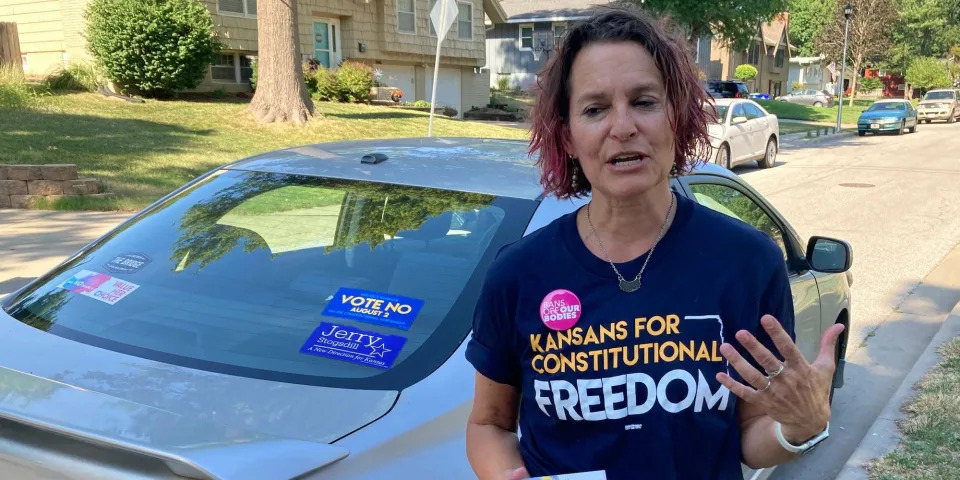
Anne Melia discusses her opposition to a proposed amendment to the Kansas Constitution that would allow legislators to further restrict or ban abortion on July 14, 2022, before she goes door-to-door to talk to prospective voters in Merriam, Kansas
John Hanna/AP

Kansas voters turned out in huge numbers to defeat an anti-abortion amendment.


Kansas rejected the amendment by a margin of over 20 points, a blowout loss.


The exceptionally high turnout is a major loss for anti-abortion groups and a warning sign for the GOP.


Kansas voters turned out in droves to summarily reject the first anti-abortion ballot measure in the post-Roe v. Wade era — and dealt a major warning sign to Republicans hoping the drastic curtailing of abortion rights nationwide won't dent their prospects in the 2022 midterms.

Amendment 2 was pushed by anti-abortion activists and would have established no right to abortion and no right for government funding for abortion under the Kansas constitution.

With over 830,000 votes counted and 99% of the vote reporting as of 12:30 a.m. ET on Tuesday, "no" was trouncing "yes" by 60% to 40%, a gaping 20-point margin.

The number of total votes cast on the amendment makes up nearly three-quarters of the votes cast in the general election in 2018, a midterm that saw a Democratic "blue wave," according to the US Elections Project. That number also comes close to matching the roughly 887,00 votes cast in the general election in 2014 and the 858,000 cast in 2010 — both midterm years where the political climate also largely favored Republicans.

With over 800,000 voters turning out to vote for the amendment — compared to 470,000 who voted in the 2018 Kansas gubernatorial primaries — the referendum demonstrated a potent motivator for abortion rights supporters. With the 2022 election ahead, abortion access being directly on the ballot could pose a serious problem for the GOP that they hadn't had to face in a world without Roe v. Wade's protections.

A "yes" vote on the measure would have eliminated the right to abortion under the state constitution, while the "no" vote left the constitutional protections to abortion in Kansas unchanged, preserving the status quo.

Lower turnout levels typically associated with primaries, especially in midterm elections, and a political environment favoring the Republican Party were initially anticipated to favor proponents of the amendment.

But before polls even closed, Kansas' chief election official, Secretary of State Scott Schwab, predicted that turnout in the August primary was on track to surpass the offices' projected 36% of the electorate and could go as high as 50%, a notably high rate for a midterm-year primary.


With over 99% of the results reporting, the "no" vote on the measure significantly outperformed President Joe Biden's vote share in several blue counties he won in the 2020 election.


Meanwhile, the "yes" vote underperformed and failed to crack 60% of the vote in several counties former President Donald Trump won handily in 2020.


In this photo from Friday, July 8, 2022, a sign in a yard in Olathe, Kansas, promotes a proposed amendment to the Kansas Constitution to allow legislators to further restrict or ban abortion
John Hanna/AP

Americans' views on abortion can, in many cases, be murky and hard to parse, but most opposed overturning Roe v. Wade, and as the result of the Kansas amendment shows, strict abortion bans or "trigger laws" are often overwhelmingly unpopular among voters of both major political parties.

And, when given the chance to shape abortion policy directly, Kansas voters displayed no appetite for enabling strict abortion bans after nearly six weeks of being faced with the real-world consequences playing out across the country.

The voters' decision upholds a 2019 ruling by the Kansas Supreme Court establishing a right to abortion under the Kansas Bill of Rights, preserving a potential legal guardrail against the kind of abortion restrictions that could be passed into law if a Republican wins the governor's race in November.

It also — for now — maintains Kansas' status as a crucial access point for abortion care in the Midwest and Southwest.

Still, Amendment 2 supercharging turnout and getting swiftly trounced at the polls doesn't spell complete doom for Republicans, who are still favored by election analysts and forecasters to win back the House of Representatives.

But it offers a warning sign ahead for the fate of future anti-abortion ballot measures, two of which are up in November in Kentucky and Montana, Republicans' hopes for muted Democratic enthusiasm and turnout for November, and — possibly — the state-level elected officials who champion harsh abortion bans and restrictions.

Google's CEO said there are 'real concerns' over productivity at the company amid a 'challenging macro environment,' reports say

  • Google's CEO Sundar Pichai has raised concerns about the company's productivity, CNBC reported.

  • Pichai told staff that Google's productivity and focus isn't where it needs to be, per CNBC.

  • He made the comments in an all-hands meeting.

Productivity and focus need to improve at Google, its CEO, Sundar Pichai, told employees in an all-hands meeting.

CNBC reported the news.

Employees at the meeting expressed concern about the wave of layoffs that have been sweeping the tech industry in recent months, employees in the meeting told CNBC.

Representatives for Google did not immediately respond to Insider's request for comment.

Google's CEO reportedly told employees at the meeting on Wednesday: "There are real concerns that our productivity as a whole is not where it needs to be for the headcount we have."

"I wanted to give some additional context following our earnings results, and ask for your help as well," Pichai reportedly said during the all-hands.

"It's clear we are facing a challenging macro environment with more uncertainty ahead," he added.

Google's HR chief Fiona Cicconi, also addressed concerns over layoffs, saying the company was "not currently looking to reduce Google's overall workforce."

In May, Insider's Hugh Langley reported that the company was slowing hiring across some of its divisions for the third quarter of 2022.

Google is launching a new program called "Simplicity Sprint"  in an effort to combat the concern over productivity and employee focus, according to related internal documentation seen by CNBC.

The initiative asks Google's workforce of more than 170,0000 employees to share ideas through an internal survey on where to improve efficiency, per CNBC


BLACKMAILING WORKERS LIVES

Baffinland issues layoff notices to more than 1,100 employees

Tue, August 2, 2022 

Baffinland Iron Mines Corp. has sent layoff notices to more than 1,100 of its employees.

The company sent the notices July 31, said spokesperson Peter Akman. The first round of layoffs is scheduled to happen Sept. 25, and the second on Oct. 11.

“The company has had to take this step out of an abundance of caution,” Akman wrote in an email to Nunatsiaq News.

Baffinland operates an iron mine on north Baffin Island, where it employs about 350 Inuit.

The company warned it would have to lay off employees if it didn’t get permission to ship six million tonnes of ore this year out of Milne Inlet.


Baffinland is currently working with a permit that allows it to ship 4.2 million tonnes of iron ore per year, since a temporary permit that allowed it to ship six million expired Dec. 31.

In May, Baffinland asked federal Northern Affairs Minister Daniel Vandal to sign an emergency order that would allow the company to skip the review process, citing the potential layoffs if its shipping limit wasn’t increased.


Asked why Baffinland didn’t apply for the permit extension earlier so the Nunavut Impact Review Board would have time to consider the application before making a recommendation to Vandal, Akman cited a number of factors, including the status of a larger application that would allow Baffinland to double the mine’s output. The company had been expecting an answer on the proposed expansion before the temporary permit expired.

Vandal denied the request for an emergency order, but has instructed the review board to treat Baffinland’s application as a priority due to the jobs at stake.

“The regulatory process is moving slowly,” Akman wrote. “As a result, Baffinland must continue to take preparatory steps to rescale its operation.”

There is still a chance the company could take back the layoff notices.

“If we receive approval to continue mining at [six million tonnes] this year as we are hoping, we will rescind the termination notices,” Akman said.

David Venn, Local Journalism Initiative Reporter, Nunatsiaq News

Termination notices sent to over 1,100 Baffinland employees on Sunday

Tue, August 2, 2022

Baffinland's Milne Inlet operations, pictured in January 2021. A company spokesperson says the company is preparing for two rounds of terminations to take effect this fall.
 (Nick Murray/CBC - image credit)

Baffinland Iron Mines sent termination notices to over 1,100 of its staff on Sunday, including 200 Inuit employees.

Baffinland spokesperson Peter Akman said the company is preparing for two rounds of terminations to take effect on Sept. 25 and Oct. 11 — if the company does not receive permission to continue extracting six million tonnes of iron ore annually from the Mary River mine.

Akman said the notices affect all employees in any aspect of the company's northern operations.

"Anyone who's working at the two sites, the port or the Mary River site, but also across Iqaluit, and across Nunavut ... Anyone who is working for us, will have potentially received the notices."

One of the employee letters, obtained by CBC News, explains the termination notice is a result of the regulatory process moving "more slowly than is necessary to meet Baffinland's operational requirements."

"As a result, pursuant to section 14.03(2) of the [Nunavut Labour Standards] Act, as of the date of this letter, you are being provided notice that on the 25th day of September 2022, your employment with Baffinland will be terminated," the letter reads.

The Nunavut Impact Review Board (NIRB) is currently reviewing a request from the company to carry on extracting ore at a similar rate as recent years, while the federal minister ponders what to do with the NIRB's recommendation that the mine not be allowed to expand as planned.

The minister of Northern Affairs, Dan Vandal, has urged the board to make its recommendation by Aug. 26. In a notice July 19, NIRB said it would be unable to meet that timeline "due to logistical constraints and existing board commitments."

Baffinland said the deadline of its production increase extension was meant to fall after the Phase 2 regulatory process was completed, but due to "a number of factors, including the COVID-19 pandemic, the authorization expired before the process concluded."

Intervenor group Oceans North has previously stated that Baffinland's situation is "a foreseeable consequence of poor management and planning," and expressed concern that the company is using the prospect of layoffs to pressure the Nunavut Impact Review Board "to approve current and future expansion of the mine."

Akman said the company is still working on getting its permit to increase its limits to six million tonnes per year, and if it is successful, then Baffinland will rescind the termination notices.

In the meantime, Akman said the letters were sent to employees last weekend "out of an abundance of caution" in the event that mine operations aren't approved by the time it meets its current production limit. He expects the company will reach that limit on the ore extraction side by mid-September, and on the shipping side by early October.

When that happens, and if no approval comes before then, Akman said the company will have "no choice" but to stop production.

"Once we reach that amount, then we have to stop," he said. "For the remainder of 2022 we will have no more work to do."

Akman didn't say whether the employees who could be terminated would be re-hired again.

Massive hailstone found near Markerville, Alta., breaks Canadian record, research group says


This record-breaking hailstone was recovered northwest of Markerville, Alta., on Monday. Its weight was recorded as 292.71 grams and its diameter as 123 millimetres.
(Francis Lavigne-Theriault/Northern Hail Project - image credit)

Tue, August 2, 2022 

A massive hailstone recovered from Monday's storm near Innisfail, Alta., has eclipsed a Canadian record, weighing in at a whopping 292.71 grams and measuring 123 millimetres in diameter, according to Western University's Northern Hail Project.

The record breaker was found under a tree canopy near Markerville, about 110 kilometres north of Calgary, shortly after the storm had passed, with several other grapefruit- to softball-sized hailstones.

The previous Canadian record holder, collected on July 31, 1973, in Cedoux, Sask., weighed 290 grams and was 114 millimetres in diameter, said the research group based in Alberta.

"It wasn't until I returned and started sifting through the bags that I found the record-breaking stone," said Francis Lavigne-Theriault, part of the group's field team, in a news release.

"It was bagged with other stones without realizing what we had in our possession."

Julian Brimelow, executive director of the Northern Hail Project, said his severe weather colleagues from around the world maintain a database of record hailstones. Only 22 hailstones, including this one, have weighed more than 290 grams.

"Finding large hailstones like this is like hitting the jackpot. So this Markerville sample joins an elite club of giant hailstones," said Brimelow.

"This stone will also help us refine our estimate of just how large it is possible for hail to grow."

The current record holder for the largest hailstone in North America fell near Vivian, South Dakota, on July 23, 2010. It weighed 879 grams and had a maximum diameter of 203 millimetres.

'It was extremely intense'

Although the discovery is exciting, Monday's storm was quite terrifying for drivers along the Queen Elizabeth II Highway between Innisfail and Red Deer.

Matt Berry got on the road at about 6 p.m. that day, and said it was "perfect" weather.

But about 10 minutes later, the storm rolled through the area, hurling massive chunks of hail down on dozens of cars on Antler Hill.

Matt Berry

"The next thing I know, my windshield was caving in on me and cracking and breaking," he said in an interview with the Calgary Eyeopener.

"My windshield is absolutely destroyed.… I was just scared of this thing coming in on top of me."

He managed to pull off to the side of the road and waited for the storm to pass. In all, it lasted for 10 to 15 minutes, he said.

According to RCMP, 34 vehicles were damaged Monday — down from an earlier estimate of 70 — while numerous people suffered minor injuries. Three collisions were caused by the storm, police said.

Stuart Brideaux, public education officer with Alberta Health Services, said local fire and EMS also attended the scene, arriving at about 6:30 p.m.

Although some people were hit indirectly by hail coming through windows and broken glass, he said no one required transportation to the hospital.

Jacques Lambert/Facebook

It's good news, considering the size of the hailstones coming down. Brimelaw said the intensity of the storm was a surprise even to his team.

"We were getting reports of grapefruit-sized hail, softball-sized hail.… Usually in an exceptional day, we maybe have tennis ball-sized hail, so six to seven centimetres. But [Monday], we had a lot of stones that were over 10 centimetres across," he said.

The Northern Hail Project team said it worked independently to confirm the record.

On Wednesday, Environment Canada said that softball-sized (10.6 cm) hail was recorded in Markerville, baseball-sized (7.5 cm) hail fell in Innisfail and Milnerton, and tennis-ball sized (6.4 cm) hail hit Sylvan Lake, Penhold and Wimborne, Alta.

Brimelow said he's not sure why the hail in this storm was so much bigger than usual, but he expects it may have something to do with an abundant amount of moisture near the ground Monday, which isn't typical in Alberta.

That element, along with the usual storm ingredients, may have come together to give more fuel to the creation of the hailstones.

"Every new data point helps inform us on what conditions are required," said Brimelow.

"Once we have measured and 3D scanned the Markerville hailstone, we can then make thin sections. The growth layers evident in those will reveal information on the hailstone's growth history in the storm."

The team may also use 3D scans to study fall behaviour and the aerodynamics of large hailstones.


Matt Melnyk

Matt Melnyk, a storm chaser in Alberta, also wonders what led to the hailstones' size. He went to Innisfail Monday to assess and take photos of the storm.

"This particular storm had a very, very large rotating updraft, which kept the hail inside the storm for a long period of time," he said in an interview with CBC Calgary News at 6.

"It was extremely intense."

WATCH | Storm chaser Matt Melnyk describes what it was like to follow Monday's hailstorm near Innisfail:

Brimelow said one of the reasons why his team is so motivated to better understand these storms is because they know how they can impact people's lives.

"Our hearts really go out to those folks because we understand how devastating it can be."

Cleanup continued Tuesday

Geoff Tagg saw that devastation with his own eyes.

He's the owner of Tagg's Extreme Towing Ltd. in Red Deer. His team was called to help out just north of Innisfail on Monday evening, and he thinks dozens more cars were mangled by the storm.

"All hell was breaking loose.… There were approximately 100, maybe a few more than that, up there with all kinds of damage," he said.

"The windshields were just busted. A couple of them looked like somebody had body slammed the front."

A number of towing companies showed up to help move cars off the road, Tagg said. They were on scene until about 3 a.m., and at least one company continued working through Tuesday to get cars out of the area.

The Insurance Bureau of Canada said it may not have estimates around insured losses for several weeks.

Matt Melnyk

But, if your vehicle is struck by hail, there are a number of steps you should take.

First, take pictures of the damage from all angles, according to Rob de Pruis, national director of consumer and industry relations with the bureau.

Next, reach out to your insurance representative and provide as much detail as possible.

"The sooner you can get the claim in, the better, but you do have a period of two years to get everything related to your claim finalized," he said in an interview with CBC Edmonton News at 6.

You may want to purchase optional comprehensive coverage, de Pruis said. It covers hail, wind and water damage to your vehicle.


Matt Berry

If you pay any extra expenses, make sure to keep those receipts.

"If you can't drive your vehicle, if you get your vehicle towed to the nearest repair facility, keep the receipt for that tow because that can be covered under your insurance policy as well."

Berry is one of several drivers who had his vehicle towed to a nearby lot. He got a ride home from his mom, who lives nearby.

After the whole ordeal, he said he'd advise anyone heading out on the road to take weather warnings seriously and stay home if possible.

"I would have never guessed that that could have happened that quickly," he said.

"It was insane."

Yet another severe thunderstorm hit Alberta on Monday night, with hail the size of softballs cracking windshields and damaging cars. Sarah Chew finds out how much these storms cost insurance.


Severe weather in Alberta: Golf ball-sized hail smashes cars along major highway

Aug 2, 2022
Global News

Hail the size of softballs fell from the sky Monday as a storm ripped through central and southern Alberta.

Vehicles had pulled off the Queen Elizabeth II Highway on Monday evening between Calgary and Red Deer to wait out a hail storm that had damaged many cars.

According to the RCMP, 70 vehicles had their windshields and windows smashed out by the storm. First responders from Innisfail had set up a triage station for those who need help, RCMP told Global News.

Late July and early August are typically active weather times for Alberta. The province has seen several severe weather alerts — including tornado watches and warnings — all long weekend.


Crazy tennisball sized hail storm in Alberta Canada! Even tornado and flooding footage


Incredible moments in the car whose windows were broken due to hail! Crazy hailstorm in Alberta!


Dozens of wrecked cars in Canada! Crazy hailstorm hits Innisfil, Alberta!

 
Tornado warmed storms with destructive Hail in Pine Lake Alberta

Aug 1, 2022

Strong tornado warned thunderstorms produced hail the size of baseballs a few big lightning strikes and heavy rain and intense rotation. This was a really bad storm for the 1st day of August. Severe hail damage occurred on our Van the back windows blown out and the windshield was very beat up and a lot of damage on the outside. Do not watch if you do not like swearing. I apologize things just got super intense.


Destructive hailstorm in pine lake Alberta Includes aftermath


Live footage as storm hits Canada ! ⚠️ Incredible storm hits Alberta and Saskatchewan


 Grapefruit-sized hail' fell Monday in Alberta, and it may break a record

Aug 3, 2022

Shorts hub

Hail as big as tennis balls, softballs and eggs fell in Alberta: Environment Canada

But about 10 minutes later, just after 6 p.m., it was an entirely different story. A storm rolled through the area, hurling massive chunks of hail down on dozens of cars stopped along Queen Elizabeth II Highway.

Berry was just north of Innisfail, near Antler Hill, when it struck.

"The next thing I know, my windshield was caving in on me and cracking and breaking," he said


Coronation Alberta Canada tornado: 31 July 2022

White snowy rivers in summer! Heavy hail all over Quito, Ecuador
Aug 3, 2022


Genuine Earth
Natural disaster 3 August 2022. 

White snowy rivers in summer. Heavy hail all over Quito, Ecuador Rain and heavy hail turned the squares and streets of southern Quito into white icy rivers. According to the National Institute of Meteorology and Hydrology, this phenomenon is due to a number of factors that contribute to the formation of clouds, including the humidity of the environment, which adds the possibility of precipitation in the afternoon to the morning sunlight. . in the south of the capital, the sewer system collapsed. At the time of publication of this informational note, no other news was recorded due to rain. #Quito #Ecuador #hurricane #wind #wave #hail #storm #flood #rain #weather #Naturaldisasters #news A natural disaster is a serious adverse event caused by natural processes on Earth; examples include floods, hurricanes, tornadoes, volcanic eruptions, earthquakes, tsunamis, storms, rain, hail, wildfires, waves, wind, snow, weather, and other geological processes.


Alberta NDP slams UCP, ex-finance minister for big COVID-19 bonus to health chief

EDMONTON — Alberta Opposition Leader Rachel Notley says the United Conservative Party government, particularly former finance minister Travis Toews, must bear the responsibility and fallout for the record-setting six-figure bonus payment to the chief medical officer of health.

Alberta NDP Opposition Leader Rachel Notley

Notley said Wednesday she isn’t passing judgment on whether the payout to Dr. Deena Hinshaw is merited.

But she said the payout has to be set against a government that, at the same time, was trying to cut the pay of front-line health workers in collective bargaining during the COVID-19 pandemic.

“It is jaw dropping to me that they would then turn around and offer up a 60 per cent bonus to someone who had — by her own admission — chosen not to completely exercise her authority and (instead) hand over decision-making power to an incredibly ill-informed cabinet,” Notley told reporters in Calgary.

The CBC, gleaning information from the government’s sunshine salary list, reported Monday that Hinshaw received a bonus of almost $228,000 for COVID-19 work in 2021 — the highest such cash benefit payout to any provincial civil servant since the list went public six years ago.

That figure, on top of her regular salary, put Hinshaw’s pay at more than $591,000.

Unions, including the Alberta Union of Provincial Employees have, like Notley, lambasted the payout as a travesty given the concurrent government steps to reduce pay and jobs in front-line health care.

Notley also said Toews’ claim he didn’t know about the payment cannot be believed.

“If it is true, then it is demonstrative of someone who has no business being finance minister in any government, and certainly not leading in government,” she said.

“There’s just no way that this should have happened under his watch.”

Toews is one of seven contenders seeking to replace Premier Jason Kenney, who announced he will soon be resigning the leadership after gaining a lacklustre 51 per cent support in a party leadership vote.

He and two other candidates left cabinet to avoid a conflict of interest during the race.

Christine Myatt, Toews’ spokesperson, responded to Notley in a statement.

"Mr. Toews did not authorize or approve this payment. In fact, he was not aware it was made. It appears this bonus was paid out by the public service without ministerial sign off,” said Myatt.

“Mr. Toews believes that Albertans expect their tax dollars to be spent wisely and with the greatest oversight.

“That is why he has promised to change the rules to ensure this does not happen again."

Toews’ campaign team tweeted out Wednesday a graphic stating that no new bonuses would be authorized without a cabinet minister’s explicit authorization.

The payout has reopened public divisions and debate over Hinshaw and the government’s handling of the pandemic and the health restrictions it imposed to combat the spread of the illness.

Kenney and Hinshaw have been criticized for acting too late in multiple waves of the pandemic. Hinshaw has also been criticized for not exercising more authority under emergency legislation, but instead subordinating her role to one of cabinet adviser rather than independent decision maker.

The issue threatens to become a wedge topic in the leadership race, with candidates such as former Wildrose party leaders Danielle Smith and Brian Jean wooing the section of the party base that bitterly resented vaccine mandates and other government-mandated restrictions.

“(The slogan) ‘we’re all in this together’ didn’t mean what we thought it did," Smith wrote on Twitter Monday. "Albertans are rightly stunned and outraged they gave Dr. Hinshaw a $228K COVID bonus."

Smith has promised that if she wins the Oct. 6 vote to replace Kenney, she will not impose any such restrictions again.

Jean wrote on Twitter on Monday: “While Albertans were losing businesses, while our health system was collapsing under mismanagement, the people on the Sky Palace balcony signed off on an all-time record bonus.”

Sky Palace referred to Kenney, Toews and others, being caught on camera having drinks and ignoring gathering rules while on the balcony of the Federal Building, near the legislature, during COVID-19.

It has come to symbolize the one-rule-for-us, another-for-them criticism of Kenney’s administration during COVID-19.

Alberta Health has said Hinshaw was paid as per a long-standing policy and financial calculation tied to emergencies.

The payout was one of the COVID-19 bonuses paid to 107 employees in management totalling $2.4 million.

This report by The Canadian Press was first published Aug. 3, 2022.

Dean Bennett, The Canadian Press