Wednesday, November 02, 2022

Metal detectorist stumbles across Viking treasure hoard in Norway

JoAnna Wendel 

Many people dream of finding buried treasure, but very few people actually do. For one man in central Norway that dream became a reality just before Christmas last year, when he took his metal detector for a stroll in a field near his home and unearthed a hoard of silver fragments from the Viking Age.


null© Brigit Maixner

At first, Pawel Bednarski wasn't sure of the value of the fragments he'd found buried under just a couple of inches of soil. There were a pair of rings, what looked like chopped-up Arabic coins and fragments of a silver bracelet, among other pieces. But when he reached out to local historians and archaeologists, the truth became clear: This was a significant find.

"It's been many years since such a large Viking treasure was found in Norway," Birgit Maixner, an archaeologist at Norway's University of Science and Technology (NTNU) in Trondheim, said in a statement.

Related: 2 Viking swords buried upright might have connected the dead to Odin and Valhalla

The silver fragments date back around 1,100 years to the eighth and ninth centuries — during the Viking Age, which lasted for about 200 years between the ninth and 11th centuries. The fragmentation of the objects suggests that these pieces were not just personal belongings but were also used as money. Vikings operated under a so-called bullion economy rather than a bartering economy, which means that rather than trading good-for-good, such as a sheep for a cow, they traded pieces of precious metals at set weights for goods. Minted coins were not commonly used in Norway until the late ninth century.

The weight system "was in use in the transition between the barter economy and the coin economy," Maixner said.

The 46 silver fragments weigh 1.5 ounces (42 grams), or about the weight of a golf ball. Maixner said that based on what we now understand of the Vikings' value system, the silver was worth a little more than half a cow — quite valuable for a time when owning five cows was about average for a medium-size farm.

While the silver fragments may have once been used by Vikings, Maixner isn't sure how the treasures ended up in Norway. The Arabic coins, which was the main source of silver in Scandinavia during the Viking Age, are older than what is usually found in Norway. Archaeologists usually find Arabic coins from the ninth and 10th centuries in Norse treasure, but these coins are from the eighth century. And the silver bracelet looks more like jewelry that's typically found in Denmark.

"The fact that this person had access to an entire broad banded bracelet, which was primarily a Danish item, might suggest that the owner had been to Denmark before traveling to this area in mid-Norway," Maixner said.

As for why or how the treasure ended up in the field, no one can say, Maixner said. Perhaps the owner was stashing it to retrieve later, or was leaving it as an offering to the gods.
World’s largest container shipping firm Maersk, a barometer for global trade, warns of 'dark clouds on the horizon'

Elliot Smith - 16h ago


The Danish giant, widely seen as a barometer for global trade, reported earnings before interest, taxes, depreciation and amortization (EBITDA) of $10.9 billion for the quarter.

CEO Soren Skou said the "exceptional results" were driven by a continued rise in ocean freight rates, but said it was clear that these have peaked and will begin to normalize in the fourth quarter.


Maersk on Wednesday posted a record third-quarter profit but warned of 'dark clouds on the horizon' as shipping container demand weakens.© Provided by CNBC

Maersk, the world's largest container shipping firm, on Wednesday posted record profit for the third quarter on the back of high ocean freight rates, but noted a slowdown in demand.

The Danish giant, widely seen as a barometer for global trade, reported earnings before interest, taxes, depreciation and amortization (EBITDA) of $10.9 billion for the quarter, above consensus analyst projections of $9.8 billion and up around 60% from the same period a year ago.

The company confirmed its full-year guidance for underlying EBITDA of $37 billion and free cash flow above $24 billion.

CEO Soren Skou said the "exceptional results" this year were driven by a continued rise in ocean freight rates, but said it was clear that these have peaked and will begin to normalize in the fourth quarter amid falling demand and an easing of supply chain congestion. Skou flagged that earnings in Maersk's ocean operations will come down in the coming months.

"With the war in Ukraine, an energy crisis in Europe, high inflation, and a looming global recession there are plenty of dark clouds on the horizon," Skou said in a statement Wednesday.

"This weighs on consumer purchasing power which in turn impacts global transportation and logistics demand. While we expect a slow-down of the global economy to lead to a softer market in Ocean, we will continue to pursue the growth opportunities within our Logistics business."

In its second-quarter report, Maersk flagged an impending slowdown in global shipping container demand amid weakening consumer confidence and supply chain congestion.

The company said Wednesday that global container demand is expected to contract between 2% and 4% in 2022, down from a previous projection of +1% to -1%, noting that freight and charter rates declined in the third quarter as demand moderated and Chinese Covid-19 restrictions diminished.

Maersk shares were down 6% during early trading in Europe
Russian journalists defy Putin to report on casualties in Ukraine

Markus Ziener - Yesterday

Soldiers from Buryatia, a small Republic in Siberian Russia, were among the first to be sent to the front lines in Ukraine. And they were among the first to die there.


The body of a Russian serviceman lies near destroyed Russian military vehicles on the roadside on the outskirts of Kharkiv, Ukraine, on Feb. 26, 2022. (Sergey Bobok / AFP/Getty Images)© Provided by LA Times

When journalist Yelana Trifonova heard about a memorial service for the fallen, she immediately bought a ticket for the eight-hour trip from her home in Irkutsk to Ulan-Ude, the capital of Buryatia. “I wanted to know what was going on there,” said the 46-year-old who works for the online platform Lyudi Baykal. “I wanted to feel the atmosphere, and I wanted to look into the faces of the relatives.”

Trifonova and fellow reporter Olga Mutinova, 44, reported the story of the funeral; Trifonova wrote it, and it was published on April 28 on the landing page of Lyudi Baikala, with photos and video.

Trifonova said she had to do the story, no matter the consequences. But the consequences of defying the Russian government can be steep.

One third of the roughly 1 million people of Buryatia, which shares a border with Mongolia, are ethnic Buryats and mostly of the Buddhist faith. The average monthly salary in Buryatia is about one-third of what people earn in Moscow, and the Russian military is an attractive employer for young people.

Beginning in early March, mourning ceremonies for soldiers who died in Russia’s war on Ukraine were held in the large hall of the Lukodrome, a sports complex in the center of Ulan-Ude. When Trifonova arrived, traffic police had already blocked off the entrance for cars.


A Buddhist funeral service is held for a Russian soldier in the city of Ulan-Ude in East Siberia, Russia.
(Lyudi Baykal)© (Lyudi Baykal)

Inside, rather than the one coffin that was originally announced, there were four. The first held 24-year-old Naidal Zyrenow, a local student of the year in 2016, who served in the Russian army as a paramedic. Naidal’s hands were crossed on his gray uniform jacket. One hand was bandaged.

The second coffin held the remains of 35-year-old Bulat Odoev, who served in the 5th Armored Brigade and is survived by a pregnant wife and daughter. The body of Shargal Dashiev, 38, who left behind a pregnant wife and two daughters, was in the third. Vladislav Kokorin, 20, who grew up in a children’s home and then went into foster care, was to be buried in the fourth.

Three of the dead were Buddhists and were buried according to traditions associated with the religion. In her story, Trifonova wrote that three Buddhist lamas stood up and began to walk around the coffins — as did the relatives. Not one sound of weeping could be heard.

Buddhists, Trifonova wrote, are not supposed to mourn loudly. After death, the soul must make its way to heaven to then return — after 49 days — in a new body. Tears would block the journey of the deceased and prevent him from letting go.

The ceremony brought clarity for Trifonova. “It became so clear to me why Russia was sending the Buryats first,” she said. “They belong to a small people in Russia, they are poor, they are humble, they are not Slavs — and they do not complain.”

Many of the families, she added, did not want to blame the government, even at the moment of their greatest grief.

“But this isn’t fair,” Trifonova said. “They don’t dare to take people from Moscow or St. Petersburg, so they turn to the ones who are showing the least resistance like Buryats, Tuvans or Dagestans.”

After the collapse of the Soviet Union in 1991, Russia started to enjoy a lively and pluralistic media landscape. New journals and dailies sprang up, and some of the more established ones were shedding their roles as mouthpieces for the government. Even a government newspaper like Izvestia became informative and readable in the ’90s.

But when Vladimir Putin came to power, expressing dissenting views became increasingly difficult. Pressure on the media to conform with government regulations was stepped up. A number of journalists were killed in Russia, the most prominent of whom was Anna Politkovskaya, who reported about the war in Chechnya for the Novaya Gazeta and died in 2006.


A woman places flowers before a portrait of slain Russian journalist Anna Politkovskaya in Moscow. (Pavel Golovkin / Associated Press)© (Pavel Golovkin / Associated Press)

Eventually, the Russian government withdrew the licenses of the few remaining independent news organizations, and they had to shut down. A relatively new law forbids contradicting the Kremlin’s language rules, which prohibit the use of certain words (“war," “invasion”) to describe the fighting in Ukraine.

Before moving to Lyudi Baykal, Trifonova and Mutinova worked for more than 10 years at Vostochno-Sibirskaya Pravda, a newspaper that was founded shortly after Russia's October Revolution of 1917 and is based in Irkutsk. But in the last few years, it had been increasingly toeing the line of the local government.

“The censorship didn’t come overnight, it came gradually,” Mutinova recalled. “Ten years ago, it was still possible to criticize the governor. Five years ago, this was already a no-go.”

The limits on reporting became tighter every year as the newspaper became more dependent on state funding. “If we wanted to write about the conditions in the local prison or even mention the name of Alexei Navalny we crossed a red line,” Mutinova said, referring to Russia's best-known dissident. “The same was true if we simply wanted to report on protests taking place in the main square in Irkutsk.” What was left to write were innocuous stories about nature or the local hospital, she said. “This is not the journalism we stand for.”


Russian opposition leader Alexei Navalny appears on a screen at Moscow City Court on May 24, 2022. (Alexander Zemlianichenko / Associated Press)

Shortly after the Russian war in Ukraine started, Mutinova and Trifonova assumed editorial responsibility for Lyudi Baikala. The website used to belong to Vostochno-Sibirskaya Pravda but had become independent thanks to a private investor. There they reported and wrote stories — concentrating their reporting on the Irkutsk/ Baikal region — about the dead and the wounded, about the tragedies of war, about the mobilization of soldiers and about cases of corruption.

“Once reporters were there to control the people in power,” Mutinova said. “This is what we are supposed to do.”

Now, however, the journalists have to publish behind an invisible curtain.

On April 16, Roskomnadzor, Russia’s federal media regulator, declared, without giving any reason, that it would block access to the news outlet. The website can be accessed only through a virtual private network, or VPN, which connects users to a private server that encrypts internet traffic and allows them to bypass restrictions. According to Trifonova and Mutinova, Russians are increasingly turning to VPNs to get independent information.

After Lyudi Baikala was officially blocked, Mutinova and Trifonova said donations rose and messages of encouragement and gratitude poured in. “The story about the funeral in Ulan-Ude was read about 80,000 times,” Mutinova said. “Some of our videos have been viewed hundreds of thousands of times.”

Trifonova added: “People have been brainwashed for months by official propaganda and repeated their version of why we are at war with Ukraine” — that the operation was necessary to cleanse Ukraine of Nazis, to liberate the oppressed people of the Donbass and to show the West that Russians can’t be bullied around. “But now as the war is getting closer, and the victims and the sufferings can no longer be concealed, more and more are waking up.”

Since the start of the war in Ukraine, thousands of Russian journalists have paid a price for spreading “fake” news about the military. Sanctions have ranged from fines to sentences of five days in jail to years in prison.

Journalists who attended the funerals in Ulan-Ude were questioned by the police and told to stop reporting on them. On Sept. 23, Mutinova and Trifonova were handcuffed and arrested by local police in Irkutsk, and freed after three hours of interrogation. No charges were filed. A case is currently underway against them for allegedly distributing fliers that say, “No to war.”

Mutinova and Trifonova were arrested only two days after the partial mobilization of 300,000 Russian military reservists was announced. The measure led to many thousands of younger Russians fleeing the country to escape the draft.


A Buddhist funeral service is held for a Russian soldier in the city of Ulan-Ude in East Siberia, Russia. (Lyudi Baykal)© (Lyudi Baykal)

“The mobilization is the big game changer,” Olga says. “Now no one can claim that the war is none of their business. The war has arrived in every house, in every apartment.”

Lyudi Baikala is publishing a running list of the dead. So far, 336 Buryats and 78 soldiers from the Irkutsk Oblast have returned in wooden coffins. Russian authorities long ago stopped publishing any numbers.

Back in March, when the funeral ceremony at Ulan-Ude’s Lukodrome was drawing to a close, officials stepped up to the microphone. Bair Tsyrenov, deputy chairman of the government of the Republic of Buryatia, said of the fallen soldiers. “They died for the greatness of Russia, for the end of bloodshed in Ukraine.”

Ulan-Ude Mayor Igor Shutenkov announced: “They fell to defend the future of our country.”

Lt. Col. Vitaly Laskov, commander of the 11th Airborne Assault Brigade, added, “The paratroopers took their last leap into the sky.”

“There was no sobbing,” Trifonova recalls. “Only pain-filled silence.”

Markus Ziener is a special correspondent.

This story originally appeared in Los Angeles Times.
Greta Thunberg: It's time to overthrow the West's oppressive and racist capitalist system

India McTaggart - TELEGRAPH

From a climate change campaigner to presenting a new far-Left political agenda against “racist” capitalism - meet the new Greta Thunberg.


Greta Thunberg - Tim Whitby/Getty Images© Tim Whitby/Getty Images

The 19-year-old Swedish activist has announced that as well as tackling her usual area of climate action and awareness-spreading, she has now thrown her weight behind defeating the West’s “oppressive” capitalist system.

Calling for a “system-wide transformation” at her book launch in London, she claimed that the world’s current “normal” - dictated by the people in power - has caused the climate breakdown.

She said: “We are never going back to normal again because ‘normal’ was already a crisis. What we refer to as normal is an extreme system built on the exploitation of people and the planet.

“It is a system defined by colonialism, imperialism, oppression and genocide by the so-called global North to accumulate wealth that still shapes our current world order.”

Ms Thunberg added: “If economic growth is our only priority, then what we are experiencing now should be exactly what we should be expecting.”

Appearing at London’s Royal Festival Hall to launch her new book, The Climate Book, on Sunday night, she decided to venture into political waters in her speech - having previously avoided doing so.


Released last week, the book includes around 100 contributions from various climate experts, including writer Naomi Klein, Tedros Adhanom Ghebreyesus, chief of the World Health Organization, and Thomas Piketty, the economist.

Expressing views that seemed more radical than in the past, she added that the climate crisis “has its roots in racist, oppressive extractivism that is exploiting both people and the planet to maximise short-term profits for a few”.

People were quick to point out the political emphasis on social media, with one best-selling author saying “this is proof that Greta hates capitalism for reasons that have nothing whatsoever to do with climate change”.

Related video: Greta Thunberg: 'In order to create societal change, we need people leading the way'  Duration 2:07  View on Watch

Michael Shellenberger, an American author, posted on Twitter that the “whole capitalist system” Ms Thunberg referred to has led to larger food surpluses than at any point in history, average human life expectancy to rise from 30 to 70 and a drop in total deaths from natural disasters.


Ms Thunberg told Samira Ahmed, the BBC journalist, during a question and answer part of the evening that “fascist movements offering easy, false solutions and scapegoats to complex problems are growing and becoming more normalised”.

When asked by Ms Ahmed whether she thought it was as simple as making laws that outlaw things, she responded: “There are many [things we can do], but while we do these things that we can do within our current system, we have to realise that we need a system-wide transformation.

“We need to change everything because right now our current system is on a collision course with the future of humanity and the future of our civilization”.


Thunberg - Kate Green/Getty Images© Provided by The Telegraph

Ms Thunberg also described the upcoming Cop27 as a forum for “greenwashing” and said she would not be attending.
The teenager, who is widely hailed as the world’s spokesman for climate change, shot to worldwide fame after attending her first United Nations climate conference in 2018, when the then 15-year-old said: “I expected it to be more action and less talking.”

During the question and answer session on Sunday, she said: “I’m not going to Cop27 for many reasons, but the space for civil society this year is extremely limited.”


This year’s conference, taking place from Nov 6 to 18 in Sharm El Sheikh, Egypt, will see world leaders - including Rishi Sunak - gather to discuss the pressing climate crisis.

“Of course, it’s very symbolic that it’s held in a tourist centre - a tourist paradise - in a country that violates most of the basic human rights - and many world leaders are too busy to go there,” she added.


Addressing the coverage of her political take in the new book on Wednesday morning, she posted on Twitter:
Ms Thunberg attached an image of an excerpt from the book alongside the post, which she said was her take on “systems and ideologies”.

'#TrumpIsDead' is trending on Twitter after a verified user apparently decided to test moderation of the platform under Elon Musk's reign

insider@insider.com (Kali Hays) - 

Elon Musk (left) and Donald Trump. Andrew Kelly, Gaelen Morse/Reuters© Provided by Business Insider

A comedian intentionally started the claim, in what could be a test for Elon Musk.

The claim was trending on Twitter. Trump's office didn't respond to a request for comment.

Musk's handling of moderation on the platform has quickly become an issue under his leadership.

A comedian and actor is putting Elon Musk's control of Twitter and its moderation practices to the test.

Tim Heidecker, known for his standup and TV work with fellow comedian Eric Wareheim, on Tuesday started the hashtag #TrumpIsDead on Twitter, owned by Musk since Thursday. In a short series of tweets regarding former president Donald Trump, Heidecker wrote "Trump is dead (died badly) and tagged Musk in saying the billionaire "suppressed this news (or has he?)"

"Many are sad by the news," Heidecker went on. "I heard he died in a sad and sick way (not as a dog, but this reporting could change soon)." The comedian is verified on Twitter, with a blue check mark by his name.

Within an hour, Heidecker's tweets had amassed close more than 20,000 likes, thousands of retweets and #TrumpIsDead began trending on Twitter on Tuesday. Musk had yet to respond to or comment on the posts. He has remained a very active user since his takeover, tweeting and responding to other tweets numerous times each day.

Twitter and Musk did not respond to a request for comment. An email sent to Trump's office seeking comment did not get a response on Tuesday evening.

Moderation misinformation, disinformation, hate speech and other problematic content on Twitter has quickly become an issue under Musk's leadership -- so much so that Musk changed his Twitter bio on Monday from Chief Twit to Twitter Complaint Hotline Operator.

The use of slurs and hate speech grew exponentially in the days following Musk's takeover. The platform has also limited the number of employees allowed to remove such content since he took over, as Bloomberg reported. Although Twitter's head of safety and integrity, Yoel Roth, said Twitter's rules were "still being enforced at scale" amid the Musk transition.

"This is exactly what we (or any company) should be doing in the midst of a corporate transition to reduce opportunities for insider risk," Roth said of the reduced access to moderation tools.

Heidecker's thread could prove a notable trial for Roth and Musk. Commenters on the thread quickly hopped onto the joke, proposing numerous satirical but fake additions to what did or may have become of Trump, from an attack of bees to a death involving McDonald's.


GOOD NEWS
Courts, government bills are unravelling Harper-era crime laws

Ben Andrews - 

The list of criminal laws passed by the Stephen Harper government that have since been struck down by Canadian courts is growing steadily.


Criminal laws introduced under former prime minister Stephen Harper imposed mandatory minimum sentences and otherwise bolstered punishment for a range of criminal offences.© John Woods/Canadian Press

The trend's latest casualty came Friday, when the Supreme Court of Canada overturned a 2011 change to the Criminal Code that required sex offenders to be automatically added to the National Sex Offender Registry — a lifelong designation for anyone convicted of two sex offences or more.

In a split decision, the court found that the law was "over-broad" and cast "too wide a net" because it captured offenders who presented a low risk of re-offending.

The decision is just the most recent in a long series of court rulings that have undone Harper-era sentencing reforms.

"The Harper sentencing law legacy has caused many years of litigation at extraordinary public expense, but it is slowly but surely being undone," Lisa Kerr, a professor of criminal law at Queen's University, said in an email.

Three laws creating mandatory minimum sentences that were passed by Harper's Conservative government have now been struck down by the Supreme Court, and another 25 have been struck down in various provinces and territories, according to research by Toronto-based lawyer Matthew Oleynik.

Taken together, the rulings suggest that Canadian courts are likely to reject future attempts by lawmakers to limit the decision-making power of judges in sentencing, or to enforce blanket approaches to punishment, several criminal and constitutional law experts told CBC.

'One-size-fits-all' approach


Many of the Harper-era criminal law reforms were contained in three major pieces of legislation: the omnibus Safe Streets and Communities Act in 2012, the Protection of Communities and Exploited Persons Act in 2014 and the Tougher Penalties for Child Predators Act in 2015.

These acts, among others, introduced mandatory minimum sentences and otherwise bolstered punishment for a range of criminal offences.

Eric Gottardi, a Vancouver-based lawyer and defence attorney, said "law and order" policies remain popular with voters — despite research from Canada and the United States suggesting that longer jail terms and harsher penalties do little to reduce crime.

Gottardi said he testified at committee hearings during Harper's time in office to warn lawmakers that the bills might be unconstitutional.

"The prior government just tried to paint whole classes of people with a broad brush," Gottardi said. "Justice doesn't have to be a one-size-fits-all kind of approach."

Carissima Mathen, a professor of constitutional and criminal law at the University of Ottawa, said blanket rules on sentencing are "often just too crude of a tool."

But mandatory minimum sentences agreed with the "tough on crime" messaging of the government at the time, University of Guelph professor of political science Kate Puddister said in an email.


'A critical shift in the law'

Conservative justice critic Rob Moore questioned the latest Supreme Court decision.

Because of the ruling, he said, many people convicted of sexual offences will be exempted from being listed on the registry. He said the original legislation was supported by all parties when it was passed.

"This is a critical shift in the law and it disproportionately impacts women and children. It must be taken very seriously," Moore said in an email statement.

Other Harper-era crime laws may soon face challenges.

The Supreme Court will rule Friday on a case that tests the constitutionality of a law that prevented a judge from allowing a young Indigenous woman to avoid jail by serving a conditional sentence.

And the government of Prime Minister Justin Trudeau is pushing back Harper-era sentencing changes as well. Legislation is before the Senate that would eliminate mandatory minimum penalties for 14 firearm and tobacco-related offences and six drug offences.

"Any mandatory minimum penalty is on difficult footing," Gottardi said.
Surrey teachers call for more staff, specialists to deal with 'impossible workload'

CBC/Radio-Canada - 


Teachers in Surrey, B.C., are calling on the local school district, federal politicians and school trustees to help recruit more specialist teachers to improve classroom working conditions and provide student services.


A student is pictured at an elementary school in Surrey, B.C. Teachers in the district are asking for more specialist teachers to help deal with "impossible workload" and improve working conditions.© Ben Nelms/CBC

The B.C. Teachers' Federation (BCTF) reached a tentative contract agreement on Monday that offers significant salary gains and other important benefits.

However, the president of the Surrey Teachers' Association says the new agreement does not do enough to address the "impossible workload" teachers are currently experiencing, especially when it comes to providing services for students with behavioural challenges.

"When specialist teachers are absent, and when programs and services cannot be maintained, then there are more opportunities for students to become dysregulated," Jatinder Bir said in a written statement on Monday.

The Surrey School District has more than 78,000 students and 13,000 staff and is the largest and fastest-growing district in B.C.

Bir said teachers have been making distress calls to the union about overcrowded classrooms and loss of service because there is not enough staff or specialists like school counsellors, psychologists and speech pathologists. Some teachers have taken early retirement, while others have gone on medical leave.

"New and veteran teachers are looking for ways to leave the profession."

Specialists not replaced immediately


Lizanne Foster, the first vice president of the Surrey Teachers' Association, says specialist teachers are not replaced from the first day they are absent, and some staff are not replaced until the new school year.

"All these specialists that help students ... when they are absent, they are not replaced. When they go and leave, they are not replaced. Sometimes the school psychologist is not replaced for an entire year," Foster told CBC's The Early Edition on Tuesday.

Last month the district asked the province to build more schools after welcoming 1,300 more students than it had projected last spring.

"A lot of those students are refugee children ... and they might not have gone to kindergarten, they might not have gone to first year. After the pandemic, lots of kids had learning loss ... and specialist teachers can fix that," she said.

Foster says students continue to fall behind in numeracy and literacy because of prolonged absence or redirection of specialists in schools.

"Currently, in the best-case scenario, some specialists are replaced after three days of absence, some are not replaced for the entirety of the school year," Bir said.

He said other school staff are often tasked with covering classroom teacher absences, which means students could lose out on things like music class and time in the library.

"I have on multiple occasions seen students cry upon being told that they were missing music for that day ... and we've had times where students miss weeks of music in a row due to failures to fill," said a Surrey school music teacher.
The dispute between Ontario's government and education workers, explained

Laura McQuillan - 

As contract talks between Ontario's government and thousands of education workers devolve into a legal battle, labour experts are split over whether the workers' big pay raise request is a reasonable one — and whether the public will be on their side.

The Canadian Union of Public Employees (CUPE) is asking for an 11.7 per cent annual raise for 55,000 workers, including education assistants, early childhood educators, custodians and administrative assistants.

The pay hike request may appear staggering to many Canadian workers, who won't get a raise anywhere near that scale this year, even with inflation at about seven per cent.

But labour economists who spoke with CBC News say there's a deeper context behind the education workers' pay hike demand — including a decade of frozen wages that CUPE says has left the workers struggling to afford to live.

Here's a look at where the dispute stands and how the workers' pay raise request stacks up.

What's the latest?


On Tuesday afternoon, CUPE said its negotiators at the bargaining table would propose a "counter-offer" to the government. It was not immediately clear what the union was prepared to concede — or whether the government would accept it.

For now, the education workers still plan to walk off the job in protest on Friday, after Doug Ford's government introduced legislation on Monday to ban the workers from striking following a breakdown in collective bargaining.

Ontario's government also said it would use the notwithstanding clause in the Charter of Rights and Freedoms to avert any constitutional challenges to the legislation.

Several school boards, including the Toronto District School Board, Peel District School Board, Ottawa Catholic School Board, Thames Valley District School Board, Waterloo Catholic District School Board and Hamilton-Wentworth Catholic District School Board, said they would close for in-person learning on Friday if the walkout went ahead.

What do the education workers want?


The education workers are asking Ontario's government for an 11.7 per cent annual raise, as well as overtime at twice the regular pay rate, 30 minutes of paid prep time per day for educational assistants and early childhood educators, an increase in benefits and professional development for all workers.


CUPE Ontario president Fred Hahn is shown in Toronto on Monday. The union represents 55,000 education workers who are seeking an 11.7 per cent annual pay increase.© Evan Mitsui/CBC

CUPE says the workers earn, on average, about $40,000 a year. An 11.7 per cent raise would give them $3.25 extra an hour, or about $4,800 extra per year (based on being paid for 35 hours per week for 43 weeks each year).

The Progressive Conservative government's final offer was a 2.5 per cent annual raise to workers making less than $43,000, and 1.5 per cent for those earning more, either of which would mean a raise of about $1,000 per year.

What's behind the 11.7 per cent figure?


Although CUPE is asking for a much higher pay raise than most workers, or even other unions, are seeking this year, it says it's trying to make up for years of stagnant pay.

From 2012 to 2021, the education workers' wages increased about 8.5 per cent. Over the same period, inflation in Ontario rose 17.8 per cent, meaning the workers essentially took a massive pay cut over that period.

How unionized wages in Ontario compare to rising inflation

"We should try and avoid the sticker shock of the [11.7 per cent] number," said Charles Smith, an associate professor of political science at the University of Saskatchewan in Saskatoon who researches labour history and unions.

"CUPE workers in the education sector have had, essentially, wage freezes for over a decade and haven't seen a significant cost-of-living increase."

How does it compare to other workers' raises?

Other unionized workers have settled for far less this year.

In Ontario, the average annual wage increase in settlements ratified so far this year is 2.6 per cent, above the national average of 1.8 per cent, according to provincial and federal government data.

Given those figures, CUPE's pay ask may rub other Canadians the wrong way — and even pit them against the education workers.

"[It] might not be palatable to unionized workers, [and] you would hear from scores of thousands of private-sphere workers that are not only not getting a raise, but they are either suffering from downsizing in their jobs, layoffs, terminations and, certainly, salary freezes," said Toronto employment lawyer Sunira Chaudhri.

"I think that's exactly where the Ford government is going to get some support."

It's unclear what level of support the workers might have from parents, who want their children to stay in class after two years of COVID-19 pandemic disruptions.

Labour studies expert Paul Christopher Gray suggests other workers should try to maintain some empathy for the protesting Ontario education workers.

"I would say: Look at how low the wage is; look at the broader context of what is in effect real wage cuts over the last decade that these workers have experienced; look at the increase in inflation and see how modest, actually, the demand they're making is," said Gray, an assistant professor of labour studies at Brock University in St. Catharines, Ont.

"And instead of 'why them,' ask 'why not me as well.'"

Is there any middle ground?

Bruce Ally, a mediator and arbitrator in Toronto, points out that unions always head to the negotiating table "asking for the stars" but are prepared to meet in the middle. He said CUPE's 11.7 per cent request would have been no different.

"We need to look at the justification, and is it realistic or not?" he said. "What are other people getting paid doing the same job? What are other provinces doing? What's the cost of living? How does that impact the salary earned?"


A sign in front of Brock Public School in Toronto on Tuesday morning shows support for education workers. Labour experts are divided over whether there will be public support for the workers' pay raise request.© Shawn Benjamin/CBC

It's unclear whether the two sides will be able to negotiate a deal or if the dispute will be decided in court, as the government is now rushing a bill through the provincial legislature to impose a contract on the education workers that will prevent them from striking. The union has said it will explore every avenue to fight the bill.

CUPE Ontario's president Fred Hahn said Tuesday that the workers would stick to their plan to walk off the job if there was no deal by Friday.
HOME TO BIG OIL & AGRIBUSINESS
USask survey shows food bank use highest in Saskatchewan and Alberta

A University of Saskatchewan poll found that food bank use in the Prairies is the highest in the nation as grocery prices continue to skyrocket across the country.

The finding is among several from a national comprehensive survey on food security conducted from Sept. 6 to Oct. 17 by the University of Saskatchewan’s (USask) Canadian Hub for Applied and Social Research (CHASR).

“The Prairies were quite a lot higher, at 10.3 per cent, versus the next lowest, British Columbia, at five per cent,” said Dr. Jessica McCutcheon (PhD), survey research manager at CHASR.

Faced with soaring grocery bills that have grown at their fastest rate since August of 1981, more Prairie residents are turning to food banks and community fridges to feed themselves than citizens of any other region in Canada.

“I looked into what might be causing this, and there wasn’t a clear answer. What was clear is that it’s not just a finding in this survey but it’s also in other surveys pretty consistently, that Alberta and Saskatchewan have among the highest food bank use rates,” McCutcheon said.

Prairie residents (27.8 per cent) are also more likely than Ontarians (17.5 per cent) or Quebecers (15.7) to say they have reduced meal sizes or skipped meals entirely to save money. And Prairie residents (52.2 per cent) are more apt to have grown or hunted their own food than Quebecers (37.1 per cent) and Ontarians (41.1 per cent), something McCutcheon said could be attributed to the relatively larger rural component of the Prairie population.

Low income is the driving cause for food insecurity, said McCutcheon, and these numbers likely far underestimate the true extent of the problem because low-income persons are the most difficult to get to complete surveys.

Locally, Executive Director for the Prince Albert Food Bank, Kim Scruby, said they have seen an increase of around 15 per cent in recent months compared to pre-COVID. That works out to be around 1,100 hampers per month for approximately 3,000 people, with half of those being children.

“The first spike occurred in June or July when gas prices started to go up a lot,” said Scruby. “Food inflation has been the other major contributor.”

The Prince Albert Food Bank is always taking donations for non-perishable goods, food donations can be dropped off at 64 11th Street East to help individuals in need.

CHASR’s Taking the Pulse of Canada survey had 1,001 respondents across Canada who were contacted via landlines and cellphones. Nearly 78 per cent of respondents said they had used coupons or bought food items on sale, 58.6 per cent said they had decreased household food waste, and 54.5 per cent said they had planned meals to ensure they had enough money and food. As well, 30.7 per cent said they had eaten less healthy food because it’s cheaper.

Notably, nearly five per cent of respondents nationally said they had stolen food out of necessity, while seven per cent of Prairie residents said they had done so.

“Again, that’s probably an underestimate because we are talking about a social desirability bias in the response,” said McCutcheon. “Some people might not admit it, but people having to go to such extremes paints a stark picture.”

As for strategies to help Canadians cope with food insecurity and raise funds to offset costs, 90 per cent support increasing funding to publicly accessible community gardens, 88.5 per cent support increasing funding to food banks, 88 per cent support implementing a universal healthy school food program, and 87 per cent providing grocery subsidies to low-income households.

While nationally 56.6 per cent support implementing a tax on sugar and artificially sweetened beverages, the strongest support for the measures is in Quebec with 77 per cent and lowest in the Prairies, where opinion is evenly split. Similarly, when it comes to penalizing carbon emissions, 73.5 per cent of Quebecers are in support while the support drops to just 30.6 per cent on the Prairies and 39 per cent in British Columbia.

Bailey Sutherland, Local Journalism Initiative Reporter, Prince Albert Daily Herald
New UN rights chief decries women's rights 'pushback'

Issued on: 02/11/2022 - 

Iran has been rocked by protests following the death of Mahsa Amini after she was arrested over the way she was wearing her headscarf - AFP
Geneva (AFP) – The new United Nations rights chief voiced deep concerns Wednesday over a swelling "pushback" on women's rights across much of the world.

During his first press conference as UN High Commissioner for Human Rights, Volker Turk said he was deeply worried to see rises in misogynistic attitudes and efforts to reverse the rights of women and girls in many countries.

There has been "a real pushback, and that's very worrying and it affects women and girls in many parts of the world in a way that is unparallelled," he told reporters.

Turk, who became the UN rights chief two weeks ago, did not point to specific country situations.

His comments however came as Iran continues to be rocked by over six weeks of deadly protests following the death of Mahsa Amini after she was arrested by the morality police in Tehran over the way she was wearing her headscarf.

Protests are also continuing, albeit on a much smaller scale, in Afghanistan, where the Taliban have issued a slew of restrictions controlling women's lives since they returned to power in August 2021.

They have also blocked girls from returning to secondary schools and barred women from many government jobs.

Turk meanwhile hinted that there was a much broader trend of pushbacks against women's rights "both in the global north and in the global south".
'Very divided world'

The Austrian national, who has spent most of his career within the UN system, voiced alarm at a growing "strongman mentality" and "autocratic tendencies" in a number of places.

This was contributing to an erosion of civic space and "the repression of and the silencing of dissent," with particular impacts for women and girls, he said.
Small protests are also continuing in Afghanistan, after the Taliban returned to power in August 2021 Wakil KOHSAR AFP

Slamming "the rise in misogyny and misogynistic attitudes", he insisted that this was not something we should need to "even deal with ... in the 21st century".

More broadly, Turk voiced deep concern about the deepening geopolitical divisions at a time when the world is still wallowing in the Covid crisis and reeling from the conflict in Ukraine.

"I am taking up my function in a world where we see a lot of geopolitical tensions, where we see a lot of fragmentation within the international system," he said.

"We face incredible challenges... We are in a very divided world."

Turk warned that countries' refusal to cooperate towards resolving those challenges was taking a dire toll on the respect for human rights "which we cannot afford".

© 2022 AFP

UN chief warns of ‘relentless’ pushback on women’s rights

By EDITH M. LEDERER
March 11, 2019

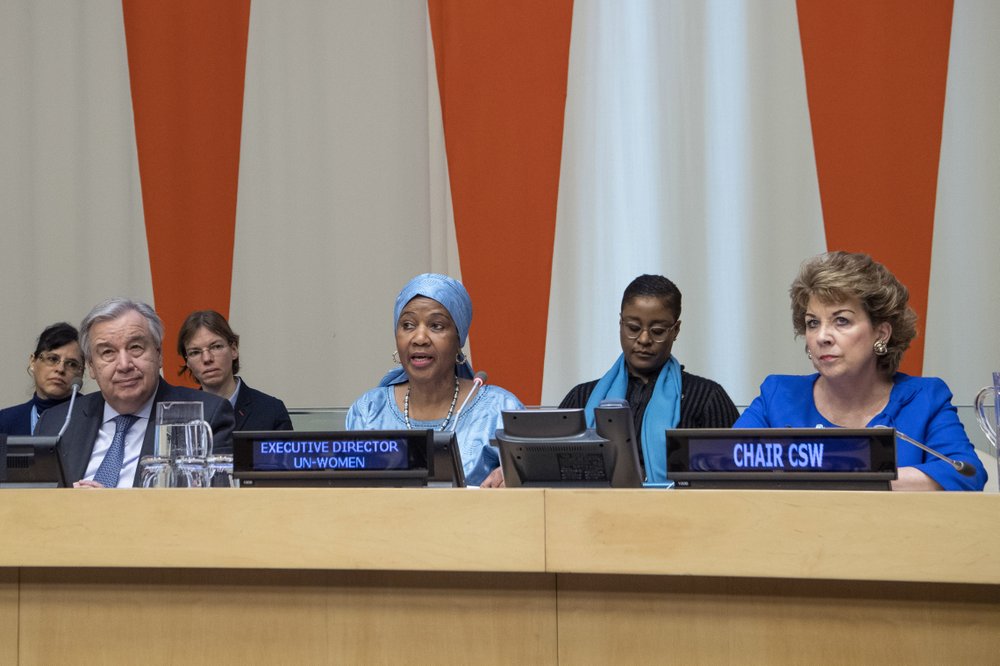
In this Friday, March 8, 2019 photo provided by the United Nations, Phumzile Mlambo-Ngcuka, third from right, executive director of UN Women, speaks at the United Nations Observance of International Women's Day at the United Nations headquarters. Mlambo-Ngcuka is calling for the revolution in technology to be used to benefit the world's poor and especially women who will not achieve gender equality without "the giant leap that 21st century innovations can bring." At left is U.N. secretary General Antonio Guterres, and at right is Geraldine Byrne-Nason, chair of the Commission on the Status of Women and Permanent Representative of Ireland to the United Nations. 
(Eskinder Debebe/The United Nations via AP)


UNITED NATIONS (AP) — Secretary-General Antonio Guterres warned Monday that there is a “deep, pervasive and relentless” pushback on women’s rights and called for a fight to “push back against the pushback.”

Calling himself “a proud feminist,” the U.N. chief said, “It is a fight we must win — together.”

Guterres spoke at the opening of the annual meeting of the Commission on the Status of Women, which since its establishment in 1947 has been committed to achieving “equality with men in all fields of human enterprise.”

The secretary-general told hundreds of ministers, delegates and representatives from civil society and business that the U.N. body could equally go by another name: “the Commission on the Status of Power — because this is the crux of the issue.”

While advocates for gender equality are mobilizing as never before, Guterres said, “around the world, there is a pushback on women’s rights.”

He pointed to increased violence against women, especially defenders of human rights and women running for political office. He cited “online abuse of women who speak out,” women 26 percent less likely to be employed than men, and “an ongoing uphill battle for reproductive rights.”

“And nationalist, populist and even austerity agendas are tearing social fabric — aggravating inequality, splintering communities, curtailing women’s rights and cutting vital services,” Guterres said.

The fight against these negative trends is a fight that must be won, he said.

“So let us say it loud and clear,” Guterres said. “We will not give ground. We will not turn back. We will push back against the pushback. And we will keep pushing. For wholesale change. For rapid change ... our world needs, starting by addressing the imbalance in power relations.”

Phumzile Mlambo-Ngcuka, head of the U.N. women’s agency, gave some examples of pushback in an Associated Press interview ahead of the commission’s meeting.

In negotiations on its final document, she said, some countries don’t want health care facilities to provide “sexual and reproductive rights,” issues that were fought over and are part of the 1995 platform for action adopted by the world’s nations at the U.N. women’s conference in Beijing.

In addition, she said, “Some countries don’t want to use the word gender. You must always say men and women, so that you do not include people who are gender non-conforming.”

She said these ideological issues are “the usual pushback” that are “ultimately about women’s bodies.”

Mlambo-Ngcuka told the commission on Monday that gains for women over the past two decades “are fragile, and we are seeing them reverse.”

The latest data indicate 131 million girls worldwide aren’t going to school and there has been a 6 percent increase in girls not attending elementary school, she said.

“On average, globally, women still have only three-quarters of the legal rights of men, and more than one billion have no recourse against violence or are restricted in their education or employment — what is now being called ‘economic violence,’” Mlambo-Ngcuka said.

And every day, approximately 830 women — 99 percent of them in developing countries — die of preventable causes related to pregnancy and childbirth, she said.

Ireland’s U.N. ambassador, Geraldine Byrne Nason, who presides over the Commission on the Status of Women, said the Beijing declaration statement that women’s rights are human rights generated optimism, but “we have been disappointed.”

Today, she said, less than 7 percent of heads of state and government are women, and only one in four parliament members around the world are female. And, she said, “it’s estimated if we don’t act, it will take 217 years to reach parity between men and women in pay and employment opportunities.”

“So what went wrong?” Byrne Nason said. “The truth is that collectively we haven’t yet succeeded in making sure that women are wherever decisions are being made.”

She said gender empowerment means handing over or sharing power “and we know how hard that is.”

“What we’re trying to achieve is that men have their rights, and nothing more, and that women have their rights, and nothing less,” Byrne Nelson said.

She said the commission will be deliberating in the next two weeks about maternity, pensions, safe roads and transport, schools that teach girls skills to succeed, women’s access to vital health care, “and the fair distribution of care and the domestic work between men and women.”