Friday, June 23, 2023

Unifor kicks off grocery talks with 100 per cent strike vote by 'fed up' workers

Story by The Canadian Press • Yesterday

Unifor national president Lana Payne.

TORONTO — Unifor says grocery workers have more resolve than ever to achieve higher wages and better working conditions as it heads into a two-year stretch of bargaining for more than a dozen collective agreements.

The work will begin with negotiations next week for a contract covering 3,700 Metro workers across the Greater Toronto Area, who — in an unusual move — have already voted 100 per cent in favour of a strike if a deal can't be reached.

The strike vote ahead of bargaining and 100 per cent support for a strike are both rare, said Stephanie Ross, an associate professor in the school of labour studies at McMaster University.

"I think that tells you something about the sense of urgency," said Ross. "People are falling behind every day."

The strike vote sends a strong signal not just to Metro, but to all three grocery giants that their workers are fed up, said Unifor national president Lana Payne.

"We need to send a signal and a very serious message to the supermarket barons that workers deserve a piece of these profits, and they deserve to have better pay, better working conditions and more full-time jobs," she said.

"We want to make important gains in this round of bargaining. We feel we're in a good place to do that."

Unifor represents more than 11,000 grocery store workers at major grocers across Ontario, Newfoundland and Labrador, Nova Scotia and Quebec, the union said. Payne said the next collective agreement up for bargaining will be for Loblaw workers in Newfoundland and Labrador this fall.

Workers have seen the quality of their jobs erode over time, with inflation eating into their wages even as the grocers post healthy profits, Payne said.

The pandemic underscored just how essential grocery store workers are, Payne said, noting that many of them received so-called 'hero pay' early on only to have it taken away — something that GTA Metro worker Courtney Cook said "felt like a slap in the face."

"This is our first bargaining since the pandemic," Cook said. "A lot of things changed during the pandemic, and we were deemed essential workers. So I think everyone's just frustrated that our pay doesn't reflect that kind of status."

Unifor held a national strategy session in May to determine its priorities for grocery sector bargaining, said Payne, as the union is hoping to establish a pattern and gain momentum with the first round at Metro. Those priorities include significant pay improvements, greater access to better health benefits, eliminating pay disparities, more full-time work and job protections for workers affected by technological changes, she said.

Metro spokeswoman Stephanie Bonk said in an email that the grocer is committed to working with the union to reach an agreement that meets employees' needs while also giving the company flexibility to meet and exceed customers' expectations.

The major grocers have come under public scrutiny as inflation surged across Canada last year, hitting more than eight per cent last June as the cost of basic necessities rose. Executives from the grocers spoke earlier this year in front of a parliamentary committee studying grocery prices, denying accusations that food price inflation was being driven by profit-mongering.

But accusations of profiteering aside, the grocers have been posting profits. On Thursday, Empire Company Ltd. reported it earned $182.9 million in its latest quarter compared with $178.5 million a year ago. Loblaw in its latest earnings report reported a profit of $418 million in its first quarter, down from $437 million last year when the company saw a one-time gain from a court ruling. And Metro in its second quarter reported earnings of $218.8 million, up from $198.1 million a year earlier.

Unifor is determined to get a bigger slice of that pie for workers, Payne said.

"It's really just hard that we're putting in everything we have for this company. And we're not getting back what we feel we deserve," said Cook.

Between the pandemic and the briefness of hero pay, ongoing inflation and grocers' profits, the grocery sector is in the midst of a "perfect storm," said Ross, leading to more labour militancy — and not just in the grocery sector.

"People are much more willing to hit the bricks than they perhaps have been … in a long time."

Ross said this first round with GTA Metro workers is all-important to set a benchmark for the pattern bargaining approach that Unifor is taking, where it tries to set a standard for one collective agreement and then replicate it across the sector.

In addition to better pay, Cook said she wants to see jobs at Metro become more stable, giving workers more predictable hours so they can better prioritize their families and their lives outside of work.

She said the 100-per-cent strike vote shows workers are ready to do whatever it takes to get what they deserve, and she thinks grocery store workers across the country will be approaching the bargaining table with the same kind of resolve.

Payne thinks the pandemic has also made Canadians more aware of grocery workers and what they face, and that this will translate into public support and sympathy as the workers bargain with grocers.

"They risked their health and safety every single day, to go to work for a job that in many cases was not paying them a decent wage," she said.

"Enough is enough here. We have to make good improvements in this collective agreement, and the resolve of our members is very strong. And I think this strike vote clearly shows they're prepared to fight if they need to."

Ross said recent major strikes have seen record levels of public support for workers in the wake of the pandemic and high inflation.

"There's a much more positive climate of potential public support for the union than there maybe has been in decades," she said.

"But … it all comes down to strategy, how the union and the employer frames their messages and how those messages land with the public."

This report by The Canadian Press was first published June 22, 2023.

Companies in this story: (TSX:MRU)

Rosa Saba, The Canadian Press
GREEN CAPITALI$M

Beyond Meat Wannabes Are Failing as Hype and Money Fade

Story by Agnieszka de Sousa and Deena Shanker • Yesterday 

(Bloomberg) -- Unreal Food ended its pursuit of an eggless egg. Remastered Foods stopped developing vegan bacon. The Meatless Farm halted its plant-based sausages.

The great shakeout in the world’s fake meat sector is here and it’s widening.

As money flows less freely due to surging interest rates, investors have sharply pulled back funding just as inflation increases production costs and makes consumers more selective about their food choices. That’s hitting a crowded field, which had mushroomed after the early success of Beyond Meat Inc. and Impossible Foods Inc.


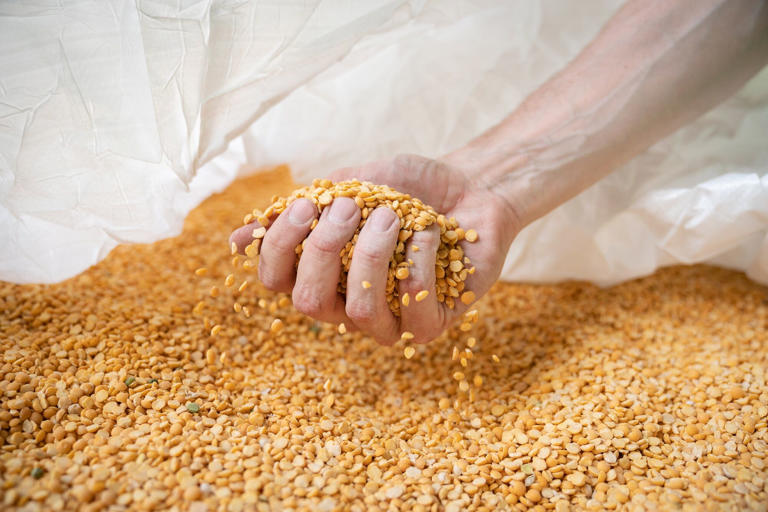
Beyond Meat Sparked A Run On Peas And A Protein Revolution
© Photographer: Ben Brewer/Bloomberg

With shoppers put off by excessive processing, nutritional value and taste, a growing list of alternative-protein companies are shutting down, laying off staff and selling themselves. Industry observers say more turmoil is coming before the sector stabilizes.

“You probably need a bit of a clear out in some of these categories to allow winners to come through,” said Mark Lynch, a partner at Oghma Partners in London, a corporate-finance advisory specializing in the food and beverage sector. Fewer players means resources will be more concentrated and survivors will control more of the available shelf space, he added.


Beyond Meat inc. Debuts Initial Public Offering At Nasdaq MarketSite
© Photographer: Michael Nagle/Bloomberg

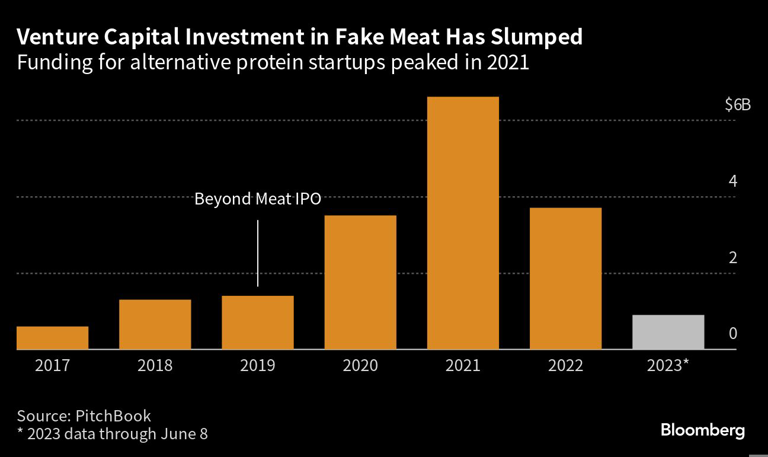
Enthusiasm for alternatives to beef and pork surged in the aftermath of Beyond Meat’s 2019 initial public offering, and venture capitalists were willing to invest in companies that offered little more than a recipe book.

But sales haven’t matched wildly optimistic projections, as high prices and odd tastes and textures made the costly products easy to cross off shopping lists. The spate of failures extends from plant-based proteins and vertical farmers, to insect breeders and lab-grown meats. Global investment in food and agriculture tech dropped 44% in 2022, according to AgFunder.


Venture Capital Investment in Fake Meat Has Slumped | Funding for alternative protein startups peaked in 2021© Source: PitchBook

The downturn has so far mainly claimed obscure names and early-stage companies, like Canada’s Merit Foods and China’s Hey Maet.

But in the UK, two up-and-coming companies recently appointed administrators: The Meatless Farm laid off staff at its headquarters in Leeds, while Plant & Bean got hit by soaring food and energy prices just two years after opening a mega factory in Lincolnshire.

The upheaval is part of an adjustment phase that happens in almost every high-growth consumer segment from smoothies to popcorn, said Andy Shovel, co-founder of British plant-based meat company THIS, whose sales are up about 45% this year.

The result will be less confusion at stores, better quality and prices getting closer to meat, according to Shovel. “From a customer’s point of view, this is only good news,” he said.Thinning the Herd

Related video: Beyond Meat launches steak substitute (CNBC)  Duration 1:25  View on Watch

Alternative-protein companies have failed in countries around the world in the past 12 months. 
Here’s a partial overview:
US Unreal Food, Cows Gone Coconut, Sun Milk, OceanTastes, Noops
UK The Meatless Farm, Plant & Bean, Remastered Foods
Canada Merit Foods, Nabati Foods, Fresh Start
EU Update Foods, PlantEdit, Entis
China Hey Maet
Source: PitchBook, Aiquicha, Bloomberg News

Industry stalwarts have also stumbled. Beyond Meat, which has seen its market value drop over 90% from its peak, has had multiple rounds of layoffs in the past year, as has Impossible Foods. Cuts have also affected Spain’s Heura Foods and California-based Eat Just Inc., which has continued to expand distribution in the US.

Traditional food companies are also retrenching. Nestle SA pulled its Garden Gourmet line and Wunda pea milk from the UK because of intense competition. Meat giant JBS SA discontinued its Planterra unit after pouring money into a mega factory in Colorado.

Despite the turmoil, some investors remain upbeat. Big Idea Ventures, a food-tech investor fund, said last month that it’s closing in on a $75 million fund-raising target. Fake bacon maker MyForest Foods raised $15 million in fresh funding earlier this month, and Israeli startup Chunk Foods announced a seed round of the same size in the spring.

Agricultural giant Archer-Daniels-Midland Co. still has faith in the sector, too. At an innovation center in Manchester, England, the company mixes processed soy with flavors to help make alternative proteins more appealing. Its venture capital unit is also continuing to invest in startups.

“The category is now evolving into what really consumers have been asking for,” said Leticia Gonçalves, ADM’s president of global foods. “Companies are now learning from the past and adjusting with new launches.”

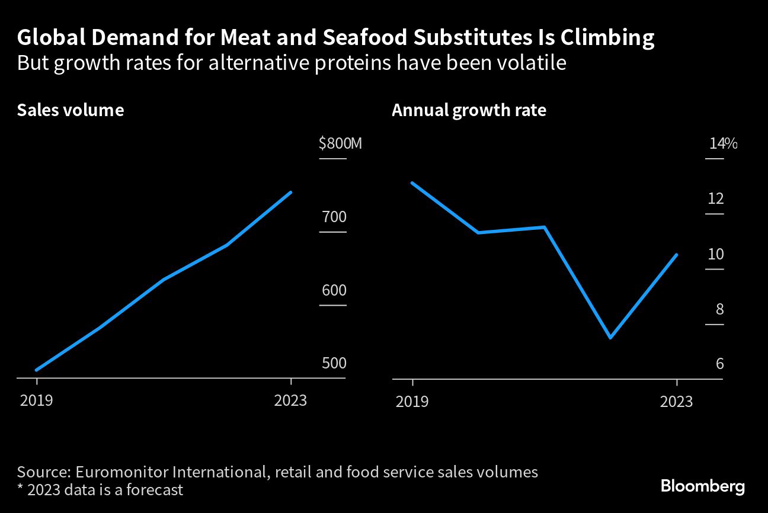
ADM expects the alternative-protein market to grow annually by “high single-digits” and reach $100 billion in sales by 2030. Euromonitor International, which tracks sales in retail outlets and food services, predicts global sales volume of meat and seafood substitutes to grow more than 10% this year.


Global Demand for Meat and Seafood Substitutes Is Climbing | But growth rates for alternative proteins have been volatile© Source: Euromonitor International, retail and food service sales volumes

About two-thirds of young consumers are planning to spend more on vegan meat and dairy products citing health perceptions and environmental benefits, according to Emma Ignaszewski, associate director at Good Food Institute, an industry group.

For some companies, the disruption is an opportunity. Minnesota-based Wicked Kitchen — a maker of vegan convenience foods like jackfruit pepperoni pizza — acquired plant-based seafood company Good Catch for over $7 million in stock as well as vegan fish brand Current Foods in a deal valued between $7 million and $10 million, Chief Executive Officer Pete Speranza told Bloomberg.

Administrators for Meatless Farm said this week that they secured the sale of the company’s brand to vegan chicken company VFC Foods.

Food is now widely understood as central to efforts to combat the climate crisis and alternative proteins are seen as delivering the biggest benefit, according to Rosie Wardle, a partner and co-founder of Synthesis Capital, who has been active in the space for a decade.

“This correction was overdue,” she said. “The best companies in the sector will be able to find the capital they need even in these challenging times. Ultimately this sector is here to stay.”Read more on venture capital and alternative proteins:
Fake Meat’s Hyped Burgers Became Just Another Food FadVenture Capital’s AI-Run Lettuce Farms Start to Go BustStartups Find One of Their Last Funding Sources Is Drying UpValue of Workers’ Shares of Impossible Foods Down 89% Since 2021


--With assistance from Sabah Meddings, Dasha Afanasieva, Yihui Xie and Tarso Veloso.

(Updates with Meatless Farm’s brand purchase in 19th paragraph.)

Most Read from Bloomberg
Coyote pup wandered for days with head stuck in container. Freeing it ‘took a village’


Screengrab from Newhouse Wildlife Rescue's Facebook post

Julia Marnin
Thu, June 22, 2023 

A coyote pup found himself in a plastic predicament when his head got stuck in a container in Massachusetts.

After two days of wandering with the plastic container — and his unsuccessful attempts to pull his head out — help was called on June 20, according to Newhouse Wildlife Rescue in Chelmsford.

Rescue group staff, Billerica & Tewksbury Animal Control officers and an environmental police officer tracked the pup down and teamed up to free him, the rescue wrote in a June 21 Facebook post.

“It took a village, but this guy’s life was saved because of it,” the post said.

Once the container was finally off his head, the young coyote was in “shock,” had pale gums, was disoriented and in need of water, according to the wildlife rescue, which brought him to its facility to care for him.

As of the morning of June 21, “he is feeling much better,” the rescue group wrote.

The person who spotted the coyote pup told the group that his parents were still around, and the group planned to reunite him with his family on June 21.

McClatchy News reached out to Newhouse Wildlife Rescue for an update on June 22 and was awaiting a response.

Coyotes originate from North America and used to only live in the continent’s western region before spreading east. Eastern coyotes are commonly found in Massachusetts.

Chelmsford is about 30 miles northwest of Boston.
Climate change may have stimulated plankton bloom behind Thai mass fish die-off: expert
REPRESENTATIVE IMAGE


Fri, June 23, 2023 
By Napat Wesshasartar

BANGKOK, June 23 (Reuters) - Climate change might have stimulated a plankton bloom that caused thousands of dead fish to wash up along a 3- to 4-kilometre stretch of beach in Thailand's southern Chumphon province, an expert said.

Thon Thamrongnawasawat, deputy dean of the Faculty of Fisheries at Kasetsart University, attributed the fish deaths on Thursday to the bloom - a natural occurrence that lowers oxygen levels in the water and causes fish to suffocate.

"Various natural phenomena, such as coral bleaching or plankton bloom, have naturally occurred for thousands to tens of thousands of years. However, when global warming occurs, it intensifies and increases the frequency of existing phenomena," he said.

According to local authorities, plankton bloom happen one or two times a year and typically last two to three days.

Officials have collected seawater for further assessment and analysis.

Worldwide, marine heatwaves have become a growing concern this year, with thousands of dead fish washing up on beaches in Texas and experts warning of algal blooms along the British coast as a result of rising sea temperatures.

Global sea surface temperatures for April and May were the highest on record for those months, according to the British Met Office.

"Whether it's Australia and places like the Great Barrier Reef or even places around England which are experiencing quite bad marine heatwaves at the moment, it's really going to be detrimental to those local ecosystems," said Sarah Perkins-Kirkpatrick, a climate scientist with the University of New South Wales in Australia.

 (Additional reporting by David Stanway in Singapore. Editing by Gerry Doyle)

Exclusive-Exxon, Guyana in talks to return unexplored offshore oil areas


A replica of Exxon's Liza Unity production vessel is seen in the company's booth at Guyana Energy Conference and Expo in Georgetown

Wed, June 21, 2023 at 5:14 AM MDT·2 min read
By Sabrina Valle

HOUSTON (Reuters) -Exxon Mobil Corp and Guyana are in talks over which unexplored offshore areas will be returned to the government, people close to the discussions said, as the nascent oil nation seeks to attract new operators to the country.

The Exxon-led consortium that controls offshore production in Guyana this year was required to return 20% of unexplored acres, under the original 2016 production contract.

The acres will include parts of its crown jewel 6.6-million-acre (26,800 sq km) Stabroek block and two other blocks not yet in production.

Guyana wants to re-market the acreage to others to speed the country's economic development and reduce the Exxon group's dominance over its energy output. Officials aim to boost oil and gas production ahead of demands to cut carbon emissions to net zero by 2050.

Exxon is in compliance with the local legislation and in "ongoing discussions with the government regarding these requirements, in respect to both timing and area," a company spokesperson said.

Exxon and its partners Hess and CNOOC produce about 375,000 barrels of oil per day from two offshore vessels. The group has approved a total of $45 billion in outlays to triple its output by 2027 from five oil platforms.

CONTRACT FORCE MAJEURE

The relinquishment deadline for the 20% unexplored portion of the Stabroek block is due in October, one of the people close to the discussions said. The government agreed to an up to one year extension, citing difficulties during the COVID-19 pandemic that prevented some work.

Guyana's Energy Ministry did not immediately respond to requests for comment.

The consortium could return some of the areas as soon as the third quarter of this year, the people said.

The group separately aims to accelerate to as early as September the start up of the third oil production vessel, Prosperity, which will bring total production to 600,000 barrels of oil and gas per day in early 2024, the people said.

Guyana and the U.S.-Chinese group are also negotiating the return of about 20% of the unexplored areas of the group's other two blocks, Kaieteur and Canje, which have yet to start production.

The returned areas could be either included in a competitive auction or directly negotiated with other governments in bilateral agreements for oil exploration, one of the people said.

The Production and Sharing Agreement signed between Guyana and the Exxon-led group in 2016 allows for prospecting license extensions. But it requires at least 20% of unexplored or undeveloped areas be returned at the renewal.

Guyana plans to hold its first competitive oil blocks auction in August, which it expects to attract new operators to the country. It will offer 14 offshore blocks outside the Exxon group's domains.

(Reporting by Sabrina Valle; Editing by Lincoln Feast and Daniel Wallis)
THE NEW 'CHINA'
Micron confirms up to $825 million investment in India chip facility

Reuters
Thu, June 22, 2023 

 The company logo is seen on the Micron Technology Inc. offices in Shanghai


OAKLAND, California (Reuters) - U.S. memory chip firm Micron Technology, Inc said on Thursday it would invest up to $825 million in a new chip assembly and test facility in Gujarat, India, its first factory in the country.

Micron said that with support from the Indian central government and from the state of Gujarat, the total investment in the facility will be $2.75 billion. Of that total, 50% will come from the Indian central government and 20% from the state of Gujarat.

Reuters reported earlier this week that India's Cabinet approved the project ahead of Prime Minister Narendra Modi's state visit to the U.S., which kicked off on Wednesday.

Micron said construction of the new facility in Gujarat is expected to begin in 2023 and the first phase of the project will be operational in late 2024. A second phase of the project is expected to start toward the second half of the decade, it said. The two phases together will create up to 5,000 new direct Micron jobs.

(Reporting By Jane Lanhee Lee in Oakland, California; Editing by Leslie Adler)

Applied Materials to invest $400 million in India for new engineering center

Reuters
Thu, June 22, 2023

Illustration shows Applied Materials logo

(Reuters) -U.S. semiconductor toolmaker Applied Materials will invest $400 million over four years in a new engineering center in India, the company said on Thursday.

Indian Prime Minister Narendra Modi had met with the company's CEO Gary Dickerson in Washington on Wednesday and invited Applied to strengthen the chip industry in the country.

Applied's investment is among a flurry of announcements this week including General Electric's deal to jointly produce jet engines for the military with state-owned Hindustan Aeronautics Ltd and data storage chipmaker Micron's $825 million investment to build a new factory in India.

Modi also met Tesla CEO Elon Musk after which the automaker's top boss said the company will try to be in India "as soon as humanly possible."

The new center is expected to be located near the company's existing facility in Bengaluru and is likely to support more than $2 billion of planned investments and create 500 new advanced engineering jobs, the company said.

Applied currently operates across six sites in India and works closely with Indian Institute of Science, Bangalore and the Indian Institute of Technology in Mumbai, two of the country's prestigious institutions.

(Reporting by Akash Sriram in Bengaluru; Editing by Anil D'Silva, Sriraj Kalluvila and Shailesh Kuber)
GEMOLOGY
Why Modi Gifted a 7.5-Carat Lab-Grown Diamond to Jill Biden


Anna Gordon
Thu, June 22, 2023 

Prime Minister Narendra Modi gifts to the U.S. First Lady Dr. Jill Biden a lab-grown 7.5-carat green diamond in the presence of the U.S. President Joe Biden at the White House on June 22, 2023. Credit - ANI/Reuters

During his visit to the U.S. this week, India’s Prime Minister Narendra Modi presented President Joe Biden and First Lady Jill Biden multiple gifts on Wednesday. But the most interesting among them was a papier mache box containing a 7.5 carat synthetic green diamond.

The lab-grown diamond (LGD) is at the heart of India’s bid to become a global leader in producing the synthetic alternative, which has a much smaller carbon footprint than mined diamonds, and is seen as “conflict free.”

According to India Today, the production of the diamond gifted to the Bidens produced just 0.028 grams of Co2 per carat, which is over 100,000 times less emissions per carat than the production of the average mined diamond.


What are LGDs, a.k.a. lab-grown diamonds?


Lab-grown diamonds are jewels with the same chemical properties as mined diamonds, containing pure carbon that is crystallized into an isotropic form. In nature, diamonds are created when carbon deposits deep underground—usually 95 to 125 miles below the surface—are subjected to extreme pressure and heat. Scientists believe that it can take over 1 billion years to form a diamond in natural circumstances. However, in laboratory settings, the production process is much faster.

According to Queensmith, a U.K.-based jeweller, there are two ways to create LGDs. The first way, referred to as the chemical vapor deposition (CVD) method, involves the use of a small, already formed diamond. The slice of diamond is placed in a chamber where it is exposed to carbon rich gas and extremely high temperatures. Over the course of several weeks, the carbon gas ionizes and sticks to the original diamond slice. This leads the diamond to grow in size and creates new diamond material.

The second method, known as high pressure high temperature method (HPHT), does not require a pre-existing diamond slice. In this method, pure carbon is pressed through a metal cube and exposed to high electrical heat at the same time. This mimics the settings that carbon deposits in natural environments experience to become diamonds. Because carbon is an abundant resource, this method does not require the intense and dangerous labor that diamond mining requires, which many believe makes lab grown diamonds more ethical and sustainable.

Why is India expanding its LGD program?

From 2018 to 2021, India more than quadrupled the dollar value of its polished synthetic diamond exports, going from $274 million to $1.29 billion in sales.

This year, India’s finance minister Nirmala Sitharaman announced that the government would subsidize research and development costs in the LGD industry by providing a grant to one of the Indian Institutes of Technology for five years.

“Lab-grown diamonds is a technology and innovation sector with high employment potential,” Sitharaman said in her speech. “These are environmentally-friendly diamonds which have optically and chemically the same properties as natural diamonds.”

Currently, India produces 15% of all LGDs in the world, according to India’s Ministry of Commerce and Industry. China is believed to be the leading producer of them around the world, accounting for 50% of the global market share. According to Allied Market Research, the industry was worth $22.3 billion in 2021, and is expected to more than double over the next decade to $55.6 billion.
Why are LGDs important?

Diamonds are used for many purposes, not just jewelry. In fact, 80% of the world’s diamonds are used for industrial purposes. Because diamond is an incredibly sturdy material, it is frequently used in electronics that are designed to last for a long time, like high-end speakers or satellites. Diamonds are also important for dentistry tools, since they are one of the few substances that can easily drill into teeth. The substance is also used in countless other industrial applications that require extremely strong materials.

LGDs are on average cheaper than mined diamonds by 30-40%. They are less likely to rely on dangerous and exploitative labor practices and do not harm the natural habitat in the way mining frequently does.
Modi’s White House visit highlights deep diaspora divides


Sakshi Venkatraman
Wed, June 21, 2023 


Many South Asian Americans have mixed feelings as they prepare themselves for Indian Prime Minister Narendra Modi’s state visit to the White House this week.

As some get ready to gather in Washington, D.C., both to welcome and protest him, data from a 2021 study underscores just how torn the diaspora is when it comes to the controversial leader — and it shows that his popularity among Indian Americans falls short of how he is received in India.

This week marks Modi’s first official state visit to the U.S., which had not invited an Indian prime minister since 2009. Modi was once banned from the U.S. for the role he allegedly played in the deadly Gujarat riots, in which 1,000 people, most of them Muslims, were killed.

For many community leaders, a historic moment is severely marred by that and other aspects of Modi’s human rights record, including censoring journalists and stripping autonomy from the region of Kashmir.

“For this kind of a ruler to be invited to a state dinner by an American president and to be given an opportunity to speak to a joint session of Congress, where he’s going to talk about the ideals of democracy, is just mind-boggling,” said Ajit Sahi, the advocacy director for the Indian American Muslim Council.

The study, conducted by the Carnegie Endowment, found that Modi’s approval rating is much lower among Indian Americans (50%) than among Indians living in India (77%). Dozens of lawmakers in both houses of Congress signed a letter urging President Joe Biden to address human rights concerns with Modi during his visit.

“This is an important relationship that we need to continue and build on as it relates to human rights,” White House press secretary Karine Jean-Pierre said at a briefing last month.

Sahi said that though Hindu nationalist sentiment in diaspora communities cannot be ignored, he thinks college-educated young people who grew up in the U.S. are distancing themselves from Modi’s politics.

“The American values of liberalism, progressivism, equality for all, justice for all, equality before the law, I think these are the things that more or less get deeply rooted in the psyche, especially if you were born and raised here,” he said.

But the diaspora in the U.S. is still split down the middle in terms of support for Modi. According to the study, 49% of Indian Americans rate his performance favorably, either strongly approving or approving of him; 31% disapprove of his performance; and 20% expressed no opinion on him at all.

“It’s a polarized space,” said Sunita Viswanath, a co-founder of the civil rights group Hindus for Human Rights. “There’s very little scope for bridge-building. ... On the one hand, you have this mainstream Hindu response, which is that India’s national leader is coming to town and is being greeted by the American president with a state dinner, and that puts India on the map.”

On the other hand, those in minority religions and castes oppressed in India say the visit feels as though the U.S. is validating the structural bias their families face, Viswanath said. Many in diaspora spaces say that bias has followed them.

“Inclusive secular democracy means the right for all the different religions to exist and practice freely,” she said. “We are Hindus, we are proud Hindus, but our Hinduism and our devotion to secular democracy, whether it’s in America, where most of us live, or in India, where most of us are from, that is what is motivating us.”

As South Asians in both camps plan to assemble in Washington throughout Modi’s three-day visit, some national organizations are urging Biden to address his recent actions.

The Committee to Protect Journalists issued a statement last week denouncing Modi’s media crackdown and the arrests of journalists since he came to power in 2014.

“Journalists critical of the government and the BJP party have been jailed, harassed, and surveilled in retaliation for their work,” CPJ President Jodie Ginsberg said in the statement. “India is the world’s largest democracy, and it needs to live up to that by ensuring a free and independent media — and we expect the United States to make this a core element of discussions.”

The Hindu American Foundation declined to comment on Modi’s visit. Overseas Friends of the BJP, an international arm of Modi’s Bharatiya Janata Party, did not respond to requests for comment.

The Council on American Islamic Relations released a video and a petition opposing Modi’s visit to address a joint session of Congress on Thursday because of his anti-Muslim, anti-Dalit and anti-Sikh policies.

“The evidence of Modi’s expanding effort to place a boot firmly on the collective heads of India’s religious minorities is extensive,” the petition said.

Though it’s hard to predict how many Indian Americans will gather outside the White House, Modi’s 2019 trip to the U.S. drew over 50,000 to Houston for a rally called “Howdy Modi.” President Donald Trump co-hosted the event, calling it a “profoundly historic event.”

Viswanath remembers the experience four years ago, protesting outside the stadium as fellow Indian Americans poured inside.

“I was holding my sign, and people were streaming into the stadium dressed in their finest,” she said. “They looked like me. They looked like my family. It was one of those moments where I’m grateful I’m on this side of history. … Our deep hope, our ardent hope, is that as we build this space, Hindus will join us.”

This article was originally published on NBCNews.com


SEE


Ancient finger painting? 57,000-year-old marks in cave are from Neanderthals, study says

Moira Ritter
Thu, June 22, 2023 

Our closest extinct human relative, Neanderthals, roamed Europe and Asia until about 40,000 years ago.

Since their discovery in the 1800s, experts have understood Neanderthals as having limited capacity for thinking beyond staying alive. But a recent discovery is calling this idea into question.

Scientists found the oldest known Neanderthal cave engravings — dating back at least 57, 000 years — inside a cave in France, according to a study published June 21 in PLOS One.


“For a long time it was thought that Neanderthals were incapable of thinking other than to ensure their subsistence,” archaeologist and study co-author Jean-Claude Marquet, of the University of Tours, France, told Smithsonian Magazine. “I think this discovery should lead prehistorians who have doubts about Neanderthal skills to reconsider.”
La Roche-Cotard

The engravings were discovered in La Roche-Cotard, an ancient cave that was first found in 1846, according to the study. Before then, the cave had been blocked by sediment for at least 51,000 years most likely preventing any access to the inside by modern people.

Since it was rediscovered, archaeologists have uncovered animal remains, tools and the organized finger tracings.

The site is located in France’s Touraine region, about 150 miles southwest of Paris.
‘Intentional and meticulous’ Neanderthal marks

Starting in 2016, experts began to more closely analyze the finger marks, and they now believe the engravings were “neither accidental nor utilitarian, but rather...intentional and meticulous.” The graphics were made only on certain surfaces throughout the cave, often following the shape of the walls and getting progressively more complex, the study explained.


Experts said it is impossible to determine the meaning behind the markings. M. Calligaro

Experts were able to determine the age of tools that were used at the site before it was sealed, which they said helped them determine the age of engravings.

The markings on the wall is “one of the most remarkable aspects” discovered at La Roche-Cotard, the study authors said. While some graphic evidence exists from Neanderthals, this evidence is mostly in the form of “mobile” objects, like pebbles, slabs or bones.

Scientists said the finger markings followed the shape of the cave’s walls. O. Spaey and G. Alain

The finger marks were found among animal marks on the walls, experts said. J. Esquerre and H. Lombard

The discoveries of the markings at La Roche-Cotard demonstrate the organized “repetition of thoughtful gestures” that was carried out with intent, according to experts.
Lingering questions

Although experts determined the age and origin of the markings, they are unable to discern the meaning behind the engravings.

Current research indicates that figurative and symbolic art did not exist yet during the time the markings were made, the authors said. However, the find is still significant.


Experts determined that the finger markings moved in various directions along the walls. O. Spaey and G. Alain

“Although the finger tracings at La Roche-Cotard are clearly intentional, it is not possible for us to establish if they represent symbolic thinking,” the authors wrote in the study. “Nevertheless, our understanding of the relationship between Neanderthals and the symbolic and even aesthetic realms has undergone a significant transformation over the past two decades and the traces preserved in the cave of La Roche-Cotard make a new and very important contribution to our knowledge of Neanderthal behaviour.”
SECOND WARNING
Newcrest Seeks to Address Gold Mine Air Pollution After Warning

Sybilla Gross
Thu, June 22, 2023 


(Bloomberg) -- Australian gold miner Newcrest Mining Ltd. is installing filters in the vent shafts at one of its largest mines, after this week being told by authorities to immediately address the “unacceptable” levels of dust being emitted from the site.

The warning is the second the Melbourne-based company, which is being taken over by Newmont Corp., has received this year from the New South Wales state government’s Environment Protection Authority. In May, the authority launched an investigation into Newcrest’s efforts to manage air pollution near its Cadia mine following complaints from nearby residents.

Recent testing showed that Newcrest, Australia’s top gold producer, had fallen “well short” of its legal obligations to meet clean air standards at Cadia, the EPA said Wednesday.

“If Newcrest cannot show its subsidiary is taking immediate action to comply, the EPA will take appropriate action which could include suspension of the license, seeking court orders or issuing further directions,” EPA Chief Executive Officer Tony Chappel said in a statement. “We require the mine to take all necessary steps to ensure dust emissions are significantly reduced and this may include a reduction in production.”

There has been no impact to production due to the issue, a Newcrest spokesperson said, adding that the company has implemented interim measures to comply with EPA regulations and continues to focus on dust mitigation equipment, including the installation of filters.

Newcrest was fined A$15,000 ($10,000) last August for failing to effectively mitigate dust pollution at Cadia, which is forecast to produce at least 560,000 ounces in fiscal 2023. The bullish prospects for the mine helped draw acquisition interest from US gold giant Newmont, which sealed its near-$20 billion purchase in May.

Most Read from Bloomberg Businessweek