Saturday, October 14, 2023

WAIT, WHAT?!

CDC study on depression and mortality finds wealth, smoking, and exercise reduce risk of death

exercise
Credit: CC0 Public Domain

US Centers for Disease Control and Prevention (CDC) researchers in Atlanta have examined the association between depressive symptoms and mortality in a large, diverse, nationally representative sample of US adults.

In a paper, "Depressive Symptoms and Mortality Among US Adults," published in JAMA Network Open, the CDC team found a higher risk of all-cause, , and ischemic heart disease mortality among adults with moderate to severe depressive symptoms compared to those without depressive symptoms.

The study utilized data from the National Health and Nutrition Examination Survey (NHANES) from 2005 to 2018, which included 23,694 participants aged 20 and older (mean age 44.7). Depressive symptoms were assessed using the Patient Health Questionnaire-9 (PHQ-9), a validated screening instrument for measuring depressive symptoms.

The cohort's characteristics included education, marital status, poverty-to-income ratio, , family history of cardiovascular disease, , antidepressant use and alcohol consumption. The NHANES dataset was cross-referenced with the National Death Index through 2019 to track mortality outcomes.

Mild depressive symptoms were found in 14.9% of participants, while moderate to severe depressive symptoms were seen in 7.2%.

For all-cause mortality, the adjusted base model found mild depressive symptoms were associated with a hazard ratio of 1.42 compared to those with no depressive symptoms, while moderate to severe depressive symptoms had a hazard ratio of 1.78.

For cardiovascular disease mortality, the overall hazard ratios were 1.49 for mild depressive symptoms and 1.79 for moderate to severe depressive symptoms. For ischemic heart disease mortality, mild depressive symptoms showed no impact, while moderate to severe depressive symptoms had a hazard ratio of 2.21. Both were strongly correlated with poverty levels.

Lifestyle factors like smoking, physical activity, and sleep health were identified as important mediators of the association between depressive symptoms and mortality. The associations were largely consistent across different subgroups.

Not highlighted in the CDC study and unlikely to be recommended, smoking caused the most significant reduction in mortality from all causes (HR 1.65) in both the mild and moderate to severe depression groups compared to the base model (HR 1.78). This was followed closely by  (HR 1.67), which is much more likely to be encouraged.

The study suggests that addressing  and associated risk factors could be important for reducing the burden of depression and its impact on mortality. It is unclear and unstated in the report how to address specific risk factors, such as the most significant driver of depression-related mortality in the data—income inequality.

More information: Zefeng Zhang et al, Depressive Symptoms and Mortality Among US Adults, JAMA Network Open (2023). DOI: 10.1001/jamanetworkopen.2023.37011


Journal information: JAMA Network Open 


© 2023 Science X NetworkStudy finds significant increase in chronic anxiety and depressive symptoms in young adults


 

When it comes to hearing, the left and right sides of the brain work together, mouse research shows

mouse
Credit: CC0 Public Domain

Johns Hopkins-led research has revealed an extensive network of connections between the right and left sides of the brain when mice are exposed to different sounds. The researchers also found that some areas of the brain are specialized to recognize certain sounds, such as "calls" from the animals. Further, the researchers also found that deaf mice had far fewer right and left brain connections, suggesting that the brain needs to "hear" and process sound during early ages to spur development of left-right brain connections.

The findings, say the researchers, may eventually help scientists pinpoint the time period when such  and specialization form, and offer potential insights into how to restore . The findings have been published in Proceedings of the National Academy of Sciences.

"The  is a collection of parts, which need to be connected properly," says Johns Hopkins neuroengineer Patrick Kanold, Ph.D., a professor of biomedical engineering.

"Using a novel microscope that enabled us to see both  hemispheres at the same time, we found that some of those connections are between the right and left brain hemispheres, allowing functional specialization. When the brain does not get the right inputs, for example in hearing loss, these brain connections are missing. This obviously is an issue if we hope to restore hearing at a later age."

In efforts to find new ways to restore hearing, Kanold's team will continue its work to identify the specific time period when brain connections form in response to sound and how to restore abnormal connections.

The team is also continuing research to understand how the brain adapts to and modulates sound processing to filter out distracting signals, such as its recent work indicating that the brain's frontal cortex provides specific signals to the auditory system during behaviors that might help in this filtering process.

More information: Georgia Calhoun et al, Bilateral widefield calcium imaging reveals circuit asymmetries and lateralized functional activation of the mouse auditory cortex, Proceedings of the National Academy of Sciences (2023). DOI: 10.1073/pnas.2219340120

Maryland researchers provide first statewide prevalence data on two new emerging pathogens in health care settings

by University of Maryland School of Medicine
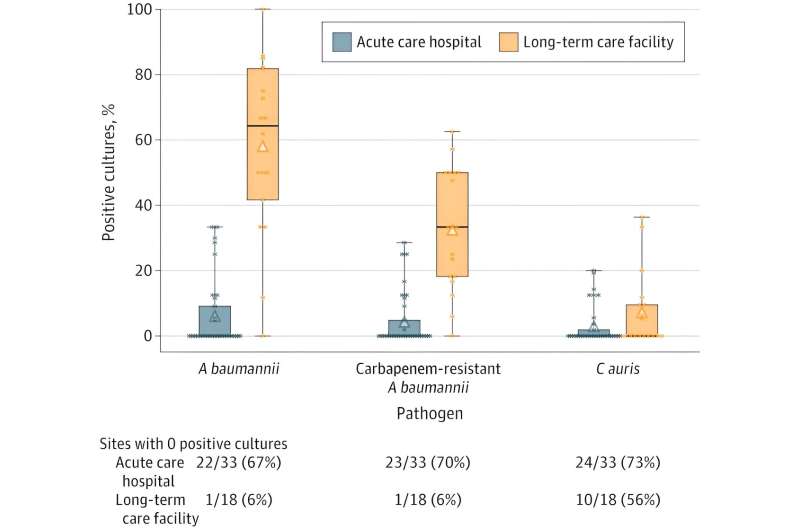
Prevalence of Acinetobacter baumannii, Carbapenem-Resistant A baumannii, and Candida auris Colonization Stratified by Type of Facility. Credit: JAMA (2023). DOI: 10.1001/jama.2023.21083

University of Maryland School of Medicine (UMSOM) researchers conducted a statewide survey of all patients on breathing machines in hospitals and long-term care facilities and found that a significant percentage of them harbored two pathogens known to be life-threatening in those with compromised immune systems.


One pathogen, Acinetobacter baumannii, was identified in nearly 31 percent of all patients on ventilators to assist with their breathing; Candida auris was identified in nearly 7 percent of patients on ventilators, according to the study which was published this week in the Journal of the American Medical Association (JAMA).

They conducted the study with colleagues at the Maryland Department of Health and presented their findings at this week's Infectious Disease Society of America annual meeting in Boston.

"We found patients in long-term care facilities, like skilled nursing homes, were more likely to be colonized with these pathogens than those getting treated in hospitals," said study leader Anthony Harris, MD, MPH, Professor of Epidemiology & Public Health at UMSOM and infectious disease specialist at University of Maryland Medical Center.

"We were the first in the nation to get a statewide survey of all ventilated patients, and I think it points to the stringency of the infection control programs in place in the state of Maryland and the excellent collaboration between the University of Maryland and the State Health Department."

Both A. baumannii and C. auris have been highlighted by the federal Centers for Disease Control and Prevention (CDC) as emerging pathogens that present a global health threat. C. auris is a fungus that spreads within and among local health care facilities—usually in those hospitalized and on breathing machines (ventilators).

Older people with weakened immune systems are particularly susceptible to this infection, which resists treatment with common anti-fungal medications. A. baumannii, a bacteria, also poses a threat to these same types of patients and has become very resistant through the years to treatment with most antibiotics.

To conduct the study, Dr. Harris and his colleagues obtained culture swabs from all 482 patients receiving mechanical ventilation in Maryland health care facilities between March and June of this year. All eligible health care facilities, 51 in total, participated in the survey. They identified A. baumannii from at least one patient in one-third of the acute care hospitals and from 94 percent of the long-term care facilities. They identified C. auris in nearly 5 percent of hospitalized patients and in 9 percent of patients in long-term care facilities.

"Testing positive, however, does not mean that patients have symptoms or active infections that are potentially life-threatening," said study co-author J. Kristie Johnson, Ph.D., Professor of Pathology at UMSOM whose lab did the A. baumannii testing for the study. "But knowing which patients are colonized with these pathogens can help contain their spread to other patients."

Over the course of 2022, state and local health departments around the country reported 2,377 clinical cases, according to the CDC, nearly five times the number infections in 2019, which was less than 500 cases. Maryland alone had 46 cases in 2022. While these infections don't normally pose much of health risk to hospital workers, they pose a significant risk of death in patients with weakened immune systems. Often the infections can be spread from patient to patient by health care workers carrying the germs on their hands, equipment or clothing.

"There is a need for more health care facilities nationwide to be aware of the extent of the problem through surveillance testing," Dr. Harris said. Certain measures can be implemented to help reduce spread of these pathogens including more stringent use of disposable gloves and gowns between patients and the use of chlorhexidine bathing of the critically ill to disinfect their skin.

"Emerging pathogens that are resistant to available therapeutics present a growing challenge in our country, especially with a projected increased growth in our aging population entering long term care facilities," said UMSOM Dean Mark Gladwin, MD, who is also Executive Vice President for Medical Affairs, UM Baltimore, and the John Z. and Akiko K. Bowers Distinguished Professor at UMSOM. "Nearly half of patients who contract C. auris infections die within 90 days, according to the CDC, and this pathogen is now found in nearly 50 states. This is why it is critical for these surveillance studies to be conducted nationwide, not just in Maryland."

UMSOM faculty members Lisa Pineles, MA, Lyndsay O'Hara, Ph.D., Leigh Smith, MD, and Indira French, MS, were co-authors on this study.

More information: Anthony D. Harris et al, Prevalence of Acinetobacter baumannii and Candida auris in Patients Receiving Mechanical Ventilation, JAMA (2023). DOI: 10.1001/jama.2023.21083
Journal information: Journal of the American Medical Association

Provided by University of Maryland School of Medicine

Cases and transmission of highly contagious fungal infections see dramatic increase between 2019 and 2021

GET RID OF BOSSES

Researchers call for increased attention to workplace mental health

workplace
Credit: Unsplash/CC0 Public Domain

An article on the workplace as a major determinant of health has been published today in The Lancet, and reveals a global picture of the work-related causes of mental health conditions.

Carried out by University College Cork (UCC), the paper illustrates that major progress in  can be made by an increased focus on improving people's work environments.

The paper, "Work-related causes of mental health conditions and interventions for their improvement in workplaces," presents sound epidemiological evidence based on large-scale international cohort studies that adverse working conditions contribute to an increased risk of onset of depressive disorders and outlines critical interventions to improve  in workplaces.

Dr. Birgit Greiner and Professor Ella Arensman, UCC School of Public Health, co-authored the article with academics from universities in Europe, Japan and Australia. Dr. Birgit Greiner will present the findings at the World Health Summit in Berlin on Sunday, 15 October.

Mental health problems and mental disorders are common

The report finds that  and  are common in the working population. Researchers cite that 15% of adults of working age experience mental health disorders, with depression, anxiety and substance abuse being the most common.

Workers with mental health disorders are at increased risk of sickness absence, unemployment, permanent exit from employment, and lower lifetime income, which in turn can exacerbate mental disorders. Mental disorders incur substantial costs for workers, employers and the whole of society.

The article finds that most interventions focus on the individual level only and recommends that more proactive interventions need to be developed to protect and promote workers' mental health and well-being.

Ahead of her address at the World Health Summit, Dr. Birgit Greiner said, "We know mental health problems and disorders are common in our working population. Workplaces have huge potential to influence mental health by promoting the positive aspects of work and providing safe, non-discriminatory support for those showing signs of mental health problems."

"Modifying psychosocial working conditions is key. Workplace mental health should be made a collective concern at all levels of an organization."

Professor Ella Arensman, Head of School of Public Health UCC and Chief Scientist, National Suicide Research Foundation, said, "Work-related mental health is an issue of society and public health importance. We know burnout and distress are common particularly within the health care sector, leading to difficulties in attracting new workers, their retention and turnover. Interventions must include the prevention of mental health problems along with helping affected individuals regardless of cause. They must also include the pro-active promotion of positive mental health, well-being and recovery."

Key recommendations

The report outlines recommendations for decision-makers to support healthy and safe work for diverse populations. Key recommendations include:

  • Governments need to ensure that the workplace is an integral part of their mental health strategies.
  • Policymakers at local, national and international levels need to regulate and control working environments—evidence suggests an increased risk of mental health problems and mental disorders in adverse conditions.
  • Policymakers should develop and improve policy on mentally healthy work, with a particular focus on the work environments of low-wage or marginalized workers.
  • Policymakers need to develop guidance on how to create and maintain mentally healthy work at all levels of an organization—this includes promoting training programs.
  • Governments should improve support and workplace conditions to enable individuals with mental health problems and disorders to be part of the workforce.
  • Health care providers should routinely include information on working conditions in the clinical assessment, diagnosis and management of mental health problems and mental disorders.

Professor Ella Arensman said, "Workplace mental health promotion practice and policy gained a lot of traction in many sectors during the past few years. Several large organizations implemented Employee Assistance Programs and Peer support systems to offer support for those with mental  problems."

"Organizations now need to take a second step and augment these programs with proactive initiatives to improve work organizations and working conditions. This is not just a moral imperative but necessary for employers to meet legal and ethical mandates on psychologically safe work environments."

These recommendations are currently being investigated in the ongoing EU Horizon 2020 MENTUPP project: Mental Health Promotion and Intervention in Occupational Settings and the new EU Horizon Europe PROSPERH project: Promoting Positive Mental and Physical Health at Work in a Changing Environment—A Multi-level Approach, led by the UCC School of Public Health and the National Suicide Research Foundation.

More information: Reiner Rugulies et al, Work-related causes of mental health conditions and interventions for their improvement in workplaces, The Lancet (2023). DOI: 10.1016/S0140-6736(23)00869-3


Journal information: The Lancet 


Provided by University College Cork 

Is research adequately assessing mental health interventions for children in low- and middle-income countries?


French taxi drivers bring unfair competition case against Uber

uber
Credit: CC0 Public Domain

Around 2,480 taxi drivers will embark on another round of their latest legal fight against Uber in Paris on Friday accusing the American giant of unfair competition as they seek around 455 million euros in damages.

Uber has had to battle a slew of legal challenges in the 12 years since it first began operating in France and this latest one pits them against some eight percent of the French profession with the plaintiffs backed by nine associations and unions out to secure victory over Uber France and Uber BV.

The French drivers launched the action in the wake of an earlier court of cassation decision recognizing the existence of a relationship of subordination between the Uber platform and one of its former drivers. The court on that occasion determined the driver had a contract of employment with the platform rather than freelance status.

"By refusing to apply French labor and tax law, Uber is therefore indulging in ," the ' representatives maintain.

They added they "intend to demonstrate that Uber has set up a system where illegality has been established as an operating principle, a system where violation of the law is used as a way to trample over the market, to the detriment of ," one of the drivers' lawyers, Cedric Dubucq, said.

The drivers believe they are each out of pocket annually to the tune of 9,300 euros per year and also want damages and interest from Uber, which says the action is unfounded and "anachronistic".

"Today, more than 35,000 VTC and  drivers use our app to generate revenue. This action goes against the interest of an entire sector and drivers who wish to remain independent," an Uber spokeswoman said.

In a different case, the Paris Court of Appeal earlier this month ordered Uber to compensate 149 taxi drivers over unfair competition linked to the activity of its former app UberPop.

© 2023 AFP

Dutch court: Uber drivers covered by taxi labor agreement


New cyber algorithm shuts down malicious robotic attack

New cyber algorithm shuts down malicious robotic attack
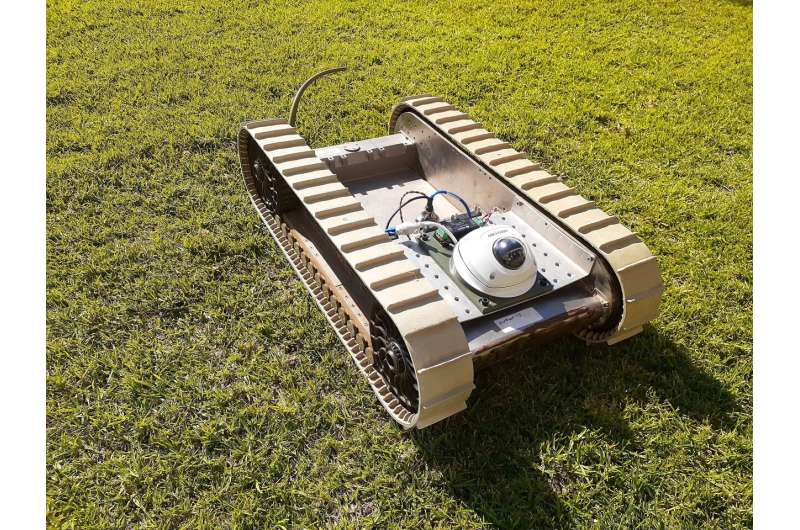
A replica of the US army combat ground vehicle used in the AI experiment. 
Credit: Fendy Santoso, Charles Sturt University

Australian researchers have designed an algorithm that can intercept a man-in-the-middle (MitM) cyberattack on an unmanned military robot and shut it down in seconds.

In an experiment using deep learning  to simulate the behavior of the human brain, artificial intelligence experts from Charles Sturt University and the University of South Australia (UniSA) trained the robot's operating system to learn the signature of a MitM eavesdropping cyberattack. This is where attackers interrupt an existing conversation or .

The algorithm, tested in real time on a replica of a United States army combat ground vehicle, was 99% successful in preventing a malicious attack. False positive rates of less than 2% validated the system, demonstrating its effectiveness.

The results have been published in IEEE Transactions on Dependable and Secure Computing.

UniSA autonomous systems researcher, Professor Anthony Finn, says the proposed algorithm performs better than other recognition techniques used around the world to detect cyberattacks.

Professor Finn and Dr. Fendy Santoso from Charles Sturt Artificial Intelligence and Cyber Futures Institute collaborated with the US Army Futures Command to replicate a man-in-the-middle cyberattack on a GVT-BOT ground vehicle and trained its operating system to recognize an attack.

"The robot operating system (ROS) is extremely susceptible to data breaches and electronic hijacking because it is so highly networked," Prof Finn says.

"The advent of Industry 4, marked by the evolution in robotics, automation, and the Internet of Things, has demanded that robots work collaboratively, where sensors, actuators and controllers need to communicate and exchange information with one another via .

"The downside of this is that it makes them highly vulnerable to cyberattacks.

"The good news, however, is that the speed of computing doubles every couple of years, and it is now possible to develop and implement sophisticated AI algorithms to guard systems against digital attacks."

Dr. Santoso says despite its tremendous benefits and widespread usage, the robot operating system largely ignores  in its coding scheme due to encrypted network traffic data and limited integrity-checking capability.

"Owing to the benefits of deep learning, our intrusion detection framework is robust and highly accurate," Dr. Santoso says. "The system can handle  suitable to safeguard large-scale and real-time data-driven systems such as ROS."

Prof Finn and Dr. Santoso plan to test their intrusion detection algorithm on different robotic platforms, such as drones, whose dynamics are faster and more complex compared to a ground .

More information: Fendy Santoso et al, Trusted Operations of a Military Ground Robot in the Face of Man-in-the-Middle Cyber-Attacks Using Deep Learning Convolutional Neural Networks: Real-Time Experimental Outcomes, IEEE Transactions on Dependable and Secure Computing (2023). DOI: 10.1109/TDSC.2023.3302807


Provided by University of South Australia AI approach yields 'athletically intelligent' robotic dog

LET FUKASHIMA KNOW

Promising material provides a simple, effective method capable of extracting uranium from seawater

Promising material provides a simple, effective method capable of extracting uranium from seawater
TEM/EDS images of MgAl (top) and MgAlNd (bottom). Credit: Energy Advances
 (2023). DOI: 10.1039/D3YA00154G

An Australian-led international research team, including a core group of ANSTO scientists, has found that doping a promising material provides a simple, effective method capable of extracting uranium from seawater.

The research, published in Energy Advances and featured on the cover, could help in designing new materials that are highly selective for uranium, efficient, and cost-effective.

Uranium is a highly valued mineral used as a  in nuclear reactors around the world.

"There's a lot of uranium in the oceans, more than a thousand times more than what is found in the ground, but it's really diluted, so it's very difficult to extract. The main challenge is that other substances in , salt and minerals, such as iron and calcium, are present in much higher amounts than uranium," explained lead scientist Dr. Jessica Veliscek Carolan, who supervised co-author honors student Hayden Ou of UNSW with Dr. Nicolas Bedford of UNSW.

First author Mohammed Zubair received a grant from the Australian Institute of Nuclear Science and Engineering (AINSE) to support his research at ANSTO.

Layered double hydroxides, materials that have attracted interest for their ability to remove metals, are fairly easy to make and can be modified to improve the way they work.

Because these layers have positive and , they can be tailored to capture specific substances such as uranium.

Lanthanide dopants, neodymium, europium and terbium, were tested. Adding neodymium to layered double hydroxides (LDHs) improved their ability to selectively capture uranium from seawater, a highly challenging process that scientists have been working on for a long time.

Synthesized materials were characterized using a variety of techniques, including scanning  (STEM) and scanning  (SEM) at ANSTO's microscopy facility by Dr. Daniel Oldfield and at UNSW by Yuwei Yang.

When neodymium was added to LDHs (MgAlNd), these materials chose uranium over ten other more abundant elements found in real seawater.

Importantly, the experiments were undertaken under seawater-like conditions.

A crucial finding was that the dopant, neodymium, changes the way uranium binds to the LDHs.

The research team also used X-ray absorption spectroscopy (XAS) and Soft X-ray spectroscopy at ANSTO's Australian Synchrotron to clarify the octahedral coordination environment, oxidation state and adsorption mechanism, respectively. They were assisted by Instrument scientists Dr. Jessica Hamilton and Dr. Lars Thomsen, co-authors of the paper.

X-ray measurements showed that under seawater conditions, the removal of uranium occurred through a process where uranium atoms formed complexes on the surface of LDHs by replacing nitrate ions in the LDH layers with uranyl carbonate anions from the seawater.

By adding  and other lanthanide elements to the LDH structure, the  between metal atoms and oxygen in the LDH became more ionic.

This improved ionic bonding made these materials much better at selectively binding to uranium via ionic surface interactions.

The authors pointed out that the study demonstrated a way to adjust how well a material can capture uranium which could lead to creating new materials that are even better at separating uranium from other substances.

The materials were not just useful for taking uranium from seawater but also had the potential to clean up uranium from radioactive wastewater near nuclear power plants.

"There are additional benefits in that these materials are simple and inexpensive to make, making them a cost-effective choice for large-scale  extraction," said Dr. Veliscek Carolan.

More information: Muhammad Zubair et al, Enhanced uranium extraction selectivity from seawater using dopant engineered layered double hydroxides, Energy Advances (2023). DOI: 10.1039/D3YA00154G

Researchers propose plasma-enhanced adsorbent for uranium extraction from seawater


$9.5 bn of key metals in overlooked electronic waste: UN

Toys, cables, electronic cigarettes, tools, electric toothbrushes, shavers, headphones and other domestic gadgets contain critical metals
Toys, cables, electronic cigarettes, tools, electric toothbrushes, shavers, 
headphones and other domestic gadgets contain critical metals.

Consumers discard or possess disused electronic goods containing raw materials critical for the green energy transition and worth almost $10 billion every year, the United Nations said on Thursday.

Toys, cables, , tools, electric toothbrushes, shavers, headphones and other domestic gadgets contain metals like lithium, gold, silver and copper.

Demand is expected to soar for these materials due to their crucial role in rapidly growing green industries such as electric vehicle battery production.

In Europe alone, copper demand is predicted to multiply by six by 2030 to meet rising needs in key sectors like renewable energy, communications, aerospace and defense.

But the materials are squandered because this "invisible" waste is thrown away rather than recycled or gathers dust in homes, the United Nations Institute for Training and Research (UNITAR) said in a report released on Thursday.

The "invisible" e-waste amounts to nine billion kilograms every year worldwide, with the related  worth $9.5 billion, around one-sixth of the estimated 2019 total of $57 billion for all e-waste, UNITAR said.

"Invisible e-waste often falls under the recycling radar of those disposing of them because they are not seen as e-waste," said Magdalena Charytanowicz of the Waste Electrical and Electronic Equipment Forum, an international association of non-profit organizations that commissioned the report.

"We need to change that and raising awareness is a large part of the answer."

More than one-third of the "invisible" waste came from toys such as , talking dolls, robots and drones, with 7.3 billion items thrown away annually.

The weight of the estimated 844 million vaping devices discarded each year is equivalent to six Eiffel Towers, the report said.

The study also found that 950 million kilograms of cables with recyclable copper were thrown away last year, enough to circle Earth 107 times.

'Invisible' E-Waste: Almost $10 billion in essential raw materials recoverable in world's annual mountain of electronic toys, cables, vapes, more
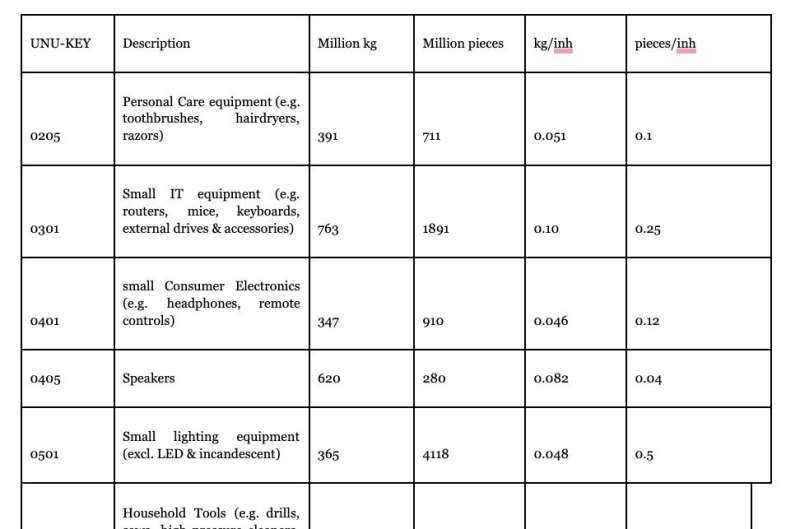
E-waste generated of selected UNU-KEYs related to invisible e-waste in 2022. Source: C.P. Baldé, T. Yamamoto, V. Forti, United Nations Institute for Training and Research, Statistical briefing on invisible e-waste for International E-waste Day 2023, 2023, Bonn. Credit: UNITAR

In Europe, 55 percent of electric and  is recycled, but the  drops to a little over 17 percent.

The recycling rate tumbles to almost zero in parts of South America, Asia and Africa, usually due to a lack of collection points, Charytanowicz said.

Manufacturers have been responsible for collecting and recycling the waste in Europe since 2005, most often in partnership with environmental authorities.

But recycling rates remain patchy, said Guillaume Duparay of French non-profit organization Ecosystem, pointing to a lack of awareness and information among consumers.

© 2023 AFP


AI researchers expose critical vulnerabilities within major large language models

ai
Credit: CC0 Public Domain

Large Language Models (LLMs) such as ChatGPT and Bard have taken the world by storm this year, with companies investing millions to develop these AI tools, and some leading AI chatbots being valued in the billions.

These LLMs, which are increasingly used within AI chatbots, scrape the entire Internet of information to learn and to inform answers that they provide to user-specified requests, known as "prompts."

However, computer scientists from the AI security start-up Mindgard and Lancaster University in the UK have demonstrated that chunks of these LLMs can be copied in less than a week for as little as $50, and the information gained can be used to launch targeted attacks.

The researchers warn that attackers exploiting these vulnerabilities could reveal private confidential information, bypass guardrails, provide incorrect answers, or stage further targeted attacks.

Detailed in a new paper to be presented at CAMLIS 2023 (Conference on Applied Machine Learning for Information Security) the researchers show that it is possible to copy important aspects of existing LLMs cheaply, and they demonstrate evidence of vulnerabilities being transferred between different models.

This attack, termed "model leeching," works by talking to LLMs in such a way—asking it a set of targeted prompts—so that the LLMs elicit insightful information giving away how the model works.

The research team, which focused their study on ChatGPT-3.5-Turbo, then used this knowledge to create their own copy model, which was 100 times smaller but replicated key aspects of the LLM.

The researchers were then able to use this model copy as a testing ground to work out how to exploit vulnerabilities in ChatGPT without detection. They were then able to use the knowledge gleaned from their model to attack vulnerabilities in ChatGPT with an 11% increased success rate.

Dr. Peter Garraghan of Lancaster University, CEO of Mindgard, and Principal Investigator on the research, said, "What we discovered is scientifically fascinating, but extremely worrying. This is among the very first works to empirically demonstrate that  can be successfully transferred between closed source and open source Machine Learning models, which is extremely concerning given how much industry relies on publicly available Machine Learning models hosted in places such as HuggingFace."

The researchers say their work highlights that although these powerful digital AI technologies have clear uses, there exist hidden weaknesses, and there may even be common vulnerabilities across models.

Businesses across industry are currently or preparing to invest billions in creating their own LLMs to undertake a wide range of tasks such as smart assistants. Financial services and large enterprises are adopting these technologies but researchers say that these vulnerabilities should be a major concern for all businesses that are planning to build or use third party LLMs.

Dr. Garraghan said, "While LLM technology is potentially transformative, businesses and scientists alike will have to think very carefully on understanding and measuring the cyber risks associated with adopting and deploying LLMs."

Provided by Lancaster University 
Radiology researchers test large language model that preserves patient privacy

 POST FORDISM

Vietnam automaker sends EVs to Laos for electric taxi service

Laos
Credit: Pixabay/CC0 Public Domain

Vietnamese automaker VinFast on Friday sent 150 cars to neighboring Laos for the launch of an electric taxi service, months after starting a similar scheme at home.

The communist state's first homegrown car manufacturer is hoping to compete with EV giants such as Tesla, and is trying to crack .

The taxi service in Laos will be run by Green and Smart Mobility JSC (GSM), which shares the same  as VinFast—the Vietnamese conglomerate Vingroup.

"Laos is an ideal starting point for GSM to expand internationally," said GSM CEO Nguyen Van Thanh.

"GSM has set the goal to promote Vietnamese electric vehicles to global consumers."

The announcement follows the launch of Vingroup's electric  in Vietnam in April.

The conglomerate is owned by Vietnam's richest man, Pham Nhat Vuong, who runs hotels, apartments and hospitals across the country.

But VinFast's international expansion has faced a rocky start.

Of the 11,300 vehicles it sold in the first half of 2023, 7,100 were bought by GSM.

The company listed on the Nasdaq in August, where its shares veered wildly.

At one point its valuation was greater than auto behemoths Ford and General Motors, before lurching back down.

In the third quarter, VinFast reported a net loss of $623 million.

But GSM says it aims to expand operations to 27 of 63 provinces and cities in Vietnam by the end of 2023, with a fleet of 30,000 electric taxis and over 90,000 electric scooters.

© 2023 AFP