Saturday, March 16, 2024


Tribunal orders Flair to pay up for spoiled seafood caused by baggage delay

A tribunal has ordered Flair Airlines to fork over hundreds of dollars in compensation to a man whose crab meat and fish cakes went bad in his luggage when it was delayed for several days.

The discount carrier must pay Brian Vu $780 for the spoiled items as well as baggage fees, interest and legal costs, according to a ruling Thursday from the B.C. Civil Resolution Tribunal.

Vu flew from British Columbia to Ontario on Nov. 6, 2022, paying $72 to check a pair of bags, one of which did not arrive until Nov. 10.

The tardy luggage contained sea cucumbers — leathery marine animals — and dandelion root as well as the crab and fish, all of which went bad, amounting to a loss of $522, the traveller said.

Flair argued it was not liable because its actions did not cause the spoilage; "rather, the items spoiled on their own," wrote tribunal member Peter Mennie, paraphrasing the airline. Flair also said its contract with passengers bars them from packing perishable items in checked bags.

However, the tribunal said carriers are responsible for suitcases once they are checked, regardless of whether they contain items they shouldn't.

"The Canadian Transportation Agency has repeatedly held that if an airline accepts checked baggage then the airline assumes liability for the baggage even if the airline has not agreed to transport certain items," Mennie wrote.

"An airline is liable if damage occurs during any period where the checked bag was in the airline’s care," he said, citing the Montreal Convention, a multilateral treaty on liability and compensation for air travellers.

The Canada Transportation Act does "not permit an airline to contract out of its liability," which is laid out in the passenger rights charter and the Montreal Convention, Mennie added.

The ruling confirms that "fancy contractual language" does not override federal rules, said Gabor Lukacs, president of the Air Passenger Rights advocacy group.

"Airlines love to contract out liability, even though the law says they have to pay compensation," Lukacs said.

"The importance of this case is that it reaffirms the well-established principle that that is not doable, that's not permissible under the law in Canada."

This report by The Canadian Press was first published March 15, 2024.


Economist says 'no investment vehicle' equal to home ownership

As the cost of homeownership in Canada soars, one economist says many unable to afford a home may miss out on a primary driver of wealth accumulation. 

On Thursday, Carrie Freestone, an economist at RBC, said in a report that renters are facing barriers to accumulating wealth as they spend more and more of their income on shelter. Freestone said in an interview with BNN Bloomberg on Friday that renters “are squeezed” and spending more than they earn. She said the trend is cause for concern. 

“I will say that if we look at wealth accumulation, homeownership has been the primary driver of wealth accumulation in Canada,” Freestone said. 

“It's accounted for half of the assets accumulated over the past three decades. So it is concerning that renters are not having access to the housing market.”

She said that homeownership is often a “nest egg,” whereby if people can pay off most of their mortgage by the time they retire they have “something to fall back on.” Freestone said this gives a person security in retirement as they can sell their home, downsize or live off the equity in their home. 

“We just don't have an investment vehicle that's equivalent when we think about the pace of asset accumulation or appreciation that we've seen,” she said. 

The solution to the problem, Freestone said, lies in addressing housing affordability in Canada by building more homes, which is “easier said than done.” She outlined that there are capacity constraints regarding the construction sector. 

With files from The Canadian Press. 


March Madness has become year's 'biggest betting month': professor

The NCAA men’s and women’s championship tournaments have become major business for sportsbooks around the world, so much so that one expert believes March has become the biggest betting month of the year.

The NCAA tournament – dubbed March Madness – runs from March 19 to April 8 and pits 68 of the best U.S. college basketball teams against one another in a single-elimination bracket-style tournament until a national champion is crowned.

The event is hugely important to the bottom lines of TV networks, college athletic programs and now the betting world, as online sports gambling is now legal in Ontario and most U.S. states. 

“It's a million-dollar-plus business and that doesn't consider television rights, but it's about a US$15 to $17-billion bet business,” Robert Boland, a law professor with a concentration in gaming, hospitality, entertainment and sports at Seton Hall Law School, told BNN Bloomberg in a television interview on Friday.

“It's probably the largest betting event in the world that happens annually. Maybe the World Cup -- a quadrennial event -- draws a little bit more money around the world, but it'll draw about $15 billion of betting.”

For Boland, the popularity of March Madness comes down to the scope of the event and fans’ allegiance to their alma mater.

“It's really taken off in the years while more people have gone to college and have loyalty and love this,” he said.

“In terms of TV, it's certainly very watched as a property and this will be the biggest betting month in sports in the United States.”

The tournament is hugely important to the wallets of the players as well, as for decades NCAA student-athletes were unpaid, but can now earn a salary off the court through name, image and likeness (NIL) deals.

“In a lot of cases, school collectives, groups of donors, (and) groups of boosters are using the collective structure to actually pay a version of salary to some athletes, but this is a big money opportunity and athletes are now able to cash in,” Boland said.

“You won't see them making tens of millions … a very few number (are) in the seven figures, (but) you'll see many more working smaller deals around the sides of this.”


Major Canadian Gildan shareholder weighs in on dramatic boardroom saga

One of Gildan Activewear Inc.’s largest shareholders says the increasingly bitter feud between the company’s board of directors and its former CEO “never should have ended” in such dramatic fashion.

Evan J. Mancer, president and chief investment officer of Winnipeg-based Cardinal Capital Management, said his firm is one of a number of high-profile shareholders who would like to see Gildan’s ousted CEO and co-founder Glenn Chamandy reinstated.

“I'm not sure how they got to this… I think there's probably more ego involved than logic,” Mancer told BNN Bloomberg in a television interview Friday morning.

“I don't know who started it, between the board and (Chamandy); founders can be very passionate about their companies… but it never should have ended like this.”

Chamandy had served as head of the Montreal-based company for nearly 20 years before he was dismissed by Gildan’s board late last year and replaced by former Fruit of the Loom executive, Vince Tyra.

The board said at the time that they had lost faith in Chamandy’s ability to deliver long-term strategic objectives, but Chamandy maintains he was fired without cause, and said he had the backing of the company’s management team.

Mancer, whose firm is estimated to be Gildan’s twelfth largest shareholder, said he thinks Gildan was “extremely well managed” under Chamandy’s leadership, and that his past moves have set the company up for future success.

“It's extremely rare that a board would ever fire a successful CEO… even if there's some ego involved, at the end of the day, the job of the board is really to keep your successful CEO, not to let them go,” he said.

Activist investor Browning West

U.S. investment firm Browning West has been the most outspoken Gildan shareholder that wants to see Chamandy reinstated as CEO, and the firm has also said it will seek to replace eight of the 11 directors on Gildan’s board.

Browning West’s latest move came earlier this week when the firm filed a lawsuit against Gildan and its board to ensure it holds its scheduled annual meeting in May "without delay and with the oversight of an independent chair” in order to ensure a leadership vote is held.

Mancer said that while he initially only wanted Chamandy reinstated, he can’t see how he and the board that ousted him could work together again, and said that Browning West’s proposed change of directors is “probably the only solution.”

“I think Browning West actually did a really good job with this new slate of directors that they're proposing,” he added.

“They're all industry heavyweights for one, but also, there's two or three of them that have got a lot of experience with succession, having worked with founders in the past, and obviously having come through what we just came through, that's very much needed at Gildan.”


Alberta amending tax rules to offer $5,000 incentive to out-of-province workers

The Alberta government has introduced legislation that would direct $10 million from this year's budget toward luring more workers to the province.

The funds for the Alberta is Calling Attraction Bonus are aimed at bringing skilled tradespeople from elsewhere in Canada.

During the last election campaign, the United Conservative Party promised to offer at least $1,200 to newcomers who move to the province to work in high-demand jobs such as health care and trades.

Premier Danielle Smith’s government now says instead it will amend the Alberta Personal Income Tax Act to introduce the Alberta is Calling Attraction Bonus to allow for a $5,000 refundable tax credit. 

Matt Jones, the minister for jobs, economy and trade, said the government determined the number should better reflect the true cost of relocation.

"In doing the work behind this program we determined the average moving costs for a Canadian, say from Ontario, to relocate to Alberta was around $5,000,” Jones told a news conference Tuesday.

"To me that (original $1,200) was not enough of a benefit to attract or motivate a moving decision, so we of course moved that benefit up to what is $5,000 tax-free."

The program, first announced by former premier Jason Kenney in 2022, initially targeted Canadians living in Toronto and Vancouver.

Last year, it focused on Atlantic Canada and parts of Ontario to bring in workers, primarily in the staff-starved hotel and restaurant industries.

Jones said Alberta is facing shortages of skilled tradespeople across the board, but said the priorities are electricians, pipefitters, heavy-duty mechanics, welders and crane operators. 

He said he would like to deal with shortages in construction as well.

"Albertans need homes, they need schools, they need hospitals and they need jobs,” he said.

“We've got tens of billions of dollars in capital investment that we have successfully won, and we must be able to deliver.”

Jones defended not using Alberta is Calling to attract health-care workers for now. 

He said all provinces are facing health-care worker shortages and the provinces are trying to collaborate on solutions to benefit everyone.

He noted there are already incentive programs in place to attract doctors and cover the bridging and upgrading of nurses, such as those from the Philippines. 

He said Alberta is Calling is open to revision.

"If this program is a success, we would look at leveraging it to other areas where we're facing labour shortages — and certainly health care and child care are two prime examples,” Jones said.

Opposition NDP heath critic Luanne Metz said the government is taking its eye off the ball and needs to focus on fixing the health-staffing shortages.

“Smith campaigned on recruiting health-care workers and yet, at the first opportunity, the UCP has broken their promise and will not be using this tool to address the staffing shortages in health care and in child care,” said Metz in a statement.

“This province desperately needs health-care workers to ensure Albertans get the surgeries and care they need," she added.

“And child-care operators are struggling to recruit early-learning and child-care workers. 

“Today’s legislation won’t do anything to recruit these staff.”

This report by The Canadian Press was first published March 12, 2024.


EXCLUSIVE: Alberta premier talks book-balancing, says Feds should 'stay in their lane'

Alberta Premier Danielle Smith says Justin Trudeau’s federal Liberals  “working against” her administration is the biggest impediment to her long-term goals for the province.

In an interview with BNN Bloomberg’s Amanda Lang airing Friday, Smith said Alberta has been able to work collaboratively with the federal government “on some things,” but criticized Ottawa for overstepping with certain environmental policies.

“The policies that keep on coming out of thin air from Environment Minister Steven Guilbeault are not constructive,” she said, pointing to the proposed oil and gas emissions cap and plans to create a net-zero electrical grid by 2035.

“This is not the way that you build a vast country like Canada. This is not the way that you build national unity. I think that there are ways that we can collaborate with the federal government, but they've got to stay in their own lane.”

Smith said that while she’s struggled to find common ground with Guilbeault, she has developed good relationships with other cabinet members, including Innovation, Science and Industry Minister François-Philippe Champagne.

“Champagne is such a champion of industry, no matter where they're located, whether it's in Quebec or Ontario or Alberta, and I just wish that more of that attitude was pervasive in all of the departments of government,” she said.

Smith said she’ll continue to oppose any of Guilbeault’s “devastating” policies she believes are aimed at completely phasing out fossil fuels and shutting down the industry’s production.

“We're going to fight back against that,” Smith said, “he's got no constitutional authority to do that.”

Smith said she recognizes the need to reduce emissions and ultimately achieve a net-zero target, but argued it will take more time to successfully reach that goal than the federal government suggests.

“We've aligned around the target of being net zero by 2050; I think that's achievable. Our big companies are working along those lines… but it does take time,” she said.

Smith said she also recognizes that investors across the world are shifting their capital towards credible plans to reduce emissions, and added that Alberta’s big industry players understand that too.

“But we also need a cost-effective supply of energy in order to maintain living standards,” she said. “We can't sacrifice reliability or affordability, we've got to do all three.”

Balancing the books

Smith said one of her biggest long-term goals is to achieve a provincial net debt of zero while running balanced budgets as premier, which she said was the number one promise she made to Albertans when campaigning for the job.

She said that in recent years, Alberta’s government revenues have failed to keep up with inflation and population growth – an issue Smith said will need to be adjusted for in budgets going forward.

An income tax cut promised by Smith in her election campaign was initially set to take effect next year but was pushed back until 2026 by the provincial government last month. Smith cited lower-than-anticipated revenues from the oil and gas sector as the main reason for the delay.

Smith said in a televised address to Albertans on Feb. 21 that the cuts “will have to wait a year and be phased in responsibly.”

The tax measure was officially introduced in Alberta's 2024 budget and will include a new bracket on the first $60,000 of personal income. It will save Albertans an estimated maximum of $760 a year.

Smith said she’s challenging her ministers to find budget savings this year in order to deliver the cut on schedule without going into a deficit to pay for it. The cut is expected to cost the government $1.4 billion annually.

“I'm hoping that Albertans are seeing that we're taking a measured approach because we know that we have to do it all, but you can't necessarily do it all at once,” she said.

“We've got to pace some of the decisions that we're making.”

Reviving the Heritage Savings Trust Fund

Smith said another one of her goals is to revive Alberta’s Heritage Savings Trust Fund, which has seen its founding vision “stall” in recent decades.

The fund was established in 1976 with the goal of saving and investing a portion of the province’s resource revenues in order to strengthen and diversify Alberta’s economy for current and future generations.

Smith said the fund started with around $12 billion worth of deposits, but provincial governments over the years have taken money out of the fund to pay for operating costs and other expenses.

She said her United Conservative Party’s commitment to keeping investment income in the fund has seen it grow to more than $20 billion in assets, and the fund is set to reach $25 billion by the end of this year.

“As it grows, it's really going to be able to sustain its own growth, and I've seen some projections that we could quite easily make it to $200 (billion) to $250 (billion) by 2050 just by keeping the investment income in the fund,” Smith said.

“That decision’s already been made, and if we can also have surpluses and we put a certain portion into savings, it'll just accelerate that growth.”

Smith said that when it comes to growing revenues in the province, Alberta has done well to attract diversified business investment with tax credits and incentives, which has led to significant increases in international and interprovincial migration.

“We want to make sure that it keeps going because as you attract businesses, you also attract the different supply chains to be able to support them, and you attract the workers, which generates additional personal income tax revenue,” she added.

“I think that we're finally beginning to see some important diversification in the economy.”  

Smith’s full interview on Taking Stock with Amanda Lang will air on Friday, March 15 at 6 p.m. on BNN Bloomberg, 9 p.m. on CP24 and 10:30 p.m. on CTV News Channel.


Canadians, parents shouldn't worry about TikTok security review: industry minister

The federal industry minister says Canadians shouldn’t worry about using TikTok, despite an ongoing national security review of the company.

Minister François-Philippe Champagne was asked at a press conference Friday whether Canadians using the app, including parents whose kids are obsessed with TikTok, should be worried. 

"The answer is no. And I think Canadians and parents should be happy to see that we were ahead of the curve," he said about launching the review six months ago.

Champagne was asked later why the government kept its review a secret if there was nothing for parents to worry about.

He said that when he spoke about whether they should be "concerned," he was referring to "actions being taken with respect to the company." 


Anything that happens as a result of the review would be "directed at the company and not the users," he said.

The federal Liberals ordered the national security review of TikTok in September 2023 but did not disclose it publicly until this week.

The revelation came after the U.S. House of Representatives passed a bill Wednesday to ban TikTok unless its China-based owner sells its stake in the business.

Champagne said the government would follow that bill carefully. He noted it "still has some way to go before it would become law," referring to the need for it to pass in the U.S. Senate.

TikTok is a wholly owned subsidiary of Chinese technology firm ByteDance Ltd.

The concern driving the U.S. bill is that because of Chinese national security laws that compel organizations to assist with intelligence gathering, the Chinese government could demand access to the data of TikTok's American consumers.

Champagne's office has asserted that the six-month-old Canadian review is not related to the U.S. bill.

The minister said Friday the Canadian probe should come as no surprise because the government issued a new policy earlier this month on foreign investment in the Canadian digital media sector. 

He said that policy was "explicit that we would be putting foreign investment in respect of interactive digital media under intense scrutiny."

That policy statement says "hostile state-sponsored or influenced actors" could use investments to spread disinformation or manipulate information in a way that harms Canada's national security.

The government has said that a business expansion triggered the review under the Investment Canada Act. It hasn't stated which one, but a government database shows a notification of new business from TikTok in June 2023.


The database says Network Sense Ventures Ltd. in Toronto and Vancouver would engage in "marketing, advertising, and content/creator development activities in relation to the use of the TikTok app in Canada."

The Investment Canada Act allows the government to launch a review when it believes a foreign investment might harm national security. 

Cabinet can take measures like making investors sell parts of the business or sell shares, or allow them to continue operating as long as they agree to conditions.

The federal government banned TikTok from its mobile devices in February 2023 following the launch of an investigation into the company by federal and provincial privacy commissioners.

Champagne said the Investment Canada Act doesn't allow him to disclose details about the review.

He said once the review is completed, "we'll be informing Canadians about any action, if any, that we decide to take with respect to that particular company."

A TikTok spokesperson said the company is cooperating with the government's review, and the company remains "committed to ensuring the safety and security of the platform for the millions of Canadian creators, artists and small businesses who rely on TikTok to earn a living, find community and create jobs."

This report by The Canadian Press was first published March 15, 2024.


Federal government reveals it ordered national security review of TikTok in September

The federal Liberals ordered a national security review of popular video app TikTok in September 2023 but did not disclose it publicly.

"This is still an ongoing case. We can't comment further because of the confidentiality provisions of the Investment Canada Act," a spokesperson for Industry Minister François-Philippe Champagne said. 

"Our government has never hesitated to (take) action, when necessary, if a case under review is found to be injurious to Canada's national security."

The revelation comes after the U.S. House of Representatives passed a bill Wednesday to ban TikTok unless its China-based owner sells its stake in the business.

"We're watching, of course, the debate going on in the United States," Prime Minister Justin Trudeau said Thursday when asked whether Canada would pursue a similar move.

In response to the same question, Champagne's office said that the Liberal cabinet "issued an order for the national security review of TikTok Canada" on Sept. 6. 

It said the review was based on the expansion of a business, which it said constituted the establishment of a new Canadian entity. It declined to provide any further details about what expansion it was reviewing. 

The office said the cabinet order was not accessible online, as is routine, because the information is protected and confidential under the Investment Canada Act. 

Champagne's office indicated TikTok would be subject to "enhanced scrutiny" under the act under a new policy on foreign investments in the interactive digital media sector released by the government earlier this month.

That policy statement says "hostile state-sponsored or influenced actors may seek to leverage foreign investments in the interactive digital media sector to propagate disinformation or manipulate information in a manner that is injurious to Canada's national security."

The Canadian review is not related to the proposed U.S. bill, which is driven by concerns that the company's current ownership structure is a national security threat.

"As you know, Canada made the determination that no government phones or devices can have the TikTok app. That’s a matter of security and safety," Trudeau said Thursday. 

"I can't comment on national security reviews."

The federal government banned TikTok from its mobile devices in February 2023 after federal and provincial privacy commissioners launched their own investigation into the platform. 

A TikTok spokesperson said the company continues "to co-operate with the government’s review of TikTok’s investment in Canada."

The spokesperson said the company remains "committed to ensuring the safety and security of the platform for the millions of Canadian creators, artists and small businesses who rely on TikTok to earn a living, find community and create jobs." 

TikTok is a wholly owned subsidiary of Chinese technology firm ByteDance Ltd. 

U.S. lawmakers contend ByteDance is beholden to the Chinese government, which could demand access to the data of TikTok's U.S. consumers, given Chinese national security laws that compel organizations to assist with intelligence gathering.

The bill must still pass the Senate, where lawmakers have indicated it will undergo a thorough review. U.S. President Joe Biden has said if Congress passes the measure, he will sign it.

Nearly 30 per cent of Canadian respondents to an October 2022 survey by Toronto Metropolitan University said they were on TikTok.

For many Canadian creators who make TikTok content, the U.S. market is paramount, said Scott Benzie, executive director of Digital First Canada. The organization advocates for digital creators, and has in the past received funding from TikTok.

"If a ban actually goes through in the U.S., Canadian careers on TikTok are over," he said. 

In addition to losing audience reach, for creators who earn money through sponsorships, "obviously most of those brands want to connect with U.S. audiences, and if that's not a possibility then that money just goes away."

Nathan Kennedy, a personal finance content creator from Hamilton, Ont., said he’s "pretty calm" about the situation, noting threats to ban TikTok have been around for years.

TikTok is his biggest platform, and the majority of his audience is in the United States. He became a full-time content creator two-and-a half years ago. 

"You kind of just have to be even-keel about the whole thing … I literally cannot do anything. It's not even in my country," he said.

He said it's hard to believe a ban will actually happen that causes TikTok to exit the U.S. 

But if the hypothetical worst-case scenario does happen, Kennedy said he would turn to other platforms.

"People are going to be watching content. That's not going to change. It's where they watch their content that might change over time," he said.

"I don't want to sound like I'm being very nonchalant here. But it's one of those things that you have to accept, that it's not your platform, it's not your business. And you kind of have to go to where the attention is."

This report by The Canadian Press was first published March 14, 2023. 

With files from The Associated Press.


Kevin O'Leary offers to purchase TikTok despite 'uncertainty' following U.S. bill

Kevin O'Leary says his interest in purchasing TikTok stems from the millions of small businesses using the platform but thinks its valuation has fallen ahead of a potential ban of the platform in the U.S.

O'Leary, the chairman of O'Leary Ventures, took to LinkedIn Wednesday offering to buy assets from TikTok’s owner ByteDance Ltd. to form a new U.S. company. His comments came after the U.S. House of Representatives passed a bill that could lead to a ban on the platform if its Beijing-based owner doesn’t sell its stake. 

“So a lot of moving parts on this deal, (it’s) really complicated, but a very interesting business with about 170 million users… But more importantly, five million small businesses use it to acquire customers, sell goods and services and advertise on it. That's where I'm focusing,” O'Leary said in an interview with BNN Bloomberg on Thursday. 

Despite the vast number of small businesses using the platform, he said there are also valuation metrics to consider. 

“Whatever it was worth two days ago, it’s worth 50 to 60 per cent less today. There's so much uncertainty around this asset, particularly what the covenants are going to be post-sale,” O'Leary said. 

“This is going to be a highly regulated industry at some point. And really the headline focus will be on TikTok because of all of the controversy around collection of user data.” 

He said his interest in potentially buying the social media platform began in 2020, and noted that the company has been “up for sale multiple times” with previous interest from Walmart, Oracle and Microsoft. 

“It's been a well-known issue regarding national security, but this time it's different because this bill is a bipartisan bill that has passed its first step in the House. It now moves on to the Senate. It's just a timing issue,” O'Leary said. 

The bill was passed in a 352-65 vote in the U.S. House and will now go to the Senate. U.S. President Joe Biden has stated he will sign the legislation if Congress passes the measure. 

O'Leary outlined in his initial LinkedIn post that issues regarding data on the platform “won’t go away.” He added that Tiktok “leaks data” to the Chinese Communist Party and needs to be sold. 

“I’m proposing purchasing these assets into a new American company,” O'Leary said in the post. 

“I’ll guarantee the servers are on American soil. I guarantee we’ll close the Chinese back doors in the code. I’ll guarantee it’s safe for users, small businesses and large businesses. It will be an American company!” 

As O'Leary angles to buy the popular video platform, others have also expressed their interest. On Thursday, former U.S. Treasury Secretary Steven Mnuchin said he is going to put together a group of investors to purchase TikTok. 

With files from the Associated Press. 


  • Class I
  • Near Miss Illustrates Need for Constant Safety Vigilance

    Written by Terry Hanken, Senior Manager-Train Operations, Union PacificMarch 07, 2024
    Pictured: Terry Hanken, UP Senior Manager-Train Operations in Pratt, Kans. (Union Pacific Photograph)

    Pictured: Terry Hanken, UP Senior Manager-Train Operations in Pratt, Kans. (Union Pacific Photograph)

    Railroaders can’t become complacent or lose respect for the heavy equipment they work around every day. A close call early in my career brought that message home for me and underscored why safety must always be top of mind.

    The incident happened in 2000, two years after I began working as a conductor in Herington, Kans., a small town about two hours west of Kansas City. I was riding on a locomotive while building a train in a rail yard. I stepped off the engine, never looking back, and proceeded to stand on the crossties of the track beside the engine. My engineer quickly cautioned me that a railcar was rolling down the track beside me—a railcar I had released earlier and had forgotten about. I glanced over my shoulder and stepped aside as the car quietly rolled by.

    Terry Hanken pictured with wife, Jeni, and their three sons. Hanken’s sons are also UP employees. (UP Photograph)

    I never heard it, didn’t remember it, had become complacent. After the car passed, I sat down on the ballast next to the engine for about 10 minutes, in shock. I was angry at myself for forgetting the simplest rule: Never foul the rail and always keep your head on a swivel.

    Without a doubt, the locomotive engineer acting as my guardian angel saved my life that day. He has since retired, and I thank him every time I see him.

    I’ve told that story to UP teammates over the years, first as a peer trainer and now as Senior Manager of Train Operations in Pratt, Kans. I’ve called the Kansas City Service Unit—now the Heartland Service Unit—my home my entire career and watched as the service unit went from last in safety to the top of the list. We’ve had great success these past few years, thanks to employee engagement, recognition and hard work. We all want to do the right thing. Making safe choices as we carry out everyday tasks can be the difference between life and death and how we ensure everyone can go home safe to their loved ones at the end of the day.

    I now pass the story of my guardian angel to my three sons, who also work for UP. Cole is Manager of Train Operations at Wichita; Trey is a conductor working out of Herington; and Drew is a conductor who works out of Salina. I’m very proud of what they’ve accomplished in their short careers, and what the railroad has afforded them to provide for their families. I can’t preach safety enough to those three, and the importance of always doing the right thing!

    It is a great honor to be selected Safety Manager of the Year for the No. 1 service unit on the system. I give thanks to my wife of 28 years, Jeni, who has been there when the phone rings in the middle of the night for the last 26 years and has always supported my career and my decision making. She grounded me into the person I am today.

    This honor is not about me. It is a reflection of ALL the Heartland Service Unit employees who work safe and work hard each and every day. We take pride in the fruits of our labor and look out for each other. We like to win!

    UP Editor’s Note: Hanken was named 2023 Safety Manager of the Year for the Heartland Service Unit.

    This article was first published on the Inside Track section of UP’s website.

    Tags: 

     Commentary


    BNSF Desperate for an Inflection

    Written by Rick Paterson, Managing Director, Loop Capital Markets
    image description

    The Smokehouse Creek wildfire in Texas, which severed BNSF’s Transcon route on February 27, was the latest in a series of problems that have significantly slowed BNSF’s network and impacted service. After running well as recently as December, BNSF now finds itself in a hole.

    We were hoping for an inflection in network velocity in the week following the wildfire effect, ending March 8, but instead we saw another sequential deterioration, from 25.1 to 24.8 mph. Within this number, Manifest service average speed fell from 22.3 to 21.7 mph, and Intermodal from 30.1 to 29.5 mph. All these speeds are materially lower than where they bottomed during the Arctic Blast in the third week of January, and except for Manifest you need to go back to June 2022—in the depths of the service crisis—to find comparable numbers.

    Just as worrisome is the recent increase in cars on line. From a weekly average of 248,000 in 2023, it rose to 256,000 in January, 261,000 in February, and hit 263,326 the week of March 4, which is a high we haven’t seen since November 2019. Part of this is simply due to higher volumes as BNSF handily leads the industry in terms of YTD volume growth (+5.5%), but there’s also no doubt a worrying congestion element that threatens the speed at which the network can get back in sync.

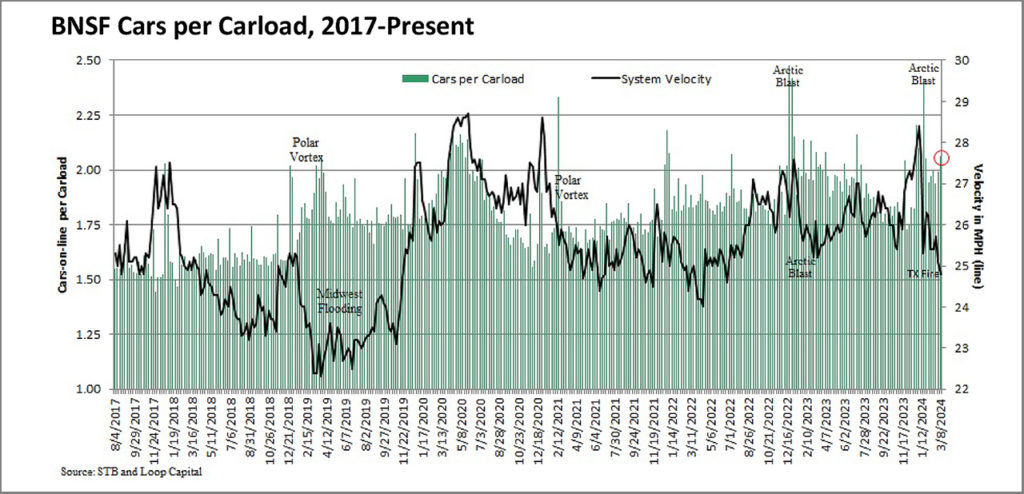
    A good way to adjust for volumes and sanity check car congestion is to look at “cars per carload,” which is basically a ratio of rolling stock relative to the loads they’re transporting. In the chart below, we’ve divided weekly intermodal units by two to account for double-stacking, and added that count to non-intermodal loads to get total “carloads.” We then divide cars on line by this number to generate cars per carload, with the lower the ratio the better. If we look at BNSF’s recent history, this averaged 1.6 in 2017 and 2018, then between 1.8-1.9 in each year between 2019 through 2023. You can see by the green columns that it sometimes spikes above two times, and it was 2.1 the week of March 4 (red circle). So even after adjusting for the current strength in intermodal volumes, there’s still some evidence of car congestion. Our assumption of a two-week bounce back from the wildfire effect now looks too optimistic, and it may be more of a slower grind higher.

    In terms of critical resources, trains holding for crews and power also both deteriorated sequentially the week of March 4: crews from 31 to 39 per day, and power from 13 to 17 per day. To put this in perspective, these topped out at 167 (crews) and 38 (power) during the service crisis, so thankfully we’re nowhere near those levels. Also notice we haven’t yet used the “M word” (meltdown) because BNSF has ample crews; albeit there are some crew districts with too few and others with too many, so there are imbalances to iron out. This, of course, isn’t unique to BNSF.

    The bottom line is that BNSF needs to be careful here, because after what we all went through in 2022 there will be no tolerance from its stakeholders and Washington D.C. for another bout of extended service failures from a major railroad. We’re at least assured that BNSF is a quality organization that fully understands the urgency of the situation.

    Tags: