Monday, January 13, 2025

Smokey Bear is Partially Right


 January 13, 2025
Facebook

Graphic: Ad Council, National Association of State Foresters, and US Forest Service.

Smokey Bear tells us “only you can prevent wildfires.” That has been Smokey’s simple message since 1944, but nevertheless he has been long associated with the policy of immediately suppressing all wildfires. This policy was called the 10 AM policy, and it meant that all wildfires should be suppressed by 10 AM of the morning after the wildfire was ignited. The 10 AM policy resulted in over-suppression of wildfires and disrupted the beneficial role of wildfire in forest ecosystems, so the policy was rightly discontinued in 1978. The fire suppression policy is sometimes known as the “Smokey Bear Effect.” In actuality, Smokey did not make any comments about fire suppression.

Smokey is correct that a greater focus on preventing unwanted human-caused wildfire ignitions will help to mitigate our wildfire management dilemma. Western forests are being heavily cut and burned for a primary purpose of moderating wildfire behavior, with substantial adverse impacts to both forests and communities. It would be much more direct and cost-effective to put greater emphasis on avoiding unwanted human-caused wildfire ignitions in the first place. This can be done while still allowing lightning strike fires to fulfill their natural and beneficial role on our forest landscapes, when safe to do so. This can be supplemented by judicious implementation of prescribed burns, only during the safest burn windows.

However, Smokey needs to clarify at whom he is pointing a rather accusatory paw. Who all needs to prevent wildfires? Does he just mean the public, or does he also include the Forest Service? The Forest Service and other land management agencies are responsible for a significant amount of wildfire ignitions and acres burned on our forest landscapes, and at times their actions have exacerbated wildfires. We need to consider all the sources of wildfire ignitions and hone our prevention strategies accordingly.

The primary ignition source of wildfire in the US is human-caused ignitions. According to a 2023 report by the Congressional Research Service, nationally 89% of wildfires from 2018 to 2022 were human-caused. According to a research paper by Balch et al., human-related ignitions have increased, resulting in larger and hotter wildfires, and the length of the wildfire season has more than tripled. University of Colorado Professor Virginia Iglesias wrote in a recent article that wildfires ignited by human activities pose a greater risk to people and cause more severe ecosystem effects than lightning-started fires. She states:

Lightning-started fires often coincide with storms that carry rain or higher humidity, which slows fires’ spread. Human-started fires, however, typically ignite under more extreme conditions – hotter temperatures, lower humidity and stronger winds. This leads to greater flame heights, faster spread in the critical early days before crews can respond, and more severe ecosystem effects, such as killing more trees and degrading the soil.

Human-ignited fires often occur in or near populated areas, where flammable structures and vegetation create even more hazardous conditions. As urban development expands into wildlands, the probability of human-started fires and the property potentially exposed to fire increase, creating a feedback loop of escalating wildfire risk.

The three primary elements that cause wildfire to ignite and spread – known as the wildfire triangle – are an ignition source. dry fuel, and hot, dry and windy weather. While all three elements are necessary, a wildfire cannot occur without an ignition. So considering ignitions of undesired human-caused wildfires, and finding ways to avoid such ignitions, is paramount for wildfire management.

Because it is now widely agreed upon to allow a certain amount of wildfire to burn on our landscapes instead of immediately suppressing all fires, the Forest Service’s focus in recent decades has been to aggressively log, “thin” and apply prescribed fire to forest landscapes in order to allow wildfires to burn more safely. This change of focus caused Smokey and his original campaign slogan, “Remember, only you can prevent forest fires,” to become obsolete, as the Forest Service itself was sometimes essentially setting forest fires during implementation of prescribed burns. As a result, the slogan was changed in 2001, to “Only you can prevent wildfires.” “Wildfires” means fires other than agency intentionally-set fires that remain within the intended containment perimeters.

The primary strategy has shifted from reducing wildfire ignitions to reducing fuels (trees and other vegetation). Since the number of forest wildfire ignitions and of acres burned at high severity have been overall steadily increasing, the fuels reduction strategy appears to not be very effective.

Additionally, the aggressive “cut and burn” strategy has caused an enormous amount of ecosystem damage in our forests, and in a few cases it has resulted in escaped prescribed fire burning entire communities, such as occurred during the Hermits Peak and Calf Canyon Fires. Implementing much lighter and more targeted cutting and burning treatments, focusing more on genuine restoration projects that support the retention of moisture in forest ecosystems, and refocusing on reducing unwanted human-caused wildfire ignitions, may be the best route for moderating the amount and severity of fire burning in our forests. It may also be the best way to protect our communities and infrastructure. This strategy should be combined with fire hardening homes and reducing fuels in the 100 feet surrounding structures.

Forest management strategies need to be considered differently in different ecosystem types. In wetter forests, wildfire is still in a historical deficit, including high severity fire. However in some drier forests, such as the Santa Fe National Forest, there has been too much wildfire, including too much high severity fire. And post-fire conifer regeneration in this dry forest appears to be either delayed or not occurring at all in some locations. The Santa Fe National Forest could be considered the “canary in the coalmine” of climate effects on forests, and we need to learn from what is occurring in this area and quickly develop climate-appropriate conservation strategies.

The New Mexico State Forester Laura McCarthy recently authored an op-ed, “Let’s bring back a proven campaign to prevent wildfires.” In it, she calls for a New Mexico wildfire prevention campaign built on New Mexico’s Smokey Bear program and modeled after Utah’s successful FireSense Program. She states that “the [FireSense] campaign reduced human-caused wildfires by 75% within three years.” Such campaigns can be an important conservation strategy, as avoiding human-caused ignitions has fewer adverse impacts on ecosystems and communities than heavily treating millions of acres of forest to moderate the effects of such ignitions.

However, State Forester McCarthy’s op-ed and the research papers and articles referenced above do not mention that much more comprehensive measures need to be taken to prevent wildfires ignited by the US Forest Service and by other land management agencies prescribed burns escapes. In the Santa Fe National Forest during the past 25 years, the majority of acres burned by wildfire were ignited by Forest Service and National Park Service escaped prescribed burns.

Out of a total of over 784,000 acres burned by wildfire in the Santa Fe National Forest during this time period, almost 435,000 acres were burned due to escaped prescribed fire ignited by these two federal land management agencies, as opposed to just over 253,000 acres ignited by all other human-caused ignitions. Less than 97,000 acres were burned due to natural ignitions (lightning strikes). Also, the largest wildfire that burned due to a lightning strike ignition was just over 17,000 acres — a relatively small area compared with the enormous areas burned by escaped prescribed fire. None of the lightning strike fires caused significant damage to either communities or infrastructure. If the large agency-ignited wildfires had not occurred, wildfires in the Santa Fe National Forest would have occurred well within a natural range.

The Forest Service claims that nationally less than 1% of their prescribed burns escape, which amounts to about seven wildfires per year. However escaped prescribed burns often result in very large and hot wildfires, and are often ignited near communities and infrastructure. So the impacts of prescribed fire escapes can be much greater than this Forest Service statistic suggests. Much more valid and meaningful statistics would be the total acres burned due to escaped prescribed burns, and the amount of damage to human resources. It’s also necessary to consider that as the climate becomes warmer and drier, the risk of escaped prescribed burns will inevitably increase, especially in dry forests.

It’s critical to reevaluate the Forest Service and other agencies’ prescribed burn practices in order to reduce wildfires caused by prescribed fire escapes. The Forest Service has made some efforts to do so, but its analysis is limited, its assumptions are sometimes unproven and controversial, and its new policy recommendations are not nearly enough to adequately improve prescribed burn safety.

Logging and “thinning” practices need to be also reconsidered, as such practices can at times exacerbate wildfire risk, wildfire size, and burn severity, instead of reducing them. Aggressively cutting trees and opening up forest canopies often results in drier forests with more flammable fuels and can allow wind to blow more intensely and drive fire up into the tree crowns. This occurred during the 2022 Santa Fe National Forest Calf Canyon Fire which was ignited by a pile burn escape. This fire was largely fueled by windthrow of trees due to aggressive logging and “thinning” having opened up the forest canopy, along with unburned slash piles.


There are a number of other strategies that can be employed by the Forest Service to reduce human-caused fires. These include closing and decommissioning unneeded forest roads (as road density has been linked with increases in human-caused wildfire), increasing forest closures during extremely hot, dry and windy weather, enacting more restrictive regulations concerning campfires, and increasing law enforcement in national forests.

Promoting Smokey Bear to the forefront again in order to educate the public about prevention of human-caused wildfire ignitions is a good strategy – or to implement vigorous alternative fire prevention campaigns. However, Smokey Bear needs to get real and be more honest about what else is necessary to prevent human-caused wildfires. We all need to do what we can, but this must include a major wildfire policy shift by the Forest Service and other land management agencies.

Hermits Peak/Calf Canyon Fire near Highway 518 in Sapello, NM Photo: Inciweb.


Sarah Hyden has been working to protect the Santa Fe National Forest for well over a decade. She was a co-founder of the Santa Fe Forest Coalition and was the WildEarth Guardians’ Santa Fe National Forest Advocate. In 2019, she co-founded The Forest Advocate, a not-for-profit organization dedicated to protection of the Santa Fe National Forest and all western forests. The Forest Advocate maintains an active website that publishes forest advocacy news and resources — theforestadvocate.org


The Coming Fires


 January 13, 2025
Facebook

Mount Hood through a skein of smoke from wildfires near Portland. Photo: Jeffrey St. Clair.

Sometime in the 1980’s, as a young college dropout living somewhere in the Boston area, and spending a lot of time hanging around the hub of activity of all sorts that was Harvard Square in Cambridge, Massachusetts, one day I got word that Pete Seeger was going to be speaking at a class.  Back then you didn’t need an ID card to enter a building, you could just walk in.  Maybe the public were welcome to that class, I don’t remember, but it was just me and a couple dozen students, in any case.

I think Pete might have played a song or two, but all I remember was the story he told.  Maybe I remember the story in particular because he cried a bit in the course of telling it.

It was a fictional story, about how some scientist had discovered that by mixing together several commonly-found, easily-available compounds of the sort you might use to clean your bathroom floor, you could create a powerful bomb.

There were efforts to suppress the information but eventually word got out, and humanity braced for impact.  In Pete’s tale, what happened next was both sides of the civil war in Peru that was then very violently ongoing used the new bomb recipe, to apocalyptic effect.

The whole country was just destroyed, with a staggering death toll.  Watching the millions of refugees streaming out of their ruined land, in Pete’s tale the rest of the world came together and made a plan to prevent this kind of thing from happening anywhere else.

Realizing that if any disgruntled person could so easily just make a bomb that would destroy the neighborhood, the only way forward was radical equality and empathy, with societies focused on taking care of each other, and making sure no one wanted to blow up the neighborhood.

For days now I’ve been glued to the news even more than usual, watching these hurricane-strength winds blow flames all over the Los Angeles area, with thousands of homes destroyed already, and so many people, including friends of mine, waiting to find out what will become of theirs.

As I hear the horror stories from a burning megalopolis, I’m reminded of Pete’s little parable, in so many ways.

Of course, it’s the combination of the parched Earth, steep hillsides, and fast winds, all in an urban setting, that make the LA area so susceptible to fire, along with poor infrastructure and other factors.  But most of the fires start out with either some kind of accident, like a cigarette butt, or a chain dragging behind a car, or with arson.

At a juncture like this, especially, every individual has the power to blow up the neighborhood, essentially, either by accident or on purpose, with no particular effort at all.

Not only does everyone have the power to burn down the neighborhood with a cigarette, but every individual’s home or business is completely interdependent on everyone else’s homes and businesses, in terms of how their properties are prepared for fire.  It’s no good if just some of the homes in a neighborhood are well-designed for fire.  They all need to be, in order for the fire not to have a foothold to spread from.

At times when there isn’t such a crisis going on, I hear frequent news reports about the difficulties they have up and down the west coast trying to retain sufficient numbers of firefighters.  The firefighters are chronically underpaid — pay that never nearly keeps up with the ever-worsening housing crisis — and the departments are chronically understaffed, as a general rule.

LA completely embodies the concept of the endless American suburb, where people have historically gone to buy their little patch of paradise, or their big patch of paradise, depending on how wealthy they may be.  But now paradise has burned, again.  And whether you’re one of the estimated 70,000 people in Los Angeles County living on the streets (some of whom may be staying warm in the winter with propane heaters in their tents), or a movie star in a mansion with a nice, safe, fireplace, we’re all equal under the Santa Anna winds, just as prone to the errant cigarette butt as everyone else, just as strong as the weakest link in the chain.

As terrible as the ongoing burning of LA continues to be, if we don’t radically change course as a society, the future is absolutely guaranteed to be astronomically worse.

If we continue to follow our current path here in the USA, which can mainly be characterized as what they call the “free market,” then after the fires in LA, just like after the fires in Santa Rosa, Paradise, Talent, Phoenix, Detroit (Oregon), and so many other cities and towns, what comes next is fire insurance becomes either far more expensive or unavailable, while the cost of buying or renting continues to increase far beyond most anyone’s earnings do, forcing people to move further and further away from urban centers, into more fire-prone rural areas.

Here in Portland, Oregon, so far away from Los Angeles, we can be sure that the housing crisis will continue to worsen, as we welcome our friends who will be moving here from LA.  Anyone from Portland can tell you that that’s going to happen, because most of the people that most of us know around here these days are from southern California.  I would also have moved here if I were from southern California, I understand completely, and hasten to add I certainly don’t harbor the least bit of ill will towards people from California, Mexico, China, or anywhere else.

But as soon as someone who does blame people from California or Mexico for the rising cost of housing around here — and someone will — then they will be playing the game of the land-owning banks and hedge funds anyone who rents or bought a house in the past two decades or so is probably deeply beholden to right now.

Yes, what comes next along with the rising cost of housing and more migrants from LA and wherever else will be more of the blame game accelerating.  Some will blame the migrants for the rising costs — deport them!  Others will blame the racists for attacking the migrants.

No one will blame the corporations doubling and tripling our rents.  The algorithms won’t promote that sort of thing, and the FBI doesn’t want to promote it, either, and neither does the corporate media.

That’s what’s coming — more of the same repercussions from the fires, along with more fires.  At least, that’s what’s coming if we continue along the route of housing as an investment market for people to do whatever they want with.

It could all be radically different, but then we’d have to first collectively acknowledge that there’s such a thing as society, and that we need to live in a country that makes policies accordingly.  And then we’d need to build a social movement powerful enough to force the political class to implement those policies, starting with things like real rent control, and a real plan for adapting to climate change, and to implement the other sorts of policies one can commonly find in so many other, more functional countries where there is a widespread belief in the existence of society.

Where it’s not just talk about everyone having an “equal shot,” as our outgoing president loves to say, but having actual equality — the kind of equality that is not just morally right, but that our future absolutely depends on.

David Rovics is a frequently-touring singer/songwriter and political pundit based out of Portland, Oregon.  His website is davidrovics.com


The Fires in Gaza are the Fires in LA


January 13, 2025
Facebook

Altadena, photo by Aaron Giesel.

Earlier on Wednesday, January 8th, I saw a prominent Zionist commentator and Twitter/X User post, “Has Greta Thunberg taken her keffiyeh off to address the fires in LA yet or are there too many Jews living here for her to be concerned?” The weird implications about a mythical antisemitic malice that climate activist Greta Thunberg has to supposedly fuel her anti-genocide and ecocide beliefs aside, the post is equally embarrassing in its lack of understanding about the exacerbators of Los Angeles’ most destructive fires in the metropolitan area’s history. Sadly, the disconnect that this post showcases is representative of many people and institutions, not only in explicitly pro-Israel spaces but also in the environmental movement. The US military is the #1 institutional polluter in the world. Cities across the country have been sacrificed by the local and federal prioritization of militarism and policing. Our endless wars have pushed forward the climate crisis, and now its catastrophic results are once again terrifyingly visible inside the belly of the beast.

For decades, the military-industrial complex has been destroying ecosystems, cities, and nations across the SWANA region for the sake of dominance in the oil industry. For 15 months, the US-Israeli bombing unleashed on Gaza has released insane amounts of fossil fuel into the atmosphere while poisoning the soil with each shell. Israel recently detonated an “earthquake bomb,” which some reports have suggested could have been possibly nuclear. The genocide in Gaza has devastated the ecosystem and will make agricultural survival in any eventual rebuilding effort extremely difficult. The war in Ukraine has resulted in explosions of the Nordstream pipeline. Bases around the world, expanded for meaningless escalation with China, have resulted in soil contaminated with toxic PFAS chemicals, harming the soil. Biodiversity is at risk globally.

Forest fires are a natural part of California’s ecosystem. They are needed to survive. The long-time development in inevitable natural burn zones, combined with the suppression of these natural cycles for the sake of billionaire Malibu homes, has not helped this situation at all. This disregard for a balanced ecosystem has historically and continuously come at the expense of middle and working-class neighborhoods in LA vulnerable to preventable fires. The threat to LA is only further magnified by the extra dry air and almost 100mph wind speeds created by the war economy’s climate crisis.

This local neglect of the natural environment comes from a similar place as the Jewish National Fund’s planting of non-native pine trees across Palestine, often above bulldozed Palestinian villages, at the expense of crucial biodiversity. In both instances, the interests of the war economy that prioritizes those in power are what remain above respect for Indigenous caretaking practices and life. And the results in both cases are catastrophic. Amidst a world that has gone through imperialist ecocidal war for decades, the world’s biodiversity, much of which is in sovereign Indigenous land, has been decimated.

This climate-sacrificial militarism isn’t just on the international stage either. In Atlanta, the proposed “Cop City” police training facility is supposed to be built on the Weelaunee Forest: sacred indigenous land also described as the “lungs” of the city. Not only does the forest provide crucial air quality, but it also acts as flooding protection. Recently, Appalachia and Atlanta suffered extreme flooding. Cop City will only make this worse as the forest is destroyed. Those prioritizing these military training facilities and exchange programs with Israeli Occupation Forces are doing so at the expense of the city itself. LA’s Mayor, Karen Bass, recently proposed allocating an extra $123 million to the police while cutting the budget of the fire department by $23 million. Now, the city is burning uncontrollably, and the fire department can only attempt to save residents.

This was avoidable. The flooding in Appalachia is avoidable. Future devastating flooding in a post-cop city Atlanta, NYC, and the entire coastal region is avoidable. Did anyone really think that we could continue to wage ecocide across the world without it coming back to us? Or prioritize militarism at home that trains with our genocidal proxy above human services? The fires in Gaza are the fires in LA. They are brought about by the same institutions and are fixable through overlapping measures. The former was intentional, and the latter is a ricochet. Both are devastating, heartbreaking, terrifying, and infuriating.

Climate organizations are warning about what the fires in LA represent. Some amount of federal funding left over from our shiny new nearly $1 trillion military budget will be allocated to helping the people of L.A. But the same organizations releasing these statements and the same politicians allocating emergency funds are the ones fanning the flames. Either by the silence that deliberately or neglectfully hides the crisis or warmongering that actively drives it further.

So no, Greta Thunberg should not “take off her keffiyeh” to talk about the fires. The only way to fight the fires is through the understanding that should come with wearing one.

Aaron Kirshenbaum is CODEPINK’s War is Not Green campaigner and East Coast regional organizer. Based in, and originally from, Brooklyn, New York, Aaron holds an M.A. in Community Development and Planning from Clark University. They also hold a B.A. in Human-Environmental and Urban-Economic Geography from Clark. During their time in school, Aaron worked on internationalist climate justice organizing and educational program development, as well as Palestine, tenant, and abolitionist organizing.


Santa Ana Winds and the New Normal


January 13, 2025

FacebookTwitter

James Village, Altadena. Photo by Aaron Giesel.

There are plenty of people lining up to lay blame for the thousands of buildings destroyed during the recent firestorms, fueled by Santa Ana winds. The incoming president blames the governor who is supposedly more interested in saving Sacramento river smelt than anything else, resulting—so it is claimed—in water shortages in Southern California. Wait, what?

Others blame the mayor of Los Angeles, who was attending a state funeral in Africa when things turned for the worse. Then there are other critics who blame the LA Fire Department for a slow response time, or LAPD for telling people to get out of their cars on Sunset Blvd., later to have their BMWs and Teslas bulldozed to clear space for fire rigs. Why didn’t they leave key fobs in the car? Let’s blame the bulldozer driver instead.

Having lived in Southern California nearly all my life, this was hardly my first encounter with Santa Ana winds. They come pretty much every year, usually during the fall and winter months, usually with heightened temperatures and clear skies. When fire erupts, however, it’s a different story. The winds push the flames, usually in the more mountainous areas where people have built homes right up against the brush which has evolved to burn every few years. Carbon returns to the soil, and seeds germinate when it starts to rain.

This year, two things have made the situation exceptionally dangerous and left Southern Californians even more vulnerable to wildfires during a Santa Ana episode. First, there has been almost no rain since the spring. There was some drizzle before the holidays, barely measurable in backyard rain gauges. Second, the winds were even stronger than usual. The winds blew for two days straight at 60 mph-plus, with gusts much faster than that. It can be windy in the Santa Ana season; this was plain old crazy-windy.

As a result, wildfires did break out, as they often do, but this was not limited to the hillsides. The stronger-than-usual winds pushed embers into relatively flatland areas normally too far to be affected by burning brush. We’re talking embers that traveled for miles, landing in places like the flatter areas of Pacific Palisades and Altadena, seemingly safe distances from where fires normally burn.

Once the embers got into these neighborhoods, the fire skipped from house to house, business to business, resulting in devastation that longtime SoCal residents have never seen before. There are thousands of buildings destroyed from Pacific Palisades, all the way up Pacific Coast Highway to Malibu. There are thousands of homes and businesses burned to the ground in Altadena, known for its craftsman bungalows, tree-lined streets, and its racial/ethnic diversity. This is not where fires are supposed to go, but in this exceptionally dry period with exceptionally strong Santa Anas, that’s exactly what happened.

As a result, fire and emergency services did the very best they could under especially harsh conditions. On top of all else, the winds were so severe that water-dropping aircraft were also unable to assist in the first day of the fire. Things have fortunately changed in the several days since. A fire in the heart of the Hollywood Hills got extinguished in hours; another grass fire in Calabasas was similarly stopped with the help of helicopters dropping H2O.

LA Mayor Karen Bass is not going to hold on to the end of a firehose. Claiming that smelt survival has been prioritized in California is laughable, but some believe it to be true because they see it on their social media feeds. Still others think that SoCal would be better protected if we went back to firemen who are white, not the recent LAFD that has tried to diversify its ranks as California has become more diverse. That viewpoint has apparently been propagated across Fox News, though we in this area have been glued to fire coverage. We are terrified.

It used to be that Santa Ana conditions would be a hassle for those of us not living in the hills. Lots of leaves (it’s fall-winter, after all), the house would shake and rattle if the wind gusted at night, and patio furniture would fly into the corner of the yard. This is worse. The winds were about as fierce as they have ever been, and it wasn’t just the gusts. This was consistent over several days, with more apparently to come.

Moreover, this is no longer just a threat to wealthier people living where (probably) they shouldn’t be. The embers from fires can get you from a distance, and the fire can spread, house to house, not from brush to overhanging eaves.

You see, this is what climate change does. Extreme weather events happen with more frequency and intensity. This is the new normal.

Edgar Kaskla is a lecturer in Political Science at Cal State Long Beach.

Environment

Los Angeles is burning and global warming is responsible

Sunday 12 January 2025

A catastrophic fire is sweeping through Los Angeles, destroying entire neighborhoods and global warming with its extreme weather, in this case extremely high wind velocity, is the principal cause. Since they began last Wednesday and as I write on January 12, the fire has swept over 37,000 acres, destroyed more than 12,400 homes, businesses, and schools,16 people have been killed and 13 people are missing, while 153,000 people have been forced to evacuate. Some communities look like they have been bombed. The city has declared a health emergency because of the dense and dangerous smoke.

Wildfires are regular events in Southern California, sometimes destroying a few houses, but this is the worst such event in Los Angeles and in U.S. history, and it is largely due to the hot Santa Ana winds. The Santa Ana, hot winds from the Mojave Desert, occur every year at this time, with gusts of as high as 50 miles an hour which dries out the chaparral and creates ideal conditions for fires, but this time winds had gusts of 100 miles an hour. Those high winds made it impossible to use the firefighting planes that, working with ground crews, drop water and chemicals to put out the fires.

California has suffered a decades-long drought, though it ended in 2023. Los Angeles received more rain than usual in the last two years, but therefore chaparral grew, and a hot summer and fall turned it into kindling. Fires started and then came the winds. Five fires broke out in different parts of the area, the largest the Palisades and Eaton fires, but also the smaller Lidia, Hurst, and Kenneth fires. Los Angeles has dozens of fire engines and 9,000 firefighters engaged and they are the most experienced with wildfires in the country, but they are not enough. Other firefighters have come to help from Northern California, Mexico, Canada.

In behavior unprecedented in such a disaster, President-elect Donald Trump blamed California’s Democratic governor Gavin Newsome for the fires, calling the governor “Newscum.” Trump falsely claimed that Newsome failed to sign a “water restoration declaration” that would have provided more water from Northern California—but there was no such document or plan. Trump has not responded to Newsome’s calls or letters and during his first presidential term, Trump cut off disaster assistance to the state.

While global warming that brought the high winds is the fundamental cause of the fire, there are other issues as well. In 2008 California adopted a new building code aimed at reducing fires, but most Los Angeles buildings were built before then and have not been brought up to code. Off and on for a hundred years, Los Angeles was a boomtown—agriculture boomed first, then oil was discovered, the movie industry developed, later came aircraft manufacturing and military production, international trade, and tourism—and each boom led the city to expand willy-nilly. The city didn’t begin to plan its development until the 1940s, but throughout the twentieth century planning and regulation were weak. Most recently, too many neighborhoods were established in the rural-urban interface where wildfires are most common and most dangerous, embers leaping from chaparral [1] , to trees, to houses.

Los Angeles already had a housing shortage and high rents, with 100,000 homeless people in Los Angeles County, and these fires will make it worse. People will want to rebuild, risking similar future disasters.

While California does best at regulating the use of carbon fuels and making the transition to other sources of energy, the United States has not been able to sufficiently reduce the use of carbon fuels. So greenhouse gases grow, global warming continues, and we have extreme weather events, from floods to fires. The country needs to end the use of carbon fuels and we need a movement than can force corporations and politicians to do so.

Attached documentslos-angeles-is-burning-and-global-warming-is-responsible_a8815.pdf (PDF - 906 KiB)
Extraction PDF [->article8815]

Footnotes


[1] the highly flaable vegetation native to the area


Interntional Viewpoint is published under the responsibility of the Bureau of the Fourth International. Signed articles do not necessarily reflect editorial policy. Articles can be reprinted with acknowledgement, and a live link if possible.
Los Angeles Firefighters Begged the City Not to Cut Funding

Less than a month ago, LA's Fire Chief warned Mayor Karen Bass of "unprecedented operational challenges"
January 12, 2025
Source: Drop Site News


The Los Angeles Fire Department knew it was severely underfunded long before this fire. “We don’t have enough firefighters and medics, we don’t have enough fire engines, we don’t have enough trucks and ambulances in the field,” Freddy Escobar, an LAFD Captain II told the city during his testimony at a budget hearing on May 1, 2024. “And we don’t have the equipment and staffing that we need to respond to half a million emergency calls for service every year,” added Escobar, who is union president of United Firefighters of Los Angeles City (UFLAC).

The captain explained that demand for fire and rescue had doubled while resources dwindled. “The LAFD has fewer firefighters and medics today than we had 15 years ago, but our emergency calls for service has increased by more than 50% during that same time,” testified Escobar.

As of May 2, 2024, 86 emergency vehicles were out of commission in Los Angeles because funds had not been allocated to hire sheet metal workers and mechanics to fix them. This includes: 40 fire engines (which carry water and are used to fight fires), 36 ambulances, and 10 fire trucks (which carry equipment, like ladders and rescue supplies). As Captain Chuong Ho testified during a budget hearing, “It just makes no sense to have million dollar fire trucks and engines taken out of service and sidelined because we don’t have enough mechanics to keep them running.”

As multiple fires engulfed entire neighborhoods in Los Angeles this week, a debate over the Los Angeles Fire Department budget has unfolded on social media. All things told, a larger LAFD budget would have made little if any difference in the enormous scale of the fires – at least four of them at once – which have been driven so far and so quickly by the famous Santa Ana winds. But the ability of the Fire Department to act as first responders, to evacuate and rescue people quickly, has a direct connection to the budget.

“We’re at the breaking point where our firefighters can no longer do more with less,” testified Fire Chief Kristin M. Crowley, in a budget hearing at city hall concerning the 2024-25 fiscal year. She made clear the LAFD was struggling: “This service delivery model is no longer sustainable.”

“Stations are outdated and ill-equipped, technology meant to protect our first responders like PFAS extractors sit waiting to be installed, and critical fire response equipment goes without maintenance,” testified Councilmember Traci Park, during the May 2, 2024 budget hearing.

Focusing on the topline budget numbers tends to overlook the granular issues. The online debate about the LAFD budget took off when Patrick Soon-Shiong, the billionaire owner of the LA Times, tweeted that LA Mayor Karen Bass had cut the department’s budget. “Fires in LA are sadly no surprise, yet the Mayor cut LA Fire Department’s budget by $23M,” he posted. “Competence matters… Follow @latimes for live coverage.”

A debate over the numbers flared up. City Councilmember Bob Blumenfield, who serves as chair of the budget committee, was cited by Politico, saying, “In fact, the city’s fire budget increased more than $50 million year-over-year compared to the last budget cycle.” It is hard to know what Blumenfeld’s office was referring to, as no budget documents reflect this figure.

The LAFD will likely go over budget this year, with an estimated $920 million total expenditure in fiscal year 2024-25. However, this is nowhere near a $50 million increase compared to the 2023-24 total expenditure at $903.8 million — they had to spend $66 million more than the city budgeted for.

City Controller Kenneth Mejia’s office confirmed to Drop Site News, “LAFD’s operating budget did get reduced by $17.6M.” Despite the LAFD’s appeal to the city for more staff, “part of that reduction included 61 total positions (civilian) being eliminated,” according to Mejia’s office. Drop Site News reached out to Councilmember Bob Blumenfield for comment but has yet to hear back.

The Fire Chief mentioned the $17.6 million year-over-year budget cut in July and December. The approved LAFD 2024-25 budget, authored by Bass, is $819.6 million, compared to $837.2 million in 2023-24.

That also means this year’s LAFD budget is $84.3 million less than last year’s total expenditure. As a result, Chief Crowley expects the department will be forced to spend over budget again to meet needs for staffing, fleet maintenance, and purchase new vehicles — all while sacrificing when it comes to responding to large-scale emergencies.

Chuong Ho, LAFD Captain II and UFLAC Vice President, testified against the proposed budget cuts on May 2, 2024, and asked city council to “add back $5.8 million” for overtime. The department currently relies on overtime hours because it is short-staffed. “Until we can finally and properly staff our fire department, we need to utilize these v-staffed [variably staffed] hours to provide coverage for these resources,” Ho said. Whatever was budgeted for overtime, this crisis will push it far beyond that figure.

The proposed budget deleted “73 vacant non-firefighter civilian positions in the Department” and transferred funding from salary accounts to the overtime pay accounts. These non-firefighter civilian positions include sheet metal workers, welders, and mechanics, who keep the fleet of LAFD vehicles operational. In May, Captain Ho reiterated how important these vacant non-fire fighter positions are: “Members of this committee need to know that fire trucks, engines, and ambulances are consistently in need of repairs and services.”

While the overtime pay account is underfunded, pulling funds from critical supply and maintenance positions may mean the firefighters working overtime lack enough trucks to drive in times of high demand.

Some online users interpreted the transfer of funds from staffing accounts to overtime pay as a good sign: “The budget changes to firefighter salaries and overtime reflect ACTUAL the staffing: Firefighters like overtime pay!” The reality is, critical staff positions were cut, and while firefighters may ”like“ overtime pay, the reliance on overtime hours was a major concern for the LAFD during the budget hearings.

Councilmember Park clarified: “While this budget makes investments in recruitment, we are still nowhere near a sustainable level of sworn personnel to be able to respond to any emergency at a moment’s notice,” the district 11 representative continued, “the already existing staffing crisis is why, sadly, LAFD has to rely in part on variable overtime to plug operational and coverage gaps necessary to keeping all of Los Angeles safe.”

Notably, the account for overtime pay was not just a concern for the LAFD. The City Clerk’s Chief Legislative Analyst, Sharon Tso, flagged the issue in a memo sent to city hall on April 30, 2024 – before budget hearings began. In the report, the fire department made up four of the twelve “potentially underfunded” accounts:

Tso noted the LAFD spent an estimated $52.9 million in 2023-24 on sick leave, overtime pay, field equipment repair, and operating supplies. The 2024-25 proposed budget from Mayor Bass only allocated $18.8 million for those same accounts. If expenditure patterns remain the same this fiscal year, the LAFD would be short an estimated $34.1 million.

The city council’s modification of the proposed budget met some, but certainly not all, of the LAFD’s critical needs outlined in the May hearings. The LAFD reduced their asks to: $5.8 million for overtime accounts to pay current staff, and 149 sworn and 16 civilian positions to be reinstated. The LAFD managed to claw back only $5.3 million from the proposed $23 million cut. In the end, councilman Tim McOsker told Drop Site News, four of the requested 11 positions to rehabilitate the old rigs were restored.

The LAFD is feeling the effects of underfunding. Less than a month ago, on December 17, 2024, Crowley’s office sent a memo to Mayor Bass, warning of “unprecedented operational challenges due to the elimination of critical civilian positions and a $7 million reduction in Overtime Variable Staffing Hours (V-Hours).”

On December 4, 2024, the Los Angeles Board of Fire Commissioners warned that the cuts have “severely limited the Department’s capacity to prepare for, train for, and respond to large-scale emergencies, including wildfires, earthquakes, hazardous material incidents, and large public events.”

Still, confusion around the previous year’s one-time expenses led one X user to conclude this year’s budget cut was negligible. In fiscal year 2023-24, “the department spent $12 million on new SCBAs because the old set expired. This was not a recurring expense!” suggesting the LAFD simply would not have additional equipment purchases to make in the following year. This is not the case.

In reality, the $12 million budgeted for the Self Contained Breathing Apparatuses (SCBAs) did not even cover half of the required SCBAs in 2023-24. In total, the LAFD used $30 million for 2,500 new SCBAs. They had to spend $18 million over-budget to cover the purchase, dipping into the city-wide Unappropriated Balance (UB) account – a prime example of the LAFD’s chronic underfunding.

With emergency calls on the rise and equipment outdated, the department has more large one-time purchases to make in 2024-25. The LAFD will again have to spend over budget to meet their needs. In a July memo, Chief Crowley addressed the likely overspending, with total expenditure estimated at $920 million in 2024-25. The chief emphasized that this year’s budget cut deleted, “onetime funding in various spending accounts.” As a result, the over budget spending will include, “new fleet purchases,” a one-time expense that is likely to exceed $50 million.

Politico wrote, citing Blumenfield, that the fire budget was cut because, “The city was in the process of negotiating a new contract with the fire department at the time the budget was being crafted, so additional funding for the department was set aside in a separate fund until that deal was finalized in November.”

Mejia’s office explained that the out-of-budget spending would come from a city-wide “Unappropriated Balance (UB)” account for payroll reconciliation—almost $105 million in funds intended to cover payroll changes and are not specific to any department.

And, Mejia’s office said, the Fire Department has not actually been given those funds yet. “Our City’s accounting system shows no indication that funds have been transferred to cover the raises in the LAFD MOU/labor agreement recently approved on November 5, 2024.” Mejia’s office explained that as of “January 9, 2025, only $35M has been transferred.” That money was transferred “mainly to cover the city’s liability payouts, litigation, and outside counsel expenses.” Mejia’s office concluded: “We do not see funds transferred for the Fire Department’s raises.”

The fire department’s resources and personnel are spread thin partially because of the homeless crisis in Los Angeles. “We are on the frontlines of this homeless crisis,” said Captain Freddy Escobar. “Fifty percent of the fires we respond to come from our homeless population. And the city reportedly spends $1.3 billion each year on homeless programs, but the LAFD is scheduled to receive a $23 million cut? This makes absolutely no sense,” he told the budget committee back in May.

While the LAFD is strapped for cash as fires burn throughout Los Angeles county, the city has spent less than half of their homeless budget, with $701 million unspent as of November 14, 2024. So far, the city spent $599 million of the $1.3 billion budgeted. City Controller Mejia’s office is the first-ever to formally track City homeless spending.

This week, Mayor Karen Bass was given the opportunity to address the controversy surrounding the LAFD budget. Bass was questioned by SkyNews on the subject, while traveling home from Ghana. Bass responded with palpably awkward silence.
California fires have destroyed at least a dozen houses of worship

THEOSOPHICAL SOCIETY ARCHIVES LOST

(RNS) — Leaders at houses of worship lost to California wildfires vow to keep the faith and help their neighbors as well as congregation members who have lost homes and been displaced.


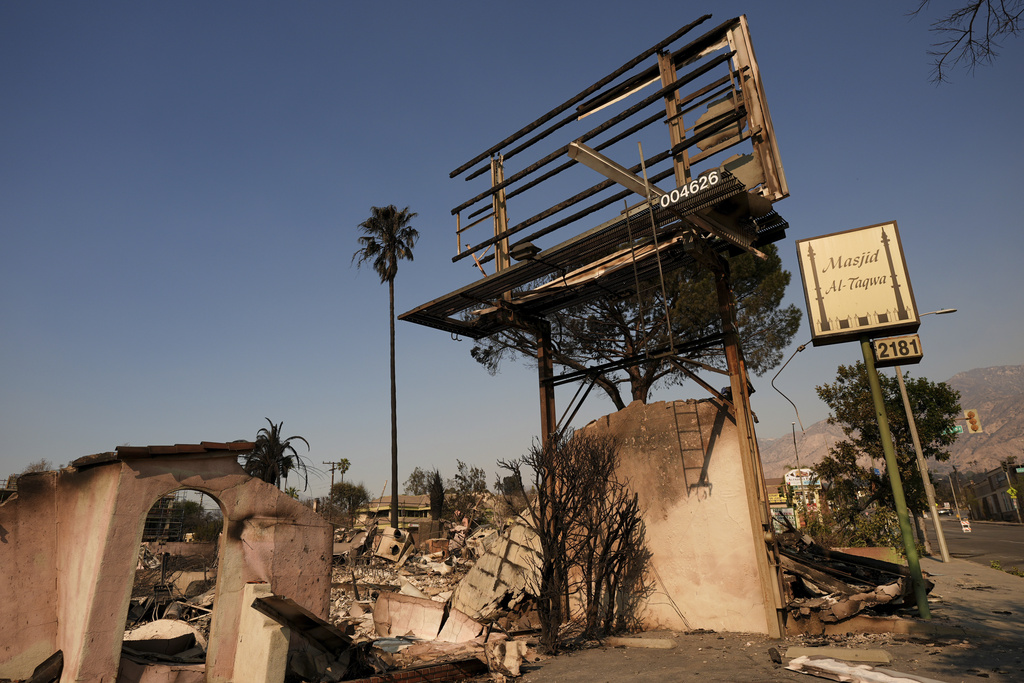
The remains of the Masjid Al-Taqwa mosque are seen in the aftermath of the Eaton Fire, Jan. 10, 2025, in Altadena, Calif. (AP Photo/Jae C. Hong)
Bob Smietana
January 11, 2025

(RNS) — Last Friday (Jan. 3), Najeeba Syeed attended Jummah prayers at the Masjid Al-Taqwa, a congregation she’d prayed for years at while living in Southern California.

Less than a week later, Syeed, a theology professor and interfaith leader, learned that Al-Taqwa, a historically African American mosque in Altadena, California, had burned to the ground — one of at least a dozen houses of worship damaged or destroyed in the wildfires that have raged in and around Los Angeles this week.

Even as local faith leaders mourned the loss of their sacred spaces, they’ve been banding together, offering words of comfort and practical help to those affected by the wildfires.

Syeed, who holds the El-Hibri Endowed Chair of Interfaith Studies at Augsburg University in Minneapolis, said Altadena has a long history of interfaith cooperation, and local faith leaders have been calling one another, offering support and looking for ways to work together.

“They’re helping their own communities, but they’re also stepping up and stepping beyond and helping each other,” said Syeed, who splits her time between Los Angeles and Minnesota. “That’s part of the story — faith communities, even when they are damaged, still show up for the broader community.”

She said a number of Muslim-owned and Black-owned businesses that had long surrounded the mosque were also damaged in the fire. Worshippers who attended Jummah prayers would often go to those businesses to get coffee or halal meals afterward. And the mosque also offered educational classes and other community activities.

“It was a hub for community, and God willing, it will be a hub going forward,” she said.


A man walks in front of the burning Altadena Community Church, Jan. 8, 2025, in the downtown Altadena section of Pasadena, Calif. (AP Photo/Chris Pizzello)

Less than a quarter mile from the Masjid Al-Taqwa, a bell tower is all that remains of Altadena Baptist Church, founded by a Swedish congregation in the 1920s and now a racially diverse faith community. About 15 families from the congregation also lost homes to the wildfires, said the Rev. George Van Alstine, 88, who has been on staff at the church for more than 50 years. Van Alstine said a vault containing the church’s history was likely lost in the fire, including records from the church’s earliest days.

He said congregations in the community — both Christian and non-Christian — have often worked together to serve their neighbors, including running the Altadena Congregations Serving Together food pantry, which had been housed across the street at Altadena Community Church and was also destroyed by wildfires.

Van Alstine said church members were gathering online Friday night to check in and to talk about how to help their neighbors and plan for the future. For right now, he said, they are taking things one day at a time.

“We’re surviving,” he said.

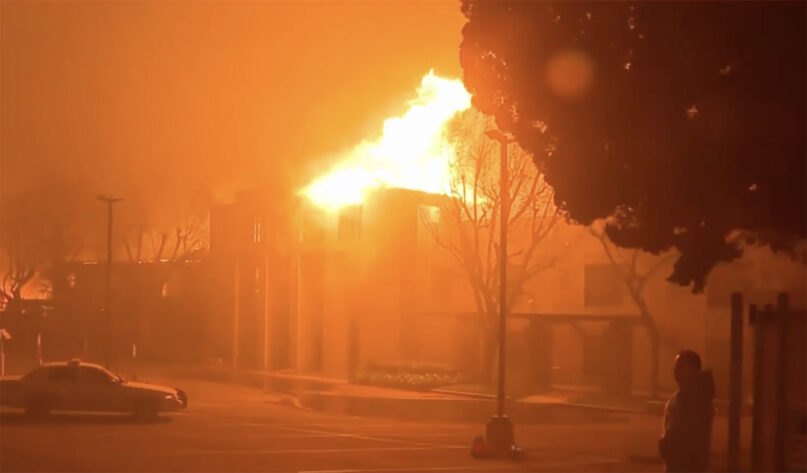
At least four wildfires are currently raging in Southern California, according to the Los Angeles Times. Eleven people have been reported dead and more than 12,000 structures burned, including at least a dozen houses of worship. Among them are Pasadena Jewish Temple, Corpus Christi Catholic Church and at least 10 Protestant churches.


The Pasadena Jewish Temple & Center burns during wildfires in Pasadena, Calif. (Video screen grab)

Other congregations suffered fire damage but were not completely lost, including Calvary Chapel in Pacific Palisades, where the sanctuary was damaged but not the entire campus.

“We probably lost the sanctuary and will have to rebuild it,” Justin Anderson, who started as the church’s pastor this week, posted on X. “But miraculously the rest of the property is nearly untouched.”

Anderson told Religion News Service that the fire has been both devastating and unpredictable, with some homes and building destroyed and others spared, seemingly randomly. The church had planned to hold a meet up this weekend for congregation members but had to postponed it because of the changing nature of the fire. Services this weekend will be held online and Anderson said he hopes to remind church members that God is still with them.

“We are not alone in this tragedy,” he said. The church has also started a disaster fund to help those with the congregation and their neighbors. Anderson said that the congregation can be of help to other congregations and the broader community during this time.

A hermitage and other buildings at the Mater Dolorosa Passionist Retreat Center were also lost to the fire, according to an update on the retreat center’s website.

“It makes complete sense to understand that our faith is tested on fire!” the center’s director wrote in an update. “But we are pilgrims of hope as Pope Francis exhorted us this year. Hope will not disappoint us. We will recover and be back serving you again.”

The Wild Hunt, a website that covers pagan news, reported that the Theosophical Society Library Center in Altadena was also lost to the wildfires. The center housed a major archive of the Theosophical Society, a movement founded in the 1800s and “dedicated to the uplifting of humanity through a better understanding of the oneness of life.”


Van Alstine said Altadena faith communities affected by the fire will continue to help their neighbors and will begin planning for the future in the days to come. For now, he said, the church office for Altadena Baptist will likely be based in his house. And he hopes church members will soon be able to get a look at the building firsthand.

He also said th bell in the church’s tower was from a former church in Pasadena and was used for summoning volunteer firefighters in the late 1800s and early 1900s. The bell tower still standing symbolizes that the church is not gone, Van Alstine said, even if the building has burned down.

“Maybe we should have somebody go up there Sunday and ring it,” he said.


Pope Francis has named the first woman to head a major Vatican office, choosing an Italian nun

ROME (AP) — The appointment marks a major step in Francis’ aim to give women more leadership roles in governing the church.


Nicole Winfield
January 8, 2025
RNS


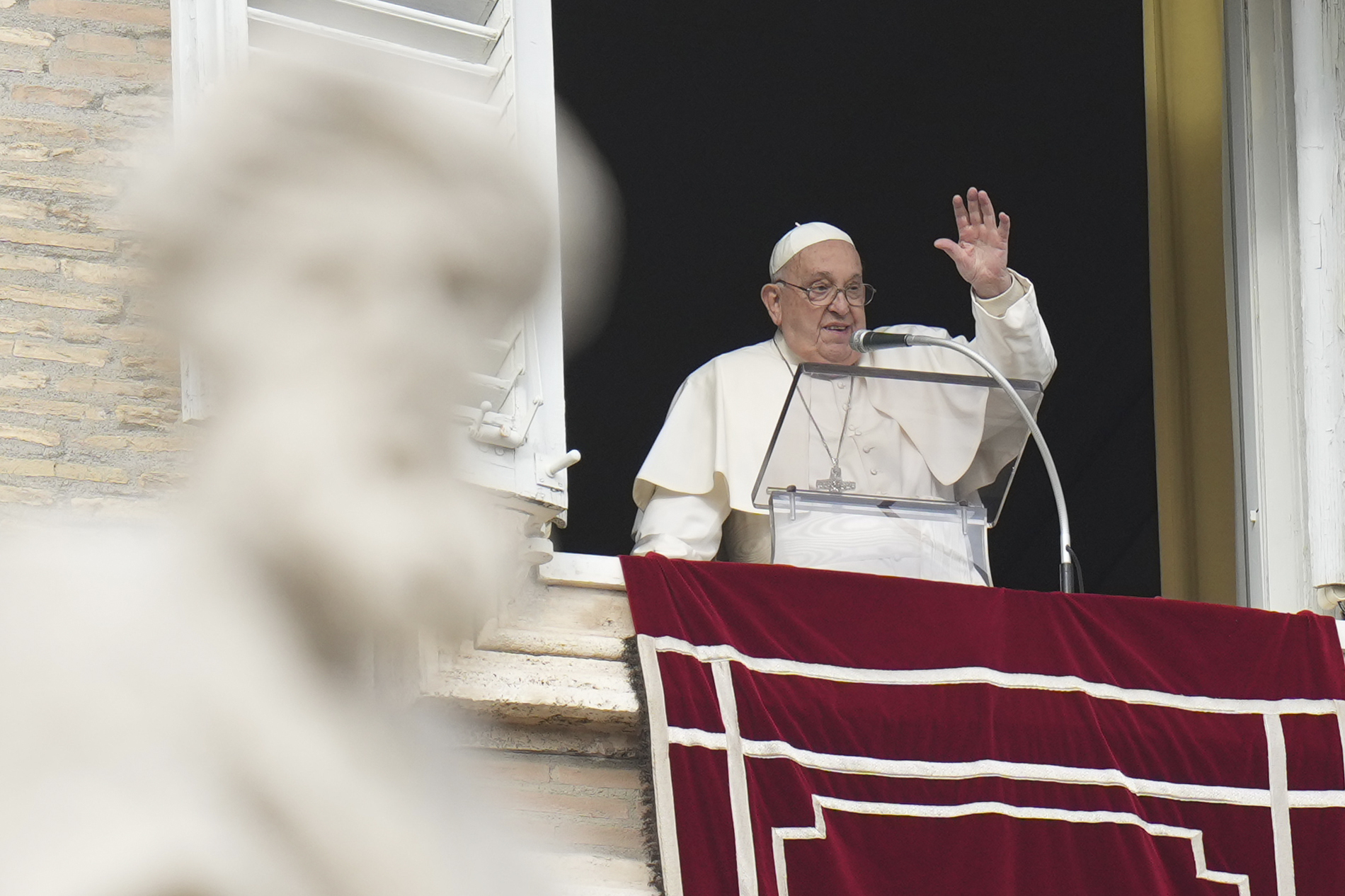
ROME (AP) — Pope Francis on Monday named the first woman to head a major Vatican office, appointing an Italian nun, Sister Simona Brambilla, to become prefect of the department responsible for all the Catholic Church’s religious orders.

The appointment marks a major step in Francis’ aim to give women more leadership roles in governing the church. While women have been named to No. 2 spots in some Vatican offices, never before has a woman been named prefect of a dicastery or congregation of the Holy See Curia, the central governing organ of the Catholic Church.

The historic nature of Brambilla’s appointment was confirmed by Vatican Media, which headlined its report “Sister Simona Brambilla is the first woman prefect in the Vatican.”

The office is one of the most important in the Vatican. Known officially as the Dicastery for the Institutes of Consecrated Life and Societies of Apostolic Life, it is responsible for every religious order, from the Jesuits and Franciscans to the Mercy nuns and smaller newer movements.

The appointment means that a woman is now responsible for the women who do much of the church’s work — the world’s 600,000 Catholic nuns — as well as the 129,000 Catholic priests who belong to religious orders.

“It should be a woman. Long ago it should have been, but thank God,” said Thomas Groome, a senior professor of theology and religious education at Boston College who has long called for the ordination of women priests. “It’s a small step along the way but symbolically, it shows an openness and a new horizon or possibility.”

Groome noted that nothing theologically would now prevent Francis from naming Brambilla a cardinal, since cardinals don’t technically have to be ordained priests.

Naming as a cardinal “would be automatic for the head of a dicastery if she was a man,” he said.

But in an indication of the novelty of the appointment and that perhaps Francis was not ready to go that far, the pope simultaneously named as a co-leader, or “pro-prefect,” a cardinal: Ángel Fernández Artime, a Salesian.

The appointment, announced in the Vatican daily bulletin, lists Brambilla first as “prefect” and Fernández second as her co-leader. Theologically, it appears Francis believed the second appointment was necessary since the head of the office must be able to celebrate Mass and perform other sacramental functions that currently can only be done by men.

Natalia Imperatori-Lee, chair of the religion and philosophy department at Manhattan University, was initially excited by Brambilla’s appointment, only to learn that Francis had named a male co-prefect.

“One day, I pray, the church will see women for the capable leaders they already are,” she said. “It’s ridiculous to think she needs help running a Vatican dicastery. Moreover, for as long as men have been in charge of this division of Vatican governance, they have governed men’s and women’s religious communities.”

Brambilla, 59, is a member of the Consolata Missionaries religious order and had served as the No. 2 in the religious orders department since 2023. She takes over from the retiring Cardinal Joao Braz de Aviz, 77.

Francis made Brambilla’s appointment possible with his 2022 reform of the Holy See’s founding constitution, which allowed laypeople, including women, to head a dicastery and become prefects.

Brambilla, a nurse, worked as a missionary in Mozambique and led her Consolata order as superior from 2011-2023, when Francis made her secretary of the religious orders department.

One major challenge she will face is the plummeting number of nuns worldwide. It has fallen by around 10,000 a year for the past several years, from around 750,000 in 2010 to 600,000 last year, according to Vatican statistics.

Brambilla’s appointment is the latest move by Francis to show by example how women can take leadership roles within the Catholic hierarchy, albeit without allowing them to be ordained as priests.

Catholic women have long complained of second-class status in an institution that reserves the priesthood for men.

Francis has upheld the ban on female priests and tamped down hopes that women could be ordained as deacons.

But there has been a marked increase in the percentage of women working in the Vatican during his papacy, including in leadership positions, from 19.3% in 2013 to 23.4% today, according to statistics reported by Vatican News. In the Curia alone, the percentage of women is 26%.

Among the women holding leadership positions are Sister Raffaella Petrini, the first-ever female secretary general of the Vatican City State, responsible for the territory’s health care system, police force and main source of revenue, the Vatican Museums, which are led by a laywoman, Barbara Jatta.

Another nun, Sister Alessandra Smerilli, is the No. 2 in the Vatican development office while several women have been appointed to under-secretary positions, including the French nun, Sister Nathalie Becquart, in the synod of bishops’ office.

___

Associated Press religion coverage receives support through the AP’s collaboration with The Conversation US, with funding from Lilly Endowment Inc. The AP is solely responsible for this content.
ANIMISTIC CATHOLICISM

Filipino Catholics pray for good health and peace in huge procession venerating Jesus statue

MANILA, Philippines (AP) — The procession marks the feast of Jesus Nazareno and is a major annual Catholic event in Asia.


Joeal Calupitan and Teresa Cerojano
January 13, 2025

MANILA, Philippines (AP) — At least 1.8 million mostly barefoot Catholic worshippers marched Thursday in an annual procession in the Philippines that venerates a centuries-old black statue of Jesus. Some said they prayed for good health for their families, an end to tensions in the South China Sea, and for incoming U.S. President Donald Trump to be kinder to Filipino immigrants.

The procession marks the feast of Jesus Nazareno and is a major annual Catholic event in Asia. The image was previously called the Black Nazarene, but church officials appealed for a change, saying the former name was not founded in history and evoked a racial slur.

The procession in Manila began before dawn Thursday, lasting nearly 21 hours as it crawled along the 6-kilometer (3.7-mile) route. The statue was finally brought inside the Minor Basilica and National Shrine of Jesus Nazareno, also known as Quiapo Church, at 1:25 a.m. on Friday.

Brig. Gen. Anthony Aberin, director of the capital region’s police, said the crowd was estimated at around 1.8 million at one point in the afternoon.

Last year, at least 2 million devotees joined the 15-hour procession, with some estimates of the crowd as high as over 6 million.

Reverend Father Robert Arellano, a spokesperson of Quiapo Church, said this year’s procession is slower compared to last year because of an increase in the number of participants and some jostling devotees climbing the glass-covered carriage housing the image.

Shouts of “Viva, viva,” rang out as the image passes by, with devotees clutching at ropes pulling the carriage and raising white towels in jubilation. The procession typically draws massive numbers of largely poor Catholics who pray for the sick and a better life.

Gaspar Espinocilla, a 56-year-old Manila city employee and a devotee of Jesus Nazareno for the last 20 years, said he is praying for his family, including his sister who has ovarian cancer. He is also praying for an end to tensions in the West Philippines Sea, a part of the South China Sea claimed by the Philippines, where China has been harassing Filipino fishermen and coast guard vessels.

“I hope China will ease up on us, they cannot seize everything as theirs,” said Espinocilla, who was wearing a maroon T-shirt printed with the face of Jesus Nazareno. “It is ours, not theirs.”

Renato Reyes, a garbage scavenger who has been a Jesus Nazareno devotee for more than three decades, said he prays for a better life for his family, for the Philippines to be free from calamities, as well as for wars overseas to end. He also said he will include in his prayers Filipinos who may be affected by Trump’s planned mass deportation of illegal immigrants.

“I hope they will not implement that because our countrymen are there just to earn a living for their families,” he added.

Officials said some 14,000 police and plainclothes officers were deployed, along with soldiers, fire fighters, prison staff and volunteers. Many nearby roads were closed and cell phone signals were blocked.

More than a dozen devotees were seen being carried away on stretchers. The Philippine Red Cross said that 467 people were given first aid or other medical assistance for mostly minor complaints like dizziness, difficulty breathing and nausea. At least 15 patients had to be brought to hospital. Police reported 604 people suffering minor injuries as of Thursday afternoon.

The statue of Jesus carrying the cross was brought to the Philippines from Mexico on a galleon in 1606 by Spanish missionaries. The ship that carried it caught fire, but the charred statue survived, according to some accounts. Church historians, however, said the statue’s color owes to the fact that it was carved out of mesquite wood, which darkens as it ages.

Many devotees believe the statue’s endurance, from fires and earthquakes through the centuries and intense bombings during World War II, is a testament to its miraculous power.

Associated Press religion coverage receives support through the AP’s collaboration with The Conversation US, with funding from Lilly Endowment Inc. The AP is solely responsible for this content.
SPACE KULT GROOMING

New LDS curriculum flops in teaching eternal polygamy to children

(RNS) — Carol Lynn Pearson writes, ‘Children will be indoctrinated with the understanding that if a ‘man of authority’ tells us God wants us to do something we believe is wrong, we are to do it anyway.’


A screenshot from the 2025 curriculum for Primary, here depicting Joseph Smith as he explains plural marriage to his first wife, Emma.


Jana Riess
January 10, 2025

(RNS) — This guest column is from Carol Lynn Pearson, author of “The Ghost of Eternal Polygamy,” reacting to the 2025 curriculum for children of The Church of Jesus Christ of Latter-day Saints. This year, the entire denomination is studying church history, so it’s not surprising that the issue of plural marriage would come up.

But Pearson — and many others — can see major problems with the way it’s handled, especially because the church is presenting it as a good thing that came from the Lord. The curriculum uses Joseph Smith’s decision to practice polygamy as an object lesson that we should all have “faith to obey a law from the Lord, even when it’s hard.”

While it may be a step forward for the church to be acknowledging the reality of Smith’s plural marriage instead of trying to sweep that history under the rug, I think Pearson is correct that any theology that tells children to obey even if their conscience says not to is a step backward. — JKR

Guest column by Carol Lynn Pearson:


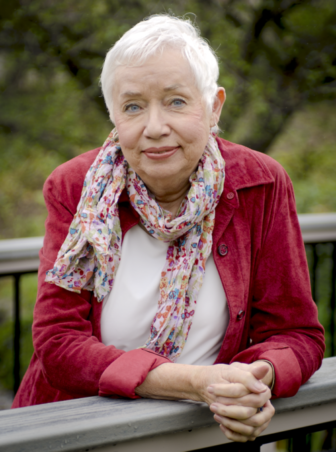
Author Carol Lynn Pearson.

This one took me by surprise. There it was — on the official website of my church, The Church of Jesus Christ of Latter-day Saints — a short lesson to be taught in 2025 in Primary, the organization that serves the children, a cartoon storybook about plural marriage in our church’s history.

The children are assured that, even though Joseph Smith was reluctant to take more wives, God himself ordered our founding prophet, already a husband to Emma, to “marry” up to 40 women and girls. Some were even in their teens, and some were already married to other men. Historical research has demonstrated that some of Joseph’s “marriages” were sexual in nature. Stories suggest that many of these women did not want to become his wives but did so because they believed in Joseph’s divine authority.

What does this Primary lesson communicate to our kids?

Children will be indoctrinated with the understanding that if a “man of authority” tells us God wants us to do something we believe is wrong, we are to do it anyway. Child molesters will be very pleased.

Nothing in the history of our church continues to be as much of a painful mess as polygamy. In 2016 I wrote and published a book titled “The Ghost of Eternal Polygamy: Haunting the Hearts and Heaven of Mormon Women and Men.” It was the result of a snowball survey that was taken by more than 8,000 members and former members of the church. Among those, 15% thought our history of polygamy was just fine, while 85% said it was hurtful and wrong. In write-in comments, many said the history of polygamy damaged their sense of self, their relationships with the church, with God and often with family members, particularly spouses.

Despite the claim to have given up polygamy, our church is still devoted to it. A man can be married in the temple for eternity to several women sequentially with the promise that they will all be his in the next life.

Soon after the publication of “The Ghost of Eternal Polygamy,” I sent a copy of the book to each member of the First Presidency of the church, the Quorum of the Twelve Apostles and other top leaders. I signed the books to each by name, “with appreciation and with the hope that you will lead us into a truly post-polygamy future.”

I knew I would not hear back from any of them, but soon I received the following email from my friend Curt Bench, the owner of a major LDS bookstore:

I learned from [Brigham Young University professor M.] that [BYU professor of religion and history H.] was asked by the Twelve Apostles to report about your book and … basically told them that it was their fault that the problem with “eternal polygamy” and the way people feel about it (as shown in your book) exists today. Nothing about their response.

I began to hope. Surely these good men would find a way, quickly or gradually, to rid our people of this harmful doctrine.

I was wrong. This new Primary lesson demonstrates that leaders of our church are determined that polygamy retain its place in history as a commandment of God. They are teaching that our place as members will always be to follow what the Brethren tell us God says, no matter the dictates of our minds and hearts.

I still receive letters and emails from women (and men) who thank me for “The Ghost of Eternal Polygamy,” telling me it has brought them great peace of mind, even saved their marriage.

Hundreds of messages tell a story similar to this one:


Joseph Smith ruined everything when he brought in plural marriage for eternity. This is hell, not heaven. I’m 69 and still worry this may become my hellish future that no, I will NEVER agree to. So heartbreaking. My brother says I could live polygamy and grin and bear if I had to. But I never will. I am distraught. Thank you for all you do.

I wrote back:


Please don’t be distraught over eternal polygamy! I’m convinced it is a fiction. A paper dragon. A nothing burger. It is the wind waking you at night making you think it is robbers. It is the dark monster under your bed that was never there!

Joseph’s polygamy came from his own creative mind, never from God. Eternal polygamy never was and never will be a reality. Please have peace of mind. Please sleep well. Please give this awful Ghost not one more ounce of your energy.

That is the message I wish I could give to every one of my sisters and brothers in this church of ours, this splendid church that yet carries in its doctrine an error. It’s an error that is not just bothersome, but — for believers — potentially poisonous.

The Brethren have shown that they can correct errors in our history. They have given significant attention to righting the wrongs done to our Black brothers and sisters, who were denied temple access and priesthood ordination for decades. Comparatively little has been done to right the wrongs done to women, who likely constitute a majority of the active members of the church.

It is my hope that the Primary teachers who are tasked with teaching that polygamy came from God will listen to their own personal guidance and teach accordingly.

(Carol Lynn Pearson is an author of more than 40 books and stage plays. She is an active member of The Church of Jesus Christ of Latter-day Saints and lives in Walnut Creek, California. One of her most famous books is “Goodbye, I Love You,” a powerful account of her marriage to a gay man, their struggle, divorce, ongoing friendship and her caring for him as he died of AIDS.)

Related content:

Eternal polygamy?: How LDS temple sealings and cancellations became a raw deal for women

Mormon women fear eternal polygamy, study shows

Polygamy lives on in Mormon temple sealings


-----