It’s possible that I shall make an ass of myself. But in that case one can always get out of it with a little dialectic. I have, of course, so worded my proposition as to be right either way (K.Marx, Letter to F.Engels on the Indian Mutiny)
President Donald Trump declined in an interview aired Sunday to rule out the possibility that the United States might enter a recession this year.
“I hate to predict things like that,” he told a Fox News interviewer when asked directly about a possible recession in 2025.
“There is a period of transition, because what we’re doing is very big — we’re bringing wealth back to America,” he said, adding, “It takes a little time.”
But Trump’s commerce secretary, Howard Lutnick, was more definitive when asked Sunday about the possibility of a recession.
“Absolutely not,” he told NBC’s “Meet the Press” when asked whether Americans should brace for a downturn.
Trump’s on-again, off-again tariff threats against Canada, Mexico, China and others have left the US financial markets in turmoil and consumers unsure what the year might bring.
Stock markets just ended their worst week since the November election.
Measures of consumer confidence are down, as shoppers — already battered by years of inflation — brace for the higher prices that tariffs can bring.
And widespread government layoffs being engineered by Trump’s billionaire advisor Elon Musk add further concern.
Some signs are mixed.
A widely watched Atlanta Federal Reserve index now predicts a 2.4 percent contraction of real GDP growth in the year’s first quarter, which would be the worst result since the height of the Covid-19 pandemic.
Much of the uncertainty stems from Trump’s shifting tariff policy — effective dates have changed, as have the sectors being targeted — as businesses and investors try to puzzle out what will come next.
Kevin Hassett, Trump’s chief economic advisor, was asked on ABC whether tariffs were primarily temporary or might become permanent.
Hassett said that depended on the behavior of the countries targeted. If they failed to respond positively, he said, the result could be a “new equilibrium” of continuing tariffs.
The administration has insisted that while the economy will pass through a possibly bumpy “transition,” things are headed in a positive direction.
In his State of the Union message on Tuesday, Trump told Americans to expect “a little disturbance” as tariffs take hold, while adding: “We’re okay with that. It won’t be much.”
And his Treasury Secretary Scott Bessent has warned of a “detox period” as the economy cuts government spending.
Given the uncertainties, economists have been wary of making firm predictions.
Economists at Goldman Sachs, citing Trump’s policies, have raised their odds of a recession over the next 12 months from 15 percent to 20 percent.
And Morgan Stanley predicted “softer growth this year” than earlier expected.
Recessions are generally defined as two consecutive quarters of weak or negative GDP growth.
The US was briefly in recession in early 2020 as the Covid pandemic spread. Millions of people lost jobs.
Greenland’s Inuit's rediscover their national pride
With her colourful Inuit earrings and tattoos on prominent display, Ujammiugaq Engell, like many Greenlanders, flaunts her rediscovered cultural identity, which US President Donald Trump’s expansionist ambitions have only spurred further.
“I’m a whole lot of person. I carry my Greenlandic and Danish sides with pride,” said the smiling 30-some-year-old, the daughter of a mixed Danish and Greenlandic couple.
After moving to Copenhagen for university, she returned to live in Nuuk, the capital of the vast Arctic island, where she now works as a museum curator.
As Greenland’s former colonial power, Denmark pursued assimilation policies that included de facto bans on the Inuit language and traditional tattoos, forced sterilisations and the removal of children from their families to be placed in Danish homes.
The policies left Greenlanders bitter and cast a dark shadow over Denmark’s national conscience.
As Greenland gradually regained autonomy in the second half of the 20th century, its population, still made up of almost 90 percent Inuits today, began to rediscover their long-stifled traditions.
Engell’s dark hair is piled high on her head in a bun, showcasing long beaded earrings that land beneath her collarbone.
Just below her right elbow, two parallel lines of dots encircle her forearm, symbolising holes to let the spirits move freely, she said.
“All women used to wear (tattoos) and then they disappeared with colonial history and Christianity taking over,” the historian by training told AFP.
“They were gone for a long time and then about 10 years ago they started making their way back into our culture.”
– Neither Danes nor Americans –
Independence is backed by all of Greenland’s main political parties, with the question of when to achieve it dominating the run-up to the island’s legislative elections on Tuesday.
Trump’s repeated remarks that he wants to get his hands on Greenland — first made during his previous term in office — have only served to boost Greenlanders’ national pride.
“I think it plays very much into the way that we are starting to understand our own importance and our own national identity,” said Engell.
Ebbe Volquardsen, a cultural history professor at the University of Greenland, said he had observed a “mental decolonisation” taking place among Greenlanders.
Volquardsen defined that as a “process where you try to become aware of colonial patterns of thought that you have internalised in your thinking and your way of looking at yourself and your own culture”
Once identified those patterns could then be unlearned, he said.
So Greenlanders have begun “to value cultural techniques that have been discredited by the colonial power and by the Church on a very practical basis, like handicrafts and drum dancing and kayaking,” he told AFP.
In Nuuk, many locals say they see their future as neither Danes nor Americans, but Greenlanders.
“We have to fight for our culture, because Denmark took it away from us,” said Liv Aurora Jensen, a candidate for the green-left Inuit Ataqatigiit (IA), one of the two parties that make up the outgoing government coalition.
Nowadays, “we have to think like Danes, we have to dress like Danes, and we have to eat like Danes. And I want our culture back”.
– Brain drain –
Greenland today is a land of emigration. Over the past three decades, 300 to 400 more people have left the territory each year than have arrived.
That is expected to shrink the population from 57,000 currently to fewer than 50,000 around the year 2040, according to Greenland’s statistics agency.
Whether the renewed debate on independence will reverse the trend is uncertain.
But the exiles represent a loss of skilled workers who could otherwise have contributed to the building of an independent state.
Many exiles are often students going abroad for higher education, mostly to Denmark.
With her architecture diploma freshly earned from Denmark’s University of Aarhus, Sika Filemonsen said she would return to Nuuk this summer.
“Growing up in Greenland, we were always told to get an education so that we could contribute to society — that people with an education are exactly what the country needs, especially Greenlanders,” she said.
“That motivation has been a big part of why I wanted to pursue an education: to be able to help shape the country and play a role in its future.”
A China Coast Guard ship (top) and a Philippine supply boat were engaged in 2014 stand off in the South China Sea (AFP Photo/Jay Directo)
The United States may still have the world's most powerful navy but it seems to have realised that this is no longer sufficient to reassert US supremacy over the high seas.
If President Donald Trump's pronouncements on shipbuilding, the Panama Canal and Greenland are anything to go by, he wants to increase US sea power on several fronts -- just as China is already doing.
Beijing's expanding influence on the world's oceans is a challenge to Washington's efforts to protect its interests.
While the United States still dominates the seas militarily, it is weaker in other maritime sectors, such as merchant shipping and shipbuilding itself, analysts told AFP.
Trump told the US Congress last week that his administration would "resurrect" the country's nautical construction industry "including commercial shipbuilding and military shipbuilding".
On China, he has complained that Beijing "controls" the Panama Canal and has refused to rule out military force to wrest control of a vital strategic asset.
The president has been equally blunt about wanting to take over Greenland, a Danish territory whose untapped mineral and oil reserves he covets.
And he wants to tax any Chinese vessel that docks in US ports.
Researcher Sophie Quintin, of Portsmouth University in the UK, said Trump's approach smacked of a return to "navalism" -- a theory stressing the importance of sea power espoused by 19th-century US naval officer Alfred Mahan.
On the other hand, Trump might just be appealing to his populist voter base, the Make America Great Again (MAGA) faithful.
"It's difficult to know if it's the fruit of a real strategic reflection," said Alessio Patalano, a specialist in maritime strategy at King's College, London.
"In the end, it doesn't matter. Serving the interests of MAGA voters by restarting naval shipyards or taxing Chinese boats leads to a navalist policy."
- Chinese sea power -
In any case, China understands the importance of sea power, said Nick Childs of Britain's International Institute for Strategic Studies.
At a Paris conference last month, Childs pointed to China's rapid expansion in maritime sectors other than its own navy.
"There are the investments we've been hearing about in global ports, global maritime infrastructure and the weaponising of the fishing fleet," he said.
Washington is concerned by the expansion of Chinese shipping companies, which they see as serving the interests of the Beijing government.
"Beijing's economic control of port operations at strategic chokepoints across the world -- many of which are part of the Maritime Silk Road initiative -- pose a threat to the United States and its allies," opined US think tank the Jamestown Foundation in February.
It cited in particular two state-owned firms, COSCO and China Merchant Ports.
Beijing could also exert "significant influence" on a third, the privately owned Hutchison Port Holdings, which controls two ports on the Panama Canal, it said.
But Paul Tourret, of France's Higher Institute of Maritime Economics (ISEMAR), cautioned against too "simplistic" a reading of China's maritime policy.
"COSCO, for example, follows a financial logic. It merely delivers to the United States the goods that Americans consume," he said.
Nevertheless, pressure from Washington seems to have had some effect.
Hutchison announced last week it had agreed to sell its lucrative Panama Canal ports to a US-led consortium, although it insisted this was a "purely commercial" decision. - Gaps in US presence -
While the United States may have the world's most powerful navy, its merchant fleet is not in such good shape, said Quintin.
"US shipping companies have significantly declined and what remains of its commercial fleet is ageing," she said.
"That has repercussions for its strategic fleet," she added, referring to civilian ships used for military transport.
"Furthermore, the shipbuilding sector is in crisis."
Tourret agreed: "There's no way the US can build ships quickly."
"The problem with US shipbuilding is that they don't have the know-how of the Japanese and Koreans, and they don't have the scale of the Chinese, who churn ships out like biscuits," added Patalano.
"When Europe is one year behind on a military programme, the US is three or four years late," said a European industry source on condition of anonymity.
Trump's avowed desire to seize control of Greenland and Canada can also be viewed as a bid to regain US dominance over the seas.
Global heating is melting Arctic ice at an alarming rate, endangering natural ecosystems and contributing to further climate change.
But that melting could also open up the region to vessels -- both commercial and military -- and to oil and mineral exploration.
Those prospects have not been lost on China, Russia or the United States.
"The Arctic space will become increasingly important for power projection, especially for missile-launching submarines," said Patalano, who sees these as "an essential component of deterrence".
Here again, "the United States is lagging behind", said Quintin.
"While China is capable of deploying three icebreakers, the US Coast Guard struggles to keep its two ageing vessels in service," she said.
US detains pro-Palestinian campus protest leader: union
A leader of protests at Columbia University against Israel's war in Gaza was arrested by immigration officers, a campus union said Sunday, after US President Donald Trump vowed to deport foreign pro-Palestinian student demonstrators.
Mahmoud Khalil, one of the most prominent faces in the campus's protest movement that erupted in response to Israel's conduct of the war, was arrested Saturday, the Student Workers of Columbia union said.
"On Saturday, Department of Homeland Security (DHS) officers detained Mahmoud Khalil, a Palestinian recent Columbia graduate and lead negotiator for last spring's Gaza solidarity encampment," the union said in a statement.
US campuses including Columbia's in New York were rocked by student protests against Israel's war in Gaza following the October 7, 2023 Hamas attack. The demonstrations ignited accusations of anti-Semitism.
Protests, some of which turned violent and saw campus buildings occupied and lectures disrupted, pitted students protesting Israel's conduct against pro-Israel campaigners, many of whom were Jewish.
Khalil, who remains in immigration enforcement detention, held permanent residency at the time of his arrest prompting thousands of people to sign a petition calling for his release, the union statement added.
"We are also aware of multiple reports of Immigration and Customs Enforcement agents accessing or attempting to access Columbia campus buildings on Friday and Saturday, including undergraduate dorms," the union said.
Columbia did not directly address Khalil's arrest in response to inquiries, but in a statement said "there have been reports of ICE in the streets around campus."
"Columbia has and will continue to follow the law. Consistent with our longstanding practice and the practice of cities and institutions throughout the country, law enforcement must have a judicial warrant to enter non-public University areas, including University buildings," Columbia said.
The Department of Homeland Security did not respond to a request for comment.
Trump railed against the student protest movement linked to the conflict in Gaza, and vowed to deport foreign students who had demonstrated.
He also threatened to cut off federal funding for institutions that he said were not doing enough to combat anti-Semitism.
His administration announced Friday it was cutting $400 million in federal grants to Columbia University, accusing it of failing to protect Jewish students from harassment.
This January, a Turkish court sentenced Sofya Alağaş, a Kurdish journalist and elected co-mayor of Siirt municipality, to six years and three months in prison on charges of membership in a terror organization.
“I honestly don’t know how it will end,” Alağaş told Truthout. “The sentence was not a legal decision but a political one. If the Turkish state takes some steps towards democratization, the case will end with an acquittal. If it doesn’t, it will be approved and I’ll be arrested.”
The sentence was the culmination of an operation by the Turkish state that began in June 2022, when she and more than a dozen other journalists were arrested for activities the government alleged were linked to the outlawed Kurdistan Workers’ Party (PKK), a militant group founded in 1978, which Ankara considers a terrorist organization. Kurds are Turkey’s largest ethnic minority group, but their traditional homelands also stretch across parts of modern Syria, Iraq and Iran. They’ve been targeted by state violence in all of those countries since the end of the Ottoman Empire, especially in Turkey.
The situation in Turkey grew more dire after July 15, 2016, when a faction within the Turkish military attempted a coup against President Recep Tayyip Erdoğan. Though the coup attempt was over by the next day, the government soon imposed what would become a two-year state of emergency, which allowed for harsher crackdowns on opposition media and rights groups, as well as mass arrests: The U.S. State Department estimated that more than 312,000 people were arrested in relation to the attempt through 2021. The state also began to replace elected mayors from the pro-Kurdish People’s Democratic Party, known today as the DEM Party, with “trustees” loyal to Erdoğan’s ruling Justice and Development Party (AKP).
Alağaş said she quit her communications job for a municipality of Diyarbakır, the largest Kurdish-majority city in Turkey, because she refused to work for a trustee. But by December 2016, the state had closed nearly 170 media outlets. “Hundreds of journalists were left unemployed. A group of unemployed female journalists had founded the online newspaper Şujin. I started working there,” Alağaş said.
When the government shut down Şujin in 2017, the group founded Jin News, a women-run news agency focused primarily on Kurdish women’s issues.
Alağaş served as a news editor and reporter. Though Jin News is still active, it remained a target. “While working there, I was subjected to pressure from the state many times because of the news we published. Lawsuit were filed against me three times on charges of making propaganda,” Alağaş said. “Access to the agency’s website was blocked 45 times.”
Alağaş remained at Jin News until 2024, when she was elected as co-mayor for the DEM Party in the Kurdish-majority municipality of Siirt in southeast Turkey, where she was born. She said her election sped up the case against her. After her conviction and sentencing for terror charges in January, Alağaş joined the list of dozens of pro-Kurdish and opposition mayors replaced by officials loyal to the AKP.
According to a report by Turkey’s Media and Law Studies Association, the charges against Alağaş stem from an investigation citing “Jin News’s editorial policies, reporting style, headlines” as proof Alağaş was promoting “violence, criticism of the state, and sympathy for the PKK.” Alağaş said those accusations were made over 103 of the 73,413 Turkish-language news items Jin News published during her tenure, including articles about the isolation of imprisoned PKK leader Abdullah Öcalan, Turkish operations against Kurds in Syria and International Women’s Day — Turkey has in recent years imposed bans and restrictions on March 8 protests, in addition to barring Istanbul’s annual Pride march. “The prosecutor cherry-picked news items and added them to the file against me,” she said.
By December 2016, the state had closed nearly 170 media outlets.
Alağaş says articles published about her were also cited — specifically about her winning the Maria Grazia Cutuli Award, an Italian prize for international women journalists. “It was interesting that the news reports regarding an international award were added to the file as evidence of a crime,” she said.
Alağaş told Truthout she has never been subjected to bullying or harassment by the public: “It is the government that does not accept our journalism. The news we produce disturbs the government.”
Gülistan Korban, who runs the women’s center at the South East Journalist Association in Diyarbakır, agrees that state repression makes basic reporting a challenge. “At first, when you mentioned ‘press freedom,’ I thought it was funny. What press freedom in Turkey?” she told Truthout. She said the restrictions on media are a nationwide problem, but that it’s worse for those working in Kurdish cities, where repression tends to be harsher and more violent than in western Turkey.
“Imagine, while you’re writing a report, or doing an interview, even while writing what someone else has said,” Korban explained, “In the future, we could be exposed to an investigation, just because we wrote that report.”
“This is always a big problem for us while writing the news. We feel our thinking is restricted, that our thoughts are shackled,” Korban said. “We, as journalists, are not free,” and between the potential for male violence and entrenched cultural norms, “as women, we are not able to do our work in a sufficient way under this pressure.”
But Korban said she has also received threats and harassment from members of the public for the kinds of news she reports. Most recently, she said her outlet was threatened by the family of a 32-year-old man for reporting that he had kidnapped a 12-year-old girl with the intent to forcibly marry her. It wasn’t enough to deter Korban and her team. “I have a small daughter; how could we not write about this?” she said, adding that the girl’s family had reported the incident to police days earlier, and they hadn’t started the investigation. But it turns out, they didn’t miss the help: “Thank goodness, she was found, she was found immediately after we wrote the report.”
Korban added that she’s been reporting and editing from home due to concerns about how a potential prison stint or worse would affect her daughter. “You can imagine how difficult it is to do this job as a woman journalist in a country,” she says, “where women are killed every day.” Journalists Under Threat
The repression against media by Turkey is part of a global trend. The Committee to Protect Journalists (CPJ) confirmed that 2024 was the deadliest in its history for media workers worldwide. Nearly 70 percent were killed by Israel, but others “were or may have been targeted by Turkish drones in Iraq and Syria.” They include several Kurdish women journalists who were covering Turkey’s attacks on primarily Kurdish forces in northern Syria and Iraq, such as Jihan Belkin and Gulistan Tara, who were from Turkey, as well as Hêro Bahadîn of Iraqi Kurdistan.
Within Turkey, repression against women and other journalists persists, though the state of emergency ended in 2018. At least 30 journalists were in prison in January 2025. Last month, police violently detained Jin News journalist Öznur Değer; in Istanbul, former Bianet editor Elif Akgül, as well as Kaos GL’s Yıldız Tar, who covers LGBTQ+ issues, were detained on terror charges. Meanwhile mainstream TV anchor Özlem Gürses was released from a 52-day house arrest for “insulting state institutions” after she seemed in a broadcast to compare Turkish-backed forces in Syria to ISIS (also known as Daesh) over their fighting with Kurdish-backed militants.
“I was subjected to pressure from the state many times because of the news we published. Lawsuit were filed against me three times on charges of making propaganda.”
Repression and violence against women journalists has come against the backdrop of Ankara’s withdrawal from the Istanbul Convention in 2021, part of what one Amnesty International official called “the tip of a dangerous anti-rights iceberg.” In 2023, the International Institute for Democracy and Electoral Assistance ranked Turkey in the “bottom 25 percent of countries in most factors of democracy performance,” with “significant declines” across those indicators over the last decade. The 2011 treaty offered a blueprint for legislation and awareness-raising measures to protect women from violence and rights violations. Killings of women were already high when Turkey pulled out of the agreement, but in the first 11 months of 2024, there were at least 359 reports of men killing women nationwide. Erdoğan has said the convention is antagonistic to “family values” and normalizes homosexuality. More recently, he’s said his party is “against the LGBT,” and last summer, Turkey deported a trans woman refugee to Syria over her HIV status. There, she was reportedly killed by her family and members of the Free Syrian Army.
Part of the “anti-rights iceberg” in Turkey is linked to the state of its democracy. Erdoğan has been in power for more than 20 years. The AKP has grown increasingly authoritarian, especially after the coup attempt further eroded already weak democratic institutions. The government remains among the top jailers of journalists, though Turkey has long targeted media. In 2007, Armenian journalist Hrant Dink was assassinated on a main street in central Istanbul, part of a long pattern of anti-press violence that goes back to military rule in the 1980s and ‘90s. Exiled journalists from Syria in Turkey have often been caught up in xenophobic attacks, spurred on by rhetoric from the secular opposition, the far right and the ruling party. These xenophobic forces exploded in a pogrom against Syrians last summer in the central Turkish city of Kayseri and elsewhere. Crackdowns on the press usually most affect leftists and minorities, but they also transcend identity. Insulting the Turkish nation has been a crime since 2005 — Nobel Laureate Orhan Pamuk has been charged under that law twice — and opponents have labeled a 2022 law on disinformation a “censorship law” for the potential it has to allow additional state interference in social media and independent news content.
As Alağaş says, “If you do not publish biased news that praises the AKP, you are definitely a target.”
Yet, when the government and PKK entered peace talks in 2013, Korban remembers that “reporting the news, doing your job even as a woman, was so easy.… There were 20 to 30 women journalists working in the field in the region. Now, I can count them on one hand.” But repression reemerged quickly. When the Gezi Park protest movement broke out in May of that year, police used water cannons, beatings and tear gas to break up demonstrations, while at least two sexual assaults by authorities were reported. The truce between the government and PKK broke down by 2015, leading to efforts to oust Kurdish parliamentarians as the economy and currency began to falter. Major shifts are likely again on this front: On February 27, PKK leader Öcalan called on fighters to lay down their arms, leading the group to declare a ceasefire, dependent on his release from an island prison. Can It Happen Here?
Some analysts have drawn parallels between Erdoğan and U.S. President Donald Trump — during a diplomatic spat in 2019, Trump even called himself a “big fan” of the Turkish president. From the cults of personality that propelled them to power, to their reliance on “lifestyle issues” to, as Xavier University’s Nazan Bedirhanoğlu wrote for Democracy Seminar, their attempts to “reinforce symbolic boundaries” among the public, their strategies hinge on sowing divisions: “Polarization thrives when enemies … are established as the main pillars of political discourse.”
Katherine Jacobsen, the CPJ coordinator for the U.S., says the perspective that “it can’t happen here” is a dangerous one.
“Comparative politics has many pitfalls … but I think there are many examples globally we can learn from,” says Jacobsen. “This kind of sense of American exceptionalism, especially around media — that we won’t have those types of problems that are in Turkey or in Hungary or Brazil — doesn’t work anymore. We’re long past the point of having any sort of exceptionalism in that realm.” In fact, all of the journalists Truthout spoke to for this article, from Turkey and the U.S., reported some sort of official or public threat related to their work.
Like Erdoğan, Trump is antagonistic to the press: By one count, he verbally attacked the media more than 100 times ahead of the 2024 election, and he’s threatened to throw reporters in jail. The Coalition For Women in Journalism wrote in a report last year that Project 2025 poses major challenges for an independent press and democracy, as Reporters Without Borders notes that repression of women journalists is growing worldwide and tends to be worse under authoritarian regimes. According to a report from October 2024 from the International Women’s Media Foundation, journalists across the U.S. were already facing increased levels of harassment and threats of violence.
Since his inauguration in January, Trump has banned the Associated Press from White House events and attacked reporters by name. One administration official accused a Voice of America reporter of being “treasonous” and called for his dismissal over a quote he used in his coverage. Meta has ended fact-checking efforts, which will likely allow misinformation to flourish, as it does on Elon Musk’s X, which reports have shown is flooded with content from neo-Nazis and white supremacists. In February, Musk also complied with a request from Turkey to block “scores” of X accounts connected with its opposition, including Kurds and leftists, as well as “a number of prominent journalists and news outlets.”
Women journalists — and especially those who are also journalists of color and LGBTQ+, disabled, or otherwise marginalized journalists, and those who have been writing about race or other kinds of inequality — are among the most vulnerable to harassment and violence.
In February 2020, a man was charged with hate crimes and harassment after he spat on and threatened trans woman journalist Serena Daniari in New York. While covering an Oregon MAGA rally that autumn, journalist Beth Nakamura recorded Trump supporters harassing her and screaming “the press is the problem.” In 2021, one Los Angeles-area news anchor told Prism that as a Black woman journalist, she’s received near constant online harassment, mostly from anonymous accounts. “If they thought they weren’t doing anything wrong, they wouldn’t hide their identity. That takes time and thought, and that makes it even more twisted,” she said. And in 2023, Trump supporters physically assaulted a woman journalist who was trying to question him in Miami. Meanwhile, ABC News correspondent Rachel Scott reportedly received death threats after interviewing Trump at a meeting of Black journalists in Chicago in July.
Pittsburgh Lesbian Correspondents blog founder Sue Kerr has been covering the LGBTQ+ community for more than 20 years. Throughout her career, she says she’s been a target. “I’ve experienced a lot of harassment, rudeness and [been] targeted by TERFs [trans-exclusionary radical feminists] several times. I’ve had three men stalk me. I was doxxed by Stormfront,” one of the earliest white supremacist hate sites on the internet. But she says the harassment got worse for her after Trump’s inauguration in January.
“This was an actual death threat by someone using their real Facebook account. That was unnerving. They weren’t hiding their identity and that’s unusual. The threat mentioned other people — admins and people affiliated with me,” Kerr told Truthout, adding that she has contacted police but has yet to hear back. Kerr says the threat was over her support for and coverage of the trans community. “The dehumanizing rhetoric from the current administration empowers people to let their worst sides show.”
Jacobsen sees the precedents the Trump administration is setting, for example by suing media outlets and journalists, as likely to embolden other politicians. “If the president is lobbing defamation suits against lots of different news organizations, who’s to say a local official can’t sue a local journalist?” That could have a chilling effect on journalists’ willingness to report, especially in local newsrooms. “It pollutes the entire media ecosystem,” she says. “Distrust in the media has been growing for a while now. Trump did not invent the concept of denigrating the media in the U.S. But he did tactically decide to ride on the growing wave of mistrust … and capitalize on that for his own political ends.”
Still, Kerr says she thinks the dangers facing marginalized journalists in the U.S. will force media workers to “be creative in how we share our stories.” Facing Repression, Journalists Won’t Back Down
Award-winning journalist and educator Stephanie Manriquez is from Mexico City but has long worked in Chicago. She is the director of Lumpen Radio, an independent FM community station based on the city’s South Side. The station is multilingual and trains community members to do radio, allowing them to take part in operating the volunteer-run outlet.
Lumpen Radio is part of the Public Media Institute (PMI), an independent media nonprofit focused on mutual aid and local stories. Manriquez says the station has worked to connect migrants to resources, and has been recording their oral histories, which will become a podcast series.
“We are fighting with our own stories and hoping that cannot be censored — we’re just speaking truths,” Manriquez told Truthout, but she admits there is some worry about how the current political climate could affect Lumpen. The station produces shows for Spanish speakers, including “Boletín Migrante,” which she says aims to change the narrative around the migrant experience by creating spaces that go beyond fear, and countering misinformation with stories of resilience.
Manriquez says that because PMI has long been a critical voice, “portraying what the community feels and fears in a radical and creative way,” its contributors are already “alert about who’s watching us.” For Lumpen, the major challenge posed by the current climate may be financial. “We know that the funds will be cut at some point, in general for nonprofits,” she says. “But I hope we can resist and continue creating.”
And that’s a sentiment shared by journalists in Turkey. When we spoke on the phone, Korban told me from Diyarbakır that the risks women and other vulnerable groups take to report on their communities can be worth it.
“Otherwise, if we never step up, we can only dream of good days, right?”
We’re resisting Trump’s authoritarian pressure.
As the Trump administration moves a mile-a-minute to implement right-wing policies and sow confusion, reliable news is an absolute must.
Truthout is working diligently to combat the fear and chaos that pervades the political moment. We’re requesting your support at this moment because we need it – your monthly gift allows us to publish uncensored, nonprofit news that speaks with clarity and truth in a moment when confusion and misinformation are rampant. As well, we’re looking with hope at the material action community activists are taking. We’re uplifting mutual aid projects, the life-sustaining work of immigrant and labor organizers, and other shows of solidarity that resist the authoritarian pressure of the Trump administration.
As we work to dispel the atmosphere of political despair, we ask that you contribute to our journalism. Over 80 percent of Truthout’s funding comes from small individual donations from our community of readers, and over a third of our total budget is supported by recurring monthly donors.
You can help by giving today. Whether you can make a small monthly donation or a larger gift, Truthout only works with your support. This article is licensed under Creative Commons (CC BY-NC-ND 4.0), and you are free to share and republish under the terms of the license.
Nyki Duda is a freelance editor and writer. She has written about migration, social movements and far right politics for Dissent, In These Times, The Progressive, and more. Duda currently researches misinformation at Lead Stories and has a master’s degree in anthropology.
'Not the barometer': Wall Street 'theory' on 'unbound Trump' warns he’s not 'concerned about markets'
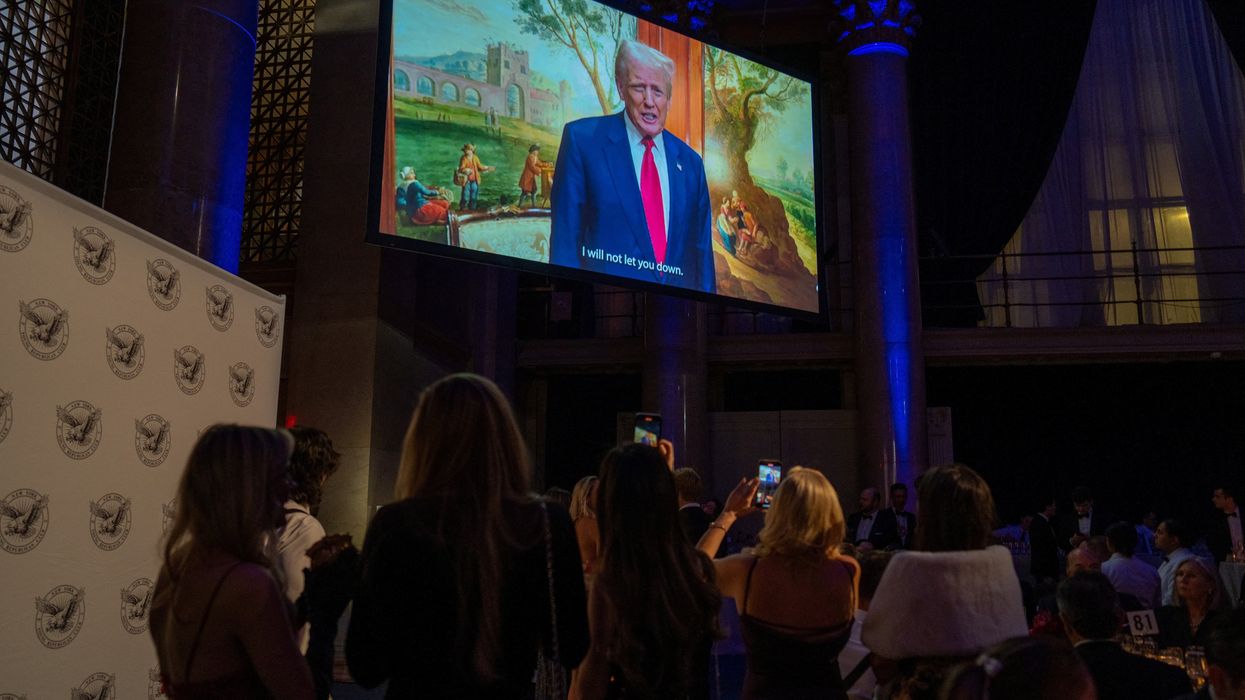
Donald Trump speaks on screen in a prerecorded message to the attendees of the New York Young Republican Club's Annual Gala at Cipriani Wall Street in New York City, U.S., December 15, 2024. REUTERS/David 'Dee' Delgado
Axios political reporter Hans Nichols on Sunday detailed a theory among economists and Wall Street investors that wonders what the “barometer” is for President Donald Trump’s economic policy — considering the president doesn’t have to worry about reelection during his second administration.
CNN’s Manu Raju and Jeff Zeleny noted the president, reacting to market fluctuations in the wake of his on-again-off-again tariffs against Mexico and Canada, claimed he’s “not looking at the markets."
“I think anyone who has watched Donald Trump for a long time knows that not true,” Zeleny said.
As Raju noted, Stanford University economist Nicholas Bloom told the Associate Press he has “an increasing fear we will enter into what may become known as the Trump recession. Ongoing policy turbulence and a tariff war could tip the U.S. economy into its first recession in five years.”
Nichols noted “there's always the potential of recession,” telling Raju economists predicted with “100 percent certainty” there would be a recession under former President Joe Biden.
“And we didn’t,” Nichols said. “That's not to say that everything's fine in the economic data, there are a lot of warning signs. Jobless claims are ticking up. Unemployment report was a little soft. I think the big question that we're asking ourselves at this table is, is there any real prospect of Trump doing a course correction?"
“There's this theory, especially up in Wall Street, that an unbound Trump who doesn't have to run for reelection isn't as concerned about the markets as he was in his first term,” Nichols continued. “I don't know if that's true, but that's a theory out there. So if the markets aren't going to be a regulator on the president, then we get to elections. But those are long ways away — November — and then the midterms again, we're looking at almost two years, which is a lot of weeks in those two years. “
“To be clear, I don't know if he's he shrugged that off as sort of the barometer on his presidency,” Nichols added. “I just think there's a theory out there. If that's not the barometer, … if those instruments, he's not looking at, what sort of territory are we in? And I don't know the answer to that question.”
Over the last three years, the head of a small charter school network that serves fewer than 1,000 students has taken home up to $870,000 annually, a startling amount that appears to be the highest for any public school superintendent in the state and among the top in the nation.
Valere Public Schools Superintendent Salvador Cavazos’ compensation to run three campuses in Austin, Corpus Christi and Brownsville exceeds the less than $450,000 that New York City’s chancellor makes to run the largest school system in the country.
But Cavazos’ salary looks far more modest in publicly posted records that are supposed to provide transparency to taxpayers. That’s because Valere excludes most of his bonuses from its reports to the state and on its own website, instead only sharing his base pay of about $300,000.
The fact that the superintendent of a small district could pull in a big-time salary shocked experts and previewed larger transparency and accountability challenges that could follow as Texas moves to approve a voucher-like program that would allow the use of public funds for private schools.
Cavazos’ total pay is alarming, said Duncan Klussmann, an associate professor at the University of Houston Department of Educational Leadership & Policy Studies.
“I just can’t imagine that there’d be any citizen in the state of Texas that would feel like that’s OK,” Klussmann said.
Details concerning Cavazos’ compensation, and that of two other superintendents identified by ProPublica and The Texas Tribune, drew a sharp rebuke from the association that advocates for charter schools across the state.
“It’s not acceptable for any public school to prioritize someone’s personal enrichment ahead of students’ best interests,” Brian Whitley, a spokesperson for the Texas Public Charter Schools Association, said in a statement. He added that any payment decisions made at the expense of students should be reversed immediately.
“The public charter school community has long embraced strong accountability and transparency. That’s what Texans deserve, both for academic outcomes and taxpayer dollars,” he said. “To that end, the full picture of superintendent compensation at all public schools should be made clearer.”
Texas lawmakers have filed legislation that would cap public school superintendents’ annual salaries, but most bills would not restrict bonuses. Those bills also don’t apply to private schools that stand to receive an influx of taxpayer dollars if lawmakers pass legislation this session approving education savings accounts, a type of voucher program. Private schools wouldn’t be subject to the same level of state oversight as public schools.
Lawmakers who advocate for vouchers won’t be able to gauge whether the investments were worthwhile if they don’t mandate that private schools follow the same financial and academic reporting requirements as public schools, said Bruce Baker, a professor at the University of Miami Department of Teaching and Learning.
Cavazos’ compensation proves that even those reporting standards are “woefully inadequate,” Baker said.
Texas school districts must post all compensation and benefits provided to their superintendent online or in public annual reports, according to rules set by the Texas Education Agency. They must also report superintendents’ salaries and any supplemental pay for extra duties to the state. But Valere excluded more than a dozen bonuses and additional payments it awarded Cavazos, some of which its board granted to him in perpetuity.
Cavazos, who has overseen the charter district since 2014 and previously served as superintendent in two other public school systems, declined an interview and did not answer written questions for this story.
Board members provided written responses to questions through attorney Ryan Lione, who serves as outside counsel for the district. In defending Cavazos’ compensation, they likened his role to that of a corporate CEO, which they said comes with “many more day-to-day duties,” including fundraising, overseeing expansion and guiding the charter through a 2020 split from its parent organization.
“We believe that the benefits that Dr. Cavazos brings to Valere through his vast experience and knowledge justify the compensation that the Board has and continues to award him,” the Valere board’s statement read.
Board members said that they did not believe the district had run afoul of any state reporting requirements because no one from the state had told them that they had.
But Jake Kobersky, a spokesperson for the state’s education agency, said it does not monitor whether districts post their compensation information online and that it only follows up if it receives tips about violations. He declined to comment on whether the district’s omission of bonuses paid to Cavazos in its reporting to the state or on the district’s website was a violation, but after questions from the news organizations, Kobersky said the agency is now reviewing the district’s reporting to “determine what next steps, if any, are necessary.” Bonus After Bonus
At least two other Texas charter school districts have also paid their superintendents hundreds of thousands of dollars on top of what they publicly reported in recent years, our analysis found.
Dallas-based Gateway Charter Academy, which serves about 600 students, paid its superintendent Robbie Moore $426,620 in 2023, nearly double his base salary of $215,100, the latest available federal tax filings show. Pay for Mollie Purcell Mozley of Faith Family Academy, another Dallas-area charter school superintendent, hit a high of $560,000 in 2021, despite a contracted salary of $306,000. She continued to receive more than $400,000 during each of the two subsequent years, according to tax filings.
The districts didn’t publicly post the additional payments on their websites, and only Faith Family Academy has reported any extra pay to the state. Moore, Mozley and Faith Family Academy did not respond to requests for comment. In a statement, Gateway Charter Academy did not address questions related to the superintendent’s compensation. Without providing any details, the statement said the district has made mistakes but is implementing “corrective measures.” Since it was contacted by the newsrooms, the district has updated its website with a new document that lists an undated $75,000 bonus for Moore. The Texas Education Agency did not answer questions about either school district.
Valere, however, stands out among the charter school districts identified by the news organizations.
Board members have voted to increase Cavazos’ pay or other financial benefits in 14 of their 24 meetings since 2021.
In one instance, the board granted Cavazos a bonus of $20,000 after taxes for every month that he continued to work for the district. The increase, described as a “retention incentive,” bolstered his take-home pay by an additional $240,000 annually.
“It’s almost like they’re just convening just to keep giving away their school’s money to this individual,” said David DeMatthews, a professor at the University of Texas Department of Educational Leadership and Policy. “I don’t think teachers that work in that school would feel so great that rather than make those investments into their children, they’re making it into this gentleman’s bank account.”
Board members defended their decision to dole out repeated bonuses to Cavazos, including payments totaling roughly half a million dollars to fully reimburse a withdrawal he made from his retirement fund in 2018 for a “personal emergency.”
They declined to discuss the nature of the personal emergency but said the payments were “the right thing to do” to ensure that Cavazos could retire one day. Board members claimed that a “significant” portion of Cavazos’ compensation came from private donations but would not say how much or provide documents to support their assertion.
The board also said that it rewarded Cavazos for his work leading the district through a “difficult” 2020 separation from its former parent organization, Southwest Key Programs, the Texas-based nonprofit that provides housing for unaccompanied minors who arrive at the southern border.
The split came after The New York Times revealed that Southwest Key’s leaders, including then-CEO Juan Sanchez, had used money from the charter district and its for-profit companies to bolster their pay well beyond the $187,000 federal cap for migrant shelter grants. Sanchez, who also served on Valere’s school board at the time, received $1.5 million in 2017 as the charter struggled with debt and students contended with deteriorating buildings, the Times found. In response to the reporting, a Southwest Key spokesperson disputed that the nonprofit had unfairly taken money from the schools. Sanchez, who resigned in 2019, denied wrongdoing, saying in an interview with ProPublica and the Tribune that his salary did not come from the charter’s coffers.
State records show that the state education agency closed an investigation in 2022 into “conflict of interest, nepotism, and misuse of funds” at Valere. The agency would not provide details on what prompted the probe or share information about its findings.
To piece together Cavazos’ compensation, the newsrooms filed public records requests for payment records and meeting minutes, which the district had not posted online for years. On at least two occasions, Cavazos received payments that initially appeared to have no record of board approval.
Minutes from a January 2024 meeting showed that the board did not vote on a $73,000 payment he later received. When the newsrooms asked about the discrepancy, the board said it provided the reporters with the wrong copy of the minutes and pointed to a different version the district had later posted online that included approval of both the payment, for a life insurance plan, and a car lease.
Another bonus came after a November board meeting attended by a reporter from the news organizations who heard no discussion of the payment. Questioned about when the board approved the bonus, members said they had done so during a closed-door portion of the meeting. After the reporter pointed out that such an action was against state law, board members said they voted after ending the closed session but before allowing the public, including the reporter, back into the meeting room. Student Performance Lags
Three academics who study school performance and compensation data said they have never seen a school board fully reimburse any employee’s retirement account or approve so many hefty bonuses in such a short period.
Experts, including Klussmann, a former superintendent of the Spring Branch Independent School District in Houston, said that the money should be put toward students’ education. The vast majority of Valere’s students qualify for free and reduced meals and more than a third are English-language learners, which education experts say are often clear indicators that students are at a learning disadvantage.
Valere’s student performance on state exams also lags behind statewide averages, data shows.
Last year, Valere teachers left at a higher rate than in most schools across the state. The turnover has been difficult for Marisol Gauna’s son, who has autism and ADHD. Gauna says he no longer has a special education teacher who works with him one on one to help overcome learning hurdles. As a result, she worries he could fail the eighth grade.
A parent of three children in the district, Gauna was flabbergasted when she learned about Cavazos’ pay from ProPublica and the Tribune. Those funds, she said, could be used to retain teachers, improve sports facilities and provide healthier cafeteria food.
“It should go to the school or even to the teachers so that way there can be good, responsible teachers that want to stay there,” Gauna said. Correction
March 6, 2025: This story originally incorrectly referred to the school district where Duncan Klussmann had been a superintendent. He worked for the Spring Branch Independent School District in Houston, not a district in Spring Branch, Texas.
The nation's largest egg producers would have American consumers believe that avian flu and inflation are behind soaring prices, but a report published Tuesday shows corporate price gouging is the real culprit driving the record cost of the dietary staple.
The fourth installment of Food & Water Watch's (FWW) Economic Cost of Food Monopolies series—titled The Rotten Egg Oligarchy—reports that the average price of a dozen eggs in the United States hit an all-time high of $4.95 in January 2025. That's more than two-and-a-half times the average price from three years ago.
"While egg prices spiral out of reach, making eggs a luxury item, Big Ag is profiting hand over fist," FWW research director Amanda Starbuck said in a statement. "But make no mistake—today's high prices are built on a foundation of corporate price gouging. Our research shows how corporations use the worsening bird flu crisis to jack up egg prices, even as their own factory farms fuel the spread of disease."
FWW found that "egg prices were already rising before the current [avian flu] outbreak hit U.S. commercial poultry flocks in February 2022, and have never returned to pre-outbreak levels."
Furthermore, "egg price spikes hit regions that were bird flu-free until recently," the report states. "The U.S. Southeast remained free of bird flu in its table egg flocks until January 2025, and actually increased egg production in 2022 and 2023 over 2021 levels. Nevertheless, retail egg prices in the Southeast rose alongside January 2023's national price spikes."
"The corporate food system is to blame for exacerbating the scale of the outbreak as well as the high cost of eggs," the publication continues. "Factory farms are virus incubators, with the movement of animals, machines, and workers between operations helping to spread the virus."
"Meanwhile, just a handful of companies produce the majority of our eggs, giving them outsized control over the prices paid by retailers, who often pass on rising costs to consumers," the paper adds. "This highly consolidated food system also enables companies to leverage a temporary shortage in one region to raise prices across the entire country."
Cal-Maine, the nation's top egg producer, enjoyed a more than 600% increase in gross profits between fiscal years 2021-23, according to FWW. The Mississippi-based company did not suffer any avian flu outbreaks in fiscal year 2023, during which it sold more eggs than during the previous two years. Yet it still sold conventional eggs at nearly three times the price as in 2021, amounting to over $1 billion in windfall profits. Meanwhile Cal-Maine paid shareholders dividends totaling $250 million in 2023, 40 times more during the previous fiscal year.
The report highlights how factory farming creates ideal conditions for the spread of avian flu, a single case of which requires the extermination of the entire flock at the affected facility, under federal regulations.
"These impacts cannot be understated," FWW stressed. "Today's average factory egg farm confines over 800,000 birds, with some operations confining several million. This magnifies the scale of animal suffering and death, as well as the enormous environmental and safety burden of disposing of a million or more infected bird carcasses."
Citing U.S. Department of Agriculture (USDA) figures, The Guardian reported Tuesday that more than 54 million birds have been affected in the past three months alone.
Egg producers know precisely how the supply-and-demand implications of these outbreaks and subsequent culls can boost their bottom lines. Meanwhile, they play a dangerous game as epidemiologists widely view a potential avian flu mutation that can be transmitted from birds to humans as the next major pandemic threat—one that's exacerbated by the Trump administration's withdrawal from the World Health Organization and cuts to federal agencies focused on averting the next pandemic.
"We cannot afford to place our food system in the hands of a few corporations that put corporate profit above all else."
So far, 70 avian flu cases—one of them fatal—have been reported in the United States, according to the U.S. Centers for Disease Control and Prevention. However, under Trump, the CDC has stopped publishing regular reports on its avian flu response plans and activities. The USDA, meanwhile, said it "accidentally" terminated staffers working on avian flu response during the firing flurry under Elon Musk's Department of Government Efficiency. The agency is scrambling to reverse the move.
"We cannot afford to place our food system in the hands of a few corporations that put corporate profit above all else," the FWW report argues. "Nor can we allow the factory farm system to continue polluting our environment and serving as the breeding ground for the next human pandemic."
"We need to enforce our nation's antitrust laws to go after corporate price fixing and collusion," the publication adds. "We also need a national ban on new and expanding factory farms, while transitioning to smaller, regional food systems that are more resilient to disruptions."
That is highly unlikely under Trump, whose policies—from taxation to regulation and beyond—have overwhelmingly favored the ultrawealthy and corporations over working Americans. Meanwhile, one of the president's signature campaign promises, to lower food prices "on day one," has evaporated amid ever-rising consumer costs.
According to the USDA's latest Food Price Outlook, overall food prices are projected to rise 3.4% in 2025. Eggs, however, are forecast to soar a staggering 41.1% this year—and possibly by as much as 74.9%.
"If President Trump has any interest in fulfilling his campaign pledge to lower food prices," Starbuck stressed, "he must begin by taking on the food monopolies exploiting pandemic threat for profit."
Trump encourages followers to 'shut up about egg prices' — boosts op-ed blaming Biden for high costs
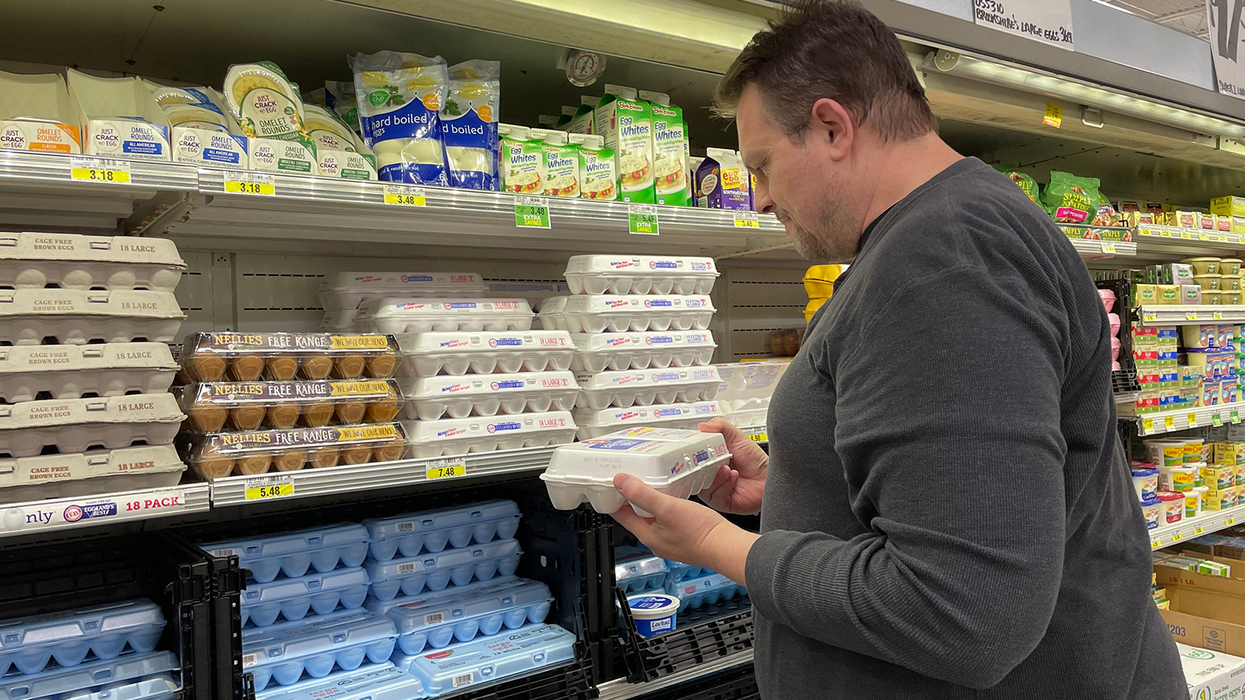
MONROE, LOUISIANA, USA - JANUARY 18, 2023: An American Caucasian man checks a carton of eggs in the grocery store before purchase. The price of egg has been very expensive due to the shortage supply.
President Donald Trump, as president-elect, insisted he “won an election” based on the price of groceries —and promised to “bring those prices way down.”
"Very simple word, groceries,” Trump told Meet the Press host Kristen Welker in December. “Like almost, you know, who uses the word? I started using the word – the groceries. When you buy apples, when you buy bacon, when you buy eggs, they would double and triple the price over a short period of time, and I won an election based on that.”
“We’re going to bring those prices way down,” Trump insisted.
Per the Guardian, “Egg prices have soared to record highs this year, with the cost of a dozen large eggs hitting almost $5 in January – more than two and a half times the average price three years ago, before the avian flu outbreak.”
But to Kirk, “the high price of eggs is in no way President Trump’s fault.” Instead, the conservative pundit lays the blame squarely at the feet of former President Joe Biden.
Kirk, in his op-ed promises, the current president’s policies “will put downward pressure on prices” — because, he writes, “the building blocks of America’s next great low-inflation, high-wage growth boom have already been laid.”
“And soon enough, so too will the eggs,” Kirk muses.
But despite Kirk’s insistence, the U.S. Department of Agriculture (USDA) — headed by Trump appointee Brooke Rollins — in February predicted egg prices could climb more than 40 percent this year as bird flu forces farmers to cull “more than 166 million birds” — including “30 million egg layers,” the Associated Press reports.
“It’s going to take a while to get through, I think in the next month or two, but hopefully by summer,” Rollins said in February.
But as the AP reports, while Rollins' USDA vows to identify “the most effective measures farmers can take” against bird flu, Brian Earnest, lead economist for animal protein at CoBank, is skeptical that things will look much different from Biden to Trump.
“I don’t see a whole lot here that is a big change here from the current plan of action,” Earnest said in February.
'Also compromised': Retired 4-star general warns Trump’s NATO 'rupture' harms more than just Europe
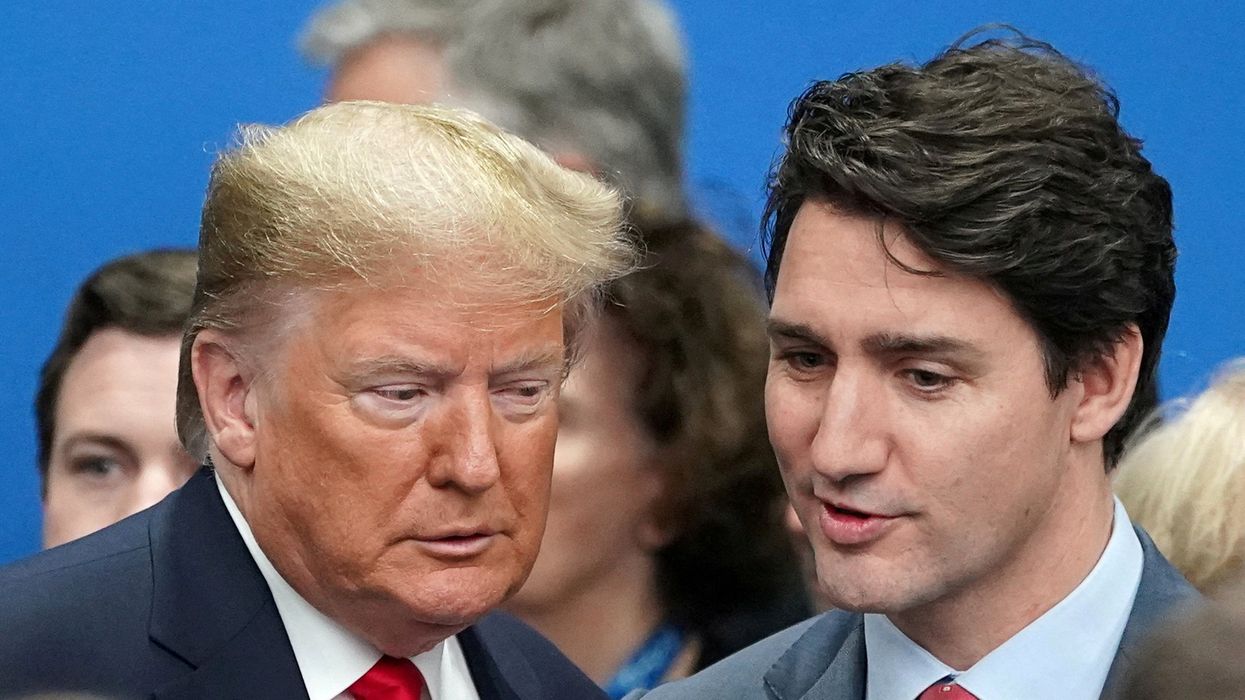
Donald Trump talks with Canada's Prime Minister Justin Trudeau during a North Atlantic Treaty Organization Plenary Session at the NATO summit in Watford, Britain, December 4, 2019. REUTERS/Kevin Lamarque/File Photo
Retired 4-star general and former Supreme Allied Commander Europe (SACEUR) Wesley Clark on Sunday warned President Donald Trump’s posture toward the North Atlantic Treaty Organization (NATO) threatens security not just in Europe — but in the United States, too.
Trump is reportedly “considering a major change to the U.S.’ participation” in NATO, and has “discussed with aides the possibility of calibrating America’s NATO engagement in a way that favors members of the alliance that spend a set percentage of their gross domestic product on defense,” NBC News reported Thursday.
Asked whether NATO can survive without assistance from the U.S., Clark on Sunday said it can “survive … but not as an effective deterrent to Russian adventurism and escalation in Europe.”
“Can the United States maintain its own security without NATO?” Clark asked. “And the answer to that is: that’s also compromised.”
Clark noted “the way President Trump has roughed them up” has “been a real shock to Europe,” and stressed that while the president’s demand for increased spending from member nations is reasonable, the timeline he’s pushing for is not.
“[To] instantaneously say that tomorrow you're not going to operate with a certain country like Germany because it can't get its budget up to what you believe it should be, that's just another way of disguising a rupture with European allies.”
Watch the video below or at this link.
Inside the countless words banned by the Trump administration
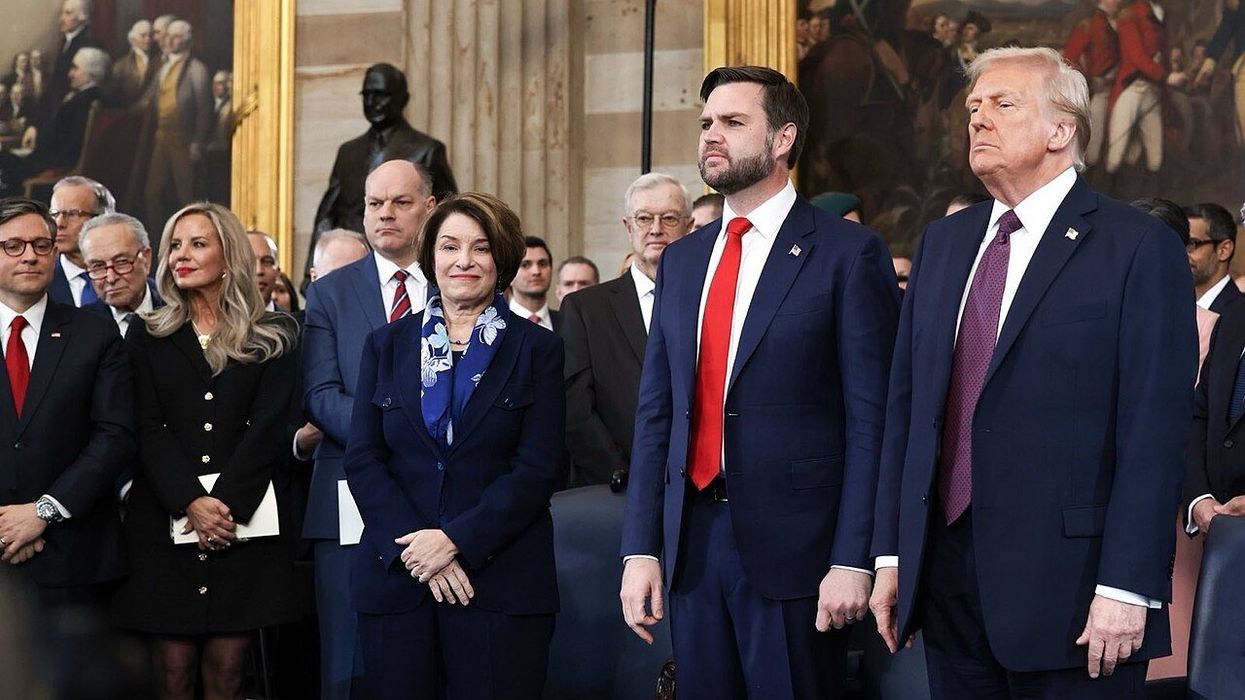
President Donald Trump and Vice President JD Vance with Sen. Amy Klobuchar, House Speaker Mike Johnson, Senate Minority Leader Chuck Schumer and others on January 20, 2025 (Wikimedia Commons)
Many MAGA Republicans vehemently criticize liberals and progressives for language policing, often mocking "woke" terms like "Latinx" and "pregnant people." And some Americans who vote Democratic are critical of "woke" language as well: "Real Time" host Bill Maher and veteran Democratic strategist James Carville argue that it's ridiculous for Democrats to say "Latinx" when the vast majority of Latinos don't use that word.
But language policing exists in the MAGA movement as well.
In an article published on March 7, New York Times journalists Karen Yourish, Annie Daniel, Saurabh Datar, Isaac White and Lazaro Gamio list some of the many words and terms that the Trump Administration is urging government workers to limit or avoid in their communications.
The list includes a lot of terms that are often mocked on the right as stereotypically "woke," including "Latinx," "pregnant people," "non-binary" and "pregnant persons." But many of the terms listed aren't necessarily thought of as "woke" — for example, "Black," "stereotype," "prostitute," "mental health," "activists," "sexuality," "inequality," "disparity," "trauma" and "discriminatory."
Also on the list: "hate speech," "gender-affirming care" and "intersectional."
"All presidential administrations change the language used in official communications to reflect their own policies," the Times reporters explain. "It is within their prerogative, as are amendments to or the removal of web pages, which The Times has found has already happened thousands of times in this administration."
The journalists add, "Still, the words and phrases listed here represent a marked — and remarkable — shift in the corpus of language being used both in the federal government's corridors of power and among its rank and file. They are an unmistakable reflection of this administration's priorities."